On-line Gas Chromatography of Mo, W and U (Oxy)chlorides*
By M. Gärtner1, Μ. Boettger4, Β. Eichler2, Η. W. Gäggeler12, Μ. Grantz4, S. Hübener4, D. T. Jost2, D. Piguet2, R. Dressler3, A. Türler2 and Α. B. Yakushev31 Labor für Radio- und Umweltchemie, Universität Bern, 3000 Bern, Switzerland 2 Labor für Radio- und Umweltchemie, Paul-Scherrer-Institut, 5232 Villigen, Switzerland 3 Flerov Laboratory for Nuclear Reactions, Dubna, 141980 Russia
4 Institut für Radiochemie, Forschungszentrum Rossendorf, D-01314 Dresden, Germany
(Received May 20, 1997; accepted in revised form September 8, 1997)
On-line gas chromatography / Group 6 Elements / Uranium / Chlorides / Oxychlorides
Summary
Group 6 elements are known to form volatile chlorides and oxychlorides. These compounds are therefore suited for separa-tions with the On-Line Gaschemistry Apparatus OLGA, a device which is able to isolate volatile species at a maximum tempera-ture of 500°C. OLGA has previously been used to study the group 4 and 5 halides. In preparation of experiments with element 106 (Sg = seaborgium), a member of group 6, first, a literature survey on the thermochemical properties of chlorides and oxychlorides of Mo and W as well as of the pseudo-group 6 element U was made. Second, OLGA experiments were per-formed with short-lived isotopes of Mo, W and U, using Cl2,
saturated with SOCl2 for chlorination, and different partial
pres-sures of 02. Under such conditions, these elements formed
spe-cies, which were volatile in quartz chromatography columns at temperatures < 250°C.
1. Introduction
Until recently, the heaviest element whose chemical properties have been studied, was element 105 (Db = dubnium** [1, 2], a group 5 element. Db showed partly surprising properties: in aqueous phase investi-gations, it resembled much more Nb and/or Pa and not Ta [3]. In gas phase studies, Db was found to behave differently from Nb and Ta [4], It remains open, if these observations are a result of so-called relativistic effects, which are predicted to influence the chemical properties of heaviest elements [5],
In 1994 the discovery of 265Sg and 266Sg [6]
pro-vided a major opportunity to extend chemical studies to element 106 (Sg = Seaborgium). From the meas-ured α-decay energies rather long half-lives of 2—30 s for 265Sg and 1 0 - 3 0 s for 266Sg were predicted. All
previously known Sg isotopes had half-lives < 1 s. Seaborgium is a member of group 6 of the Periodic Table. Hence, Mo and W are its lighter homologues. Thermodynamic predictions indicate that Sg should * Presented at the 4th International Conference on Nuclear and
Radiochemistry, St. Malo, France, September 1996. ** In this work, the element names accepted recently by IUPAC
are used.
form stable, highly volatile chloride or oxychloride compounds as do the other group 6 elements [7, 8]. A first attempt to study the volatility of seaborgium oxychloride, using the thermochromatography tech-nique, has been performed recently with the short-lived isotope 263Sg (TV2 = 0.9 s) [9, 10, 11]. However,
since the detection of 263Sg based on
spontaneous-fis-sion track counting in the chromatography column after the experiment — a decay mode which is not specific to a given nuclide — the result of this study failed to unambiguously prove that the species isolated is indeed from an isotope of Sg.
In this work, an evaluation of thermochemical data of the chlorides and oxychlorides of W, Mo and U is made. This basis is then used to propose a suitable gas chemical separation scheme for isolation of these elements with the On-Line Gas chemistry Apparatus OLGA [12]. Finally, experiments to separate short-lived isotopes of Mo, W and U using an oxygen con-taining chlorinating agent are described.
2. Stability and volatility of group 6 chlorides and oxychlorides
There exist a large number of chloride and oxychloride compounds of group 6 elements. However, application of thermochemical properties — which are valid for macroamounts — to single atoms or molecules is not a trivial matter. For example, the position of a chemical equilibrium must be translated to a probability that a single atom or molecule reaches the same chemical state as in the macroscopic system. This is easiest to achieve if the Κ value of the equilibrium is largely different form 1. In addition, one also has to keep in mind, that the formation of homobinuclear species or even polymers is highly unlikely.
2.1 S t a b i l i t y of chlorides and o x y c h l o r i d e s The binding energies within a compound are a meas-ure of the stability of a molecule in a given oxidation state. The binding energy of a chlorine atom in pure gaseous chlorides is characterized by the dissociation enthalpy (ΔH°d,x) in the reaction:
•
MCI3 - > m c i2 + CI • m c i4 - > m c i3 + CI m c i4 - > m c i2 + 2CI | 300 1c < Cr <s>— Mo W ..O X5" &---T xT'I
ν m c i6 - > m c i5 + Cl Δ MCL - > MCI, + Cl 300 400 500 600 700 800 900 Δ Η °Μ ( 9 )[ kJ/mol]Fig. 1. Molar standard enthalpies of dissociation Δ //3iIS(MClx)
with Μ = Cr, Mo, W, U and χ = 3, 4, 5, 6 as a function of the standard enthalpy of the gaseous metal ΑΗ^ω- The tendencies within the group 6 elements are symbolized with dotted, dashed-dotted or dashed regression lines, respectively. Two extrapolated values for WC13 and WC14 are given (see text). For the reaction
MC14 - > MC12 + 2 Cl zf//Ls(MClx) includes the value of two
Cl atoms.
MCI x(g> MClx_1(g) ι + CL (1)
The dependence of A HSiss(MClx) with Μ = Cr, Mo,
W, U and χ = 3, 4, 5, 6 on the standard enthalpy of the gaseous metal (ΑΗΊ,,^) [13, 14] is shown in Fig. 1. The highest known pure chloride of Cr is CrCl4(g) [15], MoC16 is unstable and exists probably only in the gas
phase in the presence of Cl2 [15], WC16 is stable
com-pared to the other hexachlorides of group 6. The bind-ing energy of the M—Cl bond changes strongly with oxidation state. Since there is no data available for gaseous WC13, zf//d,ss(WCl3) was estimated in two
different ways. First, the formation enthalpy (AH°OTm)
of WC13 was extrapolated from a correlation
be-tween AH°M(g) and zf//?omi(MCl3) (M = Cr, Mo).
Sec-ond, zf/CssCWCy was estimated by extrapolating zf#SiSs(MCl3) (M = Cr, Mo) as a function of AH°M(g).
The results of both procedures are shown in Fig. 1. The binding energy of the last Cl atom in gaseous MC13 decreases with increasing Z, which is a sign of
increasing promotion energies and disadvantageous binding geometry. In macroscopic systems, the pen-tachlorides are stabilized by the formation of dimers, which is not possible in carrier-free systems. However, the formation of heterobinuclear species with possible contaminants such as FeCl3 and A1C13 has to be
con-sidered. „ 2200 Ö Β i <3 m o2c i2 ( 9 ) · MO,CI. 2 2(8) v-"m 0
ι
Mo 1 οβΤ
Cr Τ MOCI, MOCI, Art°M(9) [kJ/mol]Fig. 2. Atomic formation enthalpies of the gaseous or solid spe-cies A H * from single atoms as a function of the standard en-thalpy of the gaseous metal AH'i,,E): AH* - values for solid
(AHfv) and gaseous (ΑΗξ,,) dioxydichlorides and oxytetrachlor-ides of group 6 elements and uranium. The standard sublimation
enthalpies A H °M are indicated by arrows.
In contrast to W, U exhibits fundamental differ-ences. While the binding energies of the last Cl atoms in UCU and UC15 are approaching the tendencies
ob-served in group 6, the binding energy of the 6th Cl atom in UC16 is considerably higher than that in MoC16
or WC16.
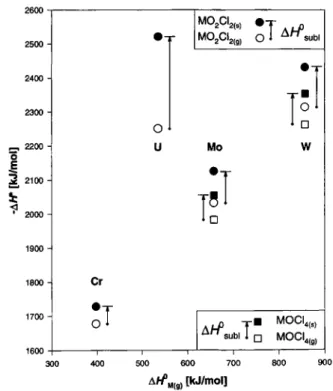
The complete break-up of a gaseous molecule into its constituting atoms in the gas phase corresponds to the atomic formation enthalpy of the gaseous (A //<%) or solid {AHf%)) species from single atoms AH*.
While AH°iss yields information about the relative
stability of oxidation states, AH* characterizes the stability of a molecule. In Fig. 2, AHfs) and AHfs)
values for dioxydichlorides and oxytetrachlorides of group 6 elements and of uranium are shown as a func-tion of AH^ig} [13, 16-19]. The difference between
AH%} and A Hfg) is the standard sublimation enthalpy
(AHlb l). AHM(g) increases with Ζ within the group 6
while U does not follow this trend. The stability of a molecular species increases with if the linear correlations AH* versus AHh^ for the gaseous and solid compounds have slopes > 1 . This is caused by the fact, that AH* is not an independent variable, but
i s t h e s u m o f AH°Mig„ AH°orm, AH% ci(g) and AH%g). As
shown in Fig. 2, this condition (slope >1), is fulfilled for the dioxydichlorides. In addition, the stability of the solid compounds increases faster than that of gas-eous compounds. Therefore, AH°ubi increases
Table 1. Thermochemical properties of Mo-, W- and U-compounds. The compilation includes measured and evaluated data from the literature: melting point (m.p.), boiling point (b.p.), decomposition, standard formation enthalpy (AH?orm) and standard entropy (S?sure)). Also listed are adsorption enthalpies AHaas for trace amounts on quartz surfaces deduced from the AH°ub,(298) values using
Eq. (17) as well as mean values for AH°ubi(298), AS°ub,(298) and AHads which are mentioned in the text
Com- state m.p. b.p. Decom- AH?om,(298) S°„,e)(298) AH°ubl(298) S°ubi(298) Ref. —AH„ds
pound position
[°C] [°C] ra [kJ/mol] [J/(mol*K)] [kJ/mol] [J/(mol*K)] [kJ/mol]
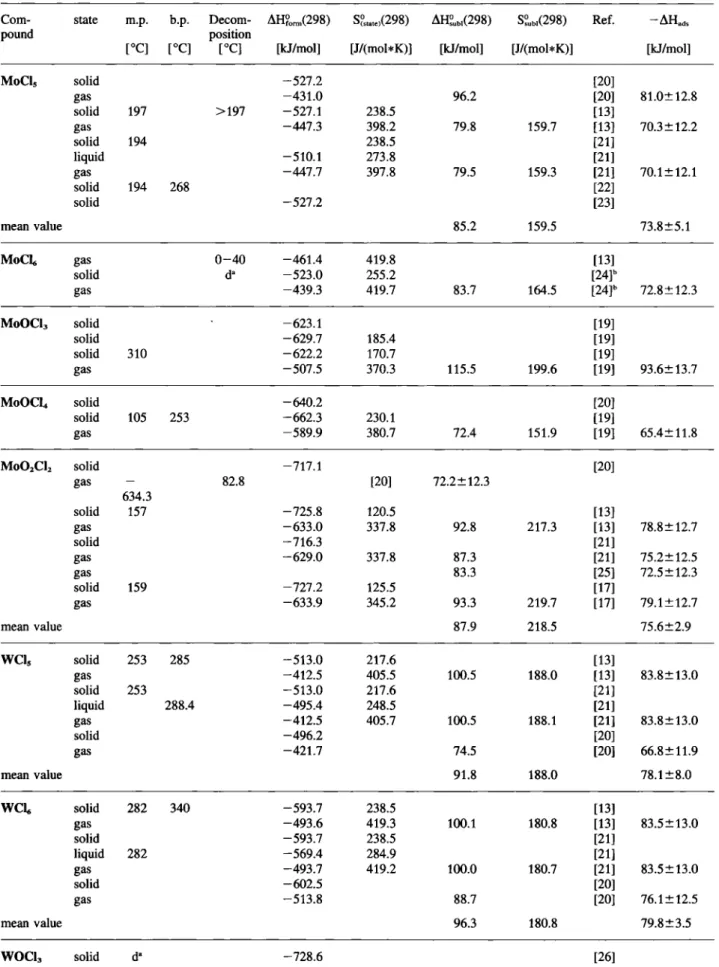
MoClj solid - 5 2 7 . 2 [20] gas - 4 3 1 . 0 96.2 [20] 81.0±12.8 solid 197 >197 - 5 2 7 . 1 238.5 [13] gas - 4 4 7 . 3 398.2 79.8 159.7 [13] 70.3±12.2 solid 194 238.5 [21] liquid - 5 1 0 . 1 273.8 [21] gas - 4 4 7 . 7 397.8 79.5 159.3 [21] 70.1±12.1 solid 194 268 [22] solid - 5 2 7 . 2 [23] mean value 85.2 159.5 73.8±5.1 MoCI* gas 0 - 4 0 - 4 6 1 . 4 419.8 [13] solid d" - 5 2 3 . 0 255.2 [24]b gas - 4 3 9 . 3 419.7 83.7 164.5 [24]b 72.8±12.3 MoOCl·, solid - 6 2 3 . 1 [19] solid - 6 2 9 . 7 185.4 [19] solid 310 - 6 2 2 . 2 170.7 [19] gas - 5 0 7 . 5 370.3 115.5 199.6 [19] 93.6±13.7 M0OCI4 solid - 6 4 0 . 2 [20] solid 105 253 - 6 6 2 . 3 230.1 [19] gas - 5 8 9 . 9 380.7 72.4 151.9 [19] 65.4±11.8 MO02C12 solid - 7 1 7 . 1 [20] gas - 82.8 [20] 72.2±12.3 634.3 solid 157 - 7 2 5 . 8 120.5 [13] gas - 6 3 3 . 0 337.8 92.8 217.3 [13] 78.8±12.7 solid - 7 1 6 . 3 [21] gas - 6 2 9 . 0 337.8 87.3 [21] 75.2±12.5 gas 83.3 [25] 72.5±12.3 solid 159 - 7 2 7 . 2 125.5 [17] gas - 6 3 3 . 9 345.2 93.3 219.7 [17] 79.1 ±12.7 mean value 87.9 218.5 75.6±2.9 WC15 solid 253 285 - 5 1 3 . 0 217.6 [13] gas - 4 1 2 . 5 405.5 100.5 188.0 [13] 83.8±13.0 solid 253 - 5 1 3 . 0 217.6 [21] liquid 288.4 - 4 9 5 . 4 248.5 [21] gas - 4 1 2 . 5 405.7 100.5 188.1 [21] 83.8±13.0 solid - 4 9 6 . 2 [20] gas - 4 2 1 . 7 74.5 [20] 66.8±11.9 mean value 91.8 188.0 78.1 ±8.0 WC1« solid 282 340 - 5 9 3 . 7 238.5 [13] gas - 4 9 3 . 6 419.3 100.1 180.8 [13] 83.5±13.0 solid - 5 9 3 . 7 238.5 [21] liquid 282 - 5 6 9 . 4 284.9 [21] gas - 4 9 3 . 7 419.2 100.0 180.7 [21] 83.5±13.0 solid - 6 0 2 . 5 [20] gas - 5 1 3 . 8 88.7 [20] 76.1±12.5 mean value 96.3 180.8 79.8±3.5 WOCl3 solid d" - 7 2 8 . 6 [26]
Table 1. Continuation
Com- state m.p. b.p. Decom- ΔΗ?οη„(298) SU>(298) AH?ubl(298) S°ubi(298) Ref. —AHads
pound position
[°C] ra ra [kJ/mol] [J/(mol*K)] [kJ/mol] [J/(mol*K)] [kJ/mol]
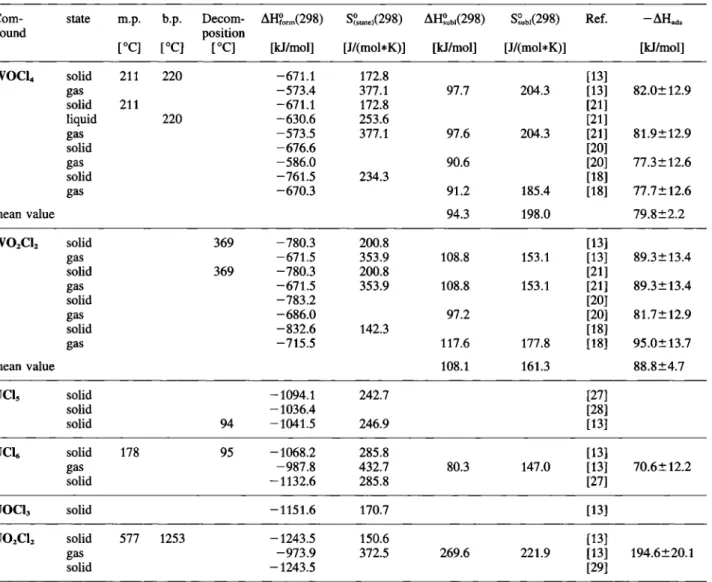
WOCl, solid 211 220 -671.1 172.8 [13] gas -573.4 377.1 97.7 204.3 [13] 82.0±12.9 solid 211 -671.1 172.8 [21] liquid 220 -630.6 253.6 [21] gas -573.5 377.1 97.6 204.3 [21] 81.9±12.9 solid -676.6 [20] gas -586.0 90.6 [20] 77.3+12.6 solid -761.5 234.3 [18] gas -670.3 91.2 185.4 [18] 77.7±12.6 mean value 94.3 198.0 79.8±2.2 w o2c i2 solid 369 -780.3 200.8 [13] gas -671.5 353.9 108.8 153.1 [13] 89.3 ±13.4 solid 369 -780.3 200.8 [21] gas -671.5 353.9 108.8 153.1 [21] 89.3 ±13.4 solid -783.2 [20] gas -686.0 97.2 [20] 81.7±12.9 solid -832.6 142.3 [18] gas -715.5 117.6 177.8 [18] 95.0±13.7 mean value 108.1 161.3 88.8±4.7 UC15 solid -1094.1 242.7 [27] solid -1036.4 [28] solid 94 -1041.5 246.9 [13] uci* solid 178 95 -1068.2 285.8 [13] gas -987.8 432.7 80.3 147.0 [13] 70.6±12.2 solid -1132.6 285.8 [27] UOC1, solid -1151.6 170.7 [13] u o2c i2 solid 577 1253 -1243.5 150.6 [13] gas -973.9 372.5 269.6 221.9 [13] 194.6±20.1 solid -1243.5 [29]
" d: decomposition; b calculated data.
MCl4(g) + 2 0( g ) <-> M02Cl2(g) + 2 Cl(g) (8)
MCl4(g) + 0( g ) MOCl4(g) (9)
AH*bst and AH*xi are always exothermic and, with the
exception of reaction (5), increasing with Z. In group 6 the reason for the different behaviour of reaction (5) is the higher stability of MOCl4. The increasing values
for A H*bit with Ζ for the substitution of the
hexachlor-ides with O-atoms (reactions 3 and 4) is an indicator for the systematic increase of the binding energy of oxygen within group 6 and thus the reason for an in-creasing stability of the dioxydichlorides.
As follows from the discussion of AH°diss, there are
also differences in the reactions of uranium chlorides with oxygen, compared to group 6 elements. The high stability of UC16 hinders the formation of U02C12 which then only forms at high oxygen partial pres-sures.
From the analyses of thermochemical data, it fol-lows, that for gaschromatographic experiments com-pounds of the oxidation state +6, namely Mo02C12, W02C12 and UCl6, are particularly well suited due to
their high stability. Since the synthesis of the pure
Cr02Cl2 < MoOCLj 2
< Mo02C12 < WOCj4 < W02C12 < (U02C12) However, this is not the sequence which is observed for the volatility of macroscopic amounts (see section 2.3).
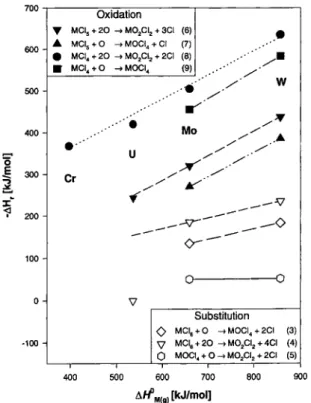
In order to compare the different oxychlorides with respect to their production and stability, the enthalpies of the substitution (AH*ubst) and oxidation (AH*,)
re-actions of the chlorides and oxychlorides with oxygen were analysed. In Fig. 3 AH*bst and AH*xi, denoted as
ΔΗ„ are shown as a function of ΔΗ°Μ(ΐ) [13, 18, 17,
14, 19]. The following reactions were considered. Substitution reactions: MCle(g) + 0( g ) M0Cl4(g) + 2 Cl(g) (3) MCl6(g) + 2 0( g ) M02Cl2(g) + 4 Cl(g) (4) MOCU(g) + 0( g ) <-> M02Cl2(g) + 2 Cl(g) (5) Oxidation reactions: MCl5(g) + 2 0<6) ^ M02Cl2(g) + 3 Cl(g) (6) MCl5 ( g )+ 0( g ) <-» MOCl4(g) + C L (7)
700 6 0 0 500 400 -Ö 300 -2 x" < ι 2 0 0 100 0 1 0 0 -400 600 600 700 800 900 AH°M(9)[kJ/mol]
Fig. 3. Enthalpies of substitution (Δ Η*bsl) and oxidation reac-tions (AH**i) of the chlorides and oxychlorides with atomic oxy-gen as a function of the standard enthalpy of the gaseous metal
ΔΗ°Μ!ΐ). From left to right: Μ = Cr, U, Mo and W. Values for
substitution reactions have open symbols whereas those for oxi-dation reactions have filled symbols. The vertical axis - Δ ΗΓ resembles AH*oba or ΔΗ*ώ, depending on the reaction. The
tend-encies within the group 6 elements are symbolized with lines to guide the eye.
chlorides of group 6 elements requires the elimination of even traces of moisture and oxygen, an experi-mental condition which is difficult to realize, it ap-pears again appropriate to concentrate on the group 6 oxychlorides.
2.2 C h o i c e of a p p r o p r i a t e gas c h e m i c a l c o n d i t i o n s
As reactive components for the synthesis of chlorides and oxychlorides in gas adsorption chromatographic experiments Cl2, SOCl2 and varying concentrations of
02 have been used. When heating SOCl2 over 76 °C
the pyrolysis reaction sets in [30]. We regard as a first step of the pyrolysis reaction:
4 SOCl2(g) S2Cl2(g) + 2 S02(g) + 3 Cl2(g) (10)
followed by the reversible reaction:
S2Cl2(g) + 2 02(g) <-> 2 S02(g) + Cl2(g). (11)
The partial pressure of 02 is then given by
/ p - S 02. p C l2 = β
V pS2Cl2 · Κ V κ
with Κ being the equilibrium constant of Eq. (11). Some values of log Κ are 100.1, 59.2 and 23.8 at
tem-peratures of 298, 500 and 1200 K, respectively. The factor 12 results from the partial pressures of S02, Cl2
and S2C12 from Eq. (10) inserted into Eq. (11)
as-suming stoichiometric conditions. It is assumed, that only trace amounts of 02 are present. The oxygen
par-tial pressure calculated in such a manner can be re-garded as a lower limit, reached with pyrolysis of SOCl2. Not included in this consideration are the
reac-tion kinetics of the different processes, which are poor-ly known.
If 02 is added the getter capacity of the system will
be reduced, and, with high amounts of oxygen, S03 is
formed and the getter capacity of the system will be exhausted. It is known, however, that the equilibrium of the reaction
S02 + 1/2 02 S03 (12)
is reached only very slowly. In consequence, the ad-dition of 02 will result most likely in a higher partial
pressure of oxygen (p02) than estimated from
equilib-rium conditions. In order to determine the most likely chemical compound synthesized in our experiments with carrier free nuclides, the equilibrium p 02 of the
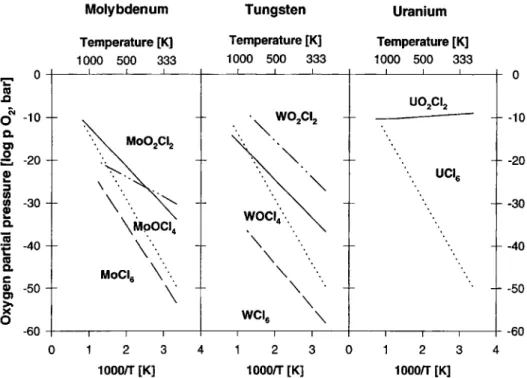
following gas phase reaction were calculated and are shown in Fig. 4.
MCl6(g) + 1/2 02<g) MOCl4(g) + Cl2(g) (13)
MCl6(g) + 02(g) <-> M02Cl2(g) + 2 Cl2(g) (14)
MOCl4(g) + 1/2 02(g) M02Cl2(g) + Cl2(g) (15)
The equilibrium constants of the reactions were taken from Refs. [13, 17, 18, 19, 14], For the calculation of p 02 it was assumed, that pCl2 is the sum of Cl2
orig-inating from pyrolysis and of added Cl2. In addition,
equal partial pressures of the compounds on the left and right hand side of the equilibrium reaction were assumed (e.g. pMOClVpMCls = 1).
As shown in Fig. 4, at low p 02 the formation of
the pure chlorides or the oxytetrachlorides is likely, whereas at higher p02, the dioxydichloride is the most
probable compound. Even the p02 from the pyrolysis
reaction of S O C l2 (dotted lines) would be sufficient to
form M O O C 14 or W O C l4. Already at relatively low p 02
the probability to form M o 02C l2 or W 02C 12 is very
high.
In case of U, p 02 from the pyrolysis reaction leads
to formation of UC16.
2.3 Volatility of c h l o r i d e s and o x y c h l o r i d e s of g r o u p 6 e l e m e n t s
A compilation of the thermodynamic data for (oxy)-chlorides of Mo, W and U available from the literature is shown in Table 1, original data as well as compiled values are included. For macroscopic amounts, the vapour pressure of a compound is a measure of its volatility. In Fig. 5, the vapour pressure curves of the gaseous state over the respective solids or liquids for Mo-, W-, and U-chlorides and oxychlorides are Oxidation • MCIS + 2 0 -» M02CI2 + 3CI (6) • MCIS + 0 -> MOCI4 + CI (7) • MCI4 + 2 0 M02CI2 + 2CI (8) • MCI4 + 0 -»MOCI, (9) • Mo Cr W / t f 0 - " o-- • V - o -o Substitution
Ο MCI6 + 0 —* MOCI4 + 2CI (3) V MCI,+ 2 0 M02CI2 + 4CI (4) ο M0CI„ + 0->M02CIj+2CI (5)
Molybdenum Tungsten Uranium Temperature [Κ] 1000 500 333 Temperature [Κ] 1000 500 333 Temperature [Κ] 1000 500 333 1000/T [Κ] 1000Π"[Κ] 1 2 3 1000/Τ [Κ]
Fig. 4. Oxygen partial pressures as a function of temperature for equilibrium conditions (see text). The dotted lines represent the equilibrium oxygen partial pressures from pyrolysis of thionyl chloride. The solid lines are the equilibrium oxygen pressures of the conversion from a pure chloride to the respective dioxydichloride. The dashed lines represent the equilibrium oxygen pressures of the conversion from a pure chloride to the respective oxytetrachloride. Finally, the dashed-dotted lines represent the equilibrium
oxygen pressures of the conversion from a oxytetrachloride to the respective dioxydichloride.
0 50 1 00 150 200 250 300 350 400
Temperature/[°C]
Fig. 5. Vapour pressure curves of the gaseous state over the respective solids or liquids for Mo-, W- and U-chlorides and
oxychlorides from Ref. [13, 18].
shown. In the system Mo—O—CI four species are ex-pected to exist in the gas phase (50 °C < Τ < 450 °C):
MOC15, M0OCI3, M0OCI4 and MO02C12. Surprisingly,
MO02C12 has a higher vapour pressure at a given
tem-perature compared to M0OCI4, which decomposes slowly to M0OCI3. This is caused by the structure of the respective solids (see Δ in Table 1). In the sys-tem W - O - C l the compounds WC15, WC16, W02C12,
and WOCI4 should exist in gas phase. The existence of WOCI3 in the gas phase is questionable, it decom-poses to WOCl2(s) and W0Cl4 ( g ) [26]. At temperatures
above 600°C WC16 decomposes to WC15, WC14 and
Cl2 [15]. In contrast to Mo02Cl2, which is stable in
gas phase, W02C12 undergoes a complex
decomposi-tion above 290°C to W03, WOCL, and WC16 [15].
There are no indications that W02C12 as a single
mole-cule is not stable in gas phase. Also, WOCI4 is known to decompose to W02C12 and WC16 above 210°C [15].
In the system U—O—CI only the pure chlorides (UC16,
UCI5, UCI4) are volatile, with UC16 being the most
vol-atile species. The volatilization of U02C12 occurs not
without simultaneous decomposition [32]. In air the decomposition starts at 460 °C with loss of Cl2, the
final product being U308.
In comparison with the sequence of Δ H°uhl (Eq. 2)
the sequence in volatility for macroscopic amounts is reversed for Mo02Cl2 and MOOC14:
vapour pressure (e.g. at Γ = 175 °C):
MO02C12 > WOCL, > M0OCI4 > W02C12 (16)
However, in a carrier-free experiment no solid phases of the compounds under investigation are present. The process of sublimation has to be replaced by a desorp-tion of a single molecule from the adsorbed state on a surface (usually quartz) to the gas phase. It has been demonstrated, that there exists an excellent correlation between the sublimation enthalpy of macroscopic compounds and the enthalpy of adsorption on quartz surfaces for single molecules [31], For chlorides, the following correlation was found:
-AHa d s = (0.655 ± 0.042) AHsubl
+ (18.0 ± 8.8) [kJ/mol] (17) In Table 1, deduced AHads values are listed, assuming
Eq. (17) is valid also for oxychlorides, which has been established experimentally for NbOCl3 [2], We
there-fore conclude that in isothermal gas adsorption chro-matography on quartz surfaces the retention times for the compounds have the order given by (2) and not by (16).
3. Experimental
3 . 1 P r o d u c t i o n of t h e r a d i o n u c l i d e s
104Mo (Τυ2 = 1.0 min) was produced from a 235U fis-sion target at the U-1200 cyclotron of the For-schungszentrum Rossendorf. 166W (TV2 — 18.8 s)
and 167W (Tm = 19.9 s) [33] were formed in the
152Gd(20Ne,xn)'66 ' 69W reaction at a beam energy of 153 MeV and a beam intensity of 1 0 0 - 1 5 0 pnA at the PSI PHILIPS cyclotron. The target, containing 0.5 mg/cm2 of 152Gd (enriched: 26%), was prepared by electrodeposition on a 15 μηι Be foil. 229U (Ti a = 58 min) was produced by bombarding a stack of 15 232Th targets with 95 MeV α-particles (250 pnA) also at the PSI PHILIPS cyclotron. These targets were 100 μg/cm2 232Th evaporated on 20 μηι Al backings.
At the same time, manifold by-products such as 165Hf (Γ1/2 = 76 s) from axn-reactions could be used to test the quality of the separation technique.
3 . 2 E x p e r i m e n t a l s e t - u p
The experimental set-up used in this study consisted of five components: first the target chamber, where the nuclear reaction products were collected, second a gas-jet system for the transport of reaction products, third
the OLGA system, where chemical reactions and chro-matographic separations were accomplished, fourth a so-called recluster unit and finally a detector arrange-ment, where the detection of a- and y-spectra was per-formed [2, 12].
In the target chamber, which was located at an ac-celerator or at a neutron beam line, the reaction prod-ucts were thermalized in helium and attached to small carbon aerosol particles. Then the particles were con-tinuously transported through a capillary to the OLGA device. There, in a first section of the chromatographic column (reaction oven) the carbon aerosol particles were stopped on a quartz wool plug. At this position, kept at 9 0 0 - 1 0 0 0 ° C , the volatile species were formed by adding different chlorinating gases (e.g. Cl2 + 02 and/or SOCl2(g)). In order to avoid impurities all con-nections and fittings in contact with the reactive gas were non-metallic. In addition, the chlorinating gas was filtered before entering the reaction oven. Also, prior to the experiment, the quartz columns were pre-treated at 900°C in a stream of chlorine gas. This cleaning procedure was necessary to achieve reproduc-ible results. The gas conditions of all experiments are summarized in Table 2. After the desired species were synthesized in the reaction oven, the chromatographic process took place in the second, isothermal part of the quartz chromatography column. Behind the
chro-matographic column, the species were reattached to new aerosol particles (KCl or CsCl) in a water-cooled recluster chamber. This permitted a further transport of the separated products to a a- or y-counting tape system. The aerosol particles containing the products were deposited on a computer tape. This spot of ac-tivity was moved stepwise in front of PIPS detectors for α-counting or a HPGe diode for y-spectroscopy. The stepping time was adjusted to the half-life of the nuclide to be measured.
Prior to every chemical investigation the gas-jet was directly connected to the tape counting system to get information about the production rates of produced nuclides. Then, the gas-jet was fed into the OLGA sys-tem and the reactive gas mixture was added. At every parameter setting (e.g. isothermal temperature of the column, reaction oven temperature, gas flow rate) the product activity on the tape was measured. From the measured count rates, as a function of the isothermal temperature, integral chromatograms were obtained. These curves allowed to determine the retention times of the species in the column using the half-lives of the nuclides as a clock. With a Monte Carlo model [2, 34, 35] adsorption enthalpies AHads of the compounds on the surface of the quartz chromatography colum were deduced.
4. Results and discussion
4 . 1 M o l y b d e n u m
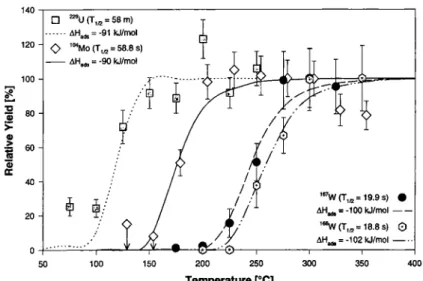
The measured relative yields (maximum yields arbi-trarily set = 100%) obtained for 104Mo are shown in Fig. 6. The maximum absolute chemical yield in the chosen 02/ S 0 C l2 system was only about 20%. This low yield was attributed to the formation of S 03 drop-lets in the recluster chamber, which significantly inter-fered with the reclustering process. The declining yields at temperatures above 300 °C were associated with diffusional losses in the recluster chamber. A fit of the data with the Monte Carlo model yields AHads = —90±3 kJ/mol. Due to the high p 02 (Table 2) the most probable species is MO02C12 (Fig. 4). This assignment is further supported by comparing the experimentally determined AHads = - 9 0 ± 3 kJ/mol with the average AHads values from Table 1. The experimentally determined value is closer to AHads(Mo02Cl2) than to AHads(MoOCl4).
4 . 2 T u n g s t e n
Fig. 6 shows the relative yields measured in two separ-ate experiments with different gas compositions (Table 2) using the isotopes 166W and 167W. The main difference was the amount of 02 in the chlorinating gas. In order to avoid the formation of S 03 droplets in the recluster unit, the amount of 02 was reduced in one of the experiments. Still, 02 impurities on the order of 100 ppm were always present in the OLGA system
Table 2. Initial gas mixtures of the different experiments shown in Fig. 6. Values are for normal temperature and pressure [STP]
Experiment Flow rate logAg)
[ml/min] [bar] Molybdenum Jet-gas (,04Mo) He 1200.0 -0.1100 Reactive gases o2 325.7 -0.6764 saturated with SOCl2 40.5 -1.5820
Gas mixture (total) 1566.2
längsten Jet-gas (,67W) He 1000.0 -0.0295 Reactive gases Cl2 72.3 -1.1703 saturated with SOCl2 11.7 -1.9613 o2 0.1 -3.9960
Gas mixture (total) 1084.1
längsten Jet-gas ( I 6 6W ) He 1000.0 -0.1100 Reactive gases o2 271.4 -0.6764 saturated with SOCl2 33.7 -1.5820
Gas mixture (total) 1305.1
Uranium Jet-gas (229U) He 1112.0 -0.2377 Reactive gases He 614.2 -0.4955 saturated with SOCl2 76.3 -1.4010 Cl2 144.6 -1.1236 02 0.2 -4.0120
Gas mixture (total) 1947.4
Ό ω > φ > S CD GC • U (T1/2 = 58 m) AHadfi = -91 kJ/mol ο 104Mo (Ti/2 = 58.8 s) ΔΗ„. = -90 kJ/mol W(T,K= 19.9 s) · Δ ΗΛ =-100 kJ/mol ™»»(Tlo= 18.8S) 0 ΔΗ„. =-102 kJ/mol 200 250 Temperature [°C] 400
Fig. 6. Measured relative yields of volatile species produced under chlorinating conditions in the OLGA III system with 229U, 104Mo, 166W and ,67W as a function of the isothermal temperature: Errors represent statistical uncertainties only (1 σ). Symbols with vertical
100 8 0 -2 60 β > φ (C 40 -20
i
i
Γ *
*
ii
\
A 168W 178.5 keV V 165Hf 179.9 keV\
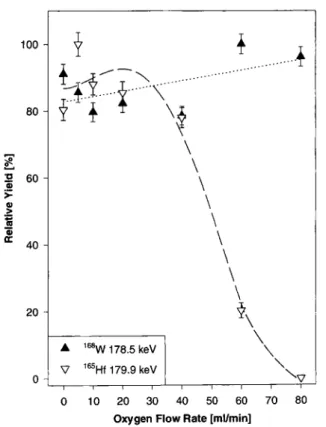
\ \ \ r 0 10 20 30 40 50 60 70 80 Oxygen Flow Rate [ml/min]Fig. 7. Relative yields of 168W and ,65Hf as a function of 02 flow rate at constant reactive gas C12/S0C12 flow rate and isothermal
temperature of the column (350 °C).
due to the diffusion of air through the polyethylene capillaries (Table 2). Under these conditions, typical maximum absolute chemical yields for several short-lived isotopes of W were between 40 and 60%. A fit with the Monte Carlo model yields A H ^ = - 1 0 2 ± 3 kJ/mol and - 1 0 0 ± 3 kJ/mol, respectively. Under our chemical conditions, the formation of W0C14 or
W02C12 is likely (Table 2 and Fig. 4). Since the large
variation of p 02 did not change the volatility of
the species, formation of W02C12 is likely. Again,
the deduced AHads agree better with the average
AHads(W02Cl2) than with AHads(W0Cl4) from Table 1.
In a thermochromatographic study [11] with iso-topes of W, using air plus SOCl2 as reactive gas, two
deposition peaks were found, which were assigned to W02C12 at a deposition temperature of 250 °C and to
WOCl4 at 160 °C. It could be shown, that with the
short-lived isotope 164W (T1/2 = 6 s) only the high
tem-perature peak was observed, in agreement with our in-terpretation of a predominant formation of W02C12.
Finally, possibilities to separate group 4 from group 6 elements were investigated. First, 02 was
added at various concentrations, keeping the iso-thermal temperature of OLGA fixed at 350°C. As shown in Fig. 7, the yields of W remained almost inde-pendent of the added 02 gas flow rates, whereas those
of Hf strongly decreased for 02 flow rates > 6 0 ml/
min.
Second, with C12/S0C12 as reactive gas and a fixed
isothermal temperature of 350 °C the temperature of the reaction oven was varied (Fig. 8). While the yield
100 -80 2 60 -β ? o> > IS 3 40 Η 20 A 16eW 178.5 keV τ V 165Hf 179.9 keV l 4 1-1-fr""
i
1 1 1 1 1 1 1 X / /J3
ν ^ 800 850 900 950 Temperature [°C] 1000Fig. 8. Relative yields of 168W and 165Hf as a function of reaction oven temperature with the reactive gas Cl2/S0Cl2/02 and a
con-stant isothermal temperature of the column (350 °C).
of W increased only slightly with temperature that of Hf was essentially zero for temperatures up to 875 °C. One reason for the behaviour of Hf could be a high retention time due to surface reactions with the quartz wool plug inside the reaction oven.
4 . 3 U r a n i u m
Using the reactive gas C12/S0C12 (see Table 2), with
the isotope 229U (TU2 = 58 min) the relative yield curve shown in Fig. 6 was measured. The fit through the data with the Monte Carlo model results in an ad-sorption enthalpy of - 9 1 ± 3 kJ/mol. The reason for the different chromatographic curves depicted in Fig. 6 for Mo and U with identical AHads values is due to the
largely different half-lives of the nuclides 104Mo and 229U. Since U02C12 is expected to have a very high
AHads values of - 1 9 4 . 6 ± 2 0 . 1 kJ/mol our result
strongly supports an assignment of the volatile species to UC16, even though the discrepancy between
experi-mental and predicted A H ^ value ( - 7 0 . 6 ± 1 2 . 2 kJ/ mol, Table 1) is somewhat large.
5. Summary and conclusion
From an evaluation of the thermochemical properties of the chlorides and oxychlorides of the group 6 ele-ments Mo and W, as well as of the pseudo-group 6 member U, it was concluded, that for ultra trace amounts of Mo and W the dioxydichlorides are the most stable compounds in contrast to U, where it is the hexachloride.
The O L G A technique was used to study the formation of volatile compounds of short-lived iso-topes of the group 6 elements M o , W and U. Short-lived nuclides of these elements were produced at nu-clear facilities and transported to the O L G A d e v i c e with a He/carbon particle gas-jet system. For the formation of volatile compounds the reactive gas mix-ture Cl2/SOCl2, containing different partial pressures
of 02, was used. For all 3 elements volatile species
were observed at isothermal temperatures < 2 5 0 °C. From the experimental gas composition, the deduced reaction equilibria for the oxidation o f the pure chlo-rides as a function of temperature, and the deduced AHads values, w e conclude that most likely the m o l e
-cules MO02C12, W 02C 12 and UC16 were formed.
These findings provide a basis for the application of the O L G A technique to the study of eka-W, the transactinide element 106 (Seaborgium, Sg).
Acknowledgements
S o m e of us (A.T., B.E., D J . , R.D., D.P.) acknowledge the warm hospitality during a beam time at FZ-Ros-sendorf. Excellent beams delivered by the PHILIPS cyclotron are highly appreciated. This work was sup-ported by the S w i s s National Science Foundation.
References
1. Schädel, Μ.: Radiochim. Acta 70/71, 2 0 7 - 2 2 3 (1996). 2. Türler, Α.: Radiochim. Acta 72, 7 - 1 7 (1996).
3. Kratz, J. V., Zimmermann, Η. P., Scherer, U. W„ Schädel, M„ Brüchle, W„ Gregorich, Κ. E„ Gannett, C. M„ Hall, H. L., Henderson, R. Α., Lee, D. M., Leyba, D. J., Nurmia, M. J., Hoffman, D. C., Gäggeler, Η. W„ Jost, D. T„ Baltens-perger, U., Ya-NaiQi, Türler, Α., Lienert, C.: Radiochim. Acta 48, 121-133 (1989).
4. Gäggeler, Η. W., Jost, D. Τ., Kovacs, J., Scherer, U. W., Weber, Α., Vermeulen, D., Türler, Α., Gregorich, Κ. Ε., Henderson, R. Α., Czerwinski, Κ. R., Kadkhodayan, Β., Lee, D. M„ Nurmia, M„ Hoffman, D. C„ Kratz, J. V., Go-ber, Μ. K., Zimmermann, H. R, Schädel, M., Brüchle, W., Schimpf, E., Zvara, I.: Radiochim. Acta 57, 9 3 - 1 0 0 (1992). 5. Keller Jr., Ο. L.: Radiochim. Acta 37, 169-180 (1984). 6. Lazarev, Υ. Α., Lobanov, Υ. V., Oganessian, Υ. T., Utyonkov,
V. K„ Abdullin, F. S„ Buklanov, G. V., Gikal, Β. N„ Iliev, S., Mezentsev, Α. N., Polyakov, Α. N., Sedykh, I. M., Shiro-kovsky, I. V., Subbotin, V. G., Sukhov, Α. M., Tsyganov, Y. S„ Zhuchko, V. E., Lougheed, R. W„ Moody, Κ. J., Wild, J. F., Hulet, Ε. Κ., McQuaid, J. Η.: Phys. Rev. Lett. 73, 624-627 (1994).
7. Pershina, V., Fricke, B.: J. Phys. Chem. 98, 6 4 6 8 - 6473 (1994).
8. Pershina, V., Fricke, B.: J. Phys. Chem. 100, 8748-8751 (1996).
9. Timokhin, S. N., Yakushev, A. B., Perelygin, V. P., Zvara, I.: Chemical Identification of Element 106 by the
Thermo-chromatographic Method, Proceeding of the International
School-Seminar on Heavy Ion Physics, Dubna 1, 204 (1993).
10. Timokhin, S. N., Yakushev, A. B„ Honggui, XU, Perelygin, V. P., Zvara, I.: J. Radioanal. Nucl. Chem. Lett. 212, 3 1 -34 (1996).
11. Yakushev, A. B., Timokhin, S. N., Vedeneev, Μ. V., Hong-gui, XU, Zvara, I.: J. Radioanal. Nucl. Chem. 205, 6 3 - 6 7 (1996).
12. Gäggeler, Η. W., Jost, D. Τ., Baltensperger, U., Weber, Α., Kovacs, Α., Vermeulen, D., Türler, Α.: Nucl. Instrum. Methods A309, 201 (1991).
13. Knacke, Ο., Kubaschewski, Ο., Hesselmann, Κ. (Eds.):
Thermochemical Properties of Inorganic Substances II, 2nd
ed., Springer-Verlag, Berlin (1991).
14. Oppermann, H., Stöver, G.: Z. Anorg. Allg. Chemie 387, 218-229 (1972).
15. Furman, Α. Α.: Neorganiceskie Khloridy, Izd. Khimiya, Moskva 1980.
16. Samsonov, G. V.: Svoistva elementov, Jzd. Metallurgiya, Moskva 1976.
17. Oppermann, Η.: Z. Anorg. Allg. Chem. 379, 2 6 2 - 272 (1970).
18. Oppermann, Η.: Z. Anorg. Allg. Chem. 383, 1 - 1 3 (1971). 19. Oppermann, H., Stöver, G., Kunze, G.: Z. Anorg. Allg.
Chem. 387, 201-217 (1972).
20. Chase jr., Μ. W„ Davis, C. Α., Downey jr., J. R„ Frurip, D. J., McDonald, R. Α., Syverud, A. N.: J. Phys. Chem. Ref. Data 11 (Suppl. 2) (1982).
21. Wagman, D. D„ Evans, W. H., Parker, V. B., Schümm, R. H„ Halow, I., Bailry, S. M„ Churney, K. L., Nuttall, R. L.: J. Phys. Chem. Ref. Data 14 (Suppl. 1) (1985).
22. Schäfer, H„ v. Schnering, H.-G., Tillack, J., Kuhnen, F., Wöhrle, Η., Baumann, Η.: Ζ. Anorg. Allg. Chem. 353, 281-310 (1967).
23. Shchukarev, S. Α., Novikov, G. I., Vasilkova, I. V., Suvorov, Α. V., Sharupin, Ν. V., Andreeva, Β. N., Baev, A. K.: Zh. Neorg. Khim. 5, 1650-1654 (1960).
24. Novikov, G. I., Galitskii, Ν. V.: Zh. Neorg. Khim. 10, 5 7 6 -582 (1965).
25. Shchukarev, S. Α., Vasilkova, I. V., Sharupin, Β. N.: Vestnik Leningrad Uni. 16(22, Ser. Fiz. Khim. 4), 130 (1961). 26. Oppermann, H., Stöver, G., Kunze, G.: Z. Anorg. Allg.
Chem. 387, 317-328 (1972).
27. Rand, Μ. H., Kubaschewski, O.: The Thermochemical
Properties of Uranium Compounds, Oliver and Boyd,
Edin-burgh (1963).
28. Gross, P., Haymann, C., Wilson, G. L.: Monatsh. Chem. 102, 924-927 (1971).
29. Cordfunke, Ε. Η. P., Oweltjes, W., Prins, G.: J. Chem. Ther-modyn. 8, 2 4 1 - 2 5 0 (1976).
30. Gmelin Handbook of inorganic chemistry: Sulfur, Suppl. Vol. B1 (Thionyl Halides) 8th ed., Frankfurt/Main (1978). 31. Eichler, B., Domanov, V. P., Zvara, I.: Report JINR, Dubna,
P12-9454 (1976).
32. Cordfunke, Ε. Η. P., Prins, G., van Vlaanderen, P.: J. Inorg. Nucl. Chem. 39, 2189-2190 (1977).
33. Dressler, R., Fischer, S., Gäggeler, Η. W., Buchertseifert, H.: PSI-Report 97-04/1 + II (1997).
34. Zvara, I.: Radiochim. Acta 38, 9 5 - 1 0 1 (1985). 35. Zvara, I.: Isotopenpraxis 26, 251-258 (1990).