Identification of Factors Influencing Flight Performance of
Field-Collected and Laboratory-Reared, Overwintered, and
Nonoverwintered Cactus Moths Fed with Field-Collected Host Plants
MARK A. SARVARY,1STEPHEN D. HIGHT,2JAMES E. CARPENTER,3STEPHANIE BLOEM,4KENNETH A. BLOEM,5
ANDSILVIA DORN1,6
Environ. Entomol. 37(5): 1291Ð1299 (2008)
ABSTRACT Environmental conditions during egg and larval development may inßuence the dis-persal ability of insect pests, thus requiring seasonal adjustment of control strategies. We studied the longest single ßight, total distance ßown, and the number of ßights initiated by wild Cactoblastis
cactorum(Berg) (Lepidoptera: Pyralidae) to determine whether the ßight performance of overwin-tered cactus moths with a prolonged feeding phase during development differs from nonoverwinoverwin-tered cactus moths. Pupae of Þeld-collected and laboratory-reared moths were transported together from the United States to Switzerland, and ßight mills were used to characterize the ßight capacity of 24-to 48-h-old adults during their most active period of the diel cycle. The lack of seasonal variation in ßight performance of those moths that developed under controlled environment but were fed with Þeld-collected Opuntia cacti showed that seasonal changes in host plant quality did not affect ßight. This consistent ßight performance in the mass-reared laboratory population throughout the year is beneÞcial for sterile insect technique programs, which aim to limit the dispersal of this pest. For Þeld-collected C. cactorum, the larger overwintered females performed similarly to nonoverwintered females, indicating that longer feeding time at lower temperature increases body size but does not inßuence female ßight capacity. Young mated females had a similar ßight capacity to unmated ones, suggesting that gravid females may play an important role in invading new habitats. For males, overwintering increased the proportion of long-distance ßyers, suggesting that they are well-adapted to locate the more sparsely dispersed females in the spring.
KEY WORDS Cactoblastis cactorum, dispersal, ßight, overwintering, seasonality
Environmental conditions to which Lepidoptera eggs and larvae are exposed during development are known to affect ßight performance and Þtness for some species in the adult stage (Willers et al. 1987, Hughes et al. 2004). Wild populations are exposed to seasonal changes and may be able to modify their behavior, including dispersal, by responding to chang-ing biotic and abiotic cues. The primary abiotic indi-cators of seasonal time for the preimaginal phase of Lepidoptera are the changes in photoperiod (Han and Gatehouse 1991, Masaki and Kimura 2001) and
tem-perature (Beck 1980, Denlinger et al. 2001). Seasonal variation of adult morphology has been observed in 10 Lepidoptera species (Fric and Konvicka 2002, Van Dyck and Wiklund 2002, Fric et al. 2006), suggesting that moths developing as larvae during winter may differ in ßight performance from those that develop later in the season. For example, overwintering in-creased the size and the ßight distance of the dia-mondback moth, Plutella xylostella L. (Shirai 1991), whereas temperature and length of photoperiod dur-ing development strongly inßuenced the migratory potential of the oriental armyworm, Mythimna
sepa-rata (Walker) (Lepidoptera: Noctuidae) (Han and Gatehouse 1991). In addition to abiotic cues, biotic factors such as differences in food quality during larval development caused by host plant choice (Carriere 1992, Mafokoane et al. 2007) or seasonal ßuctuation of nutritional values (Scheermeyer et al. 1990) can affect Þtness in Lepidoptera. Availability and quality of food sources can be crucial for insect ßight performance (Willers et al. 1987, Wanner et al. 2006).
Cactoblastis cactorum(Berg) (Lepidoptera: Pyrali-dae), a native insect to northern Argentina, Uruguay, Paraguay, and southern Brazil (Carpenter et al. 2001, Mention of trade names or commercial products in this article is
solely for the purpose of providing speciÞc information and does not imply recommendation or endorsement by the U.S. Department of Agriculture.
1ETH Zurich, Institute of Plant Sciences/Applied Entomology, CH-8092 Zurich, Switzerland.
2USDAÐARSÐCMAVE, Center for Biological Control, Florida A&M University, Tallahassee, FL 32308.
3USDAÐARS Crop Protection and Management Research Unit, Tifton, GA 31793.
4USDAÐAPHISÐPPQÐCPHST Plant Epidemiology and Risk Anal-ysis Laboratory, Raleigh, NC 27606.
5USDAÐAPHISÐPPQ, Center for Plant Health and Science Tech-nology, Raleigh, NC 27606.
6Corresponding author, e-mail: [email protected].
Bloem et al. 2005), became an invasive pest in the United States in the 1990s (Pemberton 1995, Stiling and Moon 2001, Hight et al. 2002). Depending on climactic conditions, C. cactorum can complete two or three generations per year (Zimmermann et al. 2004). The rapid geographical expansion of the cactus moth is a threat to endemic prickly pear cacti (Opuntia spp.) (Rebman and Pinkava 2001, Stiling and Moon 2001, Hight et al. 2002). In Mexico, where Opuntia cacti are important as human food, livestock fodder, and as keystone species in many ecosystems, C. cactorum will have serious economic and ecological impacts if left untreated (Zimmermann et al. 2004). The majority of adult moths perform many short ßights in both the Þeld (Zimmermann et al. 2004) and in the laboratory, whereas only few laboratory-reared cactus moths per-form long single ßights (Sarvary et al. 2008).
Use of the sterile insect technique (SIT) to limit further geographical expansion of this moth has shown much promise (Bloem et al. 2007). SIT is a pest man-agement tactic that has great potential in the control of many economically important Lepidoptera such as the cabbage looper Trichoplusia ni (Hu¨bner) (North and Holt 1969), pink bollworm Pectinophora
gossyp-iella(Saunders) (Henneberry and Clayton 1981, Hen-neberry 1993), codling moth Cydia pomonella L. (Proverbs et al. 1982, Bloem et al. 1999), and corn earworm Helicoverpa zea (Boddie) (Mannion et al. 1995). Current SIT programs rely on rearing large numbers of target pest species, on sterilizing them with gamma radiation, and on releasing them into the target population (Carpenter et al. 2005, Klassen 2005). Success of the SIT can be inßuenced by whether or not both wild and released pest popula-tions have similar dispersal characteristics (Lance and McInnis 2005, Vreysen 2005, Bloem et al. 2006a, b). In the Þeld, the characterization and comparison of ßight behavior of wild Lepidoptera populations is difÞcult, because external stimuli such as pheromones can af-fect ßight behavior (Knight 2000). Computer-linked ßight mills (Hughes and Dorn 2002, Sarvary et al. 2008) have been successfully used in comparative studies to assess the ßight performance of different insect species with the exclusion of extrinsic stimuli, measuring only the intrinsic ßight capacity (Bradley and Altizer 2005, Shirai 2006, Wu et al. 2006). In ßight mills, individuals are tethered and allowed to ßy in a circle of known circumference while a linked com-puter records each rotation. This information is used to calculate parameters describing an individualÕs ßight performance (Schumacher et al. 1997, Wanner et al. 2006). Quantitative comparisons of ßight on ßight mills have been carried out with many econom-ically important Lepidoptera, such as the codling moth, C. pomonella (Schumacher et al. 1997), the oriental fruit moth, Cydia (Grapholita) molesta (Busck) (Hughes and Dorn 2002, Hughes et al. 2004), the pink bollworm, Pectinophora gossypiella (Wu et al. 2006), the monarch butterßy, Danaus plexippus L. (Bradley and Altizer 2005), the corn earworm, H. zea (Beerwinkle et al. 1995), the cotton bollworm,
Heli-coverpa armigeraHu¨bner (Cooter and Armes 1993),
the fall webworm, Hyphantria cunea (Drury) (Ya-manaka et al. 2001), as well as laboratory-reared cactus moth (Sarvary et al. 2008). Flight performance was investigated based on the total distance ßown (TDF), the longest single continuous ßight (LSF), and the number of ßights initiated (NOF). These parameters have been previously used to describe ßight perfor-mance of tethered Cotesia glomerata L. (Wanner et al. 2006), C. pomonella (Schumacher et al. 1997, Dorn et al. 1999), C. molesta (Hughes and Dorn 2002, Hughes et al. 2004), and laboratory-reared C. cactorum (Sar-vary et al. 2008).
Temperature regimens experienced by C. cactorum during its preimaginal phase were recently shown to inßuence adult Þtness and survivorship under labora-tory conditions (Legaspi and Legaspi 2007). In par-ticular, pupal weight and adult female longevity de-clined with increasing temperature. Along coastal northern Florida, where this insect is abundant, over-wintering eggs and larvae are exposed to average tem-peratures of 10 Ð15⬚C, whereas temperatures preva-lent during subsequent generations typically ßuctuate between 18 and 26⬚C (National Climatic Data Center, Tallahassee, FL). In laboratory life-table studies, de-velopment (from egg to pupae) lasted 130 d at 18⬚C, and this period was reduced to 90 d at 22⬚C and to 55 d at temperatures between 26 and 34⬚C (Legaspi and Legaspi 2007). These data suggest that differences in abiotic conditions under which overwintering and nonoverwintering immature stages develop in the Þeld could inßuence adult Þtness and perhaps ßight performance. As larvae continue to feed in winter, we cannot exclude that changing host plant quality may further inßuence adult ßight performance. Seasonal variation in Opuntia quality has been shown previ-ously (Koch and Kennedy 1980, Retamal et al. 1986, Inglese et al. 1999, Pimienta-Barrios et al. 2000, Orona-Castillo et al. 2004) and seems to be affected by pho-toperiod, availability of water (Sutton et al. 1981, Le-rdau et al. 1992), and ßuctuations in temperature (Littlejohn and Williams 1983).
The main objective of this study was to determine whether overwintered cactus moths, which likely ex-perienced a prolonged feeding phase during larval development, differ in ßight performance from those measured for nonoverwintered moths collected in the same Þeld area. Laboratory-reared cactus moths fed with Þeld-collected Opuntia ficus-indica L. Mill. (i.e., the host plant that was subject to seasonal change) were used as a control and tested simultaneously in these experiments. Adult body size was measured, the diel pattern of ßight activity was assessed, and ßight performance was characterized in relation to age, gen-der, and mating status using computer-linked ßight mills. Body size, mating status, age, and gender were factors used to explain the variability in ßight be-havior.
Materials and Methods
Test Insects. A laboratory colony of C. cactorum that
Geor-gia in 2002 has been maintained at the USDAÐARS rearing facility in Tifton, GA, for 12Ð13 generations. Eggsticks were incubated in growth chambers (26⬚C, 70% RH), and neonates were placed on excised cactus pads (26⬚C, ⬍20% RH) collected from an Opuntia plantation adjacent to the insect rearing facility. These
O. ficus-indicaplants were exposed to naturally chang-ing environmental conditions. For this experiment, 200 C. cactorum pupae of each gender were randomly selected once per week from the laboratory colony (spring: 30 MarchÐ5 May; summer: 9 JulyÐ3 August). Wild insects used in this experiment were collected at Okaloosa Island, FL. For the overwintering popula-tion, pads of O. ficus-indica containing late-instar lar-vae were harvested between 27 February and 21 March 2007. The nonoverwintered larval population was collected at the same location from 14 to 27 June 2007. Collected larvae were transferred to screened boxes (1.2 by 0.9 by 0.3 m) and provided with excised
O. ficus-indicapads and kept under ambient outdoor temperature at St. Marks National Wildlife Refuge near Tallahassee, FL, until all larvae pupated. Infested pads were periodically transferred to new boxes, but pupae remained behind to fully sclerotize before they were removed. Pupae hardened within 2Ð7 d. The silk cocoons of both laboratory and wild pupae were care-fully removed by hand, the pupae were sorted by gender, and each gender was placed in a separate plastic petri dish (14 cm diameter). Field-collected and laboratory-reared pupae were ßown to ETH, In-stitute of Plant Sciences/Applied Entomology, Zurich, Switzerland. Each shipment (nine total shipments) arrived within 2 d of departure. To ensure that ßight performance differences measured in the laboratory were not confounded by the effects of conditions experienced during transport, temperature and hu-midity were measured by an electronic data logger (HOBO, Onset Bourne, MA) included with each ship-ment. Within 12 h of their arrival in Switzerland, the pupae were placed on Þlter paper inside 30 by 30 by 30-cm emergence cages (BugDorm; Megaview Sci-ence Education, Taichung, Taiwan) in a controlled environment room (28⬚C, 70% RH, 12 L:12 D). Pupae and adults were maintained in separate cages by col-ony (Þeld-collected or laboratory-reared), shipment, and gender (male or female). Shipments 1Ð5 included laboratory-reared moths (laboratory 1) and overwin-tered Þeld-collected moths, whereas shipments 6 Ð9 contained laboratory-reared moths (laboratory 2) and nonoverwintered moths. This terminology will be used herewith to describe the moths of the two ship-ment groups.
Adult Body Size. Within 24 h of their eclosion 20 Ð25
male and female laboratory-reared and Þeld-collected
C. cactorumadults were randomly selected from each shipment. After recording their individual weights (AB204 scale [range: 0.1 mg to 220 g]; Mettler, Ku¨snacht, Switzerland), they were returned to their emergence cages and used in the ßight experiments.
Flight Mill Techniques. Emergence cages of both
genders were checked daily for adult eclosion. Moths were collected within 24 h of eclosion, and all newly
emerged moths were placed into one cage and allowed to mate at random for 24 Ð 48 h. Cross-breeding be-tween wild and laboratory colonies or bebe-tween dif-ferent shipments of the same colony was not allowed.
Tethering. Tethering took place at 4⬚C to
immobi-lize the moths. Moths were kept at this low temper-ature for ⬍45 min. Using 00 size insect pins, 20 by 5-mm paper strips were pinned to a polystyrene tray, and a pinhead-size drop of fast drying solvent-free glue (Migros, Zurich, Switzerland) was placed on the end of each paper strip. The dorsal side of the thorax and abdomen of each moth was placed on this glued surfaced of a paper strip without allowing tarsal or wing contact with the paper or the glue. The glue dried within 30 Ð 60 s at 4⬚C. Moths attached to pin-held strips were moved to the ßight mill room (Con-viron, PGV 36; Controlled Environments, Winnipeg, Manitoba, Canada) where 24 ßight mills were set up operating in tandem under 28⬚C and 70% RH.
Flight Mill Mechanics. Moth ßight was monitored
individually over a diel cycle. During scotophase (10 h) light was maintained at 0 lux. Simulated dawn was composed of a 2-h long linear increase of light inten-sity between 0 and 4,000 lux. Photophase was main-tained at 4000 lux for 10 h. Simulated dusk (2 h), similarly to dawn, was a linear change of light intensity from 4000 to 0 lux. The set-up and the mechanics of the ßight mills were identical to those described in Sarvary et al. (2008).
Data Analysis. In the ßight mills, artiÞcially elevated
counts can occur when the reßective surface of the ßight arm rests in the path of the transmitter/receiver. If recorded signals occurred more than twice within the same second, they were eliminated by a speciÞ-cally developed analytical program (M. Gernss, ETH). Flight consisted of a sequence of revolutions and breaks. A new ßight was started if the break between two consecutive revolutions was 2 s or higher. These settings were based on the observations that cactus moths on the ßight mill ßy a minimum of one revo-lution per 2 s and a maximum of two revorevo-lutions per second. All ßights had to last at least 2 s; therefore, a single revolution was considered a break, unless an-other revolution followed it within 2 s. To decrease the size of the data set, analysis was limited to the 14 h (dusk, scotophase, dawn) that included the periods with major ßight activity, i.e., deleting the 10-h period with full light conditions where minimal activity was previously measured (Sarvary et al. 2008).
Flight capacity was characterized using LSF, TDF, and NOF. The effect of age on the ßight performance of unmated and mated moths was measured on 24- to 48-h-old moths. Before statistical analysis, the data were log transformed for each model to meet the assumption of normality. The data were unbalanced (not the same number of moths from each category ßew each time) and thus were analyzed using re-stricted maximum likelihood models (Littell et al. 1996) with PROC MIXED procedure in SAS (SAS Institute 2000). Degrees of freedom were calculated using the method described by Kenward and Roger (1997). Differences between adult weights were
tested using analysis of variance (ANOVA) with the PROC GLM procedure in SAS (SAS Institute 2000). If signiÞcant main effects were detected by the models, pairwise comparisons were performed between treat-ments using least square means separated by the Tukey-Kramer procedure with the LSMEANS com-mand (Littell et al. 1996). Because means and their SEs calculated from the log-transformed data are not meaningful in data visualization, the actual means and their SEs calculated from untransformed data using the PROC MEANS statement (SAS Institute 2000) are presented (Tables 1 and 2). Frequency distribution of the LSF of overwintered (n⫽ 70) and nonoverwin-tered (n⫽ 48) male C. cactorum was analyzed after the ßight data were separated into Þve groups by the LSF (⬍5, 5Ð20, 20Ð100, 100Ð500, and ⬎500 m). Frequen-cies of LSF were compared using the2 test (SAS
Institute 2000).
Results
Adult Body Size. Overwintered Þeld-collected
moths were signiÞcantly larger than nonoverwintered moths (F⫽ 13.09; df ⫽ 1,303; P ⬍ 0.0001), irrespective of gender (F⫽ 182.12; df ⫽ 1,303; P ⫽ 0.13; Table 1). In contrast, laboratory-reared moths from the catego-ries tested in parallel with overwintered (laboratory 1) and nonoverwintered (laboratory 2) moths did not differ signiÞcantly in body size (F⫽ 0.13; df ⫽ 1,263;
P⫽ 0.72) in females or in males (F ⫽ 13.09; df ⫽ 1,263; P⫽ 0.58; Table 1). Field-collected insects tended to be
larger than laboratory-reared insects (except for non-overwintered males). Females were always larger than males from the same origin (Table 1).
Pooling Data: Influence of Mating Status on Flight Capacity in Categories of Moths. Data were analyzed
separately for overwintered and nonoverwintered males and females, as well as for the categories labo-ratory 1 and labolabo-ratory 2. Data from the two mating status groups were pooled for Þeld-collected nonover-wintered males because differences between mated and unmated moths were not signiÞcant (TDF: F⫽ 1.38; df⫽ 1,45; P ⫽ 0.24; LSF: F ⫽ 0.87; df ⫽ 1,45; P ⫽ 0.35; NOF: F⫽ 0.52; df ⫽ 1,36.1; P ⫽ 0.47). In non-overwintered, Þeld-collected, female moths the mat-ing status also did not signiÞcantly affect any of the ßight parameters tested (TDF: F⫽ 0.13; df ⫽ 1,105; P ⫽ 0.71; LSF: F⫽ 0.07; df ⫽ 1,105; P ⫽ 0.74; NOF: F ⫽ 0.38; df⫽ 1,105; P ⫽ 0.53).
In Þeld-collected overwintered males, the data did not differ by mating status (TDF: F⫽ 0.23; df ⫽ 1,63.6;
P⫽ 0.63; LSF: F ⫽ 0.08; df ⫽ 1,62.1; P ⫽ 0.78; NOF: F ⫽
0.11; df⫽ 1,67; P ⫽ 0.74). Similarly, the ßight perfor-mance of overwintered females was not different for mated and unmated individuals (TDF: F⫽ 0.37; df ⫽ 1,77.7; P⫽ 0.54; LSF: F ⫽ 0.02; df ⫽ 1,77.5; P ⫽ 0.89; NOF: F⫽ 1.59; df ⫽ 1,77.1 P ⫽ 0.21).
Table 1. Body size (meanⴞ SEM) in milligrams of overwintered and nonoverwintered newly emerged C. cactorum
Gender Origin Weight (mg)
a
Overwinteredb n Nonoverwinteredb n
Females Field-collected 130.6⫾ 3.8a 76 91.5⫾ 3.1b 81
Laboratory-reared 65.2⫾ 1.5c 70 66.5⫾ 2.1c 75
Males Field-collected 67.9⫾ 1.6c 76 43.6⫾ 1.4d 71
Laboratory-reared 39.5⫾ 0.9d 44 39.2⫾ 1.1d 75
a
Weight of adults was measured within 24 h from eclosion. Means and their SEs were obtained from the untransformed dataset.
b
Means followed by different letters are signiÞcantly different (Tukey-Kramer LS means, P⬍ 0.05).
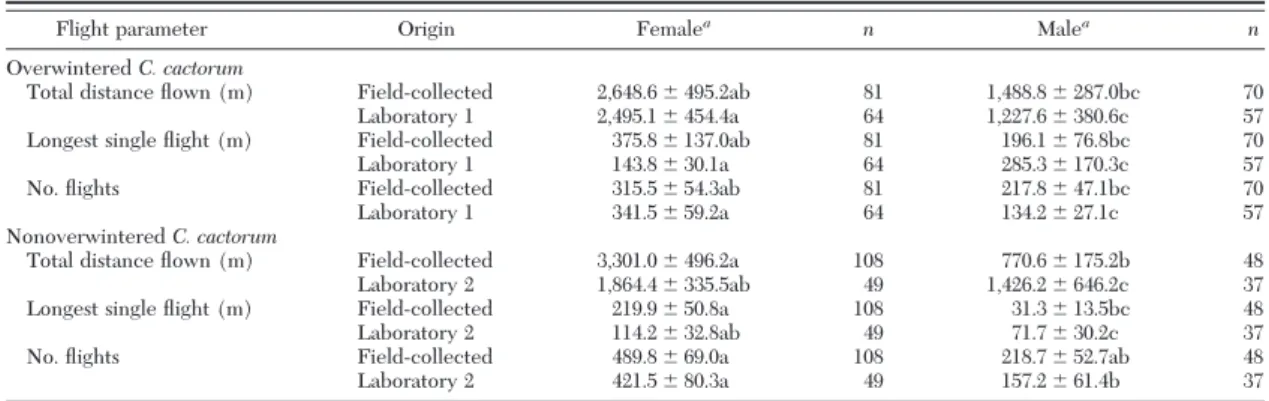
Table 2. Flight capacity parameters (meanⴞ SEM) of C. cactorum in respect to origin and gender of adult moths
Flight parameter Origin Femalea n Malea n
Overwintered C. cactorum
Total distance ßown (m) Field-collected 2,648.6⫾ 495.2ab 81 1,488.8⫾ 287.0bc 70
Laboratory 1 2,495.1⫾ 454.4a 64 1,227.6⫾ 380.6c 57
Longest single ßight (m) Field-collected 375.8⫾ 137.0ab 81 196.1⫾ 76.8bc 70
Laboratory 1 143.8⫾ 30.1a 64 285.3⫾ 170.3c 57
No. ßights Field-collected 315.5⫾ 54.3ab 81 217.8⫾ 47.1bc 70
Laboratory 1 341.5⫾ 59.2a 64 134.2⫾ 27.1c 57
Nonoverwintered C. cactorum
Total distance ßown (m) Field-collected 3,301.0⫾ 496.2a 108 770.6⫾ 175.2b 48
Laboratory 2 1,864.4⫾ 335.5ab 49 1,426.2⫾ 646.2c 37
Longest single ßight (m) Field-collected 219.9⫾ 50.8a 108 31.3⫾ 13.5bc 48
Laboratory 2 114.2⫾ 32.8ab 49 71.7⫾ 30.2c 37
No. ßights Field-collected 489.8⫾ 69.0a 108 218.7⫾ 52.7ab 48
Laboratory 2 421.5⫾ 80.3a 49 157.2⫾ 61.4b 37
Field-collected overwintered and nonoverwintered moths are compared with laboratory 1 and laboratory 2 moths, respectively, fed with host plants from the Þeld (grown at the same time as the food for overwintered and nonoverwintered moths).
Effects were measured using mixed models (ANOVA,␣ ⫽ 0.05) on the log-transformed data.
a
Means and their SEs were obtained from the untransformed dataset. Means followed by different letters within each ßight parameter are signiÞcantly different (Tukey-Kramer LS means, P⬍ 0.05).
In laboratory-reared males (laboratory 1), which were tested in parallel to overwintered moths, the effect of mating status could not be analyzed sepa-rately, because sample sizes of mated males were too low (n⫽ 5). In laboratory 1 females, mating status did not inßuence TDF and NOF (TDF: F⫽ 0.17; df ⫽ 1,60.1; P⫽ 0.67; NOF: F ⫽ 0.22; df ⫽ 1,60.6; P ⫽ 0.63). The LSF in mated females was higher than in unmated females (F ⫽ 4.15; df ⫽ 1,58.8; P ⫽ 0.046), but this difference was minimal, with the signiÞcance being very close to the P⫽ 0.05 cut-off point.
Data collected from laboratory-reared males (lab-oratory 2) that were tested in parallel to nonoverwin-tered moths were also pooled by mating status (TDF:
F⫽ 0.01; df ⫽ 1,32.7; P ⫽ 0.97; LSF: F ⫽ 0.09; df ⫽ 1,32.6; P⫽ 0.76; NOF: F ⫽ 0.11; df ⫽ 1,34; P ⫽ 0.74), because
differences were not signiÞcant. In the laboratory 2 category, there were no differences in TDF (F⫽ 3.71; df⫽ 1,45.5; P ⫽ 0.06) and LSF between mated and unmated females (F⫽ 0.17; df ⫽ 1,4.77; P ⫽ 0.66); however, mating status had a signiÞcant effect on the NOF by these females (F⫽ 5.06; df ⫽ 1,45.8; P ⫽ 0.029). Because two of the three parameters were not signiÞcantly different, the data were again pooled in further comparisons.
Comparison of Field-collected Versus Laboratory-reared Moths. Field-collected overwintered moths did
not differ signiÞcantly from laboratory 1 moths in any of the three ßight parameters (TDF: F⫽ 0.02; df ⫽ 1,259; P⫽ 0.88; LSF: F ⫽ 0.03; df ⫽ 1,264; P ⫽ 0.86; NOF: F⫽ 0.01; df ⫽ 1,224; P ⫽ 0.94). This was true for both females and males (Table 2). In addition, Þeld-collected nonoverwintered moths performed simi-larly to the laboratory 2 moths in the three ßight parameters (TDF: F⫽ 3.55; df ⫽ 1,72.8; P ⫽ 0.063; LSF:
F⫽ 1.5; df ⫽ 1,75.5; P ⫽ 0.22; NOF: F ⫽ 2.16; df ⫽ 1,20.3; P⫽ 0.15) in both genders, except for a difference (P ⫽
0.0311) between nonoverwintered Þeld-collected and laboratory-reared males in TDF (Table 2).
Female moths originating from the nonoverwin-tered Þeld collected and the laboratory 1 and labora-tory 2 categories outperformed male moths within their origin under the conditions of the experiment (Tables 2), with one exception in the NOF in non-overwintered Þeld-collected moths (t⫽ 1.75: df ⫽
1,235; P ⫽ 0.081). Overwintered Þeld-collected fe-males numerically outperformed overwintered fe-males in all ßight parameters, but these differences were not signiÞcant (Table 2).
Comparison of Laboratory 1 Versus Laboratory 2 Moths. The two categories of laboratory-reared moths
tested in parallel with the Þeld-collected moths did not differ in any of the three ßight parameters in females (TDF: F⫽ 0.97; df ⫽ 1,111; P ⫽ 0.32; LSF: F ⫽ 1.53; df ⫽ 1,111; P⫽ 0.21; NOF: F ⫽ 0.03; df ⫽ 1,111; P ⫽ 0.87) or in males (TDF: F⫽ 0.65; df ⫽ 1,92; P ⫽ 0.42; LSF:
F⫽ 0.92; df ⫽ 1,92; P ⫽ 0.33; NOF: F ⫽ 0.36; df ⫽ 1,92; P⫽ 0.54; Table 3). Because no differences were
de-tected between laboratory 1 and laboratory 2 moths that consumed Þeld-grown cactus but were reared under constant indoor conditions, the seasonal change of host food quality likely does not affect C. cactorum ßight. Thus, the direct comparison of wild moths col-lected in the Þeld at different times of the year would demonstrate the effect of the change in environmental conditions between seasons and not host plant quality. The results from the comparison of the two laboratory-reared moth categories allow for direct comparison of overwintered and nonoverwintered Þeld-collected moths without any confounding effect of seasonal food quality change.
Comparison of Overwintered Versus Nonoverwin-tered Moths. In females, there was no signiÞcant
dif-ference between Þeld-collected overwintered and nonoverwintered moths in any ßight parameter (TDF:
F⫽ 0.94; df ⫽ 1,187, P ⫽ 0.36; LSF: F ⫽ 0.01; df ⫽ 1,187, P⫽ 0.93; NOF: F ⫽ 2.08; df ⫽ 1,187; P ⫽ 0.15). Male
overwintered and nonoverwintered moths had similar values for TDF (F⫽ 0.56; df ⫽ 1,116; P ⫽ 0.45) and NOF (F⫽ 0.14; df ⫽ 1,116; P ⫽ 0.71); however, the LSF was signiÞcantly higher in overwintered than in non-overwintered males (F⫽ 6.43; df ⫽ 1,116; P ⫽ 0.012; Table 3). This difference was further analyzed by comparing the frequency distribution of the LSF ßown by Þeld-collected males (Fig. 1). Up to 70.8% of the nonoverwintered males ßew 20 m and less during the analyzed time period, whereas in overwintered males, this frequency was only 50.0%, a signiÞcant difference (2⫽ 5.08; df ⫽ 1; P ⫽ 0.024). Moreover,
only 2.0% of the nonoverwintered moths ßew 100 m or
Table 3. Flight capacity parameters (meanⴞ SEM) of field-collected overwintered compared with nonoverwintered C. cactorum moths and of laboratory 1 compared with laboratory 2 moths fed with host plants from the field (grown at the same time as the food for overwintered and non-overwintered moths, respectively)
Origin Gender Total distance ßown (m) Longest single ßight (m) No. ßights
Overwintereda Nonoverwintereda Overwintereda Nonoverwintereda Overwintereda Nonoverwintereda
Field collected Female 2648.6⫾ 495.6a 3,301.0⫾ 496.7a 375.8⫾ 137.1a 219.9⫾ 51.1a 315.5⫾ 54.0a 489.8⫾ 69.6a Male 1488.8⫾ 287.2a 770.6⫾ 175.4a 196.1⫾ 76.1a 31.3⫾ 14.0b 217.8⫾ 47.5a 218.7⫾ 53.5a Laboratory 1a Laboratory 2a Laboratory 1a Laboratory 2a Laboratory 1a Laboratory 2a
Laboratory reared
Female 2495.1⫾ 454.3a 1,864.4⫾ 336.0a 143.8⫾ 29.3a 114.2⫾ 33.4a 341.5⫾ 59.1a 421.5⫾ 80.1a Male 1227.6⫾ 380.1a 1,426.2⫾ 646.2a 285.3⫾ 170.2a 71.7⫾ 30.0a 134.2⫾ 27.8a 157.2⫾ 61.6a Effects were measured using mixed models (ANOVA,␣ ⫽ 0.05) on the log-transformed data. Comparisons were made within genders, within each origin.
a
Means and their SEs were obtained from the untransformed dataset. Means followed by different letters within rows of each ßight parameter column are signiÞcantly different (Tukey-Kramer LS means, P⬍ 0.05). For n, see Table 2.
longer in their LSF, whereas a signiÞcantly larger percentage of the overwintered moths (21.4%) ßew this distance (2⫽ 9.09; df ⫽ 1; P ⫽ 0.002; Fig. 1).
Discussion
Environmental changes experienced during devel-opment affect ßight performance in some lepidop-teran species (Shirai 1991, Fric and Konvicka 2002, Hughes et al. 2004); however, such potential effects were yet unknown for C. cactorum, an invasive pyralid herbivore in the southeastern United States. Varia-tions in environmental condiVaria-tions are known to inßu-ence Þtness parameters of C. cactorum (Petty 1948, Legaspi and Legaspi 2007). We tested the hypothesis that body size and ßight performance of overwintered and nonoverwintered C. cactorum moths differ, and our Þndings should help to Þne tune the application of SIT strategies that have been developed to manage the geographical expansion of this pest (Bloem et al. 2007).
Adult Body Size. All laboratory-reared moths used
in this study developed at controlled, constant con-ditions at 26⬚C and were fed excised cladodes from naturally grown Opuntia. The body size of the labo-ratory 1 moths (tested in parallel to overwintered moths) and laboratory 2 moths (tested in parallel to nonoverwintered moths) did not differ signiÞcantly within gender. Seasonal changes may occur in Opuntia cactus nutritional value (Retamal et al. 1986, Orona-Castillo et al. 2004), but this variation did not seem to affect the body size of moths that developed under constant laboratory temperature and humidity.
Field-collected overwintered C. cactorum had ex-perienced average monthly temperatures of 10 Ð15⬚C in their egg and larval stage, whereas nonoverwin-tered ones experienced an average temperature of 18 Ð26⬚C. Field-collected C. cactorum that had devel-oped at lower temperatures (overwintered) reached larger body size in their adult stage than those that had developed at higher temperatures (nonoverwin-tered). These results parallel and verify recent
labo-ratory Þndings showing that adults of both genders were smaller after development at 26⬚C than at 22⬚C (Legaspi and Legaspi 2007). Consistently, all data from the current and previous investigations (Legaspi and Legaspi 2007) strongly support the postulate that
C. cactorumadult body size is dependent on temper-ature during development. Because seasonal changes in the Opuntia quality did not seem to affect body weight, it is likely that the longer developmental pe-riod at lower temperatures, hence a prolonged feeding larval stage, led to the larger body size of overwintered moths. Higher pupal weight may result in increased fecundity in Lepidoptera (Carriere 1992), whereas the length of development is positively correlated to the exposure time of vulnerable larval stages to natural enemies (Feeny 1976, Benrey and Denno 1997). Field-collected moths always reached larger body size than laboratory-reared moths, regardless of the sea-son. This difference is most likely caused by feeding conditions encountered by larvae. Although Þeld-col-lected C. cactorum had been exposed to unlimited food on a cactus plant, laboratory-reared larvae were sup-plied excised cladodes in a growth chamber. Sexual dimorphism for size was shown in both Þeld-collected and laboratory-reared moths, because females always reached larger body size than males. Recently pub-lished data showing this difference in laboratory-reared moths are in support of these Þndings (Legaspi and Legaspi 2007, Sarvary et al. 2008).
Flight Capacity. Analysis of the data collected by
the electronic data logger showed no evidence that either overwintered or nonoverwintered C. cactorum pupae were exposed to extreme temperature or hu-midity during transportation from the United States to Switzerland. On the ßight mill, the larger Þeld-col-lected moths did not outperform the smaller labora-tory-reared moths. This Þnding provides important information for SIT programs where mass-reared C.
cactorummoths are being released to mate with wild moths (Carpenter et al. 2005, Klassen 2005). The ef-Þciency of SIT programs relies on comparable ßight abilities between the released and targeted popula-tions (Lance and McInnis 2005, Vreysen 2005, Bloem et al. 2006a). This study indicated a consistent body size and level of ßight performance in the laboratory-reared population of moths, irrespective of the time of the year they were reared. Therefore, provided that the dose of irradiation used to treat the moths does not negatively affect their ßight capacity (Bloem et al. 2006b), laboratory-reared C. cactorum of the present quality are expected to successfully compete in dis-persal with wild populations during the implementa-tion of SIT programs (Carpenter et al. 2001, Bloem et al. 2007). Variability in the food quality (Retamal et al. 1986, Orona-Castillo et al. 2004) or other uncontrolled seasonal changes did not affect ßight performance of the laboratory-reared moths; thus, the comparison of overwintered and nonoverwintered Þeld-collected moths directly reßects the effect of the abiotic con-ditions that eggs and larvae were exposed.
Adult C. cactorum are not capable of feeding; hence, the larger body size that overwintered females
Fig. 1. Frequency distribution of the longest single ßight of overwintered (n⫽ 70) and nonoverwintered (n ⫽ 48) Þeld-collected male C. cactorum.
reached after their longer feeding period might allow increased mobility, similarly to what has been postu-lated based on body mass quantiÞcation in several Lepidoptera species (Shirai 1991, Fric and Konvicka 2002, Fric et al. 2006). However, adult females ßew similar distances regardless of the season, suggesting that overwintering does not increase dispersal ability for this species.
In contrast, adult overwintered males were able to perform longer single ßights than smaller, nonover-wintered males, indicating an effect of the altered abiotic conditions the overwintered males had expe-rienced as eggs and larvae in the Þeld. In the oriental fruit moth a decrease in photoperiod and temperature during larval development was correlated with an in-crease of the longest single ßight (Hughes et al. 2004). In this study, differences between the overwintered and nonoverwintered C. cactorum male ßight were caused by a seasonal shift in the proportion of long ßyers and short ßyers. Although almost a quarter of the overwintered Þeld-collected males performed longest single ßights of 100 m or greater, in nonoverwintered males only 2% of the population ßew this distance without interruption. In earlier studies, both the cod-ling moth (Schumacher et al. 1997) and laboratory-reared cactus moth populations (Sarvary et al. 2008) showed strong heterogeneity for ßight, consisting of both short and long ßying individuals. The ability to continuously ßy long distances can be advantageous to overwintered males. Adult cactus moths eclose 1Ð2 h after sunset with males, emergingⱖ1 d before females (Petty 1948) to maximize their mating success by being present when the females emerge. Petty (1948) observed that longevity of overwintered moths was substantially higher and the period of their emergence was 10 Ð17 d longer than in nonoverwintered moths. Consequently, provided that brood sizes of overwin-tered and nonoverwinoverwin-tered C. cactorum in the Þeld are similar, the density of female moths on any given day is lower for the winter brood than for the summer brood. Hence, overwintered males are required to perform longer ßights to successfully locate the more sparsely distributed overwintered females. For non-overwintered males, long single ßights are less neces-sary because of higher female densities.
Cactoblastis cactorummales had similar or weaker ßight capacity than females, providing further evi-dence of the previous postulate that male captures in pheromone traps likely indicate the simultaneous presence of females (Sarvary et al. 2008). Mating did not limit the ßight performance of young female and male cactus moths, similarly to several other Lepidop-tera, such as the oriental tea tortrix, Homona
magn-anima Diakonoff (Shirai 1998), smaller tea tortrix,
Adoxophyes honmai (Yasuda) (Shirai and Kosugi 2000), and the peach fruit moth, Carposina sasakii Matsumura (Ishiguri and Shirai 2004). Hence, wild C.
cactorum, including in particular young mated fe-males, hold the potential to colonize new habitats, similar to what has been suggested for oriental fruit moth based on comparative laboratory studies (Hughes and Dorn 2002).
Overall Conclusions. The main objective of this
study was to test whether seasonal changes in envi-ronmental conditions during egg and larval develop-ment affect ßight performance of C. cactorum adults. Seasonal changes in Opuntia quality did not adversely affect ßight, and this consistency in the ßight perfor-mance of the mass-reared laboratory population throughout the year is beneÞcial for SIT programs. In Þeld-collected C. cactorum, the larger overwintered females performed similar ßights to smaller, nonover-wintered females, suggesting that environmental con-ditions during development and body size do not af-fect female ßight performance. In Þeld-collected males, change detected in the longest single ßight from overwintered to nonoverwintered specimen was caused by the seasonal shift in the proportions of long-ßyers and short-ßyers. Although overwintered males consisted of a larger proportion of long-ßyers, nonoverwintered males were short ßyers. This may be advantageous for overwintered C. cactorum males to locate females, which are more patchily dispersed in the winter brood than during other times of the year. Mating did not decrease female ßight performance, suggesting that mated females may play an important role in invading new habitats.
Acknowledgments
We thank C. Fornallaz and M. Gernss (Institute of Plant Sciences/Applied Entomology, ETH) for technical assis-tance, S. Drawdy (ARS-Tifton) for work with the cactus moth colony, C. Albanese, S. Baez, M. Getman, and J. Mass (ARS-Tallahassee) for assistance in obtaining the wild cactus moths, and the anonymous reviewers for useful comments. This research was supported by grants from USDAÐARS, NAPPO, and the Joint IAEA/FAO Programme in Vienna, Austria, to S.D.
References Cited
Beck, S. D. 1980. Insect photoperiodism, 2nd edn. Academic
Press, New York.
Beerwinkle, K. R., J. D. Lopez, Jr., D. Cheng, P. D. Lingren, and R. W. Meola. 1995. Flight potential of feral Helicov-erpa zea(Lepidoptera: Noctuidae) males measured with a 32-channel, computer-monitored, ßight-mill system. Environ. Entomol. 24: 1122Ð1130.
Benrey, B., and R. F. Denno. 1997. The
slow-growth-high-mortality hypothesis: a test using the cabbage butterßy. Ecology 78: 987Ð999.
Bloem, K. A., S. Bloem, J. E. Carpenter, S. D. Hight, J. Floyd, and H. G. Zimmermann. 2007. Development of a
bina-tional plan to stop the spread of the cactus moth,
Cacto-blastis cactorum,in North America, pp. 337Ð344. In M.J.B. Vreysen, A. S. Robinson, and J. Hendrichs (eds.), Area-wide control of insect pests: from research to Þeld im-plementation. Springer, Dordrecht, The Netherlands.
Bloem, S., K. A. Bloem, J. E. Carpenter, and C. O. Calkins. 1999. Inherited sterility in codling moth (Lepidoptera:
Tortricidae): Effect of substerilizing doses of radiation on insect fecundity, fertility, and control. Ann. Entomol. Soc. Am. 92: 222Ð229.
Bloem, S., S. D. Hight, J. E. Carpenter, and K. A. Bloem. 2005. Development of the most effective trap to monitor
the presence of the cactus moth Cactoblastis cactorum (Lepidoptera: Pyralidae). Fla. Entomol. 88: 300 Ð306.
Bloem, S., J. E. Carpenter, and S. Dorn. 2006a. Mobility of
mass-reared diapaused and nondiapaused Cydia pomonella(Lepidoptera: Tortricidae): effect of mating status and treatment with gamma radiation. J. Econ. En-tomol. 99: 699 Ð706.
Bloem, S., J. E. Carpenter, and S. Dorn. 2006b. Mobility of
mass-reared diapaused and nondiapaused Cydia pomonella(Lepidoptera: Tortricidae): effect of different constant temperatures and lengths of cold storage. J. Econ. Entomol. 99: 707Ð713.
Bradley, C. A., and S. Altizer. 2005. Parasites hinder
mon-arch butterßy ßight: implications for disease spread in migratory hosts. Ecol. Lett. 8: 290 Ð300.
Carpenter, J. E., S. Bloem, and K. A. Bloem. 2001. Inherited
sterility in Cactoblastis cactorum (Lepidoptera: Pyrali-dae). Fla. Entomol. 84: 537Ð542.
Carpenter, J. E., S. Bloem, and F. Marec. 2005. Inherited
sterility in insects, pp. 115Ð146. In V. A. Dyck, J. Hen-drichs, and A. S. Robinson (eds.), Sterile insect tech-nique: principles and practice in area-wide integrated pest management. Springer, Dordrecht, The Nether-lands.
Carriere, Y. 1992. Host plant exploitation within a
popula-tion of a generalist herbivore, Choristoneura rosaceana. Entomol. Exp. Appl. 65: 1Ð10.
Cooter, R. J., and N. J. Armes. 1993. Tethered ßight
tech-nique for monitoring the ßight performance of
Helicov-erpa armigera(Lepidoptera: Noctuidae). Environ. Ento-mol. 22: 339 Ð345.
Denlinger, D. L., J. M. Giebultowicz, and D. S. Saunders. 2001. Insect timing: circadian rhythmicity to seasonality.
Elsevier, Amsterdam, The Netherlands.
Dorn, S., P. Schumacher, C. Abivardi, and R. Meyho¨fer. 1999. Global and regional pest insects and their
antago-nists in orchards:spatial dynamics. Agric. Ecosyst. Envi-ron. 73: 111Ð118.
Feeny, P. O. 1976. Plant apparency and chemical defense.
Biochemical interactions between plants and insects, pp. 1Ð 40. In J. W. Wallace and R. L. Mansell (eds.), Recent advances in phytochemistry. Plenum, New York.
Fric, Z., and M. Konvicka. 2002. Generations of the
poly-phenic butterßy Araschnia levana differ in body design. Evol. Ecol. Res. 4: 1017Ð1033.
Fric, Z., M. Klimova, and M. Konvicka. 2006. Mechanical
design indicates differences in mobility among butterßy generations. Evol. Ecol. Res. 8: 1511Ð1522.
Han, E. N., and A. G. Gatehouse. 1991. Effect of
tempera-ture and photoperiod on the calling behaviour of a mi-gratory insect the oriental armyworm Mythimna separata. Physiol Entomol. 16: 419 Ð 428.
Henneberry, T. J. 1993. Effects of gamma radiation and low
temperature on pink bollworm (Lepidoptera: Gelechi-idae) mating activity. Southwest. Entomol. 18: 183Ð195.
Henneberry, T. J., and T. Clayton. 1981. Effects on
repro-duction of gamma irradiated laboratory reared pink boll-worms Pectinophora gossypiella and their F-1 progeny after matings with untreated laboratory reared or native insects. J. Econ. Entomol. 74: 19 Ð23.
Hight, S. D., J. E. Carpenter, K. A. Bloem, S. Bloem, R. W. Pemberton, and P. Stiling. 2002. Expanding
geographi-cal range of Cactoblastis cactorum (Lepidoptera: Pyrali-dae) in North America. Fla. Entomol. 85: 527Ð529.
Hughes, J., and S. Dorn. 2002. Sexual differences in the
ßight performance of the oriental fruit moth, Cydia
mo-lesta.Entomol. Exp. Appl. 103: 171Ð182.
Hughes, J., A. Hern, and S. Dorn. 2004. Preimaginal
envi-ronment inßuences adult ßight in Cydia molesta (Lepi-doptera: Tortricidae). Environ. Entomol. 33: 1155Ð1162.
Inglese, P., G. Barbera, and T. La Mantia. 1999. Seasonal
reproductive and vegetative growth patterns and re-source allocation during cactus pear fruit growth. Hort-Science 34: 69 Ð72.
Ishiguri, Y., and Y. Shirai. 2004. Flight activity of the peach
fruit moth, Carposina sasakii (Lepidoptera: Carposini-dae), measured by a ßight mill. Appl. Entomol. Zool. 39: 127Ð131.
Kenward, M. G., and J. H. Roger. 1997. Small sample
infer-ence for Þxed effects from restricted maximum likeli-hood. Biometrics 53: 983Ð997.
Klassen, W. 2005. Area-wide integrated pest management
and the sterile insect technique, pp. 39 Ð 68. In V. A. Dyck, J. Hendrichs, and A. S. Robinson (eds.), Sterile insect technique: principles and practice in area-wide inte-grated pest management. Springer, Dordrecht, The Neth-erlands.
Knight, A. L. 2000. Monitoring codling moth (Lepidoptera:
Tortricidae) with passive interception traps in sex pher-omone-treated apple orchards. J. Econ. Entomol. 93: 1744 Ð1751.
Koch, K. E., and R. A. Kennedy. 1980. Effects of seasonal
changes in the midwest USA on crassulacean acid me-tabolism in Opuntia humifusa. Oecologia (Berl.) 45: 390 Ð 395.
Lance, D. R., and D. O. McInnis. 2005. Biological basis of
the sterile insect technique, pp. 69 Ð94. In V. A. Dyck, J. Hendrichs, and A. S. Robinson (eds.), Sterile insect technique: principles and practice in area-wide inte-grated pest management. Springer, Dordrecht, The Neth-erlands.
Legaspi, J. C., and B. C. Legaspi, Jr. 2007. Life table analysis
for Cactoblastis cactorum immatures and female adults under Þve constant temperatures: implications for pest management. Ann. Entomol. Soc. Am. 100: 497Ð505.
Lerdau, M. T., N. M. Holbrook, H. A. Mooney, P. M. Rich, and J. L. Whitbeck. 1992. Seasonal patterns of acid
ßuctua-tions and resource storage in the arborescent cactus
Opuntia excelsain relation to light availability and size. Oecologia (Berl.) 92: 166 Ð171.
Littell, R. C., G. A. Milliken, W. W. Stroup, and R. D. Wolfinger. 1996. SAS system for mixed models. SAS
In-stitute, Cary, NC.
Littlejohn, R.O.J., and G. J. Williams, III. 1983. Diurnal and
seasonal variations in activity of crassulacean acid me-tabolism and plant water status in a northern latitude population of Opuntia erinacea. Oecologia (Berl.) 59: 83Ð 87.
Mafokoane, L. D., H. G. Zimmermann, and M. P. Hill. 2007.
The performance of Cactoblastis cactorum (Berg) (Lep-idoptera: Pyralidae) on six North American Opuntia spe-cies. Afr. Entomol. 15: 295Ð299.
Mannion, C. M., J. E. Carpenter, and H. R. Gross. 1995.
Integration of inherited sterility and a parasitoid, Archytas
marmoratus(Diptera: Tachinidae), for managing
Heli-coverpa zea(Lepidoptera: Noctuidae): acceptability and suitability of hosts. Environ. Entomol. 24: 1679 Ð1684.
Masaki, S., and Y. Kimura. 2001. Photoperiodic time
mea-surement and shift of the critical photoperiod for dia-pause induction in a moth, pp. 95Ð112. In D. L. Denlinger, J. M. Giebultowicz, and D. S. Saunders (eds.), Insect timing: circadian rhythmicity to seasonality. Elsevier, Amsterdam, The Netherlands.
North, D. T., and G. G. Holt. 1969. Population suppression
irra-diated cabbage loopers Trichoplusia ni. Can. Entomol. 101: 513Ð520.
Orona-Castillo, I., J. Cueto-Wong, B. Murillo-Amador, J. San-tamaria-Cesar, A. Flores-Hernandez, R. D. Valdez-Ce-peda, J. L. Garcia-Hernandez, and E. Troyo-Dieguez. 2004. Mineral extraction of green prickly pear cactus
under drip irrigation. J. Professional Assoc. Cactus De-velop. 6: 90 Ð101.
Pemberton, R. W. 1995. Cactoblastis cactorum
(Lepidop-tera: Pyralidae) in the United States: an immigrant bio-logical control agent or an introduction of the nursery industry? Am. Entomol. 41: 230 Ð232.
Petty, F. W. 1948. The biological control of prickly pear in
South Africa. Sci. Bull. Dept. Agric. Union South Africa 271: 1Ð163.
Pimienta-Barrios, E., J. Zanudo, E. Yepez, E. Pimienta-Bar-rios, and P. S. Nobel. 2000. Seasonal variation of net CO2
uptake for cactus pear (Opuntia ficus-indica) and pitayo (Stenocereus queretaroensis) in a semi-arid environment. J. Arid Environ. 44: 73Ð 83.
Proverbs, M. D., J. R. Newton, and C. J. Campbell. 1982.
Codling moth Cydia pomonella: a pilot program of control by sterile insect release in British Columbia, Canada. Can. Entomol. 114: 363Ð376.
Rebman, J. P., and D. J. Pinkava. 2001. Opuntia cacti of
North America: an overview. Fla. Entomol. 84: 474 Ð 483.
Retamal, N., J. M. Duran, and J. Fernandez. 1986. Seasonal
variation of chemical composition in prickly pear
(Opun-tia ficus-indica(L.) Miller). J. Sci. Food Agric. 38: 303Ð 311.
Sarvary, M. A., K. A. Bloem, S. Bloem, J. E. Carpenter, S. Hight, and S. Dorn. 2008. Diel ßight pattern and ßight
performance of Cactoblastis cactorum (Lepidoptera: Pyralidae) measured on a ßight mill: the inßuence of age, gender, mating status, and body size. J. Econ. Entomol. 101: 314 Ð324.
SAS Institute. 2000. SAS/SAT userÕs guide, release v8.00.
SAS Institute, Cary, NC.
Scheermeyer, E., R. L. Kitching, and R. E. Jones. 1990. Host
plants, temperature and seasonal effects on immature development and adult size of Euploea core corinna (Lep-idoptera: Danainae). Aust. J. Zool. 37: 599 Ð 608.
Schumacher, P., A. Weyeneth, D. Weber, and S. Dorn. 1997.
Long ßights in Cydia pomonella L. (Lepidoptera: Tortri-cidae) measured by a ßight-mill: Inßuence of sex, mated status and age. Physiol. Entomol. 22: 149 Ð160.
Shirai, Y. 1991. Seasonal changes and effects of temperature
on ßight ability of the Diamondback moth Plutella
xylos-tellaL. (Lepidoptera: Yponomeutidae). Appl. Entomol. Zool. 26: 107Ð116.
Shirai, Y. 1998. Laboratory evaluation of ßight ability of the
Oriental corn borer, Ostrinia furnacalis (Lepidoptera: Pyralidae). Bull. Entomol. Res. 88: 327Ð333.
Shirai, Y. 2006. Flight activity, reproduction, and adult
nu-trition of the beet webworm, Spoladea recurvalis (Lepi-doptera: Pyralidae). Appl. Entomol. Zool. 41: 405Ð 414.
Shirai, Y., and Y. Kosugi. 2000. Flight activity of the smaller
tea tortrix, Adoxophyes honmai (Lepidoptera: Tortrici-dae). Appl. Entomol. Zool. 35: 459 Ð 466.
Stiling, P., and D. C. Moon. 2001. Protecting rare Florida
cacti from attack by the exotic cactus moth, Cactoblastis
cactorum (Lepidoptera: Pyralidae). Fla. Entomol. 84: 506 Ð509.
Sutton, B. G., I. P. Ting, and R. Sutton. 1981. Carbohydrate
metabolism of cactus Opuntia bigelovii in a desert envi-ronment. Plant Physiol. 68: 784 Ð787.
Van Dyck, H., and C. Wiklund. 2002. Seasonal butterßy
design: morphological plasticity among three develop-mental pathways relative to sex, ßight and thermoregu-lation. J. Evol. Biol. 15: 216 Ð225.
Vreysen, M.J.B. 2005. Monitoring sterile and wild insects in
area-wide integrated pest management programmes, pp. 325Ð361. In V. A. Dyck, J. Hendrichs, and A. S. Robinson (eds.), Sterile insect technique: principles and practice in area-wide integrated pest management. Springer, Dor-drecht, The Netherlands.
Wanner, H., H. Gu, and S. Dorn. 2006. Nutritional value of
ßoral nectar sources for ßight in the parasitoid wasp,
Cotesia glomerata.Physiol. Entomol. 31: 127Ð133.
Willers, J. L., J. C. Schneider, and S. B. Ramaswamy. 1987.
Fecundity, longevity and caloric patterns in female
He-liothis virescens:changes with age due to ßight and sup-plemental carbohydrate. J. Insect Physiol. 33: 803Ð 808.
Wu, H., K. Wu, D. Wang, and Y. Guo. 2006. Flight potential
of pink bollworm, Pectinophora gossypiella Saunders (Lepidoptera: Gelechiidae). Environ. Entomol. 35: 887Ð 893.
Yamanaka, T., S. Tatsuki, and M. Shimada. 2001. Flight
char-acteristics and dispersal patterns of fall webworm (Lepi-doptera: Arctiidae) males. Environ. Entomol. 30: 1150Ð1157.
Zimmermann, H. G., S. Bloem, and H. Klein. 2004. Biology,
history, threat, surveillance and control of the cactus moth, Cactoblastis cactorum. IAEA/FAO-BSC/CM, Vi-enna, Austria.