Review Article
Adaptation of clinical guidelines: literature
review and proposition for a framework
and procedure
BÉATRICE FERVERS
1,2, JAKO S. BURGERS
1,3, MARGARET C. HAUGH
1, JEAN LATREILLE
4,5,
NAJOUA MLIKA-CABANNE
6, LOUISE PAQUET
5, MARTIN COULOMBE
5, MIREILLE POIRIER
7AND BERNARD BURNAND
8,91Fédération des centres de lutte contre le cancer, SOR, Paris, 2Centre Léon Berard, Lyon, France, 3Dutch Institute for Healthcare
Improvement CBO, Utrecht, The Netherlands, 4Hôpital Charles LeMoyne, CICM, Longueuil, 5Ministère de la santé et des services sociaux, Direction de la lutte contre le cancer, Quebec, Canada, 6Haute Autorité de Santé, St Denis la Plaine, France, 7Centre hospitalier universitaire de Québec, Département de pharmacie, Quebec, Canada, 8Centre d’épidémiologie clinique, DUMSC, Hospices-CHUV,
and 9Unité d’évaluation des soins, IUMSP, Hospices-CHUV, Lausanne, Switzerland
Abstract
Purpose. The development and updating of high-quality clinical practice guidelines require substantial resources. Many guide-line programmes throughout the world are using similar strategies to achieve similar goals, resulting in many guideguide-lines on the same topic. One method of using resources more efficiently and avoiding unnecessary duplication of effort would be to adapt existing guidelines. The aim was to review the literature on adaptation of guidelines and to propose a systematic approach for adaptation of guidelines.
Data sources. We selected and reviewed reports describing the methods and results of adaptation of guidelines from those found by searching Medline, Internet, and reference lists of relevant papers. On the basis of this review and our experience in guideline development, we proposed a conceptual framework and procedure for adaptation of guidelines.
Results. Adaptation of guidelines is performed either as an alternative to de novo guideline development or to improve guide-line implementation through local tailoring of an international or national guideguide-line. However, no validated process for the adaptation of guidelines produced in one cultural and organizational setting for use in another (i.e. trans-contextual adaptation) was found in the literature. The proposed procedure is a stepwise approach to trans-contextual adaptation, including searching for existing guidelines, quality appraisal, detailed analysis of the coherence between the evidence and the recommendations, and adaptation of the recommendations to the target context of use, taking into account the organization of the health care sys-tem and cultural context.
Conclusions. Trans-contextual adaptation of guidelines is increasingly being considered as an alternative to de novo guideline development. The proposed approach should be validated and evaluated to determine if it can reduce duplication of effort and inefficient use of resources, although guaranteeing a high-quality product, compared with de novo development.
Keywords: adaptation, clinical practice guidelines, literature review Clinical practice guidelines are increasingly proposed to improve the quality of patient care in all areas of medicine [1,2]. The systematic identification and critical analysis of evidence are the most costly and time-consuming components in the guideline development process. A large number of organiza-tions worldwide produce guidelines on similar topics, but sev-eral studies have suggested that the quality of published guidelines is highly variable [3–8]. It has been suggested that unnecessary duplication of effort could be avoided if existing guidelines were adapted rather than developed de novo [9].
However, the cultural and organizational differences between countries can lead to legitimate variations in recommendations, even if the evidence based is the same [10–14]. This means that guidelines produced in one setting may not necessarily be appropriate for another, without modification. Such modifica-tion processes have been referred to under the concept of ‘guideline adaptation’ between different care settings. Little research has been reported on methods for adapting guide-lines. In the framework of a project aimed at adapting French guidelines on the treatment of colon and ovarian cancer for use Address reprint requests to Béatrice Fervers. E-mail: [email protected]
in Quebec, we, the ADAPTE Working Group, performed a systematic review of the literature on guideline adaptation, and on the basis of these results, we propose a step-wise, structured approach for the adaptation of guidelines.
Methods
The ADAPTE Working Group
The ADAPTE Working Group was initiated during a col-laborative project between the French National Federation of Comprehensive Cancer Centres (Fédération Nationale des Centres de Lutte Contre le Cancer; FNCLCC) and the Quebec Cancer Control Department (Direction de la lutte contre le cancer). The original aim of the project was to examine how the FNCLCC guidelines (Standards, Options, Recommendations; SOR) could be adapted for use in French-speaking Quebec. The current composition of the ADAPTE Group is available at www.adapte.org. Data sources
We searched PubMed (from 1966 to March 2005), and the National Guideline Clearinghouse and the G-I-N data-bases. In addition, we searched the reference lists of relev-ant papers to identify reports on adaptation of clinical practice guidelines. For PubMed, we combined the MeSH terms guidelines and practice guidelines and the publication types guideline and practice guideline with guideline in title and abstract and the following free-text search terms: adapt* and tailor*.
We selected all reports that described and assessed tion of guidelines. We excluded reports focussing on adapta-tion of tools and materials other than clinical practice guidelines (quality of life instruments, questionnaires). Three of the authors (BF, MH, and JB) independently assessed the selected reports and retrieved the following information: objectives of adaptation, setting, disease area, and steps of the adaptation process covered. Any differences were resolved by discussion between the assessors.
Proposition for a procedure for guideline adaptation
The ADAPTE Working Group had four face-to-face meet-ings and held bi-monthly telephone conferences to discuss the results from the literature review and to propose a step-wise, structured approach to guideline adaptation. This approach was refined, taking into account discussions during the meetings. In addition, a group of 16 oncologists and phar-macists from Quebec were asked to comment on some selected steps in the process. Their comments were collected using specifically designed forms and during telephone con-ferences. After discussion about their comments, the ADAPTE Working Group modified the procedure to reflect these comments.
Results
Analysis of the literature
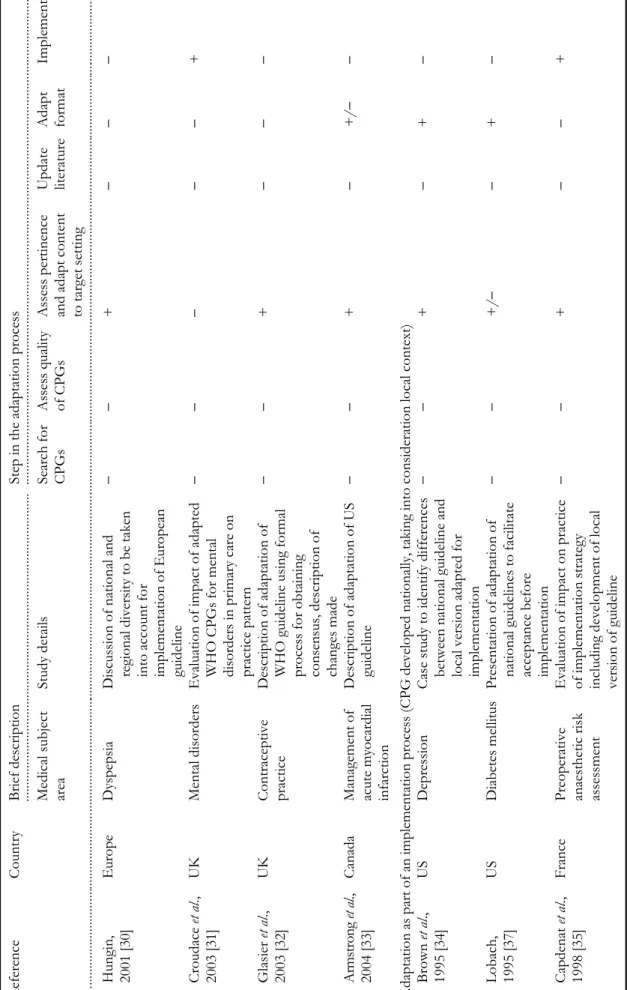
From the 1044 publications retrieved, we identified 18 that reported models, practical examples, and/or experiences of guideline adaptation (Table 1). In addition, we selected another nine publications; six were general discussion papers [9,15–19] and three focussed on the process of gathering data for cultural tailoring of guidelines for prevention [20–22]. In addition, during the preparation of this manuscript, another publication was identified [23].
Further analysis revealed different objectives for under-taking guideline adaptation. In 11 of the 18 selected publi-cations, the objective of guideline adaptation was to modify an existing guideline for use, where the source guideline was developed in a distinct cultural and organiza-tional setting. In four, this was as an alternative to de novo guideline development [18,23–25], and in the others, this was for the implementation of guidelines produced in another country or internationally, and therefore requiring adaptation to the context in the target setting [26–33]. In the remaining seven articles, the primary objective of adap-tation was to improve CPG implemenadap-tation through tai-loring of a national guideline to a narrower regional or local context [34–40]. There were two reports of rand-omized clinical trials to assess the impact of local adapta-tion of naadapta-tional guidelines [31,39].
The stages of the adaptation processes described in these publications could be grouped into six steps (Table 1):
1. Search for existing guidelines; 2. Assessment of guideline quality;
3. Assessment of applicability and adaptation of recom-mendations to target setting;
4. Literature update;
5. Adaptation of guideline format; and 6. Implementation.
The four reports describing adaptation as an alternative to a de novo development process involved at least five of these steps [18,23–25]. These reports started their process with a search for existing source CPGs, whereas the other reports started the process with a pre-selected CPG without provid-ing details of how the guideline to be adapted was selected. These reports were also the only ones to include a quality assessment of relevant guidelines [18,23–25]. Three of these studies used the Appraisal Instrument for Clinical Practice Guidelines [18,23,24], and the other used the AGREE instrument [25].
Eight of the publications reported experiences of adapting guidelines produced either internationally or in another country for implementation [26–33]. The seven remaining publications reported adaptation of national guidelines as part of an implementation process, and these discussed par-ticularly how the local context was taken into consideration. Two of these reported results from randomized clinical trials to assess the impact of local adaptation of national guidelines [31,39].
Brief descriptio n of publications on trans-contextual ad aptation of clinical practice guid elines C oun try ... ... .... ... .... ... .... ... .... ... .... ... .... ... .... ... .... ... .... ... .... ... .... ... .... ... . Brief d escription ... ... .... ... .... ... .... ... .... ... .... ... .... ... .... ... .... ... .... ... .... ... .... ... .... ... .... ... .... ... .... ... .... ... .... ... .... ... .... ... .... ... S tep in the ad apt ation pr oce ss Me dic al su bjec t ar ea Stu d y de ta ils S ea rc h for CPGs Assess quality of CPGs Ass ess pert inence and adapt cont ent to ta rg et s ett ing Up da te literature Adapt format Implement ... .... ... .... ... .... ... ... ... .... ... .... ... .... .... ... .... ... .... ... .... ... .... ... .... ... .... ... .... ... .... ... .... ... .... ... .... .... ... .. .... .... ... .... ... .... ... .... ... .... ... .... ... .. ... ... .... ... .... ... .... .... ... .... .... .... ... .... ... .... ... .... .... ... .... ... ... .... ... .... ... ... . apt at ion a s an alt er n at ive t o de novo de velopm ent Gr aha m et a l., 2002 [24] C an ada B re as t fe edi n g P re sent at ion of fr am ewor k for guideline ad aptation ++ + + + + M acLeod et al ., 2002 [18] Cana d a R isk ass essment
and prevention of pre
ssu
re
u
lce
rs
Application of framework for guideline
ad aptation ++ + − ++ Voe llinger et al ., 2003 [25] Switzerland M ajor depres sive disorder
Description and use of adaptation process
++ + + + − Gr aha m et a l., 2005 [23] Cana d a L eg u lce rs Applic ation of framework for guideline ad aptation ++ + − + − an implem entation process (CPG developed in ternationally or in an
other country, taking into consideration
contextu al differe nce s) Rhi n ehart et a l., 1991 [26] Indonesia N osocomial infections Discuss ion o f barriers to the adapt ation of US C D C guidel ines in Ind o nesia −− + −− − Reddy, 1999 [27] India H ypertension D iscuss ion o f conditions to im plem ent WH O guidel ines in Indi a −− + −− + De Wi t et a l., 2000 [28] Europe H. pylori infection Q uestionnaire to asses s barriers to the nation al implementation
of a European guideline and to identify national
specificities to be considered −− + − ++ Shye et al ., 2000 [29] USA a n d Israel Hypert ension Compar ative case stu d y of adaptation an d implementation
of HMO hypertension guidel
ines in two countries
−−
+–
+
Table 1 continued R eference C ountry .... ... .... ... .... ... .... ... .... ... .... ... .... .... ... .... ... .... ... .... ... .... ... .... ... .... Bri ef description .. .... ... .... ... .... ... .... ... .... ... .... ... .... ... .... ... .... ... .... ... .... ... .... ... .... ... .... ... .... .... ... .... ... .... ... .. .. ... .... ... .... .. St ep in the adapta tion pro cess M edica l s u bjec t ar ea Study details Search for CPGs Assess quality of CPGs Assess pertinence and
ad apt c o nt en t to target setting Update lite ra tu re Adapt format Implement .... .... ... .... ... .... ... .... ... .. ... ... .... ... .... ... .... .... ... .... ... .... ... .... ... .. .... .... ... .... ... .... ... .... ... .... ... .... ... .... ... .... ... .. ... .... ... .... ... ... .. .... .... ... .... ... .... ... .... .... .... ... .... ... .... ... .... ... .... .... .... ... .... ... ... .... ... .... ... .... .... .... ... .... ... .. . Hu ngi n , 2001 [30] Europe Dyspeps ia D
iscussion of national and regi
onal d iversity to be taken into a ccount f o r im pl em entation of Eu rope an guid eline −− + −− − Croudace et al ., 2003 [31] UK M ent al diso rder s E valu ati on of impact of adapted WHO CPGs for mental
disorders in primary care on practice pattern
−− − − − + Gl as ie r et a l., 2003 [32] UK Contraceptive prac ti ce Description of adaptation of W H O gu id el ine usi n g fo rm al
process for obtaining consens
u s, description of chang es made −− + −− − Ar ms tr o n g et al ., 2004 [33] Canada Managemen t of ac ut e myoc ar dia l infarction Description of adaptation of US guid eline −− + − +/ -− Adaptation as part of an implementati on process (CPG developed
nationally, taking into consid
eration local context) Brown et a l., 1995 [34] US Depression Case s tudy t o iden tify differences between natio n al guideline and local v ersion adapted for im pl em entation −− + − + − Lob ach, 1995 [37] US Diabetes m elli tu s P re se nt ation of adaptation of national gui d eli n es to facilitate acce ptanc e be for e im pl em entation −− +/ -− + − Cap denat et a l., 1998 [35] F ra n ce Pr eope ra ti ve
anaesthetic risk assessment
Evaluation of impa ct on practice of implemen tation s trategy including devel o pm ent of local vers ion of guideline −− + −− + continued
continued C ountry .... .... ... .... .... ... .... ... .... ... .... ... .... ... .... ... .... ... .... ... .... ... .... ... .... ... .... ... .. B rief description .... ... .... ... .... ... .... .... ... .... ... .... ... .... ... .... ... .... ... .... ... .... ... .... ... .... ... .... ... .... ... .... ... .... ... .... ... .... ... .... . S tep in the adap tation process M edical su bjec t ar ea Stu d y de ta ils S ea rc h for CP G s Assess quality of CPGs As sess p ertinence and adap t cont ent to ta rg et s ett ing Updat e literature Adapt format Implement ... .... ... .... ... .... ... .. .. .. .... ... .... ... .. .. ... .... ... .... .... ... .... ... .... ... .... ... .. .. ... .... ... .... ... .... ... .... ... .... ... .... ... .... ... ... .... ... .... ... .... .... .... ... .... ... .... ... .... .... .. .... .... ... .... ... .... ... .... ... .... ... .... ... .... .. .. .. .... .... ... .. ... .. ... ... .... ... ... . Ha ll and Ecc les, 2000 [36] UK D eep vei n thrombosis Case stud y to assess the implementation of national guideline using a multi p le strateg y im plem entation programme −− − − ++ Silagy et a l., 2002 [39] Australia Stroke and lower urinary tract symptoms Evaluation of impact of local
adaptation of national guidelines in compari
son to diss emin ation of national guideline −− + − ++ T o mlinson et a l., 2000 [40] UK D iabetes,
coronary heart dis
eas
e,
celi
ac disease, leg ulcers,
and menstrual problems
Description of local adaptation of national
guideline + −− ++ + Mavig lia et al ., 2003 [3 8] US Choles terol P resentation and discuss ion of
guideline adaptation for elec
tr onic implement ation −− − − ++
Proposition for a conceptual framework and adaptation process
The ADAPTE Working Group is particularly interested in the adaptation of guidelines produced in one setting for use in another, either as an alternative to de novo guideline develop-ment or in the context of impledevelop-mentation of an international or national guideline. We call this ‘trans-contextual adaptation’.
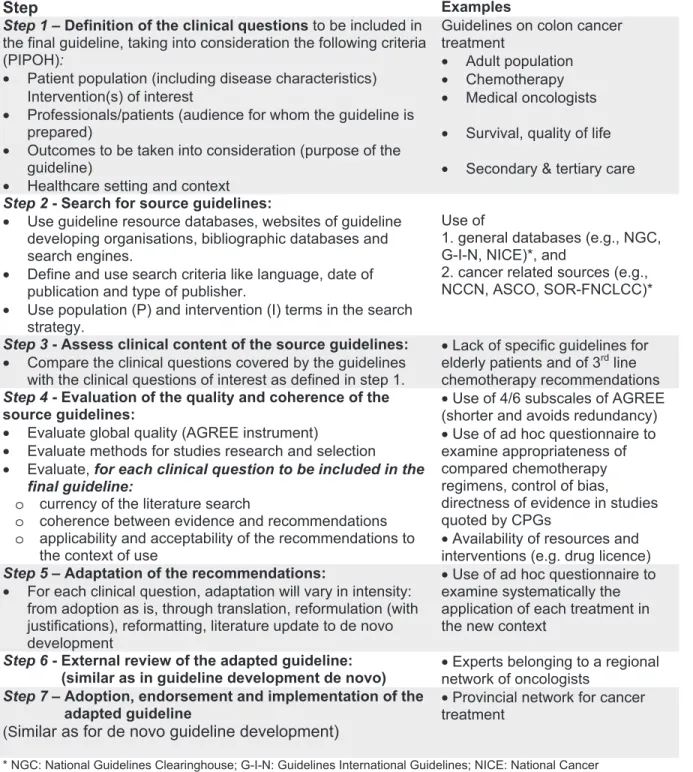
However, no systematic, validated approach to this type of adap-tation has been described in the literature. Most of the reports reviewed were case studies, and their results are difficult to gen-eralize. On the basis of this literature analysis and our experience in guideline development, the ADAPTE Working Group has designed an explicit approach to trans-contextual guideline adap-tation that comprises seven sequential steps (Figure 1).
Figure 1 Sequential process for the trans-contextual adaptation of guidelines.
Step
ExamplesStep 1 – Definition of the clinical questions to be included in
the final guideline, taking into consideration the following criteria (PIPOH):
• Patient population (including disease characteristics) Intervention(s) of interest
• Professionals/patients (audience for whom the guideline is prepared)
• Outcomes to be taken into consideration (purpose of the guideline)
• Healthcare setting and context
Guidelines on colon cancer treatment
• Adult population • Chemotherapy • Medical oncologists • Survival, quality of life • Secondary & tertiary care
Step 2 - Search for source guidelines:
• Use guideline resource databases, websites of guideline developing organisations, bibliographic databases and search engines.
• Define and use search criteria like language, date of publication and type of publisher.
• Use population (P) and intervention (I) terms in the search strategy.
Use of
1. general databases (e.g., NGC, G-I-N, NICE)*, and
2. cancer related sources (e.g., NCCN, ASCO, SOR-FNCLCC)*
Step 3 - Assess clinical content of the source guidelines:
• Compare the clinical questions covered by the guidelines with the clinical questions of interest as defined in step 1.
• Lack of specific guidelines for elderly patients and of 3rd line
chemotherapy recommendations
Step 4 - Evaluation of the quality and coherence of the
source guidelines:
• Evaluate global quality (AGREE instrument)
• Evaluate methods for studies research and selection • Evaluate, for each clinical question to be included in the
final guideline:
o currency of the literature search
o coherence between evidence and recommendations o applicability and acceptability of the recommendations to
the context of use
• Use of 4/6 subscales of AGREE (shorter and avoids redundancy) • Use of ad hoc questionnaire to examine appropriateness of compared chemotherapy regimens, control of bias, directness of evidence in studies quoted by CPGs
• Availability of resources and interventions (e.g. drug licence)
Step 5 – Adaptation of the recommendations:
• For each clinical question, adaptation will vary in intensity: from adoption as is, through translation, reformulation (with justifications), reformatting, literature update to de novo development
• Use of ad hoc questionnaire to examine systematically the application of each treatment in the new context
Step 6 - External review of the adapted guideline:
(similar as in guideline development de novo)
• Experts belonging to a regional network of oncologists
Step 7 – Adoption, endorsement and implementation of the
adapted guideline
(S
imilar as for de novo guideline development)
• Provincial network for cancer treatment
* NGC: National Guidelines Clearinghouse; G-I-N: Guidelines International Guidelines; NICE: National Cancer Institute; NCCN: National Comprehensive Cancer Institute; ASCO: American Society of Clinical Oncology; SOR-FNCLCC: Standards, Options, Recommandations – Fédération Nationale des Centres de Lutte Contre le Cancer
(i) Definition of the clinical questions: The process has a similar starting point as that for de novo development of guidelines, after having identified the need for the guideline and having established a multidisciplinary working group. The clinical questions should be defined, taking into consideration the following criteria: Patient population (including disease char-acteristics) Intervention(s) of interest, the Professionals to whom the guideline will be targeted, health Outcome(s) of interest, and the Health care setting in which the adapted guideline will be used (PIPOH).
(ii) Search for source guidelines: When guideline adaptation is used as an alternative to de novo development, we recom-mend performing a search for source guidelines to identify all the most relevant guidelines for adaptation. Because many guidelines are not published in medical journals, and not indexed in bibliographic databases, the search should start in guideline clearinghouses, such as the National Guideline Clearinghouse, the Guidelines International Network, or in country-specific databases such as the French Guideline Clearinghouse or the German database of the Agency for Quality in Medicine. In addition, websites of organizations developing guidelines and medical speciality societies can be consulted. Search engines (e.g. Google, AltaVista, and Yahoo) can be helpful, particularly for searching guidelines on rare topics. Searching in Medline using a standardized search strat-egy may yield additional guidelines: guideline [Publication Type] or practice guideline [Publication Type], or recommen-dation* [Title] or standard* [Title] or guideline* [Title], in combination with terms related to the clinical topic.
(iii) Assessment of clinical content in the source guidelines: The retrieved guidelines should then be assessed to ensure that they correspond to the clinical questions to be answered (in terms of the population and interventions), to select those that should be included in a more detailed assessment. If the retrieved guidelines do not cover the clinical questions defined in step 1, it may be necessary to revise or clarify these or to accept that there are no existing guidelines covering the questions of interest. In this latter case, it may be necessary to assess the need to produce a specific de novo guideline.
(iv) Assessment of the quality and coherence of the source guidelines: This is a pivotal step in the adaptation process and should involve assessment of three aspects: quality of reporting, internal validity (i.e. consistency between the recommenda-tions and the evidence cited), and applicability of the recom-mendations to the context of use. The AGREE instrument is becoming a widely accepted standard for assessing the meth-odological quality and reporting of guidelines [7]. However, a well-reported guideline can contain flawed recommendations. To have confidence in the recommendations, the assessment should also include the evaluation of the methods used to search and select the evidence, including the databases searched, the search strategies used, the selection criteria used, the method used to select the evidence, and how many references were found, included, and excluded. The method-ological and clinical consistency between the evidence cited and the conclusions of the critical appraisal of this evidence should include the assessment of the appropriateness of the study settings, the study protocols, and the methodological
quality of the studies. The coherence of the recommendations with the conclusions should involve an assessment of the directness of the evidence and the consistency of the strength of the recommendation, with the level of evidence of the included studies. This evaluation requires the participation of both clinical experts and guideline methodologists. Finally, the applicability and acceptability of the recommendations to the context of use in the target country, region, or local set-ting should be assessed and then discussed in detail with the working group. This should involve an assessment of the availability of the intervention and expertise, access to and quality of services, legal and resource constraints, as well as differences in cultural values and potential acceptance of intervention by the target population.
(v) Adaptation of the recommendations: Summarizing the information from the above assessments (quality scores, coherence between evidence and recommendations, and applicability of specific recommendations) for each of the selected guidelines in a comparative table will facilitate the selection of relevant source guidelines and the identification of recommendations that can be adopted and those that will require modification.
The degree of adaptation may involve adoption of the guideline, without changing the content, or adaptation of all or part of one or several source guidelines, or development of a new guideline, where the source guidelines serve as a start-ing point, dependstart-ing on the guideline topic, context, and cur-rency. The time and resources needed depend on the number of source guidelines selected, their quality and their currency, and the extent of any differences in the cultural and organiza-tional features between the context of the source guidelines and targeted context.
(vi ) External review of the adapted guideline: Before its dissemi-nation and implementation, the adapted guideline should undergo external review, which is also recommended in the process of development of a de novo guideline. The com-ments and suggestions from this external review should be addressed, either by modifying the guideline or by giving rea-sons for not taking them into account.
(vii ) Adoption, endorsement, and implementation of adapted guide-line: Once the guideline has been adapted and endorsed, a strategy of implementation should be put into action, if this is one of the missions of the organization that has adapted the guideline. If it is not their mission, then the target users will have to undertake this step.
Discussion
Most important clinical topics have already been addressed in guidelines produced somewhere in the world. Because the key methods for guideline development have converged over the years, and most organizations have limited resources, there is an increasing interest in adapting existing guidelines. Several authors suggest that adapting guidelines, rather than de novo development, could contribute to reducing unnecessary duplication of effort [19,26,27]. Our review of the literature has confirmed this increasing interest in adapting guidelines,
which is highlighted by the fact that the majority of retrieved papers were published in 2000 or later. Many guidelines groups have recognized the importance of adapting guide-lines, particularly in terms of avoiding unnecessary duplica-tion of effort, for example, the Canadian Strategy for Cancer Control and the New Zealand Guidelines Group. In addition, the Registered Nurses Association of Ontario is probably the only organization to have a guideline policy, which is based on the adaptation of existing guidelines only, with no de novo guideline development.
Adaptation of guidelines is performed at different stages of the guideline development process. In four reports, it has been used as an alternative to de novo guideline development [18,23–25], and in many others, it is used as a means of improving guideline implementation, through local tailoring of an international or national guideline, involving trans-contextual and trans-cultural adaptation and/or modification of the format. Although the objectives differ slightly, both types of adaptation aim at tailoring guidelines to make them more rel-evant to the context in which they will be implemented.
The translation of evidence into guideline recommenda-tions should take into consideration the organizational and cultural context in which the evidence will be interpreted and implemented, particularly when the evidence is weak or sparse [41]. The type and quality of the evidence on which the recommendations are based can vary, depending on the exact clinical questions addressed and when and how the search for evidence is performed. For example, the dates covered by the strategies and the use of restriction criteria, such as language, can often explain this variation. This, in combination with dif-ferences in culture and context, can lead to legitimate and/or explainable variations in guideline recommendations, without necessary involving any methodological problems. Therefore, the applicability of the guideline recommendations in the tar-get context, and the degree to which a source guideline needs adaptation is dependent on the differences in the organiza-tional, legislative, and cultural contexts. These considerations include the availability of diagnostic, treatment, and other health services, the organization of the health services, the expertise and resources as well as cultural beliefs and value judgements, patient preferences, and population characteris-tics (or prevalence of disease) [20–22,26–33]. Translation from one language to another, which is important for the implementation of guidelines produced elsewhere, could be considered as a form of cultural adaptation of the guideline.
Trans-contextual guideline adaptation should ensure that the adapted guidelines answer specific clinical questions relev-ant for the context of use and that it replies to the needs, prior-ities, legislation, policies, and resources in the targeted setting, without threatening the quality and validity of the guidelines. A multidisciplinary group is important in this process, not only to enhance the relevance for local practice but also to foster broad ownership and uptake of the adapted guideline [31,35,36,39]. The more the recommendations in the source guidelines are based on expert opinion, in the absence of a high level of evidence, the more a formal process (such as nominal group techniques, or methods based on the Delphi approach) will be required for adapting the recommendations
to increase the transparency of expert judgement [26,32]. These formal methods could also be useful for taking into consideration context variables when adapting guidelines for culturally-sensitive interventions [20–22].
Adaptation of existing guidelines will respect the evidence-based approach and should improve the quality and consist-ency of the guidelines produced. This approach could be more beneficial for countries and organizations with small budgets and limited experience, although it is probably also true for larger, better resourced and more experienced organi-zations. Currently, there is no evidence suggesting that guide-line adaptation will increase the efficiency of guideguide-line production or reduce costs, compared with de novo guideline development. However, adaptation will have to overcome certain difficulties such as heterogeneous quality, insufficient transparency in the reporting for guidelines, and the currency of the guidelines. If organizations produce adapted guidelines, they should also include in their process a means of checking the currency of their guidelines. Although several publications propose methods for this assessment, there is no validated method at present. One possible spin-off from the adaptation process could be that other organizations could be offered timely and easy access to the updated guidelines, although the modality of this sharing process would need to be developed. Further research is needed to assess the advantages of adapta-tion of guidelines, in comparison with de novo development.
In addition, our approach to guideline adaptation provides an excellent opportunity to include an appropriate implemen-tation step at the beginning of the process, by the explicit consideration of the context of use and the potential organi-zational or cultural barriers to changing current practice. This includes taking into consideration ownership and adherence issues for the guideline’s target users.
One limitation of our study is the lack of specific indexa-tion of this type of research in the main bibliographic data-bases. The literature search strategy that was developed had a low specificity; however, although the percentage of relevant papers identified was low (1.7%), we probably identified all the relevant reports. Another limitation is the need to validate the proposed process of guideline adaptation through field-testing. We are planning several such studies to refine and val-idate the process for guideline adaptation with guideline developers in different countries. The first study will involve a formal external review of the proposed adaptation process (described in a manual) by guideline methodologists. Then the manual will be used in field feasibility studies as part of a multicentre international validation study.
Trans-contextual guideline adaptation will provide an excellent opportunity to improve our understanding of how context variables, such as culture, organization of care and societal values, influence the translation of evidence into rec-ommendations for clinical practice. Moreover, this approach will facilitate cooperation between organizations developing guidelines and encourage them to explore common strategies for sharing development of guidelines at an international level to avoid duplication of effort and to define which aspects require specific national or local input. Further research is needed to evaluate, formally, the adaptation process that we
propose, particularly its advantages compared with de novo development.
Acknowledgements
The 59th ‘Commission permanente de coopération franco-québécoise (CPCFQ) 2003–2005’, the Direction de la lutte contre le cancer, Ministère de la santé et des services sociaux, Quebec, Canada, and the French Cancer League provided fin-ancial support for the meetings of the ADAPTE working group. The ‘Direction de la lutte contre le cancer, Ministère de la santé et des services sociaux, Quebec, Canada provided financial support for the participation of Louise Paquet. The French Rhône-Alpes Region, France, provided financial sup-port for the participation of Jako Burgers. The Haute Autorité de Santé, France provided financial support for the participation of Najoua Mlika-Cabanne.
We thank the reviewers as well as George Browman for his useful comments on this manuscript.
References
1. Smith TJ, Hillner BE. Ensuring quality cancer care by the use of clinical practice guidelines and critical pathways. J Clin Oncol 2001; 19: 2886–2897.
2. Woolf SH.Practice guidelines: a new reality in medicine. I. Recent developments. Arch Intern Med 1990; 150: 1811–1818. 3. Ward JE, Grieco V. Why we need guidelines for guidelines: a
study of the quality of clinical practice guidelines in Australia.
Med J Aust 1996; 165: 574–576.
4. Shaneyfelt TM, Mayo-Smith MF, Rothwangl J. Are guidelines following guidelines? The methodological quality of clinical practice guidelines in the peer-reviewed medical literature.
JAMA 1999; 281: 1900–1905.
5. Grilli R, Magrini N, Penna A, Mura G, Liberati A. Practice guidelines developed by specialty societies: the need for a critical appraisal. Lancet 2000; 355: 103–106.
6. Graham ID, Beardall S, Carter AO, Glennie J, Hebert PC, Tetroe JM et al. What is the quality of drug therapy clinical prac-tice guidelines in Canada? CMAJ 2001; 165: 157–163.
7. AGREE Collaboration.Development and validation of an inter-national appraisal instrument for assessing the quality of clinical practice guidelines: the AGREE project. Qual Saf Health Care 2003; 12: 18–23.
8. Harpole LH, Kelley MJ, Schreiber G, Toloza EM, Kolimaga J, McCrory DC. Assessment of the scope and quality of clinical practice guidelines in lung cancer. Chest 2003; 123: 7S–20S. 9. Baker R, Feder G. Clinical guidelines: where next? In J Qual
Health Care 1997; 9: 399–404.
10. Eisinger F, Geller G, Burke W, Holtzman NA. Cultural basis for differences between US and French clinical recommendations for women at increased risk of breast and ovarian cancer. Lancet
11. Hart RG, Bailey RD. An assessment of guidelines for preven-tion of ischemic stroke. Neurology 2002; 59: 977–982.
12. Burgers JS, Fervers B, Haugh M, Brouwers M, Browman G, Philip T et al. International assessment of the quality of clinical practice guidelines in oncology using the Appraisal of Guide-lines and Research and Evaluation Instrument. J Clin Oncol 2004; 22: 2000–2007.
13. Wils J, O’Dwyer P, Labianca R. Adjuvant treatment of colorec-tal cancer at the turn of the century: European and US perspec-tives. Ann Oncol 2001; 12: 13–22.
14. Manna DR, Bruijnzeels MA, Mokkink HG, Berg M. Ethnic spe-cific recommendations in clinical practice guidelines: a first exploratory comparison between guidelines from the USA, Canada, the UK, and the Netherlands. Qual Saf Health Care 2003; 12: 353–358.
15. Wise CG, Billi JE. A model for practice guideline adaptation and implementation: empowerment of the physician. Jt Comm J Qual
Improv 1995; 21: 465–476.
16. Hamadeh G, Daher M, Bizri AR. Adapting guidelines to Leba-nese clinical practice. J Med Liban 1998; 46: 261–267.
17. Graham I, Harrison M, Brouwers M. Evaluating and adapting practice guidelines for local use: a conceptual framework. In Pickering, S, Tomlinson, J, eds. Clinical Governance and Best Value:
Meeting the Modernisation Agenda, London, Churchill Livingstone, 2003: 213–229.
18. MacLeod FE, Harrison MB, Graham ID. The process of devel-oping best practice guidelines for nurses in Ontario: risk assess-ment and prevention of pressure ulcers. Ostomy Wound Manage 2002; 48: 30–38.
19. Bro F, Waldorff FB. Guidelines—let’s take a break and then move forward together! Scand J Prim Health Care 2004; 22: 2–5. 20. Shoultz J, Phillion N, Noone J, Tanner B. Listening to women:
culturally tailoring the violence prevention guidelines from the put prevention into practice program. J Am Acad Nurse Pract 2002; 14: 307–315.
21. Shoultz J, Tanner B, Harrigan R. Culturally appropriate guide-lines for alcohol and drug abuse prevention. Nurse Pract 2000; 25: 50–56.
22. Rasmussen RC, Schermann MA, Shutske JM, Olson DK. Use of the North American guidelines for children’s agricultural tasks with Hmong farm families. J Agric Saf Health 2003; 9: 265–274.
23. Graham ID, Harrison MB, Lorimer K et al. Adapting national and international leg ulcer practice guidelines for local use: the Ontario Leg Ulcer Community Care Protocol. Adv Skin Wound
Care 2005; 18: 307–318.
24. Graham ID, Harrison MB, Brouwers M, Davies BL, Dunn S. Facilitating the use of evidence in practice: evaluating and adapt-ing clinical practice guidelines for local use by health care organi-zations. J Obstet Gynecol Neonatal Nurs 2002; 31: 599–611. 25. Voellinger R, Berney A, Baumann P, Annoni JM, Bryois C,
Buclin T et al. Major depressive disorder in the general hospital: adaptation of clinical practice guidelines. General Hosp Psychiatry 2003; 25: 185–193.
26. Rhinehart E, Goldmann DA, O’Rourke EJ. Adaptation of the Centers for Disease Control guidelines for the prevention of
nosocomial infection in a pediatric intensive care unit in Jakarta, Indonesia. Am J Med 1991; 91: 213S–220S.
27. Reddy KS.Implementation of international guidelines on hyperten-sion: the Indian experience. Clin Exp Hypertens 1999; 21: 693–701. 28. de Wit NJ, Mendive J, Seifert B, Cardin F, Rubin G. Guidelines on
the management of H.pylori in primary care: development of an implementation strategy. Fam Pract 2000; 17 (suppl2.): 27–32. 29. Shye D, Porath A, Brown JB. Adapting a national guideline
for local use. a comparative case study in a US and an Israeli health maintenance organization. J Health Serv Res Policy 2000; 5: 148–155.
30. Hungin P.Working together across international boundaries: improving the primary-secondary care network. Eur J
Gastroen-terol Hepatol 2001; 13 (suppl2.): 13–16.
31. Croudace T, Evans J, Harrison G, Sharp DJ, Wilkinson E, McCann G et al. Impact of the ICD-10 Primary Health Care (PHC) diagnostic and management guidelines for mental disor-ders on detection and outcome in primary care. Cluster ran-domised controlled trial. Br J Psychiatry 2003; 182: 20–30. 32. Glasier A, Brechin S, Raine R, Penney G. A consensus process
to adapt the World Health Organization selected practice rec-ommendations for UK use. Contraception 2003; 68: 327–333. 33. Armstrong PW, Bogaty P, Buller CE, Dorian P, O’Neill BJ. The
2004 ACC/AHA Guidelines: a perspective and adaptation for Canada by the Canadian Cardiovascular Society Working Group. Can J Cardiol 2004; 20: 1075–1079.
34. Brown JB, Shye D, McFarland B. The paradox of guideline implementation: how AHCPR’s depression guideline was
adapted at Kaiser Permanente Northwest Region. Jt Comm J
Qual Improv 1995; 21: 5–21.
35. Capdenat Saint-Martin E, Michel P, Raymond JM, Iskandar H, Chevalier C, Petitpierre MN et al. Description of local adaptation of national guidelines and of active feedback for rationalising preoperative screening in patients at low risk from anaesthetics in a French University hospital. Qual Health Care 1998; 7: 5–11. 36. Hall L, Eccles M. Case study of an professional and
inter-organisational programme to adapt, implement and evaluate clinical guidelines in secondary care. Clin Perform Qual Health
Care 2000; 8: 72–82.
37. Lobach DF. A Model for Adapting Clinical Guidelines for Elec-tronic Implementation in Primary Care. Proceedings of the Annu Symp Comput Appl Medical Care 1995, 581–585. 38. Maviglia SM, Zielstorff RD, Paterno M, Teich JM, Bates DW,
Kuperman GJ. Automating complex guidelines for chronic dis-ease: lessons learned. J Am Med Inform Asso 2003; 10: 154–165. 39. Silagy CA, Weller DP, Lapsley H, Middleton P, Shelby-James T,
Fazekas B. The effectiveness of local adaptation of nationally pro-duced clinical practice guidelines. Fam Pract 2002; 19: 223–230. 40. Tomlinson J, Baker R, Stevenson K, Lakhani M. The
Leicester-shire local guideline adaptation and implementation programme: a model for clinical effectiveness? J Eval Clin Pract 2000; 6: 225–229. 41. Eisenberg JM.Globalize the evidence, localize the decision: evidence-based medicine and international diversity. Health Aff
(Millwood) 2002; 21: 166–168.