How Should a Tourist Organization
Optimize Working with Social
Influencers?
Case: Switzerland Tourism North America
Bachelor Thesis 2016
Student : Lauriane Zosso
Thesis advisor : Roland Schegg
Department of study : Tourism & Management
ii
Abstract
Tired of being bombarded with marketing messages, consumers have lost trust in brands. Paid advertisement is no longer effective and brands have to find new marketing practices to connect to consumers with more authenticity. Influencer marketing is an increasingly popular method in which a brand partners with key individuals who exert influence over an online community. Brands can thus tap into a network of trust. Influencer marketing is digital word-of-mouth: it is based on recommendations from someone consumers align with.
The purpose of this paper is to find out how a tourist organization can optimize working with social influencers. The paper focuses on the case of Switzerland Tourism North America (ST NA). The market has just started working with influencers, but faces several challenges and needs recommendations to go further. This problem is solved with empirical research: to complement the existing literature on the topic with practical insights, a qualitative survey was conducted on national tourist organizations, destination management organizations and social influencers.
Based on the analysis, interpretation and discussion of the results, a step-by-step guide was created. The featured recommendations, which were validated by experts in the field, are sorted into key phases: the incorporation of influencer marketing at the core of the company, the implementation of an influencer campaign, and the following-up of the campaign. These recommendations are tailor-made for ST NA, but can also be used by any other tourist organizations.
iii
Foreword
Trends and technologies have evolved, and influencer marketing has become the new hot topic among marketing circles. The author has always had a great interest in digital marketing. During her bachelor studies at the School of Tourism and Management, she specialized in e-tourism. During her internship at Switzerland Tourism North America, the author wanted to understand how the company could be more proactive and implement new marketing methods in order to keep up with trends and industry changes. As influencer marketing seems to be one of the most efficient marketing practice nowadays, the author decided delve deeper into the topic and find out how it should be optimized at Switzerland Tourism North America. The aim of the paper is to give recommendations in the form of a practical step-by-step guide. Previous research have been done on the topic of influencer marketing but few are specific to tourism. However, while this paper was being written many studies have been conducted. This represents one of the main difficulties of the work, the topic was constantly evolving.
The research question “How should a travel organization optimize working with influencers?” was answered based on empirical work. To complement the existing literature with practical insights, a qualitative survey was conducted on national tourist organizations, destination management organizations and social influencers.
The author is grateful to the people who facilitated the carrying-out of this paper. She thanks her thesis advisor Roland Schegg for his guidance and recommendations. She thanks Switzerland Tourism for the opportunity and the North American team for its support, with a special mention to Paolo Lunardi, Ursula Beamish-Mader, Pascal Prinz and Alex Herrmann. A very special thanks goes to the interview partners for their time and the valuable inputs they provided: Tama d’Haen, Janine Jervis, Daði Guðjónsson, Nicholas Montemaggi, Adrian Seitz, Sibylle Gerardi, Kuno Schürch, Zulfah Fredericks, Nicole Schaffner, Katrin Schmitt, Scott Kranz, Rob Sese and Erin Faherty. Finally, the author thanks Teresa Faudon and Alex Goumaz for their engagement and time in proofreading this paper.
iv
Table of content
Abstract ... ii Foreword ... iii Table of content ... iv List of tables ... viList of figures ... vii
List of abbreviations ... viii
Introduction ... 1
Chapter 1 - Literature review ... 3
1.1 Influencer marketing: a new and growing practice ... 3
1.2 The social influencer: a key individual ... 5
1.3 Challenges of influencer marketing ... 9
1.4 The influencer campaign: the key steps ... 9
Chapter 2 – Research Question ...12
2.1 Case Study ...12
2.2 Research question ...17
Chapter 3 – Methodology ...20
3.1 Explanation of methods and techniques ...20
3.2 Sampling ...21
3.3 Construction of the questionnaires ...22
3.4 Data collection ...22
Chapter 4 – Presentation of results ...23
Chapter 5 – Analysis and interpretation ...31
1. Basics ...31
2. Incorporation ...35
3. Implementation ...39
4. Follow-up ...45
v 1. Basics ...47 2. Incorporation ...49 3. Implementation ...50 4. Follow-up ...52 Chapter 7 – Recommendations ...53
1. Understanding the basics ...55
2. Set the stage ...57
3. Plan your campaign ...60
4. Collect the results ...67
Conclusion ...69
References ...72
Appendix I: Blogger Relation Guidelines ...78
Appendix II: Interview with Katrin Schmitt ...93
Appendix III: Interview guidelines ...96
Appendix IV: Samplings ...98
Appendix V: Questionnaires ... 100
A. Interviews with NTOs or DMOs ... 100
B. Interview with the Swiss key partners ... 102
C. Interview with influencers ... 104
Appendix VI: Interview transcripts ... 105
A. Interviews with DMOs ... 105
B. Interviews with ST Swiss key partners ... 131
C. Interviews with influencers ... 144
Appendix VII: Coding of the data... 153
Appendix VIII: Presentation of the results ... 154
vi
List of tables
Table 1: The key platforms ... 8
Table 2: Top criteria for working with brands ... 9
Table 3: Top ways influencers want to be incentivized ...10
Table 4: Potential and challenges of influencer marketing at ST NA ...17
Table 5: Simplified results - Basics ...24
Table 6: Simplified results - Incorporation ...25
Table 7: Simplified results - Implementation ...26
Table 8: Simplified results - Follow-up ...28
vii
List of figures
Figure 1: The online marketing sphere ... 3
Figure 2: The influencer spectrum ... 6
Figure 3: Key phases-chart 1 ...11
Figure 4: Switzerland Tourism's 4WD ...13
Figure 5: Key phases-chart 2 ...18
Figure 6: Key phases-chart 3 ...30
viii
List of abbreviations
DMO Destination Management Organization DTTT Digital Tourism Think Thank
GCC Golf Cooperation Council
HO Head Office
KAM Key Account Management
KMM Key Media Management
KPI Key Performance Indicator NTO National Tourist Organization ROI Return on Investment
SoMe Social Media
ST Switzerland Tourism
ST NA Switzerland Tourism North America
TO Tour Operator
UGC User Generated Content
1
Introduction
Consumers are increasingly exposed to advertisements to a point that they now unconsciously tune this information out. They have developed so-called “ad blindness” and have slowly lost trust in brands, tired of being constantly bombarded by marketing messages. Paid advertisement is no longer effective and this is a new challenge marketers need to overcome. Brands have to change their marketing practices and find ways to connect to consumers with more authenticity.
When it comes to making a purchase decision, consumers trust people rather than brands, a concept known as word-of-mouth. Word-of-mouth is not a new phenomenon and has been happening for a long time. However, the dynamic has been largely empowered through the rise of social media. Among these new extended social circles, key individuals have gained strong voices and have been defined as social or digital influencers. These influencers have built communities based on trust and common interests. They have the power to deliver messages that have a strong impact on their audience. And this is where influencer marketing – a new word-of-mouth form of advertising – comes into play. Brands have found a way to reach consumers through the people they love and align with: they can leverage the power of influencers to tap into this network of trust.
Influencer marketing has become the current hot topic among marketing circles and the tourism sector is no exception. When it comes to travel, social media has a significant impact on the path to decision and purchase. Indeed, it is the place where consumers look for recommendations and inspiration. Social media platforms rely heavily on visuals and lend themselves especially well to capturing experiences – the core of tourism. Influencer marketing opens a world of possibilities to travel brands, however, it has to be done right for a successful outcome.
Switzerland Tourism is the national tourist organization which markets Switzerland worldwide as a country for holidays, travel and congresses. The North American market of Switzerland Tourism acknowledges the potential of influencer marketing and has just started working with social influencers. The market would like to get recommendations on how to incorporate and implement this new form of marketing most effectively. This leads to the research question, “How should a tourist organization optimize working with social
influencers?” with the case study of Switzerland Tourism North America.
This paper is organized as follows. Firstly, chapter one explores existing literature related to the research topic and reviews the key aspects of influencer marketing. Then, chapter two
2 sets the context of the research question, presents Switzerland Tourism North America and analyses its current use of influencer marketing. Based on the problems detected, the research question will be formulated at the end of the chapter. To understand how the research question will be answered, chapter three outlines the methodologies applied in this work and describes how the study will be conducted. Next, chapter four presents the data collected in form of a table, which will then be analyzed and interpreted in chapter five. The following section – chapter six – discusses the results of the study compared with the literature review. Eventually, the essence of the work will be chapter seven, which presents the empirical work; recommendations on how Switzerland Tourism North America could optimize working with influencers will be formulated. A line is kept throughout the paper with the help of a key-phases
3
Chapter 1 - Literature review
This section explores the existing literature on influencer marketing. The goal is to understand the research problem better and to know which studies have already been produced. The author defines influencer marketing and the social influencer, presents the challenges of influencer marketing, and explores the key steps of an influencer program. At the end of the section, figure 3 summarizes the section and highlights key phases detected.
1.1 Influencer marketing: a new and growing practice
1.1.1 Definition of influencer marketing
Before the digital era, social influence was being exerted among circles of friends through word-of-mouth. In today’s hyper-connected world, these circles have extended to become social networks generating entire communities. Word now travels faster and reaches a greater amount of people. (Moxie, 2014, p. 3) They enable some individuals to gain a stronger voice and become influential among a certain community. These key individuals started to draw the attention of marketers, who saw the opportunity to access a specific audience and to communicate marketing messages. (Galeotti & Goyal, 2009, p. 509) Influencer marketing was born. It can be defined as a form of marketing that “identifies and targets individuals with influence over potential buyers” (Wong, 2014) and as the practice of “providing compensation to a social media influencer in exchange for mention, promotion or review through that influencer’s channels.” (Murphy & Schram, 2014) As shown in figure 1, influencer marketing belongs to online marketing, more specifically to social media marketing (SMM) and has key elements: content, reach, target group, trust, SMM, SEO, mobile and niches.
Figure 1: The online marketing sphere
4 1.1.2 Benefits of influencer marketing
Influencer marketing provides considerable benefits to brands. First and foremost, brands can gain credibility by tapping into a network of trust. Indeed, consumers’ trust towards brands has declined: people have become skeptical of advertisements and ads blockers have been developed. Nowadays, consumers trust people rather than brands. (Morin, 2016) As evidence, Nielsen’s survey of 28,000 consumers in 52 countries reports that 92% of the consumers said they trust earned media, such as recommendations from friends and relatives, more than other types of advertising. (Aquino, 2013, p. 32) Influencer marketing is a way to build better connections and introduce affinity and emotions into the brand-consumer relationship. Li, Lin and Lai’s study reports that people are more likely to be influenced by subjective expressions with emotional component rather than objective statements when it comes to a purchase decision. (2010, p. 295) When working with influencers, brands can not only gain trust but also loyalty and advocacy. Brand reputation can be boosted, messages can be amplified, and brand awareness can be raised. (eMarketer, 2016) To goal is to drive customer engagement and purchase decisions. Moxie, who did an online survey on fans, reports that 81% of fans purchased a product based on an influencer’s recommendation. (2014, p. 11) To summarize, influencer marketing is a way to get “unique branded social content from a trusted influential source (…), syndication of content through all platforms, the ability to target micro niches at scale, higher click-through rates and lower cost per clicks than traditional display, fresh and lasting content and loyal partners that care and share” (Murphy & Schram, 2014, p. 35)
1.1.3 The current state of influencer marketing
Influencer marketing has become a central topic for brands. TechnoratiMedia, which produced a major survey on more than 6,000 influencers, 1,200 consumers and 150 top brand marketers in 2013, reports that brands’ investment in social advertising is increasing and that 65% of the surveyed brands claimed to do influencer marketing (2013, p. 11). Influencer marketing will grow. According to Social Media Today “74% of global marketers reported they will use ‘influence marketing’ as part of their marketing strategy in the next 12 months.” (Cited in Ritchie, 2013, p. 4) Apparently influencer marketing bears fruit. In 2015, Augure carried out another survey on a sample of more than 600 communication and marketing practitioners from 3 main markets (France, Spain and the UK) and reports that among the surveyed, 93% claim their influencer marketing strategies have brought more visibility and have increased fame, 76% gained the loyalty of their customers and 27% created new business opportunities. (2015).
5 1.1.4 Influencer marketing in different industries
Working with influencers has attracted interest among many sectors, especially fashion and beauty. (Maspoli, 2016) But tourism also follows the trend and is actually the fourth sector using influencer marketing most heavily, according to RhythmOne’s benchmark. (2014) Indeed, a study done by RadiumOne shows that 73% of people, mainly millennials, get their vacation ideas from social media such as Facebook, Instagram and Twitter. (Dahan, 2015) Social media platforms are visually strong and lend themselves especially well to capturing experiences. Influencers share personal stories, give travel recommendations and inspire their community. (Dahan, 2015) May it be airlines companies, hotels or tourist offices, the travel industry is increasingly working with digital influencers. (About DCI, 2016)
1.2 The social influencer: a key individual
1.2.1 Definition of the social influencerEveryone can be an influencer. However, the impact of the influence varies according to the number of people influenced, the kind of influence exerted and the media used. (Bakshy, 2011, p. 1) Social influencers are self-made; they have built their own audience over time based on their expertise and smoothly become opinion leaders. Influencers have established a relationship of trust among their networks, and developed connectivity and centrality. They have the power to exert influence over their communities. (Bakshy, 2011, p. 1) Influencers are content creators and storytellers, and they know how to create enthusiasm. (Bakshy, 2011, p. 1) They usually have good photography, videography, writing or speaking skills. They share relevant opinions that generate authentic conversations. (Appinions, 2012, p. 8) They operate on blogs and social media (SoMe) platforms such as Facebook, Twitter, Instagram, Pinterest or YouTube. Influencers are also influenced, mainly by blogs and other colleagues. (TechnoratiMedia, 2013, p. 20)
1.2.2. The influence
Social influence is not a new concept. Back in 1944, Lazarsfeld published The People’s
Choice, which studies the influence when it comes to political votes. At his great surprise, the
survey revealed that an individual’s opinion was more likely to be influenced by a neighbor than by the propaganda broadcasted on a radio show. (Brown & Fiorella, 2013, p. 82) This statement leads to Brown and Fiorella’s theories: true influence operates in a dyadic relationship, which refers to “discussions or communication between two people involving their mutual ideas, thoughts, behaviors or ideals.” (2013, p. 81)
6 1.2.3 The types of influencers
Figure 2 classifies influencers based on the quality of the relationship with the audience and the number of people reached. Micro-influencers have a close relationship with their audience. They engage, establish conversations, and exert a true influence over the customer’s decision-making process. In other terms, they have a deep reach. Macro-influencers focus on the width of the reach rather than the depth: they broadcast to a wider and more general and loosely defined audience (Brown & Fiorella, 2013, p. 90) According to Brown & Fiorella, marketers have the tendency to focus on the influencer and his popularity rather than on the relationship (2013, p. 77). This is a natural reflex that comes from traditional media. However, social media’s essence is interactive communication and not reach (Francalanci & Hussain, 2016) Brown & Fiorella state that partnering with macro-influencers is a beginner mistake (2013, p. 90) and explain: “Today’s influence marketing strategies are typically based on identification of influencers with high scores on social influence platforms. While this model might be quicker and require less effort, it’s also less effective. The value of broad amplification is lessened by the unidentified quality of relationship, context or conversations”. (2013, p. 82) They acknowledge that if a brand wants to raise awareness, it might want to engage with macro-influencers and warn that this may not generate purchases. The consumers themselves share this point of view: 54% of consumers agree that the smaller the community, the greater the influence (TechnoratiMedia, 2013, p. 12).
Figure 2: The influencer spectrum
7 Figure 2 illustrates different types of influencers: Employees are close to the people they influence, they can educate them and become genuine ambassadors. As an example, Procter & Gamble has formal employee influencer programs. Influential consumers are buyers before being influencers. They write about a brand without being involved in a partnership because they are personally convinced. Brands should thank them and suggest endorsements. (Moxie, 2014, p. 13) Social engagers, in contrast, are not current buyers. They mention the brand in their platforms if there is a partnership. Brands should try to turn them into advocates. Channel
influencers are passionate fans of a brand. They are well known by the community manager
as they actively converse on the brand’s content. Peer influencers raise their hands to be registered in marketplaces. They seek fresh content and want to be the first to know about a new product. They look for rewards or samples in exchange for basic tasks. Everyday
influencers have just started out or have quickly risen up the ranks. They are not so selective
about brands but care about how the brand can affect their reputation. Premium influencers are expertized and professional influencers, create content of high quality and can afford to be represented by agents. They are highly selective about the brands. Finally, A-list talent are celebrities and only partner with big names who will pay millions to create mass awareness. They engage less with their audience and focus on numbers. (Moxie, 2014, pp. 7-8).
1.2.4 The platforms
Too often, marketers defaulted to calling influencers “bloggers”. Influencers do have blogs as 86% of influencers blog. (TechnoratiMedia, 2013, p. 19) However, they share content on multiple channels, a phenomenon called “influencer porosity”. (Engauge, 2013, p. 22) Table 1 presents the most important platforms according to various sources: Engauge conducted a survey on 780 influencers and 1,000 fans as well as qualitative surveys on focus groups. (2013) TapInfluence conducted a survey on 1,700 influencers and 100 marketers with an anonymous online questionnaire. (2016) TechnoratiMedia produced a survey on more than 6,000 influencers, 1,200 consumers and 150 top brand marketers. (2013) Table 1 shows divergent results. In general, Facebook is the top platform. However, recently, influencers put more importance on blogs than Facebook, a fact that confronts brands’ opinion. TapInfluence explains: “An interesting discrepancy and influencer frustration surrounds the emphasis and implied overvaluing of social shares (…) This is bothering influencers, many of whom have built their audience through their personal blogs”. (2016) It is interesting to see that consumers mention blogs as most likely to influence their purchase after retail sites. They link blogs with trust, popularity and influence. (TechnoratiMedia, 2013, p. 4) Maspoli mentions that, since 2014, YouTube and Instagram have taken a prominent place among social media channels. (Maspoli, 2016) This is also illustrated in table 1; Instagram has become more important.
8 Table 1: The key platforms
a b c d e f g g h
Influencers Consumers Bra Brands
Most used social channels (blogs included) Most important channels (blogs included) Most used social channels (blogs excluded) Most used online channels Most trusted online channels Most likely to influence a purchase online channels Most used channels (blogs included) M Most important channels (blogs included)
1. Facebook 1. Blogs 1. Facebook 1. Youtube 1. News sites 1. Retail sites 1. Facebook 1. Facebook 2. Youtube 2. Facebook 2. Twitter 2. Facebook 2. Facebook 2. Brand sites 2. Twitter 2. Twitter 3. Twitter 3. Instagram 3. LinkedIn 3. Retail Sites 3. Retail sites 3. Blogs 3. YouTube 3. Youtube
4. Blog 4. Twitter 4. Google+ 4. G+ 4. YouTube 4. Facebook 4. Pinterest 4. Instagram
5. G+ 5. Pinterest 5. Pinterest 5. Blogs 5. Blogs 5. Group/Forums 5. LinkedIn 5. Blogs
6. Insta 6. Instagram 6. News sites 6. G+ 6. YouTube 6. Blogs
7. LinkedIn 7. YouTube 7. Twitter 7. Forums 7. LinkedIn 7. Instagram
8. Other 8. Forums 8.Online
Magazines
8. G+ 8. G+
9. Pinterest 9 LinkedIn 9. Brand sites 9.Online
Magazines Source: Table by the author with multiple sources
a: Engauge (2013, p. 22) b. (TapInfluencer, 2016) c: TechnoratiMedia (2013, p. 22) d: TechnoratiMedia (2013, p. 13) e: TechnoratiMedia (2013, p. 14) f: TechnoratiMedia (2013, p. 16) g: TechnoratiMedia (2013, p. 6) h. (TapInfluencer, 2016)
Lauriane Zosso Bachelor Thesis
9
1.3 Challenges of influencer marketing
According to Augure, identifying the right influencer is the number one challenge of professionals. (2015) TapInfluence backs up Augure and reveals that 68% of marketers mention selecting relevant influencers as main challenge. (2016) Ferguson brings up another challenge: “tracking ROI for word-of-mouth marketing campaigns remains a difficult science.” (2008, p. 180) As internal challenges, marketers cite budget. (TapInfluencer, 2016)
1.4 The influencer campaign: the key steps
1.4.1 In-house or agencyAn influencer program can be run in-house or through an agency. According to TapInfluence’s suvey, 74% of brands are working directly with influencers with 21% stating that they work with agencies. (2016) Talavera argues: “not only does this outsourced model cost you high, non-transparent commission fees, it also prevents you from owning your influencer relationships, resulting in content that is less authentic and effective.” (Talavera, 2016) Some famous agencies are Niche, Instabrand, theAmplify, Evolve and Socialyte. (Hulyk, 2015) According to influencers, agencies are the best source of branding opportunities (TechnoratiMedia, 2013, p. 31)
1.4.2 Selecting the influencer
Identifying the right influencer for a brand is crucial. But before, a brand has to clearly define its goals: “A critical element of success in any social media initiative is the strategy that drives the larger plan”. (Booth & Matic, 2012) Influencer can be found via web exploration, online tools, media databases or agencies. (Hulyk, 2015) The most important criteria are reach, relevance and resonance. (Steizner, 2016) The brand’s values should align with the influencer’s. Table 2 shows the criteria influencers look into. Indeed, influencers view the brands they represent as a reflection of their personal brand. (Moxie, 2014, p. 16)
Table 2: Top criteria for working with brands
a b c
1. Affinity to the brand 1.Common values 1. Common values 2. Brand’s audience 2. Affinity to the brand
3. Campaign type 3. Past relationship with brand Source: Table by the author with multiple sources
10 1.4.3 Compensating the influencer
Various studies have been done to understand how an influencer should be compensated for his work. Among influencers, opinions are very divided, as shown in table 3.
Table 3: Top ways influencers want to be incentivized
a b c
1.Money 1.Support with content
creation
1.First look for new products
2.Free products for influencer
2.Exclusive information 2.Prizes, samples or giveaways to audience 3.Free product for
audience
3.Monetary rewards 3.Money Source: Table by the author with multiple source
a: Moxie (2014, p. 14) b: Augure (2014, p. 20) c: TechnoratiMedia (2013, p. 31)
Moxie shows that money is by far the first way influencers want to be incentivized and argues that influencers put a significant amount of time, resources and effort into building audiences and maintaining a presence on SoMe. Brown backs it up: “trust can’t be bought but it deserves to be rewarded.” (cited in Moxie, 2014) Indeed, independent influencers support themselves: 64% of influencers make revenue from blogging. (TechnoratiMedia, 2013) Furthermore, TapInfluence’s survey reports that 74% of the influencers state that brands offering inadequate compensation is the biggest mistake being made today. (2016) There is a clear gap between how the influencers would like to be incentivized and how they actually are. Influencers say they are mostly being incentivized with free products for themselves, to a lesser extent with money. (Moxie, 2014, p. 16)Indeed, Augure’s study explains that brands “feel that influencers tend to be more receptive to receiving benefits that will enable them to enhance the quality of their own contents rather than money rewards, gifts”. (Augure, 2014, p. 20) Rob Fuggetta, CEO of the social media firm Zuberance, goes further by saying that paying influencers for recommendations is bad business. Consumers would be reluctant to buy a product if they know that the person who recommends it is getting money in exchange. (Aquino, 2013, p. 33) According to Richtie, influencers should be compensated case by case according to what they produce. (2013, p. 15) According to Aquino, remuneration should be defined based on the type of influencer: popular bloggers like to receive free samples, brand advocates would rather receive recognition or special treatments. (Aquino, 2013, p. 33)
11 1.4.3 Following-up
An influencer marketing program is “far more complex than having a brand simply reach out and cut them a check”. (Engauge, 2013, p. 4) The brand-influencer relationship starts before and goes beyond the actual campaign. “Influencer marketing requires a long-term commitment from you, because that’s what you want form your influencers.” (Brown & Hayes, 2008, p. 87). Social influencers should be treated like friends, with a one-to-one relationship. (Aquino, 2013, p. 34)
To conclude this section, figure 3 summarizes the important concepts detected in the existing literature. These concepts are classified under two key phases defined by the author. The first phase is named Basics and focuses on definitions. Brands have to understand the value influencer marketing, must know what kind of individual influencers are and how they work and must be aware of the different types of influencers there are. The second phase is named Implementation and focuses on the steps and brand has to follow to launch an influencer program. This key-phases chart will evolve during this empirical paper.
Figure 3: Key phases-chart 1
Source: author’s data
1. Basics
• Influencer marketing
(definition, benefits,
state)
• The social influencer
(definition, types,
platforms)
• Challenges (ROI,
select the right
influencer, budget)
2. Implementation
• Strategy & goals
• In-house / agency
• Selecting influencers
• Compensating
influencers
• Following-up
• Measuring ROI
• Budget
12
Chapter 2 – Research Question
In this section, the case - Switzerland Tourism North America (ST NA) - comes under intense scrutiny to formulate a precise research question. The company is described and the relevance of influencer marketing for the market is explored. The potential and challenges that the company face in regards to influencer marketing are identified by numbers throughout the section. They are summarized in table 4 at the end of the section to have a better overview. To conclude the section, the key-phases chart (Figure 4) is complemented with new insights.
2.1 Case Study
2.1.1 Switzerland Tourism
Switzerland Tourism (ST) is a marketing organization that exists since 1917. It is charged by the Confederation to promote Switzerland as a vacation, travel and congress destination nationally and internationally. With headquarters in Zurich, ST has 240 employees in 27 markets worldwide. ST is financed 55% by the Swiss Confederation, 30% by key tourism partners and 15% by other sources. (Switzerland Tourism, 2016) ST strives to “project Swiss tourism as a strong brand that stands for authenticity, sustainability and a modern approach coupled with natural beauty.” (Switzerland Tourism, 2007) The company develops and implements marketing programs that generate demand on the basis of a client- and market-oriented approach. ST’s philosophy is to be open-minded, creative and unconventional, courageous and refreshing in its communication (1). (Switzerland Tourism, 2011)
ST’s strategic orientation is directed by medium-term planning (MTP), which is revised every three years and contains “a comprehensive analysis of overall economic, social and tourism conditions and trends”. (Switzerland Tourism, 2007) A yearly business plan derived from the MTP determines activities and operational guidelines and serves as a basis for the local business plan of the different markets. ST’s activities are ruled by key performance indicators (KPIs) reported per market, and distributed according to the four-wheel drive (4WD). (Switzerland Tourism, 2007). The 4WD (Figure 4) is ST’s marketing model and is composed of four key elements: eMarketing, Promotion, Key Account Management (KAM) and Key Media Management (KMM).
13 Figure 4: Switzerland Tourism's 4WD
Source:
(Switzerland Tourism, 2015)
According to figure 4, SoMe seems to be well integrated in the 4WD. SoMe reports to two departments: the eMarketing with SMM and the KMM with SoMe content. This decision seems to be relevant (2). However, SoMe seems to be neglected in ST’s official documents (3). In KMM, SoMe is almost invisible. First, it is not part of the official definitions featured in the MTP. (Switzerland Tourism, 2016, p. 27) Second, it has no related KPIs. Furthermore, in its official KPIs document, ST claims “we do not count the reach of the posts and tweets”. The only SoMe aspect is five lines on the topic of Instagram: “Count Instagram likes of Instagrammers only if you invited them pro-actively to Switzerland, only if they posted a minimum of 10 images and only if they have a minimum of 25’000 followers.” (Switzerland Tourism, 2016, p. 29) In eMarketing, SoMe doesn’t have specific KPIs. This is going to change, as in 2017 two new KPIs related to SoMe will be introduced: Fans & Followers and Fan Engagement Rate (4). (Switzerland Tourism, 2016) The SoMe activities are based on the White Paper. This official document dates back to 2011, which is thoroughly outdated for the SoMe world (3). Despite lacks in official documents, ST is performing very well at SoMe (5). It is present on Facebook, Twitter, YouTube, Pinterest, Instagram, TumblR, LinkedIn, Vine and Google+ and boasts a consistent growth in all of its social media channels. (Switzerland Tourism, 2015)
14 2.1.2 Switzerland Tourism North America
ST breaks down its markets into priority markets, active markets, strategic growth markets and development markets. Switzerland Tourism North America (ST NA) comprises the US, Canada and Mexico and is a priority market, generating about 75% of all overnight stays together with the six other priority markets (6).
2.1.3 Social Media at Switzerland Tourism North America
At ST NA, SoMe is handled by one dedicated employee (7). In his daily activities, the SoMe coordinator reports to both KMM and eMarketing, which corresponds to the 4WD. ST NA is active and successful on its SoMe platforms. It has two Facebook pages, one targeted for the US and the English-speaking part of Canada and the other one for French Canada. It also shares a Twitter account with the UK. (5)
2.1.4 State of influencer marketing at Switzerland Tourism
To be able to formulate the research question, it is crucial to understand where and how influencer marketing is currently incorporated at ST. In order to do so, the official documents and strategies, the SoMe department at HO and in the market are examined.
As observed previously, the MTP is a key document, on which ST bases its marketing activities. In chapter three of the MTP, ST indicates that “the realities of modern information transfer and social media call for a fundamental reconsideration of marketing and the marketing mix.” (Switzerland Tourism, 2016, p. 11). This statement demonstrates that SoMe is significant (8). Then, ST identifies nine major marketing trends for which it developed solutions in the following chapter of the MTP. Seven of these nine trends are related to the key concepts of influencer marketing (9):
"BtC to CtC. Sharing is a lifestyle. Visitors tweet and post their impressions. They support advertising. Social media provides classic word-of-mouth advertising with a huge multiplier. Product quality is therefore becoming even more important." (Switzerland Tourism, 2016, p. 11) Influencer marketing is CtC and does provide classic word-of-mouth advertising with a huge multiplier on SoMe.
“TMI to Trusted content, recommendation / tip. Customers are overtaxed due to shortage of time combined with the tidal wave of information. Too Much Information ("TMI") is the new buzz word. What visitors require is credible travel content of high quality, increasingly in the
15 form of visuals and film. There is demand for recommendations (trusted content).” (Switzerland Tourism, 2016, p. 12) Influencer marketing is based on trusted content as opposed to paid media.
“Mass marketing to Precision marketing: More and more often, a focus on precisely defined segments and communities is replacing mass tourism advertising targeted at the general public.” (Switzerland Tourism, 2016, p. 11) The influencer does have a specific expertise and a community with one or more common interests.
“Information processing to User-generated content. The roles of sender and recipient are becoming one. The processing of tourism information has to include visitor content.” (Switzerland Tourism, 2016, p. 12) Influencer marketing is UGC.
“Product marketing to Experience marketing. Visitors are buying experiences, not products. Traditional forms of communication and organisation are challenged.” (Switzerland Tourism, 2016, p. 12) Influencer marketing does provide experiences and not products.
“Push promotion to Promotion on demand. Mass interruption marketing is being succeeded by permission marketing. Customers want to be informed rather than wooed.” (Switzerland Tourism, 2016, p. 11) Customers decide whether to enter an influencer’s community or not.
“TV spot to Viral spot. Smart TV (such as Swisscom TV 2.0) allows viewers to skip advertising spots. New ways of communication must be sought out.” (Switzerland Tourism, 2016, p. 12) Influencer marketing is earned media and is an alternative to paid spot ads. These findings suggest that influencer marketing should be part of the solutions developed in the later chapters of the MTP. Surprisingly enough, influencer marketing is mentioned nowhere, neither in the MTP nor in the activities outlined in the business plan (10). As a matter of fact, no official KPIs are related to influencer marketing (11).
It is now interesting to delve deeper into the SoMe department of HO, the core of the company, to see how influencer marketing is incorporated. The White Paper doesn’t mention anything about influencer marketing (10). The SoMe manager released an internal document called Blogger Relation Guidelines in 2015 (12). (See Appendix I) However, this brief document focuses only on bloggers, and is not up-to-date with the existing literature and theories of influencer marketing (13). In order to get deeper insights, the SoMe manager at HO was interviewed (See Appendix II). When asked about the situation of influencer marketing at HO, she answered: “Influencer marketing is an important topic (14), but it is not considered as a priority (15)”. Indeed, two small initiatives involving influencers have already been attempted.
16 The first one is a project of Instameets for Switzerland Tourism Jubilee (100 years). The second one is an initiative coming from the Swiss Historic Hotels team and consisting of a blogger trip. Apart from that, they are no corporate influencer marketing. When the SoMe team gets requests of influencers, they forward them to the markets: “It is the job of the markets to evaluate whether they are worth the investment”. HO doesn’t provide any help to the markets with regard to influencer marketing (16). When asked about the future, the SoMe manager thinks “the wish or necessity to incorporate influencer marketing into campaigns and projects will grow.” She mentions the obstacles they face “influencer marketing has its rights but needs to mature. Our main issue is to know whether an influencer is worth the investment.” (Schmitt, 2016).
After having examined the core of ST, it is interesting to influencer marketing activities of the North American market. ST NA is very interested in influencer marketing and thinks it is a good way to reach their specific target audience better (17). (Beamish-Mader, 2016) Indeed, it has recently started working with social influencers. Initiatives have been done and seem to be increasing (18). In 2015, a prototype project has been put together for a key partner, Zurich Tourism, did not get realized, but has then been adjusted for the future. In June 2016, ST invited a travel influencer, Kelly Rizzo, in a group media trip of eight traditional journalists. (Lunardi, 2016) In 2015, ST NA was able to benefit from the expertise of its strategic premium partner Swiss International Air Lines and gain experience in a joint project (19). A famous American landscape photographer, Chris Burkard, travelled to Switzerland and promoted the country through his different platforms. This project turned out to be very successful and a second campaign took place in September 2016 in collaboration with ST NA key partner Ticino Tourism. The influencer became a true advocate of Switzerland (20). (Lunardi, 2016)
ST NA receives many requests from influencers (21). The SoMe manager checks the reach, the engagement and the style of the influencer. Sometimes asks peers whether they have worked with them before. If the influencer looks interesting, the SoMe he checks whether he can integrate the influencer into an existent press trip. (Lunardi, 2016) The ST NA media department mentions a few challenges when it comes to including influencer marketing in their activities. One of the main challenges is the reluctance of the key partners, who buys ST NA’s marketing services (22). (Lunardi, 2016) This fact leads to another challenge, which is the budget. ST NA doesn’t have get a specific budget for influencer marketing yet (23). It is important to mention that during the process of this paper, ST NA has taken a step forward in regards of influencer marketing. Indeed, for the first time, it incorporated an Influencer Social Media component in its activities listed in ST zum Mitmachen (24). At the time this work was written, one key partner bought this component. (Switzerland Tourism North America, 2016) Another challenge is to know which budget should be used and how it should be used: should
17 the influencer be paid or not (25)? How can paying an influencer and not a traditional journalist be justified (26)? If paid, does the influencer still belong to the earned media or should he be considered as a paid media (27)? (Beamish-Mader, 2016) ST NA also wonders about the lack of metrics to evaluate an influencer (28) and how a campaign could be reported (29). (Beamish-Mader, 2016) Finally, it is important to take a step back and have a look at ST NA’s 4WD. Indeed, no other department has done influencer marketing before at ST NA but the KAM shows interest in incorporating an influencer marketing component it in its activities (30). (Prinz, 2016)
2.2 Research question
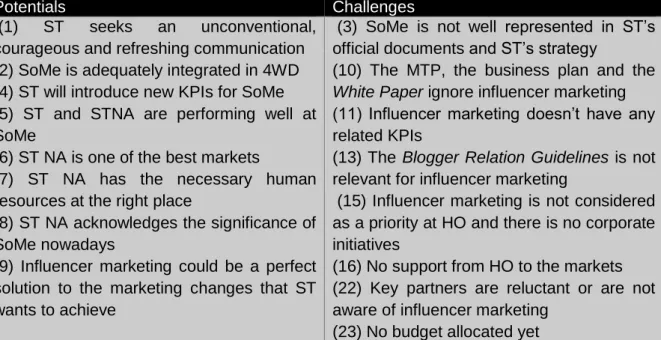
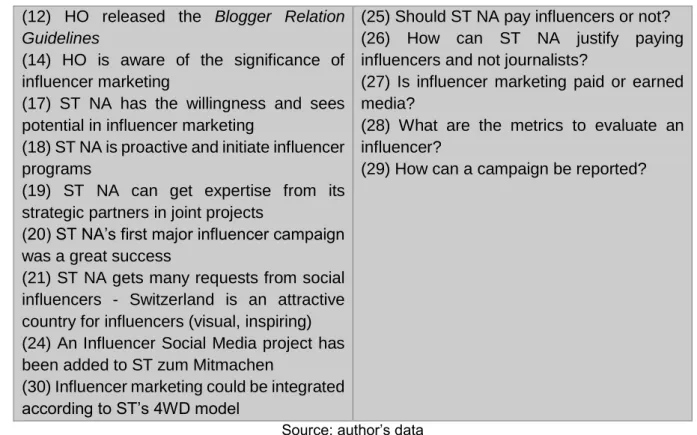
As summarized in table 4, ST NA shows great potential when it comes influencer marketing, but faces several challenges. ST NA has already initiated influencer programs and has some know-how, but there is room for improvement. ST NA expresses the wish to work further with influencer marketing and integrate it on a regular basis. ST NA would like to receive directions on how to work best with social influencers and run efficient influencer programs. This leads to the research question: How should Switzerland Tourism North America optimize working
with social influencers? The objective of this work is to create know-how and to formulate
relevant recommendations tailor-made for Switzerland Tourism North America. These recommendations would use the present potentials and give solutions on how to overcome the challenges of table 4. The results are intended to be applied by ST NA in the first instance, but any findings could also be used by ST HO, other ST markets or any other tourist organizations.
Table 4: Potential and challenges of influencer marketing at ST NA
Potentials Challenges
(1) ST seeks an unconventional, courageous and refreshing communication (2) SoMe is adequately integrated in 4WD (4) ST will introduce new KPIs for SoMe (5) ST and STNA are performing well at SoMe
(6) ST NA is one of the best markets
(7) ST NA has the necessary human resources at the right place
(8) ST NA acknowledges the significance of SoMe nowadays
(9) Influencer marketing could be a perfect solution to the marketing changes that ST wants to achieve
(3) SoMe is not well represented in ST’s official documents and ST’s strategy
(10) The MTP, the business plan and the
White Paper ignore influencer marketing
(11) Influencer marketing doesn’t have any related KPIs
(13) The Blogger Relation Guidelines is not relevant for influencer marketing
(15) Influencer marketing is not considered as a priority at HO and there is no corporate initiatives
(16) No support from HO to the markets (22) Key partners are reluctant or are not aware of influencer marketing
18 (12) HO released the Blogger Relation
Guidelines
(14) HO is aware of the significance of influencer marketing
(17) ST NA has the willingness and sees potential in influencer marketing
(18) ST NA is proactive and initiate influencer programs
(19) ST NA can get expertise from its strategic partners in joint projects
(20) ST NA’s first major influencer campaign was a great success
(21) ST NA gets many requests from social influencers - Switzerland is an attractive country for influencers (visual, inspiring) (24) An Influencer Social Media project has been added to ST zum Mitmachen
(30) Influencer marketing could be integrated according to ST’s 4WD model
(25) Should ST NA pay influencers or not? (26) How can ST NA justify paying influencers and not journalists?
(27) Is influencer marketing paid or earned media?
(28) What are the metrics to evaluate an influencer?
(29) How can a campaign be reported?
Source: author’s data
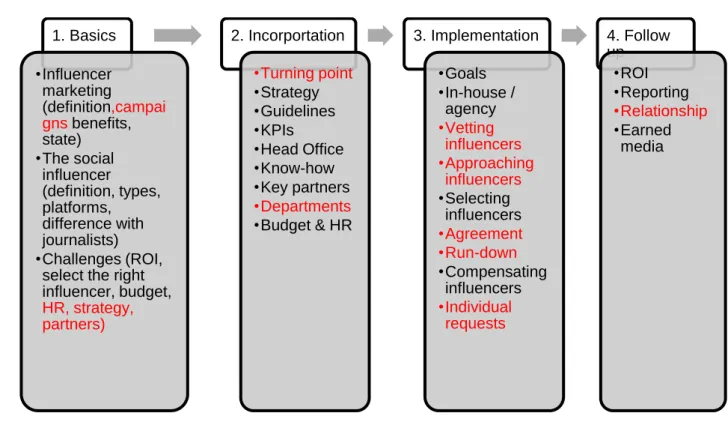
To conclude this section, the key phases-chart (Figure 5) is complemented by the insights of the case study (in red). Firstly, a key phase seems to be missing in the chart: the incorporation-phase. This phase takes place before the actual campaign and focuses on how influencer marketing should be incorporated the roots of a company. The case study mentioned the importance of strategy, guidelines, KPIs, HO, key partners and know-how. Secondly, another key phase seems to be missing in the chart: the follow-up phase. This phase takes place after the actual campaign and focuses on the results. The case study mentioned the importance of earned media and reporting. Moreover, the case study mentions the difference with journalists and the individual requests, added respectively in phase 1 and 4.
19 Source: author’s data
1. Basics •Influencer marketing (definition, benefits, state, industries) •The social influencer (definition, types, platforms, difference with journalists) •Challenges (ROI,
select the right influencer, budget) 2. Incorportation •Strategy •Guidelines •Head Office •Know-how •Key partners •Budget 3. Implementation •Goals •In-house / agency •Selecting influencers •Compensat ing influencers •Individual requests 4. Follow up •Follow-up •Earned-media •Reporting •Measuring ROI
20
Chapter 3 – Methodology
3.1 Explanation of methods and techniques
In order to answer the research question and reach the objectives of this work, the author proposes the following methodologies. A literature review on influencer marketing has been done in chapter one. It provided the important concepts, up-to-date knowledge and the existing findings on the topic. The literature review is accurate but theoretical. In order to balance the lack of practical information, insights from experts and practitioners in the tourism field will be collected. This is why exploratory research will be conducted.
Three relevant groups specific to tourism will be examined. This method has been chosen in order to get in-depth information as well as a deeper understanding of the specific problem. Individual qualitative interviews will be conducted. This method has been chosen in order to get ideas, concepts and attitudes, more relevant to answering the research question than quantitative data. The technique chosen is semi-structured. Indeed, the interviews will be guided by a script but there will be flexibility to skip some parts of the script or to focus on interesting issues. This technique ensures reliable and comparable data. The interviews will be held one-on-one. The interviews will be developed and conducted according to interview guidelines (see Appendix III).
The three groups have been chosen according to relevant insights to answering the research question they are likely to provide. The first group to be examined is composed of National Tourism Organizations (NTOs) or Destination Management Organizations (DMOs). Their structure is similar to ST and ST NA structures and they face the same kind of challenges on a national or regional level. To put it simple, they are ST NA’s competitors. The second group is composed of ST NA’s key partners. There are very important as they are the ones who buy the marketing services. To put it simple, they are ST NA’s clients. Finally, the third group is composed of social influencers, who are most relevant to the core topic.
After the data has been collected, the interviews will be transcripted and the results will be presented in chapter four, analyzed and interpreted in chapter five. In the following chapter, a discussion will compare the findings with the the existing literature. Based on this discussion, recommendations will be formulated.
21
3.2 Sampling
Due to the limited resources and timeframe available for this study, the size of the sampling is small. The samples are selected adequately to get the answers needed for the research question.
3.2.1 Sampling of the first group
The samples for the first group is selected based on different criteria to get valuable input for the final recommendations. The DMOs and NTOs have to have completed successful influencer programs and be considered as exemplary in the field. The selection is made based on three relevant reports and rankings in the digital tourism industry. The first one is the Digital Tourism Think Tank (DTTT), an initiative that “aims at providing thought leadership to the tourism industry in digital marketing best practice.” (Digital Tourism Think Tank, 2015). DTTT released a major report called The European NTO Digital Benchmark which “investigates the use of digital marketing by the European tourism sector, and benchmarks best practice.” (Digital Tourism Think Tank, 2013, p. 3) The second report is from iAmbassador, an organization that “spearheads business development, branding and nurturing and expanding partnerships with regional blogger groups and the tourism industry” and won the Travel Media Awards in 2015. (iAmbassador, 2016) And finally, the third report is from ETourism Monitor, who conducts industry studies within the framework of the Research Institute of Tourism (ITO) of the University of Applied Sciences Valais (HES-SO Valais). (Schegg, s.d.) Tourism and the web is an online magazine which promotes tourism and travel businesses on the Internet. (Roberts, 2015) Ten NTO’s and DMO’s have been selected as ideal candidates for the interviews. (See Appendix IV) Out of the ten, four accepted the interview: Visit Flanders, Promote Iceland, Visit Jordan and Emilia Romagna Turismo.
3.2.2 Sampling of the second group
The sample of the second group, ST NA’s key partners, has been selected regardless of whether they had previously run influencer campaigns or not. If they had, the interview was conducted in a way to gain their insights and to understand their level of expertise. If not, the focus was shifted to understanding the obstacles they face. ST NA works with 12 key partners: Geneva Tourism and Conventions, Lake Geneva & Matterhorn Region, Valais/Wallis, Lucerne Tourism, BE!, Interlaken Region, Jungfrau Marketing, Jungfrau Railway, Bern Region, Gstaad Tourism, Zurich Tourism, Ticino Tourism, Basel Tourism and Engadin St. Moritz. Four of them have been approached and have accepted the interviews: Geneva Tourism & Conventions, Lucerne Tourism, Zurich Tourism and Bern Tourism.
22 3.2.3 Sampling of the third group
The sample of the third group consists of influencers who are open to working with destinations and match the ST brand. Having their insights will help to formulate the recommendations. The selection was made based on the expertise of ST NA media department, on the list of the Top 8 Digital Influencers for Travel done by DCI in 2014, (DCI, 2014) and on The Social Travel Summit (STS). STS is an “exclusive annual 2-day gathering of travel & tourism professionals, leading travel bloggers & online influencers from around the world”. (The Social Travel Summit, 2015, p. 0) It is an initiative of iAmbassador in collaboration with Reiseblogger Kollekitv and Traveldudes, and the bloggers and influencers in attendance “are specially selected based on the high quality of the content produced, online reach and track record in working with the tourism industry.” (The Social Travel Summit, 2015, p. 0) 13 influencers have been selected as ideal for the interviews (see Appendix IV). Out of the 13 subjects contacted, three accepted the interview: Scott Kranz, Rob Sese and Erin Faherty.
3.3 Construction of the questionnaires
Three different questionnaires are constructed for the three different groups (see Appendix V A, B, C) but all of them follow the same structure. The questions are based on the concepts of the key phases-chart 2 (Figure 5). Each interview has an average of 15 questions, which will vary in the course of the interview according to the time available and the attitude of the interviewee. In order to get the best insights possible, the questionnaire starts with general and factual questions, which are easy to answer, in order to make the interviewee confident. It will then move to more personal and smart questions. The questionnaires has three parts. The first part focuses on the functioning of the company. The second part goes deeper into the topic and is meant to get insights on experience, opinion, feelings and knowledge. The last part is more personal and focuses on recommendations and tips the interviewee could provide to ST NA. The main goal of the questionnaire is to get insights and suggestions on how ST NA can optimize working with social influencers.
3.4 Data collection
The data will be collected and gathered by the author. All the interviews will be recorded and transcribed manually (See Appendix VI). The author will transcribe everything that is linked to the topic and helps to answer the research question. Answers unrelated to the topic will be left out. The final transcript is an organized and cleaned-up version of the interviews.
Lauriane Zosso Bachelor Thesis
23
Chapter 4 – Presentation of results
This section presents the data collected. A manually approach is considered as the best way to sort out the data in order to obtain usable information. The data were reduced a first time, to key sentences. (See Appendix VIII) Then, the data were reduced a second time to keywords, as shown on tables 5-6-7-8-9. The data are sorted into a framework. The groups of interviewees are featured on the X-scale. The second group - the Swiss key partners – is divided in two sub-groups (active and non-active in influencer marketing) to avoid false interpretation. The topics are classified on the Y-scale according the key-phases chart 2 (figure 5). During the interviews, new relevant topics were mentioned. They were added in each key-phase. Each data that is relevant to answer the research question is classified in the framework. The author opts for a tabular presentation in order to have an understandable form and a better overview of related ideas. The objective of this table is to reduce data, summarize, and identify elements of each source corresponding to the concepts. In order to simplify or group similar pieces of information, some data will be coded. (See Appendix VII)
Lauriane Zosso Bachelor Thesis
24 Table 5: Simplified results - Basics
DMOs
ST Swiss key partners
Active in influencer marketing Non-active in influencer marketing
1. B as ics Influencer marketing: definition
A1: Work with intermediary/ambassador with expertise and reach to influence specific target group.
A3: People as power of media.
Influencer marketing: campaigns
A1: Blogger trip AA1, inf. for special events. Focus on experiences rather than destination. Joint campaigns. A2: Instagram takeovers, digital talks, joint campaigns. A4: Blogger campaign AA4 repeated every year
B1: Instameet with big inf. with 1 day open to public. 2 editions.
B3: Bloggers trip to promote a package
B2: Nothing so far
B4: Nothing. Just support city Instameets.
Influencer marketing: benefits
A1: People tell your story. Cheap. Added value. Niche A2: Great ROI.
A3: Other people tell your story.
Influencer marketing: state
A1: Raise of awareness + initiatives after AA1 among TB. B1: Slow growth, contacted by other TB for advice.
B3: Uneven growth. Good overall.
B2: Low awareness internally, will grow.
B4: Low awareness internally. Social
influencer: diff with journalist
A1: Inf. shouldn’t replace journalists, diff attitudes, needs A4: Inf. need more freedom, time, flexibility. Increase of inf-journalists.
B1: Difficult because inf.-journalists. Difference of approach, input, output.
B2: Big question
B4: Similar, few differences.
Challenges A1: Measuring ROI, collaboration with partners
A2: Bureaucracy, saturated market, select the right inf.
B1: Who is the biggest
B3: Collaboration with partners
B2: Limited HR, lack of strategy, select a good inf, measuring ROI, quality check, different markets. B4: Limited HR+budget, top-down decisions, lack of SoMe,know-how and support
Source: Table by the author with multiple sources
A1: (d'Haen, 2016) A2: (Jervis, 2016) A3: (Guðjónsson, 2016) A4: (Montemaggi, 2016) B1: (Seitz, 2016) B2: (Gerardi, 2016) B3: (Fredricks, 2016) B4: (Schaffner, 2016)
25 Table 6: Simplified results - Incorporation
DMOs
ST Swiss key partners
Active in influencer marketing Non active in influencer marketing 2. Inc orpo ra ti on Turning point
A1: Change of strategy, AA1, look for people to tell our story A2: Arab Spring.
A3: Volcano eruption. Need to find a quick solution. A4: Example of Costa Brava, AA4, inspiring people.
B1: New employee
Strategy A1: New strategy with content & conversation dept. A3: New organization: use people as the power of media. A4: Be proactive, approach HO, adjust strategy.
B2: Still no strategy.
Head Office A1: Model role to partners, share learnings, bigger budget. A2: Improve communication and mutual understanding A4: Crucial: leader, proactive, educate. Bring IM from market
Know-how A1: co-worker, conferences, industry reports, learning by doing, keynote speakers, consultants, agencies, guidelines
A2: partners, travel associations, no guidelines
A4: employee, no guidelines because small but big should
B1: Instameets, learning by doing, internet, conferences, employee, no guidelines, cbc B3: conference, internal meeting, internet, guidelines, cbc
B2: peers, no guidelines would like some
B4: conferences, peers
Partners A1: Educated and aware thanks to AA1 A2: No partners.
A4: Intense collaboration to know their ROI
B3: Partners to educate
Departments A1: Content & Conversation Dept, intense collaboration. A2: Communication & PR. Integrate trade !
A4: Digital media dept, intense collaboration. Integrate trade!
B1: Media and SoMe dept, confusion, lack of collaboration B3: Media dept, intense collaboration with digital dept
B2: Media and digital dept, not enough collaboration B4: Limited HR (1 online, 2 traditional press)
Budget/ HR A2: If limited budget, be creative. A4: Try, invest, shift budgets
B1. Good budget, more to come B4: Limited budget+HR: work with inf.- journalists. Source: Table by the author with multiple sources
A1: (d'Haen, 2016) A2: (Jervis, 2016) A3: (Guðjónsson, 2016) A4: (Montemaggi, 2016) B1: (Seitz, 2016) B2: (Gerardi, 2016) B3: (Fredricks, 2016) B4: (Schaffner, 2016)
26 Table 7: Simplified results - Implementation
DMOs
ST Swiss key partners Active in influencer marketing
3. Imp lemen tat ion Goals and objectives
A3: Fight decline of tourists, fight seasonality, emotional connection, fight regionality, sustainability.
B1: Say thank you to community. KPIs A1: Content, tweets, reach, fans, engagement, conversations, actions,
emotional reactions, media value
A2: Images, samples, links, videos, engagement, impressions, views, clickthroughs, sweepstakes, sign ups, traffic, content
A3: Likes, comments.
B1: Fan, followers, likes, reach (selection of inf. based on KPIs)
B3: Engagement, content, depends a lot on the platforms.
In-house /Agency
A1: Agency for AA1 because lack of expertise and network. Challenge: markets want to get involved
A2: Never, waste of money.
A4: In-house when AA4 small. Agency when AA4 big.
B1: SoMe dept in-house or inf. Media Dept both. B2: Both.
Vetting the influencers
A2: Keep them on file, seek them out Approaching
influencers
A1: Approach inf. in the same way if groups. Easy going, first match per email, than meet in real life.
Selecting influencers
A1: Crucial for success. Hard because standards fluctuate. Quality over quantity, relevance & reach,no cloudscore, match, engagement, conversations, analytics, kind of content, amount of content, quality of content, style, understand the value, language (not market!)
A2: Crucial for success. Quality over quantity, engagement, focus, niche, followers, experience with tourism, reputation in industry, qualification for, final report delivery, no general inf.
A3: Anybody who loves Iceland: friends, locals, dreamers. Locals are the best storytellers. Quality over quantity, matching topics, common sense. A4: Hard to standardize criteria. Quality over quantity, style, quality of content, professional, business-orientation, commitment, true interest, added value, niche, analytics, no media kit.
B1: All about numbers, followers, engagement, quality of content. Does the inf. is famous, has agent, ask for money? No small inf.
B3: Assessment, Alexa.com, Followerwonk, interests, fit guidelines, target audience,
segmentation, not too demanding, type of content, no political conversations, small (not huge)
27 Agreement A1: Yes, together with inf., expectations, input, output, flexible
A2: Yes, right for pictures, videos etc… A3: Flexible, inf. are creative.
A4: Yes important, deliverables, expectations
B1: Yes, if big inf.
Run-down A1: Booklet with hashtags, storylines, did you know's, phone numbers. Goal: nice moments, feel welcome, flexibility. Meet other inf., locals for insider tips
A2: Depends, road trips, personal guide A3: Flexible, not too many restrictions
A4: Flexible, nice moments, platform to share, bring people together.
B1: Photo spots, no tight schedule, time of sunsets/sunrises.
B3: If campaign, we come up with concept. If individual inf., no specific concept, flexibility
Compensati ng the influencer
A1: Big question. No money but strong on-site experiences, flights, ground expenses. Reason: true ambassadors, no bought spokespeople. If no money, not too high expectations
A2: No money but flights, ground expenses, additional costs. Reason: we provide them content/stories. Inf. should get money from private sectors A3: Money, flights and ground expenses.
A4: Process in evolution. In the past, just accommodation. Now inf. have the right to be paid. Reason: inf. are their own brand, good work,
professional, to say thank you, right to require quality and deliverables, establish long-term relations. Stay flexible. Money is not to push them to tell smthg but to give them a framework.
B1: Big inf.: money, flights and ground expenses. Small inf.: no money, accommodation, pay everybody in 2017 if more budget
B3: No money but on-site experiences, ground expenses and flights depending on the partners. Reason: no budget.
DMOs
ST Swiss key partners
Active in influencer marketing Non active in influencer marketing
Individual requests
A1: Accept only if fits calendar and niche. Refuse general bloggers. Provide public transportation/free entrances for already planned trips. A2: Accept only if niche.
A3: Great added value to campaign of the year. A4: Go through evaluation process.
B3: Cbc B2: Ask ST markets for advice. B4: Accept if from ST markets. Integrated in press groups.
Source: Table by the author with multiple sources
A1: (d'Haen, 2016) A2: (Jervis, 2016) A3: (Guðjónsson, 2016) A4: (Montemaggi, 2016) B1: (Seitz, 2016) B2: (Gerardi, 2016) B3: (Fredricks, 2016) B4: (Schaffner, 2016)
28 Table 8: Simplified results - Follow-up
DMOs ST Swiss key partners
Active in influencer marketing Non active in influencer marketing
4. Fo ll o w -up
Relationship A1: Crucial. Keep network alive, transfer contacts. A2: Depends because understaffed. Some inf. become ambassadors by themselves. Be consistent, maintain partnerships, re-share inf.’s content.
A4: Crucial. Cultivate relationships, long-term.
B1: Not long-term except for local inf. B3: Re-share inf.’s content
Reporting A2: Reporting from inf + own reporting with tool. A4: Inf. should do reporting if smart enough. Sometimes hard because constantly traveling.
ROI A1: Formula: sum of contents + media value + score on Facebook + conversation value / total cost.
A2: Not 100% accurate. Final report with engagement, posts, analytics.
A3: Very hard. How to evaluate stimulation of a demand? In process.
A4: Added value: corporate content, feedback to adjust offers, new ambassadors, conversions seen by partners Not immediate. Numbers: hashtag trackers, advertising value equivalent, impressions.
B1: Manually calculate likes. B2: Specific tools.
Earned or
paid media A4: IM is paid media
Source: Table by the author with multiple sources
A1: (d'Haen, 2016) A2: (Jervis, 2016) A3: (Guðjónsson, 2016) A4: (Montemaggi, 2016) B1: (Seitz, 2016) B2: (Gerardi, 2016) B3: (Fredricks, 2016) B4: (Schaffner, 2016)





![Figure 1: Entering blogs in the media database. [Sonstiges = Other]](https://thumb-eu.123doks.com/thumbv2/123doknet/14939494.666378/92.892.105.812.871.1040/figure-entering-blogs-media-database-sonstiges.webp)