The brow-antlered deer
in Burma—its
distribution and status
Richard E. Salter and Jeffrey A. Sayer
Two of the three subspecies of brow-antlered deer are endangered and only the Burmese subspecies is still relatively abundant. Even so, it is a species of major concern in Burma. The authors describe the results of their surveys to determine the deer's status, the main threats to its survival and what needs to be done to
conserve it.
The brow-antlered deer Cervus eldi was formerly distributed across much of peninsular South-East Asia, from north-eastern India through Burma, Thailand and Indo-China, to the island of Hainan (China) in the east. As a result of a general decrease in range and numbers, it has been listed on Appendix I of the Convention on International Trade in Endangered Species of Wild Fauna and Flora (CITES, 1983), and two of the three sub-species are considered to be endangered (Anon., 1978). The Manipur subspecies C.e. eldi is now confined in the wild to Keibul Lamjao, a 40 sq km national park in north-eastern India (Singh, 1980). Similarly, the range of the Thai and Indo-Chinese subspecies C.e. siamensis has con-tracted considerably as a result of uncontrolled hunting and destruction of habitat (Anon., 1978). This subspecies is now very probably extinct on Hainan and is considered to be threatened with extinction (if not already extinct) in Thailand and Vietnam; its status in Kampuchea (Cambodia) is unknown (Lekagul and McNeely, 1977; Anon., 1978; Sayer, 1980).
Only the Burmese subspecies C.e. thamin is still relatively widespread and abundant, although quantitative data necessary for conservation planning are lacking. During the recent (July
Brow-antlered deer in Burma
1981-July 1984) United Nations/Government of Burma Nature Conservation and National Parks Project, the brow-antlered deer was identified as a species of major concern, and we conducted a detailed review of its conservation requirements. In this paper we summarize the current status and distribution of this species in Burma, based on a review of available literature and of unpublished data in Burma Forest Depart-ment files, on interviews with local residents, and on field surveys in known concentration areas and elsewhere in the country.
Distribution and habitat use
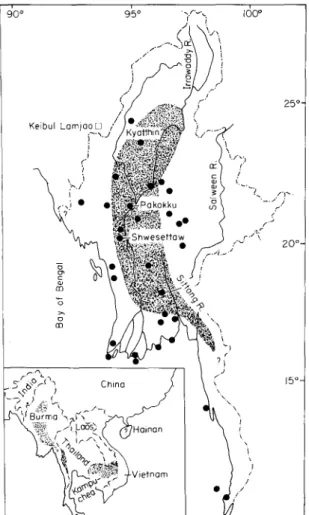
Brow-antlered deer are confined primarily to the plains of central Burma, their range centring on the Irrawaddy Plain but including the Pegu or Sittang Plain to the east (Figure 1). They are absent, however, from all but the fringes of the intervening Pegu Yoma, a range of hills running north-south between the Irrawaddy and Sittang rivers. This current distribution is similar to the historic range of the species as outlined by Peacock (1933), although local distribution is becoming increasingly fragmented as a result of habitat changes. We also had reports of brow-antlered deer in the Paan (lower Salween) district of northern Tenasserim, in which region the Burmese subspecies is also known from the Thai side of the border (Lekagul and McNeely, 1977). Outlying populations were formerly found along the Burma—Bangladesh border (Christisen, 1945) and in the Southern Shan States of east-central Burma, but their present status is unknown.
100°
25°-
20°-
15°-Figure 1. Approximate range of the brow-antlered deer in Burma (shaded area) and world range of the species (inset). Solid circles indicate areas visited by project personnel to obtain local data on wildlife populations and land use.
The primary range (between Shwesettaw and Kyatthin; Figure 1) largely coincides with the Dry Zone of central Burma, the hottest and most arid region in the country with an annual average rainfall of 500-1300 mm and maximum temper-atures of over 40°C. Rainfall increases con-centrically from the Dry Zone to an annual average of 1800-3600 mm at the outer edge of the brow-antlered deer range. Vegetation cover over the range as a whole is a mosaic of culti-vation, deciduous forest and scrub, all developed on generally flat to gently rolling terrain less than 300 m (1000 ft) above sea-level. The major forest type is deciduous dipterocarp forest (locally
242
known as indaing forest), generally featuring an open understory and dominated by
Diptero-carpus tuberculatus, Shorea oblongifolia and Pentacme siamensis, although forest
com-position, structure and height vary locally with climatic conditions and extent of human exploitation. Virtually all of the area has long been subject to various forms of human land use, including dryland cultivation, selective felling for firewood and building materials, livestock grazing and annual burning to promote forage growth. Vegetation cover of areas currently occupied by brow-antlered deer varies from heavily degraded, desert-like scrub and thorn forest (as over much of the central Dry Zone), to low, scattered to open deciduous forest (as at Shwesettaw Wildlife Sanctuary, where tree height in the main brow-antlered deer habitat is generally less than 6 m), to taller, open deciduous forest interspersed with seasonally flooded grasslands (as at Kyatthin WS, where forest canopy height is generally 6-12 m). Populations occupying (or formerly occupying) outlying areas reportedly occur in similar habitat, such as scrub jungle with open grassy areas in the foothills of the west coast (Christisen, 1945). Brow-antlered deer apparently avoid dense forests and steep, hilly areas (Evans, 1912; Hardiman, 1912; Peacock, 1933) and are absent from large areas of the country with a pre-dominant cover of tidal/swamp forest or tropical, hill or temperate evergreen forest. This gross pattern of habitat occupation by the Burmese subspecies is similar to that of C.e. siamensis, which is found in association with open plains and deciduous forests of dry, undulating country (Lekagul and McNeely, 1977; Anon., 1978; Sayer, 1980), but differs from that of the Manipur subspecies, the habitat of which consists of floating grass/reed swamps and adjacent hillocks (Gee, 1961; Ranjitsinh, 1978; Singh, 1980). However, because of the extremely limited distri-bution of the latter subspecies, it is unknown whether this is preferred or enforced habitat.
Population size and trend
Our surveys of areas occupied by brow-antlered deer were largely of a reconnaissance nature and focused on determining the general status of the species rather than generating density data;
<**?«*•
J&$4H
'* \*
<W?K
*
V-
^t'.
*v-'*.* H'- Is ' C W ^ * - . ,; ;. if '.-->' 4 • tsi'^^t
Brow-antlered deer in Delhi Zoo, India (WWF/Peter Jackson). hence, we are unable to offer a defensible
country-wide population estimate. However, we did conduct population surveys in Kyatthin WS as a component of a draft management plan, and the resultant data provide a starting point for assessing population size. The survey was con-ducted during 30 March-5 April 1983 and consisted of ground-based counts of deer along straight-line transects located at 1.5-km intervals across the southern half of the sanctuary. The
Brow-antlered deer in Burma
area covered was calculated by multiplying the transect length by twice the mean sighting distance (Hayne, 1949; Eberhardt, 1978). Based on observations of 147 deer (in 29 sightings), a mean sighting distance of 109.8 m and a total transect length of 80.6 km, we calculated density as 8.31 brow-antlered deer per sq km and the total population in the 268.2 sq km sanctuary as 2229 animals. This figure is much higher than previous population estimates (150 in 1937,50 in 243
1945-46, 80 in 1948-49, 150 in 1951-52, 500 in 1956, 69 in 1980, 200 in 1981), but this apparently is due to the subjective nature of the previous estimates and should not be taken as an indication of population growth.
Our 1983 survey, and a reconnaissance survey covering the same area in early April 1982, coincided with the end of the rutting season, during which period the normally solitary adult males are found in herds of mixed sex and age (Peacock, 1933). Virtually all of the single animals that we observed (18 out of 20) were adult males, but one or more adult male(s) also commonly consorted with females (in 17 out of 44 fully identified groups of two or more) or with females and juveniles (eight groups). Females were also seen alone (in 10 groups of one to five animals) or accompanied only by juveniles (eight groups). The socionomic sex ratio (adult males:females: juveniles) in 63 fully identified groups was 1:1.59:0.54. In a total number of 89 groups in the 1982 and 1983 reconnaissance sightings and 1983 transect study, we found that group size varied from one to 20 animals, with a mean of 3.8.
We did not extrapolate the Kyarthin data to derive a country population estimate because the nominally protected, largely intact Kyatthin area is not representative of habitat across the total brow-antlered deer range. However, the data do suggest that existing country-wide population estimates (3000-3500 in 1955, 3000 in 1960-61, 2200 in 1980-81), which are based solely on the opinions of local Forest Officers, must under-estimate true population size; at best these estimates provide an indication of areas of con-centration and of gross population trends. These data, taken with other information gathered during our surveys, suggest a still widespread but probably declining population.
Conservation
Brow-antlered deer have long been subject to habitat loss and to indiscriminate hunting pressure (Evans, 1912; Williamson, 1929; Peacock, 1933; Wilkie, 1934; Talbot, 1960; Milton and Estes, 1963), despite the formerly widespread belief that eating the meat caused leucoderma and venereal disease (Talbot, 1960).
244
Peacock (1933) considered the situation so serious that, unless suitable sanctuaries were established, the species would become extinct in Burma. Subsequently, the Shwesettaw WS (552 sq km, notified in 1940) and the Kyatthin WS (notified in 1941) were both established specifically for brow-antlered deer conservation. The Burmese subspecies was placed on the inter-national list of threatened mammals in 1948, but as a result of new population estimates it was removed in 1956 (Talbot, 1960); in the same year it was added to the list of completely pro-tected species in Burma via an amendment to the 1936 Burma Wild Life Protection Act.
Hunting continues to be a problem in the con-servation of this species, despite its officially protected status. Total offtake is unknown, but Milton and Estes (1963) provided estimates of two to three (maximum 25) per day in the central Dry Zone, and according to reliable sources up to 21 animals have been killed in a single day in Kyatthin WS. Recent incidents of poaching have also been reported from Shwesettaw WS and elsewhere, and brow-antlered deer meat is readily available in local market towns. Villagers, military personnel and other official gun-holders are all reportedly involved in hunting activities. Brow-antlered deer are also captured alive and smuggled into Thailand where they fetch high prices in the zoo trade; at least two incidents of this nature have been documented in the Pakokku area. Although illegal harvesting of this species is clearly widespread, it is virtually impossible to delimit the extent of such activities, and, in the absence of reliable population data, to determine their impact on brow-antlered deer population levels.
Similarly, although areas occupied by brow-antlered deer—including Kyatthin WS and Shwesettaw WS, the major protected areas—are increasingly being penetrated by road networks and converted to agricultural use, and are being subjected to increasing levels of fuelwood extraction and livestock grazing, the effects of such activities are difficult to determine. Brow-antlered deer are widely reported to feed on agricultural crops, and a certain amount of agriculture within an area may thus actually increase the carrying capacity. Annual burning of
forest litter may also increase carrying capacity by removing moribund, indigestible material and encouraging fresh forage growth. Disturbed subclimax habitat may thus support a greater density of deer than would habitat in an undisturbed climax state, but the types and extent of habitat disruption that can be tolerated, and their ultimate effects on population dynamics, are as yet poorly understood.
Conclusions
Available information suggests that a large population of brow-antlered deer, probably numbering several thousand animals, remains in Burma. Considering the presently restricted range of the species, Burma certainly has the best and perhaps the only remaining opportunity in the world for its conservation. Nevertheless, given the current pressures from hunting and habitat loss, we believe that even the Burmese sub-species C.e. thamin should be considered vulnerable.
The present approach to brow-antlered deer con-servation in Burma, which focuses primarily on prohibition of hunting, is largely ineffective due to enforcement problems. In any case, this approach by itself is probably inappropriate, as most cervid populations are relatively prolific and can withstand a degree of hunting pressure given adequate habitat. The major conservation problem appears to be one of widespread habitat fragmentation exacerbated by harvesting of animals from declining local populations, rather than hunting perse. The most fruitful approach to brow-antlered deer conservation would therefore be the control and management of adequate areas of habitat, such as those that still exist in and around Kyatthin WS, complemented by inte-gration of habitat management with other forms of land use throughout the range, and continued control of hunting where possible. However, additional fine-scale data are needed on the habitat requirements of this species and on its population dynamics to guide management prescriptions.
Acknowledgments
The information reported here was developed while the authors were attached to the Burma Nature Conservation and National Parks Project, a jointly funded project of the United Brow-antlered deer in Burma
Nations Development Programme and the Government of Burma implemented by the Food and Agriculture Organization of the United Nations. We thank J. H. Blower and M H. Woodford of FAO for the information that they contributed, and the many local officers of the Nature Con-servation and National Parks Project and the Burma Forest Department who both participated in our site surveys and obtained local data. We also thank J. A. McNeely for his comments on the manuscript.
References
Anon. 1978. Red Data Book. Volume 1: Mammalia. International Union for Conservation of Nature and Natural Resources, Morges.
Christisen, A.F.P. 1945. The distribution of thamin. J. Bombay not. Hist. Soc. 45,603-604.
CITES. 1983. Convention on International Trade in Endangered Species of Wild Fauna and Flora. Appendices I and II as of 29 July 1983. International Union for Conservation of Nature and Natural Resources, Gland. Eberhardt, L.L. 1978. Transect methods for population
studies. J. Wildl. Mgmt. 42,1-31.
Evans, G.P. 1912. Big-Game Shooting in Upper Burma. Longmans, Green and Co., London.
Gee, E.P. 1961. The brow-antlered deer of Manipur. Oryx. VI, 103-115.
Hardiman, J.P. 1912. Lower Chindwin District. Burma Gazeteer, Government Printing Office, Rangoon. Hayne, D. W. 1949. An examination of the strip census
method for estimating animal populations. J. Wildl. Mgmt. 13,145-157.
Lekagul, B. and McNeely, J.A. 1977. Mammals of Thailand. Association for the Conservation of Wildlife, Bangkok. Milton, O. and Estes, R.D. 1963. Burma Wildlife Survey.
1959-60. Special Publ. No. 15, American Committee for International Wild Life Protection, New York.
Peacock. E.H. 1983. A Game-Book for Burma and Adjoining Territories. Witherby, London.
Ranjitsinh, M.K. 1978. The Manipur brow-antlered deer (Ceruus eldi eldi)—a case history. Pages 26-32, In Threatened Deer. Proceedings of a Working Meeting of the Deer Specialist Group of the Survival Service Commission, Longview, Washington. International Union for the Conservation of Nature and Natural Resources, Morges.
Sayer, J.A. 1980. Captive breeding of the Thailand brow-antlered deer (Cervus eldi siamensis). Tigerpaper. 7(4), 11-12.
Singh, A. 1980. World's most endangered mammal— Manipur brow-antlered deer (Cervus eldi eldi). Tiger-paper. 7(2). 26-27.
Talbot, L.M. 1960. A look at threatened species. Oryx, V, 153-293.
Wilkie, R.S. 1934. Yamethin District. Burma Gazeteer, Government Printing Office, Rangoon.
Williamson, A. 1929. Shwebo District. Burma Gazeteer, Government Printing Office, Rangoon.
R. E. Salter, c/o 9326 169 Street, Edmonton, Alberta T5R
0A8, Canada.
J. A. Sayer, IUCN, 1196 Gland, Switzerland.