Soil fertility management for organic rice
production in the Lao PDR
W. Roder
1,*, S. Schu¨rmann
2, P. Chittanavanh
3, K. Sipaseuth
3, and M. Fernandez
41
CIP/CFC, PO Box 670, Thimphu, Bhutan.
2
Swiss College of Agriculture, Zollikofen, Bern, Switzerland.
3
Project for the Promotion of Organic Farming and Marketing in Lao PDR, Vientiane, Lao PDR.
4
Project Promotion of Organic Rice from Lao PDR, Vientiane, Lao PDR. *Corresponding author: [email protected]
Accepted 23 March 2006 Research Paper
Abstract
Rice is the most important agricultural commodity of the Lao People’s Democratic Republic (Lao PDR), produced largely using traditional methods with limited inputs of fertilizers and other chemicals. The country has a wide diversity in rice production systems and rice varieties, with over 3000 different varieties recorded. The rich diversity and the production environment and methods are favorable for organic rice production. Investigations were carried out to describe soil fertility conditions, management practices, opportunities and problems associated with organic production methods for rice. Soils used for rice production are mostly of low fertility, with low organic matter and N-availability. In spite of this, virtually no fertilizer inputs are used for upland rice production. Inorganic fertilizer inputs for lowland rice production have increased rapidly over the past decade, but are still below 20 kg ha-1. The most important nutrient sources are rice straw and manure from buffalo and cattle. Chromolaena odorata plays an important role in nutrient cycling in upland rice systems and is sometimes added to lowland fields. In a range of fertility management studies, yield increase ranged from 2 to 89% for manure, straw or rice husk applied at modest rates (3 t ha-1), 32–156% for modest rates of inorganic fertilizer (60 kg N ha-1) and 36–167% for combined application of manure or crop residues with inorganic fertilizer. The response to locally produced commercial organic fertilizer was poor. The most promising inputs and strategies available to optimize yields in organic rice production systems are (1) optimizing use of locally available nutrients, mostly from manure, crop residues and weed biomass, (2) N addition through green manure and legumes growing in rotation and (3) additions of P through guano or rock-phosphate. The Lao PDR is fortunate to have substantial bat guano deposits in limestone caves. Extensive experience is available on straw and husk management for lowland systems and green manure species for upland production systems.
Key words:manure, rice straw, rice husks, organic fertilizer, rock-phosphate, guano, green manure species
Introduction
Rice is by far the most important crop for the Lao People’s Democratic Republic (Lao PDR), grown on more than 700,000 ha annually. Based on water management, the rice-growing areas are grouped into rainfed lowland, irrigated lowland and upland rice; each of these represents approxi-mately 75, 10 and 15% of the total area under rice1. Rice yields are generally low with a national average of 3.4, 4.5 and 1.8 t ha-1for rainfed lowland, irrigated lowland and upland, respectively1. Most of the rice varieties are glutinous. Lao rice producers generally consider the absence of a market or the low market price as the main factors limiting production (Helvetas, 2005. ProRice— Phase I, 2006–2008. Project Document, Vientiane, unpub-lished). At the same time, the production of speciality rice
and/or organic rice for export markets is often seen as a potentially promising opportunity2. Within the past few years, the interest for organic production and expectations from market opportunities for organic products from the Lao PDR have increased rapidly3. The Ministry of Agriculture and Forestry and various projects and organiza-tions are promoting organic production methods for market production and for home consumption. Prevailing condi-tions favoring organic rice production generally recognized include: (1) many rainfed rice production environments are marginal with limited response to high yielding varieties and high input systems; (2) Lao rice producers presently use only limited fertilizer inputs; and (3) traditional production methods still widely used are largely organic (Helvetas, 2005. ProRice—Phase I, 2006–2008. Project Document, Vientiane, unpublished).
In the European or North American context, organic agriculture with annual crops is mostly based on mixed farming systems with legumes in the rotation and high inputs of manure. Under European conditions, cereal grain yields from organic production systems are about 10–30% lower when compared to conventional systems. Further-more, studies comparing organic and conventional pro-duction have generally used the same rates of N provided either through manure or compost for organic treatments or through inorganic fertilizers with or without manure for conventional treatments4,5. With N application rates of 100 kg and above, manure applications for organic treatments are in the range of 10–20 t ha-1.
Soil fertility management will be a major challenge for organic rice production in the Lao PDR. The European and North American experiences will have only limited application as the Lao rice farmers will not have the benefits of a mixed farming system nor will they have access to the required quantities of manure. Substantial information on soil fertility management, the use of organic fertilizers, residue management and green manure has been generated under Lao conditions; some of these results and experiences can be directly applied for organic production. Investigations were carried out with the objectives to: 1. describe current soil fertility conditions and
manage-ment practices for the major Lao rice production systems,
2. summarize experimental soil fertility management data relevant for organic rice production in Laos, and 3. describe inputs available and recommendations given
for soil fertility management in organic production systems.
Methods
Locally available source of inputs
Information on existing and potential locally available sources for soil fertility management in organic agriculture was collected from the literature and contacts with input suppliers and fertilizer factories.
Literature review and secondary data
Documents and information relating to fertility manage-ment in general and the use of organic inputs in particular were collected from published and unpublished sources.
Survey of rice producers
An economic survey was carried out in 2004, in three districts of Champasak province in collaboration with the Provincial Agriculture Service. Formal survey question-naires were used to collect production and economic data. For the present paper, only the cost of inputs and rice yields were used.
Studies by Lao-IRRI project and others
From 1990–2002, the Lao-International Rice Research Institute (IRRI) project carried out a range of studies evaluating the effect of organic fertilizer, manure, rock-phosphate, straw applications and green manure in lowland and upland rice production systems across a range of environments6–14. The results available in annual reports were revisited and summarized.
Survey organizations recommending
organic agriculture
Information was collected from non-government organi-zations which recommend organic agriculture or ‘clean agriculture’ through informal interviews supported by questionnaires.
Results
Soil fertility and current management practices
for lowland rice
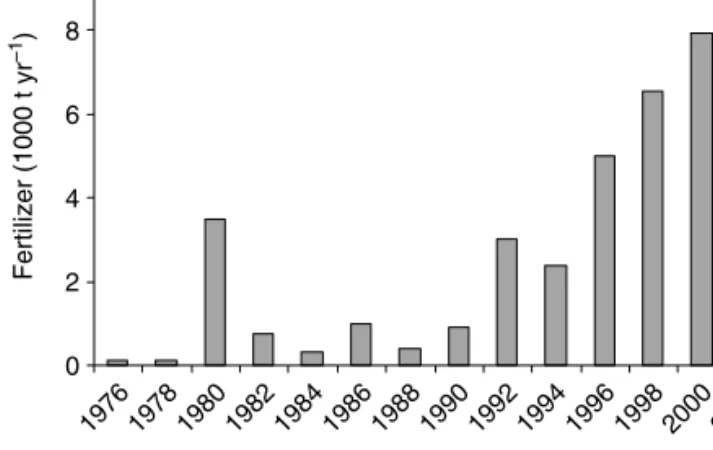
Lowland rice soils in the southern part of Laos are predominantly Acrisols15. Typically, these soils are highly weathered, have a low inherent fertility, a low pH and a low cation-exchange capacity. Soil data (0–20 cm) indicate that 80% of the soils in the south contain less than 2% organic matter, 68% are coarse textured sand and 87% have a pH of less than 5.5. Of all the elements tested, N was the most important yield-limiting factor but the severity varied considerably between sites15. The second most limiting factor was P, with 71% of the sites in the south and 37% of the sites in the north responding to P application. In spite of the low fertility, using chemical fertilizer for rainfed lowland rice production is a recently introduced practice for Laos. In a survey conducted in 1996, 60% of the farmers reported that they started using fertilizer only after 199516. In the past ten years, fertilizer consumption has increased rapidly (Fig. 1), but based on the FAO statistics17 the average fertilizer consumption is still < 10 kg ha-1 land
0 2 4 6 8 10 1976 1978 1980 1982 1984 1986 1988 1990 1992 1994 1996 1998 2000 2002 Fertilizer (1000 t yr –1 )
Figure 1. Fertilizer import (each bar represents the average of the year indicated and the year before17).
cultivated. In the survey in Champasak province, only three out of 196 households surveyed used no fertilizer for rainfed rice production. There was a strong relationship between investment in fertilizer and rice yield (Fig. 2), but the data also show that there was little return for investments in fertilizer above US$20 ha-1.
Soil fertility and current management practices
in upland rice
Upland soils are generally poor, mainly red–yellow, podzolic and reddish brown lateritic, leached and acidic, with low water-holding capacity18. Soil fertility is generally cited as a major constraint in upland rice production. Yet, extensive investigations focusing on soil-related factors that may affect rice yield failed to show a conclusive relation-ship between conventional soil fertility parameters and rice yield, and fertilizer applications did not show consistent results18(Table 1). In spite of the inconsistent response, N clearly limits rice yields. N-stress is especially likely to affect yield during the later part of the growing season as indicated by a strong relationship between leaf chlorophyll at the time of flowering and yield18. Application of P resulted in increased P uptake of 38% but had no consistent effect on grain yield19. Upland rice producers presently do not apply any fertilizer or manure. With a gradual decline in the level of organic matter because of shorter fallow cycles, it is expected that N stress may become more pronounced. For sustained upland rice production, it will be important to limit N and organic matter losses and to provide sufficient N during the critical stages of the rice crop through N-rich residues of forages/crops grown in rotation and/or appropriate fertilizers.
Various studies focused on the effect of residue management on rice yield, weed biomass and other parameters18,20,21. Although drought is considered a major yield constraint, no positive short-term benefits of mulching on grain yield could be demonstrated except in a study involving mulching with pigeonpea (Cajanus cajan)
residues22(Table 2). Burning of crop and fallow vegetation residues consistently reduced weed biomass and made field preparation easier21.
Nutrient sources for organic production
Lao rice producers mostly rely on the production capacity of their soils. Until recently, limited quantities of nutrients were added through manure or inorganic fertilizers and, before 1980, the quantities of chemical fertilizers imported were negligible17. Rice producers generally do not optimize the benefits from manure and crop residues. Straw removed at harvest is often burned after threshing or used as livestock feed and only limited efforts are made to increase the quantity or quality of manure produced.
The most important nutrient sources for organic rice production will be manure, crop residues and compost made from materials available at village level. Although most of these nutrients are already used, there are opportunities to improve the utilization and reduce losses, especially for N. The weed Chromolaena odorata plays a special role in nutrient cycling, especially in upland environments23. Occasionally, biomass of this species is also used by lowland rice producers.
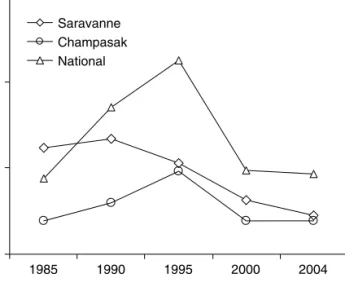
Cattle and buffalo are important sources of plant nutrients and agents in accelerating nutrient cycling. To some extent, they also serve as a vehicle for transferring nutrients from fallow land and forest to the rice fields. The available statistics indicate that there are 1.8 head cattle and 1.6 buffalo per hectare of rice. Lowland rice farm-ers are more likely to have buffalo, while upland rice farmers are more likely to have cattle. Traditionally, buffalo are used for field preparation in lowland systems. Lowland rice farmers are, however, gradually replacing buffalo with tractors (‘Tractors versus buffaloes’, Vientiane
0 1 2 3 4 5 6 0 10 20 30 40 50 60 70 80 Fertilizer cost (US$ ha–1)
Yield (t ha
–1
)
Figure 2. Investment in fertilizer and rice yield for rainfed rice in Kong, Sukumma and Phonethong districts (Champasak province).
Table 1. Results of fertilizer studies in upland rice20.
Parameters studied
Increase in rice yield (%) Application of N during early phase 0–20 Application of N during booting stage 0–40 Application of N after flowering 0–70 Application of N in two splits 0–69 Application of N in three splits 0–80
Application of P fertilizer 0–15
Table 2. Effect of residue management and mulching in upland rice20.
Parameters studied
Effect on rice yield (%) Mulching with rice straw Reduction 0–50 Mulching with pigeon pea residue Increase 57 Mulching with Chromolaena
odorata (fresh)
Times, July 12, 2005) and there is a tendency of decreasing livestock numbers (Fig. 3). Adding micro-organisms to hasten decomposition of organic matter is widely recom-mended for compost making, especially a technology known as EM (effective micro-organism). This technology may accelerate nutrient cycling and availability but it does not bring additional nutrients to a system.
Commercially available sources of nutrients that are permitted for organic agriculture are biofertilizers, bat guano and rock-phosphate. In the late 1990s, the govern-ment of Lao PDR established ten biofertilizer factories24, with a production potential of 88,400 t yr-1. In the year 2004, these factories produced about 20,000 t. All factories use similar raw material, with peat from a lake being the main ingredient (60–80%). A range of other products such as slaughterhouse by-products, by-products from beer, sugar and tobacco processing, rock-phosphate and guano are added and composted together with the peat (Manager, Dong Xiengdy factory, Vientiane, personal communication, 2005). All components are mixed, a solution of micro-organisms is sprayed on and then the mixture is fermented for 20–30 days. Analytical data are available for five factories (Table 3). Because of limited crop response, farmers have shown little interest and five factories stopped production in 2005 due to limited markets. Furthermore, according to the International Federation of Organic Agriculture Movements (IFOAM) standards, fertilizers with peat as a base would be allowed for potted plants only25.
Laos is very fortunate to have extensive deposits of bat guano in limestone caves (W. Roder, P. Chittanavanh, K. Sipaseuth, and M. Fernandez, 2005. Inputs available for organic farming, PROFIL/DoA/Helvetas, Vientiane, unpublished). It is quite likely that the deposits referred to as ‘rock-phosphate’ in some documents are actually also mineralized guano. The P and N contents of the guano deposits vary (Table 4). The mineral content is largely
dependent on the age and the stage of mineralization. The milled guano is presently sold for about US$70 t-1. At this price, it is a cheaper source of P than single or triple superphosphate. Although guano is accepted as an input for organic production, it is important to emphasize that guano is a non-renewable resource, as rapid exploitation will lead to its depletion.
Experiences with inputs permitted in
organic agriculture
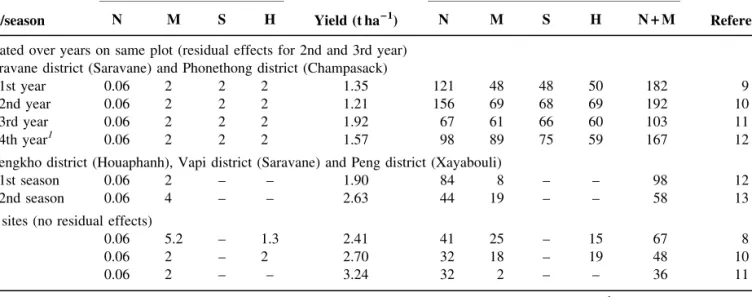
Effects of manure and crop residues for lowland rice. The Lao-IRRI project has evaluated effects of manure, straw or rice husk over a wide range of environ-ments8–14 (Table 5). These studies showed that manure, straw or rice husk applied at modest rates can increase yields by 10–80%, while modest rates of inorganic fertil-izer applied alone can increase yields by 30–150%. In all experiments, the yield increase was consistently higher with inorganic fertilizers and highest when inorganic fertilizer was combined with manure application. The residual effect of repeated manure applications was not apparent. In these studies, the nutrient quantities applied through manure or crop residues were, however, always below the nutrient quantities applied through inorganic fertilizers.
Current soil fertility management recommendations of the government extension system emphasize the benefits of using straw and rice husk. Rice farmers are, however, often reluctant to follow these recommendations. Farmers’ limited interest in utilizing straw and manure are influenced by the difficulties in collecting and transporting manure or straw and in field preparation when using straw. Further-more, crop yellowing is often observed during the first week following transplanting when straw is incorporated, due to N immobilization. 1 2 3 4 1985 1990 1995 2000 2004 Buffalo (nos ha –1 rice) Saravanne Champasak National
Figure 3. Buffalo density (numbers per hectare of lowland rice) given for the national level and two major rice-producing provinces Saravanne and Champasak1.
Table 3. Nitrogen and phosphorus composition of biofertilizers24.
Factories Content (%) N P2O5 Dong Xiengdy 1.5 2 Xiengda 2.8 8.3 Maliny 1.5 5 Savannakhet 3 5 Champasack-46 1.5 1.5
Table 4. Nitrogen and phosphorus content of five guano samples originating from Khammuone Province.
Nutrient
Content (%)
Average Range
Nitrogen 0.12 0.02–0.35
Commercially available organic fertilizers and rock-phosphate. Data are available from studies with commer-cially available biofertilizer across a wide range of locations (Table 6). One of these studies was repeated over four rice crops. The response to the biofertilizer is generally poor. A recent FAO project for the promotion of organic fertilizers tested the biofertilizer across a wide range of rice production environments with application rates of 600 kg ha-1but no yield response was observed24. This study concluded that the low nutrient content of the biofertilizers required high application rates, making the fertilizer too expensive.
The results of the limited studies with rock-phosphate (imported from Kunming, People’s Republic of China) are very promising (Table 7). The response to rock-phosphate was generally better than to triple superphosphate. Unfor-tunately, the locally available guano was not included in these studies.
Experiences with green manure species
Green manure species have been widely tested and recommended for all rice-growing environments7,18. In
spite of this, none of the species/systems recommended have been adopted on a wider scale. Both lowland and upland rice farmers sometimes use grain legumes in rotation with rice, especially Vigna species and peanuts.
Lowland rice environments. Green manure species tested included Aeschynomene afraspera, Crotalaria juncea, Sesbania aculeate, S. rostrata, Vigna radiata and V. unguiculata7. Based on studies repeated over locations and years, it was found that C. juncea and V. radiata are unsuitable for periodically saturated soil conditions that are a normal feature in rainfed lowland environments. S. rostrata was promising but it could not be recom-mended because it is a host of the root-knot nematode (Meloidogyne graminicola). In order to have optimum N-fixation, green manure legumes generally require higher P levels than rice. In a study across three locations, the dry matter production of S. rostrata was 0.6, 2.4 and 2.9 t ha-1 with 0, 30 and 60 kg P ha-1, respectively6. Phosphorus is likely to be a major limitation for using green manure in some lowland rice-growing environments. Upland rice environments. A wide range of legumes have been tested for fallow and/or soil fertility manage-ment in upland rice production systems. Already in 1930,
Table 5. Effect of N fertilizer, manure, rice straw and rice husk on rice yields.
Year/season Fertilizer (t ha-1) Yield (t ha-1) Yield increase (%) Reference N M S H N M S H N+ M
Repeated over years on same plot (residual effects for 2nd and 3rd year) Saravane district (Saravane) and Phonethong district (Champasack)
1st year 0.06 2 2 2 1.35 121 48 48 50 182 9
2nd year 0.06 2 2 2 1.21 156 69 68 69 192 10
3rd year 0.06 2 2 2 1.92 67 61 66 60 103 11
4th year1 0.06 2 2 2 1.57 98 89 75 59 167 12
Xiengkho district (Houaphanh), Vapi district (Saravane) and Peng district (Xayabouli)
1st season 0.06 2 – – 1.90 84 8 – – 98 12
2nd season 0.06 4 – – 2.63 44 19 – – 58 13
New sites (no residual effects)
0.06 5.2 – 1.3 2.41 41 25 – 15 67 8
0.06 2 – 2 2.70 32 18 – 19 48 10
0.06 2 – – 3.24 32 2 – – 36 11
N= inorganic N fertilizer (t N); M = manure; S = rice straw; H = rice husk (M, S and H quantities in t ha-1based on dry weight). 1
Phonethong district only.
Table 6. Effect of commercial organic fertilizers on rice yields.
Locations
(numbers) Seasons
Fertilizer (t ha-1) Yield Yield increase (%)
Reference N COF (t ha-1) N COF 2 2 0.06 1.0 2.0 52 18 9,10 5 3–4 0.06 1.0 2.0 66 20 14 12 1 0.07 2.0 2.79 50 12 13 N= inorganic N fertilizer in (t N).
Goubeaux26 worked with 46 legume species. The pres-ence of Mimosa invisa, a serious weed in some isolated upland areas, is an unpleasant testimony of those activ-ities. The main species promoted by various agencies for fallow improvement over the past two decades were Leucaena leucocephala, Gliricidia sepium, pigeon pea and Calliandra calothyrsus. In addition, the following species were recommended based on work carried out by the Lao-IRRI project: Arachis pintoi, Calopogonium caeruleum, Centrosema pubescens, Crotalaria anagyr-oides, Lablab purpureus, Leucaena diversifolia, Stylo-santhes guianensis, Pueraria phaseoloides and Mucuna cochinchinensis18. Most of the species evaluated have multiple uses, including food, fodder and/or fuel. Pigeon-pea received special attention, with activities focusing on: collection and testing of local and introduced cultivars, establishment methods, rotation effects, residue manage-ment and weed suppression22. Important findings from studies carried out between 1991 and 1999 over a range of locations include:
$ replacing fallow vegetation with legumes had generally
no effect on rice yield and weed biomass18;
$ interplanting rice with shrubby perennial legumes
(pigeon pea, L. leucocephala and C. anagyroides) can add to total biomass produced and suppress weeds during the dry season fallow20;
$ A. pintoi is not suitable for live mulch systems due to
competition for moisture27;
$ pigeon pea, C. anagyroides and S. guianensis are the
most promising legume species for upland rice sys-tems18;
$ residue management is a critical issue, and for most
species tested, field preparation without burning was difficult28;
$ intercropping with L. leucocephala reduced rice yield in
dry years20; and
$ most legume species can be easily established by
broad-casting seed immediately after the last rice weeding or by mixing seed with rice seed and dibbling together. The latter can, however, affect rice yield negatively29.
Recommendations given for soil
fertility management
Of all the organizations/projects visited, only two promote ‘organic production methods’ as per international defini-tions25. All other projects/organizations promote ‘chemical free agriculture’. The main recommendation given to the producer is ‘stop using chemicals’ (Table 8). Some organizations have no recommendation for soil fertility and pest management. Others recommend the use of compost. Bio-extract, effective micro-organisms and bio-control are the only other recommendations given. Surprisingly, none of the organizations promotes the use of green manure.
Except for effective micro-organisms, no information was found documenting systematic evaluation of the recommendations under Lao conditions. Similarly, no reliable information is available on the adoption rate for any of the recommended technologies. The limited availability of plant nutrients or sources of organic fertilizers (especially manure) was, however, recognized by two organizations as the main problem.
Table 7. Effect of rock-phosphate on rice yields.
Location1 Years after 1st application Yield (t ha-1) Yield increase (%) Reference TSP2 Rock P3 Vientiane 0 3.23 6 14 8 Vientiane 1 3.5 8 24 9 Vientiane 2 2 10 10 10 Houaphanh 0 4.33 14 3 9 Houaphanh 1 3.2 28 25 10 Houaphanh 2 3.3 16 35 11 1
Fertilizer application was repeated yearly for Vientiane. For Houaphanh, the fertilizer was applied in the first year only. 2
Triple superphosphate applied at the rate of 60 kg P2O5ha-1. 3
Rock-phosphate, applied at the rate of 320 kg P2O5.
Table 8. Technologies recommended for soil fertility manage-ment. Technology recommended Number of agencies1(n= 11) Recommending technology Documented results Stop using inorganic
chemicals
10 0
Use compost 8 0
EM for composting and pest management
2 1
Bio-extracts for pest management
3 0
1
Agencies recommending technology. EM, effective micro-organisms.
Implications for organic rice production
Lao farmers produce rice under marginal conditions with low yields and low yield potentials. This is often considered as an advantage for organic production as response to inorganic fertilizers is limited. Yet, soil fertility will be the most important constraint for organic rice production. In order for rice producers to benefit from organic production, practical, effective and economic soil management strate-gies have to be available. Stratestrate-gies and recommendations need to be based on local soil conditions, existing manage-ment practices and locally available nutrient sources. Unlike in Europe or Northern America, the farmers have to develop soil fertility management strategies without having the benefits of a traditional mixed cropping system with legumes or a system with large volumes of organic manure available. Depending on the evolving production system, it may be necessary to import certain inputs, especially phosphate.
The most promising technologies available to optimize yields in organic systems include:
$ optimize the use of locally available nutrients, mostly
from manure, crop residues and weed biomass,
$ add N to the system through green manure and legumes
growing in rotation, and
$ add P through guano or rock-phosphate.
Through optimal management of these nutrient sources, it will be possible to maintain or even improve present rice yields in most situations. Producers may require support in the supply of inputs (seed of green manure species, guano and rock-phosphate), marketing of new products (pulses grown in rotation and livestock products) and the develop-ment of appropriate managedevelop-ment strategies.
Research, advisory services and other agencies making recommendations for soil fertility management in organic production systems need to be keenly aware that:
$ Constant efforts have to be made to minimize
con-fusion about the meaning of ‘organic agriculture’. Until recently, most agriculture in Lao PDR was organic, yet the idea of organic agriculture is introduced as a ‘new concept’ with a wide range of interpretations. This has resulted in much confusion and misunderstandings.
$ The principles of soil fertility management are the same
for organic and conventional systems. Plants do remove nutrients from the soil, which have to be replaced.
$ When developing/recommending soil fertility
manage-ment strategies, it will be important to always be cautious about additional labor or investments.
Acknowledgements.Writing this manuscript was made possible through the support of the Department of Agriculture, Lao PDR and the Swiss Association for International Cooperation (Helvetas).
References
1 National Statistical Center. 2005. Statistics Lao PDR 1975– 2005. Committee for Planning and Investment, National Statistics Centre, Vientiane.
2 Schiller, J.M., Rao, S.A., Hatsadong, P.H., and Inthapanya, P. 2001. Glutinous rice varieties of Laos, their improvement, cultivation, processing and consumption. In R.C. Chaudhary and D.V. Tran (eds). Specialty Rices of the World: Breeding, Production and Marketing. Science Publishers, Enfield, NH. p. 19–34.
3 Chittanavanh, P., Sommani, P., Sanaphanh, K., and Roder, W. 2005. Opportunities for organic products in Vientiane— perceptions of consumers and traders Consumer and trader awareness and interest. In Proceedings of the IFOAM Organic World Congress, Adelaide, South Australia.
4 Raupp, J. 2001. Zwanzig Jahre Langzeit-Du¨ngungsversuch. Oekologie & Landbau 118(2):29–31.
5 Ma¨der, P., Fliebach, A., Dubois, D., Gunst, L., Fried, P., and Niggli, U. 2002. Soil fertility and biodiversity in organic farming. Science 96:1694–1696.
6 Lao-IRRI. 1996. Annual report. Lao-IRRI, Vientiane. 7 Lao-IRRI. 1997. Annual report. Lao-IRRI, Vientiane. 8 Lao-IRRI. 1998. Annual report. Lao-IRRI, Vientiane. 9 Lao-IRRI. 1999. Annual report. Lao-IRRI, Vientiane. 10 Lao-IRRI. 2000. Annual report. Lao-IRRI, Vientiane. 11 Lao-IRRI. 2001. Annual report. Lao-IRRI, Vientiane. 12 Lao-IRRI. 2002. Annual report. Lao-IRRI, Vientiane. 13 Lao-IRRI. 2003. Annual report. Lao-IRRI, Vientiane. 14 Lao-IRRI. 2004. Annual report. Lao-IRRI, Vientiane. 15 Linquist, B. and Sengxua, P. 2001. Nutrient management of
rainfed lowland rice in the Lao PDR. International Rice Research Institute, Los Banos, the Philippines.
16 Pandey, S. and Sanamongkhoun, M. 1998. Rainfed lowland rice in Laos: a socio-economic bench-mark study. Inter-national Rice Research Institute, Los Banos.
17 FAO. 2005. FAOSTAT on-line statistical service. FAO, Rome, Italy. Available at Web site: http://apps.fao.org (verified 2006).
18 Roder, W. 2001. Slash-and-burn rice systems in the hills of northern Lao PDR: description, challenges and opportunities. International Rice Research Institute, Los Banos.
19 George, T., Magbana, R., Roder, W., Van Keer, K., Tre´buil, G., and Reoma, V. 2001. Upland rice response to phosphorus fertilization in Asia. Agronomy Journal 93:1362– 1370.
20 Fahrney, K. 1999. Research priorities for upland rice-based agroecosystems in northern Laos. Completion of Service Report. International Rice Research Institute, Los Banos.
21 Roder, W., Keoboulapha, B., Phengchanh, S., Prot, J.C., and Matias, D. 1998. Effect of residue management and fallow length on weeds and rice yield. Weed Research 38:167–174.
22 Roder, W., Maniphone, S., and Keoboulapha, B. 1998. Pigeonpea for fallow improvement in slash-and-burn systems in the hills of Laos. Agroforestry Systems 39:45–57. 23 Roder, W., Maniphone, S., Keoboulapha, B., and Fahrney, K.
2006. Fallow improvement with Chromolaena odorata in upland rice systems of northern Laos. In M. Cairns (ed.). Voices from the Forest: Integrating Indigenous Knowledge into Sustainable Farming. RFF Press, Washington, DC. Chapter 14. p. 146–157.
24 FAO. 2004. Report of National Workshop on outcomes and impacts of the LAO-FAO TCP/LAO/2901 (A). Promotion of Organic Fertilizers at Plant Protection Center, Salakham. FAO, Field Document No. 9, Vientiane.
25 IFOAM. 2005. The IFOAM norms for organic production and processing. IFOAM, Bonn.
26 Goubeaux. 1930. Rapport agricole du Laos pour l’anne´e 1929. Inspection ge´ne´rale de l’agriculture de l’e´levage et des foreˆts, Hanoi, Vietnam.
27 Roder, W., Phengchanh, S., Maniphone, S., Songnhikong-suathor, K., and Keoboulapha, B. 1995. Weed management strategies aimed at reducing labor for upland rice production. In: Fragile Lives in Fragile Ecosystems. Proceedings of the
International Rice Research Conference, February 13–17, 1995. International Rice Research Institute, Los Banos. p. 395–405. 28 Roder, W. and Maniphone, S. 1998. Shrubby legumes for
fallow improvement in northern Laos: establishment, fallow biomass, weeds, rice yield, and soil properties. Agroforestry Systems 39:291–303.
29 Roder, W. and Maniphone, S. 1995. Forage legume establish-ment in rice slash-and-burn systems. Tropical Grasslands 29: 81–87.