DOI 10.1007/s00417-005-0219-9 W. Bernauer M. A. Thiel U. M. Langenauer K. M. Rentsch Received: 3 October 2005 Revised: 14 November 2005 Accepted: 18 November 2005 Published online: 18 January 2006 # Springer-Verlag 2006
Phosphate concentration in artificial tears
Abstract Background: Irrigating solutions and eye drops may contain phosphates as part of their buffer system. In the presence of epithelial keratopathy, a high concentration of phosphate favours corneal calcifica-tion. Knowledge of the phosphate concentration in artificial tear prod-ucts helps to prevent this sight-threatening complication. This study gives an overview on the amount of phosphate contained in artificial tears. Methods: Fifty-nine samples of commercially available artificial tear preparations were tested. The quanti-fication of phosphate was performed using the molybdate method on a Modular P autoanalyzer. Results: Twenty-six of 59 (44%) artificial tear products had a phosphate concentra-tion above physiological levels (>1.45 mmol/l). A phosphate con-centration above 25 mmol/l was found in nine products (15%), a concentration higher than 50 mmol/l in three (5%). Conclusions: Many artificial tear formulations contain unphysiological levels of phosphate, but very high concentrations are found only in a few products. These preparations have the potential to favour the formation of insoluble
crystalline calcium phosphate depos-its when used on a damaged corneal surface, and should therefore be used cautiously.
Keywords Cornea . Sodium hyaluronate . Phosphate concentration . Artificial tears . Corneal calcification
Introduction
Eye drop preparations typically consist of a pharmaceuti-cally active drug, a preservative and a vehicle [2]. Potential side effects of the active drug have been studied system-atically [4]. The toxic effects of preservatives have also been recognised [3]. Little attention has been given so far to the role of vehicles in the development of ocular adverse effects.
An ophthalmic vehicle is an agent other than the active drug or preservative that is added to a formulation to
provide proper tonicity, buffering, and viscosity to com-plement drug action. The buffering system may consist of acetic, boric and hydrochloric acid, and of potassium or sodium bicarbonate, borate, phosphate and citrate [2]. In many eye drops, the buffering system consists of phos-phates. The phosphate is typically introduced in the form of disodium hydrogen phosphate dodecahydrate or sodium dihydrogen phosphate dihydrate. Recent studies have shown that a high concentration of phosphate buffer may cause irreversible corneal calcification with visual loss. Daly et al. reported rapid corneal calcification after This work has not previously been presented.
W. Bernauer . M. A. Thiel Department of Ophthalmology, University of Zürich,
Zürich, Switzerland
W. Bernauer . U. M. Langenauer OMMA Eye Center,
Zürich, Switzerland K. M. Rentsch
Institute of Clinical Chemistry, University of Zürich,
Zürich, Switzerland W. Bernauer (*) OMMA Eye Center and University of Zürich, Theaterstrasse 2,
CH-8001 Zürich, Switzerland e-mail: [email protected] Tel.: +41-44-2568010
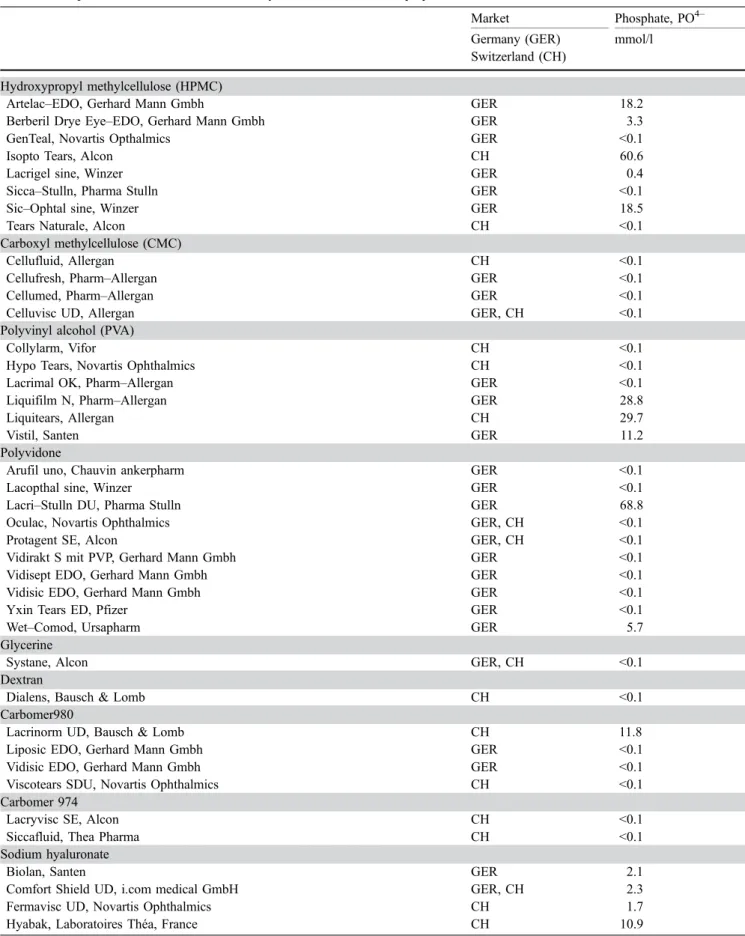
Table 1 Phosphate concentration in commercially available artificial tear preparations, German and Swiss market Market Phosphate, PO4– Germany (GER) Switzerland (CH) mmol/l Hydroxypropyl methylcellulose (HPMC)
Artelac–EDO, Gerhard Mann Gmbh GER 18.2
Berberil Drye Eye–EDO, Gerhard Mann Gmbh GER 3.3
GenTeal, Novartis Opthalmics GER <0.1
Isopto Tears, Alcon CH 60.6
Lacrigel sine, Winzer GER 0.4
Sicca–Stulln, Pharma Stulln GER <0.1
Sic–Ophtal sine, Winzer GER 18.5
Tears Naturale, Alcon CH <0.1
Carboxyl methylcellulose (CMC)
Cellufluid, Allergan CH <0.1
Cellufresh, Pharm–Allergan GER <0.1
Cellumed, Pharm–Allergan GER <0.1
Celluvisc UD, Allergan GER, CH <0.1
Polyvinyl alcohol (PVA)
Collylarm, Vifor CH <0.1
Hypo Tears, Novartis Ophthalmics CH <0.1
Lacrimal OK, Pharm–Allergan GER <0.1
Liquifilm N, Pharm–Allergan GER 28.8
Liquitears, Allergan CH 29.7
Vistil, Santen GER 11.2
Polyvidone
Arufil uno, Chauvin ankerpharm GER <0.1
Lacopthal sine, Winzer GER <0.1
Lacri–Stulln DU, Pharma Stulln GER 68.8
Oculac, Novartis Ophthalmics GER, CH <0.1
Protagent SE, Alcon GER, CH <0.1
Vidirakt S mit PVP, Gerhard Mann Gmbh GER <0.1
Vidisept EDO, Gerhard Mann Gmbh GER <0.1
Vidisic EDO, Gerhard Mann Gmbh GER <0.1
Yxin Tears ED, Pfizer GER <0.1
Wet–Comod, Ursapharm GER 5.7
Glycerine
Systane, Alcon GER, CH <0.1
Dextran
Dialens, Bausch & Lomb CH <0.1
Carbomer980
Lacrinorm UD, Bausch & Lomb CH 11.8
Liposic EDO, Gerhard Mann Gmbh GER <0.1
Vidisic EDO, Gerhard Mann Gmbh GER <0.1
Viscotears SDU, Novartis Ophthalmics CH <0.1
Carbomer 974
Lacryvisc SE, Alcon CH <0.1
Siccafluid, Thea Pharma CH <0.1
Sodium hyaluronate
Biolan, Santen GER 2.1
Comfort Shield UD, i.com medical GmbH GER, CH 2.3
Fermavisc UD, Novartis Ophthalmics CH 1.7
Hyabak, Laboratoires Théa, France CH 10.9
Hydroxypropyl methylcellulose (HPMC)
Carboxyl methylcellulose (CMC)
Polyvinyl alcohol (PVA)
Polyvidone Glycerine Dextran Carbomer980 Carbomer 974 Sodium hyaluronate
irrigation with phosphate-buffered saline [5]. Similar de-posits were described after ocular surface disease and frequent use of phospate-buffered hyaluronic acid artificial tears [1].
Information on phosphate concentrations in artificial tear preparations will help clinicians caring for patients at risk for corneal calcification. This study examines the artificial tear preparations that are currently available in Germany and/or Switzerland.
Materials and methods
All the artificial tear preparations that are listed as drop preparations in the“Rote Liste 2005” (Rote Liste Service GmbH, Frankfurt/Main, Editio Cantor Verlag, Aulendorf, Germany) and the“Arzneimittelkompendium der Schweiz 2005” (Documed AG, Basel, Switzerland) were included in this study. When the preparations were available in multidose and unit dose containers, the samples were taken from the preservative-free formulation. For technical reasons, gel preparations were not included. The quantifica-tion of the phosphate was performed with the molybdate
method on a Modular P autoanalyzer (Roche Diagnostics, Basel, Switzerland) [7]. The results were compared to the physiological concentrations published elsewhere [7,8].
Results
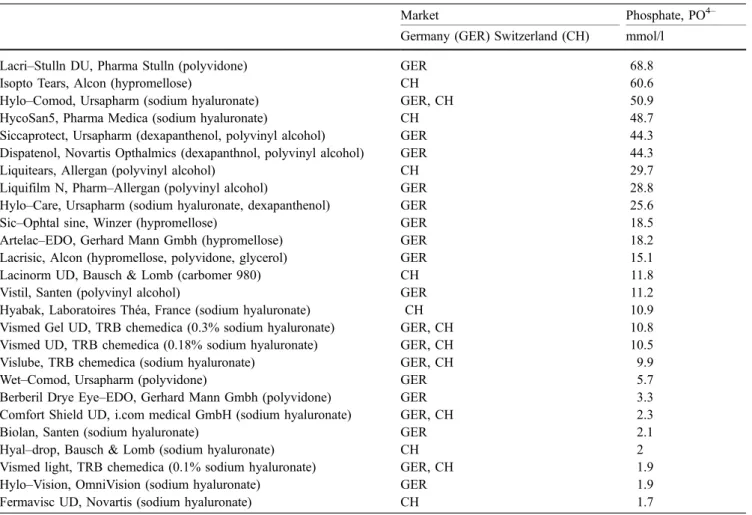
The phosphate concentrations of the ocular therapeutics that were studied are listed in Table 1. Table 2 gives an overview of the artificial tears that showed concentrations above physiological levels.
Twenty-six of 59 (44%) of the tested artificial tear products showed a phosphate concentration above physi-ological levels (>1.45 mmol/l). Concentrations above 25 mmol/l were found in nine products (15%), and high levels above 50 mmol/l in three (5%). There was no correlation between the type of product and the phosphate concentration. The three products with high phosphate concentrations included lubricants based on polyvidone (Lacri-Stulln DU, Pharma Stulln, Germany), hydroxylpro-pyl methylcellulose (Isopto Tears, Alcon) and sodium hya-luronate (Hylo-Comod, Ursapharm, Germany). Twelve of 15 hyaluronate preparations were buffered with phosphate. Table1 (continued)
Market Phosphate, PO4– Germany (GER)
Switzerland (CH)
mmol/l
Hyal–drop, Bausch & Lomb CH 2
HycoSan5, Pharma Medica CH 48.7
Hylan, Pharma Stulln GER <0.1
Hylo–Comod, Ursapharm GER, CH 50.9
Hylo–Vision, OmniVision GER 1.9
Oxyal, Santen GER <0.1
Vislube, TRB chemedica GER, CH 9.9
Vismed Gel UD, TRB chemedica GER, CH 10.8
Vismed UD, TRB chemedica GER, CH 10.5
Vismed light, TRB chemedica GER, CH 1.9
Xidan EDO, Gerhard Mann Gmbh GER <0.1
Combinations
Dispatenol, Novartis Ophthalmics (dexapanthnol, polyvinylacohol) GER 44.3 Hylo–Care, Ursapharm (sodium hyaluronate, dexapanthenol) GER 25.6 Isopto–Naturale, Alcon (hypromellose, dextran) GER <0.1 Lacrimal O.K., Pharm–Allergan (polyvinylalcohol, polyvidone) GER <0.1 Lacrisic, Alcon (hypromellose, polyvidone, glycerol) GER 15.1 Lacrycon UD, Thea Pharma (sodium hyaluronate, glycerine, Carbomer 981) CH <0.1 Oculotect sine, Novartis Ophthalmics (retinolpalmitate, hypromellose) GER 0.1 Siccaprotect, Ursapharm (dexapanthenol, polyvinylalcohol) GER 44.3 Combinations
Discussion
The constituents of topical medications change the composition of the precorneal tear film. The phosphate concentration may be increased by the vehicle of ophthal-mic preparations. Phosphates are widely used as part of buffering systems and were found in many of the artificial tear products in this series.
Recent studies have shown that phosphate buffers play a role in the process of corneal calcification [1,5,6,8,10]. Calcification occurs when calcium cations and phosphate anions form insoluble crystals within the tissue. In the cornea, deposition typically occurs as hydroxyapatite Ca5(PO4)3OH [1, 5, 9]. (Fig. 1). Deposition of calcium can be observed as a spectrum of clinical findings, ranging from subtle age-related superficial changes to full-thick-ness calcification of the entire cornea with visual loss.
Forty-five percent of the tested artificial tear products had a phosphate concentration above physiological levels (>1.45 mmol/l). High concentrations (above 25 mmol/l) were only found in nine products. To date, it is not clear which is the critical concentration of phosphate with regard to the onset of corneal calcification. In the animal model,
rapid corneal calcification developed after alkali eye burns with large epithelial defects when the eyes were irrigated with Isogutt (Dr. Winzer Pharma GmbH, Germany) [10]. In Table 2 Artificial tear products with phosphate concentrations above physiological levels (>1.45 mmol/l)
Market Phosphate, PO4–
Germany (GER) Switzerland (CH) mmol/l
Lacri–Stulln DU, Pharma Stulln (polyvidone) GER 68.8
Isopto Tears, Alcon (hypromellose) CH 60.6
Hylo–Comod, Ursapharm (sodium hyaluronate) GER, CH 50.9
HycoSan5, Pharma Medica (sodium hyaluronate) CH 48.7
Siccaprotect, Ursapharm (dexapanthenol, polyvinyl alcohol) GER 44.3 Dispatenol, Novartis Opthalmics (dexapanthnol, polyvinyl alcohol) GER 44.3
Liquitears, Allergan (polyvinyl alcohol) CH 29.7
Liquifilm N, Pharm–Allergan (polyvinyl alcohol) GER 28.8 Hylo–Care, Ursapharm (sodium hyaluronate, dexapanthenol) GER 25.6
Sic–Ophtal sine, Winzer (hypromellose) GER 18.5
Artelac–EDO, Gerhard Mann Gmbh (hypromellose) GER 18.2 Lacrisic, Alcon (hypromellose, polyvidone, glycerol) GER 15.1
Lacinorm UD, Bausch & Lomb (carbomer 980) CH 11.8
Vistil, Santen (polyvinyl alcohol) GER 11.2
Hyabak, Laboratoires Théa, France (sodium hyaluronate) CH 10.9 Vismed Gel UD, TRB chemedica (0.3% sodium hyaluronate) GER, CH 10.8 Vismed UD, TRB chemedica (0.18% sodium hyaluronate) GER, CH 10.5 Vislube, TRB chemedica (sodium hyaluronate) GER, CH 9.9
Wet–Comod, Ursapharm (polyvidone) GER 5.7
Berberil Drye Eye–EDO, Gerhard Mann Gmbh (polyvidone) GER 3.3 Comfort Shield UD, i.com medical GmbH (sodium hyaluronate) GER, CH 2.3
Biolan, Santen (sodium hyaluronate) GER 2.1
Hyal–drop, Bausch & Lomb (sodium hyaluronate) CH 2 Vismed light, TRB chemedica (0.1% sodium hyaluronate) GER, CH 1.9
Hylo–Vision, OmniVision (sodium hyaluronate) GER 1.9
Fermavisc UD, Novartis (sodium hyaluronate) CH 1.7
Fig. 1 Formation of a calcified plaque on intensified treatment with phosphate-buffered hyaluronate artificial tears. A chemical burn had led to a complete corneal erosion that was treated with a therapeutic contact lens and hyaluronate eye drops containing 50.9 mmol/l phosphate. The large area of calcification developed within 3 days
this solution, a phosphate concentration of 148 mol/l was measured.
The use of artificial tears for the treatment of epithelial keratopathy or erosions may lead to similar conditions to those in the animal model: With epithelial defects, the drops are typically applied very frequently, and the phosphate-rich lubricants may push the ion product towards precipitation. In addition, the viscous character of many artificial tears may prolong exposure time to the phosphates.
It is beyond doubt that very high topical phosphate concentrations have an impact on the process of corneal calcification. Corneal calcification, however, is dependent on many variables. These include pH, tonicity, size of
epithelial defect, and amount of barrier dysfunction [8,10]. Therefore, the definition of a critical phosphate concentra-tion is difficult. Further studies are required to allow rational recommendations. In the series with calcification following ocular surface disease and intensified use of hyaluronic acid artificial tears [1], the concentration in the lubricant was 50.9 mmol/l, which may serve as a first idea. When artificial tears are used for the treatment of epithelial defects, phosphate-free or preparations with low phosphate concentrations are preferable. This overview helps the clinician in the selection. The pharmaceutical industry is encouraged to develop phosphate-free prepara-tions for this indication.
References
1. Bernauer W, Thiel MA, Kurrer M, Heiligenhaus A, Rentsch KM, Schmitt A, Heinz C, Yanar A (2005) Corneal calcification following intensified treatment with sodium hyaluronate artificial tears. Br J Ophthalmol doi:http://10.1136/bjo.2005.082792
2. Burstein NL (1995) Ophthalmic drug formulations. In: Bartlett DJ, Jaanus SD (eds) Clinical ocular pharmacology. Butterworth-Heinemann, Boston Ox-ford Melbourne Singapore Toronto Munich New Delhi Tokyo, pp 21–45 3. Burstein NL (1980) Corneal
cytotoxicity of topically applied drugs, vehicles and preservatives. Surv Ophthalmol 25:15–30
4. Fraunfelder FT, Fraunfelder W; as-sociate editor, Randall JA (2001) Drug-induced ocular side effects, 5th edn. Butterworth-Heinemann, Boston Oxford Auckland Johannesburg Melbourne New Delhi, pp 531–630 5. Daly M, Tuft SJ, Munro PM (2005)
Acute corneal calcification following chemical injury. Cornea 24:761–765 6. Huang Y, Meek KM, Mangat H et al
(1998) Acute calcification in alkali-injured rabbit cornea treated with syn-thetic inhibitor of metalloproteinases (SIMP). Cornea 17:423–432
7. Knedel M, Haeckel R, Seidel D, Thiery J, Vonderschmitt DJ, Hänseler E (1986) Analytical performance of the random access analyser Hitachi 737. A multi-centre evaluation. J Clin Chem Clin Biochem 31:409–432
8. Nevyas AS, Raber IM, Eagle RC Jr et al (1987) Acute band keratopathy following intracameral Viscoat. Arch Ophthalmol 105:958–964 9. Schlötzer–Schrehardt U, Zagorski Z,
Holbach LM et al (1999) Corneal stromal calcification after topical steroid-phosphate therapy. Arch Ophthalmol 117:1414–1418 10. Schrage NF, Schloßmacher B,
Aschenberner W et al (2001) Phosphate buffer in alkali eye burns as
an inducer of experimental corneal calcification. Burns 27:459–464