ISRAEL JOURNAL OF MATHEMATICS 109 (1999), 339-347
C L O S E D G E O D E S I C S O N P A I R S O F P A N T S
BY
C L A I R E M . B A R I B A U D *
Ddpartement de Mathdmatiques, Ecole Polytechnique Fdddrale de Lausanne CH-1015 Lausanne, Switzerland
e-mail: [email protected]
ABSTRACT
We s t u d y t h e non-simple closed geodesics of t h e R i e m a n n surfaces of s i g n a t u r e (0, 3). In t h e aim of classifying t h e m , we define one p a r a m e - ter: t h e n u m b e r of strings. We show t h a t for a given n u m b e r of strings, a m i n i m a l geodesic exists; we t h e n give its representation and its length which d e p e n d s on t h e b o u n d a r y geodesics.
1. I n t r o d u c t i o n
A Riemann surface of signature (g, n) is an oriented, connected surface of genus g with n boundary components, called boundary geodesics, which is equipped with a metric of constant curvature - 1 . The length spectrum is the set, listed in ascending order, of lengths of closed geodesics of a Riemann surface [Hub59]. Almost every compact Riemann surface (i.e. a surface without boundary com- ponents) is determined by its length spectrum, up to isometry [Bus92]. Such surfaces can be decomposed into a succession of Riemann surfaces of signature (0, 3) more commonly called a pair of pants, so it is important to study the length spectrum of a pair of pants. Moreover, the first elements of the length spectrum of a surface yield a lot of information about the surface itself, thus we are inter- ested in the study of geodesics having a short length. One of the main difficulties is to "catch" every geodesic below a given length. An easy topological criterion, which would permit us to group on one hand short geodesics and on the other hand long geodesics, is still missing. In this article, we define a parameter - - the number of strings - - and we classify geodesics using this parameter.
* C u r r e n t address: Department of Mathematics, Switzerland.
Received November 6, 1997
ETH-Zentrum, 8029 Ziirich,
2. D e f i n i t i o n s a n d p r e l i m i n a r i e s
L e t Y b e a R i e m a n n surface of signature (0, 3) and V1, 72, V3 its b o u n d a r y geodesics. L e t us d e n o t e b y Pl, p2, P3 the p e r p e n d i c u l a r segments which respec- tively link 0'2 to 3'3, 71 to V3 and 71 to 72. T h e b o u n d a r y geodesics are n u m b e r e d such t h a t 0 < ~(71) • ~(72) ~-~ ~(3"3) , where ~(3'~) is t h e hyperbolic length of t h e geodesic Vi, i -- 1, 2, 3. To simplify notation, we will write 3' i n s t e a d of ~(3') for a n y geodesic V (and b y "geodesic" we refer to the shortest curve in the con- sidered h o m o t o p y class). T h e R i e m a n n surface Y can be split into two geodesic h e x a g o n s ]I1 and ]/2. Let a b e t h e s y m m e t r y which m a p s !/1 onto Y2 (a(pi) = p~, i = 1 , 2 , 3 ) .
D e ~ n i t i o n 2.1: A s t r i n g is a s e g m e n t of curve which links two p e r p e n d i c u l a r s Pi, Pj, i , j = 1 , 2 , 3 , i ¢ j a n d has no o t h e r intersection with Pl, P2, P3.
A closed geodesic is m a d e of a succession of 2n strings t l , . . . ,tun, n E N * , such t h a t two consecutive strings do not belong to t h e s a m e Y~, i = 1, 2. We r e m a r k also t h a t a closed geodesic always has an even n u m b e r of strings.
Definition 2.2: Let g b e a closed geodesic with 2n strings, g is said to b e z y g o m o r p h i c if it is m a d e of a succession of strings t l , . • • , t2n such t h a t ¢r(tk) =
t2n+l_k,
w h e r e 1 ~< k ~< n. W e call such a succession a g o o d s u c c e s s i o n . Notice t h a t a g o o d succession can b e d e c o m p o s e d into two h a l f - p a t h s dl = t l , . . . ,tn, d2 = t n + l , . - . ,t2n such t h a t a ( d l ) = d2.Finally, we a d o p t t h e following notation:
c~ = cosh(½7i), s~ = sinh(½vi),
ci,~ = cosh(n13'i),
si,n = sinh(n17i), i = 1,2,3.
3. R e s u l t s
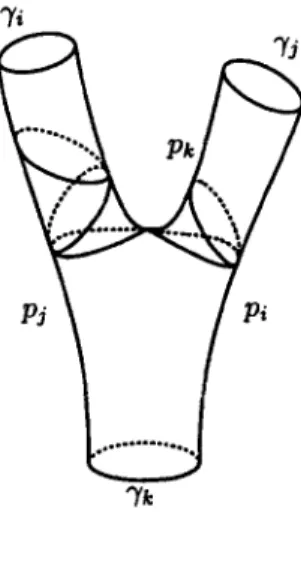
W e call ginJ, m t h e z y g o m o r p h i c closed geodesic having one of its g o o d half- successions dq, q = 1, 2 m a d e of n strings on t h e 3'i-leg, a n d m strings on t h e ~//-leg, i , j = 1,2,3, i C j a n d n , m e N* (cf. F i g u r e 1).
Vol. 109, 1999 CLOSED GEODESICS ON PAIRS OF PANTS 341
Pk
Figure 1. Geodesic g~2.
The lift of dq in the hyperbolic plane H is an edge of a crossed right-angled hexagon. So we obtain the explicit length of g~Jm given by the following relation,
( 1 ~ ) _ _
cosh ~g~,,~ 8i'nSj'm (e k + cicj) -~ Ci,nCj,m, 1 <. i <~ j ~ 3.
8i8j
ij
From now on we will write G~, m := cosh(½g/Jm).
We now state our main result in the following theorem.
T H E O R E M 3 . 1 : g,~, 1 is the shortest dosed geodesic having at least 2 (n + 1) strings. 12
4 . P r o o f o f T h e o r e m 3 . 1
We begin by classifying the giJ-geodesics described above according to their number of strings. To prove the two propositions below, we need to use just basic properties of the hyperbolic functions.
PROPOSITION 4.1: I f n >~ m, then ~j gnm ~ gmn, 1 <. i < j <. 3. ~J Proo~ We are going to prove that
ij ij
Gnm - G , ~ <. O.
By expanding the above expression, we have
ck + c~ej (s~,nsj,m - s~,msj,~) + ( c ~ , ~ e ~ , m - c~,mc~,~) <~ O.
As n >/m, the functions
sinh(nx)
x ~ > and x J
sinh(mx) cosh(mx)
are increasing. Moreover, (ck + c i c j ) / s i s j > O. m PROPOSITION 4.2: For all n , m E N*, w e h a v e
12 13 23
gn,m ~< g~,m ~< gn,m" P r o o ~ By definition 0 < 3'1 ~< 3'2 ~< 3'3. This implies that
0 < C 3 ~- c l e 2 ~ c2 -~- ClC 3 ~ c1 -~- CLC3. cosh(nx)
ij iS 2(ci ij iS
Gn, m -- G n _ l , m + 1 = - c s ) G n _ l , m + G ~ _ l , m _ l - Gn_2, m.
~j ij
The proposition is equivalent to showing that G,~,m - G,~_l,m+ 1 <. 0. This • e f ~ i j ['~iS
relation is true only 1i u n _ l , m _ 1 - u n _ 2 , m ~< 0. Because n > m, using induction, we reduce the problem to the study of the sign of the following expression,
- G~_1,2, where l ) 2.
Moreover, s i n h ( k x ) / s i n h ( x ) is an increasing function of x C R + ( k e N*). II
In order to prove the next proposition, we use the Chebyshev polynomials of the second kind:
sin(n arecos(x)) U,~(x) = sin(arceos(x)) "
These polynomials verify the relation U~+I (x) = 2 x U ~ ( x ) - U , ~ - I (x) and so does
(,)
Gn,m = 2ciG,~_l, m - G n _ 2 , m = 2 c s G n , m _ 1 - a ,m 2 from which we deduce the useful relations:i s i s i j
a n , m : U n _ l ( C i ) G 2 , m - g n _ 2 ( c i ) G l , m , Vn ~ 2 and Vm ~< 1,
i j i j i j
G,~,,~ = U m _ l ( C j ) G n , 2 - U m - 2 ( c s ) G ~ , 1, Vn ~< 1 and Vm ~< 2,
which are easy to prove by induction.
PROPOSITION 4.3: For all n, m C N* such t h a t n > m and 1 ~< i < j ~< 3, we h a v e
i j iS g n , m <~ g n - l , m + l " Proof: Using (*), we can write
Vol. 109, 1999 CLOSED GEODESICS ON PAIRS OF PANTS 343
I f / - - 2, t h e n G~2Jl - G / l J 2 ---(4cicj q- 2ca + 1 ) ( c i - c j ) ~ O.
I f / = 3, t h e n G~! 1 - G2{ 2 = (8cic 2 - 2 c i - 2cj + 4cic5)(c i - c j ) - 1 - ck <~ O.
• " i j i j . . . .
If l ~> 3, t h e n G~ 1 - G~_I, 2 = Uz_2(ci)(G3,1 - G~3,2) + Uz_3(c/)(G~2 - G~3,1). We conclude by remarking t h a t 8c/c 2 - 2 c / - 2c 5 -b 4cicj >~ 4cic 5 + 2Ck and Ck -~- i ~ aj -- C/. |
Propositions 4.1-4.3 t o g e t h e r imply t h a t 12 g~-1,1 is the shortest geodesic among the geodesics g~J~ where r + s = n (i < j ) (thus proving a particular case of T h e o r e m 3.1).
/5
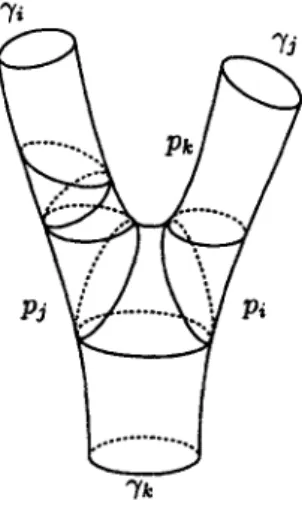
We call h~,~ the zygomorphic geodesic having one of its good half-successions dq, q = 1, 2 m a d e o f n strings on the -//-leg, one string on the ")'k-leg and m strings on the ~,j-leg, i , j , k = 1,2,3, i C j and n , m E N* (cf. Figure 2).
"rj
Pk
"rk
/J Figure 2. Geodesic h4, 2.
T h e lift of dq in the hyperbolic plane H is an edge of a right-angled hexagon. /5
So we obtain the explicit length of hn, m given by the following relation,
[ 1 ij \
c o s h ( ~ h ~ , m ) _ s~,~+lSj,m+, (Ck + t i c 5) -- c~,~+lcj,~+l, 1 ~ i ~< j ~ 3.
S i S j
/j 1 ij
F r o m now on we will write H~, m := cosh(~h~,m).
Now we c o m p a r e these two different types of zygomorphic geodesics.
PROPOSITION 4.4: For all n, m E N*, w e h a v e
ij ij
~J ij
Proof: In fact, we are going to prove Gn+I, m ~ H~, m. Let ek = ck + cicj. We
split H~, m ~J such t h a t it is easy to c o m p a r e it w i t h Gn+l, m. Let us write ij
i j i j H~m = hl + h2 + ha + h4 a n d G n + l , m = gl -~ 92 where hi - - Si'n+18j'm'Cjek, sisj h2 - - 8 i ' n + l C j ' m ek~ h 3 = C i , n + l C j , m C j , h 4 = C i , n + l S j , m s j , g 2 ~-- C i , n + l C j , m . S i gl - - S i ' n + 1 8 j ' m e k , S i S j
As h i -- gl ~ - g l ( C j - 1), we denote h~ = gl(cj - 1). Now it is easy to show t h a t
g2 -t- h3 ~ h2 and h4 ~ h~. |
PROPOSITION 4.5: Let g be a zygomorphic closed geodesic with 2n strings. Then
ij
g can be split into a succession of curves, each one homotopic to a g~s or hp, q-
geodesic, 1 <~ i < j <~ 3 and r, s, p, q E N*.
Proof: D e n o t e by dl -- t l , . . . ,t~ the g-half-path such t h a t dl D a ( d l ) is a g o o d g-succession.
_ ij
If n = 2, it is easy to see t h a t g - g1,1, i , j = 1 , 2 , 3 distinct.
I f n ~ 3, t h e n g ~ g~!x o r g ~ hi1!1, i , j ~ 1 , 2 , 3 distinct.
Let n > 3 and suppose t h a t the g o o d succession above can be split into a g o o d
succession of curves c1, • .. ,cr, each one h o m o t o p i c to a geodesic gr,siJ o r hp,q,ij
r, s, p, q E N*, called respectively g l , . - . , gr. Let d2 = dl Utn+ 1 . T h e n d2 U a(d2)
is h o m o t o p i c to a geodesic g~ having 2(n + 1) strings. Let us show t h a t g~ can be also split into a succession as described above. Let us suppose t h a t gr = gi(v a n d
d e n o t e by dr = t n + l - ( ~ + v ) , . . . ,t~ the p a t h included in dl such t h a t dr U a(dr)
is h o m o t o p i c to gr a n d t~ is on t h e "~j-leg. Let d~ = dr U tn+l.
1. If t~+l is also located on t h e ~,j-leg, then d~ U a(£2) is h o m o t o p i c t o gr =
ij
gu,v+l.
2. If tn+l is located on the ")'q-leg, q ¢ j,
i k .
a. if v = 1, t h e n d~ U a(d~2) is h o m o t o p i c to gr = h~,l,
b. if v > 1, denote f = t ~ + l - ( ~ + . ) , . . . , t n - 1 ; t h e n f U a ( f ) is h o m o t o p i c
ij
to gr -- gu,v-1 and (t~ U tn+l) U a(tn U tn+l) is h o m o t o p i c to t h e new
element gr+i = g{',q. ij
Vol. 109, 1999 C L O S E D G E O D E S I C S ON P A I R S O F P A N T S 345
PROPOSITION 4.6: For all 1 ~< m ~< n - 2 and 1 ~ i < j ~ 3,
ij ij + g ~ 1.
gn,1 ~< g ~ - m - l , 1
Proof: We reduce the problem to the following inequality,
- 1 ij 2
g2iJ g'2iJ ~ ( G n _ m _ l , 1 ) ) ; ( a m , l ) - 1 , G ~ , I ~ " ~ n - - m - l , l ~ m , 1 + ij 2
and we split the problem into two parts. Firstly, we show that
• ~ i j ~,ij 2 2 v / ( G n _ ~ _ I , 1 ) - 1 ) v / ( G ~ , I ) 2 - 1.
Let again ek = ck + cicj. Let us write
h i Si,n (Ck + CiCj) and h2 . ~ _ m _ l , p ~ . ~ , l .
Si
N o w we split hi and
h2
such that hi = hll + --- + h15 and h2 --- h21 + " ' " + h25 whereh l l S i ' n - m - 1
-- - - Ci,rnCiek, h12 ~ S i , n - m - l S i , m C k , Si
h13 -- _Ci'n--m--1 _ Si,mCiek, h14 ~- Ci,n_m_lCi,mCiC j , si and h15 = Ci,n-ra--lCi,rnCk~ h21 - S i ' n - m - ~ l C i , m C j e k ~ Si h23 -= C i , n - m - l C j 8 i ' m e k , 8i h25 -~ 2 8 i ' n - m - 1 2 Si,meiCj ok" 8 i 2 2 8 i , n - m - 1 Si,rn(C 2 Q- c i c j ) ~ h22 - - 2 8 i h24 ~ Ci,n--m--lCi,m¢ 2,
It is easy to see that hli <~ h2i, i = 1 , . . . , 5. Secondly, we have to prove
2 2 ij 2
c , cj ( ( a . . . . 1,1) - 1)((a ,112 - 11
In order to simplify the notation, let us set j2 = 2cicjck + c2c 2 >~ 3. We have the following inequality,
2 2
Si,r 2 Si,r f 2
Let us write 2 2 k l =Ci,nC j , 8i,n--rn--1 2 28i,n - m - 1 2 2 k2 = f~ + - - c i . . . lcjek + ci,~_~_lcj 8i Si,m 2 S" 2 2
We are going to prove that kl ~ k2. We split kl and k2 such that
kl = k l l A- . . . + k19 and k2 = k21 A- . . . A- k29 where and 2 2 2 2 2 2 2 2 k l l = Ci,n_m_lCi,mCiC j , k 1 2 = Ci,n_m_18i,mSiC 3 , 2 2 2 2 2 2 2 2 k 1 3 = 8 i , n _ m _ l S i , m C i C j : k 1 4 = 8i,n_m_lCi,mSiCj~ 2 2 k 1 5 : 2Ci,n_m_lCi,mSi,mCi8iC j: 2 2 k 1 6 = 2 8 i , n - m _ l C i , m S i , m e i S i c ~ k17 = 2ei,n-m-lSi,.-,~-ici,,~si,,~(s2i + c2)c~, 2 2 k 1 8 : 2 C i , n _ m _ l S i , n _ m _ l C i 8 i S i , m C ~ 2 c 2 2 k 1 9 : i,n_m_lSi,n_m_lCiSiCi,mC~: 2
k21
2 2 2 2 2 2 8 i , m ~e2 = Ci,n_m_lCi,mC~C ~, k22 = Ci,n_m_lCj---:'~Jk, 8 i 2 2 28i,n--m--l ¢28i,m ¢2 8i,n--m--1 ,'2 2 2 k 2 3 : ~ Jk ~ Jk, k 2 4 - - ~ ]k Ci,mCj, i i 8i 2 28i,m
k25 = 2c~,n_m_ l C~ --~-ekci,mcj,
i 2 2 8 i ' n - m - 1 f 2 ~ i ]g26 = 2 ekei,mej~ 8 i 8i,mk27 = 4si'~-m-lsi
ekci,n-m-lC~--~-iekci,.~c~,
k2s
= 2Ci,n_m_lC j 8i,n--m--1 ekCi,mC ~ 2 2 8i2 8i,n--rn--1 8i,m ~2 k 2 9 : 2Ci,n_m_lCj - - e k - . . . Z - j k .
8i S i
Vol. 109, 1999 CLOSED GEODESICS ON PAIRS OF PANTS 347
PROPOSITION 4.7: Let g be a non-zygomorphic closed geodesic with 2n strings. Then there is at least one zygomorphic closed geodesic with 2n strings which is shorter than g.
Proof: T h e geodesic g has an even number of strings, so we can split it into two paths Cl and c2 which are not homotopic to a boundary geodesic and have n strings each. Denote by g~ the (non-closed) geodesic which is homotopic to ci, i = 1, 2. Assume that gl is the shortest path. Then gl U a(gl ) is a zygomorphic geodesic with 2n strings which is shorter than g. |
So we can assert that 12 g~,l is the shortest closed geodesic having 2 ( n + 1) strings. Moreover, 12 gn,1 <~ g~+1,1, 12 n E N*; this means also that 12 gn,1 is the shortest closed geodesic having at least 2 ( n + 1) strings as claimed, and ends the proof of Theorem 3.1.
Remark 4.8: The minimum of G~2,1 is equal to 2n + 1.
G~2,1 is minimal when the boundary geodesics are cusps. This special case of a pair of pants was studied by Paul Schmutz Schaller [Sch96b] who gave its length spectrum without counting multiplicity, using a very different approach than the one taken here. T h e length spectrum is {2n + lln E N}. He gave also the length spectrum of a special pairs of pants with two cusps in [Sch96a].
R e f e r e n c e s [Bus92]
[Hub59]
[Sch96a]
[Sch96b]
P. Buser, Geometry and spectra of compact Riemann surfaces, in Progress in Mathematics, Vol. 106, Birkh£user, Boston, Basel, Berlin, 1992.
H. Huber, Zur analytischen Theorie hyperbolischer Raumformen und Bewegungsgruppen I, Mathematische Annalen 138 (1959), 1-26.
P. Schmutz Schaller, Arithmetic groups and the length spectrum of riemann surfaces, Duke Mathematical Journal 84 (1996), 199-215.
P. Schmutz Schaller, The modular torus has maximal length spectrum, Geometric and Functional Analysis 6 (1996), 1057 1073.