Emilie Sitzia
“WHERE IS THE PRINCE?”:
Unlocking Doré’s illustration of Perrault’s Cinderella
“- Where is the Prince?
- Here (I say pointing at the man holding Cinderella’s hand)
- No. He’s too old… That’s the King.” (Bedtime conversation with my daugh-ter)
This article proposes to consider illustrations as “intersemiotic translation” from words into images. Using this methodology, illustrations give particular insights into the reception and interpretation of Perrault’s fairy tales in a specific cultural, social and political environment. The question then becomes what do Doré’s illustrations say about the reception of Perrault’s fairy tales in 19th-century France?
RELIEF 4 (2), 2010 – ISSN: 1873-5045. P158-173 http://www.revue-relief.org
URN:NBN:NL:UI:10-1-101247
Igitur, Utrecht Publishing & Archiving Services © The author keeps the copyright of this article
Fairy tales are problematic literary texts as the work of interpretation is complicated by several factors. First of all, fairy tales are often the object of a collective reading, one that engages children as well as adults; chil-dren that often don’t relate to the stories on the same level as adults and adults that are influenced in their interpretation by their own pictorial memory of the text. To complicate matters further, fairy tales are often illustrated, which adds another layer of interpretation to be discussed by the readers. Finally, fairy tales are difficult to interpret due to the very essence of their subject matter; because they engage with the won-ders of the supernatural, they touch the very heart of our imagination.
Gustave Doré’s illustrations of Charles Perrault’s Contes de Fées have been extensively commented upon and discussed,1 but it is
inter-esting to look at them again from a new angle, that of illustration as translation. This new perspective opens up an alternative level of inter-pretation of the fairy tale’s illustration as a privileged reception of the text, unlocking information about the fairy tale’s narrative and the
char-acters and their meaning to a 19th-century French audience, the
pub-lisher’s intended readership, and the cultural significance of Perrault’s fairy tales in 19th-century France.
Theoretical Grounding: Illustration as Translation
Le Men proposes several ways to look at illustrations: “[…] one may study the sequence of images in a single edition […] or one may inves-tigate iconographic transformations in successive versions of the same episode […] or in one key illustration” (18). But it seems that there is another transversal way to look at illustration, and that is to study the relationship between illustration and text, to consider the illustration as a translation of the text, more precisely an “intersemiotic translation” (Jakobson, 79) between words and images. In his “Linguistic Aspect of Translation”, Jakobson distinguishes three types of translation: intralin-gual (or reformulation), interlinintralin-gual (or translation in its usual meing) and intersemiotic (or transmutation, from one sign system to an-other). This last category corresponds to illustrations and also to most writings on art. The illustrator is therefore engaged in “une circularité infinie des codes” 2 (Barthes, 62), translating the word into a mental
im-age and this imim-age back onto paper, the final imim-age engaging in a dia-logue with the text. If considered as such, the essential dilemma of illus-tration is then similar to that of translation: to find an equivalent and what that equivalent might mean for the translator and his/her public. As such translation and illustration offer the same level of discrepancy and adaptation in regard to the original text, depending on the degree of liberty taken by the illustrator or translator.
Generally illustration is considered as either being a literal illus-tration or an interpretative illusillus-tration. But following from the principle that illustration is a translation of words into images, it seems likely that illustrations are always to some extent interpretative. The illustrator’s work wasn’t perceived this way in 19th-century France. As Théophile
Gautier underlined in a short monograph on Johannot in his Portraits
Contemporains:
Ce travail où le crayon repasse sur le trait de la plume demande un talent tout particulier. [...] il ne s’agit pas [...] de copier la réalité comme on la voit [...]. L’illustrateur, qu’on nous permette ce néologisme, qui n’en est presque plus un, ne doit voir qu’avec les yeux d’un autre […]. (227)3
But as the illustrator incorporates in his/her illustrations all his/her cul-tural background, he/she becomes a privileged reader of the text. He/she’s translating his/her reading of the words into images, images that in turn impregnate the reader’s imagination. As Forster-Hahn un-derlined:
However earnest the attempt to achieve a ‘faithful’ transference of word into image, the artist always brings pictorial conventions into play, not only liter-ary interpretation, and, by dint of its imaginliter-ary surfeit, the illustration mani-fests intricate links to the political and cultural fabric of its own period. (511) As with all translations, illustration ought to adapt the material trans-lated to the cultural and political context of its public and so there can-not be any completely faithful translation. Therefore Doré’s illustration cannot be “[…] une interprétation erronée, en désaccord avec […] l’intention
de Perrault”4 (Gheeraert, 1) as the aim of the illustrator is not to “[…]
s’accorde[r] avec la volonté de l’auteur et le sens du texte […]”5 (Gheeraert,
2). On the contrary, the illustrator’s aim is to translate the text into his/her contemporary cultural, social and political environment, to adapt it for his/her readership.
Because of its prominent place in the book, alongside the text, and because of the instant effect created on the spectator by the image, the illustrator offers a crucial cultural reception and an interpretation of the text that sometimes prevails over the text itself, such as in Doré’s work. Just as Baudelaire’s translation of Poe came to supersede Poe’s texts in 19th-century French society, Doré’s illustrations supplanted Perrault’s
words. This is particularly exacerbated in the case of the fairy tale, where often half of the reading unit (children) is relying more on im-ages than on words to build their interpretation of the tale. The illustra-tor puts forward a reversed art criticism where the image comments, criticizes and interprets the text, through a careful choice of the repre-sented scenes and through the composition of the images. For Peter Guenter illustrations are:
[…] thus not only comments and references to the times of their production but also, and more importantly, they are interpretations of the text as it was read and understood at this period. It is a common experience when opening an illustrated book that the time-lag between the production of the illustra-tion and the viewer/reader’s own becomes immediately apparent. The con-clusions are rarely drawn: illustrations can provide the basis for a reception
assessment frequently more precise and enlightening than contemporary lit-erary reviews. (104)
Illustrations give particular insight into the reception and interpretation of the text in a specific cultural, social and political environment. The question then becomes what do Doré’s illustrations, as a privilege read-ing of the text, say about the reception of Perrault’s fairy tales in 19th
-century France?
Image-Text: A Dialogue?
For the purpose of clarity, let us now focus on the well known tale of
Cinderella by Perrault illustrated by Doré in the 1862 Stahl-Hetzel
edi-tion. Perrault’s text lays the foundation for the literary genre of the fairy tale in France. This text is therefore essential to the development of French culture and by the 19th century it had become a classic. The
luxu-rious format of the publication by Stahl-Hetzel attests to the importance of this text in the formation of the idea of a national culture.
If we allow the text to enter into a dialogue with the images, the images unlock a whole new interpretative dimension. The images offer a commentary on the narrative and the characters presented by the text relating it to contemporary social, cultural and political events. The im-ages criticise and interpret the text for its intended audience, revealing who this audience might be. Finally, the images comment on the signifi-cance of this particular tale in 19th-century cultural life.
Fig. 1. Cinderella’s godmother carving the pumpkin;
Gustave Doré; in Charles Perrault, Les contes de Perrault, illustrated by Gustave Doré, introduction by P.-J. Stahl, Hetzel, Paris, 1862; University of Canterbury Library, Rare
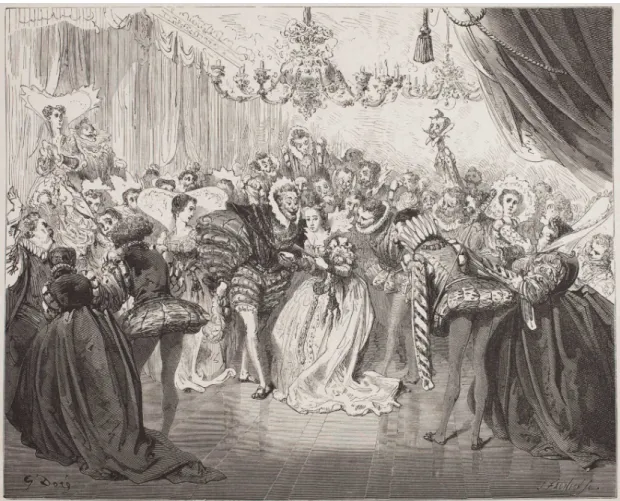
Fig. 2. The ball;
Gustave Doré; in Charles Perrault, Les contes de Perrault, illustrated by Gustave Doré, introduction by P.-J. Stahl, Hetzel, Paris, 1862; University of Canterbury Library, Rare
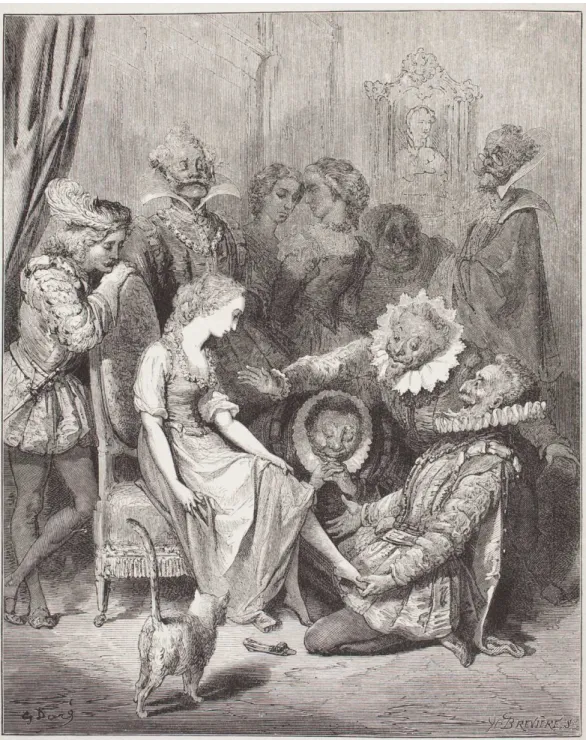
Fig. 3. The fitting of the little glass slipper;
Gustave Doré; in Charles Perrault, Les contes de Perrault, illustrated by Gustave Doré, introduction by P.-J. Stahl, Hetzel, Paris, 1862; University of Canterbury Library, Rare
What do Doré’s Illustrations Tell the Reader/Viewer About the Narra-tive and Its Characters?
Illustrations often serve to support the narrative. The choice of scenes and its relationship with the textual narrative is therefore of utmost im-portance.
Doré chose to represent three key scenes in his translation of
Cin-derella. Doré started with the scene where the Godmother carves a
pumpkin. This scene, at the beginning of the plot, is the first suspense scene — what is she going to do with the pumpkin? The second scene represented is a ball scene that seems to condense the two major ball scenes that are essential to the plot. Finally, Doré chose to represent the concluding suspense scene with the fitting of the shoe — is the shoe go-ing to fit? In that image, Doré also condensed the sequence of events: the sisters looking despisingly at Cinderella, presumably before she tries the shoe on, Cinderella trying on the shoe, the surprise of the man kneeling in front of Cinderella when the shoe fits and the satisfied godmother appearing to transform Cinderella’s cloth one last time. By so doing, Doré condenses the narrative and rushes the outcome of the story. The image operates here as a catalyst to the narrative6.
Doré’s choice of key suspense and condensed action scenes fo-cused the viewer/reader on the actions within the fairy tale, rather than concentrating on the magic processes, the family injustice, or the love story between the Prince and Cinderella. The representation of suspense and condensed scenes is pleasurable for the viewer/reader as it inter-rupts the flow of text, alternately suspending and rushing time in the fairy tale. This technique promotes an enhanced engagement of the reader with the text. The narrative is then read and seen as an exciting adventure story. While the images support the narrative they also give a specific tone to the narrative. In the case of Cinderella, the magic and sweet tone of the fairy tale and love story are overshadowed by the ex-citing adventures of the young heroine. All three nuances are present in the text but Doré decided to focus the tone of his illustration on excite-ment and adventure, opening the road to the more adventure oriented children’s literature of the end of the century7.
Because, there is very little textual information about the charac-ters in Cinderella, it is hard to evaluate whether Doré betrays the text. The Prince is “young” and Cinderella “beautiful”. This kind of qualifi-cation is unquestionably open to interpretation. What is indeed a “young” Prince? For Doré — if indeed the Prince is the man holding
Cinderella’s hand at the ball, he could well be the King — the prince is a middle-aged prince. He is much less young and charming than the prince Doré gives to the Sleeping Beauty. This element draws a direct parallel between the fairy tale and literature popular in 19th-century
France. The story of a kind, beautiful, young woman married to a rich man thanks to the intrigues of a ‘godmother’ is a topos of French litera-ture and theatre. By doing so, Doré related Cinderella directly to fash-ionable French cultural references8.
Another possible interpretation is a political one. The Prince — still assuming he is the man holding Cinderella’s hand — bears a strik-ing resemblance to Napoleon III and Cinderella to Empress Eugénie9.
Eugénie and Napoleon III’s story seems to follow the narrative of
Cin-derella. When Prince Louis Napoleon became president of the second
Republic, Eugénie attended several balls given by the ‘Prince President’ at the Elysée Palace accompanied by her mother. Eugénie was well known for her beauty, elegance, splendour and sense of fashion. When Louis Napoleon announced their marriage he claimed that he preferred a marriage of love to one creating political alliances. This marriage was controversial. Eugénie was seen by the imperial supporters as a political mistake. Louis Napoleon’s comment made it look like a Spanish count-ess, of legitimate title and ancient lineage wasn’t good enough for the Bonaparte clan, casting Eugénie in the role of Cinderella, and attracting criticism from most of Europe’s crowns. In his illustration of Cinderella Doré could have been creating a satirical version of the story of Eugénie and Louis Napoleon, thereby offering a political comment and placing
Cinderella in a contemporary political and social context10.
If the Prince isn’t the man holding Cinderella’s hand, but the man leaning on the back of Cinderella’s chair in the shoe fitting scene — his features and feathery hat relate him much more closely to the Prince of the Sleeping Beauty — the visual story is then complicated. Why doesn’t the Prince appear in the ball scene? Has the father chosen a bride for his son? This scenario would relate the tale to 19th-century
so-cial issues around marriage, a father often choosing a wife for his son and basing his choice on family wealth and political alliances. Therefore the choices in the representation of the character from a very imprecise text allow Doré to open up the tale to contemporary literary, political and social issues.
Emotions are also ambiguous both in the text and the images, particu-larly in the final scene. The almost melancholic attitude of Cinderella is
of course intriguing to say the least. But if we put the visual story back into its 19th-century context, the prospects are bleak for Cinderella. She
is either a beautiful young woman about to abandon her life as a daugh-ter to marry an older rich man and take on the role of wife and eventu-ally mother. Or she is Eugénie, about to controversieventu-ally marry a notori-ously unfaithful Louis Napoleon. Or she hasn’t of yet met the Prince she’s about to marry. This depth and mixture of feeling made visible in the illustration is fascinating, especially because the text is silent on Cinderella’s feelings at that crucial moment. The translation/illustration completes a void left in the text. The cat with an upright tail in the fore-ground reinforces the unease of the visual story. Images of cats, in 19th
-century France, are closely associated with female sexual activity11. The
upright tail of the cat reinforces this impression by creating a phallic symbol. The sisters are not represented throwing themselves at the feet of Cinderella as the text would suggest, but the instant before, when they look down at Cinderella with contempt. Their reaction completes the narrative carried by the visual story and also fills a silence in the written story, the moment before the shoe actually fits Cinderella’s foot. The surprise of the man trying on the shoe, present in the text, is em-phasised by the composition. His emotion is echoed into the half stand-ing character reachstand-ing for Cinderella. His surprise diverts the viewer’s attention from Cinderella’s mixed expression. The Godmother appears also in that scene with a satisfied look on her face. She achieved what she came for, as the role of a ‘godmother’ in 19th-century French society
is to socially link her godchildren and help them progress in society. Therefore the emotions present in the images are perfectly in harmony with the visual translation of the text. They do not betray the original text as the text is silent on those emotions.
But do the illustrations convey the moral of the story? The moral of the original story insists on the importance of grace and connections and the rewards of goodness. Perrault’s morals were often ironic and were meant to provoke a reflection on the ambivalent meaning of the tales. The moral in verse is absent from the text of the Stahl-Hetzel edi-tion and this ambivalence is now carried by the illustraedi-tion rather than the text. The omission of the verse morals is an editorial choice to adapt the text to its contemporary readership and to focus the text on the nar-rative rather than on the underlying moral. The visual narnar-rative con-veys the ambivalence of the moral of the original text, everything in that visual translation is nuanced: anxiety and social and political stakes are
displayed. Doré’s illustrations offer a more realistic approach to the tale, and are anchored in contemporary society.
Do Doré’s Illustrations Say Something About his Intended Public?
Le Men stated that illustrations “help adapt a literary work to the child” (17), but are Doré’s illustration aimed at a public of children? As we’ve seen already the illustrations’ content is complex and linked to social and political issues children would not have been aware of. So Doré’s illustrations are definitely not destined exclusively for an audience of children. In Stahl (and Doré)’s view, Perrault’s aim was to “captiver
l’enfant, faire sourire & faire penser l’homme”12 (XXII). But to get adults to
“smile and think” there needs to be a tension between the different lay-ers of meaning. Perrault’s text already addressed a double audience and created these layers through the juxtaposition of the text and ironic morals. The illustrations work in the same way offering images that ad-dress both adults and children. So while the morals have been omitted from this edition, the images, far from adapting the work to an audience of children, add updated layers of meaning to the text.
Fairy tales contribute to the building of a national identity. The push for folktales to be written down and fixed in a literary form coin-cides with nationalism trends in Europe as the identification of literary heroes is essential to building a cultural identity. It is therefore interest-ing that Doré’s illustrations, intended as a visual monument to a na-tional literary classic, were not particularly French in their visual refer-ences. Doré’s illustration of Perrault actually became very popular in the Anglo-Saxon world. Doré’s intended audience was not an exclu-sively French audience as his career was already expanding towards England at the time. Doré focused on the universal appeal of the fairy tale rather than focusing on the story as a typical French tale.
The illustrations also say something about the dominant social and cultural trends of the intended public. In an age where positivism is the fashion, it is essential that these imaginary scenes and characters are represented with as much realism as possible13. But what is realism in a
fairy tale? The godmother, the main magic character in the story, is rep-resented carving the pumpkin rather than waving her magical wand at the beautiful coach. Doré focused our attention on the limits of the godmother’s magical powers: she needs to carve the pumpkin herself. Stahl gave us indications of this intent in his introduction as he
de-fended the value of the supernatural against les “esprits trop
positifs”14(VIII). He insisted on the fact that, for childhood, magic is
an-chored in daily life (VIII) rather than in the fantastic15. Stahl insisted on
the educative aim of the unexplainable and its place in life, as well as on how hard it is to surprise children when often reality surprises them better than what adults invent. The public addressed by Doré and Stahl is then a realist public, a public looking to the marvels of the real world, rather than a positivist public, one that rely on science to explain the world around them. To sum up, Doré’s public isn’t exclusively a public of children and isn’t specifically French, it also isn’t a public of positiv-ists. It does seem as if Doré’s aim was to create an illustration that would appeal to wealthy educated parents, something that the type of publication, an illustrated large format, seems to confirm.
The Cultural Significance of Perrault in French 19th-Century Culture:
Dante and Perrault
Interestingly Doré conceptualised Perrault’s illustration as a pendant to his version of Dante.
Tout en composant intrépidement à ses frais, à ses risques et périls, sa grande & sombre illustration de Dante, Gustave Doré désirait que dans le même moment & que dans le même format splendide parussent, comme pendant et comme contraste, les Contes des Fées (sic) de Perrault. D’un côté, le merveil-leux dans ce qu’il a de plus funèbre, de plus tragique & de plus ardu; de l’autre, le merveilleux divertissant, spirituel, émouvant jusque dans le comi-que & comicomi-que juscomi-que dans l’émouvant, le merveilleux à son berceau. Il vou-lait ainsi, tout à la fois rasséréner son crayon, au sortir des épouvantes un peu monocordes de l’enfer, & prouver la variété de ses moyens. (Stahl, XX)16
At the time Doré was 35, and was still eager to prove his versatility and talent. In his essay “Resurrecting Gustave Doré” Rosenblum remarked that even though Manet and Doré were exact contemporaries Doré “had been pigeon-holed under the rebellious banner of Romanticism” (17). Rosenblum also asserted that Doré “always kept one foot rooted in the realities of modern Parisian life” (18) with works such as La
Mé-nagerie parisienne. Therefore Doré truly aspired to be a “Painter of
Mod-ern life” and was, as was Manet, following in the footsteps of Daumier, Guys and Gavarny.
Doré’s demand for the simultaneous publication of Dante and Perrault was, in my view, motivated by a will to detach himself from
his Romantic image. Dante was one of the favourite authors of the painters of the Romantic generation. Doré’s take on Dante actually used extensive visual references to paintings of the Romantic generation17.
On the other hand Perrault’s tales represent a completely different type of literature. Seen as grounded in popular culture, it is a classic of French literature18. It is a fairy tale, a light fantasy with a humorous
touch. As we’ve seen already, Doré’s take on Perrault’s tales was ori-ented towards realism and social analysis. While his illustrations of Dante reference the Romantic visual vocabulary, his illustrations of Per-rault reference also his own contemporary caricature, his work as a “painter of modern life”19. Doré gained official recognition from his
Romantic illustration of Dante. He obtained the Cross of the Legion of Honour thanks to Paul Dalloz who took a cab full of Dante’s illustra-tions to the Minister of the Interior to persuade him that Doré deserved the Cross (Rose, 34).
If we look at the two sets of illustrations as pendant it is interest-ing to note the differences. As mentioned earlier Doré chose a specific visual atmosphere and followed it throughout his illustration of the story. Doré’s illustrations of Perrault have a caricatural quality. Fairy tales have this innate caricatural quality where good and evil are easily told apart. They offer a humorous satire of society and this is visible in the style adopted by Doré. Doré used a similar style when he illustrated
Don Quixote, Gargantua and Pantagruel. Similarly when he worked with
those texts he insisted on the horrible and the monstrous elements. In his illustrations of Dante the monstrous is rather tamed and translated in a classical visual vocabulary. Doré’s illustrations of Dante are awe in-spiring in the same vein as Doré’s images of the Bible or Milton’s
Para-dise Lost. By publishing them as pendant Doré asserted the importance
of Perrault in 19th-century French culture and showed off his versatility
as a realist and an idealist, a creator and a traditionalist.
Doré’s illustrations also emphasised the importance of Perrault’s tales in 19th-century French visual culture. Van-Eecke in her remarkable
article “Contes et Fables dans les livrets de Salon” noted that the first painted illustration of Perrault is by Jean-Louis Demarne and dates back to 1798 (28). Van-Eecke also noted that among fairy tales Perrault is a favourite (31). Cinderella has numerous painted versions.20 Van-Eecke
noted that those paintings are often titled without epigraph indicating that the text is so well known there is no need for it (30). It is interesting to note that the choice of the painters often goes towards representing
the end of the tale or suspense scene (Van-Eecke, 30). This matches Doré’s practice and shows that while Doré’s illustrations support the text they also reference a practice common in painting.
Renonciat in her fascinating article “Et l’image, en fin de conte?” traces the history of the popular illustrations and representations (theat-rical, opera, popular songs, etc.) of Cinderella (112-116) and shows the power of adaptation of the fairy tales and the freedom with which 19th
-century French culture, adopted and adapted Cinderella. “Le mode de survie du conte est le réemploi”21 (Renonciat, 104). And this is exactly
what, as we’ve shown, Doré’s visual translation of Perrault does. It re-uses and adapts Cinderella to Doré’s contemporary public showing how relevant the tale can be to a 19th-century audience.
Final Questions
With the question of the faithfulness of Doré’s visual translation to Per-rault’s text comes the question of authorship22. As Perrault transposes
folktales: “There is no author writing a text, only a chain of transmission from the popular storyteller to the cultural intermediary who may be compared to a folklorist in his role” (Le Men, 24). Therefore one cannot talk about Doré ‘betraying’ Perrault’s intention just as no-one would think to condemn Delacroix for ‘betraying’ Byron’s Sardanapalus. As Le Men underlined, “the picture ultimately restored the book to the oral culture initially displaced by the printed word […]” (38). In the gap al-lowed by the search for the equivalent in the intersemiotic translation process, Doré re-told the story of Cinderella, commenting upon it, adapt-ing it and interpretadapt-ing it for his audience.
So when faced with the question “Where is the prince?” we can only answer that the prince is , just like the elusive figure in Doré’s wa-tercolour Le Pays des Fées (1881, The Art Institute of Chicago, Chicago, United States), a proteiform shadow heading for a palace of dreams at sunset.
Notes
1. See in particular the works of Le Men, Renonciat and Gheeraert. 2. “an infinite circularity of codes” (all translations by E. Sitzia) (62).
3. ”This work when the pencil draws over the line of the quill asks for a particular talent. The artist must understand the poet […], it is not about […] copying reality as one sees it […]. The illustrator, if one allows us this neologism, who is almost not one
4. ”[…] an erroneous interpretation, going against […] Perrault’s intention”(1). 5. ”harmonise itself with the author’s will and the meaning of the text” (2).
6. In an illustrated volume the narrative doesn’t work independently from the image as during the reading process, the text and the image are perceived as a single unit of meaning by the viewer/reader. Therefore Doré’s choice of scenes has an impact on the reader/viewer’s perception of the narrative and in this case operates as a catalyst to the story. It could also detract from the narrative focusing the reader/viewer’s at-tention on details or scenes absent from the textual narrative.
7. Such as Lewis Caroll’s Alice's Adventures in Wonderland published in England in 1865 and first published in France in 1869, or Johanna Spyri’s 1880 Heidi's Years of
Wandering and Learning.
8. While this motif appeared in 17th –century literature it remained popular in 19th–
century novel. Novels such as George Sand’s Indiana use this motif as a starting point for their plot.
9. Compare the illustrations with portraits such as Franz Xaver Winterhalter’s
Em-peror Napoleon III (c. 1852, Museo Napoleonico, Rome, Italy) and Franz Xaver
Winter-halter’s Empress Eugénie (1853, Musée d’Orsay, Paris, France).
10. Napoleon III’s regime was an authoritarian empire until 1861 and while by 1862 Napoleon III adopted a more liberal stance, a strong censorship system was still in place. Political comments were often made in the visual realm rather than in written form and were purposefully kept ambiguous. It is therefore impossible to find any written comments linking Napoleon to these illustrations. It would have simply been too risky for the author and Doré.
11. From Manet’s Olympia’s cat (1863) to Baudelaire’s poem “Le chat” in the 1857 edi-tion of Les Fleurs du Mal, cats and controversy go hand in hand in 19th-century France.
12. “Captivate the child and have the man smile and think” (XXII).
13. While imagination is very important in the first half of 19th-century French culture
by the 1860’s positivism and science were the dominant ideals. 14. “[…] the too positive spirits” (VIII).
15. “[…] pour elle [l’enfance] le merveilleux se trouve jusque dans les réalités de la vie commune, elle est ici à sa place ” (VIII) “[…] for children, the marvellous is found in the realities of common life, it has its place here.”
16. “While fearlessly creating at its own expense, at its own risk, his large & dark il-lustration of Dante, Gustave Doré wanted that at the same time & in the same splen-did format, as a counterpart and contrast, the Contes des Fées (sic) of Perrault be pub-lished. On one hand, the wonderful at its darkest, most tragic & most difficult; on the other hand, the wonderful entertaining, spiritual, emotional in its comic & comical in its emotions, the wonderful in its cradle. He wanted, both to calm down his pencil, coming out of the somewhat monochord horrors of hell, & demonstrate the variety of his talent”(XX).
17. For example Dante’s illustration of the crossing of the Stygian lake references Delacroix’s The Barque of Dante.
18. While today there is a heated debate on the actual origins of fairy tales, they were at the time perceived as being of popular origins.
19. Some of Doré’s illustrations of Perrault have some strong references to Romanti-cism such as the way in which he represents the forest surrounding Sleeping Beauty’s castle, while others such as Cinderella’s ball scene look more toward Doré’s own caricature works.
20. As for example two by Jean-Antoine Laurent in 1819 and 1824, one by Elisabeth Gardner (the future Mme Bouguereau) in 1872, two by James Bertrand in 1873 and 1886 and one by Guillaume Dubuffe in 1897(Van Eecke, 30).
21. “The survival mode of the tale is to be used over and over again”(104).
Corinne Van-Eecke, “Contes et fables dans les livrets de Salons“, in Romantisme, 22:78, Paris, Armand Colin, 1992.
22. It is not the purpose of this article to look at the relationship between Doré’s illus-trations and other visual representations of Perrault. For more information on that topic see the excellent article by Le Men.
Works cited
Roland Barthes, S/Z, Paris, Seuil, 1976.
Francoise Forster-Hahn, “A Hero for All Seasons? Illustrations for Goethe’s ‘Faust’ and the Course of Modern German History”, in In Zeitschrift für Kunstgeschichte, Ber-lin, Deutscher Kunstverlag, 1990.
Théophile Gautier, Portraits contemporains : littérateurs, peintres, sculpteurs, artistes
dramatiques (second edition), Paris, Charpentier, 1874.
Tony Gheeraert, “De Doré à Perrault, conférence de Tony Gheeraert, Université de Rouen”, http://www.lettres.ac-versailles.fr/spip.php?article782, 2006.
Peter W. Guenther, “Concerning Illustrations to Goethe’s Faust”, in Houston German
Studies, Munich, Wilhelm Fink Verlag, 1988.
Roman Jakobson, “Aspect linguistique de la traduction”, in Essai de linguistique
géné-rale, Paris, éditions de Minuit, 1963.
Ségolène Le Men, “Mother Goose Illustrated: From Perrault to Doré”, in Poetics
To-day, 13:1, United States, Duke University Press, Spring, 1992.
Charles Perrault, Les contes de Perrault, illustrated by Gustave Doré, introduction by par P.-J. Stahl, Paris, Hetzel, 1867.
Annie Renonciat, “Et l’image, en fin de conte? ”, in Romantisme, 22:78, Paris, Armand Colin, 1992.
Millicent Rose, Gustave Doré, London, Pleiades Books, 1946.
Robert Rosenblum, “Resurrecting Gustave Doré”, in Zafran Eric (ed.), Fantasy and