HAL Id: tel-01208153
https://tel.archives-ouvertes.fr/tel-01208153
Submitted on 2 Oct 2015
HAL is a multi-disciplinary open access
archive for the deposit and dissemination of sci-entific research documents, whether they are pub-lished or not. The documents may come from teaching and research institutions in France or abroad, or from public or private research centers.
L’archive ouverte pluridisciplinaire HAL, est destinée au dépôt et à la diffusion de documents scientifiques de niveau recherche, publiés ou non, émanant des établissements d’enseignement et de recherche français ou étrangers, des laboratoires publics ou privés.
Alina Quereilhac
To cite this version:
Alina Quereilhac. A generic approach to network experiment automation. Other [cs.OH]. Université Nice Sophia Antipolis, 2015. English. �NNT : 2015NICE4036�. �tel-01208153�
SCIENCES ET TECHNOLOGIES DE L’INFORMATION ET DE LA COMMUNICATION
T H E S E
pour l’obtention du grade deDocteur en Sciences
de l’Université Nice Sophia Antipolis
Mention : Informatique
présentée et soutenue par Alina L. QUEREILHAC
A Generic Approach to Network Experiment Automation
Une Approche Générique pour l’Automatisation des Expériences sur les Réseaux Informatiques
Thése dirigée par Walid DABBOUS et Thierry TURLETTI et préparée au sein du laboratoire INRIA, équipe DIANA
soutenue le 22 Juin 2015
Jury :
M. Walid DABBOUS INRIA, Sophia Antipolis Directeur
M. Thierry TURLETTI INRIA, Sophia Antipolis Codirecteur
M. Roberto CANONICO UNINA, Naples Rapporteur
M. Serge FDIDA UPMC, Paris Rapporteur
M. Thomas HENDERSON University of Washington, Seattle, WA Rapporteur
M. Luigi IANNONE Telecom ParisTech, Paris Examinateur
A Generic Approach to Network Experiment Automation
Abstract
Many network evaluation platforms are commonly used to empirically study and de-velop networking technologies through experimentation using simulated, emulated, and live evaluation conditions. In most cases, running experiments requires considerable manual work, which leads to human errors and makes studies difficult to reproduce. The lack of abstraction in the experimentation process and the lack of uniformity of interfaces and tools across platforms makes it hard to standardize best practises for rigorous experimentation and to use different platforms for result cross-validation. A solution to address both platform usability and experimentation rigour lies in the au-tomation of the experiment life cycle. Auau-tomation minimizes human intervention and relies on well-defined experiment descriptions and reproducible orchestration mecha-nisms. Existing network experiment automation frameworks target specific platforms or networking research domains, making it difficult to adopt them as general solutions or to use them to combine different platforms in a same study.
This thesis proposes a generic approach to automate network experiments for arbi-trary evaluation platforms, and for scenarios targeting any networking research domain. The proposed approach is based on abstracting the experiment life cycle for different platforms into generic steps that are valid for simulators, emulators, and testbeds. Based on these steps, a generic experimentation architecture is proposed, composed of an ex-periment model, an exex-perimentation interface, and an orchestration algorithm. The feasibility of this approach is demonstrated through the implementation of a framework capable of automating experiments in simulators, emulators, testbeds, or combinations of them. Three main aspects of the framework are evaluated: Its extensibility to support heterogeneous platforms, its efficiency to orchestrate experiments, and its flexibility to support diverse use cases for different networking research domains, including educa-tion, platform management, and experimentation with testbed federations, and cross-platform and multi-cross-platform scenarios. The results show that the proposed approach can be used to efficiently automate experimentation on heterogeneous evaluation plat-forms, for a wide range of scenarios.
Keywords
Network experiments, automation, reproducibility, simulation, emulation, testbeds, testbed federations.
Une Approche Générique pour l’Automatisation des
Expériences sur les Réseaux Informatiques
Résumé
Plusieurs plates-formes d’évaluation, tels que des simulateurs, des émulateurs et des bancs d’essai, sont couramment utilisées pour développer les technologies réseaux et les étudier empiriquement. Dans la plupart des cas, l’exécution de ces expériences néces-site un travail manuel considérable, ce qui entraîne de nombreuses erreurs et bogues et rend des études difficiles à reproduire. D’autant plus que le manque d’abstraction dans le processus d’expérimentation et l’absence d’uniformité des interfaces et des outils entre les plates-formes réseaux rendent la standardisation des pratiques d’expérimentation ri-goureuse difficile. Ces aspects compliquent également l’utilisation des différentes plates-formes dans une même étude pour la validation croisée des résultats. L’automatisation du cycle de vie des expériences réseaux est une solution pour établir un processus d’ex-périmentation rigoureux tout en rendant les plates-formes plus facilement utilisables. En effet, l’automatisation minimise les interventions humaines en s’appuyant sur des descriptions d’expériences bien définies et vérifiables ainsi que des mécanismes d’or-chestration reproductibles. Toutefois, les systèmes d’automatisation d’expérimentation réseau existants ciblent des plates-formes et des domaines de recherche réseau spéci-fiques, ce qui rend leur généralisation difficile sans pour autant autoriser l’utilisation de plates-formes différentes au sein d’une même étude.
La présent thèse propose une approche générique pour automatiser les expériences réseaux sur toute type de plates-formes réseaux, indépendamment de leur domaine d’application. L’approche proposée est basée sur l’abstraction du cycle de vie de l’ex-périence en étapes génériques qui sont valides pour des simulateurs, des émulateurs et des bancs d’essai. Une architecture d’expérimentation générique est proposée basée sur ces étapes, composée d’un modèle d’expérience abstrait, d’une interface d’expérimen-tation universelle, et d’un algorithme d’orchestration générique. Le faisabilité de cette approche est démontrée par la mise en œuvre d’un système capable d’automatiser les expériences dans des simulateurs, des émulateurs, des bancs d’essai, et même des com-binaisons de ces plates-formes. Les trois aspects principaux du système sont évalués : son extensibilité pour s’adapter aux plates-formes hétérogènes, son efficacité pour orches-trer des expériences réseaux et sa flexibilité pour permettre des cas d’utilisation divers. Ceci inclus les usages à but d’enseignement mais aussi la gestion de plates-formes et la mise en scene des expériences complexes regroupant bancs d’essai et fédérant des plates-formes de natures différentes. Les résultats montrent que l’approche proposée peut être utilisée pour automatiser efficacement des expériences sur des plates-formes hétérogènes, pour un large éventail de scénarios.
Mots clés
Expériences réseaux, automatisation, reproductibilité, simulation, émulation, bancs d’es-sai, fédération des bancs d’essai.
1 Introduction 13
1.1 Terminology . . . 14
1.2 A Plethora of Evaluation Platforms . . . 15
1.2.1 Platform Types . . . 15 1.2.1.1 Simulators . . . 15 1.2.1.2 Emulators . . . 16 1.2.1.3 Testbeds . . . 16 1.2.1.4 Testbed Federations . . . 17 1.2.2 Platform Uses . . . 18 1.2.2.1 Single-Platform Evaluation . . . 18 1.2.2.2 Multi-Platform Evaluation . . . 18 1.2.2.3 Cross-Platform Evaluation . . . 18
1.3 The Cost of Experimentation . . . 19
1.4 The Need for Rigorous Experimentation . . . 20
1.5 Network Experiment Automation: Overview on the State of the Art . . . 21
1.5.1 Experiment Automation for Distributed Systems . . . 21
1.5.2 Experiment Automation for Specific Platforms . . . 23
1.5.3 Experiment Automation for Heterogeneous Testbeds . . . 24
1.5.4 Comparison of Experiment Automation Tools . . . 25
1.6 Research Hypothesis . . . 27
1.7 Approach . . . 27
1.8 Contributions . . . 28
1.9 Thesis Outline . . . 30
2 Generic Network Experiment Automation 31 2.1 A Generic Network Experiment Life Cycle . . . 32
2.2 An Architecture for Generic Experiment Automation . . . 34
2.2.1 Goals . . . 34
2.2.2 Architecture Components . . . 35
2.2.3 Generic Network Experiment Model . . . 37
2.2.4 Generic Network Experimentation Programming Interface . . . . 38
2.2.5 Generic Orchestration Engine . . . 39
2.3 Specification of Architecture Components . . . 39 7
2.3.1 Experiment Model Entities Specification . . . 40
2.3.1.1 Experiment Entity . . . 40
2.3.1.2 Resource Entity . . . 40
2.3.1.3 Data Entity . . . 41
2.3.1.4 Runtime Behavior Model . . . 41
2.3.2 Experimentation Operations Specification . . . 44
2.3.2.1 Life Cycle Operations . . . 45
2.3.2.2 Methodology Operations . . . 47
2.3.3 Orchestration Algorithm Specification . . . 47
2.3.3.1 Experiment Orchestration as a Scheduling Problem . . . 47
2.3.3.2 Proposed Algorithm for Experiment Orchestration . . . 50
3 Automation Framework Implementation 55 3.1 The NEPI Project . . . 56
3.2 NEPI Architecture . . . 56
3.2.1 Generic Network Experiment Model . . . 57
3.2.1.1 ResourceManager Instances . . . 58
3.2.1.2 ResourceManager Class Hierarchy . . . 59
3.2.1.3 Extending the ResourceManager class . . . 60
3.2.2 Generic Network Experiment Programming Interface . . . 63
3.2.2.1 Experiment API . . . 63
3.2.2.2 Resource API . . . 64
3.2.3 Orchestration Engine . . . 64
3.2.3.1 The Scheduler . . . 65
3.3 Experiment Life Cycle . . . 65
3.3.1 Experiment Design . . . 66
3.3.2 Experiment Deployment and Execution . . . 67
3.3.3 Experiment Monitoring and Measuring . . . 68
3.4 Support for Platform Uses . . . 69
3.4.1 Single-Platform Evaluation . . . 69
3.4.2 Cross-Platform Evaluation . . . 69
3.4.3 Multi-Platform Evaluation . . . 70
3.5 Rigorous Experimentation Support . . . 72
3.5.1 Interactive Experimentation: Dynamic Deployment . . . 72
3.5.2 Batch Experiment Execution: The ExperimentRunner . . . 73
3.5.3 Error Detection and Failure Policies: The FailureManager . . . 75
3.5.4 Experiment Re-use: Saving, loading, and plotting . . . 75
3.5.5 Data Archiving: The Collector . . . 76
4 Framework Evaluation: Extensibility 77 4.1 Live Experimentation . . . 78
4.1.1 Linux/SSH Testbeds . . . 78
4.1.2 PlanetLab Testbeds . . . 80
4.2 Simulation . . . 85
4.2.1 The ns-3 Simulator . . . 85
4.2.1.1 The Interactive ns-3 Server . . . 86
4.2.1.2 The ns-3 ResourceManagers . . . 89
4.3 Emulation . . . 91
4.3.1 DCE . . . 92
4.3.2 NetNS . . . 94
4.4 The Cost of Extending the Framework . . . 97
5 Framework Evaluation: Efficiency 99 5.1 Dummy Platform Benchmark . . . 100
5.1.1 Time Performance . . . 101 5.1.2 Memory Performance . . . 104 5.1.3 CPU Performance . . . 105 5.2 ns-3 Platform Benchmark . . . 109 5.2.1 Time Performance . . . 110 5.2.2 Memory Performance . . . 111 5.2.3 CPU Performance . . . 112
5.3 PlanetLab Platform Benchmark . . . 114
5.3.1 Time Performance . . . 115
5.3.2 Memory Performance . . . 117
5.3.3 CPU Performance . . . 118
5.4 The Cost of Generic Orchestration . . . 120
6 Framework Evaluation: Flexibility 121 6.1 Platform Maintenance: Automating Testing and Administration Tasks . . 121
6.2 Teaching Support: Helping Students and Teachers in the Classroom . . . 123
6.3 Federated Experimentation: Supporting Experimentation On Testbed Federations125 6.4 Cross-Platform Experimentation: Crossing the Boundaries Between Platforms127 6.5 Multi-Platform Evaluation: Iterative Network Software Development . . 130
6.6 The Cost of Flexibility . . . 132
7 Conclusions 135 7.1 Advantages and Limitations . . . 136
7.2 Perspectives . . . 137
7.2.1 Improvements . . . 137
7.2.1.1 Orchestration Algorithm Optimization . . . 137
7.2.1.2 Time and Memory Optimization . . . 138
7.2.2 Extensions . . . 138
7.2.2.1 Rigorous Experimentation . . . 138
7.2.2.2 Data Processing and Analysis . . . 138
7.2.2.3 Experiment Scenario Translation . . . 139
A Experiment Life Cycle Examples 141
A.1 Simulation Life Cycle . . . 141
A.1.1 The NS-3 Simulator . . . 141
A.1.2 OMNET++ Simulation Environment . . . 142
A.1.3 Compared Life Cycles . . . 142
A.2 Emulation Life Cycle . . . 143
A.2.1 The DCE Emulator . . . 143
A.2.2 Mininet Emulator . . . 143
A.2.3 Compared Life Cycles . . . 143
A.3 Live Experiment Life Cycle . . . 144
A.3.1 PlanetLab Platform . . . 144
A.3.2 OMF Platform . . . 144
A.3.3 Compared Life Cycles . . . 145
A.4 Federated Experiment Life Cycle . . . 146
A.4.1 Fed4Fire Federation . . . 146
A.4.2 GENI Federation . . . 147
A.4.3 Compared Life Cycles . . . 148
B NEPI API Documentation 149 B.1 Modules . . . 149 B.2 Module nepi.execution.trace . . . 149 B.2.1 Class TraceAttr . . . 149 B.2.1.1 Class Variables . . . 149 B.2.2 Class Trace . . . 150 B.2.2.1 Methods . . . 150 B.3 Module nepi.execution.runner . . . 150 B.3.1 Class ExperimentRunner . . . 150 B.3.1.1 Methods . . . 151 B.4 Module nepi.execution.attribute . . . 152 B.4.1 Class Types . . . 152 B.4.1.1 Class Variables . . . 152 B.4.2 Class Flags . . . 152 B.4.2.1 Class Variables . . . 152 B.4.3 Class Attribute . . . 152 B.4.3.1 Methods . . . 153 B.4.3.2 Class Variables . . . 154 B.5 Module nepi.execution.scheduler . . . 154 B.5.1 Class TaskStatus . . . 154 B.5.1.1 Class Variables . . . 154 B.5.2 Class Task . . . 155 B.5.2.1 Methods . . . 155 B.5.3 Class HeapScheduler . . . 155 B.5.3.1 Methods . . . 155
C ResourceManager Class Template 157
D Version Française 161
Introduction
An important role of science in society is to produce knowledge and technological inno-vation for the improvement of life conditions, such as improving life expectancy, produc-ing non pollutproduc-ing energy, and fosterproduc-ing economical growth and cultural development. In particular, innovation in computer networks has helped to interconnect people and to create new markets, and has changed to a large extent the way people relate to tech-nology, making ubiquitous communications something as indispensable as tap water or electricity.
As major actors of the innovation process, researchers and engineers are faced with several challenges. In domains like computer networks, where new technologies are rapidly made obsolete, timing is an essential factor and ideas that are not realised rapidly might miss their market opportunity. In order to effectively transfer innova-tion from the laboratory to the public, networking researchers and engineers not only need to be time efficient, they also need to implement robust software that can work correctly in production environments. This requires thorough evaluation of initial ideas, as well as of the intermediate and final software implementations.
Due to the high complexity of modern networking systems, the use of purely ana-lytical evaluation methods, even to study simple ideas, is often unfeasible. Empirical evaluation methods are of great importance in applied computer sciences [1, 2] and provide an alternative to overcome the limitations of analytical methods. Networking researchers and engineers make extensive use of empirical evaluation platforms, such as simulators, emulators, and testbeds, to develop and evaluate networking solutions. However, manipulating these platforms can be time consuming and error prone, spe-cially when many technologies and diverse factors must be taken into account, or when considerable manual work is required to conduct experiments.
Ensuring a rigorous experimentation methodology presents an additional challenge on top of the difficulties of platform usage. A rigorous methodology depends largely on the good practises adopted by individual experimenters. If a platform is hard to use and requires extensive manual work, more attention and effort are necessary to avoid errors and to ensure a controlled and reproducible experimentation process. One way to achieve better control and reproducibility in the experimentation is by using automation.
Automating the technical parts of experiments, such as experiment deployment and result collection, can help to save time and to prevent human errors by reducing manual intervention. Automation also improves reproducibility by depending on well defined experiment descriptions and on re-usable experimentation procedures.
In the last decade, different solutions have been proposed in the area of computer networks to simplify experimentation, to enforce rigorous experimentation, and to ad-dress the construction of complex experiment scenarios in the form of tools [3, 4], frameworks [5, 6, 7], and testbed federations [8, 9]. However, existing solutions usu-ally support only a subset of evaluation platforms or target specific networking research domains.
The goal of this thesis is three fold. First, to propose a generic solution to automate experimentation on arbitrary networking evaluation platforms and research domains. Second, to simplify the usage of multiple platforms in a same study. Third, to provide support for rigorous experimentation across platforms.
1.1
Terminology
Platform and Environment. The terms platform and environment are used
inter-changeably to refer to a software or infrastructure used to conduct network exper-iments. Platforms can be of different types and for the purpose of this work they are divided into simulators, emulators, testbeds, and testbed federations.
Evaluation Method. Evaluation method refers to the technique used to conduct an
ex-periment. This thesis considers three evaluations methods: simulation, emulation, and live experimentation.
Repeatibility, Reproducibility, and Replicability. In this thesis, the terms
repeata-bility, reproducirepeata-bility, and replicability are used to refer to different concepts. All
three refer to the action of cloning an aspect of an experiment. Repeatability is used to indicate cloning experiment results, reproducibility is used to indicate cloning the procedure used to conduct an experiment, and replicability is used to indicate cloning the experiment scenario on a different platform. Not all platforms support repeatability, only those that provide controlled conditions that permit to obtain the same results when reproducing an experiment. All platforms should support reproducibility, this is the ability to re-play the steps of an experiment in order to obtain statistically relevant results. Replicating a scenario on different platforms requires similarities between the platforms in order for the results to be comparable.
Resource. A resource is any component modeled as part of an experiment that an
experimenter can manipulate or obtain data from. Following this definition, a host in a testbed, an application running on a host, and an entry on a routing table are all examples of experiment resources.
Host and Node. The terms host and node are used interchangeably to refer to either
1.2
A Plethora of Evaluation Platforms
The growing variety of networking technologies and evaluation scenarios has led to a proliferation of evaluation platforms tailored for different needs. Many platforms focus on specific technologies or research domains, such as Wifi networks [10, 5], or Internet services [11, 12], or use a particular evaluation method, such as simulation [13, 14], emulation [15, 16, 17], or live experimentation [18, 19, 20]. Platforms can range from general-purpose, multiple-domain and multi-method, supporting different evaluation methods for various research domains [7, 21], to single-purpose, specific-domain and specific-method, supporting a single method for a specific research domain [22, 23].
Experimenters use these platforms in various ways. They can conduct a study with only one platform, they can independently replicate their study on multiple plat-forms [24, 25] to obtain complementary results, or they can interconnect platplat-forms together to build cross-platform scenarios [26].
The diversity of platforms in the networking ecosystem attests for the fact that no single-platform, or evaluation method, has been capable of satisfying all experimen-tation needs. As networking technologies evolve, it is likely that new scenarios will continue to encourage the creation of new platforms and the use of various evaluation methods. This section gives an overview of the different types of evaluation platforms commonly employed in the networking research community, and their usages.
1.2.1 Platform Types 1.2.1.1 Simulators
Simulators imitate the behavior of real systems using models to simplify the study of the interactions between system components. They provide controlled and repeatable evaluation conditions. However, since simulators simplify reality, in some cases they might produce biased results [27, 28]. Their biggest strength is that they make possible the study of scenarios otherwise prohibitive or too costly on more realistic platforms, such as emulators and testbeds.
Simulators can be general purpose or domain specific. Examples of general purpose network simulators are ns-2 [29], ns-3 [13], and OMNET++ [14]. Examples of domain specific simulators are SENSE [30], for wireless sensor networks, OverSim [23], for overlay networks, and ndnSim [22], for named data networking.
Some of the benefits of simulators compared to emulators and testbeds are the fol-lowing:
• Running and debugging simulations, if not physically distributed, tends to be eas-ier than running and debugging live distributed experiments.
• Simulators can support larger scale experiments and a larger variety of technology models than live environments.
• Simulators allow to evaluate scenarios that are prohibitive in live environments due to the high cost of the live infrastructure, to the impossibility of controlling live traffic, or to usage restrictions, e.g., simulating a large scale attack.
• Simulators provide highly controllable environments that support perfect experi-ment repeatability.
The main drawback of simulators is their limited level of realism. They are not useful to capture unpredictable behaviors, which is needed for instance when validating production software. Discrete event simulators can also be extremely slow if too many events are generated, making simulation impractical for scenarios where large networks generate large amounts of traffic and the simulation granularity is on a per-packet level.
1.2.1.2 Emulators
Emulators combine system models with real system components, and emulated experi-ments have both synthetic-controllable and live-realistic aspects. Emulators can be seen as providing realism and controllability at three different levels of a network: the device level, the protocol level, and the application level. According to these levels, they can range between two extreme cases: hardware based and software based.
Software based emulators, such as DCE [15], model the behavior of the physical network and support execution of real applications and protocols. DCE is capable of executing unmodified applications inside an ns-3 simulation [13]. Hardware based em-ulators, or emulation testbeds, such as Flexlab [17], use real network devices, while providing host virtualization and synthetic link and traffic conditions. Flexlab [17] uses realistic Internet conditions measured from PlanetLab [11] to shape traffic between hosts in the Emulab testbed.
Other examples of emulators are Mininet [16] for OpenFlow emulation, WISER [31] for MANET protocol emulation, SUNSHINE [32] for sensor network emulation, and ModelNet [33] for scalable Internet emulation.
The benefits and drawbacks of emulation, compared to simulation and live experi-mentation, depend on the characteristics of the emulator. The main factors to consider is how well they scale, support controllable and reproducible experimentation, and what degree of realism they offer for different aspects of an experiment.
1.2.1.3 Testbeds
Testbeds are dedicated network infrastructures used to conduct experiments on real systems. In a testbed, the devices, protocols, and applications are real. Live experimen-tation allows to study a system without simplifications, exposing complex interactions between network components that could pass unnoticed on simulators or emulators.
Testbeds usually use specialized management frameworks [34] to control resources and provide services to the users. Testbed services provide resource control, experi-ment control, and data control. Resource control services include account registration,
authentication, resource discovery, resource reservation, and resource provisioning. Ex-periment control includes exEx-periment deployment, execution, and monitoring, and data control includes instrumentation and data collection.
Examples of testbeds and their management services are: PlanetLab [11] Central and Europe testbeds for Internet experimentation using MyPLC for resource control, w-iLab.t [35], NitLab [36], and NORBIT [37] for wireless experimentation using OMF [6] for experiment orchestration, Grid5000 [18] for grid software evaluation using OAR [38] for resource reservation, and SensLab [39] for sensor networks using the SensLab man-agement software.
The main advantage of testbeds compared to simulators and emulators is their high level of realism. However, testbeds usually target a specific networking research domain, so in order to achieve actual realism in the results of an experiment the characteristics of the testbed must match the requirements of the scenario. For instance, a grid envi-ronment will not accurately reflect Internet conditions and an Internet testbed will not be appropriate for realistic grid computing evaluation.
Compared to simulators, testbeds present the following drawbacks:
• Deploying experiments in a testbed is time consuming since it involves accessing and synchronizing distributed components.
• Testbeds provide limited scalability in terms of network size and a limited technol-ogy variety, since physical resources are scarce and expensive.
• Testbeds might impose usage restrictions. Resources are usually shared among many users, limiting their availability.
• Testbeds are not fully controllable or predictable environments, making it difficult to achieve experiment repeatability.
1.2.1.4 Testbed Federations
Testbed federations have the objective of transparently sharing resources across differ-ent administrative domains, i.e., independdiffer-ently managed testbeds. This transpardiffer-ent integration of testbeds gives experimenters access to a larger number of resources and to a larger variety of technologies with a same set of authentication credentials. Federa-tions provide uniform services across testbeds, showing uniform interfaces for resource control, experiment control, and data control.
There are multiple testbed federation projects featuring different degrees of testbed integration, offering different services, and targeting different research domains. Homo-geneous federations, like the PlanetLab Central and PlanetLab Europe federation [40], require all testbeds to use a same management framework. Heterogeneous federations, like the PlanetLab-Emulab federation [41], are capable of integrating testbeds that use different management frameworks.
Some federations use a centralized management approach, like in the case of the PlanetLab-Emulab federation, which provides a single point of access to browse and reserve resources across the federation. In contrast, other federations propose a decen-tralized management approach using distributed algorithms and services to browse and
allocate resources across testbeds. This is the case of the GENI [9] federation in the US and the FIRE [42] federations in Europe.
Certain federations focus on a specific research domain, like OFELIA [43] for Open-Flow research, BonFire [44] for Cloud service research, CREW [45] for cognitive radio research, and WISEBED [46] for wireless sensor research, whereas other federations, such as TEFIS [47], Panlab [48], Openlab [49], and Fed4FIRE [8], support a broad scope of domains.
Testbed federations solve several problems of isolated testbeds, like network size scalability and technology diversity. However, they do not address other limitations of testbeds such as the lack of experiment controllability and repeatability.
1.2.2 Platform Uses
1.2.2.1 Single-Platform Evaluation
Single-platform evaluation consist in conducting a network study using only one plat-form. An advantage of using a single platform is that no extra time needs to be invested in learning how to use additional platforms or to write multiple scripts and programs to run experiments on different platforms. However, using only one platform limits the scenarios that can be evaluated and might provide only a partial perspective on the problem under study. For instance, using only an Ethernet testbed to study a transport layer protocol will not permit to evaluate the impact of wireless channel conditions.
1.2.2.2 Multi-Platform Evaluation
Multi-platform evaluation consists in the independent use of complementary platforms to evaluate a same scenario. For example, using two testbeds with different physical network technologies, or using a simulation and an emulation platform independently.
Some experimentation platforms, like JiST/MobNet [50] and Netbed [7], natively support replicating an experiment using simulated, emulated, and live conditions. Fed-erations also provide uniform access to different testbeds, making it easier to replicate a same scenario on different infrastructures. Experimenters can replicate their exper-iments by manually adapting the steps they used to run the experiment to different platforms, although this is usually a costly process. Some tools, like BonnMotion [51], provide scenario translation across a group of platforms.
The main advantage of multi-platform evaluation is that it permits to validate results by gathering complementary data. A drawback is that using multiple platforms often requires more time and effort than using only one.
1.2.2.3 Cross-Platform Evaluation
Cross-platform evaluation is the simultaneous use of different platforms in a same ex-periment. It requires integrating platforms to exchange traffic or data between re-sources during experiment execution. Examples of cross-platform evaluation include interconnecting simulated, emulated, and live platforms to mix realistic and controlled
components in a same experiment, or interconnecting testbeds to run large scale ex-periments with many nodes. In this sense, testbed federations are natively capable of cross-platform evaluation if they allow to integrate independent testbeds in a single experiment.
Platforms like the CORE emulator [21] and the NSE/Emulab infrastructure [52] natively provide a way of interconnecting simulated, emulated, and live components.
The main advantage of cross-platform evaluation is enabling experimental scenar-ios that are difficult to construct using a single platform. For example, cross-platform evaluation permits to test a model for a future physical network layer using real traffic from the Internet, by connecting a simulator with a live network. A main drawback is that most platforms do not natively support interconnection to other platforms, and interconnecting them might required considerable effort.
1.3
The Cost of Experimentation
As seen in the previous section, the networking research community has access to a wide variety of evaluation platforms to conduct experiments, including simulators, emulators, testbeds, and testbed federations. Different platforms are accessed and used in differ-ent ways, through specific user interfaces, tools, and services. As an example, while a network simulator might be used by writing and executing a C++ program [13, 14], a testbed might require to first use tools to browse and allocate physical resources, then to manually configure and start scripts and programs, and finally to generate network measurements and gather data to analyse [11, 6].
The time and the effort required to conduct an experiment and collect data are tightly related to the user tools and services available on each platform. Services pro-vide support to manage resources and automate experiment operations, such as host reservation or software installation, and user tools give experimenters a way of access-ing those services. Some services can be externalized, for instance software installation or application execution can often be performed by external tools [4, 53], while others services like host reservation depend on platform internal mechanisms [10]. Since user tools and services vary greatly among platforms, the cost of conducting an experiment is platform specific. Using several platforms in a same study increases the complexity of the scenario and the time and effort needed to run the experiment, specially when no common tools can be used across platforms.
The cost of running experiments can be decomposed into the following factors:
Learning cost. The time spent to master platform interfaces, tools, and services at the
minimum level required to run the experiment.
Design cost. The time spent to write the scripts and programs needed to deploy and
execute the experiment.
Deployment cost. The time spent to allocate and configure resources for the
exper-iment, for example, virtual machine creation, host reservation, software installa-tion, etc.
Execution cost. The time spent to start scripts and programs, to synchronize resources,
to generate measurements, and to monitor the experiment.
Data collection cost. The time spent to retrieve and archive data generated during
the experimentation.
A platform-independent solution to automate experimentation can help to reduce these costs and decrease the time and effort needed to conduct networking studies for arbitrary platforms.
1.4
The Need for Rigorous Experimentation
Scientific knowledge is based on the verifiability of results and demonstrations. Veri-fiable results must be reproducible and must also permit to derive further predictions from the initial hypothesis, making it possible for science to build upon previous discov-eries to advance the state of knowledge.
In research fields like computer networks, which rely heavily on empirical evalua-tion, result verifiability requires a rigorous experimentation methodology, which must take the following into account:
• Result validation
• Experiment reproducibility • Data archiving
Result validation consists in verifying that experiment results are correct with respect to the assumptions made. In particular, this requires validating the behavior of the plat-form used for experimentation. In the case of simulators for example, model validation is necessary to assure that simulated experiments yield meaningful results [54]. Good practices regarding platform validation include documenting the behavior of the plat-form, for instance by documenting which cases, technologies, or standards it supports, and using benchmarking techniques for verification [5]. Results can be validated by re-producing an experiment many times, under different conditions or even using different platforms to gather complementary data.
Experiment reproducibility consists in re-playing [55] all the steps that were carried out originally, in order to produce additional data to corroborate or disproof the origi-nal results. Reproducibility is a property of the experimentation procedure. It requires the steps of the procedure to be re-playable, and for this the experiment configuration and procedure must be detailed and clearly documented. Experiment reproducibility is not the same as experiment repeatability, reproducibility is a necessary but not suf-ficient condition for repeatability. Repeating an experiment requires that the same, or close to the same, results be obtained when reproducing the experimentation steps. Repeatability is a property of the platform, which must provide a highly controllable experimentation environment. Simulators can support perfect repeatability, since they
are self-contained and highly controllable environments. In contrast, live experimen-tation platforms like PlanetLab do not support repeatability due to their unpredictable and non-controllable nature [56].
Data archiving consists in storing results, measurements, and experiment configu-rations in an orderly and well documented manner. Archived data permits other re-searchers to analyse the results of a study and to validate the conclusions of the original experimenters. Archiving is partly a property of the experimentation procedure, which must involve data storing and documentation, and partly a property of the platform, which must provide adequate instrumentation support. The difficulty in sharing experi-mental data and detailed instructions to reproduce experiments among the community damages the ability to verify results and to build upon those results to produce further innovation.
Concern with rigorous experimentation is not new to the networking community. Is-sues related to validity, archiving, reproducibility, and repeatability, have been discussed for many years. Different works have addressed these issues by suggesting model vali-dation [24, 17], platform benchmarking [57, 58] and calibration [59], platform active monitoring [60, 61, 62], platform instrumentation [63, 64], availability of full exper-iment records [65], platform orchestration support [55, 66, 67, 68], synthetic experi-ment descriptions [6, 16], and experiexperi-ment automation tools to help users in reproducing studies [69, 70, 71, 4].
Nevertheless, support for rigorous experimentation remains platform or domain spe-cific, since most tools and services that help enforcing it are tied to specific platforms, instead of being implemented as generic tools or standards that are platform, domain, and infrastructure independent.
1.5
Network Experiment Automation: Overview on the State
of the Art
Several works have so far addressed automation of network experiments by abstracting experiment representation and providing experiment orchestration services like auto-mated topology generation, resource allocation, execution control, and data collection. Existing tools often respond to the needs of specific communities of experimenters, fo-cusing on certain platforms or research domains. Some tools and frameworks focus on modeling the application level of distributed systems, others automate experimentation for individual platforms, and others are able to work across platforms that implement a same backend, e.g., a same management framework.
1.5.1 Experiment Automation for Distributed Systems
Tools that address experiment automation for distributed systems are generally focused on the description of the application level of experiments, and provide little flexibility to model or modify the protocol and physical characteristics of the network. In most cases they support automation on testbeds only.
Plush [72, 4], its descendent Gush [73], and Splay [3, 53] automate evaluation of distributed applications on testbeds such as PlanetLab, ModelNet, and Emulab. In the three cases, an experiment controller that communicates with agent processes on the testbed nodes is in charge of experiment automation. In the case of Plush and Gush, the controller runs on the user side, whereas in Splay the controller runs inside the testbed and receives instructions from the user through a Web interface or command-line tool. Plush can deploy and start the agent processes in the testbed nodes, in this sense Plush does not rely on a pre-installed backend in the testbed, other than a SSH daemon running in the hosts. Splay, on the contrary, requires the Splay backend to be pre-installed in all testbed hosts.
Plush and Gush use an XML specification file to describe experiments, whereas Splay uses a programmatic approach based on the Lua language. Gush and Splay support de-scribing emulated resources, and Splay supports also dede-scribing simple emulated topolo-gies as graphs. Plush supports the definition of application workflows using processes, barriers, and workflow blocks, whereas Splay supports workflows and incremental de-ployment of experiments using job scheduling and events.
ExCovery [74], focuses on dependability analysis of distributed processes. ExCov-ery uses an XML schema to represent experiments, describing processes to be executed, input factors, fault injections, and environment manipulation operations. The XML ex-periment description is passed to an exex-periment Master program, which interprets it and sends instructions to the client nodes inside the platform. The Master communi-cates with the nodes using XMLRPC calls through a dedicated communication channel. ExCovery imposes several requirements on the testbeds, such as full privileged access to all nodes.
Weevil [75] focuses on the evaluation of highly distributed systems that deal with services delivered across a large number of access points. It represents experimentation as a two-phase process: workload generation, and experiment deployment and execu-tion. The workload is generated synthetically, by recording client service calls through off-line simulation, and replaying the calls sequence during the experiment run on a testbed. Experiment deployment and execution rely on a central-controller architecture in which a master script is in charge of the coordination of the system components, the deployment of scripts, and the execution of the workload. Weevil automatically gener-ates the master, and other scripts, from a configuration file created by the user. Weevil requires access to the testbed through a user-level remote shell in order to automate experiment deployment, execution, and data collection.
Expo [76, 77] focuses on running distributed applications on grid architectures and distributed testbeds. Its main feature is the ability to efficiently distribute commands is-sued by the experimenter over heterogeneous distributed resources. The experimenter interacts with the testbed resources through an interactive interface, which communi-cates with the API testbed and with the Experiment Controller components. The API testbed wraps services provided by the testbeds and interacts with a Reservation System to allocate resource for the experiment. The Experiment Controller issues commands to resources and logs and stores information about the experiment. A Task abstrac-tion permits to associate a command to a particular resource. Tasks can be executed
synchronously or asynchronously. Experiments are described using a Ruby scripts. XFlow [78] is a workflow engine that executes experiments as control flows. Experi-ments are modeled as directed graphs composed of activities, and are described using a domain-specific language. Activities represent tasks to be executed on testbed resources, they can be aggregated at different levels forming a hierarchical structure, and arranged into composite workflows that can be re-used in different experiments. Experimenters can use the predefined activities provided by the XFlow core libraries, or implement new ones using a low-level programming language. A same experiment workflow can be adapted to different testbeds by replacing specific activities.
Execo [79] is a tool to automate the execution of parallel distributed operations on Unix hosts. Experiments are modeled in terms of local or remote processes using a Python API. Remote hosts are accessed through SSH and testbed specific services, like resource reservation, can be supported by building a layer on top of Execo. The execo_engine is the module responsible for experiment execution. It provides a basic experiment life cycle, and can be extended to define complex workflows. Among other features Execo supports parameter sweeping, file upload and retrieval, and result aggre-gation.
1.5.2 Experiment Automation for Specific Platforms
Various automation solutions have been developed to address the needs of user com-munities working with specific platforms, usually targeting specific research domains. These tools and frameworks are usually designed to take advantage of the lower level features of the target platforms. They are capable of specifying and configuring net-work topology and protocol aspects of an experiment, instead of being limited to only modeling the application level of an experiment.
WISEBED [80] is a domain specific framework to automate experimentation on wire-less sensor testbeds. It implements the concept of virtual testbeds (VTBs), similar to the PlanetLab slice concept, in order to provide isolated access to groups of resources, potentially including simulated, emulated, and live elements. VTBs are defined using the WiseML XML schema and expose a uniform experimentation interface to the ex-perimenters through a Web services interface (iWSN) installed in the testbed. After instantiating a VTB, experimenters can modify it on real time and execute commands by invoking VTB operations through a GUI or using a command-line controller.
SAFE [70] is an experiment automation environment for the ns-3 simulator. It sup-ports parallel execution of simulations, automated data collection and storage, and data analysis and visualisation. Experimenters run batch simulations by submitting a C++ ns-3 program, and a configuration file describing the parameters to explore, to the SAFE infrastructure. SAFE then launches parallel instances of a same simulation using differ-ent parameters, in order to sweep parameter ranges in the problem space. The compu-tation effort of running multiple instances of an ns-3 simulation is distributed among a pool of nodes controlled by a server. Each simulation runs until a termination detector stops it, and then the data is automatically collected back to the server for processing.
Emulab Workbench [65] automates execution of experiments in Emulab testbeds. Workbench experiments are described using the NS syntax, which divides the experi-ment definition into a static and a dynamic part. The static part describes the hosts, devices, and links, the program agents used to execute programs, and the topology con-figuration, whereas the dynamic part describes the runtime behavior of the experiment using events. Integration of ns-2 simulation elements with live hosts is supported by the NSE simulation backend [81, 52], and portions of the experiment description can be marked as simulated using a special block delimiter. During runtime, experiments are controlled and monitored by the testbed software using a distributed events system. Emulab Workbench also automates resource allocation and configuration based on the information provided in the experiment description.
1.5.3 Experiment Automation for Heterogeneous Testbeds
Automation of experiments on heterogeneous testbeds is done mostly through testbed federation. Several initiatives for testbed federation have evolved in the past years. Two of the most ambitious and large scale ones are GENI [9] in the US and Fed4FIRE [8] in Europe. Both integrate testbeds with different backends as well as other sub-federations, such as ProtoGENI [82] in GENI and Panlab [48] in Fed4FIRE.
Heterogeneous federations provide cross-testbed experiment automation tools to help experimenters to describe experiment topologies, discover and reserve resources, execute applications, and collect data. In order to achieve automation, these tools rely on common backends, i.e., control and management frameworks, that must be deployed in all testbeds in the federation. These backends allow to standardize experimentation services across testbeds, and provide a common interface for experimenters to use. An example of a backend is the Slice Federation Architecture (SFA) [83], adopted by both GENI and Fed4FIRE. SFA provides services to discover, reserve, and provision resources across testbeds in a distributed and testbed independent way.
Whereas Fed4FIRE follows an homogeneous approach and imposes a same backend on all testbeds, GENI accepts an heterogeneous approach where different federation clusters are allowed to adopt their own backend. In GENI, this gives place to sub-federation clusters with different backends, including ProtoGENI, Open Resource Con-trol Architecture (ORCA) [84], cOnCon-trol and Management Framework (OMF) [85], and PlanetLab backends. Conversely, the Fed4FIRE architecture is based on the strict adop-tion of the same backend by all testbeds and sub-federaadop-tions. This backend combines SFA and the Federated Resource Control Protocol (FRCP) [85] to provide a comprehen-sive framework for federated experimentation. SFA is used to allocate resources for the experiment and FRCP is used to control the resources during experimentation.
SFA is added to Fed4FIRE testbeds by extending the SfaWrap [86] bundle in order to expose testbed specific resources using a SFA compliant interface. Resources exposed through the SfaWrap can be browsed and allocated using the MySlice portal [87], or any other user tool capable of executing SFA queries.
FRCP is based on the OMF testbed management framework. It defines a messaging protocol to control testbed resources and a publish/subscribe infrastructure to deliver
messages to target resources inside a testbed. An experiment controller, such as the OMF Experiment Controller (EC), can orchestrate experiments by translating an experiment description defined by the user into FRCP messages that are sent to the publish/sub-scribe server of the testbed. Upon reception of the messages, the server forwards them to the Resource Controller (RC) processes that manage individual testbed resources. The OMF EC supports describing experiments in terms of nodes, links, and applications, and supports the usage of events to define experiment runtime behavior.
Although not standardized in Fed4FIRE, PanLab offers an alternative to the SFA/FRCP backend. PanLab management services are coupled with the Teagle experiment automa-tion tool. It supports the creaautoma-tion of a virtual testbed environment, through the VCT tool, as well as the generation of executable workflows, through its orchestration engine. Ad-ditionally, Teagle supports the creation of ns-3 simulation scripts from a graphical user interface [88], allowing to execute a same scenario both in testbed and in simulated mode.
GENI does not feature common tools to automate experiment execution or data col-lection, and each federation cluster relies on specific orchestration tools such as Gush and OMF EC. The PrimoGENI [89] project, derived from Emulab management software, distinguishes itself by providing an integrated development environment, called sling-shot, to manage the complete experiment life cycle. Additionally, it provides simulation and emulation support. Experimenters can schedule commands on slingshot for execu-tion on emulated hosts.
1.5.4 Comparison of Experiment Automation Tools
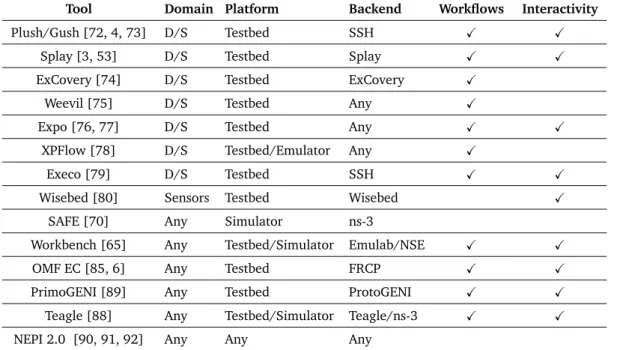
Table D.1 compares different network experiment automation tools and frameworks on the basis of their ability to support multiple research domains (Domain), to support different platform types, including simulators, emulators, and testbeds (Platform), to be independent of any framework pre-installed in the platform (Backend), to support the specification and control of runtime experiment behavior (Workflows), and to support interactive experiment execution (Interactive).
A complementary comparison of experiment management tools is available in the survey by Buchert et al. [93]. The comparison in Table D.1 focuses on the generality and adaptability of existing tools and frameworks to support experimentation on diverse platform types and domains. The list of existing tools and frameworks is extensive, and the objective of this comparison is not to be exhaustive but to give a general overview of different existing approaches.
In general, existing tools are either specialized in a certain domain or platform type, or depend on a backend that must be pre-installed in the target platform. Certain ap-proaches were born of specific problematics or within specific communities, e.g., Dis-tributed Systems, and their objective was never to be generalized to all research do-mains and platforms. Other approaches try to provide integral solutions that not only allow user-side experiment automation but that also take care of platform management and resource control through the use of a backend, e.g., testbed federations.
Tool Domain Platform Backend Workflows Interactivity
Plush/Gush [72, 4, 73] D/S Testbed SSH X X
Splay [3, 53] D/S Testbed Splay X X
ExCovery [74] D/S Testbed ExCovery X
Weevil [75] D/S Testbed Any X
Expo [76, 77] D/S Testbed Any X X
XPFlow [78] D/S Testbed/Emulator Any X
Execo [79] D/S Testbed SSH X X
Wisebed [80] Sensors Testbed Wisebed X
SAFE [70] Any Simulator ns-3
Workbench [65] Any Testbed/Simulator Emulab/NSE X X
OMF EC [85, 6] Any Testbed FRCP X X
PrimoGENI [89] Any Testbed ProtoGENI X X
Teagle [88] Any Testbed/Simulator Teagle/ns-3 X X
NEPI 2.0 [90, 91, 92] Any Any Any
Table 1.1 – Comparison of tools and frameworks to automate network experiments based on the domain
of research they support, the type of platform they can control, the backend restrictions, and their ability to support workflows and interactive experiment execution. In the values, ‘D/S’ stands for distributed systems and ‘Any’ for not restricted.
The backend dependent approach simplifies federation of testbeds and makes it eas-ier to generalize experiment automation, since the same services and interfaces can be expected across platforms. Nevertheless, adopting a common backend might not be feasible for all platforms, such as sensor testbeds with lightweight devices, and might prevent the integration of independent local resources into the experiment, such as the experimenter’s own desktop or server.
The work presented in this thesis extends and formalizes previous work done on an early version of the Network Experiment Programming Interface (NEPI) [90, 91, 92], NEPI version 2.0. NEPI was conceived from the beginning to be a generic tool for the au-tomation of network experiments. Its approach is to decouple the experiment automa-tion interface from the platform interface, making it adaptable to arbitrary platforms while offering a unified experiment automation interface to the user. Nevertheless, the original experimentation model proposed in NEPI was not flexible enough, and it did not support the definition and execution of user defined workflows, or the possibility to modify experiments during runtime. Runtime modification and interactive experi-mentation are features offered by many platforms, in particular emulators and testbeds. NEPI 2.0 could only model static experiment life cycles, and this limited the platforms it could support.
This work generalizes and simplifies the NEPI object model and user interface, proposing a generic life cycle that better adapts to testbeds and testbed federations, as well as simulators and emulators. It incorporates an orchestration engine capable of resolving orchestration dependencies between arbitrary resources, supporting user
defined workflows and interactive experimentation with runtime modifications of the experiment scenario. Additionally, this work focuses on supporting rigorous experimen-tation and enforcing experiment reproducibility, replication, documenexperimen-tation, and data archiving.
1.6
Research Hypothesis
The research question that motivates this work is whether it is possible to define a generic
solution to automate network experiments on arbitrary experimentation platforms and for arbitrary network experimentation scenarios.
Automating network experiments means minimizing or eliminating human
interven-tion in the experiment life cycle by providing mechanisms to perform the experimenta-tion steps in place of the user. These automaexperimenta-tion mechanisms must be consistent across experiment runs and allow to reproduce the same experimentation procedure.
Compatible with arbitrary platforms means that the approach chosen to automate
ex-perimentation must be potentially adaptable to any exex-perimentation platform, existing or future.
Arbitrary network experimentation scenarios means that the automation can not be
limited to a subset of scenarios or networking domains, and that it must be flexible to capture potentially any scenario involving any research domain. In particular, it should be possible to combine platforms for multi-platform and cross-platform experimenta-tion.
Following these considerations, the research hypothesis formulated in this thesis is the following:
It is possible to design and implement a technique to automate the life cycle of network experiments on any networking evaluation platform, or combination of them, in order to to evaluate any experiment scenario involving any networking research domain.
This hypothesis is motivated by the existence of experiment automation solutions that partially solve the problem of experiment automation on different network experi-mentation platforms, and the possibility of further generalizing experiment automation to arbitrary platforms based on the assumption of a common network experiment life cycle that is valid for all platforms.
1.7
Approach
The approach proposed in this thesis to automate network experimentation on arbitrary platforms does not attempt to replace existing automation solutions, but to integrate and complement them, and to foster re-usability and cooperation among existing experiment tools and platforms. This approach is based on the following principles:
Generic Experiment Life Cycle, Interface, and Model. Experiment automation is
generalized to arbitrary platforms and resources by defining a generic experimentation interface and a generic experiment model. The generic experimentation interface is based on the operations derived from the steps of a generic experiment life cycle that is
valid for arbitrary platforms. The generic experiment model is based on abstracting the representation of arbitrary scenarios using three generic entities: Experiment, Resource, and Data.
Adaptation Through External Drivers. Supporting a same experiment automation
interface across platforms, without imposing any requirements on the platforms them-selves, is achieved by decoupling the experimentation interface exposed to the user from the experimentation interfaces of individual platforms. Individual platforms are adapted to the generic interface thanks to external adaptor modules, in the same way a network device is adapted to the socket API using a specific network device driver.
Resource State-Based Workflows. Supporting configurable runtime behavior for
arbitrary resources is done by using a same state machine to describe the basic behavior of all resources and allowing users to define additional state transition constraints to model user-defined workflows. Like in Emulab [65], the proposed experiment descrip-tion model is divided in two parts, a static part to describe the resources used in the experiment, and a dynamic part to model the state-based workflows.
Generic Orchestration Engine. The execution order of the orchestration steps for
arbitrary resources is resolved by a generic orchestration engine component. This engine uses an on-line black-box scheduling algorithm to resolve the execution order of life cycle steps for all resources, taking into account dependencies between resources and user-defined workflows.
1.8
Contributions
This work makes the following contributions:
1. The formalization and specification of a generic approach to automate network experiments for arbitrary platforms and scenarios. The approach is designed
to support automation of network experiments for different evaluation methods, including simulation, emulation, and live experimentation, for single-platform, cross-platform, and multi-platform scenarios. The following associated contribu-tions are made:
• Generic Experiment Life Cycle. The identification of a generic experiment life cycle that is suited for simulators, emulators, testbeds, and testbed feder-ations.
• Generic Experiment Interface. The specification of a set of operations that encompass all tasks needed to automate experimentation on simulators, em-ulators, testbeds, and testbed federation, and the specification of additional operations to offer experiment reproducibility, experiment replication, and data archiving and sharing.
• Generic Experiment Model. The definition of a generic model to represent arbitrary experiment scenarios based on three simple abstractions: Experi-ment, Resource and Data, and supporting the definition of experiment work-flows to specify experiment runtime behavior.
• Generic Orchestration Engine. The specification of an algorithm for exper-iment orchestration capable of resolving arbitrary dependencies between life cycle steps of all resources in an experiment. This algorithm does not re-quire complete centralized knowledge of the dependency tree, and naturally supports the execution of arbitrary life cycle operations.
2. An implementation of the generic automation approach as a programming framework. The framework supports a high-level description of arbitrary
experi-ment scenarios and is capable of automating orchestration for simulation, emula-tion, and live network experiments. It is implemented as an open source Python library that can be used and extended freely by anyone. The following associated contributions are made:
• Extensible ResourceManager Class Hierarchy. An extensible class abstrac-tion to model resources on arbitrary platforms.
• Generic Orchestration Engine Implementation. An implementation of the orchestration algorithm, capable of resolving arbitrary dependencies between resources and dynamically responding to changes in the experiment scenario. The generic orchestration algorithm is implemented in the Scheduler module of the ExperimentController entity responsible for experiment coordination. • Automated Result Collection and Archiving. Support for data collection
and archiving at runtime using a Collector Resource abstraction. The Collec-tor Resource is an example of how the ResourceManager class hierarchy can be extended to provide arbitrary experimentation services.
• Error Detection and Failure Policies. User customizable policies to define experiment failure conditions and automated detection of errors during ex-periment deployment and execution.
• Experiment Reproduction. A mechanism to automate re-execution of ex-periments until a condition defined by the user is satisfied.
• Experiment Replication. Support for automated topology generation to fa-cilitate execution of a same experiment scenario on different platforms. • Simulation Support. Support for simulation using the ns-3 simulator. • Emulation Support. Support for software emulation using the DCE
emula-tion extension for ns-3, and support for the NetNS emulator based on Linux namespace virtualization.
• Live Experimentation Support. Support for live experimentation on Linux testbeds with SSH key authentication, on PlanetLab and OMF testbeds, and on the Fed4Fire testbed federation.
3. Framework Evaluation The evaluation of the proposed approach, carried out using
the framework implementation, takes into account three fundamental aspects: extensibility, efficiency, and flexibility.
• Extensibility. An evaluation of the capability of the framework to be ex-tended to arbitrary platforms, including simulators, emulators, and testbeds, is done based on the analysis of the development effort undertaken during the past two years to support platforms and resources by extending the Re-sourceManager class hierarchy.
• Efficiency. An evaluation of the orchestration efficiency of the framework, in terms of time and memory needed to run experiments, is carried out by means of three benchmarks. The benchmarks take into account different fac-tors that might impact orchestration efficiency, such as the delay to execute tasks and the number of threads used to parallelize orchestration. The first benchmark evaluates the performance of the framework using idealized con-ditions, whereas the second and third repeat the evaluation for real platforms using the ns-3 simulator and the PlanetLab testbed, respectively.
• Flexibility. A demonstration of the ability of the framework to support di-verse usages and scenarios is presented based on five use cases: Platform
Maintenance, Teaching Support, Federated Experimentation, Cross-Platform Ex-perimentation, and Multi-Platform Experimentation.
1.9
Thesis Outline
The remaining of this thesis is divided into the following six chapters:
Chapter 2: Generic Network Experiment Automation, defines a generic experiment
life cycle for simulators, emulators, and testbeds. It also defines an architecture composed of a generic experimentation interface and a generic experiment model, and proposes a generic algorithm to orchestrate arbitrary experiments based on a black-box approach for dependency resolution.
Chapter 3: Automation Framework Implementation, describes an implementation
of the architecture defined in Chapter 2, detailing all the features provided, in particular the extensible ResourceManager class hierarchy and the experiment or-chestration internals.
Chapter 4: Framework Evaluation: Extensibility, evaluates the feasibility and the
cost of supporting heterogeneous experimentation platforms using a single frame-work, based on the extensions done to the ResourceManager class hierarchy.
Chapter 5: Framework Evaluation: Efficiency, evaluates the performance of the
orchestration algorithm through three benchmarks using a Dummy platform, the ns-3 platform, and the PlanetLab platform.
Chapter 6: Framework Evaluation: Flexibility, provides use case examples to
demon-strate the ability of the framework to support a variety of scenarios involving dif-ferent networking research domains.
Chapter 7: Conclusions, summarizes the outcome of this work, and discusses the
benefits and limitations of the chosen approach, and the directions for possible extensions.
Generic Network Experiment
Automation
This chapter presents the approach proposed in this thesis to automate network exper-iments for arbitrary experimentation platforms and scenarios. Experiment automation permits to avoid manual tasks, reducing the time needed to run experiments and mini-mizing human errors. It also contributes to a rigorous experimentation methodology by simplifying experiment reproduction, replication, documentation, and data archiving, independently of the platforms used in the experimentation.
Experiment automation requires two things: a structured and detailed description of the scenario to run, and mechanisms to automatically translate the scenario description into a running experiment. These two requirements can be respectively satisfied by a description model, to represent the experiment scenario, and an orchestration model, to generate and execute operations based on the scenario description.
The approach adopted in this work consists in defining a generic experiment descrip-tion model, based on simple experiment abstracdescrip-tions, and a generic orchestradescrip-tion mech-anism, to automate deployment and execution of arbitrary experiments. The experiment model is paired with an experimentation interface that exposes common experiment operations derived from a generic experiment life cycle, and that can be adapted to all types of platform.
Platforms do not need to be adapted to the generic experimentation interface. On the contrary, the generic interface is adapted to the interfaces and services of specific plat-forms by implementing adaptor modules. These adaptor modules extend the common life cycle operations and the experiment model. Two things are achieved by adapting to
the platforms instead of adapting the platforms. The first is more flexibility in the type
of platforms and scenarios that can be supported. It is simpler to adapt to a platform than to convince platform owners to adapt their platforms, since they might be unable or unwilling to implement the necessary changes. The second is that externally adapting to the platforms empowers users. Users can create their own adapter modules, orches-tration mechanisms, or external services, without the need to convince platform owners to implement the changes in the platform.
Other solutions [6, 68, 52, 89] have also addressed similar problems related to ab-stract experiment description, orchestration automation, and support for rigorous ex-perimentation. However, existing proposals are limited to specific research domains or take a platform-centric perspective. A platform-centric perspective gives full control of automation strategies to the platform owners, and relies on agreement among them to converge to a common strategy.
The approach adopted in this work is user-centric. A user-centric approach gives users control over the experimentation models and orchestration mechanisms, and the possibility of extending or changing those mechanisms.
The rest of this chapter defines the architecture and specification of the proposed automation approach. It starts with the definition of a generic experiment life cycle, which sets the basis for the proposed automation architecture. Then it presents the main components of the architecture: a generic experiment model, a generic experimentation interface, and a generic orchestration engine.
2.1
A Generic Network Experiment Life Cycle
An experiment life cycle is defined by the sequence of steps that are taken to conduct an experiment from beginning to end. These steps might vary from one platform to another. This thesis is based on the hypothesis of the existence of a generic life cycle, composed of common steps, that can be used to model the experimentation process on arbitrary network evaluation platforms.
A mechanism capable of automating experimentation on arbitrary platforms must take into account the common operations that are needed to conduct experiments on any type of platform. These common operations can be derived from the steps of a generic experiment life cycle. In order to identify these generic steps, the life cycles of several platforms including simulators, emulators, testbeds, and testbed federations were studied, leading to the isolation of nine basic steps: a) platform setup, b)
experi-ment conception, c) experiexperi-ment design, d) experiexperi-ment deployexperi-ment, e) experiexperi-ment execution,
f) experiment monitoring, g) data collection, h) experiment termination, and i) data
pro-cessing. Appendix A provides examples of studied simulators, emulators, testbeds, and
testbed federations and their respective life cycles.
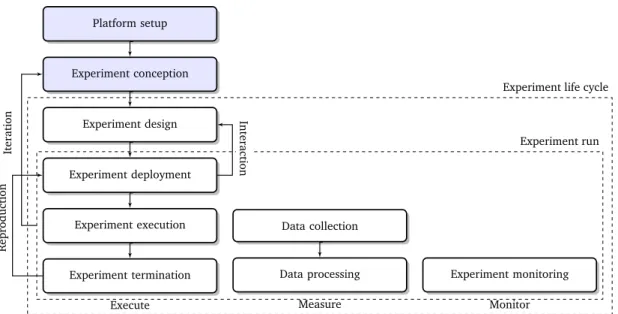
Table 2.1 gives the definition of the generic life cycle steps and Figure 2.1 shows the interactions between the generic life cycle steps. The life cycle steps are divided into
Execute, Measure, and Monitor activities, and grouped into three categories: those that
take part of the Experiment run, steps d) to i), those to take part in the Experiment life
cycle, steps c) to i), and the rest, steps a) and b).
Step a), platform set up, is performed only once per platform and per experimenter, and since it is not repeated for every experiment it is not considered to be a part of the
experiment life cycle. Step b), experiment conception, is also considered to be outside the
life cycle because it relies on the creativity of the experimenters and for this reason it cannot be automated.