HAL Id: halshs-00194716
https://halshs.archives-ouvertes.fr/halshs-00194716
Submitted on 7 Dec 2007
HAL is a multi-disciplinary open access
archive for the deposit and dissemination of sci-entific research documents, whether they are pub-lished or not. The documents may come from teaching and research institutions in France or
L’archive ouverte pluridisciplinaire HAL, est destinée au dépôt et à la diffusion de documents scientifiques de niveau recherche, publiés ou non, émanant des établissements d’enseignement et de recherche français ou étrangers, des laboratoires
Towards sustainable lignite consumption in Turkey and
a welfare analysis
Olfa Jaballi, Sebnem Sahin
To cite this version:
Olfa Jaballi, Sebnem Sahin. Towards sustainable lignite consumption in Turkey and a welfare analysis. 2005. �halshs-00194716�
Maison des Sciences Économiques, 106-112 boulevard de L'Hôpital, 75647 Paris Cedex 13
http://mse.univ-paris1.fr/Publicat.htm
Equipe Universitaire de Recherche
en Economie Quantitative - UMR 8594
Towards sustainable lignite consumption in
Turkey and a welfare analysis
Olfa J
ABALLI, E
UREQuaSebnem S
AHIN, E
UREQua &O
CDETowards Sustainable Lignite Consumption in
Turkey and a Welfare Analysis
∗
Olfa JABALLI
†EureQua, University of Paris1 Panthéon-Sorbonne
Sebnem SAHIN
‡EureQua, University of Paris1 Panthéon-Sorbonne & OECD
∗For very helpful comments and suggestions, we are grateful to Alain Ayong Le Kama,
also Antoine d’Autume and the participants at the seminar of environmental economics in EureQua at University of Paris 1 Panthéon-Sorbonne for their comments. Any errors that remain are solely our responsibility.
†Address: EUREQua, University of Paris 1 Panthéon-Sorbonne, Maison des Sciences
Economiques, 106-112 Boulevard de l’Hôpital, 75647 Paris cedex 13, France. Email: [email protected]
‡Address: OECD Environment Directorate, Global and Structural Policies Division, 2 rue
Résumé
La consommation soutenable est au coeur des débats sur le développement durable que chaque pays semble vouloir. Un des grands défis de ce siècle est de comprendre ce qui conduit la consommation et comment nous pouvons la réduire sans réduire l’efficacité économique. Cependant, la consommation n’est pas simplement déterminée par la croissance de la population, qui est générale-ment supposée être une cause clée d’une consommation non soutenable, mais aussi par l’activité économique, les choix technologiques, les valeurs sociales, les institutions et les politiques. Nous concentrons notre analyse sur la consomma-tion du lignite en Turquie en tant qu’une ressource naturelle épuisable et nous supposons que la consommation de cette ressource est la seule fin ultime de l’activité économique. Nous proposons une extention du modèle de Weitzman (1976). On introduit un paramètre de préférence relative à l’environnement pour une meilleur interprétation du bien-être social. L’un des buts premiers de ce papier consiste à établir une passerelle entre les résultats des modèles théorique et les applications empiriques. Notre modèle est construit sous GAMS pour la période 1980-2080.
Mots clés: Bien-être social, Consommation soutenable, Ressource épuis-able.
JEL Classification : D90, Q01, Q30 Abstract
Sustainable consumption is at the center of sustainable development that every country seems to want. One of the great challenges of this century must be to understand what drives the consumption and how we can reduce con-sumption through increased efficiency. However concon-sumption is not simply de-termined by population growth, which is commonly assumed to be a key cause of unsustainable consumption, but also by economic activity, technology choices, social values, institutions and policies. In this paper, we focus our analysis on lignite consumption in Turkey as an exhaustible natural resource and we as-sume that the consumption is only the ultimate end of the economic activity. Some improvments of the Weitzman model (1976) are proposed by introducing an environmental preference parameter into the model to complement his inter-pretation of welfare. Our aim is to pass from theory to practical applications by presenting some modest empirical results. Our model is constructed under GAMS for the period 1980-2080 using Turkish data.
Keys words and Phrases: Dynamic Welfare, Exhaustible Resource, Sus-tainable Consumption.
1
Introduction
Environmental accounting is an important tool for understanding the role played by the natural environment in the economy. Environmental accounts provide data that highlight both the costs imposed to the economy by pollution or resource degradation and the contribution of natural resources to the economic well-being.
In 1972, Club of Rome argued that an unlimited economic growth is impossi-ble because of the depletion of some natural resources. In response to this, new works have been developed to determine whether the presence of exhaustible resources are limiting the economic growth. Since 1987, a new concept called "sustainable development" is defined in the Brundtland report "Our Common Future" and has been used to describe this kind of concern. Discussion on the definition of the concepts of sustainable development are still going on nowa-days. One basic concern is how to reconcile environmental, social and economic requirements.
In the present paper, we choose to focus our analysis on the Turkish econ-omy since the country has been rapidly growing in terms of econecon-omy since the 1980s. During the last decade, the aggregate demand for domestic energy in-creased about 4.4 percent per year, with electricity consumption growing at an average annual rate of about 8.5 percent1. This important increase can be explained by the liberalization of the economy since the 1980s. Turkish households’ energy consumption increased due to the changing life styles; an in-creasing purchase of new electrical equipment and cars. However, lignite stayed as the most commonly used heating fuel in Turkey because of its abundance as a domestic resource and its low price. Naturally, this fast growing energy consumption had negative impacts on the environmental quality. The emissions of greenhouse gases (GHG) increased and some conflicts appeared during the official discussions with the international organizations; more specifically nego-tiations between the Turkish authorities and the international organizations on the Kyoto Protocol.
As we can see in the figure below, the domestic lignite consumption fol-lows a very fast growing trajectory and absorbs the largest part of the lignite production in Turkey. This high growth rate causes an “unsustainable” lignite consumption in this economy. This phenomena justifies our motivation to in-troduce economic measures in a simple theoretical model in order to slow down the fast increasing consumption.
1See, WORLD ENERGY COUNCIL-TURKISH NATIONAL COMMITTEE [1986-1999],
Figure 1:
L ig n ite p ro d u ctio n a n d co n su m p tio n in tu rk ey
0 1 0 2 0 3 0 4 0 5 0 6 0 7 0 1 9 8 0 1 9 8 1 1 9 8 2 1 9 8 3 1 9 8 4 1 9 8 5 1 9 8 6 1 9 8 7 1 9 8 8 1 9 8 9 1 9 9 0 1 9 9 1 1 9 9 2 1 9 9 3 1 9 9 4 1 9 9 5 1 9 9 6 1 9 9 7 Y e a rs M illion t on s C o n su m p tio n P ro d u ctio n
Naturally, such an important increase in energy consumption has a negative impact on the environmental quality due to increasing GHG emissions. However, the determination of the optimal environmental policy without reducing the economic growth performance is still a challenge for the Turkish governments.
In this paper, we chose as the departure point, the theoretical aspect where we focus our analysis on the Weitzman (1976) result in a closed economy on a possible "sustainable" energy consumption path. We suggest some improve-ments and built a new theoretical model which is followed by some empirical results applied to the Turkish case. Our model runs in GAMS and concerns the period 1980-2080.
Even though, our study focus on lignite as the most important energy source in Turkey, this kind of analysis can be expanded easily to other exhaustible nat-ural resources. Our paper can be considered the first step towards the calcula-tion of a welfare indicator Turkey. We focus our analysis on of the "Green" Net National Product (NNP), which appears as an important welfare indicator since it combines both the growth and the welfare effects. Also, the last part of our paper gives important indications towards the determinations of a sustainable development policy in Turkey.
2
Weitzman’s result applied to the Turkish case
In order to study the environmental and economic interactions in terms of op-timal control using exhaustible resources, first, let us recall that the main eco-nomic models and statements referring to this topics are often derived from the classic "cake-eating" economy studied by Hotteling (1931). In such models, one considers the allocation of an exhaustible resource which is the only good of the economy over an infinite horizon.
In order to suggest a "sustainable" energy consumption for a fast growing country like Turkey, we suggest to use the methodology described in Weitzman
(1976) because his analysis provides the basis for the treatment of exhaustible resources in the national accounts. This gives us the opportunity to test his model with real Turkish data. However, Weitzman has conducted his analysis with the assumption of a closed economy with a constant interest rate. This is more than innocent because in a closed economy the rate of interest is constant only when the capital stock is constant. In other words, the capital stock can be constant only if the whole income is being consumed. Hence, the National Net Product (NNP) is equal to the rate of interest r multiplied by the present discounted value of future consumption.
Y∗(t) ' r Z ∞
t
C∗(s)e−r(s−t) (1)
In this rather static world, Weitzman was also able to prove two important equalities on NNP (even if they won’t be true once interest rate is allowed to vary over time). First, NNP is equivalent to the Hamiltonian for a general opti-mization problem. Second, it is what might be called the stationary equivalent of future consumption. This stationary level of consumption has also often been called the sustainable level of consumption or the largest permanently sustainable level of consumption. Here, we adopt the same definitions and then attribute real values.
In his original paper, Weitzman (1976) also assumes that real income is a linear transformation of utility and the utility function itself, is linear in con-sumption. In the same framework, we determine the "sustainable" consumption trajectory for Turkey by resolving an intertemporal optimization problem. The problem will be as usual to maximize the sum of discounted utilities derived from the consumption of the resource. We assume that the resource is totally consumed: M ax {Ct} Z ∞ 0 U (Ct)e−rtdt s.t R•t= −Ct≥ 0 , Rt≥ 0, R0 (given)
Where Rtis the resource stock, Ctthe consumption and r the discount rate. Using the Maximum Principle, one determinates the optimal consumption by the dynamic equation:
• Ct Ct = r η(Ct) (2) Where η(c) = −CU00(C)/U0(C) > 0 is the elasticity of substitution of mar-ginal utility. If the elasticity η is a constant, the optimal consumption decreases exponentially at the rate −r/η, namely:
C∗t = C0e−
r
ηt (3)
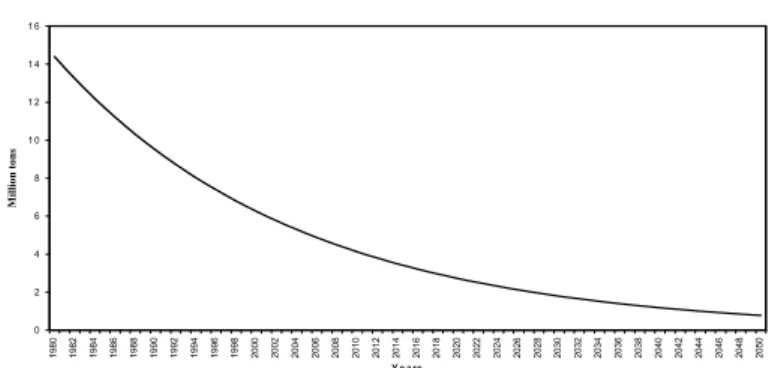
Applying this result to the Turkish domestic energy (lignite) data between 1980-2080, we observe that the optimal (or sustainable) consumption path of the lignite resources should display a decreasing evolution and behave as follows:
Figure 2: O p tim a l C o n su m p tio n 0 2 4 6 8 1 0 1 2 1 4 1 6 1980 1982 1984 1986 1988 1990 1992 1994 1996 1998 2000 2002 2004 2006 2008 2010 2012 2014 2016 2018 2020 2022 2024 2026 2028 2030 2032 2034 2036 2038 2040 2042 2044 2046 2048 2050 Y e a rs M il li on to ns
The above graphic displays the optimal lignite consumption trajectory for Turkey, using the Weitzman model. The lignite consumption and reserves are anticipated for a period of time of one hundred year, so until 2080, using the following parameters: i) the interest rate r is equal to 0.15, ii) the elasticity of consumption η is equal to -1.5 and the initial lignite reserve in 1980 is 7306 million tones.
We therefore observe that this estimation does not correspond to the real evolution of lignite use by Turkish households - that is increasing rapidly (fig-ure1). This phenomena points out the necessity to take economic measures in order to slow down the consumption rate of the exhaustible lignite reserves. The following section presents some policy recommendations in order to make the consumption trends converge towards a "sustainable consumption" path.
Here, it is necessary to note that, in this theoretical approach only the consumption of the resource procures utility to the consumer. However, in several cases the stocks of natural assets can also be a source of welfare2. Thus, we suggest to improve the model by introducing the stock of the resource in the utility function. At the same time, we suggest to introduce a parameter φ which we named "environmental social preference", that refers to an "arbitrage" decision by the social planner between the immediate consumption and the preservation of the natural resources. In the last section, we discuss the choice of policy instruments that could have an impact on the environmental social preference of the consumers.
2See Krautkraemer (1985), who analyses the feasibility of sustained consumption paths in
3
The Model
3.1
The social optimum
We are situated in an economy in which the well-being of the individuals de-pends only on the consumption Ct and the quality of the environment which is materialized by the existence of an exhaustible natural resource. However, the consumption of this resource has a negative impact on the quality of the environment. The main assumptions of our model are inspired by Weitzman (1976). The social preferences are described by a non-separable utility function, U (C, R), that depends on the consumption level and the natural resource stock in the economy.
Like most of the studies in this field, we suppose a usefulness separable function, which corresponds to a decomposition of the utility in a "non envi-ronmental" well-being, obtained by the consumption of the private good and an "environmental" well-being, that results from the preservation of the natural resource. Also we assume that: (i) it has a fully known and fixed initial stock of exhaustible resource (or reserve) R0 > 0,(ii) no technical change, (iii) popula-tion size remains constant3 and (iv) citizen preferences are identical. The social preferences are defined by a CES utility function, U (Ct, Rt), which is a twice differentiable, increasing, and strictly concave function of the resource consump-tion and stock rate ( i.e., U0(C) > 0, U0(R) > 0, U00(C) < 0, U00(R) < 0 for all C ≥ 0 and R ≥ 0).
For simplicity, let U be composed of U1 and U2, two logarithmic utility functions as follows:
U1 = log Ct (4) U2 = log Rt (5) The environmental social preference φ ∈ [0, +∞) represents the relative preference for the quality of the environment as it’s perceived by the social planner.
The social optimization problem can be interpreted as in Weitzman (1976), if and only if, the share parameter φ is equal to zero. Here, for φ different to zero, we solve a dynamic program where the social welfare function is defined as the discounted sum of the representative consumer’s utility flow under the resource stock constraint. Then, the corresponding optimization problem becomes:
M ax {Ct,Rt} Z ∞ 0 U (Ct, Rt)e−rtdt s.t R•t= −Ct≥ 0 , Rt≥ 0, R0 (given)
3For contributions analysing the case with a changing population, see, Asheim (2002),
Assuming the constraint Rt≥ 0 holds, the current-value Hamiltonian (Hc) can be written as :
Hc(Ct, Rt, λt) = U (Ct, Rt) − λtCt
Where λt is the shadow price of the resource stock in utility units. The first-order conditions for an optimal path are:
U10 = λt (6)
•
λt = rλt− φU
0
2 (7)
and the transversality condition: lim t→∞λtRte
−rt= 0
By differentiating (6) with respect to time, using (7), we denote the elasticity of marginal utility of consumption η by:
η(c) = −CU
00
(C)
U0(C) > 0 (8) The optimal consumption path is characterized by the familiar condition:
• Ct Ct = 1 η Ã φU20 U10 − r !
In fact, along the optimal path, the consumption and stock levels decline exponentially over time at a constant rate of φ+ηr
That is: Ct∗= C0e− r φ+ηt (9) and R∗t = R0e− r φ+ηt (10)
Where the level of initial consumption C0is calculated by using the value of the exogenous initial stock R0:
C0= rR0
φ + η (11)
So that, we can define the optimal and “sustainable” path of consumption as follows:
Ct∗= rR0 φ + ηe
− r
3.1.1 An empirical application
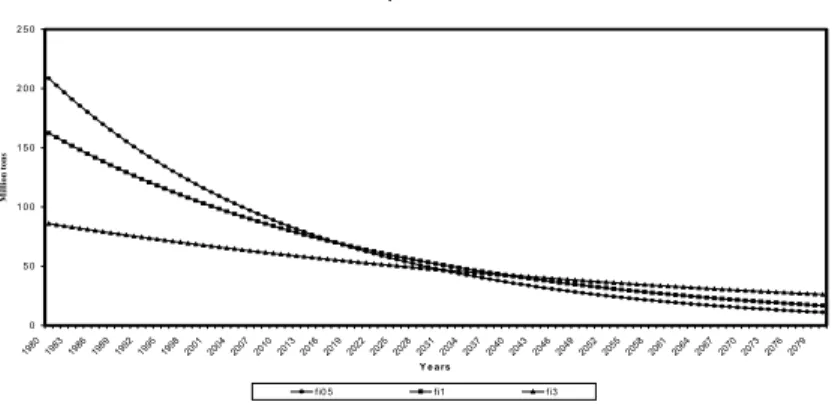
We present below the application of precedent result of our model to Turkey. More precisely we show the impact of a changing environmental social prefer-ence, on the consumption from a sustainability perspective. It is also important to remind that the actual value of social environmental preference parameter should be extremely low since the lignite consumption curve is rapidly increasing (see figure 1).
Here we define the social preference as the Turkish government’s sensitiv-ity to the environmental problems. We assume that the social planner knows exactly the value attributed to the environmental quality by the Turkish house-holds. We test our model for three different values of environmental social preference values, corresponding to low, medium and high sensitivity levels. The figure 3 represents the estimation of the consumption evolution for three different values of the environmental social preference4, φ = {0, 5; 1; 3} . After including this parameter in the model, we observe that as φ increases, the con-sumption trajectory moves up. In other words, the concon-sumption curve becomes flatter meaning more “sustainable”.
Figure 3: C o n su m p tio n E v o lu tio n 0 5 0 1 0 0 1 5 0 2 0 0 2 5 0 1980 1983 1986 1989 1992199 5 1998 2001 2004 2007 201 0 2013 2016 2019 2022 202 5 202 8 2031 2034 2037 2040 204 3 2046 2049 2052 2055 2058206 1 2064 2067 2070 2073207 6 207 9 Y e a rs Millio n to ns
fi0 5 fi1 fi3
Following the same logic, we also deduce that the lignite reserves are con-served in a more sustainable pattern. The below estimation shows us that the depletion date can be postponed from 2050 to 2080 if the Turkish consumers adopt a more "altruist" hence, a more "sustainable" consumption behavior.
Figure 4: R eser v e s E v o lu tio n 0 1 0 0 0 2 0 0 0 3 0 0 0 4 0 0 0 5 0 0 0 6 0 0 0 7 0 0 0 8 0 0 0 198 0 198 3 198 6 198 9 199 2 1995199 8 200 1 200 4 200 7 201 0 20132016201 9 202 2 202 5 202 8 203 1 20342037204 0 204 3 204 6 204 9 205 2 2055205 8 206 1 206 4 206 7 207 0 207 3 2076207 9 Y e a rs M illio n to n s
fi0 5 fi1 fi3
In the following section, we study the evolution of the private consumption path when the government decides to influence the consumption behavior of each individual agent.
3.2
The decentralized economy
In this section, we focus our analysis on the use of an exhaustible resource like the lignite, particularly for Turkey and its impact on the social welfare. This point is relevant since the environmental discussions around Kyoto protocol occupy actually an important place in the government’s agenda. Some policy measures have already been taken in order to slow down the use of the high sulfur content domestic lignite by the Turkish households.
Moreover, the analysis of the decentralized economy sheds light into the design of policies to implement the social optimum in the Turkish economy. For that, we maintain the assumptions of the Weitzman model (1976), the planner decides to impose a consumption tax rate τ , which is constant over time, in order to reduce the fast consumption rate of lignite. The representative consumer maximizes his utility under a resource stock constraint. We assume that he withdraws satisfaction entirely from his private consumption of the resource, denoted C∼t, and he is completely indifferent to the environmental quality. We try to simulate the influence that the government’s sensibility to the environment could have. The corresponding optimization program could be given as following: M ax {ct} ∞ Z 0 U (C∼t, ∼ Rt)e−rtdt s.t R∼• t= −(1 − τ) ∼ Ct
The current value of the Hamiltonian is defined as follows: Hc= U (C∼ t, ∼ Rt) + λt(τ − 1) ∼ Ct
Where λt is the shadow price of the resource stock in utility units.
In this case, we note that the private agent has no environmental prefer-ence. He takes satisfaction only from the consumption of the resource, so the intertemporal efficiency condition is determined from:
∂Hc ∂R∼t
= 0 (13)
Hence, the first order conditions become: (
U10 = λt(1 − τ ) •
λ = rλt
(14)
We note that, the transversality condition for this program is:
lim t→∞λt
∼ Rte−rt= 0
In fact, along the optimal path, the consumption and the stock levels decline exponentially over time at the constant rate of h(1 − τ)r
η i . That means: ∼ Ct ∗ =C∼0e(τ−1) r ηt (15) and ∼ R∗t =R∼0e(τ−1) r ηt (16) Where ∼ C0= r(1 − τ) η ∼ R0 (17)
So that, the optimal consumption path of consumption is calculated as fol-lows: ∼ Ct ∗ = r(1 − τ) η ∼ R0e(τ−1) r ηt (18)
As we can see in (18), the optimal consumption is a decreasing function of the tax rate τ . Therefore, the determination of an optimal tax value by the government appears more than necessary.
3.2.1 Determining the optimal tax rate
In this section, our aim is to determine the optimal tax rate value (τ∗) such that the private agent’s choice converges to the social optimum. We want to reach a situation where the consumption of lignite is declining over time and a better preservation of the reserves improves the social welfare. In other words,
consuming at a decreasing rate for a sustainable path, allows us some improve-ments in the environment quality and increases the social welfare. For that, we must have equality between the two marginal consumption evolutions in the two following cases:
• First, the social planner maximizes his utility, taking into account the en-vironmental problems caused by an increasing lignite consumption. We have found that the evolution of the marginal consumption (
•
λt
λt) is equal
to the social time preference rate r, diminished by the value of the mar-ginal utility of substitution which is multiplied by the value of the social preference φ. • λt λt = r − φ U20 U10 (19)
• Second, the consumers maximize their private utilities with no concern about the environmental damage. In this case, in order to reach a “sus-tainable” consumption path, a consumption tax should be applied. In that case, we found that the marginal consumption rate (
•
λt
λt) increases
with respect to the interest rate as described in the Hotteling rule5: •
λt λt
= r (20)
Therefore, an optimal tax value is derived from the convergence of the two marginal consumption curves. It is defined as follows:
τ∗= φU
0
2 U10
By replacing the marginal utility of consumption and resource, U10 and U20 by their expressions derived from (5) and (6), we get:
τ∗= φC0 R0
(21)
Therefore, we can express the optimal tax rate as follows in terms of the key parameters:
τ∗= rφ
(φ + η) (22)
3.2.2 An empirical application
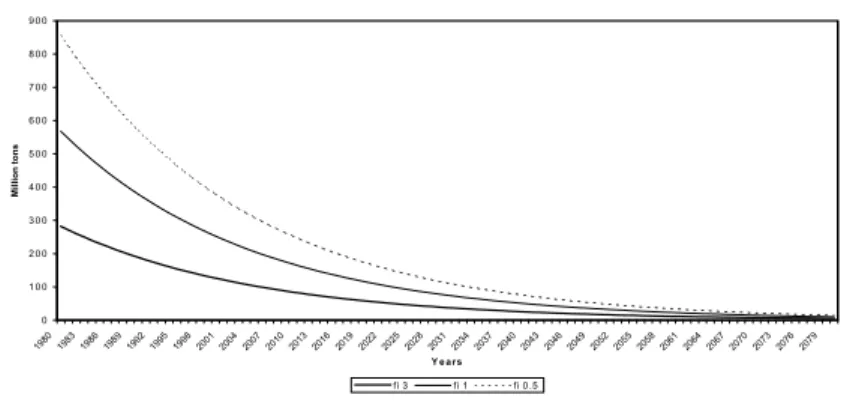
The optimal lignite consumption trajectories when the planner has an influence on the choice of the private agent by the using a fiscal policy is described by the following function: ∼ Ct ∗ =r [1 − τ∗(φ)] η ∼ R0e[τ ∗(φ)−1]r ηt (23)
The below figure displays the evaluation of the consumption: Figure 5: E v o lu tio n o f c o n s u m p tio n 0 1 0 0 2 0 0 3 0 0 4 0 0 5 0 0 6 0 0 7 0 0 8 0 0 9 0 0 198 0 1983 1986 1989 1992199 5 1998 2001 20042007201 0 2013 2016 2019202 2 2025 2028 203120342037 2040 2043 204620492052 2055 2058 2061206 4 2067 2070 207320762079 Y e a rs M illio n to n s fi 3 fi 1 fi 0 .5
We observe that the projection for a period of one hundred years of the consumption path under a taxation policy, shows that for three values of the environmental preferences φ, the fiscal policy gives more efficient results at short and middle terms. However in the long term (beginning from 2050), we can observe that the three consumption patterns are superposed for different values of φ. In other words, the optimal consumption Ct∗ declines towards zero. We deduct that there is no positive level of sustainable consumption for an infinite time horizon. Consequently, the stock is totally depleted in the long term.
4
Sustainable consumption policies and social
welfare
In this section, we adopt the point of view of the social planner and we give a simple welfare analysis for Turkey.
4.1
Overview of NNP definitions
In this section, let’s recall concept of Net National Product (NNP) and its meaning as an economic and welfare indicator. Much of the current debate
in the literature concerns the definition of the NNP as an "indicator of social welfare" or as an "indicator of sustainability" which goes back to the seminal work of Hicks (1946), Samuelson (1961) and Weitzman (1976). The discussion starts with the Hicks’ definition of an individual’s income: "the maximum value which he can consume during a week and still expect to be as well off at the end of the week as he was in the beginning" (op.cit.p.172).
If this concept is extended and applied to an economy as a whole, income would be a number representing the amount of welfare which can be enjoyed over a period of time, and leave the economy with the capacity to enjoy that same amount of welfare for the next period of time. More precisely, the development of the economy over a period of time is "sustainable", if the income, in the sense of the above definition, is constant over that period of time.
We observe that the concept is old, since the early definitions appear in the above mentioned articles. Meanwhile, in the space of only a few years, the term "Green NNP" has gained much currency. Today that is a common place to say that in estimating NNP, the following points should to be taken into consideration:
• depreciation of the physical and human capital should be deducted from the Gross National Product (GNP),
• Also the depreciation of the natural capital and the social losses that are incurred due to the increases in the stock of environmental pollution. More clearly, in the literature, the green NNP has widely been interpreted as "constant-equivalent consumption" of the traditional NNP. Citing again Hicks (in Value and Capital, 1939): "...The concept of income [is] one which the positive theoretical economist only employs in his arguments at his peril. For him, income is a very dangerous term, and it can be avoided;... a whole general theory of economic dynamics can be worked out without using it".
In our paper, we expand the definition of economic well being from the concept of the national income to the social welfare including environmental quality. Before suggesting an alternative concept of welfare by including the environmental indicators in the social well being, it is also important to remem-ber that according to Pigou (1932), economic welfare is defined as: "that part of social welfare that can be bought directly or indirectly into relation with the measuring-rod of money".
4.2
Measuring future welfare
In the last years, efforts have been made to construct the so-called "Green Net National Product" as a welfare indicator of the sustainable development where environmental pollution and natural resource depletion are taken into account. Reminding that, welfare is typically expressed in utility terms in the optimal growth theory (Weitzman, 1976), a comprehensive NNP concept is one candidate for such a measure. Such an augmented (comprehensive) NNP would
serve both as a better indicator of the overall macroeconomic performances and also as a better measure of social welfare.
We chose to focus our analysis on Weitzman’s NNP interpretation of wel-fare defined in his original paper. As we reminded in the first part, Weitzman suggested that real income was a linear transformation of utility with the as-sumption that the utility function was, itself, linear in conas-sumption. According to him, "... the national income statistician’s practice of adding in investment goods to the value of consumption by weigthing them with prices (measuring their marginal rates of transformation) might still be defended as a measure of the economy’s power to consume at a constant rate. After all, a standard welfare interpretation of NNP is that it is the largest permanently maintainable value of consumption. If all investment was convertible into consumption at the price-transformation rates, the maximum attainable level of consumption that could be maintained forever without running down capital stocks would appear to be NNP as conventionally measured ...". He shows that this is exactly the same as what would be obtained from the hypothetical constant consumption level: ∼ Ct ∗ + λt dR∼∗ t dt
In this sense, a naive interpretation of the current power to consume at a constant rate idea gives the right answer, although for the wrong reason. Net National Product is what might be called the stationary equivalent of future consumption, and this is its primary welfare interpretation6.
Let W∗
t the measure of the optimal intertemporal social welfare for Turkey, it turns out that the maximum welfare actually attainable from time t on along a competitive trajectory is:
W∗ = Z ∞ t U (C∼s∗,R∼∗s)e−r(s−t)ds W∗ = Z ∞ t · logC∼s∗+ logR∼s∗ ¸ e−r(s−t)ds ReplacingR∼∗ s and ∼ C∗
s with their expressions derived from (18) and (20), we obtain after some calculations the following expression of welfare:
W∗(R∼0) = 1 r " logR∼0+ log r(1 − τ∗(φ)) η # − (t +1r)(1 − τ ∗ (φ)) η (24) This identity is verified for all t ∈ [0, +∞[. So that, at time t = 0 we have:
W∗(R∼0) = 1 r " logR∼0+ log r(1 − τ∗ (φ)) η # −(1 − τ ∗ (φ)) rη
We should underline that W∗is a function of the initial stock of the resource ∼
R0and the optimal tax value (τ∗), itself depends on the parameter φ of environ-mental preference7. This equation gives the possibility to study the evolution of individuals welfare when the planner gives importance to the environmental damage. The below expression gives the relation between social welfare and the environmental preference parameter φ :
∂W∗ ∂φ = 1 r " logR∼0+ ∂τ∗(φ) ∂φ 1 τ∗ (φ)− 1 +1 η · τ∗(φ)+∂τ ∗ (φ) ∂φ − 1 ¸# (25)
We note that the sign of this ratio ∂W∂φ∗ depends only on the initial stock ∼
R0. Then, the necessary condition for an increasing welfare is: ∼ R0> exp " 1 η µ 1 − τ∗(φ)− ∂τ∗(φ) ∂φ ¶ +∂τ ∗ (φ) ∂φ 1 τ∗ (φ)− 1 # (26)
This inequality is always verified for all φ ∈ [1, +∞[. Consequently, the more the planner takes care of the environmental quality, the greater becomes the welfare.
5
Some concluding observations
This paper explores the relationship between economic growth and environmen-tal quality. Its major contribution is to establish a link between the theoretical research in sustainable consumption and the empirical studies, via a simple model for Turkey. The results of this paper are complementary to the conclu-sions of Weitzman (1976) that gives a standard welfare interpretation of NNP as the largest permanently maintainable value of consumption.
In this framework, we showed that the Weitzman criteria can be improved. Our most significant conclusion showed that the imposition of an environmental tax on lignite consumption, slows down the actual fast increasing trend. Con-sequently, a better conservation of this type of natural resource, could increase the national welfare. Given the parameters and the actual data on Turkey, we observed that this kind of environmental taxation leads to better economic and environmental results. The main explanation comes from the fact that in our model, the social welfare depends, not only on the resource consumption, but also on a new parameter called social "environmental preference" and the ini-tial stock of the resource. Our methodology was to include the natural resource stocks in the utility function and to weight them by a new parameter. Our empirical application results show that in order to converge to a sustainable trajectory of consumption of lignite and to improve the individual’s welfare, the planner must integrate these preferences. In our simulations, the welfare of the
7Note that the optimal tax is an increasing function of φ. Otherwise, the more the planner
Turkish households has improved. We can conclude that this outcome proves the willingness to pay an "environmental" tax of Turkish consumers for a better environmental quality. However, we should note that this is right, if and only if, the initial stock of the resource is important, which is the case here. In an opposite case there would be no interest to preserve this kind of resource.
The application of this tax can generate enough revenues for the government to improve the environmental quality. It can be used, for example, to finance some sensibilization campaign for the environmental quality and resource preser-vation. Here is the proof that the traditional instruments such as a pollution tax, which is depending on the social environmental preference, can help to attain a sustainable trend of consumption in the short and middle term.
However, one of the limits of our model is that we have no significant result in the long term analysis. This work seems to indicate a way of measuring economic development that takes into account the major issues in the discussions of sustainability for Turkey. Our suggestions answer the question whether the current rate of lignite use as an exhaustible natural resource is consistent with the growth of future welfare.
Naturally, further research needs to be done. In particular, a generalization of this approach to any natural resource, not only exhaustible ones, and to a more general framework including a group of countries.
References
[1] Arrow K., Dasgupta P., Daily G., Ehrlich P., Goulder L., Geoffrey H., Levin S., Mäler K-G., Schneider S., Starrett D. & Walker B., "Are We Consuming Too Much?", Journal of Economic Perspectives, Volume 18, Number 3, Summer 2004, 147-172.
[2] Asheim G., "Green national accounting with a changing population", Uni-versity of Oslo, 2002. (http://folk.uio.no/gasheim/popcha03.pdf)
[3] Asheim G. and Buchholz W., "A general approach to welfare measurement through national income accounting", July 2003.
[4] Asheim G. and Weitzman M. L, "Does NNP growth indicate welfare im-provement?", Memorandum No:2, Department of Economics, University of Oslo, 2001.
[5] Ayong Le Kama A.D., "Sustainable Growth, Renewable Resources and Pollution", Journal of Economics Dynamics and Control, 2001.
[6] Cairns, R. "Green Accounting for an Externality: Pollution at a Mine", Environment and Resource Economics 27, 2004, 409-427.
[7] Cairns, R. "Sustainability Accounting and Green Accounting", Environ-ment and DevelopEnviron-ment Economics 5, special issue, 2000, 49-54; reprinted as ch. 3 in Natural Resource Accounting and Economic Development, eds. Charles Perrings and Jeffrey R. Vincent, Edward Elgar, Cheltenham UK, 2003.
[8] Hamilton K. "Saving effort and population growth: theory and measure-ment", The World Bank.
[9] Hartwick J. M , "National Wealth and Net National Product", Scandina-vian Journal of Economics No : 96 (2), 1994, 253-256.
[10] Harris J. M., "Basic Principles of Sustainable Development", Working pa-per 00 04, Global Development Institute, Tufts University, June 2000. [11] Heal G., "Valuing the Future, Economic Theory and Sustainability",
Colombia University Press, New York.
[12] Hotteling H., "The Economics of Exhaustible Resources", Journal of polit-ical Economy, 1931.
[13] Jeroen C.J.M. van den Bergh and Ada Ferrer-i-Carbonell, "Economic The-ories of Sustainable Consumption", Serie Research Memoranda, Vrije Uni-versiteit, Amsterdam, November 1999.
[14] Krautkraemer, J.A, "Optimal Growth, Resource Amenities and the Preser-vation of Natural Environments". Review of Economic studies 52 (1), 1985, 153-170.
[15] Solow, R. M., "An Almost Practical Step Toward Sustainability", Resources for the Future, 1993.
[16] Pigou A. "Economics of welfare", 1932.
[17] Weitzman M. L., "Wealth and the Maximum Principle" Harvard University Press, 2003.
[18] Weitzman M. L., "A Contribution to the Theory of Welfare Accounting", Harvard University, Cambridge, MA 02138, January 2000.
[19] Weitzman M. L., "On the Welfare Significance of National Product in a Dynamic Economy", Quarterly Journal of Economics, No: 90, 1976, 156-162.
[20] World Commission on Environmental and Development, WECD "Our com-mon future", Oxford University Press, 1987.