HAL Id: hal-00297107
https://hal.archives-ouvertes.fr/hal-00297107
Submitted on 10 Apr 2008
HAL is a multi-disciplinary open access
archive for the deposit and dissemination of
sci-entific research documents, whether they are
pub-lished or not. The documents may come from
teaching and research institutions in France or
abroad, or from public or private research centers.
L’archive ouverte pluridisciplinaire HAL, est
destinée au dépôt et à la diffusion de documents
scientifiques de niveau recherche, publiés ou non,
émanant des établissements d’enseignement et de
recherche français ou étrangers, des laboratoires
publics ou privés.
A multi-institutional and interdisciplinary approach to
the assessment of vulnerability and adaptation to
climate change in the Peruvian Central Andes: problems
and prospects
A. G. Martínez, K. Takahashi, E. Núñez, Y. Silva, G. Trasmonte, K.
Mosquera, P. Lagos
To cite this version:
A. G. Martínez, K. Takahashi, E. Núñez, Y. Silva, G. Trasmonte, et al.. A multi-institutional and
interdisciplinary approach to the assessment of vulnerability and adaptation to climate change in the
Peruvian Central Andes: problems and prospects. Advances in Geosciences, European Geosciences
Union, 2008, 14, pp.257-260. �hal-00297107�
www.adv-geosci.net/14/257/2008/ © Author(s) 2008. This work is licensed under a Creative Commons License.
Geosciences
A multi-institutional and interdisciplinary approach to the
assessment of vulnerability and adaptation to climate change
in the Peruvian Central Andes: problems and prospects
A. G. Mart´ınez1, K. Takahashi2, E. N ´u ˜nez3, Y. Silva1, G. Trasmonte1, K. Mosquera1, and P. Lagos1
1Geophysical Institute of Peru, Lima, Peru 2NOAA/GFDL, Princeton, New Jersey, USA 3Yanapai, Huancayo, Peru
Received: 15 June 2007 – Revised: 29 September 2007 – Accepted: 5 October 2007 – Published: 10 April 2008
Abstract. A local integrated assessment of the
vulnerabil-ity and adaptation to climate change in the Mantaro River Basin, located in Peruvian Central Andes, was developed be-tween years 2003 to 2005. In this paper we present some lessons learned during the development of this study, em-phasizing the multi-institutional and interdisciplinary efforts, briefly showing the methodological aspects, and pointing out the main problems found.
1 Introduction
One of the main global environmental changes that has been experiencing by the planet in the last few decades is climate change, which is largely the result of anthropogenic green-house gases emissions into the atmosphere (IPCC WG1, 2007), and the consequent set of impacts on the biosphere (IPCC WG2, 2007).
Although it is recognized that the studies of the conse-quences of climate change for human activities must be de-veloped on regional and local scales, and in interdisciplinary ways that combine, interpret and communicate knowledge of diverse scientific disciplines (Rotmans and Dowlatabadi, 1998), concrete examples of studies of this nature are rarely found, partly because the methodologies for this type of study are in an incipient stage.
Motivated by this consideration, in this article we present experiences and lessons learned during the development of the pilot study “Local Integrated Assessment of the Mantaro River Basin”, which was developed fundamentally as an in-terdisciplinary and interinstitutional work between the years 2003 and 2005 by the Geophysical Institute of Peru (IGP) in
Correspondence to: A. G. Mart´ınez
coordination with the National Council of the Environment (CONAM).
The central objective of the study was to systematize and to extend the knowledge about climate change in the Man-taro River Basin, and to evaluate the climatic, physical and social aspects of its vulnerability to this change, as well as to identify viable options of adaptation in agriculture, hydro-electric energy generation and health sectors, in order to be incorporated in the local and regional development plans.
Future scenarios were generated for 50 years into the fu-ture, which was considered a long enough time that the cli-mate change signal would be significant, but short enough that they would be relevant to the stakeholders that currently inhabit or operate in the basin.
2 Study area
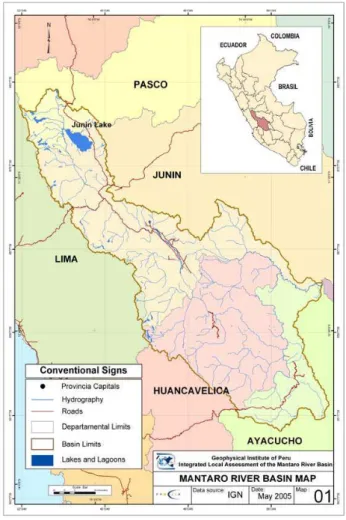
The Mantaro River Basin, located in the Peruvian Central Andes, has great socioeconomic importance for generating, through its hydroelectric power stations, nearly 35% of the electrical energy of the country, for being the main source of agricultural products for Lima (IGP, 2005a), and for having a population that surpasses the 1.2 million inhabitants.
The discharge of the Mantaro River depends on the precip-itation in the whole river basin, of the level of Lake Jun´ın and the lagoons located at the foot of the mountains in the West-ern and EastWest-ern cordilleras. The glaciers on some of these mountains are also important water reservoirs for the Andean societies that live on their foothills, and are particularly sen-sitive to the evolution of the climate change (Pouyaud et al., 1995).
258 A. G. Mart´ınez et al.: Vulnerability and adaptation to climate change in the Peruvian Central Andes
Fig. 1. Mantaro River Basin map.
3 Methodology
The methodology used in the study is outlined in Fig. 1. The first step for the development of the study was the determi-nation of a physical and socially relevant baseline based on the diagnosis of the present state of the river basin. This di-agnosis (IGP, 2005a) provided an integral landscape of the river basin reality, not only from the biophysical and socioe-conomical perspective, but also cultural (e.g. the ancestral and present perception of the environmental reality by the population). The elaboration of this diagnosis involved inte-grating information that was scattered among several institu-tions, along with the information obtained from surveys and participative workshops. The workshops, however, were not just a means of gathering information but were fundamen-tal for the design of the data collection methodology, which benefited greatly from the diversity in expertise of the pro-fessionals from the different participating institutions. The input of these professionals into the design of the surveys led to the inclusion of a larger set of themes than previously en-visioned, such as the occurrence of geodynamical and
atmo-Fig. 2. Methodology flow chart used in the Local Integrated
As-sessment in the Mantaro River Basin study.
spheric phenomena and changes in water resources, biodi-versity, and agricultural productivity. For example, following recommendations from social scientists from NGOs working on issues of regional development, information was collected on ancestral knowledge in the cultivation and consumption of native plant species, traditional agricultural practices, etc. This information was referred as “guardians of the past”.
The diagnosis allowed the identification of the main cli-mate hazards to which the population of the basin is exposed (droughts, frosts and external geodynamical processes). This information was complemented with a detailed study of the climate variability in the river basin, and with the generation of future climate scenarios and socioeconomical projections for the year 2050, which provided the basis for the analysis of present and future vulnerability (IGP, 2005b).
The vulnerability analysis was focused on three economic sectors that were selected in workshops with the partici-pation of representatives from several collaborating institu-tions. The results of this analysis in turn provided the basis for the elaboration of maps of climate hazards and for the design of measures of adaptation to the effects of the climate change, which would increase the resilience of the popula-tion of the basin (IGP, 2005b).
4 A multi-institutional and interdisciplinary approach to the local integrated assessment in the Mantaro River Basin
The fundamental tools of this study were the participative workshops with local institutions and grassroot associations of the basin, which allowed the incorporation of the knowl-edge from the stakeholders on the reality of the basin into the process of making decisions about the development of the study, such as the prioritization of socioeconomical sectors (agriculture, hydroelectric energy generation and health), the division of the basin into zones of study, the integration of activities, etc.
More than 50 institutions were invited to participate, in-cluding public institutions, non- governmental organizations (NGOs), public and private companies, universities, local and regional governments and grassroot organizations. Ef-fective support throughout the study was given by approxi-mately 25 institutions, which became the “collaborating in-stitutions” of the study.
The public institutions and NGOs associated with – to larger or smaller degree – the agricultural sector, were the most actively involved and those that contributed the most to the study. This situation was probably motivated by the high sensitivity of the agriculture sector (which is mostly done without irrigation) to climate variability – and a high dependence on precipitation for water and motivated by the high incidence of plagues in abnormally warm years, which in turn directly affects the sources of economic income and food of a large part of the population.
On the other hand, the participation of private (mining, etc.), and public (hydroelectric energy companies, potable water municipal company, etc.) companies was practically null. This was probably because the former did not consider the issues that were addressed by the study important for the development of their activities, while the latter are barely af-fected by climate variability, in addition to having a short term vision in their management.
An illustrative example of the insensitivity of the pub-lic companies to climate variability was given by the strong 2003–2004 drought, during which the level of Lake Junin, the main reservoir, was reduced by nearly 40%, yet the en-ergy production generated by Electroper´u company was es-sentially unaffected (COES, 2007), because the company has an operative strategy of dams and lagoons unloading and can play with marginal prices of energy, situation that makes the company resilient within tolerable limits to these variations.
Similarly, the same drought affected the potable water sup-ply (daily hours of service) and therefore the population, but did not affect the municipal water company that provides it, since the price the users pay for the service is approximately independent of their consumption on water (SEDAM, 2005). In fact, an effort was made for getting engineers from the company involved in the project, but they refused arguing that the production and distribution of water, their primary
concern, was unrelated to glaciers and would not be affected by climate change. Rather than an indication of ignorance, this statement was most likely motivated by a reluctance to getting involved in an issue that is not of immediate concern to them.
The participation of local and regional governments was limited, largely due to the lack of diffusion of information that climate change issues had at the beginning of the study, and to the work priorities of most authorities being focused on other immediate issues such as transport, citizen security, etc. The exceptions were the regional governments of Junin and Huancavelica, probably because both already had several years working on issues related to the environment, and had pre-existing working groups on water, contamination, forest resources, etc., so their participation in the study occurred naturally.
For the development of the study, two working groups were formed. The first group was in charge of the study of climate variability and change and was formed mainly by a small group of researchers from the Geophysical Institute of Peru, specialized in different physical sciences. The second group, formed by approximately 30 researchers of the col-laborating institutions, from diverse social and agricultural disciplines, participated in the analysis of the present and fu-ture vulnerability, as well as in the formulation of adaptation proposals (IGP, 2005b).
The researchers of the collaborative institutions partici-pated in the study without any additional financial incentive. Instead, their participation in the workshops and working meetings was facilitated by the provision of transport, meals, working material, etc. The exception was the payment made to an NGO for its participation in the development of the re-port on health and the links between this sector and climate change. However, this additional monetary support turned out to have been an error, since the studies on this sector were not any more deserving of extra support than the other two prioritized sectors, and it jeopardized the feeling of equity and the good relations with the other collaborating institu-tions.
Although the necessary interaction between specialists of different disciplines and institutions doubtlessly enriched the study, this was not easy to achieve since their different back-grounds led to serious difficulties of understanding among the researchers. This problem was eventually overcome thanks to the numerous workshops and working meetings in which the terminology and methodology used in the study were homogenized. A clear recurrent example of the differ-ences among the disciplines, was the difficulty in understand-ing the intrinsic uncertainties in the future climate scenarios. In particular, the researchers in the social sciences expected an accuracy from these scenarios that is not possible to obtain with any current method or present-day models.
An important achievement related to the previous point was to ensure the participation of the same researchers from each institution by making formal requests to their
respec-260 A. G. Mart´ınez et al.: Vulnerability and adaptation to climate change in the Peruvian Central Andes tive institutional authorities, and to obtain their “loyalty“ to
the study and the group, using some simple incentive strate-gies that emerged throughout the study: uncostly training workshops on subjects direct and indirectly related to climate change, promotion of exchange of information, giving a cer-tificate in recognition of their participation at the end of the two years, and crediting their participation in the research as individuals in the final reports of the study (IGP, 2005a, b).
In addition, during the study, an “open participation” was allowed, i.e. researchers or institutions were freely allowed to join the research group even during advanced stages of the study. Although this often meant making tedious summaries of issues already discussed and decided to the new members of the group, their subseequent contribution was beneficial for the study in the long run and also gave the group a strong sense of openness not experienced in other studies.
The lack of coordination between institutions and the ad-ministrative obstacles for the signing of cooperative agree-ments and for information exchanges, etc. were constant, mainly for public institutions. This situation was partially overcome throughout the study, but it caused delays in the initial stages of the study.
An unforeseen outcome of the study was the formation of a technical team for climate change integrated by the institu-tions that participated in the study, This technical team was formed with support from the Regional Government of Junin and its main objective is to incorporate the issues related to climate change in the development plans at the provincial and regional levels, as well as to elaborate projects for the study of vulnerability and adaptation to climate change and to develop adaptation measures to climate change.
5 Conclusions
In this concrete example of managing a local integrated assessment of the vulnerability and adaptation to climate change in the Peruvian Central Andes, it was verified that the multi-institutional and interdisciplinary participatory efforts are a powerful approach to undertaking such assessments at the local level.
Working with multiple institutions – private and public – is not free of problems, but is clear that some simple strate-gies such as the recognition of contributions of the individuas involved in the study, the training, and the exchange of infor-mation, can enormously facilitate the participation of institu-tions in the future.
Acknowledgements. The authors thanks the National Council of
Environment CONAM and the Real Embassy of the Netherlands for their support in the development of the “Local Integrated As-sessment in the Mantaro River Basin” study.
K. Takahashi is supported by a NOAA Climate and Global Change postdoctoral fellowship.
Edited by: P. Fabian
Reviewed by: two anonymous referees
References
Comit´e de Operaci´on Econ´omica del Sistema Interconectado Na-cional COES: Estad´ısticas Mensuales, in: http://www.coes.org. pe/coes/index.asp, 2007.
Instituto Geof´ısico del Per´u: Diagn´ostico de la cuenca del r´ıo Mantaro bajo la visi´on de cambio clim´atico, Fondo Editorial CONAM. Lima, Per´u, 2005a.
Instituto Geof´ısico del Per´u: Vulnerabilidad y adaptaci´on al cam-bio clim´atico en la cuenca del r´ıo Mantaro, Fondo Editorial CONAM. Lima, Per´u, 2005b.
IPCC WG1: Climate Change 2007: The Physical Science Basis, Summary for Policy Makers, Contribution of Working Group I to the Fourth Assessment Report of the Intergovernmental Panel on Climate Change, 2007.
IPCC WG2: Climate Change 2007: Impacts, Adaptation and Vul-nerability. Summary for Policy Makers, Contribution of Working Group II to the Fourth Assessment Report of the Intergovernmen-tal Panel on Climate Change, 2007.
Mart´ınez, A. G., N´u˜nez, E., Silva, Y., Takahashi, K., Trasmonte, G., Mosquera, K., and Lagos, P.: Vulnerability and adaptation to climate change in the Peruvian Central Andes: Results of a Pi-lot Study, in: International Conference on Southern Hemisphere Meteorology and Oceanography (ICSHMO), Foz do Iguac¸u. Pro-ceedings, S˜ao Jos´e dos Campos, INPE, CD-ROM ISBN 85-17-00023-4, 297–305, 2006.
Pouyaud, B., Francou, B., and Ribstein, P.: La red monitoreo glacio-hidrol´ogico de ORSTOM y de sus contrapartes en Bo-livia, Per´u y Ecuador: una herramienta para el estudio del re-calentamiento global y de sus consecuencias en los tr´opicos, in: Aguas, glaciares y cambios clim´aticos en los Andes tropi-cales, edited by: IFEA, IRD, ORSTOM, UMSA, SENAMHI y el Comit´e Nacional para el Programa Hidrol´ogico Internacional, La Paz, Bolivia, 229–238, 1995.
Rotmans, J. and Dowlatabadi, H.: Integrated assessment modelling, in: Human Choice and Climate Change, Vol. 3, The tools for Pol-icy Analysis, edited by: Rayneer, S. and Malone, E. L., Batelle Press, Columbus, OH, EE.UU, 1998.
SEDAM: Cu´al es la realidad del agua en Huancayo?, Informative, Huancayo, Peru, 2005.
Turner, B. L., Kasperson, R. E., Matson, P. A., McCarthy, J. J., Cor-rell, R. W., Christensen, L., Eckley, N., Kasperson, J. X., Luers, A., Martello, M. L., Polsky, C., Pulsipher, A., and Schiller, A.: Illustrating the coupled human-environment system for vulnera-bility analysis: Three case studies, Proceedings of the National Academy of Sciences of the United States of America, PNAS, 100, 14, 8074–8079, 2003.