HAL Id: hal-00298119
https://hal.archives-ouvertes.fr/hal-00298119
Submitted on 1 Dec 2005HAL is a multi-disciplinary open access
archive for the deposit and dissemination of sci-entific research documents, whether they are pub-lished or not. The documents may come from teaching and research institutions in France or abroad, or from public or private research centers.
L’archive ouverte pluridisciplinaire HAL, est destinée au dépôt et à la diffusion de documents scientifiques de niveau recherche, publiés ou non, émanant des établissements d’enseignement et de recherche français ou étrangers, des laboratoires publics ou privés.
Synoptic climate change as a driver of late Quaternary
glaciations in the mid-latitudes of the Southern
Hemisphere
H. Rother, J. Shulmeister
To cite this version:
H. Rother, J. Shulmeister. Synoptic climate change as a driver of late Quaternary glaciations in the mid-latitudes of the Southern Hemisphere. Climate of the Past Discussions, European Geosciences Union (EGU), 2005, 1 (3), pp.231-253. �hal-00298119�
CPD
1, 231–253, 2005 Synoptic climate change as driver of New Zealand glaciation H. Rother and J. Shulmeister Title Page Abstract Introduction Conclusions References Tables Figures J I J I Back CloseFull Screen / Esc
Print Version
Interactive Discussion
Climate of the Past Discussions, 1, 231–253, 2005 www.climate-of-the-past.net/cpd/1/231/
SRef-ID: 1814-9359/cpd/2005-1-231 European Geosciences Union
Climate of the Past Discussions
Climate of the Past Discussions is the access reviewed discussion forum of Climate of the Past
Synoptic climate change as a driver of
late Quaternary glaciations in the
mid-latitudes of the Southern Hemisphere
H. Rother and J. Shulmeister
Department of Geological Sciences, University of Canterbury, Private Bag 4800, Christchurch, New Zealand
Received: 23 September 2005 – Accepted: 11 November 2005 – Published: 1 December 2005
Correspondence to: H. Rother ([email protected])
CPD
1, 231–253, 2005 Synoptic climate change as driver of New Zealand glaciation H. Rother and J. Shulmeister Title Page Abstract Introduction Conclusions References Tables Figures J I J I Back CloseFull Screen / Esc
Print Version
Interactive Discussion
Abstract
The relative timing of late Quaternary glacial advances in mid-latitude (40–55◦S) moun-tain belts of the Southern Hemisphere (SH) has become a critical focus in the debate on global climate teleconnections. On the basis of glacial data from New Zealand and southern South America it has been argued that interhemispheric synchrony or 5
asynchrony of Quaternary glacial events is due to Northern Hemisphere (NH) forcing of SH climate through either the ocean or atmosphere systems. Here we present a glacial snow-mass balance model that demonstrates that large scale glacial advances in the temperate and hyperhumid Southern Alps of New Zealand can be generated with very little thermal forcing. This is because the rapid conversion of precipitation 10
from rainfall to snowfall drives massive ice accumulation at small thermal changes (1– 4◦C). Our model is consistent with recent paleo-environmental reconstructions showing that glacial advances in New Zealand during the Last Glacial Maximum (LGM) and the Last Glacial Interglacial Transition (LGIT) occurred under very moderate cooling. We suggest that such moderate cooling could be generated by changes in synoptic clima-15
tology, specifically through enhanced regional flow of moist westerly air masses. Our results imply that NH climate forcing may not have been the exclusive driver of Quater-nary glaciations in New Zealand and that synoptic style climate variations are a better explanation for at least some Late Quaternary glacial events, in particular during the LGIT (e.g. Younger Dryas and/or Antarctic Cold Reversal).
20
1. Introduction
Quaternary glacial signals from mountain belts in the mid-latitude Southern Hemi-sphere (mlSH), in particular from locations in New Zealand and southern South Amer-ica, have become important for testing models of past and present interhemispheric climate teleconnections (e.g. Broecker, 1997; Moreno, 2001). It has been argued that 25
cli-CPD
1, 231–253, 2005 Synoptic climate change as driver of New Zealand glaciation H. Rother and J. Shulmeister Title Page Abstract Introduction Conclusions References Tables Figures J I J I Back CloseFull Screen / Esc
Print Version
Interactive Discussion
mate forcing via the atmosphere (e.g. Denton et al., 1999; Kaplan et al., 2004) whereas, asynchrony has been interpreted as a climate link through the thermohaline conveyor (e.g. Lowell et al., 1995). The focus in this debate has been on the absolute dating of Quaternary mlSH glacial advances, which are used as proxies to identify the level of global correspondence between distinct Northern Hemisphere (NH) and Southern 5
Hemisphere (SH) climate signals.
In recent years, progress in cosmogenic and luminescence dating techniques has permitted the direct dating of glacial landforms (i.e. moraines) and deposits in mlSH mountain belts. Initial results from New Zealand and the southern Andes have been interpreted as demonstrating interhemispheric synchrony of LGM glacial advances and 10
it has also been suggested that specific LGIT climate events known from the North Atlantic region (e.g. the Younger Dryas) can be directly correlated to mountain glacier advances in the mlSH (Denton and Hendy, 1994; Ivy-Ochs et al., 1999). It has further been argued that such level of correspondence is compelling for a model of direct atmospheric forcing of glaciations in the SH (Denton et al., 1999; Kaplan et al., 2004). 15
Despite some indications of interhemispheric synchrony for a limited number of LGM and LGIT glacial advances, the paleo-climatological interpretation of the data is not straightforward. In the case of New Zealand, numerical paleo-environmental recon-structions using speleothems and fossil beetle assemblages show that LGM cooling was very moderate (Hellstrom et al., 1998) and possibly as little as 2 to 3◦C (Marra 20
et al., 2005). Reconstructed Paleo-ELAs suggest cooling in the vicinity of of 4–5◦C (Porter, 1975). These results are supported by General Circulation Model (GCM) cal-culations that predict 2 to 3◦C lower sea-surface temperature (SST) in the Tasman Sea during the LGM (Hewitt and Mitchell, 1997) while sea-surface temperature reconstruc-tions from forams suggest cooling between 3–7◦C (Barrows and Juggins, 2005). In 25
short, none of the reconstructions suggest large scale cooling during the LGM while the lower end of the reconstructions suggest cooling similar to the modern interannual variability associated with ENSO and other oscillatory systems.
South-CPD
1, 231–253, 2005 Synoptic climate change as driver of New Zealand glaciation H. Rother and J. Shulmeister Title Page Abstract Introduction Conclusions References Tables Figures J I J I Back CloseFull Screen / Esc
Print Version
Interactive Discussion
ern Alps (Denton and Hendy, 1994; Ivy-Ochs et al., 1999). However, this re-advance is neither universally detected in NZ’s glacial records (e.g. Shulmeister et al., 2005) nor, critically, is a significant cooling apparent from pollen or other paleoecological records (e.g. Singer et al., 1998; Turney et al., 2003). At the very most, the pollen records suggest a pause in the post-glacial warming between 14.6–13.6 cal.14C years (Mc-5
Glone, 1995). As both the LGM and LGIT glacio-chronological and paleoecological data appear robust, it has been difficult to resolve the occurrence of significant glacial expansions contemporaneous with only moderate cooling. The problem has wider im-plications because similar confusion has characterized the LGIT debate in southern South America with various authors proposing cooling or an absence thereof during 10
the LGIT (e.g. Bennett et al., 2000; Moreno et al., 2001).
In this paper we present a snow mass balance model from the Southern Alps of New Zealand to test the sensitivity of glacial accumulation to thermal changes. By doing so we analyse whether the emerging glacio-chronological and paleoecological records from New Zealand are in fact compatible and if minor thermal forcing is sufficient to 15
cause full-scale glacial expansion in the Southern Alps. The question has wider rel-evance because under such a scenario we must consider the possibility that some Quaternary glacial advances in NZ, and by implication in parts of South America, were generated by synoptic climate variations alone, requiring little (during the LGM) or no (during the LGIT) climate forcing from the NH.
20
2. Glaciological setting: New Zealand
New Zealand is located in the Southern Hemisphere westerly wind belt and is char-acterized by an oceanic climate. The regional climate is profoundly affected by the NE–SW trending Southern Alps (41◦–46◦S) which constitute a ∼3 km high topographic barrier in the pathway of the Southern Ocean Westerlies. Due to the interception and 25
rapid orographic forcing of west flowing moist air masses, the central Southern Alps are amongst the wettest places on the planet. Annual precipitation near the alpine
CPD
1, 231–253, 2005 Synoptic climate change as driver of New Zealand glaciation H. Rother and J. Shulmeister Title Page Abstract Introduction Conclusions References Tables Figures J I J I Back CloseFull Screen / Esc
Print Version
Interactive Discussion
divide is commonly in excess of 9000 mm with observed maximum values at around 16 000 mm (Griffiths and McSaveney, 1983; Henderson and Thompson, 1999). Critical for the glaciological setting is the marked cross-alpine precipitation distribution and the presence of a narrow hyperhumid sector which stretches along the full length of the Southern Alps. Virtually all of New Zealand’s ca. 3100 present glaciers are located in 5
this sector (National Snow and Ice Data Center, 1999). Glaciers of these perhumid environments are characterized as high turn-over systems with large positive and neg-ative mass balances, high glacial flow velocities and relneg-atively short climatic reaction times (Woo and Fitzharris, 1992; Benn and Evans, 1998).
Glacial Equilibrium Line Altitudes (ELA)1 in the Southern Alps closely reflect the 10
steep windward-leeward precipitation contrast which causes ELA gradients in New Zealand to be up to 20 times steeper than those reported for arctic and subarctic regions (Andrews and Miller, 1972; Chinn and Whitehouse, 1980). Despite this dis-tinct glaciological setting, Quaternary glacial records from the Southern Alps are of-ten directly correlated to records from other mid-latitude mountain belts, in particular 15
to those from the European Alps (e.g. Ivy-Ochs et al., 1999). A comparison of key glacial parameters of the two ranges (Fig. 1) shows that despite substantially greater mean elevations, the European Alps receive only a quarter to a third of the NZ pre-cipitation values while its distribution is far more even. A direct consequence of the hyper-humidity in the Southern Alps is a strong depression of ELAs (Chinn and White-20
house, 1980), which are generally about 1000 m lower than those in the European Alps (Mueller, 1976). The differences have important implications for mechanisms of glacial accumulation and the resulting glacial styles in the two mountain belts.
Because New Zealand’s glaciological configuration is fundamentally related to the interaction between the Southern Alps and the Westerly wind belt, studies of regional 25
paleo-circulation patterns are critical to the reconstruction of former glacial base condi-1
The ELA separates glacial accumulation from ablation areas and represents the altitude at which the glacial mass balance is zero. Key factors influencing the position of the ELA are long term mean temperatures and total precipitation.
CPD
1, 231–253, 2005 Synoptic climate change as driver of New Zealand glaciation H. Rother and J. Shulmeister Title Page Abstract Introduction Conclusions References Tables Figures J I J I Back CloseFull Screen / Esc
Print Version
Interactive Discussion
tions. Evidence for enhanced ocean upwelling (Fenner et al., 1992; Weaver et al., 1998) and maxima in dust flux (Thiede, 1979; Stewart and Neall, 1984; Carter et al., 1995) have generally been attributed to enhanced westerly flow during the LGM (e.g. Markgraf et al., 1992; Shulmeister et al., 2004). In addition, glacio-eustatic sea level lowering, increased the relative height of the Southern Alps which in turn intensi-5
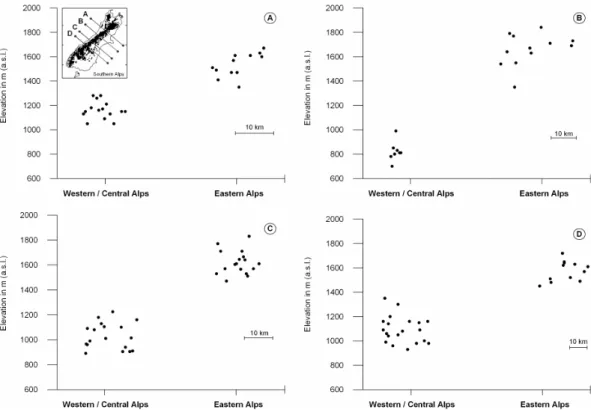
fied the orographic forcing of moist westerly air masses. It is therefore reasonable to assume that the pattern of a strong windward-leeward gradient of precipitation across the Southern Alps remained intact during Quaternary glacial periods. Such a scenario is supported by reconstructed paleo-ELAs from cirque floor elevations comparing the western/central alps to those of the eastern alps (Fig. 2). Results show that despite an 10
estimated ∼800 m ELA lowering (Porter, 1975), steep paleo-ELA gradients persisted in New Zealand during past glaciations.
To summarise, the combination of hyper-humidity and a steep paleo-ELA gradient during Late Quaternary glaciations in the Southern Alps is responsible for a specific nature of glaciation in New Zealand. Firstly, very high levels of snowfall occurred in a 15
∼20 km wide sector near the alpine divide which corresponded with the area of min-imum ELA. Secondly, due to rainshadow effects and because the ELA rises sharply east of the divide, alpine areas only a short distance from the divide received signifi-cantly less snowfall and only the highest peaks penetrated the annual snowline. This resulted in a glacial pattern where large scale ice accumulation was concentrated in 20
the narrow perhumid sector, while the contribution of all other areas to overall glacial accumulation in the Southern Alps was orders of magnitude smaller.
3. Temperature effects on snow mass balances in the Southern Alps
In the central Southern Alps present ELAs range between 1500 m–2100 m (Lamont et al., 1999). Critically, at these ELAs atmospheric temperatures remain above freezing 25
for considerable periods of the year. This means that a significant portion of the large annual precipitation at and around ELA level falls as rain. This constitutes a substantial
CPD
1, 231–253, 2005 Synoptic climate change as driver of New Zealand glaciation H. Rother and J. Shulmeister Title Page Abstract Introduction Conclusions References Tables Figures J I J I Back CloseFull Screen / Esc
Print Version
Interactive Discussion
snow resource if climate cooling occurs as additional snow is generated without any synoptic changes. By comparison, in the European Alps present ELAs are on average 1000 m higher (2500 m–3500 m) and corresponding atmospheric temperatures remain too cold for rain to form a significant portion in the annual precipitation at ELA (Fig. 3b). To investigate temperature effects on glacial accumulation in the perhumid Southern 5
Alps we use a snow mass balance model2. The model calculates annual net snow accumulation for various cooling scenarios (−1 to −9◦C in mean T) by analysing tem-perature related changes to the snow-rain-ratio, total annual precipitation and snow ablation rates.
Data are calculated for the central perhumid alpine sector (Fig. 3a) with an ELA of 10
1600 m (Chinn and Whitehouse, 1980; Clare et al., 2002) and a total annual precipi-tation of 9000 mm (Griffiths and McSaveney, 1983; Henderson and Thompson, 1999). The overall topography, ELA position and the amount of annual precipitation in this area represent average condition for substantial portions in the central alps. Temper-ature data used in the model are from the nearest climate station (Hokitika, Fig. 3a) 15
and were converted to the ELA altitude by using a standard environmental lapse rate of 6◦C/km. We calculated cooling related changes to net snow accumulation at ELA (1600 m) where the current snow mass balance is zero. Mean temperatures were then incrementally lowered to simulate potential atmospheric cooling.
Observations on snow proportions (QS) in total precipitation (Ptotal) are not available 20
for the Southern Alps but it has been shown that snow proportions correlate well to mean monthly temperatures (Lauscher, 1954; Cehak-Trock, 1958). We calculated QS in Ptotal using a regression function derived empirically from 32 stations in the Swiss Alps (Sevruk, 1992) (Fig. 3b). QS results for the Southern Alps were then adjusted for the seasonal variation in precipitation by applying weighted averages from the ob-25
served monthly precipitation at the nearby Ivory Glacier (Anderton and Chinn, 1978; Fig. 3a). At ELA (1600 m) mean annual temperature is 2.3◦C with a monthly range from
2
Full details on the model are provided in the supplement: http://www.climate-of-the-past. net/cpd/1/231/cpd-1-231-sp.zip
CPD
1, 231–253, 2005 Synoptic climate change as driver of New Zealand glaciation H. Rother and J. Shulmeister Title Page Abstract Introduction Conclusions References Tables Figures J I J I Back CloseFull Screen / Esc
Print Version
Interactive Discussion
−2.1◦C (July) to 6.4◦C (February). Results show that at this elevation 49.2% (mm water equivalent) of the annual total of 9000 mm fall currently as snow while the remaining 50.8% (4570 mm) fall as rain. This provides an enormous potential additional snow source. For every 1◦C of cooling in mean monthly temperature the percentage of snow as a proportion of precipitation grows by 5.5% (Fig. 3b).
5
Atmospheric cooling is likely to affect the amount of total annual precipitation re-ceived by the Southern Alps. Recent studies have suggested relatively wet conditions in New Zealand associated with enhanced Westerlies during the LGM (e.g. Eden and Hammond, 2003; Shulmeister et al., 2004) and LGIT (e.g. Pepper et al., 2004), while others argue that humidity was somewhat reduced during glacial periods (e.g. Hope 10
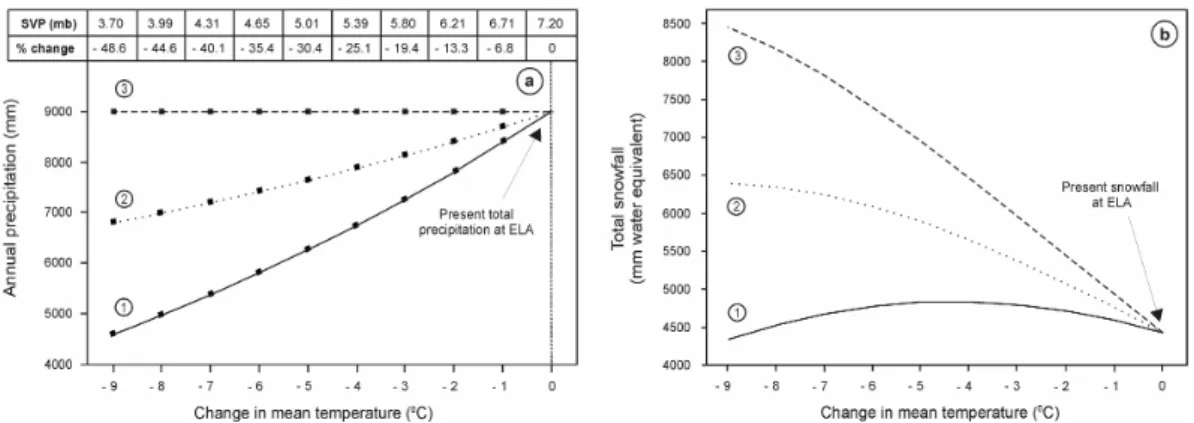
et al., 2004). To account for uncertainties regarding the response of annual precipita-tion to atmospheric cooling, we use three precipitaprecipita-tion scenarios (Fig. 4a). Scenario 1 assumes a cooling related decrease in annual precipitation and approximates the non-linear reduction through the temperature related variation in air mass saturation vapour pressure (SVP). In this scenario, variations in overall precipitation are calculated from 15
SVP changes which are used as a proxy for the moisture capacity of the air. Accord-ing to this a coolAccord-ing of −5◦C would reduce overall humidity by ∼30%. In scenario 2, the reduction in annual precipitation is assumed to be half of that of scenario 1 and scenario 3 assumes wet conditions with precipitation totals equal to the present.
Results in Fig. 4b show total annual snowfall for increasingly colder conditions as 20
calculated when our precipitation scenarios are combined with the dynamic snow-rain ratio. As expected snowfall totals vary greatly depending on the assumed annual pre-cipitation. The data generally reflect two compensating trends during cooling, firstly the continuing increase of QS in Ptotal, and secondly a cooling related decline in Ptotal (scenarios 1 and 2). Results indicate that the addition of large amounts of extra snow 25
from the rain-snow conversion causes a dramatic effect on snow mass balances in perhumid environments. Snowfall increases (scen. 2) or remains high (scen. 1) even if annual precipitation declines substantially. If conditions are wetter (scen. 3) snowfall will expand vastly as large amounts of snow are added.
CPD
1, 231–253, 2005 Synoptic climate change as driver of New Zealand glaciation H. Rother and J. Shulmeister Title Page Abstract Introduction Conclusions References Tables Figures J I J I Back CloseFull Screen / Esc
Print Version
Interactive Discussion
The projected annual snowfall total was then related to ablation for assessing net snow accumulation. We calculated snow ablation by using a degree day mass balance (DDMB) model in which mean daily temperatures are taken as an integrated index of the heat budget and where ablation is assumed to occur proportionally to the mean air temperature (e.g. Linsley, 1947). DDMB models have been widely tested under 5
field conditions where they have shown to predict ablation reliably (e.g. Komarov et al., 1969; Braithwaite and Olesen, 1989; J ´ohannesson et al., 1995; Braithwaite and Zhang, 2000). Calculation use the formula:
a(z)= kTsum(z)+ HS; T > 0◦C
where ablation (a) is computed for elevation (z), using the sum of positive mean daily 10
temperatures (Tsum) at z. The positive degree days are multiplied with k representing an empirically derived degree day factor. We use a degree day factor of 4.5 mm day-1 deg-1 as was derived for Franz Josef Glacier in the central Southern Alps (Anderson, 2003). HS is ablation from sensible heat (e.g. rain on snow) which contributes ∼2% to annual ablation in the Southern Alps (Hay and Fitzharris, 1988). We tested the model 15
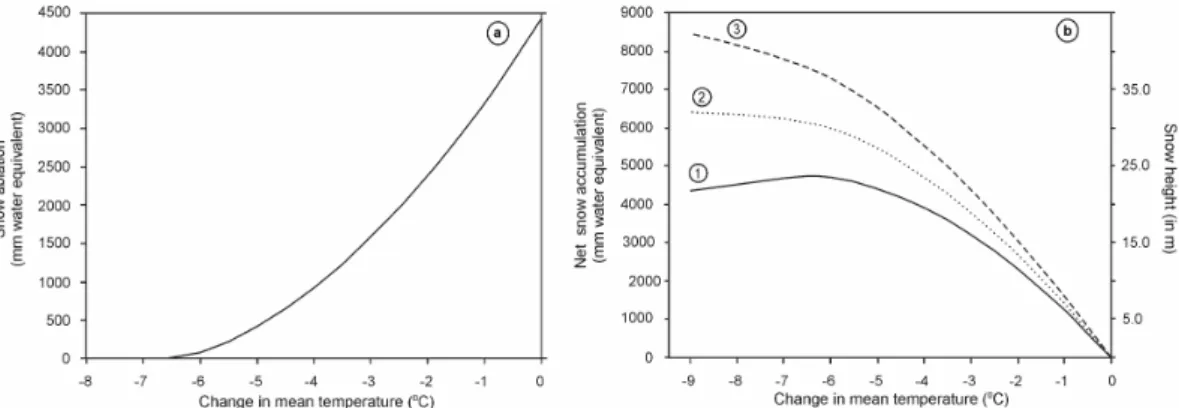
by predicting ablation at the present ELA where annual snowfall is 4432 mm and no net accumulation occurs (mass balance 0). The model indicates 4359 mm of ablation, underestimating actual ablation by only 1.7%. Overall results in Fig. 5a show how snow ablation decreases at ELA under intensifying cooling from 4432 mm/a (present temperature conditions) until it virtually stops at 6.5◦C cooling.
20
We then integrated all previously analyzed parameters (snow-rain proportions, total precipitation, snow ablation) to predict net snow accumulation in the central alps un-der increasingly cooler conditions. Results are shown in Fig. 5b where 0◦C represents current climate conditions at the ELA with no net accumulation. The outcome indi-cates that net snow accumulation in the hyperhumid Southern Alps responds strongly 25
positive to moderate cooling. Snow accumulation grows dramatically under all precip-itation scenarios even when overall humidity declines substantially. A striking feature is the steep increase recorded for the early part of the cooling (1–4◦C), where snow accumulation grows markedly mainly due to the rapid conversion from rain to snow. A
CPD
1, 231–253, 2005 Synoptic climate change as driver of New Zealand glaciation H. Rother and J. Shulmeister Title Page Abstract Introduction Conclusions References Tables Figures J I J I Back CloseFull Screen / Esc
Print Version
Interactive Discussion
cooling of only 2–3◦C at present ELA would result in the net annual addition of ∼15 ver-tical meters of snow (Fig. 5b). Interestingly, the gain generally slows with more severe cooling. For precipitation scenario 1 (driven by SVP changes) the snow accumulation trend will even reverse at around −6◦C cooling with net annual accumulation starting to decline. The effect is caused by high snow proportions at this cooling and the effective 5
halt of ablation after which the continuing decrease of total annual precipitation drives net accumulation down.
4. Discussion and conclusion
Heavy orographic precipitation in the central parts of the long (∼800 km) but narrow (∼80 km) Southern Alps results in some of the steepest recorded glacial ELA gradi-10
ents on Earth. During Quaternary glaciations and associated low sea level stands, the relative height of the Southern Alps as a barrier for moist westerly air masses was fur-ther enhanced and ELA gradients were maintained or even steepened. Reconstructed paleo-ELAs (Porter, 1975; Chinn and Whitehouse, 1980) imply that ice accumulation during the LGM was concentrated in the perhumid central alps. These conditions pro-15
duced a narrow ice cap, which covered a ∼30 km wide sector near the alpine divide. From this high turn-over ice cap valley glaciers extended 50–70 km to their LGM termi-nal positions.
Our snow mass balance model indicates that glacial accumulation in the Southern Alps is sensitive to small thermal changes. Moderate cooling (3–5◦C) is sufficient to 20
increase snowfall dramatically and trigger large positive excursions in glacial mass balances. If this cooling is sustained under a 5000–8000 mm precipitation regime it would generate glacial advances of the scale recorded for the LGM. The sensitivity of glacial systems in New Zealand to moderate cooling is mainly due to extreme perhu-midity and associated low ELA levels which cause present glacial accumulation areas 25
in the Southern Alps to receive substantial amounts of rain. We suggest that the rain-snow conversion would impact rapidly as present precipitation maxima occur during
CPD
1, 231–253, 2005 Synoptic climate change as driver of New Zealand glaciation H. Rother and J. Shulmeister Title Page Abstract Introduction Conclusions References Tables Figures J I J I Back CloseFull Screen / Esc
Print Version
Interactive Discussion
the cooler Autumn and Spring seasons thereby requiring only moderate further cooling to initiate full rain-snow conversion.
The model assumptions account for a cooling related decrease in total annual precip-itation, which is consistent with LGM humidity estimates suggested from New Zealand pollen (McGlone, 1995). Likewise, regional paleo-temperature reconstructions using 5
speleothems and fossil beetle assemblages indicate that cooling during LGM and LGIT glacial advances was only moderate (Hellstrom et al., 1998) and possibly as little as −2 to −3◦C (Marra et al., 2005). The benefit of our mass balance model is that it provides a mechanism that resolves the occurrence of substantial glacial advances in New Zealand contemporaneous with reconstructed drier conditions and under only 10
moderate atmospheric cooling.
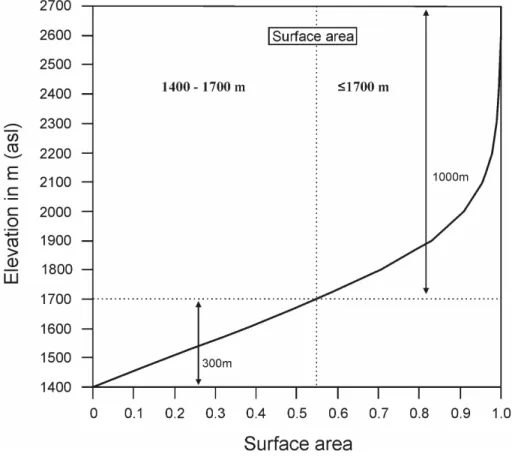
In New Zealand, hypsometric characteristics of areas immediately below snowline (∼1400–1700) in the perhumid zone, suggest that a moderate drop in ELA levels would bring extensive low angle surface areas above snowline. This factor is important be-cause new permanent snow accumulations can only occur if slope angles are suitable. 15
The effect is demonstrated for our study area where we calculated hypsometric inte-grals for a 10 km wide and 60 km long sector (S 43◦170100/E 170◦530400to S 42◦500100/E 171◦290000) (Fig. 6). Results indicate that an ELA lowering of only 300 m would more than double the low angle surface area above snowline. In reality, the increase in suit-able snow accumulation surfaces would be further enhanced by the extension of glacial 20
tongues into the upper valleys where they raise the effective elevation of the valley floor. Moderate cooling as a driver of Quaternary glacial advances in New Zealand has several important implications. Firstly, it accounts for sedimentological peculiarities associated with glacial sequences in the Southern Alps. Commonly noted features are the enormous scale of glacio-fluvial aggradation fans, the large proportions of water 25
lain deposits in ice-proximal sequences and the widespread occurrence of stratified and only weakly compacted tills (e.g. Speight, 1940; Gage, 1965, 1985; Hart, 1996). The overall climatic implication is that conditions during deposition were clearly mild enough to provide nearly year-round availability of large volumes of melt-water.
CPD
1, 231–253, 2005 Synoptic climate change as driver of New Zealand glaciation H. Rother and J. Shulmeister Title Page Abstract Introduction Conclusions References Tables Figures J I J I Back CloseFull Screen / Esc
Print Version
Interactive Discussion
Secondly, the low thermal forcing mechanism for glaciation in New Zealand implies that large glacial advances can be generated rapidly, and conversely, shut down rapidly since glacial conditions are sensitive to small thermal changes. This “flickering switch” feature of Quaternary glacial advance in the Southern Alps is likely to have resulted in a larger number of individual glacial oscillation than for example is observed in the more 5
continental European Alps. This pattern may complicate attempts to directly correlate glacial signals from the NH to New Zealand.
Thirdly, moderate cooling as a glacial driver in New Zealand highlights the dis-tinct possibility that regional (synoptic) climate phenomena were the principle cause for some Late Quaternary glacial events. It has been shown that modern glaciers 10
in western New Zealand respond to synoptic circulation changes, where enhanced zonal flow (westerly/south-westerly) is associated with glacial advances and stronger meridional flow is associated with retreats (Lamont et al., 1999; Hooker and Fitzharris, 1999). The reason is that strengthened westerly flow increases orographic precipi-tation over the mountains and reduces ablation through enhanced cloud cover, while 15
conversely, more persistent meridional circulation is associated with reduced precipi-tation and clear skies that cause increased ablation. Strong westerly flow, associated with glacial advances, mirrors the impact of El Ni ˜no on New Zealand. Recent spectral analyses on varved lake sediments have highlighted the possibility of a periodically enhanced inter-annual El Ni ˜no Southern Oscillation (ENSO) signal during the LGIT 20
over New Zealand (Pepper et al., 2004). Speleothem data from the South Island (Hell-strom et al., 1998) now supported by uranium isotope data (Robinson et al., 2004) also indicate a period of enhanced precipitation at around 13 ka. Enhanced precipitation, perhaps in association with very minor cooling, would trigger glacial re-advances in the central parts of the Southern Alps such as at Franz-Josef Glacier (Denton and Hendy, 25
1994; Ivy-Ochs et al., 1999). These changes, however, would not impact on already deglaciated mountain systems such as the Tasman Mountains in NW Nelson (Shul-meister et al., 2005), nor on the pollen record (McGlone, 1995; Singer et al., 1998; Turney et al., 2003). A synoptic “wet” event as a driver of the LGIT re-advance in New
CPD
1, 231–253, 2005 Synoptic climate change as driver of New Zealand glaciation H. Rother and J. Shulmeister Title Page Abstract Introduction Conclusions References Tables Figures J I J I Back CloseFull Screen / Esc
Print Version
Interactive Discussion
Zealand is therefore consistent with the available glacial record.
Synoptic climatology as a driver of glacial advances in hyperhumid mountain en-vironments of the Southern Alps may provide an explanation for inconsistencies in glacial records of the SHml (Southern Alps, southern Andes), where climate signals and glacial advances have been recorded as both synchronous and asynchronous to 5
Northern Hemisphere events. The situation in South America is somewhat different in that part of the discrepancy is created by the larger geographical area covered, but at least some of the records may be reconcilable using our model. However, even if our model does not apply in all cases, the likelihood that major advances in the SHml can be explained without invoking inter-hemispheric forcing, or indeed major thermal 10
changes, challenges current understanding of global climate linkages.
Acknowledgements. We thank C. Smart, I. Owens and P. Tonkin for comments on the
manuscript and Daniela Richter for assistance with the hypsometric calculations. This work was supported by the University of Canterbury Research Grant No. U 6508 and through the Marsden Grant contract UoC 301 (NZ).
15
References
Anderson, B.: The response of “Ka Roimata o Hine Hukatere” Franz Josef Glacier to climate change, Unpublished Ph.D. thesis, University of Canterbury, Christchurch, 114 p., 2003. Anderton, P. W. and Chinn, T. J.: Ivory Glacier, New Zealand, an I.H.D. representative basin
study, J. Glaciol., 20, 67–84, 1978. 20
Andrews, J. T. and Miller, G. H.: Quaternary history of the northern Cumberland Peninsula, Baffin Island, N.W.T., Canada, Arctic and Alpine Research, 4, 45-59, 1972.
Barrows, T. T. and Juggins, S.: Sea-surface temperatures around the Australasian margin and Indian Ocean during the Last Glacial Maximum, Quaternary Science Reviews, 24, 1017– 1047, 2005.
25
Benn, D. I. and Evans, D. J. A.: Glacier and Glaciation, London, 734 p., 1998.
Bennett, K. D., Haberle, S. G., and Lumley, S. H.: The last glacial-Holocene transition in south-ern Chile, Science, 290, 325–328, 2000.
CPD
1, 231–253, 2005 Synoptic climate change as driver of New Zealand glaciation H. Rother and J. Shulmeister Title Page Abstract Introduction Conclusions References Tables Figures J I J I Back CloseFull Screen / Esc
Print Version
Interactive Discussion
Braithwaite, R. J. and Olesen, O. B.: Calculation of glacier ablation from air temperature, West Greenland. Glacier fluctuations and climatic change, J. Oerlemans. Amsterdam, Kluwer Aca-demic Publishers, 219–233, 1989.
Braithwaite, R. J. and Zhang, Y.: Sensitivity of mass balances of five Swiss glaciers to temper-ature changes assessed by tuning a degree-day model, J. Glaciol., 46, 7–14, 2000.
5
Broecker, W. S.: Future directions of paleoclimate research., Quaternary Science Reviews, 16, 821–825, 1997.
Carter, L., Nelson, C. S., Neil, H. L., and Froggatt, P. C.: Correlation, dispersal, and preservation of the Kawakawa tephra and other late Quaternary tephra layers in the southwest Pacific Ocean., New Zealand J. Geology and Geophysic, 38, 29–46, 1995.
10
Cehak-Trock, H.: Der feste Niederschlag im atlantischen Klimagebiet, Arch. Meteorologie, Geo-physik, Bioklimatologie, Serie B, 8(3/4), 352–368, 1958.
Chinn, T. J. and Whitehouse, I. E.: Glacier snow line variations in the Southern Alps, New Zealand, IAHS-AISH Publ., 126, 219–228, 1980.
Clare, G. R., Fitzharris, B. B., Chinn, T. J. H., and Salinger, M. J.: Interannual variation in end-15
of-summer snowlines of the Southern Alps of New Zealand, and relationships with Southern Hemisphere atmospheric circulation and sea surface temperature patterns, Int. J. Climatol-ogy, 22, 107–120, 2002.
Denton, G. H. and Hendy, C. H.: Younger Dryas age advance of Franz-Josef Glacier in the Southern Alps of New Zealand, Science, 264, 1434–1437, 1994.
20
Denton, G. H., Heusser, C. J., Lowell, T. V., Moreno, P. I., Andersen, B. G., Heusser, L. E., Schluechter, C., and Marchant, D. R.: Interhemispheric linkage of paleoclimate during the last deglaciation, Geografiska Annaler (A), 81(2), 107–153, 1999.
Eden, D. E. and Hammond, A. P.: Dust accumulation in the New Zealand region since the last glacial maximum, Quaternary Science Reviews, 22, 2037–2052, 2003.
25
Fenner, J., Carter, L., and Stewart, R.: Late Quaternary paleoclimatic and paleoceanographic change over northern Chatham Rise, New Zealand, Marine Geology, 108, 383–404, 1992. Griffiths, G. A. and McSaveney, M. J. Distribution of mean annual precipitation across some
steepland regions of New Zealand, New Zealand J. Sci., 26, 197–209, 1983.
Hay, J. E. and Fitzharris, B. B.: The synoptic climatology of ablation on a New Zealand Glacier, 30
J. Climat., 8, 201–215, 1988.
Hellstrom, J., McCulloch, M., and Stone, J.: A detailed 31 000-year record of climate and vege-tation change, from the isotope geochemistry of two New Zealand speleothems, Quaternary
CPD
1, 231–253, 2005 Synoptic climate change as driver of New Zealand glaciation H. Rother and J. Shulmeister Title Page Abstract Introduction Conclusions References Tables Figures J I J I Back CloseFull Screen / Esc
Print Version
Interactive Discussion
Research, 50, 167–178, 1998.
Henderson, R. D. and Thompson, S. M.: Extreme rainfalls in the Southern Alps of New Zealand, J. Hydrol. (N.Z.), 38(2), 309–330, 1999.
Hewitt, C. D. and Mitchell, J. F. B.: Radiative forcing and response of a GCM to ice age boundary conditions: cloud feedback and climate sensitivity, Climate Dynamics, 13, 821–834, 1997. 5
Hooker, B. L. and Fitzharris, B. B.: The correlation between climatic parameters and the retreat and advance of Franz Josef Glacier, New Zealand, Global and Planetary Change, 22, 39–48, 1999.
Hope, G., Kershaw, A. P., Kaars, S. v. d., Xiangjun, S., Liew, P.-M., Heusser, L. E., Takahara, H., McGlone, M., Miyoshi, N., and Moss, P. T.: History of vegetation and habitat change in 10
the Austral-Asian region, Quaternary International, 118–119, 103–126, 2004.
Ivy-Ochs, S., Schluechter, C., Kubik, P. W., and Denton, G. H.: Moraine exposure dates imply synchronous Younger Dryas glacier advances in the European Alps and in the Southern Alps of New Zealand, Geografiska Annaler, 81A, 313–323, 1999.
Johannesson, T., Sigurdsson, O., Laumann, T., and Kennett, M. Degree-day glacier mass-15
balance modelling with applications to glaciers in Iceland, Norway and Greenland, J. Glaciol., 41(138), 345–358, 1995.
Kaplan, M. R., Ackert Jr., R. P., Singer, B. S., Douglass, D. C., and Kurz, M. D.: Cosmogenic nu-clide chronology of millennial-scale glacial advances during O-isotope stage 2 in Patagonia, Geological Soc. Amer. Bull., 116, 308–321, 2004.
20
Komarov, V. P., Makarova, T. T., and Sinegub, E. S.: The estimation of snowmelt runoff hydro-graph of small plain rivers using snowmelt data, Transactions of the Hydro- meteorological Centre of the USSR, N37, 3–36, 1969.
Lamont, G. N., Chinn, T. J., and Fitzharris, B. B.: Slopes of glacier ELAs in the Southern Alps of New Zealand in relation to atmospheric circulation patterns, Global and Planetary Change, 25
22, 209–219, 1999.
Lauscher, F.: Klimatologische Probleme des festen Niederschlages, Arch. Meteorologie, Geo-physik, Bioklimatologie, Serie B, 6(1/2), 60–65, 1954.
Linsley, R. K., Kohler, M. A., and Paulhus, I. L.: Applied Hydrology. New York, McGraw Hill, 432 p., 1947.
30
Lowell, T. V., Heusser, C. J., Andersen, B. G., Moreno, P. I., Hauser, A., Heusser, L. E., Schluechter, C., Marchant, D. R., and Denton, G. H.: Interhemispheric correlation of Late Pleistocene glacial events, Science, 269, 1541–1549, 1995.
CPD
1, 231–253, 2005 Synoptic climate change as driver of New Zealand glaciation H. Rother and J. Shulmeister Title Page Abstract Introduction Conclusions References Tables Figures J I J I Back CloseFull Screen / Esc
Print Version
Interactive Discussion
Markgraf, V., Dodson, J. R., Kershaw, A. P., McGlone, M. S., and Nicholls, N.: Evolution of late Pleistocene and Holocene climates in the circum-South Pacific land areas, Climate Dynam-ics, 6, 193–211, 1992.
Marra, M. J., Shulmeister, J., and Smith, E.: Reconstructing temperature during the Last Glacial Maximum from Lyndon Stream, South Island, New Zealand using beetle fossils and maxi-5
mum likelihood envelopes, Quaternary Science Reviews, accepted, 2005.
McGlone, M. S.: Late-glacial landscape and vegetation change and the Younger Dryas climatic oscillation in New Zealand, Quaternary Science Reviews, 14, 867–881, 1995.
Moreno, P. I., Jacobson, G. L., Lowell, T. V., and Denton, G. H.: Interhemispheric climate links revealed by a late-glacial cooling episode in southern Chile, Nature, 409, 804–808, 2001. 10
Mueller, F., Caflisch, T., and Mueller, G.: Firn und Eis der Schweizer Alpen, Geographisches Institut, ETH Zuerich, Publ. No. 57, 293 p., 1976.
National Snow and Ice Data Center: World Glacier Inventory, World Glacier Monitoring Service and National Snow and Ice Data Center/World Data Center for Glaciology, Boulder, CO., 1999, updated 2003.
15
Pepper, A. C., Shulmeister, J., Nobes, D. C., and Augustinus, P. A.: Possible ENSO signals prior to the Last Glacial Maximum, during the last deglaciation and the early Holocene, from New Zealand, Geophys. Res. Lett., 31, L15206, doi:10.1029/2004GL020236, 2004.
Porter, S. C.: Equilibrium-line altitudes of late Quaternary glaciers in the Southern Alps, New Zealand, Quaternary Research, 5, 27–47, 1975.
20
Robinson, L. F., Henderson, G. M., Hall, L., and Matthew, I.: Climate control of riverine and seawater uranium-isotope ratios, Science, 305, 851–854, 2004.
Sevruk, B. (Ed.): Snow cover measurements and aerial assessment of precipitation and soil moisture, World Meteorological Organization, Geneva, Operational Hydrological Report No. 35, WMO-No. 749, 283 p., p. 129, 1992.
25
Shulmeister, J., Goodwin, I., Renwick, J., Harle, K., Armand, L., McGlone, M. S., Cook, E., Dodson, J., Hesse, P. P., Mayewski, P., and Curran, M.: The southern hemisphere westerlies in the Australasian sector over the last glacial cycle: a synthesis, Quaternary International, 118–119, 23–53, 2004.
Shulmeister, J., Fink, D., and Augustinus, P.: A cosmogenic nuclide chronology of the last 30
glacial transition in North-West Nelson, New Zealand – new insights in Southern Hemisphere climate forcing during the last deglaciation, Earth and Planetary Science Letter, 233, 455– 466, 2005.
CPD
1, 231–253, 2005 Synoptic climate change as driver of New Zealand glaciation H. Rother and J. Shulmeister Title Page Abstract Introduction Conclusions References Tables Figures J I J I Back CloseFull Screen / Esc
Print Version
Interactive Discussion
Singer, C., Shulmeister, J., and McLea, B.: Evidence against a significant Younger Dryas cool-ing event in New Zealand, Science, 281, 812–814, 1998.
Stewart, R. B., Neall, V. E.: Chronology of palaeoclimatic change at the end of the last glacia-tion, Nature, 311, 47–48, 1984.
Sturman, A. and Wanner, H.: A comparative review of the weather and climate of the Southern 5
Alps of New Zealand and the European Alps, Mountain Research and Development, 21, 359–369, 2001.
Suggate, R. P.: Late Pleistocene and Quaternary glaciations of New Zealand., Quaternary Science Reviews, 9, 175–197, 1990.
Thiede, J.: Wind regimes over the late Quaternary southwest Pacific Ocean, Geology, 7, 259– 10
262, 1979.
Turney, C. S. M., McGlone, M. S., and Wilmhurst, J. M.: Asynchronous climate change between New Zealand and the North Atlantic during the last deglaciation, Geology, 31(3), 223–226, 2003.
Weaver, P. P. E., Carter, L., and Neil, H. L.: Response of surface water masses and circulation 15
to late Quaternary climate change, east of New Zealand, Paleoceanography, 13, 70–83, 1998.
Woo, M. and Fitzharris, B. B.: Reconstruction of mass balance variations for Franz Josef Glacier, New Zealand, 1913–1989, Arctic and Alpine Research, 24(4), 281–290, 1992.
CPD
1, 231–253, 2005 Synoptic climate change as driver of New Zealand glaciation H. Rother and J. Shulmeister Title Page Abstract Introduction Conclusions References Tables Figures J I J I Back CloseFull Screen / Esc
Print Version
Interactive Discussion
Figure 1. Comparison of precipitation and ELA levels across the Southern Alps (Griffiths & McSaveney 1983,
Chinn & Whitehouse 1980)and European Alps (Sturman & Wanner 2001, Mueller 1976)plotted at equal scales (except horizontal distances). In New Zealand heavy orographic precipitation is concentrated in a 15 – 30 km wide sector along the alpine divide with annual totals 3 - 4 times greater than in the European Alps. The marked distribution of precipitation causes a strong ELA depression and very steep ELA gradients. In the European Alps, the NNW-SSE rise in ELA is mainly due to the meridional temperature increase.
Fig. 1. Comparison of precipitation and ELA levels across the Southern Alps (Griffiths and
McSaveney, 1983; Chinn and Whitehouse, 1980) and European Alps (Sturman and Wanner, 2001; Mueller, 1976) plotted at equal scales (except horizontal distances). In New Zealand heavy orographic precipitation is concentrated in a 15–20 km wide sector along the alpine divide with annual totals 3–4 times greater than in the European Alps. The marked distribution of precipitation causes a strong ELA depression and very steep ELA gradients. In the European Alps, the NNW-SSE rise in ELA is mainly due to the meridional temperature increase.
CPD
1, 231–253, 2005 Synoptic climate change as driver of New Zealand glaciation H. Rother and J. Shulmeister Title Page Abstract Introduction Conclusions References Tables Figures J I J I Back CloseFull Screen / Esc
Print Version
Interactive Discussion
Figure 2. Minimum cirque floor elevations of the western/central and eastern Southern Alps. Clearly defined
cirque basins were mapped along four 30 km wide transects as shown in A. The data indicate that steep West – East precipitation and snowline gradients persisted during Quaternary glaciations.
Fig. 2. Minimum cirque floor elevations of the western/central and eastern Southern Alps.
Clearly defined cirque basins were mapped along four 30 km wide transects as shown in inset of Fig. 4A. The data indicate that steep West–East precipitation and snowline gradients persisted during Quaternary glaciations.
CPD
1, 231–253, 2005 Synoptic climate change as driver of New Zealand glaciation H. Rother and J. Shulmeister Title Page Abstract Introduction Conclusions References Tables Figures J I J I Back CloseFull Screen / Esc
Print Version
Interactive Discussion
Figure 3. Locations of study area, Hokitika climate station and Ivory Glacier in the Southern Alps (a).
Figure b shows the physical relationship between mean monthly temperature and the snow-rain ratio as derived from the Swiss Alps (Sevruk 1992). The presented data apply to altitudes 1400 – 1600 m.
Fig. 3. Locations of study area, Hokitika climate station and Ivory Glacier in the Southern Alps (a). Panel (b) shows the physical relationship between mean monthly temperature and the
snow-rain ratio as derived from the Swiss Alps (Sevruk, 1992). The presented data apply to altitudes 1400–1600 m.
CPD
1, 231–253, 2005 Synoptic climate change as driver of New Zealand glaciation H. Rother and J. Shulmeister Title Page Abstract Introduction Conclusions References Tables Figures J I J I Back CloseFull Screen / Esc
Print Version
Interactive Discussion
Figure 4. The three annual precipitation scenarios (a). Scenario 1 approximates cooling related changes through
variations in air saturation vapour pressure (SVP) (see table in 4a). Scenario 2 assumes half the change of scenario 1, and scenario 3 assumes no change in precipitation. Figure 4b shows annual snowfall under cooling as a result of changes to the snow-rain ratio and variations in total annual precipitation. Snowfall is adjusted to the seasonal variation in precipitation.
Fig. 4. The three annual precipitation scenarios (a). Scenario 1 approximates cooling related
changes through variations in air saturation vapour pressure (SVP) (see table in 4a). Scenario 2 assumes half the change of scenario 1, and scenario 3 assumes no change in precipitation. Panel(b) shows annual snowfall under cooling as a result of changes to the snow-rain ratio
and variations in total annual precipitation. Snowfall is adjusted to the seasonal variation in precipitation.
CPD
1, 231–253, 2005 Synoptic climate change as driver of New Zealand glaciation H. Rother and J. Shulmeister Title Page Abstract Introduction Conclusions References Tables Figures J I J I Back CloseFull Screen / Esc
Print Version
Interactive Discussion
Figure 5. Impact of cooling on snow ablation at present ELA as calculated by a degree day mass balance model
(a). Figure 5b shows projected annual net snow accumulation as a result of variations in annual precipitation, snow-rain proportions and ablation under -1 to -9ºC cooling. Note the steep increase in snow accumulation at moderate cooling.
Fig. 5. Impact of cooling on snow ablation at present ELA as calculated by a degree day mass
balance model(a). Panel (b) shows projected annual net snow accumulation as a result of
variations in annual precipitation, snow-rain proportions and ablation under −1 to −9◦C cooling. Note the steep increase in snow accumulation at moderate cooling.
CPD
1, 231–253, 2005 Synoptic climate change as driver of New Zealand glaciation H. Rother and J. Shulmeister Title Page Abstract Introduction Conclusions References Tables Figures J I J I Back CloseFull Screen / Esc
Print Version
Interactive Discussion
Figure 6. DEM analysed hypsometry above 1400 m in the central Southern Alps showing the potential increase
in low angle (less than 15°) surface areas above snowline from a 300 m ELA lowering (1700 m to 1400 m) The
analysed alpine area is the study area as shown in Fig. 3a. The lowering would increase low angle surface area
by 121.5 %.
Fig. 6. DEM analysed hypsometry above 1400 m in the central Southern Alps showing the
potential increase in low angle (less than 15◦) surface areas above snowline from a 300 m ELA lowering (1700 m to 1400 m) The analysed alpine area is the study area as shown in Fig. 3a. The lowering would increase low angle surface area by 121.5%.