HAL Id: insu-01493270
https://hal-insu.archives-ouvertes.fr/insu-01493270
Submitted on 31 Mar 2017
HAL is a multi-disciplinary open access archive for the deposit and dissemination of sci-entific research documents, whether they are pub-lished or not. The documents may come from teaching and research institutions in France or abroad, or from public or private research centers.
L’archive ouverte pluridisciplinaire HAL, est destinée au dépôt et à la diffusion de documents scientifiques de niveau recherche, publiés ou non, émanant des établissements d’enseignement et de recherche français ou étrangers, des laboratoires publics ou privés.
Reversal of Fe-Mg partitioning between garnet and
staurolite in eclogite-facies metapelites from the
Champtoceaux nappe (Brittany, France)
Michel Ballevre, J.L Pinardon, Jean Robert Kienast, Jean-Paul Vuichard
To cite this version:
Michel Ballevre, J.L Pinardon, Jean Robert Kienast, Jean-Paul Vuichard. Reversal of Fe-Mg par-titioning between garnet and staurolite in eclogite-facies metapelites from the Champtoceaux nappe (Brittany, France) . Journal of Petrology, Oxford University Press (OUP), 1989, 30 (6), pp.1321-1349. �10.1093/petrology/30.6.1321�. �insu-01493270�
0022-3530/89 $3.00
Reversal of Fe-Mg Partitioning Between Garnet and
Staurolite in Eclogite-facies Metapelites from the
Champtoceaux Nappe (Brittany, France)
by .M IC H E L B A L L E V R E 1, J E A N -L U C P I N A R D O N 2, JE A N -R O B E R T
K IE N A S T 2 A N D J E A N -P A U L V U IC H A R D 1
1 Laboratoire de tectonique, CAESS, Université de Rennes I, 35042 Rennes Cedex, France
2 Laboratoire de pétrologie métamorphique, U.A. C.N.R.S. 727, Université Paris VII, 75230 Paris Cedex 05, France
(Received 29 June 1988; revised typescript accepted 24 January 1989)
A B S T R A C T
This paper concentrates on the petrology of eclogite-facies metapelites and, particularly, the significance of staurolite in these rocks.
A natural example of staurolite-bearing eclogitic micaschists from the Champtoceaux nappe (Brittany, France) is first described. The Champtoceaux metapelites present, in addition to quartz, phengite, and rutile, two successive parageneses: (1) chloritoid + staurolite -I- garnet cores, and (2) garnet rims -hkyanite± chloritoid.
Detailed microprobe analyses show that garnet and chloritoid evolve towards more magnesian compositions and that staurolite is more Fe-rich than coexisting garnet. A comparison of the studied rocks with other known occurrences of eclogitic metapelites shows that whereas staurolite is always more Fe-rich than garnet in high-pressure eclogites, the reverse is true in low- to medium-pressure micaschists.
Phase relations between garnet, staurolite, chloritoid, biotite, and chlorite are analysed in the KFM ASH system (with excess quartz, phengite, rutile, and H 20). The topology of univariant reactions is depicted for a normal and a reverse Fe-M g partitioning between garnet and staurolite. Mineral compositional changes are also predicted for varying bulk-rock chemistries.
In the studied micaschists, the zonal arrangement of garnet inclusions and the progressive compositional changes of ferromagnesian phases record part of the prograde P-T path, before the attainment o f ‘peak’ metamorphic conditions (at about 650-700 °C, 18-20 kb). The retrograde path, which records the uplift of the Champtoceaux nappe, occurs under decreasing temperatures.
I N T R O D U C T I O N
Recent discoveries show that mineral assemblages in eclogitic metapelites are powerful tools for evaluating P - T conditions (Chopin & Schreyer, 1983; Koons & Thompson, 1985; Goffé & Chopin, 1986; Vuichard & Ballèvre, 1988). Their use requires a theoretical knowledge of phase relations in the KFMASH multisystem and experimental data on the limiting KFASH or KM ASH systems. In addition, careful examination of natural samples is necessary to depict actual phase relations.
Previous works (Harte & Hudson, 1979; Koons & Thompson, 1985; Vuichard & Ballèvre, 1988) show that stable associations at relatively low temperatures (i.e., lower than about 600 °C) are garnet-chloritoid-chlorite and garnet-chloritoid-kyanite, and that garnet- chloritoid-talc does not occur in pelitic rocks of ‘normal’ aluminous composition, i.e., intermediate to high Fe/(Fe + Mg) ratio (Vuichard & Ballèvre, 1988). At temperatures higher
1322 MICHEL BALLEVRE E T AL.
than about 600 °C, critical assemblages are garnet-chlorite-kyanite and garnet-talc-kyanite (Vuichard & Ballevre, 1988). Staurolite was not considered in detail in these previous studies.
The purpose of this paper is to discuss phase relations between garnet, chloritoid, staurolite, and kyanite in high-pressure metapelites. Staurolite-bearing eclogitic metapelites are known in Kazakhstan (Udovkina et al., 1980), the Dora-Maira nappe in the Western Alps (Chopin, 1985), the Fairbanks district of Alaska (Brown & Forbes, 1986), the Hohe Tauern in the Eastern Alps (Spear & Franz, 1986), the Najac klippe in the Massif Central, France (Delor et al., 1987), and the Champtoceaux nappe in Brittany, France (Ballevre et al., 1987). Our discussion does not take into account the Hohe Tauern example because staurolite is stabilized there by high amounts of ZnO (Leupolt & Franz, 1986; Spear & Franz, 1986). In the five other occurrences, staurolite is a matrix phase in the Fairbanks and Najac micaschists and is observed only as inclusions within garnet in the Kazakhstan, Dora- Maira and Champtoceaux micaschists.
In this paper, we will first describe the petrology of the Champtoceaux metapelites and compare them with other occurrences of eclogite-facies micaschists. We will show that a reversal of Fe-M g partitioning between garnet and staurolite occurs in high-pressure metapelites as previously suggested by Chopin (1985) and Vuichard & Ballevre (1988), and then explore the major consequences of this reversal for phase relations in the KFMASH multisystem.
G E O L O G I C A L S E T T I N G
The Champtoceaux nappe (Brittany, France) is located in the South Armorican domain between two major crustal faults: the Nort-sur-Erdre Fault to the north and the southern
Champtoceaux nappe
Fig. 1. Schematic structural map of the Champtoceaux nappe. Inset shows the location of the study area in Brittany (France). It should be noted that eclogite-facies metapelites are known only in the lower unit.
GARNET AND STAUROLITE IN ECLOGITE-FACIES METAPELITES 1323
branch of the South Armorican Shear Zone to the south (Fig. 1). The Champtoceaux nappe is thrust over low-grade metasediments of presumed Upper Proterozoic age. It consists of several superimposed units (Marchand, 1981), which underwent distinctive P - T histories during the Yariscan collisional event.
The lower unit of the Champtoceaux nappe consists essentially of leucocratic gneisses (i.e., leptynites) and micaschists which enclose numerous metabasic lenses. In general, the exact age of the protoliths is unknown, although some leptynites result from the intense deformation of granites (Lasnier et al, 1973; Lagarde, 1978) of probable Lower Paleozoic age (Vidal et a l, 1980). The granites intruded sediments which locally preserve evidence of contact metamorphism (Marchand, 1983). The metabasites have basaltic whole-rock compositions and MORB-type REE patterns (Paquette, 1987). Relicts of primary igneous textures or minerals are lacking in the metabasites.
The lower unit of the Champtoceaux nappe suffered an eclogitic metamorphism at an early stage of the Variscan orogeny (Paquette et al., 1984, 1985; Paquette, 1987). Eclogitic parageneses are well known in the metabasic lenses (Lacroix, 1891; Briere, 1920; Velde, 1966, 1970; Godard et al., 1981; Paquette et al, 1985) but have been only recently discovered in the quartzites (Ballevre et al, 1987). Garnet-kyanite assemblages in micaschists were first described by Lacroix (1891) but were attributed to the eclogitic episode much later (Ballevre
et al, 1987). In addition, coronitic transformations in undeformed volumes of granitic rocks
(Lasnier et al, 1973) could also be attributed to eclogite-facies rather than to granulite-facies metamorphism. Garnet-omphacite + kyanite associations from quartzites will be described fully elsewhere (Ballevre and Kienast, in preparation), and this paper concentrates on the petrology of the micaschists.
Ta b l e 1
List o f mineral abbreviations used in text, figures, and tables
Abbreviations Mineral names
Ab Albite Adr Andradite Alm Almandine An Anorthite And Andalusite Bt Biotite Chi Chlorite Cld Chloritoid Gr Graphite Gro Grossular Grt Garnet h2o Vapour Ilm Ilmenite Jd Jadeite Ky Kyanite Phg Phengite Pg Paragonite Pyr Pyrope Qtz Quartz Rt Rutile Sil Sillimanite Spe Spessartine St Staurolite Tic Talc WM White micas
1324 MICHEL BALLEVRE E T AL.
P E T R O G R A P H Y
Observed mineral parageneses in the Champtoceaux micaschists are listed in Table 2. All micaschists contain quartz, white mica, garnet, and rutile. In addition, kyanite is observed in some samples. Particular attention has been paid to garnet inclusions, notably chloritoid and staurolite, to define mineral assemblages during garnet growth (Table 2).
Most samples show evidence for ductile deformation during the growth of primary parageneses. In particular, garnet, kyanite, and sometimes white mica display numerous tiny inclusions of rutile ± graphite, whose shape fabric defines an internal schistosity S{ (Spry, 1969). Staurolite and/or chloritoid inclusions within garnets are parallel to the S{ (Figs. 2 and 3). The matrix foliation (i.e., external schistosity Sc) is generally deformed by small-scale folds. Garnet and kyanite porphyroblasts have been submitted to rotations after their growth ceased. In consequence, Sj and Se are no longer continuous. Kyanite and white mica also show evidence of intracrystalline deformation (undulose extinctions and kink-bands) (Lacroix, 1891).
A retrogressive overprint is generally present. In some samples, secondary phases grew in the absence of ductile deformation. For example, garnet is sometime^pseudomorphed by chlorite aggregates which preserve its shape and the alignment of rutile inclusions. Most samples suffered a ductile deformation during the retrograde history. In these cases, the overprint is generally more extensive. Shear bands nucleate on garnet or kyanite grains and a new foliation may develop; garnet, kyanite, arid white mica act as porphyroclasts.
Primary assemblages
Primary metamorphic assemblages contain quartz, white mica, garnet, kyanite, and rutile. Microprobe analyses of white mica reveal that only phengite is present, except in samples C H I3 and FAY26 where primary paragonite is also present. Talc was not observed. A detailed investigation of garnet-kyanite assemblages is presented in this study.
Garnet porphyroblasts commonly present inclusion-rich cores and inclusion-poor rims (Figs. 2 and 3). Garnet cores include quartz, phengite, rutile, and/or graphite. Garnet cores also include aluminous and ferromagnesian phases: chloritoid, staurolite or chloritoid + staurolite. Chloritoid shows a pale blue colour, a faint pleochroism, and sometimes polysynthetic twinning. Staurolite is colourless or pleochroic from pale yellow to yellow. Garnet rims contain kyanite, phengite, paragonite, and sometimes chloritoid, but never staurolite.
Kyanite porphyroblasts contain quartz, rutile ± graphite, and white mica inclusions. Microprobe analyses reveal that most micas are phengites but paragonite was detected in sample C H I3.
Chloritoid is observed in the matrix in samples FAY24, FAY26, and CH13 (Fig. 3). It is never in contact with quartz, garnet or kyanite and has irregular shapes. Matrix chloritoids have been partly ‘dissolved’ and are now observed as corroded relicts within white mica
± chlorite aggregates.
To summarize, textural relations suggest the following successive parageneses (Figs. 2 and 3). During a first stage, garnet + chloritoid 4- staurolite assemblages crystallized. The second stage is related to the disappearance of chloritoid + staurolite and the growth of kyanite,
leading to garnet-kyanite or garnet-chloritoid-kyanite assemblages. G arnet-
staurolite-kyanite assemblages have never been observed. In garnet-chloritoid-kyanite assemblages, chloritoid also has been removed from the matrix assemblage, but is locally preserved within phengite ± chlorite aggregates.
Table 2
Observed primary parageneses in the Champtoceaux micaschists
< C x l2 F AY 3 F A Y 6 A , F A Y 6 B F A Y 9 F A Y 2 0 FA Y21 F A Y 2 2 F A Y 23 F A Y 2 4 F A Y 2 5 F A Y 2 6 B O U 1 B O U 4 B O U 5 C H 1 0 s U CH 1 2 C H 1 3 C H 1 4 C H 1 8 C H 1 9 C H 2 0 CH 21 Qtz WM Grt Ky • • • • • • • • • • • • *> Cld 0 o o# o o# o o o# St I o o o o St II □ C h i ? □ ? ? Ru Gr o o o o o
Mineral abbreviations are described in Table 1. • = matrix phases; o in c lu s io n s with garnet cores; n = retrograde phases.
G A R N E T A N D S T A U R O L I T E I N E C L O G I T E -F A C I E S M E T A P E L I T E S 13 25
1326 MICHEL BALLEVRE E T AL.
Fig. 2. Schematic textural relations between primary phases in the Champtoceaux micaschists (sample FAY3). Noteworthy features are the inclusion-rich core with internal schistosity defined by minute graphite and rutile grains, and the progressive grain coarsening recorded by inclusions within garnet as compared with matrix grains.
Mineral abbreviations are described in Table 1.
Fig. 3. Schematic textural relations between primary phases in the Champtoceaux micaschists (sample FAY26). Same remarks as for Fig. 2.
Secondary assemblages
Secondary phases are only locally developed and have the following features:
(1) Staurolite and chloritoid inclusions are frequently replaced by fine-grained aggregates containing chlorite, paragonite, margarite, kyanite, and ilmenite. Chlorite, paragonite, and margarite are intergrown.
(2) Garnet is sometimes pseudomorphed by chlorite aggregates containing zircon grains with pleochroic aureoles (Lacroix, 1891).
(3) Kyanite inclusions and porphyroblasts are rimmed by fine-grained micaceous aggregates.
(4) Large primary phengites are locally destabilized into finer-grained secondary phengites.
(5) In samples FAY26 and FAY24, rare plagioclase grains have grown in the matrix or in garnet cracks.
GARNET AND STAUROLITE IN ECLOGITE-FACIES METAPELITES 1327
(6) In rare instances (sample FAY25), staurolite II + chlorite has grown at the expense of
garnet + kyanite. Staurolite II grains are euhedral or subhedral, whereas staurolite grains included in garnets are anhedral.
M I N E R A L O G Y
Garnet- and kyanite-bearing micaschists were selected with no or little retrograde overprint. Mineral analyses were performed on five samples (FAY3, FAY24, FAY25, FAY26, and CH10) with a Camebax microprobe analyser (Paris VI University). Operating conditions were: 15 kV accelerating voltage, 10 nA probe current and 10 s counting-time. Standards were: albite (Na), orthoclase (K, Al), diopside (Ca, Mg, Si), M n T i0 3 (Mn, Ti), Fe20 3 (Fe) and ZnS (Zn). Zn was detected with the La ray, and all others using the Ka ray. Micas and plagioclases were analysed with an enlarged beam to avoid alkali loss. Additional information on mineral compositions has been obtained with the ‘Microsonde Ouest’ (Brest) on samples Cxl2 and CH13.
Garnet (Table 5)
In all the analysed micaschists, garnets have low CaO and MnO contents and are zoned. From core to rim, they display a decrease in MnO and CaO content, an increasing MgO content and the FeO content remains approximately constant. In consequence, the Mg/(Fe + Mg) ratio p f Mg) increases from 010 to 0-25 (Fig. 4). Small chemical differences between garnet rims from different samples are observed.
(1) The grossular content of garnet rims is negligible in sample FAY26 (2mol.%) but attains up to 9 mol.% in sample FAY3 (Table 2).
(2) The X Mg ratio is higher in samples FAY24 and FAY26 (0*25-0-27) than in samples FAY3 and CH10 (0*22-0*25).
Chemical gradients within garnet grains are smoother in staurolite -I- chloritoid-bearing garnet cores than in staurolite-free rims. Moreover, in samples FAY26 and C H I3, where chloritoid occurs in garnet rims and in the matrix, the magnesium enrichment in garnet is stronger than in samples FAY3 and CH10, where only kyanite is observed in garnet rims (Fig. 4).
Chloritoid (Table 4)
Chloritoid grains show trace amounts of T i0 2 and ZnO, very low MnO content, and no A120 3 variation. Calculated Fe20 3 content is generally very low (1 wt.% or less). The main chemical variation is due to the FeM g_x substitution.
In staurolite-chloritoid garnet cores, chloritoid grains are less magnesian in the inner zone (YMg = 0*20) than in the outer zone ( XMg = 0*25).
In samples FAY24, FAY26, and C H I3, chloritoid inclusions in the garnet rim and matrix chloritoids have similar *Mg (near 0*3). As for garnet, the magnesium enrichment is stronger in samples FAY26 and C H I3 than in samples FAY3 and CH10. These observations show that the disappearance of the staurolite + chloritoid assemblage is accompanied by a strong Y Mg increase in the remaining ferromagnesian phases, i.e., garnet and chloritoid.
Staurolite (Table 5)
Following Pigage & Greenwood (1982), we adopted the formula Fe2Al9Si3. 75
o
22(OH
)2Table 3
Representative garnet analyses and structural formulae on a basis o f 12 oxygens
1 2 3 4 5 6 7 S i02 37-36(0-37) 37-36(0-26) Sample F A Y 3 36-75(0-04) 37-48(0-08) 37-61 (0-04) 37-73(0-03) 37-77(0-04) T i 02 0-07(0-01) 0-05(0-02) 0-05(0-04) 0-10(0-01) 0-05(0-02) 0-05(0-04) 0-05(0-02) a i2o3 20-93(0-06) 20-39(0-22) 20-48(0-40) 21-10(0-04) 21-22(0-04) 21-34(0-07) 21-08(0-04) Cr203 0-00(000) 0-00(000) 0-00(000) 0-00(0-00) 0-00(0-00) 0-00(000) 0-00(000) Ee20 3 0-15(0-22) 0-61(0-28) 0-45(0-12) 0-00(000) 0-00(000) 0-00(000) 0-00(0-00) FeO 30-64(0-34) 30-27(0-39) 30-34(0-34) 30-56(0-03) 30-42(0-18) 30-17(0-17) 30-41(0-11) MnO 3-08(0-60) 2-91(0-34) 2-02(0-14) 1-65(0-23) 1-21(0-04) 1-22(0-06) 1-13(0-02) MgO 2-36(0-17) 2-49(0-15) 2-64(0-15) 2-72(0-05) 3-96(0-11) 4-74(0-15) 5-07(0-08) CaO 5-00(0-28) 5-03(0-32) 5-29(0-27) 544(0-04) 4-57(0-11) 3-76(0-16) 3-37(0-11) £ oxides 99-59(0-29) 99-07(0-04) 97-96(0-57) 99-03(0-15) 99-04(0-12) 99-00(0-12) 98-85(0-21) Si 3-006 3020 3-001 3-014 3-007 3-006 3-013 Al,v 0-000 0-000 0-000 0-000 0-000 0-000 0-000 I ,v 3-006 3-020 3-001 3-014 3-007 3-006 3-013 A1V1 1-986 1-944 1-971 2-000 2-000 2-005 1-982 Ti 0-004 0003 0-003 0-006 0-003 0-003 0-003 Cr 0-000 0-000 0-000 0-000 0-000 0-000 0-000 Fe3 + 0-009 0-037 0-027 0-000 0-000 0-000 0-000 2 vi 2-000 1-984 2-002 2-006 2-003 2-007 1-985 Fe2 + 2-062 2-047 2-072 2-055 2-034 2-011 2-029 Mn 0-210 0-200 0-140 0-112 0-082 0-082 0-076 Mg 0-283 0-300 0-321 0-325 0-472 0-562 0-602 Ca 0-431 0-436 0-463 0-468 0-392 0-321 0-288 I2 + 2-986 2-982 2-995 2-961 2-980 2-976 2-995 Mg/(Mg + Fe) 0-12 0-13 0-13 0-14 0-19 0-22 0-23 Aim 69-07 68-64 69-17 69-41 68-27 67-56 67-74 Pyr 9-48 10-06 10-71 10-99 15-84 18-90 20-11 Spe 7-02 6-69 4-68 3-78 2-75 2-77 2-54 Gro 13-74 12-38 13-93 15-52 13-00 10-64 8-89 Adr 0-46 1-34 1*01 0-19 0-09 0-09 0-09 13 2 8 M I C H E L B A L L E V R E E T A L .
Table 3 (Continued)
Sample FAY26 Sample FA Y25
Core Rim Rim
S i 02 36-43(0-43) 37-88(0-26) 38-10(0-30) T i 02 0-06(0-03) 0-03(0-03) 0-03(0-04) a i2o3 21-33(0-25) 21-60(0-17) 21-51(0-09) Cr20 3 0-00(0-00) 0-00(0-00) 0-02(0-02) Fe203 0-73(0-47) 0-26(0-15) 0-20(0-07) FeO 31-14(0-04) 33-18(0-37) 30-09(0-29) MnO 3-33(0-13) 0-54(0-13) 0-73(0-04) MgO 2-22(0-09) 5-84(0-42) 6-79(0-17) CaO 4-88(0-20) 1-17(0-10) 2-11(0-45) E oxides 100-11(0-69) 100-51(0-54) 99-55(0-18) Si 2-936 2-981 2-994 A1IV 0-064 0-019 0-006 s iv 3-000 3000 3-000 A1VI 1-963 1-986 1-987 Ti 0003 0002 0001 Cr 0000 0000 0001 Fe3 + 0-045 0-016 0-012 EVI 2-011 2-003 2-002 Fe2 + 2-099 2-184 1-978 Mn 0-228 0-036 0-048 Mg 0-267 0-685 0-796 Ca 0-421 0-099 0-178 Z2 + 3-014 3-004 3-000 Mg/(Mg + Fe) Oil 0-24 0-29 Aim 69-63 72-70 65-94 Pyr 8-85 22-81 26-52 Spe 7-55 1-19 1-61 Gro 11-58 2-43 5-21 Adr 1 59 0-57 0-44
Fe3 + is estimated by stoichiometry. Each analysis is an average of three to four spot analyses clustered within a small area. Values in parentheses are standard deviations. Increasing numbers denote locations of clusters within garnets from core to rim.
M I C H E L B A L L E V R E E T A L .
GARNET AND STAUROLITE IN EC LO GITE-FACIES METAPELITES 1331
(a)
SAMPLE FAY3
0 ,2 5 -« ® 9 , 0.20 - 0.15- 0.10 -99 \ rtAOoOoO°OoOOo° O oo oo o o o uu J- 0.25 v / X -0.20 -0.15 -0.10 7 0 -i 6 5 -i 2 0 15 - 10-Mg , □ □ O □ O □ D□ □□DddDddDDd«b b b b b' 70ALM 15 10-! 5 -6 5 aaaa^a-2oPYR L. m A A AAAAAAAAAAA^ A A A A A A A A „ - 0 0 0 0 0 0 o q 00 0 a aO O O O O Oì ♦ o vv ♦♦ O o ♦ ---° o o o o o o o J---♦♦♦ 15 10 -15 Oq o 0 0o o °ooo« ♦ ♦ ♦ ♦ ♦10 GRO ?5 SPE 0.5 mm
(b)
SAMPLE FAY26
J ©9 0.30 0 .2 5 - 0.20 - 0.15 0.10 75 H 701'
25AA 20 -i 15-10 - 15-•H 5't* Q? * • • * * ®® ®<9 a ® 0o0o o0 O ooo °* □ □ D □ □ O 1 D □ □ □ □ [-0 .3 0 ° <>-0.25X
-0.20 -0.15 -0.10 -7 5 B ■ h 7 0 -6 5 MgALM
A A a a a a . A AaA A A 0 ° ° ° 0 0 ♦ < a a25
p y r -2 0 -15 -10 -1 5 -10 4 -5 . O O ^ • • • • • • GRO0 SPE
H 0.5mmFig. 4. Compositional zoning in garnets from samples FAY3 (a) and FAY26 (b). Open symbols represent analyses from Cld + St inclusion-rich cores. Full symbols represent analyses from Ky-bearing rims (FAY3) and Ky +
Table 4
Representative chloritoid analyses and structural formulae on a basis of 11 oxygens
1 Sample FA Y3 2 3 1 Sample CH10 2 3 In Grt core Sample FA Y26 In Grt rim In matrix S i 02 25-09(0-33) 24-89(0-15) 25-02(0-39) 23-46(0-18) 23-83(0-13) 23-58(0-05) 23-90(0-29) 24-61(0-08) 24-44(0-32) T i02 0-02(0-02) 0-00(0-00) 0-05(0-04) 0-02(0-02) 0-03(0-01) 0-06(0 04) 0-01(0-01) 0-05(0-02) 0-01 (0-02) a i2o3 42-16(0-05) 42-12(0-33) 42-26(0-34) 40-94(0-43) 41-22(0-20) 41-36(0-06) 41-57(0-21) 41-97(0-02) 41-43(0-30) Fe203 0-00000) 0-00(000) 0-00(0-00) 0-57(0-14) 0-22(0-31) 0-62(0-37) 0-00(0-00) 0-24(0-34) 0-34(0-22) FeO 21-94(0-08) 21-75(0-25) 20-91(0-35) 22-81(0-26) 22-69(0-01) 22-15(0-37) 22-88(0-04) 20-21(0-23) 20-23(0-20) MnO 0-51(0-16) 0-35(0-01) 0-30(0-15) 0-56(0-12) 0-25(0-02) 0-14(0-05) 0-45(0-04) 0-18(0-01) 0-29(0-05) MgO 3-13(0-32) 3-58(0-30) 4-06(0-16) 3-07(0-10) 3-38(0-14) 3-87(0-13) 3-13(0-18) 5-01 (0-46) 4-94(0-05) ZnO 0-00(0-00) 0-04(0-06) 0-08(0-05) 0-09(0-07) 0-08(0-00) 0-03(0-04) 0-06(0-03) 0-02(0-03) 0-02(0-02) 2 oxides 92-83(0-43) 92-71(0-30) 92-66(0-40) 91-50(0-74) 91-68(0-81) 91-80(0-61) 91-99(0-78) 92-28(0-56) 91-71(0-76) Si 2-031 2-016 2-019 1-952 1-970 1-944 1-9,70 1-991 1-994 A11V 0-000 0-000 0-000 0-048 0-030 0-056 0-030 0-009 0-006 £ I V 2-031 2-016 2-019 2-000 2000 2-000 2-000 2-000 2-000 A1VI 4-025 4-024 4-021 3-970 3-989 3-965 4-011 3-995 3-979 Ti 0-001 0-000 0-003 0-001 0-002 0004 0001 0-003 0-001 Fe3 + 0-000 0-000 0-000 0-036 0-013 0-039 0-000 0-015 0-021 £ VI 4-026 4-024 4-024 4-007 4004 4008 4-012 4-012 4-000 Fe2 + 1-486 1-474 1-411 1-588 1-569 1-528 1-578 1-368 1-380 Mn 0-035 0-024 0-020 0-039 0-017 0-010 0-031 0-012 0-020 Mg 0-377 0-432 0-488 0-380 0-417 0-475 0-385 0-604 0-601 Zn 0-000 0-002 0-005 0-005 0-005 0-002 0-004 0-001 0-001 I 2 + 1-898 1-932 1-925 2-013 2-008 2-010 1-997 1-985 2-003 M g/(M g + Fe) 0-20 0-23 0-26 0-19 0-21 0-24 0-20 0-31 0-30
Fe3+ is estimated by stoichiometry. Each analysis is an average of three to four spot analyses clustered in a small area denoted by the same number as the enclosing garnet. Values in parentheses are standard deviations.
M I C H E L B A L L E V R E E T A L .
Table 5
Representative staurolite analyses and structural formulae on a basis of 23 oxygens
1 Sample FA Y3 2 3 1 Sample CH10 2 3 Sample FA Y26 In Grt core Sample FA Y25 S td II S i 02 28-40 (M 3) 28-46(0-95) 28-07(0-23) 26-94(0-24) 27-66(0-23) 27-62(0-45) 28-31(013) 27-88(0-53) T i02 0-30(0-10) 0-36(0-10) 0-29(0-11) 0-43(0-07) 0-43(0-05) 0-45(0-07) 0-46(0-03) 0-13(0-08) a i2o3 54-08(3-24) 56-09(0-85) 55-71(1-24) 55-76(0-44) 54-65(0-29) 55-14(0-25) 54-76(0-01) 54-93(0-33) FeO 11-79(0-17) 11-11(1-03) 10-20(0-53) 12-04(0-79) 11-45(0-09) 10-69(0-44) 10-73(0-11) 8-24(0-14) MnO 0-41(0-05) 0-44(0-16) 0-51(0-17) 0-39(0-04) 0-28(0-03) 0-39(0 00) 0-43(0-04) 0-49(0-09) MgO 0-77(0-12) 0-59(0-16) 0-54(0-08) 0-76(0-05) 1-04(0-11) 0-75(0-08) 0-53(0-06) 1-06(0-07) ZnO 1-01(0-07) 1-33(0-63) 1-67(0-11) 1-41(0-18) 2-51(0-13) 2-70(0-23) 3-24(0-13) 4-16(0-22) 2 oxides 96-75(2-04) 98-36(0-61) 96-96(1-44) 97-74(0-41) 98-02(0-51) 97-72(0-34) 98-44(0-08) 96-88(0-69) Si 3-959 3-892 3-887 3-739 3-836 3-831 3-906 3-885 A11V 0-041 0-108 0-113 0-261 0-164 0-169 0-094 0-115 x IV 4-000 4-000 4-000 4-000 4-000 4-000 4-000 4-000 A1VI 8-848 8-937 8-984 8-863 8-773 8-849 8-816 8-910 Ti 0-031 0-037 0-030 0-045 0-045 0-047 0-048 0-014 Fe3 + 0-000 0-000 0-000 0-000 0-000 0-000 0-000 0-000 Z VI 8-880 8-974 9-013 8-909 8-818 8-896 8-864 8-923 Fe2 + 1-375 1-271 1-181 1-398 1-328 1-241 1-238 0-960 Mn 0-048 0-050 0-060 0-046 0-033 0-046 0-050 0-057 Mg 0-159 0-119 0-110 0-157 0-214 0-154 0-109 0-221 Zn 0-104 0-134 0170 0-145 0-257 0-276 0-330 0-428 £ 2 + 1-686 1-574 1-522 1-745 1-833 1-717 1-727 1-666 Mg/(Mg + Fe) 0-10 0-09 0-09 0-10 0-14 O il 0-08 0-19
All Fe is calculated as Fe2 + . Each analysis is an average of three to four spot analyses clustered in a small area denoted by the same number as the enclosing garnet. Values in parentheses are standard deviations.
G A R N E T A N D S T A U R O L I T E I N E C L O G I T E -F A C I E S M E T A P E L I T E S 1 3 3 3
1334 MICHEL BALLEVRE E T AL.
Fig. 5. Fe, Mg, and Mn + Zn content against sum of divalent cations in staurolite inclusions from the Champtoceaux micaschists. Numbers represent cations per formula unit.
The most important feature of these staurolites is their low X Mg value. All staurolites have lower X Mg than coexisting garnets (see later). A comparison of our staurolite analyses with those from the Dora-Maira micaschists (Chopin, 1985) shows that the Champtoceaux staurolites have higher Mn + Zn contents.
The analyses performed in the present study suggest the following remarks:
(1) The sum of divalent cations (R2+) is variable and always significantly smaller than 2. In contrast, the staurolite analyses of Holdaway et a l (1986a) have R2+ always equal to or greater than 2. The same is true for staurolite from Rangely Quadrangle (Guidotti, 1974) or Picuris Range (Holdaway, 1978). According to Holdaway et al (1986b, fig. 1), low R2 + suggests a high (H + F) content. For a mean value of R2+ equal to 1*70, the suggested (H + F) value would be 2*35. The MnO content of analysed staurolites is always very small (less than 05 wt.%, i.e., 0 06 cation per formula unit).
(2) Neither Mg nor Mn + Zn shows sympathetic variation with R2 + , whereas Fe does. Thus, R2+ variations seem to be related to Fe2+ variations (Fig. 5). These observations are consistent with previous studies, suggesting an incomplete Fe-M g exchange in the staurolite structure (Grambling, 1983; Holdaway et al., 1986b).
(3) As shown by Griffen et a l (1982), A1VI and R2+ are strongly correlated but this is probably a consequence of the fixed H + content assumed in the calculation of structural formulae (Holdaway et a l, 1986a). The latter authors suggested that H + content in staurolite is variable and they proposed a method for its estimation. This method (assuming Al + Si = 25-53) has been tested, but unlikely high H + values (> 2-5) have been calculated as a result.
White micas (Table 6)
The maximum celadonite content of primary phengite lies around Si = 3-3, with high X Mg values ranging from 0-75 to 0-80. Na/(Na + K) is generally low, smaller than 0T5 (Fig. 6).
GARNET AND STAUROLITE IN ECLOGITE-FACIES METAPELITES 1335
Ta b l e 6
Representative white mica analyses and structural formulae on a basis of 11 oxygens
-Phg I 13 Phg I 14 Phg II 15 Phg 11 16 Phg I 32 Pg 33 S i02 48-81 48-90 46-22 46-52 49-53 46-99 T i02 0-56 0-69 0-20 0-23 0-44 0-07 a i2o3 31-05 31-09 36-70 37-66 30-21 39-08 Cr203 0-00 0-06 000 0-06 000 000 FeO 1-43 1-43 0-80 0-46 2-06 0-58 MnO 0-00 000 000 0-06 000 0-01 MgO 2-62 2-40 0-85 0-28 2-47 0-22 CaO 0-00 000 000 000 000 0-24 N a 20 0-72 0-80 1-47 1-75 0-72 6-54 k2o 8-76 8-98 8-39 8-17 10-25 1-22 Z oxides 93-95 94-35 94-63 95-19 95-68 94-95 Si 3-259 3-257 3-056 3049 3-286 3-016 A1IV 0-741 0-743 0-944 0-951 0-714 0-984 2 iv 4 000 4 000 4 000 4000 4000 4000 A1VI 1-703 1-698 1-917 1-960 1-649 1-973 Ti 0-028 0-035 0-010 0-011 0-022 0003 Cr 0000 0003 0000 0003 0000 oooo Fe2 + 0-080 0-080 0044 0-025 0-114 0-031 Mn 0000 0000 0000 0-003 0000 0001 Mg 0-261 0-238 0-084 0-027 0-244 0-021 £VI 2-072 2-054 2-055 2-029 2-029 2-029 Ca 0000 0000 0000 0000 0000 0-017 Na 0-093 0-103 0-188 0-222 0-093 0-814 K 0-746 0-763 0-708 0-683 0-868 0-100 2int 0-839 0-866 0-896 0-905 0-961 0-931 All Fe is calculated as Fe2+.
Si
3.2 -PHENGITE X 3.0 L- 0.0 PHENGITE E 04 * 0 2 ' 0 3Na/(Na + K)
1336 MICHEL BALLEVRE E T AL.
Secondary phengites have a lower celadonite content (Si = 3 05-3 10) than primary phengites, but a higher Na/(Na + K) ratio (0-2-0*25) (Fig. 6).
Paragonite has a low Ca content [Ca/(Na + K + Ca) = 0-08] and can have a K/(Na + K + Ca) ratio ranging up to 0-10.
Kyanite
Kyanite is always nearly pure, with only trace amounts of metallic cations.
Chlorite
Chlorite compositions are relatively heterogeneous (XMg values range from 0-4 to 0-6). Variations occur in each sample and between adjacent grains. It has not been possible to distinguish primary and secondary chlorites.
Plagioclase
Plagioclase composition varies with the textural position of the grains; for example, plagioclases from sample FAY26 are purely albitic in the matrix but unzoned grains occurring in cracks in garnet contain around 15 mol.% An.
P H A S E R E L A T I O N S O F S T A U R O L I T E I N E C L O G I T I C M E T A P E L I T E S
Phase relations in the Champtoceaux micaschists
The Champtoceaux micaschists can be studied in the KFMASH system. MnO and CaO are considered as negligible components because they are strongly partitioned into garnets. Assuming that H 20 is in excess, and taking into account the presence of quartz and
A A A
Fig. 7. Al203- F e 0 - M g 0 projection from quartz, rutile and H 20 of coexisting minerals in the Champtoceaux micaschists. Open symbols represent garnet inclusions and coexisting garnets. Filled symbols represent garnet rims
GARNET AND STAUROLITE IN ECLOGITE-FACIES METAPELITES 1337
phengite, the AFM projection can be used to show phase relations in the Champtoceaux micaschists (Fig. 7). Textural observations and chemical analyses show that the primary assemblage represents a state of partial equilibrium (Loomis, 1983): chloritoid and staurolite are in equilibrium with garnet cores, but are not in equilibrium with garnet rims and matrix pihases. The local development and chemical heterogeneity of secondary phases suggests that only local equilibrium was achieved during the retrograde history. Thus, their use for
reconstructing the P -Tpath of the Champtoceaux micaschists will be more uncertain than
the use of relict prograde phases included within garnet cores.
Primary assemblages
In the studied samples, the matrix equilibrium assemblage is garnet rim + kyanite (+ phengite + quartz + rutile). Inclusions of staurolite ± chloritoid in garnet cores are used to define prograde assemblages.
All samples show a striking evolution from a garnet-chloritoid-staurolite assemblage (garnet cores) towards a garnet-kyanite association (garnet rims + matrix phases) (Fig. 7). Coexisting garnet-staurolite-kyanite was never observed, but garnet-chloritoid-kyanite was stable in sample FAY26, where chloritoid grains are present in the matrix. During the final stages of the metamorphic history, matrix chloritoid reacts with matrix phases and is now enclosed in a phengitic aggregate (Fig. 3), or separated from garnet and kyanite by chlorite sheaves.
Staurolite is always more Fe-rich and chloritoid more Mg-rich than the coexisting garnet (Fig. 7). In other words, the Fe-M g partitioning between AFM phases is, according to an increasing X Mg ratio: St < Grt < Cld.
Garnet shows, from core to rim, an increasing X Mg ratio. Chemical gradients are relatively smooth in the chloritoid + staurolite inclusion-rich cores but strongly increase in garnet rims. Chloritoid inclusions evolve towards more Mg-rich compositions from the inner to the outer zone of garnet cores. In addition, chloritoid inclusions in staurolite-free garnet rims and matrix chloritoid grains have similar compositions, which are much more magnesian than the last chloritoid inclusions coexisting with staurolite (Fig. 7). The chemical evolution of staurolite could not be precisely constrained, because of the narrow Fe-M g substitution range and chemical heterogeneities within single grains.
Secondary assemblages
Secondary chlorite-staurolite associations are observed only in sample FAY25: staurolite II presents a higher X Mg (of about 0T9) than staurolite I, but chlorite compositions are variable (XMg = 0*40-0-60). The chemical heterogeneity of plagioclase grains depends on local equilibria. Biotite is not observed.
Fe-M g partitioning between garnet and staurolite
A literature survey shows that staurolites have a higher X Mg than coexisting garnets in low- to medium-pressure metapelites, but that the reverse is true in high-pressure metapelites. Numerous studies are available in low- to medium-pressure metapelites (e.g., Albee, 1972; Guidotti, 1974; Holdaway, 1978; Yardley et al., 1980; Pigage & Greenwood, 1982; Grambling, 1983; Lang & Rice, 1985; Gibson & Speer, 1986; Klaper & Bucher- Nurminen, 1987; Holdaway et al., 1988). In contrast, only five occurrences are reported in high-pressure metapelites (see Introduction).
Figure 8 presents a compilation of Fe/Mg values for coexisting garnet and staurolite. From the numerous papers on low- to medium-pressure micaschists, we extract analyses
1338 MICHEL BALLEVRE E T AL.
0 Maine ( Guidotti, 1 9 7 0 □ New Mexico ( Holdaway, 1978 ) o Connemara ( Yardley et al, 1980 ) O Snow Peak (Lang and Rice, 1985 )
■ Dora-Maira ( Chopin, 1985) ♦ Kazakhstan ( Udovkina et a l, 1978 ) • Champtoceaux (th is paper)
(Fe/M g)st
Fig. 8. (Fe/Mg) in staurolite vs. (Fe/Mg) in coexisting garnet. Data for the Champtoceaux micaschists are taken from Tables 3 and 5.
from coexisting garnets and staurolites which have crystallized at almost fixed P -T (Holdaway, 1978; Lang & Rice, 1985) or along a P - T ‘gradient’ (Guidotti, 1974; Yardley
et a/., 1980). All available data for high-pressure metapelites have been reported (i.e., from
Kazakhstan and Dora-Maira), but only mean analyses were used for the Champtoceaux micaschists. Figure 8 clearly shows that K d values are greater than 1 in medium-pressure metapelites but less than 1 in high-pressure metapelites. It thus demonstrates that a reversal of Fe-M g partitioning occurs between garnet and staurolite.
Such a reversal has already been described between chloritoid and staurolite by Grambling (1983). He paid particular attention to possible misinterpretations of chemical data. According to him, apparent Fe-M g reversal could result from (1) disequilibrium relations between garnet and staurolite, or (2) perturbations of the Fe-M g exchange caused by minor elements, notably Fe3+, Mn, or Zn. The presence of graphite + rutile and the lack
2.0 1.8 1.6 Kd 1.4 1.2 1.0 0 Mn+Zn
Fig. 9. Plot of K d vs. minor elements in staurolites. Same symbols as for Fig. 8. We used all available garnet-staurolite pairs from the Champtoceaux micaschists for sake of complete representation.
GARNET AND STAUROLITE IN ECLOGITE-FACIES METAPELITES 1339
of ilmenite, magnetite, or haematite (Table 2) suggest a low oxygen fugacity. Very low Fe3 + estimates in garnet and chloritoid are consistent with the preceding statement. MnO, which essentially enters into garnet, is negligible in staurolite. ZnO is preferentially partitioned into staurolite, but there is no correlation between K d value and Zn + Mn content (Fig. 9). Disequilibrium between garnet and staurolite cannot be totally excluded but no evidence for it could be found.
In conclusion, available data strongly favour the existence of an inverse Fe-M g partitioning between garnet and staurolite in high-pressure metapelites, possibly as a result of the non-ideal behaviour of the Fe-M g solid solution in staurolite suggested by Holdaway
et al (1988). Preliminary experimental investigations of Fe-M g partitioning between garnet
and staurolite (Rice, 1985) also show the occurrence of such a reversal.
Topological consequences o f the Fe-M g reversal
Most authors have analysed phase relations in metapelites using the KFMASH multi system (e.g., Albee, 1972; Harte & Hudson, 1979; Koons & Thompson, 19^5; Vuichard & Ballèvre, 1988). In fact, most metapelites can be rigorously described using the AFM projection (e.g., Thompson, 1957; Greenwood, 1975).
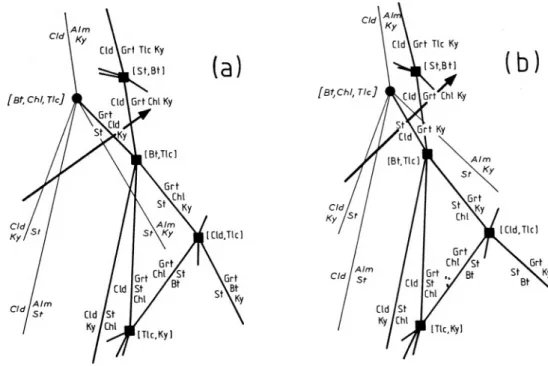
This paper focuses on phase relations between garnet, staurolite, chloritoid, chlorite, and kyanite (with excess quartz, muscovite, and H 20 ) in high-pressure metapelites. We are thus concerned only with reactions around the [Crd, Bt] KFMASH invariant point of Harte & Hudson (1979), which is equivalent to the [Bt, Tic] invariant point of Vuichard & Ballèvre (1988). These authors assumed a normal Fe-M g partitioning between AFM phases. If a reversal of Fe-M g partitioning between garnet and staurolite occurs the three terminal staurolite-out reactions:
St = Grt + Cld + Ky (1)
St = Grt + Chi + Ky (2)
St = Grt + Bt + Ky (3)
are replaced by the non-terminal reactions:
St + Cld = Grt + Ky (4)
St + Chi = Grt + Ky (5)
St + Bt = Grt + Ky. (6)
Therefore, the staurolite stability field is extended toward higher pressures and temperatures than in the case of a normal partitioning.
We will now consider in some detail what occurs around the KFMASH invariant point [Bt, Tic] which is critical for the understanding of phase relations in high-pressure metapelites. Figure 10 shows the topology of univariant KFMASH reactions around the [Bt, Tic] invariant point with normal Fe-M g partitioning (Fig. 10a) and with inverse partitioning (Fig. 10b). If X ^ g = XSg, the degenerate reaction
St = G rt + Ky (7)
will be coincident with
Fe_St = Aim + Ky (8)
1340 MICHEL BALLEVRE E T AL.
Fig. 10. Phase relations of garnet, chloritoid, staurolite, biotite, and chlorite in the KFMASH multisystem for normal, i.e., Barrovian (a) and reverse (b) Fe-M g partitioning between garnet and staurolite. Squares and heavy lines refer to invariant points and univariant reactions in the KFMASH system. Full circles and light lines refer to
invariant points and univariant reactions in the FASH system, respectively.
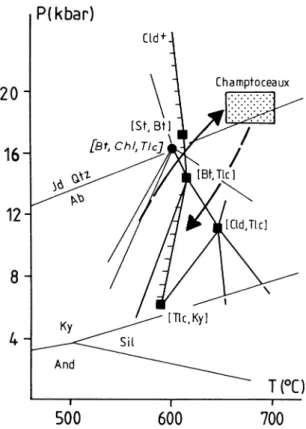
Fig. 10a will change to Fig. 10b at least in part of the P - T field, by Fe_M g changes along the (Bt, Chi, Tic) or (Bt, Cld, Tic) reactions. The inversion may occur at pressures between the invariant points [Bt, Tic] and [Bt, Chi, Tic] or [Bt, Tic] and [Cld, Tic]. Another way to relate Fig. 10a and Fig. 10b is to consider that each Schreinemakers net represents a projection in the P - T plane of univariant reaction surfaces in a three-dimensional space. The third intensive parameter is not identified at present but could be the oxygen fugacity (see, for example, Hensen, 1986) or the hydrogen content of staurolite.
Figure 11 shows the predicted Fe-M g evolution of AFM phases along a particular P - T path (arrows on Fig. 10) for aluminous bulk-rock compositions. We also represent the two types of Fe-M g partitioning. Two main consequences are to be stressed:
(1) An Fe-M g reversal does not enable a strong Mg-enrichment in staurolite, contrary to the assessment of Vuichard & Ballevre (1988). In fact, magnesian staurolites coexisting with garnet have been reported only from quartz-free metabasites (Smith, 1984; Ward, 1984; Enami & Zang, 1988) or silica-deficient peraluminous rocks (Grew & Sandiford, 1984; Schreyer et a l, 1984). The last two studies are concerned with non-metapelitic rocks where S i0 2 is not in excess. In consequence, the hypotheses required for AFM projection are not fulfilled. Moreover, Schreyer et al (1984) stated that such magnesian staurolites cannot be stable with quartz, as with pure Mg-staurolite (Schreyer, 1968).
(2) Garnet-kyanite is a critical assemblage in eclogitic metapelites: its occurrence extends towards more magnesian compositions with increasing P - T conditions. Thus, most high- pressure metapelites would appear as monotonous garnet-kyanite micaschists.
GARNET AND STAUROLITE IN ECLOGITE-FACIES METAPELITES 1341
T ,P
T ,P
Fe
Mg
Fe
Mg
(a)
(b)
Fig. 11. Schematic pseudo-binary loops for aluminous, ferrous to intermediate bulk-rock compositions. The diagrams depict the evolution of mineral compositions and assemblages along a P - T gradient (arrows on Fig. 10)
for a normal (a) and a reverse (b) Fe-M g partitioning between garnet and staurolite.
The main limitation of the above approach is that pseudo-binary loops do not take into account substitutions other than Fe-M g and non-ideal mixing behaviour in AFM phases.
A model reaction history for the Champtoceaux micaschists Prograde reaction history
As a whole, the observed parageneses in the Champtoceaux micaschists and their predicted evolution in the KFMASH system are consistent. Some points deserve further comment.
(1) Reaction (4) describes the actual reaction path in the studied micaschists. The garnet-chloritoid-staurolite assemblage is present in the garnet cores of all studied samples (Fig. 7). Garnet-staurolite-kyanite and garnet-chloritoid-kyanite assemblages are stable on the high-pressure side of reaction (4) but only garnet-chloritoid-kyanite is known at present in the Champtoceaux micaschists.
(2) Chlorite could result from the reaction
Cld = Grt -f Chi -P Ky (9)
but textural evidence in favour of this is not conclusive. If this reaction actually occurred, chlorite was probably re-equilibrated during the retrograde history.
(3) Pseudo-binary loops (Fig. lib ) are compatible with the observed chemical evolution of garnet and chloritoid, in particular with the strong Mg-enrichment after reaction (4)
1342 MICHEL BALLEVRE E T AL.
occurred. The chemical evolution of staurolite inclusions within garnet cores would tend to a slight Mg-enrichment (Fig. lib). This is not detectable in our analyses, possibly because of (a) analytical uncertainties and (b) complex solid solution behaviour of staurolite. It should be noted that the evolution from chloritoid-staurolite-garnet to garnet-chloritoid-kyanite assemblages can occur in both Fe-M g partitioning schemes. Only the evolution from chloritoid-staurolite-garnet to garnet-staurolite-kyanite assemblages would be diagnostic of an inverse partitioning.
In summary, the Champtoceaux micaschists preserve part of a prograde P - T path in garnet inclusion-rich cores, whereas matrix phases (kyanite and phengite) and garnet rims represent the ‘peak’ metamorphic conditions.
Retrograde reaction history
Reaction (5) could be used to describe the retrograde growth of chlorite + staurolite II assemblage in sample FAY25 if we assume that staurolite II, chlorite, and garnet are in equilibrium. In addition, the lack of biotite in garnet-bearing micaschists suggests that the reaction
Grt + Chi = St + Bt (10)
never takes place.
P - T C O N D I T I O N S O F T H E E C L O G I T E - F A C I E S M E T A M O R P H I S M
Even if observed phase relations in the Champtoceaux micaschists clearly show that they are true eclogite-facies parageneses, it would be highly desirable to determine the P -T conditions of this metamorphism. Few geothermobarometers are available for high- pressure metapelites, but independent estimates in eclogite-facies metabasites and quartzites can be used for reference. Quantitative evaluation of the P - T history of the studied rocks is very difficult, but the shape of the prograde P - T path can be qualitatively constrained.
Geothermobarometry
Classical geobarometers are lacking in the studied micaschists, for example, garnet-plagioclase-kyanite-quartz (Newton & Haselton, 1981). The observed associations can only be used to infer minimum or maximum pressures. In the absence of biotite and K- feldspar, the Si4+ content of primary phengites (Massone & Schreyer, 1987) gives minimum pressures of the order of 10 kb at temperatures ranging from 600 to 700 °C. In the absence of ilmenite, the GRAIL equilibrium (Bohlen et al., 1983) gives minimum pressures around 8 kb. This equilibrium unfortunately cannot be applied to garnet cores where an aluminosilicate phase is generally lacking and coexisting rutile and ilmenite are not found (see below). In the absence of sodic pyroxene, the paragonite + kyanite assemblage gives a maximum pressure at around 25 kb at 700 °C [assuming u(H20 ) = 1] (Holland, 1979).
Most geothermometers are based on Fe-M g exchange reactions between coexisting ferromagnesian minerals, notably garnet-biotite (Ferry & Spear, 1978) and garnet-phengite (Green & Heilman, 1982). Given that biotite is lacking, temperatures can only be calculated using the garnet-phengite geothermometer. The use of phengite analyses with all Fe as Fe2 + yields unreasonably high temperature estimates ranging from 800 to 850 °C at 20 kb pressure. In consequence, the Fe3 + content of phengites has been calculated assuming that Mg + Fe2 + = Si — 3. In some cases, this leads to recalculation of all Fe as Fe3 + . Such analyses have been rejected from further calculations. Using the calibration of Green &
GARNET AND STAUROLITE IN EC LO GITE-FACI ES METAPELITES 1343
Table 7
Garnet-phengite thermometry in the Champtoceaux micaschists
Sample F A Y 3 Sample F A Y 26 Grt Ca 0-295 0-272 0-282 0-099 0-274 0-176 Fe 2-025 2-038 2-026 2-207 2049 2-099 Mg 0-596 0-594 0-609 0-654 0-705 0-710 Fe/Mg 3-40 3-43 3-33 3-37 2-91 2-96 Phg Fe 0-071 0-071 0-071 0-072 0-067 0-064 Mg 0-210 0-210 0-210 0-254 0-254 0-224 Fe/Mg 0-34 0-34 0-34 0-28 0-26 0-29 K d 10-05 10-15 9-84 11-90 11-02 10-35 P = 15 kb 643 Temperatures (°C) 642 646 621 631 639 P = 20 kb 670 669 673 647 657 666 Sample FA Y6B Grt 5 11 13 29 31 33 39 Ca 0-441 0-309 0-304 0-311 0-353 0-329 0*448 Fe 1-784 1-839 1-871 1-869 1-834 1-880 1-837 Mg 0-683 0-754 0-741 0-752 0-760 0-748 0-498 Fe/Mg 2-61 2-44 2-52 2-49 2-41 2-51 3-69 Phg 4 10 12 28 30 32 37 Fe 0044 0-058 0-060 0-077 0-109 0-055 0-102 Mg 0-210 0-236 0-273 0-243 0-263 0-249 0-288 Fe/Mg 0-21 0-25 0-22 0-32 0-41 0-22 0-35 K d 12-47 9-92 11-49 7-84 5-82 11-38 10-42 Temperatures ( °C) F = 15 kb 621 645 626 677 624 627 639 P = 20 kb 647 672 652 705 650 653 665
Heilman (1982) (for low Ca and low Mg systems) with garnet rims and primary phengite compositions, temperatures ranging from 650 to 680 °C have been calculated for a pressure of 20 kb (Table 7).
Previous authors have estimated the P - T conditions of the eclogite-facies metamorphism in the Champtoceaux nappe using assemblages from eclogites (Godard et al., 1981; Paquette
et al., 1985) and quartzites (Ballèvre et al., 1987). Temperatures of the order of 700 °C have
been calculated using Fe-M g partitioning between garnet and omphacite (Ellis & Green, 1979). Pressures were found to be in the range 16-20 kb (Godard et al., 1981) or 18-20 kb (Ballèvre et al., 1987). Garnet-phengite thermometry in the studied micaschists gives slightly lower temperatures than these previous estimates. This discrepancy probably results from uncertainties in the Fe3+ content.
In conclusion, estimated P - T conditions for the eclogitic metamorphism are 650-700 °C at pressures ranging from 10 to 20 kb.
P -T evolution of the Champtoceaux micaschists
As shown previously, the Champtoceaux micaschists preserve part of their prograde P -T path. A first step towards quantitative estimates is shown in Fig. 12, where phase relations
1344 MICHEL BALLEVRE E T AL.
Fig 12. Phase relations in the FeO -AljC^-TiC^-SiC ^-T^O system. Mineral abbreviations are listed in Table 1. Only quartz-bearing reactions are represented. The St + Ilm + Qtz (Ky, Cld) Alm + Rt + H 20 is not labelled. The
arrow shows the prograde P - T path as recorded by mineral assemblages during garnet growth.
between almandine, chloritoid, staurolite, kyanite, rutile, and ilmenite with excess quartz and vapour are depicted in the F e 0 -A l20 3- T i 0 2- S i0 2- H 20 system. Experimental data allow the location of some reaction curves:
(1) According to Rao & Johannes (1979), the [Ilm] invariant point is located at around
590 °C and 16 kb. Three of the five curves emanating from this invariant point have been experimentally studied (Richardson, 1968; Ganguly, 1972; Rao & Johannes, 1979):
4Fe_ Cld + 5Ky = 2Fe _ St +1-5 Qtz + 2H20 (11)
23Fe_ Cld + 7Qtz = 4Fe_ St + 5 Aim + 19H20 (12)
6Fe_ St + 12*5Qtz = 4Alm + 23Ky + 6H20 (8)
(2) Bohlen et al. (1983) studied the P -F lo catio n of the reaction:
Alm + 3Rt = 311m + Ky-b 2Qtz (13)
and showed that the [Cld] invariant point is situated at around 11 kb, 650 °C.
Without an internally consistent set of thermodynamic data on end-member phases, we have been unable to calculate the exact position of the univariant reaction curves. Moreover, observed phases in the Champtoceaux micaschists are not purely ferrous. Consequently,
GARNET AND STAUROLITE IN ECLOGITE-FACIES METAPELITES 1345
univariant reactions of the model system are divariant equilibria in the
F e 0 -M g 0 -A l20 3- T i 0 2- S i0 2- H 20 system. Despite these uncertainties, the model system provides useful constraints on the prograde P -T path.
Indeed, the lack of ilmenite and kyanite and the presence of chloritoid and staurolite within garnet cores show that the prograde P - T path took place along curve (12), at pressures between the [Ky] and [Ilm] invariant points. Equilibrium (8) was exceeded when staurolite broke down and kyanite grew (garnet rims). This shows that garnet growth occurred during a strong pressure increase while temperature rose slightly, and suggests that the matrix assemblages equilibrated at pressures higher than 16 kb.
Geological significance of the P -T history
Figure 13 shows a part of the P - T history of the lower unit of the Champtoceaux nappe. A detailed discussion of the entire P -T history is clearly beyond the scope of this paper, because the last stages of the uplift path are not well constrained and other units within the Champtoceaux nappe (Fig. 1) have suffered different P - T histories during the Variscan orogeny. It thus seems premature to discuss only a particular P - T history—that of the
Fi g. 13. Pressure-temperature history of the Champtoceaux metapelites. Alumino-silicate phase relations after Holdaway (1971). Ab = Jd + Qtz after Holland (1980). The KFMASH multisystem of Fig. 10b is approximately located on the P - T diagram after Rao & Johannes (1979), Koons & Thompson (1985) and Vuichard & Ballèvre (1988). Upper limit of the chloritoid stability field is indicated (Cld+). Shaded area represents peak metamorphic
1346 MICHEL BALLEVRE E T AL.
studied unit—without reference to lower and higher structural levels of the same nappe pile. Some comments on the P - T history are nevertheless useful:
(1) In the unit studied, eclogite-facies metamorphism is recorded not only in the metabasites but also in pelitic and quartzitic sediments (Ballevre et a/., 1987). Incomplete coronitic transformations observed within low-strained granitic areas (Lasnier et al, 1973) can also be attributed to the eclogite-facies metamorphism. Thus the studied unit should no longer be considered as a ‘tectonic melange’ (e.g., Marchand, 1981; Godard, 1983).
(2) The lack of relict parageneses from a previous metamorphic event suggests that the studied unit was most probably submitted to a single metamorphic cycle. For example, such relicts are frequently observed in the Western Alps, where a Paleozoic continental basement was submitted to an eclogite-facies metamorphism during the Cretaceous Eoalpine events (e.g., Compagnoni, 1977; Dal Piaz & Lombardo, 1986). In the present example, however, the . breakdown of the graphitic material observed in the metapelites during the prograde history
(Figs. 2 and 3) argues for a single-phase metamorphic history and therefore for pelitic sediments of Lower Paleozoic age.
(3) Consequently, the lower unit of the Champtoceaux nappe is a fragment of the upper levels of the continental crust, which was buried to depths of ca. 60 km at an early stage of the Variscan events. This shows that crustal thickening was a major process during the Variscan orogeny, which is consistent with present models of the tectonic evolution of the whole belt (e.g., Matte, 1986).
(4) The P - T path of the studied unit is mainly characterized by the fact that the maximum temperature is achieved at a depth equal to the maximum amount of burial (Fig. 13). This is the only known example of such a P - T path in the Variscan belt. This kind of P - T path is not consistent with most simple one-dimensional thermal models (England & Richardson, 1977; England & Thompson, 1984), except those obtained with high uplift rates, e.g., in the case where extension followed thickening (Thompson & Ridley, 1987), or those calculated with normal uplift rates but where thermal re-equilibration is cancelled by screen effects (Rubie, 1984; Davy & Gillet, 1986). Clearly, more data on the P -T evolution of the whole Champtoceaux nappe are needed to constrain possible thermal-tectonic models.
C O N C L U S I O N S
The main conclusions of this study are as follows:
(1) A reversal of Fe-M g partitioning occurs in high-pressure metapelites, where staurolite is more Fe-rich than coexisting garnet (Fig. 7). Only three natural occurrences are known at present (in Kazakhstan in the USSR, the Dora-M aira nappe in the Western Alps, and the Champtoceaux nappe in Brittany) but careful examination of garnet- kyanite-phengite-rutile micaschists world-wide may reveal further examples.
(2) Taking into account the Fe-M g reversal between garnet and staurolite, we analyse the phase relations between garnet, chloritoid, staurolite, and kyanite in eclogitic metapelites. The resulting topology of univariant reactions in the KFMASH multisystem is depicted in Fig. 10b, and compositional changes are predicted by Fig. lib .
(3) The Champtoceaux micaschists record a trend of increasing pressures and temperatures towards ‘peak’ metamorphic conditions which have been estimated at around 18-20 kb, 650-700 °C. During this prograde evolution, mineralogical and compositional changes are controlled by the KFMASH univariant reaction: