HAL Id: hal-00305036
https://hal.archives-ouvertes.fr/hal-00305036
Submitted on 28 Nov 2006
HAL is a multi-disciplinary open access
archive for the deposit and dissemination of
sci-entific research documents, whether they are
pub-lished or not. The documents may come from
teaching and research institutions in France or
abroad, or from public or private research centers.
L’archive ouverte pluridisciplinaire HAL, est
destinée au dépôt et à la diffusion de documents
scientifiques de niveau recherche, publiés ou non,
émanant des établissements d’enseignement et de
recherche français ou étrangers, des laboratoires
publics ou privés.
nutrient concentrations in the River Scheldt Basin
J. Meynendonckx, G. Heuvelmans, B. Muys, J. Feyen
To cite this version:
J. Meynendonckx, G. Heuvelmans, B. Muys, J. Feyen. Effects of watershed and riparian zone
charac-teristics on nutrient concentrations in the River Scheldt Basin. Hydrology and Earth System Sciences
Discussions, European Geosciences Union, 2006, 10 (6), pp.913-922. �hal-00305036�
Hydrol. Earth Syst. Sci., 10, 913–922, 2006 www.hydrol-earth-syst-sci.net/10/913/2006/ © Author(s) 2006. This work is licensed under a Creative Commons License.
Hydrology and
Earth System
Sciences
Effects of watershed and riparian zone characteristics on nutrient
concentrations in the River Scheldt Basin
J. Meynendonckx1, G. Heuvelmans2, B. Muys3, and J. Feyen3
1Flemish Institute for Technological Research, Boeretang 200, 2400 Mol, Belgium 2Ecorem consultants nv, Kontichsesteenweg 38, 2630 Aartselaar, Belgium
3Department of Land Management and Economics, Faculty of Bioscience Engineering, Katholieke Universiteit Leuven, Vital
Decosterstraat 102, 3000 Leuven, Belgium
Received: 10 January 2006 – Published in Hydrol. Earth Syst. Sci. Discuss.: 2 May 2006 Revised: 8 November 2006 – Accepted: 23 November 2006 – Published: 28 November 2006
Abstract. The relative influence of a set of watershed char-acteristics on surface water nutrient concentrations was ex-amined in 173 watersheds within two subcatchments (Upper-Scheldt and Nete) of the River (Upper-Scheldt Basin (Flanders, Bel-gium). Each watershed was described by seasonal rainfall, discharge loading of point sources, morphological charac-teristics (area, average slope, drainage density, elongation), land use and soil properties (soil texture and drainage). Par-tial regression analysis revealed that soil drainage variables had the strongest influence on nutrient concentrations. Ad-ditional influence was exerted by land use and point source loading variables. Nitrate concentrations were positively cor-related with effluent loadings coming from wastewater treat-ment plants and with the area of agricultural land. Phosphate concentrations were best explained by effluent loadings of industrial point sources and by the area of urban land. Land use close to the river was not a better predictor of nitrate and phosphate concentrations than land use away from the river. This suggests that the mediating impact of riparian zones is rather explained by the hydrologic pathways within the buffer strip.
1 Introduction
Eutrophication is one of the most important threats to sur-face water quality and river ecosystems. A main issue facing watershed planners is how land use and management ties to the quality at the river basin outlet. The past decades, sev-eral researchers tried to relate water quality variables to land management using empirical techniques like correlation and regression analysis, often embedded in a GIS environment (Hill, 1978; Wilkin and Jackson, 1983; Osborne and Wi-ley, 1988; Hunsaker and Levine, 1995; Bolstad and Swank,
Correspondence to: J. Feyen
1997; Tufford et al., 1998; Norton and Fisher, 2000; Sliva and Williams, 2001; Davis and Neal, 2004).
Surface waters are contaminated by human activities in two ways: (1) by point sources, such as the effluent of indus-tries and wastewater treatment plants (WTP’s), and (2) by diffuse sources, such as the runoff from urban and agricul-tural areas. The importance of point sources for water qual-ity depends on the extent of industrial activqual-ity and urban land with respect to the basin area under agriculture and forest and the level and efficiency of pre-discharge treatment processes (Ometo et al., 2000). Diffuse sources are more difficult to monitor because nutrients follow a variety of pathways de-pending on the hydrological routing between overland, sub-surface and base flow (Haycock et al., 1993; Nikolaidis et al., 1998; Dzikiewicz, 2000). Different flow components dominate N and P concentrations and export. Most of the N is exported from watersheds as nitrate through subsurface flow and is therefore diffuse in space and time. In contrast, P export, whether associated to sediments or the water phase, usually occurs from critical source areas because P is mainly transported by overland flow from near stream areas during storm periods (Soranno et al., 1996; Pionke et al., 2000).
One landscape element which can exert a moderate to strong mediating effect on nutrient export is the land-water ecotone, i.e. the riparian zone. This zone is considered im-portant with respect to the regulation of the transport of sedi-ments, water and nutrients across the landscape, and has been subject of research and target of management and restoration efforts (Omernik et al., 1981; Lowrance et al., 1984; Peter-john and Correll, 1984; Mulholland, 1992; Haycock et al., 1993; Hill, 1996; Johnson et al., 1997; Tufford et al., 1998). Despite the well-known functions of riparian zones in moder-ating stream nutrient concentrations (e.g. review of Haag and Kaupenjohann, 2001), the relative influence of riparian zone versus the whole watershed characteristics on ambient nutri-ent concnutri-entrations is poorly understood. Several researchers found that land use adjacent to the stream was not a better
Fig. 1. Location of the study area.
predictor of nutrient concentrations than land use composi-tion of the whole watershed (Omernik et al., 1981; Johnson et al., 1997; Sliva and Williams, 2001). These results are in contrast to reports citing the opposite (Richards et al., 1996; Tufford et al., 1998) and to reports citing the benefits of ri-parian vegetation in reducing sediment and nutrient inputs to streams (e.g. Dillaha et al., 1989; Osborne and Kovacic, 1993; Fennessy and Cronk, 1997).
This paper describes the results of a study investigating the effects of watershed and riparian zone characteristics on the surface water nitrate and phosphate concentrations in the River Scheldt Basin. Thereto, two subcatchments were se-lected representing different conditions in the study basin. The spatial variability in observed nitrate and phosphate con-centrations within these subcatchments was related to a va-riety of watershed characteristics. The role of point and dif-fuse sources, anthropogenic (e.g. land use) and natural water-shed characteristics (e.g. geomorphic characteristics and soil properties), and the time and spatial dependent precipitation variable were taken into consideration. With respect to wa-tershed characteristics the following three research questions were addressed:
1. What is the relationship between watershed character-istics and surface water quality?
2. Is this relationship seasonal?
3. Do land use and soil properties near the stream better describe the variability in nitrate and phosphate concentra-tions than land use and soil properties in the whole water-shed?
2 Method 2.1 Study area
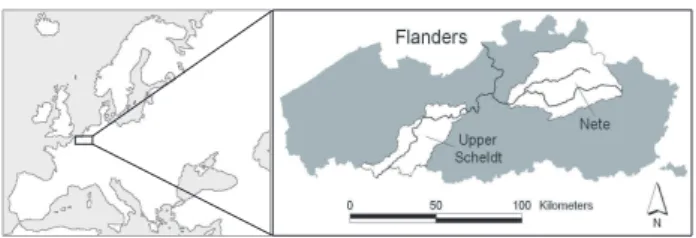
The study area consists of two subcatchments of the River Scheldt Basin situated in one of the most densely popu-lated and intensively managed regions of northwest Europe (Fig. 1). The climate is classified as marine, temperate, with an average annual precipitation of 800 mm. The Upper-Scheldt subcatchment, covering 946 km2, is situated in the Flemish hill district where the geologic substrate consists of discontinuous quaternary layers of loamy sand and sandy loam on tertiary sands and clays. Most soils are well to
mod-erately drained loam and sandy loam soils. Elevations range from 3 to 150 m above sea level. Land use is dominated by arable land (cropland 46% and pasture 29% of the area), with crop acreage dominated by wheat, corn, potatoes and sugar beets. The region is poorly seweraged with only one third of the households connected to a sewer system. The Nete subcatchment, 1673 km2 in size, is situated in the Central Kempen where the geologic substrate consists of quaternary sands on tertiary sands and clays. The watershed has a fairly uniform topography with elevations ranging from 2 to 68 m above sea level. Most soils are moderately to poorly drained sands and loamy sands. The dominant land use categories are forests, followed by field crops and pasture, respectively 30%, 29% and 16% of the area. The Nete catchment is slightly more urbanized than the Upper-Scheldt catchment (19% versus 16%) and more households are connected to a sewer of which the water is treated before discharged in the river system (63% versus 35%). In both catchments, indus-trial activities such as chemistry, food, textile and metal in-dustries contribute to the N and P loading of the rivers. 2.2 Data sources and data (pre-)processing
2.2.1 Water chemistry
Water quality data were obtained from the Flemish Environ-ment Agency, which takes and analyses samples of surface waters in Flanders (VMM, 2002). During the years 1998– 2001, the nitrate (NO3−) and phosphate (PO43−) concen-trations were determined at 67 sampling sites in the Upper-Scheldt catchment and at 106 sampling sites in the Nete catchment. Because of the low sampling frequency (one ob-servation per month) the dataset does not permit a detailed analysis of the temporal variation in water quality. Calcu-lating nutrient loadings could reduce the temporal variabil-ity, but this was impossible because river discharge data are not monitored at the same locations as the water quality, nor is the sampling frequency the same. In order to reduce the impact of variations in discharge, nitrate and phosphate concentrations were averaged by season: winter (December– February), spring (March–May), summer (June–August) and fall (September–November). As a consequence the deriva-tion of the reladeriva-tionship between nitrate and phosphate con-centrations and the watershed characteristics in this study was based on the seasonal average nutrient concentration. 2.2.2 Watershed characteristics
A vector-based geographic database was compiled for the Upper-Scheldt and Nete catchments. Each database in-cluded layers on topography, streams, water quality moni-toring sites, precipitation monimoni-toring sites, location of point sources, land use and soil properties. PC-based ArcView 3.2a (ESRI, 2000) was used to manage the GIS data layers. For each water quality monitoring site in both catchments,
J. Meynendonckx et al.: Watershed effects on instream nutrient concentrations 915 corresponding drainage areas were delineated based on the
digital terrain model (DTM) using the data pre-processing tool of AVSWAT 2000 in ArcView (Di Luzio et al., 2002). In the Upper-Scheldt catchment, 67 watersheds were delin-eated with an area ranging between 1 and 109 km2. In the Nete catchment, 106 watersheds were delineated with an area ranging between 2 and 710 km2.
Precipitation data of the years 1998–2001 from 5 meteo-stations in the Upper-Scheldt catchment and 7 meteo-stations in the Nete catchment were obtained from the Royal Meteorologi-cal Institute. Thiessen polygons were created with the Are-alRain extension in ArcView (Petras, 2001). The seasonal precipitation attributed to each watershed was derived from the Thiessen polygon showing the largest overlap with the considered watershed.
Discharge and nutrient concentration data of all point sources were obtained from the Flemish Environment Agency. Three types of point sources were used: (1) dis-charge of treated industrial wastewater in surface waters, (2) discharge of industrial wastewater in a sewer not yet con-nected to a wastewater treatment plant, and (3) discharge of treated sewage coming from a wastewater treatment plant. For each point source, mean yearly discharge and nitrate and phosphate concentrations were calculated, so that mean yearly loadings of nitrate and phosphate could be calculated by multiplying discharge with concentration. For each wa-ter quality monitoring site, loadings of all upstream point sources were summed according to the three different types of point source. Uptake and transformation processes were not taken into account.
GIS-derived morphological characteristics were water-shed area, average waterwater-shed slope, drainage density and elongation. The digital terrain model (DTM) used to derive the average slope was interpolated from digital elevation data obtained from the National Geographic Institute. Calculation of the drainage density was based on the Flemish Hydro-logical Atlas (VHA), delivered by the Flemish Land Agency (VLM). The elongation of a watershed was defined as the ra-tio of the diameter of a circle with the same area as the water-shed, to the watershed length (Langford and O’Shaughnessy, 1977, cited by Post and Jakeman, 1999). Digital land use maps were obtained from the Flemish Land Agency (VLM). Land use categories were aggregated into four classes: (1) agricultural land, including row and non-row crops, (2) pas-ture, (3) forests, and (4) urban land, including industrial and residential areas. Each land use class was expressed as a fraction of the total watershed area. Soil properties were de-rived from the digital soil maps created by the Flemish Land Agency (VLM). The VLM soil texture classes were aggre-gated into the following four classes: (1) loam (symbol A), (2) sand loam (symbol L), (3) loamy sand (symbols S and P), and (4) sand (symbol Z). The VLM soil drainage character-istics were also aggregated into four classes: (1) well drained (symbols a, b and B), (2) moderately drained (symbols c, d and D), (3) poorly drained (symbols e, f, g, F and G), and
(4) poorly drained with stagnating water (symbols h, i and I). Each soil texture and drainage class was expressed as a proportion of the total watershed area.
Finally, a proximity analysis was conducted by delineat-ing buffer zones around the VHA-streams within each wa-tershed. Zone widths of 100 and 250 m from VHA-streams were selected, after which land use, soil texture and soil drainage compositions of these buffer zones of all watersheds were calculated.
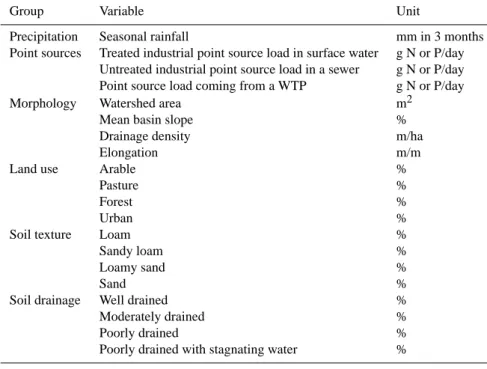
All calculated explanatory watershed characteristic vari-ables are presented in Table 1.
2.3 Statistical analyses
Descriptive statistics were calculated for the watershed and water quality databases of both the Upper-Scheldt and Nete catchment (Table 2). Distributional properties of all vari-ables were assessed and the Kolmogorov-Smirnov goodness of fit test was used to test for normality of distribution of the watershed and water quality variables. When necessary the dependent water quality variables were log transformed. Some of the explanatory watershed variables could not be normalised. To examine the degree of interdependence or multicollinearity within the explanatory watershed variables, non-parametric Spearman rank correlations were calculated. Watershed characteristics and water quality interactions were examined using two techniques: (1) a non-parametric Spearman rank correlation analysis was applied to determine the direction and magnitude of the interaction between in-dividual watershed characteristics and nitrate and phosphate concentrations, and (2) the relative importance of the water-shed characteristics grouped per environmental theme (pre-cipitation, point sources, morphological characteristics, land use, soil properties) was examined by partial regression anal-ysis (Legendre and Legendre, 1998; Lichtstein et al., 2002, Deckers et al., 2004). With respect to the latter, the follow-ing procedure was adopted and repeated for both catchments. First, a multiple regression model was built with all explana-tory variables. Next, a multiple regression model was built with all explanatory variables except those of the studied fac-tor group. The unique contribution of the concerning facfac-tor group is then given by its partial R2, calculated as the differ-ence in R2between the full model, containing all variables, and the corresponding reduced model, lacking the variables of the concerning factor group. The strength of this method is that it explicitly accounts for the intrinsic existence of correlation between variables of different factor groups by partialling out shared components of variation explained by the various factor groups (Deckers et al., 2004). After cal-culating partial R2for all seasons of the years 1998–2001, mean seasonal and overall mean partial R2were calculated. Differences in partial R2 of all distinct factor groups were tested by the non-parametric Friedman test and the Dunn test (Siegel and Castellan, 1988). The question whether nutrient concentrations are primarily influenced by riparian zone or
Table 1. Watershed characteristics used as independent variables.
Group Variable Unit
Precipitation Seasonal rainfall mm in 3 months Point sources Treated industrial point source load in surface water g N or P/day
Untreated industrial point source load in a sewer g N or P/day Point source load coming from a WTP g N or P/day Morphology Watershed area m2
Mean basin slope %
Drainage density m/ha
Elongation m/m
Land use Arable %
Pasture %
Forest %
Urban %
Soil texture Loam %
Sandy loam %
Loamy sand %
Sand %
Soil drainage Well drained % Moderately drained %
Poorly drained %
Poorly drained with stagnating water %
0 1 2 3 4 5 6 7 8 9 wi 98sp98 su98 au98 wi99sp99su99 au99 wi00 sp00su00au00 wi01 sp01 su01au01 m ea n N O 3( -) c on c. (m g N /l) 0 0,2 0,4 0,6 0,8 1 1,2 1,4 wi 98sp98su98au98wi99sp99su99au99wi00sp00su00au00wi01sp01su01au01 m ea n P O 4( 3-) c onc . ( m g P /l) Upper-Scheldt Nete
Fig. 2. Trends in mean seasonal nitrate and phosphate concentrations (wi = winter, sp = spring, su = summer, au = autumn).
by whole-watershed characteristics was examined with par-tial regression, the Friedman test and the Dunn test. Wa-tershed characteristics examined were land use, soil texture and soil drainage class. Factor groups consisted of whole watershed characteristics, characteristics within a 250 and a 100 m-buffer.
3 Results and discussion 3.1 Seasonal patterns
Seasonal concentrations of nitrate and phosphate averaged for all sampling sites of the Upper-Scheldt and Nete catch-ments are presented in Fig. 2. Nutrient concentrations are highest in the Upper-Scheldt catchment. This is most likely due to the higher input of N and P fertilizer in the
Upper-Scheldt catchment, in which agriculture is a more dominant activity than in the Nete catchment (46% versus 29%).
The seasonal variation in nitrate concentration in the catchment of the Nete is opposite to the more commonly observed pattern of dormant season maxima and growing season minima as observed in the Upper-Scheldt catchment. High stream nitrate concentrations during the dormant sea-son are thought to be the result of a reduced uptake by ter-restrial vegetation and of increased leaching (Neill, 1989). When soils remain unfrozen during winter, rates of nitro-gen immobilization associated with microbial decomposi-tion of autumn-shed leaves may be high in soils and streams (Mulholland, 1992). Since the catchment of the Nete has more forests (30% versus 8%) and more poorly drained soils (23% versus 7%) than the Upper-Scheldt catchment condi-tions for denitrification might be more favourable in the Nete
J. Meynendonckx et al.: Watershed effects on instream nutrient concentrations 917
Table 2. Descriptive statistics (min = minimum, mean = arithmetic mean, max = maximum ) of the time-independent watershed
character-istics in the whole catchments and the buffer strips of 250 m and 100 m of the Upper-Scheldt and Nete catchments. Variable Spatial Upper-Scheldt Nete
extent min mean max min mean max Watershed area 52.3 1509.6 10,930.4 177.8 6651.3 71 005.9 Mean basin slope 0 1.627 4.820 0.051 0.236 0.580 Drainage density 6.93 17.35 38.99 1.02 27.87 418.14 Elongation 0.49 0.76 1.17 0.34 0.63 1.09 Arable whole 0 14.3 51.1 0.2 20.9 50.8 250 m 0 12.7 45.7 0.4 18.0 44.5 100 m 0 10.7 45.3 0 15.5 51.5 Pasture whole 11.2 46.4 85.4 9.3 30.4 59.0 250 m 13.5 45.3 85.6 7.2 35.2 60.6 100 m 8.9 45.0 79.1 7.5 36.8 64.3 Forest whole 5.0 28.0 42.5 5.8 16.2 42.7 250 m 0 28.2 55.7 2.3 17.6 52.2 100 m 5.8 28.5 50.9 3.8 18.0 48.9 Urban whole 0 8.8 77.4 1.9 27.0 71.1 250 m 0 10.9 77.2 0.9 25.0 62.1 100 m 0 14.1 79.1 1.0 26.8 66.9 Loam whole 0 44.2 100.0 0 0 0 250 m 0 43.6 100.0 0 0 0 100 m 0 44.0 99.6 0 0 0 Sandy loam whole 0 28.5 97.1 0 3.8 78.7
250 m 0 29.4 96.5 0 4.8 78.0 100 m 0 29.0 98.6 0 5.8 79.9 Loamy sand whole 0 4.6 79.6 0 35.2 92.1 250 m 0 4.1 78.0 0 42.6 95.7 100 m 0 4.2 79.5 0 47.8 99.2 Sand whole 0 9.0 99.1 0 39.3 99.6 250 m 0 8.9 97.8 0 36.2 99.1 100 m 0 8.3 94.4 0 31.4 99.0 Well drained whole 0 29.4 76.0 0 9.0 50.1 250 m 0 17.6 68.5 0 4.6 24.3 100 m 0 10.1 63.9 0 2.5 21.5 Moderately drained whole 16.2 49.7 98.7 14.7 46.2 88.9 250 m 17.9 56.7 98.5 14.7 44.5 87.0 100 m 13.4 55.3 99.7 5.4 38.1 84.5 Poorly drained whole 0 6.5 21.4 0 20.8 55.8 250 m 0 10.8 32.0 0 33.3 70.4 100 m 0 19.5 54.8 0 43.3 85.6 Stagnating water whole 0 3.8 51.2 0 1.2 21.9 250 m 0 5.2 55.1 0 1.6 35.1 100 m 0 6.4 61.4 0 2.2 52.0
catchment, which helps to explain why dormant season max-ima are not outspoken.
The seasonal variation in phosphate concentration is simi-lar in both catchments, showing peaks in summer. The same pattern was observed by Osborne and Wiley (1988). Higher concentrations during summer are likely the result of the less frequent occurrence of showers in the summer season and the less dilution of phosphate point sources due to the overall lower base flow in summer.
3.2 Linkages between watershed characteristics and nutri-ent concnutri-entrations
3.2.1 Nitrate
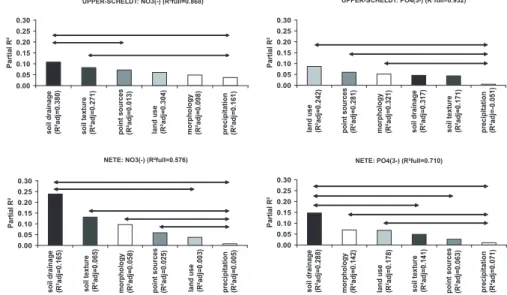
In both the Nete and Upper-Scheldt catchment, the expla-native value of the different watershed characteristics dif-fers significantly (Table 3). Soil drainage and soil texture predict stream nitrate concentrations significantly better than
Table 3. Results of Friedman test to compare partial R2of the different groups of watershed characteristics in explaining nutrient concentra-tions at the mouth.
Nitrate Phosphate Upper-Scheldt Nete Upper-Scheldt Nete Chi-square 18.607 64.517 25.923 25.923
N 16 16 16 16
Df 5 5 5 5
Asymptotic significance 0.002 0.000 0.000 0.000
Table 4. Mean Spearman rank correlation coefficients between watershed characteristics and water quality for all seasons of 1998-2001
[between brackets the frequency of significant correlation out of 16 (4 years with 4 seasons)].
Nitrate Phosphate Upper-Scheldt Nete Upper-Scheldt Nete Seasonal rainfall –0.304 (7) 0.031 (0) 0.005 (0) –0.045 (1) Treated Industrial –0.154 (2) –0.039 (1) 0.389 (9) –0.178 (8) Untreated Industrial –0.168 (0) 0.117 (0) 0.449 (12) 0.240 (10) WTP –0.017 (0) 0.321 (12) –0.139 (0) 0.043 (0) Watershed area –0.168 (2) –0.109 (5) 0.215 (2) –0.177 (8) Mean basin slope 0.191 (5) –0.133 (3) –0,481 (11) –0.154 (4) Stream density 0.121 (1) 0.016 (0) –0.398 (9) –0.024 (0) Elongation –0.034 (0) 0.284 (12) –0.155 (1) 0.253 (8) Arable 0.518 (13) –0.053 (0) 0.004 (0) –0.065 (2) Pasture 0.012 (0) 0.150 (5) –0.178 (3) 0.156 (5) Forest –0.329 (10) 0.022 (0) –0.014 (0) –0.279 (9) Urban –0.500 (13) 0.037 (0) 0.306 (7) 0.320 (12) Loam 0.117 (0) – –0.241 (4) – Sandy loam 0.141 (4) –0.023 (2) 0.158 (0) 0.158 (2) Loamy sand –0.200 (2) –0.165 (5) 0.339 (5) 0.097 (1) Sand –0.148 (7) 0.131 (3) –0.063 (1) –0.281 (10) Well drained 0.538 (13) –0.445 (16) –0.202 (2) –0.349 (11) Moderately drained –0.279 (6) 0.171 (5) –0.063 (0) 0.236 (9) Poorly drained –0.365 (7) –0.126 (2) 0.131 (1) –0.217 (9) Stagnating water –0.048 (1) 0.260 (11) 0.209 (3) 0.134 (5)
precipitation in both catchments (Fig. 3). In the Nete catch-ment the watershed morphology and point sources also play a more significant role than precipitation. The reason for the observed low influence of precipitation on nutrient concen-trations must be sought in the spatial and temporal limita-tions of both precipitation and water quality data: precipi-tation data are spatially limited while monthly water quality data in the absence of discharge data are subject to fluctua-tions which could not be taken into account. Therefore, the further analysis was concentrated on the non-time-dependent variables.
In the Upper-Scheldt catchment soil drainage explains bet-ter the observed variability in nitrate concentrations than point sources (Fig. 3). Though, when only the summer season is taken into account, point sources have the largest partial R2 of all factor groups (data not shown). A likely
explanation is that in summer (1) biomass production and plant N uptake peak and rainfall excess is small resulting in no or very small leaching of nitrate and (2) effluents of point sources are less diluted due to the overall lower base flow (Osborne and Wiley, 1988). A strong positive correla-tion exists between the proporcorrela-tion of well drained soils and downstream nitrate concentrations (Table 4). This can be ex-plained by the higher infiltration capacity, the shorter resi-dence time of subsurface water and groundwater and con-sequently less denitrification taking place (Mueller et al., 1997). Furthermore, a strong positive correlation is observed between the area of agricultural land and downstream ni-trate concentrations, a pattern observed in many other stud-ies (Hill, 1978; Neill, 1989; Johnson et al., 1997; Tufford et al., 1998). The observed negative correlation between the proportion of forest and downstream nitrate concentrations
J. Meynendonckx et al.: Watershed effects on instream nutrient concentrations 919 0.00 0.05 0.10 0.15 0.20 0.25 0.30 s o il d ra in a g e (R ²a d j=0 .3 8 0 ) s o il t e x tu re (R ²a d j=0 .2 7 1 ) p o in t s o u rc e s (R ²a d j=0 .0 1 3 ) la n d u s e (R ²a d j=0 .3 0 4 ) mo rp h o lo g y (R ²a d j=0 .0 9 8 ) p re c ip it a ti o n (R ²a d j=0 .1 6 1 ) P a rt ia l R ²
UPPER-SCHELDT: NO3(-) (R²full=0.868)
0.00 0.05 0.10 0.15 0.20 0.25 0.30 la nd us e (R ²a d j=0 .2 4 2 ) poi nt s o u rc e s (R ²a d j=0 .2 8 1 ) m or ph ol o gy (R ²a d j=0 .3 2 1 ) s oi l d ra in a g e (R ²a d j=0 .3 1 7 ) s oi l te x tur e (R ²a d j=0 .1 7 1 ) pr e c ip ita ti on (R ²a d j=-0 .0 5 1 ) Pa rti a l R ²
UPPER-SCHELDT: PO4(3-) (R²full=0.932)
0.00 0.05 0.10 0.15 0.20 0.25 0.30 s o il d ra in a g e (R ²a d j=0 .1 6 5 ) s o il t e x tu re (R ²a d j=0 .0 6 5 ) m o rp h o lo g y (R ²a d j=0 .0 5 8 ) p o in t s o u rc e s (R ²a d j=0 .0 2 5 ) la n d u s e (R ²a d j=0 .0 0 3 ) p re c ip ita ti o n (R ²a d j=0 .0 0 5 ) Pa rt ia l R²
NETE: NO3(-) (R²full=0.576)
0.00 0.05 0.10 0.15 0.20 0.25 0.30 s oi l d ra in a g e (R ²a d j=0 .2 8 8 ) m or p hol ogy (R ²a d j=0 .1 4 2 ) la nd us e (R ²a d j=0 .1 7 8 ) s oi l te x tur e (R ²a d j=0 .1 4 1 ) poi nt s o u rc e s (R ²a d j=0 .0 6 3 ) pr e c ipi ta ti on (R ²a d j=0 .0 7 1 ) Pa rti a l R ²
NETE: PO4(3-) (R²full=0.710)
Fig. 3. Mean partial R2for all seasons of 1998-2001 (arrows indicate significantly different factor groups). Mean adjusted R2for each of the factor groups and mean R2of the full model are given between brackets.
is in agreement with the results of Hunsaker and Levine (1995), but the negative correlation between the proportion of urban land and downstream concentrations contrasts to other reports (Osborne and Wiley, 1988; Sliva and Williams, 2001; Davies & Neal, 2004) and may according to Tufford et al. (1998) be the result of multicollinearity.
In the Nete catchment, soil drainage accounts better for the observed variability in nitrate concentrations than land use (Fig. 3). This is in agreement with the conclusion of Nor-ton and Fisher (2000) that soil characteristics can completely over-ride land use effects. The strong negative correlation be-tween the proportion of well drained soils and downstream nitrate concentrations (Table 4) is somehow contradictory, unless the plant uptake of N in well drained soils is con-siderably higher than in poorly drained soils. Other Spear-man rank correlations in the Nete catchment show that nitrate loadings coming from wastewater treatment plants (WTP’s) go hand in hand with higher downstream nitrate concentra-tions (Table 4) indicating that nitrate removal by WTP’s is highly insufficient. In the Upper-Scheldt catchment, the in-efficiency of nitrate removal by wastewater treatment infras-tructure was not detected because the low number of WTP’s. Furthermore, the watershed elongation of the Nete catchment is positively correlated to downstream nitrate concentrations (Table 4) suggesting that lower nitrate concentrations are ob-served downstream of lengthened watersheds, which can be explained by the longer residence time enhancing natural de-cay processes.
3.2.2 Phosphate
As for nitrate, the explanative value of the different themes of watershed characteristics is significantly different in both the Upper-Scheldt and Nete catchment (Table 3). The influ-ence of precipitation is again negligible, for the same reason as stated before, and is not taken into account in the further analysis.
In the Upper-Scheldt catchment no significant difference could be detected between the different watershed character-istics (Fig. 3). The Spearman rank correlations revealed that industrial point sources are positively correlated to down-stream phosphate concentrations (Table 4). Furthermore, a negative correlation exists between the morphological char-acteristics mean slope and stream density of the watershed and phosphate concentrations, whereas one would expect the opposite, i.e. the steeper the mean catchment slope the more likely overland flow and transport of soil particles will occur, and the more easy sediments loaded with phosphate reach the drainage network. No direct explanation for the negative correlation could be found.
In the Nete catchment, soil drainage accounts better for the observed variation in phosphate concentration than point source loadings and proportions of soil texture classes (Fig. 3). The proportion of urban land is positively corre-lated with downstream phosphorus concentrations (Table 4). This relationship may be highly influenced by point sources as well as diffuse sources. From the different types of point sources, discharge of treated industrial wastewater in a sewer not connected to a WTP is most important (Table 4). This is in agreement with the statement of Sonzogni et al. (1980) that highly industrialized urban areas contribute more phos-phorus per unit area than residential areas. Diffuse source
Table 5. Results of Friedman test to compare partial R2of land use and soil characteristics within different distances of the streams in explaining nutrient concentrations at the mouth.
Nitrate Phosphate Upper-Scheldt Nete Upper-Scheldt Nete Land use Chi-square 13.333 3.270 9.125 2.952
N 16 16 16 16
Df 2 2 2 2
Asymptotic significance 0.001 0.195 0.010 0.229 Soil texture Chi-square 1.238 9.375 6.097 6.125
N 16 16 16 16
Df 2 2 2 2
Asymptotic significance 0.538 0.009 0.047 0.047 Soil drainage Chi-square 7.125 8.000 14.400 1.625
N 16 16 16 16
Df 2 2 2 2
Asymptotic significance 0.028 0.018 0.001 0.444
pollution in urban areas is caused by artificial sealing of the surface resulting in more runoff (Sonzogni et al., 1980; Field et al., 1996) and less pollutant attenuation (Soranno et al., 1996; Corbett et al., 1997). From Table 4 it is also clear that a negative correlation exists between the proportion of sandy soils and downstream phosphorus concentrations. Greater amounts of sandy soils result in greater infiltration and thus, less potential soil erosion and overland transport of phospho-rus (Norton and Fisher, 2000). This effect is accentuated be-cause the soils are sandy and covered by forests, having a positive impact on water quality in a number of ways: (1) sandy soils act as effective sediment traps, (2) forests con-sume and store nutrients, and (3) rhizosphere of forests stim-ulate microbial assimilation of nutrients (Norton and Fisher, 2000).
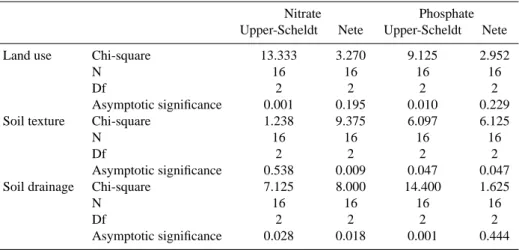
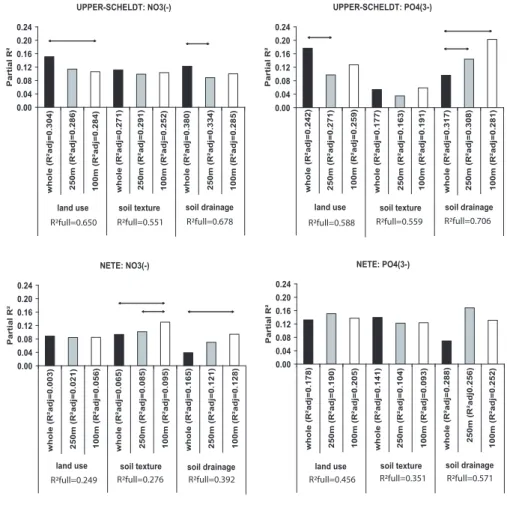
3.3 Buffer strip versus whole-catchment characteristics Results of the partial regression analysis to examine the rel-ative influence of buffer strip versus whole catchment land use and soil characterics on nutrient concentrations are pre-sented in Table 5 and Fig. 4. Neither in the Nete nor in the Upper-Scheldt catchment, land use close to the stream chan-nel (<100 or <250 m) is a better predictor of nitrate or phos-phate concentrations than land use away from the channel (>100 or >250 m) (Fig. 4). Probably, the mediating impact of riparian zones is not primarily dependent on land use ac-tivities. Rather, the hydrologic pathways within the buffer strip play a more important role. Both soil properties (texture and drainage) in the riparian zone of the Nete catchment have a higher explanative value to downstream nitrate concentra-tions than these properties for the whole watershed (Fig. 4). In the Nete catchment, where soils are dominantly moder-ately drained sands, a higher proportion of poorly drained loamy sands in the riparian zone lead to lower nitrate con-centrations (Table 4). Probably, these soils retard the
move-ment of subsurface flow increasing the time for denitrifica-tion to take place. Moreover, waterlogged condidenitrifica-tions pro-mote the denitrification process. The difference in partial R2 is most distinct in spring (data not shown), simultaneously with the lowest observed nitrate concentrations (Fig. 2). A plausible explanation is that the sum of denitrification and N uptake are highest in spring, whereas in winter N uptake ceases close to zero and denitrification reaches its maximum value, and in summer N uptake is maximal while denitrifi-cation hardly occurs. Although the proportion of agricul-tural land increases simultaneously with an increase in fine textured soils (loamy sands) within the riparian zones, land use within the riparian zone is not a better predictor of ni-trate concentrations than land use in the whole watershed. In the Upper-Scheldt catchment, no significant difference in explanative value of soil properties is observed between the buffers and the whole catchment when nitrate concentrations are considered. Phosphate concentrations, though, are bet-ter predicted by soil drainage characbet-teristics in the riparian zone. Soil drainage characteristics in the riparian zone in-fluence erosion through soil infiltration capacity (Norton and Fisher, 2000).
4 Conclusions
The analysis of the influence of a set of watershed charac-teristics categorised in environmental themes (precipitation, point sources, morphological characteristics, land use, soil properties) on instream nutrient concentrations in the River Scheldt Basin suggests that instream nutrient concentrations are largely regulated by soil drainage characteristics of the watershed. Additional influence is exerted by anthropogenic land use and point source loading variables. Despite the well-known difficulties in separating the influence of a set of intercorrelated watershed characteristics, the unique
J. Meynendonckx et al.: Watershed effects on instream nutrient concentrations 921 UPPER-SCHELDT: PO4(3-) 0.00 0.04 0.08 0.12 0.16 0.20 0.24 w h o le (R ²a d j=0 .2 4 2 ) 2 5 0 m (R ²a d j=0 .2 7 1 ) 1 0 0 m (R ²a d j=0 .2 5 9 ) w h o le (R ²a d j=0 .1 7 7 ) 2 5 0 m (R ²a d j=0 .1 6 3 ) 1 0 0 m (R ²a d j=0 .1 9 1 ) w h o le (R ²a d j=0 .3 1 7 ) 2 5 0 m (R ²a d j=0 .3 0 8 ) 1 0 0 m (R ²a d j=0 .2 8 1 )
land use soil texture soil drainage
Pa rti a l R ² NETE: PO4(3-) 0.00 0.04 0.08 0.12 0.16 0.20 0.24 w h o le (R ²a d j=0 .1 7 8 ) 2 5 0 m (R ²a d j=0 .1 9 0 ) 1 0 0 m (R ²a d j=0 .2 0 5 ) w h o le (R ²a d j=0 .1 4 1 ) 2 5 0 m (R ²a d j=0 .1 0 4 ) 1 0 0 m (R ²a d j=0 .0 9 3 ) w h o le (R ²a d j=0 .2 8 8 ) 2 5 0 m (R ²a d j0 .2 5 6 ) 1 0 0 m (R ²a d j=0 .2 5 2 )
land use soil texture soil drainage
Pa rti a l R ² UPPER-SCHELDT: NO3(-) 0.00 0.04 0.08 0.12 0.16 0.20 0.24 w h o le (R ²a d j=0 .3 0 4 ) 2 5 0 m (R ²a d j=0 .2 8 6 ) 1 0 0 m (R ²a d j=0 .2 8 4 ) w h o le (R ²a d j=0 .2 7 1 ) 2 5 0 m (R ²a d j=0 .2 9 1 ) 1 0 0 m (R ²a d j=0 .2 5 2 ) w h o le (R ²a d j=0 .3 8 0 ) 2 5 0 m (R ²a d j=0 .3 3 4 ) 1 0 0 m (R ²a d j=0 .2 8 5 )
land use soil texture soil drainage
Pa rti a l R ² NETE: NO3(-) 0.00 0.04 0.08 0.12 0.16 0.20 0.24 w h o le (R ²a d j=0 .0 0 3 ) 2 5 0 m (R ²a d j=0 .0 2 1 ) 1 0 0 m (R ²a d j=0 .0 5 6 ) w h o le (R ²a d j=0 .0 6 5 ) 2 5 0 m (R ²a d j=0 .0 8 5 ) 1 0 0 m (R ²a d j=0 .0 9 5 ) w h o le (R ²a d j=0 .1 6 5 ) 2 5 0 m (R ²a d j=0 .1 2 1 ) 1 0 0 m (R ²a d j=0 .1 2 8 )
land use soil texture soil drainage
Pa rti a l R ²
R²full=0.650 R²full=0.551 R²full=0.678 R²full=0.588 R²full=0.559 R²full=0.706
R²full=0.249 R²full=0.276 R²full=0.392 R²full=0.456 R²full=0.351 R²full=0.571
Fig. 4. Mean partial R2for all seasons of 1998–2001 (arrows indicate significantly different factor groups). Mean adjusted R2for each of the factor groups and mean R2of the full model are added.
contribution of each theme of watershed characteristics could be calculated using partial regression analysis. The data from the River Scheldt Basin suggest that an understanding of diffuse source contributions to observed instream nutrient concentrations cannot be based solely on an examination of land use variables. Such an approach may frequently provide a misleading impression of the significance of human activities. The same conclusion could be drawn from the proximity analysis. Land use close to the river was not a better predictor of nitrate and phosphate concentrations than land use away from the river. The mediating impact of riparian zones is rather explained by the hydrologic pathways within the buffer strip. Further investigations which make use of a better designed spatial and temporal sampling regime as well as a higher resolution of digital maps are required to evaluate the complex interactions which are responsible for variations in watershed nutrient exports and instream nutrient concentrations.
Edited by: A. D. Reeves
References
Basnyat, P., Teeter, L. D., Flynn, K. M., and Lockaby, B.G.: Rela-tionships between landscape characteristics and nonpoint source pollution inputs to coastal estuaries, Environ. Manage., 23, 539– 549, 1999.
Bolstad, P. V. and Swank, W. T.: Cumulative impacts of landuse on water quality in a southern Appalachian watershed, J. – Am. Water Resour. Assoc., 33, 519–533, 1997.
Bormann, F. H., Likens, G. E., and Eaton, J. S.: Biotic regulation of particulate and solution losses from a forest ecosystem, Bio-Science, 19, 600–610, 1969.
Corbett, C. W., Wahl, M., Porter, D. E., Edwards, D., and Moise, C.: Nonpoint source runoff modeling A comparison of a forested and an urban watershed on the South Carolina coast, J. Exp. Mar. Biol. Ecol., 213, 133–149, 1997.
Davies, H. and Neal, C.: GIS-based methodologies for assessing nitrate, nitrite and ammonium distributions across a major UK basin, the Humber, Hydrol. Earth Syst. Sci., 8, 823–833, 2004, http://www.hydrol-earth-syst-sci.net/8/823/2004/.
Deckers, B., Hermy, M., and Muys, B.: Factors affecting plant species composition of hedgerows Relative importance and hi-erarchy, Acta Oecologica, 26, 23-37, 2004.
Dillaha, T. A., Sherrard, J. H., and Lee, D.: Long-term effectiveness
of vegetative filter strips, Water Environ. Technol., November, 419–421, 1989.
Di Luzio, M., Srinivasan, R., Arnold, J. G., and Neitsch, S. L.: Soil and Water Assessment Tool ArcView GIS Interface Manual Ver-sion 2000, Texas Water Resources Institute, Texas, 2002. Dzikiewicz, P.: Activities in nonpoint pollution control in rural
ar-eas of Poland, Ecol. Eng., 14, 429–434, 2000.
ESRI: ArcView 3.2a, Environmental systems Research Institute Inc., Redlands CA, 2000.
Fennessy, M. S. and Cronk, J. K.: The effectiveness and restoration potential of riparian ecotones for the management of nonpoint source pollution, particularly nitrate, Critical Reviews in Envi-ronmental Science and Technology, 27, 285–317, 1997. Field, C. K., Siver, P. A., and Lott, A.: Estimating the effects of
changing land use patterns on Connecticut Lakes, J. Environ. Qual., 25, 325–333, 1996.
Haag, D. and Kaupenjohann, M.: Landscape fate of nitrate fluxes and emissions in Central Europe A critical review of con-cepts, data, and models for transport and retention, Agriculture, Ecosyst. Environ., 86, 1–21, 2001.
Haycock, N. E., Pinay, G., and Walker, C.: Nitrogen retention in river corridors European perspective, Ambio, 22, 340–346, 1993. Heathwaite, A. L., Johnes, P. J., and Peters, N. E.: Trends in
nutri-ents, Hydrol. Processes, 10, 263–293, 1996.
Hill, A. R.: Factors affecting the export of nitrate-nitrogen from drainage basins in southern Ontario, Water Res., 12, 1045–1057, 1978.
Hill, A. R.: Nitrate removal in stream riparian zones, J. Environ. Qual., 25, 743–755, 1996.
Hunsaker, C. T. and Levine, D. A.: Hierarchical approaches to the study of water quality in rivers. Spatial scale and terrestrial pro-cesses are important in developing models to translate research results to management practices, BioScience, 45, 193–203, 1995. Johnson, L. B., Richards, C., Host, G. E., and Arthur, J. W.: Landscape influences on water chemistry in Midwestern stream ecosystems, Freshwater Biol., 37, 193–208, 1997.
Legendre, P. and Legendre, L.: Numerical Ecology, Elsevier Sci-ence, Amsterdam, 1998.
Lichtstein, J. W., Simons, T. R., and Fransreb, K. E.: Landscape ef-fects on breeding songbird abundance in managed forests, Ecol. Appl., 12, 836–857, 2002.
Lowrance, R. R., Todd, R. L., Fail, J., Hendrickson, O., Leonard, R., and Asmussen, L. E.: Riparian forests as nutrient filters in agricultural watersheds, BioScience, 34, 374–377, 1984. Mueller, D. K., Ruddy, B. C., and Battaglin, W. A.: Logistic model
of nitrate in streams of the upper-midwestern United States, J. Environ. Qual., 26, 1223–1230, 1997.
Mulholland, P. J.: Regulation of nutrient concentrations in a tem-perate forest stream: roles of upland, riparian, and instream pro-cesses, Limnol. Oceanogr., 37, 1512–1526, 1992.
Neill, M.: Nitrate concentrations in river waters in the south-east of Ireland and their relationship with agricultural practice, Water Res., 23, 1339–1355, 1989.
Nikolaidis, N. P., Heng, H., Semagin, R., and Clausen, J. C.: Non-linear response of a mixed land use watershed to nitrogen load-ing, Agric., Ecosyst. Environ.t, 67, 251–265, 1998.
Norton, M. M. and Fisher, T. R.: The effects of forest on stream water quality in two coastal plain watersheds of the Chesapeake Bay, Ecol. Eng., 14, 337–362, 2000.
Omernik, J. M., Abernathy, A. R., and Male, L. M.: Stream nutrient levels and proximity of agricultural and forest land to streams: some relationships, J. Soil Water Conservation, 36, 227–231, 1981.
Ometo, J. P., Marinelli, L., Ballester, M. V., Gessner, A., Krusche, A., Victoria, R., and Williams, M.: Effects of land use on water chemistry and macroinvertebrates in two streams of the Piraci-caba river basin, south-east Brazil, Freshwater Biol., 44, 327– 337, 2000.
Osborne, L. L. and Kovacic, D. A.: Riparian vegetated buffer strips in water-quality restoration and stream management, Freshwater Biology, 29, 243–258, 1993.
Osborne, L. L. and Wiley, M. J.: Empirical relationships between land use/cover and stream water quality in an agricultural water-shed, J. Environ. Manage., 26, 9–27, 1988.
Peterjohn, W. T. and Correll, D. L.: Nutrient dynamics in an agri-cultural watershed: observations on the role of a riparian forest, Ecology, 65, 1466–1475, 1984.
Petras, I.: ArealRain.avx Areal Precipitation Calculation using Thiessen Polygons, AS11813.zip, 2001.
Pionke, H. B., Gburek, W. J., and Sharpley, A. N.: Critical source area controls on water quality in an agricultural watershed lo-cated in the Chesapeake Bay, Ecol. Eng., 14, 325–335, 2000. Post, D. A. and Jakeman, A. J.: Predicting the daily streamflow
of ungauged catchments in S.E. Australia by regionalising the parameters of a lumped conceptual rainfall-runoff model, Ecol. Modell., 123, 91–104, 1999.
Richards, C., Johnson, L. B., and Host, G. E.: Landscape-scale in-fluences on stream habitats and biota, Can. J. Fisheries Aquatic Sci., 53 (suppl. 1), 295–311, 1996.
Siegel, S. and Castellan, N. J.: Nonparametric statistics for the be-havioral sciences, McGraw-Hill, New York, 1988.
Sliva, L. and Williams, D.: Buffer zone versus whole catchment approaches to studying land use impact on river water quality, Water Res., 35, 3462–3472, 2001.
Sonzogni, W. C., Chesters, G., Coote, D. R., Jeffs, D. N., Konrad, J. C., Ostry, R. C., and Robinson, J. B.: Pollution from land runoff, Environ. Sci. Technol., 14, 148–153, 1980.
Soranno, P. A., Hubler, S. L., and Carpenter, S. R.: Phosphorus loads to surface waters: a simple model to account for spatial pattern of land use, Ecol. Appl., 6, 865–878, 1996.
Tufford, D. L., McKellar, H. N., and Hussey J. R.: In-stream non-point source nutrient prediction with land-use proximity and sea-sonality, J. Environ. Qual., 27, 100–111, 1998.
VMM: Waterkwaliteit – lozingen in het water 2001, Vlaamse Mi-lieumaatschappij, Erembodegem, 2002.
Wilkin, D. C. and Jackson, R. W.: Nonpoint water quality contribu-tions from land use, J. Environ. Syst., 13, 127–136, 1983.
![Table 4. Mean Spearman rank correlation coefficients between watershed characteristics and water quality for all seasons of 1998-2001 [between brackets the frequency of significant correlation out of 16 (4 years with 4 seasons)].](https://thumb-eu.123doks.com/thumbv2/123doknet/14772794.592169/7.892.210.685.346.730/spearman-correlation-coefficients-watershed-characteristics-frequency-significant-correlation.webp)