HAL Id: insu-02942198
https://hal-insu.archives-ouvertes.fr/insu-02942198
Submitted on 18 Sep 2020
HAL is a multi-disciplinary open access
archive for the deposit and dissemination of
sci-entific research documents, whether they are
pub-lished or not. The documents may come from
teaching and research institutions in France or
abroad, or from public or private research centers.
L’archive ouverte pluridisciplinaire HAL, est
destinée au dépôt et à la diffusion de documents
scientifiques de niveau recherche, publiés ou non,
émanant des établissements d’enseignement et de
recherche français ou étrangers, des laboratoires
publics ou privés.
Observations of Heating along Intermittent Structures
in the Inner Heliosphere from PSP Data
R.A. Qudsi, B. A. Maruca, W.H. Matthaeus, T. N. Parashar, Riddhi
Bandyopadhyay, R. Chhiber, A. Chasapis, Melvyn L. Goldstein, S.D. Bale,
J.W. Bonnell, et al.
To cite this version:
R.A. Qudsi, B. A. Maruca, W.H. Matthaeus, T. N. Parashar, Riddhi Bandyopadhyay, et al..
Ob-servations of Heating along Intermittent Structures in the Inner Heliosphere from PSP Data.
Astro-physical Journal Supplement, American Astronomical Society, 2020, 246 (2), pp.46.
�10.3847/1538-4365/ab5c19�. �insu-02942198�
Observations of heating along intermittent structures in the inner heliosphere from PSP data
R. A. Qudsi,1B. A. Maruca,2W. H. Matthaeus,2 T. N. Parashar,1Riddhi Bandyopadhyay,1 R. Chhiber,1 A. Chasapis,3 Melvyn L. Goldstein,4, 5 S. D. Bale,6, 7, 8 J. W. Bonnell,6 T. Dudok de Wit,9 K. Goetz,10 P. R. Harvey,6 R. J. MacDowall,11 D. Malaspina,3 M. Pulupa,6 J. C. Kasper,12, 13 K. E. Korreck,13 A. W. Case,13
M. Stevens,13 P. Whittlesey,6 D. Larson,6 R. Livi,6 M. Velli,14 and N. Raouafi15
1Department of Physics and Astronomy, University of Delaware, Newark, DE 19716, USA
2Department of Physics and Astronomy, Bartol Research Institute, University of Delaware, Newark, DE 19716, USA 3Laboratory for Atmospheric and Space Physics, University of Colorado Boulder, Boulder, CO 80303, USA
4NASA Goddard Space Flight Center, Greenbelt, MD 20771, USA 5University of Maryland Baltimore County, Baltimore, MD 21250, USA 6Space Sciences Laboratory, University of California, Berkeley, CA 94720-7450, USA
7Physics Department, University of California, Berkeley, CA 94720-7300, USA 8The Blackett Laboratory, Imperial College London, London, SW7 2AZ, UK
9LPC2E, CNRS and University of Orl´eans, Orl´eans, France
10School of Physics and Astronomy, University of Minnesota, Minneapolis, MN 55455, USA 11Code 695, NASA Goddard Space Flight Center, Greenbelt, MD 20771, USA
12Climate and Space Sciences and Engineering, University of Michigan, Ann Arbor, MI 48109, USA 13Smithsonian Astrophysical Observatory, Cambridge, MA 02138 USA
14Department of Earth, Planetary, and Space Sciences, University of California, Los Angeles, CA 90095, USA 15Johns Hopkins University Applied Physics Laboratory, Laurel, MD, USA
(Received December 12, 2019) ABSTRACT
The solar wind proton temperature at 1-au has been found to be correlated with small-scale in-termittent magnetic structures, i.e., regions with enhanced temperature are associated with coherent structures such as current sheets. Using Parker Solar Probe data from the first encounter, we study this association using measurements of radial proton temperature, employing the Partial Variance of Incre-ments (PVI) technique to identify intermittent magnetic structures. We observe that the probability density functions of high-PVI events have higher median temperatures than those with lower PVI, The regions in space where PVI peaks were also locations that had enhanced temperatures when compared with similar regions suggesting a heating mechanism in the young solar wind that is associated with intermittency developed by a nonlinear turbulent cascade.n the immediate vicinity.
Keywords: PSP– PVI
1. INTRODUCTION
Solar wind is a stream of charged particles emanating from Sun originating in the corona (Parker 1960,1963). It is highly magnetized collisionless plasma streaming at supersonic speed and is primarily composed of ion-ized hydrogen (i.e., protons) (Marsch et al. 1982;Kasper et al. 2012).
Despite decades of observation, the exact process that originally heats and accelerates solar-wind plasma re-mains unknown, but several candidates have been pro-posed. Turbulence cascade transfers energy from large to small scales, which can ultimate lead to dissipation and heating (Velli et al. 1989; Velli 1993; Matthaeus
et al. 1999; Dmitruk et al. 2002; Cranmer & van Bal-legooijen 2005; Cranmer et al. 2007; Cranmer & van Ballegooijen 2012;Cranmer 2014;Verdini & Velli 2007;
Verdini et al. 2009a,b;Chandran & Hollweg 2009;Perez & Chandran 2013;Lionello et al. 2014). Current sheets, generated by cascading vortices, can also lead to local-ized heating (Parashar et al. 2009; Osman et al. 2011,
2012a,b;Gingell et al. 2015). Wave particle interactions – including, e.g., microinstabilities, Landau damping, and ion-cyclotron resonance – can likewise result in heat-ing and other dramatic changes to the particles’ phase-space distribution (Gary 1993; Sahraoui et al. 2010;
Klein & Howes 2015).
2
In this study, we focused on coherent structures: fea-tures in the plasma that are persistent through time, concentrated in space, or both (Greco et al. 2018). Such structures can be produced by turbulent cascade ( Os-man et al. 2012b) and are also associated with current sheets (Yordanova et al. 2016). Osman et al. (2011,
2012b) analyzed in-situ observations and of near-Earth solar wind and found clear indications that coherent structures correlate with local enhancements in temper-ature.
In this study, we revisit the techniques ofOsman et al.
(2011, 2012b), and, by applying them to observations from Parker Solar Probe (PSP), explore the relationship between plasma structures and heating in nascent solar-wind plasma. Section2provides the background on such structures and introduces the reader to the physics of technique employed in data analysis which is described in section 3. In section 4 we present the results and discuss its implication. Section5summarizes the results along with a conclusion and potential future works.
2. BACKGROUND
The solar wind at 1-au exhibits localized structures that have been studied since the pioneering work of
Burlaga (1968); Hudson (1970); Tsurutani & Smith
(1979) and others, and more recently by Ness & Burlaga (2001); Neugebauer (2006); Erd˝oS & Balogh
(2008). Several studies have found evidence that plasma turbulence generates these structures dynam-ically (Matthaeus & Lamkin 1986; Veltri 1999; Osman et al. 2013). The structures are inhomogeneous and highly intermittent (Osman et al. 2011, 2013; Greco et al. 2008) .
Some recent studies, both observational and numer-ical, have shown that these structures are correlated with the regions of enhanced temperature in the plasma (Osman et al. 2012a, 2011; Greco et al. 2012) and un-derstanding the mechanisms by which the turbulence heats the plasma may also help solve the coronal heat-ing problem (Osman et al. 2012b). This is a particularly attractive scenario especially given the ubiquity of the localized structures. Study performed on data from PIC simulation byWu et al.(2013) shows that the correlation between enhanced temperature and coherent structures exists for sub ion inertial length (di). Further evidence
of this is provided byTenBarge & Howes(2013) for Gy-rokinetic simulation, Parashar et al.(2009);Wan et al.
(2012);Karimabadi et al.(2013);Wan et al.(2015) for PIC andServidio et al.(2012);Servidio et al.(2015) for Vlasov simulations respectively. Work done byChasapis et al.(2015) andYordanova et al.(2016) on from
Clus-ter and MMS data show similar results from observation vantage point.
In this study, we investigate these discontinuities in the magnetic field and explore their association with lo-cal enhancements in ion temperature. One method for identifying a discontinuity in a time series of magnetic-field (or any other) data is Partial Variance of Incre-ments (PVI), which is both a powerful and reliable tool for identifying and locating such regions. Following
Greco et al.(2008) we define normalized PVI as: I(t, ∆t) = |∆B(t, ∆t)|
ph|∆B(t, ∆t)|2i (1)
where, ∆B(t, ∆t) = B(t+∆t)−B(t), is the vector incre-ment in magnetic field at any given time t and a time lag of ∆t. For studying local structures induced by turbu-lence, ∆t is typically chosen to be, assuming the validity of Taylor’s hypothesis (Taylor 1938), of the order of di.
h...i is the ensemble average over a period of time, and I is the normalized PVI. Osman et al.(2012b) showed that PVI values greater than 2.4 imply the existence of strong non-Gaussian coherent structures. Although they constitute only a small fraction of total data set their contribution to the total internal energy per unit volume is high. This emphasizes the importance of using the PVI technique for such studies. We also note that an analogous examination of the association of PVI events with energetic particles was carried out at 1-au, (Tessein et al. 2016). A corresponding study of the first PSP or-bit using IS IS data is reported by Bandyopadhyay et al (this volume).
3. DATA SELECTION AND METHODOLOGY We analyzed data from PSP’s first encounter with the Sun (October 31 to November 11, 2018). The FIELDS fluxgate magnetometers provided measurements of the local magnetic field at a rate of 64 samples/NYseconds, where 1 NYsecond is defined as 0.837 seconds (Bale et al. 2016). Radial proton temperature/thermal speed data was obtained from the Solar Probe Cup (SPC), part of the Solar Wind Electron, Alpha and Proton (SWEAP) suite (Kasper et al. 2016). The average speed of solar wind during the first encounter was around 350 km/s for the most part and crossed 500km/s only on the last day of the encounter. Thus, using Taylors Hypothesis, 1 NYs corresponds to a length scale of 300 km.
Since SPC only measures radial temperature, and proton temperature is expected to be significantly anisotropic we needed to ensure that the temperature we were measuring was indeed parallel temperature. Thus, we only considered data points where magnetic field was mostly radial. Any interval where the angle
between Brˆr and B was more than 30 degrees was not
considered. This ensured that the temperature mea-sured by SPC was indeed the parallel temperature. For the calculation of PVI according to Equation1, we used 64 NYHz data, with a lag of 1 NYs, which is the native cadence of SPC (Kasper et al. 2016). The ensemble averaging was done over 8 hours, which is several times the estimated correlation time. In this study we used the correlation time computed inParashar et al.(2019). However there are there are few subtleties associated with this calculation, and Smith et al. (2001); Isaacs et al.(2015);Krishna Jagarlamudi et al.(2019); Bandy-opadhyay et al.(2019) offer more insights and discussion on this topic along with potential issues in such deter-mination. We also carried out the analysis for various different averaging times (from 1 to 12 hours) and it was observed to have minimal affect on the outcome. PVI time series was then resampled to ion cadence of 1NYHz in the way such that for each interval of 1 NYs, the maximum value of PVI in that interval was chosen. In this study we focused on the second half of the encounter, immediately after PSP was at its perihelion. The second half of the encounter has very different prop-erties compared to the first half. A greater number of energetic particles were observed (McComas & IS IS 2019), the solar wind speed was higher (Kasper et al. 2019) , and there were many more switchbacks (Bale & Fields 2019). Bandyopadhyay et al. (2019) observed enhanced local energy transfer, which points towards a more turbulent period in general, and thus a suitable environment for PVI study.
4. RESULTS AND DISCUSSION
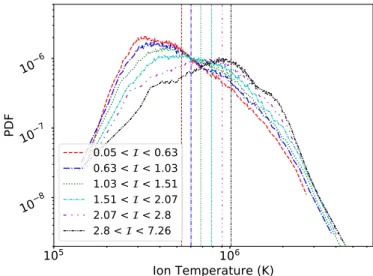
Figure 1 shows the joint histogram of radial proton-temperature and PVI for the first encounter. Increasing PVI color contours have an upwards trend, as we see temperature distribution showing a positive slope with increase in value of PVI. The positive correlation be-tween temperature and PVI suggest some kind of heat-ing in the regions with high PVI. We then condition-ally sampled radial proton temperature. Conditioncondition-ally sampled means that we arrange the data by increasing value of PVI and then divide all the data points in 6 bins such that each bin has equal number of points. We then calculate the temperature distribution within each bin which is shown in Figure 2.
As PVI increases, the probability density increases for the higher temperature and decreases for the lower tem-perature which is opposite of what we see at the low temperatures where probability density is highest for the lowest PVI. Median temperature, shown by vertical lines in Figure 2, for each of the distribution increases
1.00 0.75 0.50 0.25 0.00 0.25 0.50
log( )
5.4
5.6
5.8
6.0
6.2
6.4
log( T (K) )
10
010
110
210
3Counts
Figure 1. Joint histogram of radial proton-temperature and PVI for the second half of first encounter on a log-log scale. There is an upward trend between PVI and temperature as the blue region in the plot tilts upwards showing an increase of temperature as PVI increases.
10
510
6Ion Temperature (K)
10
810
710
60.05 < < 0.63
0.63 < < 1.03
1.03 < < 1.51
1.51 < < 2.07
2.07 < < 2.8
2.8 < < 7.26
Figure 2. PDFs for the radial proton-temperature for the second half of first encounter. Each PDF corresponds to a different PVI range such that each PVI bin has equal num-ber of data points. The probability density increases with increase in temperature for high PVI whereas it decreases for low PVI PDF. Vertical lines show the median tempera-ture for each of the PDF plot.
implying presence of stronger and stronger heating as we go to higher and more extreme values of PVI. For PVI < 1, median value of the temperature is 5.32 × 10⁵ K
whereas for PVI > 6, the median temperature increases to 1.01 × 10⁶ K. Osman et al. (2011) observed similar
4
400
200
0
200
400
t (NYs)
0.7
0.8
0.9
1
1.1
1.2
T
p(1
0
6K
)
<1
1< <2
2< <3
3< <4
4<
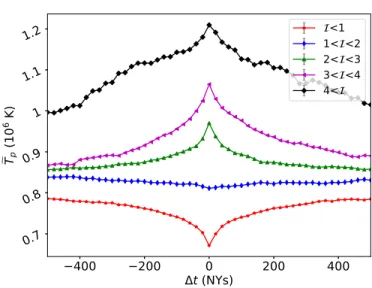
Figure 3. Figure shows conditional average temperature for different PVI thresholds at the point of a a PVI event.
e
Tp peaks at the instant of PVI event and continues to have
elevated temperature in its vicinity within the correlation time scale. Red curve, corresponding to lowest PVI shows a dip suggesting no heating when the magnetic field is very smooth.
wind at 1-au. This is consistent with heating occur-ring in the regions with small scale coherent structure in MHD turbulence.
In order to further demonstrate this relationship, we looked at the temperature at the point of high PVI event and its immediate surrounding in space using the methodology described by Osman et al. (2012b). We compute the mean value of temperature at the point of the PVI event and for points near the PVI events sepa-rated from it by up to one correlation length. Formally, these averages may be expressed as:
e
Tp(∆t, θ1, θ2) = hTp(tI+ ∆t)|θ1≤ I(tI) < θ2i (2)
where eTp is the conditionally average temperature for
all the events, ∆t is the time difference relative to the position of PVI events, tI is the time of PVI events
between the threshold θ1 and θ2
Figure 3 shows the plot of eTp for various thresholds
for the second half of the encounter. Not only do we observe enhanced temperature at the point of high PVI events, suggesting localized heating at those points, we also see that eTp for a higher PVI event is consistently
higher than nearby points separated by up to a correla-tion length. This implies that the points nearby an iden-tified PVI event have an elevated average temperature, continuously approaching the elevated average temper-ature found at the PVI event itself. Some of this effect may be due to clustering of PVI events (see Chhiber
et al.(2019)). Another point worth noting in Figure3
is the valley in the temperature profile for small PVI. This is the region where background magnetic field is smooth and it appears that in such regions, the tem-perature is lower than the temtem-perature of plasma in its immediate surrounding , which is concurrent with the fact that in those places there is no turbulence heating.
Osman et al.(2012b) found similar result in their study at 1AU. However, in our study we find a significant dip compared to the dip reported inOsman et al.(2012b), ∼ 105K compared to ∼ 2 × 10³K.
5. CONCLUSION
In this study, we used in-situ observations from PSP’s first encounter with the Sun to explore the association of proton heating with coherent magnetic structures in the young solar wind. We identified enhancements of PVI (Greco et al. 2008) as indicating the presence of such a structure (Osman et al. 2011, 2012b). We ob-served that the joint histogram of PVI and proton radial temperature shows positive trend as shown in Figure1. We also observed that the PDF of data, as shown in Figure2with higher PVI has higher mean temperature compared to those with lower PVI. This strongly sup-ports the theory that the solar wind in those regions are heated by coherent structures which are generated by plasma turbulence.
The present results demonstrate both the shifting of the PDF of temperature towards higher values with increasing PVI condition, (in Figure 2) and the spa-tial/temporal localization of the temperature enhance-ment near PVI events (in Figure 3). Both of these are fully consistent with findings in the two papers that ex-amine these effects (Osman et al.(2011,2012a), respec-tively) . It is interesting that these effects are present clearly in the PSP first orbit where turbulence is pre-sumably younger and possibly less well developed than it is at 1 AU. It is possible that the temperature differ-ential between low and high PVI is somewhat less in the PSP data than in the ACE data at 1 AU (Osman 2011), but additional samples by PSP will be needed to draw any firm conclusion of this type.
In order to further demonstrate this association we looked at the conditionally average temperatures at the point of a high PVI event and in its immediate surround-ing up to 1 correlation length. We observed that not only the point of event has the highest temperature, its vicinity shows enhanced temperature compared to lower PVI events. The local maxima of these temperature pro-files are most prominent from higher PVI events suggest-ing stronger heatsuggest-ing. The plateau region of each thresh-olds are distinct, and for higher threshold they maintain
a high value suggesting clustering of PVI events around a large discontinuity. For very smooth magnetic field we see a dip in the average temperature at that point.
Osman et al. (2012b) found similar behaviour in their study of solar wind at 1AU, though neither the heating nor the dip in temperature for small PVI that they re-ported in their study was as high as what we observed in our study. This suggests that either coherent structures are more efficient in heating the plasma near the Sun compared to 1-au or we have a lot more such structures as we move closer to the Sun. Since these coherent struc-tures are generated by plasma turbulence, these obser-vations suggest that non-linear turbulence cascade play a crucial role in heating the nascent solar wind. Given the ubiquitous nature of such structures, this process can help explain the coronal heating.
A significant limitation of this study was unavail-ability of temperature-anisotropy data. The temper-ature measures we used were not the scalar tempera-ture but rather the radial temperatempera-ture, for which reason we limited our observations to period of nearly-radial
magnetic field (see Section 3). Once ion temperature anisotropy data are available, we will revisit this work to explore both scalar and anisotropic heating. The-oretical studies have found that turbulent cascade can generate strong temperature anisotropy near coherent structures (Parashar & Matthaeus 2016).
We also hope to further explore Figure 3. Careful inspection of this plot reveals a very slight asymmetry in the shape of the temperature profile before and after the PVI event. The phenomenon was also noted in 1-au solar wind by (Osman et al. 2012b). The cause and significance of this asymmetry remain unclear, but it may it suggests a connection between local heating and large-scale processes such as heat flux.
ACKNOWLEDGMENT
This work was supported as a part of the PSP mission under contract NNN06AA01C. This research was par-tially supported by the Parker Solar Probe Plus project through Princeton IS IS subcontract SUB0000165.
REFERENCES Bale, S., & Fields. 2019, submitted.
Bale, S. D., Goetz, K., Harvey, P. R., et al. 2016, Space Science Reviews, 204, 49
Bandyopadhyay, R., Matthaeus, W. H., Parashar, T. N., et al. 2019, This Volume
Burlaga, L. F. 1968, Solar Physics, 4, 67 Chandran, B. D. G., & Hollweg, J. V. 2009, The
Astrophysical Journal, 707, 1659
Chasapis, A., Retin`o, A., Sahraoui, F., et al. 2015, ApJ, 804, L1
Chhiber, R., Goldstein, M. L., Maruca, B. A., et al. 2019, This Volume
Cranmer, S. R. 2014, The Astrophysical Journal Supplement Series, 213, 16
Cranmer, S. R. 2012, The Astrophysical Journal, 754, 92 Cranmer, S. R., van Ballegooijen, A. A., & Edgar, R. J.
2007, The Astrophysical Journal Supplement Series, 171, 520
Cranmer, S. R., & van Ballegooijen, A. A. 2005, The Astrophysical Journal Supplement Series, 156, 265 Dmitruk, P., Matthaeus, W. H., Milano, L. J., et al. 2002,
The Astrophysical Journal, 575, 571
Erd˝oS, G., & Balogh, A. 2008, Advances in Space Research, 41, 287
Gary, S. P. 1993, Theory of Space Plasma Microinstabilities (Cambridge, UK: Cambridge University Press)
Gingell, P. W., Burgess, D., & Matteini, L. 2015, The Astrophysical Journal, 802, 4
Greco, A., Matthaeus, W. H., Perri, S., et al. 2018, SSRv, 214, 1
Greco, A., Valentini, F., Servidio, S., & Matthaeus, W. H. 2012, PhRvE, 86, 066405
Greco, A., Chuychai, P., Matthaeus, W. H., Servidio, S., & Dmitruk, P. 2008, Geophysical Research Letters, 35, L19111
Hudson, P. 1970, Planetary and Space Science, 18, 1611 Isaacs, J. J., Tessein, J. A., & Matthaeus, W. H. 2015,
Journal of Geophysical Research (Space Physics), 120, 868
Karimabadi, H., Roytershteyn, V., Wan, M., et al. 2013, Physics of Plasmas, 20, 012303
Kasper, J. C., SWEAP, & FIELDS. 2019, submitted. Kasper, J. C., Abiad, R., Austin, G., et al. 2016, Space
Science Reviews, 204, 131
Kasper, J. C., Stevens, M. L., Korreck, K. E., et al. 2012, The Astrophysical Journal, 745, 162
Klein, K. G., & Howes, G. G. 2015, Phys. Plasmas, 22, 032903
Krishna Jagarlamudi, V., Dudok de Wit, T.,
Krasnoselskikh, V., & Maksimovic, M. 2019, ApJ, 871, 68 Lionello, R., Velli, M., Downs, C., et al. 2014, The
6
Marsch, E., Mhlhuser, K.-H., Rosenbauer, H., Schwenn, R., & Neubauer, F. M. 1982, J. Geophys. Res., 87, 35 Matthaeus, W. H., Zank, G. P., Oughton, S., Mullan, D. J.,
& Dmitruk, P. 1999, The Astrophysical Journal, 523, L93 Matthaeus, W. H., & Lamkin, S. L. 1986, The Physics of
Fluids, 29, 2513
McComas, D. J., & IS IS. 2019, submitted.
Ness, N. F., & Burlaga, L. F. 2001, Journal of Geophysical Research: Space Physics, 106, 15803
Neugebauer, M. 2006, Journal of Geophysical Research: Space Physics, 111, doi:10.1029/2005JA011497
Osman, K. T., Matthaeus, W. H., Kiyani, K. H., Hnat, B., & Chapman, S. C. 2013, PhRvL, 111, 201101
Osman, K. T., Matthaeus, W. H., Hnat, B., & Chapman, S. C. 2012a, PhRvL, 108, 261103
Osman, K. T., Matthaeus, W. H., Wan, M., & Rappazzo, A. F. 2012b, PhRvL, 108, 261102
Osman, K. T., Matthaeus, W. H., Greco, A., & Servidio, S. 2011, ApJ, 727, L11
Parashar, T. N., Goldstein, M. L., Maruca, B. A., et al. 2019, This Volume
Parashar, T. N., & Matthaeus, W. H. 2016, ApJ, 832, 57 Parashar, T. N., Shay, M. A., Cassak, P. A., & Matthaeus,
W. H. 2009, Physics of Plasmas, 16, 032310 Parker, E. N. 1960, ApJ, 132, 821
—. 1963, Interplanetary dynamical processes. Perez, J. C., & Chandran, B. D. G. 2013, The
Astrophysical Journal, 776, 124
Sahraoui, F., Goldstein, M. L., Belmont, G., Canu, P., & Rezeau, L. 2010, Phys. Rev. Lett., 105, 131101
Servidio, S., Valentini, F., Perrone, D., et al. 2015, Journal of Plasma Physics, 81, 325810107
Servidio, S., Valentini, F., Califano, F., & Veltri, P. 2012, Physical Review Letters,
doi:10.1103/PhysRevLett.108.045001
Smith, C. W., Matthaeus, W. H., Zank, G. P., et al. 2001, J. Geophys. Res., 106, 8253
Taylor, G. I. 1938, Proceedings of the Royal Society of London Series A, 164, 476
TenBarge, J. M., & Howes, G. G. 2013, The Astrophysical Journal, 771, L27
Tessein, J. A., Ruffolo, D., Matthaeus, W. H., & Wan, M. 2016, Geophysical Research Letters, 43, 3620
Tsurutani, B. T., & Smith, E. J. 1979, Journal of Geophysical Research: Space Physics, 84, 2773 Velli, M. 1993, A&A, 270, 304
Velli, M., Grappin, R., & Mangeney, A. 1989, PhRvL, 63, 1807
Veltri, P. 1999, Plasma Physics and Controlled Fusion, 41, A787
Verdini, A., Velli, M., & Buchlin, E. 2009a, The Astrophysical Journal, 700, L39
Verdini, A., Velli, M., Matthaeus, W. H., Oughton, S., & Dmitruk, P. 2009b, The Astrophysical Journal, 708, L116 Verdini, A., & Velli, M. 2007, The Astrophysical Journal,
662, 669
Wan, M., Matthaeus, W. H., Roytershteyn, V., et al. 2015, Phys. Rev. Lett., 114, 175002
Wan, M., Matthaeus, W. H., Karimabadi, H., et al. 2012, Phys. Rev. Lett., 109, 195001
Wu, P., Perri, S., Osman, K., et al. 2013, The Astrophysical Journal, 763, L30
Yordanova, E., Vrs, Z., Varsani, A., et al. 2016, Geophysical Research Letters, 43, 5969