David C. Smith
The Changing Structure of
the High School History
Curriculum
The time is January, 1956. We are observing a history teacher working with a grade IX class in a Montreal high school. Mr. A., a conscientious and competent specialist, steps briskly into the room. He spends the first few minutes of the lesson discussing the pivotal ideas of the previous one - the political deadlock between the Canadas in the 1860's and the forging of the "Great Coalition." During the discussion, he makes spot checks of pupils' notebooks, taking the names of those who have not done their homework for after-school detention. Mr. A. returns to the front of the room and gives a short, but dramatic, lecture on the Charlottetown and Quebec Conferences as steps on the road to Confederation. As the lecture proceeds, he writes a neat and logical outline on the blackboard, leaving a concise record of his fluent discourse. Occasionally, he answers questions, or directs questions ta the class, but these do not interrupt the sequence of his smooth delivery. After twenty minutes, the pupils are assigned to read a section in George Brown's Building the Canadian Nation, and ta make notes from the outline left on the blackboard. Those who do not finish in class time must complete the assignment at home. The next day, the implicit pattern of review, presentation and note-taking is systematically repeated.
Once a year Mr. A.'s class visits the Château de Ramezay Museum, views a film, reads a dramatization from Nathaniel Benson's Three Plays for Patriots, or engages in a special historical map or diorama project. These occasional activities are brief interludes, or interest projects, in learning the history of Canada, and no attempt is made to integrate them into the "real substance" of the course.
The High Schoo/ History Curriculum
The scene now shifts to January, 1976. Mr. A. has retired and Ms. B. has taken his place. She has been teaching for five years. Ms. B. makes a much less conspicuous entry into her grade X classroom. Sometimes she teaches just like her predecessor, but she tends to think of herself not so much as a fount of knowledge, but more as a mistress of ceremonies, setting the stage for, and creating different kinds of learning activities in history. Today, the class is divided into groups, each representing key politicians for a British North American colony at the time of the Confederation debates. Bach group is investigating the position of its colony on certain key issues of the day such as whether anything should be done about the threat of an American invasion, whether there should be an inter-colonial railroad, or whether they should work cooperatively with the other colonies to deal with common problems. To help them in their investigations, the pupils have several collections of speeches, letters and diary extra.cts in documentary collections such as Reid, McNaught and Crowe's A Sourcebook of Canadian History, Copp and Hamelin's Confederation: 1867 and the Jackdaw Kit,
Confed-eration.
Ms. B. moves from one cycle of activities to another. Sometimes she plans her unit as a problem study, sometimes along thematic Hnes, but whatever the unit design, she integrates varied activities such as spirited debates on controversial issues in history, the production of an historical newspaper, the reading of case studies or biographies, the writing of a critical essay, the construction of historical models, the viewing of films and films trips, or the close reading of compar-ative interpretations in textbooks. Ms. B. sees her role as that of one who mobilizes and organizes the class to begin each unit, as an animator and resource person, as one who helps to develop perspectives on each episode, and who provides the connecting links between each set of activities.
The educational styles of these two teachers, Mr. A. and Ms. B., help to express sorne of the changes that have taken place in the teaching of secondary history over the past twenty years. These teachers are not necessarily representative of typical teachers of their time; rather, they are presented as professionals who responded positively to the prevailing innovative thought of their respective decades. What has been the essence of that thought and how do we account for the changes that have occurred? The purpose of this essay is to document the kind of educational influences that have been brought to bear on the structure of the secondary history curriculum, to articulate what changes have occurred, and to offer sorne explanation of why these new structures have come about.
David C. Smith
changes in the history curriculum
If we reflect upon Mr. A.'s style of teaching in the 1950's, it is
apparent that the dominant aim was to pass on historical knowledge from one generation to the next. Other aims were, of course, enum-erated in the teachers' handbook, aims such as "making judgements from given historical information," or "developing attitudes of toler-ance to other religions, ideas, and nationalities," but these were taught within the limits of single secondary sources. The departmental examinations of the 1950's tended to require recall of historical information and not to test the wider set of objectives. More-over, there was a certain lack of precision in identifying what level of knowledge was taught. But the objectives were relatively simple -to know the causes, events and results associated with certain hap-penings, the textbook heing the single authority.
What stirred those involved in history teaching in 1960 was a fresh look at the school curriculum taken by Jerome Bruner. In his Process of Education,t Bruner expounded upon two ideas that were to have a profound effect upon the teaching of history. One was that the fundamental ideas or principles in a discipline could be used as the basis for planning school curricula. The other was that curricula should he devised to develop skills in intuitive and analytical think-ing.
historical knowledge
The response of social science educators to the first of these ideas was to try to determine what kinds of epistemological structures underpinned the discipline of history. There emerged a great variety of answers to tbis question. Some believed that key concepts like nationalism, power, revolution and cultural change should be threaded through the curriculum and be treated year-by-year in different contexts and in increasing levels of depth and sophistication.! However, there was certainly no consensus about what the concepts should be. Other writers placed greater emphasis on the identüication
and teaching of broad generalizations from history. Generalizations were statements that showed relationsbips between concepts such as, "To the degree that a nation is under the influence of imperialist powers, its own sovereignty is limited."· Others attempted to develop a synthesis of the two approaches, building curricula which recognized the interplay between concepts and generalizations:'
The High Schoo/ History Curriculum
history skills
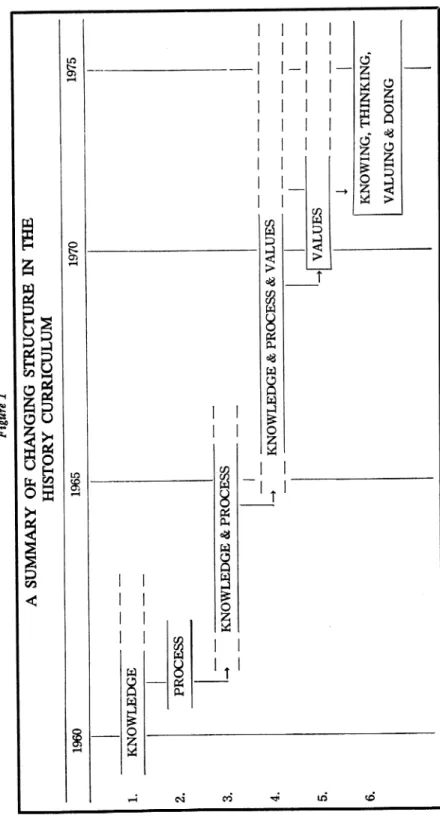
While these developments in identifying the structure of knowledge in the history curriculum were occurring, others took Bruner's idea conceming intuitive and analytical skills as being the prime rationale for structure. Among those Canadians who adopted this position was Neil Sutherland, who asserted that, "Structure in history can only be partial structure, contained in its nature rather than in its content," and "is best revealed through the historian's method."s The method referred to, as it applied to secondary history, was the solving of simple historical problems by investigating primary sources such as diaries, letters, and newspapers, as means towards thinking one's way through to a conclusion or interpretation. Such a method emphasized the array of intellectual skills in thinking: developing a hypothesis, collecting historical data, critically analysing the data, and arriving at a conclusion about the hypothesis. As a result of the emphasis on working with data, the use of kits of archive materials and collections of original documents gained increasing popularity.8 (See Step 2 Figure 1).
Out of this two-pronged response to Bruner's work there arose a content-process controversy with proponents of each debating the pros and cons of their respective structures. But by the mid-60's, efforts were being made to synthesize these approaches (see Step 3, Figure 1). Hilda Taba was perhaps among the first curriculum plan-ners to devise successfully a social studies curriculum that fused content and process in a way that Bruner had proposed.7 Others, such as Eugene Gilliom, articulated weIl the developments that led to the structural the ory behind the Taba curriculum.8
attitudes and values
Almost concurrent with Taba's synthesis was another major effort to broaden the component structures in the history curriculum. Strongly influenced by Bloom's analysis of educational objectives,9 Edwin Fenton developed an approach to history that included the teaching of knowledge, the development of inquiry skills, and the development of attitudes and valuesl • (see Step 4 in Figure 1). But in the late sixties, the idea of values education in secondary history had not been very thoroughly explored. Values education was often conceived as a separate, additive component of the curriculum. As well, the teaching of values was a socially sensitive topie and schools were not very certain about what their roles were in it.
~ 1960 Figure 1 A SUMMARY OF CHANGING STRUCfURB IN THE HISTORY CURRICULUM 1965 1970
----1975 1. KNOWLEDGE 2. 3. 4. 5. 6. ;, -PROCESS1:
-KNOWLEDGE & PROCESSL.
-1-KN:::EDGE & PROCESS & VALUES -1 1 1-lU
::::
::::
::::::::
1 :::::::: -+ VALUES . ! ----T~-KNOWING, THINKING. V ALUING & DOING~
~---~
c ~. c.. Ç) en 3 ~The High School History Curriculum
given to the valuing process by other curriculum planners who believed that valuing should have a much more prominent place in the curriculum. Pioneering the development of strategies in values clarification was the team of Raths, Harmin and Simon." But, particular application to social studies at the elementary level was made by Shaftel and Shaftel" and at the secondary level by Newman and Oliver whose work on the Harvard Social Studies Project em-phasized values clarification of historic and current public issues. 13
At about the same time in Canada, the Hodgetts Report, a nation-wide survey of history teaching, disclosed that "Canadian history in our schools is a shadowy, subdued, unrealistic version of what ac-tually happened - a bland consensus story, told without the con-troversy that is an inherent part of history."'· Such criticism had direct implications for values teaching in history and the social studies, and appeared to give rise to the development of new teaching materials as weIl as inspiration to the history projects sponsored by the Canada Studies Foundation!S
Particularly in the United States by the early 1970's, values education had become clearly identified as a major force in social education (see Step 5 in Figure 1). !ts principal tasks included value clarification, value analysis, resolving value conflicts and building value systems. Sorne educators ascribed so much importance to valuing and decision making that, for a period, values education was placed almost in an orbit of its own. Writing the introduction of the
1971 Yearbook of the National Council for the Social Studies, John Jarolimek, for example, stated: "The time is overdue when an aU-out effort must be made to find productive approaches to values educ-ation and conflict resolution."'·
In Canada, values education came into focus slightly behind the movement in the United States. An Association for Values Education and Research was established at
u.B.e.
in 1971. The Province of Alberta created a social studies curriculum using valuing as the principal base, and, in Ontario, developing an awareness of values and value alternatives was made an explicit objective of the social science guidelines in 1973. Since then, there has been an energetic development of the theory, techniques and strategies in valuing. In history, thought has been given to value analysis and clarification in a wide range of content from biography to major historical problems and issues. In a study of Confederation, for example, pupils would be encouraged to identify the values that British North Americans shared with each other and to identify also regional and group values and value conflicts.David C. Smith
attempts at synthesis
But sorne educators recognized that, while the movement had helped them to make enormous gains in their understanding of values educ-ation, their preoccupation with values as objectives had distorted. the education enterprise. Clearly there was need for better integration of valuing with the broad approaches to objectives previously developed by people such as Fenton and Taba. Accordingly, there have followed attempts at consolidation. The work of Jack Fraenkel, a former Associate Director of the Taba. Curriculum Development Project, typifies such an attempt. Fraenkel proposed a more balanced curri-culum strengthening the values component in history and social science education.l7 A less ambitious, but nevertheless praiseworthy attempt at integrating historical with value content is that of Norma McCoy who has applied value theory to the theme of the history of Canadian immigration. This could weIl serve as a model to be used for other history topics.lB
There have been, also, those who are critical that values education emphasizes only one dimension of objectives in the affective domain, and ignores other objectives such as the cultivation of sensitivities, feelings and emotions. Sorne have strived toward a melding of cogni-tive with affeccogni-tive learnings, the rational with the irrational, to produce a better blend of learning objectives. The work of George Isaac Brownl ' suggests that in the mid-1970's we may be atthe threshold
of a new era in the realization of human potential if we can achieve a better fusion of internal personal experience and external cognitive curriculum structures. Using Brown's paradigm, we can show, by means of the diagram in Figure 2 below, how one approach to confluent education might be applied to our previous example of Confederation. Brown's attempt to fuse cognitive and affective
learn-ing could be viewed as placlearn-ing Dewey's The Child and the
Cur-riculum into its modem idiom.
It is more difficult to see where we are in the mid-1970's than it is farther back where we have the benefit of hindsight. This author's estimate (Stage 6 in Figure 1) is that we may be moving towards giving pupils more responsibility by actually encouraging greater social participation as a natural extension of learning and that· also we may be achieving a. more balanced and effective synthesis of the objectives that have been differentiated and articulated for the history curriculum over the past two decades.
If we reflect on what these trends have been since the 1950's, we Can discern three principal developments. The f~rst has been the widèning of the range of objectives that has been accepted and
The High School History
Curriculum-ticed in the classroom. In the 1950's teachers were preoccupied with. knowledge, but other very important kinds of leaming have since been admitted into the consciousness of teachers. A second observ-ation is that there has been a certain amount of faddism in which educators, excited by new developments, such as the process of knowing or valuing, have been temporarily carried away by them, later usually to "re-enter," and contribute toward, a wider main-stream of development. The third trend is that there has been some limited integration of the broadening range of objectives so that they are conceived not as separate, fragmentary goals, but as strivings. that merge into each other.
Figure 2
AN APPLICATION TO HISTORY OF CONFLUENT EDUCATION
COGNITIVE AFFECTIVE
ABSTRACT STRAIGHT ABSTRACT STRAIGHT
CoGNITIVE COGNITIVE AFFECTIVE AFFECTIVE
Political union Confederation of How does a group How do 1 feel
of previously British North feel when it fuses when 1 become
separate states American colo- or amalgamates a member of a
nies was with another? new and larger
achietled in 1867 group?
History is a study of past change What is in alt peoPle is in me
What 1 feel about myself is what peoPle experienced in history
David C. Smith
interpretations of change
There remains the question, why have these changes in the theory of the history curriculum come about? To understand them, we must look at history teaching in the larger education al context. When we trace the origin of influences on the history curriculum, it is striking that several emanate from the university community.
Through the fifties and sixties, the physical sciences achieved very high prestige in academia. Exactness and objectivity were the values
par excellence of scholarship. Within the halo of the scientific method,
historians started to look more critically at the kinds of problems they investigated, the sources of data used, the quality of the data gathered, the methods by which hypotheses were tested. Even the vocabulary of the physical sciences was brought to bear upon the study of history. The ground was laid for the introduction of inquiry and discovery approaches in thé secondary school.
The physical sciences had a marked effect upon the social sciences as weIl. Derek Heater points out that more analytical and quantitative approaches were used in economics, sociology, anthropology and political science. The developments in these disciplines had a lateral effect upon history not only with respect to the methods of study but also in the use of basic social science concepts by historians.·o
Another powerful influence on the history curriculum has come from university psychologists and philosophers. We have already examined the direct impetus provided by Jerome Bruner and Benja-min Bloom in rethinking the history curriculum, but numerous others have made a very signüicant, even if less direct, impact upon the process of reflection and change. Certainly, the research of Jean Piaget on the stages of cognitive development, and of Lawrence Kohlberg on the stages of moral development, are widely acknow-ledged.21
A third explanation lies in the influence of speculative thought among professional historians and more directly in university depart-ments of history. As agents for the academic training of history teachers, they wield a very pervasive, yet often unacknowledged, in-fluence upon the teaching of secondary history. Their inin-fluence has been, again, primarily in the area of historical method. Geoffrey Milburn has emphasized the degree to which scholarly reflection "upon the definitions, interpretations, objectivity, causation and generalizations within the discipline," and Canadian historiography have affected the teaching of history.22 Thus the new generation of history majors and honors graduates is much more competent in the use of primary sources and critical inquiry techniques than were its generalist predecessors.
The High School History Curriculum
Besides the developments in academia,there are other explanations for changes in the history curriculum. Marshall McLuhan asserts that the electronic media have had a fundamental impact upon learning. The perceptions and mentality of young people have been dramatical-ly affected by the new media, particulardramatical-ly by radio and television. Each has the characteristic of instant communication so that we realize that anyone who watches the six o'dock news is learning along with everyone eIse. But unlike learning from print, the electronic media have an all-at-onceness, total field quality. The person viewing a televised constitutional conference or party leadership convention sees the politieal process at work - not just the decisions as end product. Through multiple experiences of this type, young people have become much more aware of the signifieance of process, as weIl as product, in learning, and they have therefore been mentally conditioned to engage the inquiry process in the learning of history.23 The intellectual skills orientation of history teaching and the process orientation of the young happily intersected in the sixties to produce the phenomenon we have observed. Hence the rising popularity of ethnographie studies, community history and the archaeological dig.
A final explanation of the changing patterns in history teaching may help us to understand further what happened in the years be-tween our observations of Mr. A. and Ms. B. It is that history teach-ing, like any other teachteach-ing, tends to reflect what our society currently conceives as being the sort of education needed to produce the model citizen. Those conceptions have changed considerably over the past twenty years. In the 1950's the educated person was still "the person who knows." History teaching therefore tended to be a transmission of knowledge of facts, events and others' historical explanations. But there was much ado about the explosion of knowledge and the realization that knowledge was expanding so quickly that few could really keep up with the developments in their fields. So in the early 1960's, emphasis was placed on learning how to learn and the educated person then became "the pers on who could find out." This development paralleled the investigative and inquiry approach to history and the content versus process debate. The synthesis that appeared to end the debate was the idea that "an educated person is the person who can find out what he or she needs to know."
In a decade of issues and controversies, however, simply finding out and being informed on the issues could make us into no more than a nation of fence-sitters. We had take a position, to make value judgements about where we stood on historical or contemporary issues. The result was the changing conception that "the educated person was one who can find out what he or she needs to know and
David C. Smith
then make a decision." There followed in the social sciences, the all-out effort to develop values education and to integrate it with existing conceptions. We are now so close to the present and future that it is difficult to speculate upon how the model is changing. Some might say that unless action follows mental decision, we have no real commit-ment to our decisions. Perhaps then we are moving towards the idea that "the educated person is one who can find what he or she needs to know, can make a decision and can act upon that decision." In retrospect, we can say that Mr. A. and Ms. B. are both good teachers, striving to give their pupils what they regard as the most appropriate type of education in the circumstances of their time. But the history curriculum confrODting Ms. B is potentially complex and sophisticated. Her teaching is characterized by experimentation and doubt, reconstruction and hope in the bellef that what she is doing is becoming more intellectually stimulating, emotionally satisfying and practically useful to her pupils.
references
1. Jerome Bruner, Process of Education, Cambridge, Mass.: Harvard
Uni-versity Press, 1963.
2. Roy A. Priee, et al., Major Concepts for the Social Studies, N.Y.: Syracuse
University, 1965. .
3. James G. Womack, Discovering the Structure of the Social Studies,New
York: Benziger, 1966.
4. Roland J. Wensley, "Activist Teaching and the Organization of HistOrical
ldeas," McGill Journal of Education, Vol. 1, No. 1 (Spring 1966), pp.
38-45.
5. Neil Sutherland, "Structure in the History Curriculum," Education, Vol. 5,
No. 2, pp. 7-13.
6. See for example, Neil Sutherland and Edith Deyell, Making Canadian
Hiatory, Toronto: Gage, 1966; and the series of "Canadian Jackdaw Kits"
published by McClelland and Stewart, Toronto.
7. Hilda Taba, Teachers' Handbook for Elementary Social Studies, Toronto:
Addison-Wesley, 1967.
8. Eugene Gilliom, "Structure and the History Curriculum," The Social
Studies, Vol. 40, No. 2 (February, 1968), pp. 70-76.
9. B. S. Bloom and D. R. Krathwol, Taxonomy of Educational Objectives:
Handbook 1 - The Cognitive Domain, New York: David McKay, 1956;
and D. R. Krathwol, B. S. Bloom and B. B. Masia, Taxonomy of
Educational Objectives: Handbook Il - The Affective Domain, New
York: David McKay, 1964.
10. Edwin Fenton, The New Social Studies, Toronto: Holt, Rinehart and
Winston, 1967.
Il. Louis E. Raths, Merrill Harmin and Sidney B. Simon, Values and
Teach-ing: Working with Values in the Classroom, Columbus: Merrill, 1966.
The High School History Curriculum
12. Fannie R. Shaftel and George Shaftel, Role Playing for Social Values:
Decision-Making in the Social Studies, Englewood Cliffs, N.L:
Prentice-Hall, 1967.
13. Donald Oliver and James B. Shaver, Teaching Public Issues in the High
School, Boston: Houghton Mifflin, 1966 provided the theoretical basis of
the project work of Oliver and Newman.
14. A. B. Hodgetts, What Culture? What Heritage? A Study of Civic
Educ-ation in Canada, Toronto: O.l.S.E., 1968.
15. See for example, the Prentice-Hall Series on "Canada: Issues and Options"
and the Copp Clark Series on "Issues in Canadian History."
16. Lawrence E. Metcalfe, ed., Values Education: Rationale, Strategies and
Procedures, Washington: National Council for the Social Studies, 1971,
p. vi.
17. Jack R. Fraenkel, Helping Students Think and Value: Strategies for
Teaching the Social Studies, Englewood Cliffs, N.J.: Prentice-Hall. 1973.
18. Norma McCoy, "A View on the Theory and Process of Value Education,"
The History and Social Science Teacher, Vol. 11, No. 1 (Fall 1975),
pp. 15-26.
19. George Isaac Brown, Human Teaching for Human Learning: An
Introduc-tion to Confluent EducaIntroduc-tion, New York: Viking, 1971.
20. Derek Heater, "History and the Social Sciences," in Martin Ballard, ed.,
New Movements in the Study and Teaching of History, London: Temple
Smith, 1970, pp. 138-141.
21. Sec for example, R. N. HaIlam, "Piaget and Thinking in History," in
Martin Ballard, op. cit.; and Douglas Fairbairn, "An Approach to Moral
Education," The History and Social Science Teacher, Volume II, No. 1
(FaU 1975), pp. 4-14.
22. Geoffrey Milburn, Teaching History in Canada, Toronto: McGraw-HilI-Ryerson, 1972, pp. 2, 97.
23. Marshall McLuhan, "Education in the Electronic Age," in Hugh A. Steven-son, et al., The Best of Times, The W orst of Times: Contemporary Issues