People’s Democratic Republic of Algeria Ministry of Higher Education and Scientific Research
Abdelhamid Ibn Badis University of Mostaganem Faculty of Arabic Literature and Foreign languages
Division of English
Dissertation submitted to the Department of English as partial fulfillment
for the Master Degree in Psycholinguistic Issues in Learning English
Submitted By: Supervised by : Chaa Imane Mrs.Adnani Rajaa
Members of the Jury:
Chair: Rezga Djamila Examiner: Teguia CherifMay 2017
The psycholinguistic factors
affecting EFL students classroom
interaction
Case study:
L1 students of English at Abdelhamid Ibn
Badis Mostaganem University
I
Dedication
In the Name of ALLAH, Most Gracious, Most Merciful, All the Praise is due to ALLAH alone, the Sustainer of all the worlds.
I dedicate this modest work to my dearest and wonderful parents, who bring me to this life, who have raised me to be the person I am today. You have been with me every step of the way, through good and bad. Thank you for all the unconditional love, guidance, and support that you have always given me, I love you!
To my lovely sister Dounia
To my closet friends, Azzouz Imane , Bouteraa Yousra , Benhamou Fatima
To all my friends with whom I shared the university life with its lights and shadows.
To all my dearest English teachers. Special gratitude is due to all those extraordinary People who have stood by me in very hard moments. To all those who love me.
II
Acknowledgements
This work would never be accomplished without the strength and ability that Allah Almighty had given me, and if I thank him day and night It would never be sufficient.
I would very much acknowledge my warmest gratitude to my lovely and empathetic supervisor who had been a serious guide and a source of motivation.
I am enormously thankful to the members of the jury who read and correct my work with an extreme good will, which will eventually help me to shine my work.
My endless thanks and love to my parents, who always have been a source of strength and motivation.
My limitless gratitude to teachers at the department of English Mostaganem’s University.
Finally, My endless gratitude and thanks to all my classmates for the nice times that we spent together helping each other.
III
Abstract
This study examines the psycholinguistic factors affecting EFL students classroom interaction. The present work is an endeavour to identify some obstacles behind EFL classroom interaction lack. The hypothesis adopted in this study sets out that if EFL teachers take into consideration the students’ psychological aspects and the linguistic background while teaching oral expression, classroom interaction will be promoted. The research method adopted for this piece of work was purely descriptive. The required data were gathered through questionnaires administered to L1 students of English, as well as their teachers at Abdelhamid Ibn Badis Mostaganem University. The results obtained have shown that psycholinguistic factors affect to some extent EFL students classroom interaction. On the light of these results, the earlier stated hypothesis was successfully confirmed in that promoting classroom interaction basically need to be accompanied with interaction activities which reinforces the students’sense of belonging ,reduce speaking problems and improve their oral proficiency. On the basis of the results obtained, this conducted research is not useful solely for students in helping them identifing their speaking difficulties, rather; it helps teachers as well in their understanding of the students’ psychological and linguistic backgroud impact on classroom interaction in order to promote interaction in their EFL classses.
IV
LISTE OF TABLES
Table 3.1 : Students’ attitude toward English classroom interaction ... 30
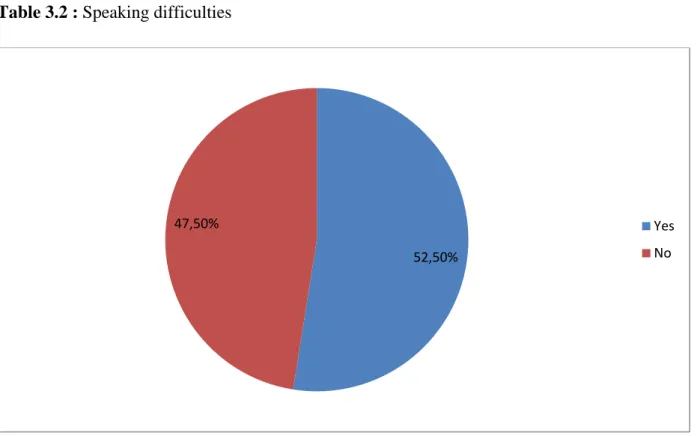
Table 3.2 : Speaking difficulties... 31
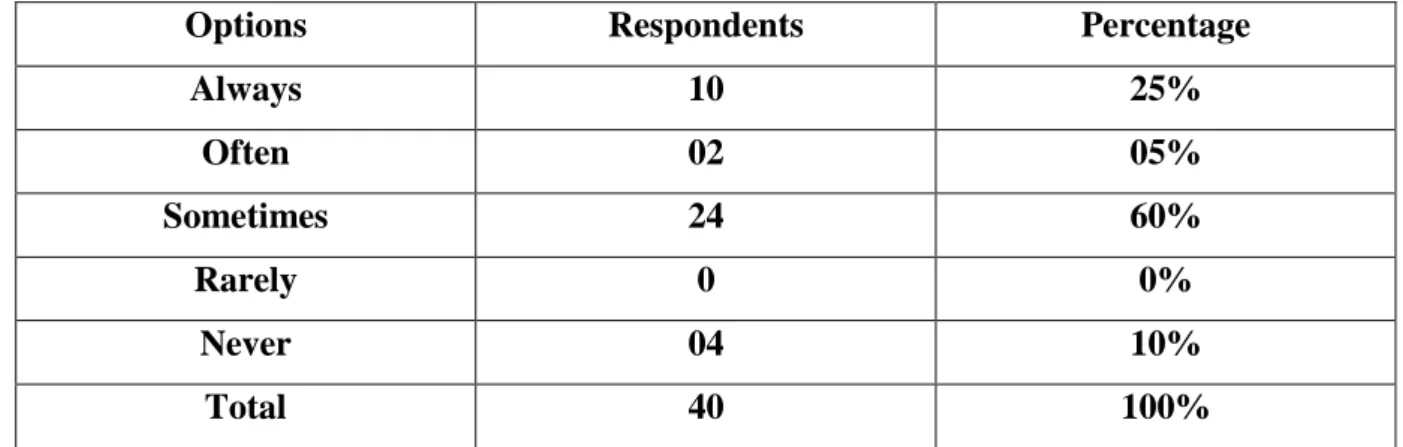
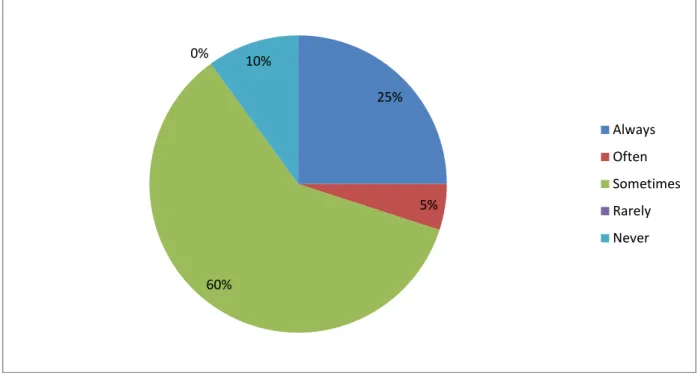
Table 3.3 : Frequency of students’ interaction in classroom ... 32
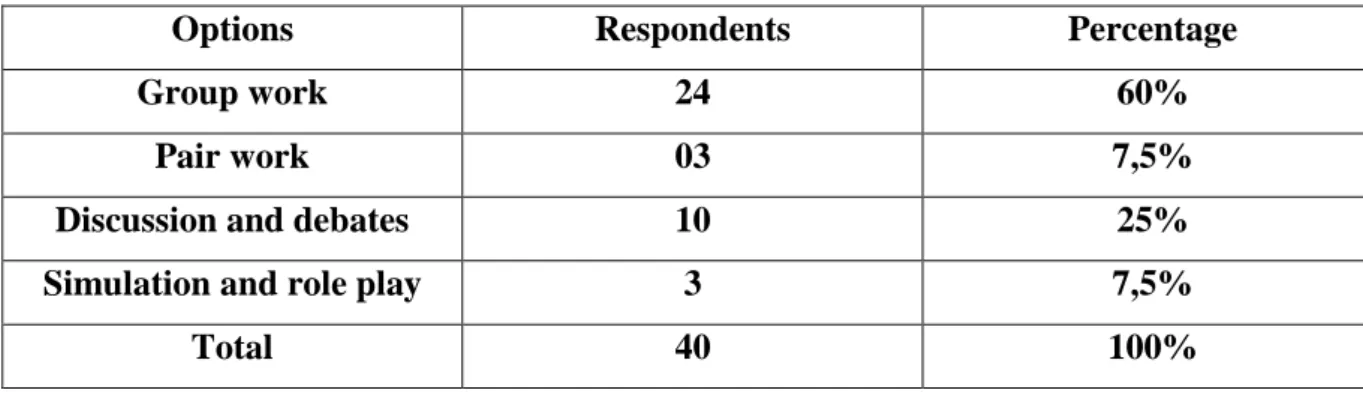
Table 3.4 : Activities the teacher implement the most in the classroom ... 34
Table 3.5 : Classroom interaction and the improvement of oral production ... 35
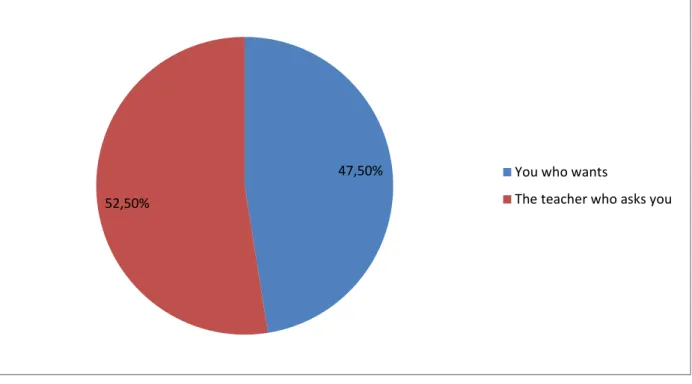
Table 3.6 : Management of interaction in the classroom ... 35
Table 3.7 : Students’ feelings about topics dealt with in classroom ... 36
Table 3.8 : The teacher’s correction ... 37
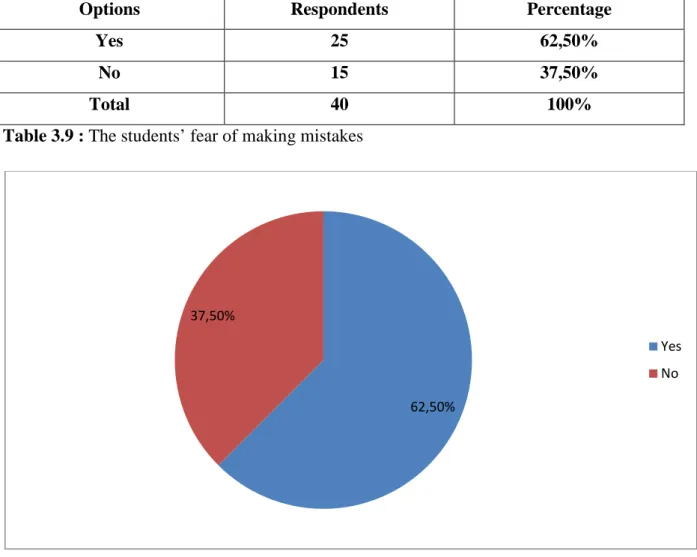
Table 3.9 : The students’ fear of making mistakes... 39
Table 3.10 : Students’ feeling when engaged with both teacher and classmates ... 40
Table 3.11.1 : Interaction dare... 41
Table 3.11.2 : Psycholinguistic factors affecting EFL classroom interaction ... 42
Table 3.2.12 : The teachers’ perception of the student’s participation... 46
Table 3.2.13 : Teacher’s techniques to promote interaction among learners. ... 47
Table 3.2.14 : Learners’ favorite speaking tasks. ... 48
Table 3.2.15 : Teachers’opinions about the influence of the students’ number. ... 49
Table 3.2.16 : The most imprtant roles for EFL teachers... 50
V
LIST OF FIGURES
Figure 3.1 : Students’ attitude toward English classroom interaction ... 30
Figure 3.2 : Speaking difficulties ... 31
Figure 3.3 : Frequency of students’ interaction in classroom... 33
Figure 3.4 : Activities the teacher implement the most in the classroom ... 34
Figure 3.5: Classroom interaction and the improvement of oral production ... 35
Figure 3.6 : Management of interaction in the classroom ... 36
Figure 3.7: Students’ feelings about topics dealt with in classrrom ... 37
Figure 3.8 : The teachers’ correction ... 38
Figure 3.9 : The students’ fear of making mistakes ... 39
Figure 3.10 : Students’ feeling when engaged with both teacher and classmates ... 40
Figure 3.11.1 : Interaction dare ... 41
Figure 3.11.2 : Psycholinguistic factors affecting EFL classroom interaction ... 42
Figure 3.2.12: The teachers’ perception of the student’s participation ... 46
Figure 3.2.13 : Teachers’ techniques to promote interaction among learners. ... 47
Figure 3.2.14 : Learners’ favorite speaking tasks. ... 48
Figure 3.2.15 : Teachers’opinions about the influence of the students’ number ... 49
Figure 3.2.16 : The most imprtant roles for EFL teachers. ... 51
VI
LIST OF ABBREVIATIONS
EFL: English as a Foreign Language. CL: Cooperative Learning.
VII
TABLE OF CONTENTS
DEDICATION ………...………..…... ... I AKNOWLEDGMENTS………..………..…... ... II ABSTRACT……… ... III LIST OF TABLES……….………..………... ... IV LIST OF FIGURES………..………..………..……….……. ... V LIST OF BBREVIATION………...…..………...……….. ... VITABLE OF CONTENTS……….……… ... VII
General Introduction ... 1
Statement of the Problem
... 1
Aim of the Study
... 2
Research Questions
... 2
Hypothesis
... 2
Research Instruments
... 3
Structure of the Dissertation
... 3
Chapter One: EFL Classroom Interaction and Students’ Difficulties
Introduction ... 4
1.1. Definition of Oral Interaction Competency ... 4
1.2. Classroom Inertaction Definition ... 5
1.3. EFL Classroom Teaching ... 5
VIII
1.5. Types of Classroom Interaction ... 7
1.5.1.1. Teacher-Students Interaction ... 7
1.5.1.2. Student-Student Interaction ... 8
1.6. EFL classroom Interaction Difficulties ... 9
1.6.1. Linguistic Obstacles ... 9
1.6.1.1. Lack of Appropriate Lexical Items ... 10
1.6.1.2. Mispronunciation ... 9 1.6.1.3. Syntactic Weaknesses ... 10 1.6.1.4. Language Interference ... 11 1.6.2. Psychological Obstacles ... 11 1.6.2.1. Lack of Self-Confidence ... 11 1.6.2.2. Shyness ... 12 1.6.2.3. Inhibition ... 13 1.6.2.4. Nothing to Say ... 13 1.6.2.5. Anxiety ... 13 1.6.2.6. Fear ... 14 1.6.2.7. Low Self_Esteem ... 15 1.6.3. Organizational Obstacles ... 15
1.6.3.1. Low and Uneven Participation ... 15
1.6.3.2. Large Classes ... 16
IX
Chapter Two: Teachers Roles and Interaction Techniques Promoting EFL Student’s
Classroom Interaction
Introduction ... 18
2.1. Teachers Roles ... 18 2.1.1. Controller ... 19 2.1.2. Assessor ... 19 2.1.3. Motivator ... 20 2.1.4. Prompter ... 21 2.1.5. Participant ... 21 2.1.6. Resource ... 21 2.1.7. Observer ... 22 2.1.8. Tutor ... 222.2. Classroom Interaction Activities ... 22
2.2.1. Pair Work ... 23
2.2.2. Group Work ... 23
2.2.3. Discussion ... 24
2.2.4. Simulation and Role Plays ... 24
2.2.5. Communication Games ... 24
2.2.6. Storytelling ... 25
2.2.7. Picture Describing ... 25
2.2.8. Information Gap ... 25
2.3. Techniques for Classroom Interaction ... 25
2.3.1. The Questioning Technique ... 26
2.3.2. Collaborative Learning Technique ... 26
X
Chapter Three: Research Field
Introduction ... 28
3.1. The Student’s Questionnaire ... 28
3.1.1. Aim of the Questionnaire ... 28
3.1.2. Description of the Questionnaire ... 28
3.1.3. Administration of the Questionnaire ... 29
3.1.4. Data Analysis ... 29
3.1.5. Interpretation of the Results ... 43
3.2. The Teachers Questionnaire ... 44
3.2.1. Aim of the Questionnaire ... 44
3.2.2. Description of the Questionnaire ... 44
3.2.3. Administration of the Questionnaire ... 45
3.2.4. Data Analysis ... 45
3.2.5. Interpretation of the Results ... 54
Conclusion ... 55
General Conclusion ... 56
Bibliography ... 58
Appendices Appendix I : The Students Questionnaire ... 60
1
General Introduction
The learning process is a complex situation that involves both learners and teachers in addition to the task and context. These elements interact with each other in a dynamic way. Foreign language teaching and learning purely comprises a kind of interaction, which basically requires active participation from both parts : the teacher and the student. Hence, classroom interaction is a vital pedagogical strategy which plays a major role in the learning process.
If learners lack self-confidence in the classroom, they will likely feel embarrassed to use the language and will evade risk-taking situations or sharing a conversation in the second language. In other terms, the mastery of the linguistic features of the language, that is vocabulary, grammar, phonetics and semantics, is insufficient to create right and familiar articulations in the target dialect. Nevertheless, there are other elements, basically affective, which assume a conspicuous part either in creating or repressing the learners' oral execution.
Researchers though, emphasized on the concept of classroom interaction in EFL classes because it fosters the exchange of knowledge, creates some sort of sense of belonging among the students and promote language use and development . Thus, the major interest of this study is proving and investigating the stated hypothesis that focuses on the idea that EFL learners do not interact in classrrom because they are some psycholinguistic obstacles basically are those related with inhibition because of shyness, anxiety,fear and language interference, and if EFL teachers take into consideration the students’ psychological aspects and the linguistic background while teaching oral expression, classroom interaction will be promoted.
Actually, some students demonstrate a poor oral performance and even a clear reluctance to interact in classroom. Classroom interaction is very important for the development of the spoken language, the fact that led many researchers and scholars as well as some linguists to insist on its significance in the enhancement of EFL student’s speaking skill . They believe that classroom interaction is a crucial and a paramount pattern for developing the skills of foreign language learning. The absence of students’classroom interaction leads eventually to poor production in speaking and it leads also to several speaking difficulties such as mispronunciation, inhibition, nothing to say, etc.
2
Besides, foreign language teachers have been advised to use a variety of teaching techniques as a pedagogical gadget that may help their students to interact more in the classroom. Different kinds of activities and tasks can raise the students’ frequency of interaction.
Most of students in EFL classes face problems and difficulties when they are asked to interact in classroom. Because of the lack of vocabulary , anxiety, inhibition, or being fearful of making mistakes and the like which reduce participation and interaction. The teacher’s encouragement and support for learners to interact in the learning environment , could be the first lead to promote student’s classroom interaction. Classroom interaction then, is considered as an effective tool in the learning process which contribute in a large part in the development of EFL sutudents oral proficiency and language use.
Therefore, the problem that the current research is dealing with is investigating the psycholinguistic difficulties affecting EFL students’ classroom interaction. The precise research question to be asked is :
What are the psycholinguistic difficulties that EFL students are facing while interacting in classroom and to what extent they may influence their oral production?
In foreign language classroom, the language is the medium of the interaction between teachers and student. Acquiring that language is, therefore, the ultimate instructional goal of foreign language learning. To achieve this goal and reach more effective teaching and learning situations, teachers should know how to deal with the differences of linguistic backgrounds, and the psychological trends. This study aims at investigating to what extent psycholinguistic factors hinder L1 students at Abdelhamid Ibn Badis Mostaganem University from classroom interaction. It aims as well in helping teachers to identify the most fruitful interactive activities promoting interaction in classrrom.
In this research we answer the following question :
What are the difficulties that EFL students are facing while interacting in classroom and to what extent they may influence students’ oral production?
Consequently, in this study it was hypothesized that if EFL teachers take into consideration the students’ psychological trends and the linguistic background while teaching oral expression, classroom interaction will be promoted.
3
Our research will rely mainly on quantitative data collection method (questionnaire) as an appropriate method or way of analyzing the information gathered within this research. The student’s questionnaire will be consisted of eleven (11) questions .The questions will take different forms like closed questions, where the students are supposed to choose “yes‟ or,” no‟ answers with the justification of their choice, multiple choice questions, where the students are asked to pick up the appropriate answer from a number of choices, and open questions which require students to give their own answers and justify them.
Secondly, another questionnaire will be addressed to teachers of L1 level at Abdelhamid Ibn Badis Mostaganem University. The teacher’s questionnaire, intended for 8 teachers and it aims at investigating the teachers opinions about the psycholinguistic factors affecting EFL classroom interaction. The teacher’s questionnaire will be consisted of eight (08) questions. The questions are either closed questions, where the teachers are asked to choose “yes” or “no” answers with the justification of their choice , or multiple choice questions where they are supposed to pick up the appropriate answer from a number of choices, or open questions where they are requested to give explanation or suggest other alternatives.
Our research is divided into three parts: descriptive part which includes two chapters, and an empirical part which includes one chapter, the data analysis of the student’s and teacher’s questionnaires.
Chapter one is devoted to EFL classroom interaction, its definition, importance,types, and EFL classroom dificulties. Whereas the second chapter emphasizes on the teachers roles, interaction activities and techniques for classroom interaction. Finally, the third chapter is purely concerned with analyzing and interpreting data gathered from both teachers’ and students’ questionnaire.
4
Chapter One : EFL Classroom Interaction and Students Difficulties
Introduction
Language is a tool for communication. We communicate with others, to express our ideas, and to know other’s ideas as well. Communication takes place where there is speech and without speech. Speaking is at the heart of a foreign language learning. One of the major responsibilities of any EFL teacher is to enable students to communicate effectively through oral language and to develop their ability to use the target language for communicative purposes.Classroom interaction may be very rewarding for students since they are facing difficulties to express their feelings, thoughts and ideas. This chapter, is devoted to EFL classroom interaction, its definition, types and importance. Then, it will discuss some psycholinguistic difficulties that EFL students face while interacting in classroom.
1.1: Definition of Oral Interaction Competency
Oral interaction competency is defined as an interactive process of constructing meaning that includes producing, receiving and processing information. Spitzberg (1988) defined it as: “The ability to interact well with others” ( p.68) .He explains the term ‘well’ to mean accuracy, clarity, comprehensibility , coherence, expertise, effectiveness and appropriateness . The process is frequently spontaneous, open-ended, and evolving, but not completely unpredictable. Its structure and meaning rely on the context in which it occurs, the participants themselves, their collective experiences, the physical environment and communication purposes. The spoken language meaning is partly conveyed through the supra-segmental phonemes including rhythm, stress, and intonation.
To interact in English is clearly important for English learners. It is also significant in terms of learning language. Oral communication helps learners to experience modified interaction. Doughty and Pica (1986) mentioned that: “Interaction is altered in some way
(either linguistically or conversationally) to facilitate comprehension of the intended message”. (p.305). Speaking requires for learners to know how to generate specific points of language such as grammar, pronunciation, and vocabulary. A good speaker synthesizes skills and knowledge to succeed in speech.
5
1.2. Classroom Interaction Definition
Defining the concept classroom interaction implies defining each term independently. The word classroom then, is considered as the the primary situation in which the the educator and the students have opportunity to use the target language. Ordinarily, language use in classroom can be utilized as media to make significant connection during the lesson.While; the term interaction is defined as the action of to communicate with or to react to (each other).
Scholars and researchers, endeavor to define the concept classroom interaction. Robinson (1994) for instance sees that Interaction refers “To reciprocal face-to-face action.
This can be verbal, channeled through written or spoken words, or nonverbal, channeled through touch, proximity, eye-contact, facial expression, gesture, posture, appearance, environmental factors, etc”. (p.7). Robinson therefore, in his definition tries to clarify the
nature of interaction by saying that it is a face-to-face activity which means it is a reciprocal process in which students face each other or their teacher.
According to Marshal (1998) in the online dictionary of sociology, classroom interaction is“ The relationship between teacher and students in the classroom “. This kind of relationship is seen as reciprocal action as it was mentioned previously.
1.3. EFL Classroom Interaction Teaching
The use of classroom interaction within EFL learners is without doubt, one of the most common, highly complex activities necessary to be considered when teaching English as a foreign language especially because we “live at a time where the ability to speak English
fluently has become a must “(Al-Sibai 2004) .The focus on the classroom interaction teaching, of course, is to improve the students’ oral engagement. Therefore, language teaching activities should aim to develop individual language use.
Ur (1996) considered speaking as the most important skill among the four skills because people who know a language are referred as speakers of that language. This indicates that using a language is more important than just knowing about it, because “There is no point knowing a lot about a language if you can’t interact with it“(Scrivener 2005).
Classroom interaction is considered as a productive teaching technique. EFL learners acquire linguistic knowledge and ability through interaction in which both the teachers and students
6
are effectively engaged so that they can create learning opportunities, which motivate the students’ interest and potential to communicate with others.
1.4. The Importance of EFL Classroom Interaction
A foreign language can best be learned not just by rigorous formal methods, but by a direct contact in order to develop effective discussions. Fruitful foreign language learning process relies heavily on the concept of classroom interaction, where the teacher and students create enjoyable atmosphere full of actions followed by reactions. This enjoyable atmosphere leads to reciprocal mutual understanding which is supposed to be shaped by the learner himself by being active participant inside the classroom. Classroom interaction therefore, is considered as a key to foreign language learning. Since, it allows students to foster their amount of participation during a course session, through producing a comprehensible output as a result of comprehensible input provided by teachers.
In addition, Yu in the Asian social science journal (2008, p.28) writes that “Classroom
interaction in the target language can now be seen as not just offering language practice, nor just learning opportunities, but as actually constructing the language development process itself”. This reveals that, the development of language can only be realized through classroom
interaction which constructs the whole operation. Furthermore, classroom interaction facilitates language learning, engages students in participating in language learning activities, and make more outputs of the language.
According to Brown (2001), “In the era of communicative language teaching, interaction is, in fact, the heart of communication” (p.35). This, reveals that classroom interaction can be the language pedagogical tool that best facilitates the language learning process due to its opportunities of creating chances for turn-takings. In EFL learning context, language learning is mainly conducted and initiated by teachers in different ways such as teacher questioning, teacher instructions, or any other kind of activities that facilitate learner’s oral performance in classroom. Whereas, other scholars like Levine (1989) relate classroom interaction to successful teaching since, it brings joy and relaxed atmosphere to both teachers and students. According to Levine, teachers highly value the process of classroom interaction, and they consider it as an essential part of the teaching process. He declares that “Interaction
is an extremely complex and difficult process, but it is also the part of teaching that many teachers say they enjoy and value the most” (p.73).
7
1.5. Types of Classroom Interaction
In foreign language classrooms, interaction assumes a crucial role in developing the students’ language use and, it figures out what learning opportunities they may get. Classroom interaction thenhas two main sorts: student-teacher interaction, and student- student interaction.
1.5.1. Teacher-Student Interaction
The teacher–student interaction is one of the most powerful element within the learning environment, and it is also a major factor which influences the student’s development, accomplishment, furthermore, performance. Teacher–student interaction forms the basis of the social context in which learning happens. This sort of interaction occurs when the teacher asks questions to learnersand learners answer these questions and vice versa; or when the teacher partakes in learningactivities.
In the traditional way of teaching, the teacher only sits or stands behinda desk, and spends a large amount of time giving lectures and directions, whereas student’s role is sitting, listening and taking notes passively. The focus of interaction was predominant between the teacher and learners. The teacher’s focal part is to command and to dominate in terms of the talking time and of the running of the process. The teacher controls the topic for classroom talk, and decides when begin and stop talking in the classroom.At times, students are equired to take part only by answering questions. They additionally have no opportunity to and always depend on the teacher’s instructions and cannot take care of issues independently as Kundu (1993) states : “Most of the time we talk in class hardly ever giving our students a chance to
talk, except when we occasionally ask them questions“.
However, recent approaches of language teaching such as “ The silent way or method “ vigorously accentuates on decreasing the teacher’s talking time for the sake of giving more chances for students to “ Run the show “ with their teacher. Students then, will feel that they are engaged in the topic and they will feel autonomous to impart the lesson with the teacher. Since teaching is always a shared-relationship job. It includes numerous support from learners as Brown (2001) recommends: “Teacher talk should not occupy the major proportion of a class hour; otherwise, you are probably not giving students enough opportunity to talk”.( p. 99)
8
Harmer (2001) on the other side, insists on the involvement of students in communication activities saying that : “ To foster learners to produce communicative outputs, learners should be involved in communicative activities”. (p.49). It means the teacher’s intervention ought to be avoided. It is highly trusted that, the student’s involvement within the teaching process will promote their achievements in learning a target language, making them comfortable and self-assured.
Teacher- student interaction facilitates the teaching process since, students do a great part of the talk in the classroom. And present part of the lesson indirectly through their interactions with their teacher. Studies on classroom interaction have demonstrated that in this type of interaction, teachers present 50% of the lesson and the other 50% is provided by the students.
1.5.2. Student-Student Interaction
Initially, student-student interaction occurs among learners within a classroom context. In this form of interaction, the teacher assumes the role of a monitor and learners are the main participants. Students interaction therefore, occurs when learners impart information with their peers, and receive input. In light of this view, studies on interaction, showed that in student-student interactions, learners may receive omprehensible input, opportunities to negotiate for meaning and receive other’s feedback, and opportunities to deliver output. Student-student interaction may actually be more important for educational accomplishment than teacher- student interaction. Constructive student- student interaction impact student’s educational desire and develop social competencies.
Johnson (1995) in her book about “ Understanding communication in second language classrooms has pointed out that: ” Student-student interaction in foreign language classrooms
can create opportunities for students to participate in less structured and more spontaneous language use, negotiate meaning, self- select when to participate, control the topic of discussion, and, most importantly, it draws on their own prior knowledge and interactional competencies to actively communicate with others”.( p.189).
Moreover, student- student interaction provides a more meaningful social environment for promoting language use than traditional teacher-directed instruction, and it can increase student’s opportunities to use language effectively.
9
1.6. EFL Classroom Interaction Dificulties
Classroom interaction remains the most difficult task to be involved in for the majority of EFL learners. According to Rababa’h (2005) there are many factors that cause difficulties while interacting .Some of these factors are related to the students themselves but others are due to the teaching strategies and the learning environment. For example, many learners lack the necessary vocabulary to get their meaning across, and consequently, they cannot keep the interaction going on, fearing mistakes making and criticism, or simply out of shyness.
1.6.1. Linguistic Obstacles
Loama (2004:01) states: “Speaking in a foreign language is very difficult and
competence on speaking takes a long time to develop ˮ.It has been noticed that the linguistic
knowledge plays a main role while interacting. Students may find obstacles within their speaking development if any feature of language is lacking or not performed well. These problems are due to lack of vocabulary, mispronunciation, and some syntactic weaknesses.
1.6.1.1. Lack of Appropriate Lexical Items
The knowledge of vocabulary is the prior requirement that the students ought to have about the language that they want to speak. However, It constitutes the most serious area of difficulty. Lack of vocabulary knowledge and having a limited repertoire unable EFL learners to generate, receive and to communicate in the target language. Students find themselves uncomfortable when they intend to express their ideas in a clear manner.
Learning any foreign languages requires incredible information of its vocabulary. In EFL classes students frequently find some problems when they attempt to express themselves because they struggle to find the necessary vocabulary item. This reflects their limited vocabulary repertoire.Hence, this lacking vocabulary influences the rate of their participation in oral activities and make them unable to interact.
10
1.6.1.2. Mispronunciation
Besides the learners’ problems in vocabulary, there is a noticeable problem which is mispronunciation of words, which leads to problems in reception or comprehension of an utterance’s meaning.
Actually, students may fail to produce an effective oral communication because of their pronunciation mistakes.Rather than conveying certain meaning, they convey others, so they do not feel at ease when speaking in front of their peers.and; consequently, reduce their oral interaction.
Pronunciation is the most significant skill in foreign language learning since it enables EFL learner to be more competent in communication.Furthermore, the level of pronunciation proficiency represents the main criteria that EFL students can be judged on and evaluated. Hence, they must practice the correct pronunciation forms and be aware of the various rules of sounds as stress, intonation …etc.Although many EFL learners studied grammar for many years, they are unable to speak like native speakers due to their improper pronunciation of the sounds of words which cause misunderstanding and ineffective communication. So, mispronunciation is one of the main factors that hinder the students’ freedom in classroom interaction.
1.6.1.3. Syntactic Weaknesses
Syntax is an important element of a language. It is defined as “the way a language manipulates and combines words (or bits of words) in order to form longer units of meaning” (Ur : 4).Students must care about any sound they produce while speaking the target language. They confront difficulties in combining words effectively ; for instance the abuse of tenses when the student says "I' am exhausting", instead of saying, "I'm exhausted".It is a serious problem since committing such syntactic errors may change the entire meaning of the sentence. Consequently, it is difficult for students to speak in the target language and this creates very embarrassing situations. As a result they keep their ideas for themselves. Moreover, EFL learners often prefer to keep silent rather than producing ungrammatical structures because they are afraid of appearing awkward in front their teachers and classmates.
11
Teachers, very often, teach grammar in isolation. As a result, students do not have the opportunity to apply the grammar knowledge in actual discourse or conversation, which provides them with structures that they need in order to organize their message across.Therefore, a grammatical mistake is one of the linguistic obstacles that prevent EFL learners’ interaction.
1.6.1.4. Language Interference
It has been widely noticed that EFL learners often use the mother tongue inside and outside classrooms because they are less exposed to the target language. Students tend to borrow words from their native language when they fail in expressing their thoughts in the foreign language due to the lack of vocabulary. Therefore, the use of mother tongue lessens the students’ speaking capacity and leads to breakdown of interaction in the classroom. In addition, they will find it difficult to use the target language accurately if they keep on borrowing words from their native language.
Atkinson (1987: 243) suggests that “at very low levels” communicative activities can be quite troublesome to set up, so using the students’ mother tongue to give instructions is warranted. However, utilizing the mother tongue inhibit EFL students for real communication and they do not feel comfortable when they have to interact only with the target language.
1.6.2. Psychological Obstacles
Interacting in classroom remains the most difficult task for EFL learners to be involved in. There are many psychological factors that affect student’s oral interaction. Most of them lack of self-confidence
,
fearful of criticism, they have nothing to say, or simply shy.Juhana (2012) in her study on psychological factors that hinder students from speaking in English class, states that "the study revealed that psychological factors such as fear of
making mistake, shyness, anxiety, lack of confidence and lack of motivation hinder students from speaking in English class" (p.100).
1.6.2.1. Lack of Self-Confidence
Lack of self-confidence has a significant impact on almost everything students intend to do: on the way they engage in activities, dealing with challenges, and interacting. For EFL learners, it is important to communicate with the target language, thus, a certain
12
amount of self-confidence is required. Furthermore, lack of self- confidence enables student’s needs to be understood, it pushes for the repression of negative feelings that can lead to a decrease of students’ interaction.
The majority of the studies carried out concerning the impact of self-confidence on students' oral performance have demonstrated that self-confidence is a significant factor in language learning. Brown (1994) states that ".Among the four language skills, the
achievement of oral performance is thought to be highly correlated with self-confidence .FL learners can’t speak the language or express themselves freely and fluently without some degree of it" (Cited in Al-Hebaish 2012:61).
Additionally, Al-Hebaish (2012) states that "Self-confidence is a personal factor that
pays a supportive role in the achievement of foreign language learning. Some studies claim that no language learning activities will be carried out successfully without it"
(P.60). In their attempts to find out if any relationship exists between L2 learners' anxiety, self-confidence and oral performance among the Korean college students, Park and Lee (2004) found that " The higher confident they were, the higher oral performance they
showed" (p.197).
Self-confidence is a very essential quality that foreign students may possess. When students believe in their abilities, they will facilitate their learning and engage in the task without any interferences which may hinder their interaction . Students will behave confidently because they feel sure of their abilities .However, students who suffers from lack of self-confidence are gaining negative impact on their presentation in the foreign language.
1.6.2.2. Shyness
Shyness is the act of feeling uncomfortable in social situations. New and unfamiliar situations can bring out students shy feelings. The classroom is an area of much stress for shy students. EFL students do not interact because they are not sure of how to act, what will happen and how others will react. They may encounter a serious obstacle in oral expression in official exams ; they are lost and worry how to stand in front of their classmates.
Over crowded classes is one of the main reasons of shyness ; they feel inconfortable about interaction in a classroom which contains a huge number of students. Cooper ( 2009 ) argued that, “ Shyness isn't a choice, it's actually much closer to fear than anything else” (
13
p.09 ). Thus, shy students may lose a lot of successful opportunities ; they will participate less and feel anxious when they do. Furthermore, when participating they provide less meaningful material due to anxiety.
1.6.2.3. Inhibition
In the field of education, pressure may create inhibition and anxiety among EFL students. The feeling of linguistic inferiority, shyness, and fear of making mistakes prevent students from taking part in the discussion or participation. Ur (2000:111) states that “Learners are
often inhibited about trying to say things in a foreign language in the classroom. Worried about, making mistakes, fearful of criticism or loosing face, or simply shy of the attention that their speech attracts.”
Since EFL students deal with a new language in their environment, anxiety overcomes their desire to interact in the classroom using the target language , which in turn makes their oral expression difficult to develop. To end, stress and anxiety are two factors that also can stop the students from performing confidently in front of their classmates
1.6.2.4. Nothing to Say
The common expressions that EFL learners use when they are imposed to participate in a given topic is “I have nothing to say ”, “No idea ”, “no comment” or they remain silent. These expressions are generated when students lack of motivation in expressing themselves or the chosen topic they should discuss or talk about.
Moreover, the poor practice of the target language can contribute in a large part to create this problem. Backer and 38 Westrup (2003) support that many students find it difficult to answer when teachers ask them to say anything in the target language. The learners may have only some ideas to talk about; they may not know how to use some vocabulary or they are not sure of the grammatical correctness. Also, students could not carry out the discussion on topics that do not rise their motivation.
1.6.2.5. Anxiety
Anxiety refers to the psychological tension that the learner goes through in performing a learning task. In a foreign language interaction, fear of negative evaluation derives from both teachers and students peers. EFL learners assume that they are not capable of
14
achieving the appropriate social impression, that’s why they are extremely worried about others evaluation when they tend to interact.
If anxiety impairs cognitive function, students who are anxious may learn less and also may not be able to demonstrate what they have learned. Therefore, they may experience even more failure. According to Horwitz, Horwitz and Cope (1986), learning a foreign language can cause low self-esteem because students have to interact by an unfamiliar way which is quite different with the way they usually use. That’s why classroom interaction can be sometimes a traumatic experience for EF learners. In addition, some researchers have claimed that students may suffer language anxiety due to cultural inhibitions. Oxford (1992) likens this to the concept known as culture shock. Learners may fear the experience of losing their identities in the target culture (Ellis 1994).
1.6.2.6. Fear
Fear remains the barrier that occupies the minds of many EFL students. Even if they have memorised some thousands of English words and dozens of grammar rules they may not be able to interact effectivelly. Some students mistakenly assume that they need to performe a correct speech in which the teacher understands every single word they generate. They link the word incorrectness and how it may influence the speech meaning. In other words they simply fear being misunderstood.
Another illusion that EFL learners tend to have is that fluent speakers don’t make mistakes. The truth is that we all make mistakes, even native speakers. The act of making mistakes is a natural part in the learning process. If students allow themselves to commit mistakes, they will develop their speaking performance effectively.
Most EFL students do not interact and remain silent because they fear appearing awkward, foolish or incompetent in front of their peers, those factors can inhibit classroom interaction. Ohata (2005) claimed that most EFL students are afraid of taking oral tests, because test taking situation in front of their peers make them feel fearful about negative consequences of getting bad grades or being negatively evaluated. Fear of negative evaluation is avoidance of evaluation situation; most EFL learners are sensitive to evaluation of their peers. Furthermore, fearful students have less control of attention. They will concentrate more on their psychological tend and how they can hide it, neglecting the teacher input.
15
1.6.2.7. Low Self-Esteem
Being confident when engaged in oral performance front of an audience or being able to cope with tasks successfully all of this a learner could not do it if he/ she have not self-esteem. This psychological factor that influence greatly learners especially foreign language learners; self-esteem is the belief in your abilities that you are capable to do things successfully in other words when a learner perform activities with confidence and without fear of failure.
Coopersmith(1967) wrote : By self-esteem we refer to the evaluation which the individual makes and customarily maintains with regard to himself; it expresses an attitude of approval or disapproval, and indicates the extent to which an individual believes himself to be capable, significant, successful and worthy. In short, self -esteem is a personal judgement of worthiness that is expressed in the attitudes that the individual holds towards himself.
The relationship between self-esteem and oral performance attract much attention because of the role of self-esteem in enhancing EFL learners’ interaction. ‘’No successful cognitive or affective activity can be carried out without some degree of self-esteem’’ (Brown, 2000, p.145). Without self-esteem learners are unable to interact because when learners doubt in their abilities to speak they are not motivated at all or they may not be involved in discussion. Also teachers over correction has a negative affect on learners self-esteem. It push them to avoid interaction so that they will not be corrected in front of their peers.
1.6.3. Organizational Obstacles
Most of EFL learners master the language rules, but they often face some difficulties in interacting with the target language. Researchers point out some organizational barrieres that could be an obstacle for EFL students classroom interaction. One of the four main obstacles mentioned by Ur (2000, p121) is low uneven participation.
1.6.3.1. Low Uneven Participation
Foreign language classes are bounded by many factors, one of these is the amount of talking time giving to each student. However, some students may seem dominating the class and they spend much time interacting without giving their classmates the floor to do so. Rivers (1968, p.98) claims that some personality factors can influence participation in forgien language class, and teachers should be able to point them out. Other students may prefer not
16
to interact due to their doubts of being incorrect, and some others keep silent, show no interest or participation all along the course.
Harmer (2001, p.120) suggests streaming weak participators in groups and letting them work together. In such cases, they will not hide behind the strong participators, and the teacher can achieve a high level of participation.
Furthermore, classroom arrangement could be another problem for students to practice their speaking activities effectively. Bowman et al. (1989, p. 40) support the idea by saying that “Traditional classroom seating arrangements often work against you in your interactive
teaching”. The eye contact is highly effective to demonstrate the teacher’s motivation.This
important factor reduce low participation in learning contexts. When teachers do not motivate their learners, the talkative ones also will show no interest and will remain silent.
1.6.3.2. Large Classes
Large classes are often viewed as one of the major challenges for both teaching and learning processes. In overcrowded classes, EFL students have less opportunities to interact since teachers face many difficulties in managing the classroom and maintaining a suitable atmosphere. Large classes limit both student opportunities to interact and teacher’ s interventions to provide feedback. Oral expression session gaols are to increase the students’ participation and to improve their speaking proficiency; however, large classes prevent EFL learners from involvement and having an equivalent chance of participation during the session.Furthermore, large EFL classes prevent students from interacting especially when they are asked for more clarification by their teachers; because they are afraid of showing that they do not understand. Thus, large classes limit or even compromise the students’ classroom interaction.
17
Conclusion
As a conclusion to this chapter, one can deduce that classroom interaction is a complex and an important component of EFL learning process ,no matter how students know much about the target language, they still face many interactive difficulties. Students often encounter many difficulties while trying to interact because of some principal factors that we have discussed in details mainly the linguistic, psychological and organizational obstacles. Consequently, teachers should be conscious of these problems and eventually try to solve them to promote classroom interaction.
18
Chapter Two: Teachers Roles and Interaction Techniques Promoting EFL
Student’s Classroom Interaction
Introduction
In any teaching situation, teachers play significant roles to facilitate the learning process. These various roles create a room for classroom interaction, which then will develop the learner’s performance. They need to be aware of the development and changes that occur during a class, as well as being able to apply materials and techniques that may encourage and motivate students’ interaction. Often he resorts to self-adopt by changing his role in order to facilitate the learning process and help learners to overcome their interactive obstacles.
EFL teachers are responsible to invent a warm atmosphere in the classroom to make their students feel comfortable and produce a language without fear and with more confidence. They should promote their students to participate during the lesson by using different techniques that help students enjoy their time while learning. In short this chapter will disscus the teachers roles in pomoting students' oral production, and some effective activities to encourage EFL student’s classroom interaction.
2.1. Teachers Roles
Effective teachers are the key element for successful students.They play a vital roles in classrooms. Instead of just lecture providers, they are supposed to embody a variety of roles. According to Harmer (2001), teachers’ roles are changed fluently according to the nature of classroom lesson’s stages and activities. Harmer thinks that the roles of controller and facilitator are the main roles. He also states that, "Teachers who look fed up or unhappy with what they are doing tend to have a negative effect on their students"(1).This means that an effective teacher should lead his problems outside the classroom because it affects the learners' achievements.
Furthermore, it is important for the effective EFL teacher to know the names of his learners because of that; they may feel comfort and happy, they notice that their teacher is interesting to know everything about them. According to Harmer, "Teachers use many metaphors to describe what they do. Sometimes they say they are like actors because 'we are always on the stage ' others think they are like orchestral conductors 'because I direct
19
conversation and set the pace and tone '. Yet others feel like gardeners, 'because we plant the seeds and then watch them grow'. The range of images-these and others- that teachers use about themselves indicate the range of views that they have about their profession."(56). EFL teacher plays lot of roles in order to keep his learners understand what he says and push them to interact.
Harmer (2001), stated that if a EFL teacher master the following roles: controller, assessor, motivator, organiser, prompter, participant, resource, tutor
,
and observer classroom interaction will be highly increased.2.1.1. Controller
The first role for the EFL teacher is to act as controller. An appropriate degree of control over the class is vital in formal language teaching. The teacher is the main responsible in the teaching and learning processes,he ecourages learners to practice in classroom activities easily and provide them with enough opportunities to be involved equally so that they will not lose the desire to learn. Harmer (2001) points out that the controller teacher is the one who transmits the knowledge from himself to his learners.
The teacher controls the pace so that activities run smoothly and efficiently. For instance, when students do skimming and scanning tasks, it is very important for the teacher to control the time. Howover, over-control will do no less harm to students than no control at all. Besides, different activities need a different degree of control. Some teachers use terms like controlled practice, half-controlled practice, and free practice to indicate where control is needed and where control should be relaxed. Researchers believed that the more interactive an activity is, the less control is needed.
2.1.2. Assessor
This is the most crucial role because of learners’ reactions. It is generally believed that it is a major part of a teacher's job to assess the students' work. According to Harmer (1983), as an assessor, the teacher does two things, that is, correcting mistakes and organizing feedback. Harmer insists that correcting should be gentle. Gentle correcting involves showing the incorrectness that occurred, but not making a big fuss about it (Harmer 1983:201). Organizing feedback is an effective way to assess students' performance so that they see how well they are doing. When organizing feedback, it is very discouraging for the
20
teacher to be critical. The assessment of the student's level is one of the most expected tasks from the teacher because effective teachers must know how to assess their learner's development.The students then can have a clear image about their levels and what they need to focus on. The teacher should show the students their strengths and weaknesses by offering corrections or praises. As Harmer (op cit: 59) says "this is where we have to act as assessor, offering feedback and correction and grading students in various ways."
A teacher cannot just teach a lesson and then move on. He must assess each student's growth and mastery of the lesson objectives. This assessment can happen informally through classroom observation or through formal methods like quizzes and tests.
Consequently, the role of an assessor according to Harmer (op cit: 59) can be manifested in :
¬ Giving feedback to the learners (their performance). ¬ Correcting them.
¬ Grading them (telling if learners pass to the next level or not)
2.1.3. Motivator
Learning is an active process, while interacting with a target language teacher motivation has a decisive influence on students’ learning process. With the increased emphasis on communication in the foreign language classroom a very challenging task for EFL teachers is to incite the students to take active part in conversations where they express themselves freely. A reason why this can be that hard in fact students do not really have a real reason to talk to each other.
As a motivator, the teacher should use interesting topics, and the discourse must have meaningful purpose to encourage the interactive process in the target language. He should always be constructive to adopt innovative new methods to motivate students to interact by placing them at the centre of the learning process. Teachers gives motivation and spirit to their students, if their students make mistakes while interacting. He should not resort to punishment whenever mistakes are made. Furthermore, the teacher will act as a support and motivates them to correct their mistakes and ask for interaction even for an insure one.
21
2.1.4. Prompter
The role of the EFL teacher as a prompter start when his learners want to interact by they lack of vocabulary or they lost the right word. In order to create independent learners,the teacher should support them to think creatively. In other words this means to prompt learners that they could interact effectively in English with using the correct vocabulary rather then introducing some words from their mother tongue because there are some learners who cannot interacte in English without using the mother tongue.
Thus, encouraging learners to participate when they lack of vocabulary or inspiring them with ideas when they lack creativity are the main criteria of the prompter role. Furthermore a good prompter should be careful, sensitive and encouraging. As Hurmer (op cit: 60) says” When we prompt we need to do it sensitively and encouragingly but, above all,
with discretion. If we are too adamant we risk taking initiative away from the students. If, on the other hand, we are too retiring, we may not supply the right amount of encouragement.”
2.1.5. Participant
Acting as a participant is helpful for the EFL teacher and his learners because it is enjoyable and they can take part in discussion. Traditionally, the teachers role was only limited in correcting mistakes and providing feedbacks. However, they can participate and be a part of the activities without dominating the whole proceeding.
The role of participant is an important role for most learners since they will have the opportunity to interact and share the language with their teachers and as a result the enhancement of learning atmosphere (Harmer, 2001).
2.1.6. Resource
The role of the teacher here is acting as an available resource to answer students’ questions when they are in need of help. When EFL learners are involved in preparation for a presentation they make to the class or they are involved in a piece of group writing, they need their teacher to guide them and tells them how to do their work. In other words, the EFL learners want their teacher to be their resource which means that the EFL teacher has more information about everything. For example, they may ask for how to pronounce or write or they want to know the meaning of a given word …etc). However, EFL teacher should encourage the learners to be independent in their learning.
22
According to Harmer (2001) when offering answers to learners’ questions, teachers should guide and help them. But at the same time they should refuse to spoon-feed their students in order to make them more independent in their learning.
2.1.7. Observer
The EFL teacher needs to adopt the role of observer of the classroom interaction, like observing the success of activities, techniques, procedures, and evaluation of learners’ behavior. When observing his learners doing their oral interactive activities, in this case the teacher is getting close to them in order to give them feedbacks.
Harmer (62) says, “Teachers do not only observe students in order to give feedback.
They also watch in order to judge the success of the different materials and activities that they take into lessons so that they can, if necessary, make changes in the future.”
Observation is more important than we think because it helps the teachers to know the level of the learners, where they make mistakes and when they do well.
2.1.8. Tutor
This role is widely recognized among the other roles because it combines both prompter and resource roles. It is performed when teachers engage their students in an 22 individual or group work. The EFL teacher guides and directs his learners to do their projects, and help them when they need help.
Harmer (2001) indicates that its difficulty arises when the teacher acts as a tutor in a very large group. In fact, it is difficult to be a tutor of a very large group because when students work in small groups or in pairs, teachers can easily offer the guidance and can go round the class. Likewise learners can have a real opportunity to feel encouraged and helped by the tutor and have an intimate relationship with their teacher.
2.2. Classroom Interaction Activities
As it was mentioned earlier, classroom interaction occurs in academic contexts and settings. EFL teachers should implement a wide range of activities in classroom to support learners interaction. The most common interaction activities are: pair-work, group- work, discussion, simulation and role plays and some communicative games.
23
2.2.1. Pair-Work
Pair work activity, is one of the effective strategies which increases the amount of talking time of students. In this activity two students (i.e. pair) practice a language together, study a written passage, fill in the blanks of information gap activities, and write dialogues. Pair work activity encourages the sharing of knowledge among the learners and the feeling of independency.
It is seen as quick and easy to organize. However, it is highly considered as a noisy process since, it increases the student’s talking time, the fact that led many teachers to avoid pair work activity simply because most of them lose control over their classes.
2.2.2. Group Work
Group work activities are an integral aspect of many EFL teachers approach. Group work interaction is seen as an activity that increases the amount of learner’s talk as it was mentioned by Ur (2000) in his book “ A course in language teaching “ saying that : “ Group
work increases the sheer amount of learner talk going on in a limited period of time and also lowers the inhibitions of learners who are unwilling to speak in front of the full class “(p.121).
Group work therefore, can reduces learners inhibition, and fosters learners responsibility and independence. Lin (2010) similarly argued that many studies have shown that cooperative learning (CL) has great benefits for the enhancement of students' motivation and the promotion of their social interactions. Group work can be an effective activity to encourage active learning, and develop key critical-thinking, interaction, and decision-making skills.Whereas, some teachers fear to lose control over their classes since there will be too much noise, and students may over-use their mother tongue.
2.2.3. Discussion and Debates
A short conversation is an excellent way to give students opportunities to interact in classroom. In discussion activity, the students share ideas and can work individually or in groups. In addition, it is an exchange of thougts, experiences, and feelings about different issues ; every one gives his/her opinion on a subject matter by providing arguments as support. Consequentely, it helps students to speak more fluently and to develop their listening and speaking abilities. Furthermore, Discussion and debates should be used in EFL classes to make students practice language as if they are in real-life situations. Moreover it promotes
24
ice-breaking amoung students in classe. Krieger (2005) comments: “Debate is an excellent activity for language learning because it engages students in a variety of cognitive and linguistic ways. In addition to providing meaningful listening, speaking and writing practice, debate is also highly effective for developing argumentation skills for persuasive speech and writing “
Hedge (2000, p.277) states that, free discussion activities will involve students in talking about a range of topics which engage their interests, opinions, histories, and experiences. As a result, teachers should pay attention to bring interesting topics and not to limit their students.
For Harmer (2000, p.273),’’some discussions just happen in the middle of lessons they
are unprepared for by the teacher, but, if encouraged, can provide some of the most enjoyablenand productive speaking in language classes.’’
2.2.4. Simulation and Role Plays
Many students greatly benefit from simulation and role plays activities since, they simulate real life situations (such as: business meeting, interviews and the like). Simulation and role plays, can be used to encourage oral fluency, to train students for realistic language use situations and bring liveliness in the classes.
Simulation and role plays are considered as the favorite speaking activities for EFL students because they brings situations from real life into the classroom. In role play students act upon a script that they wrote. Moreover, role-plays rises learners immagination, enriches learners vocabulary, and develops learners speech acts .Simulation push students to perform those speech acts, for example, apologizing, requesting, complaining, thanking.This type of activity creates enjoyable atmosphere, and relationship among students, and it fosters cooperation and collaboration.
2.2.5. Communication Games
Students come into the classroom with various levels of motivation in order to interact. Language games come to change classroom enviorement, the mood of students and to motivate them to participate in class. Games stimulate students interest to an additional conversation. It provides them with new information and vocabulary.
25
2.2.5.1. Storytelling
In this game, EFL students are asked to summarize briefly a tale or a story from somebody beforehand, or they may create their own stories to tell their classmates.This effecctive activity fosters somehow the students’creative thinking. It helps them to express their in the format of beginning, development, and ending, including the characters and setting a story has to have.
Students also can tell riddles or jokes. For instance, at the very beginning of each class session, the teacher may call a few students to tell short riddles or jokes as an opening. In this way, both types of interaction are encouraged, furthermore the teacher can get the attention of the class.
2.2.5.2. Picture Describing
Another way to make use of pictures in a speaking activity. In this last, the teacher gives to his students just one picture and asked them to discribe what it is in the picture. For this activity the teacher may empliment group work technique. Students can form groups and each group is given a different picture. Students discuss the picture with their groups, then a spokesperson for each group describes the picture to the whole class.
This activity fosters the creativity and imagination of the learners as well as their public speaking skills.
2.2.5.3. Information Gap
In this activity, students are supposed to be working in pairs. One student will have the information that other partner does not have and the partners will share their information. Information gap activities serve many purposes such as solving a problem or collecting information. Also, each partner plays an important role because the task cannot be completed if the partners do not provide the information the others need. These activities are effective because everybody has the opportunity to talk extensively in the target language.
2.3. Techniques for Classroom Interaction
Increasing interaction in EFL classrooms depends on several elements or techniques to be fully accomplished. El-Koumy (1997) in his article proposed some important techniques
26
for EFL teachers to implement interaction in their classes. These techniques are : The questioning technique, collaborative learning technique.
2.3.1. The Questioning Technique
One of the influential strategies in creating classroom interaction is the questioning technique. This technique is based on teacher’s questions addressed to his students, where foreign language learners do not have a great number of tools for initiating and maintaining language, encouraging them to formulate or answer questions can provide stepping stones for continued interaction.
Studies conducted earlier on the use of the questioning technique reveal that, this strategy had been widely used in classrooms. In the same context, Daly et al. (1994,p. 27) point out, "In classrooms, questioning on the part of teacher and students takes up a
significant portion of the day. Across all grade levels, approximately 70% of average school day interaction is occupied with this activity. ..”.
2.3.2. Collaborative Learning Technique
The collaborative learning technique refers to a set of instructional activities in which students work in learning groups. Collaborative learning is opposed to individualistic and competitive learning, which has been proclaimed as an effective instructional approach that involves the characteristics of learner-centered approaches.
Working together maximizes opportunities for student-student interaction with meaningful input, and output in a supportive environment. Moreover, collaborative learning provides students with greater opportunities to interact with each other, negotiate for meaning, work in a variety of projects that are of interest to them, and participate in real-world communicative activities more frequently than in traditional teacher-fronted classrooms.
In this technique, the speaker gets help from his classmates, and the when the teacher is asked for help, he can answer with ‘’I could not answer you, John will answer you’’.
27
Conclusion
To conclude, classroom interaction is seen as the artery of successful language teaching. Teachers therefore, are requested to reduce their talking time in classroom interactions to leave enough room to students to interact and be involved in the learning process. This chapter has given an overview about the teachers roles and responsibilities. In addition, it described some communicative games to get students more involved. Moreover, we highlighted some oral tasks used by teachers in classroom.
28
Chapter Three : Research Field
Introduction
This research is about the main psycholinguistic factors affecting EFL students classroom interaction. In the previous two chapters, we presented a brief literature review about factors that influence oral performance and the nature of classroom interaction. In order to understand the effects of the psycholiguistic factors that have on learners’ classroom interaction, this chapter is an investigation of learners’s attitudes towards classroom interaction. In addition, this chapter attempt to answer research questions and to prove the hypothesis. The research instrument used to proof the hypothesis stated earlier is a questionnaire addressed to both teachers and students of A1 level of English at Abdelhamid Ibn Badis Mostaganem University. The participant’s opinions and views are very significant and helpful in the current investigation.
3.1. The Students’ Questionnaire
3.1.1. Aim of the Questionnaire
We designed this questionnaire for first year students of English at the departement of English in Mostaganem university. Our aim was to collect information about learners’ attitudes towards interaction in classroom using the target language. In addition to the factors that affect their poor performance in speaking activities.
3.1.2. Description of the Questionnaire
This questionnaire is composed of 11 questions, which contains closed questions that need yes or no answer and open question, which need to justify or explain your choice.
Section One : Interaction in Classroom.
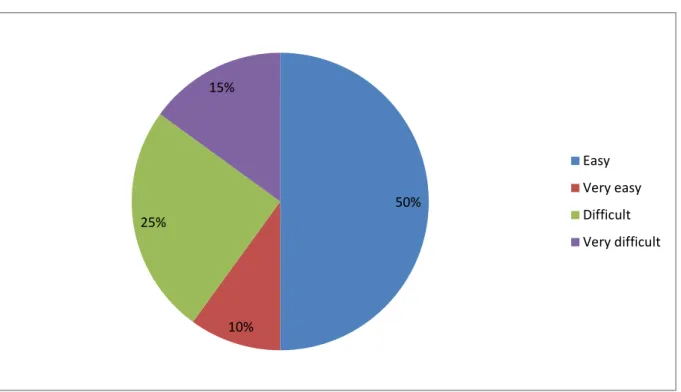
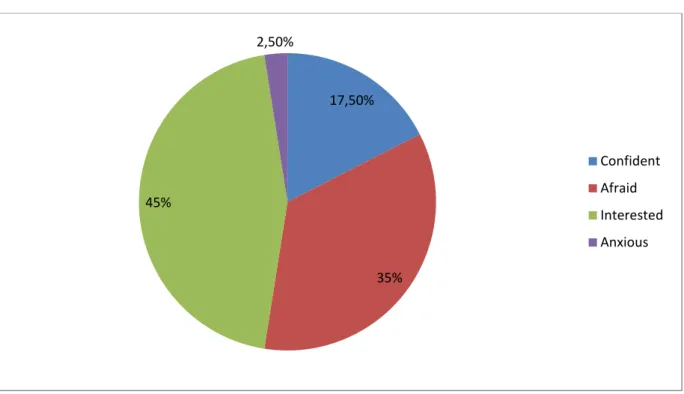
In section one, we addressed only one question. Which is an attempt to evaluate Students’ attitude toward classroom interaction. In Q1, EFL Students are asked to tick one opption in order to mention how do they find interacting in English in the classroom.