Scheduling Human Intelligence Tasks
in Multi-Tenant Crowd-Powered Systems
Djellel Eddine Difallah
⇤, Gianluca Demartini
†and Philippe Cudré-Mauroux
⇤⇤eXascale Infolab, University of Fribourg—Switzerland †Information School, University of Sheffield—United Kingdom
ABSTRACT
Micro-task crowdsourcing has become a popular approach to e↵ectively tackle complex data management problems such as data linkage, missing values, or schema matching. How-ever, the backend crowdsourced operators of crowd-powered systems typically yield higher latencies than the machine-processable operators, this is mainly due to inherent ef-ficiency di↵erences between humans and machines. This problem can be further exacerbated by the lack of workers on the target crowdsourcing platform, or when the workers are shared unequally among a number of competing requesters; including the concurrent users from the same organization who execute crowdsourced queries with di↵erent types, pri-orities and prices. Under such conditions, a crowd-powered system acts mostly as a proxy to the crowdsourcing plat-form, and hence it is very difficult to provide effiency guar-antees to its end-users.
Scheduling is the traditional way of tackling such prob-lems in computer science, by prioritizing access to shared resources. In this paper, we propose a new crowdsourcing system architecture that leverages scheduling algorithms to optimize task execution in a shared resources environment, in this case a crowdsourcing platform. Our study aims at assessing the efficiency of the crowd in settings where mul-tiple types of tasks are run concurrently. We present exten-sive experimental results comparing i) di↵erent multi-tenant crowdsourcing jobs, including a workload derived from real traces, and ii) di↵erent scheduling techniques tested with real crowd workers. Our experimental results show that task scheduling can be leveraged to achieve fairness and reduce query latency in multi-tenant crowd-powered systems, al-though with very di↵erent tradeo↵s compared to traditional settings not including human factors.
General Terms
Design; Experimentation; Human Factors.
Keywords
Crowdsourcing; Scheduling; Crowd-Powered System.
Copyright is held by the International World Wide Web Conference Com-mittee (IW3C2). IW3C2 reserves the right to provide a hyperlink to the author’s site if the Material is used in electronic media.
WWW 2016, April 11–15, 2016, Montréal, Québec, Canada. ACM 978-1-4503-4143-1/16/04.
http://dx.doi.org/10.1145/2872427.2883030 .
1. INTRODUCTION
Thanks to micro-task crowdsourcing platforms such as Amazon Mechanical Turk1 (AMT) and Crowdflower2, it is
today possible to build hybrid human-machine systems com-bining both the scalability of computers with the yet un-matched cognitive abilities of the human brain.
Micro-task crowdsourcing has already been used to power, among others, database systems [15], image search engines [10], or machine-learning algorithms [36]. In these systems, human and machines behave fundamentally di↵erently: While machines can deal with large volumes of data, with real-time streams, and with flocks of concurrent users interacting with the system, crowdsourcing is mostly used as a batch-oriented, o✏ine data processing paradigm, as opposed to cases where achieving low latency is key. The main reason behind this gap lies in the fact that crowdsourcing platforms do not provide guarantees on task completion times, due to the unpredictability of the crowd workers, who are free to come and go at any point in time and to selectively focus on an arbitrary subset of the tasks only.
With increased momentum around crowdsourcing for both academic and commercial purposes [12], managing the effi-ciency of a crowdsourcing platform in delivering results and completing tasks becomes a challenge. Efficiency concerns have so far mostly been tackled by adjusting the price of the Human Intelligence Tasks (HITs) or by repeatedly re-posting them on the crowdsourcing platform [14, 4, 11]. In this work, we propose to take control of the distribu-tion process of tasks originating from multi-tenant crowd-powered systems where multiple, and potentially heteroge-neous, HITs are executed. This allows us to apply scheduling techniques to decide which task gets to be sent to the next available worker.
We apply, adapt, and empirically evaluate a series of scheduling techniques that can be used by multi-tenant crowd-powered systems to launch HITs onto the crowdsourcing platform in order to improve their overall efficiency. For that purpose, we propose a system architecture and its AMT-tailored implementation, which have the following system-oriented objectives:
• improve the overall execution time of the generated workload, while
• ensure fairness among the di↵erent users of the system by equitably balancing the available workforce, and • avoid starvation of smaller requests.
1http://mturk.com 2http://crowdflower.com
From a worker perspective, task scheduling presents new challenges such as context switching and user priming. Hence, we try to answer the following questions: “Does known scheduling algorithms exhibit their usual properties when applied to the crowd?” and “What are the adaptations needed to accommodate the crowd work routine?”.
To the best of our knowledge, this paper is the first piece of work focusing on applying scheduling techniques in order to improve the efficiency of crowd-powered systems. While our focus is on efficiency, considering quality constrains to take scheduling decisions is left outside of the scope of this paper (see Section 7 for related work on this topic).
In the following, we experimentally compare the efficiency of various crowd scheduling approaches on real crowds of workers working in a micro-task crowdsourcing platform; We vary the size of the crowd, the ordering and priority of the tasks, as well as the size of the task batches. In addition, we take into account the unique characteristics of the crowd workers such as the e↵ect of context switching and work con-tinuity to design crowd-aware scheduling algorithms. Our experimental settings include i) a controlled setup with a fixed number of workers involved in the experiments, and ii) a real-world setup with varying number of workers, and HIT workloads taken from a commercial crowdsourcing platform log. The results of our experimental evaluation indicate that using scheduling approaches for micro-task crowdsourcing minimize the overall latency of batches of tasks irrespective of their size, while significantly improving the productivity of workers measured as their average execution time.
In summary, the main contributions of this paper are: • A crowdsourcing system architecture that implements
the newly proposed multi-tenant crowd-powered sys-tem focusing on HIT scheduling to improve syssys-tem ef-ficiency;
• A HIT scheduling layer for crowd-powered systems serving multiple users;
• A series of scheduling algorithms customized for the crowd;
• An extensive empirical evaluation comparing the scheduling algorithms over the crowd conducted both in a controlled setting as well as in a real deployment. The rest of the paper is structured as follows. Section 2 describes the HIT scheduling problem for multi-tenant crowd-powered systems. We introduce our new architecture in Section 3. In Section 4, we present the di↵erent schedul-ing algorithms we implemented for assignschedul-ing HITs to crowd workers, while Section 5 presents an extensive experimental evaluation of the proposed techniques. We discuss the re-sults and summarize our main findings in Section 6. Section 7 gives an overview of current approaches in crowd-powered systems and micro-task crowdsourcing and how they moti-vated our investigation. Finally, we conclude the paper in Section 8.
2. MOTIVATION
In this section, we give an overview of crowdsourcing plat-forms in order to highlight some of their characteristics that motivated our approach. We focus on Amazon Mechanical Turk as i) it is currently the most popular micro-task crowd-sourcing platform, ii) there is a continuous flow of workers and requesters completing and publishing HITs on the plat-form, and iii) its activity logs are available to the public [17].
2.1 The AMT Platform
Amazon Mechanical Turk is an open crowdsourcing mar-ketplace where the crowd is free to choose what to work on. This is desirable as it imposes high HIT standards; for in-stance, requesters need to pay close attention to their HIT design, documentation and pricing in order to attract and retain workers. On the other hand, this freedom limits the possibilities of the platform to provide any form of service guarantees to the requesters.
2.2 Requesters
In crowdsourcing platforms, businesses that heavily rely on micro-task crowdsourcing for their daily operations end up competing with themselves: If a requester runs concur-rent campaigns on a crowdsourcing platform, these will end up a↵ecting each other. For example, a newly posted large batch of HITs is likely to get more attention than a two days old batch waiting to be finished with few HITs remain-ing (see below for an explanation on that point).
2.3 HITs Execution Patterns in AMT
One of the common phenomena in micro-task crowdsourc-ing is the presence of long-tail work distributions: In a batch of HITs, the bulk of the work is completed by a few workers who perform most of the tasks while the rest is performed by many di↵erent workers who perform just a few HITs each.
We run an initial crowdsourcing experiment to observe the e↵ect that the number of simultaneous workers has on the throughput of our batch (HITs/Minute), and the amount of work done by each worker. We can see in Figure 2a that the overall throughput of the system increases linearly with the number of workers. Figure 2b shows the amount of work (number of HITs submitted during the experiment) performed by each worker. Here, we can observe a long-tailed distribution where few workers perform most of the tasks while many workers perform just a few tasks.
We extend our analysis to the throughput of batches run-ning concurrently on AMT. To that end, we computed the throughput of every batch publicly visible during a three months period, and grouped the results into three categories of batches (tiny, small, medium and large). The results are depicted in Figure 1. We observe that large batches dom-inate the throughput of a crowdsourcing platform even if the vast majority of the running batches are very small (less than 10 HITs). Large batches are completed at a certain speed by the crowd, up to a certain point when few HITs are left in the batch. Those final few HITs take a much longer time to be completed as compared to the majority of HITs in the batch. Such a batch starvation phenomenon has been observed in a number of recent reports, e.g., in [14, 34] where authors observe that the batch completion time depends on its size and on HIT pricing. HIT completion starts o↵ quickly but then loses momentum. In that sense, large batches of tasks are able to systematically yield higher throughputs as more crowd workers can work on them in parallel.
A similar observation was made in [15], where the authors compared the throughput of di↵erent batch sizes and con-cluded that large batches have the highest throughput, while medium sized batches (50-100 tasks) completed faster. We can conjecture that these phenomena are partially due to the preference of the crowd towards large batches. Indeed, the workers tend to explore new batches with many HITs,
0.00 0.25 0.50 0.75 1.00
Jan 01 Jan 15 Feb 01 Feb 15 Mar 01 Mar 15 Apr 01
Time (Day)
Count (Nor
maliz
ed)
(a) Batch distribution per Size − Most of the Batches present on AMT have 10 HITs or less.
0.00 0.25 0.50 0.75 1.00
Jan 01 Jan 15 Feb 01 Feb 15 Mar 01 Mar 15 Apr 01
Time (Day)
Throughput (Nor
maliz
ed) (b) Cumulative Throughput per Batch Size − The overall platform throughput is dominated by larger batches.
Tiny[0,10] Small[10,100] Medium[100,1000] Large[1000,Inf]
Figure 1: An analysis of three months activity log on Amazon MTurk January-March 2014 obtained from mturk-tracker.com [17] The crawler frequency is every 20 minutes, hence it might miss some batches. All HITs considered in this plot are rewarded $0.01. Throughput measured in HIT/minute for HIT batches of di↵erent sizes.
0 25 50 75 100 18:26 18:28 18:30 18:32 18:34 18:36 Time W or ker Count − Throughput HITs/Min ute HITs/Minute Number of workers
(a) Throughupt vs #Workers
0 10 20 30 0 50 100 Worker ID #HITs submitted (b) Work Distribution
Figure 2: Results of a crowdsourcing experiment involving 100+ workers concurrently working on a batch of HITs. (a) Throughput (measured in HITs/minute) increases with an increasing number of workers involved. (b) Work Distribution: the amount of work done by each worker has a long tailed distribution.
since they have a high reward potential, without requiring to search for and select a new type of HIT. This hypothesis is confirmed by our experimental results (see Section 5).
3. THE ARCHITECTURE OF
MULTI-TENANT
CROWD-POWERED
SYS-TEMS
We now describe a new scheduling architecture that can be integrated to a typical crowd-powered system. We designed this architecture to operate on any crowdsourcing platform, though we will focus the remaining description on AMT as a target platform.
We study scheduling techniques for crowdsourcing on AMT by introducing the notion of HIT-BUNDLE, that is, a batch container where heterogeneous HITs of comparable complexity and reward get published continuously by the crowd-powered system on AMT. We show how the notion of HIT-BUNDLE not only permits to apply di↵erent scheduling strategies but also produces a higher overall throughput in Section 5.2.
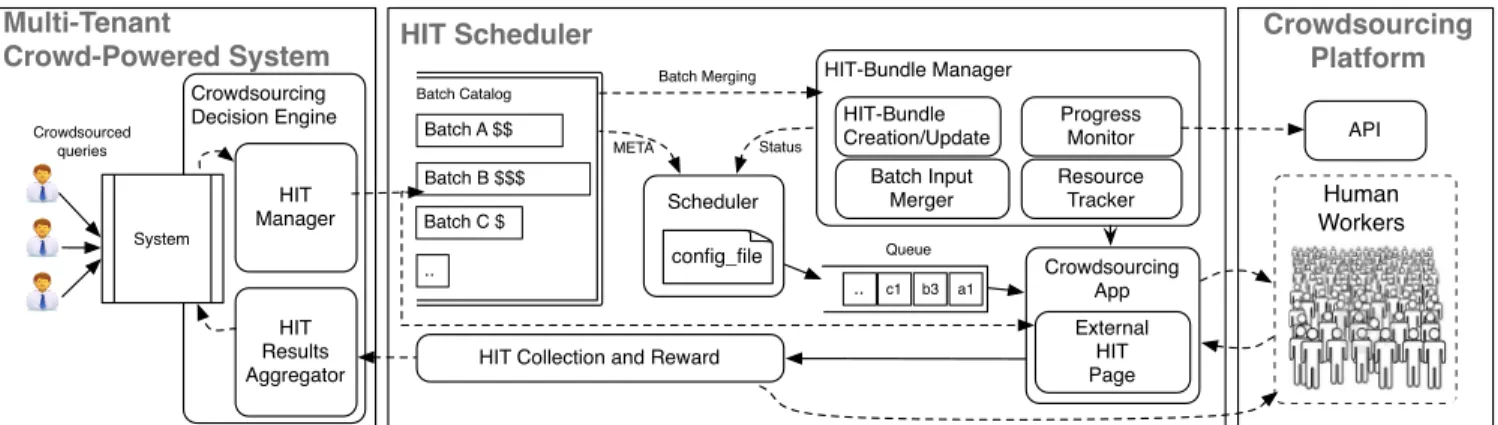
Our general framework is depicted in Figure 3. The in-put to our system comes from the di↵erent crowdsourced queries submitted through a crowdsourcing interface. A Crowdsourcing Decision Enginetakes the role of extract-ing the parts of the queries (and their input) to crowdsource. Subsequently, the HIT Manager generates HIT batches to-gether with a given monetary budget, and passes its re-quests to our HIT Scheduler. This contrasts to traditional crowd-powered systems, where batches are directly sent to the crowdsourcing platform.
The HIT Scheduler aims at improving the execution time of selected HITs. Once new HIT batches are generated, they are put in a container of tasks to-be-crowdsourced. The scheduler is constantly monitoring the progress of the work through AMT’s Application Programming Interface (API) and assigning dynamically the next HIT to the next availble worker based on a scheduling algorithm. More specifically, the HIT Scheduler collects in its Batch Catalog the set of HIT batches generated by the HIT Manager together with their reward and priorities.
Finally, the HIT-BUNDLE Manager creates crowdsourcing batchs on AMT. Based on the scheduling algorithm adopted, a HIT queue (specifying which HIT must be served next in the HIT-BUNDLE) is generated and periodically updated. As soon as a worker is available, the HIT Scheduler serves the first element in the queue. When HITs are completed, the results are collected and sent back to the system for aggregation, merging and forwards the final results to the end-users.
Workers are allowed to not accept (or return) HITs they prefer not to complete. The workers can also leave the sys-tem at any point in time. In these cases, the Scheduler takes responsibility of updating the queue and reschedules uncompleted HITs.
In the following section, we introduce a number of schedul-ing algorithms that can be used to manage HIT queues.
4. HIT SCHEDULING MODELS
In this section we give a formal problem definition of scheduling with the crowd, and introduce the set of design requirements we accounted for when creating and choosing the scheduling strategies. We will also briefly revisit com-mon scheduling approaches used by existing resource man-agers in shared environments, and discuss their advantages and drawbacks when applied to the architecture presented in Section 3. As we show in Section 5, using such algorithms presents several new dimensions to be taken into account compared to traditional CPU scheduling, thus, we also pro-pose new scheduling algorithms adapted to the crowd.
4.1 HIT Scheduling: Problem Definition
First, we formally define the problem of scheduling HITs generated by a multi-tenant crowd-based system on top of a crowdsourcing platform.
A query r submitted to the system and including crowd-powered operators generates a batch Bjof HITs. We define
Crowdsourcing Decision Engine HIT-Bundle Manager Multi-Tenant Crowd-Powered System Crowdsourcing Platform Progress Monitor API HIT Scheduler Human Workers c1 b3 a1 .. Queue Crowdsourcing App
HIT Collection and Reward HIT Results Aggregator HIT Manager Scheduler External HIT Page Batch A $$ Batch B $$$ Batch C $ .. Batch Catalog HIT-Bundle Creation/Update Batch Merging Status META System Crowdsourced queries Batch Input Merger Resource Tracker config_file
Figure 3: The role of the HIT Scheduler in a Multi-Tenant Crowd-Powered System Architecture.
has additional metadata attached to it: A monetary budget Mjto be spent for its execution and a priority score pjwith
which it should be completed: Batches with higher priority should be executed before batches with lower priority. Thus, if a high-priority batch is submitted to the platform while a low-priority batch is still uncompleted, the HITs from the high-priority batch are to be scheduled to run first.
The problem of scheduling HITs takes as input a set of available batches {B1, .., Bn} and a crowd of workers
{w1, .., wm} currently active on the platform, and produces
as output an ordered list of HITs from {B1, .., Bn} to be
assigned to workers in the crowd by publishing them as a single HIT-BUNDLE. Once a worker wi is available, the
system assigns him/her the first task in the list as decided by the scheduling algorithm.
Scheduling may need to be repeated over time to update the HIT execution queue. Such re-scheduling operations are necessary, for example when a worker fails to complete his/her assigned HIT, or when a new batch of HITs is sub-mitted by one of the clients.
In this way, we obtain some hybrid pull-push behavior on top of AMT as the workers participating in the crowd sourc-ing campaign are shown HITs computed by the scheduler. Workers are still free to decline the HIT, ask for another one, or simply seek for another requester on AMT.
Worker Context Switch.
From the worker perspective, scheduling can lead to randomly alternating task types that a single worker might receive. In such a situation, the worker has to adapt to the new task instructions, interface, question etc, and this could be penalizing (see our related work section 7). This overhead is called context switch. One of the goals of this paper is to improve the efficiency of each worker by mitigating her context switches.4.2 HIT Scheduling Requirement Analysis
Next, we describe which requirements should be taken into account when applying scheduling in a crowdsourcing setting. We then use some of these requirement to customize known scheduling techniques for the crowd.
(R1) Runtime Scalability: unlike parallel schedulers, where the compiled query plan dictates where and when the operators should be executed [30], crowd-powered systems are bound to adopt a runtime scheduler that a) dynamically adapts to the current availability of the crowd, and b) scales to make
realtime scheduling decisions as the work demand grows higher. A similar design consideration is adopted by YARN[31], the new Hadoop resource manager.
(R2) Fairness: An important feature that any shared sys-tem should provide is fairness across the users of the system. By taking control of the HIT-BUNDLE schedul-ing, the crowd-powered system acts as the load bal-ancer of the currently available crowd and the remain-ing HITs in the HIT-BUNDLE. For example, the sched-uler should provide a steady progress to large requests without blocking – or starving, the smaller requests. (R3) Priority: in a multi-tenant System, some queries have
a higher priority than others. For this reason, HITs generated from the queries should be scheduled accord-ingly. In a crowdsourcing scheduling setting, as work-ers are not committed to the platform and can leave at any point in time, a crowd-powered system sched-uler should be best-e↵ort, that is, the system should do its best to meet the requester priority requirements without any hard guarantee.
(R4) Worker Friendly: Di↵erently from CPUs, people performances are impacted by many factors includ-ing traininclud-ing e↵ects, borinclud-ingness, task difficulty and in-terestingness. Scheduling approaches over the crowd should whenever possible take these factors into ac-count. In this paper, we experimentally test worker-conscious scheduling approaches that aim at balancing the trade-o↵ between serving similar HITs to workers and providing fair execution to di↵erent HIT batches.
4.3 Basic Space-Sharing Schedulers
Crowdsourcing platforms usually operate in a non-preemptive mode, that is, they do not allow to interrupt a worker performing a task of low priority to have him perform a task of higher priority with the risk of reneging. In our evaluation we consider common space-sharing algorithms where a resource (a crowd worker in this case) is assigned a HIT until he/she finishes it, or returns it uncompleted to the platform.
FIFO.
On crowdsourcing platforms, this scheduling has the e↵ect of serving lists of tasks of the same batch to the ers until they are finished. By concentrating the entire work-force on a single job until it is done, FIFO provides the bestthroughput per batch one can expect from the platform at a given moment in time.
The potential shortcomings of this scheme are as follows: i) short jobs and high priority jobs can get stuck behind long running tasks, minimizing the overall efficiency of the crowd-sourcing system, and ii) when a batch has a large number of tasks, assigned workers can potentially get bored [27].
Shortest Job First (SJF).
Other simple scheduling schemes o↵er di↵erent tradeo↵s depending on the requirements of the multi-tenant system. Shortest Job First (SJF) o↵ers fast turn-around for short HITs, and can lead to a minimum of a context switch for part of the crowd, since the shortest jobs are either quickly finished or scheduled to the first available workers.However, SJF is not strategy-proof on current crowd-sourcing platforms as the requesters can lie about the expected HIT execution times. Hence, these schemes should be used in trusted settings mostly (e.g., in enterprise crowd-DBMSs). Moreover, these schemes do not systematically interweave tasks from di↵erent batches, and thus present also the same shortcomings as FIFO.
Round Robin (RR).
The previous schemes introduces bi-ases, in the sense that they give an advantage to one batch over the others. Round Robin removes such biases by assign-ing HITs from batches in a cyclic fashion. In this way, all the batches are guaranteed to make regular progress. While Round Robin ensures an even distribution of the workforce and avoids starvation, it does not meet one of our require-ment (R2) since it is not priority-aware: All the batches are treated equally with the side e↵ect that batches with short HITs would (proportionally) get more workforce than longer HITs. Another risk is that a worker might find her-self bouncing across tasks and being forced to continuously switch context, hence loosing time to understand the spe-cific instructions of the tasks. The negative e↵ect of context switch is evident from our experimental results (see Section 5) and should be avoided.4.4 Fair Schedulers
In order to deal with batches of HITs having di↵erent pri-orities while avoiding starvation, we also consider scheduling techniques frequently used in cluster computing.
Fair Sharing (FS).
Sharing heterogeneous resources across jobs having di↵erent demands is a well-known and plex problem that has been tackled by the cluster com-puting community. One popular approach currently used in Hadoop/Yarn is Fair Scheduling (FS) [16]. In the con-text of scheduling HITs on a crowdsourcing platform, we borrow this approach in order to achieve fair scheduling of micro-tasks: Whenever a worker is available, he/she gets a HIT from the batch with the lowest number of currently as-signed HITs which we call running tasks. Unlike Round Robin, this ensures that all the jobs get the same amount of resources (thus being fair ). Algorithm 1 gives the exact way we considered FS in our context.Weighted Fair Sharing (WFS).
In order to schedule batches with higher priority first (see R2 in Section 4.2), weighted fair scheduling can be used, in order assign a taskAlgorithm 1 Basic Fair Sharing
Input: B ={bi< p1, r1>, .., bn< pn, rn>} set of batches
currently queued with priority pi, and number of
run-ning HITs per batch ri.
Output: HIT hi.
1: When a worker is available for a task 2: BSorted= Sort B by increasing ri
3: hi= BSorted[0].getNextHit()
4: return hi
from the jobs with the least running tasks/task priority value. Algorithm1, line 2, gets in that case updated: Sort B by increasing ri/pi. This puts more weight on batches
with few running tasks and a high priority.
The following formula gives the fair share of resources (i.e., number crowd workers) allocated to a HIT batch j with priority score pj and concurrent running batches with
priority scores{p1..pN} at any given point in time
wj=
pj
PN 1 pi
4.5 Crowd-aware Scheduling
In addition to the standard scheduling techniques described above, we also evaluate a couple of approach aiming at scheduling tasks taking into account the crowd workers need (see R4 in Section 2). In that sense, we propose scheduling approaches that o↵er a tradeo↵ between being fair to the batches (by load-balancing the workers) while also being fair to the workers (by serving HITs with some continuity, if possible, and with minimal wait time).
Worker Conscious Fair Sharing (WCFS).
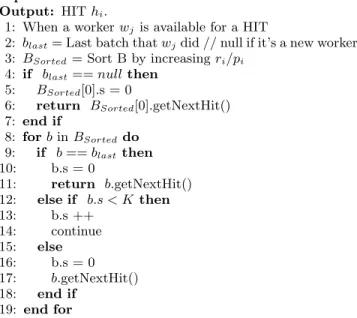
Worker Con-scious Fair Sharing (WCFS) maximizes the likelihood of a worker receiving a task from a batch he worked on re-cently, thus avoiding that a worker jumps back and forth between di↵erent tasks (i.e., minimizing context switching). We suggest to achieve this by having top priority batches concede their positions in favor of one of the next batches in the queue. Each batch can concede his turn up to K times, a predefined concession threshold, which is reset af-ter a scheduling. This approach is the crowd-equivalent of Delay Scheduling [39].5. EXPERIMENTAL EVALUATION
We describe in the following our experimental results ob-tained by scheduling HITs on the Amazon MTurk (AMT) crowdsourcing platform.
As a general experimental setup, we implemented the ar-chitecture proposed in Section 3 on top of AMT’s API. Our implementation and datasets are available as an open-source project for reproducibility purposes and as a basis for po-tential extensions3.
5.1 Datasets
For our experiments, we used a dataset composed of 7 batches of varying complexity, sizes, and reference prices. The data was partly created by us and partly collected from related works; it includes typical tasks that could have been generated by a crowd-powered system. Table 1 gives a sum-mary of our dataset and provides a short description and
Algorithm 2 Worker Conscious Fair Share
Input: B ={bi < p1, r1, si >, .., bn < pn, rn, sn >} set of
batches currently queued with priority pi, ri number of
running HITs, and siconcessions initialized to 0.
Input: K = maximum concession threshold Output: HIT hi.
1: When a worker wjis available for a HIT
2: blast= Last batch that wjdid // null if it’s a new worker
3: BSorted= Sort B by increasing ri/pi
4: if blast== null then
5: BSorted[0].s = 0
6: return BSorted[0].getNextHit()
7: end if 8: for b in BSorteddo 9: if b == blast then 10: b.s = 0 11: return b.getNextHit() 12: else if b.s < K then 13: b.s ++ 14: continue 15: else 16: b.s = 0 17: b.getNextHit() 18: end if 19: end for
references when applicable. We note that for the purpose of our experiments, we vary the batch sizes and prices accord-ing to the setup.
5.2 Micro Benchmarking
The goal of the following micro benchmark experiments is to validate some of the hypotheses that motivate the use of a HIT-BUNDLE and the design of a worker-aware schedul-ing algorithm that minimizes tasks switchschedul-ing for the crowd workers.
5.2.1 Batch Split-up
The first question we address is whether smaller or larger batches of homogeneous HITs are more attractive to the workers on AMT. We experimentally check if a single large batch executes faster than when breaking the same batch into smaller ones. To this end, we use the batch B6 which we split into 1, 10 and 60 individual batches, containing re-spectively 600, 60 and 10 HITs each. Next, we run all these batches on AMT concurrently with non-indicative titles and similar unit prices of $0.01. Note that the batch combina-tions were published at the same time on the crowdsourcing platform so all the variables like crowd population and size, concurrent requesters, and rewards are the same across the di↵erent settings.
Figure 4 shows how the three di↵erent batch splitting strategies executed overtime on B6. We observe that run-ning B6 as one large batch of 600 HITs completed first. We also observe that the strategy with 10 batches only really kicks-o↵ when the large batch finishes (and similarly for the strategy with 60 batches). From this experiment, we con-clude that larger batches provide a better throughput and constitute a better organizational strategy. This finding is especially interesting for requesters who would periodically run queries that use a common crowdsourcing operator (al-beit, with a di↵erent input), by pushing new HITs into an existing HIT-BUNDLE. ID Dataset Description Price per HIT #HITs Avg. Time per HIT B1 Customer Care Phone Number Search
Find the customer-care phone number of a given US-based com-pany using the Web.
$0.07 50 75sec
B2
Image Tagging Type all the relevant keywords re-lated to a picture from the ESP game dataset. [33]
$0.02 50 40sec
B3
Sentiment Analysis
Classify the expressed sentiment of a product review (positive, nega-tive, neutral).
$0.05 200 22sec
B4
Type a Short Text
This a is study on short memory, where a worker is presented with text for a few seconds, then he is asked to type it from memory. [32]
$0.03 100 11sec
B5 Spelling Cor-rection
A collection of short paragraphs to
spell check from StackExchange. $0.03 100 36sec
B6
Butterfly Clas-sification
Classify a butterfly image to one of 6 species (Admiral, Black Swallow-tail, Machaon, Monarch, Peacock, and Zebra). [23]
$0.01 600 15sec
B7
Item Matching Uniquely identify products that can be referred to by di↵er-ent names (e.g., ‘iPad Two’ and ‘iPad2nd Generation’). [35]
$0.01 96 22sec
Table 1: Description of the batches constituting the dataset used in our experiments. 0 200 400 600 0 500 1000 1500 2000 Time (seconds) #HITs Remaining 1 Batch of 600 HITs 10 Batches of 60Hits 60 Batches of 10Hits
Figure 4: A performance comparison of batch execution time using di↵erent grouping strategies publishing a large batch of 600 HITs vs smaller batches (From B6).
0 25 50 75 100 0 1000 2000 3000 4000 Time (seconds) #HITs Remaining B6 − Bundle B7 − Bundle B6 B7
Figure 5: A performance comparison of batch execution time using di↵erent grouping strategies publishing two distinct batches of 192 HITs separately vs combined inside an HIT-BUNDLE.
5.2.2 Merging Heterogenous Batches
We extend the above experiment to compare the execution of two heterogenous batches run separately or within a single HIT-BUNDLE. Unlike the previous experiment, where the fine-grained batches were one to two orders of magnitude smaller than the larger one, this scenario involves two batches of type B6 and B7 containing 96 HITs each, versus one HIT-BUNDLEregrouping all 192 HITs. We run the three batches concurrently on AMT, with non-indicative titles and similar unit prices of $0.01 and without altering the default serving order within the HIT-BUNDLE4. The results are depicted in
Figure 5.
** (p−value=0.023) ** (p−value=0.023) 20 40 60 RR SEQ10 SEQ25 Experiment Type Ex
ecution time per HIT (Seconds)
RR SEQ10 SEQ25
Figure 6: Average Execution time for each HIT submitted from the experimental groups RR, SEQ10 and SEQ25.
Again, the HIT-BUNDLE exhibits a faster throughput as compared to individual batches. Moreover, the embedded batches both finish before their counterparts that are run-ning separately.
At this point, we have shown that requesters who would run queries invoking di↵erent crowdsourcing operators can also benefit from pushing their HITs into the same HIT-BUNDLE. Since a system might support multiple crowdsourc-ing operators, the next question we explore is whether con-text switches (i.e., alternating HIT types) a↵ects workers efficiency.
5.2.3 Workers Sensitivity to Context Switch
The following experimental setup involves three groups of 24 distinct workers each. Each group was exposed to three types of HIT serving strategies, namely:
• RR: a worker in this group would receive tasks in an alternating order from batches B6 and B7.
• SEQ10 : here the workers will receive 10 tasks from B6 then 10 tasks from B7 then again 10 from B6 and so on.
• SEQ25 : similar to SEQ10 but with sequences of 25 tasks. In order to trigger the context switch, each par-ticipant was asked to do at least 10, and up to 100, tasks.
Figure 6 shows the average execution time of all the 100 HITs under each execution group. We observe that the av-erage of execution time of HITs is worst when using RR as compared to workers performing longer alternating se-quences in SEQ10 and SEQ25. To test the statistical signif-icance of these improvements, and since the distribution of HIT execution time cannot be assumed to be normally dis-tributed, we perform a Willcoxon signed-rank test. SEQ10 has a p=0.09 which is not enough to achieve statistical sig-nificance. However, the SEQ25 improvement over RR is statistically significant with p<0.05.
In conclusion, context switch generates a significant slow-down for the workers, thus reducing their overall efficiency. Hence, this result motivates the design of a scheduling algo-rithm that takes into account workers efficiency by schedul-ing longer sequences of HITs of the same type.
5.3 Scheduling HITs for the Crowd
Now we move our attention to experimentally comparing the scheduling algorithm that are used to manage the dis-tribution of HITs within a HIT-BUNDLE.
0 500 1000 1500 2000 B1 B2 B3 B4 B5 Batch Time (Seconds) FIFO FS RR SJF
(a) Batch Latency
0 500 1000 1500 2000 FIFO FS RR SJF Scheduling Scheme Time (Seconds)
(b) Overall Experiment Latency
Figure 7: Scheduling approaches applied to the crowd.
5.3.1 Controlled Experimental Setup
In order to develop a clear understanding of the properties of classical scheduling algorithms when applied to crowd-sourcing, we put in place an experimental setup that miti-gates the e↵ects of workforce variability overtime5.
In our controlled setting, each experiment that we run in-volves a number of crowd workers ranging between: M inw
|workforce| Maxw, at any point in time. To be within
this range target, the workers who arrive first are presented with a reCaptcha to solve (paid $0.01 each), until M inw
workers join the system, at that point the experiment be-gins serving tasks. From that point on, new workers are still accepted up to a maximum M axw. If the number of
active sessions drops bellow M inw, then the system starts
accepting new sessions again.
Unless otherwise stated, we use the following configura-tion:
• Number of workers: 10 |workforce| 15.
• Weighted Fair Sharing, with price as weighting factor. • a HIT-BUNDLE composed of {B1, B2, B3, B4, B5}. • FIFO order is [B1, B2, B3, B4, B5].
• SJF order is [B4, B3, B5, B2, B1].
Also, we note that each experiment involves a distinct crowd of workers to avoid any further training e↵ects on the tasks.
5.3.2 Comparing Scheduling Algorithms
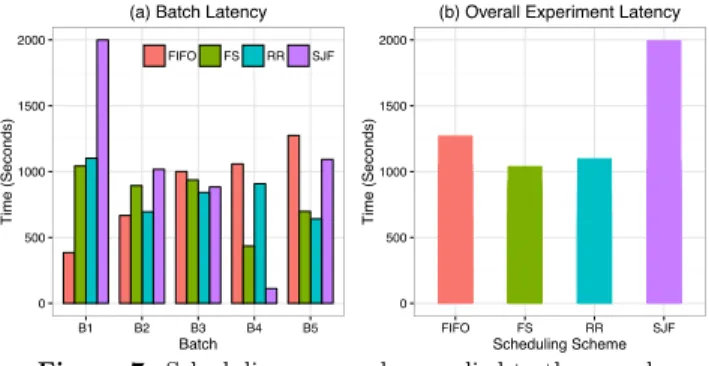
First, we compare how di↵erent scheduling algorithms perform from a latency point of view, taking into account the results of individual batches as well as the overall perfor-mance. We create a HIT-BUNDLE out of {B1,B2,B3,B4,B5}, which is then published to AMT. In each run, we use a dif-ferent scheduling algorithm from: FIFO, FS, RR, and SJF, with 10 |workforce| 15. Figure 7 shows the comple-tion time of each batch in our experimental setting and the cumulative execution time of the whole HIT-BUNDLE.
FS achieved the best overall performance, thus maximiz-ing the system utility, though, at the batch level, FS did not always win (e.g., for B2). We see how FIFO just as-signs tasks from a batch until it is completed. In our setup, we used the predefined order of the batches, which explains why B1 is getting a preferential treatment as compared to B5, which finishes last. Similarly, SJF performs unfairly over all the batches but manages to get B4 completed extremely fast. In fact, SJF uses statistics collected from the system on the execution speed of each operator (see Table 1); this explains the fast execution of B4. On the positive side, we observe that both RR and FS perform best in terms of
fair-5We decided not to run simulations, but rather to report the
actual results obtained with human workers as part of the evaluated system.
0 300 600 900 B1 B2 B3 B4 B5 Batch Time (seconds) B2:$0.02 B2:$0.05
(a)Vary The Price
0 250 500 750 1000 B1 B2 B3 B4 B5 Batch Time (seconds) 10 workers 20 workers
(b) Vary The Workforce
Figure 8: (a) E↵ect of increasing B2 priority on batch execution time. (b) E↵ect of varying the number of crowd workers involved in the completion of the HIT batches.
0 50 100 150 Batch Type Ex
ecution time per HIT (Seconds)
Individual Batches WCFS FS
Figure 9: Average execution time per HIT under di↵erent
scheduling schemes.
ness with respect to the di↵erent batches, i.e., there was no preferential treatment.
5.3.3 Varying the Control Factors
In order to test our priority control mechanism across dif-ferent batches of a HIT-BUNDLE (tuned using the price), we run an experiment with the same setup as in Section 5.3.2, but varying the price attached to B2 and using the FS al-gorithm only. Figure 8 shows that batches with a higher priority (reward) lead to faster completion times using the FS scheduling approach (gray bar of batch 2 lower than the black one). This comes at the expense of other batches being completed later.
Another dimension that we vary is the crowd size. Figure 8b shows the batch completion time of two di↵erent crowd-sourcing experiments when we vary the crowd size from 10 |workforce| 15 to 20 |workforce| 25 (keep-ing all other sett(keep-ings constant). We can see batches be(keep-ing completed faster when more workers are involved. However, di↵erent batches obtain di↵erent levels of improvement.
5.4 Live Deployment Evaluation
After the initial evaluation of the di↵erent dimensions in-volved in scheduling HITs over the crowd, we now evaluate our proposed fair scheduling techniques FS and WCFS in an uncontrolled crowdsourcing setting using HIT-BUNDLE, and compare it against a standard AMT execution.
More specifically, we create a workload that mimics a 1-hour activity on AMT from a real requester who had 28 batches running concurrently. Since we do not have access to the input of the batches, we randomly select batches from
large medium small
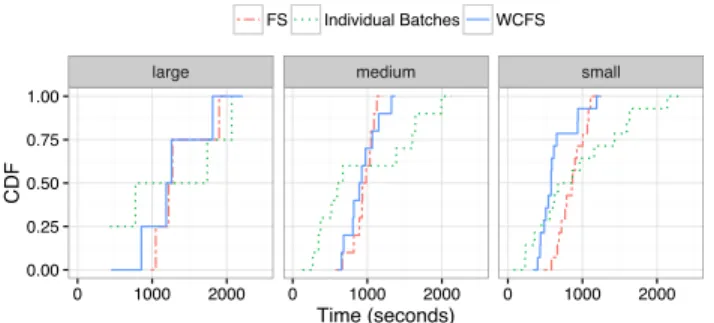
0.00 0.25 0.50 0.75 1.00 0 1000 2000 0 1000 2000 0 1000 2000 Time (seconds) CDF FS Individual Batches WCFS
Figure 10: CDF of di↵erent batch sizes and scheduling schemes.
all our experimental datasets and adapt the price and the size to the actual trace. The trace used in that sense is com-posed of 28 batches with similar rewards of $0.01; the largest batch has 45 HITs and the smallest 1 HIT only. For analysis purposes, we group batches by size: 16 small batches (1-9 HITs), 8 medium batches (9-15 HITs), and 4 large batches (16-45 HITs). The total size of this trace is 286 HITs.
5.4.1 Live Deployment Experimental Setup
We publish concurrently the 28 batches from the previ-ously described trace as individual batches (standard ap-proach) as well as into two HIT-BUNDLEs, one using FS and the other using WCFS. The individual batches use mean-ingful titles and descriptions of their associated HIT types; on the other hand the HIT-BUNDLE informs the crowd work-ers that they might receive HITs from di↵erent categories. Other parameters like requester name and reward are simi-lar.
5.4.2 Average Execution Time
Figure 9 shows the average HIT execution time obtained by the di↵erent setups. Confirming the results from Section 5.2.3, we observe that workers perform better when working on individual batches because of the missing context switch e↵ect (though the performance di↵erence is minimal). In-stead, when HITs are scheduled, execution time increases with the benefit of prioritizing certain batches. We also see that WCFS provides a trade-o↵ between letting workers work on the same type of HITs longer and having the ability to schedule batches fairly as we shall see next.
5.4.3 Results of the Live Deployment Run
We plot the CDFs of HIT completion per category in Fig-ure 10. For example, 25% of small batches completed in 500 seconds when run individually. For all batch sizes, we observe that individual batches started faster. However, in all cases they also ended last, especially for smaller batches su↵ering from some starvation (i.e., long period without progress); here, we clearly see the benefits of both FS and WCFS at load balancing.
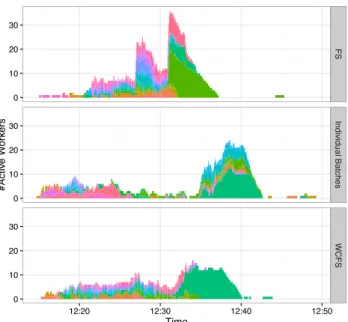
The final plot (Figure 11) shows how a large workload ex-ecutes over time on the crowdsourcing platform. We can see how many workers are involved in each setting and which HIT batch they are working on (each color represents a dif-ferent batch). Finally, as expected, the number of active workers varied wildly overtime in each setup. Corroborat-ing the results of the previous paragraph, Individual Batches received more workforce in the beginning (they start faster) then workers either left, or took some time to spill over the remaining batches in the [11:25 - 11:35] time period. Our
0 10 20 30 0 10 20 30 0 10 20 30 FS Individual Batches WCFS 12:20 12:30 12:40 12:50 Time #Activ e W or kers
Figure 11: Worker allocation with FS, WCFS and classical in-dividual batches in a live deployment of a large workload derived from crowdsourcing platform logs. Each color represents a di↵er-ent batch.
main observation is that FS and WCFS i) achieve their de-sired property of load balancing the batches when there are sufficient number of workers, ii) they finish all the jobs well before the individual execution (10-15 minutes considering the 95th percentile).
6. DISCUSSION
In Section 4.2, we introduced a set of requirements for scheduling HITs. The di↵erent scheduling techniques that we propose meet these requirements as follows: (R1) Scalability: we choose not to tackle scheduling as a high-complexity multivariate optimization problem but rather as a more scalable, HIT sorting task; this property is desirable since our scheduling algorithms are ought to serve large numbers of crowd workers—“potentially billions of users” [18]; (R2/R3) Fairness and Priority: thanks to FairSharing and weighted FS, we equitably load balance HITs and express priority of HITs as a function of the price and schedule them accordingly; (R4) Worker-Consciousness: thanks to WCFS and CGS, we are able to adapt scheduling to the crowd.
We presented above the results of a series of empirical crowdsourcing experiments where we varied di↵erent dimen-sions.
Starting with a set of micro benchmarks, the first obser-vation we make is the attractiveness of larger batches to the crowd. A possible explanation of this observation is related to the overhead of searching for new batches to work on, thus the preference given to larger batches. Next, we opti-mized for reducing context switches, as it is a well-studied problem and has a direct impact on workers’ efficiency.
From our experimental results, we conclude that the most appropriate scheduling technique among the ones we consid-ered is the WCFS variant, which allows HIT batches to be fairly treated on the crowdsourcing platform and also takes into account the needs of workers to have some continuity in the HIT they focus on rather than potentially causing them to constantly switch context.
On the worker side, we identify two key features that make crowd workers execute tasks very di↵erently compared to machines: i) crowd workers su↵er from context switch after changing the type of task they work on, and ii) they are attracted by large HIT batches that guarantee a continuous stream of HITs and, thus, of revenue.
We note that to obtain better execution times it is possi-ble, for example, to increase the monetary reward attached to the HITs. However, such reward increases would make the crowdsourcing cost rise thus hindering the scalability of the approach. Moreover, increasing the monetary reward opens up the door to spammer workers who are exclusively interested in the monetary reward and not in honestly com-pleting the HITs.
To summarize, the main observations that we draw from our experiments are:
• Large HIT batches are preferred by crowd workers; Thus, large batches attract a larger workforce which implies a higher throughput;
• Individual workers perform slightly better when work-ing on homogeneous batches (compared to batches re-grouping di↵erent types of HITs);
• HIT-BUNDLE have overall a positive impact on task la-tency as they tend to attract bigger workforces; • Scheduling techniques make it possible to prioritize
HIT batches as needed while being fair with all running batches and all involved workers; In particular, FS and WCFS equally distribute the available workforce over the di↵erent batches;
• The techniques we evaluated can be applied on top of existing micro-task crowdsourcing platforms in a scalable fashion without the need of new push crowd-sourcing mechanisms or systems, thus leveraging large crowds of people already engaged on existing plat-forms.
7. RELATED WORK
Micro-task Crowdsourcing.
Paid micro-task crowdsourc-ing has been used for a wide range of applications includcrowdsourc-ing entity resolution [35, 37], schema matching [40], entity link-ing and instance matchlink-ing [7, 8], word sense disambiguation [28], relevance judgements [1] etc.We can distinguish two types of crowdsourcing paradigms: pull-crowdsourcing and push crowdsourcing [22]. The key di↵erence is that pull-crowdsourcing platforms allow the workers to browse and choose among available tasks posted by the requesters, while push-crowdsourcing assigns tasks to workers by considering selection criterias such as skills, location or interests in order to assign tasks to the best available workers. In [13, 5], for example, authors leverage online social network profiles and activities to find better suited candidates and push tasks to them.
In this paper, we instead propose the use of a HIT-BUNDLE, that is, a unique batch of heterogeneous tasks generated by a multi-tenant system. This allows to apply task scheduling techniques within the HIT-BUNDLE and to decide which task should be served to the next available worker. In this way, we rather focus on improving the crowd efficiency without the need of deploying a dedicated crowdsourcing platform but rather allowing us to reuse popular crowdsourcing plat-forms (e.g., Amazon MTurk).
In our work, we have observed that latency and through-put can be controlled with the crowd size and pricing dimen-sions. Optimal payment strategies, reward schemes, and in-centive mechanisms for crowdsourcing have been studied [19, 29] and may also be applied in combination to crowdsourc-ing schedulcrowdsourc-ing techniques in order to maximize throughput as well as the quality of the results.
Task Assignment and Scheduling.
Scheduling tasks for the crowd has been recently discussed in the context of work quality mostly, while we focus on efficiency. In CrowdCon-trol [25], authors propose a scheduling approach to assign tasks to workers based on their history and how they learn doing tasks. Instead, we focus on the requester needs for scheduling and look at priorities of batches, while still taking into account the human dimension of crowdsourcing. More-over, [25] evaluates the proposed approaches by means of simulation while in our work we assess the e↵ectiveness of the proposed algorithms over a real deployment over the crowd.Similarly, SmartCrowd [26] considers task assignment as an optimization problem based on worker skills and their reward requirements. As compared to this, we rather focus on the system-side requirements for scheduling, by making sure that all competing batches are completed appropriately by the crowd.
Further pieces of work recently studied scheduling ap-proaches focused on work quality: [20] shows, by means of simulations, how approaches that take into account worker skills outperform standard scheduling approaches, while [24] suggests scheduling tasks according to the required skills and the previous feedback from the requesters.
A di↵erent type of scheduling has been addressed in [9], where authors look at crowdsourcing tasks that need to take place in a specific real-world geographical location. In this case, it is necessary to schedule tasks for workers in order to minimize spatial movements by taking into account their geographical location.
Task allocation in teams has been studied in [2], where authors defined the problem, studied its complexity, and proposed greedy methods to allocate tasks to teams and accordingly adjust their size. Team formation given a task has been studied in [3] looking at worker skills. In our work, we rather focus on assigning tasks to individual workers to balance the load on the crowdsourcing platform.
The Effect of Switching Tasks.
When scheduling tasks for the crowd, it is necessary to take the human dimension into account. Recent work [21] showed how disrupting tasks con-tinuity degrades the efficiency of crowd workers. Taking this result into account, we designed worker-conscious schedul-ing approaches that aim at servschedul-ing tasks of the same type in sequence to crowd workers in order to leverage training e↵ects and to avoid the negative e↵ects of context switching. Studies in the psychology domain have shown that switch-ing between di↵erent tasks types has a negative e↵ect on worker reaction time and on the quality of the work done (see, for example, [6]). In addition to this, in our work we show how context switch leads to an overall larger latency in work completion (Section 5.2) and propose scheduling tech-niques that take this human factor into account. The au-thors of [38] study the e↵ect of monetary incentives on task switching concluding that providing such incentives can helpin motivating quality work in a task switching situation. In our work, we rather aim at reducing task switching by con-sciously scheduling tasks to workers.
8. CONCLUSIONS
In a shared crowd-powered system environment, multiple users (or tenants) periodically issue queries that trigger predefined crowd-operators, resulting in independent crowdsourcing tasks published on the target crowdsourcing platform. In this paper, we pose and experimentally show that the divide strategy is not optimal, and that the crowd-powered system can increase its overall efficiency by bundling requests into a single batch that we call: HIT-BUNDLE, and then taking control of the distribution process of the tasks i.e., scheduling. Our experiments show that this approach has two benefits i) it creates larger batches that have a higher throughput, and ii) it gives to the system control on what HIT to push next—a feature that we leverage to push high-priority requests for example. Moreover, controlling the task execution makes it possible to develop more sophisticated crowdsourcing operators e.g., workflow execution, collaborative tasks.
Fairness is an important feature that shared environments (including multi-tenant crowd-powered systems) should sup-port. Thus, we explored the problem of scheduling HITs using weighted Fair Scheduling algorithms, where priority is expressed as a function of price. However, human indi-viduals behave very di↵erently from machines, they are sen-sitive to the context switch that a regular scheduler might cause. The negative e↵ects of context switching were visible in our experiments and are also supported by related stud-ies in psychology. In that context, we proposed a Worker Conscious Fair scheduling (WCFS), a new scheduling vari-ant that strikes a balance between minimizing the context switches and the fairness of the system.
We experimentally validated our algorithms over real crowds of workers on a popular paid micro-task crowdsourcing platform running both controlled and uncontrolled experiments. Our results show that it is possible to achieve i) a better system efficiency—as we reduce the overall latency of a set of batches—while ii) providing fair executions across batches, resulting in iii) non starving small jobs.
To the best of our knowledge, this is the first piece of work giving crowd-powered systems control over their HIT execution schedule, with the goal of improving their overall efficiency. Our architecture, and its AMT-tailored imple-mentation, can be leveraged in a number of ways for query optimization, and for powering complex SLAs.
9. ACKNOWLEDGMENTS
This work was supported by the Swiss National Science Foundation under grant number PP00P2 153023, by a Google Research Award, and by the UK EPSRC grant number EP/N011589/1.
10. REFERENCES
[1] O. Alonso and R. A. Baeza-Yates. Design and Implementation of Relevance Assessments Using Crowdsourcing. In ECIR, pages 153–164, 2011.
[2] A. Anagnostopoulos, L. Becchetti, C. Castillo, A. Gionis, and S. Leonardi. Power in unity: forming teams in large-scale community systems. In Proceedings of the 19th
ACM international conference on Information and knowledge management, pages 599–608. ACM, 2010. [3] A. Anagnostopoulos, L. Becchetti, C. Castillo, A. Gionis,
and S. Leonardi. Online team formation in social networks. In WWW, pages 839–848. ACM, 2012.
[4] J. P. Bigham, C. Jayant, H. Ji, G. Little, A. Miller, R. C. Miller, R. Miller, A. Tatarowicz, B. White, S. White, et al. Vizwiz: nearly real-time answers to visual questions. In UIST, pages 333–342. ACM, 2010.
[5] A. Bozzon, M. Brambilla, S. Ceri, M. Silvestri, and G. Vesci. Choosing the right crowd: expert finding in social networks. In EDBT ’13, pages 637–648. ACM, 2013. [6] M. J. Crump, J. V. McDonnell, and T. M. Gureckis.
Evaluating amazon’s mechanical turk as a tool for experimental behavioral research. PloS one, 8(3):e57410, 2013.
[7] G. Demartini, D. E. Difallah, and P. Cudr´e-Mauroux.
ZenCrowd: leveraging probabilistic reasoning and crowdsourcing techniques for large-scale entity linking. In WWW, pages 469–478, 2012.
[8] G. Demartini, D. E. Difallah, and P. Cudr´e-Mauroux.
Large-scale linked data integration using probabilistic reasoning and crowdsourcing. The VLDB Journal, 22(5):665–687, 2013.
[9] D. Deng, C. Shahabi, and U. Demiryurek. Maximizing the number of worker’s self-selected tasks in spatial
crowdsourcing. In Proc. SIGSPATIAL/GIS, pages 324–333. ACM, 2013.
[10] E. Diaz-Aviles and R. Kawase. Exploiting twitter as a social channel for human computation. In CrowdSearch, pages 15–19, 2012.
[11] D. E. Difallah, M. Catasta, G. Demartini, and
P. Cudr´e-Mauroux. Scaling-up the crowd: Micro-task
pricing schemes for worker retention and latency improvement. In Second AAAI Conference on Human Computation and Crowdsourcing, 2014.
[12] D. E. Difallah, M. Catasta, G. Demartini, P. G. Ipeirotis,
and P. Cudr´e-Mauroux. The dynamics of micro-task
crowdsourcing: The case of amazon mturk. In WWW, pages 238–247. ACM, 2015.
[13] D. E. Difallah, G. Demartini, and P. Cudr´e-Mauroux.
Pick-a-crowd: Tell me what you like, and i’ll tell you what to do. In WWW, pages 367–374, 2013.
[14] S. Faradani, B. Hartmann, and P. G. Ipeirotis. What’s the right price? pricing tasks for finishing on time. In Human Computation, 2011.
[15] M. J. Franklin, D. Kossmann, T. Kraska, S. Ramesh, and R. Xin. CrowdDB: answering queries with crowdsourcing. In SIGMOD ’11, pages 61–72. ACM, 2011.
[16] A. Ghodsi, M. Zaharia, B. Hindman, A. Konwinski, S. Shenker, and I. Stoica. Dominant resource fairness: fair allocation of multiple resource types. In NSDI’11, pages 24–24. USENIX Association, 2011.
[17] P. G. Ipeirotis. Analyzing the amazon mechanical turk marketplace. XRDS: Crossroads, The ACM Magazine for Students, 17(2):16–21, 2010.
[18] P. G. Ipeirotis and E. Gabrilovich. Quizz: Targeted crowdsourcing with a billion (potential) users. In WWW, pages 143–154. ACM, 2014.
[19] R. Jurca and B. Faltings. Mechanisms for making crowds truthful. J. Artif. Intell. Res. (JAIR), 34:209–253, 2009. [20] R. Khazankin, H. Psaier, D. Schall, and S. Dustdar.
Qos-based task scheduling in crowdsourcing environments. In Service-Oriented Computing, pages 297–311. Springer, 2011.
[21] W. S. Lasecki, A. Marcus, J. M. Rzeszotarski, and J. P. Bigham. Using Microtask Continuity to Improve Crowdsourcing. Technical Report, 2014.
[22] E. Law and L. v. Ahn. Human computation. Synthesis Lectures on Artificial Intelligence and Machine Learning, 5(3):1–121, 2011.
[23] S. Lazebnik, C. Schmid, J. Ponce, et al. Semi-local affine parts for object recognition. In British Machine Vision Conference (BMVC’04), pages 779–788, 2004.
[24] V. Nunia, B. Kakadiya, C. Hota, and M. Rajarajan. Adaptive Task Scheduling in Service Oriented Crowd Using SLURM. In ICDCIT, pages 373–385, 2013.
[25] V. Rajan, S. Bhattacharya, L. E. Celis, D. Chander, K. Dasgupta, and S. Karanam. Crowdcontrol: An online learning approach for optimal task scheduling in a dynamic crowd platform. In ICML Workshop on ’Machine Learning meets Crowdsourcing’, 2013.
[26] S. B. Roy, I. Lykourentzou, S. Thirumuruganathan, S. Amer-Yahia, and G. Das. Optimization in
knowledge-intensive crowdsourcing. CoRR, abs/1401.1302, 2014.
[27] J. M. Rzeszotarski, E. Chi, P. Paritosh, and P. Dai. Inserting micro-breaks into crowdsourcing workflows. In HCOMP (Works in Progress / Demos), volume WS-13-18 of AAAI Workshops. AAAI, 2013.
[28] N. Seemakurty, J. Chu, L. von Ahn, and A. Tomasic. Word sense disambiguation via human computation. In
Proceedings of the ACM SIGKDD Workshop on Human Computation, HCOMP ’10, pages 60–63. ACM, 2010. [29] A. Singla and A. Krause. Truthful incentives in
crowdsourcing tasks using regret minimization mechanisms. In WWW ’13, pages 1167–1178, 2013.
[30] M. Stonebraker, D. Abadi, D. J. DeWitt, S. Madden, E. Paulson, A. Pavlo, and A. Rasin. Mapreduce and parallel dbmss: friends or foes? Communications of the ACM, 53(1):64–71, 2010.
[31] V. K. Vavilapalli, A. C. Murthy, C. Douglas, S. Agarwal, M. Konar, R. Evans, T. Graves, J. Lowe, H. Shah, S. Seth, B. Saha, C. Curino, O. O’Malley, S. Radia, B. Reed, and E. Baldeschwieler. Apache hadoop yarn: Yet another resource negotiator. In SOCC ’13, pages 5:1–5:16. ACM, 2013.
[32] K. Vertanen and P. O. Kristensson. A versatile dataset for text entry evaluations based on genuine mobile emails. In Proceedings of the 13th International Conference on Human Computer Interaction with Mobile Devices and Services, pages 295–298. ACM, 2011.
[33] L. von Ahn and L. Dabbish. Labeling images with a computer game. In CHI ’04, pages 319–326. ACM, 2004. [34] J. Wang, S. Faridani, and P. Ipeirotis. Estimating the
completion time of crowdsourced tasks using survival analysis models. Crowdsourcing for search and data mining (CSDM 2011), 31, 2011.
[35] J. Wang, T. Kraska, M. J. Franklin, and J. Feng.
CrowdER: Crowdsourcing Entity Resolution. Proc. VLDB Endow., 5(11):1483–1494, July 2012.
[36] F. L. Wauthier and M. I. Jordan. Bayesian bias mitigation for crowdsourcing. In NIPS, pages 1800–1808, 2011. [37] S. E. Whang, P. Lofgren, and H. Garcia-Molina. Question
Selection for Crowd Entity Resolution. Proc. VLDB Endow., 6(6):349–360, Apr. 2013.
[38] M. Yin, Y. Chen, and Y.-A. Sun. Monetary Interventions in Crowdsourcing Task Switching. In Proceedings of the 2nd AAAI Conference on Human Computation (HCOMP), 2014.
[39] M. Zaharia, D. Borthakur, J. Sen Sarma, K. Elmeleegy, S. Shenker, and I. Stoica. Delay scheduling: a simple technique for achieving locality and fairness in cluster scheduling. In EuroSys ’10, pages 265–278. ACM, 2010. [40] C. J. Zhang, L. Chen, H. V. Jagadish, and C. C. Cao.
Reducing uncertainty of schema matching via
crowdsourcing. Proc. VLDB Endow., 6(9):757–768, July 2013.
![Figure 1: An analysis of three months activity log on Amazon MTurk January-March 2014 obtained from mturk-tracker.com [17]](https://thumb-eu.123doks.com/thumbv2/123doknet/14947894.667700/3.918.87.848.89.259/figure-analysis-months-activity-amazon-january-obtained-tracker.webp)