HAL Id: insu-01731644
https://hal-insu.archives-ouvertes.fr/insu-01731644
Submitted on 14 Mar 2018
HAL is a multi-disciplinary open access
archive for the deposit and dissemination of
sci-entific research documents, whether they are
pub-lished or not. The documents may come from
teaching and research institutions in France or
abroad, or from public or private research centers.
L’archive ouverte pluridisciplinaire HAL, est
destinée au dépôt et à la diffusion de documents
scientifiques de niveau recherche, publiés ou non,
émanant des établissements d’enseignement et de
recherche français ou étrangers, des laboratoires
publics ou privés.
3D subduction dynamics: A first-order parameter of the
transition from copper- to gold-rich deposits in the
eastern Mediterranean region
Armel Menant, Laurent Jolivet, Johann Tuduri, Christelle Loiselet, Guillaume
Bertrand, Laurent Guillou-Frottier
To cite this version:
Armel Menant, Laurent Jolivet, Johann Tuduri, Christelle Loiselet, Guillaume Bertrand, et al..
3D subduction dynamics: A first-order parameter of the transition from copper- to gold-rich
de-posits in the eastern Mediterranean region. Ore Geology Reviews, Elsevier, 2018, 94, pp.118 - 135.
�10.1016/j.oregeorev.2018.01.023�. �insu-01731644�
Contents lists available atScienceDirect
Ore Geology Reviews
journal homepage:www.elsevier.com/locate/oregeorev
3D subduction dynamics: A
first-order parameter of the transition from
copper- to gold-rich deposits in the eastern Mediterranean region
Armel Menant
a,⁎, Laurent Jolivet
b, Johann Tuduri
c,d, Christelle Loiselet
c, Guillaume Bertrand
c,
Laurent Guillou-Frottier
c,daInstitut de Physique du Globe de Paris, Paris Sorbonne Cité, Univ. Diderot, UMR 7154, CNRS, F-75005 Paris, France bSorbonne Université, CNRS-INSU, Institut des Sciences de la Terre Paris, ISTeP, UMR 7193, F-75005 Paris, France cBRGM, F-45060 Orléans, France
dISTO, UMR 7327, Université d’Orléans, CNRS, BRGM, F-45071 Orléans, France
A R T I C L E I N F O
Keywords:
3D subduction dynamics Dynamic metallogenic models Eastern Mediterranean region Kinematic reconstructions Cu- to Au-rich ore deposits Slab roll-back/tearing
A B S T R A C T
The natural variability of geometry and dynamics of subduction zones leads to a variety of mantle and crustal processes that may influence the genesis of ore deposits in the overriding plate. These complex interactions cannot be fully represented by two-dimensional (2D) models but require that the spatial and temporal evolution of ore deposits be examined in a detailed 3D tectonic framework. We compare and discuss the geodynamic and metallogenic evolution of the eastern Mediterranean subduction zone since the late Cretaceous by integrating a newly compiled metallogenic database with a recent kinematic reconstruction model. The resulting paleotec-tonic maps identify (1) a late Cretaceous Cu-rich metallogenic period with large deposits formed above a linear and stable subduction zone that produced large amounts of potentially fertile magmas in a narrow magmatic arc and (2) a late Eocene-Miocene Pb-Zn- followed by Au-rich metallogenic period with generally smaller deposits spread over a wide back-arc basin that was opened due to subduction retreat and lateral slab tearing. Supported by high-resolution numerical modeling, the proposed dynamic arc and back-arc metallogenic models emphasize (1) the influence of 3D slab dynamics and associated asthenospheric flow on ore distribution in space and time and (2) the importance of exhuming metamorphic domes in extensional back-arc setting to focus metal-bearing fluid circulations. These models differ from collision and post-collision models and may be valid on the western and eastern terminations of the whole Tethyan orogenic belt (i.e. Mediterranean and southeast Asia) where fast 3D subduction dynamics has influenced the geodynamic and metallogenic evolution of the overriding plate.
1. Introduction
Subduction zones are the world’s principal tectonic setting for ex-ploration and exploitation of copper and molybdenum as well as an important target for gold, silver, lead and zinc (e.g. Sillitoe, 1972; Sillitoe and Hedenquist, 2003; Kesler and Wilkinson, 2008; Richards, 2011). Due to their major economic interest, various conceptual models were proposed that emphasize the interactions between subduction dynamics and ore genesis (e.g.Tosdal and Richards, 2001; Richards,
2009; Bertrand et al., 2014). However, most of these models are
de-scribed in two dimensions (2D), thus underestimating the importance of along-strike changes of slab dynamics such as slab break-off or tearing that strongly affect the upper plate deformation regime as well as the distribution and composition of magmatic products in the overriding plate (Capitanio, 2014; Sternai et al., 2014; Menant et al., 2016a). In order to provide new regional guidelines for mineral exploration,
metallogenic models have to consider these geodynamic processes, re-quiring studies of the space and time evolution of ore deposits within a 3D tectonic framework; such frameworks being rarely available.
The eastern Mediterranean subduction zone belonging to the Tethyan orogenic belt (Fig. 1) is well suited for this purpose with (1) a variety of ore deposits formed from late Cretaceous to Neogene times
(Janković, 1997; Heinrich and Neubauer, 2002; Yigit, 2009; Richards,
2014) and (2) a complex tectonic evolution that includes oceanic and continental subduction, orogenic building, back-arc opening, slab roll-back and tearing, and asthenospheric upwelling (Le Pichon and
Angelier, 1979;Şengör and Yilmaz, 1981; Jolivet and Faccenna, 2000;
van Hinsbergen et al., 2005b; Jolivet et al., 2013). In addition, this
region includes significant mining areas, comprising large porphyry Cu (-Au-Mo) deposits in the Balkans such as Borska Reka and Veliki Krivelj (Bor metallogenic zone, Serbia, total mineral resources measured and indicated estimated∼2,109 Mt @ ∼0.4% Cu (Jelenković et al., 2016)),
https://doi.org/10.1016/j.oregeorev.2018.01.023
Received 18 May 2017; Received in revised form 12 January 2018; Accepted 22 January 2018
⁎Corresponding author at: Institut de Physique du Globe de Paris, Paris Sorbonne Cité, Univ. Diderot 1, rue Jussieu, 75005 Paris, France. E-mail address:[email protected](A. Menant).
0169-1368/ © 2018 The Authors. Published by Elsevier B.V. This is an open access article under the CC BY-NC-ND license (http://creativecommons.org/licenses/BY-NC-ND/4.0/). T
and Elatsite and Assarel (Bulgaria, resources estimated ∼350 Mt @ 0.4% Cu and∼254 Mt @ 0.4% Cu, respectively). Other major ore de-posits include porphyry Au dede-posits (e.g. Kışladağ, Turkey, resources estimated ∼489 Mt @ 0.6 g/t Au), epithermal Au-Ag deposits (e.g. Perama Hill, Greece, resources estimated∼12.4 Mt @ 3.5 g/t Au) and carbonate replacement Pb-Zn deposits (e.g. Olympias, Greece, resources estimated∼15.1 Mt @ 4.9% Pb and 6.5% Zn;www.eldoradogold.com). Promising mineral prospects have also been recently discovered in this area with the Halilağa porphyry Cu-Au prospect (Turkey, resources estimated∼183 Mt @ 0.3% Cu;www.pilotgold.com) and the Ada Tepe low-sulfidation epithermal Au-Ag prospect (Bulgaria, resources esti-mated∼6.9 Mt @ 3.5 g/t Au;www.dundeeprecious.com), making the eastern Mediterranean region an important target for mineral ex-ploration.
To study the influence of evolving subduction dynamics on ore-forming mechanisms along the eastern Mediterranean subduction zone, we examined the space/time evolution of metal occurrences by in-tegrating a compilation of metallogenic data to a recently developed kinematic reconstruction model of this region (Menant et al., 2016b). Resulting paleotectonic maps indicate a late Cretaceous Cu-rich period followed by a late Eocene-Miocene Pb-Zn- then Au-rich period. In light of additional geochemical and physical constraints on the 3D tectonic and magmatic evolution in this region (Pe-Piper and Piper, 2006; Zhu
et al., 2013; Ersoy and Palmer, 2013; Menant et al., 2016a), we discuss
in this paper the role of subduction-related processes, such as arc magmatism, slab retreat and tearing, back-arc extension and astheno-spheric upwelling on the mobilization, transport and deposition of metals in arc and back-arc environments. We thus reevaluate existing metallogenic models in subduction and post-subduction contexts and compare them with those proposed in other sections of the Tethyan orogenic belt.
2. Subduction and post-subduction settings
While subduction zones consist of an oceanic (or continental) li-thosphere that sinks below an overriding continental or oceanic plate, the characterization of post-subduction environments is less clear. Regions where subduction has ceased or migrated can be defined as post-subduction zones. Their tectonic, magmatic and metallogenic evo-lution is then partly driven by earlier subduction-related features in-cluding reactivation of tectonic structures (Ranalli, 2000), partial melting of subduction-modified overriding lithospheric mantle
(Johnson et al., 1978) and remobilization of metals from previously
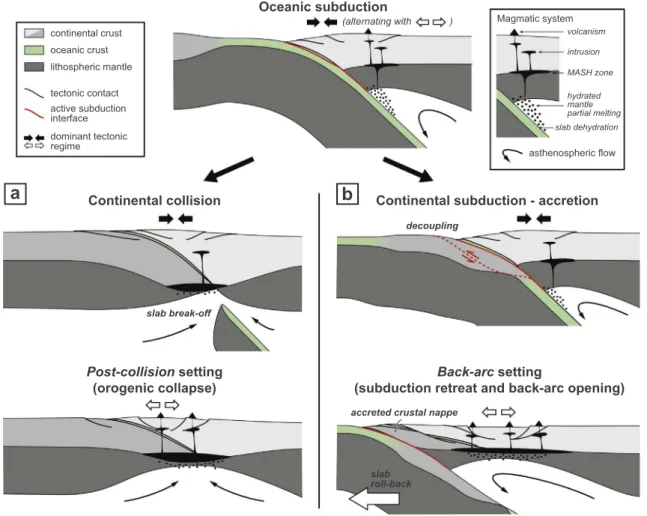
enriched sulfide-bearing residues (Richards, 2009). Two mechanisms may lead to an evolution from subduction to post-subduction environ-ment. One possibility is that continental collision associated with slab Fig. 1. Synthetic tectonic map of the eastern Mediterranean region where are represented all metal occurrences considered in the kinematic reconstruction model. Detailed map of the Cyclades archipelago is shown as inset. Map modified fromJolivet et al. (2013). Metallogenic data compiled from different databases and from the literature (see details in text). CACC: Central Anatolian Crystalline Complex.
break-off follows subduction. This results in collapse of the crustal orogenic wedge in a post-collision context, depending on the dynamic balance between plate-tectonic, gravitational and buoyancy forces (e.g. Iran, Tibet;Fig. 2a) (Bird, 1978; Agard et al., 2011). Alternatively, the subduction zone retreats, leading to back-arc opening and possible sea-floor spreading (e.g. southeast Asia and the Mediterranean region;
Fig. 2b) (Chase, 1978; Jolivet et al., 1999; Faccenna et al., 2014). In this
latter case, the word post-subduction is somewhat misleading as the migrating subduction zone and related asthenosphericflow may still affect the back-arc evolution by modifying the thermal and stress re-gimes. In the eastern Mediterranean region, both back-arc and post-collision environments have been recognized, evolving from a long-lived northward subduction zone below the Eurasian margin.
3. Geodynamic and metallogenic overview of the eastern Mediterranean region
3.1. Tectonic and magmatic evolution since the late Cretaceous
The eastern Mediterranean region consists of an assemblage of ac-creted tectonic units resulting from successive oceanic and continental subduction, collision and obduction events driven by the convergence between Eurasia and Africa since Mesozoic times (e.g. Şengör and
Yilmaz, 1981; Barrier and Vrielynck, 2008). In the late Cretaceous,
northward subduction of a branch of the Neo-Tethys ocean was active below the Eurasian margin and formed a W-E-trending linear orogenic belt, extending from the Balkans-Rhodopes to the eastern Pontides. A magmatic arc developed above this long-lived subduction zone, with
magmas displaying a dominant medium- to high-K calc-alkaline com-position (Yilmaz et al., 1997; Berza et al., 1998; von Quadt et al., 2005;
Özdamar, 2016). Shoshonitic (i.e. high-K alkaline) magmatic rocks are
only restricted to the edges of the Black Sea basin that opened during the Cretaceous (Boccaletti et al., 1978; Eyüboğlu, 2010; Nikishin et al., 2015). In the latest Cretaceous-Eocene, several continental blocks were successively accreted to the Eurasian margin, including the Central Anatolian Crystalline Complex (CACC), the Pelagonian and Tauride platforms, and affected the overriding plate tectonic evolution with significant variations from west to east.
From the Balkans-Rhodopes to the western Pontides, continental accretion occurred by decoupling crustal nappes from the subducting lithosphere (Fig. 2b) that resulted in the building of orogenic belts (i.e. the Hellenides and the Anatolides-Taurides,Fig. 1) (Jolivet et al., 2003;
van Hinsbergen et al., 2005a). As a consequence, subduction did not
cease but progressively migrated southward as attested by the con-tinuous slab imaged by seismic tomography (Wortel and Spakman,
2000; Biryol et al., 2011). New oceanic and continental domains were
then subducted, including the partly oceanic Pindos domain and the Gavrovo-Tripolitza carbonate platform (van Hinsbergen et al., 2005a). Southward propagating compressional front and recording of high-pressure-low temperature (HP-LT) metamorphism (typical of buried rocks in the subduction channel) reinforce the uninterrupted character of this subduction zone (Bonneau and Kienast, 1982; Okay, 1986;
Jolivet et al., 2003). Behind this migrating subduction zone, low- and
high-angle normal faulting resulted in the partial collapse of the Hel-lenides and Anatolides-Taurides belts and the opening of a wide back-arc basin (i.e. the Aegean basin) where metamorphic core complexes
Oceanic subduction
(alternating with )Continental collision
Post-collision setting
(orogenic collapse)
Back-arc setting
(subduction retreat and back-arc opening)
slab roll-back accreted crustal nappe
decoupling
slab break-off
Continental subduction - accretion
b
a
continental crust oceanic crust lithospheric mantle tectonic contact active subduction interface dominant tectonic regime asthenospheric flow Magmatic system slab dehydration hydrated mantle partial melting MASH zone intrusion volcanismFig. 2. Sketches showing two possible evolutions of a typical subduction zone along a continental margin. (a) Subduction zone evolving to collision then post-collision setting after a slab break-off event. (b) Subduction zone evolving to back-arc setting as a result of slab roll-back. Continental accretion may occur by decoupling crustal nappes from the downgoing continental lithosphere with no cessation of the subduction process. MASH zone: Melting, assimilation, storage and homogenization zone.
(MCCs) were exhumed in medium- to high-temperature conditions (e.g. the Rhodope and Menderes massifs and the Cyclades archipelago;
Fig. 1) (Lister et al., 1984; Gautier et al., 1993; Bozkurt and Oberhänsli,
2001; Jolivet et al., 2013). Progressive exhumation of these MCCs
to-ward the south associated with a similar migration of arc and back-arc-related magmatism led many authors to propose that this extensional tectonic setting would result from an increasing rate of southward slab roll-back in the Oligocene-Miocene (Le Pichon and Angelier, 1979; Lister et al., 1984; Jolivet et al., 1994, 2013; Ring et al., 1999, 2010; Jolivet and Faccenna, 2000; Sternai et al., 2014; Govers and Fichtner,
2016; Brun and Faccenna, 2008). Supported by seismic tomographic
models (de Boorder et al., 1998; Wortel and Spakman, 2000; Biryol
et al., 2011), a slab tear is evidenced below western Anatolia. Occurring
in the middle-late Miocene, this tearing event resulted in large-scale block rotations and trench curvature that further accelerated the ex-tensional kinematics (van Hinsbergen et al., 2005b; Jolivet et al., 2015;
Menant et al., 2016b). Coeval with back-arc basin opening, a huge
high-K calc-alkaline to shoshonitic magmatic province formed from north to south (Pe-Piper and Piper, 2006; Ersoy and Palmer, 2013). The mag-matic sources evolved from a dominant crustal source to a mantle source component, especially above the slab tear (Dilek and
Altunkaynak, 2009; Seghedi et al., 2013). Nowadays, the south-Aegean
volcanic arc displays a medium-K calc-alkaline composition supporting the existence of an underlying downgoing oceanic lithosphere (Pe-Piper
and Piper, 2005). In this paper, we consider that the main cause of the
Aegean extension is slab retreat modulated by slab tearing events. However, alternative models have been proposed to explain this ex-tension.Flerit et al. (2004)consider extension results from the dextral displacement along the North Anatolian Fault, whereasDoglioni et al., 2002suggest that extension results from differential convergence rates between the subduction of Africa relative to the disrupted overlying Eurasian lithosphere.
Further east, the eastern Anatolian geodynamic evolution was dif-ferent, characterized by a subduction jump in the latest Cretaceous from the Eurasian margin to the southern Tauride margin rather than a single retreating subduction zone (Rolland et al., 2012). Successive collisional events involving several continental blocks (i.e. the CACC and the Anatolide-Tauride block) thus occurred until thefinal collision stage of Arabia along the Bitlis-Zagros belt in the middle Eocene-Oligocene
(Fig. 1) (Jolivet and Faccenna, 2000; Agard et al., 2005; Rolland et al.,
2012). As suggested by tomographic models (Hafkenscheid et al., 2006), no slab is any longer present below the different suture zones, suggesting that slab break-off events occurred successively in the Cen-ozoic, following these collisions.
3.2. Main metallogenic provinces 3.2.1. The Balkans
Arc-related calc-alkaline plutonic and volcanic rocks in the Balkans are genetically related to porphyry Cu(-Au-Mo), skarn Fe, Cu(-Mo) or Pb-Zn and high-sulfidation epithermal Cu-Au deposits (e.g. Janković, 1997; Berza et al., 1998; Ciobanu et al., 2002; Heinrich and Neubauer,
2002; Moritz et al., 2004). They include the major Moldova Noua
posit in Romania, the Borska Reska, Veliki Krivelj and Majdanpek de-posits in Serbia and the Elatsite, Assarel and Chelopech dede-posits in Bulgaria (Table 1). A few intermediate-sulfidation epithermal deposits with base metal content have also been described (Ciobanu et al., 2002). This magmatic and metallogenic province extends from Ro-mania to Bulgaria, forming a“L”-shape belt called the Apuseni-Banat-Timok-Srednogorie (ABTS) belt (Fig. 1) (von Quadt et al., 2005). Geo-chronological constraints on metal deposits (Re-Os dating on mo-lybdenite) and associated magmatic bodies (U-Pb dating on zircon) indicate a∼20 M.y. period of magmatic-hydrothermal activity along this belt during the late Cretaceous, displaying both trench-parallel (from southeast to northwest) and trenchward (southwestward) de-creasing ages (Ciobanu et al., 2002; von Quadt et al., 2005; Zimmerman
et al., 2008; Gallhofer et al., 2015). Coevally, transtensional tectonics
with NW-SE-trending dextral fault zones occurred in the Timok and western Srednogorie segments while arc-perpendicular extension dominated in the eastern Srednogorie segment, leading to the opening of numerous sedimentary basins (Willingshofer et al., 1999; Bergerat
et al., 2010; Naydenov et al., 2013).
3.2.2. The Rhodopes and Chalkidiki peninsula
Metal deposits in the Rhodope massif and the northeastern part of the Chalkidiki peninsula are part of the Serbomacedonian-Rhodope metallogenic belt (Fig. 1) (Janković, 1997; Heinrich and Neubauer, 2002). They are spatially associated with MCCs exhumed below low-angle normal faults (i.e. the detachments) (Bonev et al., 2006; Brun and
Sokoutis, 2007) and mainly consist of three deposit types. (1) Porphyry
Au-Cu(-Mo) and high-sulfidation epithermal Cu-Au(-Ag) deposits are spatially and genetically related to high-K calc-alkaline to shoshonitic magmatism (e.g. Perama Hill, Skouries and Maronia, Greece) (Kroll
et al., 2002; Voudouris et al., 2011, 2013). (2) Intermediate-sulfidation
epithermal Pb-Zn(-Ag) veins and stockworks and associated manto-type carbonate replacements are located close to the detachments, locally crosscutting these structures (Kalogeropoulos et al., 1989; Marchev and Singer, 2002; Kaiser-Rohrmeier et al., 2004, 2013; Marchev et al., 2005). They form several orefields hosted within either metamorphic rocks (e.g. the Madan and Laki districts in Bulgaria and the Olympias deposit in Greece) or volcanic rocks (e.g. the Zvezdel and Madjarovo districts in Bulgaria). (3) Sedimentary-rock hosted low-sulfidation epi-thermal Au(-Ag) deposits are located within detachment-controlled basins in the eastern Rhodopes. Recent prospects include Ada Tepe and Stremtsi in Bulgaria (Marchev et al., 2004; Márton et al., 2010; Moritz
et al., 2014). Coupledfluid inclusions and isotopic studies on all these
deposits suggest a magmatic source for the metal-bearing fluid that becomes diluted by meteoric water, then triggering metal deposition at shallow depth (Kalogeropoulos et al., 1996; Kilias et al., 1996; Rice
et al., 2007; Moritz et al., 2014). Absolute dating of hydrothermal
al-terations (Ar-Ar dating on adularia and sericite, Re-Os dating on ar-senopyrite) indicates late Eocene-early Miocene mineralizing events, coeval with thefinal exhumation of the Rhodope MCC and the onset of a significant calc-alkaline magmatic event (Marchev and Singer, 2002; Kaiser-Rohrmeier et al., 2004, 2013; Márton et al., 2010; Moritz et al.,
2010; Hahn et al., 2012).
3.2.3. The Cyclades
The Cyclades MCC hosts a large number of metal occurrences albeit with minor metallogenic significance and the fragmentary exposure of outcrops on scattered islands, suggesting favorable conditions for metal deposition (Fig. 1). Most of mineralization consists of (1) porphyry Mo (-Cu) and Fe-rich skarn deposits observed in the Lavrion peninsula and Serifos island (Salemink, 1985; Voudouris et al., 2008, 2010; Ducoux
et al., 2017), (2) Pb-Zn(-Ag-Cu) veins and manto-type carbonate
re-placements, including the Lavrion orefield (Bonsall et al., 2011; Berger
et al., 2013) and (3) Au(-Ag) quartz veins and breccias located close to
crustal-scale detachments or within the detachment plane itself (i.e. on Tinos, Mykonos and Sifnos islands) (Skarpelis, 2002; Neubauer, 2005;
Tombros et al., 2007; Menant et al., 2013). Magmaticfluids are
gen-erally evoked to transport metals while surface-derived meteoricfluids and/or seawater seem to contribute to metal deposition at shallow depth (i.e.≤1 km) (Tombros et al., 2007, 2015; Bonsall et al., 2011;
Berger et al., 2013). No absolute dating has been performed on
al-teration minerals in the Cyclades. However, structural relationships
(Skarpelis, 2002; Menant et al., 2013) and geochronological constraints
on related intrusions (U-Pb dating on zircon) (Iglseder et al., 2009; Liati
et al., 2009; Bolhar et al., 2010) indicate a late Miocene age for
hy-drothermal activity, during the late exhumation stage of the Cyclades MCC (Jolivet et al., 2013and references therein). More recently, in-termediate-sulfidation epithermal Au-Ag(-Mn-Pb) deposits formed along the Pliocene-Quaternary Aegean volcanic arc (e.g. Milos island;Fig. 1)
Table 1 Main ore deposits in the eastern Mediterranean region since the late Cretaceous. Information on their style, metal content, reserve and/or resource s and geochronological constrains are indicated, as well as the reliability of the dating (with 2: robust dating, 1: uncertain dating). Deposit name Country Deposit style Commodities Reserves Age constraint References Major Minor Resources Mineralizing event or associated magmatism Dating method Reliability Moldova Noua Romania Porphyry Cu Au, Mo, Pb, Zn 500 Mt @ 0.4% Cu 72.5 ± 0.4 Ma Re-Os dating on molybdenite 2 Zimmerman et al., 2008 Veliki Krivelj Serbia Porphyry Cu Mo 153 Mt @ 0.3% Cu 506 Mt @ 0.4% Cu 87.9 ± 0.5 Ma Re-Os dating on molybdenite 2 Zimmerman et al., 2008; Jelenkovi ć et al., 2016 Borska Reka Serbia Porphyry Cu Au, Mo 130 Mt @ 0.6% Cu 557 Mt @ 0.6% Cu 86.2 ± 0.5 Ma Re-Os dating on molybdenite 2 Zimmerman et al., 2008; Jelenkovi ć et al., 2016 Majdanpek Serbia Porphyry Cu Au, Mo 144 Mt @ 0.4% Cu 637 Mt @ 0.3% Cu 83.4 ± 0.5 Ma Re-Os dating on molybdenite 2 Zimmerman et al., 2008; Jelenkovi ć et al., 2016 Dumitru Potok Serbia Porphyry Cu Au, Mo, Ag 290 Mt @ 0,2% Cu 81 –79 Ma Re-Os dating on molybdenite 2 Zimmerman et al., 2008; Knaak et al., 2016 Elatsite Bulgaria Porphyry Cu Au 350 Mt @ 0.4% Cu 93 –91 Ma Re-Os dating on molybdenite 2 Zimmerman et al., 2008 Medet Bulgaria Porphyry Cu Mo, Au 244 Mt @ 0.4% Cu 92 –90 Ma Re-Os dating on molybdenite 2 Zimmerman et al., 2008 Assarel Bulgaria Porphyry Cu 254 Mt @ 0.4% Cu 91.6 ± 0.3 Ma Re-Os dating on molybdenite 2 Zimmerman et al., 2008 Derekoy Turkey Porphyry Cu Mo, Au 270 Mt @ 0.3% Cu 76.7 ± 3.8 Ma K-Ar dating on whole rock (hydrothermal facies) 2 Moore et al., 1980; Yigit, 2009 Güzelyayla Turkey Porphyry Cu Mo 186.2 Mt @ 0.3% Cu 50.7 ± 0.2 Ma Re-Os dating on molybdenite 2 Yigit, 2009; Deliba ş et al., 2016b Halila ğa Turkey Porphyry Cu Au, Mo 183 Mt @ 0.3% Cu 39.56 ± 0.21 Ma Re-Os dating on molybdenite 2 Yigit, 2012; Brunetti et al., 2016 ; www.pilotgold.com Cevizlidere Turkey Porphyry Cu Mo, Au 445 Mt @ 0.4% Cu 26.0 ± 0.2 Ma Re-Os dating on molybdenite 2 Marinov et al., 2011; Zürcher et al., 2015 Skouries Greece Porphyry Au Cu 153 Mt @ 0.8 g/t Au 284 Mt @ 0.6 g/t Au 19.9 ± 0.9 Ma Ar-Ar dating on biotite (alteration mineral) 2 Kroll et al., 2002; Siron et al., 2016 ; www.eldoradogold.com K ış lada ğ Turkey Porphyry Au Mo 331 Mt @ 0.7 g/t Au 489 Mt @ 0.6 g/t Au 14.49 ± 0.06 Ma Re-Os dating on molybdenite 2 Yigit, 2009; Baker et al., 2016 .; www. eldoradogold.com Trep ča Stan Terg Serbia Skarn Pb, Zn Ag 31.5 Mt @ 3.5% Pb, 2.9% Zn 16.6 ± 0.5 Ma K-Ar dating on hydrothermal facies 2 Cassard et al., 2012 Akda ğmadeni Turkey Skarn Pb, Zn Ag 25 Mt @ 5.5% Pb, 6.5% Zn Late Cretaceous Geologic inference 1 Yigit, 2009 Balya Turkey Skarn Pb, Zn Cu, Ag, Au 2.3 Mt @ 8% Pb, 8% Zn 28 –23 Ma K-Ar dating on whole rock (alteration facies) 2 Agdemir et al., 1994; Yigit, 2012 Chelopech Bulgaria High-sul fi dation epithermal Au Cu 42.5 Mt @ 3.4 g/t Au (including past production) 93 –91 Ma U-Pb dating on zircon and rutile of volcanics 2 Moritz et al., 2003; von Quadt et al., 2005 Perama Hill Greece High-sul fi dation epithermal Au Ag 9.7 Mt @ 3.1 g/t Au 12.4 Mt @ 3.5 g/t Au 34 –24 Ma K-Ar dating on whole rock (volcanics) + structural evidences 2 Innocenti et al., 1984; Voudouris et al., 2011 Tac Turkey High-sul fi dation epithermal Au Cu 20.4 Mt @ 1.6 g/t Au Late Cretaceous Age of volcanics 2 Yigit, 2006 A ğı Da ğı Turkey High-sul fi dation epithermal Au Ag, Mo 90.1 Mt @ 0.6 g/t Au 26.4 ± 0.9 Ma Ar-Ar dating on alunite (alteration mineral) 2 Yigit, 2009, 2012 ; www.alamosgold. com Alt ıntepe Turkey Intermediate- sul fi dation epithermal Au Pb, Zn 9.5 Mt @ 0.9 g/t Au Late Cretaceous Geologic inference 1 Yigit, 2009 Çöpler Turkey Intermediate- sul fi dation epithermal Au Ag, Cu 52.3 Mt @ 1.7 g/t Au 122.8 Mt @ 1.7 g/t Au 47 –44 Ma Re-Os dating on molybdenite 2 Yigit, 2009; Ku şcu et al., 2013; İmer et al., 2016 Efemçukuru Turkey Intermediate- sul fi dation epithermal (probable) Au Ag 4.2 Mt @ 7.1 g/t Au 4.9 Mt @ 8.3 g/t Au Miocene < 13.17 ± 0.25 Ma Relative age U-Pb dating on rhyolitic dykes 1 Oyman, 2003; Boucher, 2016 ; www. eldoradogold.com Olympias Greece Carbonate replacement Pb, Zn Au, Ag 16.1 Mt @ 4.3% Pb, 5.7% Zn 16.3 Mt @ 4.9% Pb, 6.5% Zn 26.1 ± 5.3 Ma Re-Os dating on molybdenite 2 Kilias et al., 1996; Hahn et al., 2012 ; www.eldoradogold.com (continued on next page )
(Kilias et al., 2001; Naden et al., 2003).
3.2.4. Western Anatolia
The western Anatolian metallogenic province includes several ac-tive mines and numerous recent discoveries of precious- and base-metal prospects located from the Biga peninsula in the north to the Menderes massif in the south (Fig. 1) (e.g.Yigit, 2009, 2012; Sánchez et al., 2016;
Smith et al., 2016). Many of these metal deposits formed in an
exten-sional back-arc context, associated with medium- to high-K calc-alka-line and shoshonitic volcanic and plutonic bodies. Mineralization mainly consists of (1) porphyry Cu-Mo systems, including the Au-rich Kışladağ and the Cu-Au Halilağa deposits (Yigit, 2006, 2009), (2) skarn Fe(-Cu) and Pb-Zn(Au-Cu) deposits (e.g. Balya) (Agdemir et al., 1994) and (3) epithermal Au(-Ag-Cu-Pb-Zn) deposits that are variably high-, intermediate- or low-sulfidation styles (e.g. Ağı Dağı, Efemçu-kuru, Kısacık and Ovacik,Table 1) (Oyman, 2003; Yılmaz et al., 2007;
Yigit, 2012). In some cases, epithermal and porphyry connections have
been observed (e.g. Halilağa and Kuscayiri) (Yılmaz, 2003; Yigit, 2012). Absolute dating of metal deposits or associated volcanic and plutonic rocks gives two main mineralization events in the Biga peninsula (i.e. late Eocene and late Oligocene-early Miocene) (e.g.Murakami et al.,
2005; Yılmaz et al., 2007; Yigit, 2012; Smith et al., 2016), whereas a
middle Miocene mineralized stage is highlighted in the Menderes massif
(Baker et al., 2016; Boucher, 2016). This progressive north-south shift
of the magmatic and hydrothermal activity was coeval with the southward migration of back-arc extension and associated Kazdağ and Menderes MCC exhumation (Bozkurt and Oberhänsli, 2001; Bonev and
Beccaletto, 2007).
Additional fault-related Au-Ag-Sb-Hg deposits hosted by chalcedony veins and highly silicified breccias have been also described in the Kazdağ and Menderes massifs (e.g. the Tuztazi prospect) (Yigit, 2012). As no clear relationship with magmatic bodies is evidenced here, the mineralization has been alternatively interpreted as epithermal or orogenic styles related to the MCC exhumation stage (Larson and Erler,
1993; Akçay et al., 2006; Yigit, 2006).
3.2.5. The eastern Pontides and southeastern Anatolia
The eastern Pontides formed an E-W-trending orogenic belt where numerous deposits have been recognized along the southern margin of the Black Sea basin (Fig. 1), coevally with widespread calc-alkaline to shoshonitic magmatic activity (Yilmaz et al., 1997; Yigit, 2009;
Eyüboğlu, 2010). Copper dominates in these mineralized systems that
consist of (1) porphyry Cu-Mo deposits (e.g. Güzelyayla) (Delibaş et al.,
2016a,b), (2) epithermal-type precious and base metal-rich veins with
mainly high- or intermediate-sulfidation styles, (e.g. Altıntepe and Tac)
(Yigit, 2006, 2009) and (3) dominant Kuroko-type volcanogenic
mas-sive sulfide (VMS) Cu(-Pb-Zn-Au-Ag) deposits (e.g. Murgul and Çayeli;
Fig. 1,Table 1) (Yigit, 2009; Abdioğlu et al., 2015). Geochronological
constraints on ore-related alteration minerals (K-Ar and Ar-Ar dating) and intrusions (U-Pb dating on zircon) highlighted a long-lived miner-alizing event lasting from the Cretaceous to the early Eocene (e.g.
Abdioğlu et al., 2015; Delibaş et al., 2016b).
Further south, several metal deposits have also been described in southeast Anatolia, although this region remains largely underexplored
(Fig. 1) (Yigit, 2009; Kuşcu et al., 2013). Recent Ar-Ar and U-Pb dating
on magmatic rocks and alteration zones led to the identification of two metallogenic events. (1) In the late Cretaceous, subduction to post-subduction porphyry Cu(-Au-Mo) and Iron Oxide Copper-Gold (IOCG) systems formed, related to calc-alkaline to alkaline magmatism (e.g. Divriği and Hasançelebi) (Kuşcu et al., 2011) and (2) in the Eocene, porphyry and epithermal Cu-Au and skarn Fe(-Cu) deposits developed, related to calc-alkaline intrusions (e.g. the Çöpler porphyry-epithermal deposit) (İmer et al., 2016).
Table 1 (continued ) Deposit name Country Deposit style Commodities Reserves Age constraint References Major Minor Resources Mineralizing event or associated magmatism Dating method Reliability Ada Tepe Bulgaria Low-sul fi dation epithermal Au Ag 6.9 Mt @ 3.5 g/t Au 36 –35 Ma Ar-Ar dating on adularia (alteration mineral) 2 Marchev et al., 2004; Márton et al., 2010; Moritz et al., 2010 ; www. dundeeprecious.com Ovacik Turkey Low-sul fi dation epithermal Au Ag 1.2 Mt @ 13.1 g/t Au 4.2 Mt @ 7.6 g/t Au 18.2 ± 0.2 Ma Ar-Ar dating on adularia (alteration mineral) 2 Yigit, 2006, 2009; et al., 2007 K ısac ık Turkey Low-sul fi dation epithermal Au Ag 56.5 Mt @ 0.6 g/t Au Late Miocene Age of volcanics 1 Yigit, 2012 Murgul Turkey VMS Cu 71.8 Mt @ 1.1% Cu 75 –60 Ma K-Ar dating on illite (alteration mineral) 1 Çagatay and Eastoe, 1995; Abdio ğlu et al., 2015 Madenkoy Turkey VMS Cu Zn, Au, Ag 36.3 Mt @ 2% Cu Eocene Geologic inference 1 Yigit, 2009 ; www.parkelektrik.com.tr
4. Kinematic reconstruction modeling
Discussing the influence of subduction and post-subduction pro-cesses on ore genesis in the eastern Mediterranean region requires consideration of the geological, magmatic and metallogenic data de-scribed above. In this study, we integrate all these constraints, using a recently proposed kinematic reconstruction model for this region
(Menant et al., 2016b) and a detailed compilation of metallogenic data.
4.1. Methodology for kinematic reconstruction modeling
Based on the principle of plate motion, we performed detailed ki-nematic reconstructions of the eastern Mediterranean region since the late Cretaceous, using the interactive plate-tectonic reconstruction and visualization software GPlates (www.gplates.org) (Boyden et al., 2011). We thus defined 56 domains consisting of rigid lines and deforming areas that move independently in a global plate kinematic model con-stituted by 30 rigid polygons (Barrier and Vrielynck, 2008). Motions of the deforming domains were constrained using paleomagnetic, tectonic and metamorphic data (for details on geological constraints and re-construction process, seeMenant et al., 2016b). All motions were de-fined with respect to the Moesian platform (Fig. 1) that is considered as belonging to stable Eurasia since the late Cretaceous (van Hinsbergen
et al., 2008).
4.2. GIS database compilation of metallogenic data
We compiled 303 metal deposits from available databases (Singer
et al., 2008; Cassard et al., 2012; Zürcher et al., 2015) and additional
published data described above (Table 1; for the complete GIS database,
seeSupplementary Material, Table S1). In the database, the deposits are
characterized by their size (i.e. measured and indicated reserves and resources when available), their metal content (i.e. Cu, Au, Pb, Zn, Mo, Fe) and their style (i.e. from magmatic proximal, with porphyry, skarn, IOCG, high-sulfidation epithermal and VMS; to magmatic distal, with intermediate- and low-sulfidation epithermal, and carbonate replace-ment; unspecified styles such as sediment-hosted and fault-related are also included). To ensure the link between temporally constrained
subduction-related mantle and crustal processes and ore-forming me-chanisms, the timing of metal deposition has to be constrained as ac-curately as possible. When available, we consider the absolute age of mineralization (Re-Os dating method on molybdenite, arsenopyrite and pyrite) (e.g.Ciobanu et al., 2002; Zimmerman et al., 2008) or hydro-thermal alteration (K-Ar and Ar-Ar dating methods on alteration mi-nerals) (e.g.Kaiser-Rohrmeier et al., 2004; Moritz et al., 2010; Yigit, 2012). In addition, as many deposits are associated with magmatic processes, the absolute age of genetically related magmatic bodies is also compiled (e.g.von Quadt et al., 2005; Kuşcu et al., 2013). Where no absolute ages for hydrothermal and magmatic processes are avail-able,field evidence is used to provide a relative age of mineralization (e.g.Neubauer, 2005; Voudouris et al., 2011; Menant et al., 2013). The metallogenic database is then integrated to the kinematic reconstruc-tion model by attaching each deposit to the deforming domain to which it belongs, thus moving with it in the process of reconstruction. 5. Geodynamic and metallogenic evolution of the eastern Mediterranean region
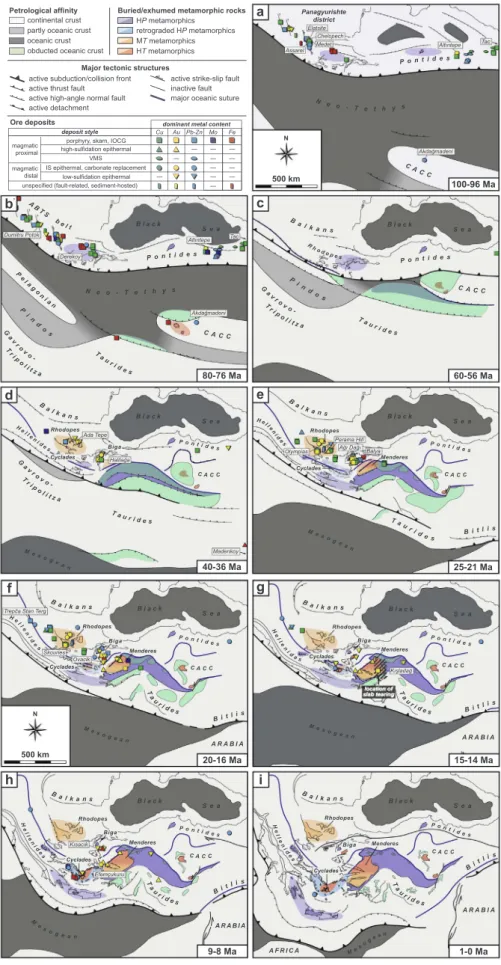
By combining our kinematic reconstruction model with our new metallogenic database, we obtain 23 detailed paleotectonic maps il-lustrating the geodynamic and metallogenic evolution of the eastern Mediterranean region since the late Cretaceous (seeFig. 3for the most critical time periods). The full set of paleotectonic maps as well as a movie of these kinematic reconstructions are also available (see
Supplementary Material, Fig. S1 andMovie S1). In this section, we
focus on the description of the metallogenic evolution and associated main tectonic events (see Menant et al. (2016b) for a detailed de-scription of the geodynamic and magmatic evolution).
5.1. Late Cretaceous
During the late Cretaceous, the eastern Mediterranean subduction zone was located∼1,000 km northward from its present-day position. The Eurasian margin formed an NW-SE- to W-E-trending linear oro-genic belt over 2000 km in length from the Balkans to the eastern Pontides. During this time period, > 750 km of the Neo-Tethys oceanic lithosphere was consumed by subduction, leading to the formation of a Movie S1. Tectonic and metallogenic evolution of the eastern Mediterranean region since the late Cretaceous deduced from the kinematic reconstruction model. Each time step corresponds to 5 Myrs between 100 and 15 Ma and 2 Myrs after 15 Ma. Tectonic and metallogenic evolution of the eastern Mediterranean region since the late Cretaceous deduced from the kinematic reconstruction model. Each time step corresponds to 5 Myrs between 100 and 15 Ma and 2 Myrs after 15 Ma can be found onhttp://dx.doi.org/10.1016/j.oregeorev.2018. 01.023
? ? ? ? ? Dumitru Potok
Petrological affinity Buried/exhumed metamorphic rocks
HP metamorphics
Major tectonic structures
active subduction/collision front active thrust fault active detachment active high-angle normal fault
inactive fault active strike-slip fault major oceanic suture obducted oceanic crust
oceanic crust partly oceanic crust continental crust
MT metamorphics retrograded HP metamorphics HT metamorphics
Ore deposits dominant metal content deposit style Cu Au Pb-Zn Mo Fe
porphyry, skarn, IOCG magmatic proximal magmatic distal high-sulfidation epithermal VMS IS epithermal, carbonate replacement
low-sulfidation epithermal unspecified (fault-related, sediment-hosted)
a
b
c
d
e
100-96 Ma 500 km N P o n t i de s AB T S b el t P o n t i de s P o n t i de s P o n t i de s N e o - T e t h y s N e o - T e t h y s C AC C B l a c k S e a B l a c k S e a B l a c k Rhodopes Cyclades S e a C A C C C A C C C A C C Pe l ag on i an P in d o s P i nd os T a u r i de s T a u r i de s T a u ri d e s T a u ri d e s B a l k an s R ho d o p e s B a l ka n s Biga P o n t i de s B l a c k Rhodopes S e a C A C C B a l ka n s Menderes Cyclades B i t l is M es o g ea n M es o g ea n Altıntepe Elatsite Chelopech Medet Assarel Akdağmadeni Akdağmadeni Derekoy Perama Hill Ağı Dağı Balya Halilağa Ada Tepe Olympias 80-76 Ma 60-56 Ma 40-36 Ma 25-21 Ma Altıntepe Tac H e l l en i d es H e ll e n i d es Tac Madenkoy Panagyurishte district G av r ov o -T r ip o li t z a G a v ro v o -T r i p o l it z a G a v ro v o -T r i p o l it z af
g
h
i
P o n t i de s P o n t i de s P o n t i de s B l a c k A R A B I A A R A B I A A R A B I A A R A B I A A F R I C A S e a B l a c k S e a B l a c k S e a C A C C C A C C C A C C T au r i de s T au r i de s B a l k a n s B a l k a n s B a l k a n s B a l k a n s Rhodopes Biga P o n t i d e s B l a c k Rhodopes S e a C A C C Biga Menderes Menderes Cyclades Rhodopes Biga Menderes Cyclades Rhodopes Biga Menderes Cyclades Cyclades B i tl i s B i tl i s M e s o ge a n T au r i de s Bi t l i s M e s o g ea n T au r i de s Bi t l is M es o g ea n M e so g e a n Trepča Stan TergKısacık Ovacik Kışladağ location of slab tearing Efemçukuru 500 km N 20-16 Ma 15-14 Ma 9-8 Ma 1-0 Ma H el l e n i d e s H e l le n i de s H e l le n i de s H e l le n i de s Skouries
Fig. 3. (a–i) Paleotectonic maps extracted from the kine-matic reconstruction model evidencing the spatial and temporal evolution of metal deposits in the eastern Mediterranean region since the late Cretaceous. Main ore deposits listed inTable 1are evidenced by their name. HP: metamorphics: high-pressure metamorphics. MT: morphics: medium-temperature metamorphics. HT: meta-morphics: high-temperature metamorphics. IS epithermal: intermediate-sulfidation epithermal. ABTS belt: Apuseni-Banat-Timok-Srednogorie belt. CACC: Central Anatolian Crystalline Complex.
magmatic arc and associated metal deposits 110–200 km away from the trench. Dominant Cu-rich mineralization thus formed (64 known oc-currences,Fig. 4), mainly as porphyry deposit type in the Balkans and the eastern Pontides (Fig. 3a, b). Epithermal and skarn deposits have also been recognized with precious and/or base metal content (15 Au-rich, 20 Pb-Zn-rich and 17 Fe-rich known occurrences). In addition, some porphyry Mo(-Cu) and VMS Cu(-Pb-Zn-Au) deposits formed in the eastern Pontides (5 and 9 known occurrences, respectively). In the ABTS metallogenic belt, these mineralized systems are exposed as NNE-SSW-oriented clusters, probably located along dextral strike-slip fault zones, such as for the Panagyurishte district (Fig. 3a). Conversely, E-W-trending extensional basins controlled the emplacement of the deposits on the southern margin of the Black Sea basin.
5.2. Latest Cretaceous-Eocene
In the latest Cretaceous-early Eocene, the Pelagonian platform and the Anatolide-Tauride block, two Africa-derived continental domains, were successively accreted on to the Eurasian margin (Fig. 3c). As de-scribed above, subduction progressively migrated in the Aegean-wes-tern Anatolian region, consuming the partly oceanic Pindos domain and the Tauride platform (Fig. 3d). During this period, the overriding con-tinental plate was characterized by dominant compressional tectonics and a decrease in the number of known deposits. Only 22 known oc-currences are then evidenced in the Rhodope massif and the Biga pe-ninsula (Fig. 4a), mainly consisting of late Eocene porphyry and low-sulfidation epithermal Au-rich systems formed 180–250 km away from the trench (Fig. 3d).
Further east, the geodynamic and metallogenic evolution of eastern Anatolia is different. Subduction zones were successively blocked, re-placed by“true” collisional events involving the Eurasian margin, the
CACC, the Anatolide-Tauride block and the Arabian plate. In this gion, a significant magmatic-hydrothermal activity has been re-cognized, resulting in the formation of dominant porphyry Cu-Au and skarn Fe deposits (15 and 4 known occurrences, respectively) (Fig. 4b). 5.3. Oligocene
In the Oligocene, an acceleration of the southward subduction re-treat led to back-arc opening and progressive exhumation of several MCCs, including the Rhodope (whose exhumation started earlier, in the Eocene), the Kazdağ and the Menderes massifs and the Cyclades ar-chipelago. Coeval with this extensional tectonic setting, numerous mi-neralized bodies formed (67 known occurrences), mainly in the central Rhodope massif with intermediate-sulfidation epithermal and carbo-nate-replacement Pb-Zn-rich deposits and in the Biga peninsula with high-sulfidation epithermal Au and porphyry Cu(-Mo-Au) deposits (Figs.3e and4a). All these occurrences formed 230–330 km away from the trench.
The final late Eocene-Oligocene collisional stage between the southern Tauride margin (belonging now to Eurasia) and the Arabian plate in eastern Anatolia was coeval with a relative quiescence in the hydrothermal activity with only one known deposit of Oligocene age (i.e. the Cevizlidere porphyry Cu(-Mo-Au) deposit;Fig. 4b).
5.4. Neogene
In the Miocene, and especially since∼15 Ma, the southward retreat of the subduction zone further accelerated and the Aegean back-arc basin was intensively stretched as a result of slab tearing below western Anatolia. MCCs were rapidly exhumed up to the surface while mag-matic and mineralized systems were progressively emplaced southward Fig. 4. Bar charts evidencing the distribution of metal occurrences as function of their metal content (upper panel) and deposit typology (lower panel) for late Cretaceous, Paleocene-Eocene, Oligocene and Neogene periods. Distinction is made between the Balkans-Rhodope-Aegean-western Anatolian region (a) and the central and eastern Pontides-Anatolian region (b). HS: high-sulfidation. IS: intermediate-sulfidation. LS: low-sulfidation.
(Fig. 3f–h). Mainly low-sulfidation epithermal Au-rich and inter-mediate-sulfidation epithermal Pb-Zn-rich deposits thus formed 200–400 km away from the trench (16 and 13 known occurrences, re-spectively;Fig. 4a). We note also the occurrence of magmatic proximal deposits, such as Au-rich porphyries, skarns and high-sulfidation thermals (9 known occurrences). Young intermediate-sulfidation epi-thermal systems of Pliocene-Pleistocene age are only distributed along the present-day Aegean volcanic arc (e.g. on Milos island; Fig. 3i). However, this does not preclude other mineralized complexes at depth in this region.
The ongoing collision between Eurasia and Arabia in eastern Anatolia is associated with only four mineralized occurrences formed in the overriding plate during the Miocene-Pliocene (Fig. 4b).
6. Discussion
In this study, our kinematic reconstructions provide details on the link between the long and complex tectonic history of the eastern Mediterranean region and its metallogenic evolution. Despite the large amount of geological constraints considered in our reconstruction model, uncertainties remain about the scenario presented above. The spatial and temporal distribution of metal deposits depends on the degree of exposure of outcrops and on the advances of mineral ex-ploration projects. However, considering the tectonic and metallogenic framework at a regional scale, we are able to discuss (1) thefirst-order influence of 3D subduction dynamics on the change of metal content in mineralized systems, (2) the role of stress regime and crustal-scale structures on the spatial distribution of metal deposits and (3) the metallogenic variability between back-arc and post-collision settings along the Tethyan orogenic belt.
6.1. From Cu- to Au-rich mineralization
Continuous southward retreat of the subduction zone from the Balkans to the Aegean-western Anatolian region since the late Cretaceous was associated with a similar migration of magmatic-hy-drothermal activity (Fig. 3) (Pe-Piper and Piper, 2006; Dilek and
Altunkaynak, 2009; Menant et al., 2016b). Associated with this arc
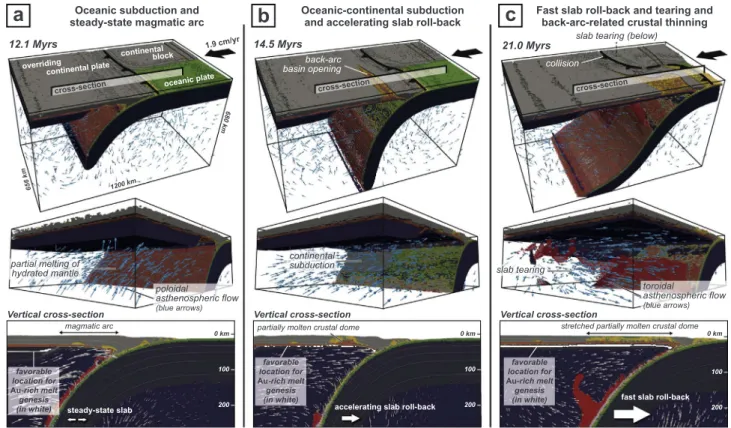
retreat and associated back-arc opening, we note the metallogenic evolution from Cu-rich deposits in the late Cretaceous to Pb-Zn- and finally Au-rich deposits in the Oligocene-Miocene (Fig. 5). In this sec-tion, we discuss for each metallogenic period the influence of 3D sub-duction dynamics on magmatic and hydrothermal processes responsible for this variable metal enrichment. Results from 3D thermo-mechanical numerical modeling of subduction and associated magmatic processes are also integrated into this discussion, providing physical constraints on the geodynamic and magmatic evolution (Fig. 6; for details on the modeling procedure and initial setup, seeMenant et al. (2016a)). The numerical model presented here is characterized by (1) the subduction of oceanic lithosphere, resulting in hydrous partial melting in the mantle wedge (Fig. 6a), (2) the coeval subduction of oceanic and continental lithosphere, resulting in trench curvature and the pro-gressive opening of a back-arc basin (Fig. 6b) and (3) a major slab tearing event at the transition between the continental and oceanic downgoing lithosphere, resulting in continental collision above the tear on one side of the model and fast retreat of oceanic subduction on the other side (Fig. 6c).
6.1.1. Steady-state subduction associated with Cu-rich deposits
In our kinematic reconstructions, the late Cretaceous period is characterized by a long and linear subduction zone along the Eurasian margin where dominant porphyry Cu(-Mo-Au), Fe and Cu(-Mo) skarns and high-sulfidation Au-Cu deposits formed (Figs.3a, b and7a), asso-ciated with typical medium- to high-K calc-alkaline arc magmatism. They are located∼150 km away from the trench, implying an overall slab dip of 28–36° if we consider an 80–110 km minimal depth for the subducting lithosphere, below which hydrous partial melting of peri-dotite occurs (Fig. 6a) (Grove et al., 2006; Menant et al., 2016a). An important feature evidenced in this study is that the Eurasian active margin remained relatively stable during a long period (> 35 Myr) with a limited southward trench migration, probably because of the large slab width (> 2000 km) that increased viscous resistance of mantle on the slab (Faccenna et al., 2003; Loiselet et al., 2009). In agreement with
Bertrand et al. (2014), we argue that this long-lived steady-state
sub-duction dynamics associated with a relatively high convergence rate (2–4 cm/yr) promoted continuous and/or multistage partial melting in
Present-day latitude (°N) 100 90 80 70 60 50 40 30 20 10 0 Age (Ma) 42 38 40 36 34 44 46
late Cretaceous Paleocene Eocene Oligocene Miocene Plio.- Q.
Rhodope MCCs
Aegean-western Anatolian domain
(Cyclades and Menderes MCCs)
AB TS
b el t
increasing rate of slab roll-back
slab tearing and trench curvature accretion of the Pelagonian and
the Tauride carbonate platforms
medium- to high-K calc-alkaline compression
extension (or transtension)
medium- to high-temperature MCC
(see Fig. 3 for detailed legend) Magmatism
Dominant stress regime
Metamorphic Core Complex (MCC)
high-K calc-alkaline to shoshonitic alkaline
Ore deposits
Fig. 5. Latitude-age diagram evidencing the spatial and temporal distribution of the main tectonic, metamorphic, magmatic and metallogenic events in the Balkans-Rhodope-Aegean-western Anatolian region since the late Cretaceous. Only metal occurrences whose timing of emplacement is constrained by absolute dating methods are represented (colored symbols with the 2σ error bar of dating). ABTS belt: Apuseni-Banat-Timok-Srednogorie belt.
a restricted part of the mantle wedge, resulting in large volumes of potentially fertile magmas (Fig. 7a). This is a reasonable explanation for the large size of these arc-related deposits formed in a transtensional to extensional tectonic setting (Table 1), as such a stress regime is usually not expected to favor large mid- to upper-crustal magmatic chambers required to form giant porphyry deposits (von Quadt et al., 2005;
Sillitoe, 2010). These late Cretaceous magmatic proximal deposits share
many characteristics with those formed above active subduction zones, such as along the Andean Cordillera, suggesting similar physico-che-mical processes responsible for metal transport and deposition (see review ofSillitoe (2010)). Ascending, metal-bearing magmas formed in the mantle wedge were thus characterized by a high Cu/Au ratio due to the better partitioning of Cu relative to Au into silica melts in this sub-arc environment (Richards, 2009; Li and Audétat, 2012), which can explain the high Cu content of porphyry deposits in the Balkans (Fig. 5). In the eastern Pontides, late Cretaceous porphyry deposits display a significant enrichment in Mo and are associated with high-K calc-al-kaline to shoshonitic magmatism (Delibaş et al., 2016a). Such a com-position of late Cretaceous magmas is observed all along the southern margin of the Black Sea basin that was coevally opening (Nikishin et al., 2015). This led us to suggest that the formation of this oceanic basin is (at least partly) responsible for this magmatic signature and for the Mo enrichment in porphyry deposits. In addition, spatially and temporally associated Kuroko-type VMS Cu(-Pb-Zn-Au-Ag) deposits imply a heated sea water flow and therefore a sub-marine environment (Abdioğlu
et al., 2015), also consistent with the formation of the Black Sea.
The late Cretaceous evolution of the eastern Mediterranean region agrees with the initial stage of our 3D numerical model where sub-duction of homogeneous oceanic lithosphere results in hydrous partial melting of the mantle wedge and magmatic arc formation in the over-riding plate (Fig. 6a). Related asthenospheric flow with a dominant poloidalflow component (i.e. in vertical plane) initiated at the slab tip
then supported intense partial melting by providing additional heat to the mantle wedge.
6.1.2. From accretion to retreating subduction and MCC exhumation, implications for Pb-Zn-rich deposits
In the latest Cretaceous-Eocene, subduction and accretion of several continental blocks occurred along the Eurasian margin, leading to compressional tectonics in the overriding plate and a sudden decrease of magmatic-hydrothermal activity (Fig. 5). In this study, no miner-alization of Paleocene age is evidenced in the Balkans (Fig. 3c). A reasonable assumption to explain this barren period is the change of subducting material (from oceanic to continental lithosphere) that avoided hydrous partial melting of the mantle wedge and mobilization of metals. This contrasts with eastern Anatolia where magmatic prox-imal and distal deposits, and especially porphyry Cu-Au-Mo deposits, formed in a post-collision setting (Kuşcu et al., 2013; Delibaş et al.,
2016b).
The collision then post-collision scenario cannot be applied to the Rhodope-Aegean-western Anatolian region as subduction did not cease but progressively migrated southward (Fig. 3d). This resulted in a new fertile period in the central Rhodope massif and Chalkidiki peninsula where intermediate-sulfidation epithermal and carbonate replacement Pb-Zn(-Ag) deposits formed in the latest Eocene-Oligocene (Fig. 4a). In our reconstructions, these deposits are spatially associated with meta-morphic domes (i.e. the MCCs) and high-K calc-alkaline to shoshonitic magmatism (Figs.3d, e and7b; see alsoMenant et al., 2016bfor the distribution of magmatism), emphasizing the extensional back-arc tec-tonic setting for this metallogenic province. Available Pb isotopic ana-lyses of ore sulfides indicate a crustal inheritance for this metal (and probably for Zn and Ag) (Kalogeropoulos et al., 1989; Marchev et al., 2005). This is consistent with the dominant magmaticfluids involved in ore forming processes that display a high crustal source component
back-arc
basin opening collision
overriding continental plate
continentablockl oceanic plate
1.9 cm/yr
cross-section cross-section cross-section
Oceanic subduction and steady-state magmatic arc
s r y M 5 . 4 1 s r y M 1 . 2 1 21.0 Myrs Oceanic-continental subduction
and accelerating slab roll-back Fast slab roll-back and tearing and back-arc-related crustal thinning
slab tearing (below)
continental
subduction slab tearing
partial melting of hydrated mantle poloidal asthenospheric flow (blue arrows) toroidal asthenospheric flow (blue arrows) favorable location for Au-rich melt genesis (in white) favorable location for Au-rich melt genesis (in white) favorable location for Au-rich melt genesis (in white) magmatic arc 0 km 100 200 0 km 100 200 n o i t c e s -s s o r c l a c i t r e V n o i t c e s -s s o r c l a c i t r e V Vertical cross-section
steady-state slab accelerating slab roll-back
fast slab roll-back
partially molten crustal dome stretched partially molten crustal dome
a
b
c
1200 km 65 6 k m 68 0 km 0 km 100 200Fig. 6. Results from 3D thermo-mechanical modeling of complex subduction zone characterized by oceanic and continental subduction, slab roll-back and tearing (for details on the modeling procedure and evolution of the model, the reader is referred toMenant et al. (2016a)). (a) Initial stage of oceanic subduction. (b) Second stage of coeval oceanic and continental subduction. (c) Third stage of slab tearing, continental collision and continuing fast retreating oceanic subduction. The two upper panels show 3D views of the overall evolution of the model and the lower panel shows 2D cross-sections of the arc and back-arc regions where are evidenced favorable zones in the lithospheric mantle to form Au-rich magmas, according to
(e.g.Rice et al., 2007). FollowingKaiser-Rohrmeier et al. (2013), we then propose the following scenario to link subduction dynamics with ore forming processes in this region (Fig. 7b). Continental accretion along the Eurasian margin in the early Cenozoicfirst resulted in crustal
thickening, leading to partial melting of the lower crust and develop-ment of migmatitic domes. In the late Eocene, crustal thinning arose from the increasing rate of southward subduction retreat (i.e. 0.5–1 cm/ yr in our reconstructions), promoting crustal heating and exhumation of Fig. 7. 3D schematic views of the eastern Mediterranean subduction zone and associated mantle and crustal processes controlling the emplacement of (a) the Cu-rich metallogenic province in the late Cretaceous, (b) the Pb-Zn-rich metallogenic province in the latest Eocene-Oligocene and (3) the Au-rich metallogenic province in the Miocene.
MCCs in the upper crust supported by the underlying asthenospheric flow. This is in line with the second stage our 3D numerical model of subduction zone that is characterized by accelerating slab roll-back and associated opening of a back-arc basin where partially molten crustal rocks are exhumed as a dome-like structure (Fig. 6b). Favourable con-ditions are thus gathered to mobilize Pb, Zn and Ag in magmaticfluids ascending up to the upper crust (Fig. 7b).
In addition, high-sulfidation epithermal Au and porphyry Cu(-Mo-Au) deposits formed during the late Eocene-early Oligocene, especially in the Biga peninsula (Fig. 3e). The typical subduction-related character of these deposits and related magmatism leads us to suggest that the coeval subduction of the partly oceanic Pindos domain may have trig-gered the formation of a short-lived magmatic arc and associated mi-neralization in this region. An alternative interpretation could be a short episode of slab tearing in the Eocene as suggested byGovers and
Fichtner (2016), although there is no clear evidence in the magmatic
record.
6.1.3. Fast retreating subduction and slab tearing, implications for Au-rich deposits
In the late Oligocene-Miocene, numerous Au(-Ag-Cu-Pb-Zn) deposits formed in the Aegean-western Anatolian region while subduction mi-grated fast toward the south, especially since the middle Miocene as slab was torn below western Turkey (Figs. 3f, g, 5and7c; see also
Jolivet et al. (2015)and references therein). Their location, far from the
trench (i.e. 200–400 km in our reconstructions), and the lack of typical magmatic arc confirm the back-arc setting for this mineralization that mainly consists of extension-related low-sulfidation epithermal Au de-posits (Fig. 4a). According to Sillitoe and Hedenquist (2003), S-rich reduced mantle-derived mafic melts would play a fundamental role to form these deposits due to their ability to transport Au, which is con-sistent with the increase of metasomatized mantle (or mafic amphibo-lite) source component of magmas related to the intense crustal thin-ning (Marchev et al., 2005; Dilek and Altunkaynak, 2009).
Coevally, skarn- and porphyry-type deposits displaying a high Au content formed, related to high-K calc-alkaline to shoshonitic magmatic intrusions (e.g. Skouries, Kışladağ, Turkey,Table 1) (Baker et al., 2016;
Siron et al., 2016). Deposition at shallow depth for the mineralization
(e.g. < 1 km? for Kışladağ) can partly explain this Au enrichment
(Baker et al., 2016), as it was pointed out for porphyry Au deposits of
the Refugio district (Chile) (Muntean and Einaudi, 2000). This as-sumption is supported by significant crustal thinning of the back-arc crust in this region due to the accelerating southward migration of the subduction zone (up to 3.5 cm/yr in our reconstructions in the middle Miocene,Fig. 3f–h). Associated extensional stress regime may thus have promoted the fast ascent of potentially fertile magmas and their cooling at shallow depth, favoring porphyry Au-rich deposits (Fig. 7c). Deeper processes have been alternatively proposed to justify this high Au content, involving Au enrichment in the parental magmas. Richards
(2009)argued for the presence of lithospheric mantle or lower crustal
amphibole-rich cumulates containing Au-rich residual sulfide phase originated from afirst-stage sub-arc metasomatism. Subsequent partial melting in a back-arc context then destabilizes these sulfide residues, notably in oxidized conditions (Jugo, 2009), thereby enabling Au re-mobilization in the melt. Another recent study proposed that pressure-temperature (P-T) conditions in the sub-back-arc metasomatized mantle imply that sulfides are essentially expressed as a solid phase (i.e. monosulfide solid solution) that has a lower ability to sequester Au than sulfide liquid if partial melting occurs (Li and Audétat, 2013). Both assumptions then imply primary magmas displaying a relatively low Cu/Au ratio formed in a typical back-arc-related P-T range of 1.0–2.5 GPa and 1050–1150 °C (Conceição and Green, 2004). Ac-cording to these P-T conditions, our 3D numerical model of subduction predicts a zone in the upper part of the lithospheric mantle, below exhuming metamorphic domes, where sulfides are stable as a solid phase (see white patches in Fig. 6). The increasing size of this zone
while subduction retreats faster after slab tearing (Fig. 6c) suggests a more efficient partitioning of Au in magmas formed in this sub-back-arc environment that may be partly responsible for the emplacement of this Au-rich deposits in the eastern Mediterranean region.
Fast retreat of the subduction evidenced in our kinematic re-constructions implies partial melting spreading over a wide area (i.e. the back-arc basin), thus explaining the commonly smaller size of these back-arc-related deposits by comparison with the late Cretaceous de-posits formed in a restricted area above a stagnant slab (Takada, 1994;
Richards, 2003). The giant Kışladağ porphyry Au deposit (Table 1) in
the Menderes massif is an exception in this region. Recent geochrono-logical constraints suggest an emplacement∼14.5 Ma ago (Baker et al., 2016), corresponding to the inferred timing for slab tearing below western Turkey (i.e.∼16–15 Ma) (Jolivet et al., 2015). Given that this deposit is located just above this tear (Fig. 3g) and that this tear strongly influenced the tectonic and magmatic evolution in this region (e.g.Dilek and Altunkaynak, 2009; Jolivet et al., 2015; Menant et al.,
2016a), we suggest that the slab tearing focused asthenosphericflow,
thus promoting intense partial melting of the overlying metasomatized lithospheric mantle and Au mobilization.
To summarize, our reconstructions indicate that the evolution of the 3D geometry and dynamics of the eastern Mediterranean subduction zone since the late Cretaceous have influenced the magmatic and hy-drothermal processes responsible for the successive emplacement of Cu-then Pb-Zn- andfinally Au-rich deposits (Figs. 5 and 7). Three different arc and back-arc settings are identified for each of these metallogenic provinces. (1) A long-lived linear oceanic subduction led to the for-mation of large amounts of Cu-bearing primary magmas in the mantle wedge that subsequently ascended to the upper crust where porphyry and epithermal deposits formed along a narrow magmatic arc (Fig. 7a). (2) Subduction retreated southward, associated with the progressive opening of a back-arc basin where MCCs were exhumed, mobilizing Pb and Zn via crustal magmas (Fig. 7b). (3) A fast retreat of subduction, enhanced by slab tearing, favored the mobilization of Au from the metasomatized lithospheric mantle and the rapid ascent of metal-bearing magmatic-then-hydrothermalfluids through the stretched crust
(Fig. 7c). The steady-state or, instead, fast-retreating kinematics of
subduction also had a major impact on the amount of potentially fertile magmas produced either in a restricted sub-arc area or below a wide back-arc basin, thus influencing the size and the economic potential of these deposits.
6.2. Structural control of mineralization
In addition to influence metal mobilization through magmatic and/ or hydrothermal fluids, subduction dynamics also determines the dominant stress regime in the overriding plate that, in turn, influences the ascent of metal-bearing fluids through the crust and the spatial distribution of resulting metal occurrences (e.g.Tosdal and Richards,
2001; Richards, 2003).
6.2.1. Late Cretaceous transtensional to extensional stress regime During the late Cretaceous, a transtensional to extensional crustal stress regime was recorded in the Balkans-Pontides belt, resulting from slab steepening and/or subduction retreat at very slow rate (i.e. ∼ 0.1 cm/yr) (Gallhofer et al., 2015; Menant et al., 2016b). In the major part of the Balkans, strike-slip and pull-apart structures thus developed, such as in the Panagyurishte district, focusing the ascent of fertile magmas into the upper crust (Fig. 7a; see alsoGallhofer et al.
(2015)). Such regularly-spaced structures can then explain the deposit
clustering along this active margin (Fig. 3b), as proposed for the An-dean Cordillera where deposit clusters are located at the intersection between trench-parallel faults and crosswise structural corridors
(Richards et al., 2001) (see alsoFig. 2inSillitoe (2010)). Alternatively,
recent numerical models suggested that the ascent of partially molten rocks in the mantle wedge (considered as the main source for primary