Designing Education
for
Twice-Exceptional Learners
by
John Francis Stillman
B.A., Design (1991)
University of California Los Angeles
Submitted to the Integrated Design and Management Program in partial fulfillment of the requirements for the degree of
Master of Science in Engineering
at the
Massachusetts Institute of Technology June 2018
0 John F Stillman. All rights reserved.
The author hereby grants to MIT permission to reproduce and to distribute publicly paper and electronic copies of this thesis document in whole or in part in any medium now known or hereafter created.
Signature redacted
Signature of Author_____Sgaueo h lnt ed Design and Management Program May 12, 2018
Certified by
Signature
redacted-Marik&. Yang Associate Professor of Mechanical Engineering
Thesis Supervisor
Accepted by
Signature redacted
MASSACHUSETTS INSTITUTE Matthew S. Krissy
OF TECHNOLOGY Executive Director, Integrated Design and Management Prog am
JUN 2
0
2018
Designing Education
for
Twice-Exceptional Learners
byJohn Francis
Stillman
Submitted to the Integrated Design and Management Program
in partial fulfillment of the requirements for the degree of Master of Science in Engineering
Abstract
Gifted and talented students with coexisting learning disabilities, also known as twice-exceptional, are increasingly recognized in U.S. schools. This increasing awareness needs to
be met with improved legal protection, better methods for identification and optimized teaching strategies for the unique needs of these students. For this thesis, literature from a range of disciplines including education, cognitive science, and psychology regarding twice-exceptionality is examined, with a specific focus on gifted students with language-based learning disabilities like dyslexia, along with commonly comorbid factors such as ADHD and anxiety. The challenges of these students are also modeled using human centered design tools. Personas of archetypal twice-exceptional students are presented to create empathy for them and awareness of their unmet needs. Design frameworks are examined that aim to improve education universally for all students. Research strongly suggests that
twice-exceptional students are under-identified and underserved in our schools and that
comprehensive, individualized teaching strategies are necessary in order for them to reach their full potential. Teaching methods are outlined that simultaneously highlight strengths and accommodate the challenges of this important group of gifted learners.
Thesis Supervisor: Maria C. Yang
Acknowledgments
The work contained in this thesis would not have been possible without the help of many wonderful individuals.
A very special thanks to Maria Yang, my thesis advisor, for encouraging me to tug on a
personally meaningful thread.
Sincere gratitude goes out to the experts I interviewed for this thesis:
John Gabrieli, Director of the Athinoula A. Martinos imaging Center at MIT's McGovern Institute Eric Falke, Director of Cognitive Interventions and Research at The Carroll School
Kathleen Monagle, Associate Dean of MIT Student Disability Services
Jessica Geragosian, Pediatric Neuropsychologist
I'm deeply indebted to Pushpa Prabakar, my classmate, collaborator and friend for helping me manage drinking from the MIT firehose.
I'd also like to thank all of my incredible classmates in IDM, the family I never knew I had.
I'd like to extend my gratitude to my friends Mike Schmitt, Matt Wallin and Mike and Lisa
Herring who encouraged me to forge ahead on what might be considered an absurd path. I'm thankful for the seemingly effortless grace and endless hospitality of Matt Patsky and Jun Untalan.
I'd like to thank Matt Kressy, Director of MIT's Integrated Design and Management whose
vision made this adventure possible for myself and my cohort.
Furthermore, I would like to thank Andy MacInnis, IDM Workshop Guru for being a great mentor and friend.
I'd like to thank my mom and dad, Kate and Frank Stillman, not only for their unending love
but also for exemplifying successful lifelong learning. Their help on this thesis, pointing out my spelling errors and muddled logic, are a lovely echo of the limitless support they have given me throughout my schooling.
Most of all I'd like to thank my wife and kids Valerie, Gus and Joy for their love, support and continual sacrifices over the last 2 years.
Table of Contents
ABSTRACT 3 ACKNOWLEDGMENTS 5 TABLE OF CONTENTS 7 LIST OF FIGURES 9 CHAPTER 1: INTRODUCTION 11 CHAPTER 2: BIOGRAPHY 12CHAPTER 3: THE TWICE-EXCEPTIONAL PARADOX 15
3.1 DEFINING THE SCOPE OF 2E 15
3.2 THE PREVALENCE OF 2E STUDENTS 16
CHAPTER 4: LEARNING DISABILITIES 18
4.1 QUALIFYING LEARNING DISABILITIES UNDER IDEA 18
4.2 THE RIGHT TO A FREE AND APPROPRIATE EDUCATION 18
4.3 IEPS AND 504 PLANS 19
CHAPTER 5: GIFTED AND TALENTED 21
5.1 FEDERAL DEFINITIONS OF "GIFTED & TALENTED" 21
CHAPTER 6: THE CHALLENGE OF IDENTIFYING 2E STUDENTS 22
6.1 PROBLEMS WITH IDENTIFYING TWICE-EXCEPTIONALITY UNDER IDEA 22
6.1.1 USING THE WISC AS A DIAGNOSTIC TOOL 23
6.1.2 STRUGGLES PARTICULAR TO 2E STUDENTS 24
CHAPTER 7: DYSLEXIA 26
7.1 WHAT IS DYSLEXIA? 26
7.2 PREVALENCE OF DYSLEXIA 26
7.3 DYSLEXIA AND 2E KIDS 27
7.4 THE PSYCHOLOGY OF DYSLEXIA 27
7-5 THE NEUROBIOLOGY OF DYSLEXIA 30
7.5.1 DIAGNOSING DYSLEXIA 35
7.5.2 TEACHING STRATEGIES FOR DYSLEXIA REMEDIATION 36
7.6 THE STRENGTHS OF DYSLEXICS 37
7.6.1 Do DYSLEXICS TEND TO HAVE ENHANCED VISUAL-SPATIAL ABILITIES? 37 7.6.2 CREATIVE APPROACHES GAINED THROUGH OVERCOMING DYSLEXIA 37
7.6.3 RESEARCH ON THE COGNITIVE AND PERCEPTUAL ABILITIES OF DYSLEXICS
CHAPTER 8: OTHER PREVALENT LEARNING DISABILITIES IN 2E STUDENTS 41
8.1 CONDITIONS THAT FREQUENTLY CO-OCCUR WITH DYSLEXIA 41
8.1.1 ADHD 41
8.1.2 AUDITORY PROCESSING DISORDER 42
8.1.3 SENSORY INTEGRATION DYSFUNCTION 43
8.2 ADDITIONAL DISADVANTAGING FACTORS 43
8.2.1 EXECUTIVE FUNCTION ISSUES 43
8.2.2 ANXIETY 44
8.2.3 CULTURAL, ETHNIC AND GENDER BIAS 44
8.3 OUTCOMES FOR UNSUPPORTED 2E STUDENTS 44
CHAPTER 9: THOUGHTS ON EDUCATING 2E KIDS 48
9.1 IMPROVING THE 2E IDENTIFICATION PROCESS 49
9.2 UNIVERSAL DESIGN FOR LEARNING, BUILDING A BASE 50
9.3 GROUPING 2E STUDENTS 51
9.4 2E STUDENTS IN GENERAL CLASSROOMS 51
9.5 INDIVIDUALIZED INSTRUCTION 52 9.5.1 TEACHING THE BIG PICTURE 52
9.5.2 PLAYING TO STRENGTHS 53
9.5.3 LEARNING STYLES VS. LEARNING ABILITIES 53
9.5.4 2E TEACHING STRATEGIES 54
CHAPTER 10: CONCLUSION 56
CHAPTER ii: REFERENCES 57
List of Figures
Figure 3-1 The Twice-Exceptional Model [inspired by Ronksley-Pavia, 2015]... 16
Figure 4-1 Americans with Disabilities Act, IDEA 2004 and Section 504 ... 19
Figure 7-1 Neural Architecture for reading ... 28
Figure 7-2 Key constructs in reading and potential deficits in dyslexia---... 30
Figure 7-3 Activation of the left temporo-parietal cortex while preforming reading tasks ... 31
Figure 7-4 Myelinated Axon...---... 31
Figure 7-5 The left arcuate fasciculus... - ... 32
Figure 7-6 Volume and FA of the left arcuate fasciculus (Saygin, et al., 2013).... ---... 33
Figure 7-7 3D model of the white matter pathways in the brain ... 34
Chapter
1:
Introduction
The term twice-exceptional (2E) describes the paradox of being an intellectually gifted student who also has a learning disability (Nielsen, et al., n.d.). This contradiction in terms, being exceptionally able and disabled, might seem to be a rare occurrence, however, the incidence of learning disabilities in the gifted population is at least as high as the incidence in the general population (10-15%) and some preliminary investigations suggest that the risk of learning disorders increases as a function of IQ (Silverman, 2002).
Recognition of this group has been hindered by the common perception that giftedness equates with academic success. A bright child who is slow to learn to read or fails to
memorize math facts or has difficulty paying attention at school is not likely to be regarded as gifted. Poor performance in any area, particularly by a student who has been identified as intelligent, is often attributed to lack of effort, lack of discipline or inattentiveness. Such a student is likely to be labeled an "underachiever" and blamed instead of helped. A major cause of underachievement in the gifted is often undetected learning disabilities (Silverman,
2003).
This thesis will explore ways we might support and encourage 2E students. Different
learning disabilities, as outlined by the Individuals with Disabilities Education Act (IDEA) will be examined with a particular focus on gifted and talented who are also dyslexic. Dyslexics think differently, are intuitive, excel at problem solving, seeing the big picture and
simplifying (Shaywitz, 2003). These students are all around us, particularly in academic programs that require visual-spatial cognitive skills such as design, engineering and physics.
MIT Media Lab co-founder Nicolas Negroponte, who is himself dyslexic, called dyslexia "The MIT disease" because of its prevalence among students and faculty (West, 2004). This thesis will explore ways we might support and encourage 2E students.
Chapter
2:
Biography
I include a biography, as it relates to twice-exceptional learning, because the topic is deeply
personal and has shaped who I am. I grew up San Mateo, California in the 70's and 80's, a pleasant, quiet suburb prior to its Silicon Valley metamorphosis. I was fortunate to be raised in a family that values education. My family is full of teachers, lawyers and engineers. All four of my grandparents graduated from prestigious universities. My grandfathers and parents all hold graduate degrees. My mom is a former teacher, guidance counselor, PTA president and benevolent tiger mom. My dad was equally engaged in the lives of myself and my two younger brothers, coaching our soccer teams and giving sage advice on everything from schoolwork to teenage ennui. Eighty-years-old and long-retired, he still spends his time taking college courses for the sheer joy of it. Despite this incredibly supportive scaffolding, I often felt uncomfortable in school.
I was a typical nerdy product of the late 70's. I loved all things Star Wars, building balsa wood airplanes, playing Dungeons & Dragons and exploring the neighborhood on my
Schwinn Stingray. I was straight out of Stranger Things central casting. My career aspirations were to play wide receiver for the Oakland Raiders, work on the next Star Wars sequel and
become an aerospace engineer.
I went to the local public elementary school. My academic record was checkered with
frustratingly variable grades. My 1975 1st grade report card from our local public school
shows that I made "accelerated progress" in math and oral communication while my written communication was rated "slower progress" in relation to my grade level. The teacher's note says that I still "need to work at a faster pace" and that I was "easily distracted at times". By 2nd grade my teacher reported that I had made "satisfactory progress" in all
subjects but noted cryptically "Still some reversals: 2, 6" without elaborating. Apparently I went to 3rd grade but there is no evidence to that effect. I do remember getting in trouble a lot for walking around during class and lacking focus.
My parents sent me to parochial school from 4th to 8 th grade. I wasn't particularly happy
about this but in hind sight it seems like it was a wise choice. California passed Proposition 13 around that time which capped property taxes and dramatically reduced public school funding with devastating results. My report cards from middle school didn't survive but my vintage SRA Standard Achievement Test reports are interesting. I excelled at math and science, consistently scoring in the 9 9th percentile. My language arts scores were
respectable but consistently more than one and a half standard deviations lower than the
STEM scores. I struggled mightily at rote memorization tasks. Spelling and math fact tests
generated great anxiety in me. Each school year I would fly under the radar with variable grades until achievement tests results came back at which point my teachers would scrutinize my perceived underachievement and lack of focus. School was generally boring
for me. My mind was constantly multithreading, thinking about something interesting to me while simultaneously trying to appear engaged in my class work. My school was quite good by 70's-era Catholic school standards but the curriculum was pretty basic. They did not offer algebra in 8th grade so my math teacher Ms. Bourdelais, a retired nun from South Boston, gave me an old algebra book and let me sit in the corner and self-teach during class. This dynamic continued after I started at the local public high school. Starting in 8th grade I
started taking the SAT test yearly as part of the local gifted and talented program. My
standardized test scores remained consistent. My math scores were off the chart; my verbal scores were consistently lower but good enough not to raise any suspicions. Freshman year
I skipped algebra and did reasonably well in geometry where I could easily visualize 2D and 3D spatial problems. Despite my interest in science, I struggled with freshman biology which
largely consisted of memorizing the internal organs of lampreys and such. I was comically inept at learning German. Sophomore year there was uncertainty as to whether or not I should be in the AP English class since my relatively high reading comprehension skills were inconsistent with my basic writing mechanics. I took the SAT again and my math score as a 15-year-old sophomore would have put me in the 9 8th percentile of college-bound high
school seniors. That same year I failed trigonometry. When I tentatively approached my trig teacher to talk about my struggles in his class, he told me I needed to pay attention and stop flirting with the girl I sat next to in class. While that was fair criticism (she was the prettiest girl in school), it didn't capture my real problem which was an inability to memorize the formulas. I retook trig in summer school. Dejected by this experience and not wanting to jeopardize my all-important GPA, I never took another math (or science, or physics) class again. My prospects of becoming an aerospace engineer seemed about as likely as getting drafted by the Oakland Raiders. I had a difficult time understanding my cognitive abilities beyond being "right-brained".
My academic life was easier as an undergraduate at UCLA. I studied Design and steered clear
of any classes that required rote memorization or phonological skills (other than my foreign language requirement; passing French was a harrowing experience). After graduation I got an entry-level job as production assistant at Industrial Light and Magic. ILM was an exciting place to be at that time. They had just wrapped Jurassic Park, a seminal moment in
computer graphics history and I got to be a player in the celluloid to digital paradigm shift. I took advantage of my afterhours access to Silicon Graphics workstations and the self-learning abilities I acquired by necessity in middle-school to teach myself coding, computer networking, animation and physics simulation. I became the first person to progress from production assistant to technical director, a job previously reserved for people with
graduate degrees in computer science. I found fulfillment being in a place where there was no ceiling on achievement and points were not deducted for poor spelling. And I got to work on a Star Wars sequel.
I joke with friends that I'm dealing with my mid-life crisis by getting an engineering degree at
MIT instead of buying a sports car. There is a grain of truth there. I am checking off some unrealized educational goals. My first graduate school class was Kerry Cahoy's Satellite
Engineering 16.851. I sheepishly mentioned to Prof. Cahoy after she agreed to let me take the class that I hadn't taken a math or science class since my sophomore year in high school.
Fortunately, in my experience, students at MIT are judged by what they can do and not what they can't do. I hope that someday that will be true in elementary schools and high schools as well. Kerry livestreamed the class from her laptop for students offsite at Lincoln Labs. The recordings of these livestreams provided an accidental, nearly effortless accommodation for me. I was able to review and dissect the lectures (which were often over my head during class) before the exams and fill in the holes in my knowledge base. This made me wonder why all schools don't routinely record lessons as an accommodation to students with learning disabilities and was the partial inspiration for my thesis topic.
Taking that class let me realize one of my pre-trigonometry dreams, aerospace engineering. I studied under a brilliant woman who discovers exoplanets in her spare time, and worked with classmates who are astronaut candidates, fighter pilots and satellite engineers. The Oakland Raiders have not yet contacted me for a tryout so my third childhood aspiration is yet to be fulfilled.
I suspect that I have some mixture of comorbid learning differences. I have never been
tested to find out. I have no regrets about my education. Because of my incredibly
supportive parents, a few outstanding teachers, luck and perseverance, things have worked out well for me. I consider being "right-brained" a gift. But I also recognize the fact that, for far too many kids, calling their learning differences a gift is pandering at best and cruel at worst.
Learning differences are often genetic. I have two amazing kids who have learning profiles that are, in some ways, similar to mine. Seeing their struggles in school has been eye-opening. As my wife Valerie and I learn more in our attempts to advocate for them, the mysteries of this "right-brained" profile are slowly being revealed. As poet Philip Schultz said when his son was diagnosed with dyslexia, "It feels as if I'm meeting myself for the first time."
Chapter
3:
The Twice-Exceptional Paradox
... failure to help the gifted child reach his potential is a societal tragedy, the extent of which is difficult to measure but which is surely great. How can
we measure the sonata unwritten, the curative drug undiscovered, the absence of political insight? They are the difference between what we are
and what we could be as a society.
-James J. Gallagher
3.1 Defining the Scope of 2E
James J. Gallagher was a driving force in the fight for inclusive education for both gifted and disabled students. He was the chief architect of the Individualized Education Program, and co-creator of IDEA and the Marland Report, three foundational pillars of support for 2E students. The term twice-exceptional was coined by Gallagher in 2004, referring to children who are both gifted and have physical or cognitive disabilities (Coleman, et al., 2005). In this thesis the term "disability" refers generally to qualifying learning disabilities under IDEA, including those in the categories of Specific Learning Disabilities (SLD) (e.g. dyslexia) and "Other Health Impairment" (e.g. Attention-Deficit/Hyperactivity Disorder or ADHD). It is important to note, however, that there are many other disabling factors that fall outside this definition, including physical disabilities, social and environmental factors. The model of twice-exceptionality is still evolving. Figure 3-1 illustrates the connection between disability and giftedness.
Both terms, gifted and disabled, are comprised of an array of diverse subcategories. Consequently, the mind of a twice-exceptional student is a complex matrix of different cognitive abilities. The opposite ways that people tend to view each of these characteristics reinforces the paradox. To wit: when we think about gifted students we tend to think about their exceptional abilities and what the can do that is considered superior relative to their peers (Ronksley-Pavia, 2015). In contrast when we think about students with disabilities we think about what they can't do. Those with a disability are viewed from a standpoint of being identified as "a 'burden' to society, an assumption reinforced as normative by prevalent biomedical and economic paradigms" (Lero, 2012).
This contradiction often causes 2E kids to be under-identified and taught in a suboptimal manner. When intelligence and underlying learning disabilities are combined, one or both of them may mask the other. Giftedness facilitates compensation. When there is less efficiency
in a particular part of the brain that normally controls a function, compensation enables another part of the brain to take over that function. The more brain power, the greater the
potential for compensation. This compensation can prevent accurate diagnosis and recognition of disabilities. Learning disabilities can depress IQ scores significantly,
preventing twice-exceptional children from qualifying for gifted programs. Compensation is unstable and fails to operate when a person in fatigued, ill, or under stress. Early
identification and intervention, assistive technology and compensation strategies are keys to success for twice-exceptional children. Detection and amelioration of disabilities can dramatically improve quality of life. Gifted children with learning disabilities can be highly successful with recognitions and intervention" (Silverman, 2003).
Disablities
Giftedness
ADHD
.
intellectual
.U
creative
Dyslexia
-at
i
A t leadership Auditory uProcessing
academic
Disorder
Figure 3-1 The Twice-Exceptional Model [inspired by Ronksley-Pavia, 2015)
3.2 The Prevalence of 2E Students
How many twice-exceptional students are there? No one really knows. Twice-exceptional individuals are found within every socioeconomic, cultural, racial and ethnic population and are present in most school classrooms. Regrettably, no federal agency or organization collects these student statistics resulting in a lack of available empirical prevalence data (Ralabate, 2006). The Marland Report to Congress estimates that 5-7% of school children are gifted and, "... capable of high performance and in need of services or activities not normally provided by the school" (Marland, 1971). In 2014 there were 6.5 million students in 98,271
public elementary and secondary schools that received services under IDEA (National Center for Educational Statistics, 2017). With the addition of private school students, it is reasonable to assume that there are at least 430,000 2E students in the United States and that each
school has multiple 2E students with unique educational needs. Note that these numbers are based on students receiving services. According to Sally Shaywitz, Co-Director of the Yale Center for Dyslexia & Creativity, there is scientific evidence that dyslexia alone affects as much as 20% of the population, a vast number of which are undiagnosed (Shaywitz, et al.,
2016). Regarding the distribution of learning disabilities, the 2Excel Project found that a total
of 14% of gifted students showed some form of twice exceptionality. Of those 3% of gifted
students showed specific learning disabilities (e.g. dyslexia), 7% ADHD characteristics, 3% emotional behavioral disorders and 1% Autism Spectrum Disorders (Rogers, 2011). Further complicating things, these impairments are often co-occurring because language, reading and math make use of many of the same cognitive capabilities (Seidenberg, 2017).
Chapter
4:
Learning Disabilities
4.1
Qualifying Learning Disabilities under IDEA
In the United States, services for disabled students are provided to those that qualify under federal law so, for practical purposes, U.S. educators tend to use those legal standards to
define learning differences. IDEA qualifying disabilities include those in the categories of Specific Learning Disabilities (SLD), Autism and "Other Health Impairment."
The largest percentage of disabled students (approximately 5o%) are found in the SLD category (National Association for Gifted Children(i), 2013). SLDs affect a student's ability to read, write, listen, speak, reason or do math. Dyslexia, dysgraphia, dyscalculia and auditory processing disorder are examples of SLDs. Dyslexics comprise approximately 80% of the SLD population (Shaywitz, et al., 2016).
Despite the fact that is the most prevalent, the most studied and a highly specific disorder in which the causative agent and evidence-based treatment are both known and validated
(Shaywitz, et al., 2016)- "dyslexia is not a special education disability category in and of itself" under IDEA. (Colorado Dept. of Ed., 2102).
Autism is a developmental disability that mainly affects a student's social and
communication skills. The umbrella term "Other Health Impairment" category covers conditions that limit a child's strength, energy or alertness such as ADHD. Students with learning differences that do not fall into one or more of the above categories can sometimes acquire services under Section 504 of the Rehabilitation Act of 1973. Under 504, colleges and universities are also required to make reasonable accommodations to make their programs accessible for qualified students with disabilities (Connor, 2012).
4.2 The Right to a Free and Appropriate Education
An inclusive educational system, one that is designed to teach the full spectrum of human neurodiversity, should be more than an aspiration. It is required by law, though imperfectly achieved. According to the U.S. Department of Education, all school-age children (grades
K-12) In the United States who are individuals with disabilities as defined by IDEA are entitled
to a "free appropriate public education" (FAPE) from schools that that receive federal
financial assistance. (U.S. Dept. of Education(2), 2016) (Americans With Disabilities Act, 1990)
FAPE requires schools to provide special education to match the specific needs of the
disabled student. Special education services must be provided for free and in the "Least Restrictive Environment" (LRE) meaning that, whenever possible, disabled students must be taught alongside their non-disabled peers. This means that specific accommodations must be made to help them participate in the general education curriculum. Examples of
accommodations include delivering curriculum in video or digital media form as opposed to printed instructions, outlining lesson plans, providing video recordings of lectures, using typefaces designed for ease of reading, providing multisensory instruction and creating optimal lighting or acoustic environments in the classroom. Note that these
"accommodations" are also teaching best practices that benefit non-disabled students as
well.
SOCon 504 ADA SM OEA 204
ADAAmrlcm with Disablites Act b~Pee oil .0"p most ~ * FAPE rqwrom AN IDEA 2004-Indivkduals with Disabilities Educational Act fdr Spsci Educeton L"w -OW ho isWma .01 %00a "A" p ed0el"We of lbgMM VAV ON., 13 Reao, 9A ap 6A
A
0~Se - ~adal ~p inuon. ad 4SWWW PAWD wmm nh4,n ctl on504 CM..enmusthv M r " samt ssan1En edeceson plan
- or - :,7j
afnon pImeNsib 1 941111 twovm
Mafor plaenoaci
ow"v als
Figure 4-1 Americans with Disabilities Act, IDEA 2004 and Section 504
4-3
IEPs
and 504 PlansIDEA 2004 requires public schools to develop an Individualized Education Program (IEP) for
every student with a disability who is found to meet the federal and state requirements for special education. The IEP is a plan or program developed to ensure that the student receives specialized instruction and related services. I EP refers both to the program and to the written document that describes it. (U.S. Dept. of Education(i), n.d.)
4 " igProce uai smfegau. no
gre.nCe Pmceves and
-" fl e noSke tw"Muft Evalouon and 01pfacment aOslons "W" lg"tS mada y a mbAsapM&ary ftum Annu OvaNImoW, aO retakuon twyr years. aetuire s conse r :e% t e elacamtnt
The 504 Plan is a plan developed to ensure that a child who has a disability identified under the law and is attending an elementary or secondary educational institution receives accommodations that will ensure their academic success and access to the learning environment. 504 plans are intended for students who do not require specialized instruction. (U.S. Dept. of Education(3), 2018)
Chapter 5:
Gifted and
Talented
5.1 Federal Definitions of "Gifted & Talented"
In 1972 The U.S. Department of Health, Education, and Welfare issued the Marland Report and brought giftedness to the educational forefront; yet there were no legal mandates associated with it. Subsequently the US government has defined "Gifted & Talented" students as those "... who give evidence of high achievement capability in areas such as
intellectual, creative, artistic, or leadership capacity, or in specific academic fields, and who need services or activities not ordinarily provided by the school in order to fully develop those capabilities (No Child Left Behind, 2001).
The U.S. Department of Education has defined both "gifted" and "learning disabled" but has not addressed how they intersect. Because gifted education is not regulated or funded on a national level, each state (or each school district if not regulated by the state) can create its own definition of giftedness and determine the identification process used to decide which students will receive services (Foley Nicpon, et al., 2011).
As an example, Massachusetts, which has one of the best, if not the best, K-12 statewide public educational systems, currently has no state-mandated gifted program (Education Week, 2018). In Massachusetts only 5.3% of K-8 schools have a gifted program, well below the national average of 68.3% (Tyner, 2018).
Chapter 6: The Challenge of Identifying 2E Students
I am somehow less interested in the weight and convolutions of Einstein's
brain than in the near certainty that people of equal talent have lived and died in cotton fields and sweatshops.
-Stephen Jay Gould
One of the biggest issues for 2E students is the problem of initially identifying them. For example, in a qualitative study of 112 high-ability students with IEPs (IQ score of 116 or above), not a single student was referred for gifted and talented services. Furthermore, these students received fewer educational modifications than classmates with IEPs in the average- or low-ability groups (Crim, 2008). Gifted students with disabilities may appear "not impaired enough" for disability-related services if they perform at grade level, and "not gifted enough" to receive gifted education services (Silverman, 2003). Federal law ensures all students with disabilities the right to FAPE. However, current policies governing
identification processes contribute to the under-identification of 2E students. The emphasis on below-grade-level performance, without regard to gifted abilities or potential
weaknesses, masks twice-exceptional students. Those who perform at grade level, by using advanced conceptual abilities and hard work to compensate, may still require interventions and accommodations to manage increasing educational demands (Gilman, et al., 2013). Conversely, when gifted students with SLD are identified and treated as gifted and have access to gifted/enrichment programming, large gains are made regarding self-concept and attitude toward school (Olenchak, 2009).
6.1 Problems with Identifying Twice-Exceptionality under IDEA
Under IDEA 1999, children with SLDs were identified through comprehensive individual assessment of ability, achievement, and all areas of potential weakness by qualified professionals (34 C.F.R. 541, 543). The use of ability-achievement discrepancies for the identification of children with learning disabilities was an important criterion for detecting SLDs. Through the comprehensive assessment process, gifted children who performed at the average level in areas of disability, well below expectations for their ability, were frequently identified and provided services for learning disabilities.
The next reauthorization, IDEA 2004 changed policy to mandate that the criteria adopted by each state "must not require the use of a severe discrepancy between intellectual ability and achievement for determining whether a child has a specific learning disability" (Assistance to states, 2006, p. 46647). Parents have no due process if children are missed (McCallum, et al., 2013). This is a disservice to 2E students since any such exclusionary model will result in the systematic denial of services to children with IQs above 100, the higher the IQ the more likely the denial of services. Yet, these are most likely to be the ones able to benefit most from services for the learning disabled. Below-grade-level performance criteria are too low to reliably locate higher ability children (not just the gifted) with learning disabilities. Conversely, giftedness may also remain hidden without comprehensive assessment due to the "masking" effects of concomitant exceptionalities, which can reduce achievement and increase the likelihood that the students will be denied access to gifted programs
(McCallum, et al., 2013).
The 2004 legislation places the primary responsibility for diagnosing SLDs in the hands of teachers, based on multiple classroom achievement measures. Through a process commonly called Response to Intervention (Rtl). Children performing below grade level are located and provided tiered interventions of increasing magnitude to alleviate performance delays, While RtI is an effective remedy for the "wait-to-fail" curriculum-based assessment
process, it could lead to fewer referrals for services for those students who are performing average or above in a given academic area, despite the relative discrepancy between this performance and their cognitive abilities. Children considered for services under IDEA 1999 might not be so treated under IDEA 2004 as interpreted by states. Without a history of accommodations for a problem, accommodations for later standardized tests (e.g., College
Board exams) become inaccessible. The termination of periodic comprehensive assessment for high school students may make essential college accommodations inaccessible because most colleges require assessment within 3 years of college entrance to grant them, even if the student has a history of special education services (an IEP or 504 Plan) or
accommodations (cf. MIT Student Disability Services, 2018). Unidentified twice-exceptional students have no access to the supports that might prevent or mitigate course failures in high school, and may be pushed out of school when failed coursework cannot be fully made up by taking remedial summer courses. Average work for twice-exceptional students may represent a "failure to thrive" and should not be construed as evidence that a student has no disabilities (Gilman, et al., 2013).
6.1.1 Using the WISC as a Diagnostic Tool
School districts use many approaches to identify gifted students. Some states and districts employ comprehensive individual IQ tests as one of several identifiers. The most popular of these is the Wechsler Intelligence Scale for Children, Fourth Edition (WISC) (Lubin, et al.,
1971). Even in districts where IQ tests are not used in student selection, the WISC is often
administered when the parents appeal the decision to deny a child services. The WISC is designed for students aged 6 to 16 years old. The most current version, the WISC-V was
published in 2014. It generates a Full Scale IQ (formerly known as an intelligence quotient or IQ score) that represents a child's general intellectual ability. It also provides five primary index scores: Verbal Comprehension Index, Visual Spatial Index, Fluid Reasoning Index, Working Memory Index, and Processing Speed Index. These indices represent a child's abilities in discrete cognitive domains. Five ancillary composite scores can be derived from various combinations of primary or primary and secondary subtests (National Association for Gifted Children(3), 2009).
The inclusion of the Working Memory Index, and Processing Speed Index in Full Scale IQ may eliminate twice exceptional students from being identified and receiving appropriate
programming. Twice-exceptional students often score lower than others in these two categories. An alternative composite score, the General Ability Index (GAl) describes a student's higher order cognitive functioning without the influence of working memory and processing speed, and is thus a more accurate tool for identifying such students (Vespi &
Yewchuk, 1992).
The WISC is used not only as an intelligence test, but as a clinical tool. Five complementary subtests yield three complementary composite scores to measure related cognitive abilities relevant to assessment and identification of attention-deficit hyperactivity
disorder (ADHD) and specific learning disabilities, particularly dyslexia and dyscalculia. This is usually done through a process called pattern analysis, in which the various subtests' scores are compared to one another and clusters of unusually low scores in relation to the others are searched for. (Kaplan, 2001) While the WISC should not be used alone to diagnose learning disabilities (LDs) (Watkins, 1997) it can be used as part of an assessment battery to identify intellectual giftedness, learning difficulties and cognitive strengths and weaknesses.
For example, gifted spatial learners with weak verbal skills are worth noting. Individuals with high spatial ability often have relative weaknesses in verbal ability. When tested using the verbally-loaded Full Scale IQ measure, students may obtain FSIQ scores below cut-off score requirements for gifted programs (Silverman, 2002).
6.1.2 Struggles Particular to 2E Students
Twice-exceptional children often display typical gifted traits including curiosity, a well-developed vocabulary, intense and wide interests, high creativity and divergent thinking. Twice-exceptional children also share many characteristics with typical disabled children, in that they frequently display deficits in comparison to the so-called norm. These deficits can include inconsistent performances at school, deficits in planning and organization, deficits in cognitive processing, deficits in receptive and/or expressive communication and deficits in motor skills (Trail, 2011). Twice-exceptional students often are faced with negative school experiences and interactions, which can lead to internalized feelings of failure, depression, low self-efficacy and worthlessness, along with externalizing behaviors such as aggression and hyperactivity. This negative emotionality is particularly disheartening because these students were found to have a great capacity for motivation and confidence (Vespi &
Yewchuk, 1992). It is crucial that educational interventions are aimed at building strengths as well as addressing weaknesses. When gifted students with SLD are treated as gifted and have access to gifted/enrichment programming, large gains are made regarding self-concept
and attitude toward school (Olenchak, 2009).
As noted above, under IDEA, a gifted child that performs at or near grade level in his or her area of weakness is not eligible for special education services, even if diagnosed with an SLD such as dyslexia (Colorado Dept. of Ed., 2011).
Chapter
7:
Dyslexia
Human beings invented reading only a few thousand years ago. And with this invention, we rearranged the very organization of our brain. Which in
turn expanded the ways we were able to think, which altered the
intellectual evolution of our species. Our ancestors' invention could come
about only because of the human brain's extraordinary ability to make new connections among its existing structures, a process made possible by the
brain's ability to be shaped by experience. This plasticity at the heart of the brain's design forms the bases for much of who we are, and who we might
become. Dyslexia cannot be anything so simple as a flaw in the brain's "reading center", for no such thing exists. In the evolution of our brain's
capacity to learn, the act of reading is not natural, with consequences both marvelous and tragic for many people, particularly children.
-Maryanne Wolf
7.1 What is Dyslexia?
The International Dyslexia Association defines dyslexia as a specific learning disability that is neurobiological in origin. It is characterized by difficulties with accurate and/or fluent word recognition and by poor spelling and decoding abilities. These difficulties typically result from a deficit in the phonological processing abilities that is often unexpected in relation to other cognitive. Secondary consequences may include problems in reading comprehension and reduced reading experience that can impede growth of vocabulary and background knowledge. This definition is incorporated into many state laws.
Dyslexia is a complex, heterogeneous disorder. For example, two of its main components, phonological skills and rapid naming, each have separate, significant heritability (Wolf,
2007). Dyslexia is persistent. A student who reads poorly in 1st grade has a 90% chance of
reading poorly in 4 th grade and a 75% chance of reading poorly in high school (Gabrieli, 2009).
7.2 Prevalence of Dyslexia
Learning to read is perilous for the 5 to 17% of children who have developmental dyslexia (Shaywitz, 2003). That confusingly wide range is frequently quoted. The reason it is so wide according to MIT Neuroscientist John Gabrieli is because, "... like so many developmental differences there's not a bimodal distribution. It's all one big bell curve and where you draw a line is a little bit of a subjective choice. The reason [the subjective choice] matters is
twofold. Who gets in that category drives research. And more practically it also drives services in schools" (Gabrieli, 2018) (Shaywitz, et al., 1992). To get a rough understanding of how many "stealth dyslexics" there are undetected within that bell curve, note that during the 2013-14 school year only 4.5% of public school students qualified for Specific Learning Disability services, the that includes dyslexia (National Center for Educational Statistics,
2017).
7.3 Dyslexia and 2E Kids
Research shows that, for typical readers, reading and IQ are not only dynamically linked over time but they also influence each other. This mutual interrelationship is not perceptible in
dyslexic readers suggesting that reading and cognition develop more independently in
dyslexia (Ferrer, et al., 2010). Thus, in dyslexia, a highly intelligent person may read at a level above average but below that expected, based on his or her intelligence, education or professional status (Shaywitz, et al., 2016). This is the central reason why dyslexia is often masked in gifted students. Even dyslexic children who improve their accuracy for reading single words often continue to read text laboriously and slowly; the effort expended to read words in text often detracts from their ability to construct the meaning of what they are reading (Gabrieli, 2009).
This dysfluency makes accessing curriculum increasingly difficult as a student transitions from "learning-to-read" to "reading-to-learn" in the later elementary grades. Others start to fail in high school. Truly brilliant LD students might not have to crack a book through high
school only to run into trouble when confronted by massive amounts of reading they need to do for their required undergraduate humanities classes, according to Kathleen Monagle,
MIT's Associate Dean of Student Disability Services (Monagle, 2018).
7.4 The Psychology of Dyslexia
I believe that reading, in its original essence, (is) that fruitful miracle of a
communication in the midst of solitude.
- Marcel Proust
Because reading involves multiple linguistic, visual and attentional processes, it is probable that variable patterns of weakness may contribute to reading difficulty across children (Figure 7-2). Although it is unlikely that there is a single causal mechanism of dyslexia, some frequent likely causes have been identified. The best understood cause for dyslexia is a
weakness in phonological awareness (PA) for spoken (auditory) language that predicts and accompanies dyslexia (Norton, et al., 2014).
The phonological module of the brain is dedicated to processing the distinctive sound elements that constitute language. The phoneme, defined as the smallest meaningful
segment of language, is the fundamental element of the linguistic system. Different
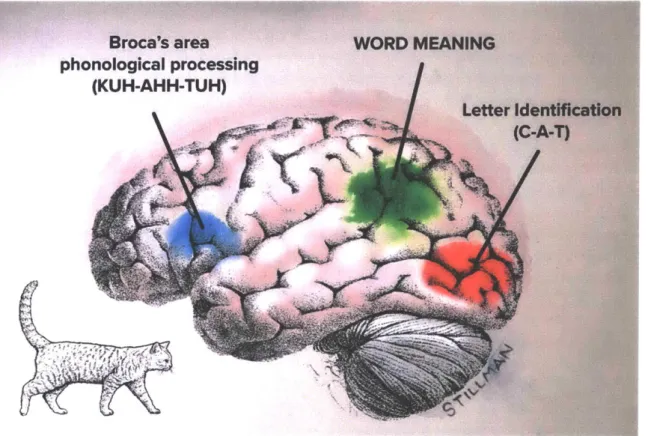
combinations of just 44 phonemes produce every word in the English language. The word "cat," for example, consists of three phonemes: "kuh," "aah," and "tuh." (Figure 7-1) Before words can be identified, understood, stored in memory or retrieved from it, they must first be broken down, or parsed, into their phonetic units by the phonological module of the brain (Shaywitz, 1996). Broca's area phonological proces (KUH-AHH-TUH WORD MEANING sing Letter Identification (C-A-T) C7 'q
Figure 7-1 Neural Architecture for reading
Letter identification activates the extrastriate cortex in the occipital lobe; phonological processing activates the inferior frontal gyrus (Broca's area); and accessing meaning activates primarily the superior temporal gyrus and parts of the middle temporal and supramarginal gyri (Shaywitz, 1996)
In spoken language, this process occurs automatically, at a preconscious level. As Noam Chomsky has convincingly argued, language is instinctive, all that is necessary is for humans to be exposed to it. A genetically determined phonological module automatically assembles
the phonemes into words for the speaker and parses the spoken word back into its underlying phonological components for the listener (Shaywitz, 1996). Or, as Harvard
cognitive scientist and linguist Steven Pinker puts it, "Children are wired for sound, but print is an optional accessory that must be painstakingly bolted on."
Although both speaking and reading rely on phonological processing, there is a significant difference: speaking is natural, and reading is not. Reading is an invention and must be learned at a conscious level. The task of the reader is to transform the visual percepts of alphabetic script into linguistic ones-that is, to recode graphemes (letters) into their corresponding phonemes. To accomplish this, the beginning reader must first come to a conscious awareness of the internal phonological structure of spoken words. Then he or she must realize that the orthography-the sequence of letters on the page-represents this phonology. That is precisely what happens when a child learns to read.
When a child is dyslexic, a deficit within the language system at the level of the phonological module impairs his or her ability to segment the written word into its underlying
phonological components. This explanation of dyslexia is referred to as the phonological model, or sometimes as the phonological deficit hypothesis (Shaywitz, 1996).
A second psychological weakness associated with dyslexia relates to rapid automatized
naming (RAN) Figure 7-2. Slowness in naming may reflect difficulty in the integration of cognitive and linguistic processes involved in fluent reading. Often, children who are
especially poor readers have weaknesses in both PA and RAN, but some children exhibit only one of these weaknesses. (Norton, et al., 2014)
A third category of potential causal explanations for dyslexia relates to basic perceptual
processes that may underlie the more proximal PA or RAN weaknesses, such as temporal sampling or processing, visual-spatial attention or perceptual learning deficits. These explanations are more mechanistic, but perhaps because they are more distal from reading per se, they are also more debated. (Norton, et al., 2014)
Construct Definition Example tasks Example standardized assessment
Phonological Knowledge of, and ability 9 Say game without the /g/ * Comprehensive Test of
awareness to manipulate, the sound Phonological Processing (PA) structure of words * What word do these (CTOPP-2)
sounds make? /s/ -/i/ -/t/
9 Phonological * Name a word that Awareness Test (PAT-2) rhymes with star
Rapid Speed with which a Name, as quickly as * Comprehensive Test of
automatized series of familiar stimuli possible, a 1oX5 array of Phonological Processing naming can be named aloud, five randomly repeated (CTOPP-2)
(RAN) reflecting efficient objects, colors, letters, or
visual-verbal numbers * Phonological
connections Awareness Test (PAT-2)
Reading Ability to read single * Read aloud a list of * Test of Word Reading
fluency words and connected common words or Efficiency (TOWRE-2) text with sufficient pseudowords as quickly
accuracy and speed so as and accurately as possible * Gray Oral Reading Test
to support efficient (GORT-5)
comprehension * Read aloud, quickly and
accurately, paragraphs of
increasing complexity (Norton, et al., 2014)
Figure 7-2 Key constructs in reading and potential deficits in dyslexia
7.5 The Neurobiology of Dyslexia
Since the late 19 th century scientists such as French neurologist Jules Dejerine have known that certain regions of the brain are important to reading (Martin, 2006). In the last 30 years,
researchers have used functional magnetic resonance imaging (fMRI) to further refine our understanding of how the reading brain works. fMRI measures brain activity by detecting changes in cerebral blood flow. The technique is accurate to a few millimeters but can only capture image data every few seconds so it has a high spatially resolution but a relatively low temporal resolution.
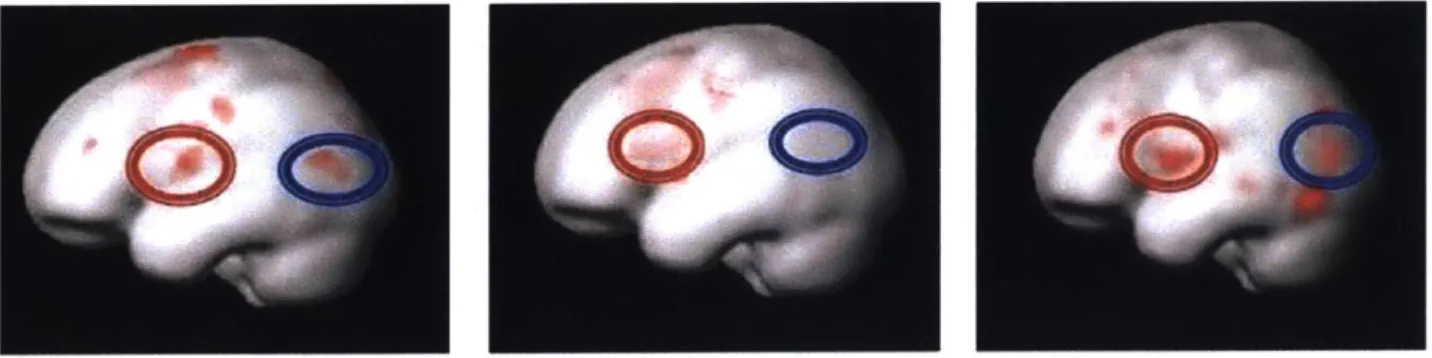
Figure 7-3 Activation of the left temporo-parietal cortex while preforming reading tasks
Left to right: Typical child reader Middle, Dyslexic child pre-remediation, Dyslexic child post-remediation
Red circles identify the frontal region of the brain. Blue circles identify the temporo-parietal region. Both regions
are hypoactivated in dyslexia and become more activated after remediation (Gabrieli, 2009).
Beginning readers use the slow and analytic parieto-temporal (Figure 7-5) region of the brain to pull apart a word and link its letters to their sounds. After a child has analyzed and learned to correctly read a particular word, she creates a permanent neural model of that word's form including spelling, pronunciation and meaning, which is stored in her occipito-temporal system (also referred to as the "word form area"). Once a word form is stored in the
occipito-temporal system, a skilled reader can access it by simply seeing it's printed form without conscious thought or effort in less than 150 milliseconds. A third reading pathway in Broca's area in the front of the brain also helps in slowly analyzing a word. FMRI mapping of the neural pathways of skilled readers show that they primarily activate the word form area in the rear of the brain as well as Broca's area in the front. In contrast, dyslexic readers show an under-activation of the neural pathways in the rear of the brain. Consequently, they have trouble analyzing words and transforming letters into sounds and even as they mature, they remain slow in dysfluent readers (Shaywitz, 2003).
Direction Message Travels
Nucleus Soma Axon Terminals
(cell body)
Dendrites Myelin
Sheath
Axon
Neuroimaging of children with dyslexia also shows altered white matter connectivity. White matter is found in the deeper tissues of the brain and contains long nerve fibers called axons (Figure 7-4). These axons are coated with myelin which acts as an insulator allowing nerve impulses to travel approximately 100 times faster than is possible in unmyelinated fibers (Fields, 2008). During a lecture at the MIT Media Lab, John Gabrieli described these bundles of axons as "information superhighways that orchestrate relatively distant parts of the brain into ensembles or networks to accomplish important things" (Gabrieli, 2018).
Arcuate
fasciculus
Broca's Wernicke's
areaarea
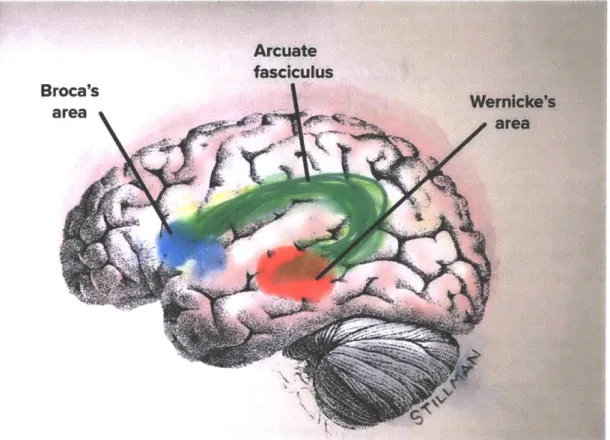
Figure 7-5 The left arcuate fasciculus
The left arcuate fasciculus is classically posited to facilitate communication between Broca's and Wernicke's areas.
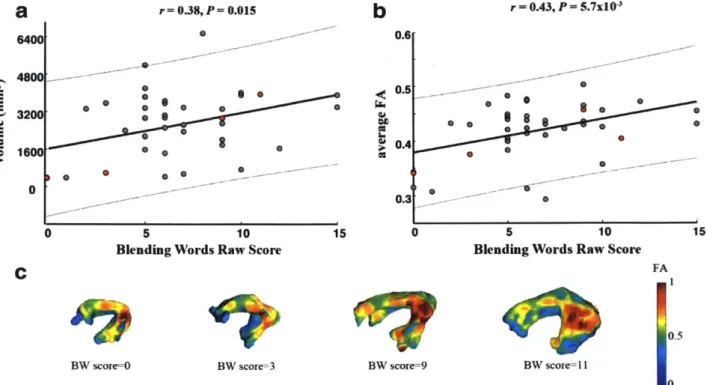
White-matter pathways of the brain may be characterized by diffusion tensor imaging (DTI). DTI visualizes white matter connectivity in the brain by measuring the flow of water at the micron-scale, microstructural level. The left Arcuate fasciculus (Figure 7-5) is the name of the white matter pathway connecting Wernicke's and Broca's area. (Gabrieli, 2018). Higher composite phonological awareness scores in older readers have been significantly and positively correlated with the volume of the left arcuate fasciculus (Klingberg, 2001). More recently researchers have discovered that the left arcuate fasciculus is already smaller and has less integrity in kindergartners who are at risk for dyslexia because of poor phonological
awareness. These findings suggest a structural basis of behavioral risk for dyslexia that predates reading instruction (Saygin, et al., 2013).
r=0.38, P= 0.015 --- 4-0 e :*. .*
b
0.6 0.5 0.4 0.3 5 10Blending Words Raw Score
15 r = 0.43, P - 5.7x10³ S . S S S.
gsa
* 0 0 - 0 ~ 5 10Blending Words Raw Score 0
C
BW score=0 BW score=3 BW score=9 BW score= I
Figure 7-6 Volume and FA of the left arcuate fasciculus (Saygin, et al., 2013)
FA
0.5
10
Greater volume and FA of the left arcuate fasciculus are associated with superior phonological awareness. a,
Volume of the left arcuate fasciculus plotted against individual raw scores of the Blending Words subtest. b,
Phonological awareness,
DTI studies of dyslexia also report greater-than-normal white-matter connectivity in the corpus callosum, the large white matter tract connecting homotopic regions of the left and right hemispheres (Dougherty, 2007). These findings suggest that, in dyslexia, white-matter
pathways supporting reading project too weakly within the primary reading pathways of the linguistic left hemisphere and project too strongly between hemispheres. This may reflect an atypical reliance on right-hemisphere regions for reading that is observed in a number of functional neuroimaging studies of dyslexics (Gabrieli, 2009).
a
6400 4800 3200 1600E
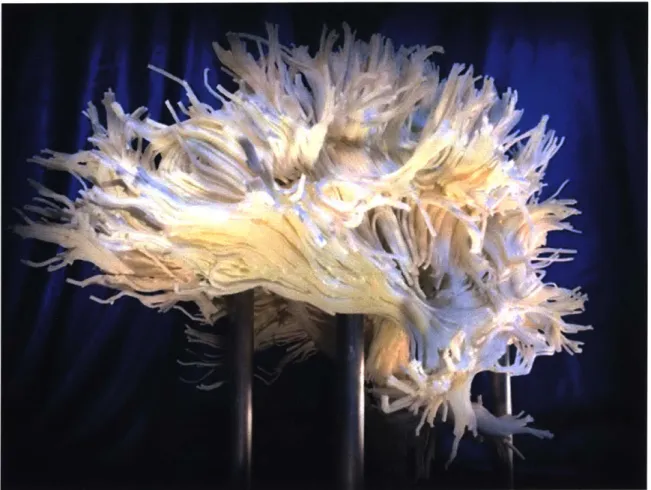
E 0 0 0 15 WFigure 7-7 3D model of the white matter pathways in the brain
(Henning U. Voss 2014)
The surprises on this landscape increase daily. Recent advances in neuroimaging research begin to paint a different picture of the brain of a person with dyslexia that may have enormous implications for future research, and particularly for intervention. Understanding these advances can make the difference between having a huge number of our future
citizens poised to contribute to society and having a huge number who cannot contribute what they could otherwise. Connecting what we know about the typical child's
development to what we know about impediments in reading can help us reclaim the lost potential of millions of children, many of whom have strengths that could light up our lives (Wolf, 2007).
7.5.1 Diagnosing Dyslexia
"Science has moved forward at a rapid pace so that we now possess the data
to reliably define dyslexia, to know it's prevalence, it's cognitive basis, it's symptoms and remarkably, where it lives in the brain and evidence-based interventions which can turn a sad, struggling child into not only a good reader,
but one who sees herself as a student with self-esteem and a fulfilling future.
Education must, and can be, aligned with science. We must ensure that scientific knowledge is translated into policy and practice and that ignorance and injustice do not prevail. We know better, we must act better"
-Sally Shaywitz, Congressional Testimony, 2014
The causes of dyslexia have been misconstrued for decades (Shaywitz, et al., 2016). Early explanations of dyslexia, put forth in the 1920s and persisting through today, hold that defects in the visual system are to blame for the reversals of letters and words thought to typify dyslexic reading (Shaywitz, 1996). Others correlated it with apathy: "Thirty, forty, fifty years ago people blamed (dyslexic) students for being lazy, sloppy and unmotivated. They viewed it as a character flaw rather than the brain difference that we now know it clearly is (Gabrieli, 2018)." Now that we know dyslexia is a highly specific disorder relating to
problems with phonological processing we're better able to diagnosis it.
Currently, most children with dyslexia are not diagnosed until they are in third grade, or about 9 years old, although it is possible to recognize children at risk for dyslexia as young as 4-5 years of age (Shaywitz, et al., 2016). Even before formal reading begins in school,
children can be observed for signs of being at risk. These risk indicators include delayed language, trouble learning common nursery rhymes, a lack of appreciation of rhymes, mispronounced words, difficulty in learning names of letters and numbers and failure to know the letters in his or her own name as well as a positive family history of dyslexia (Shaywitz, 2003).
Particularly when a reading disorder is associated with high IQ, a child may function at or near grade level in the early grades, and the Reading Disorder may not be fully apparent until the fourth grade or later. These students may not receive special education services under IDEA until their reading falls below grade level. Compounding the problem is the fact that dyslexia is not its own disability category. To wit, "An individual student who has had a diagnosis of dyslexia may or may not be eligible for special education services-it is never an automatic conclusion that if a student is identified as having dyslexia, that student is also eligible for special education services (Colorado Dept. of Ed., 2102) (pg7)." Yet, early reading intervention is key to preventing learning problems in all subjects and a potential loss of
motivation to learn, especially if the child's veiled struggle is interpreted as laziness (Gilman, et al., 2013). Unremedied reading issues compound themselves over time. In one study, first graders who scored in the lowest 20 percent of their class on a test of phonology were reading at a 2.6 grade level in the 5th grade while their classmates who scored higher were
reading at a 5.9 grade level (Shaywitz, 2003).
Current research is trying to identify which children could benefit from early intervention aimed at preventing reading difficulties. For example, the READ Study, a collaboration between the Gabrieli Lab at MIT and the Gaab Lab at Boston Children's Hospital, is trying to understand how brain differences in kindergarten children might predict their reading ability in 2nd grade. In order to do this, they are imaging children's brains in kindergarten and then again in first and second grade. The researchers theorize that even at birth, or shortly after, children's brain structures can show signs of developing reading disorders. They hope their current research will trickle down to classrooms and help eliminate "the dyslexia paradox."
7.5.2 Teaching Strategies for Dyslexia Remediation
Studies have suggested that intervention is most effective in kindergarten or first grade, however, under current educational practices, students need to show several years of reading failure before they can get a diagnosis of dyslexia, typically at the end of second grade or beginning of third grade. Studies with children conducted before reading instruction may determine whether the differential organization of white matter is
predictive of developing dyslexia or is a consequence of reading practice. Once children are diagnosed with dyslexia because of reading failure, treatment consists of intense reading instruction. Typical public school and special education interventions often stabilize the degree of reading failure rather than remediate (normalize) reading.
Controlled studies consistently show that instruction yields substantial improvement in reading accuracy for many, but not all, children. For it to work, instruction must be more intensive (for instance, 100 min per day for 8 weeks), must occur in small groups (1 or 2 students per teacher), and must include explicit and systematic instruction in phonological awareness and decoding strategies. Gains are maintained for at least a year or two by approximately half of all children after they return to the school's standard curriculum. Those children who retain their benefits improve from year to year, but they do not further catch up to typical readers. Such improvements are much more likely to occur in children who are beginning to read (ages 6 to 8) than in older children and are much more difficult to achieve for fluency than for accuracy. Thus, these resource-demanding interventions are effective for many children, but there are still challenges in developing interventions that are effective for all children (MIT Gabrieli Lab, 2013). This intensive training will typically need to last for one to three years or longer in order for a student to start catching up with her peers. Because of the intensity of these programs and the small teacher to student ratio, successful remediation rarely occurs in public schools (Shaywitz, 2003). A list of assessment strategies and standardized tests for dyslexia can be found in (Figure 7-2).
7.6 The
Strengths
of Dyslexics
7.6.1 Do Dyslexics Tend to Have Enhanced Visual-Spatial Abilities?
Take, for example, the case of children with dyslexia. In a significant number of cases, such children show enhanced facility with visual or spatial activities.
These strengths can be mobilized to help students excel in vocations and avocations that exploit visual-spatial...
-Howard Gardner
Given all innovators that showed signs of dyslexia, Edison, da Vinci, Einstein, it seems like Gardner must be right, right? The jury is still out whether or not dyslexics are born with
stronger visual-spatial skills. For starters, though biographical information does seem to
indicate that these historic figures had language-based learning, critics argue that you can't diagnose dyslexia retrospectively. Mark Seidenberg contends that "The brain isn't a zero-sum game in which a deficit in one area entails and advantage in another". Seidenberg goes on to wryly ask: "Could the conditions that cause a reading impairment have beneficial side effects, such as special talents? I can tell you that there isn't much hard evidence on the question because it is so difficult to study. No one has undertaken a large-scale prospective longitudinal study of individuals at risk for high achievement" (Seidenberg, 2017). While it is clearly possible to be both dyslexic and have advanced visual-spatial strengths, proof of a causal relationship between the two has been elusive. It is worthwhile to celebrate inspirational figures who have overcome dyslexia, but it is important not to trivialize their struggles, as popular writer Malcolm Gladwell did when he glibly described dyslexia as a "desirable difficulty" (Gladwell, 2013). Dyslexia is an incurable, lifelong challenge, even for successful adults who have overcome its worst effects.
7.6.2 Creative Approaches Gained through Overcoming Dyslexia
... while I would scarcely recommend the imposition of a disability on any person, the experience of dealing with and overcoming a disability can itself
become a great ally in dealing with subsequent challenges. -Howard Gardner