The Dynamics of Oceanic Transform Faults:
Constraints from Geophysical, Geochemical, and Geodynamical Modeling
byPatricia Michelle Marie Gregg B.S. Geology and Geophysics
University of Missouri -Rolla, 2000
SUBMITTED TO THE MIT/WHOI JOINT PROGRAM IN PARTIAL FULFILLMENT OF THE REQUIREMENTS FOR THE DEGREE OF
DOCTOR OF PHILOSOPHY IN MARINE GEOPHYSICS AT THE
MASSACHUSETTS INSTITUTE OF TECHNOLOGY AND THE
WOODS HOLE OCEANOGRAPHIC INSTITUTION JUNE 2008
C 2008 Patricia M. Gregg
All Rights reserved
The author hereby grants to MIT and WHOI permission to reproduce and distribute publicly paper and electronic
copies of this thesis document in whole or in part in any medium known or hereafter created.
Signature of Author:
MIT/WHOI Joint Program in Oceanography May 16, 2008 Certified by:
Jian Lin Senior Scientist, WHOI Thesis Supervisor Accepted by:
Bradford H. Hager Professor of Geophysics, MIT Co-Chair, Joint Committee for Marine Geology and Geophysics
CONTENTS ABSTRACT ... 7 BIOGRAPHICAL SKETCH ... 9 ACKNOWLEDGEMENTS ... 11 FUNDING SOURCES ... 13 INTRODUCTION ...
15
FUTURE DIRECTIONS... 17 REFERENCES ... 21CHAPTER 1: Segmentation of transform systems on the East Pacific Rise: Implications for earthquake processes at fast-slipping oceanic transform faults ... 25
ABSTRACT ... 25
INTRODUCTION ... 26
TRANSFORM SEGMENTATION ... 29
COULOMB STRESS CALCULATIONS ... 30
EXAMPLES OF POSSIBLE STRESS INTERACTION ... 38
CONCLUSIONS .... ... 39
ACKNOWLEDGEMENTS ... 39
REFERENCES CITED ... ... 40
CHAPTER 2: Spreading rate dependence of gravity anomalies along oceanic transform faults... 43
ABSTRACT ... 43
SUPPLEMENTARY INFORMATION ... 50
S2. Supplementary Tables ... ... .. ... ... ... 59
S3. Supplementary References ... ... 60
CHAPTER 3: The effects of mantle rheology and fault segmentation on melt generation and extraction beneath oceanic transform faults ... ... 63
A BSTRA CT ... 63
1. INTRODUCTION ... 64
2. M ODEL SETUP... 67
2.1 N um erical Approach ... 67
2.2 Melt Generation and Extraction... ... 70
2.2.1 Step 1: Fractional M elting... 72
2.2.2 Step 2: M elt M igration ... ... ... ... 74
2.2.3 Step 3: Fractional Crystallization ...76
3. NUMERICAL MODELING RESULTS... 77
3.1 Benchmark: Comparison to EPR 90N... ... 77
3.2 3D Segmented transform fault results ... ... ... 83
4. APPLICATIONS TO THE SIQUEIROS TRANSFORM FAULT SYSTEM ... 86
4. 1 Tectonic Setting ... ... ... 86
4.2 Crustal Thickness Predictions at Siqueiros ... 88
4.3 Geochemical Predictions at Siqueiros ... ... 90
5. D ISCUSSION ... .. 93
5.1 Factors controlling crustal thickness variations... ... 93
5.2 The Siqueiros Transform Effect on Mantle Melting... .. ... ... 96
5.3 High-pressure Fractional Crystallization... ... ... 97
5.4 M elt Extraction at Siqueiros Transform Fault ... ... 98
6. C ON CLU SION S ... ... 99
7. A CKNOW LEDGEM ENTS ... 99
8. R EFEREN CES ... ... ... 100
APPENDIX: Seismicity characteristics of the equatorial East Pacific Rise and its offsets
... ... 109
ABSTRACT ... 109
TABLES ... ... 110
The Dynamics of Oceanic Transform Faults:
Constraints from Geophysical, Geochemical, and Geodynamical Modeling
by
Patricia Michelle Marie Gregg Submitted to the MIT/WHOI Joint Program on May 2, 2008 in Partial Fulfillment of the Requirements for the Degree of Doctor of Philosophy in
Marine Geophysics
ABSTRACT
Segmentation and crustal accretion at oceanic transform fault systems are investigated through a combination of geophysical data analysis and geodynamical and geochemical modeling. Chapter 1 examines the effect of fault segmentation on the maximum predicted earthquake magnitude of an oceanic transform fault system. Results of thermal modeling suggest that fault segmentation by intra-transform spreading centers
(ITSC) drastically reduces the available brittle area of a transform fault and thus limits
the available earthquake rupture area. Coulomb stress models suggest that long ITSCs will prohibit static stress interaction between segments of a transform system and further limit the maximum possible magnitude of a given transform fault earthquake. In Chapter 2, gravity anomalies from a global set of oceanic transform fault systems are investigated. Surprisingly, negative residual mantle Bouguer gravity anomalies are found within fast-slipping transform fault domains. These gravity observations suggest a mass deficit within fast-slipping transform faults, which may result from porosity variations, mantle serpentinization, and/or crustal thickness variations. Two-dimensional forward modeling and the correlation of the negative gravity anomalies to bathymetric highs indicate crustal thickness excesses in these locations. Finally, in Chapter 3, mantle thermal and melting models for a visco-plastic rheology are developed to investigate the process of mantle melting and crustal accretion at ITSCs within segmented transform faults, and are applied to the Siqueiros transform fault system. Models in which melt migrates into the transform fault domain from a large region of the mantle best explain the gravity-derived crustal thickness variations observed at the Siqueiros transform. Furthermore, a mantle potential temperature of 1350'C and fractional crystallization at depths of 9 - 15.5 km best explain the major element composition variation observed at the Siqueiros transform.
THESIS SUPERVISOR:
Dr. Jian Lin, Senior Scientist, WHOI
DEFENSE CHAIR:
Dr. Henry J. B. Dick, Senior Scientist, WHOI
THESIS COMMITTEE:
Dr. Mark D. Behn, Assistant Scientist, WHOI Professor Timothy L. Grove, MIT
Dr. Deborah K. Smith, Senior Scientist, WHOI Professor Donald W. Forsyth, Brown University
BIOGRAPHICAL SKETCH
Patricia M. Gregg
Education Honors & Awards Professional Experience Field Experience Invited Talks Ph.D. Marine GeophysicsMassachusetts Institute of Technology / Woods Hole Oceanographic Institution Joint Program, Thesis Supervisor: Dr. Jian Lin
B.S. Geology and Geophysics, University of Missouri-Rolla, 2000 Summa Cum Laude, Student Marshal, GPA 3.9/4.0
09/2003 -08/2006: NSF Graduate Research Fellow (MIT/WHOI) 06/2002 -08/2003: Hollister Graduate Research Fellow (MIT/WHOI) 08/1996 - 12/2000: V.H. McNutt Geology Scholar (UMR)
08/1997 - 12/2000: Society of Exploration Geophysicists Scholar (UMR) 08/1996 -05/2000: Missouri Bright Flight Scholar (UMR)
06/2001 -06/2002: Sprint, Project Manager & Associate Engineer Summer 2000: Sandia National Laboratories, Summer Intern
Summer 1999: Woods Hole Oceanographic Institution, Summer Fellow 08/1999 -5/2000: University of Missouri-Rolla, Opportunities for
Undergraduate Research Experience (OURE) Fellow
1/1998 -5/2000: KMNR FM Campus Radio Station, Music Director Summer 1995: University of Missouri-Rolla, Jackling Student Fellow
2008: Chief Scientist, R/V New Horizon, Costa Rica Seismic Experiment 2004-2007: WHOI Geodynamics - Hawaii ('04), Iceland ('06), and Maine ('07) 2005: Ridge 2000 Cyprus Ophiolite Field School
2002: Shipboard Scientific Party, R/V Melville, Vancouver 1, East Pacific Rise 2001: Shipboard Scientific Party, R/V Atlantis, AT4-4, NOAA/PMEL Hydrophone
recovery and deployment, Mid-Atlantic Ridge
1996-2000: Participated in several geophysical data collection projects with the UMR Geophysics Group (GPR, EM, Seismic, and Resistivity)
1998: Boston University Summer Field Camp, Western Ireland
Feb. 2008: Univ. of Hawaii SOEST, "Three-dimensional melt generation and extraction at fast-slipping oceanic transform faults"
Dec. 2007: Fall AGU, "The effect of fault segmentation on the dynamics of fast-slipping oceanic transform faults"
Sept. 2006: Oklahoma State University, "The spreading rate dependence of the gravity structure of oceanic transform faults"
April 2006: Brown University, "Fast-slipping transform faults: Gaining new understanding from gravity calculations at the East Pacific Rise" Oct. 2005: WHOI Open House, "Understanding Oceanic Earthquakes"
Sept. 2004: UM -Rolla, "The Seismicity of Equatorial East Pacific Transform Faults"
Teaching Experience Service Publications Work in Progress Selected Abstracts
Spring 2007: Guest Lecturer, Boston College, GE530 Introduction to Marine Geology and Geophysics
Session Co-Convener, Western Pacific Geophysical Meeting, Beijing, 2006 MIT Graduate Student Mentor, J. Elsenbeck (M.S. 2007) and E. Roland Fall 2004: Taught two-day earth sciences and physics classes at Rolla Senior
High School, MO
Reviewer for Marine Geophysical Researches
P. M. Gregg, J. Lin, M. D. Behn, L. G. J. Mont6si, Spreading rate dependence of the gravity structure of oceanic transform faults, Nature, 448, 183-187, 2007.
P. M. Gregg, J. Lin, D. K. Smith, Segmentation of transform systems on the East Pacific Rise: Implications for earthquake processes at fast-slipping oceanic transform faults, Geology, 34, 289-292, 2006.
D. K. Smith, M. A. Tivey, P. M. Gregg, L. S. Kong, Magnetic anomalies at the Puna Ridge, a submarine extension of Kilauea Volcano: Implications for lava deposition, Journal of Geophysical Research, Vol. 106, No. B8, p. 16,047. 2001.
P.M. Gregg, M. D. Behn, J. Lin, T. L. Grove, The effects of mantle rheology and fault segmentation on melt generation and extraction beneath oceanic transform faults, in prep for J. Geophys. Res., 2008.
P. M. Gregg, M. D. Behn, J. Lin, T. L. Grove, L. G. J. Montesi, The effect of fault segmentation on the dynamics of fast-slipping oceanic transform faults, Eos Trans. AGU, Fall Meet. Suppl., Abstract T22E-04, 2007, INVITED.
P. M. Gregg, J. Lin, M. D. Behn, L. G. J. Mont6si, Spreading rate dependence of the gravity structure of oceanic transform faults: Contrast between ultra-slow/slow and intermediate/fast slipping systems, Eos Trans. AGU, Fall Meet. Suppl. Abstract V23E-0698, 2006.
P. M. Gregg, J. Lin, M. D. Behn, L. G. J. Mont6si, Spreading rate dependence of the gravity structure of oceanic transform faults, WPGM Meet., T41 B-05, 2006.
P. M. Gregg, J. Lin, D. K. Smith, Oceanic transform fault segmentation: constraints from hydroacoustic monitoring in the equatorial Pacific, Ridge 2000 Cyprus Field School, 2005.
P. M. Gregg, J. Lin, D. K. Smith, Characteristics and Possible Triggering Relationship of Earthquakes at the Pacific Transform Faults, Eos Trans. AGU, 85(47), Fall Meet. Suppl., Abstract T41A-1 164, 2004.
P. M. Gregg, D. K. Smith, L. S. Kong, K. Johnson, J. Reynolds, F. Trusdell, M. Tivey, W. Zhu, M. Bulmer, M. Avgerinos, D. Geist, T. Naumann, J. Mercer, T. Dulaney, E. Bergmanis, Lava Depocenters at the Summit of the Submarine Puna Ridge, Kilauea Volcano, Fall AGU 2000.
C. J. Weiss, P. M. Gregg, G. A. Newman, Electromagnetic Induction in a Fully 3D Heterogeneous Anisotropic Earth, Fall AGU 2000.
ACKNOWLEDGEMENTS
"It takes a village. "
Global Proverb, generally attributed to Africa
While this saying has become increasingly popular to describe the upbringing of a child, I believe that it is an equally accurate description of the efforts that go into raising a young scientist. I would not have reached this point in my career if it had not been for the valiant efforts of advisors, mentors, teachers, friends, and family. These are just some of the countless individuals who have helped me along the way.
First, many thanks to my advisor, Jian Lin -it has been an honor and a pleasure to be your graduate student. I am extremely grateful for your calm patience, tireless enthusiasm, encouragement, generosity, and constant advocacy. Your mentorship and advice have been critical for the development and execution of my thesis as well as my growth as a scientist. I am very grateful that you have encouraged me to become an independent thinker and to dig out areas of research that are of particular interest to me. Thank you for welcoming me into your home with wonderful meals (thanks also to Kelan!), introducing me to your colleagues and former students, and for the priceless experience of visiting China.
The project advisors who have worked with me during the past 6 years have been vital for helping me develop my research. I am very thankful for Debbie Smith who introduced me to the world of marine geophysics as a bright-eyed undergraduate Summer Student Fellow. Debbie's enthusiasm and love for science is contagious, and it is my interactions with her that inspired me to pursue a Ph.D. in marine geophysics. Having Mark Behn as a mentor during the final years of my graduate study has had a considerable influence on my scientific approach and the direction of my thesis. As my academic older brother, I have looked to him for guidance, encouragement, and an outstanding example of the scientist I am striving to become. I am extremely grateful for the time he has spent teaching and mentoring me as well as his generous loan of computing equipment. Tim Grove has been a constant, positive presence throughout my graduate matriculation. I got to know Tim through two of the most inspiring courses I have ever taken (Adv. Igneous Petrology and Thermodynamics), and it has been a pleasure to work with him to incorporate geochemistry into my thesis. Tim has been a tremendous resource and collaborator and the thought provoking conversations we have had over the years have manifested themselves in the final chapter of my thesis.
I am thankful to Don Forsyth who has provided insight and encouragement as a member of my thesis committee. I am very grateful for the hospitality of Henry Dick, not only in our many scientific discussions, but also for hosting dozens of meals and parties I have attended over my years at WHOI. Henry will forever be a fixture in my mind of how to bring a department together through excellent food and field trips. I am very honored to have Henry chair my thesis defense.
The scientific community of WHOI has played a significant role in my scientific growth over the past six years. I am constantly in awe at their generosity; they will take an hour out of their day to listen to a practice talk, and doors are always open when I have a question. Many thanks to Pablo Canales, my Clark South neighbor for 5 years, who has read drafts of proposals, listened to practice talks, and constantly encouraged me. Thanks also to Hans Schouten for delicious homemade meals, compelling scientific discussions, and for teaching me how not to give a bad seminar. Thanks to Dan Fornari, for his scientific generosity and sharing with me all he knows about the Siqueiros transform fault system (see Chapters 1-3 of this thesis). Many thanks to the WHOI geophysics group, including but not limited to - Laurent Mont6si, Dan Lizarralde, Adam Soule, Maurice Tivey, Chris German, Brian Tucholke, Jeff McGuire, and Ralph Stephen. Thanks to the WHOI geochemists who adopted me into their fold and gave me insight into the mantle
-to Stan Hart for his kindness and advocacy, Nobu Shimizu for giving me "the other side of the story", Zhenrong Wang for his help decoding KG92, Jurek Blusztajn, Alison Shaw, Mark Kurz, and Ken Sims. Thanks also to Jerry McManus for his encouragement and friendship.
Thank you to the continuous support of Pam Foster, Christina Cuellar, and the wonderful people in the Academic Programs Office - Marsha Gomes, Julia Westwater,
Shona Vitelli, Valarie Caron and Christine Charette. Thanks also to Andrew and Peggy Daly and Rose for their friendship and kindness. I am grateful to BL Owens who, in the final weeks of my thesis, has rescued me from several computing mishaps and has become a new friend in the process.
I think it is fair to say that the MIT/WHOI Joint Program attracts some of the brightest students in the world. It has been a tremendous gift to learn from my fellow students and be persistently challenged by them. First to my classmates, Matt Jackson and Sharon Hoffmann, your friendship over these past years has been invaluable. A further thousand "thank you's" to Sharon for day-to-day encouragement and her willingness to edit hundreds of pages of poorly written science for her fellow students. Abby Fusaro is unfailingly kind and generous. It is through tea and baked goods with this wonderful person that I survived my first year of graduate school. I am also indebted to her NH family who adopted Cory and me for several holidays and welcomed us into their home with open arms. Thanks to Hunter Oats and Vin Fusaro for their friendship and taking such good care of two of my favorite people. I am grateful for the friendships of Chris Waters, Casey Saenger, Andrea Burke, Mike Krawczynski, Andrea Llenos, Lynne Elkins, and Emily Roland who are a joy to have around; they constantly remind me of life outside of the walls of Clark. Jon Woodruff has been the ideal officemate in this push to the end; his tireless optimism has been greatly welcome. Last, and certainly not least, I owe a huge "thank you" to Rhea Workman for encouraging me to apply to the
SSF at WHOI and being a friend and supporter for over a decade.
I have been truly blessed by an extended family of close friends who have known me since I was knee high to a grasshopper. I owe much of my continued sanity in life to their unwavering support. Sheri Redfearn has inspired me with her fearlessness and passion for life since we were 10 years old; she is in everyway my sister. Ted Miller has
kept me honest and true to myself with his tough love and unfailing loyalty. Bob Kumar keeps me in smiles and laughs and tries to be a positive influence on my health along the way - Please note that I can still school both Bob and Ted at basketball (can you say "treetop"?). Raj and Jess Kumar have been my twin pillars of support during trips to San Francisco for fall AGU. They always find time to take me to fantastic places to eat and give me a dose of unconditional love. Jeff Davis believed in me before I believed in myself. He has pushed me to be my best and not settle for less. Thank you to Micah Hackett for challenging me to think more deeply about my beliefs, his friendship has made me a better person. Thanks to Serena and Seth Bennett for their hospitality and friendship over the years and welcome respite at their home in Seattle. Finally, many thanks for the love and support of Franca Oboh-Ikuenobe and Rod and Nancy Lentz, my surrogate parents and friends.
My family has given me an unfaltering support system that has allowed me to grow and flourish with the knowledge that they are there when I need them. My father, Jay Gregg, introduced me to geology before I could walk. His passion and curiosity for the world around him has greatly influenced my approach to science and my passion for finding things out. I am thankful that he "dragged" me on field trips and encouraged my love of mathematics as well as art. My mother, Mickey, is the glue that holds our family together. Her insistence that her children be well-rounded as well as well-educated has had a profound impact on me. She fostered my love for swimming and running, and encouraged me to balance my study time with outside hobbies and activities. She instilled in me a healthy work ethic with an emphasis on doing my best while not trying to be perfect. My brother, Nick is by far one of the kindest, most likeable people I have ever met. I am incredibly glad that he is my brother and close friend. He, his wife, Erin, and sons, Mason, Aidan, and Eamon, have allowed me to escape into their real world of family and laughter, reminding me that life is not made up of equations and computers. This grounding has meant the world to me during the past six years. My youngest brother William keeps us all from taking things too seriously; this is a precious skill that I hope he will never lose. I have also been blessed by two adopted parents, and loving in-laws, PJ and Robin Pettijohn. I am thankful for their care packages, emails, and phone conversations. To those I have lost during these past years - my profound thanks to my grandmothers, Patricia and Ella Mae, for giving me marvelous examples of strong, independent women.
Finally, I offer my gratitude to my life partner and husband, Cory Pettijohn. I feel incredibly fortunate and blessed to have such a fervent supporter and kindred spirit in Cory, my best friend and lonely planet tour guide.
FUNDING SOURCES
NATIONAL SCIENCE FOUNDATION GRADUATE RESEARCH FELLOWSHIP
HOLLISTER GRADUATE RESEARCH FELLOWSHIP
INTRODUCTION
The global mid-ocean ridges are segmented by more than 120 transform fault systems. These transform fault systems are critical for accommodating the geometry of the ridge system as well as crustal accretion. The primary focus of this Ph.D. thesis is the investigation of oceanic transform faults using a multidisciplinary approach. Chapter 1 explores the seismicity of oceanic transform faults and examines the relationship between fault segmentation and earthquake rupture. Chapter 2 utilizes residual mantle Bouguer gravity anomaly (RMBA) calculations, 3D thermal models, and 2D forward models to investigate the structure of a global set of transform faults. Finally, in Chapter 3, I develop combined geodynamical and geochemical models to constrain melt generation and extraction at segmented transform fault systems. Below, I present a brief description of each of these studies and their primary conclusions.
In Chapter 1, I combine Coulomb static stress models with available geological and seismicity data to illustrate the importance of fault segmentation in models of earthquake interaction at oceanic transform faults. The 2D thermal models demonstrate that fault segmentation decreases the maximum magnitude of earthquakes by decreasing the brittle area thus limiting the fault rupture of the transform fault system [Gregg et al., 2006]. Coulomb static stress models are used to explore whether adjacent fault segments behave independently of each other, and how their stress interaction depends on their offset distance. I find that, if intra-transform spreading centers are sufficiently long, adjacent transform fault segments will be decoupled and behave independently of each other. I also demonstrate the likelihood of stress interaction between strike-slip earthquakes and normal faults at nearby spreading centers. These findings are important for understanding the seismic budget of oceanic transform faults.
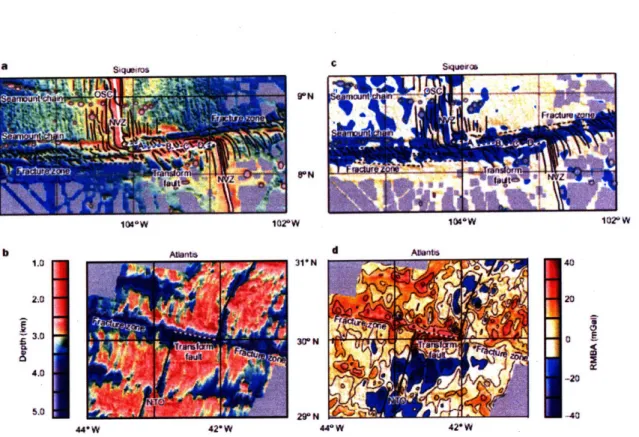
systems globally. By evaluating transform faults from several mid-ocean ridge systems using 3D gravity inversions, 3D thermal models, and 2D forward models, I show that there is systematic variation in the gravity signature of oceanic transform faults as a function of their slip rate [Gregg et al., 2007b]. The spreading-rate dependency of the gravity anomalies is especially evident at fast-slipping transform faults where I find more negative RMBA values in comparison to the adjacent ridge axes. All previous studies of slow-spreading mid-ocean ridges have shown more positive RMBA values within the transform fault domain instead, indicating crustal thinning at the end of ridge segments and focused crustal accretion at ridge segment centers [Kuo and Forsyth, 1988; Lin et al.,
1990]. Based on 2D forward models and available geological data, I propose that the negative RMBA values observed at slipping transform faults indicate that fast-slipping systems have excess magma supply and increasing crustal production within the transform fault domain. These findings directly contradict the classic models of crustal accretion at mid-ocean ridges and require further investigation to determine the source of the negative RMBA at fast-slipping transform faults.
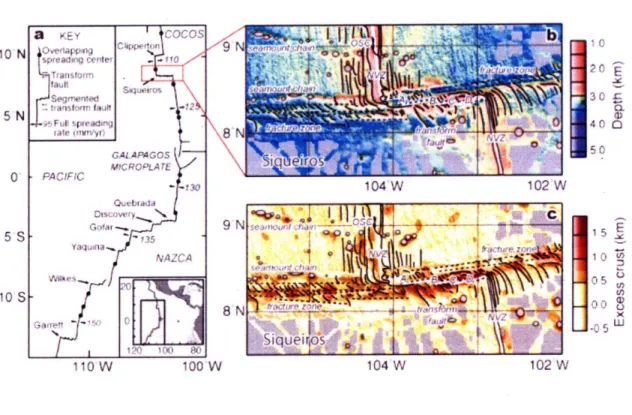
In the final chapter of my thesis, I look at the process of mantle melting and melt extraction at fast-slipping transform faults in an effort to explain the findings of increased crustal accretion at these systems [Gregg et al., 2007b]. I combine thermal models of segmented ridge-transform-ridge systems with fractional melting [Kinzler and Grove, 1992b; a; 1993] and fractional crystallization models [Yang et al., 1996]. The melt migration model of Sparks and Parmentier [1991] is used to investigate the source region of intra-transform spreading centers and examine two end-member melt aggregation models of wide vs. narrow melt pooling regions. I apply these models to the specific case of Siqueiros transform fault on the East Pacific Rise where there has been extensive geological and geophysical mapping [Fornari et al., 1989; Carbotte and Macdonald, 1992; Gregg et al., 2007b], as well as sampling via dredge and Alvin dives [Perfit et al., 1996; Hays et al., 2004]. Our findings suggest that in order to explain the estimated crustal
thicknesses indicated by the RMBA calculated at Siqueiros, melt must be pooled from large distances into the transform fault domain. Furthermore, we find that a mantle potential temperature of 1350C and fractional crystallization at depths of 9-15.5 km best fits the geochemical observations at the Siqueiros transform fault system [Perfit et al.,
1996; Hays, 2004]. These melt migration models provide us with first-order insights into
the geological processes that may be occurring at the Siqueiros transform fault.
FUTURE DIRECTIONS
The research contained in this thesis is a starting point for the development of many exciting projects for the coming years. In the future, I plan to extend my investigation to study several first-order geological processes.
Coulomb stress modeling is an invaluable tool for estimating static stress transfer following an earthquake or diking episode and determining likely locations for subsequent events [e.g., King et al., 1994]. As part of this thesis, I successfully used stress models to illustrate earthquake interaction at oceanic transform faults and the stress interaction between strike-slip earthquakes and normal faults at nearby spreading centers [Gregg et al., 2006]. It has also been suggested that stress transfer due to tectonic events can stimulate interactions between volcanoes and earthquakes. In particular, recent research on Hawaii has illustrated striking correlations between dike intrusions and earthquake
occurrence at Mauna Loa [Walter and Amelung, 2004; 2006; Amelung et al., 2007;
McGovern, 2007]. These techniques can also be applied to understanding continental rifting; specifically, what is the stress interaction between dike injection during rifting change and subsequent faulting events? For example, temporal and spatial seismicity patterns along the East African Rift system indicate that there is ongoing stress interaction between adjacent rift segments via diking and faulting events [Aronovitz et al., 2007]. Increasing our understanding of how earthquakes and volcanoes interact in settings
such as Hawaii and Africa is also important for aiding our ability to assess future hazards, which is a direction I plan to pursue.
The spreading rate dependence of mid-ocean ridge morphology is widely observed. Typical slow-spreading ridges are characterized by axial valleys and large topographic variations, whereas fast-spreading ridges are generally associated with axial highs and smoother topography [Macdonald, 1983]. However, in many locations it appears that magma supply may play an even greater role in controlling the ridge morphology than spreading rate. This paradox remains one of the first-order problems in understanding the dynamics of mid-ocean ridges. For example, the Cleft segment of the Juan de Fuca Ridge north of the 350 km-long Blanco transform fault has the morphology of a fast-spreading ridge and is thought to be magmatically robust, while the Gorda ridge to the south of Blanco, which is also spreading at a rate of 5.8 cm/yr, exhibits an axial valley typical of a slow-spreading ridge and is considered magmatically starved [Embley and Wilson, 1992; Hooft and Detrick, 1995]. Other examples include two adjacent segments at -180S on the fast-spreading East Pacific Rise separated by a small non-transform discontinuity [Sinton et al., 2002] and adjacent segments at -114 0E along the intermediate spreading South East Indian Ridge (SEIR), which are separated by a 100 km-long transform fault [Cochran and Sempere, 1997; Buck et al., 2005; Gregg et al., 2007b]. Not only is the apparent decrease in magma budget visible in the morphology of these ridge segments, it is also observed in seismic and gravity data [Hooft and Detrick,
1995] as well as in the major and trace element geochemistry of lavas from these settings [Rubin and Sinton, 2007]. At present it is unclear why adjacent segments spreading at the same rate are in such stark contrast to each other, and our current understanding of the physics behind mid-ocean ridge spreading does not fully address this problem. Possible explanations may include thermal effects due to ridge offsets, regional tectonics, mantle flow variations, mantle buoyancy [Buck et al., 2005], and mantle source heterogeneities. I plan to explore this research direction in the future.
In chapter 3 of this thesis I have developed techniques for coupling geodynamical and geochemical models, which can be constrained by geochemical and geophysical data to examine the driving forces governing the magma budget of a ridge segment and the resultant ridge morphology and geochemistry. These models can be further developed by accounting for the effect of fractional melting and crystallization on the trace element composition of extruded lavas at mid-ocean ridges. As part of my thesis work, we have made significant advancements in understanding geodynamical models by coupling them with fractional melting [Kinzler and Grove, 1992a, b; 1993] and fractional crystallization models [Yang et al., 1996]. Incorporation of trace elements into these models will further strengthen their capabilities and provide another independent variable for comparison with geochemical observations, a direction that I am interested in exploring in collaboration with geochemist colleagues.
Hydrated oceanic lithosphere is an important component of the subduction zone system. It is widely accepted that water plays a fundamental role in the processes of mantle melting and, subsequently, arc volcanism in the subduction setting. However, very little is known about the actual water budget available from hydration of the oceanic lithosphere. Two popular models for oceanic lithosphere hydration include: 1) the serpentinization of the upper lithosphere at oceanic transform faults and fracture zones; and 2) hydration of the upper mantle to depths of 40 km at large-scale normal faults flanking the outer rise (thought to be the result of the bending of the slab as it subducts) [Hacker et al., 2003]. However, it is unclear whether these two mechanisms are viable and if so, how much water is locked into hydrous phases within the down-going plate at these locations. This is another direction for future exploration.
During my thesis work, I have become increasingly interested in the effects of lithospheric hydration as a way to explain negative gravity anomalies found within fast-slipping oceanic transform faults [Gregg et al., 2007b] as well as seismic moment deficits observed at many oceanic transform faults [Boettcher and Jordan, 2004]. In the past
couple of years we have developed several 3D thermal models for various transform fault geometries and mantle rheologies [Behn et al., 2007; Gregg et al., 2007a], as well as the inclusion of hydrous phase stability fields to assess localized hydration [Roland et al., 2007]. A powerful result of these modeling efforts is the ability to estimate water budgets expected from oceanic transform faults of varying spreading rate and geometry. The next step in these calculations is to look at hydration in the inactive fracture zones and explore the dehydration of these sections of the oceanic lithosphere as they are incorporated at subduction zones at settings such as the Chile Triple Junction or the Blanco Fracture Zone.
REFERENCES
Amelung, F., S. H. Yun, T. R. Walter, P. Segall, and S. W. Kim (2007), Stress control of deep rift intrusion at Mauna Loa Volcano, Hawaii, Science, 316, 1026-1030.
Aronovitz, A. C., C. J. Ebinger, E. Campbell, D. B. Keir, A. Ayele, and G. Mitra (2007), Segment linkage in Afar via magma intrusion: The birth of a transform fault?, Eos Trans. AGU, 88, Fall Meet. Suppl., T41A-0354.
Behn, M. D., M. S. Boettcher, and G. Hirth (2007), Thermal structure of oceanic transform faults, Geology, 35, 307-310.
Boettcher, M. S., and T. H. Jordan (2004), Earthquake scaling relations for mid-ocean ridge transform faults, 109, B12, doi: 10. 1029/2004JB003110.
Buck, W. R., L. L. Lavier, and A. N. B. Poliakov (2005), Modes of faulting at mid-ocean
ridges, Nature, 434, 719-723.
Carbotte, S., and K. Macdonald (1992), East Pacific Rise 89-10° 30'N - Evolution of ridge
segments and discontinuities from Seamarc II and 3-dimensional magnetic studies, J.
Geophys. Res., 97, 6959-6982.
Cochran, J. R., and J. C. Sempere (1997), The Southeast Indian Ridge between 880E and
118 0E: Gravity anomalies and crustal accretion at intermediate spreading rates, J.
Geophys. Res., 102, 15463-15487.
Embley, R. W., and D. S. Wilson (1992), Morphology of the Blanco transform-fault
zone-NE Pacific -Implications for its tectonic evolution, Mar. Geophys. Res., 14,
25-44.
Fornari, D. J., D. G. Gallo, M. H. Edwards, J. A. Madsen, M. R. Perfit, and A. N. Shor
(1989), Structure and topography of the Siqueiros transform-fault system - Evidence
for the development of intra-transform spreading centers, Mar. Geophys. Res., 11, 263-299.
Gregg, P. M., J. Lin, and D. K. Smith (2006), Segmentation of transform systems on the East Pacific Rise: Implications for earthquake processes at fast-slipping oceanic
transform faults, Geology, 34, 289-292.
Gregg, P. M., M. D. Behn, J. Lin, and T. L. Grove (2007a), The effect of fault segmentation on the dynamics of fast-slipping oceanic transform faults, Eos. Trans. AGU, 88, Fall Meet. Suppl., Abstract T22E-04.
Gregg, P. M., J. Lin, M. D. Behn, and L. G. J. Montesi (2007b), Spreading rate dependence of gravity anomalies along oceanic transform faults, Nature, 448, 183-185. Hacker, B. R., G. A. Abers, and S. M. Peacock (2003), Subduction factory - 1.
Theoretical mineralogy, densities, seismic wave speeds, and H20 contents, J.
Geophys. Res., 108, doi:10.1029/2001JB001127.
Hays, M. R. (2004), Intra-transform volcanism along the Siqueiros Fracture Zone 8020' n
- 8030'N, East Pacific Rise, 251 pp, University of Florida, Gainesville.
Hays, M. R., M. R. Perfit, D. J. Fornari, and W. Ridley (2004), Magmatism in the Siqueiros Transform: Major and trace element evidence for mixing and multiple sources, 85, Fall Meet. Suppl., Abstract T41A-1165.
Hooft, E. E. E., and R. S. Detrick (1995), Relationship between axial morphology, crustal thickness, and mantle temperature along the Juan de Fuca and Gorda ridges, J. Geophys. Res., 100, 22499-22508.
King, G. C. P., R. S. Stein, and J. Lin (1994), Static stress changes and the triggering of earthquakes, Bull. Seismol. Soc. Amer., 84, 935-953.
Kinzler, R. J., and T. L. Grove (1992a), Primary magmas of midocean ridge basalts 2. Applications, J. Geophys. Res., 97, 6907-6926.
Kinzler, R. J., and T. L. Grove (1992b), Primary magmas of midocean ridge basalts 1. Experiments and methods, J. Geophys. Res., 97, 6885-6906.
Kinzler, R. J., and T. L. Grove (1993), Corrections and further discussion of the primary magmas of midocean ridge basalts, 1 and 2, J. Geophys. Res., 98, 22339-22347.
Kuo, B. Y., and D. W. Forsyth (1988), Gravity anomalies of the ridge transform intersection system in the south Atlantic between 310 and 34.5°S: Upwelling centers
and variations in crustal thickness, Mar. Geophys. Res., 10, 205-232.
Lin, J., G. M. Purdy, H. Schouten, J.-C. Sempere, and C. Zervas (1990), Evidence from gravity data for focused magmatic accretion along the Mid-Atlantic Ridge, Nature, 344, 627-632.
Macdonald, K. C. (1983), A geophysical comparison between fast and slow spreading centers: Constraints on magma chamber formation and hydrothermal activity, in Hydrothermal processes at seafloor spreading centers, edited by P. A. Rona, et al., pp. 27-51, Plenum, New York.
McGovern, P. J. (2007), Flexural stresses beneath Hawaii: Implications for the October 15, 2006 earthquakes and magma ascent, Submitted to Geophys. Res. Lett.
Perfit, M. R., D. J. Fornari, W. I. Ridley, P. D. Kirk, J. Casey, K. A. Kastens, J. R. Reynolds, M. Edwards, D. Desonie, R. Shuster, and S. Paradis (1996), Recent volcanism in the Siqueiros transform fault: Picritic basalts and implications for MORB magma genesis, Earth Planet. Sci. Lett., 141, 91-108.
Roland, E. C., M. D. Behn, and G. Hirth (2007), Thermal-mechanical behavior of oceanic transform faults -Implications for hydration of the upper oceanic mantle, Eos Trans. AGU, 88, Fall Meet. Suppl., Abstract T32B-06.
Rubin, K. H., and J. M. Sinton (2007), Inferences on mid-ocean ridge thermal and magmatic structure from MORB compositions, Earth Planet. Sci. Lett., 260, 257-276. Sinton, J., E. Bergmanis, K. Rubin, R. Batiza, T. K. P. Gregg, K. Gronvold, K. C.
Macdonald, and S. M. White (2002), Volcanic eruptions on mid-ocean ridges: New evidence from the superfast spreading East Pacific Rise, 17o-190S, J. Geophys. Res.,
107.
Sparks, D. W., and E. M. Parmentier (1991), Melt extraction from the mantle beneath spreading centers, Earth andPlanet. Sci. Lett., 105, 368-377.
Walter, T. R., and F. Amelung (2004), Influence of volcanic activity at Mauna Loa, Hawaii, on earthquake occurrence in the Kaoiki seismic zone, Geophys. Res. Lett., 31,
L07622, doi:10.1029/2003GL019131.
Walter, T. R., and F. Amelung (2006), Volcano-earthquake interaction at Mauna Loa Volcano, Hawaii, J. Geophys. Res., 111, B05204, doi: 10. 1029/2005JB003861.
Yang, H. J., R. J. Kinzler, and T. L. Grove (1996), Experiments and models of anhydrous, basaltic olivine-plagioclase-augite saturated melts from 0.001 to 10 kbar, Contrib. Mineral. Petrol., 124, 1-18.
CHAPTER 1: Segmentation of transform systems on the East Pacific Rise:
Implications for earthquake processes at fast-slipping oceanic transform
faults
ABSTRACT
Seven of the eight transform systems along the equatorial East Pacific Rise from
12°N to 150S have undergone extension due to reorientation of plate motions and have
been segmented into two or more strike-slip fault strands offset by intratransform spreading centers (ITSCs). Earthquakes recorded along these transform systems both teleseismically and hydroacoustically suggest that segmentation geometry plays an important role in how slip is accommodated at oceanic transforms. Results of thermal calculations suggest that the thickness of the brittle layer of a segmented transform fault could be significantly reduced by the thermal effect of ITSCs. Consequently, the potential rupture area, and thus maximum seismic moment, is decreased. Using Coulomb static stress models, we illustrate that long ITSCs will prohibit static stress interaction between transform segments and limit the maximum possible magnitude of earthquakes on a given transform system. Furthermore, transform earthquakes may have the potential to trigger seismicity on normal faults flanking ITSCs.
Published as P. M. Gregg, J. Lin, and D. K. Smith, Segmentation of transform systems on the East Pacific Rise: Implications for earthquake processes at fast-slipping oceanic transform faults. Geology, v. 34, no. 4,
INTRODUCTION
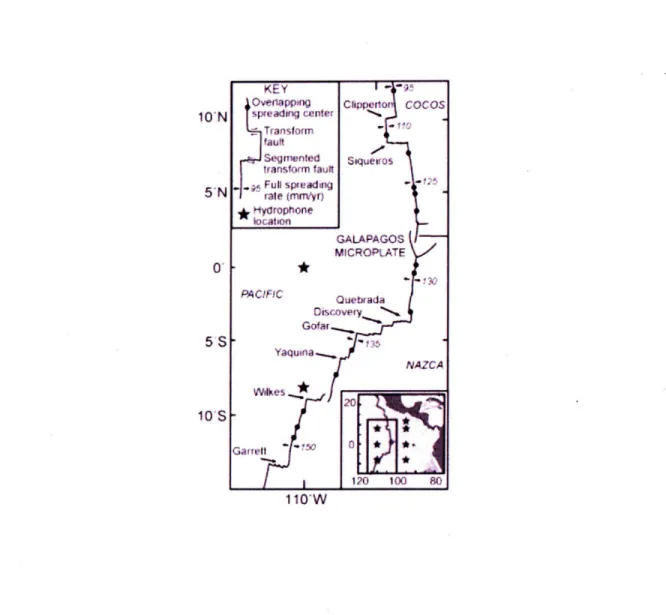
Segmented transform systems are composed of several fault strands offset by short ridges or rifts referred to as intra-transform spreading centers (ITSCs) (Menard and Atwater, 1969; Searle, 1983; Pockalny et al., 1997), where active seafloor spreading and crustal accretion are occurring (Fornari et al., 1989; Hekinian et al., 1992; Perfit et al., 1996). Along the equatorial East Pacific Rise between 15'S and 12°N (Fig. 1), the Siqueiros, Quebrada, Discovery, Gofar, Yaquina, Wilkes, and Garrett transform systems have all undergone transtension due to changes in plate motions, and each of these transforms is segmented by at least one ITSC (Searle, 1983; Fornari et al., 1989; Lonsdale, 1989; Goff et al., 1993; Pockalny et al., 1997). The Clipperton transform system has undergone several periods of transpression (Pockalny, 1997), and is the only unsegmented transform system along the equatorial East Pacific Rise.
The global deficiency of seismic moment release on oceanic transform systems has led researchers to hypothesize that a significant portion of oceanic transform slip is accommodated aseismically (e.g., Boettcher and Jordan, 2004). However, global seismicity studies have yet to consider the prevalence of transform fault segmentation. Dziak et al. (1991) observed that earthquake sizes generally correlate with the lengths of individual fault segments at the Blanco transform fault. Our observations of earthquakes recorded on East Pacific Rise transform faults indicate that segmentation is an important factor influencing rupture of large earthquakes at oceanic transforms. While it has been shown that segmentation and fault steps play an important role in controlling the earthquake behavior of continental strike-slip faults (e.g., Harris and Day, 1993), the influence of segmentation and ITSCs on earthquake processes at an oceanic transform
system has not been studied in detail.
In this paper, we use teleseismically and hydroacoustically recorded seismicity data from the equatorial East Pacific Rise and Coulomb static stress models to explore the effect of ITSCs on static stress interaction between transform fault segments. We
10'N 5N 0* 5S 10 S 110"W
Figure 1. Regional map of the equatorial EPR showing large transform and
non-transform offsets. Segmentation geometry is included based on previous geological mapping of the transform systems (e.g., Fornari et al., 1989; Lonsdale, 1989). Inset: Regional map showing location of the full array of NOAA Pacific Marine Environmental Laboratory hydrophones.
Distance (krn) Map View
x
SClipperton "" "" " .,,, ,,, •, o .i m ,," ' '' 8 C Siqueiros 0Figure 2. Comparison of estimated areas of brittle lithosphere using a one-dimensional,
steady-state lithosphere cooling model (McKenzie, 1969) for the Clipperton (B) and Siqueiros (C) transforms. A: The 90 km Clipperton transform system (X-X') and the 150 km Siqueiros transform system (Y-Y'), which is broken into five major segments S1, S2, S3, S4, and S5 separated by four ITSCs SA, SB, SC, and SD (Fornari et al.,1989). B: Calculated area of brittle lithosphere for temperatures <600 8C (shaded region) for the Clipperton transform. C: Comparison of the calculated areas of brittle lithosphere for the Siqueiros transform for a model of unsegmented geometry (area above the dotted line) versus a model consisting of five individual segments offset by steady-state ITSCs (shaded area).
E
investigate whether adjacent fault segments can behave independently of one another, and how the interaction between segments depends on their offset distance.
TRANSFORM SEGMENTATION
Segmentation of the transtensional transform systems at the equatorial East Pacific Rise has resulted in individual strike-slip fault strands with lengths of 18-89 km, with an average of -37 km. The ITSCs separating the fault strands have lengths of 5-20 km, with an average length of -11 km. Fresh lavas collected from the ITSCs within the Siqueiros and Garrett transforms (Hekinian et al., 1992; Perfit et al., 1996) indicate that ITSCs are magmatically active, implying that the regions beneath them are hotter, and thus the lithospheric plate is thinner than the surrounding domains. To explore the effect of segmentation on the transform fault thermal structure, we use a half-space steady-state lithospheric cooling model (McKenzie, 1969; Abercrombie and Ekstrom, 2001). The
temperature within the crust and mantle, T, is defined as T = Tmerf[y(2Ct)Y-/2], where Tm is
the mantle temperature at depth, assumed to be 13000C; y is the depth; K is the thermal
diffusivity, assumed to be 1,026 m2s'; and t is the age of the lithosphere obtained by dividing distance from the ridge axis by half the spreading rate.
Figure 2 compares the calculated areas of brittle deformation, defined as regions with
calculated temperatures < 6000C, for the geometries of the Clipperton and Siqueiros
transform systems. The calculated area under the 600 oC isotherm for the Clipperton transform fault is 326 km2, compared to 710 km2 for a model of a single unsegmented
fault with the cumulative length of the Siqueiros transform system. When the actual segmentation geometry of the Siqueiros transform system is considered, however, the integrated area of the calculated brittle deformation region is decreased by -60% to 277 km2.
Seismic moment (Mo), which reflects the energy released by an earthquake, is a function of the rupture area of the fault. Specifically, Mo = G x D x S, where G is the shear modulus, estimated to be 27 GPa from seismic velocities (Canales et al., 2003), D is the average slip, and S is the estimated brittle area. The resulting moment magnitude is
Mw = (2/3) x log(Mo) -10.73. For a model of constant stress drop during pure strike-slip earthquakes, Mo = (n7/2) x Ao x w x S, where Ao is the earthquake stress drop, and w is the fault width, estimated from S divided by fault length (Stein and Wysession, 2003).
Curves in Figure 3 show the predicted earthquake magnitudes for a given fault area, assuming models of constant fault slip (Fig. 3A) or constant stress drop (Fig. 3B) during earthquakes. Earthquakes recorded teleseismically as listed in the Harvard Centroid-Moment Tensor (CMT) catalog were relocated to a specific transform segment using hydroacoustically recorded earthquakes, which have smaller location errors (<6 km) (Fox et al., 2001). The maximum earthquake magnitudes observed on each of the transform fault segments at the equatorial East Pacific Rise from 1996 to 2001 are plotted in Figure 3. Assuming the complete rupture of a given individual fault segment, we can estimate the amount of slip or the stress drop for a given earthquake. For example, the largest earthquake observed on the Clipperton transform has a Mw of 6.6 (Fig. 3). If the entire brittle area of Clipperton (326 km2) was ruptured during this earthquake, the estimated average slip is 1 m, or the estimated average stress drop is 53 bar or 5.3 MPa.
COULOMB STRESS CALCULATIONS
Evidence for potential earthquake interactions along oceanic transform faults has been noted in several investigations (e.g., Toda and Stein, 2000; Bohnenstiehl et al., 2002, 2004; McGuire et al., 2002; Forsyth et al., 2003). We utilize the methods of King et al. (1994) and Toda et al. (1998) to calculate how static stress from a moderate-sized earthquake is transferred to adjacent faults, and assess the likelihood of rupturing multiple transform segments during a single earthquake. According to Coulomb failure criteria, when an earthquake occurs on a source fault, changes in Coulomb failure stress (Aof) on a receiver fault are expressed as Aof = A~s + p' x Auo, where A-rs and Aon are changes in shear and normal stresses, on the receiver fault, and pt' is the apparent friction coefficient adjusted for the pore pressure effect (King et al., 1994).
6.6i S62 3 6528 ci) =58~ C (a 5.41 t--0 100 200 300
.65
-barl• S5,5 3stressdro 46Constant stress drop
0 100 200 300
Segment area (kin
2)
Figure 3. A: The predicted maximum moment magnitude, Mw, of earthquakes (curved
lines) for a given transform segment area and a constant slip of 0. 1, 0.3, and 1.0 m. The calculations assume that the earthquake ruptures the entire transform segment. Black dots mark the observed maximum Mw recorded on the transform segments of the equatorial East Pacific Rise. The rightmost data point, Mw = 6.6, corresponds to the Clipperton transform. B: The predicted maximum Mw assuming a constant stress drop of transform earthquakes of 1, 10, and 100 bar.
-0 10 20 0 I
A
t
·
i
A
----
A
Stnke-slip receiver LSSource
earthquake fault I*-"d -0 IIFigure 4. Schematic models showing the geometry of two transform segments bisected by a single ITSC of variable length, L. The source earthquake is located on the bottom right transform segment with its left edge located at a distance, d, from the ITSC-transform intersection. The source earthquake is assumed to be a strike-slip event on a vertical plane parallel to the transform segment. A: A scenario in which the receiver fault is a strike-slip fault located on the top left transform segment, which is assumed to have the same dip, strike, and rake as the source earthquake. B: A scenario in which the receiver fault is a normal fault located along the ITSC, which is assumed to have a dip of
608 and is parallel to the ITSC.
1
We consider a simple geometry in which two adjacent transform segments are offset by an ITSC of variable length, L, for two scenarios assuming the receiver faults are either strike-slip events along the adjacent transform segment (Fig. 4A) or normal-faulting events located along the ITSC (Fig. 4B). The rupture size for the source earthquake in both cases is varied to reflect typical earthquake magnitudes observed along the segmented transforms of the equatorial East Pacific Rise.
For the first scenario, the calculated maximum change in static stress,
I
AorII,
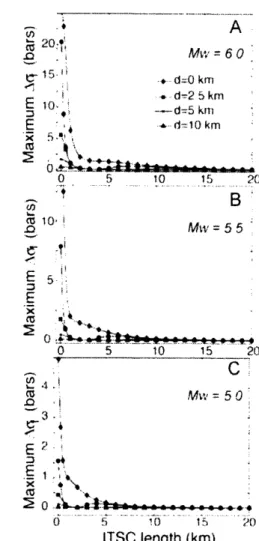
transferred to the receiver fault is plotted versus L for Mw = 5.0, 5.5, and 6.0 (Fig. 5). As the separation distance between the two transform segments increases, the predicted maximum induced Coulomb stress change on the receiver fault decreases. For example, if Mw = 6.0, d = 0 km, and L is increased from 5 to 15 km, the calculated I I AoI I I decreases from 1.35 bar to 0.25 bar (Fig. 5A). The proximity of the earthquake to the ITSC-transform intersection (ITI) is also very important: the closer the source earthquake is located to the ITI (i.e., smaller d), the greater the predicted maximum Coulomb stress change on the receiver fault (Fig. 5). For example, if Mw - 6.0, L = 5 km, and d is increased from 0 to 10 km, the calculated
IIArdl
decreases from 2.5 bars to 0.1 bars. Previous studies have shown statistically significant correlations between regions of seismicity rate changes following continental strike-slip earthquakes and areas of calculated stress changes > 0.2-1.0 bars (Toda et al., 1998).In the second scenario (Fig. 6), for Mw > 5.0, a source earthquake with relatively small d is calculated to cause significant Coulomb static stress increases on ITSC parallel secondary normal faults. Such Coulomb stress changes correspond to a decrease in normal confining pressure across the ITSC axis, which may result in triggering of normal faulting earthquakes or magmatic diking events along the ITSCs. The predicted Coulomb stress changes on secondary normal faults along the ITSC are a strong function of the location of the source earthquake. For example, if Mw = 6.0 and d is increased from 5 to 10 km, the calculated
I
IAd
I
decreases from 2.5 bars to 0.5 bar..* A a20-tl SMw = 60 15 d=O krn Sd-=2 5 km E
E
io,, d=50 km 0 s t0 15 20 B (Z 10' Mo Mw =55 E 5.-E 0 5 10 15 20 •4 3E
.
M
El
CU :20faS----C-'--
C Mw= 5 0 'N £b~.4cj ~ ~ ~ ~ S S @4 0 5 ' 0 15 ITSC length (km)Figure 5. Calculated maximum Coulomb stress changes on a secondary strike-slip
receiver fault caused by a strike-slip source earthquake (geometry shown in Fig. 4A) for source earthquake Mw 5 6.0, 5.5, and 5.0. Note that the vertical scale is different for each panel. All stress calculations were carried out using a three-dimensional boundary-element model, Coulomb 2.6 (Toda et al., 1998), assuming that both the source and receiver faults extend to a depth of 5 km. For each Coulomb calculation, we used a Young's modulus of 62.5 GPa, a Poisson's ratio of 0.25, an apparent friction coefficient, m9, of 0.4 (e.g., King et al., 1994), and a tapered slip distribution. Stresses are sampled on a horizontal plane at a depth of 2 km. The maximum change in Coulomb stress is taken directly from the point on the receiver fault where Coulomb stress reaches a maximum value. Calculations were carried out for L 5 1 to 20 km and d 5 0, 2.5, 5, and
Mw 6.0
c'
20-Mw
5.5
Mw 5.0 S15PE
!
x
o
5
10
15
2
d
(kim)
Figure 6. Calculated maximum Coulomb stress changes on a secondary normal receiver
fault along the ITSC caused by a strike-slip source earthquake on the adjacent transform segment with geometry shown in Figure 4B. The maximum change in Coulomb stress is taken from the point on the ITSC where Coulomb stress reaches a maximum value. The results shown are for calculations assuming a tapered slip distribution along the source earthquake.
-2 -1 0 1 2
Figure 7. Coulomb stress models for a teleseismically recorded earthquake (Mw = 5.7, 26 April 2001) on the Siqueiros transform system. Earthquake location is shown by
white star on each panel. A: Location map shows the segmentation geometry of Siqueiros. Outlined region indicates area investigated in B, C, and D. B: Bathymetric map overlain by the geologic interpretations (thin white lines) of Fornari et al. (1989). White circles indicate the locations of the 170 aftershocks. C: Calculated Coulomb static stress changes on secondary strike-slip receiver faults with the same dip, strike, and rake as the source earthquake. Source fault parameters from Harvard CMT focal mechanism:
strike = 263', dip = 810, and scalar moment = 4.49 x 1024 dyne-cm. We assume rupture length = 5 km, width = 5 km and slip = 0.36 m. We used a tapered slip distribution and stresses were sampled on a horizontal plane at a depth of 2 km. Fox et al. (2001) estimates a lower threshold for earthquakes recorded within the hydrophone array of Mb
= 1.0-1.8. The first 45 aftershocks (shown as white circles) occurred within 10 hours of
the mainshock and fall along fault segment S3. The 0.15 bar and 0.05 bar contours are shown as solid black lines. We observe that -31% of the first 45 aftershocks occurred in regions with stress increases > 0.15 bars, and -56% in areas with stress increases > 0.05 bars. D: Calculated Coulomb static stress changes on secondary normal faults dipping 600 and parallel to the ITSC SB. The later 125 aftershocks (shown as white circles) correspond well with predictions of increased normal stress thus suggesting that they might be associated with normal receiver faults. We observe that -63% of the latter 125 aftershocks occurred in regions with stress increases > 0.15 bars, and - 90% occurred in areas with stress increases > 0.05 bars.
EXAMPLES OF POSSIBLE STRESS INTERACTION
Hydroacoustic monitoring of the EPR (Fox et al., 2001) has allowed us to investigate several moderate sized earthquakes to determine the role of transform segmentation in earthquake processes. Here, we have chosen one Mw = 5.7 teleseismically recorded earthquake that occurred in April 2001 along the S3 segment of the Siqueiros transform fault, which appears to have triggered seismicity on the S2 segment as well as on the
ITSC SB (Fig. 7). Coulomb stress models were calculated using the source earthquake
focal mechanism recorded in the Harvard CMT catalog, and the earthquake source location was taken from the hydroacoustic earthquake catalog.
The mainshock ruptured the 24-km long S3 fault segment -10 km from its intersection with the 8 km-long ITSC SB. Approximately 170 aftershocks were recorded hydroacoustically within 24 hr and 50 km of the epicenter of the mainshock. The first 45 aftershocks (Fig. 7C) occurred along the fault segment S3 within 10 hr of the mainshock, and were spatially truncated by the ITSCs SB and SC. These aftershock locations correspond well with areas of predicted static stress increase along the source fault and on secondary strike-slip receiver faults along segment S3. Furthermore, the termination of the aftershocks east of the source fault at ITSC SC agrees with predicted estimates for segment interaction.
The subsequent 125 aftershocks (Fig. 7D) occurred on ITSC SB and the eastern end of the adjacent fault segment S2. The static stress models assuming transform-parallel strike-slip receiver faults do not predict this pattern of seismicity (Fig. 7C). Geologic interpretations of Siqueiros transform by Fornari et al. (1989) indicate several ITSC-parallel faults flanking ITSC SB to the east, west, and north (Fig. 7B). As the latter 125 aftershock locations correspond well with areas of increased Coulomb stress for normal receiver faults, we hypothesize that these aftershocks might be associated with triggered seismicity on the normal faults mapped by Fornari et al. (1989). The ITSC parallel tectonic fabric was created by ITSCs SA and SB, which appear to have slow-spreading ridge morphology (Fornari et al., 1989); this may account for the development of seismically active normal faults. Another possibility is that these aftershocks may reflect
a diking event near ITSC SB resulting from mainshock-triggered decreases in confining pressure. Dynamic stress changes might also trigger aftershocks, but are difficult to
evaluate due to the lack of detailed mainshock rupture models.
CONCLUSIONS
Detailed analysis of earthquakes on transform systems at the EPR suggests that segmentation geometry plays an important role in how slip is accommodated at fast-slipping oceanic transforms. Results of Coulomb stress models suggest that the length of the ITSC that offsets two transform fault strands will determine whether the adjacent fault segments will interact by static stress transfer. If the ITSC is sufficiently long, the adjacent segments will be decoupled and behave independently of each other. This is particularly important in studies of earthquakes at oceanic transforms since a long oceanic transform system, could be composed of several decoupled fault segments. Moreover, we illustrate that the thermal effect of ITSCs may reduce the thickness of the brittle layer, thus decreasing the potential rupture area and the maximum seismic moment of an oceanic transform fault system. Finally, we suggest that transform earthquakes may have the potential to trigger seismicity on secondary normal faults flanking ITSCs.
ACKNOWLEDGEMENTS
This work was supported by a NSF Graduate Research Fellowship (P. M. Gregg), NSF Grant OCE-0221386 (D. K. Smith and J. Lin), and the WHOI Deep Ocean Exploration Institute (J. Lin). We are grateful for helpful discussions with C. Williams, M. Behn, M. Boettcher, J. Cann, D. Fornari, D. Forsyth, J. McGuire, H. Schouten, and the WHOI geophysics group, and to D. Bohnenstiehl, E.A. Okal, and S. Toda for constructive and insightful reviews.
REFERENCES CITED
Abercrombie, R.E., and Ekstrom, G., 2001, Earthquake slip on oceanic transform faults: Nature, v. 410, p. 74-77.
Boettcher, M.S., and Jordan, T.H., 2004, Earthquake scaling relations for mid-ocean ridge transform faults: Journal of Geophysical Research-Solid Earth, v. 109, B12, doi: 10. 1029/2004JB003110.
Bohnenstiehl, D.R., Tolstoy, M., and Chapp, E., 2004, Breaking into the plate: A 7.6 Mw fracture-zone earthquake adjacent to the Central Indian Ridge: Geophysical Research Letters, v. 31, B2, doi: 10.1029/2003GL018981.
Bohnenstiehl, D.R., Tolstoy, M., Dziak, R.P., Fox, C.G., and Smith, D.K., 2002, Aftershock sequences in the mid-ocean ridge environment: an analysis using hydroacoustic data: Tectonophysics, v. 354, p. 49-70.
Canales, J.P., Detrick, R., Toomey, D.R., and Wilcock, S.D., 2003, Segment-scale variations in the crustal structure of 150-300 kyr old fast spreading oceanic crust (East Pacific Rise, 8015'N-10o5'N) from wide-angle seismic refraction profiles: Geophysical Journal International, v. 152, p. 766-794.
Dziak, R.P., Fox, C.G., and Embley, R.W., 1991, Relationship between seismicity and geologic structure of the Blanco Transform Zone: Marine Geophysical Researches, v.
13, p. 203-208.
Fornari, D.J., Gallo, D.G., Edwards, M.H., Madsen, J.A., Perfit, M.R., and Shor, A.N., 1989, Structure and topography of the Siqueiros transform-fault system - Evidence for the development of intra-transform spreading centers: Marine Geophysical Researches, v. 11, p. 263-299.
Forsyth, D.W., Yang, Y.J., Mangriotis, M.D., and Shen, Y., 2003, Coupled seismic slip on adjacent oceanic transform faults: Geophysical Research Letters, v. 30, doi: 10. 1029/2002GL016454.
Fox, C.G., Matsumoto, H., and Lau, T.-K.A., 2001, Monitoring Pacific Ocean Seismicity from an autonomous hydrophone array: Journal of Geophysical Research, v. 106, p. 4183-4206.
Goff, J.A., Fornari, D.J., Cochran, J.R., Keeley, C., and Malinverno, A., 1993, Wilkes transform system and nannoplate: Geology, v. 21, p. 623-626.
Harris, R.A., and Day, S.M., 1993, Dynamics of fault interaction - Parallel strike-slip faults: Journal of Geophysical Research-Solid Earth, v. 98, p. 4461-4472.
Hekinian, R., Bideau, D., Cannat, M., Francheteau, J., and Hebert, R., 1992, Volcanic activity and crust mantle exposure in the ultrafast Garrett transform-fault near 13-degrees-28s in the Pacific: Earth and Planetary Science Letters, v. 108, p. 259-275. King, G.C.P., Stein, R.S., and Lin, J., 1994, Static stress changes and the triggering of
earthquakes: Bulletin of the Seismological Society of America, v. 84, p. 935-953. Lonsdale, P., 1989, Segmentation of the Pacific-Nazca Spreading Center, 10N-200S:
Journal of Geophysical Research, v. 94, p. 12,197-12,225.
McGuire, J.J., Jordan, T.H., and Lin, J., 2002, Complexities of transform boundaries in the oceans, in Stein, S., and Freymueller, J., eds., Plate Boundary Zones, Volume 30: Washington, D.C., AGU, p. 425.
McKenzie, D.P., 1969, Speculations on the consequences and causes of plate motions: Geophysical Journal of the Royal Astronomical Society, v. 18, p. 1-32.
Menard, H.W., and Atwater, T., 1969, Origin of fracture zone topography: Nature (London), v. 222, p. 1037-1040.
Perfit, M.R., Fornari, D.J., Ridley, W.I., Kirk, P.D., Casey, J., Kastens, K.A., Reynolds, J.R., Edwards, M., Desonie, D., Shuster, R., and Paradis, S., 1996, Recent volcanism in the Siqueiros transform fault: Picritic basalts and implications for MORB magma genesis: Earth and Planetary Science Letters, v. 141, p. 91-108.
Pockalny, R.A., 1997, Evidence of transpression along the Clipperton Transform: Implications for processes of plate boundary reorganization: Earth and Planetary