HAL Id: hal-00512535
https://hal.archives-ouvertes.fr/hal-00512535
Submitted on 30 Aug 2010
HAL is a multi-disciplinary open access
archive for the deposit and dissemination of sci-entific research documents, whether they are pub-lished or not. The documents may come from teaching and research institutions in France or abroad, or from public or private research centers.
L’archive ouverte pluridisciplinaire HAL, est destinée au dépôt et à la diffusion de documents scientifiques de niveau recherche, publiés ou non, émanant des établissements d’enseignement et de recherche français ou étrangers, des laboratoires publics ou privés.
PARTICIPATORY DEPRESSION. A CAVEAT FOR
PARTICIPATORY RESEARCH APPROACHES
Gregory Vaughan, Jacques Lançon
To cite this version:
Gregory Vaughan, Jacques Lançon. PARTICIPATORY DEPRESSION. A CAVEAT FOR PARTIC-IPATORY RESEARCH APPROACHES. ISDA 2010, Jun 2010, Montpellier, France. 9 p. �hal-00512535�
P
ARTICIPATORY
D
EPRESSION
A
C
AVEAT FOR
P
ARTICIPATORY
R
ESEARCH
A
PPROACHES
Gregory VAUGHAN *, Jacques LANÇON **
* Museo Arqueológico de Tunja, Universidad Pedagógica y Tecnológica de Colombia, UPTC Avenida Central del Norte
Tunja, Colombia
[email protected]
** Unité de recherche Systèmes de Culture Annuels, CIRAD Direction générale INRAB
01 BP 966, Cotonou, Bénin
Abstract — Participatory approaches have become de rigueur in research for development. A goal of many
participatory projects is to generally empower beneficiaries, beyond the scope of the immediate project. The technical and organizational learning, the social contacts, and the prestige that result from participation continue to serve beneficiaries after the end of a project. These benefits would accrue more in projects with higher levels of participation. However, in the event of a premature end or an ostensible failure, how are beneficiaries of highly participatory projects affected? Based on experiences with participatory research-development projects in four villages in Benin, this paper discusses the possibility of a “participatory depression”, that is to say an intense disillusionment or sense of abandonment experienced by local participants of projects in which institutional actors fail to fulfill their responsibilities. The forging of close relationships between researchers and beneficiaries means that any incompletion of objectives is charged with personal overtones. A failed participatory project can thus do much to harm the trust of beneficiaries. The article shows that this disillusionment is stronger if participating groups exclude other community members during the project. The authors conclude by recommending a participatory ethic for researchers, based on responsible project completion and sincere commitment to the participatory process.
Key words : participation, farmer field school, participatory plant breeding, Benin
Résumé — La dépression participative: un avertissement pour les approches d'investigation participative. Les
approches participatives sont devenues la norme en recherche – développement. Outre les objectifs techniques immédiats, elles prétendent contribuer au renforcement et à l’autonomisation des participants. L'apprentissage technique et organisationnel, les liens sociaux, l’amour de soi ou le prestige qui résultent de la participation continueraient d’avoir des retombées positives sur les bénéficiaires une fois le projet achevé. Dès lors, on peut penser que les bénéfices sont liés à l’intensité de la participation mise en œuvre. Mais qu’en est-il des nombreux projets qui ne bénéficient pas d’une fin « normale » : échec, arrêt précoce, suspension etc. En se basant sur une enquête qualitative conduite dans quatre villages du Bénin ayant bénéficié de projets affichés « participatifs », cet article émet l’hypothèse d'une « dépression participative », c'est à dire une désillusion intense ou un sens d'abandon ressentis lorsque les acteurs institutionnels n'ont pas été au terme de leur engagement. Les participants, chercheurs ou bénéficiaires, nouent des relations personnelles, voire affectives, qui sont altérées en cas d’échec, ce qui entraîne une perte de confiance en soi et en l’autre. L’article montre aussi que ce sentiment est plus vif lorsque les bénéficiaires se sont isolés de leur communauté pendant le déroulement du projet. En conclusion, les auteurs recommandent une éthique de la participation pour les chercheurs, fondée sur l'engagement personnel mais aussi institutionnel et le respect des partenaires locaux.
Participatory Depression
Vaughan G., Lançon J.
INTRODUCTION: TRANSFORMATIVE PARTICIPATION AND ITS
BENEFITS
Participation is everywhere in development discourse thanks to the spread of
democratic principles through society and its institutions (White, 1996). The United Nations' Human Development Report of 1993 declares in its first pages, “The past decade has been a decade of the people. The forces of democracy are spreading across many lands. ... People's participation is becoming the central issue of our time.” (UNDP, 1993). This report links participation to security, to sustainable development, to the market, to governance, and to international aid.
Beneficiary participation in scientific research is usually presented in terms of
improving efficiency and relevance of results. User participation has been shown to improve engineering efficacy in areas as diverse as agricultural machinery, wind turbines, and
computer operating systems (Douthwaite, 2002). Agricultural researchers have utilized farmer participation in the form of on-farm agronomic trials and Farmer Field Schools to adapt research and extension to real farmer needs (Thiele et al, 2001). Participatory Plant Breeding puts part of the process of new variety creation and selection in the hands of
farmers such that varieties conform better to farmer priorities and field conditions (Weltzien et al, 2008). In both the cases of Farmer Field Schools and Participatory Plant Breeding, various authors have suggested that participation, aside from improving technical efficiency or relevance, can empower people and make them agents in their own development
(Bartlett, 2004; Sperling et al, 2001; Chevassus-au-Louis and Bazile, 2008). There are evidently many uses and types of participation, spread across all imaginable fields of research and development work. The omnipresence of the word “participation” in
development discourse even risks depriving the term of real meaning. How to make sense of it all?
Sarah White provides a framework for understanding the different uses of the term “participation” in research-development, with her scheme of the top-down and bottom-up interests represented in participatory processes (White, 1996). She describes four forms of participation. Nominal participation serves as a visible demonstration of the implication of local beneficiaries in a project, which justifies the project to its institutional creators (top-down) and gives a sense of inclusion to the beneficiaries (bottom-up). Instrumental participation is the incorporation of beneficiary in-kind contributions to a project (work, materials, etc.) to make it more efficient for funders. Beneficiaries have an interest in participating in such a project because it is the means to access the resources offered by funders. Representative participation permits beneficiaries to express their interests to guide a project, and hence ensures project sustainability to funders. And transformative
participation empowers beneficiaries through their participation in decisions and actions, which is a goal shared by the top-down originators of such projects, who also undergo a transformation in their perception and relationship of power vis-a-vis the local partner. These four categories of participation are not static; a project's institutional actors and its local participants change their attitudes, priorities, and actions as time goes by.
The considerations advanced in this paper relate mainly to transformative
participation, and to a lesser extent representative participation, in research-development projects. Transformative participation involves the most intense interaction between all participants in a project, both researchers and local people. Its desired outcome of
empowerment is more ambitious than the effective completion of a project, for empowerment implies other improvements in the lives, attitudes, efficacy, and autonomy of local
Participation in a research-development project can strengthen both human capital and social capital for participants. The gains in human capital come from the learning of new facts, skills, and ways of thinking thanks to the contact with outside experts and the project framework. This new learning does not necessarily relate to the central concepts addressed by the project but sometimes to other areas considered secondary to the project's stated goals. For instance, in the case of participatory plant breeding in Benin, participants learned most not about seeds and breeding but about the agronomic practices employed in the upkeep of the experimental plots. The social capital gains of project participants come from their regular cooperation with each other and with outside experts, and may take the form of increased collaboration with peers and experts in future endeavors not directly related to the original research-development project. Also, the prestige accorded to group members by their neighbors because of their inclusion in the project group and their regular contact with outsiders is a form of social capital (Vaughan, 2008).
1. CONTEXT OF CASE STUDIES
This paper has its origin in field research in Benin (Vaughan, 2008). The authors looked at four villages in two different geographical zones at opposite ends of Benin's cotton belt (Kassakou and Gandokossikana in the north, Koutago and Kpakpavissa in the south). In each of the two regions studied, one village had been the site of a Farmer Field School-modeled project from 2003 to 2005 (Gandokossikana and Kpakpavissa), and one village had been host to a process of Participatory Plant Breeding from 1996 to 2008 (Kassakou and Koutago).
In all the villages, the projects could be said to have been abandoned or neglected before completion. In the Farmer Field School villages, the projects were carried out for only two years, and then swiftly withdrawn. In the villages hosting Participatory Plant Breeding projects, the process had gone on for twelve years, but in the later years funding and administration for the project had changed. Researchers visited project sites less and less, essentially letting the project fall by the wayside. As of 2008 there had still been no complete evaluation and release of the cotton varieties created by farmers in this breeding project.
The four villages studied can be ranked according to higher or lower degrees of participation. Specifically, the Participatory Plant Breeding projects were more inherently participatory, with an approach we could classify as transformative participation. Local beneficiaries were involved in all stages of the research process and they were the primary selectors of genetic lines. Furthermore, one of the explicit objectives of the project as
formulated by its institutional creators (INRAB-Benin and Cirad) was to empower farmers and farmer associations to take over certain functions in which the State's role was waning, namely agronomic research, provision of inputs, and varietal selection of cotton. On the other hand, the Farmer Field School projects were designed in large part by the research institutions that initiated them (again Cirad and INRAB), so the involvement of local
beneficiaries could be classified as an instrumental or even a nominal participation. Unlike the original Farmer Field School model created by the FAO in Indonesia in the 1980s
(Pontius et al, 2000), this project pre-determined the trials and treatments that would be used in the field schools. Participating farmers' role was mainly to tend the demonstration field and to learn about the new techniques proposed by research institutions. In this respect the Benin Farmer Field School project was an example of traditional top-down agricultural extension via demonstration plots, as opposed to the transformative participatory ideal of Farmer Field Schools.
Despite this characterization of the Farmer Field Schools in Benin as less participatory than the Participatory Plant Breeding projects, one of the two Farmer Field Schools (Kpakpavissa) involved a deeper, transformative-style participation than the other.
Participatory Depression
Vaughan G., Lançon J.
This was due to the different work styles employed by the institutional facilitators involved in the two projects. In Kpakpavissa the facilitator had a pedagogy background, and closely followed the spirit of the original Farmer Field School model, encouraging observation of natural phenomena, open critical inquiry, and the scientific process among participating group members. His role was one of co-investigation with group members. In
Gandokossikana, on the other hand, the facilitator followed the top-down extension model generally exemplified by the larger project's design. He dictated the treatments that would be demonstrated in the experimental plot and told group members what were the right and wrong agricultural techniques they should employ on their own farms. His relationship with group members was one of teacher to student.
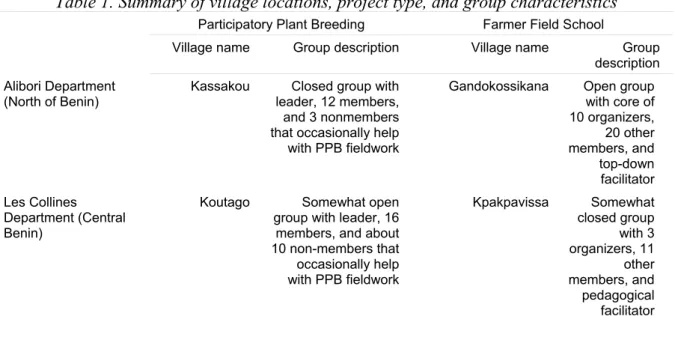
Table 1. Summary of village locations, project type, and group characteristics
Participatory Plant Breeding Farmer Field SchoolVillage name Group description Village name Group description Alibori Department
(North of Benin) Kassakou leader, 12 members, Closed group with and 3 nonmembers that occasionally help with PPB fieldwork
Gandokossikana Open group with core of 10 organizers, 20 other members, and top-down facilitator Les Collines Department (Central Benin)
Koutago Somewhat open group with leader, 16
members, and about 10 non-members that occasionally help with PPB fieldwork Kpakpavissa Somewhat closed group with 3 organizers, 11 other members, and pedagogical facilitator
2. RESULTS AND DISCUSSION OF FIELD RESEARCH
The aim of the field research undertaken by the authors in Benin was to assess benefits to human and social capital that had occurred as collateral effects of the
participatory projects. The hypothesis was that Farmer Field Schools and Participatory Plant Breeding would strengthen the human and social capital in participating groups. As
predicted, in all four villages, in both regions and both models of project, the participating group experienced improvements in its human and social capital.
In terms of human capital, members of the groups involved in these participatory projects learned and adopted certain new agricultural techniques thanks to the projects, not only for cotton (the crop directly implicated in the projects) but for other crops to which individual participants adapted and applied the new methods. Group members had long been exposed to these new techniques through extension agents, but it was only after applying them in the project plots that participants were convinced of their value.
Social capital was improved in all participating groups thanks to the projects, as measured by increased collaboration in farmwork, increased exchanges of seeds, and increased discussion of agricultural problems between group members. Members had collaborated on these points prior to the project, but their cooperation in the project with other group members strengthened these social ties. In two villages studied (Kassakou and
Kpakpavissa) the group of project participants could be qualified as “closed” or “exclusive”, and in the other two villages the group could be called “open” or “inclusive”. Members of the closed groups were tightly linked socially before the project, and their participation in the project group strengthened their social ties without favoring interaction with other people in the village. Members of the open groups (Gandokossikana and Koutago) were not as closely linked before the project. The projects in these villages strengthened social ties between group members less intensely, but involved more people, group members and non-group members alike. That is to say that elements of the project touched most people in these inclusive-group villages.
Another improvement in social capital for group members in all projects was increased prestige. Group members in all four villages felt that their prestige had risen among their fellow villagers. Part of this was an associative effect—the project groups assembled already-respected villagers, and being associated with other respected people raises one's own prestige. In Kassakou, group members accentuated this aspect by pointing out that the exclusivity of their group brought them respect, though this vision did not
coincide with the reasons non-member villagers gave for respecting group members or not. In the other villages group members traced their increased prestige precisely to the degree that they included other villagers, for example by sharing knowledge gained from the project with the rest of the village.
The last effect on social capital relates to contacts with researchers. In the two Farmer Field School projects, the participating group met with the facilitator every week during two rainy seasons, as well as receiving occasional visits from institutional
coordinators. In the Participatory Plant Breeding projects the contact with researchers was less frequent but lasted over the course of twelve years. Plant breeding group members, especially the group leader, enjoyed a collaborative relationship with researchers at various levels of the project, participating in workshops and technical analyses of different cotton varieties. In the case of the Farmer Field Schools, any contact with researchers stopped at the project's end, and in the Participatory Plant Breeding projects contact has foundered in the past years. Aside from increased contact with researchers, the predicted increase in contact with other NGOs, research institutions, and farmer groups did not occur.
During our fieldwork we noticed another, negative trend in addition to the benefits to human and social capital.
The more participatory projects experienced an unexpected effect on human and social capital: what we call “participatory depression”. Those village groups (the
Participatory Plant Breeding groups) that had had closer, more collaborative relationships with researchers were left angry and disillusioned when the projects went under, while the Farmer Field School groups, which had collaborated less with researchers (and which had in fact enjoyed fewer benefits of human and social capital) were basically content with the project experience.
The strong personal implication of participants in the two Participatory Plant Breeding projects meant that the waning involvement of researchers was seen as a betrayal.
Participating farmers knew and shared with researchers the final objective of creating and diffusing new cotton varieties, so the non-achievement of this goal was seen as a failure. Group members focused more on their deception with the project outcome, and on the neglect of researchers they had thought were partners, than on the positive secondary effects of acquiring new techniques and strengthening social links.
In the Farmer Field School villages, on the other hand, the end of the project was viewed less negatively. Participants had a less personal relationship with researchers, and were pleased with the stray lessons they'd acquired in farming methods and the closer
Participatory Depression
Vaughan G., Lançon J.
relationships with fellow group members. Group members had not participated in the planning of the project and thus did not share the formal objective (the testing and diffusion of new agricultural techniques). They accurately interpreted their role: to maintain the field and to learn. One villager from Gandokossikana even characterized the project as a
“mission accomplished”. Personal investment of the villagers in the project was very low, so any gain was seen as a benefit to the project's credit, even if it was in an area considered secondary by the institutional actors. The satisfaction of group members was disconnected from the achievement of the formal objective.
This trend of increased disillusionment with increasing levels of participation can also be seen in a comparison between the two Farmer Field School villages. In Kpakpavissa, where group members had a relationship as co-investigators and peers with the facilitator, members were left more disappointed with the departure of the project than in
Gandokossikana, where the participation of group members had been more nominal than transformative.
One last nuance is that in the villages studied, the more exclusive or closed groups suffered more from participatory depression. Between the two Participatory Plant Breeding villages, the Kassakou group members had built their self-image more around their
exclusivity and the eventual benefits that they would magnanimously offer the rest of the village once the project was completed and the new cotton varieties available. With no tangible results to show from its breeding activities, the Kassakou group's basis for gaining prestige was invalidated, and members were left feeling particularly bitter and disappointed. Koutago's group, on the other hand, had gained respect in the rest of the village precisely through its inclusion of non-members in learning sessions on new agricultural techniques. So despite the group's internal disappointment at not succeeding in the breeding project, members could console themselves with their improved image in the eyes of fellow villagers. A similar dynamic occurred in the Farmer Field School villages. Kpakpavissa group
members had been very invested in the project and had largely excluded other villagers, while in Gandokossikana group members could bid farewell to the project with the sense that they had benefited their village as a whole.
The occurrence of participatory depression makes intuitive sense, though promoters of participatory approaches are not likely to dwell on this potential dark side of the process. Successful examples of transformative participation harness personal relationships in order to go beyond technical project goals, and to strengthen human and social capital and quality of life in general. It is natural then that a failed participatory project can impact personal and social aspects that a purely technical project wouldn't touch. The accumulated social capital in the form of a cooperative relationship between participants and researchers is of course dashed in the case of project failure, but an unfruitful collaboration can also make local people more wary of future projects, especially those bearing the title of “participatory”. Though it did not happen in the studied case, one could even foresee an angry rejection of certain techniques learned during the project, despite their initial adoption and the recognition of their usefulness.
Part of the goal of transformative participation is to foster critical consciousness among all participants, hence changing and implicitly critiquing the top-down dynamic that reigns in non-participatory projects. When local participants in such a project complain that their partners have abandoned them or that they have reverted to the old top-down model, it is particularly damning, because it is a critique from within the participatory framework.
If there are any tentative lessons we can take away from the experience in Benin, they are that researchers using participatory approaches should finish projects they start, and that they must take a firm, sincere stance in favor of collaboration and partnership. We call this a participatory ethic for researchers, and it follows naturally from a genuine respect for local partners.
The importance of completion seems obvious in any project, not just in participatory approaches. If a researcher undertakes a project, he presumably does so because he feels the endeavor is worthwhile, and should be carried through to its end. It is understandable that sometimes situations beyond the control of the researcher prevent him or her from finishing a project. But in the context of participatory research approaches, it is important to remember that an unfinished, abandoned, or failed project is not just the concern of the institutional researcher(s), but of a larger group of people that are involved and invested in the effort.
This leads us to the second lesson—that a participatory, collaborative attitude must be profound and heartfelt. Often so-called participatory projects never pass beyond what White calls nominal or instrumental participation. This is not a bad thing in and of itself, as long as all actors are aware of and consent to their designated roles in the process. But if the aim of a project is a transformative participation, that is to say one that goes beyond project goals in order to improve human and social capital by employing personalized relationships of trust, cooperation, and friendship between researcher and villager, then this progressive attitude on the part of the researcher must be sincere and consistent. In the studied examples in Benin, certain researchers that had initiated the Participatory Plant Breeding projects were replaced mid-way by researchers that did not share their conviction of the value of the participatory aspects of the project, nor their respect and esteem toward participating farmers. Hence what had started out as a genuine collaboration was degraded into the false, window-dressing style of participation. Local participants were left in the dark as to the reasons for the decreased institutional presence, wondering if the friendship and partnership of researchers had never been more than a front.
An extreme example of a similar situation is described in a recent New York Times article (Harmon, 2010a). A researcher in Arizona, USA won the trust of the Havasupai indigenous community by offering them help with a diabetes epidemic. The community agreed to provide blood samples, which was a great show of faith in the researcher, as blood is sacred to the Havasupai. The research performed with the blood samples led to no
discoveries regarding the group's diabetes problem, and community members were left in the dark regarding the fate of their blood and the research. When the indigenous people found out almost fifteen years later that their blood had been used for much other research that they had not explicitly condoned, they were furious and demanded the blood samples back. This is a clear example of a researcher that did not have a genuine participatory ethic. She had established personal relationships with a local community, and then lost interest in maintaining that human relationship once she had what she needed to carry out her studies.
Bridging the cultural gulf between professional, globally mobile, usually First-World researchers and local peasant farmers is always a major hurdle to collaborative research. It takes a lot of time and effort for both parties to overcome their natural reticence towards one another. Each side must expose itself to some vulnerability, must engage in an act of faith as very different people come slowly to place trust in one another. If that bond is broken, if that personal investment is left to fall, it becomes even more difficult to build trust in future situations. This is not only an ethical issue, but a practical one, for it implies that future projects may be negatively affected by the cynicism generated by past projects. A law professor discussing the Havasupai case says, “It sows distrust...And researchers cannot do their research unless people are willing to trust them” (Harmon, 2010b).
Participatory Depression
Vaughan G., Lançon J.
Sarah White reminds us that participation is not inherently good (White, 1996). The ubiquitousness of references to participation in development projects means that often the term is employed as meaningless window-dressing to make a project more palatable. Chevassus-au-Louis and Bazile warn of the manipulation of local participant groups to validate researcher's priorities or research results (Chevassus-au-Louis and Bazile, 2008). Certain forms of participation can even reinforce relations of oppression, as when a powerful group compels people to attend its meetings in order to demonstrate the group's legitimacy to outsiders. Aside from this, participants in a project can be chosen because of their pre-existing elite status, or the benefits accruing to them from a participatory project can elevate participants' economic or social status above that of non-participants. A participatory project in such cases could thus be detrimental to non-participants by providing elites with tools to maintain and expand their power.
Unlike White, the authors of this paper do not aim to question the effectiveness or importance of participation, or even to offer caveats about participation itself. Our argument is rather a resounding endorsement of sincere participatory approaches (what White would call representative or transformative participation). We assert that if a researcher intends to use a transformative participatory method in his or her research design, that researcher must truly internalize the idea that local participants are partners and equals, and that participation is more than a window dressing or a buzzword. The researcher must make an extra
commitment to see the project through to completion. But even if results are not what was expected, or if the project seems to fail by some outward measure, when there is a real collaborative relationship between researcher and villager, nourished by constant and open communication, everyone involved will understand why the project “failed”, and participants will know that it was not the result of bad faith on anyone's part.
Adopting the participatory ethic we promote here may seem inordinately difficult for researchers. Aside from the frequent difficulty for experts to recognize poor, uneducated farmers as equals, there are also structural, logistical hurdles to inculcating a long-standing partnership with local communities. Development researchers are almost by definition mobile, unattached to one single place, and often operate on short-term contracts or must obey the demands of their employing organization. Given these realities, it can be nigh impossible to make a rock-solid, personal commitment to see a project through to its conclusion, or to tie oneself into a genuine, long-lasting relationship with one place and its people. But making this commitment is an ethical imperative to the researcher who would employ deep participatory methods. These methods imply the expansion of working relationships to include personal overtones of friendship, esteem, and affinity. In the most instrumental of terms, one takes this extra methodological step to improve project outcomes, but the election of participatory methods brings with it a responsibility toward those local people who are also being asked to take a step beyond business as usual and toward close personal collaboration. By the very nature of a participatory approach one breaches simple professional duties and enters the realm of duty to other human beings, human beings that have been made into friends.
ACKNOWLEDGEMENTS
The authors wish to thank first and foremost the group members in the four villages of Kassakou, Gandokossikana, Koutago, and Kpakpavissa for their collaboration and honesty. Thanks is also due to various researchers involved with the Cra-CF of INRAB and with Cirad for having provided basic information and access to documents about the Participatory Plant Breeding and Farmer Field School projects of the PARAB and PARCOB programs. Finally, thanks go to Henri Hocdé of Cirad, who reviewed a manuscript of this article and offered suggestions on how to clarify certain details.
REFERENCES
BARTLETT A., 2004. Entry points for empowerment, Report for CARE Bangladesh, 68 p. CHEVASSUS-AU-LOUIS B., BAZILE D., 2008. Cultiver la diversité, Cahiers Agricultures, vol.
17 n° 2, pp. 77-78.
DOUTHWAITE B., 2002. Enabling innovation: A practical guide to understanding and fostering technological change, London, Zed Books.
HARMON A., 2010a. Indian tribe wins fight to limit research of its DNA, New York Times, April 21, 2010.
HARMON A., 2010b. Havasupai case highlights risks in DNA research, New York Times, April 21, 2010.
PONTIUS J., DILTS R., BARTLETT A., 2000. Ten years of building community: from farmer field schools to community IPM, Jakarta, FAO Community IPM Program, 129 p.
SPERLING L., ASHBY J., SMITH M., WELTZIEN E., MCGUIRE S., 2001. A framework for analyzing participatory plant breeding approaches and results, Euphytica, n° 122, pp. 439-450.
THIELE G., VAN DE FLIERT E., CAMPILAN D., 2001. What happened to participatory research at the International Potato Center? Agriculture and Human Values n° 18, pp. 429–446.
VAUGHAN G., 2008. Les impacts sociaux comparés de projets participatifs dans quatre villages du Bénin, Unpublished Master thesis, 167 p.
WELTZIEN E., VOM BROCKE K., TOURÉ A., RATTUNDE F., CHANTEREAU J., 2008. Revue et tendances pour la recherche en sélection participative en Afrique de l'Ouest, Cahiers Agricultures, vol. 17 n° 2, pp. 165-171.
WHITE S., 1996. Depoliticising development: The uses and abuses of participation, Development in practice, vol. 6 n° 1, pp. 6-15.