HAL Id: hal-02805445
https://hal.inrae.fr/hal-02805445
Submitted on 6 Jun 2020
HAL is a multi-disciplinary open access
archive for the deposit and dissemination of
sci-entific research documents, whether they are
pub-lished or not. The documents may come from
teaching and research institutions in France or
abroad, or from public or private research centers.
L’archive ouverte pluridisciplinaire HAL, est
destinée au dépôt et à la diffusion de documents
scientifiques de niveau recherche, publiés ou non,
émanant des établissements d’enseignement et de
recherche français ou étrangers, des laboratoires
publics ou privés.
Genetic Resources Centre on Small Grain Cereals
Audrey Didier
To cite this version:
Audrey Didier. Genetic Resources Centre on Small Grain Cereals. Constraints in the use and
conserva-tion of plant genetic resources in Europe: a stakeholder analysis, Nov 2013, Wageningen, Netherlands.
2013. �hal-02805445�
Genetic Resources Centre on Small Grain Cereals
Didier A., Deloche M., Bardy L., Balfourier F.
INRA-UBP, UMR Genetic, Diversity and Ecophysiology of Cereals
5 chemin de Beaulieu
63039 Clermont-Ferrand Cedex 2, France
Collections
SMQ
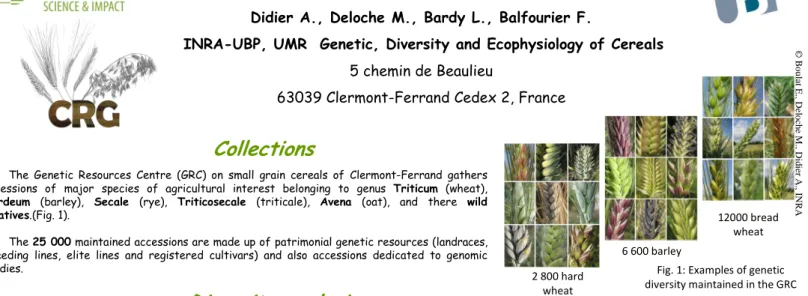
6 600 barley 12000 bread wheat 2 800 hard wheat The Genetic Resources Centre (GRC) on small grain cereals of Clermont-Ferrand gathersaccessions of major species of agricultural interest belonging to genus Triticum (wheat), Hordeum (barley), Secale (rye), Triticosecale (triticale), Avena (oat), and there wild relatives.(Fig. 1).
The 25 000 maintained accessions are made up of patrimonial genetic resources (landraces, breeding lines, elite lines and registered cultivars) and also accessions dedicated to genomic studies.
Distribution
Batches conserved in GRC mainly consist on seed samples from free-pollinated and self-pollinated spikes but also two spikes per accession are kept as reference. It allows securing traceability between two cycles of multiplication. Seeds from self-pollinated spikes are distributed for DNA analysis.
GRC received in 2013 a quality-label from a French organization IBiSA and a certification process is in progress.
© B o u la t E ., D el o ch e M ., D id ie r A ., IN RA
REFERENCES : Balfourieret al., 2007, TAG, 114(7),1265-1275; Bordes et al., 2008, JCS, 48(3),569-57; Bordes et al., 2011, JCS, 54(1),137-147; Bordes et al., 2013, TAG, 126(3),805-822;
Horvath et al., 2009 TAG 119, 1523-1537; Jallaiset al., 2012, ACA, 734,45-53; Le Gouis et al., 2012, TAG, 124,597-611; Rousset et al., 2011, TAG, 123,907-926
A part of small grains cereals collection is available online on SIReGal
http://urgi.versailles.inra.fr/siregal. This database is a part of a global portal (GnpIS) which allows crossing and exchanging data from genomic, proteomic and phenotypic evaluation.
Request of seeds samples can be done directly by SIReGal or by mail ([email protected]). Annually, around 4 200 samples are freely distributed with constant ratio between national (80%) and foreign (20%) requests. Each distribution goes with a Material Transfer Agreement (MTA). Around 50 % of samples are used by private breeders, 38% by public sector (research, botanical garden, high school …), while the remaining are distributed to farmers, often in biological agriculture, associations or private individuals (Fig. 2).
Fig. 2 : “Bon Fermier” cultivar information's on SIREGAL web site
National Network for cereal crop genetic resources
Diversity analyses of bread wheat collection, which gather 108 different countries, were used to define a core collection of 372 accessions (Balfourier et al, 2007). This core is today highly genotyped for more than 120 000 SNP and phenotyped for a hundred of agronomical and technological descriptors (Bordes et al, 2008).
Genetic structure of the core collection had been analyzed (Horvath et al, 2009) and this sample appears to be a powerful tool to perform genetic association analyses. It was used in a dozen of different research programs with various goal as bread-making quality (Bordes et al, 2011), protein composition, nitrogen uptake efficiency (Bordes et al, 2013), heading date precocity (Le Gouis et al, 2012 ; Rousset et al, 2011) or health-nutrition value of wheat (Jallais et al, 2012).
4 600 accessions of GRC wheat collection are currently highly genotyped and phenotyped to allow further genetic association analyses in the framework of the precompetitive national project “Breedwheat”.
In the European FP7 program, a part of CRG wheat and barley collection will be also evaluated in order to create prebreeding material that will support the selection of improved varieties (Whealbi project).
Oat collection with patrimonial value had been evaluated during two European projects (GENRES CT99-106 and AGRI GEN RES 870/2004). As well as agronomic traits, an estimate of biochemical characteristics (protein and cellulose) has been done by NIRS methodology.
GRC is involved with private breeders in the national networks for cereal crop genetic resources. This network had defined "National French Collection“ for bread wheat (1 784 accessions), barley (461 accessions) and Triticale (28 accessions).
The management of these specific collections is shared between GRC, in charge of multiplication, conservation and distribution of samples and data, and private breeders who phenotype accessions in multi-site network.
The national bread wheat collection has been declared in 2010 to the FAO as a French contribution to The International Treaty on Plant Genetic Resources for Food and Agriculture.
Diversity analysis
European Network
At European level, two GRC members are involved in ECPGR Cereals Networks and databases (F. Balfourier as Chair of the Wheat working group and A. Didier as member of the Barley and Avena working group).
Fig. 1: Examples of genetic diversity maintained in the GRC