Description and Analysis of Central Registry, a
Pattern for Modular Implicit Invocation
by
Jonathan Newcomb Swirsky Whitney
Submitted to the Department of Electrical Engineering
and Computer Science
in partial fulfillment of the requirements for the degree of
Master of Engineering in Computer Science and Engineering
at the
MASSACHUSETTS INSTITUTE OF TECHNOLOGY
May 2002
1Sxu 20D3
©
Jonathan Newcomb Swirsky Whitney, MMII. All rights reserved.
The author hereby grants to MIT permission to reproduce and
distribute publicly paper and electronic copies of this thesis document
Author ...
in whole or in part.
MASSACHUSESmSIT E OFTECHN01.0YJUL 3 E12002
LIBRARIES
Department of Electrical Engineering
and Computer Science
May 24, 2002
Certified by...
.
...
Daniel Jackson
~Th
Accepted by ....
Associate Professor
beTcsis
Supervisor
Artur C. Smith
Chairman, Departmental Committee on Graduate Students
Description and Analysis of Central Registry, a Pattern for
Modular Implicit Invocation
by
Jonathan Newcomb Swirsky Whitney
Submitted to the Department of Electrical Engineering and Computer Science
on May 24, 2002, in partial fulfillment of the requirements for the degree of
Master of Engineering in Computer Science and Engineering
Abstract
Central Registry is a generalization of several implicit-invocation design patterns. Its goal is to provide the kind of decoupling that implicit invocation provides in a more modular and flexible way than current patterns. We describe the pattern in detail and present a formal model of its key features. Using the formal model, we are able to establish, by automatic analysis, properties of any system that uses the pattern. We also describe an implementation framework for the pattern and evaluate its use in five substantial programs.
Keywords: Design Patterns, Implicit Invocation, Formal Models, Component Ar-chitectures.
Thesis Supervisor: Daniel Jackson Title: Associate Professor
Acknowledgments
I would like to thank Daniel Jackson for his advice and guidance. I would like to
give special thanks to Robert Lee and Allison Waingold for helping with all aspects of this work. Ilya Shlyakhter and Manu Sridharan gave me a lot of assistance with Alloy and the Alloy Analyzer. All the members of the Software Design Group at LCS were extremely supportive and friendly for many years, and I am indebted to them for countless hours of discussion. I would finally like to thank my parents, friends and roommates for listening to me talk about this thesis for hours on end.
Contents
1 Introduction 11
2 Pattern Description 15
2.1 Intent ... ... ... 15
2.2 M otivation . . . . 15
2.2.1 Overview of Central Registry Design . . . . 16
2.2.2 Exam ple . . . . 17
2.3 A pplicability . . . . 18
2.4 Structure and Behavior . . . . 19
2.4.1 Structure . . . . 19
2.4.2 Participants . . . . 19
2.4.3 Collaborations . . . . 21
2.4.4 Features and Variants . . . . 21
2.5 Consequences . . . . 23
3 Properties and Analysis 27 3.1 A Formal Model . . . . 27
3.2 Properties of Central Registry . . . . 29
3.2.1 Fundamental Properties. . . . .. 29
3.2.2 Analysis and Requirements . . . . 30
4 Implementation Framework 37 4.1 V ariants . . . . 37
4.2 Global State Reasoning in Asynchronous Central Registry . . . . 38
4.3 Benefits of the Framework . . . . 39
5 Known Uses 41 5.1 The CTAS Communications Manager . . . . 41
5.2 Tagger . . . . 45
5.3 G izm oball . . . . 46
5.4 JarSheet . . . . 49
5.5 The Visualization Tool for the Alloy Analyzer . . . . 51
6 Comparisons 53 6.1 Implicit Invocation . . . . 53 6.2 O bserver . . . . 54 6.3 EventPorts. . . . . 55 6.4 M ulticast . . . . 55 6.5 M ediator . . . . 56
7 Discussion and Conclusions 57 7.1 Formal Models of Patterns . . . . 57
7.2 Frameworks for Design Patterns . . . . 58
A Framework Specifications 61
B Complete Alloy Model 67
List of Figures
Object model for CR pattern. . . . . Module dependence diagram for typical CR system. . . . . An interaction diagram of the CR processing an Event . . . . . Core Alloy model . . . . Pseudo-code for an air-traffic-control example . . . . Formal description of a CR system that has a transaction model Condition for Commuting Operations . . . . Extension to CR model where Events specify legal transitions .
3-6 Pseudo-code for an Event which specifies legal post-states .
Pseudo-code for a global invariant . . . .
Extension to CR model with Invariants . CR system with event handlers that obey Pseudo-code for modified event handlers
CR system with strong invariants . . . .
invariants . . .
Module dependence diagram of a non-CR CTAS design. . . . Module dependence diagram of a CR CTAS design. . . . . . Module dependence diagram of a non-CR Gizmoball design.
Module dependence diagram of a CR Gizmoball design. . . .
. . . . 34 . . . . 34 . . . . 35 . . . . 35 . . . . 35 . . . . 36 . . . . 43 . . . . 44 . . . . 48 . . . . 49 2-1 2-2 2-3 3-1 3-2 3-3 3-4 3-5 3-7 3-8 3-9 3-10 3-11 5-1 5-2 5-3 5-4
List of Tables
Chapter 1
Introduction
Implicit Invocation
Implicit invocation systems are systems in which procedure calls are made implicitly
by the system. In all such systems, the major design goal is to allow for flexible assem-bly of components. Requests for procedure calls are made by announcing events, and
procedures register interest with the system for particular events. The primary bene-fit of implicit invocation systems is that the components have no dependence on each other. Instead, they all rely on the underlying system to perform the communication between them. This form of system architecture allows for incremental extension and contraction of system functionality by simply adding and removing procedures for events or by adding and removing events. In [11], Garlan et al. note that this form of architecture is complementary, and not contradictory, to data abstraction techniques, one of the most popular forms of modularization [12, 11].
Design Patterns
Design patterns have become quite popular in the software engineering field since the publication in 1995 of the "Gang of Four" book [1]. The authors describe design patterns as generic solutions to problems that arise often. Design patterns have significantly contributed to software development in many ways. Primarily, they
capture years of design experience, which enables designers to avoid thinking about problems that already have good solutions. Secondly, they provide designers with a high-level vocabulary with which to communicate.
The primary goal of design patterns is to describe designs that are flexible and reusable [1]. Each pattern description is accompanied by an informal description of how the pattern achieves more flexible designs. The structure of each pattern is described somewhat formally in UML, but the behavior descriptions are quite informal. This can cause potential problems with a system designer who desires to know if a usage of a pattern is correct. It is fairly easy to convince oneself that the structure of a design matches a pattern, but as the patterns provide no formal description of behavior, it can be difficult to decide if a design behaves as the pattern prescribes. For most patterns, the behavior is extremely simple, and thus informal descriptions often suffice.
Central Registry
Central Registry is a design pattern for implicit invocation systems. It captures the structure and behavior of the underlying communication machinery of implicit invocation systems, and provides a disctinct way in which to describe these systems. Central Registry adds some novelties of its own in the form of event filtering and global state, which allows the pattern to apply in different forms to a wide range of systems.
This thesis presents a pattern that is more complex in behavior and structure than most "Gang of Four" design patterns. One of the main contributions of this thesis is a formal model of the pattern, which gives precise definitions of both the structure and behavior of the entities involved. This approach has two benefits. Primarily, it provides system designers with a better way to check if they are using the pattern correctly. Secondly, it allows for a more precise description of how the pattern achieves a reuseable and flexible design.
" A generalized pattern for implicit invocation systems, which condenses the
de-signs of many such systems.
* A formal model that gives precise definitions of both the structure and behavior of implicit invocation systems.
" A machine-checked argument that specific properties related to modularity hold
for specific variants of the pattern.
" Some practical insights gleaned from experience using Central Reigstry, and
examples of how other related patterns are inadequate.
This thesis presents Central Registry in the style of a "Gang of Four" pattern. The layout of the typical pattern description is extended to include the formal model and machine checked argument, as well as descriptions of the tradeoffs involved in using different variants of the pattern.
Chapter 2
Pattern Description
2.1
Intent
Avoid bidirectional coupling of the sender of a request and its receiver by passing all requests through a single object. Provide mechanisms to allow for dynamic behavior in response to a request.
2.2
Motivation
Consider a door locking system in a prison. Guards have access cards, which they swipe through card readers to open doors and pass from one section to another. The system determines whether or not to unlock a door and for how long. Its goal is to mediate access between compartments of a prison in a disciplined way to minimize the risk of undesirable prisoner movements.
It is natural to structure such a system based on the physical layout of the prison. The prison may be divided into sections, with different kinds of policies for the dif-ferent sections. For example, high-security sections will have difdif-ferent rules for which doors can be open simultaneously than low-security sections. Furthermore, prison-wide rules relating to opening doors may be desirable. Lastly, requests to open a door
may be generated by a warden not physically present at the door itself.
unlocking requests, to allow these responses to change according to different states of the prison, different credentials of a guard, new administrative policies. It should be easy to change policies and to fine-tune the response of the system in different scenarios. This must be accomplished without excessive modification to existing software, such as the prisoner or guard databases.
Another problem is that requests can be generated by independent entities. It is therefore desirable that the part of the system that processes requests be independent of the parts of the system that can generate requests. Conversely, the senders of requests should remain independent of the receivers because the receivers are not always the same in different scenarios.
2.2.1
Overview of Central Registry Design
The idea of this pattern is to allow for this type of dynamic and flexible behavior while disallowing dependence between senders and receivers of the request. This is achieved
by interposing a centralized event dispatching mechanism between the senders and
receivers.
The various requirements of the prison system highlight the interesting features of the Central Registry pattern. Event handlers, which are wrapped around existing software, are registered to receive events in a single centralized table, which we call the central registry. The event handlers are registered against event filters, which accept or reject events based on their content, type and the state of the system.
Events are posted to a central queue. The event handlers that are registered against accepting filters will handle an event. There can be numerous event handlers registered to receive an event. The event handlers, in addition to carrying out local action, can change global state values and post new events to the queue. The central registry can maintain configurable policies for posting and queuing events and can also dynamically register and deregister handlers.
2.2.2
Example
This section describes parts of this system to highlight elements of the Central Reg-istry design more concretely. This section will describe the behavior of event handlers that perform access-control, event handlers that unlock specific doors, and event han-dlers that control guard GUI consoles. These event hanhan-dlers will communicate via CardSwipedEvents and DoorUnlockEvents. They will be registered with the central registry against filters that match the type of event as well as specific information contained within each individual event.
In this system, an embedded card reader is placed at every door. When a guard's card is swiped, this reader generates a CardSwipedEvent, containing the relevant data from the card and the door in question. The reader posts this event to the central registry. Each section of the prison is equipped with an access-control computer, which is an event handler. This handler is registered against an event filter that only matches CardSwipedEvents generating from doors within that section. The access-control handler then verifies the identity of the guard and grants access by generating and posting a DoorUnlockEvent. The role of the filter is to ensure that the access-controller for this section of the prison will not bother to verify requests to open doors in other sections.
This system may make use of event-based queuing priorities. A DoorLockEvent, for example, might be given a higher priority than a DoorUnlockEvent. Under this policy, all DoorLockEvents that are pending will be dispatched before any pending DoorUnlockEvents. In this system, an asynchronous post policy is appropriate, be-cause card swipes happen across the prison asynchronously and should be handled as such.
Suppose the prison has a "lock-down" status for emergencies in which certain doors should not open. This can be implemented by setting a global state variable, which event filters access when determining whether a given handler should be activated for a given event. In this state, the filters for the door-unlocking handlers will not match any CardSwipedEvents.
Another requirement may be a GUI display of a map of the prison in which doors light up when they are unlocked. Each console running this GUI display may be a separate event handler that is dynamically registered when somebody logs into the console. This handler is passive. It merely listens to DoorUnlockEvents and DoorLockEvents, and updates the display.
This design achieves fairly good decoupling between the various subsystems de-scribed as event handlers. The GUI console, for example, need not depend on any of the software running at the access-control handlers or in the card-readers. Similarly, the access-control handlers and card-readers are independent of each other. All three subsystems are dependent on the specification of the events and global state variables instead.
2.3
Applicability
The Central Registry pattern is applicable to systems that are comprised of well-encapsulated subsystems whose communication can be represented as a small set of messages, and where it is desirable for the senders and receivers of requests not to have explicit knowledge of each other.
In such systems, the Central Registry pattern improves modularity - only the global state elements and the events are shared across subsystems. If the subsystem's interfaces cannot be represented by a small set of events, using Central Registry is likely to complicate rather than simplify a system. Because handlers can be dy-namically registered and deregistered, Central Registry is particularly well-suited to systems whose communication targets change at run-time. Inter-module communica-tion concerns are moved into the Central Registry, so that communicacommunica-tion machinery need not be implemented in each module. Additionally, the pattern allows systems to achieve looser coupling and reuse of event, event filtering and event handling code.
2.4
Structure and Behavior
2.4.1
Structure
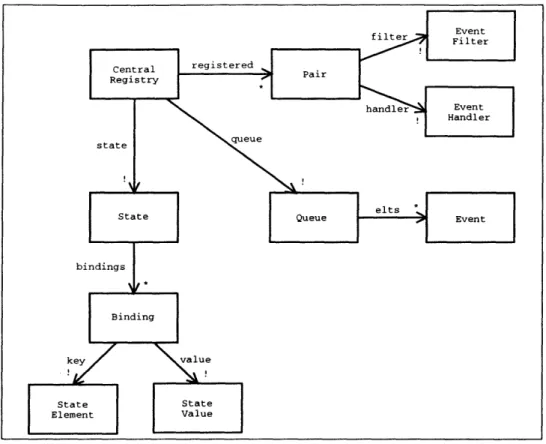
The object model in Figure 2-1 summarizes the structure of this pattern, viewed semantically. The boxes in the model represent semantic domains relevant to the pattern and the arrows connecting them represent relations between these domains. The notation on the arrowheads indicate the multiplicity of that relation where ? means "zero or one", ! means "exactly one", and * means "zero or more". While these semantic domains may be represented as classes, they do not necessarily map directly to the class structure [8]. For example, the Pairs of EventFilters and EventHandlers may be implemented as a hashtable. It is interesting to note that in Figure 2-1 the EventHandlers do not have a relation to Events. This is due to the fact that this type of diagram only captures structural properties of a design, and not behavioral properties.
The module dependence diagram shown in Figure 2-2 represents the syntactic dependences of Central Registry components on one another [8]. Edges with open arrows denote subtypes; solid edges with line heads denote dependences, and dashed edges denote weak dependences. Weak dependence results from modules depending on the existence, but not the behavior, of other modules.
As with all design patterns, there is a key dependence missing from Figure 2-2, which is the dependence between event handlers and event producers and vice-versa. This is the main achievement of the pattern.
2.4.2
Participants
Events. Events are the core of the Central Registry pattern. They encapsulate messages sent between subsystems.
EventHandlers. EventHandlers encapsulate interfaces to subsystems. They can handle certain Events in certain States. They are registered with the CentralRegistry against some set of EventFilters. EventHandlers can make changes to the State, and
Figure 2-1: Object model for CR pattern.
can be EventProducers.
EventFilters. EventFilters implement predicates on pairs of Events and States. They are registered with EventHandlers in the CentralRegistry.
EventProducers. EventProducers are components of the system that can post Events to the CentralRegistry. Often the EventProducers are also EventHandlers.
CentralRegistry. The CentralRegistry is a Singleton [1]. It maintains a registry of (EventFilter, EventHandler) pairs. It also maintains an Event queue, and a global State, which maps variable names to values. The CentralRegistry is in charge of dispatching Events to all interested Event-Handlers.
State. State is a mapping from state elements to values. It represents the shared global state of the system.
2.4.3
Collaborations
"
EventProducers post Events to the CentralRegistry." The CentralRegistry retrieves an Event from the front of the queue. It matches
the Event, along with the current State, against the registered EventFilters. For each matching EventFilter, the Event is dispatched to the corresponding EventHandler.
* The EventHandlers that are activated can post new Events to the CentralReg-istry and can update the global State.
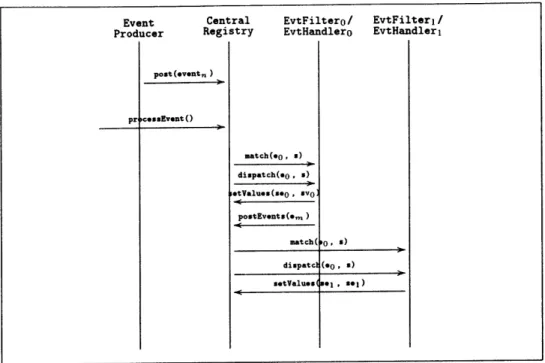
The interaction diagram in Figure 2-3 illustrates how the different entities collab-orate with each other.
2.4.4
Features and Variants
Post Policy
Events can be posted synchronously or asynchronously to the CentralRegistry. In the synchronous case, there is no queue in the CentralRegistry. All posted events are
Event Central EvtFiltero/ EvtFilterl/ Producer Registry EvtHandlero EvtHandleri
post(eventa) pr cessEvent() match(.0 , x) dispatch(e0 . a) etValues(seo , svo postEvents(em ) match( o. s)
dispatcl (eO a).
setValuestse1 , Sei)
Figure 2-3: An interaction diagram of the CR processing an Event
dispatched immediately. This behavior essentially implements implicit method calls in Implicit Invocation systems [11]. This policy has a serious drawback: if an event handler responding to event e produces new events, then these events are handled before other handlers have responded to event e, meaning that e is not handled atomically.
The asynchronous policy is a more natural message-passing model. In systems using this policy, events are placed on the end of the CentralRegistry's queue and are processed some time later. Control is returned to the event producer immediately after the event is posted.
Queue Policy
When the asynchronous post policy is in use, the CentralRegistry's queue can define a queue policy that defines how events on the queue are processed. Queue policy could range from defining event priorities, to EventProducer-based fair-queueing, to dropping events as the result of congestion.
Global State
Shared global state acts as a means of data communication between subsystems. Examples of global state variables range from status flags for the system to shared ADT's.
Often, global status flags can be replaced by dynamically registering and dereg-istering handlers. For example, two handlers which perform different actions may be swapped with one another in the registry instead of having one handler which performs both actions based on a boolean state value.
The deregistration approach might have the consequence of exposing subsystems to each other, since a handler must know about any other handlers that should be deregistered instead of just knowing about the state variable to be changed. In cases like these, the use of state is beneficial to further decoupling the system. Both event handlers depend on the global status flag, but do not refer to each other. Another benefit of this kind of design is to make the status explicit. It is often the case that much behavior must change in response to a status change. In such situations, performing dynamic registration and deregistration can get quite complicated. This can be remedied by increasing the complexity of the filtering and adding a global status flag.
Dynamic registration/deregistration
As illustrated in section 2.2, it is important to be able to modify the set of registration pairs (EventFilter, EventHandler) dynamically. We model this behavior with two special kinds of events (DeregistrationEvent and RegistrationEvent), which are handled by the CentralRegistry itself, and which contain a set of (EventHandler, EventFilter) pairs to be added or eliminated from the registry.
2.5
Consequences
This section briefly lists some of the benefits and liabilities of Central Registry. Some of these consequences will be discussed in further depth in Chapter 3.
1. Modularity.
Figure 2-2 shows a module dependence diagram for a typical Central Registry system. EventProducers do not depend on EventHandlers or vice versa. In-stead, the EventProducers depend on the CentralRegistry (because they post events to it). The EventFilters, EventHandlers, and EventProducers all depend on the Events; the Events serve as the interface amongst them. The CentralReg-istry depends on the EventFilter and EventHandler interfaces, since it makes calls to EventFilters to check if Events match and to EventHandlers to handle Events. Since the CentralRegistry just stores Events to the queue and then passes them along to EventFilters and EventHandlers, it only weakly depends on the Event interface; that is, it refers to the name of the interface without
using any of its behavior. 2. Added flexibility.
Central Registry provides much flexibility in modifying system behavior both statically and dynamically. New EventHandlers can be added at runtime, or the set of EventFilters associated with an EventHandler can change at runtime. Furthermore, new EventHandlers can be implemented independently of code already written. Lastly, modifications to existing EventHandlers should have little effect on other EventHandlers.
3. Receipt is not guaranteed.
Systems designed using Central Registry cannot guarentee that two components that wish to communicate will always succeed. In many designs, a sender will have an explicit handle on its receiver, and is thus guaranteed that the receiver is present. However, EventHandlers can silently disapear from the CentralReg-istry, which can mean that some Events will no longer have EventHandlers to handle them. Furthermore, priority-based queue policies may starve Events of low priority.
4. Performance.
there is a potential for long delay between the generation and handling of an Event. Even in systems that make use of the synchronous post policy, there is an extra level of method invocation that decreases performance. In most cases, the gain in flexibility and modularity will outweigh this.
Chapter 3
Properties and Analysis
3.1
A Formal Model
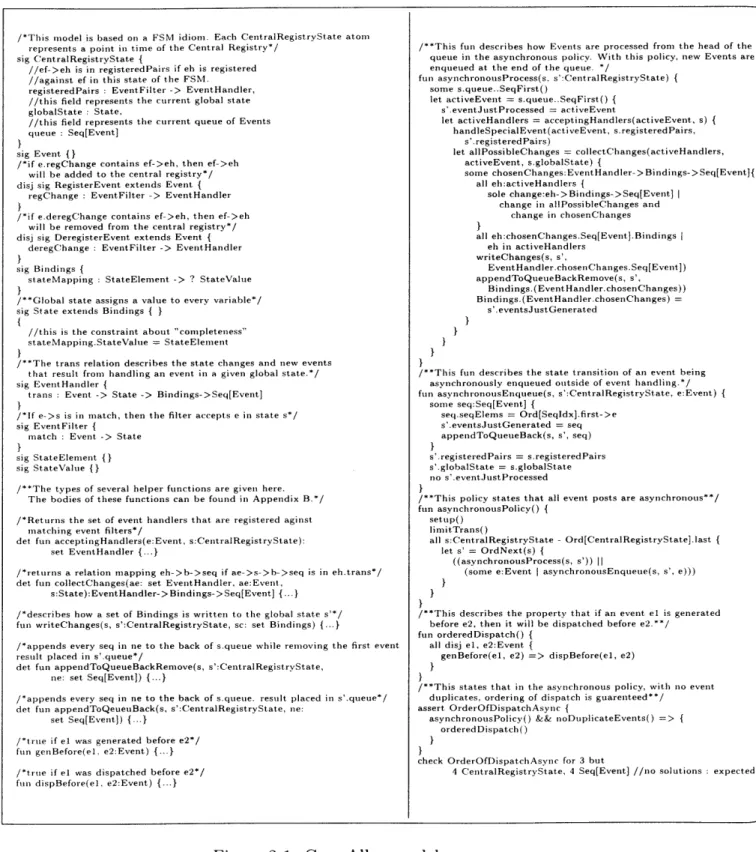
This section describes a formal model of the Central Registry pattern written in the Alloy [3] modeling language. The core structure of the model and some parts of the behavior are presented in Figure 3-1. The complete model is included in Appendix B; it fully captures the structure described in Figure 2-1, the behavior described in Figure 2-3, as well as some of the properties discussed in Section 3.2 of this chapter.
The signatures in the model roughly correspond to the domains in the object model in Figure 2-1. Some of the domains in Figure 2-1 are represented as rela-tions inside other signatures. For example, the Pair domain is represented as the registeredPairs relation in the CentralRegistryState signature. The structural model shown here contains :
* CentralRegistry, which contains a set of bindings between event filters and event handlers, a queue of events, and the global state.
" Global State which is modeled as a mapping from StateElements to StateValues.
* A set of EventFilters, which match certain event types in certain system states.
" A set of EventHandlers, which for an (event, state) pairing, produce a new set
/*This model is based on a FSM idiom. Each CentralRegistryState atom represents a point in time of the Central Registry*/
sig CentralRegistryState {
//ef->eh is in registeredPairs if eh is registered //against ef in this state of the FSM. registeredPairs : EventFilter -> EventHandler, //this field represents the current global state globalState : State,
//this field represents the current queue of Events queue : Seq[Event]
sig Event {}
/*if e.regChange contains ef->eh, then ef->eh will be added to the central registry*/
disj sig RegisterEvent extends Event {
regChange : EventFilter -> EventHandler
}
/*if e.deregChange contains ef->eh, then ef->eh will be removed from the central registry*/ disi sig DeregisterEvent extends Event {
deregChange EventFilter -> EventHandler
}
sig Bindings
stateMapping StateElement -> ? StateValue
}
/**Global state assigns a value to every variable*/ sig State extends Bindings
{
//this is the constraint about "completeness" stateMapping.StateValue = StateElement
}
/**The trans relation describes the state changes and new events that result from handling an event in a given global state.*/ sig EventHandler {
trans : Event -> State -> Bindings->Seq[Event]
}
/*If e->s is in match, then the filter accepts e in state s*/
sig EventFilter { match : Event -> State
}
sig StateElement { sig StateValue {}
/**The types of several helper functions are given here. The bodies of these functions can be found in Appendix B.*/ /*Returns the set of event handlers that are registered aginst
matching event filters*/
det fun acceptingHandlers(e:Event, s:CentralRegistryState): set EventHandler {...}
/*returns a relation mapping eh->b->seq if ae->s->b->seq is in eh.trans*/ det fun collectChanges(ae: set EventHandler, ae:Event,
s:State):EventHandler-> Bindings->Seq[Event] { ...}
/*describes how a set of Bindings is written to the global state s'*/ fun writeChanges(s, s':CentralRegistryState, sc: set Bindings) {...}
/*appends every seq in ne to the back of s.queue while removing the first event result placed in s' queue*/
det fun appendToQueueBackRemove(s, s': Central RegistryState, ne: set Seq[Event]) { ... }
/*appends every seq in ne to the back of s.queue. result placed in s'.queue*/ det fun appendToQeueuBack(s, s':CentralRegistryState, ne:
set Seq[Event]) { ... } /*true if el was generated before e2*/ fun genBefore(el, e2:Event) {...}
/*true if el was dispatched before e2*/ fun dispBefore(el, e2:Event) { ... }
/**This fun describes how Events are processed from the head of the queue in the asynchronous policy. With this policy, new Events are enqueued at the end of the queue. */
fun asynchronousProcess(s, s': Central RegistryState) some s.queue..SeqFirst()
let activeEvent = s.queue..SeqFirst() { s' eventJustProcessed = activeEvent
let activeHandlers = acceptingHandlers(activeEvent, s) { handleSpecialEvent(activeEvent, s.registeredPairs,
s'.registeredPairs)
let allPossibleChanges = collectChanges(activeHandlers, activeEvent, s.globalState) {
some chosenChanges:EventHandler- > Bindings->Seq[Event]{ all eh:activeHandlers {
sole change:eh->Bindings->Seq[Event] I
change in allPossibleChanges and change in chosenChanges all eh:chosenChanges.Seq[Event].Bindings I eh in activeHandlers writeChanges(s, s', EventHandler.chosenChanges.Seq[Event]) appendToQueueBackRemove(s, s', Bindings.(EventHander.chosenChanges)) Bindings.(Event Handler.chosenChanges) = s'.eventsJustGenerated }
/**This fun describes the state transition of an event being asynchronously enqueued outside of event handling.*/ fun asynchronousEnqueue(s, s':CentralRegistryState, e:Event)
some seq:Seq[Event] {
seq.seqElems = Ord[Seqldx].first->e s'.eventsJustGenerated = seq
appendToQueueBack(s, s', seq) }
s'.registered Pairs = s. registeredPairs s'.globalState = s.globalState no s'.eventJustProcessed
/**This policy states that all event posts are asynchronous**/ fun asynchronousPolicy() {
setup() limitTrans()
all s:CentralRegistryState - Ord[CentralRegistryState]. last { let s' = OrdNext(s) {
((asynchronousProcess(s, s')) ||
(some e:Event I asynchronousEnqueue(s, s', e)))
}
/**This describes the property that if an event el is generated before e2, then it will be dispatched before e2.**/
fun orderedDispatch() {
all disj el, e2:Event {
genBefore(el, e2) => dispBefore(el, e2) }
/**This states that in the asynchronous policy, with no event duplicates, ordering of dispatch is guarenteed**/
assert OrderOfDispatchAsync {
asynchronousPolicy() && noDuplicateEvents() => {
orderedDispatch()
check OrderOfDispatchAsync for 3 but
4 CentralRegistryState, 4 Seq[Event] //no solutions : expected
are added to the central registry's queue.
* Special events for registration and deregistration, which contain bindings be-tween event filters and event handlers that are to be added to or removed from the central registry's binding, respectively.
Figure 3-1 includes the model for the behavior of the asynchronous post policy, as well as assertions to check that this policy guarantees ordered dispatch of events. We also modeled the synchronous post policy and a two-priority queue policy, which are included in Appendix B.
3.2
Properties of Central Registry
In this section, we discuss various properties of the pattern and their consequences. First, we introduce some required properties that go along with the programming model that Central Registry is describing. We then discuss the effects of these prop-erties. All of these properties relate solely to the asynchronous post policy version of the pattern, with a simple FIFO queue.
3.2.1
Fundamental Properties
Three fundamental properties of the Central Registry pattern can be described as
follows :
" Required execution.
If the binding of (event filter
f,
event handler h) is registered, then any event posted to the central registry thatf
matches must result in the execution of h." Atomicity accross events.
All handlers that are registered against filters matching an event will execute
* Ordering of events per event producer.
If an event producer posts event e1 and e2 to the central registry in that order,
then the handlers for e1 will execute before the handlers for e2
-These properties together form a model of concurrent computation that is natural to associate with asynchronous message passing systems. An event specifies a request for service. The results of an entitity performing this service can potentially influence later requests. Arbitrary interleavings of these requests would prevent reasoning about the global state after the request has been processed.
The motivating example described in Section 2.2 assumes that not all the event handlers will be on the same machine. Thus, it is natural to think of the set of event handlers that will respond to an event as executing concurrently. The next section will discuss problems that result from this model.
3.2.2
Analysis and Requirements
This section discusses the programming discipline that is necessary to achieve imple-mentations of Central Registry systems with the properties defined in Section 3.2.1.
A fundamental problem arises out of the confluence of three factors : the existence of
global state, the requirement that all triggered event handlers execute, and the con-current execution of event handlers in response to an event. Without careful thought, it may be impossible to reason about the global state after an event is processed.
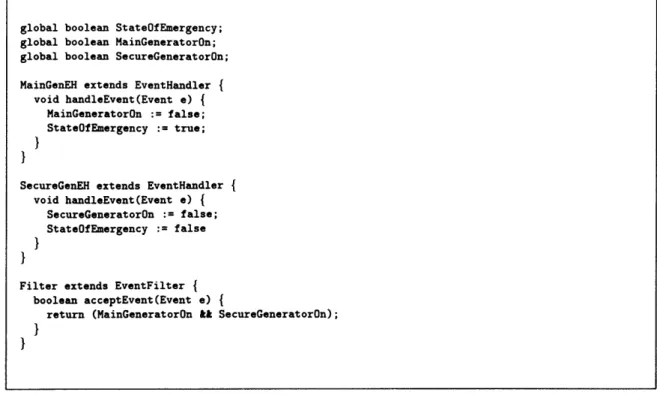
In the remainder of this section, we will refer to a simple example. Pseudo-code for this example is included in Figure 3-2. This example describes an air-traffic-control system, in which there are three global boolean variables, two event handlers, and one event filter. Both event handlers in this example are registered against the same filter Filter in the central registry. This example describes an airport that has two power generators. One of the power generators is equiped with extra features that are used only in cases of emergency (the SecureGenerator). The main power generator cannot be on during an emergency. It is undesirable for both generators to be on at the same time, although the system will not crash in this state. But it is
Figure 3-2: Pseudo-code for an air-traffic-control example
vital that at least one of the generators be on at all points in time. This means that (MainGeneratorOn || SecureGenerator0n) must always be true.
The two event handlers will execute in response to the same event, because they are both registered against the same filter. The value of StateOfEmergency depends on the particular interleavings of assignments as the two handlers execute concurrently. This means that it is impossible to reason about the value of StateOfEmergency after the event is dispatched.
Rejected Solutions
This section gives a series of solutions that are natural for this sort of problem, but fail to allow local reasoning about the behavior of event handlers.
* Change the model of event handling
A common solution to handling concurrency problems is to implement
transac-tions to allow sequential execution in the abstract. In the example of Figure 3-2, if MainGenEH executes before SecureGenEH, then MainGeneratorOn will become false. Now, the filter Filter will no longer accept the event, and SecureGenEH
global boolean StateOfEmergency; global boolean MainGenerator0n; global boolean SecureGeneratorOn; MainGenEH extends EventHandler {
void handleEvent(Event e) { MainGeneratorOn false; StateOfEmergency true;
} }
SecureGenEH extends EventHandler { void handleEvent(Event e) {
SecureGeneratorOn false; StateOfEmergency false
} }
Filter extends EventFilter { boolean acceptEvent(Event e) {
return (MainGeneratorOn kk SecureGenerator0n);
} }
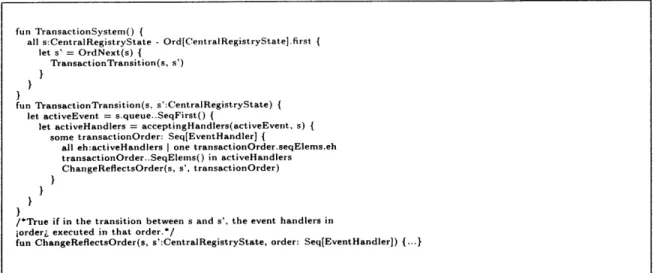
Figure 3-3: Formal description of a CR system that has a transaction model should no longer execute. The Required Execution property requires that all handlers whose filters will accept the event when it is dequeued must execute.
A solution to this problem is to provide each event handler with a read-only
copy of the dispatch-time global state. Another way around this problem is to ensure that each event handler does not affect the state in such a way that any event filters will return a different result. This requires global reasoning about all event filters and is thus undesirable. A thrid potential solution is to compute all executing filters first, and execute the handlers in a second step. This does not work because the handlers themselves can read from the state.
* Require commuting operations
Central Registry requires that all event handlers execute when invoked. Arib-trary interleavings of assignments to global variables are acceptable if every interleaving produces the same acceptable result. One way to achieve this is to require that no more than one event handler modify a state variable in re-sponse to an event. The Gizmoball system described in Section 5.3 has this requirement, which is defined in Alloy in Figure 3-4. However, this solution is undesirable because it requires global reasoning across all the event handlers, and thus eliminates decoupling between the event handlers. In the example given above, the two event handlers do not commute because they assign
con-fun TransactionSystem() {
all s:CentralRegistryState -Ord[Central RegistryState]. first let s' = OrdNext(s) {
TransactionTransition(s, s')
}
}
fun TransactionTransition(s, s': CentralRegistryState) { let activeEvent = s.queue..SeqFirst() {
let activeHandlers = acceptingHandlers(activeEvent, s) { some transactionOrder: Seq[EventHandler] {
all eh:activeHandlers I one transactionOrder.seqElems.eh transactionOrder..SeqElems() in activeHandlers
ChangeReflectsOrder(s, s', transactionOrder) }
} }
/*True if in the transition between s and s', the event handlers in iorder executed in that order.*/
fun CommutingCondition() { all cr:CentralRegistryState {
//no conflicting state writings. !StateConflicts(cr)
} }
/*true of two event handlers can assign conflicting values to the global state*/ fun StateConflicts(cr:CentralRegistryState) {...}
Figure 3-4: Condition for Commuting Operations
/**Abstract Events define legal States before and after they are executed*/ sig Event {
legalStateTrans : State -> State }
/**This describes a CR system in which every handler obeys the legalStateTrans relation of Event.*/ fun LegalBindingsSystem() {
all s:CentralRegistryState -Ord [CentralRegistryState].last { let s' = OrdNext(s) {
ObeyLegalBindingsTrans(s, s') }
}
/*Every event handler that is active in this transition must obey the legalStateTrans relation of the active event*/
fun ObeyLegalBindingsTrans(s, s': CentralRegistryState) { ... }
Figure 3-5: Extension to CR model where Events specify legal transitions flicting values to State~fEmergency.
Specify legal global states
The above solutions describe ways to allow for concurrent operation while guarantee-ing a deterministic behavior of the global state. Event producers do not know which handlers will handle their posted events. This suggests that requiring a determin-istic result is unnecessary. One way to benefit from non-determindetermin-istic results while allowing local reasoning is to specify legal values of the global state.
This solution has two variants. In both variants, event handlers will execute in some arbitrary order, and will see a read-only copy of the dispatch-time global state.
e Specify legal states in events
SavePowerEvent extends Event {
boolean legalStateTrans(oldState, newState) {
if (oldState.MainGeneratorOn && oldState.SecureGeneratorOn){ return !(newState.MainGeneratorOn && newState.SecureGeneratorOn);
}
else return true;
} }
Figure 3-6: Pseudo-code for an Event which specifies legal post-states
SomePowerInvariant{
boolean invariantHoldso) {
return (MainGeneratorOn SecureGeneratorOn);
}
Figure 3-7: Pseudo-code for a global invariant
event is dispatched, as a function of what the global state was before the event was dispatched. Figure 3-5 shows an extension to the core model of Figure 3-1 in which the Event signature now contains a relation legalStateTrans from State to State. Figure 3-5 also describes the requirement that every event handler must assert a legal state.
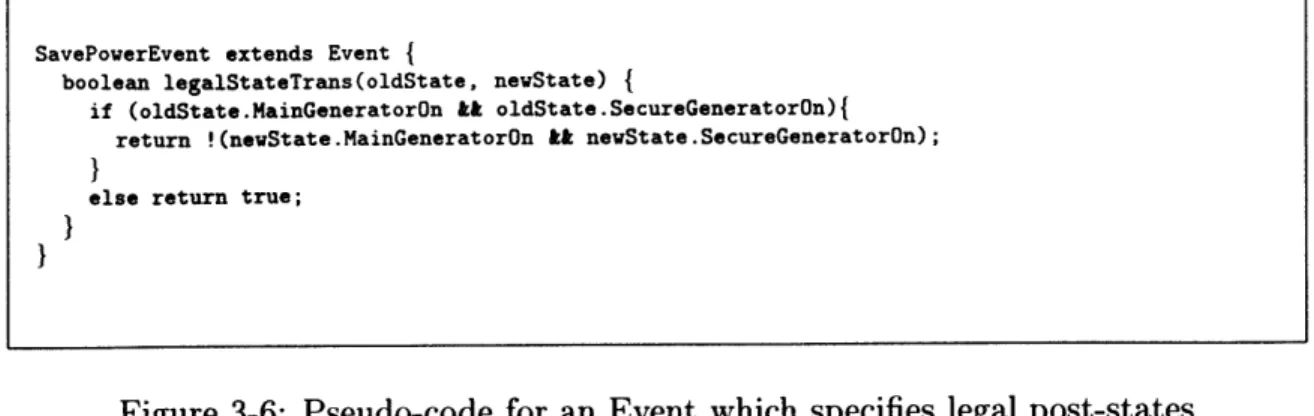
Figure 3-6 shows an example of such an event. This Figure refers to global variables defined in Figure 3-2
9 Specify global invariants
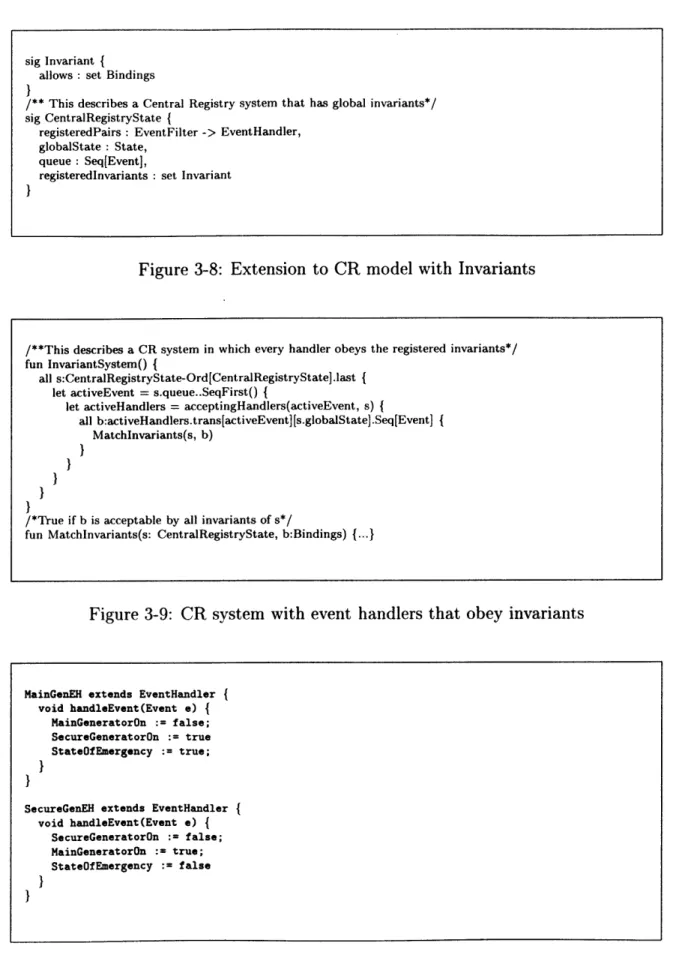
In the other variant, there are global invariants for the state variables which must hold at all times. This variant is described in Figures 8, 9 and
3-11. Figure 3-7 gives pseudo-code for such an invariant on the air-traffic-control
system.
The invariant of Figure 3-7 will not hold if both event handlers from Figure 3-2 execute. However, both handlers preserve the invariant, as they are reading a copy of the dispatch-time global state, and they assume that the filter predicate is true. In the code for MainGenEH, for example, it is assumed that the value of
sig Invariant { allows : set Bindings
I
/** This describes a Central Registry system that has global invariants*/
sig CentralRegistryState {
registeredPairs : EventFilter -> EventHandler, globalState : State,
queue : Seq[Event],
registeredInvariants : set Invariant }
Figure 3-8: Extension to CR model with Invariants
/**This describes a CR system in which every handler obeys the registered invariants*/ fun InvariantSystemo {
all s:CentralRegistryState-Ord [CentralRegistryState].last { let activeEvent = s.queue..SeqFirst() {
let activeHandlers = acceptingHandlers(activeEvent, s) {
all b:activeHandlers.trans[activeEvent] [s.globalState].Seq[Event] { MatchInvariants(s, b) } } } } }
/*rue if b is acceptable by all invariants of s*/
fun MatchInvariants(s: CentralRegistryState, b:Bindings) {...}
Figure 3-9: CR system with event handlers that obey invariants
MainGenEH extends EventHandler { void handleEvent(Event e) { MainGeneratorOn := false; SecureGeneratorOn : true StateOfEmergency : true; } }
SecureGenEH extends EventHandler { void handleEvent(Event e) { SecureGeneratorOn := false; MainGeneratorOn : true; StateOfEmergency : false } }
Figure 3-10: Pseudo-code for modified event handlers
/**This describes a CR system in which every handler obeys the registered invariants and also asserts a value for every se in an invariant it potentially modifies*/
fun StronglnvariantSystemo {
all s:CentralRegistryState-Ord[CentralRegistryState] .last { let activeEvent = s.queue..SeqFirst() {
let activeHandlers = acceptingHandlers(activeEvent, s) {
all b:activeHandlers.trans[activeEvent] [s.globalState].Seq[Event] { MatchInvariants(s, b) StronglnvariantAssertion(s, b) } } } } }
//this fun states that if a bindings intersects with an invariant's state elements, //then it must assert a value for each element
fun StronglnvariantAssertion (s:CentralRegistryState, b:Bindings) { all inv:s.registeredlnvariants {
(some b':inv.allows I some b'.stateMapping.StateValue & b.stateMapping.StateValue) =>{ all b':inv.allows {
b'.stateMapping.StateValue in b.stateMapping.StateValue }
} }
Figure 3-11: CR system with strong invariants SecureGeneratorOn will not change. This assumption is wrong.
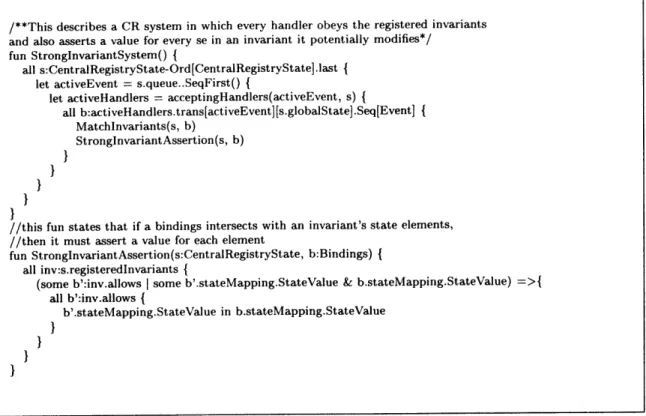
One way around this problem is to require that every event handler assign values to the global state without assuming anything about the filter predicate. The event handlers can assign each variable that they did not modify the old value from the dispatch-time copy, and the invariant will hold. Figure 3-10 shows modified pseudo-code for the event handlers from Figure 3-2. Any ordering of the two event handlers will result in a global state that satisfies the invariant. In both versions of this solution, the ordering chosen for the event handlers does not matter, and local reasoning about the global property is possible using inductive techniques described in [8].
The constraints imposed by these solutions are burdensome, and can severely limit the behavior of event handlers. Furthermore, the global state must be copied for each event that is dispatched. This can be a severe performance hit if there are many global variables. This suggests that Central Registry is not applicable to systems that require a lot of global state.
Chapter 4
Implementation Framework
This chapter presents a framework implementation of the core Central Registry com-ponents in Java. This framework defines a generic CentralRegistry component, and interfaces for Events, EventHandlers, and EventFilters. The framework also de-fines generic interfaces for the global state to which the above modules and interfaces refer.
Systems are developed with this framework by defining concrete events, global state variables and invariants over them, and event handlers and filters. Becaues the framework provides many of the interfaces, as well as all the code for the CentralRegistry component, little thought or work need go into specifying these interfaces. This makes it quite simple for a system designer to make use of the pattern, as there is little extra development work involved.
4.1
Variants
The framework provides support for all the variants of the pattern discussed in Section 2.4.4. Support for queueing policies is achieved through the definition of PolicyFilters and QueuePolicy objects. PolicyFilters are similar to to event filters, in that they represent predicates on events and global states. These filters can also be configured based on the current state of the registry and of the queue. Filtering based on the state of the queue is beneficial in situations where a Central
Registry system needs to respond to congestion of the queue. QueuePolicy objects take as input an Event, the current state of the registry, the current queue, and the global state. The behavior they define is a reordering of the events on the queue. The framework provides support for dynamic loading of various policy filters and queue policies. This makes it easy for system developers to account for variations in the behavior of their system which results in more adaptable systems in general.
The two post policies defined in section 2.4.4 are also implemented. A Central Registry system can be configured to use either of these policies at startup, and they can be switched dynamically. The framework does not allow the two to be present at the same time.
Specifications for the framework can be found in Appendix A.
4.2
Global State Reasoning in Asynchronous
Cen-tral Registry
As discussed in Section 3.2.2, reasoning about the correctness of a Central Registry system requires careful thought and discipline. The framework seeks to assuage this problem by providin behavior and structure to allow for use of the reasoning tech-niques described in Section 3.2.2. To this end, invariants are implemented as closures which are registered with the CentralRegistry and checked at runtime. Further-more, the global state that the event filters and handlers read is an unmodifiable view. This allows event handlers to reason about the state at the time of event dispatch, and not concern themselves with the actions of other handlers.
One requirement for modular reasoning discussed in Section 3.2.2 is that Event subtypes be immutable. This is specified in the Event interface, but is not checked at runtime. Another requirement is that the event handlers be executed in some order, without overlaps in state modification. The current framework solves this problem
by executing in a single thread. However, this is not necessarily the solution with the
stubs for remote machines.
4.3
Benefits of the Framework
System designers can use this framework quite easily. Initial design work must provide specifications for events, global state, and invariants on the state. This type of up-front design is quite conducive to discovering early design flaws. Furthermore, it is quite simple to make use of the framework to implement stub systems, and perform integration testing before subsystems are actually written. To achieve this, one has only to write stub event handlers that have no local effects on the subsystems they are encapsulating. This type of prototyping can also lead to earlier discovery of design problems.
Another benefit of using the framework is ease of implementation. Because much of the behavior of the CentralRegistry component is already implemented, and the rest of the behavior is encapsulated with generic interfaces, implementation using this pattern does not require as much overhead as the size and complexity of the pattern might suggest.
Chapter 5
Known Uses
We have implemented a number of systems using the Central Registry pattern. We have also used the pattern to redesign some existing systems.
5.1
The CTAS Communications Manager
CTAS is a suite of tools developed by NASA designed to aid management of air traffic
flow at large airports. The primary goal of CTAS is to increase the landing rate of aircraft through automated planning [4].
A component of this system was redesigned by a seminar of MIT graduate students
and faculty [4]. This variant of the CTAS Communications Manager component is the one that we redesigned using the Central Registry pattern. In fact, the impetus behind the Central Registry pattern originated from limitations of this variant of the
CM component.
Design Overview
The CTAS Communications Manager (CM) is essentially a message switching and database server. The CM is in charge of maintaining and controlling the client pro-cesses, and interfacing the client processes with the aircraft database. All client-to-client interactions are filtered through the CM. The CM must be able to handle the departure and arrival of new client processes.
The redesign of the CM is event-based. There are three types of events: messages from clients, administrative events generated by the server, and the actual addition and deletion of clients. However, the CM does not provide a common interface for these events and does not explicitly recognize messages and client arrival/departure as events. This severely limits the flexibility of the CTAS system, as the event noti-fication paths connect the producers and consumers of the events directly.
The Central Registry Solution
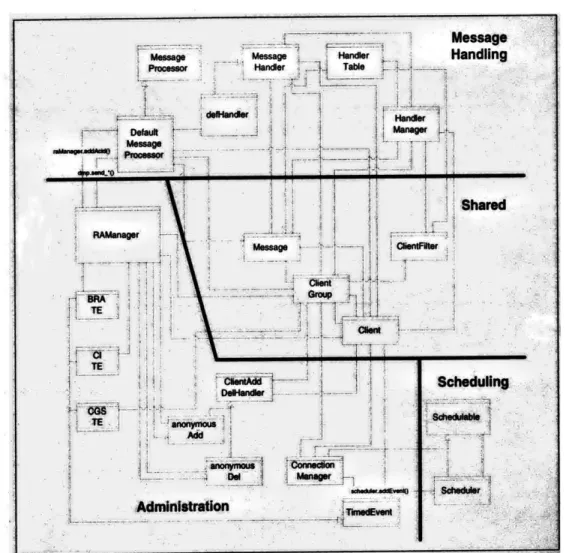
We redesigned the CTAS CM using the Central Registry pattern. The subsystems for message-handling, clients, schedulers, and management of flight analyzers are each modeled as event handlers. The result is a much more flexible and decoupled system. New behavior can be added dynamically, and different implementations of components can be easily swapped. Figures 5-1 and 5-2 show module dependence diagrams of the CTAS CM not using and using Central Registry respectively. Note that for clarity, the Central Registry components have been left out in Figure 5-2. Many modules depend on the central registry module, as well as on events. However, these Figures are highlighting the missing dependences between various pre-existing modules.
This solution makes use of the asynchronous post policy described in Section 2.4.4, and does not use any special queue policy. This system does not require any global state, although some might be introduced to handle emergency cases.
Benefits:
" Achieved further decoupling between the different subsystems.
" Allowed for unification of events under a single hierarchy, which permits easier
extensions to system behavior. Liabilities:
* Delayed message passing (higher latency).
Figure 5-1: Module dependence diagram of a non-CR CTAS design.
a I -Message Handling deianifer -- -jP ocesoHsnssr S MessageProcesso Mngr a Handler - Schehiabl Message Filte 'Message -S---ed Manager - -1'iiidAdm Iniutration Evnt Scheduling
Figure 5-2: Module dependence diagram of a CR CTAS design.
5.2
Tagger
Tagger is a text-processing system written by Daniel Jackson [9]. It takes marked up text as input, and generates output for a layout program (like QuarkXpress). The design of the Tagger system largely resembles the Central Registry pattern, but differs in some key aspects. We redesigned this system to comply with Central Registry pattern, which resulted in a more flexible system.
Design Overview
Tagger uses a token registry, which accepts one event for each token generated by the input parser, and dispatches them to handlers, which are registered on the token types. Two particular problems in the design complicated the code:
The registry is not a singleton. The design is complicated by the fact that
events that correspond to the numbering of sections, figures, etc. are handled by different handlers than events for normal text. The registry consists of two instances that are active at different times. The two registries maintain different sets of handlers that embody the behaviors that result from the different contexts of whether the event is for a numbering string or normal text. This interferes with decoupling: the input subsystem must decide which registry to send tokens to and the event handlers must know which registry to register with. This inflexibility highlights the resemblance of the Tagger design to the Multicast pattern described in [10].
Handlers are implicitly context-dependent. There is one specific case in
the Tagger system when a handler is registered with the standard registry, and im-mediately removes itself after it is activated. This is to handle the start of a new paragraph: if no paragraph style token appears after a paragraph break, then a de-fault style tag must be inserted; if a paragraph style token does appear, then it is processed as usual. Thus, a new handler must be registered when a paragraph break is reached, and then deregistered after the next token has been handled. But there is nothing in the structure of the system that makes this context change explicit, which makes it difficult to judge how modifications to the system will effect the behavior.
The Central Registry Solution
We added two state variables, TEXT-MODE and PARASTART, to address the anoma-lies in the original design. TEXTMODE describes whether the system is in normal text mode or numbering text mode, which correspond to the behaviors of the two dif-ferent registries in the original design. Event filters check the value of this variable and dispatch to the correct handler. This solution lacks the elegance of two separate registries that the original design held.
PARASTART keeps track of whether a paragraph break just occurred, in which case the event handler for text tokens looks up the default paragraph style and outputs that token before the text token. The state of the system is now explicit, and no longer needs to be inferred from the registered handlers.
Our implementation of Tagger uses the synchronous event posting policy, in order to process every event generated by an incoming token before processing the next token. We also implemented a variant of Tagger that did not make use of global state, but instead made use of Registration and Deregistration events. While this scheme worked, it was rather unwieldy. This system is an example where global state is not necessary, but significantly improves the ease of implementation.
Benefits:
" Centralized token dispatching, which permits greater behavioral flexibility. " Allowed for explicit definition of shared context.
Liabilities:
* Shared data can limit modular reasoning.
" Complex filtering as a result of merging registries into a singleton.
5.3
Gizmoball
Gizmoball is a configurable pinball game, used as a final project in an introductory software engineering class at MIT [7]. The user controls a set of flippers, and must
attempt to keep balls from falling off the bottom of the playing area. Users can halt play, reconfigure the layout of the playing area, and load saved configurations from disk. The objects on the board are called gizmos. Gizmos may also be connected, so that if a ball hits some bumper, that collision can cause a flipper on the other side of the board to flip.
Design Overview
Some of the interesting issues in the design of this system are
The design of the Gizmo ADT and the triggering system. A common
solution presented by many students is what we call an "action-based" design. In this design, gizmos maintain a set of gizmos that they are connected to. The connections are maintained in the form of actions, which can be performed on the target gizmos. Essentially, this design is a variant of the Multicast pattern described in Section 6.4. This design hinders the ability to add new collision behavior. For instance, to increment a point counter each time that the ball collides with a bumper, a new point increment action must explicitly be registered with each bumper.
The interface between the GUI and the backend. A common solution is the use of the Observer pattern [1]. As we discuss in Section 6.2, while the Observer pattern does allow the backend to be independent of the GUI, the GUI is still depen-dent on the backend, since it must query the backend for update information. Thus, modifications to the backend can potentially result in modifications in the GUI.
Dealing with multi-threaded animation. One common solution is to have an animation thread that calls some method on a board ADT which causes an update to the GUI through the observer interface. However, implementors have to pay careful attention to which threads are performing which tasks and must worry about data races. Some designs simply have the animation thread take care of everything, in which case performance becomes an issue. Good Gizmoball designs usually provide some variant of the Command [1] pattern between the animation thread, and the main program thread.
Figure 5-3: Module dependence diagram of a non-CR Gizmoball design. The Central Registry Solution
The Central Registry version of Gizmoball was implemented with Robert Lee and Allison Waingold. Figures 5-3 and 5-4 show module dependence diagrams of Gizmoball designs not using and using Central Registry respectively. These diagrams highlight the improved decoupling and modularity in the Central Registry design.
While implementing Gizmoball, we perceived several benefits. Our design of the gizmo ADT models connections as event handlers, and triggering of connections and collisions as events. Switching 'between modes (editing, animating, not-animating) is modeled with global state. Communication between the backend and the GUI is event-based, severing any dependences between the two subsystems. The animation thread communicates with the rest of the system by posting events to the central registry. Our implementation uses a simple queueing policy which drops extra repaint-request events in the presence of performance slowdown.
This system exposed one potential problem with the Central Registry pattern. In Central Registry systems, much of the system state is recorded in the queue and
Figure 5-4: Module dependence diagram of a CR Gizmoball design.
the registry. It is therefore quite complicated to store and load this information from disk. However, this can be remedied by adding an extra event handler that logs every event and can produce a file from an event trace.
Benefits:
* Easy extension of triggering system to incorporate new actions.
" Completely decoupled the GUI and the backend.
Liabilities:
* Difficulty of saving system state to a file.
* Performance overhead, important in real-time system.
5.4
JarSheet
JarSheet is a configurable spreadsheet application developed by this author accom-panied by Robert Lee and Allison Waingold.
Central Physics
File I/O RegistryPhsc