Dependence, Independence, and
Interdependence in World Politics
Dinsha Mistree
Submitted to the Department of Political Science in Partial Fulfillment of the Requirements for the
Degree
ofBachelor of Science
and for theDegree of
Master of Science
at the
Massachusetts Institute of
Technology
June 2006
@ 2006 Massachusetts Institute of Technology All rights reserved
1 1
JUN
2 7
2006
1
I
1
LIBRARIES
aARCHIVES
...
...
..
...
Signature of Author.v.
r: :-.
Department of Political Science June 5,2006
- w w - -
Certifiedby
Nazli Choucri Professor of Political Science Thesis Supervisor 1
...
.
. . .
. . .
Certified by '..-.
*A
..-.
Kenneth Oye Associate Professor of Political ScienceSecond Reader
Acceptedby
...
:...-...
Roger Petersen Chairman, Department committee on Graduate StudentsDependence, Independence, and
Interdependence in World Politics
Dinsha Mistree
Submitted to the Department of Political Science in Partial Fulfillment of the Requirements for the
Degree of Bachelor of Science and for the Degree of Master of Science
ABSTRACT
We implement techniques of graph theory to international trade in order to empirically inspect the international system of trade. Examining macro and submacro levels of the international system of trade from 1962-2003, we find the presence of a Scale-Free Network with a Multiscalar Hierarchy. Such structures are resilient to bottom-up economic collapse, but are susceptible to top-down and horizontal economic failures. Our findings are based upon an especially novel approach for examining submacro systems, applying latent community identification analysis to identify trading communities that are not necessarily formalized or institutionalized as trading blocs. Following this analysis, we examine the role of international institutions in the international trade network, specifically considering macro level institutions for stability solutions and examining the effects of joining a trade bloc. We find evidence that supports the intergovernmentalist framework, whereby certain types of trade blocs seem to succeed while others fail, leading to different results in integration and unification.
Thesis Supervisor: Nazli Choucri
ACKNOWLEDGEMENTS
This thesis represents several years of my thoughts and several years of my work. The following pages would not have been possible, however, without the amazing help of several important people. I would first and foremost like to thank my brother, Behram Mistree. With this project, Behram in all regards can be seen as the father. He initially created several of the datasets, introduced me to the idea that international trade can be analyzed as just another system, replete with feedback and dynamics, and got me energized about the research possibilities in general. Beyond the research, Behram has been a tremendous and positive presence throughout my life. One meets people like him once in a lifetime, and I am so fortunate that he is my brother.
If Behram is the father of this project, Ramy Amaout is the mindful uncle. Ramy has been studying networks in biological systems and introduced me to much of the literature, the existing computer and GUI programs, and kept me abreast of advances in network research. Throughout the project, Ramy displayed particularly patience and understanding as I internalized, developed, and then adapted the concepts to better suit the International Relations bend of this project.
I would also like to thank my two thesis advisors, Nazli Choucri and Kenneth Oye. I have tremendously enjoyed, and greatly benefited from working with Nazli over the last two years. She has been a constant source of support in anything I pursue, giving me way more autonomy than a Bachelor's / Master's student could expect. Nazli is well- known for taking innovative research methods and adapting them for political science. I only hope that this project continues that tradition.
To say that Kenneth Oye was especially instrumental in helping me refine my thoughts is an understatement. He helped me see the forest when I was oscillating
between looking at the trees and the entire ecosystem. For his insights, I am tremendously grateful.
The research contained in this thesis would not have been possible without Hanyin Lin's excellent assistance as a UROP student. For better or worse, Hanyin was also frequently subjected to my ideas and musings before anybody else. Her advice and aid throughout this project is greatly appreciated.
This project would not have been possible without the generous support of the MIT Political Science Department, and the assistance has been - and still is - greatly
appreciated.
Finally I would like to thank my parents, Farrokh Mistree and Janet Katherine Allen, for providing direction for me throughout my life. Growing up with two parents interested in systems analysis and multidisciplinary approaches to academic research, this thesis is the embodiment of their guidance. After reading this thesis, the reader will observe that the apple does not fall far from the tree.
ABSTRACT
...
2ACKNOWLEDGEMENTS
... ...
3TABLE OF CONTENTS
... ...
5LIST OF FIGURES AND TABLES
...
6...
GLOSSARY 9 CHAPTER 1: A NEW APPROACH TO EXAMINING THE INTERNATIONAL SYSTEM...
1 2 Purposes of Project... ...
...
15Thesis Layout
...
...
-20CHAPTER 2: GRAPH THEORY AND INTERNATIONAL SYSTEMS THEORY: THEN AND NOW
...
23Overview
...
23A Brief History of Graph Theory
...
.
.
.
.
...
...
23Systems Analysis in International Relations
...
27Scoping the Topology of International Systems
...
-32Macro International Systems Theory
...
.... ... ...
34Submacro International Systems Theory
... ...
...
36Previous Empirical Research of International Systems Theory: An Example
...
38De Mesquita and Lalman's Methodological Strategy
...
...
39De Mesquita and Lalman's Dependent Variable
...
.
.
.
...
40De Mesquita and Lalman's Independent Variables
...
...
41Improving De Mesquita and Lalman's Methodology for the Purposes of Identifying the Structure of the International System
...
42...
Chapter Summary 44 CHAPTER 3: MACRO PATTERNS IN THE INTERNATIONAL SYSTEM...
45Overview
... ...
45Network Analysis of the Macro System
...
45Three Possible Network Structures
...
52Macro Level Methodology
...
...
54Chapter Summary
...
68CHAPTER 4: SUBMACRO PATTERNS IN THE INTERNATIONAL SYSTEM
.
69 Overview...
69Formulating a Rigorous Submacro Approach
...
69Findings
...
...
...
75Latent Submacro Systems in 1962
...
...
...
-75Latent Submacro Systems in 1982
...
89Latent Submacro Systems in 2002
...
100Latent Submacro Systems in 2002
...
101Chapter Summary
...
108CHAPTER 5: INTERDEPENDENCY IN THE INTERNATIONAL SYSTEM
....
109Overview
...
.
.
.
...
...
1 0 9 Stability in a Scale-Free Network...
109...
Some Shortcomings in Graph Theory 121
...
...
CHAPTER 6: INSTITUTIONS IN THE INTERNATIONAL SYSTEM 124
Overview
...
124Macro International Institutions For Stability
...
124Submacro Institutions in the International System
...
127Chapter Summary
...
143CHAPTER 7: SUMMARY AND FUTURE DIRECTIONS
...
144An Alternative Understanding of the International System
...
-144Future Possibilities
...*...
146Conclusion
...
..
...
149BIBLIOGRAPHY
...
150...
APPENDIX A: SOME NOTES ON DATA METHODOLOGY...
157APPENDIX B: A LIST O F THE MEMBERS O F TRADE BLOCS AND THEIR
...
YEARS OF ACCESSION 163LIST OF FIGURES AND TABLES
Figure 1: Friendship Relationships Between Children in a US School.
From Newman. 2003. Courtesy of James Moody...
...
18Figure 2: A Latent Submacro Clique in the International System
...
19Figure 3: A Conceptual System-Dynamics Model of Insurgent Activity and Recruitment (from Choucri. et al.. 2006)
... ...
29Figure 4: Where Given Societies Fall Along Two Cultural Dimensions
.
From Inglehart and Carballo, 1997: pg.
41...
...
...
-37Figure 5: A Labeled Network
...
...
-48Figure 6: A Network with Nodes A-G
...
....
...
...
-49Figure 7: Four Different Networks
...
51Figure 8: An Egalitarian Network Structure
...
-53Figure 9: A Random Network (a) versus a Scale-Free Network (b). from Wikipedia
...
...
.
53Figure 10: Visual Depiction of Export Network in 1965
...
..59Figure 11 : Visual Depiction of Export Network in 1965, with Country Labels
...
60Figure 12: Visual Depiction of Export Network in 2000
...
..
...
-61Figure 13: Visual Depiction of Export Network in 2000. with Country Labels
...
62Figure 14: Distribution of Degrees in 1965
...
64Figure 15: Distribution of Degrees in 2000
...
64Figure 16: Possible Hierarchical Structures
.
Courtesy of Dodds. et al., 2004...
66Figure 17: Divisive Cliques vs
.
Overlapping Cliques...
72Figure 18: A k-Clique Where k=2
... ...
73Figure 19: A k=9 Latent Clique from 1962, with Country Labels
...
76Figure 20: A k=9 Latent Clique from 1962, with Weighted Relationships and Country Labels
...
78Figure 21: The First of Two k=6 Latent Cliques in 1962. with Country Labels
...
80Figure 22: The Second of Two k=6 Latent Cliques in 1962, with Country Labels
...
80Figure 23: Two k=6 Latent Cliques in 1962
...
81...
Figure 24: Two k=6 Latent Clique in 1962, with Countries Labeled 81...
Figure 25: Two k=6 Cliques and Their Connecting Nodes. with Country Labels 82Figure 26: Two k=6 Cliques and Their Connecting Nodes. with Weighted
Relationships and Country Labels
...
-83Figure 27: A k=4 Latent Clique in 1962
...
...
...
85Figure 28: A k=4 Latent Clique in 1962. with Country Labels
...
... ...
86Figure 29: A k=4 Latent Clique in 1962. with Weighted Relationships
...
87Figure 30: A k=4 Latent Clique in 1962. Weighted and with Country Labels
...
88Figure 31: A k=10 Latent Clique in 1982. with Country Labels
... ..
90Figure 32: A k=6 Latent Clique in 1982
...
91Figure 33: A k=6 Latent Clique in 1982. with Country Labels
...
..
..
..
..
92Figure 34: A k=6 Latent Clique. with Weighted Relationships
...
93Figure 35: A k=6 Latent Clique. with Weighted Relationships and Country Labels
...
94Figure 36: A Second k=6 Latent Clique in 1982. with Country Labels
... ...
95Figure 37: The Interactions Between Two k=6 Cliques in 1982
... ... ...
97Figure 38: The Interactions Between Two k=6 Cliques in 1982. with Country Labels
...
98Figure 39: The Interactions Between Two k=6 Cliques in 1982. with Weighted
...
Relationships 99 Figure 40: The Interactions Between Two k=6 Cliques in 1982. Weighted and with Country Labels...
100Figure 41: Normalized Average Degrees of Separation Across Time
...
102Figure 42: A k=10 Latent Clique in 2002. with Country Labels
... ...
-103Figure 43: A k=10 Latent Clique in 2002. with Weighted Relationships and Country Variables
...
... ... ...
104Figure 44: A k=7 Latent Clique in 2002
...
...
107Figure 45: A Weighted k=7 Latent Clique in 2002. with Labels
... ...
-107Figure 46: Possible Hierarchical Structures from Watts. et al.. 2004
...
111Figure 47: A k=4 Latent Clique from 2002. with Country Labels
...
113Figure 48: Hypothetical Trade Clique Interactions
...
115Figure 49: Hypothetical Trade Clique Interactions. with Country Labels
...
115Figure 50: A k=5 Latent Clique from 1984. with Country Labels
...
117Figure 51: A k=9 Latent Clique from 1964. with Labels
...
118Figure 52: The Theoretical Upper-Echelon
...
119Figure 53: The Upper-Echelon with Spokes Connected Through Pure-Dependent Submacro Relationships
...
120Figure 54: The Upper-Echelon with Spokes Connected Through Multi-Dependent Submacro Relationships
...
...
...
120Figure 55: The Global Average Clustering Coefficient Across Time
...
129Figure 56: Clustering Coefficient of APEC Across Time
...
...
130Figure 57: Clustering Coefficient of ASEAN Across Time
... ...
131Figure 58: Clustering Coefficient of EU Across Time
...
-131Figure 59: Clustering Coefficient of FTAA Across Time
...
...
132Figure 60: Clustering Coefficient of MERCOSUR Across Time
... ...
132...
Figure 61: Normalized Average Degrees of Countries in APEC Across Time 137...
Figure 62: Normalized Average Degree of Countries in FTAA Across Time 138...
Figure 63: Normalized Average Degree of Countries in NAFTA Across Time 138 Figure 64: Normalized Average Degrees of Countries in SAARC Across Time...
139 Figure 65: Degrees of Members in APEC Across Time...
...
...
-140 Figure 66: Degrees of Members in FTAA Across Time...
1 4 0 Figure 67: Degrees of Members of NAFTA Across Time...
141 Figure 68: Degrees of Members of SAARC Across Time...
141 Figure 69: Degrees of Members in FTAA Across Time. Excluding the United States.
...
...*.. ...
-142Table 1: Usages of System in IR Theory
.
Adapted from Goodman. 1965: italics added by Goodman...
.
.
.
.
...
28 Table 2: Top Ten Countries in 1965 and 2000 in Terms of Degrees in theInternational Trade System
... ... ...
105 Table 3: Intra-Trade of Trade Groups as Percentage of Total Exports for EachTrade Grouping
...
.
.
.
.
...
...
133 Table 4: Successful and Non-Successful Trade Blocs... ...
136GLOSSARY
Balance ofpower System: A macro level system where several Hubs interact with one
another to form the upper echelon of trade partnerships. Such a system shows remarkable homophily between the traders.
Clique: Also known as a community, is a group of countries.
Clustering Coefficient: Given three countries, A, B, and C, where A and B trade and B
and C trade, the clustering coefficient is the likelihood that A and C trade.
Contagion: Also known as cascading failure, refers to the spread of economic failure
throughout the international economic system.
Core-Periphery Hierarchy: A Hierarchical structure with a very rigid and top-down
structure.
Degrees: A measure of the number of relationships a node enjoys.
Degree ofseparation: The minimum number of edges between two nodes. Directed Edge: An edge with at least one flow traversing between two nodes.
Egalitarian Network: A network where all nodes have equal relationships and numbers of
relationships.
Equal-Dependent Submacro System: A submacro system where all nodes have roughly
equal relationships, and numbers of relationships.
Gatekeeper: A country that bridges a connection between two submacro groups. Graph: Also known as a network, is a representation of a system.
Hierarchy: The ordering of countries in the international system. Several Hierarchies are
possible; we find that a Multiscalar Hierarchy best describes the international system of trade.
Homophily: The level and strength of interconnections in a network.
Hub: A node that is more important to the structure of the network than most other nodes. Interdependence: Interconnections between two or more countries.
k-Clique: Communities where all nodes satisfy a minimum threshold of partnership
through their connections with other nodes in that clique.
Latent Clique: A grouping that has not necessarily been formalized or distinguished by a
pact or by geographic characteristics.
Local Team Hierarchy: Contains several Gatekeepers, but nodes primarily follow a top-
down Hierarchy of trade relationships.
Macro Level Approach: An approach that examines all nodes in the system relative to
one another.
Micro Level Approach: An approach that examines dyadic, or bilateral, relationships in
the system.
Multi-Dependent Submacro System: A submacro system with more than one Hub and
more than one Spoke.
Multiscalar Hierarchy: A Hierarchy between Random, Random Interdivisional, Core-
Periphery and Local Team. It is the most basic top-down hierarchical structure.
Node: Also known as a vertex, is a singular actor in a system.
Pure-Dependent Submacro System: A submacro system with a singular Hub and several Spoke countries.
Random Hierarchy: A Hierarchy that is not necessarily governed by top-down trade
Random Interdivisional Hierarchy: Apparent top-down relationships, but horizontal
interactions are prevalent as well.
Random Network: A network with a Gaussian degree distribution. As contrasted to an
Egalitarian Network or a Scale-Free Network.
Scale-Free Network: A network with a Power-Law degree distribution. A Scale-Free
Network contains Hubs and Spokes and its presence suggests that subsystem relationships are important to understanding the hierarchy of the macro system. The international system of trade is a Scale-Free Network.
Spoke: A node that is less important to the system structure than a Hub.
Spring Embedding Function: A type of energy minimization for displaying graphs. A
spring embedding function minimizes the visual size of the edges between the nodes while maintaining a certain amount of space between each node.
Submacro Level Approach: An approach where we examine the relationships between
countries that take place between more than two nations, but fewer than all nations.
System: "An interconnection of components, devices, or subsystems" (Oppenheim,
Wilsky, and Nawab, 1 997: 3 8).
Trade Bloc: Also known as a trade group, is a formalized, or institutionalized group of
countries that have preferential trade agreements with one another.
CHAPTER 1: A NEW APPROACH TO EXAMINING THE
INTERNATIONAL SYSTEM
Throughout the early 1990s, several countries in Eastern Asia - including
Thailand, Malaysia, Indonesia, the Philippines, Singapore and South Korea - enjoyed
incredibly rapid economic growth. International organizations such as the World Bank and the International Monetary Fund hailed the economic success as nothing short of a wonder, an Asian economic miracle (World Bank, 1993; Stiglitz and Yusuf, 2001).
In July of 1997, the bubble burst as an economic crisis ravaged these so-called Asian Tigers. Exports declined, foreign investment shrunk, a decline in earnings set in, and economic growth slowed (Yusuf, 2001). The causes of the economic collapse are still debated today: investors with a "herd mentality" were spooked by IMF threats to Indonesia due to asymmetric information, (Radelet and Sachs, 1998); struggles in the Thai real estate and financial sectors spread to economic problems in other areas in the region (Yusuf, 2001); even the Malaysian Prime Minister had an opinion, arguing that massive currency speculation by George Soros gutted the Malaysian economy, hurting surrounding economies (Billington, 1999). The list of causes goes on and on.
While identifying the causes of the economic crisis are well worth pursuing, what is equally interesting is the way in which policy-makers responded. Common to the mindsets of the policy-makers was that this economic down-turn needed to be contained. The governing logic was simple to understand: national economies are highly integrated with one another, and if a group of economies sputter, the decline may cause the larger economic system to sputter as well, or even collapse. In other words, depression in the international economic system is somehow contagious.
Thinking about international systems such as the international economic system is nothing new. Scholars in International Relations (IR) are purposefully engaged in working to identify and understand the structures of such international systems (Waltz, 1954; Rosencrance, 1963; Walt, 1985; K a u h a n , 1997). Over the past sixty years, a rich corpus of theory has been merged with rational choice and empirical analysis to offer many insights into each dimension of world politics. Typically, analysis of the ways in which nations interact with one another has proceeded along three different levels (Berton, 1969). In the first level, countries engage in bilateral relationships, forming micro systems, where two countries directly interact with and influence each other. Such interactions include bilateral trade, non-alliance wars, or migration flows in which only two countries are involved. In the second level, countries join in multilateral relationships, forming submacro systems. In such cases, a country would interact with a community of countries, greater than two, but less than the entire population of all of the nations of the world: they would interact with a subsystem of the overall international order.' Examples of such submacro systems include trade blocs, military alliances, and common money markets.' The third level involves relationships where a nation's interactions are controlled, influenced, and determined relative to its position among the rest of the nations of the world.3 Such international relationships are embodied in the macro system, or international order. These three levels of relationships are distinct, but not separate. Together, they influence the larger international system structure and shape the types of interactions between countries.
A submacro system is a grouping of nations. Such a grouping can be geographically regional, a trade group, or a political alliance, for example. The term comes from Berton, 1969.
As the reader will soon discover, in this thesis we seek to find latent submacro systems rather than manifest subsystems such as these.
Integrative approaches across these levels tend to consider any two, but rarely all three, levels at once. Such a non-holistic perspective results from methodologies in IR typically focusing on thesis identification and testing where the principal goal is one of recognizing the primary cause of an effect; analyzing the intemational system requires systemic theory identification and testing, whereby one explains how changes and feedbacks in the system structure affect the conversion of inputs into outputs (Kaplan, 1960: ~ i i i ) . ~ To put it more clearly, the goal of systems analysis is not necessarily to observe and test a causal theory, but it is instead intended to help the researcher observe the patterns of interactions among actors. One may be able to perform thesis testing after identifying the system structure.
While scholars in IR have investigated the international system, sociologists, scientists, and engineers have increasingly engaged in studies of systems pertinent to their own domains and disciplines (Newman, 2003). As scholars recognized the commonality of studying systems, a new mode of analysis grew out of their collaborations known as complexity science, or graph theory? Graph theory now stands as a robust - but still developing - arena within academia. More importantly, graph
theory offers a way of approaching the three levels of the intemational system at once, by using dyadic relationships to identify and explore submacro and macro system structures.
For Kaplan, both thesis and systemic theory are elements of theory, and he stresses that theory should not be contained to thesis identification alone (1957: xiii).
Complexity science and graph theory are also known as network theory. While the terms are used interchangeably throughout the literature (see Newman 2003 for example), we predict that in time, network theory will come to classify relationships where flows between actors are involved, while graph theory will describe relationships between various actors. If we accept such a dichotomy, both the hndamental concepts and the mathematics of network theory and graph theory are nevertheless tremendously similar, making such a distinction a moot point. However, since we are primarily focused upon relationships of trade rather than flows of trade, we shall describe our approach as a graph theoretic approach.
Not surprisingly, one of the chief pursuits within graph theory is analyzing system stability and the spread of system instability. Albert and Barabisi examine the stability of certain types of systems and networks in the context of the Internet and the World Wide Web (2002); Maslov and Sneppen investigate stability in protein networks (2002); Dunne, Williams, and Martinez consider system stability in the network of food webs (2002). Indeed, while IR scholars such as Robert E. Keohane complain that predictability is elusive as "[tloo many factors interact in complex ways to produce the results we see," including "[rlandom shocks [that] disrupt the system," graph theorists do not shy away from this challenge (1 997: 150). Instead, they embrace it. The attitude that complexity is something that needs be better understood, rather than something that needs to be avoided, guides our project.
Purposes of Project
In order to better understand system stability, system instability, and contagion conditions, we seek to identify the structure of the international system. Recognizing that the international system includes a diverse and diffuse set of relationships, we seek to identify the structure in terms of one type of interaction: international trade! Further recognizing that a whole host of non-country actors - including individuals, grassroots
movements, multinational corporations, and other non-governmental organizations - all
affect international politics, we contain our analysis of the international system exclusively to relationships between countries. While other elements of the international system are important, nations form the backbone of international politics, and it is their
6 In Chapter 2, we explain why we chose trade over other measures. To be clear, the Asian financial crisis was not caused by changes in trade, but rather by changes in capital and investment flows. Modeling such other economic structures would also be a useful and worthwhile project.
relationships among themselves and with the overall structure that we are chiefly interested in identifying (Gilpin, 1 98 1 : 26; Kaufman, 1997).
In order to fully understand the international system of trade, one needs to consider its subsidiary levels: the micro (relationships between two countries), the submacro (relationships between more than two countries, but fewer than all countries), and the macro (relationships between all countries). In analyzing trade, much work has already been conducted across all three levels. Micro / dyadic / bilateral relationships have been examined by several scholars, most notably by Beck, King, and Zeng (2000; 2004) and by Bennett and Starn (2000).~ At the opposite end of the spectrum, macro relationships have been considered by Waltz (1954) and Walt (1985), to name just two of many theorists. And between micro and macro, submacro relationships have been studied in terms of geographic country groupings (Schirm, 2002), in terms of political and military alliances (Krebs, 1999), in terms of culture (Huntington, 1996), and in terms of economic bonds, especially by way of trade blocs (Mansfield and Milner, 1999).
Few studies ever examine the common nature of these submacro systems, however (Berton, 1969). These submacro systems affect their member countries, they affect the macro level, and they affect each other, and yet the best research in this arena has compared submacro groupings only within their contexts. One can find research that compares the European Union (EU) and the North American Free Trade Agreement (Abbott, 2000), or research that examines political alliances (Kupchan, 1988), but one is unlikely to find research that compares Asian country relationships to the South African Customs Union, or even research on non-formalized trading communities - where the
involved nations do cooperate increasingly with each other without the benefits of an
Each of these works use micro relationships to explore the causes and consequences of dyadic conflict.
official trade alliance. As a result, our understanding of inter-national interactions at the submacro level pales in comparison to our understanding of interactions at the micro and macro level^.^ In this project, we seek to overcome this condition by observing submacro relationships embedded within dyadic r e l a t i ~ n s h i ~ s . ~
To identify these several latent submacro groupings of countries, we shall take full advantages of recent developments in graph theory, especially utilizing advances in community identification analysis. Most networks typically have regions where the components are increasingly interconnected relative to the rest of the network, and these regions are known as cliques, or clusters (Palla, et al., 2005).'O For our purposes, such cliques are nonformalized, submacro groupings of countries.
'
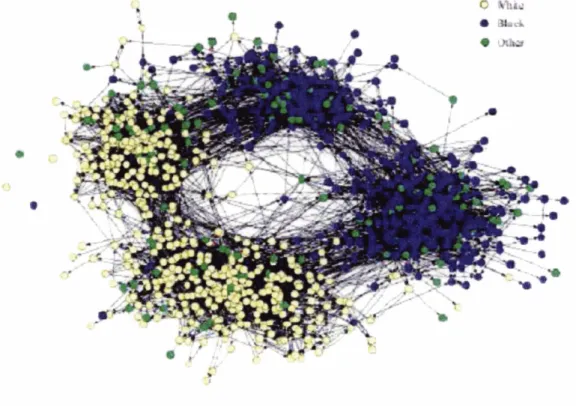
Why consider latent cliques at all? In Figure 1, a friendship network of children in a US school is shown (Newman, 2003; picture courtesy of James ~ o o d ~ ) . ' ~ The light dots represent white children; the dark dots represent black children; the shaded dots represent children of other racial backgrounds.13 Notice that while children do divide
The hyphen placed in the term "inter-national" is to draw attention to the fact that nations compete in an anarchic setting, with no all-powerful super-organization mediating actions. As a result, it is not fair to say that we are in a state of globalization, as we are in a state of inter-nationalization (Hirst and Thompson, 2002).
In earlier dmfts of this thesis, we described the latent cliques as "embedded." However, in The Great Transformation, Polanyi frequently refers to the economic system being embedded in the interactions of a larger international system, meaning that it is not autonomous. This concept of embeddedness has been adopted by many others, including Granovetter, Ruggie, and Evans (Block, 2001). To avoid conhsion, from now on, we will use the term "latent" to describe non-formalized clusters in the international trade system.
lo Cliques are also known as clusters, communities, and groupings (Derknyi, et al., 2005).
By a nonforrnalized grouping, we mean a grouping that is tied together by the fact that they trade with one another, not necessarily by geography, explicit trade bloc status, or culture.
l2 Newman's "Structure and Function of Complex Networks" represents the best compendium of network
theory (2003). Citing 429 other references, Newman leaves few stones unturned.
l 3 The hard copy of the thesis will be printed in black-and-white; the electronic version will include color.
In the electronic version, white children are represented with yellow dots, black children with blue dots, and children of other racial backgrounds with green dots.
themselves along racial lines, what emerge are four distinct clusters - or communities of children - suggesting that some other divide beyond race exists as well.14
Figure 1: Friendship Relationships Between Children in a US School. From Newman, 2003, Courtesy of James Moody
As a thought exercise, let us consider these dots as countries instead of school children. Each color would then represent exclusive participation in a certain explicit trading bloc (such as N m A or the EU) as opposed to another trading bloc. However,
the common divide within each of the trading groups would not be apparent if participation in a trading group were all that was being considered. Thus, the benefit of
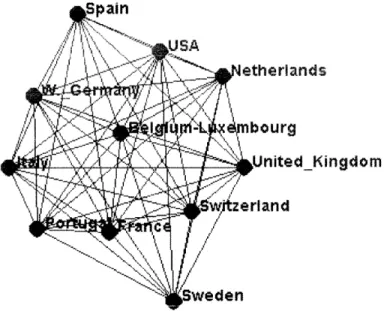
identifying each clique in the dataset is that it allows us to observe groupings that are not typically studied. For illustrative purposes, in Figure 2 we have provided one such latent
14
One may suspect that this divide is perhaps one of gender or class, but in actuality, it is a product of an age divide.
submacro clique from 1984.15 Notice that the seven countries included come from different trade groups, different cultures, different political alliances, and different continents? To be clear, the value of considering latent trade cliques is that they are determined exclusively in terms of trade interactions, without relying upon any prior assumptions about identities or classifications.
Germany
Figure 2: A Latent Submacro Clique in the International System
Finally, if our primary purpose in this project is to capture the structures and functions of the international system in terms of trade in order to understand the stability of trade, the latent purpose of this project is to demonstrate that graph theory should find a welcoming home in IR, and within political science at large.I7 To this end, we discuss
l 5 We shall discuss how this latent clique was identified and constructed in Chapters 3 and 4.
16
A cynic might point out that these countries all belong to the Organization for Economic Co-operation and Development (OECD). However, in 1984, South Korea was not a member of this group and would not join for another twelve years. However, perhaps being so intertwined with these richer countries did help
South Korea achieve OECD status, further demonstrating the benefits of examining latent submacro cliques.
l7 This is not to imply that graph theory has not been used before in political science. Indeed, as we shall show in the next chapter, its beginnings are rooted in political science.
the current state of graph theory in IR and political science, and we also speculate about &re possibilities for graph theory across our field?
Thesis Layout
The thesis is laid out as follows. In Chapter 2, we examine the history of graph theory, especially in the context of political science. Graph theory was born and first nurtured by sociologists and political scientists; however it has spent much of its adolescence in the company of scientists and engineers. As a result, applications of graph theory in the social sciences have predominantly been constrained to analyzing relationships between people, while incorporations of graph theory in the hard sciences have thoroughly pervaded physics (Albert and Barabbi, 2002), computer science (Huberman, 200 I), and especially biology (Anderson and May, 199 1 ; Shen-Orr, Milo, Mangan, and Alon, 2002).
In Chapter 2, we also explore the previous research pertaining to structures of the international system. Many structures of international systems have been presented in theoretical terms, but few have been tested. We shall examine and consider several of these propositions, as well as one of the leading empirical examinations which tests the propositions of systems theory. We shall also examine various literatures on international submacro systems. Several types of submacro systems abound, both in theory and in reality, and we shall briefly review several of these structures before calling
Throughout our speculations, we shall offer citations for the reader to follow up where graph theory are being employed.
19
The selection of each of these citations is illustrative, but by no means random. Albert and Barabasi have written one of the foremost reviews of network theory in physics; Huberman's book is entitled The Laws of the Web, and discusses network theory in context to one of the greatest contributions fiom computer science: the World Wide Web; Anderson and May's book discusses networks in the context of one of the most pressing issues in biology: the spread of infectious diseases; and Shen-Orr, et al.'s piece explores how various proteins interact to express genes. Examples are all described in Newman, 2003.
for the analysis that cuts across regional, political, cultural, and economic taxonomies of submacro systems.
In Chapter 3, we empirically examine the macro structure of the international trade system. Analyzing all of the major trade relationships between countries from 1962-2003, we find that a Scale-Free Network best captures and explains the dynamics of international trade?' A Scale-Free Network suggests that certain countries are tantamount to the stability of the system relative to other countries and that a hierarchy exists among actors. A Scale-Free Network also suggests that subsystems, or in our case, submacro systems, play an important role in the dynamics of the overall system.
In Chapter 4, we seek to empirically identify these submacro systems. Using one of the most recently developed algorithms in graph theory for latent community identification (and the one best-suited for our purposes of identifying cliques of countries), we present several of these cliques from the years 1962, 1982, and 2002.2' We find that while the composition of cliques may change, several core properties are inherent to these groupings, which is the subject of Chapter 5.
In Chapter 5, we examine the differences of various submacro systems in the context of the hierarchical possibilities of the international system. A range of submacro systems exist, with different forms of interdependence uniting these multilateral groupings. We conclude fiom our submacro analysis that the international trade system follows a Multiscalar Hierarchy, one possible hierarchy of a Scale-Free Network. We
20
A major trade relationship is defined as one in which a large portion of a country's overall trade comes fiom or goes to another country. While compiling the datasets, we found that several countries share minor and insignificant amounts of trade flows. In order to capture the true structure of trade, we established a cutoff to discern minor fiom major trade. For a further explanation of how the cutoff was designed and implemented, see Chapter 2 and Appendix A on data methodology.
21
also discuss the ramifications of such an international system for economic stability and for economic coercion.
In Chapter 6, we introduce international institutions to the discussion of economic stability. We examine institutions both as a source of stability for the international system (through an analysis of macro institutions), and as a source for improving member country conditions (through an analysis of formalized trade blocs, which are submacro institutions).
We conclude in Chapter 7 with a summary of the major findings. Among the major findings is that we identify the presence of a Scale-Free macro system, with a whole myriad set of different latent submacro cliques, which suggest a Multiscalar Hierarchy of the international trade system. We also find that trade blocs are most effective at improving all member nations when they resemble Egalitarian Network as opposed to a Scale-Free Network. We conclude with some parting thoughts about possible future areas of IR research based upon systems theory, graph theory, and especially based upon international trade. This thesis represents only the tip of the iceberg in terms of the tools and datasets that have been brought together, and in this chapter we intend to lay out other possible directions for research.
CHAPTER 2: GRAPH THEORY AND INTERNATIONAL
SYSTEMS THEORY: THEN AND NOW
Overview
Graph theory is also known as complex systems science, and there are several complex systems present in social structures (Newman, 2003; Marsden, 2002; Piepers, 2 0 0 6 ) . ~ ~ We shall examine the history of graph theory in order to show that graph theory can also be usellly applied to several different areas of political science. We then turn to international systems theory literature to see whether graph theory may give us any leverage in testing these theories. We discuss theory and previous research of the submacro system, calling for analyses which consider latent country communities rather than pre-defined communities. We close by examining the shortcomings of De Mesquita and Lalman's empirical analysis of the systemic effects on conflict in the international system to identify how we may improve our own analysis (1988).
A
Brief History of Graph Theory
One of the earliest forms of graph theory within the social sciences was the observance of the small world phenomenon. The small world phenomenon was first considered by political scientist Ithiel de Sola Pool and mathematician Manfred Kochen in the 1950s (Pool and Kochen, 1978).~' Pool and Kochen argued that through familial
22
These examples are illustrative: Newman explicitly states that complex systems exist in social structures, Marsden lists several possible sociological studies that could benefit Erom graph theoretic methodologies, and Piepers applies graph theory to international relationships.
23 Pool and Kochen worked together for over twenty years, but did not co-author a published piece together
until 1978. In "Contacts and Influence," the first ever article in the journal Social Networks, the abstract explains the story:
"This essay raises more questions than it answers. In first draft, which we have only moderately revised, it was written about two decades ago and has been circulating in manuscript since then. (References to recent literature have, however, been added.) It was not published previously because we raised so many questions that we did not know how to answer; we hoped to eventually solve the problems and publish. The time has come to
ties, friendships, or acquaintances, any two people in the world are connected through a minimal number of links (Etheredge, 2006). In terns of political science, the applications of Pool's and Kochen's research were mainly contained to the comparativist literature - seeking to identify such conditions as the distance a message would have to
travel from the average American to the president, or how an idea could spread among bureaucracies - but could eventually be applied across the various domains of political science. As time progressed, Pool's and Kochen's notion of a small world was accepted amazingly well by popular culture: their work gave rise to the hypothesis that all people were connected within six acquaintances, which in turn inspired a play entitled Six
Degrees of Separation (Guare, 1990), and more recently, the title of the popular book Six
Degrees: The Science of A Connected Age (Watts, 2 0 0 3 ) ~ ~ ~ Barab6sisi's Linked: The New Science of Networks, which explores degrees of separation across a whole range of disciplines, has also enjoyed large-scale popularity (2002).
Since the time of Pool and Kochen, the small worldphenomenon has particularly manifested itself in comparative politics in the form of social capital. Robert Putnam defines social capital as the "features of social life - networks, norms, and trust - that
enable participants to act together more effectively to pursue shared objectives" (Putnam,
cut bait. With the publication of a new journal of human network studies, we offer our initial soundings and unsolved questions to the community of researchers which is now forming in this field. While a great deal of work has been done on some of these questions during the past 20 years, we do not feel that the basic problems have been adequately resolved" (Pool and Kochen, 1978: Abstract).
Any true student of social capital would fully appreciate this piece.
24 The history of six degrees is actually more nuanced. In his book, Watts recognizes Pool and Kochen were the first to attempt to academically investigate the small worldphenomenon, doing so in the 1950s. Their work inspired Stanley Milgram to conjecture that the maximum number of degrees among any two randomly selected people in the population is six, technically making Milgram the father of the theory of six degrees of separation. However, without Pool and Kochen, "Milgram would have been off doing another experiment" (Watts, 2003 : 160- 1 6 1).
1995: 664-665)? And social capital may explain several important elements in the study of politics. In Making Democracy Work: Civic Traditions in Northern Italy, Putnam argues that social capital may stimulate the formation of democracy (1993). In its essence, Putnarn's concept of social capital relies upon gauging the smaN world
phenomenon across societies.
Recently, social scientists and business researchers have also tried to measure the fiequency of interactions among individuals to measure the pervasiveness of various ideas (Choucri, et al., 2006; Shive, 2006):~ In order to gauge the fkequency and quality of interactions, researchers will estimate interactions using epidemic modeling (Sterman, 2000).*~ Knowing the approximate fiequency of infectivity and the approximate number of affected individuals, they then can generate an approximation of the number and amount of interactions within a population. Such a methodology could be especially usehl in testing Putnam's theory of social capital and democracy.
Research in systems is also nothing new to political science. Within our domain of IR, Morton A. Kaplan defines a system as "a set of variables so related, in contradistinction to its environment, that describable behavioral regularities characterize the internal relationships of the variables to each other and the external relationships of the set of individual variables to combinations of external variables" (Kaplan, 1960: 4).
25 Putnam has defined social capital many times and in many venues, always consistently. The choice of
taking the definition fiom "Tuning In, Tuning Out: The Strange Disappearance of Capital in America" is not random, however. This talk was for prepared as the 1995 Ithiel de Sola Pool Lecture. Strangely, Putnam seems reticent to adopt tools of network theory, preferring instead to employ traditional empirical and qualitative methodologies.
26 Shive shows that an epidemic model of investor behavior may explain price fluctuations of various
stocks. She does not use diseases and infectivity rates, but another way of getting around the social capital methodology nightmare without using disease (particularly pertinent to developed countries), would be to inspect infectivity rates in terms of the stock market, or in terms of fashion.
27 Sterman discusses the possibilities of epidemic modeling in the context of applications for business, but he gives much credit to network sociologists (2000).
A system can be defined more succinctly as "an interconnection of components, devices, or subsystems" (Oppenheim, Wilsky, and Nawab, 1997: 38).28 Such a definition keeps
the thrust of Kaplan's notion of system intact, while more concretely explaining the elements which might compose a system.
A graph is simply the representation of such a system?9 Therefore, graph theory refers to the study of these systems. More specifically, graph theory "is a branch of mathematics concerned with how networks can be encoded and their properties measured," while network theory tends to refer to flows across these networks and among the various actors (Rodrigue, 2005: Chapter 2).30 Since Pool and Kochen's speculations and musings more than fifty years ago, graph theory has rapidly developed, especially within the hard sciences. Over much of this time period, the methodology of graph theory was primarily visually-based, with scientists examining a network image to extract findings (Newman, 2003). And visualizations are still one of the key aspects of graph theory." However, contemporary researchers in graph theory have added to this paradigm of visual-inspection by introducing various statistical techniques.32
This inclusion of statistical methods to graph theory has been partially driven by the advent of computational analysis - one cannot gainllly eye-ball a network composed
of millions or billions of components - and partly by the emergence of domains devoted
28 Defining terms is especially important in political science: this shall be exemplified fiuther in the chapter
with our discussion of previous usages of the term "system."
29 Network theory involves actually identifying and mapping the links between various actors, and studying
what these links mean in the context of the system.
30 The definition of graph theory is provided by Rodrigue; the observation that network theory tends to
focus on flows is our observation fiom the literature and is certainly not hard-and-fast as network theory and graph theory are often used synonymously with each other. As we mentioned in fn. 5, we expect this distinction to become more pronounced in proceeding years.
3' Ortiz discusses the usefulness of analysis through visualizations throughout political science (2005).
" Visualization-as-method is also undergoing a similar catharsis as researchers are gainfully examining the
ramifications of various spatial layouts in the context of viewer's perceptions. For a recent summary of this literature, see McGrath and Blythe, 2004.
to analyzing especially complex networks, and particularly the domain of computational biology (ibid). In computational biology, researchers have been trying to capture the structure of the system of genes and their relationships with proteins, a system of tremendous size and complexity (Palla, et al., 2005). While the international system clearly does not approach the complexity of protein-gene dynamics, statistical tools are nonetheless useful, and for our purposes both visual and statistical tools of graph theory are appropriate.
Systems Analysis in lnterna tional Relations
In Man, the State, and War, Kenneth Waltz introduces three images for analyzing IR (1954). Each image includes an area of study that can affect world politics. The first image includes individuals, the second image includes the domestic institutions of the nation, and the third image involves the international structure, or system. Waltz's two chief goals are to justify realism in the context of international politics (that nations are driven by power-maximization rather than by simple desires for peace and harmony), and to stress the importance of research in the third image, and more broadly in understanding systemic patterns of IR.
What Waltz meant by "system," however, is not the only understanding of the term prevalent in our literature. Scholars in IR have employed the concept of "system" in three different usages in IR theory, oftentimes promoting ambiguity and confusion, summarized in Table 1 (Goodman, 1965). The first usage, system-as-description, is when the tern is used to describe patterns of interactions between and among actors; typically nations are the identified actors. For example, nations go to war: the causes and consequences of these interactions give rise to a system. The second usage, system-as-
explanation, suggests that actions are determined by pre-existing systemic explanations, oftentimes not justifying the specific cause of a pattern of behavior. Kondratiev waves would be an example of system-as-explanation, where wars are expected to be more prevalent every twenty years without any specific cause (Goldstein, 1988). In a recent paper about war between the great powers, Peipers uses graph theory to explain how system regularity suggests that individual actors and forces are inconsequential pieces in the causes of great power war (2006).~~ System-as-method describes when the term is used to capture special methodologies to describe the international system in the context of interactions among actors. For instance, when game theory was first introduced to IR, the new methodology was described as one that would help capture the international system (Goodman, 1965: 260).
Table 2: Usages of System in IR Theory. Adapted from Goodman, 1965: italics added by Goodman
Usage S ystem-as- Description S ystem-as- Explanation System-as- Method
33 Unfortunately, Peipers uses statistical tools of network theory that are most u s e l l for large numbers of
observations. Even if one looks over a period of 450 years, as Peipers does, there have only been 97 great power wars. Also, Peipers argues that there is some sort of system that causes these great power wars, and that this system does not include individual.
Characterized B'Q.. .
"an arrangement of he
actors. . .in which interactions are patterned and identifiablev "a particular
mangemeent in which the nature of the at~angement makes it die major variable" "application of special of approaches: methodologies, or analytical concepts to the data of intenlittiorla1 politics" Emmples
James M. Rosenau: "a system is considered to exist in an environment and to be composed of parts, which, through interaction, are in relation to each other. Consequently, a system has a sa-ucture and encompassed processes though which it is either sustained or changed."
Charles McClellmd: "Since both principal actors occup similar positions and experience similar difficulties, they might drift gradually toward collaboration, except h t such a movement is blocked by #?e essential curtfldct strrrctttre of the internatioz~aI sjastem ."
"[tlhe particular 'systems\itilized in Sysebu-as-hf ethod are often drawn fiom other disciplines and applied to international politics. hlcClellandls homeostatic equilibrium 'systernkoncept derives fiorn biology, George Lipska derives his concept of equilibrium 'systems' from economics; and R. N. Rosencrance finds 'systems" in rriecharlics arialogous to those of politics."
To be clear, Kaplan's definition of system that we chose at the beginning of this section is one of system-as-description. For the purposes of this project, such a definition is the most appropriate. While we do use methodologies extracted from graph theory that are new to political science and IR, the system we are concerned with is not primarily the method. We are chiefly concerned with identifying the structures and substructures of the international trade system. If our work is so fortunate as to see h r e developments, it may give rise to system-as-explanation work, where the structures can be used to explain relations and interactions.
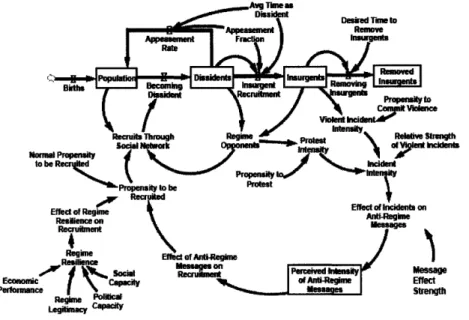
Not surprisingly, with such a heavy focus on systemic analysis, methods in system dynamics have also become more common across our field (Choucri, et al., 2006; Lofdahl, 2002; Robbins, 2005)." In Figure 3, we include a theoretical system dynamics model of insurgency activity and recruitment.
la----
&-r , -
OfARbFRcginrcJw
Effectm5sa Strength
Figure 3: A Conceptual System-Dynamics Model of Insurgent Activity and Recruitment (from Choucri, et al., 2006)
" Again, the examples are illustrative rather than exhaustive. Of these, the book by Lofdahl is probably most closely related to the topic at hand: in Environmental Impacts of Globalization and Trade: A Systems Study, Lofdahl highlights the negatives of increased trade (2002).
Notice that most of the components of the system are not specifically actors, but instead include a variety of concepts. While the purposes of system dynamics and graph theory are similar - both seek to capture and understand the nature of systems - graph
theory tends to be contained to understanding relationships between actors rather than relationships between concepts. Graph theory and system dynamics are separate methodological approaches.
It should also be noted that neural network analysis and graph theory are qualitatively distinct. In neural network analysis, the goal is to predict a set of results, typically by bypassing the causal pattern. In graph theory, the goal is to identify the structure of relationships between the actors to understand the system structure. As we have discussed, graph theory is a method of system-as-description. Oppositely, causality- based prediction remains the primary goal of neural network analysis.
Despite their differences, approaches to integrating IR with neural network analysis do yield an important lesson for those who wish to introduce a new methodology to IR: introducing new methodologies to IR occasionally draws skepticism and criticism. For instance, to better understand the nature of international conflict, Beck, King, and Zeng designed a neural network model for predicting the frequency of conflict among nations (2000). Working at a time when neural networks were still in a primitive stage, Beck, King, and Zeng demonstrated the promise of neural network analysis by comparing their findings to findings derived from traditional empirical tools, most notably including regression models.35 Their proposal of utilizing neural network analysis to predict
3 5
Neural network analysis is rapidly developing, but we fully expect that in several years neural network analysis circa 2006 will also be described as "primitive." Beck, King, and Zeng explain the development
conflict generated significant backlash from traditional, regression-focused, empirical researchers for implying that a new statistical methodology may offer better insight (De Marchi, Gelpi, and Grynaviski, 2004). In response, Beck, King, and Zeng convincingly demonstrate that neural networking does have value by re-creating a successll neural network model, in turn proving that the implementation of new methodologies to consider old questions is a worthwhile activity (2004). We agree with Beck, King, and Zeng that IR can benefit from the investigation of novel methods.
As we discussed earlier, it is not fair to say that graph theory is an entirely new approach to political science, but graph theory today is so very different from what it was in Pool and Kochen's time. Modern-day graph theory has been used in limited fashion in IR, but for the most part, it has not been used to examine the international system as a whole. Peipers' article on great power wars shaping the international system is the obvious exception, where Peipers searches for tipping points for war among the great powers (2006). However, Peipers only considers the great power countries rather than all the countries of the world when fiaming his international system. Within international trade analysis, Krernpel and Pliirnper have utilized graph theory and gravity modeling, but have only included forty-five countries in their models.36 Furthermore, Krempel and Pliimper use graph theory primarily to conduct micro system analysis, re-confirming the Gravity Theory model, whereby trade is more likely to occur between two countries when the two countries are geographically closer together or the economies are large
of neural network analysis in the context of their project when they redo their experiments in subsequent work, finding that their methods used in 2000 need to be updated when employed in 2004 (2004).
36 Gravity modeling is the practice of taking into account geographic distances when examining the causes
of international trade, usually at the dyadic, or micro-level; Krempel and Pliirnper offer several visualizations of their forty-five country network with geographic weighting:
ht~://~~~.cmu.edu/ioss/content/articles/volume4/Krem~e1Plumper~files/m5countw.htm1 (Accessed May, 2006).
(2002). To be clear, they do not claim to be examining the structure of the international system, but do implement tools which could help us understand relationships that are more complex than simply dyadic relationships. Their work offers little traction in examining the submacro and macro levels of international systems. Fortunately, IR theory does have a set of propositions that could guide this work.
Scoping the Topology of International Systems
In our conception, the international system includes several submacro systems interacting with a larger, macro system.37 However, the concept of the international system is distinct from the concept of a world system. The typical definition of a world system in the context of political science is "the social organization of the human species" (Modelski, 2000: 25). World system theorists are concerned with identifying patterns of group behavior that hold over long-term time periods and across different organizational hierarchies. In contrast, to understand the international system is to understand the contemporary version of one part of the world system: one in which nations and their actions and interactions drive international politics.
There are several overlapping concepts between the world system and the international system, and understanding the international system can shape our understanding of the world system. Denemark, Friedman, Gills, and Modelski wonder whether center-periphery hierarchies have always dictated social organizations and whether they differ in various subsystems of the world system (2000: xvi). In the next chapter, we shall examine the center-periphery hierarchies of the international trade
37
These subsystems include relationships at the macro level where all countries are involved, relationships between two countries, which are micro level relationships in IR, and relationships between more than two, but less than all countries, which are relationships at the submacro level (Berton, 1969). These
system and how it has changed (or not changed) over recent time. Two other world systems theorists, Chase-Dunn and Hall, note that all world hierarchical networks exhibit cyclical "pulsations in the spatial extent of interaction networks" (2000: 100). This would suggest that in the context of the international system, nations undulate in their relations with others and in their participation in an international order.
In order to fully understand the international system, we also need to understand various other subsystems within it. One especially important misconception about analyzing international systems is perhaps best exemplified by J. David Singer in "The Level-of-Analysis Problem in International Relations" (Singer, 196 1). Representing the backlash to the domain's call for more research in the third image, Singer explains that "[tlhus, we tend to move, in a system-oriented model, away from notions implying much national autonomy and independence of choice and toward a more deterministic orientation" (ibid: 81). While Singer is simply voicing the concern that analyzing IR in an international systems perspective may be hdamentally flawed (he does not necessarily adhere to this position), understanding the world as a system is not a bad approach. Such an approach does not mean we ignore domestic and internal variations among separate nations: indeed if anything, we must especially focus on such components, devices, and subsystems if we are to understand how the larger international system works.38 Individual decision-makers and other exogenous elements do exist and interact with the world system, and understanding the consequences of such elements is crucial to understanding the international system. In this project we strive to maintain a
38 Another weakness of Peipers' findng is that he refuses to recognize the importance of such components
in his international system. He explains that the pattern of his international system is such that regardless of the leaders or of the institutions involved, great powers will go to war. In fact, one of the weaknesses of his conclusions is that he does not consider that the pattern of change is unfolding at the leadership-level or at the institutional level and is simply manifesting itself with great power wars (2006).
balance between the international system and the international submacro systems, but we recognize the limitations of simply examining international trade without considering individuals, non-governmental organizations, or multinational corporations.
Macro International Systems Theory
For our purposes, we analyze the international trade system in terms of one large, macro meta-system and in terms of various international submacro systems. Such macro meta-systems can be considered as variants of the international order. Kaplan offers six such states of equilibrium of the international order; note that only one macro system can exist at any given time (1 957: Ch. 2):
1. The Balance of Power System: Exists in a null political subsystem (anarchy). There are at least five "essential" actors / nations in a Balance of Power System that implement the "essential" rules which govern the characteristic behavior of the population of actors.
2. The Loose Bipolar System: Formalized, supranational actors as well as national actors both participate in such a system. Two subclasses of supranational actors must exist to form the bipolar system. During the time of the Cold War, NATO and the Communist blocs formed a Loose Bipolar System.
3. The Tight Bipolar System: Similar to the Loose Bipolar System except all
national actors belong to one of the subclass supranational organizations. Such a system would resemble the international system during the Cold War if all of the members of the Third World had allied with NATO or the Communists.
4. The Universal System: The previous three systems include an anarchic political order; the universal system assumes that national actors are governed by a universal actor. If the United Nations and the World Trade Organization had greater power in the contemporary international system, we would call our modern-day international system a Universal System.
5. The Hierarchical System in Directive and Non-Directive Forms: The
Hierarchical System is one in which a universal power rules directly over the people, with no independent national political systems. In its Non-Directive Form, the Hierarchical System is a world-wide democracy; in its Directive Form, the system is authoritarian.
6. The Unit Veto System: The Unit Veto System can occur when either national actors or bloc actors control the system. The Unit Veto System stipulates that all members have the capability of destroying each other, suggesting that all members are equally powerhl.
While Kaplan was writing in the 1950s and 1960s, understanding the macro international system again became popular following the end of the Cold Richard Ned Lebow observes that due to the collapse of the USSR, "prominent realists maintain that a shift is under way in the international system fiom bi- to multipolarity" (1994: 249). For Lebow, a Multipolar System is most similar to a Balance of Power System, except that in a Multipolar System, anarchy could be supplanted by a universal actor. Contending that the paradigm of realism requires the condition of international anarchy,
39 Between Kaplan and Lebow, several prominent scholars have considered the meta-structure of the
international system, coming up with a whole slew of various orders. One system that deserves mentioning is that of Hegemonic System, where one national actor maintains stability across the international system. However, the Hegemonic System is really a derivative of the Universal System. The key readings on the Hegemonic System are Gilpin, 1 98 1 and Keohane, 1 984.