Design for the Modern Prometheus:
Towards an Integrated Biodesign Workflow
by
MAS NOITUTESunanda Sharma
BS, MIT (2014)
LIBRARIES
Submitted to the Program in Media Arts and Sciences,'
School of Architecture and Planning,
in partial fulfillment of the requirements for the degree of
Master of Science in Media Arts and Sciences
at the
MASSACHUSETTS INSTITUTE OF TECHNOLOGY
June 2016
@
Massachusetts Institute of Technology 2016. All rights reserved.
Signature redacted
Author...
Program in Media Ar s and Sciences
May 6, 2016
Certified by...Signature
redacted
#1
/
Nerl'Oxm/n
Associate Professor of Media A ts and Sciences
Program in Media Arts and Sciences
Thesis Supervisor
Signature redacted,
Accepted by...
. ...
-
v
7
Pattie Maes
Design for the Modern Prometheus:
Towards an Integrated Biodesign Workflow
by
Sunanda Sharma
Submitted to the Program in Media Arts and Sciences, School of Architecture and Planning,
on May 6, 2016, in partial fulfillment of the requirements for the degree of
Master of Science in Media Arts and Sciences
Abstract
Biodesign is a growing field that harnesses the re-engineering capabilities of synthetic biology and the principles of design to create functional products on a variety of scales. It is now possible to precisely modify and program living organisms to create prod-ucts useful for medicine, fabrication, and more. These capabilities are today inspiring designers to consider, and design for opportunities associated with, the incorporation of biological and otherwise living matter into the built environment. Standard Com-puter Aided Design (CAD) software used in design and engineering often does not have resolution required for living systems, whereas many known bioCAD software do not allow for larger scales. In addition, simulations and animations are usually limited to a short timescale, and do not allow for predictive models over days or weeks. For creating environments in which living materials or systems, from bacterial biofilms to functional swarms, can intertwine with synthetically fabricated constructs, rapid prototyping software must be developed that can allow for both design and simula-tion in different condisimula-tions over time. This thesis is an attempt at creating a design methodology and finding a software platform for inclusion of living material systems in manufacturing of products on multiple scales. Existing biological CAD software is surveyed and applied to two case study projects engaging multiple scales (i.e. human scale, and architectural scale) for which the digital fabrication of living materials pro-vides additional functionality and augments the biological or ecological environment. In the process, novel work is presented in the areas of apiary management and 3D printing with biology. Additionally, several computational approaches, including rule based and agent-based techniques, are applied to both projects and evaluated for ac-curacy and usability. This research took place in Mediated Matters newly constructed BL2 Wet Lab, and serves as a demonstration of research that lies at the intersection
of additive manufacturing and synthetic biology.
Thesis Supervisor: Neri Oxman
Title: Associate Professor of Media Arts and Sciences, Program in Media Arts and Sciences
Design for the Modern Prometheus:
Towards an Integrated Biodesign Workflow
by
Sunanda Sharma
The following people served as readers for this thesis:
Signature redacted
Thesis Rea
... .
.. . . .
..
Ed Boyden
Associate Professor of Media Arts and Sciences
Program in Media Arts and Sciences
Thesis Reader
...
Signature redacted
Jean Livet
Research Director
Institut de la Vision
Acknowledgements
This entire work and the last few (and next few) years of my life would be different
without my Mediated Matter extended family -Kelly Donovan, Laia Mogas Soldevilla,
Jorge Duro Royo, Daniel Lizardo, John Klein, Christoph Bader, Dominik Kolb, James Weaver, Tzu Chieh Tang, Chikara Inamura, Giorgia Franchin, Steve Keating, Julian Leland, Mike Stern, Will Patrick, Markus Kayser, Katharina and Emil Kayser, Jonah
Goodman - for their friendship, kindness, and knowledge. Thanks, admiration, and
respect for Neri Oxman, my mentor, advisor, professor, and friend, who has opened countless doors for me and cared endlessly. Beyond Mediated Matter, I wish to acknowledge the MAS program and Media Lab, especially Linda Peterson, Keira Horowitz, Monica Orta, Stacie Slotnick, Jess Sousa, and Joi Ito.
Further thanks to my mentors and peers at MIT and other institutions in my scientific education, especially Ed Boyden (who also serves as an advisor), Annabelle Singer, Pei Ann Lin, Giovanni Talei Franzesi at MIT; Jean Livet at Institut de la Vision (who also serves as an advisor); Mriganka Sur and Pawan Sinha at MIT.
Critical to this work was the creation and development of a wet lab in building E14, and for this I must thank Jessica Tsymbal, Kevin Davis, Bernard King, and Facilities; Lorena Altamirano, Marilyn Hallock, and EHS; Noah Jakimo, Lisa Nip, Charles Fracchia, the Molecular Machines group, and the Center for Bits and Atoms for their help making a lab functional; David Kong; Travis Emery, Rodrigo Garcia, Danielle Feldman, and the Sur Lab; Jenn Brophy, Felix Moser, and the Voigt Lab; Stephanie Hays, Jessica Polka, and the Silver Lab; Eleonore Tham and the Lu lab; Vanessa Cheung and Anthony Fuccione. In addition, I want to thank those who helped with the creation of the Synthetic Apiary: Noah Wilson-Rich and his team at Best Bees; Andy and Susie Magdanz; and Alok Tayi and the TetraScience team. Last but not least, thanks to my best friend and brother, biggest inspiration, and longest collaborator, Samvaran; my caring, thoughtful mother, Usha; my first scien-tific role model, my father, Jeetu; and the rest of my family of inquisitive and artistic minds. Thank you to my closest sisters, Patricia Saylor and Lindsay Donovan, and my amazingly supportive friends, including those in the Media Arts and Sciences
pro-gram at MIT - Bianca Datta, Juliana Nazare, and many others - for encouraging me
and going through this process together; as well as my Bexley, Burton Third, AXO, and undergrad families, especially Kristjan Eerik Kaseniit. And the most love and appreciation for my constant and fiercest supporter, Hans Pech.
-~ - -~
-Contents
Abstract
1 Introduction: Contextualization
1.1 Historically Controlling Life . . . . .
1.2 Mediated Matter and the Media Lab
1.3
1.4
Lens and Perspective . . . . Core Focus . . . . 2 Background: Foundations 2.1 Biodesign . . . . 2.2 Realizations of Biodesign . . . . 2.3 System Components . . . . 2.3.1 Environment . . . . 2.3.2 Material . . . .. 2.3.3 Living . . . . 2.4 Prior Work . . . . 2.5 Current Workflows . . . .
3 Proposal: Motivations and Specific 3.1 Motivations . . . .
3.2 Steps and Evaluation . . . .
Goals 2 11 11 13 14 14 16 16 19 19 19 20 23 23 26 28 28 29
4 Survey: Existing Computational D
4.1 BioCAD and Related Terms ...
4.2 Experimental Framework . . . . . 4.3 Selection Criteria . . . . 4.4 Modeling Approaches . . . . 4.4.1 Rule Based . . . . 4.4.2 Hybrid . . . . 4.4.3 Agent Based . . . . 4.4.4 Lattice-Based . . . . 4.4.5 Selection . . . . 4.5 Final Selection and Considerations
sign Tools 32 . . . . 3 2 . . . . 3 4 . . . . 3 4 . . . . 4 1 . . . . 4 1 . . . . 4 1 . . . . 4 2 . . . . 4 2 . . . . 4 4 . . . . 4 4 e
5 Case Study 1: Swarm Fabrication 5.1 5.2 5.3 5.4 5.5 5.6 Background . . . . Focus . . . . Materials and Methods . Experimental Framework 5.4.1 In laboratory . .
5.4.2 In silico . . . . .
Evaluation . . . . Results and Discussion .
6 Case Study 2: Living Wearables
6.1 Background . . . .
6.2 Focus . . . .
6.3 Materials and Methods . . . . . 6.4 Experimental Framework . . . . 6.4.1 In laboratory . . . .
6.4.2 In silico . . . .
6.5 Evaluation . . . .
6.6 Results and Discussion . . . . .
7 Conclusions and Future Work: Discussions 7.1 Overall Evaluation . . . .
7.2 Future Work . . . .
7.3 Issues and Perspectives . . . .
8 Reflections: Impacts
8.1 Contributions . . . . 8.1.1 E14-470 BL2 Lab . . . .
8.1.2 Synthetic Apiary
8.1.3 3D Printed Materials for Experimental Biology
8.1.4 Computational Tools for Biological Systems . .
8.2 Broader Impacts . . . . A Appendix: Publications, Patents, and Awards
B Appendix: Synthetic Apiary for Controlled Year-round
Observa-tion of Apis mellifera
46 46 51 51 55 56 56 57 58 67 67 70 70 71 72 72 73 74 77 77 79 80 82 82 82 85 88 88 89 90 92 7 . . . .
.
.
List of Figures
2-1 Venn Diagram of Biodesign. Design and biology both are deep
fields; in their intersection lies the spectrum of biodesign, which can grow in complexity based on contribution to and from the parent fields. 18 2-2 Examples of Biodesign Across Fields. Four examples of objects
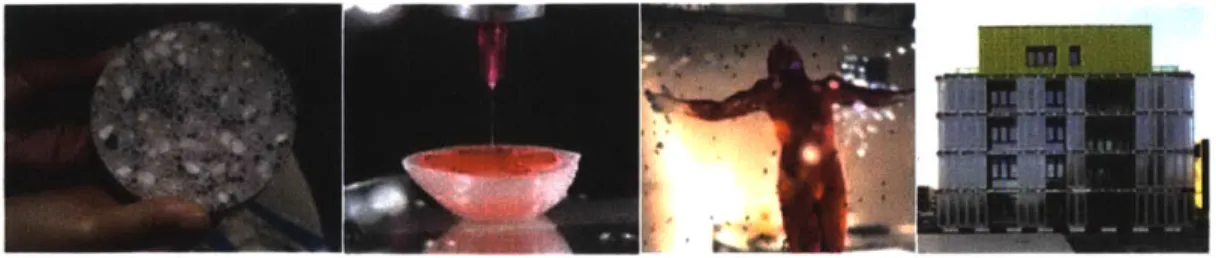
that include living components. From left to right: self healing concrete
[8], bioprinted cartilage tissue [56], a bee-fabricated sculpture [61], and
a building powered by algae [82]. . . . . 20
2-3 A Typical Ashby Plot. An Ashby plot or chart allows for material
comparison and selection by along different parameters - for example embodied energy and strength. Adapted from Manufacturing Toolbox
Blog (Autodesk). . . . . 21
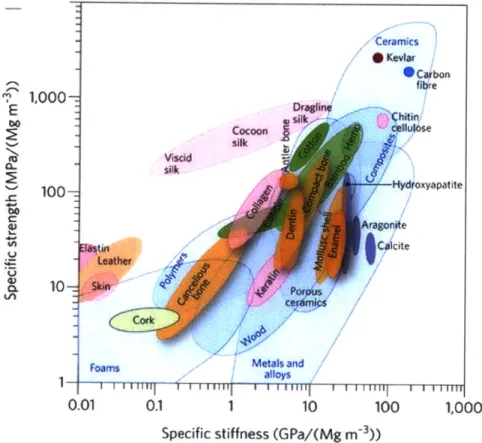
2-4 Ashby Plot Focusing on Bio and Natural Materials. This chart, adapted from Wegst et al. 2015, focuses on biomaterials and materials found in nature. These can actually surpass traditional materials in different qualities, and occupy new spaces on the chart. . . . . 22
2-5 Phylogenetic Tree of Life. Shown is a full phylogenetic tree that
includes mainly organisms currently in existence. Adapted from Evo-geneao. . . . . 24
2-6 Prior work by Mediated Matter. Two projects that provided a
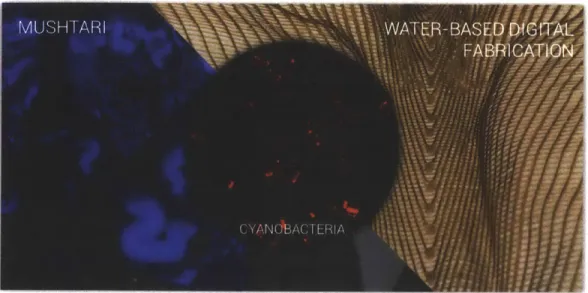
foundation for this further exploration are Mushtari (left) and Water Based Fabrication (related to the Ocean Pavilion) (right). In both of these projects, the same strains of bacteria were used to augment func-tionality (center). Images by Mediated Matter Group, Paula Aguilera, Jonathan Williams, Stephanie Hays, Tom Ferrante. . . . . 25 3-1 Proposed Workflow. . . . . 29 3-2 Feedback Loops in Biodesign Systems. In the ideal system, the
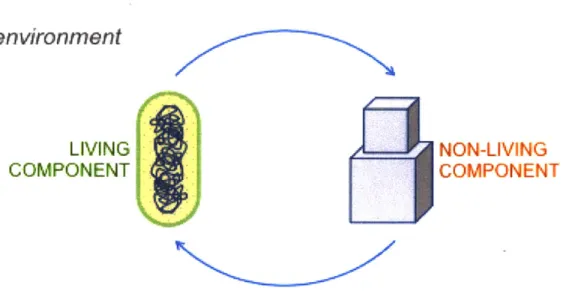
living and non living components should exist in a dynamic feedback loop that exchanges with the environment. . . . . 30
4-1 Table of Surveyed Software Tools. A complete list of the software
and computational tools surveyed for this thesis. Each was evaluated on the basis of four criteria; shown here is selection based on the first
- activity - with the qualifying programs in black and those that did not pass in gray. *cellML refers to those simulations directly based on
cellML, including PyCML and CHASE. . . . . 37
4-2 Selection of Tools based on Scale. The qualifying tools from Figure 4-1 were arranged based on scale of operation (criterion 2). Highlighted in blue are those that operate in the scale of interest for these studies; highlighted in red are those that are not scale-based, so cannot be eval-uated under this criterion. **Maya with plugins refers to nDynamics, nCloth, and nParticles. . . . . 38
4-3 Selection of Tools based on User Interface and Graphical Out-put. The six tools that passed the first two criteria were evaluated for user interface and graphical output. Publications and documentations of completed projects using these tools were compared. . . . . 39
4-4 Selection of Tools based on User Interface and Graphical Out-put. Tools that were exempted from criterion 2 were evaluated for user interface and graphical output. Publications and documentations of completed projects using these tools were compared. . . . . 40 4-5 Comparison of Modeling Approaches for Systems Biology.
Nine common approaches for systems modeling and simulation. Adapted
from Bartocci and Lio 2016. . . . . 43
5-1 Apis m ellifera. . . . . 48
5-2 Top down rendering of designed enclosure. Illustration by Markus Kayser and Jorge Duro Royo. . . . . 52 5-3 Side view rendering of designed enclosure. Illustration by Markus
Kayser and Jorge Duro Royo. . . . . 53 5-4 Actual built enclosure, before insertion of hives. . . . . 54 5-5 Top down rendering of designed enclosure. Illustration by Markus
Kayser and Jorge Duro Royo. . . . . 60 5-6 Researcher pictured with two initial hives. . . . . 61 5-7 Small eggs within freshly created wax. . . . . 62 5-8 Material Products of the Synthetic Apiary. Shown here are a
light microscope image of honey (40x) (left) and a natural wax struc-ture (right), both of which indicate that the bees were actively building and generating food stores. . . . . 62 5-9 Synthetic Apiary Experimental Set up. The Apiary experimental
space featured hives (numbered 1-8) some of which were on tables (purple), support poles (black and pink circles), and a foraging area for water, nectar, and pollen (green). . . . . 63
5-10 NetLogo BEEHAVE Experimental Set up. The environment of BEEHAVE featured a graphical representation of factors and data over
time, as well as plots of measured and predicted values. . . . . 64
5-11 Comparison of Parameters. The NetLogo BEEHAVE set up was
compared to the real conditions to evaluate how many parameters were accounted for. . . . . 65 5-12 Population over Time. The population of worker bees were counted
by hand over different days. . . . . 66 6-1 Printed chips of VeroGrey and TangoBlackPlus after cleaning. 71
6-2 NetLogo Bacteria Experimental Set up. The environment
fea-tured a graphical representation of the bacterial population and plots over survival over time, as well as sliders to change parameters. . . . 73
6-3 Comparison of In vitro and in silico Parameters. . . . . 74 6-4 LIVE/DEAD Assay Results. Cell samples exposed to control
polystyrene, VeroGrey, and TangoBlackPlus were stained and ana-lyzed. Shown here are results from VeroGrey (left) and TangoBlack-Plus (right). Points in Q3 indicate dead cells, points in Q4 illustrate
living . . . . . 75
6-5 Colony growth post-cytotoxicity assay. After cells were grown
overnight in 6 well culture plates with control (glass), VeroGrey, and TangoBlack, cells were sampled from each to assess viability. Shown from left to right is colony growth with Control (lawn), VeroGrey (562 colonies), and TangoBlack (99 colonies). . . . . 76 6-6 Cell counting In vitro and in silico. Counted colonies in both
conditions are represented as ratios to one another. . . . . 76 8-1 E14-470 Design Progression. Initial renders of the space (top (A)
and side (B)). The design went through many iterations to accommo-date regulations of the Media Lab, MIT, and the city of Cambridge.
A later version is shown in C (top) and D (side) including equipment.
Illustrations by Chikara Inamura. . . . . 84
8-2 Inside the Synthetic Apiary. A view of the two initial hives inside the Synthetic Apiary, installed November 2015. . . . . 85 8-3 Honeybee Hives on E15 Roof. Two Apis mellifera hives were
installed on the roof of building E15 in summer 2015 for initial obser-vations in a semi-natural environment. . . . . 86
8-4 Pollen within Langstroth Frame. Pollen stored in cells of a natural Langstroth hive. The variety of colors indicates the variety of flowering plants that bees visited. . . . . 87
Chapter 1
Introduction
Contextualization
1.1
Historically Controlling Life
In a fit of enthusiastic madness I created a rational creature and was bound towards him to assure, as far as was in my power, his happiness and well-being...
Victor Frankenstein, Chapter 24
Frankenstein or The Modern Prometheus
Mary Shelley
In Mary Shelley's classic gothic novel, Frankenstein [84], the scientist Victor Franken-stein looks upon his monster in the final scene, realizing that he created a living, rational being and failed to create an environment in which it could thrive. He could not predict the morality and actions of his monster, and the novel ends with Victor, the modern Prometheus, dying after attempting to kill his own creation.
Frankenstein, while clearly fantastical and dramatic, illustrates the difficulties in
deal-ing with and exercisdeal-ing control over livdeal-ing organisms. While designers and engineers have largely learned how to modify and fabricate with materials like metals, challenges are still apparent when working with natural materials and biomaterials that have less predictable, more time-dependent properties. For example, cellulose and chitin are two of the most abundant biopolymers existent in nature (85], yet are still being continually researched because complete predictive control has yet to be established. This challenge is further exacerbated in the case of living organisms in standard built environments and fabricated products.
As the world of design and manufacturing progressively intersects with the world of biology and the natural sciences, it is becoming increasingly important that essen-tial elements of each are exchanged. In the past five years in particular, significant progress has been made in exploring digital fabrication as a means to computationally control manufacturing on multiple scales. In addition, the democratization of rapid prototyping, user-friendly software, and low-cost manufacturing tools such as desktop
3D printers [48] are allowing many more people to experiment with design and
cre-ation, and thereby partake in the dialogue. Online communities, marketplaces, and makerspaces such as Shapeways [21] and Sculpteo [20], allow anyone to design prints and even sell or share with others. Additive manufacturing is being hailed as the third revolution, both for industry and individual makers [37]. Whether this is true or not, the improvements in computer aided design and modeling software have correlated with an expansion of purposes for products and the utilizable material catalog, and are now being pushed further as living organisms are considered.
Living organisms themselves are now being engineered, too. Born out of the momen-tum of genetic engineering and systems biology, the field of synthetic biology aims to rigorously create, control, and program cellular behavior [33] and [57]. Though both the story of synthetic biology and its definition are still being discussed, it is
now fact that several techniques have been established that allow organisms to be forward-engineered to allow for designed form and function. These methods are con-tinually being improved and reinvented [40], and applications are acknowledged to be widespread - from medicine to materials science - and the field is now capturing the imagination of designers as well.
1.2
Mediated Matter and the Media Lab
This work is a reflection of the environment in which it was done; both the research group in which I work and the department on the whole are described as "antidis-ciplinary" [50]. This means that traditional disciplines are not accurate metrics to contain the research -many projects deliberately exceed these bounds.
Mediated Matter began atop the newly constructed tenets of Material Ecology, a field pioneered and coined by Professor Neri Oxman [72]. This approach highlights how context and environment are intrinsically linked to material design and fabrication. In the past five years, the research group has expanded to include students trained in materials science, product design, architecture, mechanical engineering, computer science, structural engineering, computational design, and biology.
Throughout this time, several key concepts have arisen, one of which is "design across scales" [73]. Similar to the idea of ultrascale engineering of Markus Buehler [32] and Eames' Powers of Ten [71], this idea encapsulates how principles of design can apply on every scale - from the atom to the universe. Complexity is gained by assessing projects with variable focus and resolution, though the approach - top-down or bottom-up -may vary. The concept is an underlying current in this work,
which seeks to combine fields and tools across scales with an overarching workflow that is applicable to products and platforms alike.
1.3
Lens and Perspective
While this work is firmly in the realm of interdisciplinary exploration, my own for-mal background is in biology - including molecular and micro - and my research experiences and mentors have allowed me to learn about mammalian disease models, clinical science, imaging, neuroscience, biotechnology, biophysics, cancer biology, and more. Two formative experiences were in the labs of Professor Ed Boyden at MIT and Dr. Jean Livet at the Institut de la Vision. From each PI, I learned cutting edge techniques such as optogenetics [29] and Brainbow [62], but also how crossing from one field to another can yield new perspectives for invention and problem solving.
My lens is that of a science student, which applies to the experiments discussed in
this work and the perspective through which I have learned and explored the world of design. In context, this thesis is one of many current pushes to apply biology and design, both in the Media Lab and in the world, and serves as a foundation for further study.
1.4
Core Focus
Several gaps remain between precise computational tools for biology (which tend to focus on the micron scale and smaller) and those for product and architectural design (which rarely move below the millimeter scale). Furthermore, sophisticated and aesthetic design tools often lack the simulation duration and parameter control needed for accurate representation of living systems, thereby curtailing full realization of biological components in designed pieces.
The broad question at hand is:
As discussed in the next pages, this question is broken down further -namely:
What are the steps in current workflows for traditional product design and biological experimentation?
Is it possible to apply these workflows to biodesign?
How can we bridge the gap between in silico and physical tools for both design and biology to allow for efficient and deliberate creation?
The overarching goals of this thesis are:
* To contribute novel and significant knowledge or products to the Media Lab and biodesign community
" To address the problem of product realization in biodesign
* To further collaborations between designers and biologists
Chapter 2
Background
Foundations
2.1
Biodesign
Biodesign is, most simply, designing with living systems [18]. This definition is very flexible; it may also encompass bio-inspired design [43], biomimicry [13], medical device design [60], global problem solving, environmentally sustainable product de-sign, and other areas. The field has gained attention in recent years and is linked to other burgeoning spheres, including synthetic biology, bioprinting [22],
biocompu-tation [47], bio-art [16], DIY Bio [19], citizen science [14], and biohacking [54]. In
every case, however, it appeals to both designers and biologists and often has an ap-plication or education driven focus. In the spectrum of laboratory work to consumer markets, biodesign attempts to find a happy medium -in which rigorous biology em-beds functionality, and design offers application and physical embodiment on a larger scale.
Biodesign is seen as a step deeper into both fields (Figure 2-1), as it moves past theory or pure aesthetic into function, integration, and use [69]. In bio-inspired design and biomimicry, phenomena seen in nature are often replicated with standard materials, to be both aesthetically and metaphorically representative, as well as to harness the nature-perfected solution to a problem. For example, mimicking skin denticles -a particular pattern used by Galapagos Sharks to repel bacteria - can create antimicrobial surfaces [28]. In this case, the discovery of the skin could be done by biologists, but the physical product and application is done by designers. In contrast, a biodesign approach can harness an organism itself - in natural or engineered state
-in a functional product. In this case, both designer and biologist must become familiar with the other field, as they work with novel environments and materials. Cutting edge techniques in both design and biology are garnered to explore this interface, which has both breadth and depth. This allows for complex exploration that sheds light on new questions - how can we "design life" [93]? Can we make biology a "new material for design" cite? How can synthetic biology function as a new enabling technology for makers across fields? Pioneers in biology such as George Church, J. Craig Venter, and Drew Endy, as well as designers such as Daisy Ginsberg, Kathryn Fleming, and students at the Royal College of Art have asserted that this area is a very shared domain.
In the manifestations of biodesign that include organisms, there are parts that are living and therefore highly dynamic, though they can be synthetically engineered to yield more predictable behavior; and there are parts that are non living and can be more readily controlled. The latter can be deliberately created to interact precisely with the living parts, through processes like templating. For example, irrigation systems that deposit water to specific areas on a plant bed will more or less ensure that plants will thrive in hydrated areas and be absent elsewhere. Ideally, however, the living components can respond and influence the nonliving components, creating a feedback loop. As in biology, this loop could serve as a type of symbiosis to a desirable
DESIGN
BIODESIGNBIOLOGY
Figure 2-1: Venn Diagram of Biodesign. Design and biology both are deep fields;
in their intersection lies the spectrum of biodesign, which can grow in complexity based on contribution to and from the parent fields.
end state or theoretically ad infinitum, or could amplify or dampen outputs.
In addition to symbiosis, concepts such as biosensing can be very relevant and have historically been used in many real world applications. A classic example of a biosen-sor is a canary in a mine: coal miners used to bring caged canaries into tunnels, as the birds would die first if dangerous but undetectable gases were present, alerting the miners. In far less gruesome adaptations, biotic components can change in response to external stimuli, such as chemicals, and yield a response or set off a cascading pathway. For example, glucose-oxidase based blood monitors act by using an enzyme to bind to blood glucose with a readable output [6]. In another example, Tangible Media Group's piece BioLogic [101] includes embedded bacterial spores that sense humidity and change, thereby opening pores on a dancer's wearable suit. The con-nection between sensing and actuation is also very closely studied in synthetic biology, and is integral in the programming of cellular life [58].
The language used to describe these biological concepts and even life itself often over-lap with the language of design. Terms such as hierarchy, form, function, space,
light, heavy, and structure - and even architectural expressions such as metabolism
- comprise a shared lexicon between the two fields, though connotations vary. Fur-thermore, certain methods that have gained foothold in the world of design, such as Finite Element Analysis, have now been applied in biology - to discretize complex systems into more tractable parts [49].
2.2
Realizations of Biodesign
There are today several examples of biodesign -which in this context means a physical
object which includes fabricated and living components. These realizations can be
found in product design, biomedical research, art, and architecture (Figure 2-2), as well as several other fields. While some examples of biodesign are decades old commercial products, such as ChiaPets [2], others are recent projects closer to the realm of speculative design [77].
2.3
System Components
Most of the projects and products can be divided into three components: living, non-living, and environment. In addition, all of them are inherently multiscale and dynamic systems, which contribute to both complexity and application potential.
2.3.1
Environment
The environment, as considered here, refers to the local and global surroundings which
interact with the built or designed components. Given the highly dynamic nature of
TM
0 4:
Figure 2-2: Examples of Biodesign Across Fields. Four examples of objects that inclu(le living coinponents. From left to right: self healing concrete
[81,
bioprinted cartilage tissue [56], a bee-fabricated sculpture[61],
and a building powered by algae[82].
living and natural elements, even small changes may cause a great effect. The environ-ment is intrinsically linked to the scale and application; for example, the environienviron-ment for a building will encompass the landscape (e.g. urban,
rural),
terrain (e.g. moun-tainous, ocean), natural phenomena (e.g. earthquakes, torna(loes), (ynanic features (e.g. influence from humans and other organisns), weather (e.g. temperature, humid-ity, seasons), local ecosystems (e.g. tundra, rainforest), an( climate (e.g. temnperate, tropical). In contrast, a consumer pJroduct has a niore localized environment that may affect plerformnamlce - such as heat from sunlight, motion by a wearer, or subimiersionin water. Imlportantly, the environment can provide energy to generate a sustainable and renewable product.
2.3.2
Material
The materi-al in this context refers to the non-living comlponents, which may be scaf-folding, enclosures, or other structures that contact the living comnponents. Thel mate-ri-al makesup the more traditionally designed or fabricated component of a piece, and can therefore be
created
using existing computational aid fabrication tools.Materi-als can be characterized based on their properties, especially those that are intrinsic
or intensive -such as surface energy, specific strength, or stiffness
[96].
These can be quantitatively measured and used in computational muodeling am(l pre(liction. Illa(-dition, the measured properties can allow for functionalities, for example, the surface charge allowing for antimicrobial utility. The material catalog contains composites, metals, ceramics, and more, as shown in Figure 2-3 [5].
4-0Y) U) 104- 103- 102-10 1-0.1 0.01 . 103 104 105 106
Embodied energy per cubic meter, Hp.p (MJ/m3)
107
Figure 2-3: A Typical Ashby Plot. An Ashby plot or chart allows for material comparison and selection by along different parameters - for example embodied energy and strength. Adapted from Manufacturing Toolbox Blog (Autodesk).
Strength - Energy / m3 Composites
Metals and polymers: yield strength , Carn CFRP s es Metals
Ceramics. glasses: modulusof rupture. MOR Techica AIN WC
Elastomers tensile tear strength, (3 1 ehncl Al i
Composites: tensile failure, ceramics Cast irons
W alloys
Natural Zinc alloys
Naturals GFRP Ti alloys materials GR
Non-technical Wood U Ni alloys
ceramics to grain A P
Stone Soda Cu alloys
Brick gilas-D BikWood I - as Al alloys Sgrain E 0 PEEK Lead alloys \ PTFE
elastomers Polymers and/ LetNeoprene elstomers
Concrete Butyl rubber Cork RigiO polymer
Foams - foams Guide lines for
minimum energy design Flexible polymer foams 2/3 /2 Hpp Hpp Hpp MFA.09 I 02
While traditional building materials and even fabricated materials are considered
" static", they do have time-dependent behaviors such as degradation that affect their
properties. However, most representations such as Ashby plots exist in 2D. This may be tested in the future as natural and biomaterials, which may be more dynamic, are added to the catalog (Figure 2-4) [971. One important note is that biomaterials include those that are naturally biocompatible, and thus may be good candidates for interfacing with living organisms.
1,0001i 100eah
}Leathet
10-~ Skint 1 hiOarns Ceram cs Kevlar SCarbon fibre Dragline silL Chitin silkVic Cocoon c~Cellulcse
VCiscid silk 00
~ACalcite
Ceramics Cork Metals and ,loy ST r I IiTj 11 IT---Tj7 I III~Ttr _ 1
0,01 0.1 1 10 100 1,000
Specific stiffness (GPa/(Mg m-))
Figure 2-4: Ashby Plot Focusing on Bio and Natural Materials. This chart, adapted from Wegst et al. 2015, focuses on biomaterials and materials found in nature. These can actually surpass traditional materials in different qualities, and occupy new spaces on the chart.
E
00
4:
00
2.3.3
Living
The living catalog, by contrast, theoretically includes all of organisms currently in existence (Figure 2-5) - as well as those that are synthetically engineered and al-tered [10]. Organisms, like materials, also have measurable properties, which can be considered in the context of the characteristics of life [64]. These can generally be considered: 1. Growth 2. Homeostasis 3. Reproduction 4. Responsiveness 5. Organization 6. Adaptation 7. Metabolism
Certain model organisms found in the phylogenetic tree, such as types of bacteria, yeast, and now even some mammals, have been genetically altered to create new outputs [55] [35]. Synthetic biology techniques can allow biologists and designers to program in behaviors, which can be considered as functionalities that can be useful in products or for humans.
2.4
Prior Work
In 2014 and 2015, two projects were developed in Mediated Matter that explored the biodesign space that was initiated with the Silk Pavilion the year before [66].
F01 -5ard f f wt thg.
Fid
~All
rights s- dEukasryoles
Bacteria
-DAU 63 M J$ 37 W '0 Atiflo.,
~f
hw.4K. -a -4 44 SOSE i 250 2W 6S T.-kqFigure 2-5: Phylogenetic Tree of Life. Shown is a full phylogenetic tree that
includes mainly organisms currently in existence. Adapted from Evogeneao.
The first of these was the Ocean Pavilion, which was a foray into water-based fabrica-tion. In this project, a, KUKA robotic arm was fitted with a custom deposition head which could extrude different concentrations of chitosan. Chitosan is a water-soluble derivative of chitin, which is an abundant biopolymer that forms exoskeletons of crustaceans, insects, and other organisms; it is also a huge waste product of the food industry [52]. By tuning the amount of water in the liquid chitosan mixture, prop-erties such as viscosity, optical transparency, and stiffness could be controlled. Over the course of the project, large scale (3m) pieces were 3D printed and responded to environmental conditions to fold into unique configurations, partially informed by the hierarchical deposition pattern. These pieces could be returned to aqueous environ-ments and fully biodegrade, illustrating the use of biopolymers as greener materials. In addition, chitosan was explored as a scaffold for certain types of bacteria, which could theoretically coat or be otherwise embedded in a piece and provide some sort of fuel or chemical output. The initial experimentation was done with a photosyn-thetic algae called cyanobacteria, which survived on certain chitosan concentrations and has previously been engineered to produce fuels such as ethanol [100]. Ideally, an architectural scale chitosan scaffold containing this microorganism could be used as an alternative building facade, converting sunlight into usable energy, similar to
'"USHTARI,40
CYANC 3ACTERIA
Figure 2-6: Prior work by Mediated Matter. Two projects that provided a foun-dation for this further exploration are Mush[ari (left) and Water Based Fabrication (related to the Ocean Pavilion) (right). In both of these projects, the same strains of bacteria were used to augment functionality (center). Images by Mediated Matter Group, Paula Aguilera, Jonathan Williams, Stephanie Hays, Ton Ferrante.
work shown ii Figure 2-2.
The second project, which was oni the wearable scale, was the creation of an "artificial gut" called M'ush/ari [651 [74]. This was a 3D printed piece, worn on the hips, which
featured a 59 meter long continuous channel that
could
house microorganisms in solution. The 3D print was the first of its kind, and used soluble support ini order to clear the full channel. The microorganism was the same strain used in the OceanPavilion - cyanuobacteria (Syncchococcus clongatus PCC7942) engineered by the Silver
Lab at Harvard WYSS Institute to export large amounts of sucrose. This capability could make it a good candidate for co-culture, as ianly other strains metabolize
sucrose and call produce other useful compounds. Given that it was a prototype piece, only small patches were usel for experimentation; however, the idea was novel
2.5
Current Workflows
Overall, it is difficult to find any examples of deliberately structured biodesign pieces existent today, partially because the process of design and that of science are very different. It appears that design projects can begin and develop in many different directions: inspiration from nature or other sources, desire to explore a single material and its capabilities, illustration of a particular tool and its utility, and many more. Scientific inspiration can also come from many areas, but a more standardized work-flow is followed -the scientific method. This consists of creating an initial hypothesis, developing testable and specific predictions, gathering data through observation and experimentation, and comparing against the hypothesis. The cycle can continue until significant conclusions are drawn.
In both the previous projects done in Mediated Matter, the approach to biodesign was experimental. The traditional materials could be designed using computational aids, but the interaction with the living components was more surmised than tested. For instance, the fact that chitosan is naturally bacteriostatic or antimicrobial was not acknowledged until late in the project, and presented a significant obstacle. Similarly in the wearable, it was unknown how long the cells could survive, how to supply them with nutrients and remove waste, if there would be plaque or film formation in the walls, or even if the pumping of liquid could cause shearing.
The challenge of a biodesign workflow is to allow for creativity while maintaining rigor to highlight the best of both fields. The often used "guess and check" method does not often lead to sustainable or replicable results, and lessens the impact of biodesign projects. When the project is in the realm of art, application is not always a high priority, so the project process is not constrained and many different approaches work. The only area in which there seems to be a standardized workflow is in medical device design, in which the application offers many conditions that drive the purpose and
the creation. In addition, simulations of common medical disorders are often used before in vitro or in vivo testing, and can inform design at an early stage. Thus, an application driven model could be useful in biodesign in general, and adding a computational component could be highly useful to maximize efficiency and precision.
Chapter 3
Proposal
Motivations and Specific Goals
3.1
Motivations
The motivation of this thesis is to propose a new biodesign workflow that takes inspiration from the fields of biology and design. It can be used to create multiscale projects that incorporate living organisms as well as non living components that interact with the environment for a variety of applications. This will ideally allow for biologists and designers to create greater impact with their projects more efficiently and allow for reproducibility. Instead of using a "guess and check" methodology which makes iteration costly, in silico (computational) methods borrowed from design and engineering can be implemented prior to physical work. It can be validated using scientific approaches in vitro (which in this case, means in a physical realization). While there are many potential workflows that can be taken from biology or design, the proposed workflow has these steps: formulation, simulation, experimentation, and
deployment (Figure 3-1). The observations from each step go back into the design. Similar to the steps of the scientific method, these steps can be done repeatedly to change the design before deployment.
SYSTEM DESIGN
FORMULATION SIMULATION EXPERIMENTATION DEPLOYMENT
in silico
in vitro
Figure 3-1: Proposed Workflow.
Two underlying concepts here are scale and feedback. Scale is naturally at play with the inclusion of biological systems, which follow levels of hierarchy (from cell to organism); this mirrors the hierarchy of material systems (from atom to compound material). Furthermore, existing tools from different fields allow designers to modify components on many scales -from the gene to the colony, or molecule to block -and thus the complexity leads to opportunity. Feedback on the other hand is a common theme in biology, and describes how components interact to influence one another (Figure 3-2). One of the benefits of a biodesign system that has modifiable living and non living parts is that feedback loops may be established -and can lead to dynamic, responsive products that offer flexibility and adaptation over time.
3.2
Steps and Evaluation
The process of biodesign will be explored through the creation of two products, or "case studies" - one on the architectural scale and one on the wearable scale. In each
environment
LIVING
NON-LIV NG
COMPONENT
COM PONENT
Figure 3-2: Feedback Loops in Biodesign Systems. In the ideal system, the living and non living components should exist in a dynamic feedback loop that exchanges with the environment.
product, a living organism community will be contained within a built environment, and control will be explored through templating. Because the process has several parts, the focus of this thesis will be on the computational
in
silico piece - which in itself is a significant area. Therefore, the existing field of computational biodesign-related tools will be surveyed, and a single tool will be selected to be used in both case studies.These goals can be summarized in the following steps:
1. Survey of Computational Tools for Biodesign. A survey of in silico tools
will be conducted, and selection criteria developed. Evaluation will consist of testing the criteria in the process, and the selection of a single tool.
2. Case Study Architectural Scale Biodesign. A large scale project will be
created that includes a community of living organisms in a built space. The design of the space should be informed by the environment, materials, and living components. When the set up is complete, a simple assay will be developed to
compare the simulation of project performance to actual performance. This will serve as the evaluation.
3. Case Study Wearable Scale Biodesign. A smaller scale project will be
created that includes a community of microorganisms in a fabricated piece. The design of the piece should be informed by the environment, materials, and living components. When the set up is complete, a simple assay will be developed to compare the simulation of project performance to actual performance. This will serve as the evaluation.
In order to create a feasible scope, two key choices have been made. The first is an assumption that a single computational tool exists that can be used for both projects though they are on different scales, though they both focus on a living community within a built space. Software exists that can be used with many different characterized materials for a myriad of applications; possibly the same approach could be done with characterized organisms replacing materials. However, it is possible that existing tools are organism or species specific. Either way, the survey process will still provide a current census of what exists in the field, and inform the creation of new tools in the future that build on these foundations.
The second choice made is to consider organisms in the biological context - not to adapt existing computer-aided design software by creating a fluid or material that approximates the living mass. While this approach could be valid, it may not work for organisms that do not form physical communities (e.g. biofilms). Nevertheless, this is an interesting and highly relevant area to explore for the future.
Chapter 4
Survey
Existing Computational Design Tools
4.1
BioCAD and Related Terms
In the area of design and engineering, there are many options for software to assist in the creation and evaluation of physical pieces before and during actual fabrication. One subset of computational tools includes Computer Aided Design (CAD), Com-puter Aided Manufacturing (CAM), and ComCom-puter Aided Engineering (CAE) [23]. While many software platforms and programs integrate various aspects of these three and definitions are not entirely set, generally CAD refers to those programs that can be used to create 2D and 3D graphical representations. By contrast, CAM software is often used to exert control over manufacturing tools in a production environment; and CAE software simulates performance to verify engineering and design [87]. A
commonly associated term is digital prototyping, which refers to the entire process of exploring ideas and designs before physical execution of products [36].
In more recent years, the terms CAD, CAM, CAE, and digital prototyping have all begun to enter the vernacular of biologists and scientists. The relatively new field of "bioCAD" is widely applied to almost any software tool used in biology - including those that allow for plasmid design, graphical pathway configuration, bioinformatics,
3D imaging reconstructions, data representation, molecular design, experimental
de-sign, and community behaviors. The unifying factor is that all of these tools are in
silico as opposed to in vitro or in vivo, which simply means computational. These
tools have been applied to medical engineering, clinical science, systems biology, and synthetic biology, and have great potential to improve efficiency and standardization in both experimental and applied biology. Concepts such as FEM have even been considered for computer-assisted biology, with the argument that compounds can be analyzed for coordination and compatibility just as discretized engineering materi-als can. Objectively, a significant amount is known about common compounds and model organisms used in life sciences research, so computer-assisted tools should be relevant.
BioCAD tools can take in a variety of inputs and create outputs for many purposes and scales. Certain programs can be useful in visualizing large data sets, for example in computational biology. Others feature graphical user interfaces with simplified diagrams for plasmid engineering or pathway design (e.g. VectorNTI [92]). In the scope of this thesis, a tool for predictive simulation based on verified models would be most useful. Additionally, an interface similar to those found in SolidWorks [89] or Rhinoceros [79] would allow for creation of detailed renders. Ideally, the tool would be applicable on multiple scales -by incorporating different modeling approaches on each
scale and integrating in a bottom-up approach. Thus, the same tool could be used to model bees and microorganisms as living components in their built environments.
4.2
Experimental Framework
The purpose of this survey was to identify if there is an existing in silico simulation tool that could be useful in informing the design of two biodesign case studies, one on the architectural scale with insects in communities, one on the wearable scale with unicellular organisms in communities. The first step was to survey the exist-ing tools, which span a variety of fields - molecular, synthetic, systems, micro, and computational biology; bio engineering and bio physics; mathematical biology; and computational design and manufacturing. One tool would be selected to generate
in silico simulations and compared against in vitro and experimental results for each
case study. This process would serve as both a useful review, as such a comprehensive overview of the current field does not currently exist in literature; identify the gaps in the domain; and most importantly, establish a component of the proposed workflow.
4.3
Selection Criteria
Given the breadth of the bioCAD field, there are literally hundreds of existing com-putational tools for modeling and simulation. In order to be as inclusive as pos-sible, 130 software tools, packages, platforms, plug-ins, and scripts were surveyed, found in the non-exhaustive list in Figure 4-1. These were found through a litera-ture search using Web of Science, PubMed, and Google Scholar; these were linked to the keywords: "computational", "design", "biology", "modeling", "simulation", "systems biology", "synthetic biology", "whole cell", "organism", "cellular interac-tion", "biofilm", "mathematical", "cellular potts", "cellular automata", "game of life" , "bacterial", "agent based", "lattice based", "in silico", "in vitro",
"experi-mental", "parameters", "growth", "behavior", bioCAD", "bioCAM", "bioCAE", "biodesign".
In order to select the appropriate computational tool for the two proposed projects, certain criteria were established, namely:
1. Active community, updates, and support. It is critical to select a tool that
is being used by the community, as this is an indicator that it is useful and valid. In addition, those that have support and updates - like any other commonly used software - will be the most rigorously tested and refined. In this case, "activity" is defined as any documented update, publication, or community usage in the last year (2015) (Figure 4-1).
2. Focuses on the cell (micron) level and above. Because biology by nature spans many scales, the corresponding software must focus on different scales as well. In this case, the two projects deal with full organisms as units - so the software must be at least cell level or greater (Figure 4-2).
3. Has an interactive rendering GUI. One aspect that makes traditional CAD
software useful is the graphical representation and renders that can be gener-ated and modified by the user. The visual component allows for possibly more specification and simulation capability, versus numerical data and plots, and focuses on the object. In this case, any graphical or visual representation that the user can interact with - rather than modify only via command line -would
be desirable (Figure 4-3, 4-4).
4. Simulation is based on a verified modeling approach and is modifi-able based on user input. Simulation differs from animation because it can be based on a verified model of behavior. For example, how a protein folds is
based on its hierarchical structure, and can be mathematically predicted. In addition, different conditions - such as the amino acids in the primary sequence
-can be changed to yield different global results that can be seen in the folding simulation. For biochemical kinetics, certain organism behaviors, growth
pat-terns, and other processes, a palette of models have been created and tested over time. These can all serve as potential bases for simulation and would be useful as predictive tools.
BIOCAD TOOLS
Autododi Fuldit Wk> Benchware GeneI IBM Rati
3DEK Designe, Rhapsody
CAIDnano Kasim Kasa moes
TeselaGen NAMD Mc"
FPipE o4
BetsWB Gnome GROMACS
AMBER GeneCader CHARMM QueMol PynA JSMo Pathway Logicc Turnor Satnulatr CellModeller celIPACK cellblender VceII BsoCHAM BMoBlender Mob PkSn
PLUMED Chimera'MDS CompuCe3D ePMV VectorNTI Masari
PYSCES MARTINI Paua ay F ade@l Studio Home nanoCAD ChoemDra Breach mMaya FLAME nynamics GenoCAD RePast Berichling
CCP4 SYBYL xSuIe Clotho
elIML' Fldt COOT Mse InVent BrJADE
Gm-Srm nClath NedLogo Aquarnm Swarm
GreatSPN nParraies Stochr5 Snoopy
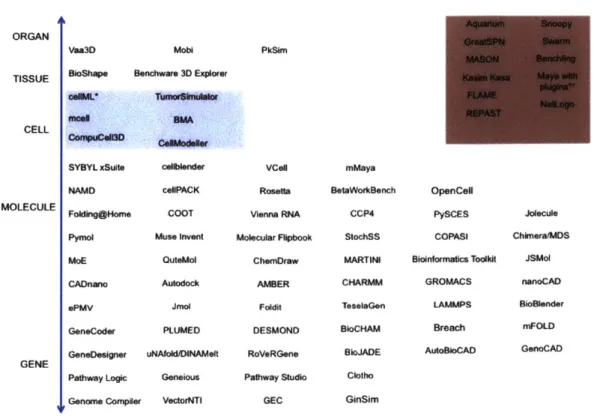
Figure 4-1: Table of Surveyed Software Tools. A complete list of the software and computational tools surveyed for this thesis. Each was evaluated on the basis of four criteria; shown here is selection based on the first - activity - with the qualifying programs in black and those that did not pass in gray. *cellML refers to those simulations directly based on cellML, including PyCML and CHASE.
GEC
AuRBioCAD
RuVeRGene
DINAMelt
nif OLD
LAMMPS JaesLie BMA Vaa3D
DESMOND Jmdo OperaCell Vlennra RNA Rosetta COPASI BioShape
Generus-I
IORGAN TISSUE CELL MOLECULE GENE PkSim VCe01 Rosetta Vienna RNA Molecular Flipbook ChemDraw AMBER Foldit DESMOND RoVeRGene Pathway Studio GEC Vaa3D Mobi
BloShape Benchware 3D Explorer
ceIlML' TumorSimulator
mcel BMA
CompuCell3D CelModeller
SYBYL xSuite celilblender
NAMD cellPACK
Folding@Home COOT
Pymol Muse Invent
MOE QuteMol
CADnano Aulodock
ePMV Jmol
GeneCoder PLUMED
GeneDesigner uNAfold/DINAMeIt
Pathway Logic Geneious
Genome Compiler VectorNTI
OpenCell PySCES COPASI Biottormatics Toolkit GROMACS LAMMPS Breach AutoBioCAD
Figure 4-2: Selection of Tools based on Scale. The qualifying tools from Figure 4-1 were arranged based on scale of operation (criterion 2). Highlighted in blue are those that operate in the scale of interest for these studies; highlighted in red are those that are not scale-based, so cannot be evaluated under this criterion. **Maya with plugins refers to nDynamics, nCloth, and nParticles.
Aquarium GreatSPN MASON Kasim Kasa FLAME REPAST mMaya BetaWorkBench CCP4 StochSS MARTINI CHARMM TeselaGen BpoCHAM BioJADE Clotho GinSim Snoopy Swarm Banchling Maya with plugins' NetLogo Jolecule ChimeratMDS JSMol nanoCAD BioBlender mFOLD GenoCAD
Criterion 2 was notably broken, since several tools were not scale-based. These tools followed different modeling approaches, and offered another alternative: a mnultiscale tool that applies the same model to an integrated system - more of a "top-down" approach. In order to accommodate for this new option, the tools that fell into this subcategory were exen)ted from criterion 2. The six tools that could be evalnated under the original criteria (i.e., were based on scale) were next tested against criterion
3, which focuses on user interface (Figure 4-3).
CompuCell3D TumorSimulator mCell
cellML Applications CellModeller BMA
Figure 4-3: Selection of Tools based on User Interface and Graphical Out-put. The six tools that passed the first two criteria were evaluated for user iiiterface
and graphical output. Publications and documentations of con)leted projects using
these tools were compared.
Five tools )assed the first three criteria, and were further investigated. Thirteen tools passed criterion 1 but not 2, and were also under consideration. At this point, it was appmlarent that two key asp1ects that were not descril)ed by the criteria were
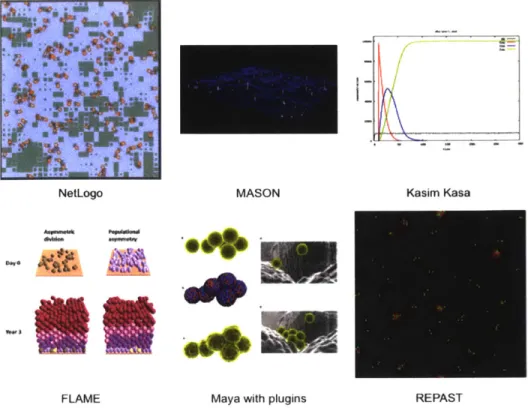
NetLogo MASON Kasim Kasa
FLAME Maya with plugins REPAST
Figure 4-4: Selection of Tools based on User Interface and Graphical
Out-put. Tools that were exemn)te(l from
criterioi
2 were evaluated for user interface and graphical outiut. Publications aid (lociimenitations of completed )roJects using these tools were coIll)ared.purpose and feasil)ility of implementation, which are interlinked. Certain tools, such as TumorSimulator, GreatSPN, and Snoopy, were create(d for s)ecific purposes and thus were difficilt to generally apply to a variety of col(litions; Benchling (digital la)
notebook
and assistant) and Aquarium (for molecular biology workflow) were also excluded for these reasons. Others, such as BioModel Analyzer (BMA), were most applicable as teaching tools, as they had sillJ)lified niodels that would not scale or bend to fit differing contexts. After these exclusions, the tools that failedcriterionl
2 were evaliated for criterion 3 -user
interface an(l graj)hical output (Fig 4-4).At the eild of the first three evaluations, the remaining tools were: ComupuCell3D, CellModeller, mCell, NetLogo, MASON, FLAME, Maya with plugins, and REPAST.
4.4
Modeling Approaches
Criterion 4 initially was designed to separate simulation software from animation software, to ensure that user input would not be the sole input for behavior, which would be unrealistic. However, given the issue that arose with criterion 2, it became important to first gain an understanding of different modeling approaches that are not purely bottom-up mathematics.
Shown in Figure 4-5 are nine types of modeling approaches used in systems biology, which are applicable to this study of living and non-living hybrid systems. Given that each case study is focused on a living community, systems biology would possibly offer an elegant perspective. The software tools surveyed fall into four of these approaches: rule-based, hybrid, agent-based, and lattice-based [24].
4.4.1
Rule Based
Rule based systems are those that follow defined models with specific rules, such as enzyme-substrate binding. The terms themselves can be easily exchanged and modified, unlike in equations, and established rules can be implemented to define particular interactions. Certain add-ons for mCell, such as BioNetGen, employ this technique.
4.4.2
Hybrid
Hybrid systems apply the logic of state based systems but add in dynamics, and often feature ordinary differential or partial differential equations (ODEs and PDEs). This allows for representation of continuous dynamics. CellModeller incorporates