Resilience trinity: safeguarding ecosystem functioning and services across
different time horizons and decision contexts
Abstract
Ensuring ecosystem resilience is an intuitive approach to safeguard the functioning of ecosystems and hence the future provisioning of ecosystem services (ES). However,
resilience is a multi-faceted concept that is difficult to operationalize. Focusing on resilience mechanisms, such as diversity, network architectures or adaptive capacity, has recently been suggested as means to operationalize resilience. Still, the focus on mechanisms is not specific enough. We suggest a conceptual framework, resilience trinity, to facilitate management based on resilience mechanisms in three distinctive decision contexts and time-horizons: i) reactive, when there is an imminent threat to ES resilience and a high pressure to act, ii) adjustive, when the threat is known in general but there is still time to adapt management, and iii) provident, when time horizons are very long and the nature of the threats is uncertain, leading to a low willingness to act. Resilience has different interpretations and implications at these different time horizons, which also prevail in different disciplines. Social ecology, ecology, and engineering are often implicitly focussing on provident, adjustive, or reactive resilience, respectively, but these different notions and of resilience and their corresponding social, ecological, and economic trade-offs need to be reconciled. Otherwise, we keep risking unintended consequences of reactive actions, or shying away from provident action because of uncertainties that cannot be reduced. The suggested trinity of time horizons and their decision contexts could help ensuring that longer-term management actions are not missed while urgent threats to ES are given priority.
Key words: resilience, ecosystems, concepts, ecosystem services provisioning, management 1 2 3 4 5 6 7 8 9 10 11 12 13 14 15 16 17 18 19 20 21 22 23 24 25
Introduction
Resilience has many different definitions. Holling’s definition as the “ability of ... systems to absorb changes ... and still persist” (Holling 1973) has become the most widely used one, in particular with regard to social-ecological systems. It focusses on the “persistence of
relationships” (Holling 1973) and thus the functioning and self-organization of entire systems. This holistic focus is in contrast to more reductionist interpretations, which prevail in ecology and focus on specific state variables and decompose resilience into the ability to resist, or recover from, disturbances and thereby persist (Oliver et al. 2015). Still, both interpretations imply that a loss of resilience might put the continued provision of ecosystem functioning and services (ES) at risk. Thus, understanding resilience of ecosystems is of fundamental interest because humans depend on ecosystem services (Millennium Ecosystem Assessment 2005; Díaz et al. 2015). Management for sustainable ES provisioning must safeguard, strengthen, or restore ecosystems’ resilience. However, the utilization of these insights in practice is still limited. While it makes intuitive sense to manage for resilience it is unclear which actions should follow from this goal (Standish et al. 2014).
If resilience is to be operationalized, its broad range of interpretations creates at least confusion, many cases of false labelling (Donohue et al. 2016), and at worst loopholes for mismanagement (Schoon et al. 2015; Newton 2016). Likewise, quantification of resilience (Angeler and Allen 2016; Allen et al. 2016) will remain a major issue unless the multiple meanings and implications of resilience are disentangled and reconciled.
As a way forward it has been suggested to focus on managing specific mechanisms that underlie the resilience of ecosystem functioning and thus support the recovery,
resistance, and persistence of the whole system (Biggs et al. 2012; Oliver et al. 2015; Berthet, et al, 2018) instead of focusing on managing for resilience per se. Focusing on mechanisms 26 27 28 29 30 31 32 33 34 35 36 37 38 39 40 41 42 43 44 45 46 47 48 49
the concrete steps to achieve an increase in resilience. We argue, however, that a focus on resilience mechanisms is still not specific enough for two reasons: (1) recovery and resistance are reductionist concepts, while persistence is a holistic one, and (2) we need to take into account different time horizons and, hence, decision contexts.
An example from forestry illustrates the importance of time horizons: bark beetle infestations can kill off entire stands of spruce and cause great damage (Wermelinger 2004). Thus, the ES of wood provision is strongly reduced in a short-term perspective. A
countermeasure could be spruce reforestation, where increasing tree vigour and stability through thinning (Spittlehouse and Stewart 2003) would aim at increasing the fitness of individual trees and thus focus on resilience mechanisms at the level of the individuals (Seidl et al. 2016). However, if we consider a longer time horizon (e.g. centuries), the effects of insect outbreaks in temperate European forests may be exacerbated by other disturbances, such as water limitation, forest fires or outbreaks of tree-killing pathogens (Lindner et al. 2010; Seidl et al. 2016). In that longer time frame, just spruce reforestation and thinning would not be the most useful way to strengthen the resilience of wood production. Instead, fostering resilience mechanisms at the community level, for example by increasing stand heterogeneity, would be a better choice because interspecific differences in reactions to disturbances can be utilized to ensure long term wood supply (Seidl et al. 2016, p. 127). There is thus a trade-off between (1) addressing long time horizons where you can increase general resilience at the forest community level, which is likely to reduce economic revenue, in particular because wood production may be reduced and take longer, or (2) addressing shorter time horizons where you focus on fast-growing species such as spruce and increase the individual resilience through thinning, with increased economic revenue but reduced community resilience. Similar trade-offs are common when resilience on different time horizons is addressed. 51 52 53 54 55 56 57 58 59 60 61 62 63 64 65 66 67 68 69 70 71 72 73 74 75
Approaches are needed that account for our limited understanding of system
responses at different time horizons while advocating the use of natural mechanisms (“nature-based solutions”, e.g. Cohen-Shacham et al. 2016), for example for bark beetles natural diversity in species composition and local age and size structure (e.g., Rademacher et al. 2004). Here, we suggest a simple framework that comprises resilience mechanisms and time horizons to facilitate better decisions to safeguard future ecosystem service provisioning. We (1) discuss the reductionist and holistic aspects of resilience and why they need to be
reconciled, (2) provide a brief review and a new categorization of resilience mechanisms, (3) suggest three time horizons for the management of ecosystem services, show that they imply different decision contexts, and try to relate these time horizons to resilience mechanisms, and (4) give an example on the linkage of time horizons and possible resilience mechanisms.
Our main message is that resilience has three main different interpretations in different decision contexts which are determined by different time horizons (“resilience trinity”). Clarifying these interpretations according to decision context and time horizon is key to effectively managing for resilience of ecosystem services. Although it certainly has been known before that management actions to bolster resilience will depend on the time scale under consideration, we believe that the real problem lies deeper and can be traced back to different interpretations and schools of thought.
Resilience research between reductionism and holism
Current interpretations range from resilience as a way of thinking in sustainability science (Folke et al. 2010; Biggs et al. 2015) to resilience as a multidimensional metric comprising recovery, resistance, and persistence in ecology and biodiversity research (Oliver et al. 2015; Donohue et al. 2016; Ingrisch and Bahn 2018), through to adopting resilience as a
management paradigm in response to national policy (e.g. Isaac et al, 2018). 76 77 78 79 80 81 82 83 84 85 86 87 88 89 90 91 92 93 94 95 96 97 98 99
Recovery refers to a specific state variable of an ecosystem and is defined as the process of the variable returning, after a disturbance, to the values of the reference state or dynamics. (Note that this has often been, and still is, called "resilience”; we follow Standish and colleagues (2014) to use “recovery” for this interpretation of resilience). Two qualifiers of recovery are “domain of attraction” (Grimm and Wissel 1997), (i.e., how much a variable may change and still show at least some recovery) and “return time” (i.e., the time it needs until it returns to the reference state of dynamics). The domain of attraction is the maximal “amplitude” allowing for recovery (see resistance).
Resistance refers to a specific state variable of an ecosystem (e.g., species number) and is defined by the change of the variable following a disturbance relative to the value before the disturbance (Donohue et al. 2016). Resistance can be quantified immediately after the end of the disturbance event (Oliver et al. 2015), or after a new (or the old) reference state of dynamics has been reached (Shade et al. 2012). Both of these aspects are related to each other but not necessarily always in the same way. “Amplitude” is a metric of resistance and quantifies how much a variable has changed.
Persistence refers to the existence of an ecosystem through time as an identifiable unit. For populations, “existence” is easy to define, but for ecosystems we can use different sets of functional or structural criteria (Jax et al. 1998, Cumming and Collier 2005). In practice, persistence can be defined by a set of state variables remaining within certain ranges which then indicates "persistence of relationships" (Holling 1973).
Recovery and resistance are reductionist concepts because they often reduce the representation of ecological systems to single state variables, for example abundance or total biomass of populations, or functional diversity for communities. Recovery and resistance could in principle also be explored for entire systems, but that would require that we know what set of variables fully characterizes the system, which usually is not the case.
100 101 102 103 104 105 106 107 108 109 110 111 112 113 114 115 116 117 118 119 120 121 122 123 124
Moreover, in addition to the requirement to define state variables, other features limit the scope of the reductionist concepts even further. According to Grimm and Wissel (1997), an “ecological situation” for which recovery and resistance can be unambiguously defined, assessed, and communicated, is defined by: level of organization, state variable,
characteristics of the disturbance, definition of the reference state to which responses to disturbances can be related (Cumming and Collier 2005; Jax et al. 1998), and spatial and temporal scale. Similarly, Carpenter et al. (2001) suggest that operationalizing resilience requires specifying “of what to what”, that is what is the state variable or feature used to characterize the system, and what kinds of disturbances are considered? The choice of any of the elements of a certain “ecological situation” is likely to affect our assessment of a stability property and our ability to detect the underlying mechanisms.
A classic example is metapopulations: if local habitats are suitable but small, local populations are prone to extinction. Persistence of populations is thus low, but when we consider larger spatial scales and thereby the regional pool of small habitats, persistence of the metapopulation and even populations increases, and we capture recolonization as a central stability mechanism (Levins 1969). Thus, shifting the spatial scale of our perception leads us to consider the metapopulation as a more appropriate level of organisation, and to identify the relevant mechanisms of persistence: connectivity and desynchronization of local dynamics.
In contrast to recovery and resistance, persistence is a holistic concept because it refers to entire systems. Quantifying persistence requires defining the systems in the first place. This is rarely done explicitly because it is challenging and depends on the observer’s purpose and conceptualization of the system. Jax et al. (1998) suggest four criteria for deciding on persistence over time: whether or not a spatial or functional definition of the system is used; the degree of expected internal relationships within the system, which is 125 126 127 128 129 130 131 132 133 134 135 136 137 138 139 140 141 142 143 144 145 146 147 148 149
similar to Holling’s “persistence of relationships”; the selected phenomena to characterize the system, which have been named “patterns” (Grimm et al. 2005) in ecological modelling; and the degree of aggregation in representing the system’s entities or disturbances. Overall, this approach tries to identify essentials that can be used to tell whether a system did persist or not. Similarly, Cumming and Collier (2005) define persistence as “system identity resides in the continued presence, in both space and time, of key components and key relationships”. For a few ecosystems such essentials and key elements can be identified (e.g., the
characteristic tree-grass ratio and scattered spatial distribution of trees in savannas; Jeltsch et al. 2000). However, for most other systems they are still debated.
To conclude, depending on whether the focus is on recovery and resistance or on persistence, ecological studies either end up with reductionist assessments of stability properties of often very limited scope, or with holistic assessments, which are usually “metamodels” (Cumming and Collier 2005), or conceptual models, rather than
quantifications because the essential elements of defining persistence are usually not known. Ecology tends to be more reductionist, focussing in particular on recovery, while social-ecological research tends to be more holistic, referring to entire systems and their functioning.
Resilience research thus has to navigate, like Odysseus did between the two sea monsters Scylla and Charybdis, between the two extremes of reductionism and holism. Progress has been slow because results from reductionist studies are often transferred, without further evidence, to the “stability” or “resilience” of the entire systems, whereas holistic studies often remain conceptual by referring to “states” and “conditions” without carefully considering criteria for assessing change and identity. To make progress, we need to reconcile the reductionist and holistic elements of Holling’s resilience.
150 151 152 153 154 155 156 157 158 159 160 161 162 163 164 165 166 167 168 169 170 171 172 173
As a first step, we suggest addressing the resilience of ecosystem services and, hence, functioning. This forces us to ask specific questions: what specific services and potential disturbances are we talking about? That is, we have to answer the question: “resilience of what to what”? (Carpenter et al. 2001). The disadvantage of this is that the concept of ES itself is subject of critical debate. Issues include trade-offs between ES (Seppelt et al. 2011, Lautenbach et al. 2019), the delineation of “ES providing units", and whether or not
biodiversity is a service, a good, or a mechanism (Bennett et al. 2009; Mace et al. 2012; Jax and Heink 2015). Nevertheless, a focus on ES, and hence the underlying functioning, helps us to address specific resilience mechanisms. In contrast to managing the resilience of a hard-to-define ecosystem, the relevant level of biological organization often is obvious if the goal is to manage for resilience of a specific ES. Focussing on mechanisms underlying the resilience of ES forces us to be more specific.
Resilience mechanisms
Resilience mechanisms have been explored for decades in systems as diverse as coral reefs, rangelands, rainforests, or contaminated aquifers. Table 1 provides an overview of
mechanisms that have been identified in review articles focusing on “resilience”, “mechanism”, and “ecosystem service” (see Supporting Information for the specific definition of each mechanism). In most cases these mechanisms are based on expert knowledge or theory and are rarely validated empirically outside their holistic social-ecological contexts (Egli et al 2018).
Grouping these mechanisms into categories helps keeping an overview but can never be perfect because mechanisms, i.e. causal relationships, cannot be separated from the context in which they operate. We grouped the mechanisms into four categories. (1) Portfolio mechanisms spread the risk of being affected by a disturbance. They are often based on 174 175 176 177 178 179 180 181 182 183 184 185 186 187 188 189 190 191 192 193 194 195 196 197
diversity, redundancy, or heterogeneity. Mechanisms in the category Function (2) are related to important roles that elements of a system play for functioning; they can only be observed dynamically as they enfold in the course of time. A well-known mechanism in this category is based on the presence of keystone species. Some overlap with the portfolio category exists, since for example diversity can act as portfolio mechanism but also affect function.
Therefore, we here set the focus on functional aspects that are not primarily based on diversity, redundancy, or heterogeneity. (3) Adaptation mechanisms share aspects of the Portfolio and Function category. They require diversity to function and are observed over the course of time. However, resilience mechanisms in this category are different because they feature adaptation via various mechanisms, including natural selection. (4) The fourth category, Structure, refers to structural features that affect recovery and resistance and that can be observed statically, in a snapshot of a system. Prominent examples are modularity and connectivity.
Table 1 demonstrates the diversity of resilience mechanisms and that any attempt to categorize them is necessarily subjective and to some degree arbitrary, as can be inferred from comparing our categories to those cited in the legend of Table 1 and the supplement. The reason is that these mechanisms do not work in isolation but together with other mechanisms. How they do so depends on the specific system and context under consideration. Increasing connectivity, for example, can reduce extinction risk in local habitats, but increase the risk of disease spreading. Likewise, diversity in terms of species numbers is generally believed to increase resilience, but many ecosystems dominated by a few species exist, for example boreal forests.
The mechanisms listed in Table 1 represent empirical knowledge or theory. However, it is difficult to translate the knowledge they represent directly into actions. For example, intuitively it seems evident that biodiversity increases resilience, but decades of biodiversity 198 199 200 201 202 203 204 205 206 207 208 209 210 211 212 213 214 215 216 217 218 219 220 221 222
research show how difficult it is to understand this relationship in systems that are more complex than simplified models or controlled experiments (Cardinale et al. 2012; De Laender et al. 2016). Thus, the mechanisms listed in Table 1 are only possible mechanisms. Whether they are relevant and whether some of them dominate or compromise others, depends on the specific situation and context (Biggs et al. 2012; Desjardins et al. 2015). The most important features of these situations are the time horizon considered (which also defines a spatial context) and the decision context linked to this horizon.
Rationale for a “resilience trinity”
Focussing on ES and their underlying mechanisms helps us to ask more specific questions about resilience and thereby supports operationalization. Still, context matters. Consider for example the storage of organic carbon in soils (soil organic carbon, SOC). Soils store at least three times the amount of carbon found in the atmosphere or in living plants (Parry et al. 2007). This is one key function supporting climate regulation. Soil biota mediate SOC persistence and turnover (Schmidt et al. 2011; Schimel and Schaeffer 2012). Land use is one of the main stresses on SOC levels, with persistently low and decreasing levels in more intense land uses. Stress leads to the destruction of soil structure and to a decrease in soil biodiversity on which structural reformation relies (Crawford et al. 2011; Ponge et al. 2013). Short term (~1 yr) responses to conserve SOC aim at improving soil management practices, such as less intense tillage, retaining stubble in the field, or introducing cover crops when fields are temporarily not in production. Longer term (10-100 yr) measures would comprise similar soil management interventions but also consider taking fields out of production permanently. Additional options are the introduction of intercropping systems or even landscape engineering, for example producing terraces or hedges, to avoid erosion. This requires the consideration of land use and its management from a long-term planning and 223 224 225 226 227 228 229 230 231 232 233 234 235 236 237 238 239 240 241 242 243 244 245 246
policy perspective, for instance designating land-uses (e.g., forestry) on lands prone to SOC loss.
Thus, different time horizons require different measures, which leads us the
“resilience trinity” framework. Threats to ES can be acute and obvious in some contexts. In these situations, the loss of the desired functions is imminent or has already happened. Time for reaction is limited and the actions are planned for comparatively short time horizons. We call this decision context reactive. It is further characterized by a high acceptance for actions by the stakeholders involved. Examples for a reactive decision context include local pest outbreaks, an emerging wildlife disease that threatens livestock, or catastrophic floods in river flood plains. The “command and control” mindset of engineering usually is dominant in this context and usually is targeting the symptoms, not the causes of a problem.
In contrast to reactive, in adjustive decision contexts ES are threatened, but not yet to a level that is critical to their provisioning. Concerns about future losses exist, but the
urgency perceived by stakeholders of actions to increase resilience is lower than in a reactive context. Therefore, there are initiatives and incentives to adjust current management
practices. Safeguarding ES resilience in an adjustive decision context can be slow though or even fail because of the lower perceived urgency for actions. Dealing with the decline of honey bees provides an example of the difference between reactive and adjustive decision contexts. A reactive decision was triggered by an incident in the Upper Rhine valley in 2008, where 11,500 honey bee colonies were lost due to dust from maize seeds treated with an insecticide. Blowing out of this dust containing the active substance into the environment with pneumatic sowing machines resulted in contamination of nectar and pollen (Pistorius et al. 2010). In turn, new regulations were installed for both quality control of seed treatment and for vacuuming potential dust during sowing. In contrast, adjustive decisions regarding pollinators are for example declarations of intent of the current government of Germany 247 248 249 250 251 252 253 254 255 256 257 258 259 260 261 262 263 264 265 266 267 268 269 270 271
(CDU/CSU SPD 2018) to stop the decline of insects by revisiting current regulation schemes, which easily could take decades to be realized. Mostly, the adjustive decision context is the one within which ecologists discuss resilience.
Third, provident decision contexts are distinguished from the two previous contexts by even longer time horizons. Here, the task is to conserve, restore or improve resilience mechanisms without a specific threat being the trigger for action. The basic motivation is that resilience of ES might erode in the future in unforeseeable ways due to (unforeseeable) changes of environmental and societal drivers. Lacking an imminent threat, the provident decision context deals with measures that generally support resilience of ES. Yet, acceptance of actions is low for provident decisions, particularly because returns from current
investments are uncertain. An example is the creation of large reserve networks, which can safeguard the provisioning of ES even against unknown future threats, as they are likely to harbour the structure and functions required for resilience mechanisms. However, this benefit cannot easily be accounted for and thus not be balanced against the loss of, for example, arable land. Typically, this provident decision context is addressed in sustainability and transformation science.
Our conceptualization of provident resilience is similar to the idea of “general resilience” (Folke et al. 2010), which is “concerned more about resilience to all kinds of shocks, including completely novel ones” (Folke et al. 2010), while “specified resilience” refers “to problems relating to particular aspects of a system that might arise from a particular set of sources or shocks.” (Folke et al. 2010). Our resilience trinity framework explicitly refers to different time horizons and their decision contexts, but overlaps with the specified/general distinction by emphasizing the long-term risks of focussing solely on reactive, or specified, resilience.
272 273 274 275 276 277 278 279 280 281 282 283 284 285 286 287 288 289 290 291 292 293 294 295
Resilience mechanisms within the trinity framework
As mentioned in Section 3, the strength and scope of resilience mechanisms depend on the context, for example whether we focus on individuals, populations, communities,
ecosystems, or landscapes. The resilience trinity framework is meant to organize our
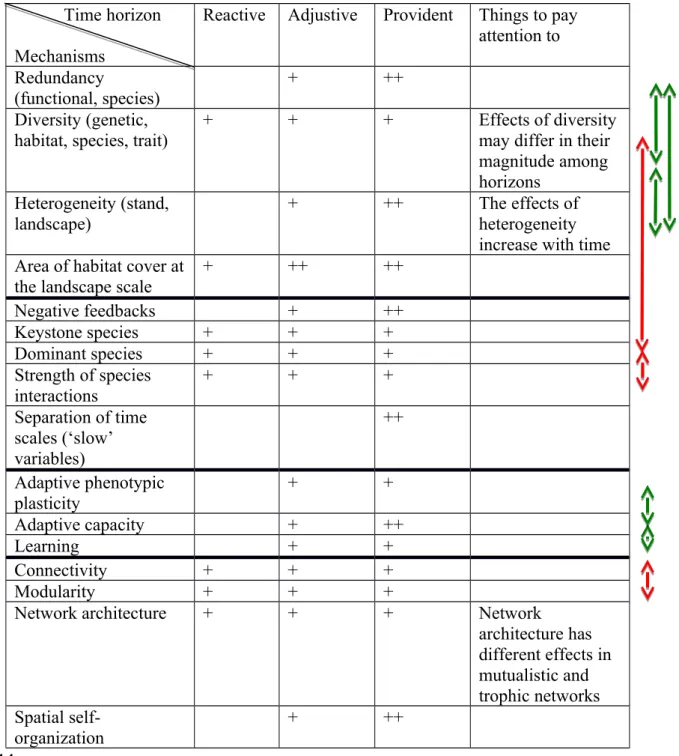
thinking, debate, and research on this context dependency along three different time horizons and hence decision contexts. In Table 2, the mechanisms of Table 1 are related to these time horizons. Some mechanisms are less likely to be useful on the reactive scale and need the provident scale to unfold their potential, for example spatial self-organization. Other mechanisms are relevant for all three trinity aspects, e.g. diversity. Table 2 also includes possible interactions between pairs of mechanisms. Some pairs might compromise each other, for example “diversity” and “dominant species”, while other might show synergies, for example “redundancy” and “heterogeneity”.
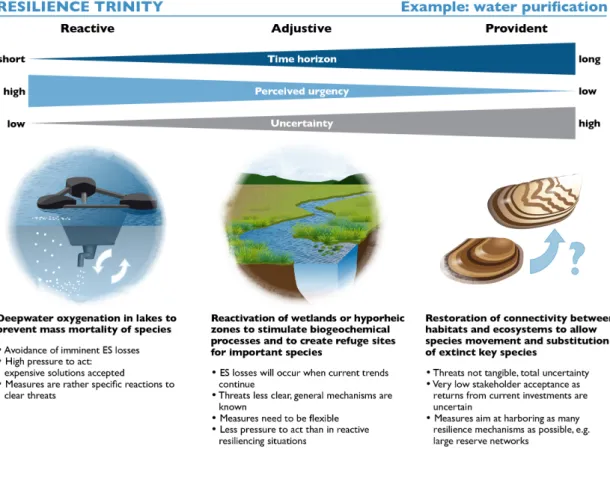
Even more than Table 1, each and any element of Table 2 is open to discussion and its interpretation depends on the specific context and ES considered, and on how researchers and practitioners interpret the terms included. Table 2 thus does not provide a ready-to-use solution, but provides an invitation to explicitly and systematically discuss relevant issues of safeguarding ES in terms of increasing resilience. In the following, we demonstrate the strength of our conceptual framework by applying it to the ES of water purification (Fig. 1).
Example: Water purification
Water is a fundamental resource. Societies, economies and the natural environment rely on permanent water provision in sufficient quantity and quality. A multitude of threats endanger water purification services. Some threats are acute (e.g., pulses of toxicants or the occurrence of extensive anoxia in lakes) and require immediate action. At intermediate time scales, solutions must be found to control pollution pathways, avoid structural degradation of river 296 297 298 299 300 301 302 303 304 305 306 307 308 309 310 311 312 313 314 315 316 317 318 319
courses or excessive eutrophication. On longer time scales, threats are likely related to human perturbations of the global biogeochemical cycles (nitrogen, phosphorus, carbon),
predominantly by farming, or structural degradations. However, direct and indirect
consequences from these threats cannot be forecasted yet, which makes it more challenging to develop and justify countermeasures.
Actions related to reactive decision contexts aim to prevent the imminent danger of losing ecosystem functions. They are often based on technology and aim at preserving or restoring a certain state of a system (Fig. 1). Examples include increasing the height of dikes, or the oxygenation of deep water in lakes to prevent mass mortality of species and internal loading with pollutants (Beutel and Horne 1999). These measures profit from extensive knowledge of the ecosystem’s functioning and a clear definition of the problem and its solution. Possibly high costs of these solutions are justified by strong societal pressure to act immediately, e.g. for maintaining drinking water supply from a reservoir or a lake (e.g. suppression of manganese release, Bryant et al. (2011). In addition, they are a reaction to a specific and rather clearly described threat.
An example for an action in an adjustive decision context is the nutrient reduction by flocculation, which is used to remove nutrients from lakes or reservoirs (Mehner et al. 2008) and add substances such as aluminium to remove phosphate from the water column.
Lowering phosphate concentrations reduces eutrophication in general and shifts algal communities from a dominance of potentially toxic cyanobacteria towards a community consisting of eukaryotic algae and therefore comes along with a major improvement of water quality. Such measures require more careful planning than reactive decisions, for example adapted dosing and application of flocculants, as well as detailed pre-studies. Another example of a decision in an adjustive context is the activation of major reactive zones, for 320 321 322 323 324 325 326 327 328 329 330 331 332 333 334 335 336 337 338 339 340 341 342 343
example wetlands or hyporheic zones in riverbeds (Rode et al. 2015) for water quality regulation.
Decisions in provident contexts often follow a systems approach. In the water sector they often include the landscape context. Implementation of buffer strips along rivers, for example, can reduce nutrient exports from land into the water cycle and therefore weaken environmental pressures from agriculture (Mayer et al. 2007). Another example is key species, which are often important for self-purification within aquatic environment such as bivalves filtrating the water or other organisms with similar functions (McCay et al. 2003; Kathol et al. 2011). The protection of key species is one example for safeguarding ES resilience at long time horizons. This includes the restoration of habitats and refuges for key species. Even so, current key species may not prevail under future conditions. Thus, actions that allow other species with the same functions but a better fitness to thrive under new conditions could be an important measure in provident decision contexts. Managing connectivity between ecosystems and habitats to allow for spread of better adapted species while monitoring the effects of species’ movements on the functionality of food webs could thus be a core element to safeguard the resilience of water purification at long time horizons. In that sense, invading species may even substitute the loss of natural key species. In the future, invading mussels and clams could substitute for native unionids in rivers of the Northern Hemisphere, a pattern which is already present in several systems (Strayer and Smith 1996; Caraco et al. 2006). This may, however, be at odds with various other goals such as biodiversity conservation, maintaining existing ecosystem functions, functionality of human infrastructures or human recreation (Minchin et al. 2002). Policy makers and decision makers must explicitly recognize the trade-offs in this situation and recognize that
ecosystems are multi-scaled and nonlinear with inherent uncertainty and managing for one 344 345 346 347 348 349 350 351 352 353 354 355 356 357 358 359 360 361 362 363 364 365 366 367
spatial or temporal context ignores reality and tends to reduce resilience at other spatial and temporal scales (see also Schlüter et al. 2019).
Tables 1 and 2 can be used as a tool in this context: which resilience mechanisms are employed by the potential actions for increasing reactive, adjustive, or provident resilience, that were discussed so far for this example? Increasing the height of dikes, or the oxygenation of deep water, are engineering solutions that clearly represent a reactive context. They address the symptom, i.e. flood risk and pollution, respectively, but not the causes of these risks. As a result, in the long term they might even severely increase the risk of losing ES of interest, as the reasons for the erosion of resilience might accumulate. Increasing the height of dikes and oxygenation do not mimic any natural resilience mechanism. In contrast, the measures discussed for the provident context, i.e. buffer strips, keystone species, and
improving connectivity, represent mechanisms that actually do exist in nature and can affect water quality in a positive way. However, a focus on a specific species that directly affect water quality, such as bivalves, may compromise efforts to restore biodiversity, in particular if non-native bivalves are considered.
Conclusion
Resilience is an important concept that refers to the ability of ecosystems to self-organize in a way that they can “absorb changes ... and still persist” (Holling 1973). Quantitative features of this ability are resistance, recovery and persistence. While persistence is a holistic concept focusing on the whole system and the persistence of all relationship within, recovery and resistance are reductionist concepts looking at single state variables. Although resilience has become a concept that is popular among scientists, actors and stakeholders alike (Newton 2016), the dichotomy of holistic and reductionist interpretations of this concept have so far hampered its use for planning, management, and environmental decision making (Standish et 368 369 370 371 372 373 374 375 376 377 378 379 380 381 382 383 384 385 386 387 388 389 390 391
al. 2014). Focussing more on the mechanisms underlying resilience and grouping them into categories, like the ones we used in Table 1, is a first step towards operationalizing resilience. Still, at least one more step, distinguishing different time horizons and decision contexts, is required.
Our framework, dubbed resilience trinity, tries to keep the attractiveness of the concept of resilience while demanding more specification. Our main purpose is to create awareness for different time horizons (short, intermediate and long-term). These imply different decision contexts and management attitudes (reactive, adjustive and provident). None of the three contexts is more important than the others – they all need to be considered and finally to be reconciled. Otherwise, exclusively focusing on reactive management could compromise long-term resilience of certain services. Solely provident actions could lead to short-term losses of services, or unacceptable risks. There is no simple, generic solution to reconcile the trade-offs of the different time horizons and decision contexts. Rather, our framework is designed to add structure to decision making and policy development. Further examples and, preferably, case studies will be needed to learn about, and possibly improve, its usefulness.
A main criterion for the design of the resilience trinity framework was simplicity: focusing on three time horizons and clarifying the decision context can facilitate
operationalizing resilience and ecosystem services, both complex and multidimensional concepts. Our vision is to ultimately foster a proactive approach that does not ignore the consequences of reactive and adjustive decisions for the time scale of provident decisions. To be clear, decisions for all three time scales need to be made now, but they address different time scales. Acknowledgments 392 393 394 395 396 397 398 399 400 401 402 403 404 405 406 407 408 409 410 411 412 413 414 415 416
We would like to thank three anonymous reviewers for their insightful comments. We would like to thank Sebastian Fiedler, Hans-Jörg Vogel, Steve Railsback, and Graeme Cumming for helpful comments on an earlier version of this manuscript. HW acknowledges funding support through the German Research Foundation DFG project TI 824/2-1 “Ecosystem resilience towards climate change – the role of interacting buffer mechanisms in
Mediterranean-type ecosystems and through the project Emerging Ecosystems”. We also thank UFZ’s Integrated Project “Emerging Ecosystems” within the research program "Terrestrial Environment" of the Helmholtz Association for funding workshops to develop ideas that are presented in this manuscript. We thank Lisa Vogel and Daphne Braun for professional revision of the illustrations.
References
Angeler DG, Allen CR. 2016. Quantifying resilience. Journal of Applied Ecology 53: 617-624.
Allen CR, Angeler DG, Cumming GS, Folke C, Twidwell D, Uden DR. 2016. Quantifying spatial resilience. Journal of Applied Ecology 53: 625-635.
Bennett EM, Peterson GD, and Gordon LJ. 2009. Understanding relationships among multiple ecosystem services. Ecology letters 12: 1394–1404.
Bernhardt JR and Leslie HM. 2013. Resilience to climate change in coastal marine ecosystems. Annual Review of Marine Systems 5: 371-92.
Berthet, E.T., Bretagnolle, V., Lavorel, S., Sabatier, R., Tichit, M., and Segrestin, B. (2018) Applying ecological knowledge to the innovative design of sustainable
agroecosystems. Journal of Applied Ecology doi 10.111/1365-2664.13173.
Beutel MW and Horne AJ. 1999. A review of the effects of hypolimnetic oxygenation on lake and reservoir water quality. Lake and Reservoir Management 15: 285–297. Biggs R, Schlüter M, Biggs D, et al. 2012. Toward principles for enhancing the resilience of
ecosystem services. Annual review of environment and resources 37: 421–448. Biggs R, Schlüter M, and Schoon ML. 2015. Principles for building resilience: sustaining
ecosystem services in social-ecological systems. Cambridge University Press. 417 418 419 420 421 422 423 424 425 426 427 428 429 430 431 432 433 434 435 436 437 438 439 440 441 442 443 444 445
Bryant LD, Hsu-Kim H, Gantzer PA, and Little JC. 2011. Solving the problem at the source: Controlling Mn release at the sediment-water interface via hypolimnetic oxygenation. Water Research 45: 6381–92.
Caraco NF, Cole JJ, and Strayer DL. 2006. Top down control from the bottom: regulation of eutrophication in a large river by benthic grazing. Limnology and Oceanography 51: 664–670.
Cardinale BJ, Duffy JE, Gonzalez A, et al. 2012. Biodiversity loss and its impact on humanity. Nature 486: 59.
Carpenter S, Walker B, Anderies JM, and Abel N. 2001. From metaphor to measurement: resilience of what to what? Ecosystems 4: 765–781.
CDU/CSU SPD. 2018. Ein neuer Aufbruch für Europa Eine neue Dynamik für Deutschland Ein neuer Zusammenhalt für unser Land. Koalitionsvertrag zwischen CDU, CSU und SPD, 18. Legislaturperiode.
https://www.bundesregierung.de/resource/blob/975226/847984/5b8bc23590d4cb2892 b31c987ad672b7/2018-03-14-koalitionsvertrag-data.pdf?download=1
Chapin III FS, Carpenter SR, Kofinas GP, et al. 2010. Ecosystem stewardship: sustainability strategies for a rapidly changing planet. Trends in ecology & evolution 25: 241–249. Cohen-Shacham, E., Walters, G., Janzen, C., & Maginnis, S. (2016). Nature-based solutions
to address global societal challenges. IUCN, Gland, Switzerland, pp. 97.
Conversi A, Dakos V, Gårdmark, et al. 2015. A holistic view of marine regime shifts. Phil Trans R Soc B 370: 20130279.
Crawford JW, Deacon L, Grinev D, et al. 2011. Microbial diversity affects self-organization of the soil–microbe system with consequences for function. Journal of the Royal Society Interface: rsif20110679.
De Laender F, Rohr JR, Ashauer R, et al. 2016. Reintroducing environmental change drivers in biodiversity–ecosystem functioning research. Trends in ecology & evolution 31: 905–915.
Desjardins E, Barker G, Lindo Z, et al. 2015. Promoting resilience. The Quarterly review of biology 90: 147–165.
Díaz S, Demissew S, Carabias J, et al. 2015. The IPBES Conceptual Framework—
connecting nature and people. Current Opinion in Environmental Sustainability 14: 1–16.
Donohue I, Hillebrand H, Montoya JM, et al. 2016. Navigating the complexity of ecological 446 447 448 449 450 451 452 453 454 455 456 457 458 459 460 461 462 463 464 465 466 467 468 469 470 471 472 473 474 475 476 477 478
Egli, L., Weise, H., Radchuk, V., Seppelt, R., Grimm, V. 2019. Exploring resilience with agent-based models: state of the art, knowledge gaps and recommendations for coping with multidimensionality. Ecological Complexity 40:100718
Folke C, Carpenter S, Walker B, et al. 2010. Resilience thinking: integrating resilience, adaptability and transformability. Ecology and society 15:
https://www.jstor.org/stable/26268226.
Gedan KB, Altieri AH, and Bertness MD. 2011. Uncertain future of New England salt marshes. Marine Ecology Progress Series 434: 229–238.
Griffiths BS and Philippot L. 2013. Insights into the resistance and resilience of the soil microbial community. FEMS microbiology reviews 37: 112–129.
Grimm V and Wissel C. 1997. Babel, or the ecological stability discussions: an inventory and analysis of terminology and a guide for avoiding confusion. Oecologia 109: 323–334. Holling, C. S. 1973. Resilience and stability of ecological systems. Annual review of ecology
and systematics, 4(1), 1-23.
Isaac, N.J.B. et al 2018. Defining and delivering resilient ecological networks: Nature conservation in England. Journal of Applied Ecology (in press) doi 10.111/1365-2664.13196.
Jax K and Heink U. 2015. Searching for the place of biodiversity in the ecosystem services discourse. Biological Conservation 191: 198–205.
Kathol M, Fischer H, and Weitere M. 2011. Contribution of biofilm-dwelling consumers to pelagic–benthic coupling in a large river. Freshwater Biology 56: 1160–1172. Lautenbach, S., Mupepele, A.-C., Dormann, et al. 2019. Blind spots in ecosystem services
research and challenges for implementation. Regional Environmental Change https://doi.org/10.1007/s10113-018-1457-9
Lindner M, Maroschek M, Netherer S, et al. 2010. Climate change impacts, adaptive capacity, and vulnerability of European forest ecosystems. Forest ecology and management 259: 698–709.
Mace GM, Norris K, and Fitter AH. 2012. Biodiversity and ecosystem services: a multilayered relationship. Trends in ecology & evolution 27: 19–26.
Martin, E. A., Feit, B., Requier, F., Friberg, H., & Jonsson, M. (2019). Assessing the resilience of biodiversity-driven functions in agroecosystems under environmental change. Advances in Ecological Research 60: 59-123.
480 481 482 483 484 485 486 487 488 489 490 491 492 493 494 495 496 497 498 499 500 501 502 503 504 505 506 507 508 509 510 511
Mayer PM, Reynolds SK, McCutchen MD, and Canfield TJ. 2007. Meta-Analysis of Nitrogen Removal in Riparian Buffers. Journal of Environmental Quality 36: 1172– 80.
McCay DPF, Peterson CH, DeAlteris JT, and Catena J. 2003. Restoration that targets function as opposed to structure: replacing lost bivalve production and filtration. Marine Ecology Progress Series 264: 197–212.
Mehner T, Diekmann M, Gonsiorczyk T, et al. 2008. Rapid recovery from eutrophication of a stratified lake by disruption of internal nutrient load. Ecosystems 11: 1142–1156. Millennium Ecosystem Assessment MEA. 2005. Ecosystems and human well-being. Island
Press Washington, DC.
Minchin D, Lucy F, and Sullivan M. 2002. Zebra mussel: impacts and spread. In: Invasive aquatic species of Europe. Distribution, impacts and management. Springer.
Newton AC. 2016. Biodiversity risks of adopting resilience as a policy goal. Conservation Letters 9: 369–376.
Oliver TH, Heard MS, Isaac NJB, et al. 2015. Biodiversity and Resilience of Ecosystem Functions. Trends in Ecology & Evolution xx: 1–12.
Palumbi SR, Sandifer PA, Allan JD, et al. 2009. Managing for ocean biodiversity to sustain marine ecosystem services. Frontiers in Ecology and the Environment 7: 204–211. Parry M, Canziani O, Palutikof J, et al. 2007. Climate change 2007: impacts, adaptation and
vulnerability. Cambridge University Press Cambridge.
Pistorius, J., Bischoff, G., Heimbach, U., & Stähler, M. (2010). Bee poisoning incidents in Germany in spring 2008 caused by abrasion of active substance from treated seeds during sowing of maize. Julius-Kühn-Archiv, (423), 118.
Ponge J-F, Pérès G, Guernion M, et al. 2013. The impact of agricultural practices on soil biota: a regional study. Soil Biology and Biochemistry 67: 271–284.
Rademacher, C., Neuert, C., Grundmann, V., Wissel, C., Grimm, V. 2004. Reconstructing spatiotemporal dynamics of central European natural beech forests: the rule-based model BEFORE. Forest Ecology and Management 194: 349-368.
Rode M, Hartwig M, Wagenschein D, et al. 2015. The importance of hyporheic zone processes on ecological functioning and solute transport of streams and rivers. In: Ecosystem services and river basin ecohydrology. Springer.
Sasaki T, Furukawa T, Iwasaki Y, et al. 2015. Perspectives for ecosystem management based on ecosystem resilience and ecological thresholds against multiple and stochastic 512 513 514 515 516 517 518 519 520 521 522 523 524 525 526 527 528 529 530 531 532 533 534 535 536 537 538 539 540 541 542 543 544
Schimel J and Schaeffer SM. 2012. Microbial control over carbon cycling in soil. Frontiers in microbiology 3: 348.
Schlüter M, Müller B, Frank K 2019. The potential of models and modeling for social-ecological systems research: the reference frame ModSES. Ecology and Society, 24(1) :31. https://doi.org/10.5751/ES-10716-240131.
Schmidt MW, Torn MS, Abiven S, et al. 2011. Persistence of soil organic matter as an ecosystem property. Nature 478: 49.
Schoon ML, Robards MD, Brown K, et al. 2015. Politics and the resilience of ecosystem services. Principles for building resilience: sustaining ecosystem services in social-ecological systems Cambridge University Press, Cambridge, UK http://dx doi org/101017/cbo9781316014240 3: 32–49.
Seidl R, Spies TA, Peterson DL, et al. 2016. Searching for resilience: addressing the impacts of changing disturbance regimes on forest ecosystem services. Journal of Applied Ecology 53: 120–129.
Seppelt R, Dormann CF, Eppink FV, et al. 2011. A quantitative review of ecosystem service studies: approaches, shortcomings and the road ahead. Journal of applied Ecology 48: 630–636.
Spears BM, Ives SC, Angeler DG, et al. 2015. Effective management of ecological resilience–are we there yet? Journal of applied ecology 52: 1311–1315.
Spittlehouse DL, Stewart RB. 2003. Adaptation to climate change in forest management. BC Journal of Ecosystems and Management, 4, 1–11.
Standish RJ, Hobbs RJ, Mayfield MM, et al. 2014. Resilience in ecology: Abstraction, distraction, or where the action is? Biological Conservation 177: 43–51.
Strayer DL and Smith LC. 1996. Relationships between zebra mussels (Dreissena
polymorpha) and unionid clams during the early stages of the zebra mussel invasion of the Hudson River. Freshwater Biology 36: 771–780.
Thompson ID, Okabe K, Parrotta JA, et al. 2014. Biodiversity and ecosystem services: lessons from nature to improve management of planted forests for REDD-plus. Biodiversity and conservation 23: 2613–2635.
Timpane-Padgham BL, Beechie T, and Klinger T. 2017. A systematic review of ecological attributes that confer resilience to climate change in environmental restoration. PLoS One 12: e0173812, https://doi.org/10.1371/journal.pone.0173812.
546 547 548 549 550 551 552 553 554 555 556 557 558 559 560 561 562 563 564 565 566 567 568 569 570 571 572 573 574 575 576 577
Traill LW, Lim ML, Sodhi NS, and Bradshaw CJ. 2010. Mechanisms driving change: altered species interactions and ecosystem function through global warming. Journal of Animal Ecology 79: 937–947.
Wermelinger B. 2004. Ecology and management of the spruce bark beetle Ips typographus— a review of recent research. Forest ecology and management 202: 67–82.
578 579 580 581 582 583
Figures
Figure 1. Measures to safeguard the ecosystem service (ES) of water purification across different time horizons. The time horizon of interest determines the decision context (upper arrow). If an ES needs to be safeguarded now (very short time horizon) the pressure to act is high and uncertainty is comparatively low. In contrast, uncertainty is very high and the pressure to act very low for long time horizons. The resulting decision contexts will warrant different measures; thus we propose to distinguish reactive, adjustive and provident contexts. It is important to be aware of the different decision contexts because they will lead to
different decisions and trade-offs. Our resilience trinity framework tries to create and establish this awareness.
584 586 587 588 589 590 591 592 593 594 595
Table 1. Mechanisms expected to confer resilience. Here we used a literature search (Table S2) to compile mechanisms and group them into categories (see Table S1 for definitions of each mechanism). Those categories are not exclusive. Other possible categories are for example diversity, connectivity and adaptive capacity (Bernhardt and Leslie 2013); species, community, landscape (Oliver et al. 2015); complexity, adaptivity (Desjardins et al. 2015). For a overview of mechanisms in social-ecological systems see (Biggs et al. 2012, 2015), for attributes that confer resilience to climate change in the context of restoration see Timpane-Padgham et al. (2017), and for biodiversity-driven mechanisms in agro-ecosystems see Martin et al. (2019).
GROUP MECHANISM GENERALIDEA EXAMPLEDEFINITIONS1 REFERENCES
Portfolio: Spreading the effects of disturbances Redundancy (functional, species)
Losing certain species may not matter because their function can be provided by functionally equivalent species.
“when multiple species perform similar functions (…) the resistance of an
ecosystem function will be higher if those species also have differing responses to environmental perturbations”(Oliver et al. 2015)
(Biggs et al. 2012; Bernhardt and Leslie 2013; Griffiths and Philippot 2013; Desjardins et al. 2015; Oliver et al. 2015; Sasaki et al. 2015) Diversity (genetic, habitat, species, trait, response) Individuals or populations are sensitive to disturbances to different extents.
“Species in the same functional group often show different responses to disturbances (Laliberte et al. 2010), and hence the value of redundancy”
(Palumbi et al. 2009; Chapin III et al. 2010; Traill et al. 2010; Biggs et al. 2012; Bernhardt and Leslie 2013; Griffiths and Philippot 2013; Thompson et al. 2014; Desjardins et al. 2015; Oliver et al. 2015; Sasaki et al. 2015)
Heterogeneity
(stand, landscape)
Functions lost in certain places can be
compensated or restored from other, less affected places.
“Resilience is an emergent ecosystem property conferred through biodiversity, (…), ecosystem diversity (heterogeneity and beta diversity) across a forest landscape“ (Thompson et al. 2014)
(Thompson et al. 2014; Desjardins et al. 2015)
Area of habitat cover at the
“Larger areas of natural or semi-natural habitat tend to provide a greater range and
(Oliver et al. 2015) 596 597 598 599 600 601
GROUP MECHANISM GENERALIDEA EXAMPLEDEFINITIONS1 REFERENCES
landscape scale amount of resources, which promote higher
species richness and larger population sizes […]. This […] is likely to mean greater genetic diversity and functional redundancy […]” (Oliver et al. 2015) Function: Functional features that affect recovery and resistance (identifiable only in system dynamics) Negative feedbacks
Negative feedbacks, for example density dependence, cause recovery to equilibria.
“Negative feedback mechanisms contribute to maintain the ecosystem state” (Conversi et al. 2014)
(Chapin III et al. 2010; Gedan et al. 2011; Biggs et al. 2012; Conversi et al. 2015; Spears et al. 2015)
Keystone species Keystone species (of functional types) may be the main factor
maintaining a certain function or structure.
“Loss of the keystone species can lead to cascading effects” (Sasaki et al. 2015) “Loss of keystone predators can have large effects for a system through cascading effects of expansion of herbivore populations” (Thompson et al. 2014)
(Traill et al. 2010; Thompson et al. 2014; Sasaki et al. 2015)
Dominant species
A dominant species that is resilient will entail its resilience to the entire system.
“If the dominant species is resilient to disturbances it will maintain ES functioning despite disturbances” (Sasaki et al. 2015)
(Sasaki et al. 2015) Strength of species interaction Weak links in an interaction network of species can dampen internal and external variations in components of the network.
“Weakly interacting species stabilize community dynamics by dampening strong, potentially destabilizing consumer-resource interactions and facilitative interactions.” (Bernhardt & Leslie 2013)
(Bernhardt and Leslie 2013)
Separation of time scales (“slow variables”) Through self-organization, slow-changing variables can emerge that constrain and control fast-changing
“slow variables are usually related to regulating ecosystem services, and that the strength of regulating services can attenuate the impact of shocks on ecosystems.” (Bennett et al. 2009)
GROUP MECHANISM GENERALIDEA EXAMPLEDEFINITIONS1 REFERENCES reduce variation (“panarchy”) Adaptation: Adaptation in order to better cope with disturbances ; changes in disturbance regimes Adaptive phenotypic plasticity Individuals change in response to disturbance and thereby reduce the effects of subsequent disturbances.
“Capacity of individuals to respond to environmental changes through flexible behavioural or physiological strategies […]” (Oliver et al. 2015)
“(…) phenotypic plasticity may be the most important component of adaptive potential (…). ” (Bernhardt & Leslie 2013)
(Bernhardt and Leslie 2013; Oliver et al. 2015)
Adaptive capacity
Populations, communities, and ecosystems have the ability to change, through change of individuals, shifts of distributions, and rapid evolution, and thereby reduce responses to subsequent
disturbances.
“ability of populations, communities and ecosystems to adapt […] through a combination of phenotypic plasticity, physiol. responses, distributional shifts, rapid evolution of traits” (Bernhard and Leslie 2013)
(Bernhardt and Leslie 2013)
Learning Individuals learn and thereby recover faster or respond less to
disturbances.
“The process of modifying existing or acquiring new knowledge, behaviours, skills, values, or preferences at individual, group, or societal levels”(Biggs et al. 2012)
(Biggs et al. 2012, 2015) Structure: Structural features that affect recovery and resistance (identifiable in snapshots of a system)
Connectivity Higher connectivity between habitats allows for faster recovery by moving individuals or resources.
“connections that promote stability and recovery at multiple scales of biological organization” (Bernhardt and Leslie 2013)
(Biggs et al. 2012; Bernhardt and Leslie 2013)
Modularity Organization in more or less disconnected compartment allows for asynchronous responses and thereby recovery.
“It refers to compartmentalization of populations in space and time. (…). For example, where populations are too closely connected, severe disturbances to one population may affect all populations.”
GROUP MECHANISM GENERALIDEA EXAMPLEDEFINITIONS1 REFERENCES
(Bernhardt & Leslie 2013)
Network architecture
Depending on the type of interaction between nodes, the connectedness and other features of the interaction network determine the response to disturbances.
“A highly connected and nested
architecture promotes community stability in mutualistic networks, whereas stability is increased in compartmented and weakly connected architectures in trophic networks. (…) ” (Bernhardt & Leslie 2013)
(Bernhardt and Leslie 2013; Griffiths and Philippot 2013; Oliver et al. 2015)
Spatial self- organization
Positive feedback can lead to self-organized spatial patterns that are self-similar over time and lead to recovery from disturbances.
1 It should be noted that no single definition can capture the heterogeneity of existing definitions, their context dependency, and their overlap.
See Table S1 for the full list of definitions we extracted from the literature. 602
Table 2. Relating resilience mechanisms to the trinity of time horizons and decision contexts: reactive, adjustive, provident. The table demonstrates the possible importance of each
resilience mechanism at each horizon. High importance is indicated by presence of ‘++’ and potential importance by ‘+’. Some mechanisms are not very influential at the reactive time horizon (as indicated by the absence of ‘+’) because they require longer time spans to manifest their effects on ES. Red arrows on the right of the table indicate possible trade-offs between certain pairs of resilience mechanisms, while green arrows indicate possible
synergies, where mechanisms would enhance each others’ positive effect on resilience. This table is meant as a framework for structured discussions but not as a ready-to-use solution, because virtually every “+” or arrow depends on the system and context considered. Time horizon
Mechanisms
Reactive Adjustive Provident Things to pay attention to Redundancy
(functional, species)
+ ++
Diversity (genetic, habitat, species, trait)
+ + + Effects of diversity
may differ in their magnitude among horizons Heterogeneity (stand, landscape) + ++ The effects of heterogeneity increase with time Area of habitat cover at
the landscape scale + ++ ++
Negative feedbacks + ++ Keystone species + + + Dominant species + + + Strength of species interactions + + + Separation of time scales (‘slow’ variables) ++ Adaptive phenotypic plasticity + + Adaptive capacity + ++ Learning + + Connectivity + + + Modularity + + +
Network architecture + + + Network
architecture has different effects in mutualistic and trophic networks Spatial self-organization + ++ 604 605 606 607 608 609 610 611 612 613 614