People’s Democratic Republic of Algeria
Ministry of Higher Education and Scientific Research MENTOURI UNIVERSITY-CONSTANTINE FACULTY OF LETTERS AND LANGUAGES DEPARTEMENT OF FOREIGN LANGUAGES
THE IMPACT OF INFORMATION PROCESSING
STRATEGIES AND DISCOURSE FUNCTIONS
ON MATERIALS DESIGN
Thesis submitted to the Department of Foreign Languages In candidacy for the degree of Doctorat d’Etat
In Applied Linguistics
By: M. HAMADA Hacène Supervisor: Pr. SAADI Hacène
Board of Examiners:
Chairwoman: Pr. ABDERRAHIM Farida Prof. University of Constantine Supervisor: Pr. SAADI Hacène Prof. University of Constantine Member: Pr. HAROUNI Zahri Prof. University of Constantine Member: Dr. HOCINE Nacira M.C. University of Annaba Member: Dr. GHOUAR Amor M.C. University of Batna
DEDICATION This work is dedicated:
to the memory of my father who did not live long enough to see the task achieved;
to my children and my wife whose continuous support boosted my energy;
AKNOWLEDGEMENTS
All my gratitude goes to my supervisor Professor Hacène SAADI whose sound advice and intellectual guidance contributed largely to the elaboration and completion of this task.
I also wish to thank the teacher-trainees of the Ecole Normale Supérieuere, the postgraduate students and teachers of EAP at Constantine University who participated in the practical aspects of the research.
Thanks are due to Professor Abderrahim Farida -University of Constantine, and Professor Pauline Robinson –University of Reading-UK, for their help and advice when I started this research.
I also wish to thank Professor Andrzej Kopczynski, University of Warsaw-Poland, for his intellectual generosity.
ABSTRACT
This research investigates the impact of information processing strategies and communicative discourse functions on teaching/learning materials designed by teachers and teacher-trainees of English for Academic Purposes at Constantine University. This study can be useful to teachers and course textbook designers who want to design language teaching materials based on authentic texts. It attempts to satisfy the needs of students of English for academic purposes by providing their teachers with a materials design procedure that takes into account learning strategies and discourse organisation (functions and notions).
The teachers’ pedagogical task of designing and developing language teaching materials requires their active collaboration by taking into account learning objectives, information processing stages, and discourse functions. Such a task requires the design of learning activities which encourage learners to develop learning strategies. The importance of this study lies in the teachers’ commitment in the task of implementation, by developing their own language materials, which makes them aware of their role in promoting learners’ strategies. This task, then, provides teachers with autonomy of analysis, selection, design and development of their materials. An experimental study is carried out, within the theoretical framework, with the collaborative action of three groups of participants. On one hand, almost all Departments of Constantine University provide an English course which is taught by teachers who graduated from The Department of English of the same university. They received a general course in teaching English as a foreign language without any focus or particular training in materials design. They represent the control group of the experiment. On the other hand, a group of teacher trainees at the Ecole Normale Supérieure in Constantine, and a group
of postgraduate students at the Department of English, University of Constantine, attended our experiment.
Our investigation about the learning and teaching situation was based on questionnaires addressed to a random sample of first-year undergraduate students at the departments of social sciences, a random sample of their teachers, and a random sample of postgraduate students and decision-makers of these Departments. The two experimental groups attended an experiment where focus was put on adopting a procedure in the design of authentic materials. An evaluation of the experiment was conducted through a project work. Both experimental groups and control group participants had to design language teaching materials based on authentic texts, like newspaper articles, for reading comprehension purposes, which were submitted at the end of the study.
The results show that collaborative action through reflective teaching, the use of information processing strategies together with discourse functions, and other components, improve the teachers’ autonomy in selecting, designing and developing their own language teaching materials.
LIST OF ABBREVIATIONS
EAP: English for Academic Purposes EFL: English as a Foreign Language CG: Control Group
EG1: Experimental Group One EG2: Experimental Group Two ENS: Ecole Normale Supérieure ESL: English as a Second Language EST: English for Science and Technology LMD: Licence, Master, Doctorat
LT/L: Language Teaching/Learning LTM: Long Term Memory
PPP: Presentation, Practice, Production SL: Second Language
SLA: Second Language Acquisition STM: Short Term Memory
TEFL: Teaching English as a Foreign Language WM: Working Memory
LIST OF TABLES AND FIGURES
Table N° Title Page
Figure1: Frame for ‘dog’ schema (Figure 7. in Green. 1987:44) 38
Table1: Left –and –Right Brain Characteristics (table: 5.1in Brown, 2000:19) 47
Figure2: Diagram of the Strategy System Showing all the Strategies (figure 1.4 in Oxford, 1990:18-21) 55-56 Table 2: Learning Strategies (table 5.2 in Brown, 2000:125-126) 58
Table 3: Communication Strategies (table: 5.3 in Brown, 2000: 127) 58
Table 4: Comparison of Bloom’s (19 56) Taxonomy and Fontana’s (1995) Objectives. 62
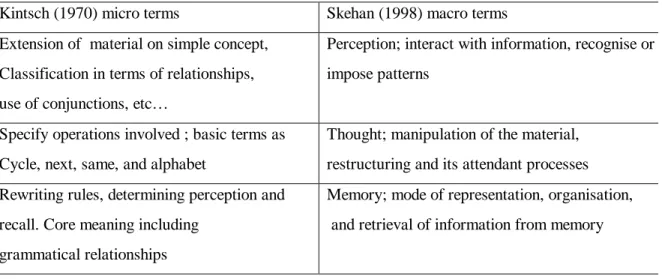
Table 5: Kintsch’ (1970) and Skehan’s (1998) rule learning strategies. 66
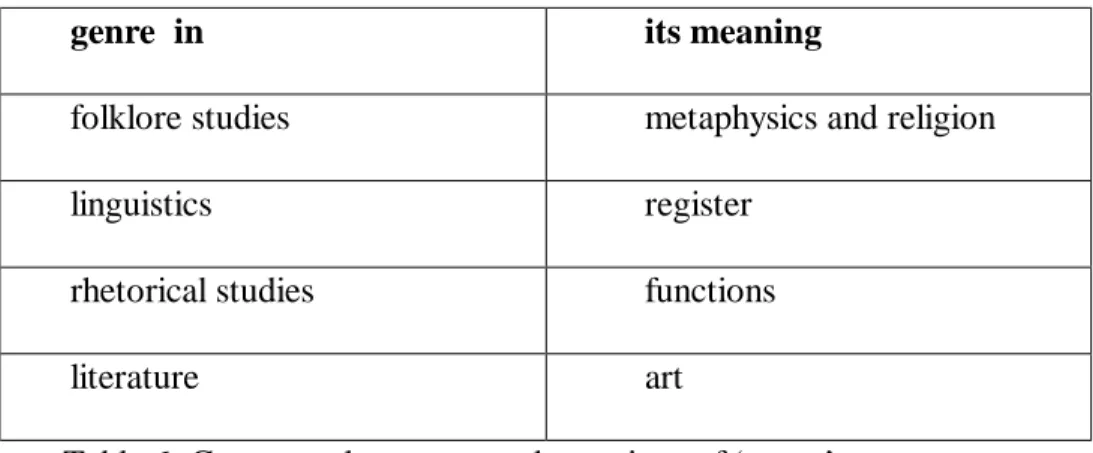
Table 6: Conceptual contexts and meanings of ‘genre’ 88
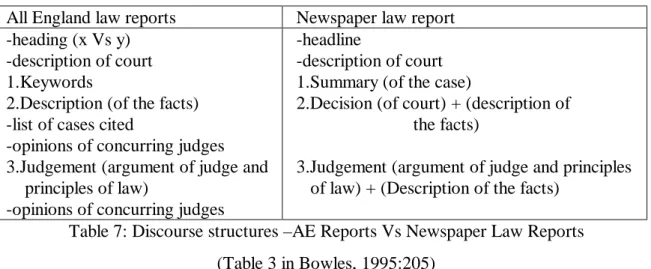
Table 7: Discourse structures –AE reports Vs Newspaper Law Reports (table 3 in Bowles, 1995:205) 96
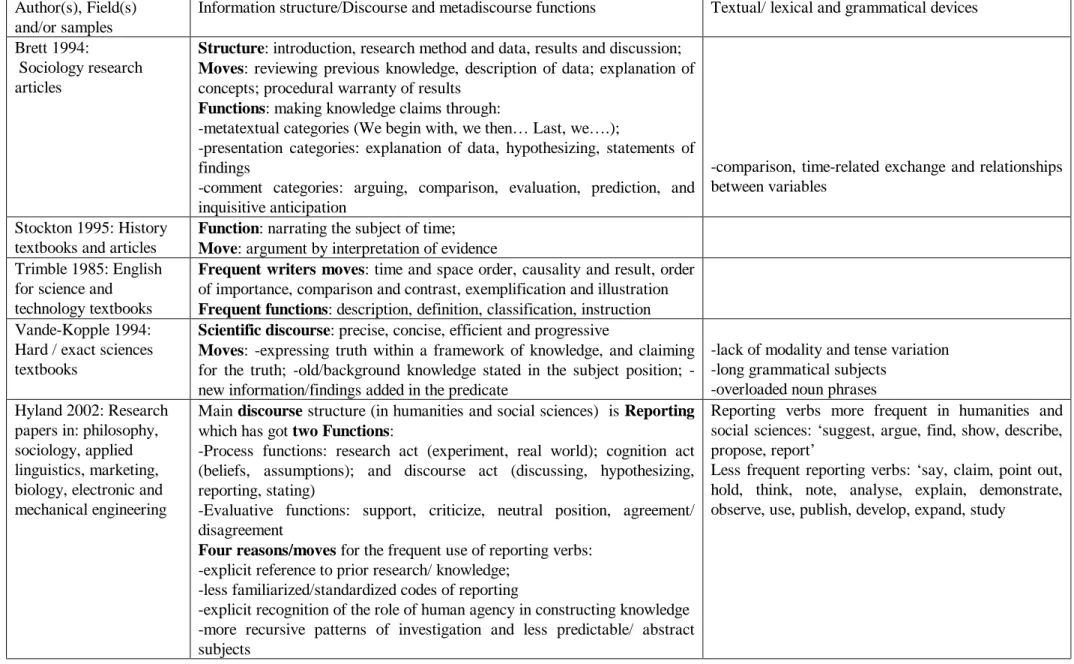
Table 8: EAP genre studies and findings. 122-124 Table 9: Undergraduates’ willingness and time availability 189
Table 10: Undergraduates’ purposes and motivation 190
Table 11: Undergraduates’ proficiency level in reading 192
Table 12: Undergraduates’ types of reading difficulties 193
Table 13: Undergraduates’ reading strategies 196
Table 14: Undergraduates’ sentence meaning strategies 200
Table 15: Undergraduates’ lexicon/semantic search strategies 201
Table 16: Postgraduates’ evaluation of the undergraduate English course 204
Table 17: Features to be improved in the undergraduate English course 205
Table 19: Postgraduates’ academic English contexts 207
Table 20: Postgraduates’ academic materials and media 207
Table 21: EAP teaching materials 212
Table 22: Major lesson plans of EAP teachers 214
Table 23: Materials design and development purposes 217
Table 24: Types of authentic texts selected by EAP teachers 218
Table 25: Types of modifications brought to authentic texts 219
Table 26: Control Group Evaluation of Pretest achievements 285
Table 27: Control Group Evaluation of Posttest achievements 286
Table 28: Experimental group one Pretest achievements 288
Table 29: Experimental group one Posttest achievements 289
Table 30: Experimental group two pretest achievements 291
Table 31: Experimental group two posttest achievements 292
Table 32: Comparative evaluation of pretest and posttest achievements 293
Table 33: Participants’ comparative achievements in Example 1 303
Table 34: Participants’ comparative achievements in Example 2 306
Table 35: Participants’ comparative achievements in Example 3 310
Table 36: Participants’ comparative achievements in Example 4 312
CONTENTS
INTRODUCTION 1
1. Statement of the problem and research proposals 2
2. Research hypotheses 4
3. Research methodology and tools 5
4. Presentation of the thesis 8
CHAPTER ONE: INFORMATION PROCESSING STRATEGIES 11
Introduction 12
1. Definition of learning 12
Traditional definitions 13 Modern definitions of learning 14 2. Theories of learning 18 Behaviourist theory 18 Gestalt theory 20 Cognitive theory 21 3. Motivation to learn 22 4. Information processing 24
Memory and learning 31
Schema and learning 36
6. Thinking and problem solving 41
Thinking 41 Problem solving 42 7. Learning styles 45 8. Learning strategies 52 9. Learning objectives 60
10. Rule learning and language 63
Conclusion 67
CHAPTER TWO: DISCOURSE AND GENRE ANALYSIS 69
Introduction 70
1. register and conversional analysis 71
2. Notional functional analysis 72
3. Discourse analysis 73 Text 74
discourse 75
Context 77
4. Elements of discourse 81
Cohesion elements 81
coherence and discourse processing 83
5. Genre analysis 88
Wide context genre studies 93
Limited topic genre studies
97
Comparative / contrastive genre studies 103
6. Summary of findings in genre studies 115
Information structure and writer’s moves 115
Argumentation 115 Agency and reporting 116 Discourse functions 117 Textual features 118 Sentence structure 118 Connectives 119 Lexis 120
Comments and conclusion 120
CHAPTER THREE: SYLLABUS AND MATERIALS DESIGN 125
Introduction 127
1. syllabus design 127
2. Approaches to syllabus design 129
Structural syllabuses 130 Notional / functional syllabuses 132 Communicative syllabuses 135 3. Criteria of syllabus and course design 138
Data collection 138
The learners 138
The community 138
Pedagogical institutions and educational authorities 139
Subject specialists 139 Content selection 140 Validity 140 Interest 141 Learnability 141 Significance 141
Syllabus sequencing / ordering 142
Syllabus implementation 143 4. Syllabus types 145 Product-oriented syllabuses 145 Process-oriented syllabuses 146 Task-based syllabuses 148 Task definition 148
Pedagogic criteria for good task selection 150
Task components and types 152
5. Materials defined 156
Materials and media 157 Aural / oral materials 161
Reading materials 161
Paralinguistic materials 161
Authentic materials and authentic texts 162 Authentic task pedagogy 163 6. Materials analysis, evaluation, and development 166
Adopting materials
Adapting materials 169
Materials design and development: principles and processes 170
Comments and conclusion 182
CHAPTER FOUR: SITUATION ANALYSIS 184
Introduction 185
1. The undergraduate students 186
Learners’ identity and background knowledge 187 Willingness to learn, purposes and motivation 189 Proficiency level, difficulties and strategies 191 2. Postgraduate students and teachers of the subject matter 202
Postgraduate population identity 203 postgraduate learning experience and suggestions 203 Postgraduate present needs 205 3. The teachers of English for Academic Purposes 209
Teachers’ qualifications and experience 209
Course planning, materials and methodology 210
Teachers’ materials design and development 216
4. Summary of findings 224
Learning objectives 224 Learning difficulties and strategies 225 Materials development and implementation 226 Conclusion 227
CHAPTER FIVE: EXPERIMENT IMPLEMENTATION 228
Introduction 229
1. Methodology and procedures 229
2. Design of the experiment 230
The participants’ background knowledge 230 Objectives of the experiment 231 Content of the experiment 232 3. Implementation of the experiment 233
Defining materials and their types 234
Learning objectives and strategies 236
Task and competency based learning 242
4. The training project 244
Lesson plans 244 Materials analysis and evaluation 245 The first example 246
The second example 252
The third example 258
4.2.3.1. Our comments 267
The fourth example 267
4.2.4.1 Our comments 270
5. Production project: Materials design and development 271
Summary and conclusion 272
CHAPTER SIX: EVALUATION OF RESULTS AND FINDINGS 273
Introduction 275
1. The population 275
Control group
Experimental group one 276
Experimental group two 276 2. The pretest 277 The material 277 3. The posttest 278 The materials 279 4. The instructions 279
5. The evaluation criteria and grading 280
Content topic and information structure 281 language functions 281 Language notions 282 Proficiency level 282 Achievement objectives 282 Lesson plan 283
Number and appropriateness of activities 283
Explicit instructions 283
Number and appropriateness of items 284
Production outcome 284 6. Results and comments 284
The Results of control group participants 285
Pretest achievements 285 Posttest achievements 286
The results of experimental group one participants 287
Pretest achievements 287 Posttest achievements 289
The results of experimental group two participants 290
Pretest achievements 290 Posttest achievements 292 7. Comparative evaluation of results and achievements 293
Results and achievements in the pretest 294
Results and achievements in the posttest 295
The control group comparative achievements 295 The experimental group one comparative achievements 296
The experimental group two comparative achievements 297
Comparative evaluation of rates 298 8. Qualitative comparison of projects in the posttest 299
Overall qualitative comparison and evaluation 299 Qualitative comparison of common materials and projects 303 Example 1: ‘Postman spent five days in car boot’ 303
Example 2: ‘Abandoned baby coloured, say police’ 306
Example 3: ‘Hero rescues girl under bus’ 309
Example 4: ‘Best man is the groom’ 312
9. Summary of qualitative findings 315
Conclusion 316
CHAPTER SEVEN: PEDAGOGICAL IMPLICATIONS 317
Introduction 318
1. Pedagogical implications 318
2. Pedagogical recommendations 321
3. Teacher/Learner development and autonomy 324
Conclusion 325
BIBLIOGRAPHY 329
APPENDIXES: Appendix I: Questionnaires 342
Appendix I.1: Undergraduate students’ questionnaire 343
Appendix I.2: Postgraduates and teachers’ questionnaire 346
Appendix I.3: EAP teachers’ questionnaire 349
Appendix II: Bloom’s taxonomy revisited 353
Appendix III: Fifteen authentic newspaper articles 358
Appendix IV: Control group posttest materials 364
Appendix V: Experimental group one posttest materials 385
INTRODUCTION 1. Statement of the problem and research proposals 2. Research hypotheses
3. Research methodology and tools 4. Presentation of the thesis
INTRODUCTION 1. Statement of the problem and research proposals:
This research studies the problem of materials design and development by teachers of English for Academic purposes at the University of Constantine. It assumes first that teachers in this field lack training and comprehensive practice of materials production to satisfy the needs of their students. The reasons may be due to insufficient knowledge and lack of methodological, systematic practice in materials development.
This research attempts to set up criteria of analysis, selection and development of E.A.P materials, particularly for students of English at the humanities and social sciences; economics, psychology, sociology, history, and communication departments. Moreover, many studies have been carried out in this field, with reference to particular academic subjects, -including my Magistère dissertation- and came out with suggestions for elements of content and implementation of the syllabus. Results of such studies are sometimes divergent as every academic field has been examined in isolation with regard to the learners’ specific needs and bias to subject specific data, thus making every E.A.P situation a particular case study.
In this research, we presume that students of the humanities and social sciences have a common need of learning English to get more knowledge - information - about their academic subjects. We consider, thus, their learning of English closely related to information processing, retrieval and transfer, not simply a matter of learning a foreign language for its own sake. Consequently, the present research will focus on the criteria of analysis, selection, and design of a relevant implementation, taking into account the nature and type of
information (producer-channel-audience), the processing of information (background knowledge - input - meaning negotiation -decoding - transfer ) , and the nature of language learning strategies.
Furthermore, academic English discourse shows particular characteristics of type and organisation which turn out to be important factors that influence the language teaching pedagogy in terms of materials' selection and task design for learners. This entails that such assumptions have to be theoretically - academically- based and practically tested. Theoretically, we will have to deal with the cognitive model of schemata, closely related to information processing, which enhances the idea that learning is possible through understanding of meaning where a learner uses his background knowledge (schematic frames; long and short-term memory) to negotiate the meaning of an input and then, if he understands, will process the information (retrieval: memory and / or transfer: use it to do something else or to communicate).
The models of discourse analysis in the academic fields reveal some types and organisations most specific to the fields mentioned above. These models converge to bring agreement among scholars about some types of academic discourse, and sometimes diverge to bring some disagreement about "genre" of academic discourse. When they converge, the product of discourse analysis becomes a stereotype that can be applied to the analysis of any academic text; when they diverge, the product becomes an analysis of academic "genre" which establishes a typical identity for each academic text being analysed.
Stereotypic models imply that language teaching materials should undergo a stereotypic pedagogical treatment while "genre" models imply that the materials should be treated differently; each language teaching material should get its specific teaching/learning tasks for learners. The nature of language learning strategies implies that learning takes place through chunks - not through items - where the learner is exposed to situations and contexts of language use; it is a top-down strategy to understand E.A.P, in opposition to a bottom-up strategy to teach the rules of the language. Such a strategy will allow room for the learner to deal with the intention of the message producer, the content (idea; information), and, at last, language forms/rules which convey the intention and the content. EAP teachers need to be trained to take into account the above mentioned assumptions if they are willing to help their students achieve some learning objectives.
2. Research hypotheses:
The research assumes that teachers who are to be involved in materials design and development must take into account a number of principles and apply them when selecting and producing their own materials. Materials selection and production has to be a systematic process in teacher-training and teacher development of awareness and autonomy in decision making. The hypotheses of the research can be set in the following order:
Hypothesis One: Teachers and teacher-trainees take into account and apply information structure and processing strategies in order to select and design learning materials which favour comprehension of information and academic discourse;
Hypothesis Two: Teachers and teacher-trainees take into account discourse organisation and text features of language functions and notions in order to select and develop learning materials which favour language practice;
Hypothesis Three: Applying the principles of materials selection and development – mentioned in the two hypotheses above, systematically lead teachers to set production tasks which prepare learners to deal with academic discourse/genres most relevant to their university subjects.
Assembling and using the three hypotheses as experimental input and systematic practice by teachers and teacher-trainees in a materials design and development project will help us assess the effect of these hypotheses on the materials produced. This is to be described below in research methodology and tools.
3. Research methodology and tools:
This research is carried out through data gathering and experimental practice of knowledge input and using that knowledge in developing the ability of designing materials for language learning in EAP. Data collection is done through questionnaires and investigation of the whole situation where English is taught for academic purposes at the departments of the humanities and social sciences, University of Constantine (cited above). It includes questionnaires addressed to undergraduate students (100 students from each one of the five departments of humanities and social sciences), post graduates students and teachers of the academic subjects (50 informants from each department), and teachers of EAP (2 teachers from each department). It also takes into account a pre-test for teachers of EAP as a control group and two experimental groups, in developing authentic texts into language teaching materials.
The undergraduate students’ questionnaire helps us determine the learners’ background knowledge, purposes of learning English, and most probable styles and strategies of learning and using English at university. The post graduates’ and teachers’ questionnaire helps us consider the target objectives of using English in academic research fields, and also take into account these informants’ points of view about their previous learning experience. The English teachers’ questionnaire and pre-test help us to determine their background knowledge about teaching and materials development abilities and experience.
The experiment is based primarily on the application of the hypotheses cited above (learning and information processing strategies and discourse functions and notions). Here, the meaning attributed to ‘experimental’ research is not in the strictly narrowed sense of manipulating independent and dependent variables and a rigorous experimental control of extraneous variables, but rather in the broader sense of trying or experimenting materials design for learning and teaching through collaborative action research (typical of classroom research) with various strategies to check whether it will work or not. The informants of both experimental groups (ENS students and postgraduate students) are exposed to aspects of learning stages and levels, and types of discourse genres most frequently found in EAP. They are then trained to analyse and evaluate already designed materials from school textbooks according to some criteria. They are also trained to select authentic texts; analyse and develop them as language teaching/learning materials according to some criteria. These criteria of analysis, evaluation, and development are discussed in the chapters devoted to Syllabus Design, Material Design and Development, and the Experiment). Through the
experiment, observation, peer learning and workshops are used as implementation tools in order to enhance the ability of materials development.
All together, the research tools and steps are placed within a framework of experimental, collaborative action research method which tracks and implements informants’ abilities. The purpose of this methodology is to advocate quantitative and qualitative findings in order to claim that improvement of teachers’ materials development abilities can be achieved through the three hypotheses, cited above, and experiential practice enhanced by observation, peer-learning (collaboration), and workshops. It is thus a collaborative action research –done by teachers and teacher-trainees, which experiments some theoretical and practical aspects of learning strategies and discourse functions and notions in the design and development of language learning materials. Thus, in addition to numerical data of the quantitative research method, the qualitative research provides non-numerical data which use such techniques as: content analysis, discourse analysis, ethno-methodology, focus groups, reports, observation grids and diaries.
A post test is administered to the control group and to the two experimental groups. It consisted of the development of authentic texts into language teaching/learning materials. It represents a project work and a result of the experiment. It serves as a tool of evaluating the informants’ abilities (from both experimental groups) by comparing them to the abilities of teachers’ from the control group. The criteria of evaluation which are derived from the qualitative characteristics of materials, and comparison of results, will help us determine, qualitatively, the effects predicted by the hypotheses in terms of achievements in materials development to teach EAP
4. Presentation of the thesis
The thesis is presented in seven chapters which consecutively deal with related and consequent topics. As the title suggests, information processing and discourse analysis act as the theoretical framework which influence practical implications in syllabus design and implementation of the syllabus with materials. Thus, the first three chapters –information processing strategies, discourse and genre analysis, and syllabus and materials design-delimit the theoretical framework and consequently lead to practical implications and considerations of learning activities and tasks which are demonstrated in materials design. The last four chapters do not deal with any theoretical discussions; they cover mainly the analysis of the situation before the experiment, design and implementation of the experiment itself, and provide quantitative and qualitative evaluation which is followed by pedagogical implications.
Chapter one -Information processing strategies- describes the learning process by traditional and modern definition according to major theories and shows how information processing strategies remain the core cognitive process of meaning negotiation. Learning, then, implies using memory in a schematic way in order to think and solve problems. It explains the learning –memory relationship in terms of styles and strategies adopted by learners. Though not all the styles and strategies are directly, but indirectly- related to memory, their impact on the design of learning objectives and learning tasks has been the major concern of education and pedagogy during the last sixty years.
Chapter two -Discourse and genre analysis- presents the evolution in the field of applied linguistics with close relationship to text analysis: register, notional functional and
discourse analysis. It sheds light on cohesion and coherence in discourse structure and explains how discourse processing according to interactive, schematic models, leads directly to the specific study of genre types. Demonstrating discourse analysis and genre studies in English for academic purposes leads us to distinguish wide contexts from limited and comparative/contrastive contexts. Their findings are, hence, listed and explained as: information structure and writer’s moves, argumentation, agency and reporting, functions and textual features.
Chapter three -Syllabus and materials design- shows how some trends in languages studies provided a change in syllabus inventories which improved from structural to notional/functional and communicative sets, leading to syllabus types in terms of content selection and sequencing. The evolution in learning theories biased the syllabus types from a product-oriented to process oriented pedagogy which demonstrated the adoption of task-based and, the so-called, competency task-based pedagogy. Materials design and development represent the link between the ideas and findings of the previous two chapters to the real world of syllabus implementation. Consequently, this chapter explains and exemplifies the dichotomy between materials and media with a careful, atomistic and discourse biased classification of authentic materials within authentic pedagogy. It also provides a progressive model of materials design and development based on the contributors’ abilities of adopting, adapting, and analysis and evaluation of, language teaching/learning materials.
In Chapter four, an analysis of the whole situation of teaching/learning English for academic purposes is carried out relying on three categories of population involved: the learners, the postgraduate students and teachers of the subjects at five departments of
humanities and social sciences, and the EAP teachers. The analysis covers both undergraduate and postgraduate learners’ needs, strategies, and purposes as well as the teachers’ pedagogical procedures and materials choice and development.
The experiment –Chapter five, requires an implementation in materials design and development through collaborative action of the participants and tracking their developing experience. In this chapter we present the content and the procedure of the experiment by reference to the ideas put forward throughout the thesis and by exemplification of participants’ tasks and contributions.
Evaluation of the experimental research is done through a pretest and a posttest which are thoroughly described in Chapter six. We provide content and criteria of evaluation of both tests according to what has been put forward in the previous chapters. The results and achievements of the control group and the two experimental groups are analysed and discussed quantitatively and qualitatively, according to the evaluation criteria. Qualitative results of the experiment lead to the pedagogical implications which are presented in chapter seven. Finally a general summary and conclusion on the general findings and future prospects are given at the end of the thesis. The appendixes include the questionnaires used in the situation analysis, reference materials for the experiment, and the three (control and experimental) groups’ posttest projects.
CHAPTER ONE
INFORMATION PROCESSING STRATEGIES Introduction
1. Definition of learning
Traditional definitions of learning Modern definitions of learning 2. Theories of learning Behaviourist theory Gestalt theory Cognitive theory 3. Motivation to learn 4. Information processing 5. Memory, schema and learning
Memory and learning Schema and learning
6. Thinking and problem solving Thinking
Problem solving 7. Learning styles 8. Learning strategies 9. Learning objectives
10. Rule learning and language Conclusion
Information processing Strategies Introduction:
Learning is a natural, acquired or developed, activity which every human being uses in a way or another. Its definition requires clear, concise terms, and more appropriately an ‘operational definition’, and its steps may vary from one learning theory to another because each theory attempts to describe how and why human beings process information according to its own theoretical principles. Hence, whatever the theory, a number of learning styles and strategies have been identified and described. Learning, then, is a process of the mind which requires the use and reuse of already learned/developed styles and strategies to learn a language or anything else which represent knowledge in its broad sense. Even if the process of learning has been described in modern times in almost the same terms by many psychologists, human beings adopt and/or adapt ways of learning that may be specific to a particular person, or a group of persons who have chosen to follow a number of ways or steps. This is what most researchers in the field would call styles and strategies. A definition of these terms is necessary, at first, to distinguish one from the other, and secondly to correlate them with purposes and objectives of learning.
1. Definition of learning:
Common sense leads people to consider that learning is an accumulation of a certain amount of knowledge or a certain number of abilities of performing different tasks. Others rather consider that learning is a life style a person follows from the cradle to the tomb. Could we be satisfied with such general and wise assumptions which human mind has reached? For the learned and academic world, this seems unsatisfactory, and somehow
proper to lay man’s knowledge about learning. We have to take into account the views, the theories and the results of various studies devoted to this field.
1.1 Traditional definitions:
Most traditional definitions of learning are based on religious beliefs and old philosophical assumptions. Islamic trends, for example, consider learning as a duty a Muslim has to do in order to know his own religion whatever the difficulties he may face. The first Koranic verse was an order and an advice to the prophet to ‘read’ and discover what the human being does not know. The prophet’s advice to Muslims was to seek knowledge, from the cradle to the tomb, even if they had to travel to China. Learning some knowledge was, and still is, enlightenment for the individual while ignorance was, and still is, synonym of darkness. Learning was consequently linked to accumulated knowledge of and about religious matters, drawing a straight line between those who know and those who do not have that knowledge.
Philosophers considered learning as a mental process which required methodological thinking, rejecting memorisation and knowledge accumulation, favouring doubt and questioning in order to learn about things. Descartes put this idea quite clearly in his Discours de la méthode:
‘J’ai été nourri aux lettres dés mon enfance, et parce qu’on me persuadait que, par leur moyen, on pouvait acquérir une connaissance claire et assurée de tout ce qui est utile à la vie, j’avais un extrême désir de les apprendre. Mais, sitôt que j’eus achevé tout ce cours d’études (…), je changeai entièrement d’opinion. Car je me trouvais embarrassé de tant de doutes et d’erreurs, qu’il me semblait n’avoir fait autre profit, en tâchant de m’instruire, sinon que j’avais découvert de plus en plus mon ignorance.’ (Descartes. 1966: 35)
Descartes (ibid) explains that this notion of doubt would lead him slowly to discover things by his own way of thinking, and even if he would not learn a lot of things he would not take the risk of falling into fallacies.
This challenge in the way learning was considered, from mere rote learning to mentally processed operations of doubt, cause and effect, etc… lead to the independence of various fields of science from theological prescriptions and views. In old times the learned person (‘El Aalam’ in Arabic) had to comprehensively acquire and learn every single aspect of religion, philosophy, mythology, literature, chemistry, astrology, etc…, otherwise he would not be proclaimed so. Nowadays, a learned person is considered to be an effective learner if he proves academic achievements and an acceptable mode of behaviour among his own community. The term “learning” itself is nowadays so important to be left to general religious or philosophical speculations. “Learning” or “learning a given subject-language” became the core of behaviour and mental studies in the fields of psychology and psycholinguistics.
1.2 Modern definitions of learning:
The modern academic world describes learning as an attitude the person adopts towards his environment, according to environmental stimuli and a wide scope of social needs. Learning can be seen as an active process of transforming knowledge, insights and skills into a learning behaviour. It may be incidental, by chance or intentional. It is considered as an innate, long lasting, ability in human beings.
Chaplin’s (1975:284-285) dictionary of psychology defines learning as an ‘acquisition of any relatively permanent change in behaviour as a result of practice or experience; a process of acquiring responses as a result of special practice.” This short definition is heavily loaded in terms of its meaning. It takes into account ‘acquisition’ which is innate in human beings, ‘relatively permanent change’ and ‘process’ which mean that learning occurs through a number of stages of ‘practice and experience’, and that the result of learning is seen as a behaviour made of a number of responses. This is more of a behaviourist definition which does not take into account details of the ‘practical experience’
Almost similarly, Entwistle et.al (1979: 367) consider that “learning can be viewed in terms of three related elements: intention, process, and outcome”. This is straight away a simple definition which excludes learning incidentally and puts focus on intentional learning. This means that human beings are willing to learn whenever they intend or decide to do so. This willingness to learn may be affected by various factors and makes learning a matter of consciousness and awareness. Most important feature of this definition is the term “process” which means that learning takes place in a systematically organised long series of events or instances. These instances can even be seen as stages or steps of the process. The last term “outcome” makes learning a beneficial result of the person’s investment. A person, in other terms, would learn if there is some moral, emotional, social, or material profit.
Entwistle’s (ibid) neglect of incidental learning may be due to the fact that learning is so complex a process that some of its instances cannot be observed, described and/or evaluated. Child (1977: 81) considers this feature of learning in the following terms:
“Whilst there is no complete agreement among psychologists about the details of learning processes, they do accept the basic premise that learning occurs whenever one adopts new,
or modifies existing, behaviour patterns in a way which has some influence on future performance or attitudes. Unless there were in fact some influences, we would not be able to detect that learning had taken place (…). But the definition includes learning which occurs without deliberate or conscious awareness, bad as well as good behaviour and covert attitudes as well as overt performance.”
Thus, the absence of deliberate or conscious awareness does deprive the person from learning. Incidental learning can even be seen as a feature of natural learning about immediate environment without particular focus of attention on a particular thing to be learned. Both (Entwistle’s and Child’s) definitions, above, do not contradict Chaplin’s one but each puts focus on a particular aspect of learning. All three definitions identify at least common factors of learning that we can express as:
- Intentional or programmed learning as a matter of programmed practice - Incidental learning as a matter of life experience
- Both factors above are a result of willingness and motivation - Environmental/external stimuli and insights bring some changes - Changes are continuous and make a whole process
- Results and outcomes are observed in the present and future patterns of behaviour
All these characteristic features of learning are included in almost all other definitions elaborated by other scholars. Fontana (1995: 141-171) and Anderson (1995: passim) assume the same ideas about the definition of learning and add a number of detailed information relative to external/environmental factors and cognitive processes which affect the learning process.
Fontana (1995: 141-142) defines learning by summarizing what almost all psychologists say: ‘(…) most psychologists would agree that learning is a relatively persistent change in an individual’s potential behaviour due to experience.’ Fontana explains that the three major components of this definition are: ‘change’, ‘experience’ and ‘potential behaviour’. He also stresses the fact that the studies of these three terms lead to divergent view points between behaviourists and cognitive theories.
Anderson (1995: passim) considers learning as an essential element in cognitive psychology. He focuses the study on the importance of visual and speech perception, attention, and knowledge representation in memory through encoding, storage, retention, and retrieval of information. He adds that all these steps of learning lead to problem solving, reasoning and decision making. In addition to a number of learning types which Anderson surveys (behavioural, intentional, incidental, and power law), his main distinction is made between strategic and tactical learning (Anderson.ibid: 283-289): ‘strategic learning is learning how to organise one’s problem solving for a specific class of problems’, and ‘tactical learning is learning sequences of actions that help solve a problem.’
As Entwistle (1979) formulated his statement on the basis of research findings which investigated learning attitudes, his scope of study was on ways or attitudes learners adopt while learning. He even called these ways and attitudes “distinctive approaches”. Child (1977), Fontana (1995) and Anderson (1995) on the other hand, formulated their statements on the basis that “learning” has been an essential element in a number of theories in the field of psychology. While their terms reflect theoretical assumptions of psychology, Entwistle’s terms reflect practical, programmed processes that learners use/choose while learning. Hence, we have to consider, first, the theoretical frameworks of learning that emerged from
psychology and, then, take into account the various practical outcomes in terms of learners’ styles and strategies while learning.
2. Theories of learning:
A theory is generally a set of assumptions, beliefs, and hypotheses that have been observed, tested and evaluated in the academic world. It attempts to explain and/or describe a given natural, physical, social, or human phenomenon in a scientific way, using simple and precise terms.
In the field of psychology, observation and description of human behaviour has been widely explained by a number of theories with more or less focus on learning. We shall attempt to shed some light on a certain number of theories which considered learning as a major element in human personality development and man’s intellectual and academic achievements. This is far from being a thorough, encyclopaedic, account of all learning theories and/or experiments but rather a summary of the most influential ones.
2.1 Behaviourist theory:
Child (1977: 81-91) sums up this theory in the works of famous behaviourist psychologists like Watson, Thorndike, Pavlov, Hull, and Skinner. Behaviourist theory focused on the study of animal and human behaviour to determine the connection between stimulus and response as a learning process. That is why the theory is commonly called connectionist. Child (1977) considers, within this scope, that Watson determined the law of ‘trial and error’ which is followed by children in solving a number of problems by applying a process of alternative paths. Child (Ibid), then, stresses the work of Thorndike which came out with ‘reinforcement’ as a ‘law of effect’ and the ‘law of exercise’ which is basically an
assumption of Watson’s work. Pavlov’s findings on conditional and unconditional stimuli do not seem to have great impact on classroom teaching, as Child (ibid) points out, but rather contributed in the study of children’s behaviour and reaction to school environment (fear and pleasure of learning, reciprocal inhibition, spontaneous recovery, and stimulus generalisation). Child similarly evaluates the shortcoming of Hull’s finding in the stimulus response connection and its contribution to classroom teaching. For him, the main contribution of Hull was the ‘reactive inhibition’ where there is a tendency not to make a response which has just been made. According to Child (ibid) the main contribution to programmed learning was made by Skinner with ‘operant conditioning’ and the conclusions he drew about learning. These conclusions specify that: -short steps of learning which grow out of previously learned behaviour; - regular reward and control by reinforcement; - quick reward after correct response which is known as feedback; -and opportunity to discover stimulus discriminations for the most likely paths to success.
Anderson (1995:8-10) attributes directly behaviourist findings to American psychologists and Gestalt psychology to Europeans. The most important figure of behaviourist theory, according to Anderson (ibid), was Edward Thorndike and his basic principle of the effect of reward and punishment on the rate of learning. He argues that the tradition of American studies was focusing on external -observable- behaviour, biasing research towards an “action-oriented” psychology which could satisfy educational demands at that time, neglecting “the workings of the mind that underlay that behaviour”.
2.2 Gestalt theory:
Child (1977: 72-73) considers that the founders of the school known as Gestalt
attempt to avoid breaking down behaviour into constituent parts which obscured the full meaning of that behaviour. Gestalt psychology, within these terms, can be regarded as a comprehensive study reacting to behaviourist theory. Within this scope, Gestalt psychology, according to Child (1977: 73), concentrated on a study of perception for a better understanding of learning. This study of perception focused on insights or intuition. The term “gestalt” means “pattern” or “form” in German. The main claim of this theory of insights, according to Child (1977: 92) who relied on Kohler’s experiments, was that individuals could, out of a sudden insight, find a solution to a problem which they were not able to solve earlier. After a number of trials the individual could repeat the same solution in a similar event and transfer that ability to new situations. A study of perception from this point of view could then be considered as a study of “a whole” set of “patterns” intuitively used by the individual.
Gestalt psychology is also known as a theory of insights or introspections. Its origin can be traced back to the work of the German psychologist Wilhelm Wundt and his psychology laboratory. Anderson (1995:7-8) considers him as the father of modern psychology and that the European, as opposed to American, theory of psychology started with Wundt’s introspective views and experiments. Anderson explains that the introspective theory consisted of mind self-observation or self-inspection. The content of introspective reports could, at that time, make an account of psychological theory. In this method, informants had, for example, ‘to generate associates to a given word, and then introspect on the contents of their consciousness during the period between reading the word and making associations’ (Anderson.1995: 7)
Both Child (1977) and Anderson (1995) consider that Gestalt psychology was in fact the starting point of investigation into a theory of cognition though this was neither the statement nor the claims of that German school. Both agree on the principle that a study of learning cannot be carried out without great consideration be given to perception and processes of the mind; Gestalt psychology was the initial step to understand processes of the mind.
2.3 Cognition theory:
Kintsch et.al (1984: 16) give a broad definition of cognitive science in general by considering it as ‘a collection of several pair-wise intersections among anthropology, computer science, linguistics, neuroscience, philosophy and psychology.’ From first glance, this definition includes terms that are classified in alphabetic order because one wonders how computer science may be mentioned before linguistics, philosophy and psychology. A second consideration of this definition tells us that cognitive science is a multidisciplinary subject which requires a comprehensive study of human mind evolution starting from anthropological findings of ancient societies (called primitive, even if findings proved their elaborate-intelligent way of life), taking into account philosophy and linguistics as major human contributions into the understanding and the expression of man’s own ideas, focusing behaviour studies on the individual’s behaviour and development, and at last investigating neurological structure of the brain, comparing the human thinking processes to create artificial intelligence in the field of computer science.
On the other hand, Anderson (1995: 10-12) considers that there is somehow a slight difference between cognitive science and cognitive psychology. Of course, Anderson
adheres to the aspects of the definition of cognitive science as stated in Kintsch (1984.ibid) mentioned above. But he says that “Cognitive psychology broke away from behaviourism in response to developments in information theory, artificial intelligence, and linguistics.” He further adds that cognitive psychology emerged after World War II as a response to the failure of behaviourist theory to deal with behavioural problems which could not be explained or solved by behaviourist psychology pattern of stimulus- response relationships. Anderson even states that cognitive psychology had its basic foundations academically established by two major events: the first one was the publication of a very important book
-Cognitive Psychology- by Ulric Neisser in 1967, and the second one was the beginning of
the Journal of Cognitive Psychology in 1970. Anderson, thus, considers the emergence of cognitive psychology as prior to the emergence of cognitive science which he dates back to the appearance of the Journal of Cognitive Science in 1976. According to Anderson (1995. ibid) and many other scholars (Gardner, 1987; Stillings et al, 1995), Cognitive psychology started with the study of perception and attention as major elements of information theory, then moved to more elaborated research on learning, remembering, thinking, problem solving, decision making, and language.
3. Motivation to learn:
Almost all definitions and explanation of the learning process and theories –mentioned above, stress the fact that willingness and motivation to learn are basic factors which contribute to the achievement of incidental or programmed learning purpose. In general terms and considerations of the learning process, Both Child (1977) and Entwistle (1979) determine that ‘intentional’ and ‘incidental’ learning achievements and experience are the
results of ‘willingness and motivation’ (see 1.2 above). However, in some theories of learning, willingness and motivation have been given relative roles and efficiency.
Schools of thought and theories of learning and psychology have been considering the importance, role, and efficiency of willingness and motivation according to their own principles and foundations (see section 2 above). For example, while the behaviourist learning theory quite clearly stresses the positive effects of ‘reward’ and ‘punishment’ on the rate of learning, the Gestalt theory does not identify observable willingness and motivation factors because it is based mainly on introspections and insights. The wide multidisciplinary concerns of cognitive theory (see 2.3 above) give ‘willingness and motivation’ predominant roles in the stages of perception and attention which, in turn, may have further impact on the other stages of the learning process.
In the field of education in general, willingness and motivation are characterised by a number of features which Child (1977: 39-55) identifies as: curiosity, exploration and manipulation, need to achieve, level of aspiration, self-esteem, incentives and knowledge of results, as well as cooperation and competition, and performance and drive. All these factors may be considered as ‘intrinsic’ (proper to the learner) and/or extrinsic (proper to the educational environment) qualities which encourage learners to continue learning if good use is made of them in the design and implementation of learning activities.
Within the scope of teaching/learning a foreign or a second language, O’Malley and Chamot (1990: 160-161) consider that ‘motivation, or the will to learn’ can be an influential factor which determines students’ success or failure in trying new strategies. They argue that
a successful learner is one who has gained confidence in learning a foreign language and that s/he ‘is likely to approach new learning tasks with a higher degree of motivation’ than one who has accumulated failure and thus develops a negative attitude towards his/her ability to learn. Consequently, O’Malley and Chamot (ibid) advise that the initial strategy training is to make the learners experience success and thus increase their motivation. Within the same scope, Oxford (1990: 141-145) considers motivation as a set of tactful ‘affective strategies’ –which do not differ from Child’s features (1977) above, and includes them among her diagram of ‘Indirect strategies’ (see section 8, figure 2 below). The consecutive importance of motivation and ‘affective strategies, according to Oxford (ibid: 204-206), is the determination of learners’ ‘specific needs’ and ‘time availability’. She considers that ‘strategy training, for teachers, starts first by gathering enough knowledge about their learners’ needs and the required time and energy to satisfy those needs. Woolfolk (2004: 384-385) stresses the fact that any successful use of motivation depends on the ability of the teacher to distinguish ‘intrinsic value’ from ‘instrumental value’ of the learners needs. Like Corder’s (1973: 203) distinction between ‘integrative’ and ‘instrumental’ motivation, Woolfolk’s distinction leads to bias of learning activities and outcomes towards the inclusion of cultural, emotional aspects to provide ‘intrinsic’ (integrative) values, and the inclusion of short and long term goals to satisfy ‘instrumental’ values and purposes.
4. Information Processing:
The early cognitive trends which studied information processing were based on the speculation that the human mental operations could be compared to the functioning of a computer in dealing with a number of digits. Two major works of the 1970’s – Massaro (1975) and Mayer (1977) attempted to bring the issue into the learning process with more or
less success in moving away from the stimulus response model towards and elaborate thinking/problem solving challenge. Massaro (1975: 39-40) states that ‘the stages of mental processing include: detection recognition and reaction (…) which lead us to consider information processing as the processes we have identified between stimulus and response (...) and can be clarified in terms of our information-processing analysis. Stimulus is the information available to the detection process which transduces the physical signal into a neurological code.’
Massaro (1975:42) Figure 1:
Stimulus detection recognition response selection response Massaro (1975: 64) Figure 1 bis: on memory search
Test digit: detection recognition memory search response selection response and comparison
Massaro (1975: 248-257) Discusses the relationship between the storage structure in immediate memory and the psychological process at each stage of processing information through visual recognition. Massaro considers that the visual stimulus leads first to perceptual visual storage and then to recognition and storage in immediate memory. These three - perception, recognition and immediate memory- stages are followed by the rehearsal stage which in turn will lead to the recall stage. Hence recall (remembering) cannot take place unless there is enough rehearsal of the items stored in immediate memory. Massaro (ibid) adds that:
‘(…) the central assumption of our information-processing model is that a number of processing stages occur between stimulus and response. These processing stages are assumed to be successive and each stage operates on the information available to it. The
operation of a particular stage takes time and transforms the information, making it available to the next stage of processing. Two theoretical constructs are important to this approach. First, the structural construct describes or defines the nature of the information at a particular stage of processing. Second, the functional construct describes the operations of a stage of information processing.’ (Massaro, 1975: 599-600)
To explain this assumption of an information processing model, Massaro (1975: 601) draws a flow diagram of the temporal course of auditory and visual information processing. He distinguishes first the stimuli as sound and sight wave patterns which lead to an auditory and visual receptor system. At this step he considers the stage of feature detection or sensation which is followed by perceptual auditory and visual storage. This storage helps in establishing primary recognition. Massaro calls this a perception stage which develops the interpretation of signs. It is followed by synthesized auditory and visual memory which represents a secondary recognition and leads to a stage of conception – concept formation. Concepts are then stored in a generated abstract memory. They are recorded and rehearsed through a last stage that Massaro calls knowledge of rules. According to this model, recording and rehearsal act as a feedback to generate more concepts in abstract memory and reinforce synthesized items in auditory and visual memory.
Mayer (1977:133) makes a close link between information processing, thinking and cognition. He considers that the information approach to thinking assumes that a human being is (…) a processor of information whose cognitive processes, including thinking, can be presented as either:
-a sequence of mental processes or operations performed on information in the subject’s memory; or
-a sequence of internal states or changes performed on information that progress towards a goal
We can add, then, that this represents a certain number of moves the subject undertakes to solve a problem.
More recent works give information processing the place it deserves in educational psychology: (Anderson. 1995:12-18), (Matlin.2003:10-13), (Slavin.2003:173-187), (Woolfolk.2004:239-271), (Baron and Kalsher.2005:164-172), and (Ormord.2006:42-49). All these scholars agree on the fact that the initial research was inspired by computer science and most of them lead the discussion into further developments of information processing theory and its impact in the field of learning and teaching but those who limited the scope to cognition (Matlin.2003) rather diminish its role.
According to Anderson (1995), the information processing approach became predominant in cognitive psychology, and attempted to analyse cognition into a set of steps in which an abstract entity, called information, is processed. The paradigm showed how an individual saw a probe stimulus which had to be encoded and then compared to each digit in the memory set. Then, the individual had to decide on a response and generate it. Time required for stimulus perception, decision making, and generating a response was of high importance in this paradigm which accounted much more for mathematical operations and relations of digits. Anderson (ibid) adds that Sternberg paradigm of digits, though, essential, needed much more contribution from the environment, physiology and the complex neural representation of information in the brain. (See §§ above, definition of learning).
On the other hand, Matlin (2003:10) considers that one component of the information processing approach is to interpret the mental process as “information progressing though the system in a series of stages, one step at a time”. Matlin claims that these stages are: First, reception of stimuli and comparison with information stored in memory; Second, seeking additional information stored in memory; Third, making a decision; and finally, executing the response. Matlin considers that the most prominent example of this approach was the model developed by Atkinson and Schiffrin in 1968 which had great influence on cognitive psychology. The model proposed that memory is a sequence of discrete steps in which information is transferred from one storage area to another. The first step of the model is the sensory memory which gets the external stimuli for a few seconds. The second step is the short term memory (which is now called working memory, as we shall see in section 4) that gets, from sensory memory, some small amounts of information and uses it during some seconds (about 30, according to Matlin). The third step is where material and information that have been rehearsed pass from short term memory to long term memory for relatively permanent storage.
In this model, most of the received information in sensory memory is lost unless there is a certain amount of focus of attention and perception. Short term memory requires rehearsal so that information is understood and stored in long term memory. In a criticism of this model, Matlin (2003:12-13) admits it had a great impact on further developments in cognitive psychology but considers that this impact diminished in recent years because, and for matters related to convenience, psychologists focused their investigations on two broad aspects of learning: -kinds of memory and their interrelationships, and; - a theoretical framework that accounts for an information processing model.
This second aspect is closely related to our research and investigation. Perception, rehearsal and retrieval, being major characteristics of the information processing model, are the most important stages of a programmed learning experience. The type and amount of information the learners are exposed to, the type and quality of activities suggested for rehearsal and retrieval account that much for learners’ proficiency development and achievement of learning objectives. While the information processing approach lost its impact in cognitive psychology but paved the way to memory and cognitive style research fields, it gained grounds in educational psychology as a framework for the design, implementation, and evaluation of the learning process. Moreover, the cognitive studies of memory rather confirmed the idea that organised, intentional and tactical-strategic learning improves memory abilities, as we shall see in the next parts of this work.
It is, thus, logical that some trends of cognitive psychology - which do not rely on response as a model of changing behaviour-, diminish the role of information processing and focus on cognitive levels. It is also consequent that some trends in cognitive psychology abandon the idea of immediate stimulus-response relationships-which favours a rush towards performance objectives achievement- and study the learning process as a model of information (subject/material and language) processing.
More recent works in educational psychology stress the fact that, even if first information processing models speculated over computer and artificial intelligence findings, it is sometimes the neuropsychological research (human brain functioning) which influenced developments in the world of computer operations. Slavin (2003:173-187), Woolfolk