RESEARCH OUTPUTS / RÉSULTATS DE RECHERCHE
Author(s) - Auteur(s) :
Publication date - Date de publication :
Permanent link - Permalien :
Rights / License - Licence de droit d’auteur :
Bibliothèque Universitaire Moretus Plantin
Institutional Repository - Research Portal
Dépôt Institutionnel - Portail de la Recherche
researchportal.unamur.be
University of Namur
Fingerprints in online media reveal the organization of social systems
Lambiotte, Renaud
Published in:
Awareness
DOI:
10.2417/3201202.003985
Publication date:
2012
Document Version
Publisher's PDF, also known as Version of record
Link to publication
Citation for pulished version (HARVARD):
Lambiotte, R 2012, 'Fingerprints in online media reveal the organization of social systems', Awareness.
https://doi.org/10.2417/3201202.003985
General rights
Copyright and moral rights for the publications made accessible in the public portal are retained by the authors and/or other copyright owners and it is a condition of accessing publications that users recognise and abide by the legal requirements associated with these rights. • Users may download and print one copy of any publication from the public portal for the purpose of private study or research. • You may not further distribute the material or use it for any profit-making activity or commercial gain
• You may freely distribute the URL identifying the publication in the public portal ?
Take down policy
If you believe that this document breaches copyright please contact us providing details, and we will remove access to the work immediately and investigate your claim.
10.2417/3201202.003985
Fingerprints in online media
reveal the organization of social
systems
Renaud Lambiotte
The Internet’s technological revolution spreads into the social sciences as networking sites and the virtual worlds of web-based games facilitate studies of unprecedented scale.
Quantitative analysis in the social sciences has historically relied on small-scale and static data, typically gathered by ques-tionnaires or observing people in their daily lives. The last few years have witnessed a change of paradigm driven by the emer-gence of pervasive technologies that fill electronic databases with information about our everyday lives. This may be our per-sonal relations, our whereabouts, or even our taste in music or literature.1 Through this window of data, researchers observe
the collective behaviour of millions of individuals and search for common trends and underlying patterns.2–6In parallel, the advent of Internet gaming provides a huge pool of potential participants in online studies, making it possible to conduct laboratory-style experiments involving thousands of people.7, 8
These studies offer exciting research perspectives by providing the first empirical observations of the dynamics and organiza-tion of social systems at a large scale, with the potential to radi-cally improve our understanding of human societies.
The sheer size and sensitive nature of the data raises a se-ries of theoretical, algorithmic and ethical issues. First, tra-ditional social graph theory, which was originally developed to analyse how the connections in small and static networks affect how they function, needs a thorough update to deal with dynamical networks made of millions of nodes. For in-stance, the algorithms that provide readable maps of the sys-tem organization must be more efficient.9, 10 Another crucial challenge is the development of robust data-sharing practices to facilitate research and respect user privacy. Finally, the field of online experimentation, which is still in its infancy, requires the adoption of common protocols. An example would be setting up incentives, such as services or micropayments, for participation in crowd-sourcing platforms.
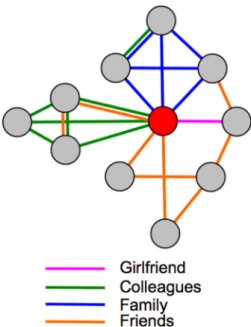
Figure 1. The ego-network around the red individual is composed of
connections that correspond to different social processes. Most studies of large-scale networks tend to overlook this aspect, simply identifying the presence or absence of relations. Such representation leads to a lim-ited and sometimes misleading characterization of the social network as a whole.
Large-scale studies often rely on coarse descriptions of the individuals and their relations. For instance, in the tradition of statistical physics, the internal state of an individual is often modeled as a binary variable, for example ’sell’ or ’buy,’ thereby over-simplifying its complex nature. Similarly, the type of rela-tion between individuals is usually neglected, and is either ap-proximated by a binary variable, such as ’present’ or ’absent,’ or by a weight characterizing its intensity. Attempts to improve the measurement of such details include real-world experiments where people wear ’sociometers’12 that capture physical prox-imity, location, movement and other facets of their social life.
10.2417/3201202.003985 Page 2/3
Figure 2. Statewide variations in neuroticism, a personality trait associated with emotional impulsiveness, as calculated from MyPersonality11
data. Red corresponds to states whose values are statistically over the average, while blue states are below average.
However, those experiments tend to be limited in size. Our work aims at uncovering the nature of social relations between indi-viduals and at providing a detailed measure of their internal state at a large scale.
A set of nodes connected by different types of relations is called a multiplex or multi-relational network13 (see Figure 1). In order to measure multiplexity in large social systems, we turned to the Pardus massive multiplayer online game.14In such a game, players are immersed in a virtual world where they experience an alternative life with a variety of possible social interactions among players. Virtual worlds offer a series of ad-vantages for research: for instance, all information about ac-tions taken by players is stored in log files, and experiments that would have been otherwise unacceptable or impossible can be conducted.15 In our work,16 we extracted networks based on six different types of one-to-one interactions between the players. We observed significant topological differences between networks with a positive connotation (friendship, communica-tion or trade) and those with a negative connotacommunica-tion (enmity,
armed aggression or punishment). We also studied the interde-pendence of different network types and presented the first em-pirical large-scale verification of structural balance theory.16, 17 This theory predicts that certain types of network motifs are sta-ble, and thus over-represented, in networks with conflictual re-lations.
Another important aspect missing from previous works is a characterization of the internal state of individuals. A psycho-logical profile is a good candidate for capturing this state. To explore that idea, we analysed data from the highly popular
MyPersonality Facebook application,11which has surveyed
mil-lions of Facebook users with peer-reviewed personality tests. Coupled with standard Facebook information about the users, this data allowed us to address a range of hitherto unanswered questions, such as whether personality affects social behaviour, correlates with taste in movies18or shows significant
geograph-ical variations19 (see Figure 2). In particular, we performed a
10.2417/3201202.003985 Page 3/3
study of the relationship between sociometric popularity (num-ber of Facebook contacts) and personality traits using data from 200,000 individuals,20 the first of its kind on a large number of subjects. We found that the strongest predictor for an individ-ual’s number of contacts is a trait called extraversion, which is usually associated with sociability and excitement-seeking, while other personality traits do not play a significant role.
Social science is about studying how behaviour on a societal level emerges from a large number of interactions between indi-viduals. However, those interactions and the intrinsic properties of individuals are hard to measure, especially at a large scale. Our work aims to find the right balance between high-quality data in small systems and low-quality data in large systems. To do so, we have focused on new types of data in virtual worlds and in Facebook. This approach has opened new research direc-tions related to the dynamics and organization of conflict and to the effect of personality on social behaviour. As a next step, we will explore in detail the dynamic nature of social networks, namely the rearrangement of links in time, and develop theo-retical models and algorithms to help understand the temporal behaviour of social networks.
I would like to thank my collaborators, in particular V. D. Blondel, J.-C. Delvenne, M. Kosinski, D. Quercia, M. Szell and S. Thurner. This work was conducted under COST (European Cooperation in Science and Technology) Action MP0801: Physics of Competition and Con-flicts. Author Information Renaud Lambiotte Department of Mathematics University of Namur Namur, Belgium
Renaud Lambiotte is an assistant professor.
References
1. D. Lazer, A. Pentland, L. Adamic, S. Aral, A.-L. Barab´asi, D. Brewer, N. Chris-takis, et al., Computational social sciences, Science 323, pp. 721–724, 2009. 2. L. Adamic and N. Glance, The political blogosphere and the 2004 US election:
divided, Proc. 3rd Int’l Workshop Link Discovery, pp. 36–43, 2005. doi:10.1145/1134271.1134277
3. J. Leskovec, L. Adamic, and B. Huberman, The dynamics of viral marketing, ACM
Trans. Web 1, p. 1, 2007.
4. J.-P. Onnela, J. Saram¨aki, J. Hyv ¨onen, G. Szab ´o, D. Lazer, K. Kaski, J. Kert´esz, and A.-L. Barab´asi, Structure and tie strengths in mobile communication networks,
Proc. Nat’l Acad. Sci. USA 104, pp. 7332–7336, 2007.
5. R. Lambiotte, V. D. Blondel, C. de Kerchove, E. Huens, C. Prieur, Z. Smoreda, and P. Van Dooren, Geographical dispersal of mobile communication networks,
Physica A 387, pp. 5317–5325, 2008.
6. M.C. Gonz´alez, C.A. Hidalgo, and A.-L. Barab´asi, Understanding individual hu-man mobility patterns, Nature 453, pp. 479–482, 2008.
7. D. J. Watts, A twenty-first century science, Nature 445, p. 489, 2007.
8. M. J. Salganik and D. J. Watts, Web-based experiments for the study of collective social dynamics in cultural markets, Topics Cognit. Sci. 1, pp. 439–468, 2009. 9. M. Rosvall and C.T. Bergstrom, Maps of random walks on complex networks reveal
community structure, Proc. Nat’l Acad. Sci. USA 105, pp. 1118–1123, 2008. 10. V. D. Blondel, J.-L. Guillaume, R. Lambiotte, and E. Lefebvre, Fast unfolding of
communities in large networks, J. Stat. Mech., p. P10008, 2008. 11. Homepage of the MyPersonality research project.
http://www.mypersonality.org/
12. A. Pentland, Honest Signals: How They Shape Our World, MIT Press, 2008. 13. M. McPherson, L. Smith-Lovin, and J.M. Cook, Birds of a feather: homophily in
social networks, Annu. Rev. Sociol. 27, pp. 415–444, 2001.
14. Homepage of the Pardus massive multiplayer online browser game. http://www.pardus.at
15. W. S. Bainbridge, The scientific research potential of virtual worlds, Science 317, pp. 472–476, 2007.
16. M. Szell, R. Lambiotte, and S. Thurner, Multi-relational organization of large-scale social networks in an online world, Proc. Nat’l Acad. Sci. USA 107, pp. 13636– 13641, 2010.
17. J. Leskovec, D. Huttenlocher, and J. Kleinberg, Predicting positive and negative links in online social networks, Proc. Int’l Conf. World Wide Web, pp. 641–650, 2010.
18. O. Chausson, Who watches what?: assessing the impact of gender and personality on film preferences. Paper published online on the MyPersonality project website. http://mypersonality.org/wiki/doku.php?id=movie tastes and personality 19. P. J. Rentfrow, Statewide differences in personality: toward a psychological geography
of the United States, Amer. Psych. 65, pp. 548–558, 2010.
20. D. Quercia, R. Lambiotte, M. Kosinski, D. Stillwell, and J. Crowcroft, The person-ality of popular Facebook users, Proc. ACM Conf. Comput. Support. Cooperat.
Work, 2012. To appear.
c