HAL Id: tel-01870206
https://tel.archives-ouvertes.fr/tel-01870206
Submitted on 7 Sep 2018
HAL is a multi-disciplinary open access archive for the deposit and dissemination of sci-entific research documents, whether they are pub-lished or not. The documents may come from
L’archive ouverte pluridisciplinaire HAL, est destinée au dépôt et à la diffusion de documents scientifiques de niveau recherche, publiés ou non, émanant des établissements d’enseignement et de
Recognition
Hua Lu
To cite this version:
Hua Lu. Video Analysis for Micro- Expression Spotting and Recognition. Signal and Image processing. INSA de Rennes, 2018. English. �NNT : 2018ISAR0005�. �tel-01870206�
pour obtenir le titre de DOCTEUR DE L’INSA RENNES Spécialité : Signal, Image, Vision
Hua LU
ECOLE DOCTORALE : MATHSTIC LABORATOIRE : IETR UMR CNRS 6164
Video Analysis for
Micro-Expression Spotting and
Recognition
Thèse soutenue le 05.04.2018
devant le jury composé de :
Christophe ROSENBERGER
Professeur, ENSI Caen / Président
Olivier ALATA
Professeur, Université de Saint-Etienne / Rapporteur
Mohamed DAOUDI
Professeur, Université de Lille / Rapporteur
Catherine SOLADIE
Maître de Conférences, CentraleSupélec / Examinateur
Pascal BOURDON
Maître de Conférences, Université de Poitiers / Examinateur
Kidiyo KPALMA
Professeur, INSA de Rennes / Directeur de thèse
Analyse de vidéo pour la détection et la
reconnaissance de micro-expressions
Hua LU
En partenariat avec
Firstly, I would like to express my sincere gratitude to my two supervisors Prof. Kidiyo KAPLMA and Prof. Joseph RONSIN for the continuous support of my PHD study and related research, for their patience, motivation, and immense knowledge. Their guidances provided me many help in all the time of research and writing of this thesis. I could not have imagined having better advisors for my PHD study.
Besides, I would like to thank the rest of my thesis committee, Prof.Olivier ALATA, Mohamed DAOUDI, Christophe ROSENBERGER, Catherine SOLADIE and Pascal BOURDON, for their insightful comments and questions which encouraged me to widen my research from various perspective.
Furthermore, I am grateful to all those who gave me the possibility to complete this study. Especially, I would like to express my sincere gratitude to Prof. Mingqiang YANG, the supervisor of master, for his help, support and encouragement in overcoming numerous obstacles I have been facing. Meanwhile, I would like to thank Da CHEN, for the guidance in writhing skills and fruitful discussion with him. In addition, I am grateful for the scholarship provided by China Scholarship Council (CSC).
Nevertheless, I am also grateful to all my colleagues in Institut d’Electronique et de Télécommunications de Rennes (IETR) for providing me help and guidance both in my daily life and research work.
I would like thank my friends, HengYang WEI, Yi LIU, Lu ZhANG, Qiong WANG, Shishun TIAN, Fangyi CHAO, Lipin LI, Jingjun Gao and Ang Zhou, for their help and of course friendship.
Finally, I would like to thank my family : my parents, my sisters and brother for supporting me spiritually throughout writing this thesis and my life.
Chapitre 1 : Introduction
Les expressions faciales se produisent lorsque les gens ont tendance à exprimer leurs sentiments ou réagir à une situation. Dans notre vie quotidienne, les expressions faciales jouent un rôle important dans la communication avec les autres. En général, elles peu-vent se diviser grossièrement en deux catégories : macro-expression et micro-expression. Contrairement aux macro-expressions qui durent longtemps et ont une forte manifesta-tion sur le visage, les micro-expressions se caractérisent par un changement rapide qui dure moins d’une demi seconde et ont une faible intensité sur des parties du visage. Les micro-expressions apparaissent généralement dans les situations où les gens cherchent á contrôler ou gérer leurs émotions : une micro-expression, c’est ce qu’il reste lorsque la personne essaie de dissimuler une émotion. Généralement, dans la vie quotidienne, l’ob-jectif principal du contrôle des émotions ou des mensonges est de lisser et faciliter les interactions sociales, de gagner l’estime et l’affection des autres. La politesse veut que l’on ne révèle pas les mensonges lorsqu’ils surviennent afin d’assurer un fonctionnement social normal. Cependant, il est important de détecter les mensonges commis avec une intention hostile. Les menteurs ne peuvent pas supprimer complètement toute expression faciale du visage et ainsi, la manifestation de micro-expressions peut servir comme un indice d’une tromperie. Ces propriétés inspirent les applications potentielles des micro-expressions dans les domaines de la sécurité, de la médecine, dans la détection de mau-vaises intentions dans un aéroport, dans la perception de distorsions psychiatriques chez des patients, et dans l’efficacité des négociations dans les affaires.
L’objectif de l’analyse des micro-expressions dans des vidéos comprend leur détection et leur reconnaissance. Une grande variété d’approches de détection et de reconnaissance de micro-expressions a été exploitée au cours de la dernière décennie. Pour la détection de micro-expressions, une idée largement utilisée est de comparer les distances statistiques
dérivée de la déformation du visage est un autre moyen de suivre les micro-expressions, par ex. la méthode de flux optique [SBF+14]. Cependant, les informations de mouvement restent souvent sensibles au bruit.
Pour la reconnaissance de micro-expressions, l’extraction des caractéristiques est l’un des points les plus importants. De nombreux efforts ont été déployés pour l’extraction de caractéristiques efficaces et discriminantes. Le motif local binaire (LBP-TOP), défini à partir de trois plans orthogonaux, est l’un des descripteurs choisis en premier pour la représentation des micro-expressions [PLZP11], en raison de sa capacité à décrire à la fois la forme et la dynamique des informations de texture des images du visage. Cependant, les méthodes basées sur LBP-TOP ont des difficultés à capturer les changements d’ap-parence subtils tels que les petites rides autour des yeux ou de la bouche, et par lesquels les résultats de la reconnaissance des micro-expressions sont dominants. Comme vari-antes, parmi les caractéristiques existvari-antes, les caractéristiques de mouvement dérivées du flux optique sont choisies, en raison de leur capacité à caractériser, avec succès, des mouvements subtils sur le visage.
Dans cette thèse, deux méthodes de détection et une méthode de reconnaissance de micro-expressions sont proposées. Le reste de la thèse est organisé comme suit : le con-texte de la thèse est introduit dans le chapitre 2, y compris les concepts de base sur les macro- et micro-expressions. Le chapitre 3 introduit plusieurs descripteurs de caractéris-tiques fondamentaux et le classificateur SVM (machine à vecteurs de support) utilisé dans la reconnaissance de micro-expressions. Deux méthodes proposées pour la détection de micro-expressions sont présentées dans le chapitre 4. Le chapitre 5 introduit les méth-odes de reconnaissance de micro-expressions faciales basées sur des caractéristiques de mouvement. Enfin, la conclusion et des perspectives sont présentées dans le chapitre 6.
Chapitre 2 : Expressions faciales
Ce chapitre présente le contexte de cette thèse : les concepts de base sur les et micro-expressions. La description de l’expression faciale et les différences entre macro-et micro-expressions ainsi que leurs relations sont présentées. L’outil classique d’analyse d’expressions faciales par système de codage d’actions faciales FACS (facial action coding system) faisant usage d’unités d’action (AU) analysant les expressions est présenté. Dans
Les macro-expressions sont des expressions faciales qui durent plus d’une demi-seconde et peuvent être facilement observées à l’œil nu tandis que les micro-expressions sont des expressions faciales qui se produisent dans un temps bref qui est beaucoup plus court que les macro-expressions. Une micro-expression révèle le vrai sentiment/émotion que les gens essaient de cacher ou d’inhiber. L’origine de la micro-expression peut remonter à l’hypothèse d’inhibition de Darwin [DP98] écrivant que certaines expressions faciales ne peuvent pas s’être créées spontanément mais en fait sont exprimées pour refléter l’émo-tion ressentie. Près de cent ans plus tard, Haggard et Isaacs [HI66a] ont rapporté trouver des micro-expressions lors d’un visionnage de films cinématographiques, image par im-age, dans une recherche sur l’échange thérapeute-patient. Quelques années plus tard, en s’appuyant sur les travaux antérieurs de Haggard et Isaacs, Ekman et Frisen [EF69] ont signalé l’existence de la micro-expression quand ils ont étudié les relations entre le mensonge et les comportements non verbaux du corps. La capacité à identifier les micro-expressions est une compétence importante pour lire l’émotion ressentie par une personne. Cependant, la plupart les gens ne peuvent remarquer l’apparition de micro-expressions, ni les reconnaître en temps réel. Elles apparaissent et disparaissent si vite que vous les manqueriez si vous cligniez des yeux. Aussi, les scientifiques tentent-ils de former les gens à reconnaître les micro-expressions. L’entraînement avec l’outil d’appren-tissage de micro-expressions augmente le taux de reconnaissance des mensonges pendant lesquels des micro-expressions se produisent. Afin d’analyser les expressions faciales, le système de codage d’action faciale (FACS) basé sur les unités d’action faciales (AU) fut développé par Ekman et Friesen [EF76] pour décrire et distinguer les mouvements du visage. Une unité d’action est l’unité minimale du comportement facial, qui peut être combinée et prise en compte pour décrire toute expression faciale. Ils ont défini 44 AU qui sont présentées et étudiées en groupes en fonction de l’emplacement ou du type d’action en cause.
Pour l’étude des micro-expressions, neuf bases de données ont été établies dans les années récentes. Le tableau 1 résume brièvement ces bases de données.
USD-HD 100 \ \ \ 29,7 1280×720 Posé 6 Non
York-DDT 18 50 \ \ \ \ Spontané \ Non
Canal9 24 195 \ \ \ 720×576 Spontané \ Non
CASME A 195 35 22.3 1 60 1280×720 Spontané 7 Oui
B 640×480 SMIC SMIC-HS 164 20 26,7 3 100 640×480 Spontané 3 Non SMIC-VIS 71 10 25 SMIC-NIR 71 10
CASME II 255 35 22,03 1 200 640×480 Spontané 5 Oui CAS(ME)2 57 22 22,59 1 30 640×480 Spontané 4 Oui SAMM 159 32 33,24 13 200 2040×1088 Spontané 7 Oui
Chapitre 3 : Extraction et classification des caractéristiques
faciales
L’extraction et la classification de caractéristiques faciales sont les principales tâches dans un système d’analyse le micro-expressions. L’extraction des caractéristiques faciales et les méthodes d’apprentissage automatique sont toutes les deux essentielles pour obtenir une excellente performance de reconnaissance. L’extraction de caractéristiques est un pro-cessus de transformation de données brutes en vecteurs de caractéristiques qui décrivent correctement les données de sorte que la performance du modèle construit sur des données inconnues puisse être optimale. Une caractéristique descriptive est une représentation d’une image pour sa caractérisation. Ce processus implique l’extraction d’informations efficaces et l’ignorance des données non essentielles. Un bon vecteur de caractéristiques fournit des informations essentielles et discriminantes pour des tâches telles que la dé-tection d’objets ou la reconnaissance d’images. Une fois ces vecteurs de caractéristiques obtenus, les vecteurs sont livrés à des classificateurs comme les SVM ou les forêts d’arbres décisionnels (ou Random Forest) pour produire la classification.
Une brève étude bibliographique est menée dans ce chapitre sur l’extraction des carac-téristiques faciales et leur classification. Plusieurs méthodes fondamentales pour l’extrac-tion de caractéristiques sont examinées et toutes constituent la base pour l’extracl’extrac-tion de caractéristiques de expressions. La plupart des travaux liés à l’analyse des micro-expressions impliquent l’amélioration ou la combinaison de ces méthodes fondamentales. Le principe de base du SVM est présenté, avec trois noyaux largement utilisés : à savoir le noyau linéaire, le noyau polynomial et le noyau gaussien RBF (radial basis function).
Les approches traitant de micro-expressions dans le domaine de la vision par ordi-nateur consistent à détecter et classifier les micro-expressions dans des vidéos. Cela in-spire une série d’approches pour l’analyse de micro-expressions intégrant des techniques assistées par ordinateur. Ce chapitre présente deux axes basés sur deux nouvelles carac-téristiques pour la détection de micro-expressions, qui seront présentées dans ce qui suit : la projection intégrale et la distance géométrique.
Détection de micro-expression à l’aide de la projection intégrale
Dans cette section, nous proposons une nouvelle méthode de détection des micro-mouvements en invoquant la projection intégrale (IP) [LKR17] comme caractéristique pour décrire les changements dans des blocs divisant l’image du visage. Fondamentale-ment, la nouvelle méthode consiste en une série d’opérations : le suivi du visage et son traitement, le recadrage et l’extraction des visages, le calcul de la distance χ2 pour mesurer la dissimilarité entre la caractéristique de projection intégrale de chaque trame et celle des images de référence, et le seuillage et la détection de pics. Parmi ces procé-dures, la projection intégrale sera présentée en détail ci-après. De façon à réduire les effets du choix de l’image de référence, une nouvelle méthode de sélection d’une image de référence est développée. Elle convient à la tâche de détection dans de longues vidéos en sélectionnant automatiquement différentes images de référence. Par comparaison avec la méthode qui choisit toujours la première image comme référence, dans le cas d’une très longue vidéo, elle permet de réduire des erreurs s’accumulant le long d’une séquence.
Projection intégrale
En raison des difficultés pour les gens à lire les micro-expressions, il est nécessaire de trouver des méthodes appropriées pour capter les changements subtils et rapides du visage. L’approche IP est présentée dans ce qui suit et est considérée comme une technique utile pour l’extraction des traits du visage. Comme l’IP peut être extrêmement efficace pour déterminer la position des caractéristiques, Brunelli et al. [BP93] l’ont appliqué pour la reconnaissance du visage humain. Dans un travail récent [HZH+16a], une méthode combinant l’IP et le LBP a été choisie pour la reconnaissance de micro-expressions grâce à sa capacité à fournir la propriété de la forme des images faciales. L’IP est une méthode
Soit Ω ⊂ R2 le domaine de l’image et I : Ω × D → R une séquence d’images de niveaux de gris, où D ⊂ R est l’espace temps. A chaque point (x, y) ∈ Ω et à l’instant t, la valeur d’intensité est notée I(x, y, t) et la formule typique de la fonction IP peut être exprimée comme suit :
IPtH(x) = 1 y2− y1 Z y2 y1 I(x, y, t)dy, (1) IPtV(y) = 1 x2− x1 Z x2 x1 I(x, y, t)dx, (2)
La prochaine section présente une autre approche de détection des micro-expressions utilisant les caractéristiques géométriques.
Détection de micro-expressions à l’aide de la distance géométrique
Dans cette section, une autre méthode de détection innovante est proposée en ex-ploitant les distances géométriques (distances euclidiennes) entre des points clés définis sur un visage. Les distances euclidiennes entre les points clés peuvent capturer des dé-placements subtils le long des séquences et se sont avérées convenir à différentes tâches d’analyse faciale. Comme le rognage et le recadrage des visages ne sont pas requis, une faible complexité de calcul peut être obtenue en comparaison avec d’autres méthodes d’extraction de caractéristiques de textures ou de mouvements. L’organigramme de la méthode proposée est résumé à la Fig. 1. L’algorithme initialement extrait 49 points clés du visage dans des séquences vidéo contenant une micro-expression dynamique, cela du début jusqu’à la fin en passant par l’apogée, en utilisant la méthode de descente su-pervisée [XT13]. Afin d’obtenir des localisations précises, il est important de recaler les points clés après que l’alignement est effectué. La tâche essentielle dans l’organigramme est "Distance géométrique (geometrical distance)", qui sera expliquée plus en détails dans ce qui suit. L’analyse de la distance est effectuée pour le calcul de la différence le long de la séquence vidéo et la caractéristique obtenue est fournie au SVM pour la classification de la séquence en micro-expression (ME) / en non micro-expression (Non ME).
Figure 2: Une illustration des distances géométriques. (a) Emplacements des points de référence. (b)Distances géométriques entre les points des sourcils et le point de nez (Gb). (c) Distances géométrique entre les points de
paupières (Ge). d) Les distances géométriques de la bouche (Gm), y compris les distances entre les points de la
bouche et le point sous le nez (Gu), les coins des lèvres largeur(Gl& Gr), largeur de la bouche (Gw) et hauteur de
de la géométrie des déplacements des points clés le long de la séquence vidéo, cela sans prendre en compte toutes les informations de texture du visage. Parmi les 49 points clés, les points du sourcil (10 points) et de la bouche (18 points) sont très sensibles à la plupart des expressions : voir Fig. 2. Il est rainsonnable de penser que la différence géométrique d’une micro-expression entre les images d’une séquence possède une dynamique le long de la séquence : elle commence à partir d’une petite valeur, puis atteint un pic et finalement retombe à une petite valeur.
Dans ce chapitre, deux méthodes de détection de micro-expressions sont proposées. L’-analyse sur les différences de la projection intégrale permet de détecter automatiquement les micro-mouvements avec une complexité de calcul faible. Les résultats expérimentaux sont positifs sur l’ensemble des bases de données CASME-A, CASME-B et CASME II, indiquant que cette méthode est capable de capter des micro-expressions dans des vidéos. À notre connaissance, c’est la méthode la plus rapide pour la détection automatique de micro-expressions et elle pourrait être mise en œuvre à l’avenir pour une détection en temps réel. La caractéristique géométrique est extraite de la face alignée, sans prendre en compte l’étape d’extraction du visage. La distance géométrique capture les petits changements pertinents plutôt qu’une caractéristique d’apparence. Ainsi, cette fonction-nalité est robuste à une variation d’éclairage. La performance sur quatre jeux de données de micro-expressions faciales (telles que SMIC-sub, SMIC-HS, SMIC-NIR, SMIC-VIS) démontre l’efficacité et le potentiel discriminant de la caractéristique géométrique. Au cours de l’expérience, il a été remarqué que les mouvements de la tête peuvent provoquer des détections erronées. Donc, á l’avenir, des algorithmes plus robustes devraient être étudiés pour résoudre ces problèmes.
Chapitre 5 : Reconnaissance de micro-expressions basée sur
le mouvement
Ce chapitre présente les méthodes de reconnaissance des micro-expressions faciales basées sur des caractéristiques du mouvement. A la suite de l’examen des approches ex-istantes pour la reconnaissance de micro-expressions, un nouvel opérateur, appelé fusion d’histogrammes des frontières de mouvement (FMBH), est proposé. Cet opérateur est
de ces champs de vecteurs externes. Les mouvements inattendus causés par un décalage résiduel apparaissant entre les images rognées de différentes trames sont supprimés et seul le mouvement relatif est capturé. Pour la construction des histogrammes respectifs, nous examinons également l’influence des différentes façons de construire une grille dense. Les études actuelles calculent les histogrammes des caractéristiques du mouvement en exploitant un nombre fixe de cases d’orientation spatiale. Notre travail étudie l’influence du nombre de cases d’orientation et de sa rotation de manière à tester la performance de reconnaissance. Afin d’extraire des caractéristiques discriminantes, la réduction de la dimensionnalité par la méthode de l’ACP est appliquée car elle présente des propriétés puissantes pour identifier la plupart des caractéristiques significatives et maintenir une forte corrélation entre deux caractéristiques de mouvement. Enfin, le classificateur SVM est utilisé pour la classification.
Fusion des histogrammes des frontières de mouvement : le descripteur proposé
Le mouvement facial peut être bien décrit en associant des caractéristiques de mouve-ment. Dans cette section, nous introduisons une nouvelle méthode de fusion de caractéris-tiques d’histogrammes de frontières de mouvement qui est établie sur la caractéristique de frontières de mouvement MBH. Les MBH sont calculés en termes, à la fois, des normes ou amplitudes Mp, Mqet des angles θp and θq. Nous définissons et considérons une fonction scalaire : α : Ω → S1 qui est calculé en termes de θp and θq par
α(x) = Earctan(θq(x), θp(x)), (3)
où θpet θqsont définis dans Eqs. (5.3) and (5.4). La fonction α peut être facilement utilisée
pour établir un nouvel histogramme des orientations. Afin d’obtenir un histogramme pondéré, les normes Mpet Mqsont combinées ensemble. Cela peut être fait en considérant
une fonction M : Ω → R M (x) = q p2 x(x) + p2y(x) + q2x(x) + q2y(x) = q M2 p(x) + Mq2(x) (4)
∇F (x) = ∇p(x) ∇q(x) ! = px(x) py(x), qx(x) qy(x) ! . (5)
où px(x) (ou qx(x)) et py(x) (ou qy(x)) sont respectivement les d érivées de p(x) et de
q(x) selon x et y. Nous avons maintenant obtenu la fonction d’orientation α et la fonction de pondération M . L’étape suivante consiste à construire le nouvel histogramme. Puisque les deux histogrammes utilisés dans MBH sont fusionnés ensemble, la méthode proposée peut être appelée "fusion d’histogrammes des frontières de mouvement" pour "fusion MBH" (FMBH).
Soit {Θi}1≤i≤P une collection de sous-ensembles connectés de l’espace d’orientation S1 satisfaisant Θi∩ Θj = ∅, ∀i 6= j et ∪iΘi = S1. Basé sur une telle partition, la fusion
de l’histogramme des limites de mouvement H peut être construit avec un ensemble de fonctions caractéristiques χi χi(x) = 1, si α(x) ∈ Θi, 0, autrement. (6)
et la fonction de pondération qui est la norme M telle que H(i) =
Z
Ω
χi(x) M (x) dx. (7)
La forme discrète ˆH de H peut être exprimée par ˆ
H(i) = X
x∈Z2
χi(x) M (x), (8)
pour tout x ∈ Z2, où Z2 est la grille de discrétisation orthogonale du domaine Ω. La contribution principale, dans ce chapitre, réside dans la construction des carac-téristiques faciales établies sur la base de champs de vecteurs de flux optiques différentiels. Dans ce but, un mappage non linéaire a permis d’établir une caractéristique fusionnant les champs de vecteurs de gradients respectifs des deux composantes du flux optique. Les caractéristiques proposées sont ainsi extraites des normes de Frobenius de la matrice jacobienne dérivée du flux optique. Pour évaluer et optimiser les performances des car-actéristiques proposées, nous avons également étudié l’influence des différentes façons de construire les cases (bins) de l’histogramme en fonction du nombre de cases et de l’an-gle d’orientation initial de la première case. Les expériences menées sur quatre jeux de
Chapitre 6 : Conclusion et perspectives
Cette thèse est consacrée à la détection et la reconnaissance de micro-expressions dans les vidéos. Nous avons proposé des méthodes d’extraction de caractéristiques pour l’analyse de micro-expressions. La contribution principale et les éventuels travaux futurs sont présentés dans ce qui suit.
Contributions :
• principe de détection des micro-expressions basé sur la fonctionnalité IP,
• principe de détection des micro-expressions basé sur la géométrie des points clé, • principe de reconnaissance des micro-expressions basé sur une caractéristique de
mouvement. Travaux futurs :
• il serait utile d’étudier plus en profondeur la caractéristique géométrique pour la détection et la reconnaissance des micro-expressions,
• il vaudrait la peine de développer des approches plus puissantes d’alignement des visages,
• il serait utile d’explorer d’autres fonctions de mouvement, ou de combiner celles existantes,
• il serait intéressant d’étudier l’influence de différents classificateurs par apprentis-sage automatique pour la détection et la reconnaissance des micro-expressions, • pour des travaux de recherche futurs dans ce domaine : plus de bases de données
sur les micro-expressions devraient être construites à l’avenir. De nouvelles bases de données publiques et librement accessibles qui contiendraient plus d’échantillons, des données dans un véritable environnement de mensonge, des conditions variables d’occlusion, d’éclairage, etc. sont les bienvenues pour ce type de travail.
1 Introduction 17
2 Facial expressions 23
2.1 Introduction . . . 23
2.2 Facial Macro-Expressions . . . 23
2.3 Facial Micro-Expressions . . . 25
2.4 Facial Action Coding System (FACS) . . . 30
2.5 Micro-Expression Databases . . . 32
2.6 Conclusion . . . 44
3 Facial feature extraction and classification 45 3.1 Introduction . . . 45
3.2 Facial Expressions features . . . 46
3.2.1 Local Binary Battern (LBP) and its variant . . . 46
3.2.2 Histogram of Oriented Gradient (HOG) . . . 52
3.2.3 Optical Flow based features . . . 54
3.2.4 Video Magnification based features . . . 59
3.3 Facial micro-expression classification using Support Vector Machine (SVM) 60 3.4 Conclusion . . . 61
4 Micro-Expression Detection 63 4.1 Introduction . . . 63
4.2 Related work . . . 64
4.3 Micro-expression Detection Using the Integral Projection . . . 65
4.3.1 Integral Projection . . . 65
4.3.3 Experiments . . . 75
4.4 Micro-Expression Detection using Facial Geometrical Feature . . . 78
4.4.1 Geometrical Distance . . . 79
4.4.2 Dissimilarity analysis and Gaussian Smoothing . . . 83
4.4.3 Experiments . . . 85
4.5 Conclusion . . . 90
5 Motion-based micro-expression recognition 91 5.1 Introduction . . . 91
5.2 Related Works . . . 92
5.3 Fusion of Motion Boundary Histograms : the proposed descriptor . . . 94
5.3.1 Motion boundary (MB) features computation . . . 95
5.3.2 Fusion motion boundary histograms . . . 96
5.3.3 Bins construction . . . 98
5.4 Implementation Details . . . 99
5.4.1 Datasets . . . 99
5.4.2 Baseline features . . . 101
5.5 Experimental results . . . 104
5.5.1 Comparison of performance of descriptors under different number of bins . . . 104
5.5.2 Comparison of different blocking . . . 106
5.5.3 Comparison of baseline descriptors with state-of-the-arts . . . 106
5.6 Conclusion . . . 109
6 Conclusion and Perspectives 111
Appendix A 127
Appendix B 137
Publication 139
Introduction
In our daily life, the facial expressions play a significant role in communication with others. People can convey their feelings by making facial expressions and can also know the emotions of others by reading facial expressions. In general, the facial expressions are roughly divided into two categories : the macro-expressions and the micro-expressions. In contrast to the macro-expressions which last a long time and have strong manifestation on face, micro-expressions can be characterized as a rapid change which last only less than a half of second and have a low intensity in parts of the face. Micro-expressions usually appear in situations where people want to control or manage their emotions. For most people, the main purpose of telling lies in their daily life is to smooth so-cial interactions, or to gain the esteem and affection of other people. Politeness com-mands that we should not reveal these lies in order to ensure the normal social function-ing. However, it can be important to detect lies with hostile intent. Liars cannot com-pletely suppress facial expressions such that the manifestation of micro-expressions can be served as leakage or deception clue. These properties inspire the potential applications of micro-expressions in (1) high-stake situation, such as criminal investigations, airport and mass transit checkpoints, counter terrorism ; (2) business, including the sales, coach-ing, traincoach-ing, management, recruitment, leadership, business negotiations ; (3) medical treatment, such as doctor-patient consultation. However, despite the efforts of exploiting the micro-expression training tool by Ekman [Ekm02] for training people to recog-nize micro-expressions with naked eyes, only few experts have the ability of capturing micro-expressions by naked eyes. Given these difficulties suffered by the micro-expression detection by human, the requirements towards automatic facial micro-expression analysis
have insensitively increased in recent years. Even though the techniques in the field of computer vision/video understanding has been widely developed, the micro-expression analysis is still a challenging problem, since micro-expressions have the characters of brief duration and low intensity.
The goal of micro-expression analysis consists of two tasks : the detection and clas-sification of micro-expressions in videos. A broad variety of micro-expressions detection and recognition approaches have been exploited in the past decade.
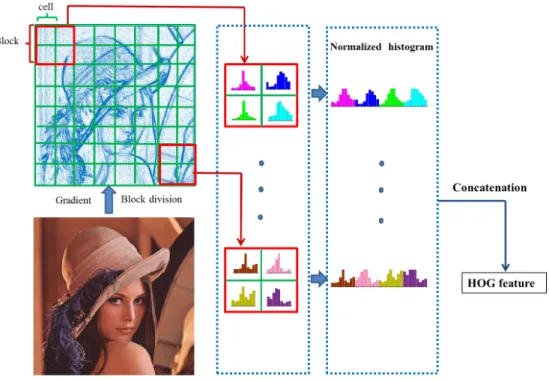
For micro-expressions detection, a widely used idea is to compare the statistical dis-tances between texture features derived from different video frames, the main advantage of which is the low computation complexity. The approaches based on this distance-based idea take into account the basic features like the local binary patterns (LBP) [MZP14a] and the histogram of oriented gradient (HOG) [PKO09, DYL15] to characterize changes in the blocks of a face image. With these features in hand, the statistical distances such as the chi-squared distance can be used to compare differences between the reference frame and the successive frames. A micro-expression is made up of a set of successive frames, each of which has a distance value to the reference frame. Using the motion informa-tion derived from the face deformainforma-tion is an alternative way to track micro-expressions, e.g. the optical strain method [SBF+14]. However, the motion information is sensitive to noise. A main directional maximal difference [WWQ+17] is proposed for solving this problem. Using the machine learning classifiers, more advanced detection methods have been devoted to this field, such as the temporal interpolation model [PLZP11], the re-encoded LBP using a re-parametrization of the second local order Gaussian Jet [RHP13], the random walk model [XFP+16] or the sparse sampling [LNSP17] combined with the support vector machine (SVM), multi-kernel learning or random forest classifiers. In their basic formulation, the supervised methods train a model to determine if a sequence does or does not contain a micro-expression. Although these methods achieve better detection performance than unsupervised models, the establishment of the training database will cost high computation burden.
For micro-expression recognition, the feature extraction is one of the most important steps. Many efforts have been done concerning the extraction of efficient and discriminant features. The local binary pattern from three orthogonal planes (LBP-TOP) operator is one of the firstly chosen descriptors for the representation of micro-expressions [PLZP11], due to its ability to describe both the shape and the dynamic texture information of face images. Furthermore, in order to improve the recognition results, a variety of the methods
that combine the LBP-TOP with other descriptors have been developed, including the LBP-STP [LHM+15], the combination of the Eulerian video magnification and the LBP-TOP [WRS+12], the STLBP-IIP model [HWL+16] and the STCLQP model [HZH+16a]. However, these methods based on the LBP-TOP have difficulties to capture the subtle appearance changes such as small wrinkles around the eyes or mouths, by which the recognition results of the micro-expressions are dominated. Alternatively, motion features derived from the optical flow are chosen due to their ability in successively characterizing subtle movements on face. The corresponding approaches include the main direction mean optical flow [LZY+16], the bi-weighted oriented optical flow [LSPW16] and the facial dynamics map [XZW17].
Besides the methods listed above, the approaches, such as the tensor independent color space model [WYL+14] and the combination of the local spatiotemporal directional features and robust principal component analysis in [WYZ+14], as well as the method based on the similar appearance of macro- and micro-expressions which aims to recognize micro-expressions by training a model in macro-expressions dataset [WSF11, JBY+17], also have obtained promising results.
Within this thesis, three methods for micro-expression detection and recognition are proposed. The main structure of the document is outlined as follows :
• Chapter 2 introduces the background : the basic knowledge for the macro- and micro-expression. We start this chapter from the description of the facial expres-sion, and point out the differences between macro- and micro-expressions as well as their relations. Then the classical facial expressions analysis tool using facial action coding system (FACS) is introduced to make use of action units (AUs) for analyz-ing expressions. In this chapter, nine micro-expressions databases built in recent years are briefly introduced. Among them, three widely used databases including CASME [YWL+13a], CASME II [WJYWZ+14] and SMIC [LPH+13] are listed in detail. Specifically, the procedure of building databases is provided, including the way of expression elicitation, the way of selecting micro-expressions from raw videos and so on. The unsettled work in the establishment of micro-expressions databases is finally discussed.
• Chapter 3 introduces several fundamental feature descriptors and the support vector machine classifier used in micro-expressions recognition. Features include the LBP-based features, the optical flow-based features, the histogram of oriented gradient descriptor. Three kernels of the SVM are investigated.
• Chapter 4 introduces our two new methods for micro-expression detection. 1. A micro-movement detection method exploiting the integral projection [LKR17]
as a feature descriptor to characterize changes in the blocks of the face im-age is proposed. Basically, this new method consists of a series of operation : face tracking and processing, cropping and masking faces, integral project-ing extraction, chi-squared distance computation for measurproject-ing the integral projection feature dissimilarity between each frame and the reference frame, and the thresholding and peak detection on obtained chi-squared distance val-ues. In order to reduce effects of the reference frame choice, a new reference frame selection method is developed. It leads to the reduction of the errors accumulating along the sequence, when compared to method which always chooses the first frame. The proposed method is evaluated on two widely used datasets of CASME and CASME II through experimental comparisons with some popular feature extractors such as the OF, LBP and HOG operators. One of the main advantages of our method is its computation simplicity : the proposed method can obtain better or comparable results, but requiring much less computation time than the existing models using the OF, LBP and HOG operators.
2. A novel detection method is proposed by exploiting the geometrical distances (Eu-clidean distance) on a face. The Eu(Eu-clidean distances between key points can capture subtle displacements along sequences and are proved to be suitable for different facial analysis tasks. Since the operation of cropping faces is not required, a lower computation complexity can be achieved in contrast with other texture or motion feature extraction methods. Experiments are con-ducted on the SMIC database by comparing the proposed method against state-of-the-art. The SMIC database consists of four sub-datasets which are SMIC-sub, SMIC-HS, SMIC-VIS, and SMIC-NIR. Comparative experimen-tal results demonstrate that the proposed feature descriptor yields the best performance.
• Chapter 5 introduces facial micro-expressions recognition methods based on mo-tion features. Upon the reviews of the existing approaches for micro-expression recognition, a new operator, called fusion motion boundary histograms (FMBH), is proposed. This operator is computed by combing both the horizontal and the vertical components of the differential of the optical flow. It is established by fusing
the information derived from these external vector fields in a nonlinear mapping manner. The unexpected motions caused by residual mis-registration that occurs between images cropped from different frames is removed such that the relative motion can be captured. For the construction of the respective histograms, we also examine the influence of different ways of building bins in a dense grid. Current studies compute the histograms of motion features by exploiting a fixed number of spatial orientation bins. This study investigates the influence of the number of orientation bins and its rotation so as to test the corresponding recognition per-formance. In order to extract discriminative features, the dimensionality reduction method of the PCA is applied since the PCA has powerful properties to identify most meaningful features and maintain a strong correlation between two motion features. Finally, the SVM classifier is employed for classification. The proposed feature is then validated and evaluated through the leave-one-subject-out (LOSO) protocol for micro-expression recognition. Moreover, the proposed method is com-pared to state-of-the-art methods on four well-known databases CASME, CASME II, SMIC and CAS(ME)2. Comparative experimental results demonstrate that the proposed FMBH feature descriptor yields promising performance.
Chapter 6 summarizes the main contributions of this thesis and gives the perspec-tive future work.
Facial expressions
2.1
Introduction
Facial macro- and micro-expression analysis are topics of computer vision in recent years. Both macro- and micro-expressions play different roles in a human’s life. They are facial expressions which mainly differ from each another regarding their lasting time. The studies associated to micro-expression begun half a century ago, and focused in the field of psychology. Finding solutions to micro-expression related problems by computer vision has attracted more and more attention thanks to the establishment of a broad variety of available micro-expression datasets.
This chapter begins by giving general concepts involving facial expressions that con-tain facial macro and micro-expressions in Section 2.2. The facial action coding sys-tem (FACS) in Section 2.4 is specially presented, which breaks down facial movements into a number of action units (AUs) and describes the facial changes in terms of AUs. This coding system can be exploited as a useful tool for building macro- and micro-expression database. Next, several micro-expression datasets are described in Section 2.5. The con-clusion is presented in Section 2.6.
2.2
Facial Macro-Expressions
Macro-expressions are facial expressions which last more than half second and can be easily observed by naked eyes. Most studies associated to facial expression analysis refer to the macro-expression analysis. Facial expression is one of the most powerful channels of communication for human beings to convey their feelings, intentions, personality and
so on. As a non-verbal behavior, the facial expression plays an important role in our daily life. People can express their feelings by making facial expressions and can also communicate with others by reading facial expressions. During the past two decades, facial expression analysis has been paid huge attention in many fields. Psychologists studied the human psychology conveyed by the changing facial expression and computer scientists relied on the digital process to analyze the expression.
As one of the most famous pioneers for scientific exploration of facial expression, Dar-win [DP98] hypothesized, based on his theory of evolution, that certain facial expressions of emotion appeared to be universal across various countries and culture. For a long time, the universality of facial expressions has remained standing debates in the psychology. Some emotion theorists carried out researches in various cultures to demonstrate that there exists several universal (basic or fundamental) emotions using the same elemental of facial muscle movements across the world [Tom84, EF86, EFO+87, Bro91, MF92, CH92]. For example, Tomkins et al. [Tom84] proposed 8 basic emotions, fear, anger, joy, sad-ness, disgust, acceptance, surprise and curiosity. Ekman et al. [EF86] reported 7 ba-sic facial expressions of anger, fear, surprise, sadness, disgust, contempt and happiness. However, there exists arguments against this theory. The early opinion is culture specific view, that what a facial expression implies is different from culture to culture [LaB47]. Ortony [OT90] questioned the assumption in theory of basic emotions and the view that which emotions are basic ones. Russell [Rus94] also doubted the reliability of the basic emotions concept which is plausible proposed by western psychologists and concluded that the association between facial expressions and emotion labels may vary in widely different cultures.
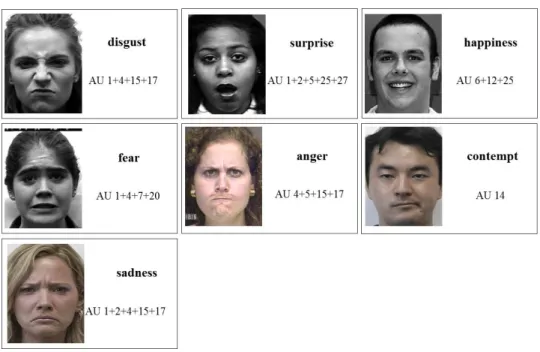
Despite the controversy, the universality theory of facial expression is widely accepted by many researchers and has had a profound impact on the modern automatic facial ex-pression analysis. However, according to Russell [Rus94], contempt and disgust have been found to be confused with each other such that contempt has aroused the most contro-versy and is thought to be the least well established of the basic emotions proposed by Ekman and Friesen [EF86]. Thus, researchers have been focusing on developing automatic recognition systems that recognize the six basic expressions except contempt. Automatic facial expression recognition has drawn an increasing attention within the computer vi-sion in recent years due to its wide applications in many areas such as human-robot interaction [ZG00] and computer facial animation [PW08]. Fig. 2.1 illustrates samples of seven basic facial expressions from Cohn-Kanade database (CK) [KCT00] and its
ex-tended database (CK+) [LCK+10]. Each expression is labeled by the action units (AUs), which will be introduced in Section 2.4.
Figure 2.1: Examples of seven basic facial expressions from Cohn-Kanade (CK) database. The gray images are from the original CK database and the color images are samples from the extended database (CK+). Each expression is labeled by the action units (AUs), which will be introduced in Section 2.4.
2.3
Facial Micro-Expressions
The concept of "micro-expression" is proposed by Ekman and Frisen [EF69] and widely accepted by researchers. Micro-expressions are facial expressions that occur within a brief time which is shorter than macro-expressions. A micro-expression is a facial ex-pression, which reveals the true feeling that people try to hide and suppress.
Micro-expressions occur when people are trying to manage their facial expressions purposefully. There are three major ways in falsifying a facial expression [EF75] : (1) an expression is simulated so that you express an emotion with an expression while you feel nothing, (2) neutralized so that nothing is manifested on your face while indeed you do have a particular feeling, or (3) masked so that a felt emotion is covered by other emotions corresponding to different expressions. A micro-expression is the result of interruption, which occurs in deintensifying, neutralizing, or masking a felt facial expression [EF75] (Page 163). When you sense from your facial muscles that you are
beginning to show the true feeling, you try to conceal the expression appearing on your face by deintensifying, neutralizing or masking it. The felt emotion remains on the face within a fraction of a second, named micro-expressions, followed immediately by a falsified facial expression.
There exists two features distinguishing micro-expressions from macro-expressions. Short duration. The duration of the micro-expression is the main feature which differentiates from macro-expression. Obviously, the duration of the micro-expression is variable. However, the definition of the micro-expression’s duration still remains ambigu-ous. The range of the micro-expression is firstly defined as ’40 − 200’ ms in the study of Ekman and Friesen [EF75], followed by ’333 ms or less’ in [ER97] and ’less than 250 ms’ in [Ekm09]. Recent researchers provide different versions of definitions. Matsomoto and Hwang [MH11] consider the micro-expression ranges from 67 to 500 ms. Shen et al. [SWF12] suggest that a proper upper limit of duration of micro-expressions may be around 200 ms based on their experiments’ observations. Yan et al. [YWL+13b] conduct the study to provide evidence to define micro-expression by duration and present a dura-tion of 170 − 500 ms. Based on these observadura-tions, the duradura-tion of the micro-expression should be further discussed.
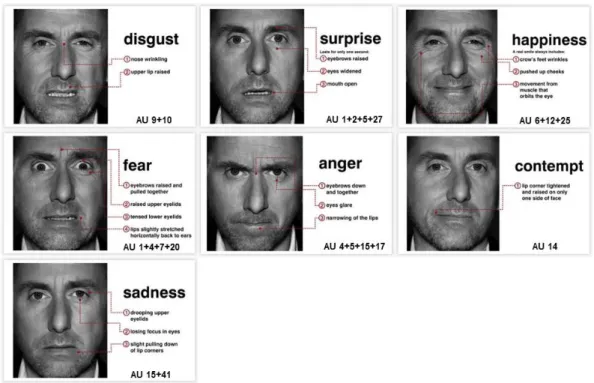
Low intensity. Micro-expressions involve a subtle movement. They may be very brief full (entire face), partial (only occurring in specific area) or slight (not much muscular contraction) expressions [Ekm07]. Figure 2.2 illustrates seven micro-expressions with AUs labels, where the AUs are depicted in Section 2.4. Comparing with macro-expressions in Figure 2.1, micro-expressions involve low intensity of the facial muscles.
Regardless of whether they are macro or micro, facial expressions are dynamic tem-poral process that match the time and duration of facial deformations and are described with three important features : onset, apex and offset [Ekm09, Bet12]. The onset is the point at which the expression starts to show up, the apex is the instant when the de-formation of the expression reaches a peak and the offset represents the instant when the expression fades away. Hence, the micro-expression detection is a temporal segmen-tation of videos, which includes locating the micro-expression appearance instant and providing the duration between the onset and offset. Fig. 2.3 present an image sequence of the micro-expression which is labeled by ’disgust’ in CASME [YWL+13a]. A subtle "nose wrinkling" with the label of AU9 can be observed in the third picture. Due to the limit space, only five frames are presented including 1st(onset), 5th, 9th (apex), 13th and 16th (offset).
Figure 2.2: An example of seven micro-expressions. Each micro-expression is labeled by the action units (AUs) with detailed interpretation. Figure reprinted from [Dan10]
Figure 2.3: An example of a micro-expression sequence. Five frames are presented including 1st(onset), 5th, 9th (apex), 13th and 16th (offset).
The origin of the micro-expression can be traced back to Darwin’s inhibition hypoth-esis writing that certain facial expressions can not be spontaneously created but in fact are expressed to reflect the felt emotion. In his book [DP98], he wrote :
A man when moderately angry, or even when enraged, may command the movements of his body, but...those muscles of the face which are least obedient to the will, will sometimes alone betray a slight and passing emotion. (Page 79).
Nearly one hundred years later, Haggard and Isaacs [HI66a] reported to find micro-expressions when scanning motion films frame-by-frame in therapist-patient interchange research. They watched occasionally that the expression on patient’s face changed dra-matically within a few fraction of second. They named this expression as "micromomen-tary expression (MME)" and found that the MME is meaningful to therapeutic process. In the study of Haggard and Isaacs, the MME could be spotted with a slow motion projection and could not be seen at normal rate.
A few years later, building on the earlier work of Haggard and Isaacs, Ekman and Frisen [EF69] reported the existence of the micro-expression when they studied the rela-tions between deception and nonverbal behaviors of the body. They indicated that : (1) as one of nonverbal behaviors, the micro-expression may serve as leakage or deception clue ; (2) micro-expressions occur on part of face, in other words, they may be fragments of a squelched, neutralized, or masked display ; (3) the appearance of micro-expressions may be similar with macro-expressions but may be greatly reduced in time ; (4) micro-expressions can be read by expert clinical observers without the benefit of slow motion projection, but most people without training have difficulty to detect micro-expressions ; (5) proper training could help people improve the ability to recognize micro-expressions. The study of micro-expression has inspired some researches concerning the measure-ment of individual difference in emotion recognition ability (ERA) which varies across gender, ethnicity, culture, and psychiatric status [MLWC+00]. In order to measure this ability, Ekman and Friesen [EF74] developed the Brief Affect Recognition Task (BART) which involves a brief facial presentation (under 200 ms). Another measurement study was conducted by Matsumoto and his colleagues [MLWC+00], who explored a new test named the Japanese and Caucasian Brief Affect Recognition Test (JACBART). In the JACBART, seven basic facial expressions (anger, contempt, disgust, fear, happiness, sadness and surprise) were utilized and displayed briefly (under 200 ms). Each facial expression was embedded in the middle of a 1000 ms presentation of the same poser’s neutral expression.
Although the micro-expressions have been noted since Darwin, Porter and Ten Brink [PTB08] were the first to verify the existence of micro-expression with a scientific study, in which
the genuine and falsified facial expressions of emotion were investigated. Their study showed that : (1) partially supporting the Darwin’s inhibition hypothesis theory to prove that the occurrence of inconsistent expressions were observed more frequently in masked than in genuine expressions. However, genuine neutral expressions and neutralized ex-pressions of felt emotion cannot be distinguished by inconsistent exex-pressions ; (2) ques-tioning the assumption that micro-expressions may occur on entire face, proposed by Ekman [EF75]. In fact, experiments in this study pointed out that micro-expressions were partially appeared, only in the upper or the lower face ; (3) partial supporting expressions as a cue to deception. Their experiments pointed out that the micro-expressions occurred in the both genuine and falsified (including simulated, masked and neutralized [EF75]) emotional contexts. These partial micro-expressions were reliable indicator of the deception when they occurred in masked expressions. However, their oc-currence in genuine expressions provides implications of false-positive errors, leading to the questionable applications such as airline-security (potential human-rights violations). The ability to identify micro-expressions is an important skill for reading a person’s felt emotion. However, most people cannot recognize the micro-expressions, not even notice their occurrence in real time. They appear and disappear so fast that you would miss them if you blink. Thus, scientists attempt to train people for recognizing micro-expressions. One is led by Ekman [Ekm02] and his group1, named micro-expression training tool (METT), which aims at training people to recognize by naked eyes seven basic micro-expressions (anger, contempt, disgust, fear, happiness, sadness and surprise). The alternative tool is the micro-expression training videos (METV)2, developed by Wezowski and his colleagues [WM16] for detecting micro-expressions on faces filmed on videos. Training with these tools increases the accurate recognition rate of deceptions in which micro-expressions occur.
The existence of micro-expression is relevant to deception in daily life. In the studies of DePaulo et al. [DKK+96], lying was defined as "intentionally try to mislead someone". Most people tell lies in every day life to smooth social interactions, to gain the esteem and affection of other people [DK98]. Politeness commands that we should not try to reveal these lies when they occur to ensure the normal social functioning. But it is
1. https ://www.eiagroup.com/us/training/online-training/ 2. http ://www.microexpressionstest.com/
important to detect lies told by individuals with hostile intent. The study led by Hurley and Frank [HF11] says liars cannot completely suppress facial expressions such that the manifestation of micro-expressions can be regarded as the deception clues.
The existence of micro-expression is related to lies in high-stakes contexts such as criminal investigations, airport and mass transit checkpoints, counter terrorism, and so on [HF11]. For example, if someone intends to pose a threat to airline passengers, and is transiting a security checkpoint, he may have a fear of discovery. In order to hide the true feeling, he will try to manage his emotion resulting in more subtle manifestation of facial expressions. These micro-expressions can be detected by experts. In fact, the Transportation Security Administration (TSA) of United States launched a program called Screen Passengers by Observation Technique (SPOT), which is designed to identify people who could pose a threat to airline passengers, depending on 94 signs of stress, fear, or deception. There are about 3, 000 of TSA officers working at some 161 airports across the United States. The foundation of this programme is based on the micro-expression’s study developed by Ekman and his group [Wei10]. Detecting these lies has assumed public safety and national security.
According to [WW12], the recognition of micro-expression is useful in business, in-cluding the sales, coaching, training, management, recruitment, leadership, business ne-gotiations. Research in companies led by Wezowski and his wife Kasia [WW12] prove that the best sales people and negotiators are experts in reading body language and micro-expressions. It is a huge advantage in business if people can see what somebody feels.
Other applications of micro-expressions involve medical treatment, such as doctor-patient consultation. For clinicians, being capable of perceiving facial expression may aid in interpreting how much pain a patient is experiencing. However, some clues to-wards individuals who would repeatedly attempt suicide are most likely to be missed by doctors if they do not directly state the emotional impact on the patient. These clues are the manifestation of micro-expressions. The clinicians’ person perception accuracy is related to the ability to recognize micro-expressions on patients. The study in [EL09a] proved that training with the METT improve the recognition of the static facial micro-expression (use one image instead of a sequence) of those medical students identified as good at communication with patients.
In the following, the facial action coding system (FACS) will be introduced, which is one of the most important tools for facial expression analysis.
2.4
Facial Action Coding System (FACS)
The previous researches on facial behavior studies depend on observers to infer from the whole face leading to inaccurate inferences about emotions and different interpre-tations. In order to solve this problem, Ekman and Friesen [EF76] developed a facial action coding system (FACS) to describe and distinguish facial movement based on ac-tion units (AUs). An acac-tion unit is the minimal unit of facial behavior, which can be in combination accounting for any facial expression. They defined 44 AUs which are pre-sented and learned in groups based upon the location or type of action involved. AUs are divided into two main groups based on their location : AUs of the upper face and AUs of the lower face. The upper and lower face AUs are illustrated in Fig. 2.4.
AUs involve facial muscles. Part of the action units are only associated with one facial muscle, and some action units are controlled by several muscles. For instance, AU 15 is the action of lip corner depressor which is controlled by Depressor anguli oris muscle. AU 26 represents the action of chin raiser which involves Mentalis muscle, see Fig. 2.5 for an intuitive display of facial muscles.
Figure 2.5: Facial muscles. Reproduced from [Pre13].
AUs can occur singlely or in combination. In [Sch85], more than 7000 different com-binations of AUs have been observed. The comcom-binations of AUs can produce relatively independent changes in appearance, changes in which one action masks another, or a new and distinctive set of appearances. For example, the appearance changes for AU 1 + 2 are a sum of the appearance changes caused by AU 1 and AU 2 independently, without AU distorting or masking the appearances of the other. Another combination of the AU 1 + 2 + 4 produces an appearance which is not simple the sum of the appearance of the individual AUs, but creates new and distinctive appearance. Examples of the seven expressions and their AU labels are shown in Figure 2.1.
The FACS provides an effective facial expression analysis tool so that any complex expression can be analyzed by breaking it down into a series of motion units. Thus, the FACS is considered to be a useful tool in micro-expression analysis, especially in the establishment of the micro-expression databases, which will be introduced in the following.
2.5
Micro-Expression Databases
The well-established database is the foundation for developing micro-expression de-tection or recognition system. Building a database that satisfies the different require-ments and will be widely used for testing new algorithm is a difficult and challenging task. For micro-expression recognition, it poses various challenges in terms of building a standardized database, including the way of expression elicitation, the way of selecting micro-expression from raw videos. One of the most important problem is that expres-sions can be posed or spontaneous. Posed expresexpres-sions are the artificial expresexpres-sions that a person yields when someone asked him or her to do so. It usually happens when the subject is under observation in laboratory. In contrast, spontaneous expressions are the ones that people produce spontaneously, when people are involved with natural conver-sations, watching films etc. Posed micro-expressions are easy to capture and recognize, while spontaneous expressions are difficult to be produced and selected. They are different in appearance and temporal dynamic. Developing micro-expression analysis system im-plies that the spontaneous rather than posed expressions are recognized. Thus, current researchers have started focusing on building spontaneous micro-expression databases and developing spontaneous expression analysis. According to [Bet12], "a standardized training and testing database contains images and video sequences (at different resolu-tions) of people displaying spontaneous expressions under different conditions (lighting conditions, occlusions, head rotations, etc)". Nine micro-expressions databases were built in recent years. Three of them are widely used in micro-expression analysis : (i) the Chi-nese Academy Of Sciences Micro-expression (CASME) [YWL+13a] ; (ii) the Spontaneous Micro-expression Database (SMIC) [LPH+13] and (iii) the improved CASME (CASME II) [WJYWZ+14]. Following paragraphs will present these nine databases in detail.
Polikvsky’s Database [PKO09] contains 10 university student subjects (5 Asian, 4 Caucasian, 1 Indian) who were asked to perform 7 basic emotions with low facial muscles intensity and to go back to the neutral face expression as fast as possible, trying to simulate the micro-expression emotion. They used high speed camera with 480 × 640 resolution at a frame rate of 200fps. The drawback is that all the micro-expressions in this database are mimic expressions instead of spontaneous ones.
USF-HD [SGGS11] contains 100 micro-expressions and 181 macro-expressions. Videos of 47 sequences lasting on average approximately 1 minute in length were collected by cameras at a resolution of 720 × 1280 and a frame rate of 29.7 fps. Instead of
sponta-neous facial expressions, subjects were asked to mimic example videos containing micro-expressions to present micro-micro-expressions. Out-of-plane head motion was avoided in order to decrease the difficulties of detecting micro-expressions.
York Deception Detection Test (York-DDT) [WSB09] includes fifty partici-pants (31 females and 19 males) who are students of University of York except one ad-ministrator, all are native English speakers, aged between 18 and 45. It was first recorded as part of a psychological study for a deception detection test (DDT) at 25fps. All the participants were instructed to deceive or tell the truth when describing an emotional clip of a surgery or non-emotional film clip of a sunny beach. When they observed a surgical procedure, they were asked to describe it as if watching a beach scene, whereas if they saw the beach scene, they were asked to describe it as if watching a surgical procedure. In total, the deception detection task (DDT) consisted of 20 videos which had an overall length of 23 min and 15 seconds and each clip varied between 46 and 85 second with a mean length of approximately 60 seconds. 18 micro-expressions [PLZP11] were found on faces of 9 participants (3 male and 6 female) : 7 from the emotional and 11 from the non-emotional scene. There existed only 7 frames in the shortest clip.
Canal9 [VDFS09, SGGS11] comprises 70 political debates recorded by the Canal9 local TV station, which is used for analysis of social interactions and micro-expression research. Canal 9 database is recorded in HD format with a resolution of 720×576 and for a total of 43 hours and 10 minutes, where 19.7% of data time are recorded in the camera view of the full group (all people involved), 66.1% of data time is in personal shots, and 11.0% of data time is in multiple participants. Fig. 2.6 shows those three frequent camera views. Each debate was around a main question with a yes/no answer like " Are you favorable to the new laws on scientific research ? " In terms of gender, twenty−five women and one hundred and sixty-five men are involved in these debates. These videos were annotated according to socially relevant features (turn-taking, agreement−disagreement, and role) and low level descriptors (speaker segmentation, shot segmentation and so on). There were twenty−four sequences containing a micro-expression (each around 6 seconds) [SGGS11]. The advantage of this database is that all the micro-expressions are spontaneous and reflect real emotions that politicians try to hide. It is a challenging task to spot micro-expressions in this dataset due to other irrelevant facial movements and non−frontal camera view.
The Chinese Academy Of Sciences Micro-expression (CASME) [YWL+13a] consists of two classes : the CASME-A and CASME-B, which were recorded by BenQ
Figure 2.6: Most frequent camera views in Canal9 dataset. Figure is reprinted from [VDFS09]
M31 camera with the resolution set to 1280 × 720 and Point Grey camera with resolution of 640 × 480, both filmed at 60fps. Moreover, the CASME-A and B were built in different lighting conditions, where participants from CASME-A were recorded in natural light while the samples in class B were filmed in a room with two LED lights that brought about uneven illumination on face. Participants (13 females, 22 males, the mean age of 22.03 years) were asked to seat in front of the 19−inch monitor with a camera on a tripod and watch the video episodes with high emotional valence for recording their emotions. Neutral faces are retained before and after the occurrence of each micro-expression. For coding process, two well-trained coders comprehensively went through the recordings and selected all micro-expressions that were no more than 500 ms or onset duration less than 250 ms because fast-onset facial expressions were considered as micro-expressions.
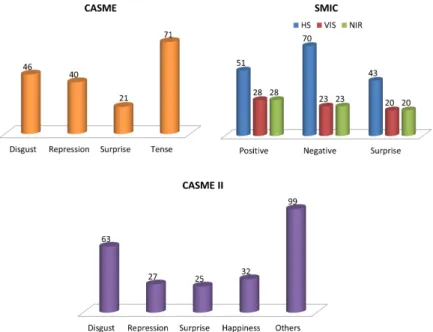
Some participants showed no micro-expressions. 195 short videos of 19 participants of 35 were selected, lasting 0.2 -11.7 s with an average time of 3.2 s. Most of videos contain one expression sequence with the labeled onset, apex and offset. These micro-expressions are labeled by AUs based on FACS coding system [EF77]. The CASME-A includes 95 micro-expressions of 7 subjects, and the CASME-B consists of 100 expres-sions of 12 subjects. For all subjects, the number of micro-expresexpres-sions range from 2 to 38. The criteria for classifying an emotion depends on the video content, self-report of par-ticipants. Eight classes of micro-expressions were captured including disgust 46, surprise 21, happiness 9, fear 2, contempt 2, sadness 6, repression 40 and tense 71. Unlike seven basic facial expressions, the tense and repression emotions that frequently appear in daily life are defined and introduced as micro-expressions in this dataset. The dataset provides micro-expressions sequences as well as videos for detection and recognition. Fig. 2.7 illus-trates some samples from the CASME. In fact, an image sequence consists of more than five frames. Three key frames (onset, apex and offset) are labeled in this figure. Each
Figure 2.7: Samples from the CASME dataset. (a) Raw images from videos. Images of first and second column are samples from the CASME-A and CASME-B, respectively. (b) Cropped images. From left to right : disgust , happiness, surprise, contempt , fear , sadness, repression and tense. We provide five frames of each expression from the onset to offset labeled with AUs. 1 − 4 columns are cropped samples of the CASME-A and the rest belongs to the CASME-B.
sequence is labeled as action units.
Spontaneous Micro-expression Database (SMIC) [LPH+13] was established by the Oulu institution and has three versions according to the released time. The first version of SMIC (referred as SMIC-sub)3 only includes 77 video sequences of 6 subjects data [PLZP11] recorded by a high speed camera of 100 fps. Lately, they released the second version of SMIC which contains three subsets, including the SMIC-HS, SMIC-VIS, and SMIC-NIR, which were recorded separately by a high speed (HS) camera of 100 fps, a normal visual camera (VIS) and a near-infrared (NIR) camera at 25 fps, all of three with the resolution of 640×480. However, the first version and second version only consist of short video clips rather than long video clips. In recent times, an extended version of SMIC (refered as SMIC-E) was released and was also divided into three datasets of the SMIC-E-HS, the SMIC-E-VIS and the SMIC-E-NIR, in which the SMIC-E-HS includes 13 subjects data of 157 long video clips, the SMIC-E-VIS and SMIC-E-VIR both contain 8 subjects data of 71 long video clips of average duration of 5.9 seconds.
For the second version, 20 participants with a mean age of 26.7 attended the recording experiment, among those 6 were females and 14 males, 10 Asians, 9 Caucasians and 1 African. The SMIC dataset was recorded in an indoor environment designed to resemble an interrogation. Like the procedure of the CASME, participants were demanded to watch highly emotional videos to induce corresponding spontaneous micro-expressions. Each participant was recorded about 50 minutes.
Not all participants showed micro-expressions. The SMIC-HS dataset contains 164 micro-expression video clips elicited from 16 subjects (mean age is 28.1 years, 6 females and 10 males, 8 Caucasians and 8 Asians), while both the SMIC-VIS and SMIC-NIR consist of 71 micro-expression video clips elicited from 8 subjects. For each subject, the number of micro-expression clips ranges between 2 and 29. These expressions are classified into three categories : positive (happiness), negative (sadness, fear and disgust) and surprise. The HS contains 51 positive, 70 negative and 43 surprise. Both the VIS and NIR consist of 28 positive, 23 negative and 20 surprise. Video clips provided in the HS are no more than 50 frames and are within 13 frames both in the VIS and NIR dataset. Clips without micro-expressions randomly selected from the original videos were supplied as the counterpart data for the micro-expression detection. Fig. 2.8 shows samples from the SMIC-HS, in which (a) and (b) show samples with micro-expressions, in contrast with samples in (c) and (d). Faces without micro-expressions can be either neutral or
Figure 2.8: Samples from the SMIC-HS dataset. Images in (a) and (b) are samples containing micro-expressions, while (c) and (d) provide samples without micro-expressions as a comparison. (a) and (c) Raw images. (b) and (d) Cropped images, for (b), from top to bottom : positive, negative, surprise. We provide five frames of each expression from the onset to offset. Assume the expression sequence has N frames, the index of these five frames are 1, N4,N2, 3N4 and N , respectively. Indexes in (d) are same to that in (b).
with macro-expressions, see Fig. 2.8 (c) and (d).
Figure 2.9: Samples from the CASME II dataset. (a) Raw images from videos. (b) Cropped images. From left to right : disgust , happiness, surprise, repression and others. We provide five frames of each expression from the onset to offset labeled with AUs.
CASME II [WJYWZ+14] is an extended version of CASME that offers higher tem-poral resolution (200fps), larger face size (about 280×340 pixels on facial area), more sam-ples (255 micro-expressions4) than the SMIC and CASME datasets. As micro-expression is rapid facial activity with low intensity, the higher spatial and temporal resolution can provide more detailed information on the facial muscle movement. The dataset was built in a well-controlled laboratory environment with a proper illumination that removed light flickering. 35 participants with a mean age of 22.03 years participated to this recording, in which 255 short videos of 26 subjects containing micro-expressions were selected. Each short video involves one micro-expression with the onset, apex and offset frames labeled and action units (AUs) encoded. Five main categories are provided that cover disgust 63, happiness 32, surprise 25, repression 27 and others 99. In fact, there are also two
4. In [WJYWZ+14], the authors reported 247 samples. However, in the excel they provided, we found
![Figure 2.5: Facial muscles. Reproduced from [Pre13].](https://thumb-eu.123doks.com/thumbv2/123doknet/14538010.724341/37.892.251.585.304.607/figure-facial-muscles-reproduced-from-pre.webp)
![Figure 2.6: Most frequent camera views in Canal9 dataset. Figure is reprinted from [VDFS09]](https://thumb-eu.123doks.com/thumbv2/123doknet/14538010.724341/40.892.197.777.147.309/figure-frequent-camera-views-canal-dataset-figure-reprinted.webp)
![Figure 2.12: Acquisition setup for elicitation and recording of micro-expressions. Figure reprinted from [WJYWZ + 14].](https://thumb-eu.123doks.com/thumbv2/123doknet/14538010.724341/47.892.125.718.567.865/figure-acquisition-elicitation-recording-expressions-figure-reprinted-wjywz.webp)
![Figure 3.3: Examples of texture primitives which can be detected by the LBP (white circles represent ones, black circles zeros, red circles are center points.) [HPA04]](https://thumb-eu.123doks.com/thumbv2/123doknet/14538010.724341/53.892.119.728.140.294/figure-examples-texture-primitives-detected-circles-represent-circles.webp)