HAL Id: hal-02881679
https://hal.archives-ouvertes.fr/hal-02881679
Submitted on 25 Jun 2020
HAL is a multi-disciplinary open access archive for the deposit and dissemination of sci-entific research documents, whether they are pub-lished or not. The documents may come from teaching and research institutions in France or abroad, or from public or private research centers.
L’archive ouverte pluridisciplinaire HAL, est destinée au dépôt et à la diffusion de documents scientifiques de niveau recherche, publiés ou non, émanant des établissements d’enseignement et de recherche français ou étrangers, des laboratoires publics ou privés.
In CEOs we trust: When religion matters in
cross-border acquisitions. The case of a multifaith
country
Diana W. P. Kwok, Pierre-Xavier Meschi, Olivier Bertrand
To cite this version:
Diana W. P. Kwok, Pierre-Xavier Meschi, Olivier Bertrand. In CEOs we trust: When religion matters in cross-border acquisitions. The case of a multifaith country. International Business Review, Elsevier, 2020, 29 (4), pp.101705. �10.1016/j.ibusrev.2020.101705�. �hal-02881679�
In CEOs we trust: When religion matters in cross-border
acquisitions. The case of a multifaith country
May 2020 version
Accepted by International Business Review
Copyright © 2020 Diana W.P. Kwok, Pierre-Xavier Meschi, Olivier Bertrand. All rights reserved.
Diana W.P. Kwok
EM Strasbourg Business School, Université de Strasbourg, HuManiS (UR 7308), Strasbourg, France
E-mail: [email protected] Pierre-Xavier Meschi
IAE Aix-Marseille Graduate School of Management, CERGAM, Aix-Marseille Université, Aix-en-Provence, France
SKEMA Business School, Sophia Antipolis, France Email: [email protected]
Olivier Bertrand
Fundação Getulio Vargas - Brazilian School of Public and Business Administration (FGV-EBAPE), Rio de Janeiro, Brazil
In CEOs we trust: When religion matters in cross-border acquisitions. The case of a multifaith country
Highlights
Religious similarity facilitates personnel trust in the acquirer’s CEO.
Religious similarity indicates shared values in early post-acquisition integration. Personnel religiosity strengthens the religious similarity-trust relationship. A successful prior alliance does not reduce the role of religious similarity. Managers should address faith-based sensitivities during pre- and post-M&A.
In CEOs we trust: When religion matters in cross-border acquisitions. The case of a multifaith country
Abstract
This paper examines the emergence of trust by multifaith target-firm personnel in foreign acquirer CEOs during early post-acquisition integration, a decisive period for acquisition success, yet considerably under-researched. Combining self-categorization and similarity-attraction theories, we argue that religious similarity with the foreign acquirer’s CEO represents shared values to the personnel, from which trust in the CEO arises. Further, we scrutinize the moderating effects of the personnel’s religiosity and prior alliance success between the acquirer and target firm. We test our model using field-experimental data from 411 multifaith Malaysian personnel. The findings show that personnel-leader trust occurs more readily with religious similarity than religious dissimilarity, and that the personnel’s religiosity strengthens this relationship. However, a successful prior alliance does not weaken the religious similarity– trust relationship. Our research encourages acquisition managers to consider religion, a factor beyond the traditional acquisition playbook, as a trust antecedent during early post-acquisition integration.
Keywords: cross-border acquisitions, interpersonal trust, religion, Malaysia, multifaith employee, experimental methods
1. Introduction
Cross-border acquisitions are complex to implement and integrate, especially when post-acquisition integration is characterized by uncertainty and complexity (Cartwright & Price, 2003; Cording, Christmann, & King, 2008; Seo & Hill, 2005).1 Trust is crucial in cross-border M&As (Meglio & Risberg, 2010; Stahl & Sitkin, 2005) specifically between the personnel of the acquirer and target firms (Stahl, Chua, & Pablo, 2012; Stahl, Larsson, Kremershof, & Sitkin, 2011). Insufficient trust by target-firm personnel can hinder post-acquisition integration through lower employee satisfaction, job performance, resource sharing, and knowledge transfer (Stahl & Sitkin, 2005; Stahl et al., 2011; 2012). When the M&A is announced, the personnel will usually become anxious and uncertain especially about job- and career-related consequences including redundancies (Buono & Bowditch, 1989; Butler, Perryman, & Ranft, 2012; Seo & Hill, 2005). Birkinshaw, Bresman, and Håkanson’s (2000) seminal paper indicates that early post-acquisition integration is a decisive period for human integration. Yet, two decades later, there is scant research into this critical acquisition stage (Erkkilä, 2017).
We address this gap by examining the emergence of interpersonal trust by target-firm personnel in the foreign acquirer’s CEO, who is usually the acquirer’s most visible senior representative. For target-firm personnel, the acquirer’s CEO can provide important cues for shaping their own behavior vis-à-vis the acquisition and on their future (Melkonian, 2004; Melkonian, Monin, & Noorderhaven, 2011). We focus on the rise of early trust in the foreign acquirer’s CEO based on religious similarity or dissimilarity. Religious similarity facilitates attraction, trust, and relationship building in social and professional relationships (Adida, Laitin, & Valfort, 2015; McPherson, Smith-Lovin, & Cook, 2001; Phillips, Tracey, & Karra, 2013; Richardson, 2014; Schotter & Abdelzaher, 2013). A growing number of M&A researchers have examined the effects of religion (e.g., Dow, Cuypers, & Ertug, 2016; Elnahas,
Hassan, & Ismail, 2017; Erel, Liao, & Weisbach, 2009). Dow et al. (2016) finds that within-country religious diversity can add complexity to behavioral uncertainty and information asymmetry between foreign acquirers and local target firms, based on cross-border M&As involving 67 acquirers and 69 target countries. Such complexity could affect personnel-leader trust during the transitional context of post-acquisition integration (Clark, Gioia, Ketchen, & Thomas, 2010; Colman & Rouziès, 2018; Drori, Wrzesniewski, & Ellis, 2013).
This paper builds on Dow et al. (2016) from the perspective of multifaith target-firm personnel. Our main argument is that multifaith personnel will view religious similarity with the foreign acquirer’s CEO as an indication of shared beliefs and values. The acquirer’s CEO with similar values and beliefs is perceived to be more trustworthy especially during the early integration stage, when considerable information asymmetries exist on the newly announced cross-border M&A. Our arguments draw on two related theories, self-categorization (Tajfel & Turner, 1979) and similarity-attraction (Byrne, 1971). Self-categorization theory is particularly appropriate in M&A contexts where uncertainty and unpredictability prevail (Hogg & Terry, 2000; Hogg, Adelman, & Blagg, 2010); the individual defines him/herself in terms of ‘we’ (social identity) rather than ‘I’ (personal identity) (Tajfel & Turner, 1979). Similarity-attraction theory argues that individuals with similar demographic characteristics (e.g., age, gender, culture, background) build rapport more easily (Byrne, 1971). In multifaith societies, religion is a stronger driver of similarity relative to societies with a single dominant faith (Laumann, 1973; Phillips et al., 2013).
While probing into personnel-leader trust in cross-border M&As, we examine how the religious similarity–trust relationship is moderated by (i) the target-firm personnel’s religiosity, and (ii) prior alliance success between the acquirer and target firm. The inclusion of individual and organizational level moderators responds to Birkinshaw et al.’s (2000) call to use multiple levels of analyses in cross-border M&As, and allows a closer scrutiny of the micro-level social
exchange processes that are nested within the acquired organization (Andersson, Cuervo-Cazurra, & Nielsen, 2014). Religiosity or commitment to one’s religion can influence behavior and attitudes when the role expectations from religion are internalized (Weaver & Agle, 2002). Religious individuals tend to be more anxious and trust their in-group more readily, including colleagues (Hilary & Hui, 2009). Thus, we argue that the target-firm personnel who are more religious will place more emphasis on belonging to an in-group and having similar values with the foreign acquirer’s CEO (compared to less religious personnel), such that the religious similarity–trust relationship will be strengthened. Forming and managing an alliance allows firms to learn about one another (Gulati, 1995). A successful alliance indicates a sense of commitment to the relationship, willingness to coordinate activities, and inter-firm trust (Mohr & Spekman, 1994), which in turn creates sentiments of in-group belonging (Pettigrew & Tropp, 2006) for the partner firms and their personnel. Thus, a successful prior alliance is argued to weaken the target-firm personnel’s trust in the foreign acquirer’s CEO based on religious similarity (relative to a successful prior alliance of uncertain outcome).
We test our hypotheses in Malaysia, a multifaith country and middle-ranking destination for inward cross-border M&As in Southeast Asia (UNCTAD, 2018). Malaysia’s population comprises four main religions: Muslim, 61%; Buddhist, 20%; Christian, 9%; and, Hindu, 6% (Malaysian Department of Statistics, 2010). The single-country context allows for better control over heterogeneity in country environments. Our policy capturing field-experiment yielded 4,110 trust decisions by 411 multifaith Malaysian target-firm personnel. We find support that target-firm personnel trust in the CEO emerges more readily with religious similarity than religious dissimilarity, and that the positive effect of religious similarity on trust is strengthened when the personnel is more religious. However, despite our a priori expectations, prior alliance success does not appear to moderate the religious similarity-trust relationship.
Our paper offers four main contributions to the literature, based on its field-experimental approach which is relatively under-utilized despite its merits (Zellmer-Bruhn, Caligiuri, & Thomas, 2016). First, our results show that religion, a factor beyond the traditional acquisition playbook, is a catalyst (respectively, constraint) of trust by multifaith target-firm personnel during the decisive period of early post-M&A integration. This suggests that religion matters for subordinate-leader trust in the context of cross-border acquisitions. Thus, foreign acquirers have to consider and deal with an additional level of cultural complexity during post-acquisition integration (Teerikangas & Very, 2006), namely, at individual level. Second, this paper highlights the importance of the identity aspect of religion during post-acquisition integration from the perspective of target-firm personnel. Because identity-related issues are emotionally charged (Graebner, Heimeriks, Huy, & Vaara, 2017) and loss of identity during post-acquisition integration can spread negative emotions among personnel (Ford & Harding, 2003; Sarala, Vaara, & Junni, 2019), integration leaders need to play an active role to manage their subordinates’ identities, negative emotions, and trust-related emotions (Graebner, 2004; Graebner et al., 2017; Sarala et al., 2019).
Third, our findings show that self-categorization on the basis of religious similarity influences trust during human integration, thus providing empirical evidence of the appropriateness of self-categorization theory in the context of cross-border M&A uncertainty (Hogg & Terry, 2000). The religion-based categorization illustrates how values—especially based on religious similarity with the leader—can facilitate trust development by target-firm personnel in cross-border M&As, amidst the transitional context of post-acquisition integration (Clark et al., Colman & Rouziès, 2018; Drori et al., 2013). Fourth, the target-firm personnel’s religiosity strengthens the religious similarity-trust relationship. This suggests that religiosity should be considered when studying religious similarity or dissimilarity in organizations.
2. Theory and hypotheses
2.1 Interpersonal trust: Key forms and antecedents
This paper is concerned with interpersonal trust, whereby trust by target-firm personnel at individual level (the trustor) is directed at a specific individual, the foreign acquirer’s CEO (the trustee). It adopts Rousseau, Sitkin, Burt, and Camerer’s (1998, p. 395) multidisciplinary definition of trust, as “a psychological state comprising the intention to accept vulnerability based upon positive expectations of the intentions or behavior of another.” The definition captures three elements: the personnel’s expectation that the CEO will be benevolent towards the target-firm personnel during post-acquisition integration, the personnel’s willingness to risk or be vulnerable to the non-fulfilment of this belief, and his/her dependency on the CEO’s actions (Whitener, Brodt, Korsgaard, & Werner, 1998).
Consistent with prior research on target-firm personnel trust after a takeover (Stahl et al., 2012), we adopt a cognitive-trust approach since limited information is available on the acquirer’s managers during early post-acquisition integration. McAllister (1995) distinguishes two forms of trust: cognition-based trust based on rational information on the trustee’s competence, reliability, and credibility; and, affect-based trust based on an emotional attachment or concern for the other party’s interests and welfare, that develops over time through repeated interactions. Other than rational information, cognitive trust can rely on stereotypes, first impressions and rapid cues, rather than personal interactions (Brewer, 1981; McKnight, Cummings, & Chervany, 1998). Given our focus on initial trust formation and religious similarity, presumptive (Kramer, 1999) or primary trust (Marková, Linell, & Gillespie, 2008) is also relevant. Presumptive trust is unquestioned and does not require reflection, e.g., parent-child trust and trust in God (Marková et al., 2008).
In one of the most influential trust models (Burke, Sims, Lazzara, & Salas, 2007; Fulmer & Gelfand, 2012), Mayer, Davis, and Schoorman (1995) proposes three main
characteristics of trustees that affect perceived trustworthiness. Ability refers to the trustee’s domain-specific skills and competence; benevolence represents the trustor’s belief in the trustee’s desire to “do good to the trustor” (p. 718); while integrity refers to the perception that the trustee “adheres to a set of principles that the trustor finds acceptable” (p. 719). The three dimensions are key predictors of interpersonal trust in multiple contexts, such as international joint ventures (Ertug, Cuypers, Noorderhaven, & Bensaou, 2013; Khalid & Ali, 2016), buyer-supplier relationships (Dyer & Chu, 2000; 2011), organizational boundary spanners (Perrone, Zaheer, & McEvily, 2003), online investing (Balasubramanian, Konana, & Menon, 2003), and mentoring relationships (Young & Perrewé, 2000). Whereas all the three trust determinants are important for trusting both leaders and workers, integrity is significantly stronger for trusting leaders; this may be due to the leader-worker power differential (Colquitt, Scott, & LePine, 2007). Moreover, subordinate-leader trust is not necessarily mutual, nor reciprocal (Brower, Schoorman, & Tan, 2000; Korsgaard, Brower, & Lester, 2015; Schoorman, Mayer, & Davis, 2007). Leaders emphasize the subordinate’s receptivity, availability, and discreteness, while subordinates emphasize the leader’s availability, competence, discreteness, integrity, and openness (Brower, Lester, Korsgaard, & Dineen, 2009).
According to Fulmer and Gelfand’s (2012) review, the most extensively researched antecedents of interpersonal trust are trustee characteristics and behaviors, including leadership styles (e.g., empowering leadership, Caldwell & Dixon, 2010; transformational leadership and transactional leadership, Jung & Avolio, 2000; servant leadership, Van Dierendonck, 2011). This confirms the trustor’s subjective perceptions as the most important determinant of a trustee’s trustworthiness (Mayer et al., 1995; Tenzer, Pudelko, & Harzing, 2014). Other trust antecedents can be categorized under trustor characteristics, shared characteristics between the trustor and trustee, communication processes, structural characteristics, organizational characteristics, and characteristics that are external to the organization (see Fulmer & Gelfand,
2012). In terms of shared trustor and trustee characteristics, ethnic similarity has been studied in the context of international business partners (Jiang, Chua, Kotabe, & Murray, 2011) and with regards the social structures of trust (Chua, Morris, & Ingram, 2009). Chinese managers show higher affect- and cognition-based trust towards their international business partners who are of Chinese rather than non-Chinese ethnicity (Jiang et al., 2011). Both the forms of trust are more intertwined for Chinese than American managers, and indicate that Chinese networks are more closely and intricately woven (Chua et al., 2009). In societies that emphasize personal relationships such as Asia, affect-based factors (e.g., personal relationships) precede cognition-based factors (e.g., professionalism, technical skills), including in developing subordinate trust in supervisors (Poon, 2013; Tan & Chee, 2005; Wasti, Tan, Brower, & Önder, 2007). Conversely, in Western societies, cognition-based trust precedes affect-based trust (McAllister, 1995; Rousseau et al., 1998).
2.2 Religious similarity and trust in cross-border acquisitions
Post-acquisition integration is a highly identity-relevant context, when individuals and groups struggle to retain and redefine their identities (Clark et al., 2010; Drori et al., 2013; Maguire & Phillips, 2008), especially in the case of cross-border acquisitions. Amidst the uncertainty and unpredictability of post-acquisition integration (Cording et al., 2008), having a common social identity is very pertinent (Hogg & Terry, 2000; Hogg et al., 2010) as it can pave the way for social influence, cooperation, organization, and leadership (Turner & Haslam, 2001). Cartwright and Schoenberg (2006, p. S3) highlights the “valuable theoretical contribution” that social identity can make to our understanding of the acquisition process.
Religion is a salient social characteristic for initial trust formation by target-firm personnel in the context of cross-border acquisitions. This paper relies on the dual motives of self-categorization, that individuals seek to enhance self-esteem by differentiating the ‘us’ (in-group) from ‘them’ (out-(in-group) (Tajfel & Turner, 1979), while reducing uncertainty about what
to expect from their social and physical environments (Hogg & Mullin, 1999; Hogg & Terry, 2000).2 Salience is a feature of self-categorization theory that refers to how easily a social category comes to mind and can be matched to the properties of the social context (Hogg & Terry, 2000; Turner & Oakes, 1986). Hogg et al. (2010) emphasizes the favorable impact of religion, self-categorization, group identification, together with belonging—for uncertainty reduction. In certain religions, those of the same faith are perceived as an extended family, clan or fraternity, such as among the Muslims, Jews, Christians, and Buddhists (Haight, 2010; Schotter & Abdelzaher, 2013; Seul, 1999; Tracey, 2012).
We combine self-categorization with similarity-attraction, following Jiang et al.’s (2012) study of the effects of ethnic similarity on trust by Chinese business executives towards their foreign partners. According to similarity-attraction theory, having common attitudes, interests and perspectives determine how individuals are attracted, like, and would enjoy working and interacting with another individual (Byrne, 1971). Similarity-attraction based on religion is observed in social (e.g., Adida et al., 2015; McPherson et al., 2001) and professional relationships (Richardson, 2014; Richardson & Ariffin, 2019; Schotter & Abdelzaher, 2013). However, religious similarity can have weak ties or less clear-cut outcomes in certain contexts (Kurt, Sinkovics, Sinkovics, & Yamin, 2020). For example, religious similarity does not facilitate all aspects of international business negotiations (Richardson & Rammal, 2018), and the degree of advertising intensity for the export product or a differentiated product moderates the effect of religious similarity on bilateral trust in international trade (Lo Turco & Maggioni, 2018). Individual spirituality enhances the effect of religious homophily in the context of business networks that support SME internationalization (Kurt et al., 2020).
2 Self-categorization originates from social identity theory (Haslam, Reicher, & Reynolds, 2012; Hogg & Terry,
2000), which is the principal framework used to study the dynamics of multicultural teams and organizations (Stahl, Mäkelä, Zander, & Maznevski, 2010).
Religion strongly conditions the values of individuals (Adida et al., 2015; Hillman, 2007). The influence of religious values in the workplace, business, and on leadership was suggested as early as Weber (1905). This includes Protestant ethics (Child, 2009; Miller & Timothy, 2010; Weber, 1905), Confucian, Taoist and Buddhist values (Lin, Ho, & Lin, 2013; Marques, 2010; Xing & Liu, 2016), and Muslim beliefs (Richardson, 2014; Richardson & Rammal, 2018; Schotter & Abdelzaher, 2013). Our central argument is that religion embodies the work-related values of both subordinates and leaders. In the case of religious similarity between the target-firm personnel and foreign acquirer’s CEO, the personnel draws comfort from sharing common beliefs, values, and principles with the CEO. Value homophily—which is based on attitudes, values and beliefs—includes internal states that can shape individuals’ orientation towards future behaviors (Kurt et al., 2020; Lazarsfeld & Merton, 1954; McPherson et al., 2001). This helps to diminish the personnel’s uncertainty especially when information about the acquirer is limited, such as during early post-acquisition integration. In viewing the CEO as ‘us’, trust is more readily given by the target-firm personnel. Employees who perceive their leader as being similar or sharing common values will trust him/her more readily (Gillespie & Mann, 2004; Huang & Iun, 2006). Assuming that religious dissimilarity and religious similarity are opposite concepts, we apply the reverse rationale to hypothesize on the negative impact of religious dissimilarity on trust. Based on the above, we establish that:
Hypothesis 1: During the early stage of post-acquisition integration, the target-firm personnel’s trust in the foreign acquirer’s CEO is higher with religious similarity than with religious dissimilarity.
In the next two subsections, we investigate how an individual-level variable and organizational-level variable moderate the relationship between religious similarity and trust. Probing into the micro-level processes of social exchange that are nested in the acquired entity (Andersson et al., 2014) allows for a better understanding of the religion-trust relationship.
Religiosity reflects a person’s commitment to his/her religion. It comprises a religious affiliation (e.g., Buddhist, Christian, Hindu, Muslim), religious activities (e.g., frequency of church/mosque attendance or prayers), and degree of religious beliefs (Bjarnason, 2007; McDaniel & Burnett, 1990). People who are less religious are likely to have a religious affiliation but low levels of religious activities and beliefs. Since religiosity is a human value that tends to be stable over a fairly long time period (McDaniel & Burnett, 1990), it can influence both behavior and attitudes when the role expectations from religion are internalized (Weaver & Agle, 2002). An experimental study by Tan and Vogel (2008) shows that more religious individuals are perceived as more trustworthy, and trustors who are more religious show this behavior more distinctively. Berggren and Bjørnskov (2011) offers a theoretical discussion that religiosity could stimulate or reduce trust.
Hilary and Hui (2009) confirms prior research that religious individuals are more risk-averse, including in corporate decision-making. Religious individuals tend to be more anxious and trust their in-group more easily than their out-group (ibid.). Put differently, more religious people are likely to polarize more heavily towards ‘us’ and display more bias against ‘them’, relative to less religious people. The higher the individual’s religious commitment, the more important it is to be part of an in-group and share similar values, including at work. Richardson and Ariffin (2019) examines managerial religiosity in decision making for foreign market entry, but finds that religiosity plays a relatively minor role in terms of ‘when’ and ‘how’ to internationalize. However, a Muslim religious manager may be attracted to a religiously-distant market if it has a large Muslim minority group, for example, Australia (ibid.). This supports the argument that the combination of religion, self-categorization, group identification, and belonging, facilitates uncertainty reduction (Hogg et al., 2010). During early post-acquisition integration, we argue that the target-firm personnel who is more religious would place more importance on belonging to an in-group and having similar values (based on religion) with the
foreign acquirer’s CEO. Thus, we expect the religious similarity–trust relationship to be stronger when the personnel is more religious.
On the other hand, target-firm personnel who are less religious have fewer faith-based constraints and considerations. They feel less inclined to belong to an extended family or clan, or to have similar work-related values (based on religion) with the foreign acquirer’s CEO. The less religious target-firm personnel are expected to be more indifferent and unconcerned about the religion of the foreign acquirer’s CEO, than the more religious target-firm personnel. Thus, we propose that:
Hypothesis 2: Religiosity strengthens the positive effect of religious similarity on trust.
2.4 The moderating role of prior alliance success
Trust can develop in interorganizational relationships, such as alliances and especially successful alliances (e.g., Currall & Inkpen, 2002; Gulati, 1995; Poppo, Zhou, & Ryu, 2008). During the lifetime of an alliance, the partner firms gain familiarity with one another through repeated interactions, experience, and learning (Gulati, 1995), thus allowing trust to develop between the personnel of the partner firms. In this study, we consider cross-border acquisitions where at the time the acquisition is announced, the acquirer and target firms are (or were) alliance partners.
A successful alliance is characterized by a sense of commitment to the relationship, willingness to coordinate activities, and inter-firm trust (Mohr & Spekman, 1994). These attributes echo Allport’s (1954) influential intergroup contact theory, which maintains that inter-group contact can reduce prejudice when certain conditions are present, in particular, equal status between the groups, common goals, and inter-group cooperation. A successful prior alliance should therefore create sentiments of in-group belonging (Pettigrew & Tropp, 2006) for the partner firms and their personnel, and enhance their subsequent rapport (as in the case of a successful team-building program for employees or students). Having successfully
formed and managed an alliance also demonstrates that the parties have complied with the norms of equity (Ring & Van de Ven, 1992; Stahl & Sitkin, 2005). Since fairness is an important attribute of in-group/out-group identities (Tajfel & Turner, 1979), a successful prior alliance strengthens trust development between the parties.
We therefore argue that when the target and its acquirer have experienced a successful prior alliance, religious similarity would be less relevant in facilitating target-firm personnel trust. The success of the prior alliance creates (or reinforces) the sense of in-group belonging for all the personnel at the partner firms. Subsequently, when the cross-border acquisition occurs between the alliance partners, the target-firm personnel would more readily trust the foreign acquirer’s CEO since he/she is one of ‘us’. This being the case, we expect religious similarity to become a less important basis of trust for the target-firm personnel—based on self-categorization or similarity-attraction—unlike what might be observed for a prior alliance with uncertain success (or outcome). In general, it has been shown that having multiple sources of information can lead to redundant benefits from the additional information (Burt, 1997; Haunschild & Beckman, 1998). When multiple contexts provide redundant information, their combined effect should be smaller than the sum of their individual effects (Schildt & Laamanen, 2006).
Conversely, when the two firms have formed an international alliance but the alliance objectives are still pending realization or their realization remains uncertain, the personnel of the partner firms are more likely to view each other as the out-group. Any in-group sentiments between the personnel of the partner firms would be nascent or less developed—compared to what might be observed after a successful prior alliance. This suggests that when the cross-border acquisition occurs between the alliance partners, the target-firm personnel have a much weaker basis for trusting the foreign acquirer’s CEO. Moreover, the uncertain outcome of the international alliance may weaken the commitment of the partner firms to the acquisition, and
their willingness to coordinate activities and resources. Similarly, an alliance of uncertain outcome could raise additional questions in the minds of target-firm personnel—as to the intentions and benevolence of the foreign acquirer’s CEO, thus exacerbating the post-acquisition uncertainty faced by these personnel. We therefore argue that when the prior alliance outcome is uncertain, sharing the same religion as the acquirer’s CEO becomes a more essential basis from which the target-firm personnel can develop interpersonal trust in the CEO. Religious similarity would reassure the personnel that the CEO has similar beliefs, values and principles, and can be considered as ‘us’. Thus, on the basis that self-categorization and the context of prior alliance success are partial substitutes, we establish that:
Hypothesis 3: The presence of a successful prior alliance weakens the positive effect of religious similarity on trust.
3. Methods 3.1 Data
Data was collected from December 2015 to May 2016, from a sample of Malaysians ranging from non-managers to senior managers. Public-sector personnel were excluded as they are unlikely to find themselves in acquisition situations. A total of 4,923 personalized e-mail invitations were sent to individuals from over 300 organizations, each with a non-transferable survey weblink. Respondents were recruited from multiple sources: social media sites (LinkedIn and Facebook), professional associations (university alumni groups and chambers of commerce), firms, contact lists, personal connections of the first author, and respondent referrals. To enhance the response rate, respondents were guaranteed complete confidentiality and anonymity, and could elect to receive a summary of our findings. We offered 50 restaurant vouchers worth €250 in total through a prize draw conducted at the end of the study. Up to three reminders were e-mailed to each individual, together with a final mailshot to selected individuals who had started but not completed the survey.
From the 442 surveys completed, 31 invalid responses were eliminated, yielding 411 responses. The 411 respondents were from multiple faiths: Muslim, 30%; Christian, 23%; Buddhist, 22%; Hindu, 15%; Sikh, 1%; and, no religion declared, 9%. In terms of ethnicity, we had Chinese (46%), Malay (28%), and Indian (24%) respondents. The Malay respondents were all Muslim (100%); the Chinese respondents were predominantly Buddhist (47%) or Christian (37%); and, the Indian respondents were mainly Hindu (61%), Christian (17%), or Muslim (5%).3 A total of 55% respondents were male, 47% were aged above 40 years old, 87% had at least a Bachelor’s degree, 71% held managerial positions, and 44% had acquisition experience from their current/past firm or had managed/advised on acquisitions. Their organizations had up to 200 employees (31%), 201–1,000 employees (30%), or over 1,000 employees (39%). Their industries were manufacturing (22%), services (71%), and others (7%). The firm types represented were publicly listed firms (41%), privately owned firms (53%), government-linked corporations (GLCs, 11%), and non-profit organizations (4%).4
3.2 Policy capturing experiment
We collected data using the policy capturing method (PCM), a field-experimental approach. Management-related papers are increasingly using experiments to examine decision-making (Aguinis & Bradley, 2014), including PCM in acquisitions (Pablo, 1994; Stahl et al., 2012; Yildiz & Fey, 2016) and internationalization (Hitt, Dacin, Levitas, Arregle, & Borza, 2000; Hitt, Ahlstrom, Dacin, Levitas, & Svobodina, 2004; Tong, Reuer, Tyler, & Zhang, 2015). The
3 The Muslims were the largest group of respondents in our sample (n=122, or 30%) and comprised
quasi-exclusively of 113 ethnic Malays, the second largest ethnic group of our sample. The Malays are increasingly active in the private sector especially with GLICs (government-linked investment companies) controlling more than 68,000 Malaysian private companies directly and indirectly (Aruna, 2016), and thanks to preferential treatment that affords the Malays greater access to private companies. The Muslim/Malay subsample was substantially smaller than the Chinese subsample which comprised the largest number of respondents in our sample (n=187, or 46%). One-to-one mapping between ethnicity and religion is not appropriate for the Chinese ethnic group. Our Chinese respondents were predominantly Buddhists (n=88, or 21%) and Christians (n=70, or 17%).
4 Both privately owned firms and GLCs can be either listed or privately owned, thus the percentages do not add
calls for more experimental methods in international business (Zellmer-Bruhn et al., 2016) and trust research (Fulmer & Gelfand, 2012) are also encouraging.
PCM combines elements of controlled experiments and traditional surveys to study decision-making at individual and group levels (Karren & Barringer, 2002). Thus, the inherent weaknesses of one approach can be offset against the strengths of the other. Respondents make evaluations based on stylized scenarios embedded with explanatory variables. To draw inferences about respondents’ decision strategies, researchers experimentally vary the attributes of the explanatory variables, and interpret regressions of the decisions against explanatory variables (Aiman-Smith, Scullen, & Barr, 2002).
PCM is particularly appropriate for our research into the effects of religious similarity on trust development during early post-acquisition integration. First, by varying the attributes of our independent variables in stylized scenarios, decision-making can be analyzed with more depth and focus than through comparatively abstract survey questions (Dülmer, 2007). Given the sensitivity of religion and religious differences coupled with the complex nature of trust, PCM allows finer-grained probing to address our research question. Second, PCM offers a deliberate albeit discreet examination of the structural and contextual dimensions of culture (Caprar et al., 2015). The use of a more direct questioning method to probe into the religious similarity–trust relationship may induce respondents to present themselves as being more socially oriented and altruistic than is actually the case.
Third, PCM allows greater control over confounding effects and improved data reliability (Aiman-Smith et al., 2002), as respondents’ decisions are based on a consistent set of independent variables. When analyzing cross-sectional and realized transactions or using other more direct approaches, peripheral factors are often combined together and may even be unidentified (Aguinis & Bradley, 2014; Tong et al., 2015). Fourth, PCM circumvents retrospective bias and memory loss by respondents on their acquisition experience, unlike
traditional surveys and interviews (Golden, 1992; Hitt et al., 2004; Stahl et al., 2012). Thus, the lapse of time is immaterial for respondents with M&A experience.
3.3 Decision situation and variables
The policy-capturing instrument was in English, the business language of Malaysia, and implemented as an online survey. It contained questions based on stylized scenarios, and the respondent’s demographic characteristics and professional background. Respondents were instructed to: imagine themselves working in a firm that had just been taken over by a foreign acquirer (to reflect our focus on early post-acquisition integration), think about their own situation and concerns about being part of a bigger organization and group of companies, review the scenarios with hypothetical acquiring firms and CEOs, and make decisions based on the scenarios.
3.3.1 Dependent variable
Our dependent variable is defined as the target-firm personnel’s trust in the acquirer’s CEO. We selected three dimensions from Mayer and Davis (1999), one of the most widely replicated measures of interpersonal trust (McEvily & Tortoriello, 2011). (i) Ability (“I feel confident about the acquiring firm’s CEO’s skills”). (ii) Benevolence (“I believe that the acquiring firm’s CEO would not knowingly do anything to hurt my firm and its employees”). (iii) Integrity (“I feel that the acquiring firm’s CEO tries to be fair in dealing with others”). We measured the dimensions on a seven-point Likert scale (from 1=strongly disagree to 7=strongly agree). Cronbach’s alpha was calculated for the dimensions and given the strong internal consistency (0.895), we took an average of the dimensions to create the dependent variable (Hitt et al., 2000).
3.3.2 Independent variable
Religious similarity, our independent variable, compares the respondent’s religion (from the survey demographic characteristics: Buddhist, Christian, Hindu, Muslim, Sikh, other, or no religion) with that of the acquirer’s CEO (scenario attributes: Buddhist, Christian, Hindu, or Muslim). We coded this variable 1 if the respondent and CEO have the same religion (religious similarity), and 0 otherwise (religious dissimilarity).
3.3.3 Moderating variables
The first moderating variable, prior alliance success, was included in the stylized scenarios with two attributes (positive or uncertain outcome; 1=positive outcome, 0=uncertain outcome). The Appendix shows how the scenarios were manipulated. The second moderating variable, religiosity, was included in the demographic questions. Religiosity, a subjective rating of the importance of religion in the respondent’s life (“I consider myself to be a religious person”), was adapted from Peterson, Albaum, Merunka, Munuera, and Smith (2010) and Aygün, Arslan, and Güney (2008). We measured religiosity on a similar seven-point Likert scale as above. Wanous, Reichers, and Hudy’s (1997) widely cited meta-analysis states that single-item measures can be more robust than multi-item measures “if the construct being measured is sufficiently narrow or unambiguous to the respondent” (p. 247). Subsequent papers confirm the predictive validity of single-item measures relative to multi-item measures (Bergkvist, 2015; Bergkvist & Rossiter, 2007; Drolet & Morrison, 2001). Single-item measures of religiosity are relatively common in ethics research (e.g., Albaum, 2014; Angelidis & Ibrahim, 2004; Kurpis, Beqiri, & Helgeson, 2008; Longenecker, McKinney, & Moore, 2004).
Three control variables are included in the stylized scenarios, with the first two being trust determinants. (i) Developed-economy acquirer with four attributes (China, India, the United Arab Emirates (UAE), or the United States (USA)), refers to the acquirer’s country-of-origin.5 In international joint ventures, the nationality or home country of a partner is a basis for social categorization and stereotyping (Kramer, 1999; Terracciano & McCrae, 2007) that can affect the level of trust by the other partner (Ertug et al., 2013). Similarly, the acquirer’s country-of-origin is likely to be a salient category for target-firm personnel, especially during early post-M&A integration. (ii) Level of post-acquisition integration with two attributes (minimal or substantial, corresponding to low or high integration; 1=minimal, 0=substantial). Integration usually involves the acquirer monitoring the target firm’s performance and imposing controls on the latter’s technological, organizational, and cultural configuration; the target firm loses part or all its autonomy. Trust and monitoring are negatively related (McAllister, 1995), as are autonomy removal and trust in the acquirer’s management by German and Singaporean target-firm employees (Stahl et al., 2012). (iii) Ethnic similarity compares the ethnicities of the respondent (from the survey demographic characteristics: Malay, Chinese, Indian, Sikh, or other) and the acquirer’s CEO (scenario attributes: Arab, Chinese, Indian, or Caucasian). It is coded 1 if the respondent and CEO’s ethnicities are the same, and 0 otherwise.6 An individual’s ethnicity can sometimes determine his/her religion (e.g., a large majority of Malays are Muslim). However, one-to-one mapping between ethnicity and religion is not always possible, for instance, the ethnic Chinese in Malaysia are predominantly Buddhist, but can also be Christian or Muslim.
5 The four countries were selected as they are easily cognizable to our target respondents (Malaysian
non-managers and non-managers). The countries are relatable by our respondents as large FDI investors or potential FDI investors to Malaysia. Moreover, all four countries mirror the religious diversity found in Malaysia. Their main religions correspond with Malaysia’s combination of religions.
6 For a Malay respondent–Arab CEO pair, ethnic similarity is coded 1 as some Malays are descendants of Arabs
Further, we controlled for other demographic characteristics and professional backgrounds which could affect the target-firm personnel’s trust in the foreign acquirer’s CEO (Hitt et al., 2000, 2004; Stahl et al., 2012; Tong et al., 2015): gender (1=female, 0=male), age (1=above 40 years old, 0=40 years old and below), current position (1=non-managerial personnel, 2=junior manager, 3=middle manager, 4=senior manager), international experience (1=international experience through work or study, 2=international experience through work and study, 0=no international experience), and acquisition experience (1=prior experience with acquisitions, 0=no prior experience with acquisitions). Lastly, three target-firm characteristics were controlled: firm size (1=up to 10 personnel, 2=11–200 personnel, 3=201–500 personnel, 4=501–1,000 personnel, 5=1,001–5,000 personnel, 6=above 5,000 personnel), industry dummy (1=manufacturing, manufacturing); and, ownership dummy (1=public-listed, 0=non-public-listed).
3.4 Implementation
Our experimental design followed the comprehensive implementation guidelines of Auspurg and Hinz (2015). Each respondent evaluated one of six blocks of 10 scenarios each. Limiting each respondent to evaluate only 10 scenarios avoids respondent fatigue and boredom (ibid.). From 256 possible scenarios (4x4x2x2x4), we first eliminated 148 implausible ones (e.g., a Chinese acquirer with a Hindu CEO), leaving 108 plausible scenarios. The SAS macro %MktEx was used to create efficient experimental designs, optimizing two key criteria reflected in the design’s D-efficiency: orthogonality (no correlations between the elements of a factor located in a matrix), and level balance (each factor level occurs with equal frequency) (Auspurg & Hinz, 2015; Kuhfeld, 2010). However, using all 108 plausible scenarios would require substantial research time and money, as in the case of a full factorial design (Graham & Cable, 2001). We thus used another SAS macro %MktBlock to divide the scenarios into orthogonal
blocks of 10 scenarios each (Kuhfeld, 2010). After comparing D-efficiencies for fractional factorial designs of N=100, 90, 80, etc., we chose N=60; its D-efficiency is 99.85% as efficient as for N=100 (Auspurg & Hinz, 2015). To avoid any order effects, our online survey platform also randomized the 10 scenarios in each block (ibid.).
A pilot study was conducted in two phases with 37 academics, graduate students, and Malaysian employees. The scenarios were adapted for a subtler presentation of the independent variable, religious similarity; certain scenarios of questionable plausibility were eliminated; and, the religiosity measure was simplified.
4. Results
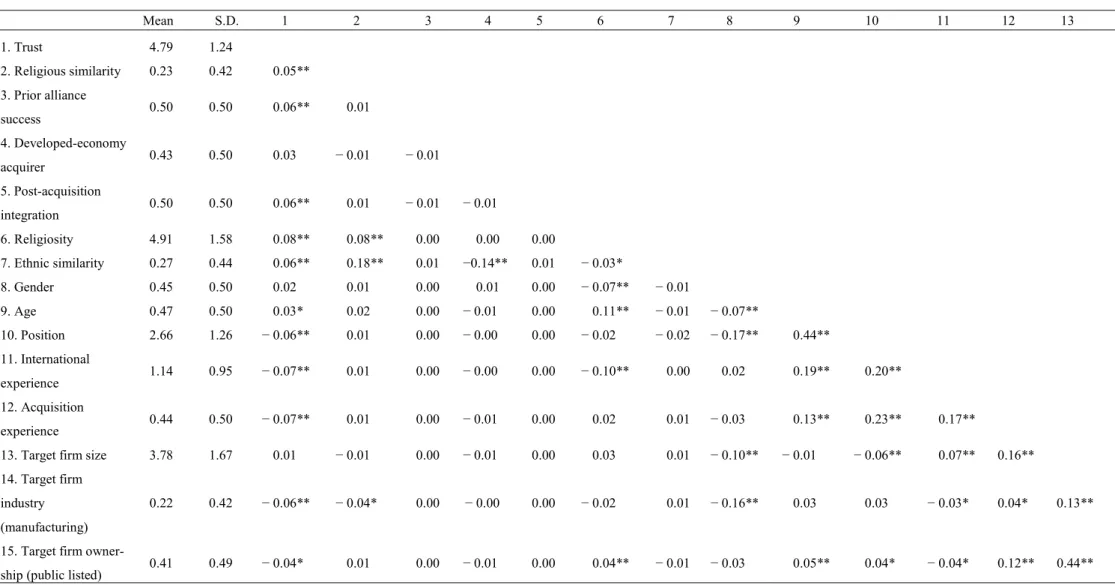
The field-experiment provided 30 trust decisions per respondent. This was reduced to 10 observations per respondent (as described above) or 4,110 observations in total. Table 1 presents descriptive statistics and correlations for all the variables used.
INSERT TABLE 1 ABOUT HERE
We used hierarchical linear modeling (HLM) for data analysis. Since an individual’s decisions may be more similar to one another than to decisions taken by other individuals, HLM is much more appropriate for analyzing PCM data than ordinary least squares (OLS) regression. HLM accommodates variance within and between respondents, allows examination of group effects (Raudenbush & Bryk, 2002), and accounts for the potential autocorrelation of nested data and heteroskedasticity (Hofmann, 1997). However, while HLM coefficients are interpreted like OLS coefficients, HLM-based symmetrical confidence intervals can be very misleading (Raudenbush & Bryk, 2002).
We test a 2-level model (Hitt et al., 2000; Patzelt & Shepherd, 2008) with 4,110 observations at Level 1 and 411 observations at Level 2.7 Our data at Level 1 comprises criteria or decision attributes that vary for the same respondent as a result of the manipulated scenarios. That is, the five variables that are embedded in the scenarios (religious similarity, prior alliance success, developed economy acquirer, post-acquisition integration, and ethnic similarity), as well as the two interaction terms (religious similarity*religiosity and religious similarity*prior alliance success). Our data at Level 2 comprises the respondent’s personal, firm, and industry characteristics that do not vary with the manipulated scenarios, specifically, gender, age, current position, international experience, acquisition experience, firm size, industry, and type of firm ownership.
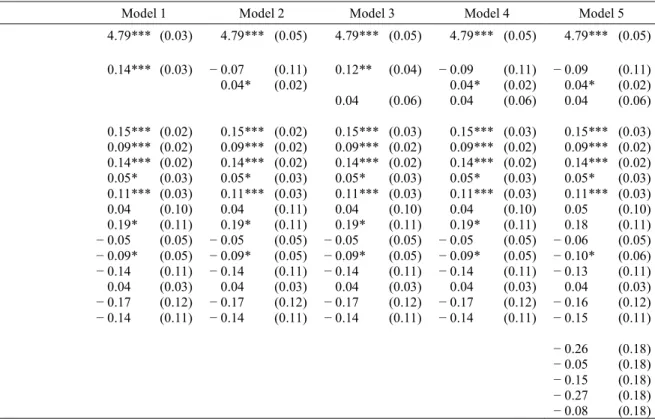
The independent variables are centered around the group mean and the control variables around the grand mean (Enders & Tofighi, 2007; Raudenbush & Bryk, 2002). The intraclass correlation coefficient is 0.63, indicating that about 63% of the variance in the target-firm personnel’s trust is between individuals (Raudenbush & Bryk, 2002). Table 2 presents the results of our HLM analysis. Model 1 presents our main independent variable, religious similarity (see Hypothesis 1). Model 2 examines the interaction between religious similarity and religiosity (see Hypothesis 2). Similarly, Model 3 examines the interaction between religious similarity and prior alliance success (see Hypothesis 3). Model 4 examines the two interaction effects simultaneously.
INSERT TABLE 2 ABOUT HERE
7 Our data fits with a simple nested model rather than a cross-nested model. “In simple nested models, each Level
1 observation belongs only to one Level 2 group. By contrast, in cross-nested (or cross-classified) (multilevel models) a Level 1 observation can be nested in two Level 2 groups” (Peterson, Arregle, & Martin, 2012, p. 452).
Hypothesis 1 predicts that religious similarity between target-firm personnel and the foreign acquirer’s CEO will lead to higher trust in the latter during early post-acquisition integration. The results in Model 1 indicate that the personnel’s trust in the CEO is significantly higher when they have similar religions (b=0.14, p < 0.001), thus supporting Hypothesis 1. A change in religious similarity from 0 to 1 (dissimilarity to similarity) is associated with a 0.14 unit increase in trust in the CEO, holding all other variables constant.
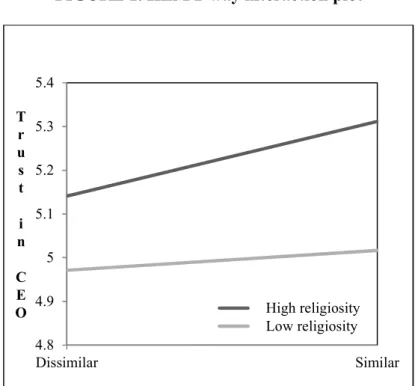
Hypothesis 2 argues that when the target-firm personnel is more (respectively, less) religious, the positive effect of religious similarity on trust in the foreign acquirer’s CEO will be strengthened (respectively, weakened). Our predicted direction of interaction is observed in Models 2 and 4, where the interaction term religious similarity*religiosity is positive and significant (b=0.04, p=0.06). Hypothesis 2 is supported in that religiosity increases the overall effect of religious similarity on trust. To facilitate the interpretation of these findings, the HLM 2-way interaction effects is plotted in Figure 1.8 Specifically, we plot the relationship between religious similarity and trust in the foreign acquirer’s CEO, at low and high religiosity levels (i.e., one standard deviation below or above the mean). Figure 1 depicts the statistically significant support for Hypothesis 2, that is, the positive relationship between religious similarity and trust is strengthened when the target-firm personnel is more religious.
Hypothesis 3 proposes that when the target and acquirer firms have experienced a successful prior alliance, the positive effect of religious similarity on trust would be weakened. The coefficient of the interaction term religious similarity*prior alliance success in Models 3 and 4 is positive but not statistically significant (b=0.04, p=0.53). Thus, Hypothesis 3 is not
8 We used the online calculator and graphing tool for HLM 2-way interactions by Preacher, Curran, and Bauer
(http://www.quantpsy.org/interact/hlm2.htm, accessed on 3/2/20). Since our independent variable (religious similarity) is at Level 1 while our control variable (religiosity) is at Level 2, we used Preacher et al.’s “Case 3” calculator for cross-level interaction. In accordance with the detailed instructions by Preacher et al., we input the following data for this calculation: (i) the output of our HLM tests (regression coefficients, coefficient variances, and degrees of freedom), and (ii) conditional values for religiosity and religious similarity.
empirically supported. We nevertheless draw attention to the positive and significant direct effect of prior alliance success on trust in the foreign acquirer’s CEO, in Models 1-4 (b=0.15, p < 0.001). While prior alliance success increases trust, it does not reduce the positive role of religious similarity.
Two control variables that were included in our stylized scenarios deserve mention. First, post-acquisition integration has a positive and significant effect on trust by target-firm personnel (b=0.14, p < 0.001). A change in the level of integration from 0 to 1 (low to high) is associated with a 0.14 unit increase in trust in the foreign acquirer’s CEO, holding all other variables constant. This contrasts with Stahl et al.’s (2012) negative relationship between autonomy removal and trust in the acquirer’s management, based on German and Singaporean respondents. Depending on the level of post-acquisition integration, the target firm loses part or all its autonomy due to monitoring and controls imposed by the acquirer. In reviewing research into the role of culture in M&As, Goulet and Schweiger (2006, p. 410) states that “targets may be culturally predisposed in the way they respond to integration”; likewise, the integration approach of acquirers could be culturally predisposed.
Second, developed-economy acquirer has a positive and significant impact on trust in the foreign acquirer’s CEO (b=0.09, p < 0.001). Malaysian target-firm personnel favor a developed-economy acquirer over an emerging-economy acquirer. When the acquirer originates from a developed economy instead of an emerging economy, trust in the acquirer’s CEO increases by an estimated 0.09 units. This is consistent with Stahl et al.’s (2012) findings that Singaporeans seem to prefer being taken over by a foreign vs. a domestic acquirer. Third, ethnic similarity between target-firm personnel and the foreign acquirer’s CEO is positive and significant across all models (b=0.11, p < 0.001). In other words, trust in the acquirer’s CEO is expected to increase by 0.11 units when the personnel and CEO have similar ethnicities.
Overall, the control variables confirm the utility of conducting multiple levels of analyses in cross-border M&As (Birkinshaw et al., 2000).
We conducted robustness tests to check for “block effects” in our results. As mentioned above, our field-experiment comprised six orthogonal blocks of 10 scenarios each, with one block randomly assigned to each respondent. Our 4,110 observations are divided between: Block 1, 17%; Block 2, 17%; Block 3, 18%; Block 4, 17%; Block 5, 15%; and Block 6, 16%. To account for any bias resulting from a particular block, we extended the analyses reported in Table 2 by assigning dummies to each block; Block 5 (the smallest) was the reference group. Model 5 in Table 2 reports the test statistics which suggest that our results are robust. No dummy is statistically significant, and the coefficients, significance levels, and standard errors of the independent and moderating variables are very similar to those in the preceding models. Thus, there is no “block effect.”
5. Discussion
This study examines the foundations of interpersonal trust by multifaith Malaysian target-firm personnel in the foreign acquirer’s CEO during early post-acquisition integration, on the basis that the personnel seek cues from the CEO to come to terms with uncertainty and to shape their own behavior towards the acquisition. Integrating self-categorization and similarity-attraction theories, we build on social identity to investigate religious similarity as an indication of shared values between the target-firm personnel and foreign acquirer’s CEO. Based on the case of a multifaith country, Malaysia, our field-experimental results show that trust by target-firm personnel emerges more readily when the foreign acquirer’s CEO has a similar religion. Further, we find that the positive effect of religious similarity on trust is strengthened when the target-firm personnel is more religious, but that a successful prior alliance between the acquirer and target firm does not weaken the religious similarity–trust relationship.
5.1 Theoretical implications
Until recently, the impact of religion on trust and organizations in general received scant attention (Berggren & Bjørnskov, 2011; Chan-Serafin, Brief, & George, 2013; Tracey, 2012). Yet, 84% of the world’s population is religiously affiliated (Pew Research Center, 2012), and religious values do influence the workplace, business, and leadership (Weber, 1905). Our paper extends the trust and M&A literatures from the relatively under-researched perspectives of target-firm personnel and the critical period of early post-M&A integration. We use a single, multifaith country as our research context, thereby elaborating on Dow et al.’s (2016) large-scale findings that multifaith societies add complexity to integrating cross-border acquisitions. Our findings show the importance of religion, a factor beyond the traditional acquisition playbook, as an antecedent for trust by target-firm personnel. This sheds light on an additional level of cultural complexity that foreign acquirers have to consider and deal with during post-acquisition integration (Teerikangas & Very, 2006), that is, at individual level. Extant research emphasizes national and organizational culture differences (i.e., at country and organizational level) as the main integration challenges (e.g., Brannen & Peterson, 2009; Chatterjee, Lubatkin, Schweiger, & Weber, 1992; Shimizu, Hitt, Vaidyanath, & Pisano, 2004).
Religion features more prominently in cross-border acquisitions in multifaith countries since it characterizes identity more in multifaith societies than in societies with a single dominant faith (Laumann, 1973; Phillips et al., 2013). During M&As, individuals and groups struggle to retain and redefine their personal, professional, or organizational identities (e.g., Clark et al., 2010; Drori et al., 2013), including religion-based social identities. Loss of identity during post-acquisition integration can lead to negative emotions spreading among personnel (Ford & Harding, 2003; Sarala et al., 2019). M&As often include strong emotions (Kiefer, 2002; Kusstatscher & Cooper, 2005; Graebner et al., 2017), which are part of constructing
meaning during integration (Kiefer, 2002; Schriber, King, & Bauer, 2019), and key determinants of social identity (Sarala et al., 2019). Negative emotions are likely to undermine the personnel’s trust towards the organization and its leaders (Kiefer, 2005; Sarala et al., 2019), and their support for the M&A (Giessner, Viki, Otten, Terry, & Täuber, 2006; Graebner et al., 2017). Thus, leaders can facilitate post-acquisition integration by actively managing the identities and negative emotions of their subordinates (Graebner, 2004; Graebner et al., 2017; Sarala et al., 2019), including trust-related emotions (Graebner et al., 2017).
In showing that religion-based categorization influences trust perceptions during human integration, our research provides empirical support for Hogg and Terry’s (2000) assertion about the appropriateness of self-categorization theory for M&As. Religion, together with self-categorization, group identification, and belonging, can facilitate uncertainty reduction (Hogg et al., 2010). The feeling of uncertainty can intensify the negative emotional responses linked to post-acquisition integration (Bar-Anan, Wilson, & Gilbert, 2009; Clarke & Salleh, 2011). Thus, when target-firm personnel share common beliefs and values based on religious similarity with the foreign acquirer’s CEO (or superior from the foreign acquirer), this would reassure the personnel about the leader’s intentions and benevolence, which in turn facilitates trust in the leader. Religion is a salient characteristic for attraction and homophily, a related concept which refers to the propensity to interact with similar others. Value homophily (Lazarsfeld & Merton, 1954) or influence that is based on attitudes, values, and beliefs, “includes the wide variety of internal states presumed to shape our orientation toward future behavior” (McPherson et al., 2001, p. 419; Phillips et al., 2013, p. 137). Values are integral to M&As, especially when the boundaries, structures and practices of the pre-merger firms and their personnel are blurred, negotiated, reshaped, reinforced, and contested. Similarly, international business involves crossing physical boundaries and negotiating values, as well as recreating and redefining social identities. Studies on foreign market entry also document
religion-based categorization, especially by Muslim managers and entrepreneurs (Kurt et al., 2020; Phillips et al., 2013; Richardson, 2014; Richardson & Ariffin, 2019; Schotter & Abdelzaher, 2013). Interestingly, the religious similarity-trust relationship is not a constant for Muslim categorization: weak ties or mixed outcomes are found in certain internationalization contexts (see Kurt et al., 2020; Lo Turco & Maggioni, 2018; Richardson & Rammal, 2018).
Our study equally confirms the strengthening effect of the target-firm personnel’s religiosity or degree of commitment to religion, on the religious similarity-trust relationship (Hypothesis 2). A more religious individual is likely to place greater importance on self-categorizing, group identification, belonging, and sharing similar values, principles, and worldviews (than a less religious individual). In viewing someone from a similar religion as a member of the fraternity, family, or clan, the positive effect of religious similarity on self-categorization trust is reinforced for personnel who are more religious. Richardson (2014) proposes that categorization based on religion in the Muslim community may be distinctive and more pronounced relative to non-Muslim communities. However, in their study of religiosity in the context of initial internationalization by Malaysian Muslim manager-founders, Richardson and Ariffin (2019) reports that religiosity plays a relatively minor role in terms of the extent and modes of market entry. Yet, a religiously-distant market could be attractive to a religious manager-founder if it has a large Muslim minority, for example, Australia (ibid.). Weaver and Agle (2002) and Wimberley (1989) call for more fine-grained analyses when studying how religion influences behavior. Likewise, we recommend that organizational studies treat religiosity in tandem with religious similarity/dissimilarity.
We also examine the moderating effects of prior alliance success between the acquirer and target firm, hypothesizing that the presence of a successful prior alliance would weaken the positive effect of religious similarity on self-categorization trust. The interaction term is not significant, whereas the direct effect of prior alliance success on trust in the foreign
acquirer’s CEO is positive and significant. This suggests that a successful experience of prior alliance is not sufficient to reduce the role of religious similarity. The strength of the religious similarity-trust relationship could be such that it remains, regardless of whether the prior alliance was successful or has an uncertain outcome. Thus, more sophisticated testing is called for, to understand how prior alliance success moderates the religion–trust relationship, and the consequences when alliance objectives are still pending realization or their realization remains uncertain.
Our research offers a unique emerging-economy perspective to the M&A and trust literatures, from the perspective of a multifaith country. The majority of M&A scholarship focuses on developed economies, and studies of M&As in emerging economies are dominated by China and India (Lebedev, Peng, Xie, & Stevens, 2015). Many cross-national variations are still poorly understood in Asia (Bruton & Lau, 2008; Meyer, 2006), Africa (Liou & Rao-Nicholson, 2017; Xing, Liu, Tarba, & Cooper, 2016), and beyond. As for trust research, this is based mostly on Western samples and may not be generalizable (Fulmer & Gelfand, 2012; Kong, Dirks, & Ferrin, 2014). Thus, our paper adds to trust scholarship in the Asian context (e.g., Chua et al., 2009; Jiang et al., 2011; Poon, 2013; Tan & Chee, 2005; Wasti et al., 2007). Lastly, our consideration of within-country religious diversity speaks to the broader scholarship of international business and cross-cultural management. Cross-cultural studies that equate country of residence or nationality with culture have long been criticized for ignoring intra-national cultural differences (see Caprar et al., 2015; Lenartowicz et al., 2003; Tung, 2008; Tung & Verbeke, 2010); however, researchers are slow to heed the repeated admonitions (Taras et al., 2016).
Our research provides a number of managerial implications. First, it points to religion and religiosity as a mechanism to cope with the uncertainties and stress of post-acquisition integration for target-firm personnel. Religious coping (using religion as a coping mechanism; Krause, 1998) facilitates the adaptation to uncertainty or stress, and includes acceptance, cognitive restructuring, emotion regulation, and positive thinking (see meta-analytic research by Connor-Smith & Flachsbart, 2007; McCullough, Hoyt, Larson, Koenig, & Thoresen, 2000). Clarke and Salleh (2011) provides evidence of Bruneian managers who applied Islamic principles during post-merger integration to enable patience, tolerance, adaptative capacities, gratitude for one’s situation, and a recognition that things could be worse, all of which helped to keep the managers’ negative emotions in check.
Second, since M&As affect personnel’s identities, social identities, and emotions, acquisition leaders should be proactive in managing the identities and negative emotions of personnel during post-acquisition integration. Our study draws attention to religion as a catalyst (respectively, constraint) of trust development in cross-border M&As, as well as to religion-related values, social identities, sentiments, and emotions. Religion and faith play a significant role in how personnel manage uncertainties and emotional responses during integration (Clarke & Salleh, 2011). Thus, acquisition managers could build on the strengths and weaknesses of religious similarity or dissimilarity in subordinate-leader relationships during post-acquisition integration, with a view to mitigating negative emotions. Initiatives could be set up to anticipate the religion-related behavior of both firms’ personnel, address religious biases, develop awareness of religion-sensitive triggers, and minimize misunderstanding (e.g., coaching, workshops). In the case of religious dissimilarity, managers could display an open and positive attitude to the personnel’s religious norms, practices, and celebrations. They could also seek the help of colleagues to bridge any such differences. Managers from both firms should
encourage informal contact (e.g., departmental lunches, after-work events) between the different religious groups in order to penetrate ‘us’ and ‘them’ barriers.
Third, acquisition managers should apply religion-related sensitivities even from the pre-M&A phase—since acquisition synergies are captured from the pre-acquisition stage, the acquirer, and the target firm (Teerikangas, Very, & Pisano, 2011). During the target evaluation, deal negotiation and due diligence phases, dealmakers and managers should consider the religion-related behavior of the members of both firms as this may affect M&A outcomes. Moreover, inadvertent disregard for religion-related behavior (prejudiced comments, disrespect for religious beliefs, attitudes toward alcohol and certain foods) can cause offense, disrupt negotiations, and lead to loss of trust. For example, final negotiations for a Malaysian-Finnish telecommunications joint venture nearly derailed in 2013 when a Malaysian-Finnish negotiator was perceived to be insensitive to the local culture (Ainuddin, 2015; Dow et al., 2016).
5.3 Limitations and future research
We acknowledge the limitations of our research. Given that religion features prominently in our study and is itself a sensitive subject, social desirability bias is likely to be an issue. In societies and cultures that value harmony and being non-confrontational (like Malaysia), individuals with a personal bias may be accustomed to masking their prejudices. Our field-experimental approach attempted to mitigate social desirability bias by studying religious similarity more discretely than through direct questioning methods.
Experimental designs have inherent shortcomings. PCM’s main weakness pertains to external validity from evaluating a series of stylized scenarios. First, the scenario cues were manipulated relatively simplistically but required respondent’s concentration to discern the differences between one scenario and another, and to make ten independent sets of judgements. Second, to avoid overly long and complex scenarios and hence respondent fatigue, the
scenarios intentionally excluded details that could affect trust decisions (e.g., acquiring firm profile, acquisition history, alternative employment options, remuneration/benefits changes, economic conditions). Thus, we traded control over confounding factors that are less critical to our study, with a degree of realism. Third, the thought mechanisms behind religion-related decisions may be subconscious and too complex to capture through evaluating hypothetical acquiring firms with hypothetical CEOs. Equally, respondents could have faced cognitive challenges with the multilevel nature of our scenario cues—at individual and organizational levels. Notwithstanding its limits, PCM has helped to illuminate some of the mechanisms that shape trust decisions by target-firm personnel in cross-border acquisitions, and extends existing research on foreign entry modes.
Comparing categorization by religious group (e.g., Christians vs. Buddhists) could provide interesting insights into post-acquisition integration. Huff and Kelley (2003, 2005) argue that most collectivist cultures in Asia—Japan, Korea, Hong Kong, Taiwan, and China— have a higher tendency to trust those from their in-group, compared to more individualist cultures (e.g., the US); however, Malaysia is an interesting exception of a collectivist culture. Since Malaysian society is less Confucian and more heterogeneous than its East Asian neighbors, the need to work with other ethnic groups may have fostered Malaysians’ ability to trust out-groups (ibid.). Huff and Kelley’s (2003, 2005) rationale based on ethnic categorization, differs from our orientation of religious categorization. Thus, it would be fruitful to examine the implications of combining ethnicity with religion, such as which combinations of ethnicity and religion tend to develop trust more easily. For instance, Chinese Christians could be compared with Chinese Buddhists within the same location, and Indian Christians with Indian Hindus.
To gain deeper insights into the interplay between religion and religiosity, future research could use a multiple-item measure to distinguish between the cognitive (knowing),