HAL Id: tel-01635545
https://tel.archives-ouvertes.fr/tel-01635545
Submitted on 15 Nov 2017HAL is a multi-disciplinary open access
archive for the deposit and dissemination of sci-entific research documents, whether they are pub-lished or not. The documents may come from teaching and research institutions in France or abroad, or from public or private research centers.
L’archive ouverte pluridisciplinaire HAL, est destinée au dépôt et à la diffusion de documents scientifiques de niveau recherche, publiés ou non, émanant des établissements d’enseignement et de recherche français ou étrangers, des laboratoires publics ou privés.
reinforced composites under dynamic loading
Mariem Nciri
To cite this version:
Mariem Nciri. Constitutive behaviour modelling of short fibre reinforced composites under dy-namic loading. Mechanics of materials [physics.class-ph]. Université de Valenciennes et du Hainaut-Cambresis; École nationale d’ingénieurs de Tunis (Tunisie), 2017. English. �NNT : 2017VALE0016�. �tel-01635545�
Pour obtenir le grade de Docteur de l’Université de
VALENCIENNES ET DU HAINAUT-CAMBRÉSIS
Discipline, spécialité selon la liste des spécialités pour lesquelles l’Ecole Doctorale est accréditée :
MÉCANIQUE
Présentée et soutenue par Mariem NCIRI Le 11/05/2017, à Valenciennes École doctorale :
Sciences Pour l’Ingénieur (SPI), Lille Nord-de-France
Équipe de recherche, Laboratoire :
Laboratoire d’Automatique, de Mécanique et d’Informatique Industrielles et Humaines (LAMIH)
Modélisation du Comportement des Composites à Fibres Courtes
Non-Alignées en Dynamique
Rapporteurs :
BERNASCONI, Andrea. Professeur, Politecnico di Milano
AMMAR, Amine. Professeur, Arts et Métiers ParisTech, ENSAM Angers
Examinateurs :
DOGHRI, Issam. Professeur, Université Catholique de Louvain (Président du jury) HADDAR, Nader. Maître de Conférences, École Nationale d’Ingénieurs de Sfax NOTTA-CUVIER, Délphine. Maître de Conférences, Université de Valenciennes CHAARI, Fahmi. Maître de Conférences, Université de Valenciennes
Invité :
MAALEJ, Yamen. Maître de Conférences, École Nationale d’Ingénieurs de Tunis
Directeurs de thèse :
LAURO, Franck. Professeur, Université de Valenciennes
Ecole Doctorale Sciences et Technologies
Thèse de DOCTORAT
Ingénierie des systèmes informatiques
N° d’ordre:
République Tunisienne Ministère de l’Enseignement Supérieur,
de la Recherche Scientifique Université de Sfax
École Nationale d’Ingénieurs de Sfax
THESE
Présentée à
L’École Nationale d’Ingénieurs de Sfax
En vue de l’obtention du
DOCTORAT
Dans la discipline Mécanique
Par
Mariem NCIRI
Modélisation du Comportement des Composites à
Fibres Courtes Non-Alignées en Dynamique
Soutenu le 11/05/2017 devant le jury composé de :
M. BERNASCONI, Andrea. Professeur, Politecnico di Milano Rapporteur
M. AMMAR, Amine. Professeur, Arts et Métiers ParisTech ENSAM Angers Rapporteur
M. DOGHRI, Issam. Professeur, Université Catholique de Louvain Examinateur
M. HADDAR, Nader. Maître de Conférences, École Nationale d’Ingénieurs de Sfax Examinateur
Mme. NOTTA-CUVIER, Délphine. Maître de Conférences, Université de Valenciennes Examinateur
M. CHAARI, Fahmi. Maître de Conférences, Université de Valenciennes Examinateur
M. MAALEJ, Yamen. Maître de Conférences, École Nationale d’Ingénieurs de Tunis Invité
M. LAURO, Franck. Professeur, Université de Valenciennes Directeur de thèse
Acknowledgements
First of all, I express my deepest feelings of gratitude to my supervisors Franck Lauro and Bassem Zouari for their trust on my abilities and for these three years of support and guidance.
My sincere thanks go to Delphine Notta-Cuvier for the scientific supervision conducted with boundless enthousiasm, the unvaluable advices and availability, and for all what I have learnt thanks to her. Thanks to her help this work is seeing the daylight.
My thanks go as well to Fahmi Chaari for his significant help, especially with processing X-ray tomography, and his priceless advices and the interesting discussions we have had.
I extend my thanks to Yamen Maalej for his trust and encouragements all along these three years. My thanks go as well to Rémi Delille, Grégory Haugou, Frédéric Robache and Denis Lesueur for their unvaluable help in the realisation of the experimental work.
I am also grateful to Catherine Foucard, Sabine Guilain and Isabelle Oliveira for their avalibility and help with administrative formalities.
I have also a thought for all those I met and shared time with during this thesis, especially Sylvain Treutenare, Ludovic Dufour, Rim Chtourou, Anthony Bracq and Van Tu Doan.
I owe my thanks to the members of the jury for having honoured me and accepting to assess my work.
Last but not least, I am very grateful to all my family and my friends, for their continuous support, and to Mehdi for his incredible patience and support through these intense years.
Abbreviations and notations
Acronyms/Abbreviations
SFRC Short Fibre Reinforced Composite SFRT Short Fibre Reinforced Thermoplastic PP Polypropylene
µ-CT Micro-Computed Tomography IFD Injection Flow Direction VE Viscoelastic
VP Viscoplastic E-VP Elasto-Viscoplastic VE-VP Viscoelastic-Viscoplastic DMA Dynamic Mechanical Analysis MFR Melt Flow Rate
DIC Digital Image Correlation
Operators
xi component i of a vertor x
xi j component ij of a second-order tensor x
xi jkl component ijkl of a fourth-order tensor x
xT Transpose of tensor x ˙
x Material time derivative of x
⟨.⟩ Macauley bracket δi j Kronecker symbol
: Double contraction of tensors ∂x
∂a Partial derivative of x with respect to a δi j Kronecker symbol
Variables and parameters
Matrix viscoelasticity
σM Cauchy stress tensor of the matrix material
σM,dev Deviatoric part of the matrix stress tensor
σM,H Dilatational part of the matrix stress tensor
ε Total strain tensor
εve Viscoelastic part of the strain tensor
εve
dev Deviatoric part of the viscoelastic strain tensor
εve
H Dilatational part of the viscoelastic strain tensor
ρM Density of the matrix material
ϕM Helmholtz free energy of the matrix material
ϕve
M Viscoelastic part of the Helmholtz free energy Rve Fourth-order relaxation tensor
E∞ Long-term elastic modulus
Ei ithtime dependent modulus G Shear relaxation function
K Bulk relaxation function
G∞ Long-term shear modulus
K∞ Long-term bulk modulus
Gi ithshear relaxation modulus Ki ithbulk relaxation modulus
τd
i ithdeviatoric relaxation time
µd
i ithdeviatoric viscous coefficient
τv
i ithvolumetric relaxation time
µv
Matrix viscoplasticity
ψvp
M Viscoplastic potential of dissipation
εvp Viscoplastic part of the strain tensor n Viscoplastic flow direction tensor λ Viscoplastic multiplier
κ Hardening variable/cumulative viscoplastic strain
I1 First invariant of the matrix Cauchy stress tensor
I2 Second invariant of the matrix Cauchy stress tensor
f Raghava yield surface
Fvp Dynamic yield surface σvp Viscous overstress function
µ Hydrostatic pressure dependency parameter σcomp Yield surface in compression
σt Yield surface in tension
H Hardening thermodynamic force/function
a+ Volume variation parameter under positive pressure
a− Volume variation parameter under negative pressure
m Strain rate sensitivity parameter ˙
Fibre/Composite parameters
⃗ai Fibre orientation vector of the ithfibre medium
Ai Orientation matrix of the ithfibre medium
viF Volume fraction of the ithfibre medium
vF Total volume fraction of fibres vM Matrix volume fraction
σ0, i
F 1D fibre axial stress
σi
F Stress tensor of the ithfibre medium
σc Composite stress tensor
FFi Tensor of deformation gradient of the ithfibre medium
F Total deformation gradient tensor
C Right Cauchy-Green tensors of the composite
CFi Right Cauchy-Green tensors of the ithfibre medium ε0, i
F 1D Hencky strain of the fibres
τ Interfacial Shear Strength
Li Fibres length in the ithmedium
ri Fibre radius in the ithmedium
EFi Elasticity modulus in the ithfibre medium
Nf am Number of fibre media
ρ Density of the composite material ρi
F Density of the ithfibre medium
ϕi
Ductile damage parameters
D Damage scalar variable ˜
σM Effective Cauchy stress tensor of the matrix material D Fourth-order damage tensor
D′ Derivative of the damage tensor
Dα Intermediate fourth-order damage tensor
Mα Inverse of the intermediate fourth-order damage tensor Y Damage thermodynamic force
Ydev Deviatoric part of the damage thermodynamic force YH Hydrostatic part of the damage thermodynamic force
ψD
M Damage dissipation potential
S Damage parameter
Interfacial debonding and failure parameters
εth Threshold strain value of devonding initiation
LαD Microfailure length over the partially debonded fibre for fibre mediumα
deltaα length on wich load transmission is prevented for fibre mediumα
νnucl
v Volume fraction of nucleated voids
νcrit
Contents
Acknowledgements 1
Abbreviations and notations 3
Table of Contents 9
List of Tables 11
List of Figures 13
1 General Introduction 1
2 State of art of short fibre reinforced composites behaviour and modelling 7
2.1 Generalities about short-fibre reinforced thermoplastics . . . 7
2.1.1 Microstructure of short fibre reinforced composites . . . 8
2.1.2 Techniques of orientation measurement . . . 10
2.2 Behaviour of thermoplastic matrices . . . 11
2.3 Behaviour of short fibre reinforced composites. . . 13
2.4 Modelling of short fibre reinforced composites. . . 14
2.5 Conclusion . . . 19
3 Constitutive model for short-fibre reinforced composites 21 3.1 Presentation of the approach for SFRC modelling . . . 22
3.2 Constitutive laws of SFRC behaviour model . . . 23
3.2.1 Viscoelastic-viscoplastic behaviour model of thermoplastic matrix . . . . 23
3.2.2 Modelling of fibres mechanical response . . . 36
3.2.3 Modelling of composite mechanical response . . . 38
3.3 Conclusion . . . 40
4 Experimental procedure for the parameters identification and validation of the model 43
4.1 Characterisation of the implemented behaviour model . . . 43
4.1.1 PP matrix VE-VP behaviour model . . . 44
4.1.2 Extension of the modelling to PP matrix reinforced with short glass fibres 61 4.1.3 Validation of the composite model for tensile tests at different loading direction and strain-rate . . . 82
4.2 Conclusion . . . 88
5 Damage and fracture modelling 91 5.1 State of art of damage characterisation and modelling for SFRC . . . 91
5.2 Modelling of matrix ductile damage . . . 93
5.2.1 Anisotropic damage model for the matrix material . . . 93
5.2.2 Thermodynamic formulation of damage evolution laws . . . 96
5.2.3 Characterisation and validation of the matrix damage model . . . 98
5.3 Fibre-Matrix interfacial damage . . . 107
5.4 Validation of the damage model . . . 114
5.5 Fracture modelling . . . 117
5.5.1 Damage development based criteria . . . 117
5.5.2 Tensile tests with notched specimens . . . 119
5.5.3 Identification and verification of the fracture criteria . . . 121
5.6 Conclusion . . . 130
Conclusion 133 5.7 General conclusion . . . 133
5.8 Future works . . . 135
Bibliography 137
A Identification of the parameter Cnucl 145
Abstract 147
List of Tables
3.1 Return-mapping algorithm for the computation of VE-VP thermoplastic matrix
be-haviour . . . 35
3.2 Material parameters of the matrix and composite constitutive laws . . . 41
4.1 DMA cycles . . . 45
4.2 Identified linear viscoelastic parameters of the PP matrix material. . . 49
4.3 DIC acquisition rate . . . 51
4.4 Standard deviation of DIC strains (for an axial displacement of 4.5 mm at 1 mm/min) 52 4.5 Viscoplastic parameters of PP matrix material . . . 60
4.6 Supplier specifications of the composites materials . . . 61
4.7 Fibre average orientation with respect to specimen axis over the specimen central volume for the differentθ specimens of PPGF30 . . . 78
4.8 Angle-Volume fraction data at 0◦for PP-30GF (PP30-0-1) and PP-40GF (PP40-0-1) 82 5.1 Values of critical axial strain for different distributions of fibre orientation of 0◦ -specimens . . . 126
5.2 Total void computed at a composite axial strain of 0.05 for different angles of fibre orientation . . . 128
List of Figures
1.1 Stiffness of various materials with respect to their densities . . . 2
1.2 Polypropylene matrix reinforced with 40% of short glass fibres under uniaxial ten-sion test at a constant strain rate. In the figureσf represents the failure stress [1].. . 3
2.1 Example of a microstructure: Polyamide 6.6 matrix reinforced with short glass fibres [8] . . . 9
2.2 Melt flow profile of short fibre reinforced polymer within mould cavity during filling. 10 2.3 Stress-strain diagrams for PP with 40 wt.% glass fibres at different strain rates [52] 15 3.1 Raghava yield surface for different values of the hydrostatic pressure dependency parameter,η . . . 29
3.2 Viscoplastic dissipation potential for different values of a+and a− . . . 30
3.3 Schematic representation of the computation of composite stress tensor. . . 39
4.1 Geometry of DMA specimen . . . 45
4.2 An example of a stress response to an applied sinusoidal strain for frequencies equal to 0.05, 0.1, 0.25, 0.5 and 1 Hz . . . 46
4.3 Storage (a) and loss (b) moduli versus angular pulsation for PP matrix . . . 47
4.4 Comparison of measured and identified loss and storage moduli over a wide range of angular pulsation,ω . . . 49
4.5 Geometry of tensile specimens (dimensions in mm) . . . 50
4.6 Definition of ROI and ZOI for the strain field measurement using DIC technique. . 51
4.7 Influence of the facet size on the computation of “Axial strain” in a critical zone during a rigid body motion test . . . 52
4.8 DIC strains computed during the test of PP at 1 mm/min . . . 53
4.9 Quasi-static and dynamic tensile behaviour of PP, as measured by DIC . . . 54
4.10 Compression test set-up . . . 55
4.11 Compression behaviour of PP at two different strain rates . . . 56
4.12 Evolution of the viscoplastic Poisson ratio versus true axial strain. . . 57
4.13 Experimentally obtained behaviour surface with the SE ˙E method . . . 58
4.14 Behaviour laws obtained with the SE ˙E method . . . 59
4.15 Tensile and compression behaviour of PP for the identification of the parameter of hydrostatic pressure dependency (at 1 mm.min−1) . . . 59
4.16 Comparison between modelled and experimental tensile behaviour of PP at different loading rates (Continuous lines = Experimental data, Dashed lines = Numerical data) with scattering bars . . . 61
4.17 Orientation of tensile specimens in injection-moulded plates . . . 62
4.18 Scanned volume and definition of anglesθ and ψ . . . 63
4.19 Reconstructed 3D microstructure of PP-30GF by micro-computed tomography . . 63
4.20 Treatement of 2D grey-scaled images obtained fromµ-CT scan of a PP-30GF spec-imen . . . 64
4.21 Example of directionality histogram obtained for a PP-30GF specimen cut at 0◦with respect to the IFD . . . 64
4.22 Variation of the fibre orientation through the specimen thickness (Skin-Shell-Core structure) . . . 65
4.23 Comparison of results obtained with a “step” of 1 and 10 from a PP-30GF specimen at an angleθ = 0◦for the selection of the 2D grey-scaled images through the thickness 66 4.24 Comparison of scan results at different locations over the specimen ROI . . . 67
4.25 Fibre orientation of specimens cut at different locations and 0◦with respect to IFD for PP-30GF . . . 68
4.26 Fibre orientation of specimens cut at angles equal to 20◦, 45◦, 60◦ and 90◦ with respect to IFD for PP-30GF . . . 69
4.27 Fibre orientation histograms of specimens cut at angles equal to 0◦, 20◦, 45◦, 60◦ and 90◦with respect to IFD for PP-40GF. . . 70
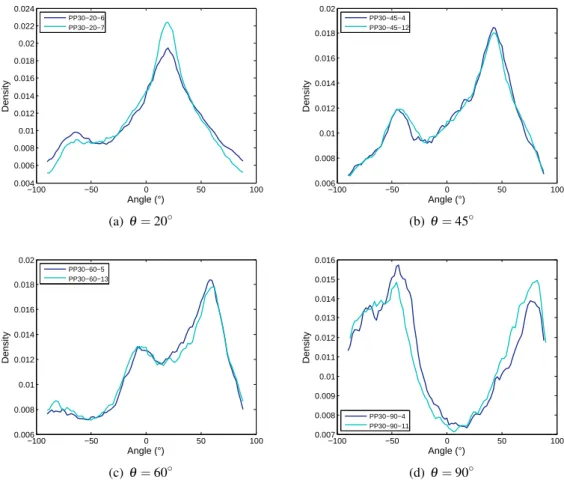
4.28 Fibre distribution of orientation of specimens cut at angles equal to 0◦, 20◦, 45◦, 60◦ and 90◦with respect to IFD for PP-30GF. . . 72
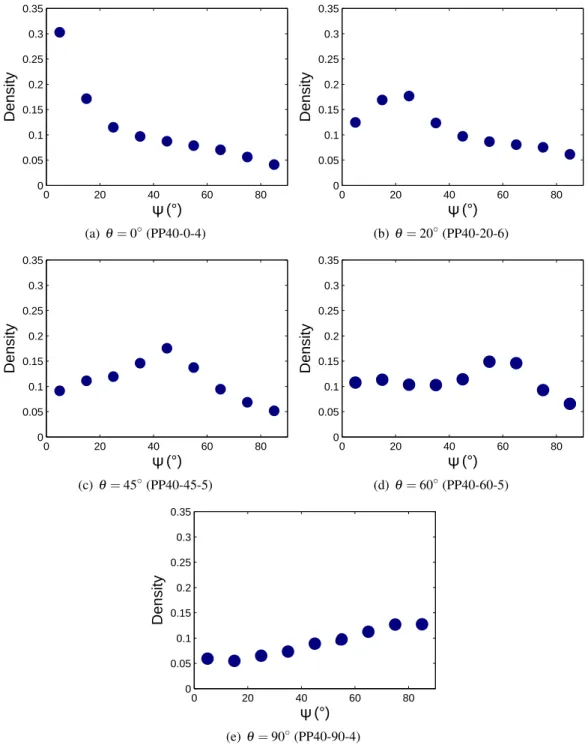
4.29 Fibre distribution of orientation of specimens cut at angles equal to 0◦, 20◦, 45◦, 60◦ and 90◦with respect to IFD for PP-40GF. . . 73
4.30 Tensile specimens for optical extensometry measurement . . . 75
4.31 Tensile tests at different strain rates and loading angles for PP-30GF . . . 76
4.33 Observation of anisotropic behaviour by considering different loading directions from quasi-static tensile tests (at 1 mm.min−1) for PP (dashed line) and the com-posite materials (PP-30GF and PP-40GF) . . . 78
4.34 Tensile behaviour of 0◦- specimens (at 1 mm.min−1) with different average values ofψ . . . 79
4.35 Apparent rigidity of PP-30GF and PP-40GF at different strain rates. . . 79
4.36 Average axial stress at break of PP-30GF and PP-40GF at different strain rates . . . 80
4.37 Comparison of experimental and numerically simulated tensile behaviour of speci-mens PP30-0-1 (τ = 23 MPa) and PP40-0-1 (τ = 26.5 MPa) . . . 81
4.38 Representation of the layered structure of the fibre orientation for the computation of the tensile response of a PP30-0 specimen (at 1 mm.min−1) . . . 83
4.39 Results of simulated tensile test with layered distributions of fibre orientation of a PP30-0 specimen at 1 mm.min−1 . . . 84
4.40 Comparison of experimental and numerical data for tests of 0◦specimens of PP-30GF 85
4.41 Comparison of experimental and numerical data for tests of 20◦specimens of PP-30GF 85
4.42 Comparison of experimental and numerical data for tests of 45◦specimens of PP-30GF 85
4.43 Comparison of experimental and numerical data for tests of 60◦specimens of PP-30GF 86
4.44 Comparison of experimental and numerical data for tests of 90◦specimens of PP-30GF 86
4.45 Comparison of experimental and numerical data for tests of 0◦specimens of PP-40GF 87
4.46 Comparison of experimental and numerical data for tests of 20◦specimens of PP-40GF 87
4.47 Comparison of experimental and numerical data for tests of 45◦specimens of PP-40GF 87
4.48 Comparison of experimental and numerical data for tests of 60◦specimens of PP-40GF 88
4.49 Comparison of experimental and numerical data for tests of 90◦specimens of PP-40GF 88
5.1 Definition of the damaged and effective configurations in Continum Damage Me-chanics. . . 94
5.2 Damage anisotropy of the reinforced matrix material . . . 95
5.3 Influence of parameter S on the evolution of the damage variable D (1 mm.min−1) . 100
5.4 Influence of parameter S on the damaged matrix response at tension (1 mm.min−1) 100
5.5 Damage variable determination from cyclic tests using the stiffness-loss method [38] 101
5.6 Cartography corresponding to an engineering strain of 0.087 and determination of the ROI of homogeneous strain . . . 101
5.7 Stress-true strain response for cyclic uniaxial tensile test on PP . . . 102
5.9 Identification of the parameter S . . . 105
5.10 Influence of damage on computation of PP matrix tensile behaviour,for a wide range of strain rate . . . 106
5.11 Anisotropy of the matrix damage for the PP-30GF composite (data computed using distributions of fibre orientation of specimens PP30-0-4 and PP30-90-4) . . . 107
5.12 A schematic representation of failure scenario in SFRC subjected to an axial loading (in the direction of the fibre axis) . . . 108
5.13 Effect of fibre/matrix debonding on load transmission . . . 109
5.14 Influence of parameter b on the fibre length unavailable for load transmission (a fixed at 0.2) . . . 112
5.15 Influence of parameter a on the fibre length unavailable for load transmission (b fixed at 2) . . . 112
5.16 Influence of parameter a on the fibre axial stress (b fixed at 2) . . . 113
5.17 Influence of parameter a on the composite PP-GF30 axial stress (b fixed at 2), in the case of specimen PP30-0-1 tested at 1 mm.min−1 . . . 113
5.18 Comparison of experimental and numerical results for the identified parameters a and b (specimen PP30-0-1 tested at 1 mm.min−1) . . . 114
5.19 Implementation scheme . . . 115
5.20 Verification of the model with the implemented matrix and interfacial damage mod-els by comparison with experimental results in the case of PP-30GF . . . 116
5.21 Fibre debonding in a fracture surface of PP-30GF tested at 1mm.min−1(visualised by MEB) . . . 118
5.22 Evolution of cumulated void volume fraction with different distributions of fibre orientation resulting from different cutting anglesθ . . . 119
5.23 Notched specimen geometry and definition of the ROI. . . 120
5.24 Influence of the facet size on the measured axial strain at the step 150 (corresponding to an engineering strain of 0.04) . . . 121
5.25 Cartography of axial strains at the pre-failure step (last step) for 0◦-specimens with a facet size of 31x31 pix2 . . . 122
5.26 Local strain measurement at the pre-failure step of the specimen PP30-0-4 . . . 122
5.27 Influence of the mesh size on the strain localisation at the notch zone . . . 123
5.29 Identification of the critical cumulated void fraction with results obtained for the specimen PP30-0-4 . . . 124
5.30 Evolution of the cumulated void (a) with different distributions of fibre orientation obtained from specimens cut atθ = 0◦(b) . . . 125
5.31 Failure criteria at 0◦with respect to IFD (dashed vertical lines correspond to the ex-perimental minimum (PP30-0-5) and maximum (PP30-0-6) failure strains obtained with notched specimens . . . 126
5.32 Cartography of axial strains at the pre-failure step (last step) for 90◦-specimens with a facet size of 31x31 pix2 . . . 127
5.33 Identification of the failure strain with notched specimen PP30-90-4 . . . 129
5.34 Failure criteria at 90◦ with respect to IFD (dashed vertical lines correspond to the experimental minimum (PP30-90-3) and maximum (PP30-90-5) failure strains ob-tained with notched specimens . . . 130
5.35 Cumulated void evolution for theoretical composites with aligned fibres (0◦and 90◦) 130
5.36 Fracture surface of PP-30GF tested at (a) 1 mm.min−1 and (b) 1000 mm.min−1 obtained by SEM obserbations. . . 136
A.1 Total volume variation and strain volume variation fraction of the composite material (PP-30GF) . . . 146
A.2 Comparison between experimental and computed void volume fraction with the identified value of Cnucl (with data corresponding to the notch specimen PP30-0-4) . . . 146
General Introduction
Composite materials are known as new generation of strong-stiff and lightweight materials. Yet this kind of material has existed in nature for thousands of years now, like wood, bamboo and bones, long before the modern engineering community thought of developing the first composite material. In general a composite is made from two or more distinct materials with significantly different physical and/or chemical properties, which produce a material with properties different from those of the individual components. The first phase of composite material is called matrix and its main role is to transfer load to reinforcing agents. Polymeric matrices are under concern in this work. Scientists developed the first polymers, a result of the polymerisation process of monomers, at the beginning of the 20thcentury. Examples of synthetic polymeric structures, amongst others, include nylon, polyethylene, polyster, and epoxy. According to their thermomechanical properties, two categories of polymeric matrices can be found: Thermoset (e.g. epoxies) and thermoplastic (e.g. nylon, polypropylene, high density polyethylene, polycarbonate) polymers. The primary physical difference is that thermoplastics, with linear and branched chains, can be remelted back into a liquid form, whereas thermoset plastics, with crosslinked chains, will always remain in a per-manent solid state. Given the relatively “weak” properties of polymeric materials, reinforcement is needed to create a stiff material. Therefore, a second phase is introduced as reinforcing agent like particles, nanotubes, nanoparticles or fibres (continuous, long or short). A relation between density and Young’s modulus for various materials can be seen in Figure 1.1, where the high mechanical properties of reinforcement (fibres, particles), compared to those of polymeric ones, are highlighed.
5 Carbon fibre Kevlar fibre Carbon fibre composites Diamond Steel Alumina Titanium Glass Glass fibre composites Carbon fibre composites (// fibres) ( fibres) Wood (// grain) Polymer resins Wood ( grain) 0.2 0.5 1 2 5 10 0.1 0.1 1 10 100 1000 Density, ρ (Mg m-3) Youn g's Modu lus, E (GP a) Youn g Modu lus (GP a)
Figure 1.1: Stiffness of various materials with respect to their densities
With fibre reinforcement, it is well established that stiffness, strength and, for many polymers, toughness are improved. The dimensional stability, creep resistance, ageing and weathering prop-erties, crucial in some applications, can also be improved. The increase in stiffness and failure stress of a Polypropylene matrix reinforced by 40% in volume fraction of short glass fibres and loaded in main fibre direction is highlighed in Figure1.2.
Two categories of reinforcing fibres can be distinguished: continuous (or long) and short fibres. The fibre reinforced composites with the highest mechanical properties are those with continuous fibre reinforcement. However, such materials cannot be adapted easily to mass production and are generally confined to products in which the property benefits outweigh the cost penalty. Short fibre reinforced composites (SFRC) can offer a unique combination of properties with interestingly superior mechanical properties over the parent polymers. Among other advantages, short-fibre reinforced composites are interesting from an industrial point of view for their relatively low cost and easy manufacturing process as they can be processed in a manner similar to polymeric materials. In the case of thermoplastics, conventional fabrication techniques, such as extrusion compounding and injection moulding, are available, allowing mass production of components with quite intricate shapes.
Stress Strain σf=80 MPa σf=27 MPa Composite Polypropylene
Figure 1.2: Polypropylene matrix reinforced with 40% of short glass fibres under uniaxial tension test at a constant strain rate. In the figureσf represents the failure stress [1].
In this context, short fibre reinforced composites are finding ever-increasing interest in engineering applications, such as automotive industry (e.g. for the manufacturing of instrument panels of vehicules).
The kind of composite material to be further discussed in this manuscript is a thermoplastic matrix reinforced with short glass fibres. The properties of SFRC are partly induced by the composition (fibre volume fraction) and partly by the processing, giving a wide range of property combinations to which both designer and manufacturer should be alert. By adding suitable fibres and by con-trolling factors such as the aspect ratio, the dispersion, the fibres orientation and the fibre-matrix adhesion, significant improvements in property can be achieved.
The extensive use of these composites needs, however, a thorough theoretical knowledge of their properties and their interactions with process and/or loading conditions the material will have to withstand. This becomes more crucial under extreme loading conditions (e.g. crash or impact load-ing) with the material behaviour complexity (e.g. polymeric matrices viscosity). In that context, characterisation of short fibre composite materials, prediction of effective mechanical properties and micromechanical analytical modelling under various loading conditions are a field of study for researchers. For instance, when targeted structures are subjected to high speed loading application, robust theoritical approche that can take strain-rate sensitivity into account, in addition to other specificities (like reinforcement complexity and damage phenomena) are needed for a reliable prediction of the materials behaviour.
Taking all the aforementioned into consideration, the ultimate objective of this thesis work is to present an efficient approach for the numerical modelling of short fibre composite in the frame-work of dynamic loading. Major guidelines for this frame-work is that most important interdepen-dent phenomena, for instance, viscosity, complex anisotropy, failure mechanisms, are to be fully adressed in a unified modelling. The proposed approach is at an intermediate scale between complex homogenisation approaches and often inaccurate purely phenomenological descriptions. The current approach is based on the additive decomposition of the composite thermodynamic potential. The composite is thus seen as the assembly of a matrix medium and several media of embedded fibres. The deformation gradient, applied to the composite as a whole, and its multi-plicative decomposition implicitly link the media. A main asset of this approach is its adaptability to all kinds of reinforcement characteristics (orientation and geometrical properties) and matrix behaviour while keeping the implementation relatively easy. The matrix behaviour is modelled as strain rate dependent using a coupled Viscoelastic (VE)-Viscoplastic (VP) scheme. Complex distributions of fibre orientation are considered, leading to an accurate representation of the actual reinforcement orientations. Thus, the coupled influence of strain rate and anisotropy of SFRC behaviour can be modelled. An experimental compaign is conducted in order to identify the material parameters used in the model. According to experimental observations, damage mech-anisms, mainly matrix ductile damage and fibre-matrix decohesion occur during the material loading. These phenomenon are introduced in the constitutive model which is implemented in an explicit finite element code. The accuracy of the developped model is evaluated by comparison with experimental tests at various loading configurations and for a wide range of strain rates. In order to fullfil the afformentioned objectives the work is structured according to the following major lines: A part is dedicated to the proposition of a modelling approach with the developpe-ment and impledeveloppe-mentation of constitutive laws for short fibre reinforced thermoplastic material subjected to dynamic loadings. A second part is about the experimental investigations conducted in order to identify the material parameters, to microscopically characterise the fibres distribution of orientation and to characterise the composite behaviour under different loading configurations. A Final part is devoted to the modelling of failure mechanisms in SFRC as a progression of damage phenomena leading to composite’s ultimate failure.
Outlines of the report
The manuscript is structured around the most important issues to deal with when modelling and characterizing the composite behaviour untill its ultimate failure. It is organized as follows:
• Chapter 2 introduces general aspects related to the material under investigation and
pro-vides a background for the mechanical characterisation of short fibre composite thermoplas-tics. Most important contributions for the modelling of short fibre reinforced composites are reviewed throughout this chapter. Different approaches that have been developed will be presented and a bigger attention to the fundamental approches on micromechanical modelling will be payed. Finally the chapter highlights the motivations of the modelling choices presented in this work.
• Chapter 3 deals with the developped constitutive model. Firstly, the thermodynamic basis
of the approach is presented. Then the different constitutive laws associated to the matrix, the fibres and the short-fibre-reinforced composite are presented for non damaged material.
• Chapter 4 deals with the experimental procedure for the identification of the involved
ma-terial parameters and the characterisation of the composite mama-terial behaviour. Tests and procedure for identification of matrix material parameters are first described. The composite microstructure is then analysed, in particular thanks to the characterisation of complex dis-tributions of fibre orientation by micro-computed tomography. Finally the proposed consti-tutive model is validated by comparison between the simulation results and the experimental data.
• Chapter 5 is devoted to the modelling of damage mechanisms and ultimate failure of short
fibre reinforced composites. Damage modelling is performed by associating an anisotropic ductile damage model to the matrix material and an interfacial damage model to fibre-matrix interface. Identification of the involved parameters is based on experimental tests realised on a SFRC. Finally, a fracture criteria is defined as a threshold of the predicted damage amount that a SFRC can withstand.
• Finally Chapter 6 gives a conclusion of this work. The manuscript ends with perspectives
State of art of short fibre reinforced
composites behaviour and modelling
Short fibre reinforced composite materials (SFRC) are attractive for many industrial applications thanks to interesting mechanical and physical properties. Their superior mechanical properties in combination with low manufacturing cost are the main reasons behind their wide use and study. A wide range of investigations have been done in order to assess the potential and limitations of such materials in different loadings or environmental conditions, for numerous combinations of matrix and reinforcement materials. It was widely reported that main factors governing the physical and mechanical behaviour of SFRC are the properties of the individual constituents, fibre volume fraction, fibre orientation and length distributions and fibre-matrix interface strength.
The present chapter provides a background for general aspects and mechanical characterisation of short fibre composite materials. Through this chapter different experimental investigations and numerical approaches that have been developed by numerous researchers through the years will be presented. The chapter begins by discussing the main aspects and manufacturing processes with the major factors affecting the behaviour of short fibre composite. It continues by addressing the major results about the characterisation of the material’s behaviour and then the fundamental numerical methods and theoretical approaches on micromechanical analytical modelling.
2.1
Generalities about short-fibre reinforced thermoplastics
The significant improvements induced by adding fibres to thermoplastics in mechanical (stiffness, strength, toughness, resistance to creep, dimensional stability) and thermal (maximum service temperature) properties can be obtained without sacrificing the mouldability of the materials for SFRC. Conventional extrusion compounding and injection moulding machines designed for
unfilled thermoplastics, allowing rapid production of components with complex shapes, can then be used for SFRC [2]. In fact, common commercial grades of fibre reinforced thermoplastics can be processed at temperature, pressure, injection rate and cycle duration similar to those used to process unfilled thermoplastics. There are, however, differences between processing of fibre reinforced materials and unfilled thermoplastics that must be heeded. For instance, the fibre length degradation, which affects fibre aspect ratio, depends on tools and operating conditions [3]. Most influencing process parameters are flow speed and temperature and mould geometry [4,5]. Other crucial properties of SFRC, such as fibres’ distribution of orientation, are strongly dependent on manufacturing process. In addition, as reported for instance by Milewski [6] and Fu et al [7], increasing the volume fraction of fibres increases the probability of fibre to fibre interaction and then has a direct consequence on the fibre length, aspect ratio and orientation. In the following of this section, attention is payed to morphological aspects of SFRC and then to the fibre orientation as main source of anisotropy in the material.
2.1.1 Microstructure of short fibre reinforced composites
The macroscopic behaviour of short fibre reinforced composites is directly dependent on its con-stituents properties (i.e. fibres and matrix material properties), fibre/matrix interfacial properties and the reinforcement configuration. Among microstructural characteristics of SFRC the rein-forcement configuration and properties are of great importance (i.e. fibre volume fraction, fibre orientation and length distributions, interfacial properties,...). The fibre volume fraction is usually fairly controlled, though local variations of fibre density (i.e. significantly higher and lower fibre content than the average value) may occur. There are, however, very few reports of measurements of this in the literature. In contrast, short fibre orientation is difficult to control (see Figure2.3) and constitutes a process-dependent property that greatly influences the overall properties of the composite material.
Tool geometry and processing conditions are beyong process parameters to be manipulated specif-ically to control the fibre orientation distribution in the product. Attempts to control distributions of fibre orientation have been proposed by developping models for the dependence of fibre orien-tation distribution on processing conditions [9,10]. A study was performed by Goettler [11] on fibre orientation during injection flow in order to optimise the composite directional strength and stiffness using a kinematic model. Akay and Barkley [12] have treated process parameters, fibre orientation distribution and mechanical properties as inter-related variables for injection-moulded short-glass fibre-reinforced polypropylene. They have shown that an increase in melt and mould
Figure 2.1: Example of a microstructure: Polyamide 6.6 matrix reinforced with short glass fibres [8]
temperature and injection speed cause a significant decrease in short fibre alignement along the injection flow direction. In their study they also investigated the gradual change in the preferential fibre alignement in the mouldings. In fact, an injection moulded short fibre composite tends to have a stratified morphology in which the most prominent feature is the variation of fibre orientation distribution through the thickness. This layered structure is mainly induced by differential solidifi-cation, shearing and melt-flow or fountain-flow patterns effect (including divergence, convergence and shape of the flow fronts). A shematic representation of the fountain flow process is given in Figure2.2. Interactions with neighbouring fibres and/or with mould wall are also reported to be of significant influence on the fibre alignement during melt-flow process. Base on microscopic observation, it has been reported that injection moulded samples exhibit a skin/shell/core/shell/skin organisation through thickness with different fibre orientation [12,13].
The fibres in the shell regions are predominantly aligned along the flow direction due to high shearing near the mould wall surface. The core region consists, however, on predominanly tran-verse fibre alignement, owing to low shearing and high extensional flow. Finally, the fibres in skin regions, i.e. in areas adjacent to the walls of the mould cavity, adopt random orientation because they are rapidly freezed in contact with comparatively cold walls during the fountain flow process [14,15].
A study on the layered structure of short fibre reinforced polymers was recently presented by Thi [13], where it is found that layer proportions, i.e. layers relative thickness, are globally dependent on the process parameters (e.g. mould geometry, matrix material viscosity, injection speed, fibre
Figure 2.2: Melt flow profile of short fibre reinforced polymer within mould cavity during filling.
content and aspect ratio,...). According to the work presented by Akay and Barkley [12], fibre ori-entation within injection moulded SFRC has a direct effect on tensile properties of the composite. They examined the evolution of the elastic moduli and ultimate tensile strength values and found that they are reduced when increasing the core relative thickness.
Given the complexity of SFRC microstructure and its crucial effect on the mechanical behaviour, a number of researchers have been interested in developing accurate techniques for measuring the fibre orientation in injection-molded parts formed from short-fibre composite.
2.1.2 Techniques of orientation measurement
Measuring fibre orientations started first by acquiring data either from polished sections by re-flective microscopy or from microtomed samples by transmission optical microscopy or contact microradiography. Experimental results in this category are reported in [4,16,17,18].
Fischer and Eyerer [19], Bay and Tucker [20], Zhu et al [21] and Hine et al [22] measured short-fibre orientations by examining polished cross-sections by optical reflective microscopy. In these works, they considered the ellipse-shaped intersection of a fibre with a plane to calculate the misalignment angle of the fibres axis. Later, Zak [23] proposed a three-dimensional measurement of distribution of fibre orientation by combining data from two consecutive closely spaced cross-sections of a specimen. This method was presented as an unbiased distribution data for the near-zero misalignment angles and a solution to the orientation duality problem. Eberhardt and Clarcke [24] and Clarcke et al [25, 26] presented automated techniques of the use of confocal laser scanning microscopy for the measurement of 3D distributions of orientation which enables
semi-transparent materials to be optically sectioned for a given distance from the sample’s surface. Compared to conventional optical and electron microscopies, acoustic, and scanning tunneling microscopies, x-ray microtomography offers unique imaging capabilities, for instance the pos-sibility of three-dimensional scanning. A comparison between optical and tomographic methods is performed by Bernasconi et al [27]. The system consists of a high-resolution imaging x-ray detector and high-speed tomographic image reconstruction procedures together with a collimated monochromatic area-filling x-ray beam. Tomography scanning technique is based on mathemat-ical analysis that consists on the reconstruction of a function from values of its line integrals [28]. Transmission tomography implements the needed mathematics to create non-destructive cross-sectional images of the internal structure of a sample from measurement and analysis of penetrating radiation directed through the sample in multiple coplanar rays [29]. Shen et al [30] used micro-CT to observe and measure the fibre orientation in a 5 wt% short-glass-fibre-reinforced phenolic foam. They reconstructed the 3D fibre distribution of the foam from the obtained micro-CT images, and then they imported this 3D quantitative information into the software program Auto-CAD and used it to analyze the spatial length and orientation of the individual fibres. A global characterisation of fibre orientation distribution by micro-CT was proposed by Nguyen Thi et al [31] for high fibre content.
In this work, x-ray microtomography will be used for the characterisation of the reinforcement configuration in a short-glass-fibre-reinforced polypropylene at microscopic scale.
2.2
Behaviour of thermoplastic matrices
In this thesis work, composites under study are polymer reinforced composites. General aspects about polymeric behaviour and, more precisely, thermoplastic polymers are reviewed in the fol-lowing paragraphs.
Polymer materials result of the polymerisation of small size organic molecules, called monomers. The structure of the formed macromolecules differs and give rize to different architectures. Two main types can be distiguished according to these architectures; thermoset and thermoplastic poly-mers. Attention will be paid here to thermoplastics as widely used polymers in the case of short fibre reinforced polymers. The molecular structure of thermoplastic polymers is either crystalline (organized, in which the chains are aligned), amorphous (not organised, e.g. Polystyrene (PS) and Polycarbonate (PC)) or semi-crystalline, where the two structures coexist and the corresponding polymer is characterised by a degree of crystallinity (e.g. Polyethylene (PE) and Polypropylene
(PP)) [32].
Many studies have been dedicated to the characterisation of thermoplastic behaviour when sub-jected to a wide range of loading conditions. The rate dependency is one of the main features of semi-crystalline thermoplastics that becomes more crucial when dealing with high speed applica-tions, in particular. Zhang and Moore [33] have shwon the significant increase in the response of High Density Polyethylene (HDPE) as the strain rate hardening is varied.
For the global behaviour of thermoplastic polymers usually a distinction is made between the linear elastic and/or linear viscoelastic regime at small strains, the nonlinear viscoelastic response at moderate strains and the viscoplastic behaviour at rather large strains. The modeling of the me-chanical response of these polymers can be a difficult task because the numerical model represent-ing material’s behaviour must account for all of these deformation regimes. In the literature, these polymer materials are usually described and modelled as viscoelastic (VE), elasto-viscoplastic (EVP) or viscoelastic-viscoplastic (VE-VP). The difference between these classes of behaviour can be illustrated by a uniaxial tension test which comprises a monotonic loading phase followed by unloading to zero stress. In the case of viscoelasticity, the response is rate dependent in both phases, which implies that the stress-strain slope (Young’s modulus) increases with increasing strain rate. Upon unloading to zero stress, the material retrieves its initial zero stress state, not instantly, after a sufficient waiting time. A complete description of viscoelastic behaviour is given by Christensen [34], Findley [35] and Salençon [36]. An elasto-viscoplastic polymer will behave differently during the same uniaxial loading/unloading test. Below an initial yield stress, the response is rate-independent linear elastic. Beyong it the stress-strain response is both nonlinear and rate-dependent, with the stress increasing with the strain rate. After unloading to zero stress, there remains an irreversible strain which decreases but does not disappear even after a long time. For a description of EVP models, one can refer to Perzyna [37] and Lemaitre and Chaboche [38]. A thermoplastic polymer can also behave as a combination of these two types of behaviour. In fact, when the response is rate dependent below and above the yield stress, the overall behaviour is classified as viscoelastic-viscoplastic. This combination has got a physical explanation in the case of semi-crystalline thermoplastics. Indeed, several micromechanical observations tend to show that crystalline lamellae and amorphous chains are assembled in series and obey VE and VP behaviour, respectively [39]. Chaboche [40] considered this case to develop a combined constitutive model for polymeric materials. A more thorough study of viscoelastic-viscoplastic behaviour modelling will be further adressed in the manuscript. In addition to rate dependency, thermoplastics can show a strong dependency to temperature, as demonstrated by Karger-Kocsis and Friedrech [41]. The
later property is however not in the scope of this work.
Other features can characterise the behaviour of thermoplastics when subjected to a wide range of loading conditions. For instance they can exhibit non isochoric plastic flow and pressure de-pendent behaviour. Non-isochoric plastic flow of polymers has been studied by various authors. The volumetric strain of polyethylene terephtalate (PET) and high-impact polystyrene (HIPS) has been measured by G’Sell [42] using a video-controlled testing where the longitudinal and transverse strains are measured by tracking markers positioned on the specimens. In the same way, the volume strain measurement for polypropylene (PP) material was quantified by G’Sell et al [43] and Jerabek et al [44]. From the obtained results, authors concluded that the plastic deformation should not be considered as an isochoric process. The effect of hydrostatic pressure on the behaviour and for instance on the yield stress of polymers has been widely studied as well (e.g., Wang and Pan [45]; Khan and Farrokh [46]). It was reported that this is caused by the structure of the polymer chains in thermoplastic polymers. Under a load, a specific energy is needed to move a chain segment or side chain. The flexibility of chains requires a certain free volume, which is smaller at higher hydrostatic pressures. Thereby, the inner molecular forces have a stronger effect. Thus, the molecular flexibility is restricted and is affected by the applied hydrostatic pressure. Sauer and Pae [47] have highlighted the particular dependency to hydrostatic pressure in semi-crystalline polypropylene.
As stated in introduction, polymeric materials often serves as the blinder in composite materials when reinforced by stiff inclusions (particles, fibres (long or short), platelets, etc...). In this case, the complexity of their behaviour is enhanced by the presence of fillers with complex properties, in terms of geometry, orientation. The following section highlights the main aspects in the behaviour of reinforced polymers and precisely in the case of short fibre reinforced thermoplastics.
2.3
Behaviour of short fibre reinforced composites
The mechanical behaviour of short fibre reinforced composites can be complex because of the complexity of the polymeric matrix behaviour and of the reinforcement characteristics, for in-stance in terms of distribution of orientation and length. Experimental investigations exist in the literature for the characterisation of short fibre reinforced composites. An extended study on mechanical and thermal properties of short fibre composite materials has been presented by Thomason [48]. The author investigates the influence of fibre length and volume fraction of a composite consisting of short glass fibres embedded in a polypropylene matrix. Results show that
stiffness increases almost linearly with respect to fibre concentration up to a volume fraction of 60%. A similar dependency between fibre length and stiffness was observed. Composites with higher fibre content show lower stiffness which may be due to fibre packing and out-of-plane orientation tendency. Moreover, when applications with severe loading conditions, such as crash or impact, are targeted, it is crucial to characterise the dependency of the material to strain rate. As thermoplastic polymers, such as polypropylene (PP) exhibit a viscoelastic and/or viscoplastic behaviour, i.e. sensitive to strain rate, the mechanical behaviour of composite material is likely to be directly impacted by this property of matrix material. This strain rate sensitivity is reported by Mouhmid et al. for a short-glass-fibre reinforced PA6,6 [49], Reis et al. for a short-glass-fibre reinforced polyurethane [50] and Schofig et al. [51] for glass-fibre-reinforced polypropylene and polybutene-1. In the same way Fitoussi et al. proved the sensitivity of a glass-fibre-reinforced ethylene-propylene copolymere to strain rate by tensile tests performed in the injection flow direction of the composite [52] (Figure2.3). In such materials, where the complexity of matrix behaviour can be added to that of the reinforcement properties, the strain rate sensitivity has to be associated to the anisotropy induced by the fibres. Therefore, the coupled effect of strain rate dependency and fibre orientation has to be characterised in the case of SFRC. There is however a lack of data concerning this issue. A work is presented by Krivachy et al [53] on the characteri-sation of the mechancal behaviour of short fibre thermoplastic (Crastin: Polybutylene-terephthalat and Acrylnitril/Styrol/Acrylester with 20 weight % short-glass fibres) under compression, shear and tension loadings at different velocities. Results show that the material appeared to be strongly anisotropic and strain rate dependent, with additional influence of hydrostatic pressure on plasticity and failure behaviour. The study was however limited to an orthotropic assimilation of the material and no coupled effect of anisotropy and strain rate sensitivity was directly studied. Finally, the behaviour of short fibre reinforced composites can be considerably affected by different coexisting damage phenomena. It is reported in literature that the most important are fibre-matrix interfacial debonding and matrix anisotropic ductile damage [54,55]. A more particular attention is payed to the developpement of damage phenomea within a short fibre reinforced composite in the chapter 4 of this report.
2.4
Modelling of short fibre reinforced composites
Computation of macroscopic stress-strain relationship of SFRC is treated in the literature mainly on the basis of micro-mechanical approaches. For these approaches, the macroscopic response of
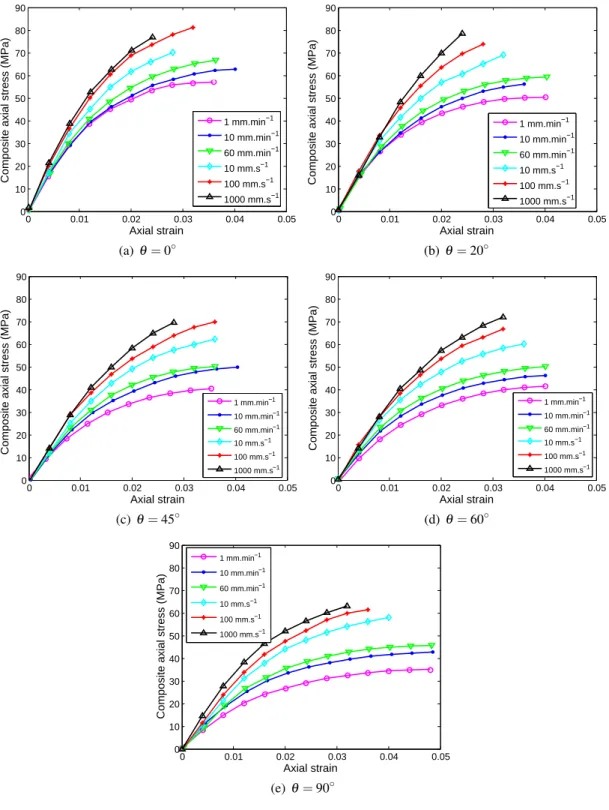
Figure 2.3: Stress-strain diagrams for PP with 40 wt.% glass fibres at different strain rates [52]
the heterogeneous material depends on the properties of its constituents as well as on their spatial distribution, i.e., the microstructure configuration. Among them one may cite: direct finite element (FE) analysis on representative cells of the microstructure [56], mean-field homogenization (MFH) techniques and the asymptotic or mathematical theory of homogenization [57,58].
The mechanical behaviour modelling of a short fibre composite was first adressed by the imple-mentation of micromechanical models. Innovative works were released first in 1889 by Voigt and in 1929 by Reuss. Both models were reference works since the earlier developed models were mainly based on the Voigt and Reuss models, known later as the Rule of Mixtures (RoM) and the Inverse Rule of Mixtures (IRoM), respectively. A modification of the Rule of Mixture was later proposed in the pioneering work by Cox in 1952 [59] based on stress distribution along a fibre using the shear lag model. It consisted on modifying the Rule of Mixture by introducing a fibre length factor. The shear lag model uses microstructural parameters such as fibre length and fibre to fibre distance in order to calculate macroscopic effective properties.
Later, the problem of multi-phases materials started to be differently and more thoroughly adressed. The concept of phase concentration tensor of stress and strain was fist introduced by Hill [60,61]. In his work, Hill treated the calculation of macroscopic elastic properties by taking into account the relative concentration and geometry of inclusions. Inclusions are assumed to be aligned ellipses and to have the same elastic properties as that of short fibres. The method is based on the solution of
the auxiliary elastic problem involving a uniformly loaded infinite mass containing an ellipsoidal inhomogeneity.
This concept was originally proposed by Eshelby in 1957 by analysing the heterogeneities of stress and strain fields caused by an ellipsoidal inclusion embedded in an infinite matrix. The analysis is based on a four steps virtual experiment, where the infinite matrix is subjected to a far field strain. The strain and stress perturbations induced by the presence of the inclusion are treated by an elastic accomodation between the inclusion and its surroundings [62].
The common process of homogenization methods can be summerized in two steps. Firstly, a local problem of a single inclusion has to be solved in order to obtain the local response and secondly a process of averaging of the local behaviour to obtain the global response takes place. The assumption of non-interaction between inhomogeneities is considered to be valid in case of low volume fraction of reinforcement. However, industrial applications of short fibre composites generally demands relatively high fibre volume fraction, as a consequence this assumption is rarely respected. Therefore, different theories have been developed to take into account such interactions in the stress/strain fields. One of the most used homogenisation schemes is the model proposed by Mori and Tanaka [63]. Similarly, The dilute diffusion model and the self-consistent model have been developped, respectively, for the cases of low and high concentration of fillers. The direct use of the homogenization methods was limited to linear elastic composites. Its extension to different and more complex types of behaviour was first dealt with in the case of linear viscoelastic composites. It consisted on applying the homogenisation schemes to an equivalent linear isother-mal elastic representation of the viscoelastic behaviour, but in Laplace-Carson space. Using the correspondance principle, constitutive equations are recast in a linear elastic form into the Laplace domain [64,65]. After homogenisation in the Laplace space, the effective properties are found by the inverse transform. The case of non-linear behaviour was more complicated when dealing with homogenizations schemes. Some formulations were proposed to tackle the problem of inelastic composites by linearizing the constitutive laws and retrieving a linear elastic-like representation of the model. Two of the most used linearization methods are secant [66, 67] and incremental methods [68].
In the same way elasto-viscoplastic behaviour was dealt with. Masson and Zaoui [69] and Pier-ard and Doghri [70] used the correspondance principle to model linearised elasto-viscoplastic composites. Ju [71] and Doghri [72] worked on the linearization of time-discretized constitutive equations. Later, the affine [73,74,75,76] and the incrementally affine formulations [77] where the proposal leads to thermo-elastic-like relations in the Laplace-Carson (L-C) and the time
do-mains, respectively, have been proposed.
The case of viscoelastic-viscoplastic composites is more complicated and there are few available models. Indeed, compared to viscoelastic or elasto-(visco) plastic behaviour modelling, the mod-elling of viscoelastic-viscoplastic (VE-VP) short-fibre reinforced composites has received little attention up to now and even less in case of relatively complex microstructure. A micromechanical model was proposed by Kim and Muliana [78] for predicting a VE-VP response of particle rein-forced composites. The studied composite consists of linear elastic spherical particles dispersed in a homogeneous VE-VP matrix. The proposed model is actually an extension of a previously proposed micromechanical model by Muliana and Kim [78] for nonlinear VE composites. It assumes a composite microstructure with randomly distributed particles, idealized by periodi-cally distributed cubic particles in a matrix medium. A unit-cell micromodel is then generated with this microstructure. The cells and subcells homogenization method is developed in terms of the average strains and stresses in the subcells. Good results were obtained with this model for low volume fractions of particles, i.e. when interactions between particles can be neglected. Aboudi [79] proposed a micromechanical model for multiphase materials in which matrix and reinforcements phases can both behave as a VE-VP material. The model is based on an asymptotic homogenization technique of composite materials with a periodic microstructure. The response of the developped model depends highly on the complexity of composite’s microstructure.
All the aforementioned models are micromechanical models. The common base of the presented theoretical work in micromechanical aspects is the idealisation of the materials morphology, based on assumptions like equal distances between fibres, the uniform length and orientation, etc. Yet, a closer examination of material’s morphology can give rise to a more realistic representation of the microstructure of the composite taking into account various geometric parameters and allows to develop more accurate material behaviour laws which can be evaluated through a computational approach.
Works dealing with numerical models for short fibre composites considering microstructures or micromechanical properties have been proposed in the litterature. Hine [80] has proposed finite element model for the prediction of elastic properties of composites with aligned short fibres of uniform length. Representations of the microstructure are realised by geometric periodicity. Pan [81] also studied the effect of random fibre orientation on the macroscopic effective stiffness properties of composite. Through the paper, the author underlines the difficulty of creating models that represent the geometry at micro-level for high volume fraction. A method of generating three dimensional, random fibrous realisations is presented which is based on the Random Sequential
Absorption (RSA) algorithm. Fibres were simulated as sphere-cylinders, which are cylinders with a hemisphere attached to both ends. LRSM is a method proposed by Ianita and Weitsmann [82] and is a windowing approach able to rapidly evaluate a large number of fibre arrangements for in-plane orientation. Calculations of effective properties are based on the classical laminate theory. The method has the ability to measure the statistical inhomogeneity in the material by information derived from local region. Berger el al [83] investigates the elastic constants of short fibre com-posite materials using a three dimensional RVE. Fibres were simulated as cylinders for the case of random orientation and aligned fibres. The periodic microstructure was created using the RSA method. The author discusses the limitation of the fibre volume fraction with this method.
As it was explained by Kari et al. [84] the main advantage of analysing SFRC using numerical models is the ability to approach, to a satisfactory degree, the real micro-structure of the material. The author evaluates the effective mechanical properties of a randomly distributed short fibre composite, for relatively high fibre volume fraction (40%).
Although various constributions have been proposed to model short fibre reinforced composites, there are still remarkable efforts to do in order to attain a satisfying accuracy and efficiency of modelling. In fact, handling simultaneously the two most important features about the composite behaviour, i.e. complex microstructure and behaviour laws is still a field of study. Numerical models can be limited by the heterogeneity of the reinforcement and its properties and specially by the time consuming computation. Moreover, in addition to limitations dealing with constituents’ behaviour laws, homogenization methods, based on inclusion-type problems can become very difficult to handle in the case of reinforcement with non-aligned short fibres. To overcome this difficulty, Doghri and Tinel [85] have developed a double step homogenisation procedure. In a first step, a two-phase “pseudo-grain” constituted of the matrix material reinforced with identical and aligned fibres is homogenised. The second step then consists in the homogenisation of all pseudo-grains to compute mechanical properties at the representative elementary volume scale, taking all orientations of the fibres into account.
All these contributions show that the difficulty of implementing homogenisation based models for SFRC increases significantly as the behaviour of constituents and fibres orientation distribution become more complex. The main drawback of this approach is its numerical cost related to the inversion of the Laplace transform. Alternative approaches need then to be developped in order to present a unified model, where the materials complexity can be efficiently taken into account.
2.5
Conclusion
In this chapter, most important mechanical and microstructural properties of short-fibre reinforced thermoplastics are presented with a highlight on short fibre orientation. The most important ex-isting results about the polymeric materials, and more precisely thermoplastics, and mechanical behaviour of short fibre reinforced composites are presented. This litterature survey concerns, in a second part, the main theoretical models developped through the years. Micromechanical models provide a useful tool for the prediction of material mechanical behaviour. There is, however, a lack of contributions where an acurate representation of the microstructure is represented while the complexity of the materials behaviour is taken into account. Indeed, the complexity of the com-posite microstructure, constituents behaviour, and interactions between them, are main features to be adressed for an efficient modelling of the material behaviour. Considering the case of extreme loading, when additional phenomena can intervens (i.e. damage mechanisms), and the high cost of the available approaches in terms of computation time, it can be concluded that effort is still needed for an efficient and complete modelling that goes beyond the limits of the existing models. The presented litterature survey is also an indicator that a more simple and holistic approach can be proposed as an alternative to the computation time costly avalaible approaches. It is therefore very interesting to consider models of composite behaviour at an intermediate scale between very complex homogenisation approaches and often inaccurate purely phenomenological descriptions. Consequently, in this thesis, an alternative modelling based on the additive decomposition of the composite thermodynamic potential is considered. The composite is seen as the assembly of a matrix medium and several media of embedded fibres. The deformation gradient, applied to the composite as a whole, and its multiplicative decomposition implicitly link the media. Nedjar [87] used this approach for viscoelastic materials, assuming that fibres carry load only in tension. Klinkel et al. [88] showed it can be theoretically applied to non-linear elasto-plastic behaviour for the matrix and the fibres but without a practical application of their implementations in the analysis of a short-fibre-reinforced material’s behaviour. More recently, Notta-Cuvier et al. [86] used this approach to deal with rate-independent elastoplastic SFRC behaviour. A main asset of this approach is its adaptability to all kinds of reinforcement characteristics (orientation and geometrical properties) and matrix behaviour while keeping the implementation relatively easy. The present work treats the modelling of SFRC’s behaviour when subjected to severe loading conditions, in particular at high strain rates. To this end, the matrix behaviour is modelled using a coupled VE-VP scheme. Complex distributions of fibre orientation are considered, leading to an
accurate representation of the actual reinforcement orientations so that the coupled influence of strain rate and anisotropy of SFRC behaviour can be modelled.
Constitutive model for short-fibre
reinforced composites
It is reported from the existing contributions, described in chapter 2, that mechanical behaviour modelling of short-fibre reinforced composites (SFRC) becomes very difficult when dealing with complex behaviour of the constituents (e.g. non-linear time-rate dependent behaviour) and/or complex reinforcement configuration (e.g. complex fibre orientation). To the author’s knowledge, no direct or practical application is presented today for the modelling of fibre reinforced strain rate dependent matrix with distributions of fibre orientation. Given the issues raised in previ-ously reported works, it can be very interesting to consider models of composite behaviour at an intermediate scale between generally limited and inaccurate phenomenological descriptions and complex homogenization approaches. Following this line, we focus in this work on an alternative approach originally proposed by Nedjar [87] and Klinkel et al. [88] that consists in assimilating the composite to an assembly of a matrix medium with several media of embedded fibres. One of main assets of this approach is its adaptability to all kinds of behaviour of matrix and fibre media while keeping a relative simplicity of implementation. Recently, this approach has been used by Notta-Cuvier et al. [54, 86] for the modelling of non-linear pressure dependent and damageable behaviour of SFRC. In the current work, we consider the later approach to adress the modelling of SFRC behaviour when subjected to severe loading conditions, and more precisely, at high strain rates (e.g. cases of crash, impact...). Moreover, the division of the short fibres into several families having their own mechanical and geometrical properties and orientation allows easy consideration of all types of reinforcement characteristics, including distributed or random orientations. In order to reproduce the strain rate dependency of the matrix material, a coupled viscoelastic-viscoplastic (VE-VP) model is implemented in the framework of non-associated viscoplasticity. The case of distributed orientations is considered for the reinforcing fibres with load transmission at fibre/matrix interface described by an adapted shear-lag model

![Figure 2.3: Stress-strain diagrams for PP with 40 wt.% glass fibres at different strain rates [52]](https://thumb-eu.123doks.com/thumbv2/123doknet/14742038.755267/36.892.260.636.190.475/figure-stress-strain-diagrams-glass-fibres-different-strain.webp)