HAL Id: tel-03094902
https://hal.archives-ouvertes.fr/tel-03094902
Submitted on 15 Jan 2021
HAL is a multi-disciplinary open access
archive for the deposit and dissemination of sci-entific research documents, whether they are pub-lished or not. The documents may come from teaching and research institutions in France or abroad, or from public or private research centers.
L’archive ouverte pluridisciplinaire HAL, est destinée au dépôt et à la diffusion de documents scientifiques de niveau recherche, publiés ou non, émanant des établissements d’enseignement et de recherche français ou étrangers, des laboratoires publics ou privés.
Algorithms to Search Games and Interruptible Systems
Spyros Angelopoulos
To cite this version:
Spyros Angelopoulos. Computation under Uncertainty: From Online Algorithms to Search Games and Interruptible Systems. Data Structures and Algorithms [cs.DS]. Sorbonne University, 2020. �tel-03094902�
Online Algorithms to Search Games
and Interruptible Systems
Spyros Angelopoulos
Habilitation Thesis
Defended on: December 14, 2020
Committee members
Steve Alpern, Warwick Business School
Nikhil Bansal, TU Eindhoven
Christoph Dürr, CNRS and Sorbonne Université
Pierre Fraigniaud, CNRS and Université de Paris
Lisa Hellerstein, New York University
Patrick Jaillet, MIT
Claire Mathieu, CNRS and Université de Paris
Laboratoire d’Informatique de Paris 6
Sorbonne Université
Search Games and Interruptible Systems
Spyros Angelopoulos
Abstract
This Habilitation thesis explores aspects of computation in a status of uncertainty. First, we study online problems, in which the input is not known in advance, and the algorithm must make decisions for each input item without knowledge of future input items. Second, we consider search games, in which a mobile searcher must locate an immobile hider that lies in some unknown point of the search domain. Last, we study the design and analysis of interruptible systems, in which the system must be able to produce a reasonably efficient output even if interrupted at some arbitrary point in time.
A unifying theme in the study of the above topics is the power and limitations of well-known, worst-case measures such as the competitive ratio and the acceleration ratio. We argue that in certain cases, more nuanced performance measures are required, and to this end we introduce new models and techniques of analysis. We also demonstrate and exploit connections between these measures and approaches, even though they apply to seemingly unrelated domains.
Resumé
Ce mémoire d’Habilitation explore les aspects de la computation dans un statut d’incertitude. En premier lieu nous étudions les problèmes en-ligne, dans lesquels les données (input) ne sont pas connues à l’avance et où l’algorithme doit prendre des décisions pour chaque donnée en l’absence de connaissance des données apportées par la suite. En deuxième lieu nous considérons les jeux de recherche, dans lesquels un acteur en démarche de recherche doit localiser un acteur caché immobile qui se trouve à un point inconnu du domaine de recherche. En dernier lieu, nous examinons la conception et l’analyse de systèmes interruptibles, dans lesquels le système doit être en capacité de produire un résultat de manière raisonnablement efficace même s’il est interrompu à un instant arbitraire.
Un fil rouge dans l’étude des sujets succinctement présentés ci-dessus est l’examen de la puissance et des limites de mesures de performance dans le cas le plus défavorable, tels le rapport de compétitivité et le rapport d’accélération. Nous avançons que dans certains cas, des mesures de performance plus nuancées s’imposent, et à cet effet nous introduisons de nouveaux modèles et techniques d’analyse. Nous démontrons et exploitons aussi des relations entre ces mesures et ces approches, même si elles s’appliquent en apparence à des domaines distincts.
1 Introduction 5
1.1 Online computation and competitive analysis . . . 6
1.1.1 The setting . . . 6
1.1.2 Competitive analysis of online algorithms . . . 7
1.1.3 Beyond competitive analysis . . . 8
1.1.4 Online computation with advice . . . 8
1.1.5 Examples of online problems . . . 9
1.2 Search games and competitive analysis of online searching . . . 11
1.2.1 The setting . . . 11
1.2.2 Online search and competitive analysis of search strategies . . . 12
1.2.3 Related work . . . 14
1.3 Interruptible systems and contract algorithms . . . 15
1.3.1 The setting . . . 15
1.3.2 The acceleration ratio of a schedule . . . 16
1.3.3 Related work . . . 17
1.4 Contribution of this thesis . . . 17
1.4.1 Online Computation . . . 17
1.4.2 Online searching . . . 19
1.4.3 Scheduling of contract algorithms and interruptible computation . . . 20
2 New measures and models in online computation 23 2.1 The bijective ratio of online algorithms . . . 23
2.1.1 Background . . . 23
2.1.2 Related work . . . 25
2.1.3 A general framework for establishing bijective optimality . . . 26
2.1.4 Beyond (exact) bijective analysis: The bijective ratio of online algorithms 29 2.1.5 An application: The bijective ratio of k-server problems . . . 29
2.2 Online computation with untrusted advice . . . 32
2.2.1 Background . . . 33
2.2.2 A new model for online computation with untrusted advice . . . 33
2.2.3 Applications of the framework . . . 34
2.2.4 Randomized online algorithms with untrusted advice . . . 39
2.3 Discussion . . . 39
3 Online search 41 3.1 Online ray search with turn cost . . . 41
3.1.1 Background . . . 41
3.1.2 LP formulations of star search with turn cost . . . 42
3.1.3 Finding a feasible solution to the dual LP . . . 43
3.1.4 Searching with multiple searchers in the presence of turn cost . . . 45
3.2 Weighted m-ray search . . . 47 3
3.2.1 Background . . . 47
3.2.2 The uniform (unweighted) setting . . . 48
3.2.3 The general weighted setting . . . 49
3.3 Bijective analysis of linear search . . . 53
3.3.1 Background . . . 53
3.3.2 Strategies of optimal discovery ratio in Σ . . . 54
3.3.3 Strategies of optimal discovery ratio in Σ9 . . . 56
3.4 Competitive analysis of expanding search . . . 58
3.4.1 Background . . . 58
3.4.2 Expanding search in a graph . . . 59
3.4.3 Expanding search in a network . . . 64
3.5 Discussion . . . 68
4 Contract scheduling and interruptible algorithms 71 4.1 Scheduling contract algorithms with end guarantees . . . 71
4.1.1 Background . . . 71
4.1.2 Cyclic schedules and the LP formulation . . . 72
4.1.3 Obtaining an optimal schedule . . . 73
4.1.4 Computational evaluation . . . 75
4.2 New measures for evaluating contract schedules . . . 76
4.2.1 Background . . . 76
4.2.2 Problem formulation and comparison of measures . . . 77
4.2.3 A schedule of small deficiency for generalm . . . 80
4.2.4 Lower bounds on the deficiency of a schedule for a single processor . . . . 82
4.3 Connections between contract scheduling and ray searching . . . 84
4.3.1 Search with probabilistic detection and scheduling of randomized contract algorithms . . . 85
4.3.2 Randomized scheduling of contract algorithms . . . 87
4.3.3 Further connections . . . 87
4.4 Discussion . . . 89
5 Conclusion 91 5.1 Online computation . . . 91
5.1.1 Bijective analysis of online algorithms . . . 91
5.1.2 Towards more realistic advice models . . . 91
5.2 Search games . . . 92
5.3 Interruptible algorithms and beyond . . . 92
Introduction
Computer Science, as we know it today, has been largely shaped through the early advancements in the field of Computational Complexity. The introduction of the Turing machine established a simple, yet powerful model of computation, and the Cook-Levin theorem and its subsequent applications demonstrated that an entire class of computational problems can be related in terms of hardness. Complexity theory provided the tools for the systematic study of a fundamental question: How difficult is it to solve efficiently a given computational problem?
A central concept in complexity theory is that the computational efficiency of an algorithm is determined by the worst-case instance. For example, the time complexity of an algorithm is the worst-case time required to solve the problem on a Turing machine; likewise, the space complexity of an algorithm is the worst-case tape length required, as function of the input size. This concept of worst-case analysis is thus instrumental in complexity theory. It is worth observing that, at least to a certain degree, this “philosophy of analysis” marks a certain de-parture from other approaches that have been applied in the mathematical analysis of systems. For a notable example, queuing theory, which is the mathematical study of waiting lines, has traditionally applied a probabilistic approach in the analysis of queuing protocols. Namely, it studies concepts such as the average wait time in a queue, rather than the worst-case wait time. Subsequently to the successes in the field of computational complexity in the ’70s, several new computational models and areas emerged, largely motivated by real-life computational settings. For instance, parallel and distributed computation studies systems whose components are located on different networked computers; online computation studies settings in which the input is not known to the algorithm prior to its execution, but it is rather revealed in pieces throughout its execution; and the field of approximation algorithms studies the hardness of approximating computationally difficult problems.
It is interesting to note that these computational paradigms and areas inherited from complex-ity theory, and adapted accordingly, the concept of worst-case analysis. That is, the performance of a parallel, or distributed, or online, or approximation algorithm is evaluated on a worst-case, i.e, adversarial instance. A rather striking example of this analysis approach is the study of queuing systems in a worst-case setting (see the adversarial queuing theory paradigm [45]).
A basic tenet of worst-case analysis is relating the performance of the algorithm to an ideal solution. For instance, in approximation algorithms, the performance of the algorithm is com-pared to the optimal solution for the given instance, even (and especially if) the problem is NP-hard. For a different example, in online computation, the performance of the online algo-rithm is compared to an ideal algoalgo-rithm which, unlike the online algoalgo-rithm, has foreknowledge of the input.
At an intuitive level, there are two main aspects of worst-case analysis that justify its preva-lence, and its success. First, it leads to strict, ubiquitous performance guarantees that do not rely to any assumptions or probabilistic properties. Second, and perhaps equally importantly, it is a clean-cut analysis approach to which a plethora of computational problems are amenable,
as amply demonstrated by the successes in the fields mentioned above.
Despite these appealing properties, it should be evident, even at an intuitive level, that worst-case analysis is not necessarily a panacea, especially when expressed via the “intermediary” that corresponds to the ideal solution. To illustrate this with an example, suppose that we would like to compare the football teams of two schools. One possibility, and probably the most sensible, is to have the two teams compete against each other. Another possibility is to have each team play against an “ideal team” (think of your favorite Champions League cup holder), and compare the school teams based on their individual performance. Arguably, the latter may not a good idea, since the two teams would probably perform equally bad with very little, if any, margin for drawing any useful conclusions. The example illustrates some pitfalls of worst-case analysis, and acts as a warning that more nuanced approaches may be required.
In this Habilitation thesis we study computational problems under uncertainty, with an em-phasis on established and alternate worst-case measures of algorithmic performance. In this class of problems, the algorithm has to operate with limited information concerning the input or the problem setting. We will focus on three broad classes of such problems. We begin with online computation, in which the standard worst-case analysis is competitive analysis, and the corre-sponding worst-case measure the competitive ratio (Section 1.1). Next, we study search games, in which a mobile searcher has to locate, in an efficient manner, an immobile target that hides in some unknown position of the search domain (Section 1.2). Here, competitive analysis can been applied as a way for evaluating the performance of a search strategy relative to an ideal searcher that knows the precise hiding position of the target. The last part pertains to anytime computation, in which we are interested in designing algorithms that perform well even when interrupted during their execution (Section 1.3). Here, the associated worst case measure relates the performance of the interruptible algorithm to an ideal one that knows the precise time the interruption will occur.
An underlying theme that characterizes our contribution in the above topics is that, as we will argue later, worst-case analysis sometimes suffers from certain deficiencies. We remedy this by proposing new measures and analysis techniques, which are either applied complementary to the known measures, or entirely on their own. These measures and approaches have certain similarities that we exploit, despite the fact that they are applied in seemingly unrelated fields. In certain cases, we go one step further: we show that a certain model does not capture adequately a given setting or requirement, and propose a new model of study; or we show that a certain proof technique has led to erroneous results, and give a correct proof. A detailed list of the contribution of this thesis is given in Section 1.4.
1.1
Online computation and competitive analysis
1.1.1 The setting
Decisions in the real world usually have to be made in a status of incomplete information. A similar situation arises in many applications in computer science: an algorithm may not have complete knowledge of the environment, but we still require that it performs as efficiently as possible. Consider, for instance, an algorithm which has to act on a sequence of “events”, however it knows only the events that occurred in the past. Can one design algorithms that are competitive with an omniscient agent that knows the entire future?
Online computation is a paradigm that applies precisely in settings in which the input to the algorithm is not known ahead of its execution, but is rather revealed incrementally. More formally, the input to the algorithm consists of a sequence of requests. Once a request is revealed to the algorithm, it must act on it, i.e., the algorithm must serve the request. This action comes with two constraints: First, it is irrevocable, in that the algorithm cannot revoke its action on a past request while serving the current request. Second, the model assumes that the algorithm has no knowledge about future requests, while serving the current request.
A typical online problem is often a combinatorial optimization problem in which the input is not known in advance. Hence, there is a concept of a value associated with the actions of the online algorithm. More specifically, in a cost minimization problem, serving a request incurs a cost, whereas in a profit maximization problem, serving a request accrues a benefit.
Example 1. Consider the well-known paging or cache replacement problem. A fast cache of size k mediates between the CPU and the slow memory. Each of the k cache entries can store a single page, and suppose there are N k pages in total. Each request in the request sequence consists of a single page. An online algorithm for this problem must serve a request to a page p as follows. If p is in the cache, no action needs to be taken, and no cost is incurred. Otherwise, the algorithm must decide which page to evict from the cache, so as to bring in p. This action is done at unit cost. Therefore, the overall cost of the online algorithm on a given request sequence is the total number of page evictions for serving the sequence.
It is not surprising that online algorithms have been a topic of study, implicitly and explic-itly, for almost forty years: many computational problems are intrinsically online. The book [44] provides an in-depth analysis of advances in this field1. Equally importantly, online computa-tion has had an impact in several domains of computer science such as machine learning [57], networks [56], and databases [77], for some representative examples.
1.1.2 Competitive analysis of online algorithms
How does one analyze and compare the performance of online algorithms? The standard method of such evaluation is by means of a worst-case measure, known as the competitive ratio, which was introduced in the seminal work of Sleator and Tarjan [125]. In words, the competitive ratio of an online algorithm is the worst-case ratio (among all possible request sequences) of the performance of the online algorithm (e.g., its cost in case of a minimization problem) over the corresponding performance of the best offline algorithm that has advance knowledge of the input. More formally, we have the following definition.
Definition 2. Given a cost-minimization problem and a deterministic online algorithm A, the (strict) competitive ratio of A is defined by the quantity
cr(A) = sup
σ
A(σ) Opt(σ),
where A(σ) denotes the cost of A on request sequence σ, and Opt(σ) denotes the optimal cost for serving σ in an offline manner (i.e., assuming knowledge of σ).
A similar definition can apply to a profit-maximization online problem. The competitive ratio of an online problem is defined as the best competitive ratio achieved by an online algorithm for the said problem.
Occasionally, a slightly weaker version of Definition 2 is used, notably when the online problem cannot admit any efficient online algorithm according to the strict competitive ratio. More precisely, we say that algorithm A has asymptotic competitive ratio r if on every sequence σ it holds that A(σ) ≤ r · Opt(σ) + c, where c is a constant. Unless explicitly mentioned, any reference to “competitive ratio” in this thesis applies to the strict competitive ratio.
Definition 2 can be extended, in a natural way, to randomized online algorithms. Namely, it suffices to replace the algorithm’s costA(σ) (which is now a random variable), with its expected cost E(σ), where the expectation is over the random choices of the algorithm.
The framework of competitive analysis has proven itself extremely fruitful in the development of online computation as an important field of theoretical computer science, and hundreds of
1
There is a new book in preparation on online algorithms by Borodin and Pankratov, which is a testament to the ever increasing interest in online algorithms.
online problem have been studied under the competitiveness lens. This is due to the amenability of most online problems to this type of worst-case analysis. To be more specific, on the one hand, positive results, i.e., upper bounds on the competitive ratio, typically follow from combinatorial analysis that involves the worst-case behavior of a given online algorithm relative to the optimal solution. On the other hand, negative results, i.e., lower bounds on the competitive ratio, follow from a suitably constructed two-person game between the algorithm and an adversary. While such a game is conceptually simple to define for deterministic online algorithms, it is more intricate in the context of randomized online algorithms, and special care must be given to appropriately defining the power of the adversary [37].
1.1.3 Beyond competitive analysis
Notwithstanding the undeniable success of competitive analysis, certain drawbacks have long been known. Most notably, due to its pessimistic (i.e., worst-case) evaluation of algorithms, it often fails to distinguish between algorithms for which experimental evidence (or even plain intuition) would show significant differences in terms of performance. One definitive illustration of this undesirable situation is the paging problem, as defined in Example 1. In particular, strategies which are very efficient in practice, such as Least-Recently-Used and strategies that are naive and inefficient, such as Flush-When-Full are both optimal and thus indistinguishable using competitive analysis [125].
Generally speaking, competitive analysis is particularly meaningful when the obtained com-petitive ratios are small; however, when the comcom-petitive ratios are large (and even more so, in the case of an unbounded ratio) it risks no longer reflecting what is observed in practice. In these cases, a finer measure may very well be required. This disconnect between the empirical and the theoretical performance evaluation motivated a substantial line of research on measures alterna-tive to the competialterna-tive ratio. Some of the known approaches are: the Max-Max ratio [36]; the dif-fuse adversary model [102, 129, 130]; loose competitiveness [128, 131]; the random order ratio [99]; the relative worst-order ratio [50, 48, 51]; the accommodation function model [55]; and stochastic dominance as well as bijective and average analysis [84, 58, 59, 123, 114, 108, 13, 81, 12, 25]. We refer the reader to the surveys [69, 83] for an in-depth discussion of the above techniques.
1.1.4 Online computation with advice
The standard model of online computation assumes that the online algorithm has no information concerning the requests it will have to serve in the future. In practice, however, online algorithms are often provided with some (limited) knowledge of the input. For example, the algorithm may have some lookahead on some of the upcoming requests, or it may know the size of the request sequence, or some specific characteristics of certain requests. While competitive analysis is still applicable, especially from the point of view of the analysis of a known, given algorithm, a new model was required to formally quantify the power and limitations of offline information.
The term advice complexity was first coined by Dobrev et al. [68], and subsequent formal models were presented by Böckenhauer et al. [41] and Emek et al. [70], with this goal in mind. More precisely, in the advice setting, the online algorithm receives some bits that encode infor-mation concerning the sequence of input items. As expected, this additional inforinfor-mation can boost the performance of the algorithm, which is often reflected in better competitive ratios.
Under the current models, the advice bits can encode any information about the input se-quence; indeed, defining the “right” information to be given to the algorithm plays an important role in obtaining better online algorithms. Clearly, the performance of the online algorithm can only improve by increasing the size of the advice. The objective is thus to identify trade-offs between the size of the advice and the performance of the algorithm. This is meant to provide a smooth transition between the purely online world (nothing is known about the input) and the purely “offline” world (everything is known about the input).
While a certain distinction can be made between several advice models (e.g, the advice may be given by an oracle either “per request”, or rather “as a whole”), in this thesis, we focus on the tape model of advice [42], in which the algorithm has access to an advice string that is communicated by an oracle with access to the complete input. The advice complexity is precisely the length of this communication. More specifically, we have the following definition.
Definition 3. We say that an online problem isc-competitive with advice of size f (n), where f is a given function, andn is the size (i.e., length) of the request sequence, if there is a c-competitive algorithm for the problem with advice tape of size at most f (n).
In the last decade, a substantial number of online optimization problems have been studied in the advice model; we refer the reader to the survey of Boyar et al. [49] for an in-depth discussion of developments in this field.
1.1.5 Examples of online problems
In this section we present some important examples of online problems that are of interest in this thesis. We also survey some known results on the performance of online algorithms for these problems. In order to keep this section self-contained (and not overly long), we only survey results that apply to the standard model in which the algorithm has no advice on the input. In Chapter 2 we will come back to some of these problems, and address issues related to their advice complexity.
k-server
Thek-server problem, originally proposed by Manasse et al. [110], involves k mobile servers over a metric space. Upon a request to a point in this space, a server must be moved to it. The incurred cost is the overall distance traversed by the servers. Thek-server problem generalizes the paging problem and has motivated an outstanding body of research (see the surveys [63] and [101]). In general metric spaces, and in one of the most celebrated results in online computation, the Work Function Algorithm (wfa) of Koutsoupias and Papadimitriou is (2k−1)-competitive [103]; moreover, the best-known lower bound on the deterministic competitive ratio is k [110]. wfa is also known to be k-competitive on the line [32] as well as for two servers in general metric spaces [63], and it is also the best known algorithm for the circle metric [44]. Chrobak and Larmore showed that the algorithm Double Coverage, which moves certain servers at the same speed in the direction of the request until a server reaches the requested point, is k-competitive for the tree metric [62].
Weighted paging
In the standard (uniform) paging problem, each page is associated with the same cache eviction cost. Weighted paging is a generalization of the standard paging problem in which each page p is associated with an eviction cost cp. This problem has generated an impressive body of work
from the point of view of competitive analysis (see e.g., [60, 127, 31] and references therein). It is well known that the weighted paging problem for a cache of size k is equivalent to the k-server problem in a discrete star graph, assuming there are no requests to the center node of the star. More precisely, the star has as many edges as pages, and the weight of each edge is equal to half the eviction cost of the corresponding page; last, requests may appear on any leaf of the star.
For weighted paging, a tight k-competitive deterministic algorithm follows from the more general work of Chrobak et al. [62] for the k-server problem on trees. The randomized version of the problem has a much more fascinating history of research, which culminates with a randomized O(log k)-competitive algorithm due to Bansal, Buchbinder and Naor [31].
Online reordering buffer management
In this online problem, the request sequence consists of points in a metric space, which have to be processed by a single server. The server comes with a buffer of size (capacity) k, and must decide, at each point in time, which request from its buffer to serve next. Serving a request entails moving the server to the location of the request. The objective is to minimize the total distance that the server has traveled within the metric space throughout serving the requests. This problem was introduced by Räcke et al. [116], and can model context switching costs that occur in various applications ranging from production engineering to disk management.
For this problem, Räcke et al. [116] gave aO(log2k)-competitive algorithm for uniform metric spaces, which was subsequently improved to O(log k) by Englert and Westermann [71], and for general, non-uniform metrics. Avigdor-Elgrabli and Rabani [27] improved this bound to O(log k/ log log k), which was in turn improved to a guarantee of O(√logk) by Adamaszek et al. [1]. The latter is close to optimal due to a lower bound of Ω(plog k/ log log k) shown in the same paper. All of the above results apply to deterministic algorithms.
Ski rental
The ski rental problem is a canonical example in online rent-or-buy problems. Here, the request sequence can be seen as vacation days, and on each day the vacationer (that is, the online algorithm) must decide whether to continue renting skis, or buy them. Without loss of generality we assume that renting costs a unit per day, and buying costs B ∈ N+. The number of days
is unknown to the online algorithm. Generalizations of ski rental have been applied in many settings, such as dynamic TCP acknowledgment [95], the parking permit problem [113], and snoopy caching [94]. A simple online algorithm that rents until day B− 1, and buys on day B achieves an optimal deterministic competitive ratio equal to 2− 1/B, whereas a more involved randomized strategy achieves optimal competitive ratio equal toe/(e− 1) [96].
Online bidding
In the online bidding problem, a player wants to guess a hidden, unknown value u, with u≥ 1. To this end, the player submits a sequence X = (xi) of positive, increasing bids, until one of
them is at leastu. The strategy of the player is defined by this sequence of bids, and the cost of guessing the hidden value u is equal toPj
i=1xi, wherej is such that xj−1< u≤ xj. Hence the
following natural definition of the competitive ratio of the bidder’s strategy.
cr(X) = sup
u
Pj
i=1xi
u , where j is such that xj−1 < u≤ xj.
The problem was introduced in [61] as a canonical problem for formalizing doubling-based strategies in online and offline optimization problems. A simple doubling strategy in which xi = 2i yields an optimal deterministic competitive ratio equal to 4, whereas a more complex
randomized strategy achieves an optimal competitive ratio of e/(e− 1).
It is worth noting that online bidding is essentially equivalent to the linear search problem (informally known as the cow-path problem), as we will see in Section 1.2. Moreover, it is identical to the problem of minimizing the acceleration ratio of interruptible algorithms, in its simplest setting, as we will discuss in Section 1.3.
Bin packing
This is the online variant of one of the first combinatorial optimization problems ever studied from the point of view of approximation algorithms; in fact, online bin packing was studied under worst-case measures even before competitive analysis was formally introduced in [125].
The problem models several applications [90, 64], and as such is of both theoretical and practical significance.
An instance of the online bin packing problem consists of a sequence of items with different sizes in the range(0, 1], and the objective is to pack these items into a minimum number of bins of unit capacity. For each arriving item, the algorithm must either place it in one of the current bins, or open a new bin for the item. By the nature of the bin packing problem, it cannot be avoided that a constant number of bins are not well filled. Hence, it is standard practice to measure the performance of an online algorithm by means of the asymptotic competitive ratio.
A straightforward algorithm for online bin packing is First Fit. This algorithm maintains bins in the same order that they have been opened, and places an item into the first available bin with enough free space; if no such bin exists, it opens a new bin. Johnson [89] proved that the competitive ratio of First Fit is 1.7. Since this result, many other algorithms with improved competitive ratios have been studied. The best known algorithm was recently proposed by Balogh et al. [29] and has a competitive ratio of at most 1.5783. Moreover, it is known that no online algorithm can achieve a competitive ratio better than 1.54278 [30].
List update
The list update problem is one of the fundamental online problems, and among the first to be studied under the framework of competitive analysis [125]. The problem setting consists of a list of items, and a sequence of requests that must be served. Each request corresponds to an “access” to an item in the list. If the item is at positioni of the list, then its access cost is i. After accessing the item, the online algorithm can move it closer to the front of the list at no cost: this operation is called a free exchange. In addition, at any point in time, the online algorithm can choose to swap any two consecutive items in the list: this operation is called a paid exchange, and incurs unit cost.
Move-To-Front (Mtf) is an algorithm that moves every accessed item to the front of the list using a free exchange. Sleator and Tarjan [125] proved that Mtf has a competitive ratio equal to 2. This ratio turns out to be the best that a deterministic algorithm can achieve [86]. Timestamp, introduced by Albers [2], is another algorithm that achieves the optimal competitive ratio of 2. This algorithm uses a free exchange to move an accessed itemx to the front of the first item that has been accessed at most once since the last access to x. Another class of algorithms are Move-To-Front-Every-Other-Access (Mtf2) algorithms that move the accessed item to the front of the list on every other access. More precisely, these algorithms maintain a bit for each item in the list. Upon accessing an itemx, the bit of x is flipped, and x is moved to front if its bit is 0 after the flip (otherwise the list is not updated). If all bits are initialized to 0 at the beginning of the algorithm’s execution, Mtf2 is called called Move-To-Front-Even (Mtfe), otherwise, Mtf2 is called Move-To-Front-Odd (Mtfo). Both Mtfe and Mtfo algorithms have a competitive ratio of 2.5 [53]. Boyar et al [53] showed that, for any request sequence, one among Timestamp, Mtfo, and Mtfe must have a competitive ratio of at most 5/3, which, as we will see later, is very useful in the design of list update algorithms with advice.
1.2
Search games and competitive analysis of online searching
1.2.1 The setting
Searching for a target is a common task in everyday life, and an important computational problem with numerous applications. Problems involving search arise in such diverse areas as drilling for oil in multiple sites, the forest service looking for missing backpackers, search-and-rescue operations in the open seas, and navigating a robot between two points on the Mars terrain. All these problems involve a mobile searcher which must locate an immobile target, often also called hider, that lies in some unknown point in the search domain, i.e, the environment in which the
search takes place. The searcher starts from some initial placement within the domain, which we call the origin, or root. There is, also, some underlying concept of quality of search, in the sense that we wish, in informal terms, for the searcher to be able to locate the target as efficiently as possible. The cost incurred by the searcher expresses precisely the “effort” of the searcher, and is defined appropriately depending on the setting at hand. For example, the cost can be defined as the total distance traversed by the searcher until it reaches the hider.
Search theory is one of the original disciplines within the field of Operations Research. Typ-ically, search problems are amenable to a game-theoretic approach, in which the searcher and the hider are players in a two-person zero-sum game over either pure or mixed strategies. More precisely, the searcher’s strategy space consists of all possible trajectories it can follow in the search domain, whereas the hider’s strategy space consists of all points in which it can hide. Given specific searcher and hider strategies, the cost assigned to the searcher is the time it takes to locate the hider, and can be seen as the game-theoretic payoff to the maximizing hider. The value of the game is then defined naturally as the minimax value at equilibrium. This game-theoretic framework offers a simple, yet very inclusive abstraction of search games that has led to an impressive body of work (see, e.g., the book [6], and more recently [5]).
It is worth noting that the Operations Research (OR) and the Theoretical Computer Sci-ence (TCS) communities follow somewhat different approaches on these problems. In OR, the emphasis is typically on the exact value of the game, usually for mixed strategies, and on a case-by-case analysis for a variety of domains (e.g., the infinite line, star graphs, trees, general networks). The asymptotic analysis and approximations of the value of the game tend to be of secondary importance. Thus, the problem may be deemed “unsolved” if the exact value of the game is yet unknown, and algorithmic considerations are often ignored, i.e., the searcher’s optimal trajectories may be computationally hard to find. In contrast, in TCS, the focus is on explicit polynomial-time strategies, and for NP-hard search problems, approximation algorithms are sought. Asymptotic analysis is often the analysis of choice when it is hard to evaluate the exact value of the game.
1.2.2 Online search and competitive analysis of search strategies
Consider the case in which the search domain is unbounded. For a simple example, suppose that the domain consists of an infinite line that is unbounded both to the left and to the right of the origin. In this simple example, the search game has no equilibrium, since the hider can choose to hide arbitrarily far from the origin. To make the setting amendable to some kind of analysis, Beck and Newman [35] introduced the concept of normalized cost. More precisely, given a search strategyS, and a hider h, let c(S, h) denote the total cost required for the searcher to locate h, and let d(h) denote the distance of h from the origin. Beck and Newman defined the normalized cost ˆc(S, h) as the ratio
ˆ
c(S, h) = c(S, h) d(h) ,
and argued that for this payoff function, one can find both pure and mixed equilibria in the corresponding search game.
It is interesting to note that the definition of normalized cost is conceptually similar to a worst-case measure such as the competitive ratio. The numerator in the definition of the normalized cost is the cost of the strategy (i.e., the algorithm) whereas the denominator can be interpreted as the “optimal” cost for locating the hider, assuming that we know the precise position of the hider in the search domain. We can thus extend the definition of competitive analysis to the analysis of search games2.
2It is worth noting that searching is not, per se, an online problem: there is no request sequence associated
with the problem. Nevertheless, the term “competitive analysis of search games” seems to have been adopted without reservations by both the OR and the TCS communities.
Definition 4. The competitive ratio of a (pure) search strategy S is defined as sup
h
ˆ c(S, h).
A search strategy is called optimal if it has minimum competitive ratio. The competitive ratio of an optimal strategy is defined as the competitive ratio of the search game.
As in competitive analysis of online algorithms, the framework allows for both deterministic (pure) and randomized (mixed) strategies. In the latter case, it suffices to replace the numerator of the normalized cost with the expected cost incurred by the searcher. One can thus refer to the deterministic or the randomized competitive ratio of a search strategy.
We will be making a standard assumption in the field concerning the hider’s position: namely, that it cannot hide arbitrarily close to the origin, but at least to some (unit) distance away from it. Otherwise, every strategy can have unbounded competitive ratio.
Example 5. Consider the setting in which the search domain consists of an infinite line that is unbounded both to the left and to the right of the origin (we refer to the two sides of direction as the “0” and the “1” side). What are the optimal deterministic and randomized competitive ratios? This problem is known as the linear search problem, or informally the cow path problem.
For this problem, Beck and Neuman [35] showed an optimal deterministic competitive ratio equal to 9, which is achieved by a simple doubling strategy as follows. In iteration i, the searcher will start from the origin, traverse side i (mod 2) to a length equal to 2i, and return to the
origin. A more complex randomized strategy shown and analyzed by Kao et al [93] has optimal randomized competitive ratio approximately equal to 4.5911.
It is worth noting that linear search is competitively equivalent to the online bidding problem defined in Section 1.1.5. In particular, any strategy for online bidding that has competitive ratio C can be translated to a search strategy for linear search of competitive ratio 1 + 2C, and vice versa.
Example 6. Consider the setting in which the search domain consists of m semi-infinite, con-current rays which intersect at a common originO. This setting is known as the m-ray search or star search problem and generalizes linear search, since linear search is identical to 2-ray search. A mobile searcher, initially placed at O, can navigate through the star at unit speed. There is also a target that is hidden at some distance d(h) from O, at a ray unknown to the searcher. A search strategyS determines, at every point in time at which the searcher is at the origin, a ray r and a depth lr, such that the searcher will traverse r to depth at most lr, and unless the target
has been found, will return to O. Figure 1.1 illustrates the setting.
Gal [73, 74] gave an optimal deterministic strategy for m-ray search, a result that was later rediscovered by Baeza-Yates et al. [28]. Consider an arbitrary indexing of rays with number 0, 1, . . . m− 1. In Gal’s optimal strategy, in iteration i, the searcher starting from the origin traverses ray i (mod m) to a length equal to (m/(m− 1))i, and returns to the origin. The
resulting optimal competitive ratio is equal to
1 + 2 m
m
(m− 1)m−1.
Linear search, and its generalization, the star search, are among the most well-studied prob-lems in search theory (see, for example, Chapters 7 and 9 in [5]). This is because star search has applications that are not necessarily confined to the concept of locating a target, which explains its significance and popularity. Indeed, star search offers an abstraction that applies naturally in settings in which we seek an intelligent allocation of resources to tasks. More precisely, it captures decision-making aspects when the objective is to successfully complete at least one
O
h d(h)
Figure 1.1: Illustration of ray search in a star ofm = 4 rays.
task, without knowing in advance the completion time of each task. Some concrete applications include: drilling for oil in a number of different locations in [112]; the design of efficient inter-ruptible algorithms, i.e., algorithms that return acceptable solutions even if interrupted during their execution (as we will discuss in Chapter 4); and database query optimization (in particular, pipelined filter ordering in [65]).
1.2.3 Related work
Optimal strategies for linear search under the (deterministic) competitive ratio were first given in [35]. As mentioned in Example 6, [74] gave optimal strategies for the generalized problem of ray searching, and the optimal competitive ratio can be written equivalently as
1 + 2M, where M = b
m
b− 1 and b = m
m− 1. (1.1)
Gal’s optimal strategy is an example of a cyclic strategy, namely a strategy that visit the rays in a round-robin fashion, according to a fixed permutation of the m rays. It is also an example of a geometric or exponential strategy, in that it is a cyclic strategy which in the i-th iteration traverses the corresponding ray to a length equal to bi, for some appropriately chosen b that
is called the base. For some (but not all) of the problems we will study, cyclic and geometric strategies are significant since they lead to optimal strategies, as in the case of the simplest variant of m-ray search.
Other related work includes the study of randomization [122] and [93]; multi-searcher strate-gies [107]; searching with turn cost [66]; the variant in which some probabilistic information on target placement is known [88, 91]; and the related problem of designing hybrid algorithms by [92].
Bounded star search, namely the case in which an upper bound is known on the distance of the target from the root was studied in [106] and [47]. New performance measures that are applicable in the context of multi-target searching were introduced in [100] and [112] (i.e., the setting in which there are multiple hiders and the searcher must locate one of them).
Competitive analysis has been applied beyond the linear and star search, for example in searching within a graph [104, 72, 17]. In particular, Koutsoupias et al. [104] showed that minimizing the competitive ratio is NP-hard for general graphs, and gave strategies that achieve an O(1)-approximation of the optimal deterministic and randomized competitive ratio.
1.3
Interruptible systems and contract algorithms
1.3.1 The setting
One of the central objectives in the design of intelligent systems is the provision for anytime capabilities. In particular, several applications such as medical diagnostic systems and motion planning algorithms require that the system outputs a reasonably efficient solution even if in-terrupted during its execution. Hence the following problem arises: can we transform a given algorithm to its interruptible equivalent, without compromising the algorithm’s performance?
Anytime algorithms are algorithms whose quality of output improves gradually as the amount of available computation time increases. This class of algorithms was introduced first by Dean and Boddy [43] in the context of time-depending planning, as well as by Horvitz [85] in the context of flexible computation. Anytime algorithms occur naturally in settings where a computationally intensive problem is addressed under uncertainty with respect to the available computation time. An example of this is a problem in which the answer must be provided when determined by an external input over which we have no control. For instance, consider an automated trading program for the stock market. These programs run time-intensive simulations to price various financial instruments. When a change in the bid price of a given stock occurs, the algorithm must produce a decision (buy/sell/hold) at that very instant, using whatever information it had garnished over the course of the simulations, so as to take advantage of the newly posted price. Another example is given by real-time applications. For instance, consider a motion planning algorithm for a robot in which a solution must be produced within a certain, but varying, amount of time: for example, if a robot is about to collide, a move is required instantaneously even if the algorithm is to produce a suboptimal move, while in others, there is sufficient time to carefully compute the next step. In this situation, the amount of allotted time is given to the algorithm beforehand.
According to Russell and Zilberstein [121], a further distinction can be made between two different types of anytime algorithms. On the one hand, interruptible algorithms are algorithms whose allowable running time is not known in advance, and thus can be interrupted (queried) at any given point throughout their execution. A typical example is algorithms based on local search, e.g., simulated annealing and hill climbing. On the other hand, the class of contract algorithms consists of algorithms which are given the amount of allowable computation time (i.e, the intended query time) as part of the input. However, if the algorithm is interrupted at any point before the contract time expires, the algorithm may not return a meaningful output. A typical example of contract algorithms is polynomial-time approximation schemes (PTAS) based on Dynamic Programming (DP): the larger the amount of computation time, the better the achieved approximation ratio. However, the algorithm may require all the available computation time in order to fill in the important entries of the DP table, otherwise the solution returned may be useless.
Although contract algorithms are obviously less appealing than interruptible algorithms, due to their lack of interruptible capabilities, they still can be quite useful on their own. For example, they often use simpler data structures, and thus tend to be easier to implement and maintain than interruptible algorithms [38]. Thus the following questions arise: Given a contract algorithm for a computational problem, can we transform it to an interruptible one? And how can one quantify the performance of the resulting interruptible algorithm.
Let us begin with addressing the first question. Here, one could opt for an ad-hoc method that is problem-specific. Another, and far more general technique is based on repeated executions of the contract algorithms with increasing execution times. This technique was first given in [121], and is based on iteratively doubling the available execution times (i.e., the contract lengths) of the contract algorithm. This can be described as a schedule of executions of the same algorithm in which thei-th execution is run for a time equal to 2i. In this schedule, if an interruption occurs
worst-case.
A generalization of the above setting was studied in [133] in whichn different instances of an optimization problem are given, along with the statement of a contract algorithm for the problem. The objective is to design a schedule of interleaved executions of the contract algorithm for each instance. More formally, we consider the following setting. We assume a single processor and n problem instances or simply instances, numbered0, . . . , n− 1. A schedule X can be described as a sequence of the form ((xi, pi))i, meaning that the i-th scheduled contract in X has length xi
and is assigned to problempi ∈ {0, . . . , n − 1}. Suppose that an interruption takes place at time
t, and let `p,t(X) denote the length (duration) of the longest execution of a contract algorithm
for problem p that has completed by time t in X. Intuitively, this quantity `p,t(X) describes the
“progress” that the interruptible system (i.e., the schedule X) has achieved by time t.
Example 7. Suppose that we are given two problem instances, i.e., n = 2, and consider the schedule of Figure 1.2. The contracts for each instance are depicted in light (yellow) and dark (blue) colors, respectively, and the associated numbers describe their lengths. For an interruption that occurs at time t = 12, the largest contracts completed for the two problem instances have lengths 4 and 2, respectively.
. . .
1 1 3 2 4 3 5
t=12
Figure 1.2: Illustration of a schedule of contracts for two problem instances.
We now move on to the second question. Given a schedule X, how can we evaluate its efficiency? We address this question in the following section.
1.3.2 The acceleration ratio of a schedule
Let us go back to the example of a single problem instance (n = 1) and a schedule of contract lengths described by the sequence xi = 2i. As we observed earlier, there is a multiplicative gap
of at most 4 between the interruptiont and the largest contract length completed by time t, and this is the optimal such gap, i.e, no other schedule can reduce this gap [133].
There is a natural interpretation to this quantity. It implies that an increase of the processor speed (in which the schedule is run) by a factor equal to 4 yields a system which is as efficient as one in which the interruption time is known in advance. Russell and Zilberstein refer thus to this measure as the acceleration ratio of the schedule.
For a formal definition, let us consider the general setting that involvesn problem instances. Then the acceleration ratio of a schedule X [121], denoted by acc (X), is defined as
acc(X) = sup t max p t `p,t(X) , (1.2)
where recall that `p,t(X) is defined as the length of the largest contract for instance p that has
completed in X by time t.
There are a few observations that we need to make. First, note that the interruptiont can be arbitrarily small, then no schedule can have finite acceleration ratio. Hence we will be making the usual assumption in the field thatt is at least 1. Second, all previous work on the acceleration ratio of a schedule assumes that t can be arbitrarily large, in that an interruption may appear arbitrarily far ahead in the future. This also implies that, as far as the theoretical analysis is concerned, the schedule is supposed to be infinite.
Furthermore, it needs to be emphasized that the acceleration ratio is a resource augmentation measure that relates processor speed to clairvoyance with respect to interruptions. It does not imply, in general, any further strict guarantees on the performance of the interruptible system. For example, if the contract algorithm is an approximation algorithm for an NP-hard problem, the acceleration ratio does not necessarily provide any useful information concerning the approximation ratio upon interruption.
Last, we observe that for a single problem instancen = 1, the problem is identical to online bidding (defined in Section 1.1.5) and essentially equivalent to the linear search problem (defined in Section 1.2). More precisely, a C competitive algorithm for online bidding gives rise to a schedule of the same acceleration ratio and vice versa, and a schedule with acceleration ratio C translates to strategy for linear search that has competitive ratio 1 + 2C, and vice versa.
1.3.3 Related work
Contract scheduling has been studied in a variety of settings. Optimal schedules for a single processor and multiple instances were given in [133]. In particular, for n problem instances, there is a simple, optimal, cyclic strategy, in which the i-th contract in the schedule is for problem i (mod n), and has length (n + 1)/n)i. This optimal acceleration ratio is equal to
bn+1
b− 1, with b = n + 1
n . (1.3)
Note that cyclic and geometric (or exponential) schedules can be defined along the same lines as cyclic and geometric strategies in ray search.
A more general setting involves scheduling the executions of contract algorithms in multiple processors, instead of a single one. Schedules of optimal acceleration ratio for a single instance and multiple processors were shown in [39]. The most general setting of multiple instance and multiple processors was first studied in [38], which gave an optimal schedule assuming the restrictive class of cyclic schedules. Optimal schedules for the multi-instance, multi-processor setting, without restrictions, were established in [105]. [21] studied contract scheduling in the presence of soft deadlines, namely when the interruption is not a strict deadline, but there is rather a “grace period” within which the interruptive system must output a solution. The setting in which the interruption is stochastic, instead of adversarial was studied in [39].
There are some interesting connections between the problem of minimizing the acceleration ratio of a (single processor) schedule forn instances, and the problem of minimizing the compet-itive ratio of (single searcher) m-ray search. More specifically, [38] showed that a cyclic strategy for ray search can be translated to a cyclic strategy for contract scheduling and vice versa, and gave an expression that relates the competitive and acceleration ratios of the corresponding solutions.
1.4
Contribution of this thesis
In this thesis we study problems related to online computation, algorithmic search theory, and interruptible computation. Our focus is on new models, measures, techniques and settings, as well as on connections between the above fields. Below we give an outline of our contributions.
1.4.1 Online Computation
Bijective analysis and the bijective ratio of online algorithms
In previous work [13] we introduced bijective analysis as a technique for pair-wise comparison of online algorithms based on the concept of dominance. Unlike worst-case measures such as the competitive ratio, bijective analysis compares online algorithms on their performance over
the entire spectrum of request sequences. This technique has been applied in problems such as paging, list update, bin coloring, routing in array mesh networks, and in connection with Bloom filters, and has often provided a clear separation between algorithms whose performance varies significantly in practice.
Despite its appealing properties, bijective analysis is quite restrictive: it seeks a relation between online algorithms that may be either too difficult to establish analytically, or worse, may not even exist. We thus propose remedies to these shortcomings. Our objective it to make all online algorithms amenable to this type of analysis.
First, we establish sufficient conditions that allow us to prove the bijective optimality of a certain class of algorithms for a wide range of problems; we demonstrate this approach in the context of well-studied online problems such as weighted paging, reordering buffer management, and 2-server on the circle.
Second, to account for situations in which either two algorithms are incomparable, or there is no clear optimum, we introduce the bijective ratio as a natural extension of (exact) bijective analysis. This makes it possible to compare two arbitrary online algorithms for an arbitrary online problem. In addition, the bijective ratio is a generalization of the Max/Max ratio [36], and allows for the incorporation of other useful techniques such as amortized analysis. We demonstrate the applicability of the bijective ratio to one of the fundamental online problems, namely the continuous k-server problem on metrics such as the line, the circle, and the star. Among other results, we show that the greedy algorithm attains bijective ratios of O(k) across these metrics. This is in contrast to competitive analysis, according to which the greedy algorithm has unbounded competitive ratio, but also closer to empirical evidence that the greedy algorithm is not woefully inefficient.
Online computation with untrusted advice
This work proposes a new model of online computation with advice, and its starting point is a rather simple and intuitive observation. Namely, unlike real life in which advice is a recommen-dation that we can choose to follow or to ignore based on trustworthiness, in the current advice model, the online algorithm treats it as infallible. This means that if the advice is corrupt or, worse, if it comes from a malicious source, the algorithm may perform poorly. In this work, we study online computation in a setting in which the advice is provided by an untrusted source.
Our objective is to quantify the impact of untrusted advice so as to design and analyze online algorithms that are robust and perform well even when the advice is generated in a malicious, adversarial manner. It is also the first work that attempts to bridge the rather large gap between the information theoretic model of advice complexity and the machine learning world, where the advice (i.e., the predictor) is always considered to be noisy.
Our new model takes into consideration the competitive performance in both settings of trusted and untrusted advice, and leads naturally to Pareto-optimality as the desired efficient concept. We show how the new model can be applied to online problems such as ski rental, online bidding, bin packing, and list update, defined in Section 1.1.5. For ski-rental and online bidding, we show how to obtain algorithms that are Pareto-optimal with respect to the competitive ratios achieved; this improves upon the framework of Purohit [115] in which Pareto-optimality is not necessarily guaranteed. For bin packing and list update, we give online algorithms with worst-case tradeoffs in their competitiveness, depending on whether the advice is trusted or not; this is motivated by work of Lykouris and Vassilvitskii [109] on the paging problem, but in which the competitiveness depends on the reliability of the advice. Furthermore, we demonstrate how to prove lower bounds, within this model, on the tradeoff between the number of advice bits and the competitiveness of any online algorithm. Last, we study the effect of randomization: here we show that for ski-rental there is a randomized algorithm that Pareto-dominates any deterministic algorithm with advice of any size. We also show that a single random bit is not always inferior to a single advice bit, as it happens in the standard advice model.
1.4.2 Online searching
Online searching with turn cost
In this work we consider the problem ofm-ray search in a setting in which every time the searcher turns direction, it incurs a fixed cost. This is motivated by applications such as robot search, in which turning is a costly operation that should not be ignored (e.g., it may take quite some time for the robot to turn). The objective is to optimize the competitive ratio, as function of the number of rays and the turn cost. This was a problem that was introduced and studied by Demaine et al. [66], who gave an elegant approach based on infinite linear programming. Solving this infinite LP gives a lower bound on the competitive ratio, which matches an upper bound of a simple, cyclic strategy.
While this approach is elegant and yields eventually the optimal algorithm, we show a flaw in the proof of [66]; namely, the technique used in [66] cannot prove the feasibility, much less the optimality of the claimed solution. More specifically, in our work we first demonstrate that the definition of duality in infinite LPs, as given in [66] can lead to erroneous results. We then provide a non-trivial correction which establishes the optimality of a certain round-robin search strategy. The main idea here is to find first a solution for each finite LP withk constraints, each corresponding to an adversarial target placement, and then evaluate the limit solution ask tends to infinity.
We then consider a generalization of this problem, which combines turn cost considerations (es defined above) and the presence of multiple searchers that must locate a target which lies in an unknown position of an m-ray. The setting is a combination of the multi-searcher problem with no turn cost [107] and the single-searcher problem with turn cost [66]. It is also the problem that lead us to discover the subtleties, and pitfalls, in the analysis of infinite LPs.
We obtain a near-optimal strategy for this combined problem, using again an approach based on infinite linear-programming formulations. Our solution to these problems follows, at a high level, the approach for the single-searcher setting. Namely, one would like to show that any strat-egy can be described by an infinite LP, in which, roughly speaking, each constraint corresponds to an adversarial placement of the target. There is a considerable complication here: The above statement is not necessarily true. We bypass this problem by creating a lower-bound series of LPs, which are not tied to a real strategy, but can be used to bound the performance of any strategy.
Best-of-both-worlds analysis of linear search
As mentioned in Section 1.2, there is a simple doubling strategy that achieves an optimal com-petitive ratio equal to 9 for linear search. This is not the unique comcom-petitively optimal strategy; in fact there is an infinite number of 9-competitively strategies. Perhaps surprisingly, and to the best of our knowledge, this simple observation has not attracted sufficient attention. To be precise, one could ask the same question that was asked for online problems with a multi-tude of optimal algorithms: Is there a strategy that intuitively could be better, or at least no worse, than the doubling strategy? And if yes, can we establish a theoretical separation between competitively equivalent strategies?
In this work we investigate this question by applying essentially the framework of bijective analysis to linear search. More precisely, we propose a measure that reflects the rate at which the line is being explored by the searcher, and which can be seen as an extension of the bijective ratio over an uncountable set of requests. Using this measure, we show that a natural strategy that explores the line aggressively (i.e., the searcher moves to the furthest possible extent each time around) is optimal among all 9-competitive strategies. This provides, in particular, a strict separation from the competitively optimal doubling strategy, which is much more conservative in terms of exploration.
Weighted m-ray search
In this line of work we extend online search, and more specifically m-ray search, to the setting in which there is not a single hider, but rather multiple hiders that lie in unknown positions of the search domain. Each hider has a weight that is revealed to the searcher when it is reached, at which point the searcher accrues the weight. There is also a target weight W that represents the total weight that the searcher needs to attain. We are thus interested in minimizing the competitive ratio of m-ray search, where each ray may have at most one hider. More specifically, the competitive ratio compares the cost incurred by the searcher to the optimal cost of an omniscient searcher that knows the exact positions of all hiders. This generalization is a formulation of weighted resource allocation: namely, how one should allocate resources (i.e., computational time) among m different, weighted tasks, without knowing in advance the task weights.
We distinguish between two settings: The uniform setting, in which all the hiders are identi-cal, i.e., they all have unit weights, and the non-uniform setting in which each hider has its own weight, represented by a non-negative real number. For the uniform setting, we show that there is an optimal cyclic strategy which increases the search lengths by a constant factor every time a hider is located. In contrast, the non-uniform setting turns out to be much more complex, since simple strategies as the above are very inefficient. Instead, we have to rely to a strategy that modifies the search lengths adaptively, depending on the number of hiders located so far. We give a parameterized analysis of this adaptive strategy that establishes near-optimality with respect to the parameter W/wmax, wherewmaxis the maximum hider weight.
Competitive analysis of expanding search
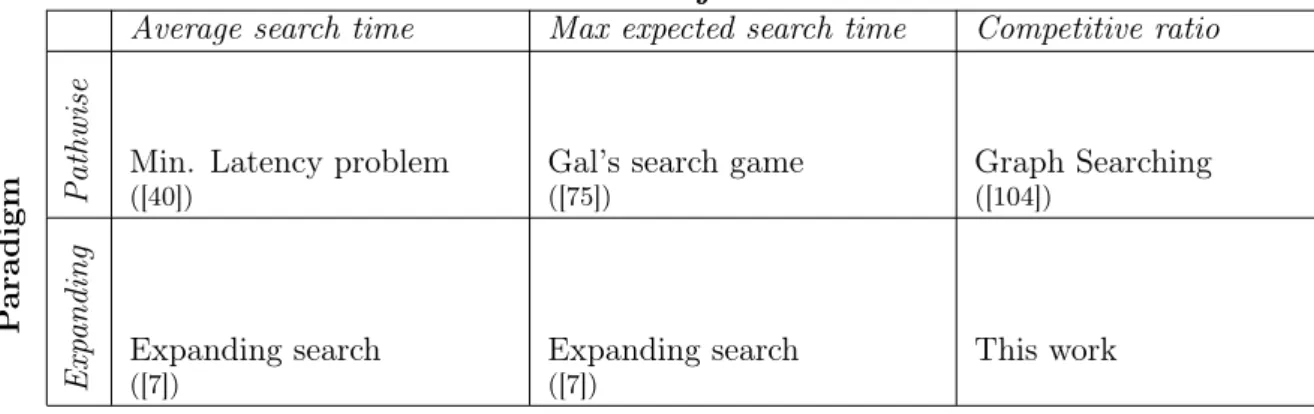
The usual search paradigm when seeking an immobile hider in a search domain is what we now call pathwise search, in that the searcher follows a continuous unit speed path, and the search cost is the total time that the searcher spends. More recently, Alpern and Lidbetter [7] introduced a new paradigm which they term expanding search, in which the searcher may restart the search at any time from any previously reached point, or more informally, the searcher does not incur cost for revisiting previously explored territory. This is a useful paradigm when modeling problems such as de-mining a field (ensuring that an area is mine-free is the costly operation as opposed to navigating through an area that has been de-mined) and drilling for coal (again, drilling is the costly operation).
In our work we study expanding search under the framework of competitive analysis. We consider two settings. First, the setting in which the target hides in the vertex of an edge-weighted graph, and second, the setting in which the target hides over any point of a given network, which may be bounded or unbounded. We present hardness and approximation results that pertain to both the deterministic and the randomized competitive ratios, with the randomized setting being, as expected, the more challenging one.
1.4.3 Scheduling of contract algorithms and interruptible computation
Earliest-completion scheduling of contract algorithms with end guarantees
All previous work on contract scheduling has provided strict performance guarantees for several variants of this setting, assuming that an interruption can occur arbitrarily ahead in the future. This means that the schedule is, at least theoretically, infinite. In practice, however, one expects that the schedule will reach a point beyond which further progress will only be marginal, hence it can be deemed complete. This occurs when the schedule has completed a sufficiently long contract for each problem instance, i.e., when each problem has attained a desired end guarantee.
In our work we study contract scheduling in a setting that is motivated by the above obser-vation. In particular, we seek a finite schedule with the following properties: i) it attains the
optimal acceleration ratio, as in the standard model; and ii) it minimizes the time required to satisfy the end guarantees, among all schedules that obey property (i). In other words, if an interruption occurs during the execution of the schedule, the schedule has optimal performance; otherwise, if no interruption has occurred, it outputs a solution that meets the end guarantees the earliest possible, among all schedules optimal with respect to the acceleration ratio.
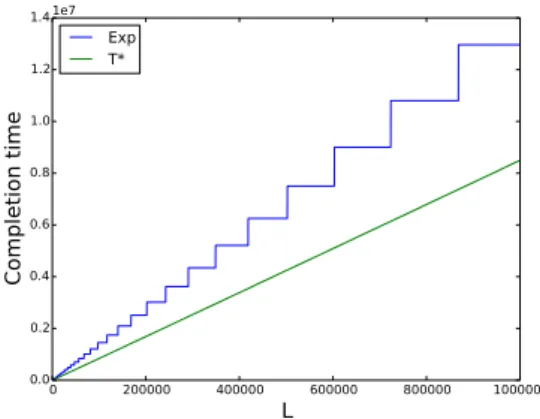
We show how to obtain an optimal schedule that satisfies the above properties. We com-plement the theoretical analysis with a computational evaluation that quantifies the gains with respect to the standard, infinite schedules.
A new measure for the analysis of interruptible systems
In this work we take a closer look into the performance measures for interruptible systems based on schedules of contract algorithms for n problem instances. We observe that the acceleration ratio compares the performance of the schedule to an ideal solution that knows both the inter-ruption time and the queried instance. Thus, the ideal solution effectively ignores all but one of the problem instances. This yields an overly powerful ideal solution, which implies, in turn, a weak performance guarantee for the contract schedule.
We thus ask the question: can we define an extension of the acceleration ratio in which the quality of the schedule is compared to an ideal solution that only knows the interruption time, but must produce solutions to all n problem instances? We answer this question by introducing the deficiency of a schedule as a performance measure that meets these requirements. Beyond this conceptual contribution, minimizing the definency turned out to be a challenging optimization problem on its own, and much harder than minimizing the acceleration ratio. We showed several upper and lower bounds on the deficiency of schedules, and the takaway message is that there exist schedules with small, constant deficiency, independent of n. To highlight the applicability of our techniques, in the journal version we also showed how to obtain a much simpler proof of the main resul of [38].
Further connections between ray searching and contract scheduling
Bernstein et al. [38] were the first to demonstrate that ray searching and contract scheduling have certain similarities. In particular, they showed that cyclic strategies for one problem yield cyclic strategies for the other, and gave a relation for the corresponding competitive and acceleration ratios. In our work, we argue that the connections are deeper, in that these problems capture fundamental aspects of resource allocation under uncertainty.
In particular, we study several variants of these families of problems, such as searching and scheduling with probabilistic considerations, redundancy and fault-tolerance issues, randomized strategies, and trade-offs between performance and preemptions. For many of these problems we present the first known results that apply to multi-ray and multi-problem domains. Our objective is to demonstrate that several well-motivated settings can be addressed using the same underlying approach.