
ADVANCES IN PALLADIUM-CATALYZED CARBON-NITROGEN BOND FORMING PROCESSES
By Rachel E. Tundel
Submitted to the Department of Chemistry in Partial Fulfillment of the
Requirements for the Degree of
BACHELOR OF SCIENCE IN
CHEMISTRY At the
Massachusetts Institute of Technology
May 2006
D1Sa.t ao.,
© 2006 Massachusetts Institute of Technology
r7 All Rights Reserved
Signature of Author.. .L; ... .... a Certified by ... /.iV. ·.... - '.
Accepted
by ...-
...
Department of Chemistry May 12, 2006 ' Stephen L. Buchwald Thesis Supervisor Sylvia T. Ceyer Associate Department Head MASSACHUSETTS INSTITlTE]OF TECHNOLOGY
AUG 0 1 2006
ADVANCES IN PALLADIUM-CATALYZED CARBON-NITROGEN BOND FORMING PROCESSES
By Rachel E. Tundel
Submitted to the Department of Chemistry May, 2006 In Partial Fulfillment of the Requirement for the Degree of
Bachelor of Science in Chemistry
ABSTRACT
Chapter 1.
Microwave-assisted, palladium-catalyzed C-N bond-forming reactions with aryl/heteroaryl nonaflates/halides and amines using the soluble amine bases
DBU (1,8-diazabicyclo[5.4.0]undec-7-ene) or MTBD
(7-methyl-1,5,7-triazabicyclo[4.4.0]dec-5-ene) and a catalyst system consisting of Pd2dba3and
ligands (XantPhos, 2-dicylcohexylphosphino-2',4',6'-triisopropyl-1,1 '-biphenyl
(XPhos) and 2-di-tert-butylphosphino-2',4',6'-triisopropyl-1, '-biphenyl) resulted in
good to excellent yields of arylamines in short reaction times.
Chapter 2.
Using a catalyst comprised of the bulky, electron-rich monophosphine ligand di-tert-Butyl XPhos (2-di-tert-butylphosphino-2',4',6'-triisopropyl-1,1'-biphenyl) and Pd2dba3with sodium tert-butoxide as the base, amino heterocycles were coupled
successfully with aryl/heteroaryl halides in moderate to excellent yields.
Thesis Supervisor: Professor Stephen L. Buchwald Title: Camille Dreyfus Professor of Chemistry
Acknowledgments
Firstly, I would like to thank the two most influential people in my
undergraduate research career, Professor Stephen L. Buchwald and Dr. Kevin W. Anderson.
I am grateful to Professor Buchwald for giving me my first chance to perform research in a synthetic organic chemistry lab, despite not having much experience and background in organic chemistry at the time I applied for the UROP. Additionally, I'd like to thank him for providing a great research
atmosphere in which I was able to develop as a scientist. I truly could not have
imagined a more supportive, innovative and patient research advisor, and I am thankful that my very first foray into research has been an extraordinarily positive experience.
I am also very grateful to Kevin Anderson, who was my mentor for the
duration of my UROP and has been absolutely instrumental and vital to my
development as a chemist. Not only did he patiently teach me much about synthetic organic chemistry, but he also helped me develop research skills. Providing guidance and help whenever I needed it, he also he gave me the freedom to solve research problems and allowed me to work independently fairly
early in my experience.
I would like to thank the other people I worked and interacted with in the Buchwald lab. They truly helped to create a great atmosphere in which to learn
chemistry and lab skills. Particularly, I'd like to thank Dr. Matthew Rainka, Mr. Joseph Martinelli, Dr. Nan Zheng and Dr. Catharine Larsen.
Additionally, I would like to thank my academic advisor, Professor
Catherine Drennan for encouraging me to seek the UROP experience on which this thesis was based, and for helping me to navigate my way through my chemistry education at MIT. Always available to chat about classes, research and almost anything else despite her own hectic schedule, she truly enabled me to take advantage of the great opportunities MIT had to offer. Additionally, I am
very lucky to have had guidance from many of the other professors at MIT throughout my undergraduate career as well.
I would also like to thank my family, Phil, Nancy, Jon and Matt Tundel,
who have always supported me, loved me, and believed in me.
Finally, I'd like to thank my friends who definitely made going through MIT
much more pleasant.
I thank the UROP office and Pfizer for financial support of my research. I am also indebted to Mr. Richard P. Simmons, who, through his donations to MIT, generously provided much of the grant that allowed me to attend MIT in the first
Preface
Parts of this thesis have been adapted from the following articles co-written by the author.
"Monodentate Phosphines Provide Highly Active Catalyst for
Palladium-Catalyzed C-N Bond-Forming Reactions of Heteroaromatic Halides/Amines and
(H)N-Heteroaromatics" Anderson, K. W.; Tundel, R. E.; Ikawa, T.; Altman, R. A.; Buchwald, S. L. submitted.
"Expedited Palladium-Catalyzed Amination of Aryl Nonaflates through the use of
Microwave-Irradiation and Soluble Organic Amine Bases" Tundel, R. E.; Anderson, K. W.; Buchwald, S. L. J. Org. Chem. 2006. 71, 430.
Table of Contents
Introduction 7
References 16
Chapter 1: Microwave-assisted, palladium-catalyzed amination of aryl nonaflates
and halides using soluble, weak organic amine bases. 19
Introduction 20
Results and Discussion 22
Experimental 34
References 49
Chapter 2: Palladium-catalyzed arylation of amino-heterocycles using bulky,
electron-rich monophosphine ligands 51
Introduction 52
Results and Discussion 53
Experimental 60
References 65
Introduction
Aryl amines are important structural motifs that are found in many different classes of organic compounds. In addition to their prevalence in
pharmaceuticals1, natural products2 and other biologically active compounds, aryl amines are present in other industrially useful compounds such as pigments3,
xerographic materials and photographic materials4. For example, amide linkages
are present in the natural product Ubistatin A, which is involved in the regulation of ubiquitin-directed protein degradation5. Pigment red 170 also includes aryl
amine motifs through amide and hydrazone linkages6(Figure 1).
Figure 1. Examples of C-N linkages in compounds
SO3H H HO3S N N I OH OH O OH H N SO3H H SU3H
UbistatinA, involved in regulation of ubiquitin-directed protein degradation Pigment red 170, used in automotive coatings
King et a. Science, 2004, 306, 117.
Classical methods in formation of aromatic C-N bonds in many cases requires multiple reaction steps, and/or harsh reaction conditions. Nucleophilic aromatic substitution of an electron-deficient aromatic ring with amine salts7 is an
example of a commonly-used protocol in C-N bond-formation. A drawback of this method is that extremely harsh reaction conditions are often required (e.g.,
high reaction temperatures, polar solvents), which limits the functional group tolerance and substrate scope of the reaction (Scheme 1).
Scheme 1. Nucleophilic Aromatic Substitution
C X LiNR'(R") NR'(R")
R = EWG X = halide
Another traditional method of forming aromatic carbon-nitrogen bonds is to convert an aryl halide to a benzyne intermediate with a strong base. The
benzyne intermediate is then trapped with an amine to form the aryl amine compounds (Scheme 2). Problems that plague this method are lack of functional
group tolerance and chemoselectivity of the nucleophilic attack of the amine.
Scheme 2. Benzyne Methods
X strong base [ HNR(R) NR'(R")
X = halide
One of the first transition-metal mediated processes to form aromatic C-N bonds were Ullmann couplings (1904)9. In these reactions, stoichiometric
amounts of copper and high reaction temperatures (>150 °C) were required to couple aryl halides and amines (Scheme 3). However, through the development of more active catalyst systems, copper-catalyzed C-N couplings can be
conducted using milder reaction conditions' 1 1.
Scheme 3. Ullmann-type Couplings
AX HNR'(R") NR'(R")
R R
CuX (< 1 eq) X = halide
In 1983, Migita and co-workers made a breakthrough in the goal of creating a transition-metal catalyst that could effect the formation of carbon-nitrogen bonds efficiently and selectively1 2. They developed a protocol for
coupling tributyl-N,N-diethylaminostannane with aryl bromides using a palladium catalyst (Scheme 4). Palladium is an attractive transition-metal for these types of transformations due to its stability and inherent tolerance toward functional groups. However, this reaction required the use of toxic and moisture-sensitive organo-tin compounds. Despite its potential utility, this reaction remained largely unstudied for another ten years.
Scheme 4. Migita's system for
R-aBr
R = H, alkyl
r coupling aryl bromides with organostannanes
Bu3Sn-NEt 2 NEt2
(o-tolVAP)5PdC
toluene
100 O°C
3h
A year later, Boger and Panek published a protocol for the palladium-mediated intramolecular amination of an aryl bromide in the total synthesis of
Lavendamycin, an HIV reverse-transcriptase inhibitor1 3 (Scheme 5). However,
this system required stoichiometric amounts of palladium, which is not practical for everyday use.
Scheme 5. Boger's Pd-mediated intramolecular, Sn-free amination of an aryl
bromide MeO2C N CO2Me H2N Me Br Pd(PPh3)4(1.5 eq) dioxane 80 °C MeO2C N CO2Me HN Me H2N N C0H2 HN Me
Lavendamycin, potent HIV reverse-transcriptase inhibitor
In 1994, Buchwald and co-workers revisited the reaction that Migita discovered14 (Scheme 6). An improvement was made through the generation of tin amides in situ from tributyltin-diethyl amine. This increased the generality of
the reaction tremendously, allowing the successful coupling of different amines. However, this protocol still required the use of toxic organo-tin compounds.
Scheme 6.
bromides
Buchwald's system for coupling tin-amides generated in situ with aryl
Bu3Sn-NEt2
QY,
NR'(R") Bu3Sn-NR ' (R" )] 3, Br 1-2.5 mol % [(o-tol)2P]2PdCI2 toluene 105 CAlmost simultaneously, the Buchwald15 and Hartwig'6groups published
protocols that coupled amines directly with aryl bromides without the use of organo-tin transmetallating agents. With the addition of a strong base (NaOtBu or LiHMDS) and a palladium catalyst, aryl bromides and amines were coupled (Scheme 7). In the years since this seminal discovery, many improvements have been made to this reaction; its substrate scope and efficiency have been
improved through the use of weak bases and more active catalysts1725.
Scheme 7. The first systems of tin-free, palladium catalyzed couplings of amines
and aryl bromides Br
R
HNR'(R") 2-5 mol% (o-tol)3P)2PdCI2
or Pd(dba)2/(o-to3)P
NaOt-Bu or LiHMDS toluene 65-110 °C
NR'(R")
Palladium-catalyzed carbon-nitrogen protocols have since become extremely common in many sectors of industry and academia. Merck recently synthesized a Muscarinic receptor antagonist using a palladium-catalyzed amination protocol to couple a precursor with an ammonia surrogate2 6.
HNR'(R")
toluene 80 °C
Eli Lilly coupled a 2-halopyridine-deriviative with a primary amide in the synthesis of a 5-HT1F receptor agonist2 7 (Figure 2).
Figure 2. Applications of palladium-catalyzed C-N bond-forming processes
, , .NH2
HO, N N
F7t
JPh
H
F
Muscarinic receptor antagonist (from benzophenone imine precursor) Banyu and Merck, J. Org. Chem 2001, 6775.
NH
[3 IN\>-NH
Norastemizole H1-receptor antagonist
Hong et al. Tet. Lett. 1997, 5607.
5-HT1F receptor agonist
Eli Lilly and Mathes et al. Tet. Left. 2003, 725.
MeO g
N
OMe
Part of an organic electroluminescent device
Klubek et al US Pat. Appl. Publ. US 2005014018, 2005
A non-pharmaceutical application of palladium-catalyzed C-N chemistry was in the synthesis of an organic electroluminescent device2 8. In academia, this chemistry was used in the synthesis of ligands for the catalytic reduction of
dinitrogen to ammonia at a single molybdenum center by Schrock and his
Figure 3. Synthesis of ligands for the catalytic reduction of dinitrogen at a single Molybdenum center -Pr 0.3 N(CH2CH2NH2)3 0.5 % Pd2(dba)3, 1.5 % rac-BINAP NaOt-Bu, Toluene, 85 °C, 20 h Trip
-NNN
Trip 87 % HIPT *. -Pr i-Pr· ~
~
HIPT
-Pr 'i Cl I HIPT ,~T'~ N djN( Pr LPr \Nc > Mo-CIIn addition to the development of more active catalysts and better reaction conditions that increase the substrate scope of this reaction, much work has been done to elucidate the mechanism by which these couplings occur31 3 4. The
following catalytic cycle has been proposed based on this work (Scheme 8):
Scheme 8. The proposed catalytic cycle.
(R")R'N -% Product Formation (Reductive Elimination) NR'(R") LBaseHXPd(ll) Base-HX go, Base -(RH" Ligand L2Pd (0) Dissociation
1l-L (for monodentate phosphines)
L1Pd (0) ' X ... . R X LPd(ll), I. it .¥-X L1Pd(ll) ,< HI I il . .R )R'NH - Bindin! Nucleophile acidifi Activation deprot Activation of Electrophilic Component (Oxidative Addition) IR'(R") g of amine to Pd(ll) greatly
.s the amine's H, facilitating
onation. i-Pr i-Pr I strong base: Bu, KOH v/ weak base: , C2C03 Fast w NaOt-ll RDS K3PO4 5'~
The palladium source that is used as a precatalyst is either in the Pd(O) or
Pd(ll) oxidation states; however, for palladium to enter the catalytic cycle, it must be in the Pd(O) oxidation state. Palladium(ll) species must be reduced to Pd(O), either by the ligand, trace water in the reaction or through the use of an additive (such as a tertiary amine or an aryl boronic acid).
Once in the catalytic cycle, the coordinatively unsaturated L1-Pd species undergoes oxidative addition to the aryl electrophile. This oxidative addition complex can then coordinate the amine, which serves as the nucleophile. Once the amine is bound, the proton on the amine becomes greatly acidified such that
it can be deprotonated by a weak base. This deprotonation step is very fast using a strong base (e.g., NaOtBu or KOH), while it is the rate-determining step
with weak bases (e.g., K3P04 or Cs2CO3). Once this Li-Palladium(ll) amido
species is deprotonated, reductive elimination occurs, which forms the product
and regenerates the Pd(O) catalyst.
Figure 4. Bidentate ligands commonly used in palladium-catalyzed C-N
bond-forming processes. Me Me PPh2 Fe PPh2 PPh PPh2 PPh2 rac-BINAP XantPhos DPPF
Significant improvements in catalyst activity were made through the use of
bidentate ligands BINAP35-38, XantPhos3 94 3 and DPPF4 4-45 (Figure 4). While the catalytic systems worked well with a wide range of substrate combinations, aryl chlorides were unreactive.
To address the problems of other catalyst systems, the Buchwald group has pioneered the synthesis and use of bulky monophosphine ligands in Pd-mediated C-N bond-forming reactions4 6 4 7. The most active supporting ligand for
this process, prior to joining the group, was XPhos (Figure 5). Properties of this ligand, such as 2,2'-ortho substitution on the bottom ring of the
Figure 5. Key features of bulky, electron-rich monophosphine ligands
facilitates oxidative
addition
Facilitates reductive elimination and promotes
formation of
L1 Pd species i-Pr
i-Pr prevents palladacycle
formation
biphenyl backbone provide steric bulk, in addition to preventing carbo-palladation
(Figure 5 and 6).
Figure 6. Carbo-palladation with a ligand with no substitution on the 2,2'-ortho
position of the lower ring.
Calorimetric studies in our laboratory have shown that the more bulky the catalyst is in the 2,2'-ortho substitution of the bottom ring, the more stable and reactive the catalyst is. As a result, more catalyst turn-overs can be achieved, increasing the overall lifetime of the catalyst (barring other pathways of catalyst
Figure 7. Trends in catalyst stability and reactivity
'PCY2
C
PCY2 PCY2Et
H
/-Pr
/-Pr Me
Increasing steric bulk, stability and reactivity
Catalysts based on this class of ligands have not only displayed high stability, but also have shown increased reactivity in palladium-catalyzed carbon-nitrogen bond-forming reactions5 51.' In some cases, these reactions can be conducted at room temperature. The stability of this class of ligands is believed
to be due to -interactions between the lower aromatic ring of the biaryl moiety
and the Pd(O) center52-5 5. Therefore, this t-interaction may stabilize any
intermediate in the catalytic cycle increasing the overall lifetime of the catalyst. The high activity may be attributed to a number of factors. Electron-rich ligands should increase the electronic density on Pd, thus facilitating oxidative addition since this process is nucleophilic in nature. Second, the bulkiness of the ligand should favor reductive elimination and facilitate formation of a monoligated Pd(O) species, which is believed to be the active catalyst. This has been shown
by systematically varying the ratio of ligand to Pd. As the ligand to Pd ratio is
increased in the series of monophosphinobiaryl ligands, decreased reaction rates
were observed5 6 57.
Since its discovery, both academic and industrial chemists have adopted palladium-catalyzed amination methodology in their everyday use, emphasizing the large impact this chemistry has had in organic synthesis5 8. While there was
significant progress in developing more active catalyst for palladium-catalyzed C-N bond-forming processes, there still remained many obstacles to overcome and substrate classes to explore. Through work described in this thesis, the
applications of these reactions have been extended further, though they are just
VDh
a small fraction of the overall improvements continually being made in this area of synthetic organic chemistry.
References
(1) Czarnak, A. W. Acc. Chem. Res. 1996, 29, 112.
(2) Buckingham, J. Dictionary of Natural Products. University Press, Cambridge,
MA, 1994.
(3) Patten, T. C. Pigment Handbook. Wiley-lnterscience, New York, NY, 1973. (4) Law, K-. Y. Chem. Rev. 1993, 93, 449.
(5) King. Science. 2004, 306, 117.
(6) Schmidt, M. U.; Hofmann, D. W. M.; Buchsbaum, C.; Metz, H. J. Angew.
Chem. Int. Ed. 2006, 45, 1313.
(7) March, J.; Smith, M. B. Advanced Organic Chemistry: Reactions, Mechanism, and Structure, 5th Ed.: Eds; John Wiley & Sons, Inc.: New York, 2001.
(8) Biehl, E. J. Org. Chem. 1987, 52, 2619.
(9) Kurti, L., and B. Czako. Strategic Applications of Named Reactions in
Organic Synthesis. Elsevier, 2005.
(10) Kunz, K.; Scholtz, U.; Ganzer, D. Synlett. 2003, 2428.
(11) Ley, S. V.; Thomas, A. W. Angew. Chem. Int. Ed. 2003, 42, 5400.
(12) Kosugi, M.; Kameyama, M.; Migita, T. Chem. Lett. 1983, 927. (13) Boger, D. L.; Panek, J. S. Tet. Lett. 1984, 25, 3175.
(14) Guram, A.; Buchwald, S. L. J. Am. Chem. Soc. 1994, 116, 7901. (15) Guram, A.; Buchwald, S. L. Angew. Chem. Int. Ed. 1995, 34, 1348. (16) Louie, J; Hartwig, J. F. Tet. Lett. 1995, 36, 3609.
(17) Wolfe, J. P.; Buchwald, S. L. Tet. Lett. 1997, 38, 6359.
(18) Old, D. W.; Wolfe, J. P.; Buchwald, S. L. J. Am. Chem. Soc. 1998, 120,
9722.
(19) Hartwig, J. F. in Handbook on Organopalladium Chemistry for Organic
Synthesis, Negishi, E. Ed., Wiley-lnterscience, New York, 2002, 1051-1096 and
(20) Muci, A. R.; Buchwald, S. L. Top. Curr. Chem. 2002, 219, 131 and
references within.
(21) Harkal, S.; Rataboul, F.; Zapf, A.; Fuhrmann, C.; Riermeier, T.; Monsees, A.; Beller, M. Adv. Synth. Catal. 2004, 346, 1742.
(22) Nandakumar, M. V.; Verkade, J. G. Angew. Chem. Int. Ed. 2005, 44, 3115. (23) Viciu, M. S.; Kissling, R. M.; Stevens, E. D.; Nolan, S. P. Org. Lett. 2002, 4,
2229.
(24) Urgaonkar, S.; Verkade, J. G. J. Org. Chem. 2004, 69, 9135.
(25) Jiang, L.; Buchwald, S. L. Palladium-Catalyzed Aromatic Carbon-Nitrogen
Bond Formation. In Metal-Catalyzed Cross-Coupling Reactions, 2nd Ed.: de Meijere, A.; Diederich, F. Eds; Wiley-VCH: Weinheim, 2004, pp. 699-760 and references within.
(26) Mase, T et al. J. Org. Chem. 2001, 66, 6775. (27) Mathes et al. Tet. Lett. 2003, 44, 725.
(28) Klubek et al. US Pat. Appl. Publ. US 2005014018, 2005. (29) Yandulov, D.; Schrock, R. R. Science. 2003, 301, 76.
(30) Yandulov, D.; Schrock, R. R. J. Am. Chem. Soc. 2002, 124, 6252. (31) Singh, U. K.; Strieter, E. R.; Blackmond, D. G.; Buchwald, S. L. J. Am. Chem. Soc. 2002, 124, 14104.
(32) Hamann, B. C.; Hartwig, J. F. J. Am. Chem. Soc. 1998, 120, 3694. (33) Hartwig. J. Am. Chem. Soc. 2001, 123, 12905.
(34) Blackmond, Buchwald. J. Am. Chem. Soc. 2003, 125, 13978.
(35) Wolfe, J. P.; Wagaw, S.; Buchwald, S. L. J. Am. Chem. Soc. 1996, 118, 715. (36) Wolfe, J. P.; Buchwald, S. L. J. Org. Chem. 1997, 62, 6066.
(37) Wolfe, J. P.; Buchwald, S. L. J. Org. Chem. 2000, 65, 1144. (38) BINAP = (R), (S) or rac-2,2'-bis(diphenylphosphino)-1,1'-binaphthyl.
(39) Kranenburg, M.; van der Burgt, Y. E. M.; Kamer, P. C. J.; van Leeuwen, P. W. N. M.; Goubitz, K.; Fraanje, J. Organometallics. 1995, 14, 3081.
(40) Kranenburg, M.; Delis, J. G. P.; Kamer, P. C. J.; van Leeuwen, P. W. N.; Vrieze, K.; Veldman, N.; Spek, A. L.; Goubitz, K.; Fraanje, J. J. Am. Chem. Soc.,
(41) Yin, J.; Buchwald, S. L. Org. Lett. 2000, 2, 1101.
(42) Yin, J.; Buchwald, S. L. J. Am. Chem. Soc. 2002, 124, 6043.
(43) XantPhos = 9,9-dimethyl-4,5-bis(diphenylphosphinophenyl)ether.
(44) Driver, M. S.; Hartwig, J. F. J. Am. Chem. Soc. 1996, 118, 7217. (45) DPPF = 1, '-bis(diphenylphosphino)ferrocene.
(46) Hartwig, J. F. in Handbook on Organopalladium Chemistry for Organic
Synthesis, Negishi, E. Ed., Wiley-lnterscience, New York, 2002, 1051-1096 and
references within.
(47) Muci, A. R.; Buchwald, S. L. Top. Curr. Chem. 2002, 219, 131 and
references within.
(48) Wolfe, J. P.; Wagaw, S.; Marcoux, J. F.; Buchwald, S.L. Acc. Chem. Res. 1998, 31, 805.
(49) Jiang, L.; Buchwald, S. L. Palladium-Catalyzed Aromatic Carbon-Nitrogen
Bond Formation. In Metal-Catalyzed Cross-Coupling Reactions, 2nd Ed.: de Meijere, A.; Diederich, F. Eds; Wiley-VCH: Weinheim, 2004, pp. 699-760 and references within.
(50) Hartwig, J. F. in Handbook on Organopalladium Chemistry for Organic
Synthesis, Negishi, E. Ed., Wiley-lnterscience, New York, 2002, 1051-1096 and
references within.
(51) Muci, A. R.; Buchwald, S. L. Top. Curr. Chem. 2002, 219, 131 and
references within.
(52) Yin, J.; Rainka, M. P.; Zhang, X. -X.; Buchwald, S. L. J. Am. Chem. Soc. 2002, 124, 1162.
(53) Walker, S. D.; Barder, T. E.; Martinelli, J. R.; Buchwald, S. L. Angew. Chem. Int. Ed. 2004, 43,1871.
(54) Barder, T. E. J. Am. Chem. Soc. 2006, 128, 898.
(55) Barder, T. E.; Walker, S. D.; Martinelli, J. R. J. Am. Chem. Soc. 2005, 127,
4685.
(56) Alcazar-Roman, L. M.; Hartwig, J. F. J. Am. Chem. Soc. 2001, 123, 12905.
(57) Strieter, E. R. Unpublished results, 2004.
Chapter 1.
Expedited Palladium-Catalyzed Amination of Aryl Nonaflates and Aryl Halides Through the Use of Microwave Irradiation and Soluble Organic
Introduction
The palladium-catalyzed cross-coupling of aryl halides and aryl sulfonates with amines has become a common and immensely useful method in organic synthesis'. There has been significant improvement in the substrate scope of these reactions due to the use of weak inorganic bases (e.g., K3PO4 and
Cs2CO3). Through the development of highly active catalyst systems, these
reactions can operate at lower catalyst loadings and with much shorter reaction times2. Despite these improvements, typical palladium-catalyzed C-N coupling
reactions still require anywhere from 2 to 24 hours to go to completion. To address this problem, research groups have been employing microwave technology to shorten reaction times2c -3.
Microwave-assisted reactions are very attractive to synthetic organic chemists, in some cases shortening reaction times and improving regio- and/or chemoselectivity4. Reactions that once required hours to complete could now be
finished within minutes5. Thus, the emergence of microwave technology for
increasing reaction rates has been well documented in published literature6. To
date, there have been few studies using microwave irradiation to enhance reaction rates for C-N bond-forming reactions.
Without the use of a base or a catalyst, aliphatic amines were arylated with aryl triflates using very high temperatures (200 °C) and the polar solvent
NMP (N-methylpyrrolidinone)7. Due to the forcing conditions, not many functional groups were tolerated. Since the reaction occurs by nucleophilic aromatic substitution at the aryl triflate, the reaction scope was limited to more nucleophilic primary and secondary alkyl amines. Reactions using less-nucleophilic amines (e.g., anilines) as substrates were not successful and resulted in only trace yields of the desired aryl amines (Scheme 1).
Scheme 1. Previous systems for microwave-assisted C-N bond-formation
R+C"
HM
HNR'(R")
NMP MW 200 °C 5-120 min 1-98% yield O Br tNH 2 NR'(R") Pd(OAc)2, Ligand NaOtBu (or Cs2C03) tBuOH/Toluene 22-96% yield 3-30 minRecently, Jensen and co-workers employed microwave irradiation in the
synthesis of p38 MAP inhibitors8. Using a catalyst system of Pd(OAc)2and supporting ligand 1 (2-dicyclohexylphosphino-(2',4',6'-triisopropyl)biphenyl), aryl halides and aryl sulfonates were coupled successfully with
p-aminobenzophenone using NaOt-Bu or Cs2CO3 as the base and a solvent mixture of tert-butanol and toluene (1/5). Additionally, various anilines were arylated with benzophenone halides. While this system is very efficient, with most reactions being complete in less than 20 minutes, the substrate scope is somewhat limited; only primary anilines were arylated successfully (Scheme 1).
In many cases, palladium-catalyzed C-N bond-forming reactions in the microwave required forcing conditions with highly polar solvents and strong bases (e.g., NaOt-Bu)9. As a result, base-sensitive functional groups are not tolerated, limiting the substrate scope. The use of Cs2CO3 and other weak
inorganic bases improve functional group tolerance, however insoluble bases can create problems in the microwave. Insoluble bases can lead to the formation of hot spots from inefficient stirring, resulting in non-uniform heating; this can sometimes lead to lower yields and explosions" 11. To improve functional group tolerance and efficient heating and stirring, we sought to create a system using a soluble, hindered organic amine base.
Results and Discussion
We chose to begin our studies by using a catalyst system comprised of 1
and Pd2dba3. The bulky, electron-rich monophosphine ligand XPhos has been
demonstrated to be one of the most active supporting ligands in palladium-catalyzed C-N bond-forming reactions'2. In order to ensure that the reactions
could be completed in shorter reaction times ( 15 min), a Pd (0) source Pd2dba3 was used so that the palladium could immediately enter the catalytic cycle
without requiring time for reduction of Pd (II), as with other Pd sources such as
Pd(OAc)2.
Figure 1. Supporting ligands and soluble organic amine bases used in this study.
Soluble-Organic Bases
Me Me
P N X
PPh2 PPh2 M
i-Pr 1 (XPhos) i-Pr 2 XantPhos, 3 DBU MTBD
In our earliest investigations, aryl nonaflates (ArONf = ArOSO2(CF2)3CF3)
were screened to find the optimal base and solvent for the system. Since aryl halides were inert to coupling with amines using soluble organic amine bases (e.g., DBU), aryl nonaflates were initially used. Aryl nonaflates have been demonstrated to be useful substrates in palladium-catalyzed C-N coupling
reactions due to the wide commercial availability of the corresponding phenols12.
As compared to an aryl triflate, aryl nonaflates are also more stable under basic reaction conditions and in many cases can resist cleavage into the
corresponding phenol, which can result in lower yields12. Additionally, we thought that aryl sulfonates would be ideal for study due to our desire to use weak amine bases. In order to be able to utilize such weak bases, we
hypothesized that the oxidative addition product of the aryl nonaflate would be
able to form a much more electrophilic palladium species as compared to an aryl
halide (Scheme 2). This is how we rationalized the lack of reactivity seen with aryl bromides using most weak amine bases.
Scheme 2. Electrophilic palladium species.
LI\ + ONf Ll\
/Pd(ll) Pd (II) Product Formation (R")R'N
"N6+ -IN/ + I - - - R"NR"-N / 1!3-R (Reductive Elimination) -R
H irreversible
R
H
N',
N H ONf ONEThe sulfonate, as it is a much better leaving group than a halide, should be able to draw more electron-density from the amine-coordinated palladium species. This causes an even greater acidification of the palladium-bound amine, which can drive the pKa of the proton down to a range that can be deprotonated by weak amine bases. Once deprotonation occurs, the product forms irreversibly through reductive elimination.
Our initial studies into designing a protocol for the amination of aryl
nonaflates, the simple electronically-neutral p-tButyl phenyl nonaflate and aniline were initially coupled to investigate optimal reaction conditions. In support of green chemistry, solvent-less conditions were explored first, and the organic amine bases TEA (triethylamine), DABCO (1,4-diazabicyclo[2.2.2]octane) and DBU (1,8-diazabicyclo[4.4.0]undec-7-ene) were screened (Table 1, entries 1-3). While all three bases resulted in greater than 99% conversion, only DBU
Table 1. Screen of Bases and Solvents for the Palladium-Catalyzed Amination of 4-t-Butylphenyl Nonaflate.a
t-Bf ,, H2N H2NyO base, solvent Pd2dba3, 1 HN
t-Bu I+ ( 150W)
t
150 C, 15 min t-Bu
Entry Baseb Solvent Conv. (%) Yield (%)C
1 TEA none >99 0 2 DABCO none >99 0 3 DBU none >99 87d 4 DBU toluene >99 99 5 MTBD toluene >99 85 6 TMP toluene >99 80
7 Proton Sponge toluene 37 25
8 TBD toluene 12 0 9 TMG toluene 10 0 10 TMPMG toluene 90 89 11 DBU 1,4-dioxane 56 35 12 DBU 1,4-dioxane >99 38e 13 DBU DMF 92 86 14 DBU DMF >99 92f 15 DBU DMSO 94 52
aReaction Conditions: 1.0 equiv Ar-ONf, 1.3 equiv amine, 2.5 equiv base, 0.05 eq.
1, 0.0125 equiv Pd2dba3, 2 mL solventlmmol Ar-ONf. b TEA = triethylamine,
DABCO = 1,4-Diazabicyclo[2.2.2]octane, DBU = 1,8-diazabicyclo[5.4.0]undec-7-ene, MTBD = 7-methyl-1,5,7-triazabicyclo[4.4.0]dec-5-1,8-diazabicyclo[5.4.0]undec-7-ene, TMP = 2,2,6,6-tetramethyl piperidine, Proton Sponge = 1,8-Bis(dimethylamino)naphthalene, TBD
= 1,5,7-triazabicyclo[4.4.0]dec-5-ene, TMG = N,N,NN'-tetramethylguanidine,
TMPMG = N,N,NN'-tetramethyl-N"-(phenylmethyl)guanidine. cGC-yield. dReaction
was complete in 1 min; isolated yield. eReaction was conducted at 175 °C for 15
min. fReaction was conducted at 175 °C for 5 min.
In case some coupling reactions were unsuccessful running in solvent-free conditions. Toluene, a common solvent in these coupling reactions, was used to screen additional bases to maximize the flexibility of the system. Proton Sponge
(1,8-bis(dimethylamino)naphthalene) resulted in less than 40% conversion of the starting material to product (Table 1, entry 7).
Since DBU was successful as a base, we sought a structurally similar, yet stronger base to use for more difficult substrates. MTBD
(7-methyl-1,5,7-triazabicylco[4.4.0]dec-5-ene) features a guanidine motif in its structure and its
alkyl substituents are tethered back to expose the lone pairs on nitrogen; thus, this base is more basic than DBU, and worked similarly to DBU.
TBD (1,5,7-triazabicyclo[4.4.0]dec-5-ene), which is an even stronger base than MTBD, was also tested, but did not work well and resulted in low conversion
and no observed product by GC (Table 1, entry 8). TMG (tetramethylguanidine),
which is analogous to TBD, only less hindered, resulted in similarly low
conversions of starting material to product (Table 1, entry 9). This indicates that the presence of a free NH on the guanidine bases inhibits the reaction,
regardless of the PKa of the base. Interestingly, the free (H)N- on the hindered secondary amine base TMP (tetramethylpiperidine) did not inhibit the reaction and resulted in good yields of product (Table 1, entry 6). A drawback of this base is that it was not a good absorber of microwave irradiation; this resulted in ramp-up times in excess of 10 minutes. Conversely, MTBD, DBU and other guanidine bases are excellent absorbers of microwave irradiation. This property helps reactions using non-polar solvents to reach the desired temperature in the reaction vessel in shorter periods of time3.
Due to the high cost of MTBD (-$4500/mol)1 4, we sought to find
alternatives that would take advantage of the guanidine base moiety, yet would be relatively simple to prepare. For this reason, we synthesized the
N-benzylated derivative of TMG, TMPMG
(N,N,N',N'-tetramethyl-N"-(phenylmethyl)guanidine). In toluene at 150 °C for 15 min, the reaction using this
base went to 90% conversion to product (Table 1, entry 10). Despite similar structural components to MTBD, this base was less effective, possibly because it was less basic. MTBD has a more rigid alkylated guanidine structure, leaving the lone pairs on the nitrogen more exposed and better able to deprotonate the coordinated amine; as a contrast, N-benzylated tetramethylguanidine does not have this rigid structure, so the larger benzyl group can obstruct the lone pairs on the nitrogen, causing it to be less basic. As this base performed worse than both DBU and MTBD, we decided to continue our studies using DBU and MTBD.
To optimize the solvent, we used DBU as the base to perform reactions in solvents of different polarities. Only reactions run in toluene or DMF went to full conversion and produced high yields of products (Table 1, entries 4-5 and 13-14). Since this reaction works well in solvents of different polarities, the scope
can possibly be expanded to include more polar substrates. Reactions run in
1,4-dioxane and DMSO produced high conversions, but only modest yields of product (Table 1, entries 11-12 and 15); the side-products mostly consisted of decomposition product of the aryl nonaflate to its corresponding phenol.
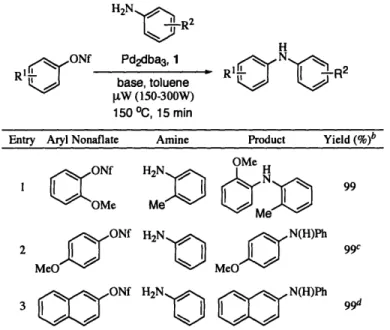
Table 2. Palladium-Catalyzed Amination of Electron-Rich and Electron-Neutral
Aryl Nonaflates.a
H2N
.. R2 H ONf Pd2dba3, 1 I 2 R'1 J base, toluene " R W (150-300W) 150 OC, 15 minEntry Aryl Nonaflate Amine Product Yield (%)b
eOMe Men
Me
2 MeO O N f H2NO MeO N (H ) P h 99c
,c
Nf H2N j K, N(H)PhaReaction Conditions: 1.0 equiv Ar-ONf, 1.3 equiv amine, 2.5 equiv DBU, 0.06 equiv 1, 0.015 equiv Pd2dba3, 2mL toluene/mmol Ar-ONf.. bYields (isolated) represent an average
of two runs. CMTBD was used as the base. d2 was used.
Using DBU as the base, the coupling of electron-rich and electron-neutral aryl nonaflates with anilines was explored. With XPhos as the supporting ligand, an ortho-substituted aryl nonaflate was coupled successfully in 15 minutes with an ortho-substituted aniline in excellent yields (Table 2, entry 1). The coupling of an electron-neutral aryl nonaflate and aniline was also successful (Table 2, entry 31. In the coupling of the electron-rich 4-methoxyphenyl nonaflate with aniline, using DBU as the base led to incomplete conversions. When
MTBD was substituted as the base, the reaction went to full conversion in 15 minutes and produced excellent yields (Table 2, entry 2).
Seeking to improve functional group tolerance, we attempted to couple aryl nonaflates and anilines bearing an assortment of functional groups (e.g., -NO2, C(O)Me, -CN, CO2Me). For these reactions, XPhos 1 was no longer the
most effective ligand to enact these couplings, so the more hindered analogue of XPhos, 2, and the chelating ligand XantPhos 3 were used.
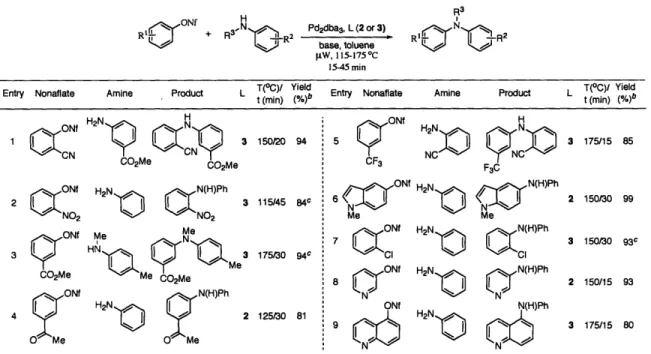
For aryl nonaflates that contained functional groups in the ortho position
(Table 3, entries 1-2, and 7), the bidentate ligand XantPhos 3 had to be
employed. Due to the thermal instability of 2-nitrophenyl nonaflate, the highest temperature that could be used in the microwave was 115 °C, necessitating a reaction time of 45 minutes. In this case, DBU was unsuccessful in driving the
reaction to full conversion, so MTBD was substituted as the base. Under these conditions, the reaction went to full conversion.
An ortho-halo aryl nonaflate combined successfully with aniline. The amination of 2-chlorophenyl nonaflate is particularly useful as it can be used in the synthesis of carbazoles through C-H activation, which is a process that has been demonstrated by several research groups5 (Table 3, entry 7). For this
Table 3. Palladium-Catalyzed Amination of Functionalized Aryl Nonaflates.a
OW H I
RL' + · R3' # Pd2dba3, L (2 or 3) 2
C
+ Rs1cj..i7 base, toluene[LW, 115-175°C 15-45 min
Entry Nonaflate Amine Product L T (O)db Entry Nonaflate Amine Product L T(C) Yield
1 NN 3 150/20 94 5 3 175/15 85 CO2Me CO2Me CF3 F3C , 3 150/30 93c ^,ONf C, N02 Me MeHN 2 150/15 COl~nI R e NH2 ONf N(H)Ph [ Me N N2 2 1 81 N N 175/15 80
aReaction Conditions: 1.0 equiv Ar-ONf, 1.3 equiv amine, 2.5 equiv DBU, 0.10 equiv ligands 2 or 3, 0.025 equiv Pd2dbaa, 2 mL toluene/mmol Ar-ONf. bYield (isolated) represent an average of two runs. CMTBD used as the base.
In cases where the aryl nonaflate was functionalized in the meta- position, XantPhos 3 was an ineffective supporting ligand. Instead, 2 was the optimal ligand to use in the coupling of 3-acetylphenyl nonaflate and N-methyl-5-indolyl nonaflate with aniline. Additionally, heteroaryl nonaflates (Table 3, entries 6 and 8-9) were coupled successfully with aniline within 30 minutes using DBU as the base. N-heteroarylamines are important structural motifs in many natural products and other pharmacologically active molecules.
Only primary anilines were able to be coupled effectively with aryl
nonaflates using DBU. With the stronger base MTBD, we hoped to expand the substrate scope to allow for the arylation of other amine nucleophiles, such as N-alkyl anilines, imines and amides'6. The inclusion of these substrates was vital in
expanding the utility of this method. Fortunately, the substrate scope was expanded by simply changing the base to MTBD. N-methyl-p-toluidine was
arylated with a met.-functionalized aryl nonaflate in 94% yield using XantPhos 3
Benzophenone imine, an ammonia equivalent, is a useful substrate for coupling reactions; the product of this coupling can easily be cleaved with
aqueous HCI or hydroxylamineHCI (NH2OHHCI)7. Using these new reaction
conditions, benzophenone imine was coupled successfully with a variety of aryl nonaflates, including aryl nonaflates bearing functional groups and heteroaryl nonaflates (Table 4, entries 1-4). The imine adduct formed by 6-quinolyl nonaflate was hydrolyzed using 1.0 M HCI (Table 4, entry 4). Using literature procedures, the coupling products of benzophenone imine and aryl nonaflates bearing the base-sensitive methyl ester and nitrile functional groups were
cleaved to the corresponding anilines using hydroxylamineHCI (Table 4, entries 1-2). The coupling product of 3-pyridinyl nonaflate and benzophenone imine was isolated as the imine (Table 4, entry 3). All of these reactions were complete in good to excellent yields within 30 minutes; previously, these processes took up to 24 hours to go to completion and often required a strong inorganic base.
Table 4. Palladium-Catalyzed Imination, Amidation and Amination of
Aryl/heteroaryl Nonaflates.a
, ONf Pd2dba3, XantPhos 3 , NR 2 R3 R1 '-"')XJ + HNR2R3 MTBD, toluene RI X RW (150-300 W) X 125-175 °C, 15-30 min Yield Yield
Entry Nonaflate Amine Product (%)b (%)b Entry Nonaflate Amine Product (%)b(Yeb
1 MeO2C..~ ON, HNhPh h MC CF O 2 Ph PMeOMeO2C NH2 7 Cl Cl
c~rO
Ph | X Nf |HN 92g NNC NC.~yONf HNz Ph NC O2N H2N ¢ PhN2
80' ¢gONf HNy Ph P. h N '. 3C v gF 3C 8 C ONf NH2 H EN ONf N" 0h 3¢/ONf
[
9
HN<NN
Me
N
Q
3
CF
·
O
l11
HN8 CF3aReaction Conditions: 1.0 equiv Ar-ONf, 1.3 equiv amine, 2.5 equiv MTBD, 0.10 equiv XantPhos 3, 0.025 equiv Pd2dba3, 2 mL toluene/mmol Ar-ONf. bYield (isolated) represent an average of two runs. C0.06 equiv XantPhos 3 and 0.015 equiv Pd2dba3 used. 125 °C, 30 min. e140 °C, 20 min. 150 °C, 15 min. g150 °C, 30 min. h175 C, 30 min. Isolated as the free amine after hydrolysis of the imine with HCI
(1.0 M). JIsolated as the free amine after hydrolysis of the imine with NH20H-HCI.
By switching to MTBD, various amides were reacted with aryl nonaflates. Reactions of this type typically would go to low conversion using DBU as the base. An aliphatic primary amide was coupled successfully to an electron-neutral aryl nonaflate in 92% yield (Table 4, entry 5). The primary amide benzamide was efficiently combined with the electron-poor
3-trifluoromethylphenyl nonaflate in good yield (Table 4, entry 6). Since aryl
chlorides are inert using these reaction conditions, 2-cyanophenyl nonaflate was selectively aminated with 3-chlorobenzamide in 92% yield (Table 4, entry 7). All of these couplings were performed using 3 as the supporting ligand. A limitation of this method was that secondary amides could not be coupled with any kind of aryl nonaflate. These reactions resulted in low conversions with little product formation.
Heterocyclic aryl amines are important structural motifs in many
biologically and pharmacologically active compounds. A protocol that could form these types of structures in very short amounts of time would be of particular use to many sectors of industry and academia. Using a microwave-enhanced
method for C-N couplings, derivatives of a specific target molecule can be synthesized rapidly, aiding in discovery. With supporting ligand 3, several different amino heterocycles bearing pyridine, pyrimidine, pyrazole and benzimidazole structures were coupled successfully to aryl and heteroaryl nonaflates within 30 minutes (Table 4, entries 8-11).
3-Trifluoromethylphenyl nonaflate was coupled successfully with 2-amino-5-chloropyridine, showing complete selectivity of the coupling product of the aryl nonaflate (Table 4, entry 8). 2-Naphthyl nonaflate was combined with 1-ethyl-5-aminopyrazole for a yield of 71% (Table 4, entry 9). Heteroaryl nonaflate and aminoheterocycle couplings were also successful, with the reacting of 3-pyridinyl
nonaflate and 2-aminopyrimidine (Table 4, entry 10) and 6-quinolyl nonaflate and 1-methyl-2-aminobenzimidazole (Table 4, entry 11), producing 80%, 99% yields, respectively.
Aryl Halides
We sought to generalize the system for use not only with aryl nonaflates, but aryl halides as well. In our initial studies, it was found that DBU was not an effective base to use in the coupling of aryl halides. Since the oxidative addition product to an aryl nonaflate is thought to produce an electrophilic palladium-species, amine bases were ideal for this type of transformation. However, the oxidative addition product of aryl halides is not as electrophilic.
Since MTBD is a stronger base and better able to deprotonate the
palladium-amine species generated, we decided to explore the use of MTBD as the base. Using the solvent toluene, only 42% conversion of 3-bromoanisole was achieved. Through the use of the more polar solvent DMF, the reaction went to full conversion to the diarylamine product in 98% yield.
Table 5. Screen of Solvents for the Palladium-Catalyzed Amination of 3-Bromoanisole.a MeO Br H2N Pd2dba3(1.25%) XPhos (5%) base, solvent JtW (150W) 150 °C, 15 minill H MeO N
Entry Base Solvent Conversion (%) Yield (%)
I MTBD Toluene 42 42
2 MTBD Trifluorotoluene 37 36
3 MTBD Dioxane 34 33
4 MTBD DMF >99 98
aReaction Conditions: 1.0 equiv Ar-Br, 1.3 equiv amine, 2.5 equiv base, 0.05 eq. 1,
0.0125 equiv Pd2dba3, 2 mL solvent/mmol Ar-Br b MTBD =
7-methyl-1,5,7-triazabicyclo[4.4.0]dec-5-ene. CGC-yield. Reaction was complete in 1 min; isolated yield.
Interestingly, this is one of the few examples in palladium-catalyzed C-N
bond forming processes in which DMF has been a successful solvent. Being able to use a polar solvent such as DMF is useful, because it may allow for more
polar substrates to be used in the reaction.
Table 6. The arylation of 2-amino-5-chloropyridine with 5-bromoindole
Br H2N *,.. + I N N ~^C, H Pd2dba3(1.5 %) Ligand (6%) MTBD, DMF gW, 150 °C 30 mill H
,N
N-.
Ligand XantPhos t-BuXPhos Conv (%) 27 95 Yield (%) 82 .- PrUsing these optimized conditions, 5-bromoindole was coupled with 2-amino-5-chloropyridine. The only product observed was the coupling product at the aryl bromide and none of the aryl chloride homocoupling. As this set of substrates presented an ambiguous situation as far as ligand choice, two ligands
were screened (2 and XantPhos 3). However, it had been hypothesized
previously that 2-aminoheterocycles could not be arylated using non-chelating monophosphine ligands due to formation of dipyridine-Pd complexes; this complex is not part of the catalytic cycle and can shut down the reaction.
Interestingly, XantPhos could only push the reaction to 27% conversion at 150 °C
in 30 minutes, whereas 2 went to 95% conversion in the same time and at the same temperature. This result was of particular interest due to the lack of literature precedent showing arylation of these substrates using monodentate ligands. The next chapter explores the utility and generality of this system.
In conclusion, a general, fast and efficient protocol for the palladium-catalyzed, microwave assisted coupling of aryl/heteroaryl halides and nonaflates and a variety of amines, amides and benzophenone imine has been developed. This method expands the utility of microwave-enhanced C-N bond forming processes by allowing for the inclusion of substrates with a broad scope of functional groups on the amine and aryl nonaflate/halide. The utilization of a soluble, weak amine base makes this method more attuned to microwave reactors due to the possibility of increased efficiency in heating and stirring.
Experimental
General: Pd2dba3 and XantPhos (Ligand 3) were purchased from Strem Chemical Co. and used without further purification. Ligands 1 and 2 were prepared according to literature procedure and are also commercially available
from Strem and Aldrich. DBU and MTBD were purchased from Aldrich and used
without further purification. Toluene and dichloromethane were purchased from J. T. Baker in CYCLE-TAINER solvent delivery kegs, which were vigorously purged with argon for 2 h, and further purified by passing the solvent through two packed columns of neutral alumina and copper (11) oxide under argon pressure. All other reagents were purchased from commercial sources and used without further purification.
Analytical Methods: All reactions were carried out under an argon atmosphere
in oven-dried glassware. IR spectra were obtained on a Perkin-Elmer Model
2000 FT-IR using NaCI plates (thin film). 1H NMR and 13C NMR spectra were
recorded on a Bruker 400 MHz instrument with chemical shifts reported in ppm
relative to the residual deuterated solvent or the internal standard
tetramethylsilane. Yield refers to isolated yields of compounds greater than 95% purity as determined by capillary gas chromatography (GC), and proton Nuclear Magnetic Resonance spectroscopy (H NMR) analysis. Yields for the preparation of starting materials (aryl nonaflates/halides) refer to a single experiment
whereas those reported in Tables 2-4 and 6 are an average of two or more runs.
The procedures described in this section are representative, thus, the yields may differ slightly from those given in Tables 2-4. 1H NMR and melting points (where
applicable) of all known compounds were taken. All new aryl nonaflates and amines were further characterized by elemental analysis.
Microwave Instrument/Methods:
All couplings were conducted using a CEM Explorer PLS® microwave for High Throughput Sequential Chemistry (HTSC) with cooling to optimize the power. Temperature measurements were conducted using an infrared temperature
sensor positioned below the reaction vessel. Reaction times refer to the total hold time at the indicated temperature with ramp times ranging from 1-2 minutes. While there was some variation in the ramp time for each experiment, all
reported examples were reproducible using the indicated hold time/temperature.
Preparation of known aryllheteroaryl nonafiates: 4- t-butylphenyl nonaflate; 2,6-dimethylphenyl nonaflate; 2-methoxyphenyl nonaflate; 4-methoxyphenyl nonaflate; 2-naphthyl nonaflate; 2-nitrophenyl nonaflate; 3-acetylphenyl nonaflate; 2-chlorophenyl nonaflate; and 3-pyridynyl nonaflate were prepared using literature procedures.
General procedure for the synthesis of aryllheteroaryl nonaflates:
A solution of phenol (1.0 equiv), cat. DMAP (0.05 equiv.), i-Pr2NEt (1.2 equiv.) in
dichloromethane (20 mL) was cooled to 0 °C in an ice bath and
nonafluorobutanesulfonic fluoride (1.1 equiv.) was added dropwise. The solution was allowed to warm to room temperature and stir for 12-24 h after which the solution was poured into water (20 mL/mmol phenol). The organic layer was extracted with dichloromethane, washed with aqueous NaOH (2.0 M), dried over
anhydrous magnesium sulfate, filtered, and concentrated under reduced pressure. The crude material was purified by column chromatography on silica gel (eluting with ethyl acetate/hexanes mixtures).
5- N-methylindolyl nonaflate
Using the general procedure, 5- N-methyl hydroxyindole (1.47 g, 9.99 mmol),
i-Pr2NEt (2.1 mL, 12.0 mmol), DMAP (61 mg, 0.5 mmol), dichloromethane (20 mL) and nonaflurobutanesulfonyl fluoride (2.0 mL, 11.0 mmol) were used. The crude material was purified by column chromatography on silica gel (eluting with ethyl
acetate/hexanes, 1:10) to give the title compound as a brown oil (1.4 g, 41%). 1H NMR (400 MHz, CDC13) 6: 7.56 (d, J = 2.4 Hz,1 H), 7.32 (d, J = 8.8 Hz, 1H), 7.13-7.17 (m, 2H), 6.55 (d, J = 3.2 Hz, 1H), 3.81 (s, 3H). 13C NMR (100 MHz, CDCI3) 6: 144.0, 135.7, 131.5, 128.8, 114.9, 113.4, 110.3, 109.3-118.2 (m, 4C),
102.0, 33.3. IR (neat, cm-1): 1631, 1422, 1355, 1240, 1143, 942. Anal. Calcd for
C1 3H8F9NO3S: C, 36.37; H, 1.88. Found: C, 36.81; H, 1.76.
2-Cyanophenyl nonaflate
Using the general procedure, 2-hydroxybenzonitrile (2.33 g, 20.0 mmol), i-Pr2NEt
(4.20 mL, 24.0 mmol), nonafluorobutanesulfonyl fluoride (4.00 mL, 22.0 mmol),
DMAP (123 mg, 1.00 mmol), and dichloromethane (35 mL) were used. The crude
material was purified by column chromatography on silica gel (eluting with ethyl acetate/hexanes, 1:6) to give the title compound as a white solid (7.2 g, 90%):
Mp = 38-39 C 1H NMR (400 MHz, CDC13) 6: 7.79 (m, 1H), 7.39 (m, 1H), 7.54 (m,
2H). 3C NMR (100 MHz, CDCI
3) 6: 150.1,134.9, 134.7, 128.9, 122.8, 113.7,
107.7, 106.4-115.2 (m, 4C). IR (neat, cm-1): 1658, 1588, 1359. Anal. Calcd for CllH 4F9NO3S: C, 32.93; H, 1.00. Found: C, 33.00; H, 1.00.
3-Carboxymethylphenyl nonaflate
Using the general procedure, 3-hydroxy methylbenzoate (3.00 g, 20.0 mmol),
i-Pr2Net (4.20 mL, 24.0 mmol), nonafluorobutanesulfonyl fluoride (4.00 mL, 22.0
mmol), DMAP (123 mg, 1.00 mmol), and dichloromethane (35 mL) were used.
The crude material was purified by column chromatography on silica gel (eluting with ethyl acetate/hexanes, 1:10) to give the title compound as a colorless oil (6.9
g, 80%). H NMR (400 MHz, CDCI3) 6: 8.05 (d, J = 6.6 Hz, 1H), 9.42 (s, 1H),
7.46-7.55 (m, 2H), 3.93 (s, 3H). 13C NMR (100 MHz, CDCI3) 6: 165.3,149.9, 133.0, 129.6, 125.8, 122.7,109.8-188.7 (m, 4C). IR (neat, cm-1): 1729, 1658,
1432, 1155. Anal. Calcd for C12H7F90 5S: C, 33.19; H, 1.62. Found: C, 33.35; H,
1.51.
3-Trifluoromethylphenyl nonaflate
Using the general procedure, 3-hydroxybenzotrifluoride (1.80 mL, 20.0 mmol),
i-Pr2NEt (4.20 mL, 24.0 mmol), nonafluorobutanesulfonyl fluoride (4.00 mL, 22.0
mmol), DMAP (123 mg, 1.00 mmol), and dichloromethane (35 mL) were used.
with ethyl acetate/hexanes, 1:10) to give the title compound as a colorless oil (5.6
g, 85%). 1H NMR (400 MHz, CDCI3) 6: 7.51-7.70 (m, 4H). 13C NMR (100 MHz,
CDCI3) 6: 150.0, 133.7 (m, 1C), 131.3, 127.3, 125.6, 125.5, 119.1, 110.3-125.5
(m, 4C). IR (neat, cm-1): 1658, 1597, 1427, 1157, 1069. Anal. Calcd for C11H4F1203S: C, 29.74; H, 0.91. Found: C, 29.78; H, 0.91.
5-Quinolyl nonaflate
Using the general procedure, 5-hydroxyquinoline (1.3 g, 8.9 mmol), i-Pr2NEt
(2.10 mL, 12.0 mmol), nonafluorobutanesulfonyl fluoride (2.00 mL, 11.0 mmol),
DMAP (61 mg, 0.50 mmol), and dichloromethane (20 mL) were used. The crude material was purified by column chromatography on silica gel (eluting with ethyl acetate/hexanes, 5:1) to give the title compound as a pink solid (7.7 g, 71%): Mp
= 66-67 °C. 1H NMR (400 MHz, CDC13) 6: 9.00 (s, 1H), 8.19-8.23 (m, 2H), 7.76
(s, 1H), 7.62 (m, 1H), 7.50 (m, 1H). 13C NMR (100 MHz, CDC13) 6: 151.9, 147.5,
147.3, 136.3, 132.7, 128.5, 123.3, 122.6, 119.4, 110.0-120.3 (m, 4C). IR (neat, cm-1): 1659, 1530, 1427, 1156. Anal. Calcd for C13H6F9NO3S: C, 36.55; H, 1.42.
Found: C, 36.66; H, 1.39.
3-Cyanophenyl nonaflate
Using the general procedure, 3-cyanophenol (2.38 g, 20.0 mmol), i-Pr2NEt (4.20
mL, 24.0 mmol), nonafluorobutanesulfonyl fluoride (4.00 mL, 22.0 mmol), DMAP
(123 mg, 1.00 mmol), and dichloromethane (35 mL) were used. The crude
material was purified by column chromatography on silica gel (eluting with ethyl
acetate/hexanes, 1:10) to give the title compound as a brown oil (6.9 g, 86%). 'H NMR (400 MHz, CDCI3) 6: 7.70-7.72 (m, 1H), 7.55- 7.64 (m, 3H). 13C NMR (100
MHz, CDCI3) 6: 149.7, 132.3, 131.6, 126.3, 125.2, 116.8, 115.8, 110.0-118.6 (m,
4C). IR (neat, cm-1): 2239, 1579, 1430, 1239, 1145, 938, 799. Anal. Calcd for
Table 1: Screen of bases and solvents for the palladium-catalyzed amination of 4- t-butylphenyl nonaflate
An oven-dried, disposable microwave tube containing a stir bar was charged with
1 (6.0 mg, 0.013 mmol) and Pd2dba3(2.9 mg, 0.0031 mmol). The tube was then capped with a plastic microwave septum and then evacuated and backfilled with argon. To the vessel, 4-t-butyl phenyl nonaflate (77 pL, 0.25 mmol), aniline (23 pL, 0.33 mmol), base (0.63 mmol) and solvent (0.5 mL, where indicated) were added via syringe. The vessel was submitted to microwave irradiation with stirring for 15 min at 150 C. The mixture was cooled to room temperature and then water, ethyl acetate and the internal standard dodecane (0.25 mmol) were added. The reactions were analyzed by GC.
N-(4- tert-Butylphenyl)aniline (Table 1, Entry 3)
The organic layer was separated, dried over anhydrous MgSO4and
concentrated. The crude material was purified by column chromatography on silica gel (hexanes/ethyl acetate, 1:10) to give the title compound as a colorless
oil (49 mg, 87%). 1H NMR (400 MHz, CDC13) 6: 7.50 (d, J = 8 Hz, 2H), 7.44 (t, J =
8 Hz, 2H), 7.22 (d, J = 7.6 Hz, 4H), 7.10 (t, J = 7.2 Hz, 1H), 5.76 (br-s, 1H).
General Procedure for Tables 2-5
An oven-dried disposable microwave tube containing a stir bar was charged with Pd2dba3 and ligand. The vessel was sealed with a plastic microwave septum and
then evacuated and backfilled with argon; this sequence was repeated two additional times. The aryl/heteroaryl nonaflate (1.0 eq.), amine (1.3 eq.), DBU or
MTBD (2.5 eq.) and toluene or DMF (2 mL/mmol) were successively added via
syringe (aryl/heteroaryl nonaflates/halides or amines that were solids at room temperature were added prior to the evacuation and backfill sequence). The vessel was submitted to microwave irradiation with stirring until the starting aryl/heteroaryl nonaflate had been completely consumed as judged by GC analysis. The mixture was cooled to room temperature and then diluted with water and ethyl acetate. The organic layer was separated, dried over anhydrous
MgSO4 and concentrated. The crude material was purified by column
chromatography on silica gel (eluting with ethyl acetate/hexanes mixtures).
Experimental procedures for Table 2
N-(2-Methoxyphenyl)-2-methylaniline (Table 2, Entry 1)
Using the general procedure, 2-methoxyphenyl nonaflate (406 mg, 1.00 mmol),
Pd2dba3 (13.8 mg, 0.0150 mmol), ligand 1 (28.6 mg, 0.0600 mmol), o-toluidine
(175 pL mg, 1.30 mmol), and DBU (382 pL, 2.50 mmol) in toluene (2 mL) was
subjected to microwave irradiation for 15 min at 150 C. The crude material was purified by column chromatography on silica gel (eluting with ethyl
acetate/hexanes, 1:20) to give the title compound as a brown solid (209 mg, 98
%): Mp = 38-39 °C (lit. 36-37 °C). 'H NMR (400 MHz, CDCI3) 6: 7.31 (d, J = 8 Hz,
1H), 7.21 (t, J = 5.6 Hz, 1H), 7.15 (t, J = 6.4 Hz, 1H), 7.03 (d, J = 7.2 Hz, 1H), 6.94 (t, J = 7.2 Hz, 1H), 6.87 (m, 1H), 6.83 (m, 2H), 3.89 (s, 3H), 2.27 (s, 3H).
N-(4-Methoxyphenyl)aniline (Table 2, Entry 2)
Using the general procedure, 4-methoxyphenyl nonaflate (102 mg, 0.250 mmol),
Pd2dba3(3.4 mg, 0.0038 mmol), ligand 1 (7.2 mg, 0.015 mmol), aniline (23 pL,
0.33 mmol), MTBD (90 pL, 0.63 mmol) in toluene (0.5 mL) were subjected to
microwave irradiation for 15 min at 150 C. The crude material was purified by column chromatography on silica gel (eluting with ethyl acetate/hexanes, 1:4) to
give the title compound as a brown solid (50 mg, 99%): Mp = 106-107 °C (lit. 108-108.5 0C). 1H NMR (400 MHz, CDCI3) 6: 7.11-7.17 (m, 2H), 6.98-7.01 (m,
2H), 6.73-6.84 (m, 5H), 5.41 (brs, 1H), 3.72 (s, 3H).
N-(2-Napthyl)aniline (Table 2, Entry 3)
Using the general procedure, 2-napthyl nonaflate (213 mg, 0.500 mmol), Pd2dba3
(6.8 mg, 0.0075 mmol), ligand 2 (12.7 mg, 0.0300 mmol), aniline (46 pL, 0.65
mmol), DBU (191 pL, 1.25 mmol) in toluene (1.0 mL) was subjected to
column chromatography on silica gel (eluting with ethyl acetate/hexanes, 1:4) to give the title compound as a brown solid (110 mg, 99%): Mp = 104-106 °C (lit.
107-108 C). 1H NMR (400 MHz, CDC13) 6: 7.65 (d, J = 8.4 Hz, 2H), 7.55 (d, J =
8.0 Hz, 1H), 7.33 (m, 2H), 7.22 (m, 3H), 7.10 (m, 3H), 6.89 (t, J = 8.0 Hz, 1H), 5.76 (br-s, 1 H).
Experimental Procedures for Table 3
N-(2-Cyanophenyl)-3-carboxymethylaniline (Table 3, Entry 1)
Using the general procedure, 2-cyanophenyl nonaflate (201 mg, 0.500 mmol),
Pd2dba3(11.7 mg, 0.0125 mmol), XantPhos (28.9 mg, 0.0500 mmol), 3-methyl
aminobenzoate (98 mg, 0.65 mmol), DBU (191 pL, 1.25 mmol) in toluene (1.0
mL) was subjected to microwave irradiation for 20 min at 150 °C. The crude material was purified by column chromatography on silica gel (eluting with ethyl acetate/hexanes, 1:2) to give the title compound as a yellow solid (117 mg, 93%):
Mp = 82-83 °C. 1H NMR (400 MHz, CDCI3) 6: 7.87 (d, J = 1.2 Hz, 1H), 7.69 (d, J = 7.2 Hz, 1H), 7.27-7.45 (m, 4H), 7.15 (t, J = 8.4 Hz, 1H), 6.81 (t, J = 7.6 Hz, 1H), 6.40 (br s, 1H), 3.84 (s, 3H). 13C NMR (100 MHz, CDC13) 6: 166.7, 146.7, 140.6, 134.2, 133.4, 131.8, 129.8, 125.6, 125.0, 122.0, 120.2, 117.5, 114.8, 99.5, 52.5. IR (neat, cm-'): 3341, 2218, 1722, 1589, 1576, 1523, 1455, 1437, 1295, 1217, 1108, 1000, 749. LRMS (%): 252 (M, 100), 220 (80), 192 (75), 166 (8), 139 (6), 110 (20), 96 (10), 83 (13), 65 (20), 50 (10).
N-(2-Nitrophenyl)aniline (Table 3, Entry 2)
Using the general procedure, 2- nitrophenyl nonaflate (105 mg, 0.250 mmol),
Pd2dba3 (5.8 mg, 0.0063 mmol), XantPhos (14.5 mg, 0.0250 mmol), aniline (23
pL, 0.33 mmol), MTBD (90 pL, 0.63 mmol) in toluene (0.5 mL) was subjected to
microwave irradiation for 45 min at 115 C. The crude material was purified by column chromatography on silica gel (eluting with ethyl acetate/hexanes, 1:6) to
CDCI3) 6: 9.42 (br s, 1H), 8.12 (d, J = 8.4 Hz, 1H), 7.26-7.35 (m, 3H), 7.13-7.20
(m, 4H), 6.69 (t, J = 8.0 H, 1H).
N-Methyl- N-(3-carboxymethyl)aniline (Table 3, Entry 3)
Using the general procedure, 3-carboxymethylphenyl nonaflate (177 mg, 0.250 mmol), Pd2dba3(5.8 mg, 0.0063 mmol), XantPhos (14.5 mg, 0.0250 mmol),
N-methyl- p-toluidine (41 pL, 0.33 mmol), MTBD (90 pL, 0.63 mmol) in toluene (0.5
mL) was subjected to microwave irradiation for 30 min at 175 °C. The crude material was purified by column chromatography on silica gel (eluting with ethyl acetate/hexanes, 1:4) to give the title compound as a yellow oil (56 mg, 89%). 1H
NMR (400 MHz, CDCI3) : 7.47 (m, 1H), 7.40 (d, J = 8.4 Hz, 1H), 7.15 (m, 1H),
7.06 (d, J = 8 Hz, 2H), 6.94 (d, J = 8 Hz, 3H). 13C NMR (100 MHz, CDCI3) 6:
167.9, 149.8, 146.4, 133.8, 131.3, 130.6, 129.3, 124.2, 121.8, 120.5, 117.6, 52.5, 40.8, 21.3. IR (neat, cm-') 2949, 1721, 1598, 1511, 1446, 1348, 1106, 753. Anal. Calcd for C16H17NO2: C, 75.27; H, 6.71. Found: C, 75.07; H, 6.65.
1-(3-anilinophenyl)-ethanone (Table 3, Entry 4)
Using the general procedure, 3-acetylphenyl nonaflate (204 mg, 0.500 mmol), Pd2dba3(11.7 mg, 0.0125 mmol), ligand 2 (21.2 mg, 0.0500 mmol), aniline (46
pL, 0.65 mmol), DBU (180 pL, 1.25 mmol) in toluene (1.0 mL) was subjected to
microwave irradiation for 30 min at 125 °C. The crude material was purified by column chromatography on silica gel (eluting with ethyl acetate/hexanes, 1:3) to give the title compound as a yellow solid (83 mg, 81%): Mp = 87-88 °C (lit. 92.5
°C). H NMR (400 MHz, CDCI3) 6: 7.62 (s, 1H), 7.48 (dt, J = 7.6, 1.2 Hz, 1H),
7.25-7.33 (m, 4H), 7.09 (d, J = 7.6 Hz, 2H), 6.98 (t, J = 7.2 Hz, 1H), 5.89 (br-s, 1H), 2.57 (s, 3H).
N-(3-Trifluoromethylphenyl)-2-cyanoaniline (Table 3, Entry 5)
Using the general procedure, 3-trifluoromethylphenyl nonaflate (444 mg, 1.00
mmol), Pd2dba3(6.8 mg, 0.015 mmol), XantPhos (34.7 mg, 0.0600 mmol),
mL) was subjected to microwave irradiation for 15 min at 175 °C. The crude material was purified by column chromatography on silica gel (eluting with ethyl acetate/hexanes, 1:3) to give the title compound as a yellow solid (226 mg, 86%):
Mp = 81-82 C (lit. 81-82 C). H NMR (400 MHz, CDC13) 6: 7.55 (d, J = 8 Hz,
1H), 7.42-7.45 (m, 3H), 7.34-7.35 (m, 2H), 7.25 (d, J = 8.8, 1H), 6.95 (t, J = 7.6, 1 H), 6.47 (s, 1H).
(1-Methyl-I H-indol-5-yl)-phenyl-amine (Table 3, Entry 6)
Using the general procedure, 5-N-methylindolyl nonaflate (109 mg, 0.250 mmol),
Pd2dba3(5.8 mg, 0.0063 mmol), ligand 2 (14.5 mg, 0.0250 mmol), aniline (23 pL,
0.33 mmol), DBU (90 pL, 0.63 mmol) in toluene (0.5 mL) was subjected to
microwave irradiation for 30 min at 150 C. The crude material was purified by column chromatography on silica gel (eluting with ethyl acetate/hexanes, 1:4) to
give the title compound as a yellow solid (55 mg, 99%): Mp = 163-165 °C. H NMR (400 MHz, CDCI3) 6: 7.33 (s, 1H), 7.10-7.20 (m, 2H), 6.96-7.03 (m, 2H),
6.83 (d, J = 8 Hz, 2H), 6.72 (t, J = 7.2 Hz, 1H), 6.32 (d, J = 3.2 Hz, 1H), 5.53 (br-s, 1H), 3.70 (s, 3H). 13C NMR (100 MHz, CDC3) 6: 146.6,134.8,134.0,129.7,
129.4, 129.2, 119.1,118.2, 115.3, 113.7, 110.0, 100.7, 33.2. IR (neat, cm'): 3382, 1599, 1509, 1481, 1423, 1309, 1249, 1153, 886, 754. Anal. Calcd for C15H14N2: C, 81.05; H, 6.35. Found: C, 80.65; H, 6.23.
N-(2-Chlorophenyl)aniline (Table 3, Entry 7)
Using the general procedure, 2-chlorophenyl nonaflate (210 mg, 0.500 mmol),
Pd2dba3 (11.7 mg, 0.0125 mmol), XantPhos (28.9 mg, 0.0500 mmol), aniline (46
pL, 0.65 mmol), MTBD (180 L, 1.25 mmol) in toluene (1.0 mL) was subjected to
microwave irradiation for 30 min at 150 C. The crude material was purified by column chromatography on silica gel (eluting with ethyl acetate/hexanes, 1:6) to
give the title compound as a colorless oil (100 mg, 93%). H NMR (400 MHz, CDCI3) 6: 7.15-7.23 (m, 4H), 6.98-7.05 (m, 3H), 6.93 (t, J = 7.2 Hz, 1H), 6.68 (m,
N-Phenyl-3-aminopyridine (Table 3, Entry 8)
Using the general procedure, 3-pyridinyl nonaflate (91 mg, 0.25 mmol), Pd2dba3
(5.8 mg, 0.0063 mmol), XantPhos (14.5 mg, 0.0250 mmol), aniline (23 pL, 0.33 mmol), DBU (95 pL, 0.63 mmol) in toluene (0.5 mL) was subjected to microwave
irradiation for 15 min at 150 °C. The crude material was purified by column chromatography on silica gel (eluting with ethyl acetate/hexanes, 1:2) to give the
title compound as a light brown solid (36 mg, 90%): Mp 141-143 °C (lit.140-141
0C).
1H NMR (400 MHz, CDC13) 6: 8.30 (d, J = 2.8 Hz, 1 H), 8.07 (dd, J = 8.6, 1.2
Hz, 1H), 7.35 (m, 1H), 7.19-7.24 (m, 2H), 7.00-7.11 (m, 3H), 6.91 (t, J = 7.2 Hz, 1H), 5.87 (br-s, 1H).
N-Phenyl-5-aminoquinoline (Table 3, Entry 9)
Using the general procedure, 5-quinolyl nonaflate (104 mg, 0.250 mmol), Pd2dba3 (5.8 mg, 0.0063 mmol), XantPhos (14.5 mg, 0.0250 mmol), aniline (23
IJL, 0.33 mmol), DBU (95 pL, 0.63 mmol) in toluene (0.5 mL) was subjected to
microwave irradiation for 15 min at 175 °C. The crude material was purified by column chromatography on silica gel (eluting with ethyl acetate/hexanes, 1:2) to
give the title compound as a brown solid (45 mg, 85%): Mp 178-180 °C. H NMR (400 MHz, CDC13) 6: 8.63 (d, J = 3.4 Hz, 1H), 7.90 (d, J = 9.2 Hz, 1H), 7.85 (d, J
= 8 Hz, 1H), 7.33 (dd, J = 9.2, 2.4 Hz, 1H), 7.20-7.28 (m, 4H), 7.12 (d, J = 8 Hz, 2H), 6.95 (t, J = 7.2 Hz, 1 H), 6.06 (br s, 1 H).
Experimental procedures for Table 4:
Methyl 3-aminobenzoate (Table 4, Entry 1)
Using the general procedure, 3-carboxymethyl nonaflate (104 mg, 0.250 mmol),
Pd2dba3 (3.4 mg, 0.0038 mmol), XantPhos (8.7 mg, 0.015 mmol), benzophenone
imine (70. L, 0.33 mmol), MTBD (90. pIL, 0.63 mmol) in toluene (0.5 mL) was
subjected to microwave irradiation for 20 min at 140 °C. According to literature procedure, the crude material was then reacted with hydroxylamine'HCI (70. mg,








![[PDF] Cours sur les fonctionnalités de base d Excel pdf | Cours informatique](data:image/gif;base64,R0lGODlhAQABAIAAAP///wAAACH5BAEAAAAALAAAAAABAAEAAAICRAEAOw==)