Ab Initio Study of Dynamically Tunable Catalysis
for Carbon Dioxide Reduction
by
Babatunde 0. Alawode
S.M., Mechanical Engineering, Massachusetts Institute of Technology
(2015)
S.M., Material Science and Engineering, Massachusetts Institute of
Technology (2015)
Submitted to the Department of Mechanical Engineering
in partial fulfillment of the requirements for the degree of
Doctor of Philosophy
at the
MASSACHUSETTS INSTITUTE OF TECHNOLOGY
September 2017
@
Massachusetts Institute of Technology 2017. All rights reserved.
Signature redacted
Author
Certified by
Certified by
Certified by....
Department of Mechanical Engineering
A',A
-_ ,,/7~
_yJune,5thf2017
...
Signature redacted
Alexie M. Kolpak
Assistant Professor, Department of Mechanical Engineering
S1
nau
Tiesis
Supervisor
...
Signature red atd
...
Betar M. Gallant
Assistant Professor, Department of Mechanical Engineering
A
*-Signature
redacted
...
Ahmed Ghoniem
Professor, Department of Mechanical Engineering
Accepted by ...
MASSACHSET ILNSTITUTE OF TECHNOLOGYSEP
22
2017
LIBRARIES
n
A
-Af V
thesis
Supervisor
Signature redacted
--...
Rohan Abeyaratne
Chairman, Department Committee on Graduate Theses
77 Massachusetts Avenue Cambridge, MA 02139 http://Iibraries.mit.edu/ask
DISCLAIMER NOTICE
Due to the condition of the original material, there are unavoidable
flaws in this reproduction. We have made every effort possible to
provide you with the best copy available.
Thank you.
The images contained in this document are of the
best quality available.
Ab Initio Study of Dynamically Tunable Catalysis for Carbon
Dioxide Reduction
by
Babatunde 0. Alawode
Submitted to the Department of Mechanical Engineering on June 5th, 2017, in partial fulfillment of the
requirements for the degree of Doctor of Philosophy
Abstract
Catalytic conversion of CO2 into useful chemicals is an attractive alternative to
ex-pensive physical carbon sequestration methods. However, this approach is challenging because current chemical conversion methods employ high temperatures or pressures, thereby increasing cost and potentially leading to net carbon positive processes. Our work presents a novel materials system for dynamic modification of catalytic behavior via polarization reversal in a ferroelectric substrate (i.e tunable catalysis) in order to reduce the energy required for these reactions.
Dynamically Tunable Catalysis (catalysis enhanced by real-time changes in the surface chemistry of the catalyst) has been gaining ground recently as a way to go beyond the limits of Sabatier's principle. However, it is not clear whether the catalytic activities of proposed schemes are really better than simply finding a good material close to the top of the volcano in a static catalysis scheme. In this thesis, we study the tunable catalysis scheme of ZnO supported on a ferroelectric. We demonstrate that the physics and chemistry at the surface of the ZnO film can be tuned via the polarization direction of the PbTiO3 substrate and the thickness of the ZnO.
Using Density Functional Theory (DFT), we evaluate the effect of the number of layers and ZnO film orientation on the film's surface chemistry. By characterizing the adsorption and reduction of CO2 on the different surfaces, we show that a tunable
catalysis scheme can significantly increase the rate of CO2 reduction by several orders
of magnitude with less energy cost than simply increasing reaction temperatures and pressures.
In addition, we develop a scheme to induce ferroelectricity in ZnO films. If proven in the lab, this will be the first scheme to induce ferroelectricity in ZnO without relying on the involvement of dipole-inducing dopants. In addition, we show that this scheme allows for consistent surface chemistry in tunable catalysis which is important for practical applications. Finally, for the first time, we develop an approach to screen for new tunable catalyst candidates that can potentially be applied to oxides. Our work opens new doors for the catalysis of CO2 reactions.
and also their limitations. It thus represents an important contribution to both interface physics and surface catalysis.
Thesis Supervisor: Alexie M. Kolpak
Title: Assistant Professor, Department of Mechanical Engineering Thesis Supervisor: Betar M. Gallant
Title: Assistant Professor, Department of Mechanical Engineering Thesis Supervisor: Ahmed Ghoniem
Acknowledgments
To the people who have supported or collaborated with me in one way or another in the past five years of grad school:
Akin & Deola & Moyo Oyedele, Amara Uyanna, Adanna Chukwuma, Chika Ug-boh, Yetunde Alo, Chibueze Amanchukwu, David Kwabi, Pierre Claver Yao and the rest of MIT West African Clan, Prof. Alexie Kolpak, Prof. Sang-Gook Kim, Prof. Betar Gallant, Prof. Ahmed Ghoniem, the Kim Group members especially Prof. Jeehwan Kim, Yunjo Kim and Samuel Cruz, the Kolpak Group members es-pecially Nongnuch Artrith, Jerry (Xi) Rong, Levi Lentz and Brian Kolb, Sam Bhat-tacharyya, Nwike Iloeje, Mureji Fatunde, Joy Ekuta, Chidube Ezeozue, Xiaoyu Wu, Mrs. Iyabo Attah, Mrs. Ifeanyi Olagbaju, Mrs. Margaret Anyigbo, Darshan Desai, Joshua Eniola, Heather Beem, Sam Perli, Courtney Jean-Baptiste, Kunle Adeyemo, Joan Omijeh, Jerop Kipruto, Chinwe Ibecheozor, Darshan Desai, Lauren Siegel, Qee-Qee Gao, Kemi Adeyemi, Doreen Ndishabandi, Thomas Richman, Julia & Pedro & Gabriella Reynolds, Donna Levin, Nick Meyer, Bill Aulet, Elaine Chen, Georgie Campbell-Flatter, Julia Turnbull, Linda Baa-Mintah, Natasha Somji, QeeQee Gao, the Alawode family, the Martin Trust Center for MIT Entrepreneurship, the MIT Legatum Center, the PKG Public Service Center, MISTI, D-Lab, the MIT Energy Initiative, S3TEC, the Center for Material Science and Engineering at MIT and the Martin Family.
Contents
1 Introduction
1.1 Global warming and CO2 conversion . . . .
1.2 Introduction: Sabatier's Principle and Dynamically Tunable Catalysis
1.3 Objectives of this thesis . . . .
2 Literature review of dynamically tunable catalysis 2.1 Introduction . . . . 2.2 Ferroelectric materials as catalysts - early research . . 2.3 Tunable catalysis on bare perovskites . . . . 2.4 Tunable catalysis on perovskite-supported metal films 2.5 Tunable catalysis on perovskite-supported oxide films 2.6 Sum m ary . . . .
3 Methods
3.0.1 Design of the dynamically tunable catalyst 3.1 Materials modeling . . . . 3.2 Density Functional Theory . . . . 3.2.1 Exchange Correlation Functionals . . . . 3.2.2 Pseudopotentials . . . . 3.2.3 Dispersion Correction (DFT-D) . . . . 3.2.4 Density of States . . . .
3.2.5 Nudged Elastic Band Calculations . . . . 3.2.6 Limitations of DFT . . . . 25 25 29 31 35 . . . . 35 . . . . 36 . . . . 36 . . . . 39 . . . . 40 . . . . 42 45 . . . . 45 . . . . 46 . . . . 47 . . . . 51 . . . . 52 . . . . 53 . . . . 54 . . . . 54 . . . . 55
3.3 From DFT to reaction rates: microkinetic modeling of heterogenous
catalysis . . . . 56
3.3.1 Thermodynamics . . . . 56
3.3.2 Thermodynamic corrections . . . . 58
3.3.3 Approximations for modeling reaction rates . . . . 58
3.4 Conclusion . . . . 59
4 Evaluation of non-polar ZnO grown on PbTiO3 as a tunable catalyst for CO2 conversion 61 4.1 Introduction . . . . 61
4.2 Computational Methods. . . . . 64
4.2.1 Effect of adding an electrode. . . . . 64
4.2.2 DFT parameters. . . . . 67
4.3 Results and Discussion . . . . 67
4.3.1 Detailed adsorption properties of adsorbed CO2 on (ZnO)1/PbTiO 3 and ZnO slab. . . . . 71
4.4 Conclusion . . . . 74
5 Reversible Polarization in Thin-Film ZnO 75 5.1 Introduction . . . .. . . . . 75
5.2 Computational Methods . . . . 78
5.3 Results and Discussion . . . . 78
5.3.1 Ground States . . . . 78
5.3.2 Energy Considerations . . . . 81
5.3.3 Application to Tunable Catalysis . . . . 81
5.4 Conclusion . . . . 83
6 The development of a framework for the analysis of dynamically tunable catalysis of CO2 85 6.1 Introduction . . . . 85
6.3 6.4 6.5 6.2.1 Computational methods . . . . 86 6.2.2 M icrokinetic model . . . . 87 Results . . . . 89 Energy considerations . . . . 98 Conclusion . . . . 101
7 Tunable catalysis of CO2 conversion to methanol and cyclic carbon-ates 7.1 Introduction . . . . 7.2 Methanol synthesis . . . . 7.2.1 Computational methods 7.2.2 Results and discussion 7.3 Cyclic carbonate synthesis . . . 7.3.1 Computational methods 7.3.2 Results and discussion 7.4 Conclusion . . . . 8 Summary, limitations and outlook 8.1 Sum m ary . . . . 8.2 Limitations and implied approximations . . . . 8.2.1 Rate and effect of polarization reversal in the perovskite . . 8.2.2 Effect of the non-stoichiometric composition of the catalyst . 8.3 Outlook and future work . . . . [03 103 104 105 105 112 112 113 114 115 115 116 116 116 120 A Appendix for Chapter 7 A.1 Adsorption geometries on Zn- and O-terminated ZnO(0001) B DFT study of remote epitaxy through graphene layers B.1 Introduction . . . . B .2 M ethods . . . . B.2.1 Graphene formation and transfer . . . . B.2.2 Epitaxial growth . . . . 121 . . . . . 121 131 . . . . . 131 . . . . . 134 . . . . . 134 . . . . . 135
B.2.3 Computational model . . . . 136
B.2.4 Exfoliation of GaAs from graphene surface . . . . 136
B.2.5 Light-emitting diodes . . . . 137
B.3 Results . . . . 137
List of Figures
1-1 Specific volumetric and gravimetric energies of fossil fuels compared to Li-ion batteries. . . . . 26 1-2 Trends in Atmospheric Concentrations and Anthropogenic Emissions
of Carbon Dioxide. . . . . 27
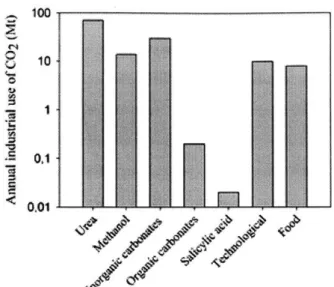
1-3 Annual industrial use of CO2. Note the vertical axis is logarithmic.
Adapted from Ref. [1]. . . . . 28
1-4 Potential products of carbon dioxide conversion. . . . . 29 1-5 Sabatier's principle illustration. In (a), the arrows show the pathway
for the dissociation of a gas AB to mono-atomic gases A and B. Fig. (b) illustrates the volcano plot of the catalytic activity versus interaction for a class of materials. The points on the graph represent different materials/surfaces for the same reaction and reaction conditions. . . 30
1-6 Tunable catalysis illustration. Changing the surface chemistry of a catalyst to achieve varied surface states for the dissociation of gas AB to gases A and B. . . . . 31 1-7 Tunable catalysis illustration. In (a), the arrows show the pathway
for the dissociation of a gas AB to mono-atomic gases A and B. The adsorption of AB and dissociation to adsorbed A and B take place on one state of the catalyst (red lines) and the desorption of the product takes place at the other state of the catalyst (blue lines). Fig. (b) illustrates the expectation that the activity of the reaction on a tunable catalyst should be higher than the top of the static catalysis volcano. 32
2-1 (a) Schematics showing the as-grown BTO thin film. Au/Co was used as the top metal electrodes. (b) Piezoresponse Force Microscopy (PFM) amplitude and (c) phase hysteresis loops measured in the struc-ture. (d) Schematics showing the structure based on a water-treated BTO thin film. The chemically induced surface polarization in the top passive layer is depicted by blue arrows. Panels e and f show its PFM amplitude and phase signals, respectively. Adapted from Ref. [2]. . . 38
2-2 (a)A*(d) Chemisorption energies Echem for CO, 0, C, and N as a
function of polarization direction and Pt thickness for the PbO/Pt interfaces. Red plus signs indicate the P+ interface, and blue minus signs represent the P- interface. The zero of energy corresponds to
Echem on unsupported Pt(100). (e),A(h) Site-preference energies Esite
for CO, 0, C, and N. The solid black lines give Esite for the adsorbates
on unsupported Pt(100). Points above the dotted lines represent a change in the preferred bonding site relative to Pt(100). Adapted from
R ef. [3]. . . . . 4 1
3-1 Tunable catalyst design . . . . 46 3-2 DFT self-consistency scheme. . . . . 50 3-3 Microkinetic modeling scheme . . . . 57 4-1 Computation supercell and relaxed atomic structure for (a) ZnO(1120)n/PbTiO3t
and (b) ZnO(1120)n/PbTiO34 slabs for n = 4. The dashed circle repre-sents the position for oxygen insertion at the interface. Fig. (c) shows the parameters and orientations for matching ZnO(1120) to PbTiO3.
Grey, red, cyan, and black atoms are Zn, 0, Ti, and Pb, respectively. 62 4-2 (a) Determining the effects of platinum electrodes on surface
proper-ties. Calculations were carried out with an electrode support and with-out an electrode support. (b)Comparing the ZnO binding energy on PbTiO3 and CO2 adsorption energy on ZnO/PbTiO3 with and without
4-3 Projected densities of states for the topmost five layers of a) (ZnO)2/PbTiO3/Pt and b) (ZnO)2/PbTiO 3. . . . . 66
4-4 Adsorption energies of (a) C02, and (b) CO+102, on (ZnO(1120)),/[2x
2]PbTiO3 as a function of n. Diamonds and circles represent
adsorp-tion on the positively and negatively polarized structures, respectively. horizontal dashed lines represent the adsorption energy of the molecules on an unsupported ZnO slab. Structures on the right show the adsorp-tion configuraadsorp-tions for the corresponding molecule on stoichiometric structures with n =1. Oxygen atoms in the adsorbates are colored m agenta for clarity. . . . . 68
4-5 Mediation of the interface chemistry by the (a) positively polarized (b) negatively polarized substrates. (c) is a plot of the surface displace-m ents. . . . . 69
4-6 Redistribution of charges in one-layer ZnO(1120) when the PbTiO
3
substrate is (a) positively polarized (b) negatively polarized. . . . . . 70
4-7 CO2 adsorption geometry on (a) ZnO slab (b) (ZnO)1/PbTiO3t (c) (ZnO)1/PbTiO 3T. . . . . 72
4-8 Projected density of states (PDOS) of C and the two 0 atoms of
CO2 after adsorption on (a) ZnO slab (b) (ZnO)1/PbTiO3t and (c) (ZnO)1/PbTiO3t. . . . . 73
5-1 (a) ZnO epitaxy on c-axis oriented ZnO ((i) and (iii)) and an arbitrary lattice-matched non-polar substrate ((ii)). (b) Expected ZnO epitaxy on (i) positively polarized ferroelectric, (ii) neutral ferroelectric (iii) negatively polarized ferroelectric. (c) Scheme for switching the polar-ization of thin-film ZnO. The doping of the ZnO is to enable its use as an electrode. . . . . 77
5-2 Starting (top) and final (bottom) configurations for the calculation of the ground states of ZnO(0001),/PbTiO3 for n = 4. For each direction
of substrate polarization, we did relax calculations with the polar ZnO film in the same ((a) and (c)) and opposite ((b) and (d)) polarization directions. . . . . 79
5-3 Absolute value of the average buckling in the ZnO bi-layers. . . . . . 80
5-4 Densities of states projected on the topmost Zn and 0 atomic layers
in ZnO(0001)n/PbTiO3 for n =1, 2, 3 and 4. The bottom graphs are for unsupported thick ZnO slabs. . . . . 82
5-5 Adsorption energies of CO2 on ZnO(0001)n/PbTiO3 for n =1, 2, 3 and
4. Lines denoting the adsorption of CO2 on ZnO(0001) slabs are added. 83
6-1 Parameters calculated in the reaction pathway for CO2 dissociation. 86
6-2 Reaction pathway for CO2 dissociation over unsupported ZnO (gray
stars) and ZnO supported on positively and negatively poled PbTiO3
(red diamonds and blue circles, respectively). The vertical axis is en-ergy with respect to an isolated CO2 molecule. The vertical arrow
indicates switching of the substrate polarization from P+ to P-. Atom colors are the same as in Fig. 4-1, with adsorbate 0 atoms shown in magenta for clarity. . . . . 90
6-3 Reaction rates for CO2 dissociation over thin-film ZnO supported on
positively and negatively poled PbTiO3 (red and blue points,
respec-tively). The notations correspond to the surfaces listed in Table 6.1. The rates are plotted against the dissociative adsorption energy (en-ergy of adsorbed CO+O relative to an isolated CO2 molecule). The
point corresponding to the unsupported non-polar slab is not shown in this plot for simplicity, but its value is close to the "3L -" point. . . 92
6-4 Reaction rates for CO2 dissociation over one, two and three-layer
non-polar ZnO and non-polar ZnO. Red, blue and magenta points represent reactions on positively poled, negatively poled and dynamically poled structures respectively. . . . . 93
6-5 Volcano plot drawn over the plot of Fig. 6-3 to develop a hypothesis for the prediction of tunable catalysis. . . . . 94
6-6 Bronsted-Evans-Polanyi relation for catalysis on supported ZnO. The inset shows a definition of the quantities ETS and Edi,. .. . . . 95
6-7 3-dimensional plot of the rate of reaction for all values of Eads, the energy of adsorbed C02, and Edi,,, the energy of adsorbed CO+O.
These parameters are depicted in (a) and the rate plot is in (b). The dashed line in (b) is the locus of peak rates for each Ead, and is given
by Eads = 2.86Etss - 7.57. . . . . 97
6-8 An assumed linear relation between ET!S and E 5 5. These
quanti-ties are defined in (a) where the red and blue lines represent reaction pathways on positively and negatively polarized structures respectively. The "non-polar slab" point is the special case of a sufficiently thick or non-supported ZnO(1120) slab for which the substrate polarization has no effect on surface properties, i.e E+S=Ejs and E5
s,=E
5s-
. . .. . . . .. 976-9 Prediction of tunable catalysis rates by calculating adsorption proper-ties on just the positively polarized structure. The definitions of El. and E+,5 are shown in (a) and the calculated reaction rates using the
relationship discussed in Figs. 6-6 and 6-8 is shown in (b). The dashed line is the same as in Fig. 6-8. Improved reaction rates occurs only when the point (El+s, Eadj,) is to the left of the line. . . . . 99
6-10 Temperatures required to achieve the same rate of reaction on the un-supported ZnO slab (left y axis) and the un-supported switchable slab (horizontal x axis). The temperature range of the horizontal axis was chosen so that the substrate is always below its Curie point. The reac-tion rate (right y axis) is shown on a logarithmic scale and normalized so the rate calculated at T=300K is 1. . . . . 100 6-11 Ratio of heating energy to switching energy, F as a function of
tem-perature of the supported switchable slab ("Dynamic Scheme Temper-ature"). . . . . 101
7-1 Atomic geometry of CO2 adsorption shown with side and top views of
all unconstrained atoms for (a) Zn-terminated ZnO(0001) and b) 0-terminated ZnO(0001). The geometry for other adsorbates are shown in figures in Appendix A. . . . . 106 7-2 Surface phase diagram as a function of CO2 and H2 chemical potential
for (a) Zn-terminated ZnO(0001) and (b) 0-terminated ZnO(0001). Ap = 0 corresponds to the standard pressure of 1 bar. . . . . 109 7-3 Reaction pathways for methanol synthesis over Zn-terminated ZnO (0001).
The x-axis denote the pathway along the solid line. . . . . 110 7-4 Reaction pathways for methanol synthesis over 0-terminated ZnO(0001).
The x-axis denote the pathway along the solid line. . . . .111 7-5 Comparison of the energetics of a selected pathway for methanol
syn-thesis over Zn- and 0-terminated ZnO(0001) surfaces, and the minimum-energy dynamically tunable catalysis (DTC) pathway when the surface states of the ZnO are constantly switched. . . . .111 7-6 This is similar to Fig. 7-5 except that the effective DTC pathway is
explicitly illustrated. We see the DTC enabled a 14.5 eV reduction in the free energy of the reaction without a change of the temperature. 112 7-7 Scheme for the synthesis of cyclic carbonates from epoxides and CO
2
7-8 Comparison of the energetics of of ethene carbonate synthesis over Zn-and O-terminated ZnO(0001) surfaces. . . . . 114
8-1 (a) Possible configurations in an oxygen-rich environment. (b) Oxygen chemical potential as a function of temperature and pressure. (c) Free energy versus oxygen chemical potential for n = 1 and n = 4. Shaded regions represent the range of po under the growth conditions reported
in Ref.
14]
is 10-5Pa (highlighted line) and 400 < T < 700 . 1uo canbe decreased by reducing pressure and increasing temperature. . . . 118 8-2 (a) Oxygen vacancy formation energy, AE, as a function of distance
from the interface. The presence of an extra 0 at the interface is predicted to be determined by the initial growth configuration. (b) Atomic structure of CO on the non-stoichiometric (ZnO)1/PbTiO3T
and (ZnO)1/PbTiO34, demonstrating the selective removal of
interfa-cial 0 by the adsorbing CO. Atom colors are the same as in Fig. 4-1, with adsorbate 0 atoms shown in magenta for clarity. . . . . 119
A-i Atomic geometry of CO2 adsorption shown with side and top views
of all unconstrained atoms for (a) Zn-terminated ZnO(0001) and b) O-terminated ZnO(0001). . . . . 122 A-2 Atomic geometry of CO adsorption shown with side and top views
of all unconstrained atoms for (a) Zn-terminated ZnO(0001) and b) 0-terminated ZnO(0001). . . . . 122 A-3 Atomic geometry of 0 adsorption shown with side and top views of
all unconstrained atoms for (a) Zn-terminated ZnO(0001) and b) 0-terminated ZnO(0001). . . . . 123 A-4 Atomic geometry of COOH adsorption shown with side and top views
of all unconstrained atoms for (a) Zn-terminated ZnO(0001) and b) 0-terminated ZnO(0001). . . . . 123
A-5 Atomic geometry of OCH2
0
adsorption shown with side and top viewsof all unconstrained atoms for (a) Zn-terminated ZnO(0001) and b) 0-terminated ZnO(0001). . . . . 124 A-6 Atomic geometry of OH adsorption shown with side and top views
of all unconstrained atoms for (a) Zn-terminated ZnO(0001) and b) 0-terminated ZnO(0001). . . . . 124 A-7 Atomic geometry of H adsorption shown with side and top views of
all unconstrained atoms for (a) Zn-terminated ZnO(0001) and b) 0-terminated ZnO(0001). . . . . 125 A-8 Atomic geometry of H20 adsorption shown with side and top views
of all unconstrained atoms for (a) Zn-terminated ZnO(0001) and b) 0-terminated ZnO(0001). . . . . 125 A-9 Atomic geometry of CH30H adsorption shown with side and top views
of all unconstrained atoms for (a) Zn-terminated ZnO(0001) and b) 0-terminated ZnO(0001). . . . . 126 A-10 Atomic geometry of HCOO adsorption shown with side and top views
of all unconstrained atoms for (a) Zn-terminated ZnO(0001) and b) 0-terminated ZnO(0001). . . . . 126 A-11 Atomic geometry of HCOOH adsorption shown with side and top views
of all unconstrained atoms for (a) Zn-terminated ZnO(0001) and b) 0-terminated ZnO(0001). . . . . 127 A-12 Atomic geometry of OCH2OH adsorption shown with side and top
views of all unconstrained atoms for (a) Zn-terminated ZnO(0001) and
b) 0-terminated ZnO(0001). . . . . 127
A-13 Atomic geometry of CH20 adsorption shown with side and top views
of all unconstrained atoms for (a) Zn-terminated ZnO(0001) and b) 0-terminated ZnO(0001). . . . . 128 A-14 Atomic geometry of CH30 adsorption shown with side and top views
of all unconstrained atoms for (a) Zn-terminated ZnO(0001) and b) 0-terminated ZnO(0001). . . . . 128
A-15 Atomic geometry of HCO adsorption shown with side and top views of all unconstrained atoms for (a) Zn-terminated ZnO(0001) and b) 0-terminated ZnO(0001). . . . . 129 A-16 Atomic geometry of CO3 adsorption shown with side and top views
of all unconstrained atoms for (a) Zn-terminated ZnO(0001) and b) 0-terminated ZnO(0001). . . . . 129
B-1 Schematic of a method for growing/transferring single-crystalline thin films on/from epitaxial graphene. (a) Graphitization of a SiC sub-strate to form epitaxial graphene. (b) Epitaxial growth of GaN on graphene. (c) Deposition of a stressor layer (Ni). (d) Release of GaN from the substrate with a handling tape. (e) Transfer of the released GaN/Ni/tape stack on a host substrate. (f) Removal of the tape and Ni by thermal release and wet etching, leaving a GaN film on the host substrate. Reprinted with permission from Ref. [5]. . . . . 133 B-2 Experimental method of multiple layer graphene transfer. This figure
was produced by the Jeehwan Kim Group at MIT. . . . . 134 B-3 (a), (b), Main plots, results of DFT calculations of averaged electron
density along separated slabs of GaAs for AshAGa interaction (a) and AsaAAs interaction (b). Periodic boundary conditions were im-posed along the dashed lines of the simulation model (shown at top). Both plots show the existence of significant electron charge density between the separated slabs within a gap of about 9
A.
(c)hAf(e), EBSD maps of GaAs grown on and exfoliated from aAmonolayerhAZ grapheneAGaAs(001) substrate (c), showing (001) single-crystallinity, and of GaAs grown on and exfoliated from AAYbilayerAA2 (d) and AA tetralayeraAZ (e) graphenehA$GaAs(001) substrate showing (111)-dominant polycrystallinity. On the left is the inverse pole figure colour triangle for crystallographic orientations. . . . . 138B-4 (a) The front surface of the GaAs epilayer grown on monolayer graphenedA-GaAs substrate is generally smooth but also contains impinging marks which need to be addressed by further optimization of nucleation and growth. Inset, 1 Iijm AU 1 Iijm non-contact AFM scan; the epitaxial layer appears to be growing via step flow growth. The r.m.s. roughness of the AFM scan is 0.3 nm. (b), (c), Three-dimensional growth was observed for films grown on thicker grapheneAA$substrates owing to limited registry from the substrates. Scale bars, 4 Jijm. Top and bot-tom panels of adA~c indicate front and released surfaces, respectively.
... 140
B-5 (a) Diagram of exfoliated stacks of GaAs released from a graphenedA-GaAs(001) substrate. (b) !EdAA2Jy scan of GaAs exfoliated from monolayer graphene transferred on a GaAs(001) substrate showing (001) single-crystallinity as indicated by XRD peaks of the (002) and
(004) lattice labelled in red. (c)
IEdAA2y
scan of GaAs exfoliatedfrom bilayer graphene transferred on GaAs(100) substrate showing polycrystallinity with dominant (111) orientation, as indicated by the
XRD peak of the (111) lattice labelled in red, and d,
IEAA$2iy
scan ofGaAs exfoliated from tetralayer graphene transferred on a GaAs(001) substrate showing polycrystallinity with dominant (111) orientation, also indicated by XRD peak of the (111) lattice labelled in red. The IEAA$2Iy scans also picked up XRD peaks from the Ni stressor film and the Ti adhesion layer that was used to exfoliate the GaAs films (Methods). The presence of these films are shown by the XRD peak of the (111) Ni lattice and the (101) lattice of anatase TiO2 from the
B-6 Characterization of GaAs grown on the monolayer graphenehAGaAs(001) substrate. (a) Large-scale EBSD map of exfoliated GaAs. (b) High-resolution X-ray diffraction azimuthal off-axis
IT
scan of the same ex-foliated GaAs layer, representing a single-crystalline zinc-blende struc-ture without in-plane rotations. (c) EBSD map of an exfoliated GaAs layer grown on a monolayer grapheneaAGaAs substrate without H2annealing after transfer. (d) High-resolution STEM images showing ex-cellent remote alignment of the GaAs(001) lattices through the graphene. Convergent-beam electron diffraction patterns from the epilayer (top inset) and the substrate (bottom inset) show identical zinc-blende (001) orientations. (e) Low-angle annular dark field STEM image showing no dislocations. . . . . 142
B-7 AlGaInPAA$GaInP double heterojunction LEDs on a graphenedA$-GaAs substrate. AlGaInPaA$GaInP double heterojunction LEDs on a grapheneaAGaAs substrate. a, Cross-sectional SEM image of het-erojunction LEDs. b, IAAQV curves of LEDs grown on grapheneaA-GaAs substrates and directly on grapheneaA-GaAs. Inset, emitted red light from the LEDs grown on the graphenedA$GaAs substrate. c, Electrolumi-nescence spectra of the LEDs grown on graphenehAGaAs substrates and directly on GaAs, Inset, photographs of functioning LEDs grown on both substrates. ... ... 145
B-8 Single-crystalline III-V(001) films exfoliated from graphenehAIII-V(001) substrates after remote epitaxy. Single-crystalline III-V(001) films exfoliated from graphenehAIII-V(001) substrates after remote epi-taxy. a, d, g, GaAs; b, e, h, InP; c, f, i, GaP. Schematic illustra-tion (top left) shows the exfoliaillustra-tion process of thin-film sample prepa-ration for high-resolution X-ray diffraction and EBSD characteriza-tions. adAc, Photographs of single-crystalline GaAs(001), InP(001), and GaP(001) films exfoliated from grapheneaAIII-V(001) substrates. dAA~f, High-resolution X-ray diffraction EA
A2Jy
scans of the exfoli-ated semiconductor/stressor stack that includes GaAs(001), InP(001), and GaP(001) epilayers. ghAi, Large-scale EBSD maps of GaAs(001), InP(001), and GaP(001) epilayer surfaces. . . . . 147List of Tables
4.1 CO2 adsorption geometries on the substrates. 11 and 12 are the lengths
of the
C-O
bonds in the CO2 molecule and 13 is the length of the bondbetween the carbon atom and the nearest 0 atom on the surface. 6 is the O-C-O angle in the adsorbate. . . . . 72 5.1 Free energy JAGI and upper bound of activation energy Ea for the
relaxed configurations of Fig. 5-2(b) and (d) to reach absolute minima. n is the number of layers. The energy values are normalized per ZnO p air. . . . . 80
6.1 Eads, ETs and Edi., values for CO2 dissociation on all surfaces
consid-ered. ... ... 89 7.1 Formation energies of all species with respect to the two surfaces
Chapter 1
Introduction
A short part of the first section of this chapter was published in a previous work
[6].
1.1
Global warming and CO
2
conversion
The world currently meets most of its energy needs by burning fossil fuels. [7 Be-ginning from the industrial revolution, this has resulted in increasing concentrations of greenhouse gases in the atmosphere and concomitant rise in atmospheric temper-atures (Fig. 1-2). In an ideal world, switching to renewable energies is desired, but renewable energies are limited by the storage capacity of existing batteries. For ex-ample, Fig. 1-1 compares the specific energies of gasoline and diesel to that of Li ion batteries. We see that the fossil fuels are far better for energy storage, both when volume or weight is considered. This advantage, combined with the ease of trans-portation and low cost, means that we cannot expect to completely end our reliance on fossil fuels in the next few decades. This presents a unique dilemma, as we cannot afford the environmental cost of continous usage of fossil fuels. This means we have to consider means of harnessing the advantages of fossil fuel use (cheap and reliable energy) while avoiding the side effects (global warming).
There are currently three approaches to this: direct usage, sequestration and conversion. In the first case, carbon dioxide has some interesting but rather limited uses in beverages, fire extinguishers, oil recovery, etc. [8] Perhaps a better-studied
10 I 40-10
30-
20-20
1
30
1
40
1
501
Diesel1
Gasoline
Libattery
I
10
20 30T
40
50
-40
-30
-20 -10Energy density, mass (MJ/kg)
Figure 1-1: Specific volumetric and gravimetric energies of fossil fuels compared to
Li-ion batteries.
380 7,000 -Atmospheric Anthropogenic 360 Concentrations Emissions 6,000 0
340
-
- 000 320 4.000 300 3,000 6280 - 2O0J 260 1,000 1750 1800 1850 190O 1950 2OO0Source: Oak Ridge National Laboratory, Carbon DMmide Informaton Analysis Center,
http:cdfac.ead.ortgov/.
Figure 1-2: Trends in Atmospheric Concentrations and Anthropogenic Emissions of Carbon Dioxide.
case is that of physical capture of the gas. This method, known as Carbon Capture and Storage (capture, compression, transportation, and storage of CO2 in suitable
subterranean geological reservoirs) [9] is a large-scale approach which may be limited
by cost and our understanding of the long-term capacity of geological formations to
hold CO2. Moreover, capturing and compressing CO2 may increase the fuel needs of,
for example, a coal-fired CCS plant by 25-40%. [101 These and other system costs are estimated to increase the cost of the energy produced by 21-91% for purpose built plants, and even more for existing ones. [10] There are concerns that safe and permanent storage of CO2 cannot be guaranteed and that even very low leakage rates
could undermine any climate mitigation effects. [11, 12, 131
The third approach, chemical or biological conversion, may be the best option yet if we are able to find cheaper ways to achieve the fixation. Since carbon and oxygen are both key elements in organic chemistry, there are a wide range of chemicals (Fig. 1-4) that can at least theoretically utilize CO2 as a feedstock for production, including
organic acids, alcohols, esters, and sugars which have important commercial uses. [14, 9] For example, methanol, which is the basic chemical building block of paints, solvents and plastics, has innovative applications in energy, transportation fuels
1151
and fuel cells. It had a global demand of 45.6 million metric tons and generated $36100
0.
0A
Figure 1-3: Annual industrial use of CO2. Note the vertical axis is logarithmic. Adapted from Ref. [1].
billion in economic activity in 2010 [16].
Another potential large scale use of CO2 is the production of cyclic carbonates.
These have several commercial applications due to their use as chemical intermediates (e.g for dimethyl carbonate production) [171 and as aprotic polar solvents. [181 A particularly important and growing application of cyclic carbonates is their use as electrolytes in lithium ion batteries. [19] Practically, however, CO2 is utilized to a
very limited extent in industrial production processes. Fig. 1-3 shows some trends in actual CO2 use. We see that scale of conversion to methanol is comparable to
that of the technological uses (primarily enhanced oil recovery) though the former has a much greater demand than the latter. This is partly due to the fact that the most efficient reactant for the conversion is frequently not CO2. For example,
in the industrial production of methanol, a mixture of CO and H2 (syngas) is the primary feedstock as these are much easier to obtain (by secondary conversion from natural gas) and a relatively small amount of CO2 is only fed into the reactor to
ensure conversion of any unreacted H2. Another stumbling block to the adoption
of CO2 as a choice reactant is the high energy and financial cost of the conversion
process itself. For example, commercial production of cyclic carbonates relies on quaternary ammonium or phosphonium salts as catalysts which require the use of high
Co-polymers che s s V N-
~N'
V_ Urea4 O'0 -I C C~OH cab Methanl C;%OH "O Polymer buidng blocks 0, iCH1*1-N-_C=O o F0o o ICHa-N=C=0 DMmethyl carbonale Formic Sakyfic acidi5d OHO '0 0
h ) Ou OH
Figure 1-4: Potential products of carbon dioxide conversion.
temperatures and pressures. Under these conditions, CO2 fixation is a net producer
rather than consumer of CO2 due to the energy required to heat and pressurize the
reactor and reactants. [20] These challenges explain why the current industrial usage
of CO2 is only 0.5% of the 24Gt/yr total anthropogenic CO2 we produce.[1] This
obvious gap has led many researchers to investigate ways to improve the CO2 fixation
process. Since the rate of any chemical process can be increased in theory by utilizing a catalyst, we will next explore why a good catalyst has not been found for CO2 conversion processes.
1.2
Introduction: Sabatier's Principle and
Dynami-cally Tunable Catalysis
Efficient solid state catalysis requires materials that can facilitate both the adsorption of reactants and the desorption of products. However, for the same static surface,
ycIc
onates
Transition state
A(g)+ B(g)
AB(g) A+B ads _
ABa
Reaction coordinates Good adsorber Good desorber
(a) (b)
Figure 1-5: Sabatier's principle illustration. In (a), the arrows show the pathway for the dissociation of a gas AB to mono-atomic gases A and B. Fig. (b) illustrates the volcano plot of the catalytic activity versus interaction for a class of materials. The points on the graph represent different materials/surfaces for the same reaction and reaction conditions.
strong binding of the reactants, which leads to a fast first step is generally correlated with strong binding of the products, leading to a slow last step -see Fig. 1-5(a). Since the rate of the reaction is determined by the slowest step, the best catalyst for a given reaction for a given class of materials will have an intermediate level of interaction with reactant, intermediate, and product species. This principle, known as Sabatier's principle, is illustrated by the schematic "volcano plot" in Fig. 1-5(b). Based on this conception, the goal of most catalysis research is to find the least expensive material that is as close as possible to the top of the volcano. [21, 22, 231
The key objective of tunable catalysis is to combine the advantages of both strong and weak interactions with the various species involved in a reaction in order to overcome Sabatier's principle and obtain rates that are better than those accessible by simply compromising on the catalyst-species interactions. This is illustrated in Fig. 1-6, in which the gas dissociation process AB > A+B is carried out in two steps, each at different states of the catalyst. In the illustration, the adsorption of the gas AB(g) and the dissociation to adsorbed A and B species on the surface of the catalyst all take place at the same surface state. Then another state of the catalyst is induced. This state is assumed to be more favorable for the desorption of gases
'I "4 ..0 * * Stai Good adsorber S t Good desorber XDTC?
Dynamically tunable catalyst
Figure 1-6: Tunable catalysis illustration. Changing the surface chemistry of a cata-lyst to achieve varied surface states for the dissociation of gas AB to gases A and B.
A(g) and B(g). Fig. 1-7 shows how switching between the reaction pathways that occur on two different states of a catalyst can lead to faster reaction rates (higher catalytic activity), shifting the activity of the tunable catalyst above the top of the volcano curve, which is not accessible to a static catalyst. The varied state of the catalyst could be achieved in a number of different ways, for example, by applying a cyclic electric field across a ferroelectric such as a perovskite, which is the focus of this work, or by temperature modulation.
1.3
Objectives of this thesis
To design a tunable catalysis system for a specific reaction, it is necessary to consider the following:
1. The material of the ferroelectric substrate. 2. The material of the film.
3. The orientation of the film.
-t
4,(g)+B(g)tc
AB 1 s
Reaction coordinates Good adsorber Good desorber
Figure 1-7: Tunable catalysis illustration. In (a), the arrows show the pathway for the dissociation of a gas AB to mono-atomic gases A and B. The adsorption of AB and dissociation to adsorbed A and B take place on one state of the catalyst (red lines) and the desorption of the product takes place at the other state of the. catalyst (blue lines). Fig. (b) illustrates the expectation that the activity of the reaction on a tunable catalyst should be higher than the top of the static catalysis volcano.
5. Interface structure.
6. Environmental conditions.
Given such a rich parameter space, there is a lot of research to be done to fully understand tunable catalysis. As we will show in the next chapter, researchers simply select one point in this space and focus on the application of the selected catalyst to potentially promote a selected reaction. The knowledge gaps inevitably created by this approach inspired our work. In this thesis, we seek to answer the following questions:
1. What is the mechanism for the changing surface chemistry in a material (the film) when there is an underlying ferroelectric substrate?
2. Is there any limit to the thickness of the film for tunable catalysis to be possible? 3. What are the necessary conditions for tunable catalysis to be possible?
4. How can we extend the influence of the substrate to enable tunable catalysis on thicker films?
6. What are the guiding principles for material screening in tunable catalysis?
An additional goal of our work is to find possible applications of tunable catalysis to CO2 conversion processes, so we select zinc oxide as the film material and will test
all hypotheses using the CO2 dissociation reaction, which is frequently the first step
in CO2 conversion processes. ZnO was selected because it is commonly used as a
catalyst for the industrially and environmentally important CO and CO2 conversion
reactions, frequently in conjunction with a copper co-catalyst [24, 25]. We choose to study hetrostructures of epitaxial non-polar ZnO(1120) and polar ZnO(0001) films on PbTiO3, as similar systems have previously been grown experimentally [4].
This thesis is laid out as follows. This chapter introduces the work and our objectives. Chapter 2 is a literature review of tunable catalysis. Chapter 3 explains the methods used in this work: Density Functional Theory (DFT) and Micro-kinetic Modeling (MKM). In Chapter 4, we evaluate the effect of a PbTiO3 substrate on the
surface of thin-film non-polar ZnO. Chapter 5 explores the possibility of tunability of ZnO polar surfaces, which is in effect a quest to induce ferroelectricity in the material. We show that this is possible and calculate the energetic requirements. In Chapter 6, we explore the tunable catalysis of CO2 reduction on supported ZnO surfaces. We
show an important criterion for tunable catalysis to happen and discuss the extension of our results to other oxides. In Chapter 7, we show that tunable catalysis can be applied to more complex CO2 reactions, including the synthesis of methanol and the
addition of epoxides to CO2 to form cyclic carbonates. We summarize the thesis in
Chapter 2
Literature review of dynamically
tunable catalysis
Portions of this chapter were published in the author's master's dissertation [6.
2.1
Introduction
Systematic analysis of tunable catalysis has only recently begun: so far, only three groups have published any work on it in the past 10 years. In 2007, Kolpak et al. [31 showed that the surface chemistry of Pt can be tuned by growing a thin layer on a ferroelectric. However, the applicability of the proposed Pt/PbTiO3 catalyst
is limited because such thin layers of metal agglomerate rather than form thin films on oxides [261. Therefore, other researchers have looked into the use of oxides as the active catalyst instead. Lee and Selloni [27] showed that polarization of the perovskite subtrate determined whether or not the reaction efficiency for the oxygen evolution reaction was improved on TiO2/SrTiO3. Kakekhani and Ismaili-Beigi [28] proposed a
NO dissociation mechanism on electric field-actuated tunable CrO2/PbTiO3 catalyst.
Later, they also proposed that temperature actuation is possible for H20 dissociation
on PbTiO3 [29]. In this chapter, we will examine these and related papers and the
foundations of polarization-influenced catalysis. We will particularly focus on research on materials that are appropriate for dynamically (real-time) tunable catalysis.
2.2
Ferroelectric materials as catalysts
-
early
re-search
The direction of the ferroelectric polarization has been demonstrated to have an ef-fect on the surface chemistry of ferroelectrics. The first to demonstrate this for a ferroelectric was Parravano in the early 1950s who showed that the rate of CO oxida-tion over KNbO3 and NaNbO3 significantly increased around the Curie temperatures
of the catalysts [30J. In the 1960s, it was demonstrated by Stadler and co-workers that feooelectric polarization of a substrate can influence the physical properties of a supported metal films [31, 32]. Inoue and co-workers et al. extended this result in the 1980s by studying the chemical properties of the surface of palladium supported on LiNbO3 [33, 341. They found that the oxidation rate of CO over the negatively
poled structure was higher than on the positively poled structure. Also, in the 1980s, some work was done on the chemical properties of the surfaces of polar ZnO, which has polarization perpendicular to the surface, but this polarization is not reversible.
By using temperature programmed desorption (TPD) measurements, Vohs and
co-workers studied the adsorption and/or decomposition of formaldehyde, ethanol, 1-propanol, acetic acid and formic acid on the positively polarized Zn-terminated ZnO surface and the negatively polarized 0-terminated surface [35, 36, 37J. They found that the Zn-termination is reactive to all the species but the 0-termination is not. This insight will be shown to be important later in this thesis.
2.3
Tunable catalysis on bare perovskites
The simplest dynamically tunable catalysis scheme utilizes the different surface chemistries on the surfaces of perovskites. The necessary electronic and structural reconstruc-tions [38, 39, 40, 41j on both the positive and negatively polarized perovskite surfaces account for the change in surface chemistry upon polarization switching. The re-constructions are mostly due to the need to constrain the divergence of the internal electric field with increasing thickness of the slab.
An experimental study of catalysis on bare ferroelectric surfaces is that of Yun and co-workers. They measured the TPD data for different kinds of molecules and showed that 2-propanol has a desorption peak temperature 1OOK greater on the negatively polarized surface compared to the positively polarized one [42]. This means that the adsorption energy is much greater on the negatively polarized surface.
The internal electric field in ferroelectric catalysts and the polar surface termi-nations can mitigate electron-hole recombitermi-nations when used for the photocatalysis and this has resulted in several studies on the possibilities of using ferroelectrics as solar cell materials and photocatalysts [43j. Another interesting catalytic application of bare ferroelectrics such as BaTiO3 and PbTiO3 is the combustion of methane[44].
An exciting phenomenon on these materials for hydrocarbon-related catalysis is the difference in adsorption properties of ethanol and methanol on oppositely poled sur-faces. It was found that ethanol adsorbs more rapidly on negatively poled BaTiO3
[45] in contrast to methanol which adsorbs more rapidly on positively poled BaTiO3
[46]. This highlights the intriguing possibility of tuning the surface of the catalyst for selectivity towards methanol or ethanol.
However, the picture is not all-rosy for the case of dynamically tunable catalysis. Several researchers have attempted to use the quite different surface chemistries at the different polarization states of the perovksite catalyst to experimentally design dynamically tunable catalysts. Some of the work includes BaTiO3 and SrTiO3 tunable
catalysts for H20 adsorption [471, H20 dissociation [2, 48] and CO oxidation [491. It is
found that the progression of the surface adsorption or reaction significantly screens the polarization, degrades the surface or pins the polarization of the ferroelectric slab. Through first principles calculations, it is shown that the polarization pinning is caused by the formation of oxygen vacancies which stabilizes an inward pointing polarization [50]. In effect, the progression of the tuned catalysis on the surface of the catalyst itself degrades the catalyst. An example of this phenomenon is shown in Fig. 2-1, adapted from Ref. [2] which clearly shows the degradation of the ferroelectricity in barium titanate (BTO) when the surface is treated with water. Therefore, bare surfaces of perovskites are ineffective as tunable catalysts.
(a)
(b)
Oxynpn Vocancy 410 At(e)
.. ... .. WM0W 4 3 2 1 4 -2 .1 0 1 2 3 Voltage MV Up Do~wn 4 2 g4 1 Voltag (V) it S 10ISO
190~0
Voage V .3 4 4 0 1 Voltage MV 2 1Figure 2-1: (a) Schematics showing the as-grown BTO thin film. Au/Co was used as the top metal electrodes. (b) Piezoresponse Force Microscopy (PFM) amplitude and (c) phase hysteresis loops measured in the structure. (d) Schematics showing the structure based on a water-treated BTO thin film. The chemically induced surface polarization in the top passive layer is depicted by blue arrows. Panels e and f show its PFM amplitude and phase signals, respectively. Adapted from Ref. [2].
(c)
(d)
Up
2.4
Tunable catalysis on perovskite-supported metal
films
Since it has been shown by Inoue and co-workers [34] that the tunable catalysis effects are maintained on ferroelectrics even when a thin metal film is grown over them, researchers turned towards this system for inspiration. Inoue and co-workers reported that activation energy (hence kinetic behavior) for CO oxidation over a LiNbO3
-supported Pd catalyst significantly changed depending on the polarization of the support and the thickness of the Pb layer. They found that the energy barrier varied over Pd on the positive polar surface changed from 126KJ/mol when the Pd thickness was over 0.2nm to 96KJ/mol at 0.02nm, whereas the Pd deposited on the negatively poled surface showed a constant energy barrier of 128KJ/mol irrespective of thickness. They also showed that the adsorption energy of CO and H2 on NiO deposited on
oppositely poled directions of LiNbO3 [33]. This phenomenon was explained using a
band bending model in which the polarization of the substrate modifies the electronic distribution on the NiO surface.
Other researchers have also shown similar results. In 1990, Roberts and co-workers carried out CO adsorption on ZnO-supported Pt films 151J. Depending on the polar-ization direction of the ZnO support, the adsorption energy of CO (determined via a TPD characterization) is greater when the support is positively polarized than when it is negatively polarized. Yun et al.
152]
also carried out CO adsorption via TPD but this time on Pd clusters supported on LiNbO3. Their results showed no differencein adsorption properties of the molecule when the polarization direction is different. This suggests that the surface chemistry on supported metal structures depends on the thickness of the film.
Based on this idea, Kolpak and co-workers carried out theoretical research on the surface chemistry of Pt layers deposited on oppositely poled PbTiO3. Their results
showed different chemisorption strength and site preference for the adsorption of CO, 0, C, and N, altering the reaction pathways for the dissociation of CO, 02, N2 and
2-2, in agreement with the experimental results discussed in the last paragraph. The researchers explained that the polarization-induced changes in the surface chemistry effects are mitigated by the small electronic screening length of Pt, so that only atomically thick films exhibit significant effects. Since it is also challenging to wet oxide surfaces with catalytically active transition metals [26J, manufacturing reliable pervoskite supported catalysts will be a significant engineering challenge, thus we expect that the aggregation of the metal into nanoparticles will supress the effects of substrate polarization on catalytic activity in real catalysts of this design.
2.5
Tunable catalysis on perovskite-supported oxide
films
Recently, researchers have begun explore the possiblity of replacing metals in the supported tunable catalysis schemes as described above, with binary oxides. This removes the surface degradation effects on the bare ferroelectric and the coagulation effects of metallic films on the perovskite support. Moreover, consistent thin films of oxides have been reported grown experimentally on perovskites (e.g Ref. [4]) through advances in epitaxial growth methods such as Atomic Layer Deposition [53] and Molecular Beam Epitaxy [541. We now report on recent research on binary oxide-perovskite heterostructures.
Inoue and co-workers
155]
studied H2 and 02 adsorption on LiNbO3-supportedTiO2 and NiO films respectively. On the supported TiO2 film, the adsorption energy
of H2 was 0.15 eV higher on the positively polarized structure. On the otherhand, for
02 adsorption on the supported NiO film, the higher adsorption energy, by 0.57 eV, was observed on the negatively polarized structure. A few decades later, they showed that varying the polarization of the LiNbO3 support influenced the surface chemistry
of NiO enough for them to obtain four to seven times increase in oxidation rates of CO, when compared to the oxidation on a static structure [56]. This was the first clear case of dynamically tunablel catalysis in an experiment.
strvnger binding cnmpared to Pt(I 00)
a)CO
wAker binding stronger bhning -b)
C 1 I weaker binding stronger bindinge>O
I I I I - Ivak rbinding stnge binding d)N 1 2 3 4 5 Pt thickness (layers) 0.5 0.5 0.0 -0.5 0.5 -05 0.0 -1.0 -1.5 0.5 0.50 -2 -0.5top
A bri)CO
- bri -hol C holWaO
T I I I bri h> N T I I I I 1 2 3 4 5 Pt thickness (layers)Figure 2-2: (a)hAf(d) Chemisorption energies Echem for CO, 0, C, and N as a function of polarization direction and Pt thickness for the PbO/Pt interfaces. Red plus signs indicate the P+ interface, and blue minus signs represent the P- interface. The zero of energy corresponds to Echem on unsupported Pt(100). (e)aA(h) Site-preference energies Esite for CO, 0, C, and N. The solid black lines give Esite for the adsorbates on unsupported Pt(100). Points above the dotted lines represent a change in the preferred bonding site relative to Pt(100). Adapted from Ref. [3].
0.2 0.0 -0.2 -0.4 -0.6 E A 0.2 P -0.4 -0.6 0.2 > 0.0 -0.2 .4 -0.6 0.2 0.0 -0.2 .0.4
Theoretical work support the conclusions from the experimental studies. In 2013, Garrity and co-workers showed that the the binding energy of 02 on the surface of PbTiO3-supported RuO2 is 1 eV greater on the positively polarized structure
com-pared to the negatively polarized structure [57]. Two years later, the same research group showed that the binding energies of NO2, NO, 02, CO and CO2 on PbTiO3
-supported TiO2 were quite different on the positively and negatively polarized
struc-tures [281. Lee and Selloni [271 explored the oxygen evolution reaction (OER) on epitaxial heterostructures of TiO2 on polar SrTiO3 perovskite. They show that the
reactivity of the TiO2 surface is tuned by polarization of the substrate and also the
extent of the reaction. Compared to the OER on unsupported TiO2, the positively
poled surface reduced the thermodynamic barriers and significantly improve the ef-ficiency of the OER reaction. This is similar to the result obtained by Kakekhani and Ismail-Beigi [28] for NO, decomposition and CO oxidation on CrO2/PbTiO3
-Their model required switching the polarization of the ferroelectric in situ by an elec-tric field at roughly the turn-over frequency of the reaction. The same group later designed a catalytic cycle for water splitting that is actuated by cyclic temperature modulation [29].
2.6
Summary
We have examined the history of tunable catalysis and showed the recent advances in the field. We explored the catalytic activities on bare ferroelectric surfaces,
ferroelectric-supported metal surfaces and ferroelectric-ferroelectric-supported oxide surfaces. We see that the polarization of the ferroelectric support in each case affects the adsorption energy and reaction rate of several types of molecules and reactions. The parameter space for the exploration of tunable catalysis is rich, and so far, the approach by researchers has been to select an arbitrary point in the rich parameter space that represent tunable catalysis. This is sub-optimal, and we know that adding a predictive theory for static surface catalysis based on the d-band model and Bronsted-Evans-Polanyi relations [58, 59] led to significant advances in the development of new catalysts. This calls for
a more systematic approach to understanding and designing tunable catalysts. This thesis aims to fill this gap.
Chapter 3
Methods
Portions of this chapter were published in a previous work /6.
3.0.1
Design of the dynamically tunable catalyst
As discussed in Chapter 1, tunable catalysis is necessary to obtain catalytic rates beyond the limitations of Sabatier's principle. One way to achieve this is to perform catalysis on the surface of a perovskite tuned by a constantly changing electric field. As discussed in Chapter 2, this approach is not practical, as the participation of the atoms of the catalyst quickly degrades the ferroelectric properties of the material. Our catalyst is designed to have the strong difference in surface chemistry induced by a perovskite but without the reaction taking place on its surface. This is achieved by the epitaxial growth of a thin film of an oxide on the surface of the perovskite. This scheme is illustrated in Fig. 3-1. Lead titanate (PbTiO3) is chosen as Component
1, and zinc oxide (ZnO) is chosen as component 2. Since both of these materials are earth-abundant, the catalyst is expected to be both effective and cheap if our work