Ke K
K y words: Age-related differences, assessment of delay of gratification, delay discounting, delay of gratification, self-regulation. Co
C
C rrerr sps ondence: Reinhardrr Drobetz, Mag.rer.nataa ., Departrr ment of Psyss chology, Psyss chopataa hology and Clinical Intervrr evv ntion, Univii evv rsitytt of Zurich, Binzmuehlestrasse 14/17, 8050 Zurich, Switzerland.
E-mail: [email protected]
Received December 1, 2010; accepted in revised form January 18, 2011. First published ahead of print December 14, 2011 as DOI: 10.3275/8178
Delay
a
a of grat
a
a ifi
ff cat
a
a ion in old age: assessment
n
n ,
age-relat
a
a ed eff
ff e
ff ct
c
c s, and clinical implicat
a
a ions
Reinhard Drobetz, Andreas Maercker and Simon Forstmeier Department of Psychology, University of Zurich, Zurich, Switzerland
ABSTRTT ARR CT.TT Delay ofo grarr tifi iff cation (D(( oG)G , the ability to re
rr je ejj ct immediately available smaller rerr wardrr s in faff vor ofo later largr er rewards, has been a topic ofo continuous re-search interest foff r almost 60 years. Although numer-ous studies have expx lored this construct and its efe fff eff cts on wellbeing, social behavior, cognitive abilities, and academic success in childrerr n, DoG studies in adulthood and old age are scarce. Instead, delay discounting (D
(( D)D , that is, the degree to which individuals devalue delayed rewards, has been used in samples ofo adults and older individuals, and is ofo particular interest in clinical studies. FiFF ndingsgg frff orr m DDDD rerr searcrr h sugggg egg st that the prefe eff rence foff r delayed rewards increases from childhood to early adulthood, and then decreases from middle age to old age. The main aim ofo this re-view is to elucidate the importance ofo DoG in adult-hood and old age. First, the review expx lores the theo-re
rr tical status ofo DoG by sps ecifi yff ing the rerr lationships and distinctions between DoG and related constructs. Sec-ond, it provides an overview ofo DoG measurements, fr
ff om traditional to novel. ThTT ird, the efe fff eff cts ofo DoG on development and wellbeing are expx lored. FoFF urth, age-re
rr lated difi fff eff rerr nces in DoG arerr summarized. Lastly, the review closes with conclusions, clinical implications, and the outlook foff r possible fuff rther rerr searcrr h direrr ctions. (A
(( ging Clin Expx Res 2012; 24: 6-14) ©2012, Editrice Kurtis
most every day of our lives: the choice between an im-mediate rewardrr and a larger delayaa ed rewardrr whww ich implies the investment of time and effort. In scientific language, this behavaa ivv or is termed Delay ofo Grarr tifi iff cation (DoG) – the voluntaryrr postponement of immediate gratification for the sake of later and better rewards (2).
DoG has been a topic of psyss chological research intn erestss for almost 60 years. The DoG paradigm was inspired by the work of psychologist Walter Mischel, who is well-kn
kk own for his pioneering DoG experiments. The concept was originally investigated in children, and there is only a small body of research on DoG in adulthood and old age. Howevevv r, it is not only children and adolescents who choose to delayaa or not to delayaa gratification; adults and el-derly people also have to make daily choices betwtt een im-mediate and delayed pleasures. For example, they may have to decide betwtt een spending their money (e.g., a life insurance payout) now, or saving it for their heirs. Like-wise, diabetes patients may decide against delicious sweets in view of the expected health payoffs. From a lifespan perspective, practical examples are plentiful: stopping smoking to reduce health risks, or working for the gratification of a pension in old age. Thus, DoG is al-so highly relevant in old age.
In this review, we first describe the theoretical basis of DoG and its link to related constructs. We then provide an overview of traditional and novel assessment proce-dures and empirical findings with regard to the effects of DoG on cognition, motivation, social variables, and wellbeing, and summarize age-related differences in DoG. The review closes with conclusions, clinical im-plications, and the outlook for possible further research directions.
INTRODUCTION
If you had the choice between one marshmallow now or two marshmallows later, which would you prefer? This question from Walter Mischel’s (1) original “marsh-mallow test” represents a dilemma which confronts us
THEORETICAL STATAA US OF DELALL YAA OF GRARR TAA IFICATAA ION
Much theoretical work has been done to explain DoG behavior and to localize DoG in the nomological netwtt ork of the related constructs of self-regulation, delay dis-counting, and executive function.
Selfl -ff regulation
Self-regulation, a complex multifaceted personality process, involves internal and/or transactional processes that enable goal-directed activities to be maintained (3). Both self-regulation and DoG involve the active man-agement of goals (4). Some authors see DoG as a mea-sure of self-regulation (e.g., 5); indeed, the DoG paradigm has been used in studies on the development of self-regulation (6). Likewise, Academic DoG, i.e., delaying gratification in order to attain academic success, and self-regulataa ed learning strataa egies are closelyll relataa ed (7), and theories of self-ff regulataa ion also drawaa on DoG (3). Successfuff l self-regulation is necessarily accompanied by successful DoG – for example, when individuals prevent themselves from thinking about immediately available rewards (1). Convnn evv rselyll , failure of self-regulation (i.e., choosing the im-mediate reward) tends to be accompanied by an atten-tional shift to that reward (8).
Delay discounting
Humans discount the vavv lue of delayaa ed grataa ificataa ion. Givii -vv en the choice betwtt een twtt o equal rewards, one immediate and one delayed, they usually take the immediate one. A delayed reward is chosen only if it is larger than the im-mediate one (9). DD is the degree to which an individual devalues delayed rewards (10, 11). In other words, as the delay increases, the value of the reward and hence the likekk lihood of its sustained choice decreases. The hyhh perbr olic function most accurately describes DD curves for de-layed reinforcers (12).
Although DoG and delay discounting (DD) are often seen as relataa ed or evevv n identical, the empirical evivv dence al-so suggests differences betwtt een the twtt o (13, 14). Where-as DoG calls for sustained choices, DD involves commit-ment choices. The “sustained choice” procedure used in traditional DoG experiments requires indivivv duals to sustain their choice of the delayaa ed rewaww rdrr during the delayaa period, overcoming the temptation to defect to the immediate, smaller, and continually avavv ilable reward. DD procedures, in contrast, confront participants with unchangeable and separataa e choices for either the immediataa elyll avaa avv ilaba le or the postponed stimulus on each trial (14, 15).
Executive functions
The term “executive function(ing)” covers various functions and skills that “enable a person to engage suc-cessfully in purposeful, self-serving behaviors” (16, p. 42). Executive functions include, for example,
attention-al flexibility (17) or inhibition (of predominant responses) (18). Executive subfunctions cooperate in goal-directed problem-solvivv ng (17) and provivv de the basis for making de-cisions, maintaining action, and regulating the self (19). Zelazo and Müller (20) distinguished between hot and cold executive functions. Cold executive functions are primarily cognitively operated and emotionally neutral (e.g., working memoryrr , planning), whereas hot executive fu
ff nctions are affff ectivi evv lyll loaded (e.g., delayaa of rewaww rdrr s, reg-ulation of motivation and emotion, stimulus control) (21, 22). From this theoretical perspective, DoG involves hot executive functions – including the anticipation of future consequences and perseverance.
There is scientific consensus that the frontal lobes, es-pecially the prefrontal cortex, are the neural substrates of executive functions (18, 23). More specifically, the ven-tromedial prefrontal cortex is seen as the brain area in-vo
vv lvll evv d in hot executuu ivevv fuff nctions, and the dorsolata eral pre-frontal cortex in cold ones.
ASSESSMENT OF DELALL YAA OF
GRARR TAA IFICATAA ION – FROM THE TRARR DITIONAL TO THE NOVEL
Traditional behavioral assessment of delay of gratification in childhood
There are basically two traditional procedures of DoG assessment (see Silverman, [24]): First, Walter Mischel developed the continuous measure of DoG for studies with young children (usually between the ages of 4 and 6 years). In this procedure, the experimenter leaves the participants alone in a room with a bell and one marsh-mallow in front of them. The experimenter informs the children that they will get a smaller reward (usually one marshmallow or one cookie) if they call the experimenter by ringing the bell. However, if they wait until the exper-imenter returns (aftff er aboutuu 20 minutuu es; partrr icipants were not told how long they would havaa evv to wait), they will get a larger rewaww rdrr (t(( wtt o marshmallowsww ). The numbm er of seconds of waww itii ing is recordrr ed and usuu ed as a contnn inuous vavv riaba le (1). Second, the dichotomous measure of DoG involves a single question. The experimenter asks participants whether they would prefer a small reward now, or a larger reward later (e.g., in one hour). This procedure yields a dichotomous variable, as participants can only make one choice between two options (24).
Selfl -ff report questionnaires foff r adults
It has been proposed that DoG measures used with adultlls requqq ire not onlyll meaningfuff l delayaa intervrr avv ls (dayaa s and weeks instead of minutes), but also meaningful and at-tractive rewards (25). However, it is difficult to find viable and non-trivivv al rewards for adults. Consequentlyl , many re-searchers have used questionnaires to assess DoG in adults. Table 1 provides an overview of the self-report questionnaires available for the broad field of DoG.
T a b le 1 -S e lfl -ffr e p o rt q u e st io n n a ir e s a ss e ss in g d e la y o f o g ra ti fi ca ti o n . N a m e D e fe rm e n t o f G ra ti fi ca ti o n Q u e st io n n a ir e (D G Q ) (7 3 ) M u lt id im e n si o n a l D e la y o f G ra ti fi ca ti o n S ca le (M D G ) (4 7 ) A cad e m ic D e la y o f G ra tific a ti o n S ca le (A D O G S ) A d a p ta ti o n o f M D G (7 5 ) M o n e ta ry C h o ic e Q u e st io n n a ir e (M C Q ) o r K ir b y D e la y D is co u n ti n g Q u e st io n n a ir e (K D D Q ) (7 6 ) S h o rt S e lf -R e g u la ti o n Q u e st io n n a ir e (S S R Q ) (5 4 ) B ri e f S e lf -C o n tr o l S ca le (B S C S ) (5 5 ) B a rr a tt Im p u ls iv e n e ss S ca le (B IS ) (5 6 ) F u tu re O ri e n ta ti o n S ca le (4 3 ) Z im b a rd o T im e P e rs p e ct iv e In ve n to ry (Z T P I) (4 1 ) F o c u s o f m e a s u re m e n t D e fe rm e n t o f gr a ti fi ca ti o n D e la y o f g ra ti fi ca ti o n w it h 5 d im e n si o n s: 1 . P e rs o n a l co n su m e r 2 . A ca d e m icc o n ce rn s 3 . C a re e r co n ce rn s 4 . In d iv id u a l so ci o p o lit ic a l is su e s 5 . G ro u p so ci o p o lit ic a l is su e s S it u a ti o n a lly sp e ci fi c a ca d e m ic d e la y o f g ra ti fi ca ti o n in a g iv e n co u rs e D e la y d is co u n ti n g , in te rp re te d a s im p u ls iv it y o r se lf -c o n tr o l O ve ra ll se lf -r e g u la ti o n : 1 . Im p u ls e co n tr o l fa ct o r 2 . G o a l se tt in g fa ct o r S e lf -c o n tr o l Im p u ls iv e n e ss 1 . T im e p e rs p e ct iv e 2 . A n ti ci p a ti o n o f fu tu re co n se q u e n ce s 3 . P la n n in g a h e a d 1 . P a st -n e g a ti ve ti m e p e rs p e ct iv e 2 . P a st -p o si ti ve ti m e p e rs p e ct iv e 3 . P re se n t-fa ta lis ti c ti m e p e rs p e ct iv e 4 . P re se n t-h e d o n is ti c ti m e -p e rs p e ct iv e 5 . F u tu re tim e p e rs p e ct iv e S c a le / re s p o n s e fo rm a t Y e s/ n o ; W it t (7 4 ) ve rs io n w it h 5 -p o in t L ik e rt sc a le fr o m “1 = d e fi n it e ly d is a g re e ” to “5 = d e fi n it e ly a g re e ” F o rc e d -c h o ic e F o rc e d -c h o ic e ; a d d it io n a l ra ti n g o f st re n g th o f ch o ic e (“ d e fi n it e ly ” o r “p ro b a b ly ”) F o rc e d -c h o ic e (1 o f 2 a lt e rn a ti ve s) 5 -p o in t sc a le fr o m “s tr o n g ly di sa g re e ” to “s tr o n g ly a g re e ” 5 -p o in t sc a le fr o m “n o t a t a ll” to “v e ry m u ch ” 4 -p o in t sc a le fr o m “r a re ly / n e ve r” to “a lm o st a lw a y s / a lw a y s” C h o ic e o f b e st d e sc ri p to r (f o rc e d -c h o ic e ) a n d ra ti n g o f d e sc ri p to r (“ R e a lly tr u e fo r m e ” o r “S o rt o f tr u e fo r m e ”) 5 -p o in t sc a le fr o m “v e ry u n tr u e ” to “v e ry tr ue ” E x a m p le it e m s A re y o u g o o d a t sa v in g y o u r m o n e y ra th e r th a n sp e n d in g it st ra ig h t a w a y ? D o y o u a g re e w it h th e p h il o so p h y : “ E a t, d ri n k a n d b e m e rr yr , foff r to m o rr o w w e m a y b e a ll d e a d ”? P e rs o n a l co n su m e r: (a(( ) I w o u ld ra th e r sp e n d th e m o n e y I m a k e to b u y faff sh io n a b le cl o th e s n o w , o r (b ) sa ve th e m o n ey I m a k e to b u y a ca r in tw o y e a rs ’ ti m e A ca d e m ic co n ce rn s: (a(( ) I w o u ld rarr th e r st a y in sc h o o l a n d tr arr ve l a f a -ff te r g ra d u a ti o n , o r (b ) ta k e a ye a r o f o fff a n d tr arr ve l, ev en ifi it m ea n s faff ll in g b e h in d in sc h o o l P a ire d n o n -a ca d e m ic a n d a ca d e m ic a lt e rn a -ti ve s; G o to a p a rt y th e n ig h t b e foff re a te st O R S tu d y fi rs t a n d p a rt y o n ly if y o u h a v e ti m e D e ci si o n s b e twtt e e n twtt o h yp o th e ti ca l a m o u n ts o f m o n e y w h ic h d if fe r in si ze a n d d e la y : sm a lle r su m n o w ve rs u s la rg e r su m a t a la te r ti m e : W o WW u ld y o u p re f e eff r $ g 3 4 to d a y , o r $ 5 0 in 3 0 d a y s? I a m a b le to re si st te m p ta ti o n . It ’s h a rd foff r m e to n o ti ce w h e n I’ v e “h a d e n o u g h ” (a(( lc o h o l, foff o d , sw e e ts ). I a m g o o d a t re si st in g te m p ta ti o n . I sp e n d to o m u ch m o n e y . I sa v e re g u la rl y . I sp e n d o r ch a rgr e m o re th a n I e a rn . A n ti ci p a ti o n o f fu tu re co n se q u e n ce s: S o m e p e o p le w o u ld ra th e r sav e th e ir m o n e y foff ra ra in y d a y th a n sp e n d it ri g h t a w a y o n so m e th in g fu n B U T O th e r p e o p le w o u ld rarr th er sps en d th ei r m o n ey ri g h t a w a y o n so m e-th in g fu n th a n sa v e it foff r a ra in y d a y P re se n t-h e d o n is ti c – p re se n t-o ri e n ta ti o n (= im -m e d ia te D o G ): S p e n d in g w h a t I e a rn o n p le a su re s to d a y is b e tt e r th a n sav in g foff r to m o rr o w ’s secu ri ty F u tu re o ri e n ta ti o n (= d e la y e d D o G ): B e f e off re m a k in g a d e ci si o n , I w e ig h th e co st s a g a in st th e b e n e f e it s N o . o f it e m s 1 2 3 0 1 0 2 7 3 1 1 3 3 0 1 5 5 6
The advantage of these self-report measures is clearly thataa studuu ies can easilyll applyll them to samples of adults and older people. However, all the approaches to assessing DoG in adulthood described so far depart from the orig-inal idea of a behavaa ivv oral measure of self-control. A furtrr her problem of assessing DoG by self-reportrr questionnaires is that responses may be affected by social desirabilitytt bias. In other words, respondents may present themselves as having higher ability to delay gratification than is actual-ly the case.
Single behavioral measures ofo delay ofo gratifica-tion foff r adolescents and adults
A study of individuals with schizophrenia and con-trols used a board game for DoG measurement. At des-ignated fields on the board, partrr icipants had to decide be-tween two immediate snacks (chocolate drops, gummy bears, or crisps) or continuing to play and receiving dou-ble that amount (four delayed snacks) at the end of the game. The authors implemented a large number of trials (70 times two vs four snacks) and observrr ed a decrease in impulsive choices over the choice of the game (26).
In sum, most studies on DoG and DD have applied monetaryrr rewards. Some authors used hypothetical mon-ey (e.g., 27), others real monetary incentives (e.g., 25). Wulfert et al. (25) highlighted two aspects requiring con-sideration in experimental DoG studies. First, the incen-tives offered must be attractive enough to motivate par-ticipants. For instance, money is an almost universal in-centive. Second, it is important to bear in mind that the amount of a rewaww rdrr and its delayaa interact dependentlyll (28-30). For example, most people would choose $200 in 20 weeks over $190 in 19 weeks, but $190 immediately rather than $200 in a week’s time (31). Thus, in DoG studies, choices between two incentives should include a preference equilibrium at the beginning. In particular, monetaryrr choice tasks should involve varyrr ing amounts of money and delay intervals (25).
Comprehensive behavioral measure ofo delay ofo gratification in adulthood
The Delay of Gratification Test for Adults (DoG-A) is a more comprehensive behavioral measure of motivation-al self-regulation whww ich can be applied with adults and old-er people (32). It consists of four decision tasks involving four different types of rewards – snacks, hypothetical money, real money, and magazines (partly adapted from 25, 26). We refer interested readers to (32) for a com-prehensive description of the DoG-A and evaluation and validation results.
EFFECTS OF DELALL YAA OF GRARR TAA IFICATAA ION Numerous studies have investigated the effects of DoG on wellbeing, social behavior, cognitive abilities, and academic success. Although most studies to date
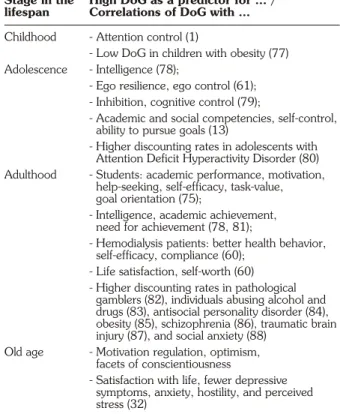
have focused on the effects of DoG in children and ado-lescents, there have been some studies with samples of adults and older people. Table 2 lists their core results.
AGE-RELALL TAA ED DIFFERENCES IN DELALL YAA OF GRARR TAA IFICATAA ION
The ability of patience (e.g., delaying rewards) seems to change across the lifespan. Everyday observations show that people become increasingly patient with age: children are less willing to wait than adults, and even ado-lescents often react impulsively (33).
To our knowledge, the only existing study to have used a DoG measure to compare different age groups is our own (32). The sample was divided into three age groups of betwtt een 60 and 94 years. There waww s a non-sig-nificant trend, the highest DoG being found in the group of those aged 60-69 years, and the lowest in those aged over 80 years. However, there are several studies which used a DD measure.
Comparison ofo delay ofo gratification across the lifeff span
Green et al. (15) conducted the first study comparing children (mean age: 12 yrs), adolescents (20 yrs) and older adults (67 yrs) with regard to DD choices between
Table 2 - EfE fff eff cts ofo delay ofo gratification across the lifeff span.
Stage in the High DoG as a predictor for … / lifeff span Correlations of DoG with …
Childhood - Attention control (1)
- Low DoG in children with obesity (77)
Adolescence - Intelligence (78);
- Ego resilience, ego control (61); - Inhibition, cognitive control (79);
- Academic and social competencies, self-control, ability to pursue goals (13)
- Higher discounting rates in adolescents with Attention Deficit Hyperactivity Disorder (80)
Adulthood - Students: academic performance, motivation,
help-seeking, self-efficacy, task-value, goal orientation (75);
- Intelligence, academic achievement, need for achievement (78, 81);
- Hemodialysis patients: better health behavior, self-efficacy, compliance (60);
- Life satisfaction, self-worth (60) - Higher discounting rates in pathological
gamblers (82), individuals abusing alcohol and drugs (83), antisocial personality disorder (84), obesity (85), schizophrenia (86), traumatic brain
injn ury (87), and social anxiety (88)
Old age - Motivation regulation, optimism,
facets of conscientiousness
- Satisfaction with life, fewer depressive symptoms, anxiety, hostility, and perceived stress (32)
had to choose between a sooner or later illness (DD in bouts of flu; e.g., 1-day flu immediately vs 10-day flu in 1 year). The findings demonstrated that the middle-aged group had the lowest DD rates and that the younger and older indivii ivv duals discountnn ed most in monetaryrr and hol-iday choices. The findings did not support the hypothesis of Rogers (34), but are consistent with a theoryrr of Sozou and Seymour (37) (see next section), according to which DoG increases until middle age, after which it decreases steadily with age.
To sum up, some authors report a curvilinear rela-tionship between DD and age (37, 38), middle-aged adults having the lowest discounting rates (high self-con-trol) and younger and older individuals having higher rates (low self-control). Early in life, DD rates are high be-cause the environment still has to be explored and the fu-ture is uncertrr ain. In later life, the futuu ure again becomes in-secure and riskykk as diverse capacities decline. Relative to Trostel and Tayaa lor (38), the model of Sozou and Seymour (37) hypothesizes a steeper decrease in discounting rates from the age of 40. Both theories are inconsistent with the hypotheses of Rogers (34), who predicts a linear decrease in DD across the lifespan, with no middle-age peak. Taken together, the hypotheses of Trostel and Taylor (38) and of Sozou and Seymour (37) are not in-dependent (33). For instance, the age-related decline in fertrr ilitytt mayaa affect the expectancy of enjn oying the pleasure of delayed rewards in the future.
Time persrr pective and subjb ejj ctive lifi eff -expx ectancy – contribution to evolutionary theories
Green et al. (36) proposed that DoG may become less important as people increasingly see their life expectan-cy as limited. Although the autuu hors compared vavv rious age groups, they did not include measures of subu jb ectivevv life ex-pectancy. As such, they could not analyze this potential-ly important influencing factor. Time-perspective, a fun-damental component in the construction of psychological time, is the result of cognitive processes which divide one individual’s experience into past, present, and future temporal frames (39). Subjb ective life expectancy is the number of years an individual expects to live (40).
Some humans are predominantly present-oriented, others are primarilyll fuff tuu ure-oriented. The former prefer im-mediate gratification and have less impulse control. The latter focus on delayed gratification – they make choices based on the estimated cost/b// enefit ratio of a future pleasure or action. They are also better able to control their impulses (41).
Socio-emotional selectivity theory (42) postulates that individuals focus more on the present and less on the fu-ture when they realize that the rest of their life is limited. Thus, instead of future payoffs, they focus on making the right choices now. This inflffuences both their decisions and their actions, as they payaa more atttt ention to subu jb ectivevv and immediate vs delayed hypothetical monetary rewards.
The results revealed a lifespan developmental trend: the rate of discounting was highest in children (i.e., low self-control) and lowest in older adults (i.e., high self-con-trol). This quantitative age difference in DD may be at-tributu able to children’s lack of experience with long delay, or to their greater impulsivity. The findings support the evolutionary perspective of Rogers (34). However, Read and Read (33) identified some limitations. First, partici-pants came from heterogeneous backgrounds (e.g., un-dergraduate students vs older indivivv duals from a study par-ticipant pool). Second, subsample sizes were quite small (12 partrr icipants per age group). Thirdrr , the researchers did not control for important influencing variables such as gender, socio-economic status, marital status, health status, etc. Most criticallyll , there were no middle-aged par-ticipants.
Harrison, Lau and Williams (35) estimated the DD rates of 268 Danish citizens aged between 19 and 75 years. They found a decline of DD with increasing age. Thus, they confirmed the findings of Green et al. (15). In a further study, Green et al. (36) explored the role of age and income in DD (using the same procedure as in their previous study). They compared three groups: 20 younger adults (upper income group; mean age: 33.3 yrs) and 40 older adults equally divided into upper (70.7 yrs) and lower income groups (70.8 yrs). Although the younger and older upper income groups did not differ in terms of DD, the older lower income group had higher DD rates than either the younger or the older upper in-come groups. Some limitations of this study need to be mentioned: small sample size, unequal distribution of men and women, exclusion of middle-aged individuals and lower income younger adults, and lack of control for influencing factors. Overall, Green at al. (36) could not confirm a systematic decrease in DD from childhood to old age.
Read and Read (33) identified some flaws in the pio-neering study of Green et al. (15) and tried to overcome them in a new study investigating DD across the lifespan. First, their study involved 123 participants between 19 and 89 years: not onlyll a young (mean age: 25 yrs) and an old group (75 yrs), but also a middle-aged group (44 yrs). Gender distribution was also equal in all three groups, and the autuu hors controlled for income and wealth as well as for health status and health-related behavior. Read and Read (33) measured several dimensions of DD: first, participants had to choose between immediate smaller vs lataa er larger hyhh pothetical amounts of money (DD in monetary choices). The monetary rewards were fixed, butuu the time-spans vavv ried (e.g., immediate vs in 1 year; in 7 vs in 10 years). Second, respondents completed a questionnaire by tapping their choices between less hol-iday earlier and more holhol-iday later (DD in holhol-idays; e.g., 1 day in 1 year vs 21 days in 3 years). Third, individuals
intuitive aspects (12). The prioritization of immediate vs delayed rewards thus changes with age. If older adults are unsure whether they will benefit from delayed re-wards in the future, because they feel that time is run-ning out, they may well favor a certain reward in the present. Behavioral economic models support these ideas: older adults seem to take their subjective life ex-pectancy (number of remaining years) into consideration in economic decision processes. Greater rates of delay discounting are reported in older adults because in-creasing age implies a higher risk of not surviving to col-lect a delayed reward (42).
Steinberg et al. (43) focused on age-related differences in future orientation and DD in individuals aged between 10 and 30 years. Future orientation subsumes cognitive, motivational, affective, attitudinal and evaluative con-strurr cts, includuu ing time-perspectivevv and the degree to whww ich individuals think about their future lives or imagine possi-ble future circumstances (44, 45). The authors measured DD with a monetary choice procedure and future orien-tation with a newly developed scale (see Table 1). The re-sults showed that adolescents aged between 10 and 13 years describe a weww akekk r fuff tuu utt re orientnn ataa ion than partrr icipantn s aged 16 and older. First, they more often prefer smaller and sooner to delayed, larger rewards. Second, they de-scribe themselves as less concerned about their future and less likely to anticipate the consequences of deci-sions. Surprisingly, future orientation and not impulsivity (measured with the Barratt Impulsivev ness Scale; see Table 1) significantly mediated the age differences in DD.
CONCLUSIONS Clinical implications
DoG is an importrr ant predictor of vavv rious cognitivevv abil-ities, motivation to change, health behaviors, and well-being. With respect to health behavior, DoG plays a de-cisivii evv role in, for example, the decision to aba stain from ex-cessive sunbathing in order to reduce the risk of con-tracting skikk n cancer in old age, or to engage in regular ex-ercise to keep fit and healthy. DoG may also be essential in maintaining health behavior – a fact which may be ex-ploited by programs promoting health-related behavaa ivv or. In addition, DoG is not onlyll importrr ant in the field of primaryrr prevention. The success of secondary and tertiary pre-vention also depends on self-regulated behavior – for example, in minimizing the negativevv effects of chronic dis-eases such as rheumatism, hypertonia, diabetes, HIV and COPD. In sum, compliant behavior reduces costs for social insurance systems.
Reasons foff r lack ofo delay ofo gratification studies in adulthood and old age
Why have DoG studies to date largely neglected adult-hood and old age? One answer is simply that the original continuous measure of DoG is only suitable for children.
Mischel’s original DoG paradigm (the "marshmallow test", 46) is of limited, if any, value for studies with ado-lescents and adults, because the delay intervals were adapted to children’s experience and perception of time, and thus span onlyll a few minutuu es. In contrast, studuu ies wiww th adults require both meaningful DoG intervals (days or weeks) and meaningful rewards. Assessment of DoG by self-report questionnaires may produce biased results, due to the problem of social desirabilitytt (25). It is only re-cently that an age-appropriate DoG test has been devel-oped by the present authors (32).
Several studies have focused on DD from childhood to old age, most of them using hypothetical monetary choice procedures which have gained broad acceptance in psychological and economic research. Although DoG is a multidimensional construct (47, 48) which may differ from domain to domain, it is still unclear whether low DD rates imply a general preference for delayed rewards. In fact, in a study with the newly developed DoG test, the snacks score proved to be the best indicator of wellbeing, although the various reward tytt pes had low-to-medium in-tercorrelations (32). By the same token, a factor analysis in a study with college student leaders showed that DoG could be divivv ded into dimensions such as achievevv ment ori-entation and career objb ectives (47). Similarly, the concept of academic DoG limits DoG to that contextxx (achievevv ment of academic rewards). Experimenters must also bear in mind that DoG is highly dependent on the situation (e.g., 21). Nevertheless, a general factor of DoG may also make sense, because individuals can potentially exhibit high DoG in many dimensions. For example, one indi-vidual may show high academic DoG and high DoG in health behavior. Moreover, there is little evidence to support the idea of DoG as an ability which is both learned and generalized across situations (8, 49). Sever-al authors have emphasized that the DD task is an indi-cator of actual decisions, as DD rates do not differ be-tween real and hypothetical monetary rewards (50-52).
Another reason for the neglect of DoG studies in adulthood may be that self-regulation can easily be mea-sured with self-reportrr questionnaires such as the Volitional Components Inventory (VCI; 53), Short Self-Regulation Questionnaire (SSRQ; 54), Brief Self-Control Scale (BSCS; 55) or Barratt Impulsiveness Scale (BIS; 56). Executive functions have also been broadly examined in impaired and unimpaired older adults. Diverse measures are applicable, depending on the domain of executive fu
ff nctioning: for example, task swss iww tching (T(( rail Makikk ng Test - Part B; 57) or inhibition of predominant responses (Stroop Color-Word Test; 58).
Does the ability to delay gratification decrease or increase with age?
On one hand, the aba ilitytt to self-ff reguluu ataa e seems to be stss a-ble across the lifespan (25). Some autuu hors havaa e suggested
th
tt ataa DoG likekk wee iww se takekk s shape in childll hood and remains ro-bustss in lataa er lifef (59-61). On the other hand, changes in the abilitytt to delayaa gratification across the lifespan are obvivv ous and observable in everyday life: young children are more impulsive and impatient, whereas adults and older indi-vi
vv duals are more pataa ientnn , betttt er aba le to resistss their impuluu ses, and more wiww lling to waww itii (33). In other woww rdrr s, possibi le long-term consequences weigh more heavily and seriously for adults. Neuropsychological evivv dence supportrr s these ideas: the frontal lobe regions (“cold” system) mature as children grow up, whereas the “hot” system is already fully devel-oped (62). Howevevv r, as older indivivv duals become awaa are of the limited time available to them, they may come to be-have “like there’s no tomorrow” (36). Thus, the variables of time-perspective and subjb ective life expectancy give new impetus to evovv lutuu ionaryrr theories, and mayaa help to ex-plain whww y DoG mayaa decrease in adulthood and old age. In addition, neuropsychological evidence suggests that DoG may decrease in both unimpaired and impaired older ad
aa uluu tlls – for example, in indivii ivv duals wiww tii h dementnn ia, a disease wi
w
w tii h drarr mataa icallyll increasing prevee avv lence rarr taa es (63). Empirirr cal findings point to relations between executive functions, DoG, and frontal functioning (64-66). In normal aging, there is a neural loss in the prefrff ontnn al cortrr ex (67, 68). Neu-ropsyss chological behavaa ivv oral evee ivv dence also describes a decline in executive functions with advancing age (e.g., 69). Indi-viduals with dementia also have significantly more deficits in executive functions than unimpaired controls (e.g., 70). In sumuu , there is a need for vavv lidataa ed DoG measures for application in adults.
Po P
P tential future studies ofo delay ofo gratification First, longitudinal analyses could investigate stabilitytt vs changes in DoG across the lifespan. Second, the possible protective effects of DoG on health, wellbeing and satis-fa
ff ction wiww th life in adultllhood and old age waww rrant more de-tailed investigation. Third, further studies should examine whether DoG helps to protect against cognitive decline. Specifically, high DoG may result in high cognitive and motivavv tional reservrr evv s. Whereas cognitivevv reservrr evv helps the human brain to cope with impairment through activation of pre-existing cognitive resources and compensatory mechanisms (71), motivational reserve refers to motiva-tional aspects of cognitive aging (72). For instance, indi-viduals with high DoG across the lifespan may show higher educational and occupational attainment – two in-dices of cognitive reserve (71). DoG is a behavioral mea-sure of motivational abilities which are discussed as pro-tective factors in emotional and cognitive health (72).
Fourtrr h, the neural subu strata es of DoG are also wortrr h ex-ploring. Structural MRI studies could further examine the relationship between DoG and the frontal lobes. Functional MRI studies could contribute to elucidating activation patterns in decisions for immediate vs delayed rewards.
Lastly, as difficulty in delaying gratification and self-regulating is seen as maladaptivevv , immature and irrational (e.g., 15), implications for practice include the devel-opment of interventions to enhance DoG. Inasmuch as DoG is a crucial ability associated with numerous competencies and qualities, various open questions war-rant investigation here. For example, research could explore the benefits of DoG modifications in different age groups and as a predictor of diverse outcomes across the lifespan.
ACKNOWLEDGEMENTS
This manuscript was funded by the Jacobs Foundation research grant to Reinhard Drobetz, a pre-doctoral fellow of the International Max Planck Research School "The Life Course: Evolutionary and Ontogenetic Dynamics" (LIFE, www.imprs-life.mpg.de).
REFERENCES
1. Mischel W. Processes in delayaa of gratification. In Berkowitz L, Ed. Advances in Experimental Social Psychology. San Diego, CA: Academic Press, 1974: 249-92.
2. Mischel W, Shoda Y, Rodriguez MI. Delay of gratification in children. Science 1989; 244: 933-8.
3. Baumeister RF, Heatherton TF. Self-regulation failure: an overview. Psychol Inq 1996; 7: 1-15.
4. Freund AM, Baltes PB. Life-management strategies of selec-tion, optimizaselec-tion, and compensation: measurement by self-reportrr and construct validity. J Pers Soc Psychol 2002; 82: 642-62. 5. Mazur JE. An adjusting procedure for studying delayed
rein-forcement. In Commons ML, Mazur EJ, Nevin JA, Rachlin HI, Eds. Quantitative Analyses of Behavior: The Effect of Delay and of Intervening Events on Reinforcement Value. Hillsdale, NJ: Erlbaum, 1987: 55-73.
6. Demetriou A. Organization and development of self-under-standing and self-regulation. In Boekaertrr s M, Pintrich PR, Zeidner M, Eds. Handbook of Self-Regulation. San Diego, CA: Academic Press, 2000: 209-51.
7. Bembenutty H, Karabenick SA, Eds. Academic delay of gratifi-cation, future goals, and self-regulated learning. Annual Meeting of the American Educational Research Association. Chicago, IL, 2003.
8. Karniol R, Miller DT. Why not wait? A cognitivevv model of self-im-posed delay termination. J Pers Soc Psychol 1983; 45: 935-42. 9. Green L, Myerson J, Ostaszewski P. Discounting of delayed re-wards across the life span: age differences in individual dis-counting functions. Behav Process 1999; 46: 89-96. 10. Ainslie GW. Specious reward: a behavioral theory of
impulsive-ness and impulse control. Psychol Bull 1975; 82: 463-96. 11. Rachlin H, Green F. Commitment, choice and self-control. J Exp
Anal Behav 1972; 17: 15-22.
12. Reynolds B, de Wit H, Richards JB. Delayaa of gratification and de-lay discounting in rats. Behav Process 2002; 59: 157-68. 13. Mischel W, Shoda Y, Peake PK. The nature of adolescent
com-petencies predicted by preschool delayaa of gratification. J Pers Soc Psychol 1988; 54: 687-96.
14. Reynolds B, Schiffbauer R. Delay of gratification and delay dis-counting: a unifyff ing feedback model of delayaa -related impulsivevv be-havior. Psychol Rec 2005; 55: 439-60.
15. Green L, FrFF yrr A, MyMM erson J. Discounting of delayaa ed rewaww rdrr s: a life-span comparison. Psychol Sci 1994; 5: 33-6.
16. Lezak MD. Neuropsychological assessment. 3rd ed. New York: Oxford University Press, 1995.
17. Hongwanishkul D, Happaney KR, Lee WS, Zelazo PD. Assessment of hot and cool executive function in young children: age-related changes and indivivv dual differences. Dev Neuropsychol 2005; 28: 617-44.
18. Salthouse TATT , Atkinson TM, Berish DE. Executive functioning as a potential mediator of age-related cognitive decline in normal adults. J Exp Psychol Gen 2003; 132: 566-94.
19. Baumeister RF. The self. In Gilbertrr DT, FiFF skekk ST, Lindzey G, Eds. Handbook of Social Psyss chology. 4th ed. New York: McGrawaa -ww Hill, 1998: 680-740.
20. Zelazo PD, Müller U. ExEE ecutuu ivevv fuff nction in tytt pical and atytt pical de-ve
vv lopment. In Goswami U, EdEE . Handbook of Childhood Cognitivevv Development. Oxford: Blackwkk ell, 2002: 445-69.
21. Metcalfe J, Mischel W. A hot/t c// ool-syss stem analyll sis of delayaa of grataa -ification: dynamics of willpower. Psychol Rev 1999; 106: 3-19. 22. Zelazo PD, Qu L, Müller U. Hot and cool aspects of executive function: relations in early development. In Schneider W, Schumann-Hengsteler R, Sodian B, Eds. Young Children's Cognitive Development: Interrelationships among Executive Functioning, Working Memory, Verbal Ability, and Theory of Mind. Mahwah, NJ: Erlbaum, 2005: 71-93.
23. Stuss DT, Benson DF. The frontal lobes. New York: Raven Press, 1986.
24. Silverman IW. Gender differences in delay of gratification: a meta-analysis. Sex Roles 2003; 49: 451-63.
25. Wulfert E, Block JA, Santa Ana E, Rodriguez ML, Colsman M. Delayaa of gratification: impulsivevv choices and problem behava ivv ors in early and late adolescence. J Pers 2002; 70: 533-52. 26. Knolle-Veentjt er S, Huth V, Ferstl R, Aldenhoff JB, Hinze-Selch
D. Delay of gratification and executive performance in individu-als with schizophrenia: putative role for eating behavior and body weight regulation. J Psychiatr Res 2008; 42: 98-105. 27. Madden GJ, Petryrr NM, Badger GJ, Bickekk l WK. Impulsivii evv and self-ff
control choices in opioid-dependent patients and non-drug-using control participants: drug and monetary rewards. Exp Clin Psychopharmacol 1997; 5: 256-62.
28. Chapman GB. Temporal discounting and utility for health and money. J Exp Psychol Learn Mem Cogn 1996; 22: 771-91. 29. Green L, Snyderman M. Choice between rewards differing in
amount and delay: toward a choice model of self control. J Exp Anal Behav 1980; 34: 135-47.
30. Kirbr y KN. Bidding on the futuu ure: evivv dence against normative dis-counuu tnn ittng of delayaa eyy d rerr wee aww rdrr s. J ExEE pxx PsPP yss cyy hol Gen 1997; 126: 54-70. 31. Herrnstein RJ. Rational choice theory - necessary but not
suffi-cient. Am Psychol 1990; 45: 356-67.
32. Forstmeier S, Drobetz R, Maercker A. The Delay of Gratification Test for Adults (DoG-A): Validating a behavioral measure of self-motivation in a sample of older people. Motiv Emotion 2011; 35: 118-34.
33. Read D, Read NL. Time discounting over the lifespan. Organ Behav Hum 2004; 94: 22-32.
34. Rogers AR. EvEE olutuu ion of time preference by natural selection. Am Econ Rev 1994; 84: 460-81.
35. Harrison GW, LaLL u MI, Williams MB. Estimataa ing indivii ivv dual discount rates in Denmark: a field experiment. Am Econ Rev 2002; 92: 1606-17.
36. Green L, Myerson J, Lichtman D, Rosen S, Fryrr A. Temporal dis-counting in choice between delayed rewards: the role of age and income. Psychol Aging 1996; 11: 79-84.
37. Sozou PD, Seymour RM. Augmented discounting: interaction be-tween ageing and time-preference behaviour. Proc R Soc B 2003; 270: 1047-53.
38. Trostel PA, Taylor GA. A theory of time preference. Econ Inq 2001; 39: 379-95.
39. Boyd JN, Zimbardo PG. Time perspective, health, and risk tak-ing. In Strathman A, Joireman J, Eds. Understanding Behavaa ivv or in the Contextxx of Time: Theoryrr , research, and applicataa ion. Mahwaww h, NJ: Lawrence Erlbaum Associates, 2005: 85-107.
40. Ross CE, Mirowsww kykk J. FaFF milyll relataa ionships, social supportrr and subu -jective life expectancy. J Health Soc Behav 2002; 43: 469-89. 41. Zimbardo PG, Boyd JN. Putting time in perspective: a valid, re-liable individual-differences metric. J Pers Soc Psychol 1999; 77: 1271-88.
42. Carstensen LL, Isaacowiw tz DM, Charles ST. Takikk ng time seriouslyll . A theory of socioemotional selectivity. Am Psychol 1999; 54: 165-81.
43. Steinberg L, Graham S, O'Brien L, Woolard J, Cauffman E, Banich M. Age differences in future orientation and delay dis-counting. Child Dev 2009; 80: 28-44.
44. Cauffff man E, Steinberg L. (Im)mataa uritytt of juduu gment in adolescence: why adolescents may be less culpable than adults. Behav Sci Law 2000; 18: 741-60.
45. Greene AL. Future time perspective in adolescence - the present of things future revisited. J Youth Adolesc 1986; 15: 99-113. 46. Goleman D. Emotional Intelligence. New York: Bantam Books,
1995.
47. Ward WE, Perry TB, Woltz J, Doolin E. Delay of gratification among black college student leaders. J Black Psychol 1989; 15: 111-28.
48. Bembenutuu tytt H. Sustaining motivavv tion and academic goals: the in-va
vv luaba le role of academic delayaa of grataa ificataa ion. LeLL arn Indivi ivv d Diffff er 1999; 11: 233-57.
49. Eisenberger R, Adornetttt o M. Generalized self-control of delayaa and effort. J Pers Soc Psychol 1986; 51: 1020-31.
50. Johnson MW, Bickel WK. Within-subject comparison of real and hypothetical money rewards in delay discounting. J Exp Anal Behav 2002; 77: 129-46.
51. Lagorio CH, Madden GJ. Delay discounting of real and hypo-thetical rewards III: Steady-state assessments, forced-choice trials, and all real rewards. Behav Process 2005; 69: 173-87. 52. Madden GJ, Begotka AM, Raiff BR, Kastern LL. Delay
dis-counting of real and hypothetical rewards. Exp Clin Psychopharmacol 2003; 11: 139-45.
53. Kuhl J, Fuhrmann A. Decomposing self-regulation and self-con-trol: the Volitional Components Inventory. In: Heckhausen J, Dweck CS, Eds. Motivation and Self-Regulation across the Life Span. Cambridge: Cambridge University Press, 1998: 15-49. 54. Neal DJ, Carey KB. A follow-ww up psyss chometric analyll sis of the
self-regulation questionnaire. Psychol Addict Behav 2005; 19: 414-22.
55. Tagney JP, Baumeister RF, Boone AL. High self-control predicts good adjd ustment, less pathology, better grades, and interper-sonal success. J Pers 2004; 72: 271-322.
56. Patton JH, Stanford MS, Barratt ES. Factor structure of the Barratt Impulsiveness Scale. J Clin Psychol 1995; 51: 768-74. 57. Reitan R. Validityt of the Trail Making Test as an indication of
or-ganic brain damage. Percept Mot Skills 1958; 8: 271-6. 58. Stroop J. Studies of interference in serial verbal reactions. J
Exp Psychol Gen 1935; 18: 643-62.
-dis-count rates: evidence from Tsimane' Amerindians of the Bolivian rain forest. J Econ Psychol 2002; 23: 291-316.
60. Rosenbaum M, Ben-Ari Smira K. Cognitive and personality fac-tors in the delay of gratification of hemodialysis patients. J Pers Soc Psychol 1986; 51: 357-64.
61. Funder DC, Block J. The role of ego-control, ego-resiliency, and IQ in delay of gratification in adolescence. J Pers Soc Psychol 1989; 57: 1041-50.
62. Altman J, Bayaa er SAS . Migrataa ion and distributuu ion of twtt o populataa ions of hippocampal granule cell precursors during the perinatal and postnatal periods. J Comp Neurol 1990; 301: 365-81. 63. Ferri CP, Prince M, Brayne C, et al. Global prevalence of
de-mentia: a Delphi consensus study. Lancet 2005; 366: 2112-7. 64. Stuss DT, Levine B. Adult clinical neuropsychology: lessons from studies of the frontal lobes. Annu Rev Psychol 2002; 53: 401-33.
65. Spinella M. Neurobehavivv oral correlates of impulsivivv tytt : evivv dence of prefrontal involvement. Int J Neurosci 2004; 114: 95-104. 66. Cheung AM, Mitsis EM, Halperin JM. The relationship of
be-havioral inhibition to executive functions in young adults. J Clin Exp Neuropsychol 2004; 26: 393-404.
67. Zatz LM, Jernigan TL, Ahumada AJ. White matter changes in cerebral computed tomography relating to aging. J Comp Assist Tomogr 1982; 6: 19-23.
68. Ropper, AH, Samuels, MA. Adams and Victor's Principles of Neurology. 9th ed. New York: McGraw-Hill Professional, 2009. 69. Mitttt enberg W, Seidenberg M, O'Learyrr DS, DiGiulio DV. Changes in cerebral functioning associated with normal aging. J Clin Exp Neuropsychol 1989; 11: 918-32.
70. Lafleche G, Albert M. Executive function deficits in early Alzheimer's disease. Neuropsychology 1995; 9: 313-20. 71. Stern Y. Cognitive reservrr e and Alzheimer disease. Alzheimer Dis
Assoc Disord 2006; 20: 112-7.
72. Forstmeier S, Maercker A. Motivational reserve: lifetime moti-va
vv taa ional aba ilities contributuu e to cognitivevv and emotional health in old age. Psychol Aging 2008; 23: 886-99.
73. Ray JJ, Naja man JM. The generalizability of deferment of gratifi-cation. J Soc Psychol 1986; 126: 117-9.
74. Witttt LALL . Person situataa ion effff ects and gender diffff erences in the
pre-diction of social responsibilitytt . J Soc Psys chol 1990; 130: 543-53. 75. Bembenutty H, Karabenick SA. Academic delay of
gratifica-tion. Learn Individ Differ 1998; 10: 329-46.
76. Kirby KN, Petryrr NM, Bickel WK. Heroin addicts have higher dis-count rates for delayed rewards than non-drug-using controls. J Exp Psychol Gen 1999; 128: 78-87.
77. Bonato DP, Boland FJFF . Delay of gratification in obese children. Addict Behav 1983; 8: 71-4.
78. Mischel W, Metzner R. Preference for delayed reward as a func-tion of age, intelligence, and length of delay interval. J Abnorm Soc Psychol 1962; 64: 425-31.
79. Eigsti IM, Zayas V, Mischel W, et al. Predicting cognitive control from preschool to late adolescence and young adulthood. Psychol Sci 2006; 17: 478-86.
80. Scheres A, Lee A, Sumiya M. Temporal reward discounting and ADHD: task and symptom specific effects. J Neural Transm 2008; 115: 221-6.
81. Mischel W. Preference for delayed reinforcement and social re-sponsibility. J Abnorm Soc Psychol 1961; 62: 1-7.
82. Reynolds B. A review of delay-discounting research with hu-mans: relations to drug use and gambling. Behav Pharmacol 2006; 17: 651-67.
83. de WiWW tii H. Impuluu sivii ivv tiiytt asaa a detee ett rmrr inantn ann aa dnn consequqq euu nce of drurr guu usuu e: a review of underlying processes. Addict Biol 2009; 14: 22-31. 84. Petry NM. Discounting of delayed rewards in substance abusers:
relataa ionship to antnn isocial personalitytt disordrr er. Psyss chopharmacologygg 2002; 162: 425-32.
85. Weller RE, Cook EW, Avsar KB, Cox JE. Obese women show greater delay discounting than healthy-weight women. Appetite 2008; 51: 563-9.
86. Heerey EA, Robinson BM, McMahon RP, Gold JM. Delay dis-counting in schizophrenia. Cogn Neuropsychiatry 2007; 12: 213-21.
87. Dixon MR, Jacobs EA, Sanders S, et al. Impulsivity, self-control, and delay discounting in persons with acquired brain injury. Behavioral Interventions 2005; 20: 101-20.
88. Rounds JS, Beck JG, Grant DM. Is the delay discounting paradigm useful in understanding social anxiety? Behav Res Ther 2007; 45: 729-35.