HAL Id: hal-00701606
https://hal.archives-ouvertes.fr/hal-00701606
Submitted on 25 May 2012
HAL is a multi-disciplinary open access
archive for the deposit and dissemination of
sci-entific research documents, whether they are
pub-lished or not. The documents may come from
teaching and research institutions in France or
abroad, or from public or private research centers.
L’archive ouverte pluridisciplinaire HAL, est
destinée au dépôt et à la diffusion de documents
scientifiques de niveau recherche, publiés ou non,
émanant des établissements d’enseignement et de
recherche français ou étrangers, des laboratoires
publics ou privés.
Wordnet creation and extension made simple: A
multilingual lexicon-based approach using wiki resources
Valérie Hanoka, Benoît Sagot
To cite this version:
Valérie Hanoka, Benoît Sagot. Wordnet creation and extension made simple: A multilingual
lexicon-based approach using wiki resources. LREC 2012 : 8th international conference on Language Resources
and Evaluation, May 2012, Istanbul, Turkey. pp.6. �hal-00701606�
Wordnet creation and extension made simple:
A multilingual lexicon-based approach using wiki resources
Valérie Hanoka
1,2, Benoît Sagot
11. Alpage, INRIA Paris-Rocquencourt & Université Paris 7, 175 rue du Chevaleret, 75013 Paris, France 2. Verbatim Analysis, 14 rue Friant, 75014 Paris, France
[email protected], [email protected]
Abstract
In this paper, we propose a simple methodology for building or extending wordnets using easily extractible lexical knowledge from Wiktionary and Wikipedia. This method relies on a large multilingual translation/synonym graph in many languages as well as synset-aligned wordnets. It guesses frequent and polysemous literals that are difficult to find using other methods by looking at back-translations in the graph, showing that the use of a heavily multilingual lexicon can be a way to mitigate the lack of wide coverage bilingual lexicon for wordnet creation or extension. We evaluate our approach on French by applying it for extending WOLF, a freely available French wordnet.
Keywords: WordNet, Word Sense Disambiguation, Wiki resources
1.
Introduction
In recent years, researchers working on languages other than English have tried to compensate for the lack of digital lexical databases such as the Princeton WordNet (PWN) (Fellbaum, 1998). Since manual taxonomy cre-ation is a costly investment, automatic wordnet crecre-ation and extension has become a field of interest. Many methods have been developed for creating or extending wordnets in a growing number of languages. In this paper, follow-ing previous work, we introduce a technique that leverages existing wordnets using multilingual lexical resources ex-tracted from Wiktionaries and the Wikipedia. We apply it for extending the free French wordnet WOLF (Sagot and Fišer, 2008; Sagot and Fišer, 2012).
2.
Related work
The question of multilinguality for bootstraping wordnets arose soon after the release of the PWN (Vossen, 1998) and still is an active research area (Pianta et al., 2002; Tufi¸s et al., 2004a; Diab, 2004; Sagot and Fišer, 2008; de Melo and Weikum, 2009; Navigli and Ponzetto, 2010). Multilingual approaches using the PWN as a reference for the creation of new wordnets in other languages tend to rely on the use of a similar synset inventory. Due to conceptual discrepancies between languages, finding a good translation for a given literal is not always easy.
Following works of Resnik and Yarowsky (1997) and Ide et al. (2002) on multilingual sense disambiguation, Dyvik (1998) proposed to find accurate translations of synsets lit-erals by looking at bilingual parallel corpora. Pianta et al. (2002) used bilingual (back-)translations and contextual in-formation (gloses) in order to ease lexicographers’ work for the Italian MultiWordNet construction. Sagot and Fišer (2008) merged the results of two different approaches for synset filling: translations extracted from parallel corpora in 5 languages and bilingual lexicons extracted from freely available resources.
Beyond traditional wordnet extension/creation, some au-thors proposed to overcome the difficulty of constructing new wordnets for a bunch of languages other than En-glish by using wiki resources: Navigli and Ponzetto (2010) made the link between multilingual encyclopedic knowl-edge from Wikipedia and multilingual wordnet creation us-ing the PWN as a seed wordnet. de Melo and Weikum (2009) used machine learning technique over a multilin-gual knowledge graph (derived from mono- and bi-linmultilin-gual resources) and a set of existing wordnets to build a large scale universal wordnet.
3.
Methodology
Following the precepts of multilingual word sense disam-biguation initiated by Dagan et al. (1991), we defend the idea that using a heavily multilingual lexicon is a way to mitigate the lack of wide coverage bilingual lexicon for wordnet creation or extension.
Our strategy can be sketched as follows. First, we ex-tract a largely multilingual translation and synonym lexical database. Then, using synset-aligned multilingual word-nets, we rank translation candidates in order to favour most plausible candidates for each synset. In this section, we describe these two steps in more details. In the next sec-tions, we report on our experiments for extending the auto-matically developed French wordnet WOLF using this ap-proach, and evaluate the results.
3.1. Building and filtering a large-scale multilingual translation graph
The first step of our methodology consists in extracting a directed translation and synonym graph from a set of Wik-tionaries and Wikipedia articles (using inter-wiki links) in as many languages as possible. The use of directed edges prevents pervasive effects of erroneous translations in the graph. For the sake of the explanation, the resulting graph G will be referred to as the translation graph, synonymy links being treated as ‘translations’ from a language to the
same language. As this method relies on heavy multilin-gualism, translations for languages we did not aim to ex-tract are kept.
For a broad group of languages, developing a simple parser for Wiktionary and Wikipedia dumps is possible. However, due to the collaborative nature of the wiki resources and the lack of a formal meta-syntax, resulting translation/synonym lists are noisy. What is more, depending on the number of languages considered for the extraction, the translation graph G may quickly become very large. It is therefore necessary to filter this list.
The filtering heuristic we used is twofold.
• We remove redundant translation pairs. This step fil-ters true duplicates and translations of various senses of the input word into a same word;
• We remove translations that involve (word, language) pairs that are not present in at least n translations. In our experiments, we found that n = 3 offered a good trade-off between the reliability of translations and the resulting graph’s coverage. This first step filters out pairs that are too isolated to be used by a multilgual approach, and allows for filtering most noise in-troduced by errors in the input resources. After this run, each node in the translation graph necessarily has a minimum degree of 3;
We now have built our highly-multilingual directed trans-lation graph G. Each of its nodes represents a (word/term, language) pair.
3.2. Filling or extending synsets
As our system is designed to fill wordnet synsets using the extension approach, it requires as an input synset-aligned wordnets in m different languages (ideally with m ≥ 3). As a reminder, we shall denote by the term synset the union of all literals present in the synsets of all input wordnets that correspond to a same id. Consistently with this defini-tion, we shall call literal a triplet of the form (word/term, language, weight). For the sake of simplicity, we shall also consider that the nodes of the translation graph G represent a literal, although with a non-specified weight.
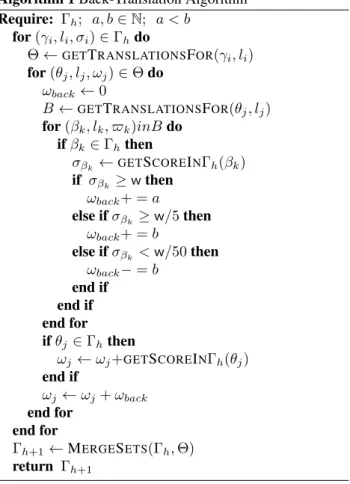
The algorithm for filling synsets we shall now present, and whose structure in pseudo-code is given in Algorithm 1, operates on a per-synset basis. It takes advantage of the directionality of the graph and simply uses the principle of back-translation in order to rank candidates.
The general idea, applied on each synset, is as follows. We start from an initial multilingual set Γ0 filled with the
lit-erals from our input wordnets, our gold litlit-erals associated with a gold weight w = 100. Starting from this set Γ0, we
use the translation graph G to build a set Θ1 of candidate
literals. We then put together the candidate literals from Θ1and the literals in Γ0, thus creating a new multilingual
set Γ1. This Γ1might in turn be the input of the algorithm,
thus creating a new multiligual set Γ2 via a new set Θ2of
candidate literals, and so on.
Now, let us describe our algorithm in a more formalized way. At each step, and for a given synset, we start from an
Algorithm 1 Back-Translation Algorithm Require: Γh; a, b ∈ N; a < b for (γi, li, σi) ∈ Γhdo Θ ←GETTRANSLATIONSFOR(γi, li) for (θj, lj, ωj) ∈ Θ do ωback ← 0 B ←GETTRANSLATIONSFOR(θj, lj) for (βk, lk, $k)inB do if βk ∈ Γhthen σβk ←GETSCOREINΓh(βk) if σβk≥ w then ωback+ = a else if σβk ≥ w/5 then ωback+ = b else if σβk < w/50 then ωback− = b end if end if end for if θj∈ Γhthen ωj ← ωj+GETSCOREINΓh(θj) end if ωj ← ωj+ ωback end for end for Γh+1← MERGESETS(Γh, Θ) return Γh+1
input multilingual set, the set of source literals. These liter-als, of the form (γi, li, σi), are gathered in the input
multi-lingual set Γ. The algorithm uses Γ to query the translation graph G in order to propose a new multilingual set Θ of candidate literalsof the form (θj, lj, ωj). The candidate
literals in Θ are then used to inflate Γ, under certain condi-tions.
In the reminder, we shall not explicit the difference between a node in G and the literal it represents. We defined the language degreeof a vertex γi in the translation graph G
with regard to a language l, noted degl(γi), as the number
of outgoing edges in G incident to γileading to literals in
the language l. For instance, in fig.1, degtr(tableen) = 2
and degid(tableen) = 1.
Figure 1: An illustrative snippet of a node and some of its neighbours in the translation graph
For each γi that belongs to the set S of source literals, we
add in Θ all translations of γiin any language found in our
Figure 2: Log-number of translations from source to target language contained in the translation graph after filtering.
literals θi ∈ Θ is assigned a weight ωi, initialized to the
inverse of degl(γi).
This weight is then updated heuristically according to the quality of its translations. Let B be the set of back-translations of all θi’s, i.e., translations of the θi’s that
be-long to the set S of source literals. For each βi ∈ B with
weight $i:
• if $i≥ w, we add a back-translation bonus a to ωi;
• if $i≥ w5, we add a reduced back-translation bonus b
to ωi;
• if $i < 10w, we subtract the reduced back-translation
bonus b to ωi;
Different bounds and bonus values can be tried. For our experiment, we choose empirically a = 10w and b =50w Once the set Θ of candidate literals is produced, we create a new multilingual set Γ0 by taking the union of the input multilingual set Γ and the content of Θ.
As explained above, this algorithm might be repeated sev-eral times, taking the output multilingual set of one step as the input multilingual set of the next one. In our experi-ments, we executed it twice.
After having applied this algorithm twice on each synset, we enriched all synsets in our input worndets and produced an expanded wordnet in which each (literal, synset) pair has retained its final output weight. This allowed for filtering out new (literal, synset) pairs that have a score lower than a certain threshold.
Before we illustrate this algorithm on an example, we now provide details about our experiments.
4.
Experiments
We extracted translation/synonym pairs from a set of Wik-tionaries in 18 languages (Czech, Dutch, English, French, German, Hebrew, Indonesian, Italian, Japanese, Korean Polish, Portuguese, Romanian, Russian, Slovak, Spanish, Swedish and Turkish) and the French Wikipedia. The first raw extraction step resulted in 9,916,345 translations pairs and 748,385 synonymy pairs. After filtering 1,584,370 (16%) translations pairs and 366,826(49%) synonymy pairs remained. The average degree (both directions) of the translation graph is 3.522.
Figure 2 shows the number of translations pairs before and after filtering for each language.
For our experiment, we used the PWN 2.0 for English, and the BalkaNet wordnets for Czech, Bulgarian and Romanian (Tufi¸s et al., 2004b) which are aligned to the PWN 2.0. However, we did not use the French WOLF, in order to compare our approach to those used for developing this resource. Here is an example of the algorithm applied to synset ENG20-01562015-a {obedient}. Table 1 presents the aligned synset after completion.
For this example, we have Γ = {(inequality, en, 100), (im-paritate, ro, 100), (inegalitate, ro, 100), (HepaBeHcTBo, bg,
100)} for the first run.
Translations for inequality(en) result in 7 candidates lit-erals in 6 different languages (de, it, fr, sv, en, es). Among them, three candidate literals gain the back-translation bonus a: Ungleichung(de), inégalité(fr), olikhet (sv).
No translations were found for imparitate(ro), inegali-tate(ro) andHepaBeHcTBo(bg).
English Romanian Bulgarian French inequality imparitate HepaBeHcTBo
triangle inequality(2.0) inegalitate inégalité (12.0) dissimilarity(1.5) dissemblance (1.0)
inéquation (1.0)
Table 1: Synset ENG20-04543367-n aligned in different languages after completion. Bold words represents gold literals. Candidate literals are followed by their score. Empty column for Czech is omitted here.
The preceding step results in a bigger Γ set whose cardinal is now |Γ| = 11, as 7 candidates literals have been added. For the second run of the algorithm:
Translations for inequality(en) result in updating the scores of the 7 candidate literals added during last run, adding bonus to the same trio as before.
Translations for new item Ungleichheit(de) whose score is 0.8 result in updating scores for 1 literal. Four new candidate literals are added in 4 languages (tr, fr, en, ru), among which one gain the a bonus (e¸sitsizlik(tr)). Translations for new item Ungleichung(de) whose score is 11.0 result in updating scores for 1 literal. Two new candidate literals are added in 2 languages (fr, ru), among which one gain the a bonus (inéquation(fr)). Translations for new item inégalité(fr) whose score is 12.0
result in updating scores for 2 English literals. Translations for new item olikhet(sv) whose score is 12.0
result in updating scores for 1 literal, and add a new candidate literal in Swedish with no bonus.
No translations were found forHepaBeHcTBo(bg) and the
other 5 candidate literals added during the first run. The final result, as showed in table 1, managed to guess re-lated candidate literals for French and English. The most accurate French candidate (inégalité) receive by far the best score among other French candidates (inéquation, dissem-blance). Concerning the English candidates, poor scores show that they did not gain any bonus during the process, and should probably not be accepted in the synset.
5.
Results and evaluation
Retaining only candidates with a score greater than 30, we created 10, 568 (literal, synset) candidates, among which as many as 6, 119 (58%) are not included in the WOLF. Ta-ble 2 show a random sample of these (literal, synset) can-didates, associated with PWN literals and definition for the synset, the score of the candidate, our manual evaluation (YES if it is correct, NO otherwise), as well as information about whether this candidates was already included in the WOLF (YES if it was in the WOLF, NO otherwise). For evaluating our approach, we put together all (literal, synset) pairs we produced as well as all WOLF (literal, synset) pairs for synsets for which we generated at least one candidate. We performed a manual evaluation of 400 of these (literal, synset) pairs by assigning a boolean score (correct/incorrect) to all such pairs for a random sample of the synsets.
We evaluated our approach according to two parameters. The first one, t, is a threshold on the score associated by our approach to each candidate: setting the threshold at 30 retains all candidates, whereas setting it at a higher value discards all candidates with a lower score. The second pa-rameter nmax is an upper bound on the number of
candi-dates retained for each synset: if this parameter is set to 3, the candidates for a given synset are sorted by decreasing score, and at most the first 3 candidates are retained (less than 3 if scores fall below t).
For each value of t and each value of nmaxwe evaluate:
• the precision of our candidates, the ratio of correct candidates w.r.t. the total number of candidates; if we retain all 10, 568 candidates (i.e., t = 30 and nmax =
∞), the precision is 74.1%;
• an estimation of the number of correct candidates we obtain, computed as the total number of candidates times the precision figure; again, if we retain all can-didates, we can thus expect around 10, 568 × 0.741 = 6, 465 candidates; among them, 6, 119 are not in the WOLF, and their precision is 65%; this shown that not only our approach generated candidates not generated by previous approaches, but these candidates have a high precision as well; still, using more strict parame-ters can improve this precision figure (see below); • an approximate “recall”, measured w.r.t. these 6, 465
correct candidates that are kept if we retain them all (i.e., with t = 30 and nmax= ∞);
• an approximate “f-score” based on the precision and “recall” figures.
Table 3 shows the precision figures and associated number of candidates that we obtain with different sets of parame-ter values. The outcome of these evaluations can be sum-marized as follows. First, as expected, increasing nmaxor
t decreases the number of candidates but increases the pre-cision. For nmax = 1 and t = 50, the precision reaches
86% over 3, 353 candidates. Among them, 1, 601 candi-dates are not present in the WOLF, and the precision on these candidates is as high as 82%. On candidates already in the WOLF, the precision is over 89%, vs. 87% on all (lit-eral, synset) pairs from the WOLF. However, such parame-ter values are quite restrictive. Based on the “f-score” fig-ures, the optimal parameter values are (t = 30, nmax= 3)
With such values, we retain 10, 403 candidates (almost all of them) with a 74, 8% precision (slightly but significantly higher than with nmax = ∞. A manual validation of all
these candidates would add around 7, 781 correct candi-dates in the WOLF.
French Synset id Score PWN literals PWN definition Correct Already
literal in the synset (man. eval.) inWOLF
harmonie 06738523-n 54.7 harmony, concord, agreement of opinions YES NO concordance
ivre 00879266-a 100.0 intoxicated, drunk as if under the influence of alcohol YES NO alphabet 06096415-n 39.6 alphabet a character set that includes letters YES NO
and is used to write a language
ensemble 00515754-b 66.3 together in each other’s company YES NO jeunesse 10099908-n 47.0 young person, youth a young person (especially a NO YES
younker, spring chicken young man or boy)
tête 08134688-n 100.0 head the top of something YES YES salamandre 03825556-n 35.6 poker, stove poker, fire fire iron consisting of a metal rod NO NO
hook, salamander with a handle; used to stir a fire
périlleux 01991204-a 40.6 hazardous, risky, involving risk or danger YES YES venturesome, venturous
accord 06733497-n 34.7 agreement the verbal act of agreeing YES YES électricité 07054143-n 71.8 electricity keen and shared excitement NO YES
Table 2: Examples of (literal, synset) candidates produced by our algorithm
t = 30 t = 40 t = 50 t = 60 nmax= 1 8362/77.3 5340/81.5 3353/85.6 2245/90.5
nmax= 3 10403/74.8 6298/80.6 3890/85.1 2582/89.6
nmax= ∞ 10568/74.1 6357/80.3 3917/85.2 2594/89.6
Table 3: Number of (literal, synset) candidates retained when using different values for the thresholds t and nmax, with the
corresdonding precision measure.
As can be seen on Table 3, precision figures consistently correlate with t and with nmax, which shows the relevance
of the score computed by our algorithm. As a consequence, higher t values associated with nmax = 1 lead to higher
precision figures. For example, parameter values (t = 60, nmax = 1) lead to as high a precision as 90, 5%, still
retaining 2, 245 candidates among which around 2, 031% correct ones.
Chosing (t = 30, nmax = 3) as parameters, we performed
a manual examination of correct generated candidates that are not in the WOLF. In almost all cases, these candidates correspond to high or medium frequency words that are polysemic, sometimes highly polysemic. In other words, these candidates correspond to the most useful informa-tion in any wordnet-based applicainforma-tion, but also to cases for which previous approaches used for developing the WOLF performed the least satisfyingly: the alignment-based ap-proach used for disambiguating polysemous words (Sagot and Fišer, 2008) was highly corpus-dependant and could not cover well medium frequency words; the lexicon-based approach was first restricted to monosemous words (Sagot and Fišer, 2008), and later efforts towards its use on pol-ysemous words (Sagot and Fišer, 2012) did not perform well on highly polysemous words. Examples of literals not present at all in WOLF but covered by our candidates in-clude as basic and frequent words as manger ‘eat’, taper ‘hit’, lent ‘slow’, faim ‘hunger’ or dehors outside’.
6.
Conclusion and perspectives
The method presented in this paper consists in extending/-bootstraping synset-aligned wordnets simply by looking at back-translations found in a large multilingual translation graph extracted from a set of wiki resources in as many
languages as possible. It is well suited for creating or en-riching WordNets for languages that have at their disposal large or medium coverage Wiktionary and Wikipedia. An interesting point would be to determine if, for languages with smaller wiktionary and/or wikipedia, the use of larger wiktionaries for other languages and/or the improvement of translation graph can prove to be sufficient for a good quality extension. We plan to improve current results by upgrading the translation graph’s quality as in Mausam et al. (2009) and computing scores for candidate literals by doing a march in the translation graph.
7.
References
Ido Dagan, Alon Itai, and Ulrike Schwall. 1991. Two lan-guages are more informative than one. In in Proceedings of the Annual Meeting of the Association for Computa-tional Linguistics (ACL), pages 130–137.
Gerard de Melo and Gerhard Weikum. 2009. Towards a universal wordnet by learning from combined evidence. In Proceedings of the 18th ACM conference on Informa-tion and knowledge management, CIKM ’09, pages 513– 522, New York, NY, USA. ACM.
Mona T. Diab. 2004. The feasibility of bootstrapping an arabic wordnet leveraging parallel corpora and and an english wordnet. In Proceedings of the Arabic Language Technologies and Resources, Cairo.
Helge Dyvik. 1998. Translations as semantic mirrors: from parallel corpus to wordnet. In Proceedings of the Workshop Multilinguality in the lexicon II at the 13th biennial European Conference on Artificial Intelligence (ECAI’98), pages 24–44, Brighton, UK.
Elec-tronic Lexical Database. MIT Press, Cambridge, Mas-sachusetts.
Nancy Ide, Tomaž Erjavec, and Dan Tufi¸s. 2002. Sense discrimination with parallel corpora. In Proceedings of the ACL-02 workshop on Word sense disambiguation: recent successes and future directions - Volume 8, WSD ’02, pages 61–66, Stroudsburg, PA, USA. Association for Computational Linguistics.
Mausam, Stephen Soderland, Oren Etzioni, Daniel S. Weld, Michael Skinner, and Jeff Bilmes. 2009. Compiling a massive, multilingual dictionary via probabilistic infer-ence. In Proceedings of the Joint Conference of the 47th Annual Meeting of the ACL and the 4th International Joint Conference on Natural Language Processing of the AFNLP: Volume 1 - Volume 1, ACL ’09, pages 262–270, Stroudsburg, PA, USA. Association for Computational Linguistics.
Roberto Navigli and Simone Paolo Ponzetto. 2010. Babel-Net: Building a Very Large Multilingual Semantic Net-work. In Proceedings of the 48th Annual Meeting of the Association for Computational Linguistics, pages 216– 225, Uppsala, Sweden.
Emanuele Pianta, Luisa Bentivogli, and Christian Girardi. 2002. Multiwordnet: developing an aligned multilingual database. In Proceedings of the First International Con-ference on Global WordNet.
Philip Resnik and David Yarowsky. 1997. A perspective on word sense disambiguation methods and their evaluation. In Proceedings of the SIGLEX Workshop.
Benoît Sagot and Darja Fišer. 2008. Building a free french wordnet from multilingual resources. In Ontolex 2008, Marrakech, Morocco.
Benoît Sagot and Darja Fišer. 2012. Automatic extension of WOLF. In Proceedings of the 6th Global WordNet Conference, Matsue, Japan.
D. Tufi¸s, D. Cristea, and S. Stamou. 2004a. Balka-net: Aims, methods, results and perspectives. a general overview. In: D. Tufi¸s (ed): Special Issue on BalkaNet. Romanian Journal on Science and Technology of Infor-mation, pages 3–4.
Dan Tufi¸s, Dan Cristea, and Sofia Stamou. 2004b. Balka-Net: Aims, Methods, Results and Perspectives. A Gen-eral Overview. In Romanian Journal on Information Sci-ence and Technology. Special Issue on BalkaNet, vol-ume 7, pages 9–34.
Piek Vossen, editor. 1998. EuroWordNet: a multilingual database with lexical semantic networks. Kluwer Aca-demic Publishers, Norwell, MA, USA.