Democratization and the Development of Japan's Uneven Welfare State
by
Yumiko T. Shimabukuro B.A., Lewis and Clark College (2000)
M.I.A., Columbia University (2003)
IN( nffT
Submitted to the Department of Political Science in Partial Fulfillment of the Requirements for the Degree of
Doctor of Philosophy at the
MASSACHUSETTS INSTITUTE OF TECHNOLOGY
September 2012
0 2012 Yumiko T. Shimabukuro. All rights reserved.
The author hereby grants to MIT permission to reproduce and to distribute publicly paper and electronic copies of this thesis document in whole or in part in any medium now
known or hereafter created.
Signature of Author....
/I
.. .. ...
Department of Political Science July 30, 2012 C ertified by ... .... ...
Richard J. Samuels Ford International Professor of Political Science Thesis Supervisor A ccepted by ... ...
Roger Petersen Arthur and Ruth Sloan Professor of Political Science Chair of the Graduate Program Committee
Democratization and the Development of Japan's Uneven Welfare State
by
Yumiko T. Shimabukuro
Submitted to the Department of Political Science on July 31, 2012 in Partial Fulfillment of the Requirements for the Degree of Doctor of Philosophy
ABSTRACT
Comparative data reveal that Japan consistently has had one of the highest poverty rates among advanced industrialized nations, yet its government taxes the poor more heavily and gives them less in public cash transfers than its peers. Why does a country, endowed with democratic institutions, deep pockets, and a sizable social welfare system provide so little public assistance to the poor? I identify two features of Japan's political and economic development that gave rise to a distinctively threadbare safety net. First, the country's late-developer status paired with state-led industrial development incentivized the primary interest groups-namely, the agrarian landlords, industrialists, and organized labor-to oppose redistribution. Second, the manner in which democratic institutions were introduced in the late nineteenth century and the subsequent expansion of suffrage enabled these groups to gain political influence and block expansion of poor relief in the Diet. Beyond formulating redistributive policies, they locked in the minimalist pattern of redistribution by denying the poor the right to vote (pre-1945) and adopting an electoral system that muted their political voice after suffrage was obtained (post-1945). Consequently, Japan's welfare state developed unevenly, featuring a heavy layer of social insurance programs that benefit well-organized interest groups and an exceptionally minimalist public assistance program for the poor. Thus, contrary to extant theories that associate democracy, economic modernization, and a robust labor movement with higher social spending for the poor, I show that these factors stifled redistribution in the case of Japan. My findings strongly suggest that how a country built its democracy and wealth influences whether a welfare state reinforces or ameliorates existing inequality.
Thesis Supervisor: Richard J. Samuels
Table of Contents
Page Acknowledgements
Part I. The puzzle, literature review, and theory
Introduction
Chapter 1 Nickel and diming Japanese style: an overview of the data and literature review
Chapter 2 A conceptual framework of how safety nets evolve
5
7
34
99
Part II. The politics of exclusion
Chapter 3 A break with the past: From feudal poor relief to a modern public
assistance system
129
Chapter 4 Confronting democracy and poverty: the rise of agrarian landlords and the fall of Meiji oligarchs
152
Chapter 5 Partial democratization for the age of industry: the rise of industrialists and the path of retrenchment
194
Chapter 6 Building an exclusionary democracy and a welfare state without a safety net: the failed alliance between labor and poor
250
Conclusion
References
309 320
Acknowledgements
I accumulated debts of gratitude to individuals and organizations in completing this
dissertation. The chair of my dissertation, Richard "Dick" Samuels, went the extra mile to help me kick off the project. He orchestrated numerous brainstorming sessions, patiently showed me step-by-step how to write a dissertation, and responded to my seemingly endless questions with patience and candor. The writing stage in particular was a lonely process but Dick was always there to assist me and he did so in countless ways. I extend my deepest gratitude to him for being a dedicated teacher and a wonderful scholar.
Equally important in the development of my dissertation were my other committee members, Andrea Campbell and David Singer. Andrea provided excellent critiques and theoretical insights that challenged me to modify and improve my analysis. David offered thoughtful feedback and he took the time to nurture rather than extinguish my ideas. I am indebted to both for giving me the tools necessary to revise the dissertation.
Special thanks go to my longtime mentor, Gerald Curtis, for his enduring support. I could not have entered the academic world without his validation and am profoundly grateful for his sage advice on my dissertation. I am also indebted to Sheldon Garon for reading earlier drafts of my dissertation and offering me penetrating critiques. I have managed to address some and plan to tackle the others in the future.
Over the years, I have benefited tremendously from Harvard's vibrant academic
community. I am very grateful to the hosts and participants of the Japan study workshop at the Program on U.S.-Japan Relations for giving me the opportunity to present my work. Susan Pharr, Shinju Fujihira, Amy Catalinac, and Ken Haig and the dozen
participants challenged me to rethink some of my conclusions and made a positive impact on the project. Presenting my work at the History, Institutions, and Politics Workshop led by Kathleen Thelen, Peter Hall, and Daniel Ziblatt gave me invaluable insights and the discussants, James Conran, and Alexander Hertel-Fernandez, were terrific. My
fascination with the social welfare literature began with the teachings of Torben Iversen and I learned a great deal from conversations with him.
I am delighted to acknowledge the institutional support I received for my various
research activities: The Social Science Research Council, the Center for International Studies at MIT, the Institute for Humane Studies at George Mason University, and the Center for Global Partnership. I want to express my sincere gratitude to the support staff at MIT, Susan Twarog and Diana Gallagher, who guided me through the process of completing the dissertation.
On a personal note, a round of thanks is in order for my triad of families-- Shimabukuro, Takebayashi, and Lukauskas-for keeping my spirits high in hard times. In particular, my parents, Kunio and Keiko, made a critical decision when I was fifteen to switch from a Japanese to an American school; a decision, though difficult for me to swallow at the time, which ended up profoundly changing my life. My siblings, Hiroe and Kimiyoshi, have a special place in my heart and I always look forward to our reunions-I am
counting the days. Lastly, I want to thank my husband, Arvid, for the wonderful life that we share. He catches me when I fall (my safety net!) and always finds a way to make my life complete. I am grateful for all that he is and am looking forward to spending the next and every chapter of my life with him.
Part I. The puzzle, literature review, and theory
INTRODUCTION
Just as one should not judge a book by its cover, one should not judge a country
by its general profile. Japan is often presented as a successful example of a democratic
transition and one of the most prosperous countries in the world.' It is the only Asian country considered to be a "welfare state," a label that only a handful of countries that substantially commit their resources to care for the economic wellbeing of its citizens possess.2 One might expect, judging solely from its general attributes, that it dispenses generous assistance to the poor.
This would be a reasonable supposition, given that generations of scholars have contended that democratic institutions are better equipped to care for the poor and have shown empirically that democracies are correlated with higher social spending than non-democracies.3 Most of the explanations center on the electoral process, the ensuing
' The most recent work that examines Japan's democratic transition is Mary Alice Haddad, Building Democracy in Japan (New York, NY: Cambridge University Press, 2012).
2 Countries that are committed to spending a sizable portion of their government expenditures for social
welfare programs are often referred to as the "welfare state" or "welfare regime." See Gosta Esping-Andersen, The Three Worlds of Welfare Capitalism (Princeton, NJ: Princeton University Press, 1990). 3 See for example, Robert R. Kaufman and Alex Segura-Ubiergo, "Globalization, Domestic Politics, and Social Spending in Latin America," World Politics 53 no. 4 (2001): 553-87; David Stasavage, "Democracy and Education Spending in Africa," American Journal of Political Science 49 no. 2 (April 2005): 343-358; David Brown and Wendy Hunter, "Democracy and Social Spending in Latin America," American Political
competition and political participation inherent in democratic governance: democracy makes leaders address welfare concerns in order to appeal to broad constituencies and obtain a large "winning coalition" (Bueno de Mesquita et al., 2002 and 2003); democracy forces leaders to respond to public welfare issues because voters can penalize them if social-economic conditions deteriorate (Sen, 1981, 1999); democracy makes the median voter the decisive player in government spending decisions and, faced with inequality, the median voter with below-average income will use the ballot box to push for greater redistribution (Meltzer and Richard, 1981).4 Accordingly, one would expect Japanese democratic institutions to facilitate substantial government transfers to the poor.
Japan's status as one of the richest countries in the world would also make us believe that it shows largess to the poor. Simply put, it can afford to lift individuals out of poverty. Studies that link economic modernization and the expansion of social welfare programs inform us that industrialization creates both the demand for and supply of social policies. Proponents of this view argue that the productive forces that improve people's lives can also generate "an avalanche of social dislocation" that increases the demand for states to provide citizens with social protection.5 Simultaneously, economic
Science Review 93 no. 4 (1999): 779-790. For an insightful literature review and assessment of whether democracy helps or hurts the poor, see Michael Ross, "Is Democracy Good for the Poor?" American Journal of Political Science 50 no. 4 (October, 2006): 860-874.
4 Bruce Bueno de Mesquita et al., "Political Institutions, Policy Choice and the Survival of Leaders,"
British Journal of Political Science 32 no. 4 (2002): 559-590; The Logic of Political Survival (Baltimore: MIT Press, 2003); Amartya Sen, Poverty and Famines: An Essay on Entitlement and Deprivation (New York, NY: Oxford University Press, 1981); Development as Freedom (New York, NY: Alfred A. Knopf,
1999); Allan H. Meltzer and Scott F. Richard, "A Rational Theory of the Size of Government," Journal of
Political Economy 89 no. 5 (October 1981): 914-927. Other scholars argue that democracy improves welfare of citizens because it secures political stability, labor rights, higher wages, freedom of speech, and the rule of law. See for example, Dani Rodrik, "Democracies Pay Higher Wages," The Quarterly Journal
of Economics 114 no. 3 (August 1999): 707-737; David Lake and Matthew Baum, "The Invisible Hand of Democracy: Political Control and the Provision of Public Services," Comparative Political Studies 34 no. 6 (2001): 587-621.
5 Karl Polanyi, The Great Transformation: The Political and Economic Origins of Our Time (Boston, MA:
modernization increases the state's revenue and administrative capacities needed to develop and maintain expensive social welfare programs.6 Given Japan's remarkable economic achievements over the last century and the ample financial and organizational resources that the government has accumulated over time, one would imagine that it provides care for the needy.
Moreover, Japan has a well developed social welfare system that offers a variety of social protection schemes to protect citizens from unforeseeable risks and unavoidable events that could lead to income losses.7 As Gregory Kasza has shown, the Japanese welfare state is "no more unique than the other advanced welfare states but sits
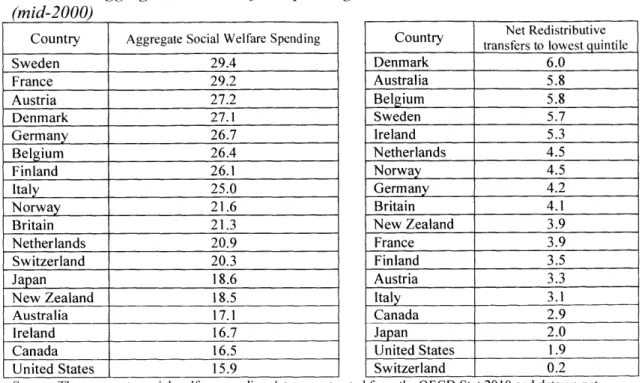
comfortably within the general parameters of the species."8 The most recent data reveal that Japan spends nearly twenty percent of its GDP on social welfare programs.9 One might presume that a sizable portion of social spending is used to provide adequate social services for the poor.
Although the Japanese poor have seemingly hit the redistribution trifecta by residing in a rich, democratic welfare state, the government has defied the odds by
choosing to maintain an exceptionally minimalist relief arrangement for the poor. Comparatively, the Japanese government has taxed the poor at a higher rate while delivering fewer transfers than other countries. On the one hand, the poorest of the
6 Harold Wilensky and Charles N. Lebeaux, Industrial Society and Social We/fare (New York: Russell
Sage Foundation, 1958); Clark Kerr, et al., Industrialism and Industrial Man (Cambridge, MA: Harvard University Press, 1960).
7 The content of Japanese "welfare state" is also analyzed in the work of John Creighton Campbell, How Policies Change: The Japanese Government and the Aging Society (Princeton, NY: Princeton University Press, 1992); Margarita Estevez-Abe, Welfare and Capitalism in Postwar Japan (Cambridge, MA: Cambridge University Press, 2008).
8 Gregory J. Kasza, One World of Welfare: Japan in Comparative Perspective (Ithaca: Cornell University Press, 2006), 140.
9 According to the OECD, Japan spent 18.7% of GDP on social welfare in 2007 and this figure is estimated to have increased since then.
population in Japan contributes more taxes and social security payments than other countries: the share of the taxes and social security contributions paid by the lowest quintile in Japan is around 6%, twice if not three times higher than in other countries: Germany (2.1), Finland (4.0), Canada (2.3), United States (1.6), and Britain (1.7). On the other hand, the lowest income quintile in Japan received only 15.9% of all public cash transfers, compared to other countries such as Germany (17.4), Finland (32.9), Canada
(25.7), United States (24.8) and Britain (31.4)."
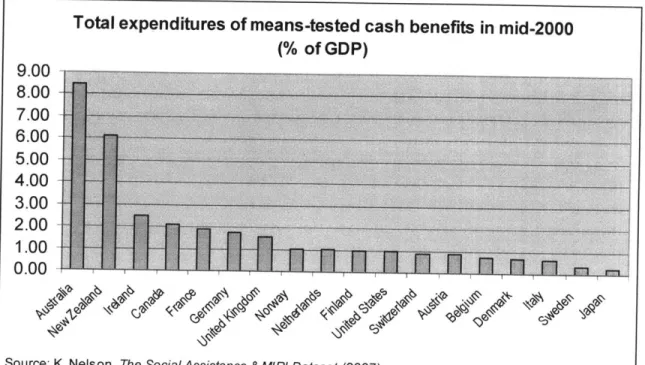
Whereas most affluent democracies spend over 2.0% of GDP for public assistance programs for the poor, Japan spends merely 0.2%." Its access rate to public assistance also confirms the ultra-minimalist approach to poverty. Only 0.3% of working age-population receives public assistance in Japan, in contrast to its peers that generally serve over 3.0% of the population. Furthermore, it is estimated that only 10-20% of the eligible poor actually receive assistance in Japan, compared to the take-up rate for social
assistance in other OECD countries that ranges from 40%-80%.12
Its meager spending and restrictive access to public assistance belie the fact that the incidence of poverty has been high comparatively and historically. Available data suggest that absolute poverty was widespread during the pre-1945 period-at times even reaching around fifty percent-although it has improved since 1945, the post-tax and transfer relative poverty rate has remained around ten to fourteen percent, a range that is
10
OECD, Growing Unequal? Income Distribution and Poverty in OECD Countries (Paris: OECD
Publishing, 2008), 116.
" I explore the state of poverty and redistribution more fully in chapter one, which also contains the relevant references. For an overview of social assistance in OECD countries that contains valuable information such as programmatic descriptions and relevant data on access rate and spending, see Ian Gough et al., "Social Assistance in OECD Countries," Journal of European Social Policy 7 no. 1 (1997):
17-43.
12 The average take-up rates in OECD countries is from Virginia Hernanz, Frank Malherbet, and Michele
Pellizzari, "Take-up of Welfare Benefits in OECD Countries: A Review of the Evidence," OECD Social, Employment and Migration Working Papers (2004): 11-12. See chapter one for a full list of data sources.
higher than most advanced industrialized countries.13 Despite the remarkable political, economic, and social progress that the country has made, the Japanese safety net for the poor-literally, a lifeline for the destitute-is so threadbare that at least one person dies of starvation every week and nearly a dozen people commit suicide daily due to
economic hardship. 4 Why does a country, endowed with democratic institutions, deep
pockets, and a sizable social welfare system provide so little to the poor?
Argument in brief
The central contention of my dissertation is that when and how a country pursued industrialization and democratization mattered deeply in the development of a safety net for the poor. Ironically, what made Japan stand out-being the first non-western country to industrialize and introduce democratic institutions at the turn of the century-gave rise to a distinctively threadbare safety net for the poor. At critical moments in the nation building process, the country's effort to catch up to the West in the realm of political and economic development impeded it from converging in the realm of social assistance.
In order to illuminate the causal factors and temporal dynamics at work, I present an analytical framework that shows how a particular pattern of democratization and industrialization can interact to hinder the development of a robust safety net over time. I utilize Japan's "deviant" or "outlier" outcome, which has not been fully explained by existing models, to identify a new causal path.'5 The model presented here, therefore, primarily functions as a heuristic device to identify new variables and processes that are
13 Today, Japan's relative poverty rate is around sixteen percent.
14 See the appendix in chapter one for historical data on suicide and starvation deaths.
15 For an extended discussion on heuristic theory building, see Alexander L. George and Andrew Bennett,
important-such as the role of electoral safeguards and the nature of industrialization--but have been overlooked or downplayed in the comparative literature on redistriindustrialization--bution. Moreover, by pinpointing the key similarities and distinctions between Japan and other countries, my intention is to make the Japan story more accessible and ripe for a comprehensive comparison in future studies.
My principal theoretical claim is that when and how a country built its democracy
and wealth matters in who gets what from government. Two issues determine the course of redistribution: who has a say in the policymaking process and what are their economic incentive to aid the poor. I argue that the process of democratization defines who has political influence while the economic incentives to aid the poor are structured by the process of industrialization. As major social groups (e.g., agrarian landlords,
industrialists, and working class) vie for greater economic gains and political representation they choose the pattern of the safety net that best suits their broader strategic economic interests.
The dominant interest groups that gain political representation (e.g., agrarian landholders, industrialists, and organized labor), I argue, formulate not just redistributive policies in the short-run but also the overarching electoral institutions that frame the context in which redistribution is contested over time. In the course of shaping and reshaping the electoral terrain, they determine whether to include or exclude the poor from the policymaking process itself. When key social groups have little incentive to help the poor, they are more likely to exclude them from the policymaking process. They do so by instituting stringent voting rules that continue disenfranchising the poor or by adopting an electoral system that mutes the poor's political voice even after they are
granted suffrage. In other words, when major political groups oppose redistribution, they are more likely to create an exclusionary democracy that negates the "one person, one vote" principle in order to shut out the poor from the politics of public expenditures. Thus, cross-country variation in the level of poverty relief today is partly attributable to a particular institutional choice made during democratization, which in turn is based on the very question of how much to give to the poor in the form of relief, votes, or voice. The
political structure ultimately reflects the redistributive preferences of the holders of power and this ensures that the pattern of redistribution is locked in for the long run.
Process-tracing the origins of Japanese democracy, capitalism, and the safety net helps us identify the two key elements of democratic reforms that determine who gets to make redistributive choices: the varying effectiveness of electoral safeguards (e.g., constitutional provisions that limit the power of the elected assembly) and "carriers of democratization" (the agents that successfully advance democratic reforms). While the redistributive interests of key social groups (e.g., agrarian landlords, industrialists, and working class) are mainly shaped by the varying tempo and nature of industrial
development.
In Japan, two patterns of political and economic development-first, its late developer status paired with state-led industrial development and, second, the elite-driven process of democratization combined with ineffective electoral safeguards--led the government to choose a minimalist course of redistribution. The next section provides a summary of how the development of democracy, capitalism, and social welfare policy in Japan intersected to produce a particular pattern of the safety net for the poor.
The Case of Japan: An Overview
Two centuries ago, Japan was a poor, authoritarian country with a fairly robust safety net for the poor. Its quest to build democracy and wealth, however, led to a dramatic reduction in the level of poor relief in the short run and, in the long run, stifled its growth, even though the country continued making enormous progress in political, economic and social affairs. The country's late developmental state-led industrial capitalism structured the incentives of the main social groups (e.g., agrarian landlords, industrialists, and organized labor) in ways that hurt the prospects of building a safety net. At the same time, the political influence of these groups was amplified because the traditional holders of power introduced democratic institutions with ineffective electoral safeguards and failed to curb the power of the elected assembly.
As a result, the gradual transition towards democratization hampered the development of a robust safety net as expanding suffrage to key groups-agrarian
landholders in 1890, industrialists in 1900, and organized labor in 1925-each in turn voiced opposition to expand poor relief in order to pursue their narrow economic interests. Moreover, these groups eventually agreed to institute an electoral system that enhanced the political representation of organized economic interests at the expense of the unorganized; this shut out the poor from redistributive politics even after universal suffrage was adopted in 1945. My four empirical chapters capture how the interplay between democratization and industrialization restricted the flow of redistribution over time. Below, I recount the key findings and point out the main historical turning points.
Prior to the birth of a nation-state (Tokugawa regime 1603-1868), feudal lords engaged in despotic redistribution by employing poor relief as a means of extraction.'6
The economy was largely agrarian and labor mobility was restricted; this enabled each feudal lord to administer relief with the objective of maximizing his returns from poor laborers. In essence, rulers provided relief to the poor-whose labor represented an indispensable source of tax revenue-to increase productivity and discourage rebellion. Each feudal lord was responsible for the wellbeing of the poor who belonged to him and resided in his territories.
In the 1850s, Western powers forced Japan to end its isolationist foreign and commercial policies, which triggered an intricate domestic political struggle that eventually led to the collapse of the Tokugawa regime. The new leaders, the Meiji oligarchs, abolished a host of feudal practices and institutions as a part of the grand mission to build a modern nation state. Dismantling the feudal system entailed a number of significant changes, such as land reform, local administrative changes, and
liberalization of the labor market. In particular, increased labor mobility vitiated the logic of despotic redistribution since the poor no longer belonged to any one person or community. The need to socially protect citizens became visible as the wholesale
changes, especially the opening of Japan's near-autarkic domestic market, entailed large-scale dislocation and transitional hardships for many ordinary Japanese.
16 A number of economists conceptualize redistribution as an instrument of extraction. See Dan Usher and Merwan Engineer, "The Distribution of Income in a Despotic Society," Public Choice 54 no. 3 (1987): 261-276; Herschel Grossman and Suk Jae Noh, "Proprietary Public Finance and Economic Welfare,"
Journal of Public Economics 53 no. 1 (1994): 187-204; Martin McGuire and Mancur Olson, "The
Economics of Autocracy and Majority Rule: The Invisible Hand and the Use of Force," Journal of
Under such circumstances, the Meiji oligarchs scrambled to create the country's first nation-wide public assistance system, the so-called 1874 Relief Regulations (Jukkyii
Kisoku). The Relief Regulations, however, virtually served no one as the Meiji
government reserved scarce government resources for the sole purpose of promoting national industrial development. Japan's aspirations were to become rich-as quickly as possible-but this was a daunting task given that it was a latecomer that needed to catch-up to the more advanced economies in the West with poor factor endowments: scarce land and capital but abundant in labor. As Rodrik (2012) notes, during the "first wave of globalization," (1870-1914) all of the poor countries in the periphery were dictated by the constraints imposed by geography and factor endowment.'7 Japan was truly an exception
in that it carved out a new path of industrial growth that defied the notion of comparative advantage. The Meiji oligarchs drafted the world's first "development plan," which employed a capital-intensive strategy that designated the state as the key player to foster industrial growth and nurture private entrepreneurship. 18 To address the shortage of capital, the new Meiji government created a centralized tax system, imposed a high land tax, which fell mostly on the agrarian class, and directed that any funds amassed were to be used primarily to foster industrialization, not for poor relief or any other activities.
With one hand, the government channeled funds to spark industrial growth: it implemented various forms of import substitution programs to nurture infant industries; assisted in the borrowing of foreign technology and acquisition of machinery; invested heavily in key industries such as steel and iron to offset the high entry costs of firms in these sectors; and built vital infrastructure, such as roads, telecommunications, postal
" Dani Rodrik, The Globalization Paradox: Democracy and the Future of World Economy (New York, NY: W.W. Norton & Company, 2011), 142-143.
services, and public utilities (e.g., electricity) to help lower transaction costs. With the other, it withheld funds for the Relief Regulations and instituted new ultra-restrictive
eligibility rules to deter individuals from applying. For the first time in history, individuals were subjected to a stringent application process in which they were thoroughly investigated before receiving assistance. The new eligibility rules were so
strict that they basically barred most people from relief. In essence, the funneling imperative to meet the initial start-up costs of industrial development trimmed Relief Regulations down to the bare bones.
The new public assistance system was so inadequate that within two decades of its inception, the oligarchs questioned the merits of staying on course with the minimalist policy direction. The task of catching-up to the West in the realm of social policy
increasingly gained saliency among the oligarchs but the mission was thwarted by a new political class, comprised of agrarian elites, that were enfranchised as a part of the grand mission to build a "democracy" in the late nineteenth century. The oligarch's initiative to expand poverty relief in the inaugural session of the Diet largely failed because they
mistakenly made "democracy" work.
The ruling oligarchs made a crucial decision to adopt democratic institutions in the 1880s in response to an intensifying intra-oligarchic conflict. The minority faction of the oligarchy advocated democratization in order to gain a greater voice in the
decision-making process. They formed an alliance with the agrarian landlords who were fuming over the exorbitantly high land tax needed to pursue a capital-intensive, state-guided industrial development. In order to oppose the prevailing taxation without representation, the agrarian landlords willingly supplied financial resources to create pressure for
democratization from below. The majority faction conceded in order to keep the oligarchy intact and preserve its political power, paving the path of democratization.'"
Although the concept of democracy was unfamiliarly "Western" to the Japanese, the Meiji oligarchs were by no means intimidated by the perils of democracy. They were aware that early democratization in Western nations involved implementing a number of undemocratic rules that limited political representation (e.g., restrictive voting rules, non-elected parliamentary chamber) and safeguards to ensure a more gradual transition and controlled institutional change.20 The oligarchs toured Europe and the United States,
hired foreign administrative experts and learned how ruling elites abroad had coped with the challenges of early democratization.
The oligarchs ushered in democratic reforms that established a new constitution and an elected assembly, but they applied numerous electoral safeguards against the domination of party politics, such as granting veto power to the House of Peers or giving the Emperor, whom the oligarchs could persuade, the right to dissolve the Diet when faced with an unruly elected assembly.2 1 From local to national political institutions, the
oligarchs painstakingly engineered the electoral terrain to create a "sham assembly" and to maintain a firm grip over the decision-making process.22 Yet, to their surprise, once the Diet floor opened, the organs of the embryonic form of democracy unmistakably
19 Mark J. Ramseyer and Frances M. Rosenbluth, The Politics of Oligarchy: Institutional Choice in
Imperial Japan (New York, NY: Cambridge University Press, 1995), 28.
20 On this point, see Daniel Ziblatt, "How Did Europe Democratize?" World Politics, 58 no. 2 (January
2006).
21 As Amel Ahmed points out, the process of democratization prior to 1945 was often inconsistent and
contradictory where "inclusionary reforms and exclusionary safeguards" went hand-in-hand. Amel Ahmed, Engineering Electoral Dominance: Democratization and Electoral System Choice in the Era of
Industrialization (New York, NY: Cambridge University Press, forthcoming), 1. For a historical narrative on how the Meiji oligarchs placed a number of electoral safeguards to hedge the risk of an unruly Diet, see John K. Fairbank, Edwin 0. Reischauer, and Albert M. Craig, East Asia: The Modern Transformation (Boston, MA: Houghton Mifflin Co., 1965);
functioned. Despite the franchise being limited to just one percent of the population-and mostly to the agrarian lpopulation-andholders--the preferences of eligible voters were filtered by national representatives who used the assembly floor to advance their constituents' interests and challenge the status-quo.
Early democratization prevented the country from constructing a safety net because a band of newly-elected provincial notables-who the Minister of Agriculture and Commerce, Mutsu Munemitsu, crudely described as the "three hundred farmers"
(sanbyaku no hyakushadomo)-ferociously attacked the oligarchs' proposal to
significantly expand poor relief in the inaugural session of the Diet.2 3 The oligarchs prided themselves as the defenders of the public interest and denounced the politics of private gains. Elected officials, in contrast, "learned their political lessons on local
ground and came to the Diet prepared to represent their class and the interests of their district, much as they had in village and prefectural assemblies, where neither Bentham nor Blackstone had been of much use."24 The rural agrarian elites, already enraged by the high tax burden imposed by the oligarchs to spur industrialization, opposed expansion of poor relief on the grounds that it would lead to higher taxes in the future.
The "voice" of agrarian landed elites that opposed redistribution on the national political stage was amplified because the oligarchs made a strategic error in granting the legislature veto power over budgetary matters and taxation. Although the oligarchs instituted a number of safeguards to hedge against the risk of an unruly Diet, newly-elected officials chose to oppose rather than cooperate with the oligarchy, thereby dashing the oligarchs' expectations of how elected representatives would respond to
23 Carol Gluck, Japan's Modern Myths: Ideology in the Late Meiji Period (Princeton, NJ: Princeton
University Press, 1985), 69. 24 Ibid., 72.
structural constraints. The failure to capitalize on the historical opportunity to expand poor relief reflected a much broader political change ushered in by democratic reforms: steering the course of redistribution required the cooperation of the elected officials who represented economic interest groups that opposed poor relief.
Compared to many Western European countries, where democratic transitions were often gradual and stretched over a long time horizon, democratization in Japan occurred at a much faster pace. It took only a few years from the opening of the Diet for a new carrier of democratization and another villain in the history of poor relief to emerge: the urban industrialists. The political ascendency of "political merchants" was facilitated by the reluctance of agrarian elites to support the swelling government spending to stimulate industrial growth; in addition, industrialists feared that the strong agrarian opposition towards the land tax might lead to higher corporate taxes. The escalating conflict between urban and rural interests created a schism among the elites and, paired with strong pressure for suffrage expansion by the urban industrialists, eventually induced partial democratization in 1900.
Increasing the political representation of the urban industrialists, however, was lethal to the growth of social assistance for the poor. The industrialists successfully obtained the government funds necessary to build key industries, infrastructure, and a skilled workforce. Using resources to aid the poor, whether they were sick, elderly, children, or working, generated marginal economic gains and, therefore, was a policy industrialists would not consider. From 1890 to the early 1900s, welfare bureaucrats and a few rogue politicians urged the national government to overhaul the 1874 Relief
citizens from the new risks that rapid industrialization posed. The proposed expansions were defeated without deliberation as the agrarian-industrialist dominated Diet turned a deaf ear to the matter.
The archaic Relief Regulations continued to serve as Japan's principal poor relief legislation until a new ultra-minimalist poor relief bill, the Relief and Protection Law
(Kyfigoh), superseded them in 1929. By then, Japan had already "taken a leap in the
dark" by adopting universal manhood suffrage in 1925, but the key interest group that attained suffrage, the working class, turned its back on poor relief to pursue its narrow economic interests and leverage its political position.2 5 The tempo and nature of
industrialization structure how workers are organized-along centralized or decentralized lines-which in turn define the nature of working class actions, redistributive
preferences, and the prospects of allying with other social groups including the poor. Japan's late developmental state-led industrial capitalism induced decentralization of the working class movement and incentivized organized labor to withdraw from the
democratization movement and abandon efforts to demand social protection from the state.
Late industrial development created a number of hurdles for organized labor to form a centralized, broad-based working class organizational structure that could forge crosscutting ties and promote encompassing interests. Trailing behind advanced countries gave government officials and employers in late developers more room to forestall the development of a centralized working class mobilization. The Meiji government and employers had foreknowledge of how working class mobilization
25 Lord Derby noted that the1868 Reform Bill, which would considerably expand suffrage, was like taking
emerged in Western Europe; consequently, they used repression and adopted labor regulations that prevented the formation of a centralized working class movement more conducive for a labor-poor alliance. In addition, massive importation of technology under the late development approach imposed large-scale, fast-paced economic
transformation that hindered workers from controlling skill development; vice versa, it gave Japanese employers the upper hand in monopolizing and decentralizing skill formation.26
Most importantly, however, the dualistic structure of state-led industrial
capitalism in Japan made the strongest impact in shaping the contours of working class organization. The "catch-up" policies created a number of giant corporations that would
lead the nation's industrial development. Mainly due to government assistance and collusive banking networks, these pace-setting firms had ample financial resources to provide paternalistic programs and in-company training to instill corporate loyalty and incentivize workers to organize vertically at the firm or plant level and forgo horizontally linked craft or industry unions. Their deep pockets also enabled major corporations to forge close ties with political parties and ensured that the government would help institutionalize vertically structured labor-management relations.
Given these incentives, the powerful unions that formed within the large leading firms strategically chose brotherhood in the factory over class solidarity and withdrew from the democratization movement. In addition, they set the trend for the working class movement as a whole by pressuring smaller unions to follow suit. Thus, plant- or firm-based unions encouraged workers to focus on their narrow workplace issues at the
26 Ronald Dore, British Factory, Japanese Factory: The Origins of National Diversity in Industrial
expense of pursuing broad-based political and social welfare reforms. The
compartmentalization of the working class limited the prospects of organized labor forging an alliance with other social groups such as the poor and led to the creation of a political "left" that exclusively focused on the needs of organized labor.
The decentralization of the working class movement and the resulting failed alliance between organized labor and the poor led to the latter's exclusion from the making of the Japanese democracy and welfare state. Weak working class pressure for democratization and redistribution gave the ruling elites, comprised largely of agrarian landlords and industrialists, complete autonomy over deciding which group would be included or excluded in the democratic process and welfare expansion. On the one hand, the ruling elites began creating an oriental version of the Bismarckian social insurance system in the early 1920s in order to coopt emerging labor aristocracy. On the other hand, they staunchly refused to construct a safety net for the unorganized working and non-working poor. Likewise, the ruling elites adopted universal manhood suffrage in
1925 and extended voting rights to the working class but simultaneously instituted a
latent voting rule that disqualified individuals who were receiving aid on the account of poverty. In addition, the residency requirement for voting was lengthened to one year in order to prevent migratory workers, who were more likely to be unorganized working poor, from voting.
The results of the sixteenth general election, the first after the enactment of universal manhood suffrage in 1925, reflected workers' "compromise with capital," as the overwhelming majority of newly enfranchised workers voted for the ruling
redistribution, a new and restrictive poor relief bill, the Relief and Protection Law passed in the national assembly in 1929 without an appropriation of funds. Despite the onset of the Great Depression, its implementation was delayed for three years and it denied the poor the right to relief and preserved the ongoing practice of minimalist approach to poverty relief. In essence, the country's path-breaking transition towards economic modernity and democratization gave rise to an uneven welfare state that comprised of a heavy layer of social insurance programs at the top but with a distinctively threadbare safety net for the poor at the bottom.
While Japan failed to build a robust safety net during the pre-war era, the aftermath of the war in 1945 brought a new development, the U.S. Occupation, which forced Japan to adopt the Daily Life Security Law (Seikatsu hogoh5) in 1946, which underwent minor revision in 1950. For the first time in the country's history, the poor were given the right to vote and seek public assistance. Article twenty-five of the Japanese constitution drafted under the U.S. Occupation guaranteed that all citizens are entitled to "maintain the minimum standards of wholesome and cultured living" and the state must mobilize its resources to promote social welfare protection.
Nonetheless, despite the fact that the Daily Life Security Law had the institutional capacity to function as a robust safety net for the poor, it was poorly maintained because the representatives of agrarian landholders, industrialists, and organized labor faced another round of post-war economic catch-up policies and agreed to limit spending for the impoverished. Moreover, this time around, they consented to adopting and
maintaining the multi-member-district single-non-transferable-voting system
economic interests at the expense of the unorganized. Agrarian, industrialist, and labor interests dominated under the MMD/SNTV system, which enabled them to get what they wanted: lucrative farm subsidies, industrial policies, employment protection, and a social insurance-based "welfare state" for organized labor. As a consequence, Japan's post-war
safety net has remained threadbare and stands out as one of most minimalist and restrictive public assistance systems found in the advanced industrialized world.
Lessons
from Japan
The findings from the Japan case shed light on some of the enduring puzzles in the study of politics and poverty in affluent democracies today: Why haven't the poor expropriated wealth from the rich by voting for generous redistributive transfers to themselves? Why has economic progress failed to eradicate poverty? Why do social welfare programs in some countries reinforce rather than ameliorate existing inequalities?
An in-depth examination of the origins of Japanese political, economic, and social welfare institutions reveals three key dimensions of the redistributive policymaking process that help formulate answers to these puzzles. Firstly, all democracies were not created equal and elites that oppose redistribution can impose exclusionary reforms that can undermine the political representation of the poor in redistributive politics. Secondly, for late developers, pursuing a state-led industrial development strategy can take a
country from rags to riches but it can also hurt the poor in a multitude of ways. Thirdly, under certain conditions, the working class is neither redistribution nor
pro-democratization, which points to the need to examine more carefully how its class interest is defined. Let me explain each point in turn.
From Aristotle to Alexis de Tocqueville, great minds have expressed great concerns that the principle of political equality underpinning democracy is a desirable feature that could also be its Achilles' heel. The seemingly benign inclusionary democratic reforms that establish a "one person, one vote" system, skeptics argue, can breed their own complications because they empower the poor with votes that they may then use to expropriate the rich and drain state finances. The seminal works by T.H. Marshall and Reinhard Bendix have also noted that democratization accompanies
conferral of political rights to the lower strata of society, which segues to their attainment of social rights.2 7
Yet, a number of recent studies have shown that democracies do not necessarily redistribute more to the poor than nondemocracies. 28 In fact, even among a select group of the most affluent democracies in the world, one can clearly observe variation in the extent to which governments aid the poor; in addition, my dissertation shows that Japan's level of redistribution is the lowest of the low among this group.2 9 Some scholars have
argued that the issue is not whether a country is democratic or not but rather, which electoral system (e.g., proportional representation versus majoritarian system) is in place.3 0
They do not address, however, the fact that social assistance for the poor
27 T.H. Marshall and Tom Bottomore, Citizenship and Social Class (London: Pluto Press, 1992); T.H.
Marshall, Social Policy in The Twentieth Century (London: Hutchinson & Co., 1967); Reinhard Bendix, Nation-Building and Citizenship (New York: John Wiley and Sons, 1964).
28 Ross (2006: p. 28) contends that "[d]emocracy unquestionably produces non-economic benefits for people in poverty, endowing them with political rights and liberties. But for those in the bottom quintiles, these political rights produce few if any improvements in their material well-being." See also Casey B. Mulligan, Ricard Gil, and Xavier Sala-i-Martin, "Do Democracies Have Different Public Policies than Nondemocracies?" Journal of Economic Perspectives 18 no. I (Winter, 2004): 51-74.
29 See for example, Alberto Alesina and Edward Glaeser, Fighting Poverty in the U.S. and Europe: A
World of Difference (Oxford: Oxford University Press, 2004); Torben Iversen and David Soskice, "Electoral Institutions and the Politics of Coalitions: Why Some Democracies Redistribute More than Others," American Political Science Review vol.100 no. 2 (2006): 165-181.
30 For an overview of the extant literature on the link between electoral system and redistribution, see Jonathan A. Rodden, "Back to the Future: Endogenous Institutions and Comparative Politics," in
diverged across countries prior to the introduction of universal suffrage or the adoption of an electoral system (e.g., proportional representation) that purportedly leads to higher social spending.31 The English poor law, for example, dates back to the late sixteenth century but universal manhood suffrage did not occur until 1918; similarly, Japan created its first nation-wide public assistance system in 1874 while the poor obtained votes only after 1945. Most European countries that adopted proportional representation did so around 1917 to 1920, well after the expansion of modern poor relief system, which took place around the late eighteenth to mid-nineteenth century.32 For example, Denmark
introduced proportional representation in 1918. Yet, its compulsory 1803 Danish Poor Law, deemed local parishes responsible for the poor, and the Danish constitution guaranteed that individuals were "entitled to receive aid from the state" in 1849.
This problematic timing issue stems from the fact that the existing literature on electoral institutions fails to appreciate the significance of redistributive concerns in shaping electoral rules. My dissertation inspects the intersection between the evolution of politics and markets and reveals a reverse causation: redistributive concerns are one of the primary factors shaping electoral institutions. When the ruling elites oppose
redistribution towards the poor, they are more likely to adopt an electoral system that
Comparative Politics: Rationality, Culture, and Structure (second edition), edited by Mark Lichbach and
Alan Zuckerman (New York, NY: Cambridge University Press, 2008). See also Markus M. L. Crepaz, "Inclusion versus Exclusion: Political Institutions and Welfare Expenditures," Comparative Politics 31 no. 1 (October, 1998): 61-80.
31 The fact that "welfare state" precedes "democracy" is also pointed out by Esping-Andersen (1998). He writes: "When it holds that welfare states are more likely to develop the more democratic rights are extended, the thesis confronts the historical oddity that the first major welfare-state initiatives occurred prior to democracy and were powerfully motivated by the desire to arrest its realization" (Esping-Andersen, 1990: 15).
32 For a longer list on when countries adopted proportional representation, see Ahmed (forthcoming).
3 Sigrun Kahl, "Religious Doctrines and Poor Relief: A Different Causal Pathway," in Religion, Class
Coalitions, and Welfare States, edited by Kees van Kersbergen and Philip Manow (New York, NY:
shuts out the poor. In other words, electoral systems reinforce rather than produce redistributive outcome.
A full exploration of the origins of democracy in Japan also confirms the causal
importance of "political mistakes, misperceptions, and unintended consequences" in the development of political and social welfare institutions. While "mistakes" rarely appear in the literature on democratization and redistribution as a causal factor, as Capoccia and Ziblatt (2010) note, these unpredictable, contingent events occur frequently during the period of institutional creation.3 5 Indeed, the failure of the Meiji oligarchs to maintain its
hegemony and build the foundations of a strong safety net highlights the importance of examining contingent factors on the development of democratic institutions and
redistributive outcomes.
The second lesson from the case of Japan is that how a country develops
economically matters deeply in the evolution of political and social welfare institutions. For a latecomer, pursuing economic growth through state-led industrial growth strategy has its costs, notably, that the poor tend to get excluded from participating in or
benefiting from the country's political, economic, and social welfare achievements. Funneling government resources to stoke industrial growth creates winners (revenue-receiving industrialists) at the expense of losers (the tax-paying agrarian class), and the
latter is more likely to demand compensation or a reduction in taxes. Such a stark budget tradeoff creates an intra-elite conflict where each group will attempt to minimize its tax
3 Giovanni Capoccia and Daniel Ziblatt, "The Historical Turn in Democratization Studies: A New Research Agenda for Europe and Beyond," Comparative Political Studies 43 no. 8/9 (2010): 931-968. 35 Ibid. See also, Paul Pierson, "Path Dependence, Increasing Returns, and the Study of Politics," American
burden and avoid incurring additional expenses, such as programmatic funding for the poor.
Furthermore, the observation that late development hurts the prospects of a labor-poor alliance merits closer scrutiny. Consistent with the findings from Iversen and Soskice (2010, 2012), the Japan case reveals that the decentralized structure of working class mobilization hinders the formation of an "encompassing" left that promotes
universalistic generous redistributive policies.36 While Iversen and Soskice attribute the nature of working class mobilization to the presence of strong guilds that control the supply of skills, my Japan-specific story reveals that the country's state-led industrial development largely induced the decentralization of working class movement.
Finally, the proposition that a powerful "left" produces a strong "welfare state" has become a staple in analyzing a wide range of social policy outcomes. Yet, the Japanese case suggests some limits to this approach. First, the assumption that labor unions and the poor share similar interests in greater redistribution needs to be qualified. Japanese labor unions have historically shown little interest in expanding poverty relief, focusing instead on promoting "workers' issues": job security, wage increases, improved working conditions, and employment opportunities. My findings indicate that the left's preferences toward redistribution to the poor are not as fixed as the theory purports.
This begs the broader question of when and how working class pressure impacts redistribution toward the poor. The Japanese case demonstrates that whether or not the poor are represented in the redistributive policymaking process is directly linked to how
36 I also find that economic interest plays an important role in facilitating democratic reforms. See Torben Iversen and David Soskice, "Two Paths to Democracy," Open Forum, Center for European Studies, Harvard University, 2010; see also their latest book manuscript, Politics and Capitalism (presented at the Center for European Studies Workshop at Harvard University (December 2012).
nascent labor unions marshaled their power resources to gain political representation. Active state intervention in labor conflicts and decentralization of skill formation incentivized organized workers to pursue a strategy that prevented an alliance with the unorganized working poor. Thus, instead of pursuing broad-based working class solidarity, labor unions chose to augment their power by focusing on narrow workplace issues. Labor's strategic political choice to gain voice in politics and workplace created an insider-outsider cleavage between organized workers and the working poor. The rift continues to divide workers today and partly explains why Japan's "welfare state" is uneven, designed to benefit well-off workers and the issue of aiding the working poor has fallen by the wayside, despite their greater need for social protection.
Understanding the causes of Japan's uneven welfare state is critical to assessing how Japan fits into the broader comparative literature. One of the most influential social policy scholars of our generation, Gesta Esping-Andersen, acknowledged that Japan did not fit neatly into his famous "three worlds of welfare capitalism" typology (e.g., liberal, social democratic, and continental conservative regime). He observed that the Japanese welfare state was a "hybrid"--"an amalgam of the conservative 'Bismarckian' regime and the liberal residualism." It featured a relatively comprehensive social insurance system (e.g., healthcare, social security, etc.) similar to those found in Europe and yet its cash transfers for the poor were limited as in the case of the United States.37 My case study on the origins of the working class mobilization and its impact on the development of the welfare state addresses this issue front and center. It shows that the decentralization and compartmentalization of working class movement prevented labor from allying with the
37 Gosta Esping-Andersen, "Hybrid or Unique?: the Japanese Welfare State Between Europe and America," Journal of European Social Policy 7 no. 3 (1997): 184.
poor, which meant that the political ascendency of the working class resulted in the expansion of social insurance programs for workers while social assistance for the poor remained trapped in a residual form.
Dissertation organization
My dissertation is organized as follows. The first chapter presents comparative
data on the level of poverty and relief efforts across advanced industrialized countries and shows that Japan's public assistance system is distinctively threadbare by international standards. It also evaluates what existing theories of redistribution have to say about the Japan case and beyond.
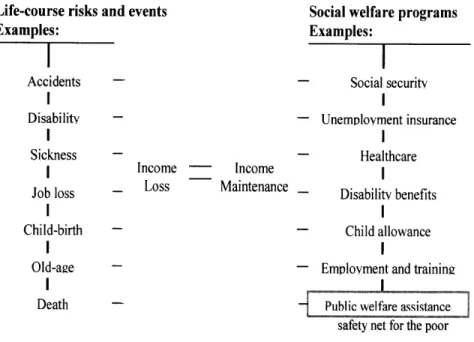
In chapter two, I present a theoretical framework that explains when and how safety nets evolve over time. The first section provides the nuts and bolts of social protection and identifies the main types of safety nets. Then I discuss the challenges the poor face in attaining social protection. The second section discusses conditions under which safety nets are more likely to emerge and endure. It identifies the key social actors, how their preferences towards redistribution are formed, and what institutional conditions enable or constrain them from exercising their political voice. The third
section illustrates the divergent paths of redistribution in comparative terms. This analytical framework is used as a guide for the subsequent case of Japan.
My four empirical chapters are divided according to the four major historical
turning points in the co-evolution of the poverty relief system, democratization, and industrialization: from feudalism to modern nation-state (initiating industrial
of industry (industrial take off), and transition towards mass democratization (advances towards industrial maturity).
In chapter three, I examine the transition from feudal poor relief practices to the creation of the country's first national public assistance system. I explain how the country's late-development industrialization strategy contributed to the dramatic reduction in poor relief from feudal times.
Chapter four analyzes how the overlap of two processes-early democratization and late development industrial growth-gave rise to a new political class comprised of agrarian landlords that ended up blocking the oligarchs' proposal to expand poor relief in the latter part of Meiji period. It examines why the agrarian elites sought political
representation, how they succeeded in obtaining voting rights, and why they were able to use their votes effectively to advance their redistributive interests in 1890. One of the goals of this chapter is to show how the Meiji oligarchs designed and built Japan's democratic institutions and explain how their faulty engineering eroded their hegemony and gave rise to party politics.
Chapter five examines how the political ascendency of the urban industrialists induced partial democratization in the age of industry and paved the path of welfare retrenchment. The demand to stoke industrial growth intensified and the agrarian-industrialist dominated Diet approved greater spending for infrastructural development and public goods provision while refusing to expand poor relief. This chapter also shows how the state mobilized civil society actors to provide a substitute for public assistance but their activities were grossly inadequate to address mass poverty.
The penultimate chapter is divided into two parts. The first-half examines the evolution of working class movement from its inception in the late nineteenth century to its subsequent maturation in the 1920s and explains how late industrial development prevented the poor from joining or benefiting from the social movement spearheaded by organized labor. One of the objectives of this chapter is to test the central thesis of the power resources theory that organized labor plays the key role in expanding suffrage and redistribution. The latter part examines the consequences of the failed alliance between organized labor and the poor and how it led to the latter's exclusion from the makings of Japanese democracy and welfare state.
The concluding chapter restates the puzzle, relocates it in the existing literature, and explains the significance of the main findings in each chapter. It also offers the implications of the study and explains how the findings from my dissertation improve our understanding on why some democracies redistribute more than others.
CHAPTER 1
Nickel and Diming Japanese Style:
An Overview of the Data and Review of the Literature
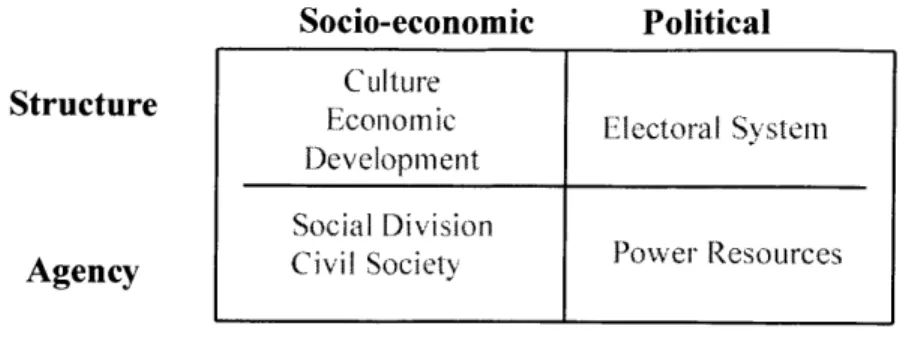
This chapter is divided into two parts. In the first part, I present comparative data on the level of poverty and relief efforts across advanced industrialized countries and show that Japan's public assistance system--the "safety net" for the poor--is distinctively threadbare by international standards and merits exploration. In the latter part, I evaluate what existing theories of redistribution have to say about the Japan case and beyond. I organize the competing explanations into six categories, based on: social division, culture, economic development, civil society, power resources, and electoral system. I discuss the main theoretical claims of each explanation in general terms, examine how it has been deployed in comparative research, and evaluate how well it applies to the Japan case. The five missing elements of the existing literature are: (1) the inadequate
explanation for the nexus between the origins of electoral systems and the level of redistribution; (2) the ambiguity over the impact of working class mobilization on redistribution; (3) the limits of deductively positing political and social actor's
preferences toward redistribution; (4) paying insufficient attention to the relationship between how a country industrializes and how it redistributes its wealth; (5) the lack of explanation given for why some countries have developed an intra-welfare state
I. The Japanese exceptionalism
Discovering the skeleton in the closet
On July 1 0th 2007, the partially mummified corpse of a 52 year old man was
found along with his diary in Kitakyushu, Japan.38 The diary chronicled his fight against the pangs of an empty stomach and his grueling ordeal to obtain public assistance. He
starved to death two months after his welfare payments were terminated. The report of a person dying of starvation who had been shunned by the country's austere public
assistance system was neither the first in Kitakyushu nor in the rest of the country.39 At least one person dies of starvation each week and a dozen commit suicide daily by reason of economic hardship [table 1.1 and figure 1.1 ].40 This darker, harsher side of Japan is at
odds with the more familiar images of the country as a modern, affluent, democratic society and merits a full investigation.
38 Sankei Shimbun Osaka Shakaibu, Seikatsu Hogo ga Abunai [The Livelihood Protection in danger]
(Tokyo: Sankei Shimbun Shuppan, 2008), 65- 68. For articles written in English on this topic, see for example, Norimitsu Onishi, "Death Reveals Harsh Side of a 'Model' in Japan," The New York Times, October 12, 2007.
39 The 2007 case was the fifth case of starvation death in Kitakyushu. Similarly in May of 2006, a 56 year old unemployed man was found starved to death. He visited the public assistance office twice but was denied application forms. For articles on this issue written in English, see The Japan Times, "Tighter welfare driving starvation deaths," October 14, 2007; Kyodo News, "Unemployed temp worker, 49, believed starved to death in Osaka apartment," January 17, 2009. Most recently, the Sankei (20 February 2012) reported that a family of three was found starved to death in Saitama prefecture.
40 According to the mortality statistics on "lack of food" compiled by the World Health Organization in 2004, Japan's figure (87 deaths in 2000) is significantly higher than those of other advanced industrialized countries: Canada (9 deaths), South Korea (9 deaths), Australia (4 deaths), Spain (1 death), Germany (1
death), and Sweden (1 death). The only country that tops Japan's number is the United States (120 deaths). According to the Japanese government, on average 71 people died each year due to "lack of food"
(shokury6 nofusoku) from 1997 to 2008 (Ministry of Health, Labour, and Welfare, Jinka Datai Chosa
[Population Vital Statistics Report] various years). In regards to suicide rate, from 1980 to 2007, on average, 4174 committed suicide per year due to socio-economic hardship (keizai seikatsu mondai). See the National Police Agency Community Safety Bureau Regional Division, "Jisatsu no Gaiya Shiry6"
[Suicide General Materials], various years at http://www.npa.go.jp/toukei/index.htm; Ministry of Health, Labour, and Welfare, Dai Gokai Jisatsu Shib5 T~kei [5th statistics concerning suicide deaths] (Tokyo: