Design and Evaluation of a Benchmark for Main
Memory Transaction Processing Systems
by
Elizabeth G. Reid
Submitted to the Department of Electrical Engineering and Computer
Science
in partial fulfillment of the requirements for the degree of
Master of Engineering in Computer Science and Engineering
at the
MASSACHUSETTS INSTITUTE OF TECHNOLOGY
June 2009
@
Massachusetts Institute of Technology 2009. All rights reserved.
,7 /
Author ... .
.. ...
Department of Electrical En ineering
and Computer Science
(
May 18, 2009
Certified by...
Samuel Madden
Associate Professor
Thesis Supervisor
Accepted by...(
Arthur C. Smith
Chairman, Department Committee on Graduate Theses
MASSACHUSETTS INSITUTE
OF TECHNOLOGY
JUL 2 0 2009
ARCHIVES
Design and Evaluation of a Benchmark for Main Memory
Transaction Processing Systems
by
Elizabeth G. Reid
Submitted to the Department of Electrical Engineering and Computer Science on May 18, 2009, in partial fulfillment of the
requirements for the degree of
Master of Engineering in Computer Science and Engineering
Abstract
We designed a diverse collection of benchmarks for Main Memory Database Systems (MMDBs) to validate and compare entries in a programming contest. Each entrant to the contest programmed an indexing system optimized for multicore multithread execution. The contest framework provided an API for the contestants, and bench-marked their submissions.
This thesis describes the test goals, the API, and the test environment. It docu-ments the website used by the contestants, describes the general nature of the tests run on each submission, and summarizes the results for each submission that was able to complete the tests.
Thesis Supervisor: Samuel Madden Title: Associate Professor
Acknowledgments
I would like to thank Sam Madden for his support, assistance and patience throughout this thesis. Not only did he help with issues that arose during my work, his help in moderating the contest was invaluable.
I would also like to thank Mike Stonebraker for his vision and feedback on the structure and content of the contest, Margo Seltzer for her patience while helping me debug my Berkeley DB implementation, my cousin Garrett Reid for loaning me the use of one of his computers for testing, and for being a guinea pig for many of my scripts and setups, and my father Brian Reid for helping me unravel many of the bugs that arose over the last eight months.
And finally, thank you to my family for helping edit my thesis, reading it when I no longer had the patience to go through it again myself, and my friends for keeping me entertained when I probably should have been working.
Contents
1 Introduction 13
1.1 Motivations For Main Memory Database Systems . ... 13
1.2 Contest Overview ... 14
1.2.1 Transactions ... 15
1.3 Previous Main Memory Data Structures . ... 16
1.4 Contributions ... 18
1.4.1 Benchmark Design ... 18
1.4.2 Testing Framework ... ... 20
1.4.3 Analysis of Submissions ... .. 21
2 API, Testing and Benchmarks 23 2.1 API Overview ... ... ... .. 23 2.1.1 Function Calls ... ... ... 24 2.1.2 Data Structures ... ... . . . 28 2.2 Unit Tests . . . .. . 30 2.3 Benchm arks ... 32 2.3.1 Initialization ... ... ... . . . 32 2.3.2 Testing ... ... ... ... .. 33 2.3.3 Benchmark Variations ... 34 2.4 Example Implementation . ... ... . 35 3 Website 37 3.1 Security ... .... 37 7
3.2 Individual Results ... 38 3.3 Leaderboard ... .... .... ... 40 3.4 Organizational W ebsite ... 42 4 Submissions 43 4.1 Data Structures ... ... ... .. 44 4.2 Concurrency Control ... ... 45 4.2.1 Locking ... 45 4.2.2 Deadlocks ... 46 4.3 Memory Management ... ... . 47 4.4 Multicore Support ... ... 47 5 Evaluation 49 5.1 Tests . . . . . . .. . . . . . . .. . . . 49 5.2 R esults . . . . . . .. . . 50 5.3 Discussion ... . . . . . . . . .. . . ... . 55 5.3.1 Individual Submissions . . . . 55 5.3.2 Optimization Analysis . .. .. . ... . 61 5.3.3 Conclusion ... .... ... 62
List of Figures
2-1 Function calls defined in API. ... 24
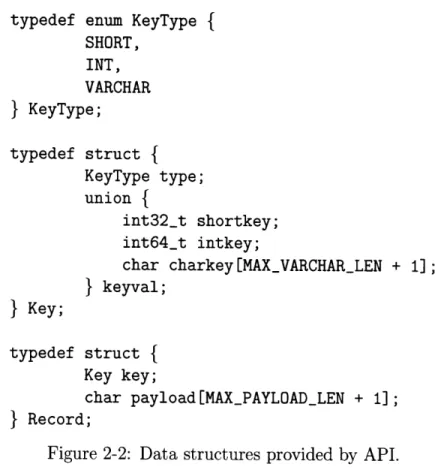
2-2 Data structures provided by API. ... 28
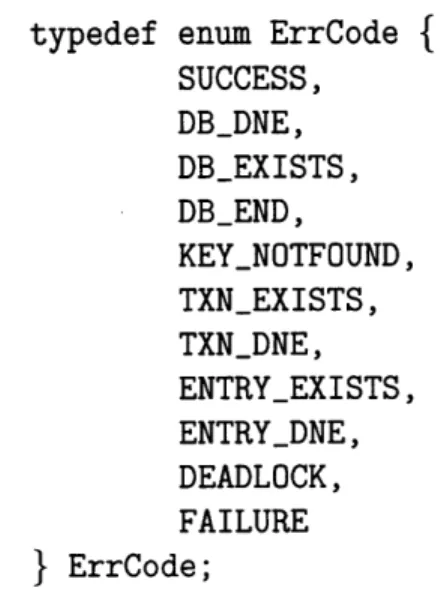
2-3 Error codes provided by API. ... 29
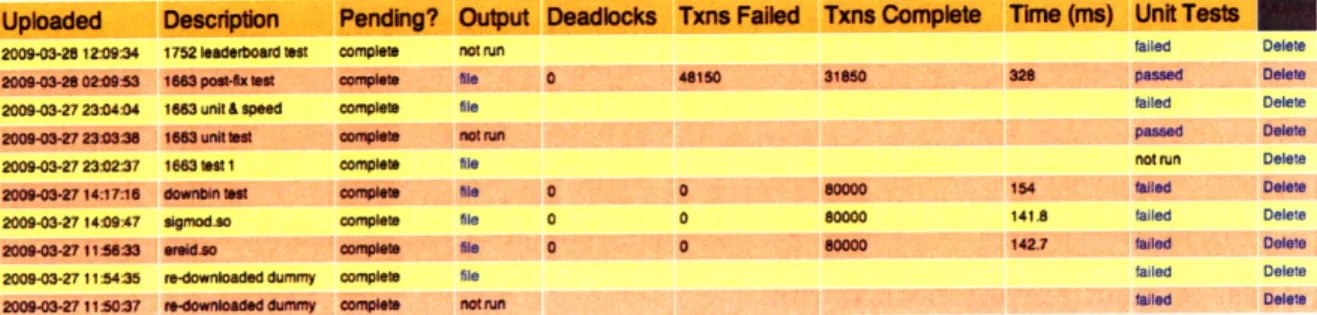
3-1 Screen shot of example results for a participant. . ... 39
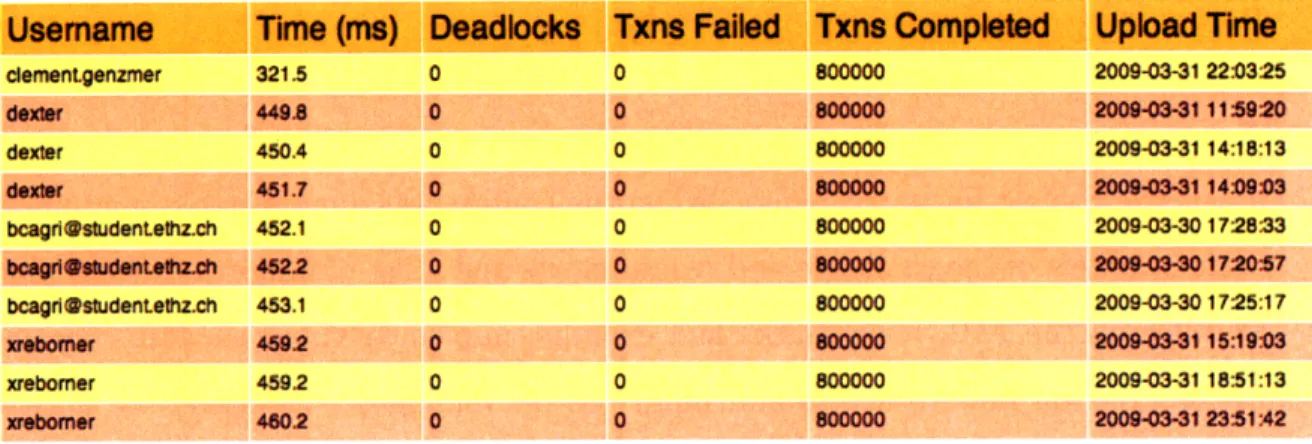
3-2 Leaderboard displayed on the contest website. . ... 41
3-3 Second leaderboard displayed on the contest website. . ... 41 5-1 Results from the primary benchmark instances (all times in milliseconds). 53 5-2 Results from the variation benchmark tests (all times in milliseconds). 54
List of Tables
5.1 Control Variables For Preliminary Benchmark Instances ... 50
5.2 Control Variables For Additional Primary Benchmark Instances . . . 50
5.3 Control Variables For Variations On Primary Benchmark ... 51
5.4 Results of Preliminary Benchmarks . ... 51
5.5 Results of Additional Instances of Primary Benchmark ... 52
Chapter 1
Introduction
In this document I discuss the motivation, framework and preliminary results of the First Annual SIGMOD (Special Interest Group on Management of Data) Pro-gramming Contest, which will culminate at the SIGMOD conference in June 2009 in Providence, Rhode Island. The competition is to create an indexing system for main memory data optimized for a multi-core machine running many threads over multiple indices. The contest was designed, implemented and run by myself, Samuel Madden and Mike Stonebraker beginning in October 2008. This thesis was written in May 2009 before the final stages of the competition were completed and the winner was determined.
1.1
Motivations For Main Memory Database Systems
Main memory database systems (MMDBs) store their data in main physical memory in order to provide much faster access speeds than traditional disk-resident database systems (DRDBs) can provide. Reading data from disk is often the slowest piece of computer systems, especially data-intensive applications like databases. By removing disks from a system's design, the efficiency and throughput of the system can be
drastically improved.
Due to the historical costs of main memory, traditional DRDBs have been designed to work using a combination of disk-resident data and main memory caching for a
subset of the data in an attempt to minimize the delays caused by waiting for data to be read from the disk. As technology has improved and chip density increased, main memory has become large enough to hold entire databases completely, opening the door for MMDBs to emerge as a different type of database system [4].
While DRDBs can be run entirely in main memory and be fully functional, their storage structures were specifically optimized to use the disk to store data. In order to take full advantage of the features added by living primarily in main memory, new systems must be designed. Not only is the access time significantly shorter for main memory systems, but they need not be block-oriented because there is no fixed-cost per access and sequential access fixed-cost is insignificant. Almost every aspect of a database system can be affected by these differences. This motivates research into the best design for a MMDB to maximize performance.
1.2
Contest Overview
The Call for Entries for the First Annual SIGMOD Programming Contest was posted to the conference's website in October 2008. It specified that student teams from degree granting institutions were welcome to participate for a cash prize of $5,000 by creating an indexing system for main memory data.
We released the official API, along with an example implementation and some ba-sic unit tests, in mid-December and tweaked them slightly over the following months to fix bugs and clarify points of confusion for participants. We provided an initial version of the basic benchmark test to be used to compare the different implementa-tions at the beginning of February 2009, although it went through more significant transformations over the following months than the rest of the released code. We also gave participants a basic harness that allowed them to run the benchmark on their own machines.
At the end of February, we launched a website that allowed participants to see the results when their implementations are run on the official testing machine. The
site also contains a leaderboard to show the fastest results on a few basic benchmark tests to give participants an idea of the speeds being reached by other teams.
The contest closed at 11:59 pm EST on March 31, 2009, at which point participants must have turned in a working binary and all of their source code to be tested and inspected in order to determine the finalists. We ran a few basic benchmarks over all of the submissions, and the eight fastest were pulled out for closer inspection and further testing. From those eight, we selected five finalists to come to the SIGMOD conference in June to explain their design and for a final round of testing before a winner is chosen.
1.2.1
Transactions
The primary unit of work in a database is a transaction. A single transaction is made up of one or more smaller tasks, each reading or writing information to one or more indices in a database. These tasks occur in a specified order within the transaction, and once they have all completed, the transaction is committed and the changes it produced are made permanent. Alternately, if the client wishes to undo any of the smaller tasks performed in a transaction, all of the tasks performed in the transaction must also be undone. This property is called 'atomicity' and is sometimes referred to as 'all-or-nothing', as either all of the work in a transaction is done, or none of it is done.
The atomic property of a transaction is important so that any changes made to a database will not leave it in an inconsistent state. A database may have some internal logic dictating relationships between different pieces of data within it. Thus, if one piece of data is added, changed or removed, the associated data must be adjusted as well. By guaranteeing that transactions are atomic, clients can make all of the necessary updates within a single transaction and know that consistency will be maintained.
Multiple transactions may be running simultaneously on a database. However, each must behave as if it is the only transaction currently given access to the data it accesses. If one transaction reads a piece of information from an index and then
a second transaction changes that value before the first transaction completes, the behavior of one or both of these transactions may be significantly affected. This
'isolation' property often requires some sort of locking mechanism to give the imple-mentation some concurrency control, although how the locks behave depends on the implementation. The most straightforward implementation would be to remove the parallelization between any of the threads to run one transaction at a time, but this would deliver very poor performance.
The final property of transactions that database systems must guarantee is 'dura-bility'. Once a transaction has completed, all of the changes made during that transac-tion must exist in the database even if the system crashes. However, for the purposes of this contest, crash-recoverability was not required of the implementations. Previ-ous research [5, 8] has shown that, while crash-recoverability is important, there are different tools that can be used to support it given different hardware performance requirements (duplication, logging, etc.). By removing any form of long-term dura-bility code from these implementations, the code remains a useful tool for all of these different systems, rather than those using whatever durability scheme we might have required.
1.3
Previous Main Memory Data Structures
As discussed briefly in Section 1.1, the optimal layout of data that lives in main memory should be different from the layout of data that lives on disk. The structure of this data can have a significant effect on the performance of a system that interacts with it, and as such a number of data structures have been proposed over the years to solve the problem.
B-trees were invented and optimized for systems that read and write large chunks of data to disk [1], which is especially common in databases and file systems. They are organized in block-sized chunks and occasionally reorganize themselves to support searches, inserts and deletions in O(log n) amortized time.
main memory database systems [6]. A T-tree is a binary tree with many elements in a node which gives it the good update and storage characteristics of a B-tree. However, later research [7] found that T-trees give the impression of being cache conscious by utilizing data in each node multiple times when searching a tree, but that the cache-locality of the data was not properly utilized. When they were first proposed, the gap between processor and main memory speeds was not very large and so the source of the speed-up was not properly understood. Thus, a T-tree's fundamental behavior is similar to a binary tree's until the bottom of the tree has been reached, at which time a more cache-conscious behavior is exhibited. For trees large enough to require many layers of nodes before the leaves are reached, that depth can significantly impede the performance of a T-tree.
The Cache Sensitive Search Tree (CSS-Tree) was proposed to surpass the perfor-mance of both B-trees and T-trees by paying closer attention to reference locality and cache behavior [7]. CSS-trees store a directory structure on top of a sorted array that represents a search tree. The nodes in the array are designed to match in size the cache-line size of the machine on which it is running.
Recent research has been done [2] into Cache-Oblivious String B-trees (COSB-trees), which are designed to improve the performance of B-trees on disk. Kuszmaul emphet al. propose that B-trees perform suboptimally when keys are long or variable length, when keys are compressed, for range queries and with respect to memory effects such as disk prefetching. They present the COSB-tree as a data structure that is more efficient when searching, inserting and deleting from a tree, performing range queries and using all levels of a memory hierarchy to make good use of disk locality, and also maintains an index whose size is proportional to the front-compressed size of the dictionary. While this data structure is not specifically designed for use in main memory, some of the optimizations it emphasizes, such as cache obliviousness, could be applicable to main-memory-specific data structures as well.
While the creators of CSS-trees did some analysis comparing the performance of different tree structures in main memory, there has not been a comparison done by an independent third party. By allowing participants to use any data structures they
choose to create their database implementation, the relative merits of each system should be made more clear.
1.4
Contributions
The contributions provided by this thesis lie mainly in the infrastructure and design of the contest, as well as the analysis of the final submissions.
1.4.1
Benchmark Design
We designed the benchmarks for this contest to fairly measure the performance of the different implementations without introducing excessive overhead. The distribution and type of tests to be run over the indices was specified in the contest description. However, the design of the mechanism to generate data for the indices, as well as how to measure the performance of the implementations, went through several iterations before being finalized.
Performance Measurements
Initially, the proposed benchmark required each transaction to take only a small amount of time. The benchmark of an implementation was supposed to count each time a transaction took longer than that limit, with the final score being proportional to the number of 'violations'. However, this could lead to undesirable behavior if participants optimized their implementation too closely to this benchmark.
If a particular transaction takes significantly longer than the time limit, the penalty would be the same as finishing only milliseconds afterward. Thus, once the threshold has been crossed an implementation would be able to use the unpun-ished time to do any internal reorganization or cleanup that had not been properly completed during earlier transactions in an attempt to keep within the transactional boundaries.
The solution to this problem was to abandon the threshold entirely, and instead fall back on using a global timer that records how long the entire benchmark takes
to complete. The amortized time for each transaction is thus the most important behavior in each implementation, rather than the individual transaction times.
Data Generation
We originally generated the data used to populate and provide queries for testing the indices using a random number generator (RNG) while the benchmark was running. This provided an even distribution of data and reproducible tests by seeding the RNG and carefully controlling how different threads accessed it.
However, it was eventually determined that the method used to produce a new number by the RNG introduced too much overhead relative to the time each imple-mentation took to run a single transaction. This distorts performance measurements by making it difficult to distinguish overhead costs from the time required for the implementation to perform its required tasks.
In order to avoid this potential loophole, and to remove the random data gener-ation from the performance time entirely, we pre-generated all of the random data used to test the indices at the beginning of the benchmark and stored it in large arrays in main memory. This method has the added benefit of restricting the number of random keys and payloads used during testing, thus increasing the potential for collisions. This forces implementations to handle them more often, and thus make sure that they are handled efficiently.
The exact behavior of the benchmark cannot be predicted before it begins, so we had to generate the worst-case amount of data required for the different tests every time they were run. This significantly increased the amount of space required to hold all of the generated data, which is stored in memory that would otherwise be available to the participants to use for their implementation's internal storage structures. However, we believe the benefit of a very small overhead for generating data during the test itself compared to the detriment of the wasted space to be preferable.
1.4.2
Testing Framework
We ran a multitude of tests over many different implementations a large number of times. In order to make this easier, we built a testing framework that organized the system at multiple levels.
We designed benchmarks themselves so that, given the same seed, the same tests are run in the same order with the same data, independent of any other factors. This allowed for side-by-side comparisons of different implementations that were given the same workload. It also allows a problematic test to be repeated for debugging purposes.
In order to automate the tests so that they could be run in bulk sequentially, we wrote two Python scripts, one to handle the organization of the tests being run, and one to run a specific test in isolation.
The outermost script queried the database of tasks to find any pending tasks that participants had issued, such as running the unit tests or one of the benchmark tests over their implementation. For each test, the script used the information provided to calculate parameters that are passed into the benchmark test. Parameters include: how many times to run the test, which test should be run, how many inserts are done per thread, how many tests are run per thread, how many threads are used in the test, and how many indices are created in the test. The script inserts this information into the database, and then starts the inner script. While the inner script is running, the outer script keeps track of how long it has been running, and if it exceeds a predetermined time threshold, it kills the test and moves onto the next one. If the inner script finishes testing within the time limit, the outer script parses the results of the test and enters them into the database. It also copies the output files from the test into a location that can be accessed by the participant via a web interface, so that the debug output can be analyzed.
The inner script provides isolated security for the test being run by building a jail directory into which all of the relevant test files are copied (further described in
the results from each of them. Once the benchmarks have completed, the inner script runs various tests over the binary, such as the Phantom Test, and then returns the results to the outer script.
This modular framework can be easily adapted to run a variety of tests over a collection of binaries. This was done for the final testing of the submissions, thus exhibiting its usefulness.
1.4.3
Analysis of Submissions
The third significant contribution of this project is the analysis of the submissions to the contest. After winnowing down the submissions with an initial round of testing, we more thoroughly tested and hand inspected the code of the remaining submissions in order to determine their methodology and to identify some common aspects to their designs that are effective on the supplied benchmarks. The most important
design decisions for any implementation were isolated and some of the more effective choices were identified.
In Chapter 2 I discuss the development of the API and what test and benchmarks we used to compare the submissions to the contest. In Chapter 3 I describe the website provided for the participants to test their implementations. In Chapter 4 I discuss the general design decisions each team made during their design. In Chapter 5 I discuss the results of the tests on the implementations and analyze the effectiveness of some of the design decisions and draw conclusions about the effectiveness of our benchmarks.
Chapter 2
API, Testing and Benchmarks
We first devised a standard application programming interface (API) for' a database application to allow standardized testing and comparison of the submissions to the contest. The API is written in C but was also designed and tested to support C++ implementations. We also developed unit tests and a benchmark script to verify that the participants' code supported all behavior defined in the API and to determine which implementations ran the fastest under different loads.
2.1
API Overview
The API defines the function calls that the submissions must implement in order to be a valid solution and provides a small number of standardized data structures and constants. As a database application, the API supports a few basic features: the creation of indices in which data is stored in an organized manner, the ability to insert and remove data from an index, and the ability to retrieve data from an index or scan through the data in an index. Data is organized in each index in pairs of associated Keys and payloads, where the Keys have an absolute order relative to each other, but each Key can have multiple payloads associated with it.
ErrCode create(KeyType type, char *name);
ErrCode openIndex(const char *name, IdxState **idxState); ErrCode closeIndex(IdxState *idxState);
ErrCode beginTransaction(TxnState **txn); ErrCode abortTransaction(TxnState *txn); ErrCode commitTransaction(TxnState *txn);
ErrCode get(IdxState *idxState, TxnState *txn, Record *record); ErrCode getNext(IdxState *idxState, TxnState *txn, Record *record);
ErrCode insertRecord(IdxState *idxState, TxnState *txn, Key *k, const char* payload); ErrCode deleteRecord(IdxState *idxState, TxnState *txn, Record *record);
Figure 2-1: Function calls defined in API.
2.1.1
Function Calls
The API contains ten function calls that a valid submission must implement. Those functions are used in the unit tests and benchmarks to verify and compare the different implementations. To lessen the performance impact of the testing infrastructure, the parameters passed to the functions are pointers to variables rather than the variables themselves. This minimizes the amount of data written to the stack for each call so that it takes less time to make the call.
Index Management
There are three functions that deal specifically with the creation and access to indices. The create function makes a new index with a KeyType (see Section 2.1.2) and name specified. It is called only once per index after which the index is available to any thread in the process. The name must be a unique string of characters used to identify the index when opening it via the openIndex function. If create is called with a name that was already used to make an index then the function returns an ErrCode (see Section 2.1.2) indicating the issue.
The openIndex function provides access to an index. The arguments specify the index by its unique name and include a handle to an IdxState pointer (see Sec-tion 2.1.2) pointing to whatever informaSec-tion the implementaSec-tion will need to uniquely identify and support the thread's access to the specified index. If the name specified has not been used in a successful call to openIndex then the function returns an ErrCode indicating that the database does not exist.
Once a thread has finished using an index it can close its connection to it using the closeIndex function. The only parameter passed in is the IdxState pointer that was passed by the implementation in the openIndex call. Once the closeIndex call has completed this pointer is no longer a valid index identifier for the thread and its access to the index is closed until it calls openIndex again.
Transaction Management
There are three functions that manage transactions. Each thread can have only one outstanding transaction running at a time, but a single transaction can span multiple indices with a single thread. Other transactions should not see a transaction's updates until it has committed, but later operations within the a transaction must be able to see the previous effects of the transaction. Also, the transactions must be serialized so that the changes made to a database are equivalent to running the transactions in some serial order, one after another. The implementation may serialize concurrent transactions in any order.
The beginTransaction function signals the beginning of a transaction. Its only parameter is a pointer to a TxnState pointer (see Section 2.1.2) that the implemen-tation uses to uniquely identify this transaction in the future. If the thread calling beginTransaction has a transaction that is currently open then the function returns an ErrCode indicating that a new transaction cannot be opened.
Once a thread has finished all of the operations involved in its transaction any changes it has made are committed using the commitTransaction function. The only parameter passed to the call is the TxnState variable that was used during beginTransaction, and after commitTransaction completes the variable is no longer valid. However, if the TxnState variable is not a valid identifier then the function returns an ErrCode indicating the problem. Alternatively, if the transaction was valid but could not commit due to deadlock with one or more other transactions then the function returns an ErrCode telling the client that the changes could not be committed at that time.
commitTransaction to make the changes permanent, a transaction can be discarded using a abortTransaction call. Any changes made to the database over the course of the transaction will be rolled back as though the transaction had never happened. However, if the TxnState variable is not a valid transaction identifier or if rolling back the changes in the transaction caused a deadlock, then the function returns an ErrCode indicating the specific problem.
Database Calls
There are four functions used to access and manipulate the data stored in an index. Each function can only act upon one index at a time, even if multiple indices are open for a given thread. Each function call can be part of a larger, complex transaction by handing in a TxnState variable created during a beginTransaction call. If, instead NULL is passed in as the TxnState value then any changes made in the function call are immediately committed.
Information is inserted into an index using the insertRecord function. Beyond specifying the index and transaction, the other parameters for the function are the Key and payload for the entry. If that particular Key/payload pair already exists in that index only a single copy of the entry is kept and the function returns an ErrCode indicating what occurred. Alternatively, if inserting the record into the index causes a deadlock, the function returns an ErrCode indicating this.
Information is deleted from an index using the deleteRecord function. A Record variable is handed in as a parameter that specifies what information should be deleted from the index in question. The Record can either specify a specific Key/payload pair to be removed, or it can set the payload to NULL. If the latter is done then all Records in the index with the specified Key are deleted. If, in either case, the specified Key is not found in the index then the function returns an ErrCode indicating the problem. Alternately, if deleting the data from the index would cause a deadlock, the appropriate ErrCode is returned.
There are two functions that are used to retrieve a Record from an index. To retrieve a Record given a specific Key a client may use the get function. A Record is
passed in as a parameter in which the Key is specified by the client and the payload is left blank. The implementation copies in the payload information associated with that Key into the available space. If there is more than one payload associated with that Key then the implementation can choose which to return. If the specified Key does not have any associated payloads in the index then the function returns an ErrCode indicating the issue.
The other payloads associated with a Key can be accessed using the getNext function. It is passed an empty Record object into which it copies both the Key and payload to be returned. If there are n payloads associated with a Key then a single call to get followed by n-1 calls to getNext should return all n Records with the specified Key. However, getNext can scan an entire index of information, not just the values associated with a single Key. It will always return the Record following the previous Record retrieved by a call to either get or getNext in the same transaction. Also, if a call to get was made specifying a Key that did not exist in the index, getNext should return the first Record in the index that does exist after that Key. If there have not yet been any get or getNext calls then getNext returns the first Record in the index. When getNext is called after the last Record in an index has already been accessed then an ErrCode is returned indicating that the end of the index has been reached.
Unspecified Functions
The functions defined in the API were designed to allow the various implementations to be tested and compared using standardized tests. As such, some functions were not included that would be needed for a launch-worthy API. Most noteworthy of the missing functionality is the lack of a deleteIndex function which would completely delete an entire index from the database.
Memory Management
While the parameters handed into the function calls described above have space al-located for them in memory at the time of the function call, many of them are not
typedef enum KeyType { SHORT, INT, VARCHAR } KeyType; typedef struct { KeyType type; union
{
int32_t shortkey; int64_t intkey; char charkey[MAX_VARCHAR_LEN + 1]; } keyval; } Key; typedef struct { Key key; char payload[MAX_PAYLOAD_LEN + 1]; } Record;Figure 2-2: Data structures provided by API.
guaranteed to remain at that location after the call has completed. The Records, Keys and payloads are allocated by the client and the client is in charge of freeing that memory, which can be done any time after the call has completed. If the imple-mentation needs to access the information stored in these parameters once the call has completed, it must copy it into some other location in memory that it has allocated. However, the implementation-specific data types (see Section 2.1.2) are allocated by the database implementations, which are also in charge of freeing them once they are no longer in use.
2.1.2 Data Structures
Record Information
The database records being passed in and out of the database are defined by a col-lection of C structs in the API. A Record is made up of a Key and a payload, where the Key can have three possible KeyTypes: 32-bit int, 64-bit long or a variable-length string of up to 128 bytes. These values are all stored in structs which have the smallest
typedef enum ErrCode
{
SUCCESS, DB_DNE, DB_EXISTS, DB_END, KEY_NOTFOUND, TXN_EXISTS, TXN_DNE, ENTRY_EXISTS, ENTRY_DNE, DEADLOCK, FAILURE } ErrCode;Figure 2-3: Error codes provided by API.
possible size while still allowing for all possible Key types and holding both a payload string and a Key string.
The structs passed into the database are kept as small as possible so that the amount of data passed in a function call can be minimized. In C, structs are of a constant size and of union type so that they have a known layout, but this means that if a Record contains a 32-bit Key, the Record will still be allocated large enough
to hold a string-valued Key.
It would have required significantly less space to have the payload and varchar Key values in the struct be pointers to a string on the heap, cutting down the size of the Key struct by 120 bytes and the payload struct by 92 bytes. However, passing a pointer to a string on the heap leaves it ambiguous who is in charge of freeing the memory, as well as when it will occur. By including the entire string in the struct this ambiguity is removed.
Error Codes
The API also defines a set of error codes that are used to allow a database imple-mentation to indicate the success or reason for failure of a function call. Not all of the error codes are applicable for every function call, so the specifications for each function define the circumstances under which a given error code is returned. Every
function can return SUCCESS when the function completed successfully and FAILURE if some unknown error occurred.
Implementation-Specific Data Types
The API provides two unimplemented data types, IdxState and TxnState. They are used to pass implementation-specific information into function calls so that index- and transaction-specific information can be recorded and accessed by the implementation without requiring that the API specify what this structure contains.
The contents, structure and size of the data type are defined entirely by the implementation. It is also in charge of allocating and deallocating the memory that holds the structure, and simply hands the API a pointer to its location on the heap. The IdxState structure is used to keep track of an index that has been opened by a specific thread. It is used when opening and closing connections to an index, as well as when a query is being run on an index. It is not needed for transaction-specific function calls. It is created by the implementation during the openIndex call and it is destroyed during the closeIndex call.
The TxnState structure is used to keep track of transaction-specific information that is also particular to a specific thread. It is the only argument needed for the func-tions that begin, commit or abort a transaction, and is included in all of the function calls in which a query is sent to an index. It is created by the implementation during the beginTransaction call and it is destroyed during either the commitTransaction or abortTransaction calls.
2.2
Unit Tests
Unit tests were developed with a dual purpose: to verify that the implementation behaves properly and to show the participants the basic idea behind the way their code will be used and what the expected edge-case behaviors are.
There are three threads that run during the unit tests, and the tests are run over three indices. The primary thread creates the primary index before branching off
two other test threads to run other tests. Meanwhile, it inserts, deletes and accesses data in the primary index in a series of transactions designed to work the basic functionality of the API, including supplying multiple payloads for the same Key, scanning through the index using getNext and then properly indicating the end of the index, ensuring that duplicate Key/payload pairs cannot exist in the same index,
aborting transactions and executing transactions that use multiple indices.
While the main tests are running in the primary thread, a second thread simulta-neously runs some basic tests over a separate index to ensure that the two can exist simultaneously and their data is kept separate from one another.
A third thread runs a test to ensure that the transactional guarantees required from the index are respected by the implementation under test. It continuously queries the primary index, checking to make sure that it cannot see data that only exists mid-transaction during the primary tests. It loops the same test over and over until the primary test has finished all of its transactions.
Phantom Problem
One test that was not handed out to the contestants during the contest but was run over the each implementation is a test to ensure that an index properly handles the phantom problem. The phantom problem is a bug which arises when "phantom" data suddenly appears in an index mid-transaction. This generally occurs when a database uses a fine-grained locking scheme within an index, and so when a transaction is scanning through a section of data, only the data that is in the index at that time is locked, rather than the range as a whole. Thus, when a second transaction inserts a new piece of information within that range and commits while the first transaction is still running, the conflict is not detected and the first transaction sees this new information, which violates the 'repeatable reads' requirement of transactions.
The test for this situation uses two threads, one of which is a single transaction which loops continuously over an entire index using getNext. Meanwhile, a second thread attempts to add data into the index at the same time in a separate transaction. If at any time the first thread sees any of the new data appear, then the
implementa-tion does not properly handle the phantom problem. However, if the implementaimplementa-tion either does not allow the second thread to insert new data while the first thread is looping through the index, or if the first thread does not see any new data, then the implementation properly handles the phantom problem.
2.3
Benchmarks
We developed a suite of benchmarks to compare the run-times of different implemen-tations under the same work load. Different benchmarks stress different aspects of a system by making small adjustments to the workload, such as the number of threads running, how much data is used to populate each index, or the distribution of keys.
2.3.1
Initialization
We released the primary benchmark along with the API and unit tests so that the participants would be aware what behavior the contest emphasized and what exactly was being timed. Constant arguments to the benchmark control how many indices are created for the benchmark, how many threads are used to populate and run queries over the indices, and how many populate inserts and queries each thread runs. It is also passed a value used to seed the random number generator so that it performs the same inserts and queries in the same order when given the same seed, even though it is run across multiple threads.
When the test begins, it initializes all of the data structures and generates random values to be used for the tests. Pre-generating all of the values used in the test significantly decreases the overhead time required to run the benchmark so that the reported time is primarily spent in the implementation rather than the benchmark
itself.
Each type of Key has its values stored in its own array, as well as the payload values. The threads share these arrays, which allows for repeated Keys and payloads to appear. Furthermore, each thread has its own array of random integers. Whenever a new random value is needed by a thread, it grabs the next integer in the array and
uses it as an index into the relevant array, or simply as a random number. Because each thread has its own array, the rate at which one thread uses the random num-bers does not affect what numnum-bers the other threads see. Furthermore, because the numbers are generated using a seeded random number generator, they are consistent across multiple runs of the test.
2.3.2
Testing
Once the initialization stage is complete, the actual testing of the implementation begins. The time it takes for each part to run is recorded by the benchmark. First each of the indices being used in the test is created, each in a separate thread, using as many threads as there are indices. Therefore there will not be fewer threads than indices used overall for the benchmark.
Once each of the threads has finished the creation step, the threads populate the indices with randomly generated Key/payload pairs. Any thread can populate any of the indices; in each iteration a random index is selected and then a Record is inserted with a randomly generated Key and payload combination.
Once the threads have finished populating the indices, each thread begins running tests over them. There are three possible tests a thread can run on an index: scan, get and update. Each test runs in its own transaction, and if the implementation deadlocks during the test, the transaction is aborted and the same test is re-run. The benchmark keeps track of how many deadlocks the implementation reports, as well as how many transactions complete successfully and how many fail. These numbers are reported at the end of the benchmark, along with how long it took to run.
The scan test, chosen 10% of the time, picks a random index and a random Key that may be in that index. It then calls get on that Key and then scans forward through the index using getNext between 100 and 200 times. This test is meant to determine how well an implementation can go through an index in order.
The get test, chosen 30% of the time, picks a random index to test and then calls get between 20 and 30 times with a series of random Keys of the appropriate type.
This test is meant to determine how well an implementation can jump from one place in an index to another.
The update test, chosen 60% of the time, picks a random index to test and then generates a random Key/payload pair to insert into the index. It then generates a new Key and deletes all entries under that Key from the index. This is done between 5 and 10 times for that index before the transaction is complete. This test is meant to stress an implementation's ability to update its contents quickly. It should be noted that, while inserting a Record into an index will almost always succeed (it will only fail if the Record is already in the index), the call to delete all Records under a Key will not always remove any information from the index due to the fact that the Key is not guaranteed to have been inserted into that index. However, this discrepancy should be counterbalanced by the fact that the deletion will sometimes remove multiple Records from the index under the same Key.
Once all of the threads have finished testing the implementation, the time it took for all three stages to occur is recorded and reported back, along with the number of deadlocks, failed transactions and completed transactions accrued over the course of the benchmark.
2.3.3
Benchmark Variations
The primary benchmark can be run with a variety of behaviors by varying the con-stants controlling the number of indices, threads, insertions and tests run each time. However, in the system described above, the distribution of data used for Keys and payloads is drawn from a uniform distribution, and only one index is used at a time for each test. This is not necessarily the most stressful test to run over a database, and so two variations of the benchmark were developed.
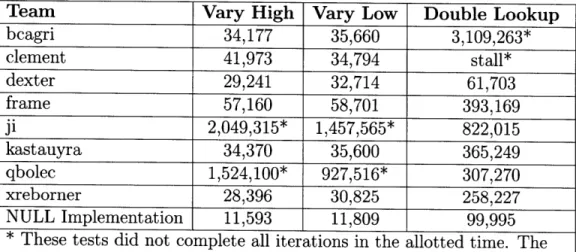
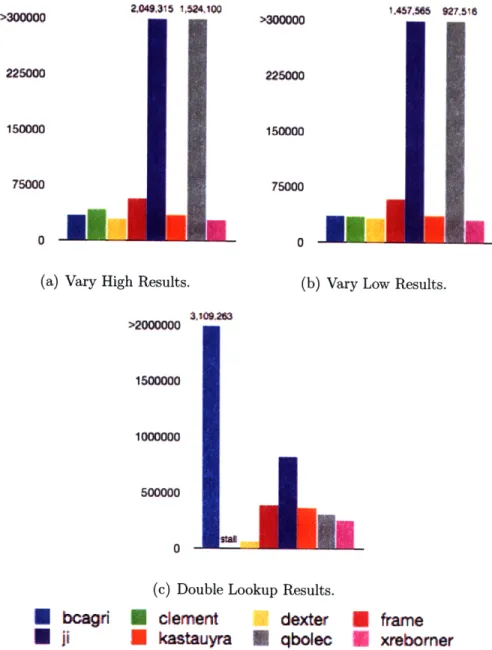
One variant behaved similarly to the primary benchmark described above. How-ever, instead of using all three possible Key types, only 64-bit integer Keys were used. Furthermore, only the 8 highest bits were varied between Keys in one instance of the test, and only the 8 lowest bits in the other. This causes an unfriendly Key
dis-tribution with many duplicates that exposes weak hash functions and non-general optimizations.
The second variation on the benchmark also compared the different implemen-tations using the standard Key distribution, but used multiple indices in each test transaction. For this test, two indices are opened at the beginning of the transaction. Then, a random Key is generated and an associated Record is retrieved from the first index. The payload associated with this Record is then used as a Key to do a lookup in the second index. Because Keys must also be possible payloads, only variable-length string Keys can be used.
2.4
Example Implementation
We provided an example implementation of the API that used Berkeley DB. The point of the example implementation was twofold. It tested the API to ensure that it contained enough information for the required tasks to be completed appropriately. It also gave a baseline example for the participants to see what behavior was expected of their implementations that was not specifically covered in the API or unit tests.
Berkeley DB [3] is an open-source library that provides an embedded database capability. It originated at UC Berkeley in the early 90s and has since been acquired by the Oracle Corporation for further development and distribution. It is designed to provide all of the traditional database behavior, including full crash recoverability and scalability while eliminating the client/server communication and SQL processing delays by allowing users to embed the code directly into their software.
However, Berkeley DB's wide range of features makes it a much slower system than one that is aimed specifically for this competition. It is not a main memory system, and in order to provide crash recovery it makes many disk writes that could have been dropped for the purposes of our competition. Furthermore, it supports significantly larger databases than any of our benchmarks so has a large overhead to keep track of this potential information. However, because it was not designed with this competition in mind, Berkeley DB does not allow for these features to be turned
off, and as such it has very poor performance with our benchmarks relative to the submissions to the competition.
Chapter 3
Website
A website was created to allow users to test their implementations on the machine used to test the submissions once the competition was closed. The machine is a dual-4 core 2.6 GHz Intel Xeon 5430 (64-bit) with 16 GB of RAM. It runs Red Hat Fedora
Core 10.
In order to ensure that every test run on the machine had the same resources available for every user, we created a submission system to run the users' tests. Users submit their binary to be tested, at which point it is entered into a queue. One at a time, a test is taken from the queue and run in isolation. Once the test is complete, the results from the test are entered into a database and the next test is begun.
3.1
Security
We took a few precautions in order to provide a modicum of security against the unknown and unchecked binaries being executed on the testing machine. We use a special user account on the machine whose sole purpose is to run tests for partici-pants. When a test is run, the participant's binary and various testing binaries and supporting files are copied into a new folder by a system call. Then, the working directory is switched into that folder, and chroot is called for the process in order to isolate it from the rest of the system by changing the apparent disk root directory. At this point, the process that executes the tests on the participant's unknown binary
believes that the root of the system is that folder, and cannot see or access any other files on the machine.
Creating a jail using chroot does provide some security, but care must be taken not to provide any hard links to files outside of the directory. This would negate the isolation and allow users access to the entire system. Even without creating any obvious ways out of the jail, this system does not ensure security. A binary might be able to exploit a buffer overflow in the provided C libraries to escape the limited scope of the system. However, this would require a lot of work by an attacker, and would have to be a deliberate attack. This system may not block all malicious users, but it does defend against accidents.
The script used to run each test and enter the results of the test into the database once it completes also keeps track of how long an individual test has been running. If a test runs longer than desired, the test is killed and no results are reported back to the user. There is also a system thread running in the background that checks for stray processes related to the tests and kills them if they have been running longer than is reasonable. Not only does this prevent a buggy implementation from never completing its benchmark test and thus hold the machine hostage against all other users' tests, but it also ensures that each user is given the same resources while his test is running.
3.2
Individual Results
The results of participants' tests are displayed on the web interface. Each user creates a unique login on his first visit to the website. Once he has logged in, any tests he requests to be run are associated with that user name. On his home page, a table of test results and pending tests for his account are available. For completed tests, the information available includes when the test was originally requested, the user-supplied description for the test, a link to a file of output produced by the test (containing the output from any printlines the user inserted into his code, as well as some general output of results from the benchmark itself), how many deadlocks
2009-03-28 12D934 1752 hederboard test comtple not tin failed Delete
2009-03-27 23044 1663 unit & speed complete file failed Delete
2009-03-27 2302 7 16e63 ast 1 CompleS fle notrun Delete
2009-3-27 1409 47 algmodso complee ie 0 0 80000 141.8 failed Delete
2009-03-27 1154,35 re-downloadeddummy complete file failed Delete
Figure 3-1: Screen shot of example results for a participant.
occurred during the test, how many transactions failed during the test, how many transactions completed during the test, how long the test took to run, and the output from the unit tests, if the user chose to execute them as well.
When a test is requested and a binary is provided, the binary is saved to disk to be used when the test is run. Furthermore, once a test is run the output produced by the benchmark and the the output produced by the unit tests are each saved in a file that is also saved to disk. These results are made available to the user for inspection so they can see how their code behaved, including their own debugging or informative printlines.
The web interface also allows users to delete their own results from the database that keeps track of all of the tests. When a result is deleted, the entry is completely removed from the database, although the supplementary files (the binary and the output files) remain on disk. This allows us (the contest managers) to look at the results from any old tests and re-run any old tests, even if the user can no longer see the results via the web interface. However, because the output files are kept in a location accessible via the Internet, there is no system in place to prevent anyone from looking at the output of other user's tests, including those that have been deleted from the database.
Over the month and a half that the website was available before the contest was closed, we revised the benchmark several times. The changes made to it varied from small bug fixes to changing how the random numbers were generated, and could affect the run-time of participant's code. In order to distinguish between the different benchmarks, a version number was included in the database information for any test
run. Whenever the benchmark was updated, the version number attached to all new tests was incremented. After this occurred, a button was shown on the users' home page that allowed them to re-run the benchmark test on an old binary. This button only appeared next to results for an older version of the benchmark, and only if the test had not already been re-run.
3.3
Leaderboard
The website also provided a leaderboard of the 10 fastest results for two basic bench-mark tests. Each user was allowed no more than three spots in the table, preventing the fastest user from re-running the same code multiple times to fill up the table with identical results. When submitting a binary to be tested on the site, participants were required to specifically state that it is being submitted for the leaderboard test. This automatically forces the system to run the unit tests over the binary, and if the binary does not pass all of the unit tests it is not eligible for the leaderboard. Furthermore, if a test does not complete all requested transactions (due to transaction failures or deadlocks), it is not eligible for the leaderboard. Finally, only tests run on the most recent version of the benchmark would appear on the leaderboard. Whenever a new version of the benchmark was released, all of the results on the leaderboard for the previous version of the benchmark would be re-run to immediately repopulate the leaderboard. This has the potential to show slow results on the leaderboard, but they quickly fall off the leaderboard when faster runs complete. Also, users have the ability to delete any of their own records from the system if they do not want them to appear on the leaderboard.
The two benchmark tests for which leaderboards were created were variants of the basic benchmark tests, with different loads. Each ran with a random number of indices and 50 threads, created indices of all three key types and ran all three types of benchmark tests (see section 2.3.2). One leaderboard test ran with 400 inserts per thread in the populate phase and 1600 tests in the testing phase. The final values of this leaderboard are shown in Figure 3-2. The other leaderboard ran 10 times as
dementgenzmer 3215 0 0 800000 2009-03-31 22:0325
dexter 450.4 0 0 800000 2009-03-31 14:18:13
[email protected] 452.1 0 0 800000 2009-03-30 172833
bcagd @studentethz.ch 453.1 0 0 800000 2009-03-30 1725:17
xrebomer 4592 0 0 800000 2009-03-31 1851:13
Figure 3-2: Leaderboard displayed on the contest website.
mmi n e ine d m4n " xreborner 19062 0 clementgenzmer 4065.4 0 dexter 5228.3 0 dexter 52280 xrebomer 5232.3 0 bcagdr@studentethzch 5259.1 0 0 0
0
80000 8000000 8000000 8000M 800000 ODD=00 2009-03-31 23:4829 2009-03-31 22*0624 2009-03-31 143457 2009-03-31 1724"51 2009-03-30 162136 2000-0O-8 17 0Z.42Figure 3-3: Second leaderboard displayed on the contest website.
many inserts and tests per thread, which increased the overall size of the database and the number of tests run by a factor of 500 each. The final values of this leaderboard are shown in Figure 3-3.
By providing two different leaderboard tables, we acknowledged that different implementations could excel under different workloads. Some implementations could handle small databases extremely fast, but not scale well. Some implementations could scale nicely, but have a lot of overhead to support the scalability that would slow it down with smaller databases.
Participants were informed that the results displayed on the leaderboard were only used as reference, and did not indicate who would win the contest. Other factors than simply how fast the code ran would be involved in the decision.
3.4
Organizational Website
A separate website was also maintained to post announcements and basic information about the contest for participants. When the contest was announced, it contained a basic overview of the challenge and requirements and a list of important dates. Once we released the API, benchmarks and example implementation, the site contained instructions on how to access and build the relevant files. Whenever we updated benchmarks, API or unit tests, we also posted an announcement on the website explaining what changes had been made and any relevant additional information. All of the benchmarks, unit tests and phantom test are now posted on the website, which can be found here: http://db. csail.mit. edu/sigmod09contest/.
Chapter 4
Submissions
While there were over 90 different accounts created to access the testing site, by the deadline of 11:59 pm on March 31st, 2009 only 17 binaries had been submitted. Of these 17 submissions, one had not turned in a valid binary and there was no response to an email sent to the provided email account. A second submission could not run on our 64-bit Linux machine and so was also not a valid submission. The 15 remaining submissions were tested using the various benchmarks, unit tests and phantom test. Submissions were received from teams associated with schools in countries all over the world, including Australia, China, Denmark, France, Germany, Poland, Switzer-land and the United States. The number of people on a team varied from one person to up to three people listed as working on the code.
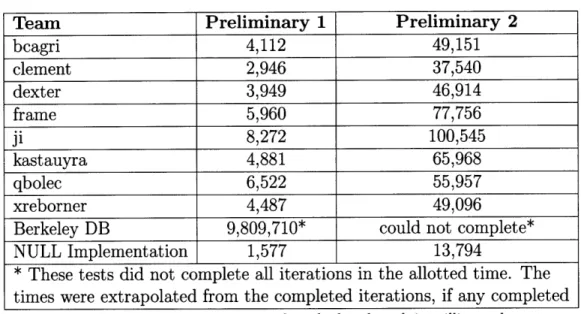
Five different versions of the basic benchmark test were run over all 15 submissions, along with the unit tests and the phantom test, in order to get a basic idea how each implementation performed. The five tests run were the two leaderboard tests used on the website (see Table 5.1), a test using 30 threads and indices, a test using 55 threads and indices, a test that inserts 1000 times as much data per thread during the populate phase in order to push the limits of the available memory and a test that only uses 5 indices (see Table 5.2). Each test was run multiple times with different random seeds for each implementation, and the average time was reported back.
From the results of these tests, eight submissions were chosen that successfully completed all of the benchmark tests in a short time. Some of these implementations
did not successfully pass the phantom test, but this was considered a fixable issue, and the test had not been released to the participants.
The implementations not chosen for closer inspection were left behind for various reasons. Some of the implementations timed out before being able to complete the given benchmarks or failed the unit tests. Others completed all of the tests success-fully, but were significantly slower than the eight that were chosen for closer inspection on all of the benchmarks, and so were not investigated further.
4.1
Data Structures
One important decision in every design is the data structure used to store the Records in memory. However the information is stored, Records must be able to be accessed either via a direct lookup using get, or while scanning the indices using getNext. Furthermore, the data cannot be static, as Records are occasionally added to or removed from the indices, even after the indices have been populated.
Most participants chose to use some form of tree to store the database information. Trees allow for roughly O(log n) lookup times, while maintaining a global order among the Keys, so the index can be scanned as well. There is a wide range of different tree-based data structures, however, so even implementations using a tree must decide what type of tree to use.
One implementation uses T-trees, which were invented with the intent to be better for main memory databases than B-trees. Rather than keeping all of the data stored in the structure itself, T-trees hold onto pointers to the data since all of the information is kept in memory and so can be accessed quickly without the random seek penalties of data stored on disk. By moving the core of the data out of the main tree structure, this also allows the tree to be restructured more quickly when it requires balancing, because less data is moved.
Another implementation uses CSS-(cache-sensitive search) B+-Trees. Cache-concious data structures treat the lines in the cache as the unit of memory of which they must be most aware, as opposed to blocks on the disk. This optimization is merged with a
design feature of B+trees to keep the children of a node contiguous in memory so that only one pointer must be kept, thus minimizing the overhead of the data structure. The trees are also occasionally restructured once they have grown significantly in size. This keeps the trees balanced so that none of the data is particularly unfavorable to access in the future, but does take the system offline for a significant amount of time while each tree is being reorganized.
A few different implementations used variations on a prefix tree, or trie, as their primary data structure. Tries use the location of a node in the tree to indicate the key with which a value is associated. This helps minimize overhead in the trie by lessening the amount of key information stored in each node, while still keeping the keys in an absolute order. Further analysis of tries can be found in Section 5.3.1 in the discussion of dexter's implementation.
A few implementations chose not to use a tree as the primary data structure. Instead, they chose a hash-based method of storage, like a multimap or a collection of simple hash tables. This allows for extremely fast access times, but forces the implementer to create a scheme to keep track of the global ordering of the keys. One implementation that does this, by clement is described in more detail in Section 5.3.1.
4.2
Concurrency Control
All of the official tests are run on a multi-core system and use multiple threads to run tests at the same time. This means that two different transactions may attempt to read or update an index at the same time. If this occurs, transactional guarantees are broken and the information stored in the database can be corrupted.
4.2.1
Locking
In order to prevent this problem, many implementations use some form of locking to prevent different threads from interfering with each others' behavior. Of the im-plementations that used locking, all of them used whole-index locking rather than locks on smaller pieces of an index. However, while some implementations used a