HAL Id: hal-00303272
https://hal.archives-ouvertes.fr/hal-00303272
Submitted on 29 Jan 2008HAL is a multi-disciplinary open access
archive for the deposit and dissemination of sci-entific research documents, whether they are pub-lished or not. The documents may come from teaching and research institutions in France or abroad, or from public or private research centers.
L’archive ouverte pluridisciplinaire HAL, est destinée au dépôt et à la diffusion de documents scientifiques de niveau recherche, publiés ou non, émanant des établissements d’enseignement et de recherche français ou étrangers, des laboratoires publics ou privés.
Impact of surface emissions to the zonal variability of
tropical tropospheric ozone and carbon monoxide for
november 2004
K. W. Bowman, D. Jones, J. Logan, H. Worden, F. Boersma, R. Chang, S.
Kulawik, G. Osterman, J. Worden
To cite this version:
K. W. Bowman, D. Jones, J. Logan, H. Worden, F. Boersma, et al.. Impact of surface emissions to the zonal variability of tropical tropospheric ozone and carbon monoxide for november 2004. Atmospheric Chemistry and Physics Discussions, European Geosciences Union, 2008, 8 (1), pp.1505-1548. �hal-00303272�
ACPD
8, 1505–1548, 2008 Impact of surface emissions K. W. Bowman et al. Title Page Abstract Introduction Conclusions References Tables Figures ◭ ◮ ◭ ◮ Back CloseFull Screen / Esc
Printer-friendly Version
Interactive Discussion
EGU
Atmos. Chem. Phys. Discuss., 8, 1505–1548, 2008 www.atmos-chem-phys-discuss.net/8/1505/2008/ © Author(s) 2008. This work is licensed
under a Creative Commons License.
Atmospheric Chemistry and Physics Discussions
Impact of surface emissions to the zonal
variability of tropical tropospheric ozone
and carbon monoxide for november 2004
K. W. Bowman1, D. Jones2, J. Logan3, H. Worden1,*, F. Boersma3, R. Chang4, S. Kulawik1, G. Osterman1, and J. Worden1
1
Jet Propulsion Laboratory, California Institute of Technology, Pasadena, CA, USA
2
Department of Physics, University of Toronto, Toronto, Canada
3
School of Engineering and Applied Sciences, Harvard University, Cambridge, MA, USA
4
Department of Chemistry, University of Toronto, Toronto, Canada
*
now at: National Center for Atmospheric Research, Boulder, CO, USA
Received: 9 October 2007 – Accepted: 10 December 2007 – Published: 29 January 2008 Correspondence to: K. W. Bowman ([email protected])
ACPD
8, 1505–1548, 2008 Impact of surface emissions K. W. Bowman et al. Title Page Abstract Introduction Conclusions References Tables Figures ◭ ◮ ◭ ◮ Back CloseFull Screen / Esc
Printer-friendly Version
Interactive Discussion
EGU
Abstract
The chemical and dynamical processes governing the zonal variability of tropical tropo-spheric ozone and carbon monoxide are investigated for November 2004 using satel-lite observations, in-situ measurements, and chemical transport models in conjunc-tion with inverse-estimated surface emissions. Vertical ozone profile estimates from
5
the Tropospheric Emission Spectrometer (TES) and ozone sonde measurements from the Southern Hemisphere Additional Ozonesondes (SHADOZ) network show the so-called zonal “wave-one” pattern, which is characterized by peak ozone concentrations (70–80 ppb) centered over the Atlantic, as well as elevated concentrations of ozone over Indonesia and Australia (60–70 ppb) in the lower troposphere. Observational
ev-10
idence from TES CO vertical profiles and Ozone Monitoring Instrument (OMI) NO2 columns point to regional surface emissions as an important contributor to the ele-vated ozone over Indonesia. This contribution is investigated with the GEOS-Chem chemistry and transport model using surface emission estimates derived from an opti-mal inverse model, which was constrained by TES and Measurements Of Pollution In
15
The Troposphere (MOPITT) CO profiles (Jones et al., 2007). These a posteriori es-timates, which were over a factor of 2 greater than climatological emissions, reduced differences between GEOS-Chem and TES ozone observations by 30–40% and led to changes in GEOS-Chem upper tropospheric ozone of up to 40% over Indonesia. The remaining residual differences can be explained in part by upper tropospheric ozone
20
produced from lightning NOx in the South Atlantic. Furthermore, model simulations
from GEOS-Chem indicate that ozone over Indonesian/Australian is more sensitive to changes in surface emissions of NOxthan ozone over the tropical Atlantic.
1 Introduction
The distribution of tropical tropospheric ozone is governed by the complex interplay of
25
ACPD
8, 1505–1548, 2008 Impact of surface emissions K. W. Bowman et al. Title Page Abstract Introduction Conclusions References Tables Figures ◭ ◮ ◭ ◮ Back CloseFull Screen / Esc
Printer-friendly Version
Interactive Discussion
EGU
biomass burning, forest fires and fossil fuels through the production of carbon monox-ide and hydrocarbons in the presence of nitrogen oxmonox-ides (NOx)(Jacob et al.,1996). The monthly distribution and intensity of these emissions can vary between South Amer-ica, sub-equatorial AfrAmer-ica, and Indonesia/Australia (Arellano et al.,2006;Duncan et al.,
2003b,a). Furthermore, the production and distribution of ozone from these emissions
5
depends nonlinearly on the type of emission, the intensity of those emissions, and the prevailing meteorological conditions. In the middle and upper troposphere, ozone can be generated efficiently through lightning-based production of NOx (Pickering et al.,
1998;Martin et al.,2000,2002;Jenkins and Ryu,2004b,a). Tropospheric ozone can be transported globally where it can impact the oxidative capacity of the global
atmo-10
sphere, radiative forcing of the climate system, and air quality (Fishman et al.,1979,
1991;Fishman and Larsen,1987;Lacis et al.,1990;Kiehl et al.,1999;Portmann et al.,
1997;Naik et al.,2005;Jacob,1999;Li et al.,2002)
Earth-observing satellites provide a rich suite of data to investigate the processes controlling tropical tropospheric ozone. In particular, the Tropospheric Emission
Spec-15
trometer (TES), aboard NASA’s Aura spacecraft, adds a unique observational dataset that includes vertical estimates of both ozone and a key signature of pollution, carbon monoxide. Co-located measurements of ozone and CO can help distinguish between natural and anthropogenic sources of ozone (Zhang et al., 2006) and vertical profile information can aid in disentangling the meteorological processes driving the
redistri-20
bution of ozone (Jourdain et al., 2007). This information will be crucial to unraveling the impact of surface emissions on free tropospheric ozone.
We investigate the impact of surface emissions on the distribution of ozone in the tropical troposphere based on an integrated approach that combines multiple satellite data, sonde measurements, chemistry and transport modeling under the framework
25
of data assimilation and linear optimal estimation. Satellite observations will provide insight into the sources and distribution of ozone precursors, as well as concomitant ozone. The analysis is focused over the southern hemisphere during November 2004 , which marks a transitional period between Austral winter and summer where biomass
ACPD
8, 1505–1548, 2008 Impact of surface emissions K. W. Bowman et al. Title Page Abstract Introduction Conclusions References Tables Figures ◭ ◮ ◭ ◮ Back CloseFull Screen / Esc
Printer-friendly Version
Interactive Discussion
EGU
burning migrates from subequatorial Africa to the northern tropics but where interan-nual variations such as El-Ni ˜no Southern Oscillation (ENSO) can have a significant impact on burning over Indonesia and Australia (Thompson et al.,2001).
Biomass burning will generally produce a number of hydrocarbons for which carbon monoxide is an important tracer. Observations of CO vertical profiles from TES are
5
used to examine the distribution of pollution generated from biomass burning in the southern Hemisphere. The key chemical mechanism for ozone production involves the NOx (NO+NO2) family. Observations of NO2 tropospheric columns from the Ozone
Monitoring Instrument (OMI) are used to show regions of enhanced surface emissions. Colocation of enhanced values of both CO and NOx provides the critical ingredients
10
for anthropogenic ozone formation. Complicating this analysis, however, is the produc-tion of NO from lightning, which is particularly intense over the tropics (Hauglustaine
et al.,2001;Martin et al.,2002;Sauvage et al.,2007). Observations of lightning flash counts from the Lightning Imaging Sensor (LIS) are used to get a sense of the zonal distribution of lightning and its role in ozone formation.
15
Tropical tropospheric ozone has been studied extensively from a variety of platforms including aircraft (Marenco et al., 1998), ships (Thompson et al.,2000), sondes (
Lo-gan and Kirchoff, 1986; Thompson et al., 2003b; Oltmans et al., 2001), and satel-lites (Fishman et al., 1991). Of these observations, the Southern Hemispheric Ad-ditional Ozonesondes (SHADOZ) network of ozone sonde observations has provided
20
the longest and most extensive record of the vertical distribution of ozone. Ozone mea-sured from this network for November 2004 provides important correlative information. These datasets provide the observational context to relate surface emissions, ozone precursors, ozone, and the pollution pathways connecting them. We quantify this re-lationship through the GEOS-Chem chemistry and transport model and optimal
lin-25
ear parameter estimates of surface emissions. Carbon monoxide is a good proxy for combustion byproducts. (Jones et al., 2007) conducted an inverse analysis of CO emissions for November 2004 using TES and Measurements Of Pollution In The Tro-posphere (MOPITT) data as constraints. The model was then run using the a
poste-ACPD
8, 1505–1548, 2008 Impact of surface emissions K. W. Bowman et al. Title Page Abstract Introduction Conclusions References Tables Figures ◭ ◮ ◭ ◮ Back CloseFull Screen / Esc
Printer-friendly Version
Interactive Discussion
EGU
riori CO emissions, and with changes in NOx and hydrocarbon emissions scaled to the changes in CO emissions, to give updated ozone fields. Here we compare these ozone fields with TES observations of ozone. Residual differences between TES and model ozone are investigated by analyzing the differences in ozone, CO, NOx, and PAN
between a priori and a posteriori emissions.
5
2 Tropospheric Emission Spectrometer (TES)
2.1 Introduction
TES is an infrared, high resolution, Fourier Transform spectrometer covering the spec-tral range 650–3050 cm−1(3.3–15.4 µm) at an apodized spectral resolution of 0.1 cm−1
(nadir viewing). Launched into a polar sun-synchronous orbit (13:38 h local mean
so-10
lar time ascending node) on 15 July 2004, the TES orbit repeats its ground track ev-ery 16 days, allowing global mapping of the vertical distribution of tropospheric ozone and carbon monoxide along with atmospheric temperature,water vapor, surface prop-erties (nadir), and effective cloud propprop-erties (nadir). TES has a fixed array of 16 de-tectors, which in the nadir mode, have an individual footprint of approximately 5.3×
15
.5 km2. In order to increase the signal-to-noise ratio, these detectors are averaged together to produce a combined footprint of 5.3×8.4 km2. TES has two basic observa-tional modes: the global survey mode, where observations are taken 5 degrees apart in latitude, and the “step-and-stare” mode, where the separation between observa-tions is approximately 40 km along the orbit (Beer and Glavich,1989;Osterman et al.,
20
2007). For this study, 6 global surveys over the course of 12 days were used where each global survey mode produced 1152 observations per day. The data used here is based on V002, which is available at the NASA Langley Atmospheric Data Center (http://eosweb.larc.nasa.gov/). Both TES CO and ozone profile estimates have been compared against a variety of aircraft, in-situ, and model studies. TES ozone is biased
25
ACPD
8, 1505–1548, 2008 Impact of surface emissions K. W. Bowman et al. Title Page Abstract Introduction Conclusions References Tables Figures ◭ ◮ ◭ ◮ Back CloseFull Screen / Esc
Printer-friendly Version
Interactive Discussion
EGU
et al., 2007; Osterman et al., 2007; Worden et al., 2007) and lidar (Richards et al.,
2007). TES CO profiles are within 15% of aircraft profiles (Luo et al.,2007a; Lopez et al., 20081) while TES CO columns are within 4.4% of MOPITT columns (Luo et al.,
2007b).
2.2 Characterization of TES trace gas profile estimates
5
The estimate of an atmospheric state, e.g., vertical distribution of ozone, is calcu-lated through the minimization of the norm difference between spectral radiances mea-sured by TES and an atmospheric “forward” model subject to constraints on the first and second-order statistics of that atmospheric state. This minimization is carried out through a non-linear least squares optimization algorithm. A detailed linear error
anal-10
ysis is performed around the estimated state that accounts for random, systematic, “smoothing” and “cross-state” error (Bowman et al.,2006,2002;Worden et al.,2004).
Under the assumption that differences between the estimated and true state is linear with respect to the difference in spectral radiances, the estimated state can be related to the true state through the following linear model:
15
ˆx=xa+A(x−xa)+ǫ (1)
where ˆx, x, xaare the estimated, “true”, and a priori state vectors, respectively, ǫ is the
observational error with covariance
Sǫ=E [ǫǫ⊤] (2)
that accounts for the random, systematic and “cross-state” error terms (Worden et al.,
20
2004). The averaging kernel matrix, A, can be defined as
A = ∂ˆx
∂x. (3)
1
Lopez, J. P., Luo, M., Christensen, L. E., Loewenstein, M., Jost, H., Webster, C. R., and Osterman, G.: TES carbon monoxide validation during two AVE campaigns using the Argus and ALIAS instruments on NASA’s WB-57F, J. Geophys. Res., submitted, 2008.
ACPD
8, 1505–1548, 2008 Impact of surface emissions K. W. Bowman et al. Title Page Abstract Introduction Conclusions References Tables Figures ◭ ◮ ◭ ◮ Back CloseFull Screen / Esc
Printer-friendly Version
Interactive Discussion
EGU
The averaging kernel matrix defines the sensitivity of the estimated state to changes to the true state. The averaging kernel matrix is used to calculate the vertical resolution, information content, and degrees of freedom for signal of the estimate or “retrieval” (Rodgers,2000). The averaging kernel is a non-linear function of forward model pa-rameters, e.g., cloud optical depth, as well as the retrieved state. For example, higher
5
ozone concentrations result in greater sensitivity and therefore higher values in the av-eraging kernel. Figure1 shows the average of the diagonal of the averaging kernel matrix from 15S to the equator as a function of longitude for TES estimates of ozone for the November 4–16 time period. Larger values indicate greater sensitivity to the atmospheric state at their corresponding pressure levels. The peaks of the averaging
10
kernel matrix are centered near 600 mb indicating that TES observations have signifi-cant sensitivity to the lower troposphere.
A suite of quality criteria are used for selection of the observations. For ozone, the absolute radiance residual means is less than 0.1, the radiance root mean square val-ues are between 0.5 and 1.75, the retrieved cloud top pressure is between 90 and
15
1300 hPa, the absolute difference between surface temperature and atmospheric tem-perature is less than 25 K, the absolute difference of the emissivity from its a priori value is less than 0.04, and the absolute difference between the surface temperature and its a priori value is less than 8 K (Osterman et al.,2007).
2.3 Construction of the TES observation operator and comparison to chemistry and
20
transport models
The vertical resolution and bias characterized by Eq. (3) must be taken into account in order to compare TES ozone and CO profile estimates with in-situ measurements and modeled profiles. The TES observation operator is constructed to perform this function and will be shown for comparison with a chemistry and transport model (CTM). A CTM
25
can be described by a “forward” model
ACPD
8, 1505–1548, 2008 Impact of surface emissions K. W. Bowman et al. Title Page Abstract Introduction Conclusions References Tables Figures ◭ ◮ ◭ ◮ Back CloseFull Screen / Esc
Printer-friendly Version
Interactive Discussion
EGU
where xi ,mt is the vector whose elements are the natural logarithm of the vertical distri-bution of the model atmospheric state, e.g., CO, at location i and time t, ytis a vector whose elements are the 3-D distribution of the atmospheric state, utis a vector whose
elements contain key source and sink terms for the atmospheric state, and F is the model operator that interpolates the global atmospheric state to the TES footprint at
5
location i. The TES observation operator is
Hit(xt,ut, t) = xit,a+ A i t(x i ,m t − x i t,a). (5)
The natural logarithm operation on the CTM model operator in Eq. (4) accounts for the fact that TES retrievals of trace gases such as ozone and CO are performed on the natural logarithm of those gases. By implication, the a priori state vector and averaging
10
kernel matrix are also in natural logarithm and consequently the statistics are assumed to be lognormal in distribution. In the case where the actual atmospheric state is equal to Eq. (4), then the TES profile estimate can be written in the standard noise model ˆxi ,mt = Hi
t(yt,ut, t) + ǫ. (6)
Equation (6) includes both the vertical resolution and characterized errors in the TES
15
retrieval. Subtracting Eq. (5) from Eq. (1) results in
ˆxit− ˆxi ,mt = Ait(x − xi ,mt ) + ǫ, (7)
where the averaging kernel varies as a function of location and time. The bias asso-ciated with the a priori is removed in the comparison between the model and the TES retrieval in Eq. (7). The first term on the right hand side of Eq. (7) accounts for the
20
vertical resolution of the estimate and the second term accounts for the observational error. This approach was used to demonstrate the potential of TES observations to constrain CO emissions in (Jones et al.,2003).
ACPD
8, 1505–1548, 2008 Impact of surface emissions K. W. Bowman et al. Title Page Abstract Introduction Conclusions References Tables Figures ◭ ◮ ◭ ◮ Back CloseFull Screen / Esc
Printer-friendly Version
Interactive Discussion
EGU
3 Overview of TES tropical tropospheric ozone and carbon monoxide observa-tions
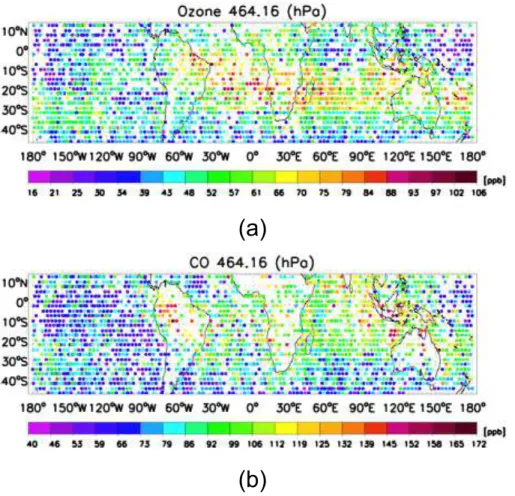
TES observations of ozone and CO are shown from 15 N to 30 S at 464 hPa from 4– 16 November 2004 in Fig. 2. The most notable feature is a band of elevated ozone starting from eastern Brazil through both the Atlantic and Indian Oceans and extending
5
into the Pacific. The highest ozone concentrations are observed both over the tropical Atlantic (>100 ppbv) and over Madagascar. This pervasive zonal ozone distribution has been observed from satellites, in particular from the total ozone mapping spectrometer (TOMS) using a tropospheric ozone residual technique (Fishman and Larsen,1987;
Fishman et al., 1991, 2003). This distribution is due in part to the recirculation of
10
ozone and ozone precursors between South America and sub-equatorial Africa over the Atlantic (Kalnay et al., 1996; Krishnamurti et al., 1996; Thompson et al., 1996;
Sinha et al.,2004).
In addition, a high pressure system centered over Australia, low monthly averaged cloud optical depths from the International Satellite Cloud Climatology Project (ISCCP)
15
(Rossow and Schiffer,1991;Rossow et al.,1993) (available at http://isccp.giss.nasa.
gov/), and relatively high biomass burning (van der Werf et al.,2006) indicate condi-tions favorable to ozone formation. TES observacondi-tions of mid-tropospheric ozone show enhanced values extending northwest of Australia into Indonesia, which have been associated with El Ni ˜no conditions (Thompson et al.,2001;Chandra et al.,2007).
20
TES observations of CO show a plume from South America extending into the west-ern Pacific consistent with previous satellite and aircraft observations (Chatfield et al.,
2002; Edwards et al., 2006). These concentrations in conjunction with MODIS fire-counts are indicative of a continued presence of continental emission sources even as the southern hemisphere transitions to its Austral summer, wet season. Similar to TES
25
ozone, Indonesia-Australia region shows elevated concentrations of TES CO compara-ble to South America and sub-equatorial Africa. In addition, the pervasive high values of CO across the Indian ocean are suggestive of recirculation of emissions between
ACPD
8, 1505–1548, 2008 Impact of surface emissions K. W. Bowman et al. Title Page Abstract Introduction Conclusions References Tables Figures ◭ ◮ ◭ ◮ Back CloseFull Screen / Esc
Printer-friendly Version
Interactive Discussion
EGU
continents, which is consistent with studies from the Southern African Fire-Atmosphere Research Initiative (SAFARI), e.g., (Garstang et al.,1996).
3.1 Comparison of TES ozone to the SHADOZ network
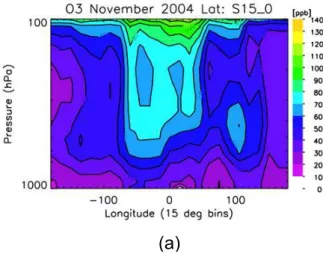
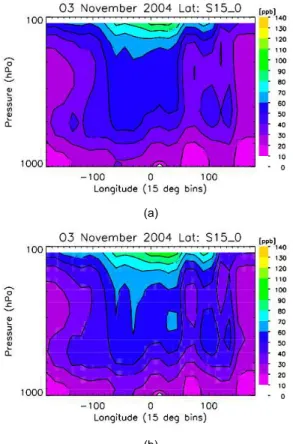
The vertical distribution of ozone over the southern tropics as observed by TES is shown in Fig.3where the TES observations have been averaged in 15◦bins between
5
the equator and 30 S. There were roughly 30 observations for each bin. A pervasive high in ozone is evident across the tropical Atlantic with values up to about 80 ppb from 15 S to the equator. This distribution follows the so-called “wave-one” pattern (
Thomp-son et al.,2000;Logan,1999). From Fig.3a there is a secondary ozone enhancement over Indonesia-northern Australia between 90 E–100 E and 400–500 hPa. A similar
10
picture emerges based on ozone sondes drawn from the SHADOZ network (
Thomp-son et al.,2003a) for November 2004, which is shown in Fig. 4. A total of 30 sondes were used in the average ranging from just one sonde measurement at Java to 6 sonde measurements at Natal. In the tropical Atlantic between 0 and 30 W, Ascencion (8 S, 14.4 W) and Natal (5.8 S, 35.2 W) show middle tropospheric values between 60–
15
80 ppb, consistent with TES observations in Fig.3. At the Java site (7.5 S, 112.6 E), elevated ozone concentrations of 50–70 ppb are observed between 700-400 hPa while TES observations over the same region indicate a similar enhancement. The vertical structure of the ozone over Indonesia is somewhat different than ozone enhancements over the tropical Atlantic and western Indian Ocean suggesting that different processes
20
are controlling ozone formation there.
The vertical distribution of TES ozone from 30 S to 15 S are shown in Fig.3b. Ele-vated ozone stretches from Southern Brazil across the Atlantic and Africa into most of the Indian Ocean. This elevated ozone is pervasive from roughly 500–200 hPa. Com-parison between Pretoria (25.9 S, 28 E) and TES observations show similar values of
25
ozone (80–100 ppb) between 400–200 hPa whereas Reunion Island (21.1 S, 55.5 E) indicates significantly higher ozone above 200 hPa. Similar to the ozone distribution in Fig.2, higher amounts of ozone are seen throughout the troposphere over the Indian
ACPD
8, 1505–1548, 2008 Impact of surface emissions K. W. Bowman et al. Title Page Abstract Introduction Conclusions References Tables Figures ◭ ◮ ◭ ◮ Back CloseFull Screen / Esc
Printer-friendly Version
Interactive Discussion
EGU
Ocean relative to the remote Pacific by roughly 10–20 ppb, consistent with transport of ozone from South America, South Atlantic, and Africa into the Indian Ocean.
4 Signatures of lightning and surface NOx
The concentrations and distribution of NOx has a significant impact of the distribution of ozone (Jacob et al.,1996). In the southern hemisphere, the primary sources of
sur-5
face NOxare biomass burning, fossil fuel and biofuel combustion (Jaegl ´e et al.,2005).
These emissions can produce ozone near the surface which can in turn be convec-tively lofted into the upper troposphere (Chatfield and Delany,1990). However, NOx
from lightning is directly emitted into the upper troposphere and can play a dominant role in the production of tropical ozone (Pickering et al.,1998;Sauvage et al.,2007;
10
Martin et al.,2007;Boersma et al.,2005). The Lightning Imaging Sensor (LIS) aboard the Tropical Rainfall Measuring Mission (TRMM) estimates lightning flash counts by means of a high speed CCD imaging sensor (3–6 km horizontal resolution) in conjunc-tion with a narrow band (λ=777nm) filter. Lightning flash counts from LIS are shown in Fig.5 for November 2004. For this month, lightning flash counts are densely
dis-15
tributed over Northern Argentina and to a lesser extent southeastern Brazil, throughout tropical Africa and Southern Africa with rates exceeding 150. By comparison, Indone-sia/Northern Australia shows markedly less flash counts with rates generally less than 25. This distribution is consistent with the high pressure system from the NCEP reanal-ysis and the ISCCP cloud optical depth. Consequently, we could expect the regional
20
contribution of ozone from lightning NOx over Indonesia/Australia to be less than the
regional contribution of lightning to South America and Africa.
The distribution of lower tropospheric NO2 can be investigated from monthly aver-aged tropospheric NO2columns derived from the Ozone Monitoring Instrument (OMI,
(Levelt et al.,2006)), which are shown in Fig.6for November 2004. The columns are
25
calculated using the the retrieval-assimilation algorithm described in (Boersma et al.,
hori-ACPD
8, 1505–1548, 2008 Impact of surface emissions K. W. Bowman et al. Title Page Abstract Introduction Conclusions References Tables Figures ◭ ◮ ◭ ◮ Back CloseFull Screen / Esc
Printer-friendly Version
Interactive Discussion
EGU
zontal resolutions of 25×24 km2 have been gridded onto a 0.5◦×0.5◦ grid. To avoid situations with clouds screening the NO2 underneath, only cloud-free (cloud radiance
fraction <50%) observations were taken. The estimated uncertainty for individual OMI observations is on the order of 30–50% for situations with appreciable NO2 columns
(>1 1015molec/cm2), but it is anticipated that the averaging of large numbers of pixels
5
here reduces the uncertainty of the monthly average to within 5–10%. Given these uncertainties, NO2 tropospheric column values on the order of 8 10
15
molec/cm2 are concentrated south of the mouths of the Amazon in Brazil as well as Northern Aus-tralia. With the exception of Johannesburg region in South Africa where values ap-proach 20 1015molec/cm2 , there are no high concentrations of tropospheric NO2 in
10
sub-equatorial Africa.
5 Comparison of GEOS-Chem to TES estimates of CO and ozone
5.1 Description of GEOS-Chem
The GEOS-Chem global chemistry and transport model was originally described by
(Bey et al., 2001). The simulation conducted for the November 2004 used
GEOS-15
Chem v7.02.04 (http://www-as.harvard.edu:16080/chemistry/trop/index.html) driven by GEOS-4 assimilated meteorological observations from the NASA Global Modeling and Assimilation Office (GMAO). The GEOS-4 observations have a temporal resolution of 6 h (3 h for surface variables and mixing depths), a horizontal resolution of 1◦×1.25◦, and 55 vertical layers. Here we degrade the horizontal resolution to 2◦
×2.5◦ from the
20
surface up to 0.01 hPa. The model includes a complete description of tropospheric O3
-NOx-hydrocarbon chemistry, including sulfate aerosols, black carbon, organic carbon,
sea salt, and dust. Anthropogenic emissions in the model are described in (Duncan
et al.,2007). Extensive evaluations of the GEOS-Chem tropospheric ozone simulations have been conducted by (Wu et al.,2007;Martin et al.,2002;Liu et al.,2006).
ACPD
8, 1505–1548, 2008 Impact of surface emissions K. W. Bowman et al. Title Page Abstract Introduction Conclusions References Tables Figures ◭ ◮ ◭ ◮ Back CloseFull Screen / Esc
Printer-friendly Version
Interactive Discussion
EGU
5.2 Comparison of GEOS-Chem to TES CO over the southern tropics
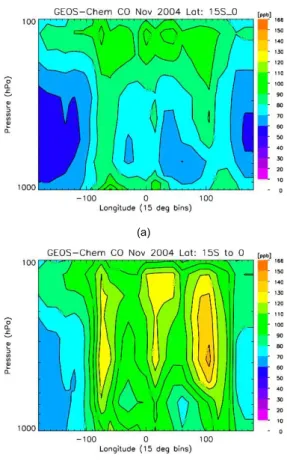
The GEOS-Chem CO zonal distribution from 15◦S to the equator is shown in Fig. 7a. The results are averaged from 4–16 November 2004 in 15◦
×15◦bins. This simulation used climatological biomass burning emissions, which result in elevated values of CO over South America, Africa, and Indonesia/Australia. In the lower and middle
tropo-5
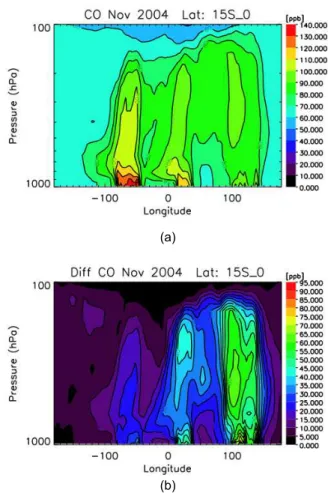
sphere CO over South America dominates the region with values up to 40 ppb higher than Indonesia/Australia. The zonal distribution of TES CO from 15◦S-0 is shown in Fig.8. These retrievals also are averaged in 15◦longitudinal bins with roughly 20–30 observations per bin. For comparison, the GEOS-Chem CO fields were sampled at the coincident TES observation coordinates and the TES observation operator, see
10
Eq. (5), was applied as shown in Fig. 9a. There is significant disagreement both in the magnitude and relative distribution of the GEOS-Chem and TES CO observations with differences up to 40 ppb. TES observations in Fig.8show that CO over Indone-sia/Australia was as high as that over South America.
TES CO observations were used to estimate the CO source emissions over the
15
globe in (Jones et al.,2007). The a priori and a posteriori emissions for South Amer-ica, sub-equatorial AfrAmer-ica, and Australia/Indonesia are listed in Table1. For this time period, the emissions were estimated to be over twice as high as those in the a priori simulation. The GEOS-Chem results at the TES resolution and sampling with the a posteriori emission are shown in Fig.9b. The a posteriori CO distribution from
GEOS-20
Chem between 15◦S and the equator is in remarkably good agreement with the TES observations shown in Fig.8.
The response of GEOS-Chem CO fields to changes in the emissions is shown in Fig. 7b. The maximum increase in CO is over the Indonesia/Australia region is al-most 100 ppb or 85% near the surface and approximately 60 ppb or a 65% increase
25
throughout the free troposphere. Over the Indian Ocean, the CO distribution in GEOS-Chem increased by about 35 ppb over the Indian Ocean and around 45 ppb over sub-equatorial Africa in the 200–400 hPa region. Over South America, the increase is
ACPD
8, 1505–1548, 2008 Impact of surface emissions K. W. Bowman et al. Title Page Abstract Introduction Conclusions References Tables Figures ◭ ◮ ◭ ◮ Back CloseFull Screen / Esc
Printer-friendly Version
Interactive Discussion
EGU
modest – no more than 30 ppb.
5.3 Comparison of GEOS-Chem to TES ozone over the southern tropics
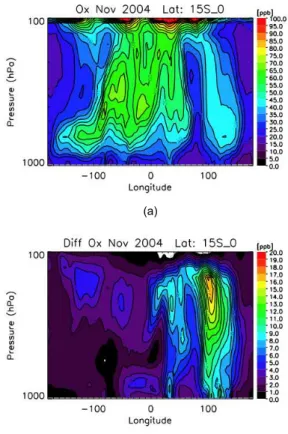
The zonal distribution of ozone from the GEOS-Chem model with a priori emissions is shown in the top panel of Fig.10a from 15◦S-0 averaged in the same manner as CO. GEOS-Chem follows the familiar “wave-one” pattern (Thompson et al., 2003b) with
5
enhanced values of ozone across the tropical Atlantic. However, there is a modest secondary maximum in ozone over Indonesia/Australia relative to the Pacific. This en-hancement is also observed in Fig.11a where the TES observation operator has been applied to the GEOS-Chem fields. In both cases, the ozone amounts are less than those observed by TES in Fig.3over both the tropical Atlantic and Indonesia/Australia.
10
The ozone distribution from GEOS-Chem was also calculated based on the revised emissions where the NOx emissions were scaled with the CO a posteriori emission estimates. The GEOS-Chem fields with the a posteriori emissions sampled along the TES observations are shown in Fig.11b. There is an increase in upper tropospheric ozone at 200 hPa over the tropical Atlantic and at 280 hPa over sub-equatorial Africa.
15
In addition, an overall increase of about 10 ppb throughout the troposphere can be seen over Indonesia/Australia. Use of the a posteriori emissions improves agreement between the model and TES ozone, but significant discrepancies remain.
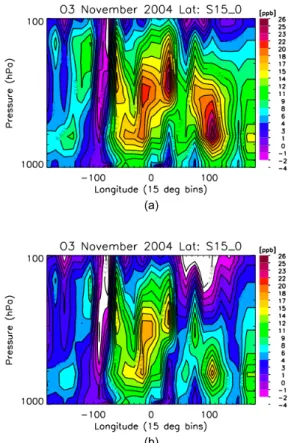
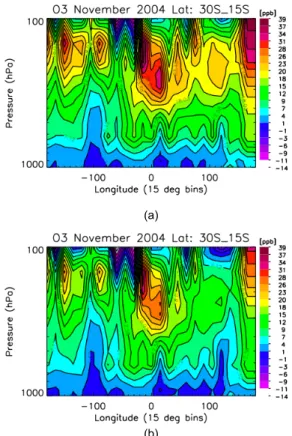
The difference between the TES observations of ozone and GEOS-Chem with a pri-ori (top panels) and a posteripri-ori (bottom panels) emissions are shown in Fig.12 for
20
15 S to the equator and Fig.13 for 30 S to 15 S. The top panels show the largest dif-ferences in ozone are centered over the Atlantic and Indonesia. With the a posteriori emissions, the bottom panels show an overall decrease in ozone differences that is fairly uniform zonally. Over the tropical Atlantic, the difference between GEOS-Chem and TES are reduced by roughly 5 ppb from 30 S-0. The reduction over the
Indone-25
sia/Australia region in the mid-troposphere is more substantial: up to 10 ppb. On the other hand, the upper tropospheric ozone differences at 100 E and 100 W from 15 S-0 increased with the a posteriori emissions. With those exceptions, TES observations
ACPD
8, 1505–1548, 2008 Impact of surface emissions K. W. Bowman et al. Title Page Abstract Introduction Conclusions References Tables Figures ◭ ◮ ◭ ◮ Back CloseFull Screen / Esc
Printer-friendly Version
Interactive Discussion
EGU
are higher everywhere relative to GEOS-Chem.
In contrast to the a posteriori CO comparisons with TES observations (Fig.9), there remains significant residual differences in ozone. This residual indicates that assump-tions used in the emissions are incorrect, e.g., the relative distribution of CO to NOx, pathways relating those emissions to ozone formation are deficient, or background
5
processes have not be properly described. Over the Atlantic, the residual differences and their spatial structure can be attributed in part to ozone generated from lightning NOx. In (Sauvage et al., 2007), increasing the intra-cloud to ground-to-cloud flash
ratio to 0.75 for lightning NOx formation considerably improved agreement between
GEOS-Chem and SHADOZ network ozone for the September-October-November
sea-10
son (although this increase reduced agreement in other seasons). The peak changes in ozone to this ratio were centered between 500–300hPa over the Ascension Islands and increased ozone there by 10–20 ppb, which is consistent with the residual differ-ence in Fig.12b. In addition, there is a residual difference over Indonesia/Australia at 600 hPa of up to 15 ppb that can not be explained by surface emissions. This difference
15
may reflect deficiencies in sources of NOx from regional lightning, vertical mixing, or
assumed composition of the emission sources.
5.4 Response of GEOS-Chem to changes in ozone and NOxdistribution from a
pos-teriori emission estimates
We can use the emission estimates to investigate chemical mechanisms linking those
20
emissions to the tropical ozone distribution and to interpret the residual differences be-tween TES and GEOS-Chem ozone distributions. The averaged difference bebe-tween GEOS-Chem ozone fields with a priori and a posteriori emissions are shown in Fig.10. The largest differences in ozone from the change in emissions are over the Indone-sia/Australia regions where ozone increases by up to 16 ppb in the upper troposphere
25
centered around 150 hPa. It is in this upper tropospheric region, as shown in Fig.12b, that GEOS-Chem ozone is greater than the TES observations by up to 15%. The amount of ozone produced, however, will be sensitive to the chemical composition of
ACPD
8, 1505–1548, 2008 Impact of surface emissions K. W. Bowman et al. Title Page Abstract Introduction Conclusions References Tables Figures ◭ ◮ ◭ ◮ Back CloseFull Screen / Esc
Printer-friendly Version
Interactive Discussion
EGU
the lofted emissions. Consequently, one interpretation is that the overestimate is due to uniform scaling of all combustion sources.
The ozone response to the emission changes over sub-equatorial Africa is approx-imately 8 ppb near the surface and around 200 ppb. Over South America, there were few changes in the ozone distribution, consistent with a modest increase in emission
5
strengths. Curiously, there was a significant increase in ozone in the remote Pacific centered around 150 S in the upper troposphere (>15%).
The principle chemical mechanism for the ozone response in the free troposphere to changes in surface emissions is the ambient NOxdistribution. CO is assumed to be
a tracer of emissions generally and consequently all the emissions, including NOx, are
10
scaled along with the CO emissions derived from the inverse analysis. However, the NOx zonal distribution has a different response to the scaled emissions than the CO
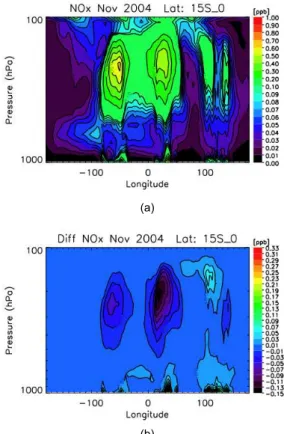
distribution. The NOx distribution based on the GEOS-Chem a priori emissions and
the change in mean zonal NOx from the a posteriori emissions are shown in Fig.14. The a priori NOxfields are highest over South America where the values are up to 6–7
15
times higher than over Indonesia/Australia and up to twice as high as sub-equatorial Africa. The concentrations of NOxin the free troposphere are due primarily to lightning sources (Pickering et al., 1998; Folkins et al., 2006), with the South American and sub-equatorial African regions exhibiting a much larger source of NOx from lightning
than the Indonesian/Australian regions. Qualitatively, this distribution is consistent with
20
the LIS observations in Fig. 5. Associated with the higher concentrations of NOx,
the model simulation with the a priori emissions also produces more ozone (Fig. 10) over South America and sub-equatorial Africa than over Indonesia/Australia. The low ozone abundance over Indonesia/Australia, however, also reflects convective transport of ozone-poor marine air to the upper troposphere (Lelieveld et al.,2001). Enhanced
25
ozone over South America and sub-equatorial Africa results in greater concentrations of OH (by more than a factor of 2) over these regions, which together with the higher NOx levels leads to significantly more HNO3 (by almost an order of magnitude) over
ACPD
8, 1505–1548, 2008 Impact of surface emissions K. W. Bowman et al. Title Page Abstract Introduction Conclusions References Tables Figures ◭ ◮ ◭ ◮ Back CloseFull Screen / Esc
Printer-friendly Version
Interactive Discussion
EGU
The greatest increase in free tropospheric NOx(100 ppt) to the a posteriori emissions is centered over the Java Sea (115 E) at 150 hPa just to the east of the high NOx
concentrations over Sumatra (105 E). Conversely the greatest decrease (>120 ppt) in free tropospheric NOxis located over the western coast of Africa. In addition, there is a significant decrease over South America (>55 ppt) centered at 250 hPa. The response
5
of free tropospheric NOx to increases in the surface emissions, which include surface
NOx, is a non-linear function of both the ambient amounts of ozone, NOx, and OH along with the chemical composition of lofted emissions. Over Indonesia/Australia the dominant sink for NOx is formation of peroxyacetylnitrate (PAN), whereas over South
America and Africa NOx is lost through formation of PAN and HNO3(due to the higher
10
levels OH in these regions). In addition, the NO/NO2ratio is lower over South America and Africa because of the higher abundances of ozone in these regions. This enhances the conversion of NOx to PAN and HNO3.
Another important difference between the three tropical continental regions is the distribution of organics such as acetaldehyde, acetone, and formaldehyde in the free
15
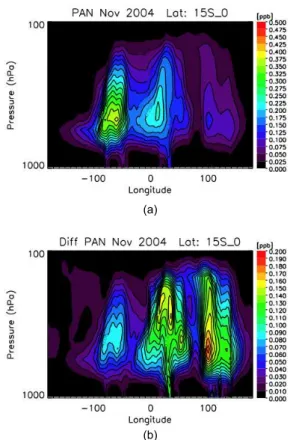
troposphere. Acetaldehyde, for example, is oxidized by reaction with OH to produce peroxyacetyl radicals (CH3C(O)OO) that in turn react with NO2to form PAN. The mean difference in PAN concentrations between the simulations with the a priori and a poste-riori emissions is shown in Fig.15. The response of upper tropospheric PAN to surface emission changes above Africa is over 150 ppt, which is roughly 50% greater than
20
over Indonesia/Australia. Tropospheric PAN also increased over South America with changes up to 100 ppt. We can conclude that, for this time period, increases in surface emissions over South America and sub-equatorial Africa preferentially lead to the for-mation of PAN at the expense of NOxand consequently mute the production of ozone.
On the other hand, increased surface emissions in Indonesia/Australia, while leading
25
to enhanced PAN, do not lead to a reduction of NOx due to the overall lower back-ground concentrations of NOx, OH, and carbonyl compounds. Consequently, ozone
production is regionally enhanced. The different responses to increased emissions over these three regions illustrate the importance of both background meteorological
ACPD
8, 1505–1548, 2008 Impact of surface emissions K. W. Bowman et al. Title Page Abstract Introduction Conclusions References Tables Figures ◭ ◮ ◭ ◮ Back CloseFull Screen / Esc
Printer-friendly Version
Interactive Discussion
EGU
conditions and the particular chemical composition of the emissions in linking ozone production to surface emissions. These responses must be characterized in order to reduce uncertainty both in present day and future changes in ozone (Horowitz,2006).
6 Conclusions
We have investigated the processes controlling the zonal distribution of tropical
tropo-5
spheric ozone with a focus on the sensitivity of that distribution to changes in surface emissions between South America, sub-equatorial Africa, and Indonesia/Australia for November, 2004.
Against the backdrop of the “wave-one” pattern of elevated ozone in the tropical Atlantic, TES ozone profiles also indicate enhanced values over Indonesia/Australia
10
with volume mixing ratios up to 70 ppb at 600 hPa. This enhancement is consistent with a SHADOZ sonde observation over Java. Co-located CO profiles from TES and NO2
columns from OMI indicate concentrations over Indonesia/Australia are comparable to those over South America and Africa.
From this observational context, we assessed the contribution of surface emissions
15
to tropical ozone using GEOS-Chem simulations with a posteriori emissions derived from a linear inverse model, which was based on TES and MOPITT CO developed in (Jones et al., 2007). Based on over a factor of 2 increase in surface emissions in sub-equatorial Africa and Indonesia/Australia, the overall difference between TES and GEOS-Chem ozone was reduced throughout the troposphere between 30 S-0.
20
Over Africa and Indonesia/Australia the discrepancies between GEOS-Chem and TES decreased by roughly 10 ppb.
While there was overall improvement between TES ozone observations and GEOS-Chem, there remained substantial disagreements. Maximum residual differences of approximately 18 ppb are seen between 15 S-0 and 30 ppb between 30 S–15 S. In the
25
upper troposphere over the Eastern Indian Ocean and parts of the Western Pacific, GEOS-Chem overestimated the ozone distributions by 5 ppb.
ACPD
8, 1505–1548, 2008 Impact of surface emissions K. W. Bowman et al. Title Page Abstract Introduction Conclusions References Tables Figures ◭ ◮ ◭ ◮ Back CloseFull Screen / Esc
Printer-friendly Version
Interactive Discussion
EGU
The residual differences in ozone of 10–20 ppb in the mid-troposphere over the trop-ical Atlantic are consistent with the differences found in (Sauvage et al.,2007) associ-ated with underestimates of lightning NOxformation in GEOS-Chem for the
September-October-November season. In addition, there is a residual difference over Indone-sia/Australia at 600 hPa of up to 15 ppb that can not be explained by surface emissions.
5
We investigated these residual differences further by examining the spatial patterns in GEOS-Chem estimates of ozone, CO, and NOx from changes between the a
pri-ori and a posteripri-ori surface emissions. The greatest change to the free tropospheric ozone distribution from 15 S-0 was over Indonesia (<16 ppb) at 175 hPa, consistent with maximum positive changes in NOx (<100 ppt) and CO (<70 ppb). Consequently,
10
free tropospheric ozone over Indonesia/Australia is sensitive to changes in regional surface emissions and these emissions make a significant contribution to the regional ozone budget.
On the other hand, the free tropospheric NOx distribution declined over Africa and South America with losses exceeding 150 ppt. We examined the PAN response as a
15
possible loss mechanism for the NOx. Maximum increases in PAN, which reached over
150 ppt, corresponded to the maximum decreases in the NOx distribution. Therefore, conversion of NOx to PAN can partially explain the decreases in NOx in response to
increases in surface emission over South America and Africa. If this mechanism is cor-rect, then the sensitivity of the tropical Atlantic ozone to changes in surface emissions
20
of NOx is low because of the large ambient distribution of ozone and NOx from
light-ning. However, the enhanced PAN could lead to additional ozone formation downwind through conversion of PAN back to NOx (Staudt et al.,2003).
Based on scenarios discussed in the IPCC-4, the tropical latitudes are particularly sensitive to climate change in terms of precipitation and land-use(Solomon et al.,
25
2007). Based on our results, the emissions from Indonesia/Australian are an important contributor to the zonal tropical ozone distribution both in terms of the ozone produced and in the sensitivity of ozone to changes in those emissions. Given the complex feedbacks between land-use, biomass burning, biofuel production, plant productivity,
ACPD
8, 1505–1548, 2008 Impact of surface emissions K. W. Bowman et al. Title Page Abstract Introduction Conclusions References Tables Figures ◭ ◮ ◭ ◮ Back CloseFull Screen / Esc
Printer-friendly Version
Interactive Discussion
EGU
and CO2 uptake and emission, (Levine,1999;Sitch et al.,2007;Lohman et al.,2007;
Forster et al.,2007), quantifying the present and future impact of surface emissions to tropical ozone will be critical for understanding chemistry-climate coupling.
Acknowledgements. This work was performed, in part, at the Jet Propulsion Laboratory,
Cali-fornia Institute of Technology, under a contract with the National Aeronautics and Space
Admin-5
istration (NASA). J. Logan was funded by a grant from NASA to Harvard University. D. Jones was supported by funding from the Natural Sciences and Engineering Research Council of Canada. We also thank the SHADOZ program for making the sonde data accessible.
References
Arellano, A. F., Kasibhatla, P. S., Giglio, L., van der Werf, G. R., Randerson, J. T., and Collatz,
10
G. J.: Time-dependent inversion estimates of global biomass-burning CO emissions using Measurement of Pollution in the Troposphere (MOPITT) measurements, J. Geophys. Res, 111, D09303, doi:10.1029/2005JD006613, 2006. 1507
Beer, R. and Glavich, T.: Remote Sensing of the Troposphere by Infrared Emissions Spec-troscopy, Appl. Optics, 1129, 42–51, 1989. 1509
15
Bey, I., Jacob, D. J., Yantosca, R. M., Logan, J. A., Field, B. D., Fiore, A. M., Li, Q., Liu, H. Y., Mickley, L. J., and Schultz, M. G.: Global modeling of tropospheric chemistry with assimilated meteorology: Model description and evaluation, J. Geophys. Res., 106(D19), 23 073–23 095, 2001. 1516
Boersma, K., Eskes, H. J., Veefkind, J. P., Brinskma, E. J., van der A, R. J., Sneep, M., van den
20
Oord, G. H. J., Levelt, P. F., Stammes, P., Gleason, J. F., and Bucsela, E. J.: Near-real time retrieval of tropospheric NO2from OMI, Atmos. Chem. Phys., 7, 2103–2118, 2007,
http://www.atmos-chem-phys.net/7/2103/2007/. 1515
Boersma, K. F., Eskes, H. J., and Brinksma, E. J.: Error analysis for tropospheric NO2retrieval from space, J. Geophys. Res.-Atmospheres, 109, D04311, doi:10.1029/2003JD003962,
25
2004. 1515
Boersma, K. F., Eskes, H. J., Meijer, E. W., and Kelder, H. M.: Estimates of lightning NOx production from GOME satellite observations, Atmos. Chem. Phys., 5, 2311–2331, 2005,
ACPD
8, 1505–1548, 2008 Impact of surface emissions K. W. Bowman et al. Title Page Abstract Introduction Conclusions References Tables Figures ◭ ◮ ◭ ◮ Back CloseFull Screen / Esc
Printer-friendly Version
Interactive Discussion
EGU
Bowman, K., Worden, J., Steck, T., Worden, H., Clough, S., and Rodgers, C.: Capturing time and vertical variability of tropospheric ozone: A study using TES nadir retrievals, J. Geophys. Res., 107, 4723, doi:10.1029/2002JD002150, 2002. 1510
Bowman, K. W., Rodgers, C. D., Kulawik, S. S., Worden, J., Sarkissian, E., Osterman, G., Steck, T., Lou, M., Eldering, A., Shephard, M., Worden, H., Lampel, M., Clough, S., Brown,
5
P., Rinsland, C., Gunson, M., and Beer, R.: Tropospheric Emission Spectrometer: Retrieval Method and Error Analysis, IEEE T. Geosci. Remote, 44, doi:10.1109/TGRS.2006.871234, 2006. 1510
Chandra, S., Ziemke, J. R., Schoeberl, M. R., Froidevaux, L., Read, W. G., Levelt, P. F., and Bhartia, P. K.: Effects of the 2004 El Ni ˜no on tropospheric ozone and water vapor, Geophys.
10
Res. Lett., 34, L06802, doi:10.1029/2006GL028779, 2007. 1513
Chatfield, R. B. and Delany, A.: Convection links biomass burning to increased tropical ozone: However, models will tend to overpredict O3, J. Geophys. Res.-Atmospheres, 95(D11), 18 473–18 488, 1990. 1515
Chatfield, R. B., Guo, Z., Sachse, G. W., Blake, D. R., and Blake, N. J.: The subtropical global
15
plume in the Pacific Exploratory Mission-Tropics A (PEM-Tropics A), PEM-Tropics B, and the Global Atmospheric Sampling Program (GASP): How tropical emissions affect the remote Pacific, J. Geophys. Res., 107(D16), doi:10.1029/2001JD000497, 2002. 1513
Duncan, B. N., Bey, I., Chin, M., Mickley, L. J., Fairlie, T. D., Martin, R. V., and Matsueda, H.: Indonesian wildfires of 1997: Impact on tropospheric chemistry, J. Geophys. Res., 108,
20
4458, doi:10.1029/2002JD003195, 2003a. 1507
Duncan, B. N., Martin, R. V., Staudt, A. C., Yevich, R., and Logan, J. A.: Interannual and seasonal variability of biomass burning emissions constrained by satellite observations, J. Geophys. Res., 108, 4100, doi:10.1029/2002JD002378, 2003b.1507
Duncan, B. N., Logan, J. A., Bey, I., Megretskaia, I. A., and Yantosca, R. M.: The global
25
budget of CO, 1988-1997: source estimates and validation with a global model, J. Geophys. Res.,112, D22301, doi:10.1029/2007JD008459, 2007. 1516
Edwards, D. P., Emmons, L. K., Gille, J. C., Chu, A., Atti ´e, J.-L., Giglio, L., Wood, S. W., Haywood, J., Deeter, M. N., Massie, S. T., Ziskin, D. C., and Drummond, J. R.: Satellite-observed pollution from Southern Hemisphere biomass burning, J. Geophys. Res., D14312,
30
doi:10.1029/2005JD006655, 2006. 1513
Fishman, J. and Larsen, J. C.: Distribution of total ozone and stratospheric ozone in the tropics: Implications for the distribution of tropospheric ozone, J. Geophys. Res., 92, 6627–6634,
ACPD
8, 1505–1548, 2008 Impact of surface emissions K. W. Bowman et al. Title Page Abstract Introduction Conclusions References Tables Figures ◭ ◮ ◭ ◮ Back CloseFull Screen / Esc
Printer-friendly Version
Interactive Discussion
EGU
1987. 1507,1513
Fishman, J., Ramanathan, V., Crutzen, P. J., and Liu, S. C.: Tropospheric ozone and climate, Nature, 282, 818–820, doi:10.1038/282818a0, 1979. 1507
Fishman, J., Fakhruzzaman, K., Cros, B., and Nganga, D.: Identification of Widespread Pollu-tion in the Southern Hemisphere deduced from satelite analyses, Science, 252, 1693–1696,
5
1991. 1507,1508,1513
Fishman, J., Wozniak, A. E., and Creilson, J. K.: Global distribution of tropospheric ozone from satellite measurements using the empirically corrected tropospheric ozone residual tech-nique: Identification of the regional aspects of air pollution, Atmos. Chem. Phys., 3, 2003.
1513 10
Folkins, I., Bernath, P., Boone, C., Donner, L. J., Eldering, A., Lesins, G., Martin, R. V., Sinnhu-ber, B.-M., and Walker, K.: Testing convective parameterizations with tropical measurements of HNO3, CO, H2O, and O3: Implications for the water vapor budget, J. Geophys. Res., 111, D23304, doi:10.1029/2006JD007325, 2006. 1520
Forster, P., Ramaswamy, V., Artaxo, P., Berntsen, T., Betts, R., Fahey, D., Haywood, J., Lean, J.,
15
Lowe, D., Myhre, G., Nganga, J., Prinn, R., Raga, G., Schulz, M., and Dorland, R. V.: Climate Change 2007: The Physical Science Basis. Contribution of Working Group I to the Fourth Assessment Report of the Intergovernmental Panel on Climate Change, chap. Changes in Atmospheric Constituents and in Radiative Forcing, 131–217, Cambridge University Press, 2007. 1524
20
Garstang, M., Tyson, P. D., Swap, R., Edwards, M., Kallberg, P., and Lindesay, J. A.: Horizontal and vertical transport of air over southern Africa, J. Geophys. Res., 101, 23 721–23 736, 1996. 1514
Hauglustaine, D., Emmons, L., Newchurch, M., Brasseur, G., Takao, T., Matsubara, K., John-son, J., Ridley, B., Stith, J., and Dye, J.: On the Role of Lightning NOx in the Formation of
25
Tropospheric Ozone Plumes: A Global Model Perspective, J. Atmos. Chem., 38, 277–294, 2001. 1508
Horowitz, L.: Past, present, and future concentrations of tropospheric ozone and aerosols: Methodology, ozone evaluation, and sensitivity to aerosol wet removal, J. Geophys. Res., 111, D22211, doi:10.1029/2005JD006937, 2006. 1522
30
Jacob, D., Heikes, B. G., Fan, S.-M., Logan, J. A., Mauzerall, D. L., Bradshaw, J. D., Singh, H. B., Gregory, G. L., Talbot, R. W., Blake, D. R., and Sachse, G. W.: Origin of ozone and NOx in the tropical troposphere: A photochemical analysis of aircraft observations over the
ACPD
8, 1505–1548, 2008 Impact of surface emissions K. W. Bowman et al. Title Page Abstract Introduction Conclusions References Tables Figures ◭ ◮ ◭ ◮ Back CloseFull Screen / Esc
Printer-friendly Version
Interactive Discussion
EGU
South Atlantic basin, J. Geophys. Res., 101(D19), 24 235–24 250, doi:10.1029/96JD00336, 1996. 1507,1515
Jacob, D. J.: Introduction to Atmospheric Chemistry, Princeton University Press, New Jersey, 1999. 1507
Jaegl ´e, L., Steinberger, L., Martin, R. V., and Chance, K.: Global partitioning of NOx sources
5
using satellite observations: Relative roles of fossil fuel combustion, biomass burning and soil emissions, Faraday Discuss., 130, 407–423, doi:10.1039/b502128f, 2005. 1515
Jenkins, G. S. and Ryu, J.-H.: Space-borne observations link the tropical atlantic ozone maximum and paradox to lightning, Atmos. Chem. Phys., 4, 361–375, available at:
http://www.atmos-chem-phys.net/4/361/2004/acp-4-361-2004.pdf, 2004a. 1507 10
Jenkins, G. S. and Ryu, J.-H.: Linking horizontal and vertical transports of biomass fire emis-sions to the tropical Atlantic ozone paradox during the Northern Hemisphere winter season: climatology, Atmos. Chem. Phys., 4, 449–469, 2004b. 1507
Jones, D. B. A., Bowman, K. W., Palmer, P. I., Worden, J. R., Jacob, D. J., Hoffman, R. N., Bey, I., and Yantosca, R. M.: Potential of observations from the Tropospheric Emission
Spec-15
trometer to constrain continental sources of carbon monoxide, J. Geophys. Res., 108, 4789, doi:10.1029/2003JD003702, 2003. 1512
Jones, D. B. A., Bowman, K. W., Logan, J. A., and et al: Integrated analysis of carbon monoxide emissions from biomass burning using data from the TES and MOPITT satellite instruments, Atmos. Chem. Phys. Discuss., 2007. 1506,1508,1517,1522,1533
20
Jourdain, L., Worden, H. M., Worden, J. R., Bowman, K., Li, Q., Eldering, A., Kulawik, S. S., Osterman, G., Boersma, K. F., Fisher, B., Rinsland, C. P., Beer, R., and Gun-son, M.: Tropospheric vertical distribution of tropical Atlantic ozone observed by TES dur-ing the northern African biomass burndur-ing season, Geophys. Res. Lett., 34, L04810, doi: 10.1029/2006GL028284, 2007. 1507
25
Kalnay, E., Kanamitsu, M., Kistler, R., Collins, W., Deaven, D., Gandin, L., Iredell, M., Saha, S., White, G., Woollen, J., Zhu, Y., Chellah, M., Ebisuzaki, W., Higgins, W., Janowiak, J., Mo, K. C., Ropelewski, C., Wang, J., Leetma, A., Reynolds, R., Jenne, R., and Joseph, D.: The NCEP/NCAR 40-Year and Reanalysis Project, B. Am. Meteorol. Soc., 77, 437–471, 1996.
1513 30
Kiehl, J. T., Schneider, T. L., Portmann, R. W., and Solomon, S.: Climate forcing due to tropo-spheric and stratotropo-spheric ozone, J. Geophys. Res., 104, 31 239–31 254, 1999. 1507
Ja-ACPD
8, 1505–1548, 2008 Impact of surface emissions K. W. Bowman et al. Title Page Abstract Introduction Conclusions References Tables Figures ◭ ◮ ◭ ◮ Back CloseFull Screen / Esc
Printer-friendly Version
Interactive Discussion
EGU
cob, D. J., and Logan, J.: Passive tracer transport relevant to the TRACE A experiment, J. Geophys. Res., 101, 23 889–23 908, doi:10.1029/95JD02419, 1996.1513
Lacis, A., Wuebbles, D. J., and Logan, J. A.: Radiative forcing of climate by changes in the vertical distribution of ozone, J. Geophys. Res., 95(D7), 9971–9981, 1990. 1507
Lelieveld, J., Crutzen, P. J., Ramanathan, V., Andreae, M. O., Brenninkmeijer, C. A. M.,
Cam-5
pos, T., Cass, G. R., Dickerson, R. R., Fischer, H., de Gouw, J. A., Hansel, A., Jefferson, A., Kley, D., de Laat, A. T. J., Lal, S., Lawrence, M. G., Lobert, J. M., Mayol-Bracero, O. L., Mitra, A. P., Novakov, T., Oltmans, S. J., Prather, K. A., Reiner, T., Rodhe, H., Scheeren, H. A., Sikka, D., and Williams, J.: The Indian Ocean Experiment: Widespread Air Pollution from South and Southeast Asia, Science, 291, 1031–1036, doi:10.1126/science.1057103, 2001.
10
1520
Levelt, P. F., Gijsbertus, van den Oord, H. J., Dobber, M. R., M ¨alkki, A., Visser, H., de Vries, J., Stammes, P., Lundell, J. O. V., and Saari, H.: The Ozone Monitoring Instrument, IEEE T. Geosci. Remote , 44, 1093–1101, 2006. 1515
Levine, J. S.: The 1997 fires in Kalimantan and Sumatra, Indonesia: Gaseous and particulate
15
emissions, Geophys. Res. Lett., 26(7), 815–818, 1999. 1524
Li, Q., Jacob, D. J., Bey, I., Palmer, P. I., Duncan, B. N., Field, B. D., Martin, R. V., Fiore, A. M., Yantosca, R. M., Parrish, D. D., Simmonds, P. G., and Oltmans, S. J.: Transatlantic transport of pollution and its effects on surface ozone in Europe and North America, J. Geophys. Res., 107, doi:10.1029/2001JD001422, 2002.1507
20
Liu, X., Chance, K., Sioris, C. E., Kurosu, T. P., Spurr, R. J. D., Martin, R. V., Fu, T.-M., Logan, J. A., Jacob, D. J., Palmer, P. I., Newchurch, M. J., Megretskaia, I. A., and Chatfield, R. B.: First directly retrieved global distribution of tropospheric column ozone from GOME: Com-parison with the GEOS-CHEM model, J. Geophys. Res., 111, doi:10.1029/2005JD006564, 2006. 1516
25
Logan, J.: An Analysis of ozonesonde data for the troposphere: Recommendations for testing 3-D models and development of a gridded climatology for tropospheric ozone, J. Geophys. Res., 104, 16 115–16 149, 1999. 1514
Logan, J. A. and Kirchoff, V.: Seasonal variations of tropospheric ozone at Natal, Brazil, J. Geophys. Res., 91, 7875–7881, 1986.1508
30
Lohman, D. J., Bickford, D., and Sodhi, N. S.: The Burning Issue, Science, 316, 2007.1524
Luo, M., Rinsland, C., Fisher, B., Sachse, G., Diskin, G., Logan, J., Worden, H., Kulawik, S., Osterman, G., Eldering, A., Herman, R., and Shephard, M.: TES carbon monoxide validation
ACPD
8, 1505–1548, 2008 Impact of surface emissions K. W. Bowman et al. Title Page Abstract Introduction Conclusions References Tables Figures ◭ ◮ ◭ ◮ Back CloseFull Screen / Esc
Printer-friendly Version
Interactive Discussion
EGU
with DACOM aircraft measurements during INTEX-B 2006, J. Geophys. Res., 112, D24S48, doi:10.1029/2007JD008803, 2007a.1510
Luo, M., Rinsland, C. P., Rodgers, C. D., Logan, J. A., Worden, H., Kulawik, S., Eldering, A., Goldman, A., Shephard, M. W., Gunson, M., and Lampel, M.: Comparison of carbon monoxide measurements by TES and MOPITT – the influence of a priori data and instrument
5
characteristics on nadir atmospheric species retrievals, J. Geophys. Res., D09303, doi:10. 1029/2006JD007663, 2007b. 1510
Marenco, A., Thouret, V., N ´ed ´elec, P., Athierlec, G., Smit, H., Helten, M., Kley, D., Karcher, F., Simon, P., Law, K., Pyle, J., Poschmann, G., Wrede, R. V., Hume, C., and Cook, T.: Measure-ment of ozone and water vapor by Airbus in-service aircraft: The MOZAIC airborne program,
10
An overview, J. Geophys. Res., 103, 25 631–25 642, doi:10.1029/98JD00977, 1998. 1508
Martin, R., Jacob, D. J., Logan, J. A., Ziemke, J. M., and Washington, R.: Detection of a lightning influence on tropical tropospheric ozone, Geophys. Res. Lett., 27, 1639–1642, 2000. 1507
Martin, R. V., Jacob, D. J., Logan, J. A., Bey, I., Yantosca, R. M., Staudt, A. C., Li, Q., Fiore, A. M., Duncan, B. N., and Liu, H.: Interpretation of TOMS observations of tropical
tropo-15
spheric ozone with a global model and in situ observations, J. Geophys. Res., 107, 4351, doi:10.1029/2001JD001480, 2002.1507,1508,1516
Martin, R. V., Sauvage, B., Folkins, I., Sioris, C. E., Boone, C., Bernath, P., and Ziemke, J.: Space-based constraints on the production of nitric oxide by lightning, J. Geophys. Res., 112, D09309, doi:10.1029/2006JD007831, 2007. 1515
20
Naik, V., Mauzerall, D., Horowitz, L., Schwarzkopf, M. D., Ramaswamy, V., and Oppenheimer, M.: Net radiative forcing due to changes in regional emissions of tropospheric ozone precur-sors, J. Geophys. Res., 110, D24306, doi:10.1029/2005JD005908, 2005. 1507
Nassar, R., Logan, J., Worden, H., Megretskaia, I. A., Bowman, K., Osterman, G., Thompson, A. M., Tarasick, D. W., Austin, S., Claude, H., Dubey, M. K., Hocking, W. K., Johnson, B. J.,
25
Joseph, E., Merrill, J., Morris, G. A., Newchurch, M., Oltmans, S. J., Posny, F., and Schmidlin, F.: Validation of Tropospheric Emission Spectrometer (TES) Nadir Ozone Profiles Using Ozonesonde Measurements, J. Geophys. Res, in press, 2007.1509
Oltmans, S. J., Johnson, B. J., J. M. Harris, H. V., Thompson, A. M., Koshy, K., Simon, P., Bendura, R. J., Logan, J. A., Hasebe, F., Shiotani, M., Kirchhoff, V. W. J. H., Maata, M.,
30
Sami, G., Samad, A., Tabuadravu, J., Enriquez, H., Agama, M., Cornejo, J., and Paredes, F.: Ozone in the Pacific tropical troposphere from ozonesonde observations, J. Geophys. Res., 106, 32 503–32 526, 2001. 1508
ACPD
8, 1505–1548, 2008 Impact of surface emissions K. W. Bowman et al. Title Page Abstract Introduction Conclusions References Tables Figures ◭ ◮ ◭ ◮ Back CloseFull Screen / Esc
Printer-friendly Version
Interactive Discussion
EGU
Osterman and et al: Tropospheric Emission Spectrometer TES L2 Data User’s Guide, Tech. Rep. V3.00, Jet Propulsion Laboratory, California Institute of Technology, Pasadena, CA, 2007. 1509,1511
Osterman, G., Kulawik, S., Worden, H., Richards, N., Fisher, B., Eldering, A., Shephard, M., Froidevaux, L., Labow, G., Luo, M., Herman, R., and Bowman, K.: Validation of Tropospheric
5
Emission Spectrometer (TES) Measurements of the Total, Stratospheric and Tropospheric Column Abundance of Ozone, J. Geophys. Res., in press, 2007. 1510
Pickering, K., Wang, Y., Tao, W.-K., Price, C., and M ¨uller, J.-F.: Vertical distributions of light-ning NOx for use in regional and global chemical transport models, J. Geophys. Res., 103, 31 203–31 216, 1998. 1507,1515,1520
10
Portmann, R. W., Solomon, S., Fishman, J., Olson, J., Kiehl, J., and Briegleb, B.: Radiative forc-ing of the Earth’s climate system due to tropical tropospheric ozone production, J. Geophys. Res., 102(D8), 9409–9417, 1997.1507
Richards, N. A. D., Osterman, G. B., Browell, E. V., Avery, M., and Li, Q.: Validation of Tro-pospheric Emission Spectrometer (TES) Ozone Profiles with Aircraft Observations During
15
INTEX-B, J. Geophys. Res., in press, 2007.1510
Rodgers, C.: Inverse Methods for Atmospheric Sounding: Theory and Practise, World Scien-tific, London, 2000. 1511
Rossow, W. and Schiffer, R.: ISCCP Cloud Data Products, B. Am. Meteorol. Soc., 72, 2–20, 1991. 1513
20
Rossow, W., Walker, A., and Garder, L.: Comparison of ISCCP and Other Cloud Amounts, J. Climate, 6, 2394–2418, 1993. 1513
Sauvage, B., Martin, R. V., van Donkelaar, A., Liu, X., Chance, K., Jaegl ´e, L., Palmer, P. I., Wu, S., and Fu, T.-M.: Remote sensed and in situ constraints on processes affecting tropical tropospheric ozone, Atmos. Chem. Phys., 7, 815–838, 2007,
25
http://www.atmos-chem-phys.net/7/815/2007/. 1508,1515,1519,1523
Sinha, P., Jaegl ´e, L., Hobbs, P. V., and Liang, Q.: Transport of biomass burning emissions from southern Africa, J. Geophys. Res., 109, D20204, doi:10.1029/2004JD005044, 2004. 1513
Sitch, S., Cox, P. M., Collins, W. J., and Huntingford, C.: Indirect radiative forcing of climate change through ozone effects on the land-carbon sink, Nature, doi:10.1038/nature06059,
30
2007. 1524
Solomon, S., Qin, D., Manning, M., Alley, R., Berntsen, T., Bindoff, N., Chen, Z., Chidthaisong, A., Gregory, J., Hegerl, G., Heimann, M., Hewitson, B., Hoskins, B., Joos, F., Jouzel, J.,
ACPD
8, 1505–1548, 2008 Impact of surface emissions K. W. Bowman et al. Title Page Abstract Introduction Conclusions References Tables Figures ◭ ◮ ◭ ◮ Back CloseFull Screen / Esc
Printer-friendly Version
Interactive Discussion
EGU
Kattsov, V., Lohmann, U., Matsuno, T., Molina, M., Nicholls, N., Overpeck, J., Raga, G., Ra-maswamy, V., Ren, J., Rusticucci, M., Somerville, R., Stocker, T., Whetton, P., Wood, R., and Wratt, D.: Climate Change 2007: The Physical Science Basis. Contribution of Working Group I to the Fourth Assessment Report of the Intergovernmental Panel on Climate Change, chap. Technical Summary, 20–90, Cambridge University Press, 2007. 1523
5
Staudt, A. C., Jacob, D. J., Ravetta, F., Logan, J. A., Bachiochi, D., Krishnamurti, T. N., Sand-holm, S., Ridley, B., Singh, H. B., and Talbot, B.: Sources and chemistry of nitrogen oxides over the tropical Pacific, J. Geophys. Res., 108, 8239, doi:10.1029/2002JD002139, 2003.
1523
Thompson, A., Doddridge, B. G., Witte, J. C., Hudson, R. D., Luke, W. T., Johnson, J. E.,
10
Johnson, B. J., Oltmans, S. J., and Weller, R.: A tropical Atlantic ozone paradox: Shipboard and satellite views of a tropospheric ozone maximum and wave-one in January – February 1999, Geophys. Res. Lett., 27, 3317–3320, 2000. 1508,1514
Thompson, A. M., Diab, R. D., Bodeker, G. E., Zunckel, M., Coetzee, G. J. R., Archer, C. B., McNamara, D. P., Pickering, K. E., Combrink, J., Fishman, J., and Nganga, D.: Ozone over
15
southern Africa during SAFARI-92/TRACE A, J. Geophys. Res., 101, 23 793–23 708, 1996.
1513
Thompson, A. M., Witte, J. C., Hudson, R. D., Guo, H., Herman, J. R., and Fujiwara, M.: Tropical Tropospheric Ozone and Biomass Burning, Science, 291, 128–2132, 2001. 1508,1513
Thompson, A. M., Witte, J. C., McPeters, R. D., Oltmans, S. J., Schmidlin, F. J., Logan, J. A.,
20
Fujiwara, M., Volker, Kirchhoff, W. J. H., Posny, F., Coetzee, G. J. R., Hoegger, B., Kawakami, S., Ogawa, T., Johnson, B. J., V ¨omel, H., and Labow, G.: Southern Hemisphere Additional Ozonesondes (SHADOZ) 1998–2000 tropical ozone climatology 1. Comparison with Total Ozone Mapping Spectrometer (TOMS) and ground-based measurements, J. Geophys. Res., 108, 8238, doi:10.1029/2001JD000967, 2003a.1514
25
Thompson, A. M., Witte, J. C., Oltmans, S. J., Schmidlin, F. J., Logan, J. A., Fujiwara, M., Kirch-hoff, V. W. J. H., Posny, F., Coetzee, G. J. R., Hoegger, B., Kawakami, S., Ogawa, T., Fortuin, J. P. F., and Kelder, H. M.: Southern Hemisphere Additional Ozonesondes (SHADOZ) 1998 – 2000 tropical ozone climatology 2. Tropospheric variability and the zonal wave-one, J. Geo-phys. Res., 108, 8241, doi:10.1029/2002JD002241, 2003b.1508,1518
30
van der Werf, G. R., Randerson, J. T., Giglio, L., Collatz, G. J., Kasibhatla, P. S., and A. F. Arel-lano, J.: Interannual variability in global biomass burning emissions from 1997 to 2004, At-mos. Chem. Phys., 6, 3423–3441, available at: www.atmos-chem-phys.net/6/3423/2006/,
ACPD
8, 1505–1548, 2008 Impact of surface emissions K. W. Bowman et al. Title Page Abstract Introduction Conclusions References Tables Figures ◭ ◮ ◭ ◮ Back CloseFull Screen / Esc
Printer-friendly Version
Interactive Discussion
EGU
2006. 1513
Worden, H. M., Logan, J. A., Worden, J. R., Beer, R., Bowman, K., Clough, S. A., Eldering, A., Fisher, B. M., Gunson, M. R., Herman, R. L., Kulawik, S. S., Lampel, M. C., Luo, M., Megret-skaia, I. A., Osterman, G. B., and Shephard, M.: Comparisons of Tropospheric Emission Spectrometer (TES) ozone profiles to ozonesondes: methods and initial results, J. Geophys.
5
Res., 112, D03309, doi:10.1029/2006JD007258, 2007. 1510
Worden, J., Kulawik, S. S., Shepard, M., Clough, S., Worden, H., Bowman, K., and Goldman, A.: Predicted errors of Tropospheric Emission Spectrometer nadir retrievals from spectral window selection, J. Geophys. Res., 109, D09308, doi:10.1029/2004JD004522, 2004. 1510
Wu, S., Mickley, L., Jacob, D., Logan, J., Yantosca, R., and Rind, D.: Why are there large
10
differences between models in global budgets of tropospheric ozone?, J. Geophys. Res., 112, D05302, doi:10.1029/2006JD007801, 2007. 1516
Zhang, L., Jacob, D. J., Bowman, K. W., Logan, J. A., Turquety, S., Hudman, R. C., Li, Q., Beer, R., Worden, H. M., Worden, J. R., Rinsland, C. P., Kulawik, S. S., Lampel, M. C., Shephard, M. W., Fisher, B. M., Eldering, A., and Avery, M. A.: Ozone-CO correlations determined by
15
the TES satellite instrument in continental outflow regions, Geophys. Res. Lett., 33, L18804, doi:10.1029/2006GL026399, 2006. 1507