HAL Id: hal-00298909
https://hal.archives-ouvertes.fr/hal-00298909
Submitted on 6 Nov 2007HAL is a multi-disciplinary open access
archive for the deposit and dissemination of sci-entific research documents, whether they are pub-lished or not. The documents may come from teaching and research institutions in France or abroad, or from public or private research centers.
L’archive ouverte pluridisciplinaire HAL, est destinée au dépôt et à la diffusion de documents scientifiques de niveau recherche, publiés ou non, émanant des établissements d’enseignement et de recherche français ou étrangers, des laboratoires publics ou privés.
Assessing the biodegradability of terrestrially-derived
organic matter in Scottish sea loch sediments
P. S. Loh, A. E. J. Miller, A. D. Reeves, S. M. Harvey, J. Overnell
To cite this version:
P. S. Loh, A. E. J. Miller, A. D. Reeves, S. M. Harvey, J. Overnell. Assessing the biodegradability of terrestrially-derived organic matter in Scottish sea loch sediments. Hydrology and Earth System Sciences Discussions, European Geosciences Union, 2007, 4 (6), pp.4005-4035. �hal-00298909�
HESSD
4, 4005–4035, 2007 Assessment of the biodegradability of terrestrial organic matter P. S. Loh et al. Title Page Abstract Introduction Conclusions References Tables Figures ◭ ◮ ◭ ◮ Back Close Full Screen / EscPrinter-friendly Version Interactive Discussion Hydrol. Earth Syst. Sci. Discuss., 4, 4005–4035, 2007
www.hydrol-earth-syst-sci-discuss.net/4/4005/2007/ © Author(s) 2007. This work is licensed
under a Creative Commons License.
Hydrology and Earth System Sciences Discussions
Papers published in Hydrology and Earth System Sciences Discussions are under open-access review for the journal Hydrology and Earth System Sciences
Assessing the biodegradability of
terrestrially-derived organic matter in
Scottish sea loch sediments
P. S. Loh1,*, A. E. J. Miller2, A. D. Reeves3, S. M. Harvey2, and J. Overnell2
1
UHI Millennium Institute, Scottish Association for Marine Science, Dunstaffnage Marine Laboratory, Oban PA37 1QA, Scotland, UK
2
Scottish Association for Marine Science, Dunstaffnage Marine Laboratory, Oban PA37 1QA, Scotland, UK
3
Environmental Systems Research Group, Geography Department, University of Dundee, Dundee DD1 4HN, Scotland, UK
*
now at: Institute of Marine Geology and Chemistry, National Sun Yat-Sen University, Kaohsiung, Taiwan, Republic of China
Received: 22 October 2007 – Accepted: 24 October 2007 – Published: 6 November 2007 Correspondence to: P. S. Loh ([email protected])
HESSD
4, 4005–4035, 2007 Assessment of the biodegradability of terrestrial organic matter P. S. Loh et al. Title Page Abstract Introduction Conclusions References Tables Figures ◭ ◮ ◭ ◮ Back Close Full Screen / EscPrinter-friendly Version Interactive Discussion
Abstract
Lignin oxidation products were used to determine the sources, transport and distribu-tion of terrestrially-derived organic matter (OM) in two Scottish sea lochs, Loch Creran and Loch Etive. Oxygen uptake rates, molar OC/N ratios (from bulk elemental anal-ysis) and Rp values (from loss on ignition experiments, the ratio of the refractory to
5
total OM) were also determined for sediments along transects of the lochs. Lignin data indicate the importance of riverine inputs, contributing land-derived carbon to the lochs as total lignin (Λ, mg/100 mg organic carbon, OC) decreased from 0.69 to 0.45 and 0.70 to 0.29 from the head to outside of Lochs Creran and Etive, respectively. In addi-tion, significant correlations for lignin content against total OM and OC (p<0.05) also
10
suggest a distinct contribution of terrestrial OM to carbon pools in the lochs. The gen-eral trend of decreasing oxygen uptake rates from the head (20.8 mmole m−2day−1) to
mouth (9.4 mmole m−2day−1) of Loch Creran indicates decomposition of some
terres-trial OM. Biodegradability of the sediment OM was also characterized by the increase of Rp values from the head to mouth of the lochs: 0.40 to 0.80 for Etive and 0.43 to
15
0.63 in Creran. Further, the molar OC/N ratio decreased from 11.2 to 6.4 in Creran, and from 17.5 to 8.2 in Etive. Our results show that the relatively fresh, terrestrially-derived OM, which is still susceptible to mineralization, plays an important role in fuelling the biogeochemical cycling of carbon in both systems. This work also demonstrates that oxygen uptake rate, Rp value and molar OC/N ratio are able to serve as useful proxies
20
to indicate sediment biodegradability.
1 Introduction
Biodegradation is the biologically catalysed reduction in the complexity of chemicals and usually results in conversion of organic carbon (OC), nitrogen (ON), phosphorus and sulphur to inorganic products (Alexander, 1999). Hence, “biodegradability” refers
25
to the susceptibility of the organic matter (OM) to degradation; or to the “freshness” or 4006
HESSD
4, 4005–4035, 2007 Assessment of the biodegradability of terrestrial organic matter P. S. Loh et al. Title Page Abstract Introduction Conclusions References Tables Figures ◭ ◮ ◭ ◮ Back Close Full Screen / EscPrinter-friendly Version Interactive Discussion “quality” or “diagenetic state” of OM. Early attempts to determine biodegradability were
carried out by Westrich and Berner (1984), who studied oxygen uptake rates in labo-ratory incubated sediments. Studies have since used the oxygen uptake rate in intact incubated sediment cores, as this represents the amount of OM directly oxidised dur-ing aerobic degradation (Parsons et al., 1977; Henrichs, 1992; Overnell et al., 1995);
5
or due to oxidation of reduced species such as sulphide formed during anaerobic OM degradation (Elsgaard and Jorgensen, 1992). Others have used oxygen uptake rate as a measure of OM mineralization due to burrowing activities of benthic organisms (Wassman, 1984; Grant and Hargrave, 1987; Glud et al., 1994). However, these oxy-gen uptake rate determinations did not investigate the influence of OM source on the
10
rate of degradation.
Because of its resistance to microbial degradation, the use of lignin as a tracer to study land-derived OM has been well documented (Hedges and Parker, 1976; Hedges and Ertel, 1982; and references therein). Numerous studies have used lignin to study the distribution of marine and land-derived OM (Hedges and Parker, 1976; Wilson et al.,
15
1985; Mitra et al., 2000). The importance of riverine input contributing terrestrial debris into near shore sediments is also well documented (Liss et al., 1991; Milliman, 1991; Ward et al., 1994), as is an offshore decrease of lignin-derived phenols (Hedges and Parker, 1976; Miltner and Emeis, 2001; Bianchi et al., 2002). Studies conducted at the Lower St. Lawrence Estuary and Saguenay Fjord further reported lignin, together with
20
OC, total nitrogen and organic phosphate to indicate OM diagenesis (Louchouarn et al., 1997). Few have qualified, however, the role of terrestrial OM in these environments.
Lignin compounds are found only in vascular land plants (Sarkanen and Ludwig, 1971). The CuO oxidation consists of a series of steps involving oxidation, extraction, silylation and finally detection of lignin phenols by the gas chromatography. These lignin
25
phenols are present as a suite of eight simple lignin phenols, produced upon silylation as the trimethylsilylated forms (Hedges et al., 1982; Miltner and Emeis, 2000). Total lignin is the sum of vanillyl (V; vanillin, acetovanillone and vanillic acid), syringyl (S; syringaldehyde, acetosyringone and syringic acid) and cinnamyl (C; p-coumaric and
HESSD
4, 4005–4035, 2007 Assessment of the biodegradability of terrestrial organic matter P. S. Loh et al. Title Page Abstract Introduction Conclusions References Tables Figures ◭ ◮ ◭ ◮ Back Close Full Screen / EscPrinter-friendly Version Interactive Discussion ferulic acids) phenols, reported as Λ (mg/100 mg organic carbon, OC; Hedges and
Mann, 1979a).
These lignin phenols can be used to characterize different vegetation sources: for example, elevated S/V ratios are indicative of angiosperm tissues, whilst elevated C/V ratios indicate the presence of non-woody tissues (Hedges and Mann, 1979b; Bianchi
5
and Argyrou, 1997; Goni et al., 1998). The vanillic acid to vanillin ratio, (Ad/Al)v is indicative of the diagenetic state, as relatively high (Ad/Al)v indicates more degraded material (Hedges et al., 1982; Miltner and Emeis, 2001). Lignin parameters such as C/V, S/V and (Ad/Al)v ratios, along with molar OC/N ratios, have been used to study lignin diagenesis (Ishiwatari and Uzaki, 1987).
10
A valuable tool for linking OM source to sediment biodegradability is the Rp index (Kristensen, 1990). Calculated as the ratio of the refractory to total OM, the study showed that more easily degradable environmental samples have lower Rp value, and vice versa. Rp value, in conjunction with molar OC/N ratio, provides a strong tool to measure the sediment biodegradability. During the initial stage of OM degradation the
15
OC/N ratio increases due to preferential nitrogen utilization; later decreasing due to ni-trogen immobilization (Benner et al., 1991). Increase in the OC/N ratio also implies the presence of non-living material, whilst a decrease in the OC/N ratio, with an associated increase in (Ad/Al)v, indicates diagenesis (Pocklington and MacGregor, 1973).
What follows is a comparative study, relating lignin parameters to variables such as
20
oxygen uptake rate, Rp value and molar OC/N ratio in order to determine whether the biodegradability of sediment OM is influenced by terrestrial debris. The objectives of this work were: (i) to determine the potential for terrestrial OM to facilitate biogeochem-ical cycling in sea loch environments; and (ii) to determine whether oxygen uptake rate, molar OC/N ratio and Rp value could serve as proxies to indicate sediment
biodegrad-25
ability.
HESSD
4, 4005–4035, 2007 Assessment of the biodegradability of terrestrial organic matter P. S. Loh et al. Title Page Abstract Introduction Conclusions References Tables Figures ◭ ◮ ◭ ◮ Back Close Full Screen / EscPrinter-friendly Version Interactive Discussion
2 Materials and methods
2.1 Study areas
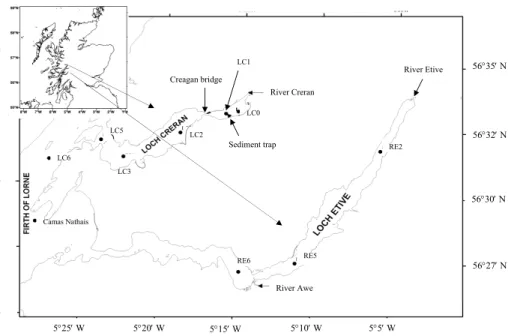
Lochs Creran and Etive are neighbouring sea lochs located on the west coast of Scot-land (Fig. 1). Over the lower ground surrounding the lochs and rivers, deciduous plants such as oak, beech and birch dominate. Gymnosperms such as spruce cover the
5
higher ground. 2.1.1 Loch Creran
Loch Creran is 12.8 km long with a surface area of 13.5 km2. This loch has a relatively small catchment area of 164 km2. The mean freshwater input is 286×106m3yr−1 and
the flushing time is three days (Edwards and Sharples, 1986). Since Creran is relatively
10
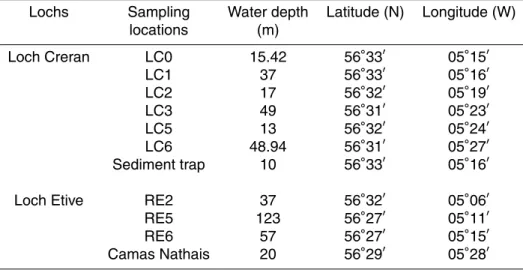
small and shallow, the seasonal hydrography follows the pattern of the Firth of Lorne and tidal flushing is sufficient to ensure mixing throughout the water column (Gage, 1972). There are four sills which separate the loch into distinct basins. There are five sampling locations situated along the length of the loch: LC0, LC1, LC2, LC3 and LC5; LC6 is located outside the loch in the Firth of Lorne. River Creran, at the head, is the
15
major source of freshwater input to the loch (Table 1, Fig. 1). 2.1.2 Loch Etive
The larger of the two lochs, Loch Etive, is 29.5 km long with surface area of 28.3 km2 and catchment of 1400 km2(Gage, 1972; Wood et al., 1973; Edwards and Edelstens, 1977). The mean freshwater input is 286×106m3yr−1 (Edwards and Sharples, 1986).
20
In Loch Etive there is prolonged water stratification. The residence time of isolated waters may extend up to 30 months, with a mean of 16 months. The large freshwater inflow, after prolonged periods of low freshwater runoff, controls an occasional ven-tilation and replenishment of the deep basins (Gage, 1972; Edwards and Grantham, 1986; Edwards and Trusdale, 1997). Loch Etive has a sill at the seaward entrance to
25
HESSD
4, 4005–4035, 2007 Assessment of the biodegradability of terrestrial organic matter P. S. Loh et al. Title Page Abstract Introduction Conclusions References Tables Figures ◭ ◮ ◭ ◮ Back Close Full Screen / EscPrinter-friendly Version Interactive Discussion the lower loch (Falls of Lora), and a shallow narrow at the opening to the upper loch
(Bonawe). Sample sites RE2 and RE5 are located in the upper loch, RE6 in the lower loch, and Camas Nathais in the Firth of Lorne (Table 1, Fig. 1). The major freshwater inputs are River Etive at the head of the loch, and River Awe at Bonawe (Gage, 1972; Edwards and Sharples, 1986).
5
2.2 Sampling and sample pre-treatment
Three undisturbed sediment cores were obtained from each location using a Craib corer (Craib, 1965) lined with an acrylic core tube of 24 cm long x 5.9 cm i.d. Site LC1 was visited at monthly intervals. All other locations were visited at four monthly intervals. Loch Etive was visited for three consecutive months. A sediment trap was
10
deployed in Loch Creran (see Table 1 for location) under 10 m of water. The trap consists of 11 cm i.d. and 100 cm long collecting tubes with removable clear plastic collecting tubes. The trap was serviced monthly. In the laboratory, sediments in the collecting tubes were allowed to settle, and the water siphoned out. The sediment slurry was then centrifuged at 600 x g for 10 min and after pouring off the supernatant,
15
was subjected to freeze-drying.
In the laboratory, oxygen uptake tests were carried out on whole sediment cores. Upon completion, the top 1 cm slice was removed from each core, frozen overnight and subjected to freeze-drying the following day. Dried sediments were then ground to fineness using a pestle and mortar for the lignin, loss on ignition and bulk elemental
20
determinations.
2.3 Analytical methods
2.3.1 Oxygen uptake rate analysis
Oxygen uptake rates were determined by measuring the decrease in dissolved oxygen concentration in the overlying water from incubated intact sediment cores (Parkes and
25
HESSD
4, 4005–4035, 2007 Assessment of the biodegradability of terrestrial organic matter P. S. Loh et al. Title Page Abstract Introduction Conclusions References Tables Figures ◭ ◮ ◭ ◮ Back Close Full Screen / EscPrinter-friendly Version Interactive Discussion Buckingham, 1986; Glud et al., 1994; Overnell et al., 1995). After collection, the core
tubes were sealed with rubber bungs and transported back to the laboratory. Here the cores were transferred to a container of seawater collected from 10 m below the sur-face at the sampling site (i.e. below the mixed layer). The cores were kept overnight in the dark at in situ temperature, with the upper bungs removed. The overlying water
5
column was gently aerated to maintain a saturated dissolved oxygen concentration. On the following day, submersible stirrers were fitted onto the core tubes, thus isolating the core and its overlying water. The stirring rate was adjusted to prevent stagnation of the overlying water without causing sediment resuspension (Overnell et al., 1995) in order to maintain uniform oxygen concentration. At time zero, replicate water samples
10
were collected from the container using 10 ml glass syringes. The samples were fixed immediately following collection. The cores were incubated for twenty four hours, after which three samples were collected from the overlying water of each core and fixed. The dissolved oxygen concentration was measured by Winkler titration with potentio-metric detection of the end point (Parkes and Buckingham, 1986). The oxygen uptake
15
rate was calculated from the difference in oxygen concentration of the overlying water between the start and end of the incubation. Method validation was based on repeated analyses of samples: 15 replicates of a single sample, plus routine triplicate analyses of all samples for environmental interpretation. The precision determine was over the range 0.10–7.90% coefficient of variation. Oxygen uptake rate was calculated after
20
Skoog et al. (1996) and Hansen (1999). 2.3.2 Lignin analysis
The alkaline CuO oxidation method used to extract lignin-derived phenols from envi-ronmental samples follows methods detailed in previous studies (Hedges and Ertel, 1982; Readman et al., 1986; Goni and Hedges, 1992). Approximately 0.5 g dry
sedi-25
ment was oxidized at 155◦C for three hours with 1.0 g CuO and 7 ml of 8% w/v NaOH
solution in an oxygen free atmosphere, in a PTFE-lined stainless-steel reaction vessel. Products which had been extracted three times with diethyl ether were spiked with the
HESSD
4, 4005–4035, 2007 Assessment of the biodegradability of terrestrial organic matter P. S. Loh et al. Title Page Abstract Introduction Conclusions References Tables Figures ◭ ◮ ◭ ◮ Back Close Full Screen / EscPrinter-friendly Version Interactive Discussion internal standard ethyl vanillin. The combined extracts and standards were treated with
anhydrous Na2SO4, filtered and rotary evaporated to near dryness.
The dried extract was subjected to a silylation process, to convert lignin phe-nols to their more thermodynamically stable trimethylsilylated forms. The ox-idation product was dissolved in 100 µl dried toluene. An equal volume of
5
bis(trimethylsilyl)trifluoroacetamide with 10% trimethylchlorosilane (BSTFA:TMCS = 10:1; Sigma Aldrich) was added as a catalyst (Poole, 1979). Samples were heated at 90◦C (Wilson et al., 1995) for 10 min and then analysed using a GC-FID
(Perkin-Elmer 8410) fitted with a 0.25 mm i.d. ×30 m of 100% dimethylpolysiloxane (ZB-1, Phenomenex, Zebron) column and a split ratio of 100:1. The initial temperature was
10
100◦C, increased at 5◦C per minute to 200◦C, and held for 10 min. For the second ramp,
the temperature increased at 20◦C per minute to 300◦C and this was held for 5 min.
Both injector and detector temperatures were 300◦C. The equilibration time was 2 min.
Based on replicate analyses the range of sample reproducibilities for total lignin con-centrations was 7.8–37.4% (coefficient of variation). Gas chromatography with mass
15
spectrometry (GC-MS) analysis was used to confirm the chemical nature of the lignin phenol compounds (Hedges and Parker, 1976; Onstad et al., 2000): a TRACE MS Thermo Quest, Finnigan instrument was used, fitted with a 0.25 mm i.d. ×30 m of 5% phenyl-methylpolysiloxane capillary column (RTX-5MS, RESTEK CORP.), employing a split ratio 100:1. The initial temperature was 100◦C, increasing at 5◦C per minute to
20
200◦C, and held for 10 min. For the second ramp, temperature was increased at 20◦C
per minute to 300◦C. The inlet temperature was 300◦C, the oven maximum temperature
was 350◦C and the equilibration time was 0.5 min.
2.3.3 Loss on ignition
Significant losses of mass between 250◦C and 300◦C have been observed (Mook and
25
Hoskin, 1982); hence 250◦C was used in this work as the initial combustion
tempera-ture. Although it is difficult to determine the exact type of materials burned off at 50◦C, it
is likely that most refractory terrestrial and aquatic OM will be included. Most inorganic 4012
HESSD
4, 4005–4035, 2007 Assessment of the biodegradability of terrestrial organic matter P. S. Loh et al. Title Page Abstract Introduction Conclusions References Tables Figures ◭ ◮ ◭ ◮ Back Close Full Screen / EscPrinter-friendly Version Interactive Discussion carbon has been shown to oxidize above 500◦C (Hirota and Szyper, 1975; Kristensen
and Andersen, 1987); hence 500◦C was used as the higher temperature.
Method validation was carried out by subjecting a single sample to repeated analy-ses. Approximately 0.5 g aliquots of dried sediment were weighed precisely into cru-cibles. These were ashed (250◦
C for 16 h) in a muffle furnace, cooled and reweighed.
5
Sediments were then heated to 500◦C (Kristensen and Andersen, 1987) for 16 h
(Sutherland, 1998), cooled and reweighed. The percentage weight losses after com-bustion at these two temperatures were defined as the % labile and % refractory OM respectively. The sum of % labile and % refractory OM was taken to be the % total OM. Rp value, the ratio of the refractory to total OM, is used to determine the stage
10
of decomposition of biogenic materials (Kristensen, 1990). Percentage reproducibil-ity obtained from validation experiments and sample analyses were within the range 10–20% coefficient of variation.
2.3.4 Bulk elemental and isotope analyses
For organic carbon (%OC) and total nitrogen (%TN) determinations, approximately
15
10 mg sediment samples were acidified with 1 ml of 5% w/v sulphurous acid in vials. These were allowed to stand overnight in a fume cupboard and were subsequently freeze-dried. The product was quantitatively transferred into tin capsules and CHN analyses were performed in triplicate using a LECO CHN-900 analyzer. For total car-bon (TC) determination, 10 mg dry sediment was transferred into 8×5 mm tin capsules
20
and analysed similarly. Sample reproducibilities for the %TC and %TN ranged from 0–20.6% and 0–19.2%, respectively.
For the carbon isotope determination, approximately 0.1 mg dried sediment was weighed into a 8×5 mm tin capsule and analysed using a 20–20 Stable Isotope An-alyzer (PD2 Europa Scientific Instruments). Percentage reproducibilities ranged from
25
0.0–16.9%. The standard used was L-isoleucine, which was pre-calibrated against a Pee Dee Belemnite (PDB; Bashkin, 2002) standard. The δ13C value was calculated from the measured carbon isotope ratios of the sample and standard gases (Degens,
HESSD
4, 4005–4035, 2007 Assessment of the biodegradability of terrestrial organic matter P. S. Loh et al. Title Page Abstract Introduction Conclusions References Tables Figures ◭ ◮ ◭ ◮ Back Close Full Screen / EscPrinter-friendly Version Interactive Discussion 1969; Boutton, 1991): δ13C(‰) = Rsample− Rstandard Rstandard × 10 3 where Rsample= 13
C/12C ratio in the sample, and Rstandard= 13
C/12C ratio in the standard.
3 Results
3.1 Yields of land-derived organic matter
5
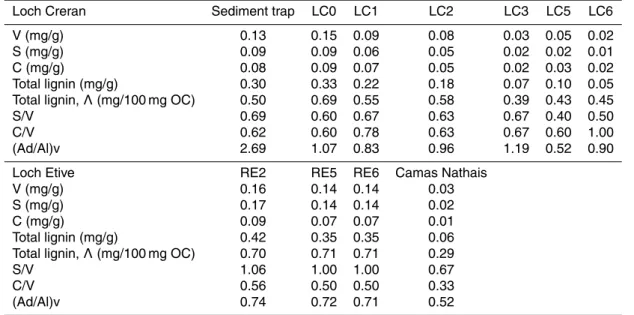
Overall, lignin parameters at individual locations exhibited no distinct change with time, hence these have been averaged for presentation in Table 2. The range of Λ values in Lochs Creran and Etive (0.29 to 0.71; Table 2) are within limits reported in the past for riverine, estuarine and marine sediments (Hedges and Mann, 1979b; Readman et al., 1986; Requejo et al., 1986; Ishiwatari and Uzaki, 1987; Prahl et al., 1994; Goni et
10
al., 1997 and 1998; Goni et al., 2000; Miltner and Emeis, 2001; Bianchi et al., 2002). It was found that vanillyl phenols are the major lignin oxidation products, followed by the syringyl and cinnamyl phenols. This is most probably because vanillyl phenols are produced by both angiosperms and gymnosperms; and syringyl phenols are produced only by angiosperms (Sarkanen and Ludwig, 1971; Hedges and Mann, 1979b; Hedges
15
et al., 1982).
In Loch Creran, the sediment trap and LC0 surface sediments yielded the highest abundance of vanillyl, syringyl and cinnamyl phenols. The highest Λ (0.50 and 0.69) were found in the trap and LC0 surface sediments. Further down the loch, Λ decreased to 0.55 at LC1, and increased slightly to 0.58 at LC2, decreased to 0.39 at LC3, and
in-20
creased slightly again to 0.43 (LC5) and 0.54 (LC6). Similar to Creran, Loch Etive also displays a significant trend of decreasing lignin content further from the freshwater in-put. Compared to Loch Creran, however, all three stations, RE2, RE5 and RE6 in Etive displayed a higher yield of total lignin with Λ ranging from 0.70 to 0.71. Camas Nathais
HESSD
4, 4005–4035, 2007 Assessment of the biodegradability of terrestrial organic matter P. S. Loh et al. Title Page Abstract Introduction Conclusions References Tables Figures ◭ ◮ ◭ ◮ Back Close Full Screen / EscPrinter-friendly Version Interactive Discussion in the Lynn of Lorne had by far the lowest Λ of 0.29 (ANOVA: p<0.05). Sediments from
Creran head and LC0 surface sediments both show the most depleted δ13C values of −25.0‰ and −25.2‰, respectively. Sediments from LC6 have the most enriched values (−14.4‰). Similarly in Loch Etive, the δ13C values increased seawards. RE2, RE5 and RE6 have an average δ13C value of approximately −25.8‰. Camas Nathais
5
has significantly the highest δ13C values of −13.5‰, however this could indicate pos-sible contribution of C4 plants (−11‰ to −16‰; Boom et al., 2001). These values indicate the dominance of terrestrial OM (−22‰ to −35‰; Cerling et al., 1995; Goni and Thomas, 2000) near the riverine input, with marine OM predominating seawards (−12‰ to −23‰; Gearing et al., 1984; Ruttenberg and Goni, 1997; Gordon and Goni,
10
2003).
3.2 Proxies for sediment biodegradability 3.2.1 Oxygen uptake rates
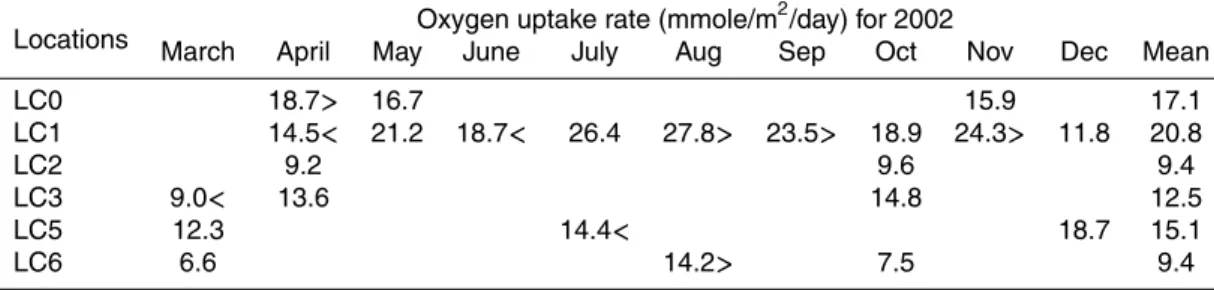
Results for the oxygen uptake rate analyses for Loch Creran are presented in Table 3. At LC0, oxygen uptake rates were highest during April (18.7 mmole m−2 day−1) and
15
decreased significantly during the following months (ANOVA: p<0.05). For other loca-tions, it seems that higher oxygen uptake rates occurred later in the year. The mean oxygen uptake rate at LC1 was 20.8 mmole m−2 day−1, whilst the observed trend for
LC1 was an increase from July to November 2002. This was probably due to microbial decomposition of the relatively fresh terrestrial OM. There are no significant differences
20
in the measured rates at LC2, whilst at LC3 the rate increased significantly from March to April, and was highest in October. At LC5 and LC6 the highest oxygen uptake rates occurred during December and August respectively. The mean rate within the upper most basin ranged from 17.1 to 20.8 mmole m−2day−1 (from LC0 to LC1) and in the
middle basin from 9.4 to 15.1 mmole m−2day−1(from LC2 to LC5).
25
HESSD
4, 4005–4035, 2007 Assessment of the biodegradability of terrestrial organic matter P. S. Loh et al. Title Page Abstract Introduction Conclusions References Tables Figures ◭ ◮ ◭ ◮ Back Close Full Screen / EscPrinter-friendly Version Interactive Discussion 3.2.2 Loss on ignition and bulk elemental composition
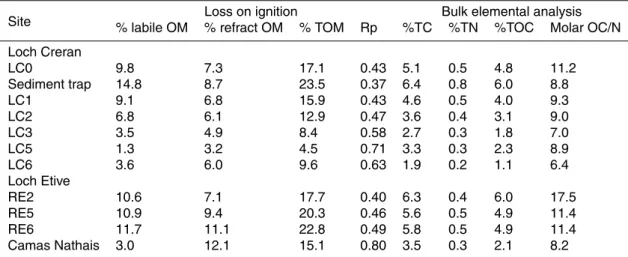
As there was also no significant trend for the loss on ignition and bulk elemental results at individual locations, mean data are presented in Table 4. Sediment trap materials had the highest contents of labile (14.8%), refractory (8.7%) and total OM (23.4%) compared to all surface sediments. This indicates that most of the OM in the water
5
column undergoes remineralization and/or transportation through the lochs. However, during transport, the OM and OC contents decreased significantly. Comparison be-tween surface sediments shows that the location nearest the river input (LC0) had the highest labile (9.8%), refractory (7.3%) and total OM (17.1%). Overall the Rp values increased significantly from 0.43 at LC0 to 0.63 outside the loch at LC6, whilst the
per-10
centage labile, refractory and total OM decreased from the head to mouth of the loch. The surface sediment molar OC/N ratios in Loch Creran also decreased significantly further down the loch: the highest was found at LC0 (11.2) and the lowest at LC 6 (6.4). Similarly, the %TC, %TN, and %TOC of surface sediments decreased from the head to mouth of Loch Creran (ANOVA: p<0.05). Of the surface sediments, LC0 had the
15
highest %TC (5.1), %TN (0.5) and %TOC (4.8) whilst LC6 had the lowest contents of %TC (1.9), %TN (0.2) and %TOC (1.1) respectively. Sediment trap material contained the highest %TC (6.4) and %TN (0.8).
In Loch Etive the % labile OM was relatively constant from RE2 to RE6, whilst % re-fractory OM increased by ∼56%. RE2, situated nearest the river input, had the highest
20
%TC and %TOC and molar OC/N ratio. RE5 and RE6 had almost the same values for these variables and %TN. Although a lower percentage of labile material was to be expected from RE2 to RE6, due to the degradation of inputs from River Etive, the nom-inal increase at RE5 may relate to autochthonous sources, whilst at RE6 the influence of River Awe is clear. Increases in the relative fraction of refractory material result from
25
degradation of labile material from River Etive and input of fresher terrestrial material from River Awe.
At Camas Nathais there was a dramatic decrease in % labile OM (74% lower than
HESSD
4, 4005–4035, 2007 Assessment of the biodegradability of terrestrial organic matter P. S. Loh et al. Title Page Abstract Introduction Conclusions References Tables Figures ◭ ◮ ◭ ◮ Back Close Full Screen / EscPrinter-friendly Version Interactive Discussion RE6), whilst % refractory OM remained of a similar order to the other stations: the
low-est %TC, %TN, %TOC and molar OC/N ratio were also observed. Seemingly, during transportation the OM undergoes decomposition hence the OM at Camas Nathais was quite highly degraded.
4 Discussion
5
4.1 Sources of terrestrial organic matter
The distribution of total OM and OC in both lochs is largely influenced by the terrestrial inputs from River Creran to Loch Creran, and Rivers Etive and Awe to Loch Etive. Total lignin (Λ, mg/100 mg OC) in the upper Loch Creran surface sediments ranged from 0.54 to 0.69, and in the lower loch from 0.39 to 0.45. The Λ values in the upper
10
Loch Etive surface sediments ranged from 0.70 to 0.71 within the loch, down to 0.29 at Camas Nathais. These results suggest the importance of Rivers Creran, Etive and Awe, contributing terrestrial materials to the respective lochs.
The contribution of terrestrially-derived materials to the sedimentary carbon inven-tory in the lochs was investigated by correlating total lignin with total OM and TC. Total
15
lignin was deemed significant in relation to % total OM and %TC, implying that terres-trial materials make a major contribution to total OM and TC in both lochs (regression analysis: p<0.05). %TC shows significant correlation (regression analyses: p<0.05) with total lignin in Loch Creran (r2=0.88, p<0.05, n=7) and Loch Etive (r2=0.99,
p<0.05, n=4). Terrestrial materials contribute significantly to the total OM and specif-20
ically to the labile fraction of OM, as shown by significant relationships between total lignin with % labile OM (regression analysis: r2=0.87; p<0.05; n=6) and lignin with % total OM (regression analysis: r2=0.67; p<0.05; n=6) along the length of Loch Creran, and lignin versus % labile OM (regression analysis: r2=0.93; p<0.05; n=4) in Loch Etive.
25
Due to the complex nature of the structure of lignin, its degradation is a slow process 4017
HESSD
4, 4005–4035, 2007 Assessment of the biodegradability of terrestrial organic matter P. S. Loh et al. Title Page Abstract Introduction Conclusions References Tables Figures ◭ ◮ ◭ ◮ Back Close Full Screen / EscPrinter-friendly Version Interactive Discussion (Hurst and Burges, 1967; Zeikus, 1980). Some authors found no quantifiable lignin
degradation in aerobic aquatic environments (Hedges et al., 1986; Ertel et al., 1986; Hamilton and Hedges, 1988) or in anaerobic environments (Eriksson et al., 1990). Be-cause of these findings, it might be expected that lignin would be found in the refractory OM fraction. This has not been identified in the systems studied here: lignin contents
5
do not have any correlation with the refractory fraction of OM. Whilst this may be due to the masking effects of variable inputs/components of the total OM, it may also indicate that refractory material includes lignin that has undergone diagenesis to an undefined structure such as ‘humus’ (Hurst and Burges, 1967; Christman and Oglesby, 1971; Zeikus, 1980; Hedges and Oades, 1997).
10
The characteristics, or sources, of plant materials are also determined from the sy-ringyl/vanillyl (S/V) and cinnamyl/vanillyl (C/V) ratios. As angiosperms produce more S than V phenols and gymnosperms produce only V, higher S/V ratios indicate a higher abundance of angiosperms. As only non-woody tissues produce C phenols, higher C/V ratios are indicative of non-woody materials (Leo and Barghoorn, 1970; Sarkanen and
15
Ludwig, 1971; Hedges and Mann, 1979b; Miltner and Emeis, 2001). The S/V ratios in Lochs Creran and Etive ranged from 0.40 to 1.06, with a mean value of 0.59 (from LC0 to LC5 surface sediments) within Creran and 0.94 (from RE2 to RE6) in Etive. The range of C/V ratios in both lochs is 0.33–1.00, with mean values of 0.66 within Creran and 0.52 within Etive. The S/V and C/V ratios in both lochs are higher than
20
other locations: for example the Washington continental shelf and slope (Hedges and Mann, 1979a; Prahl et al., 1994), Baltic Sea (Miltner and Emeis, 2001), Tamar Estuary (Readman et al., 1986) and Narragansett Bay Estuary (Requejo et al., 1986). Accord-ingly, these high ratios are indicative of the presence of non-woody angiosperm tissues (Hedges and Parker, 1976; Goni et al., 2000). These non-woody tissues most
prob-25
ably originate from the leaves of plants commonly found around the loch catchments: Hedges and Mann (1979a) considered leaves as the non-woody tissue of a plant.
HESSD
4, 4005–4035, 2007 Assessment of the biodegradability of terrestrial organic matter P. S. Loh et al. Title Page Abstract Introduction Conclusions References Tables Figures ◭ ◮ ◭ ◮ Back Close Full Screen / EscPrinter-friendly Version Interactive Discussion 4.2 Proxies for sediment biodegradability
4.2.1 Oxygen uptake rate
Seasonal studies show a slight increase in oxygen uptake rates at LC1 from July to September 2002; probably the result of enhanced microbial activity (Wassman, 1984; Parkes and Buckingham, 1986; Overnell et al., 1995). The oxygen uptake rates were
5
averaged and showed a significant decrease from the head to mouth of Loch Creran (Fig. 2; p<0.05). Overnell et al. (1995) determined the oxygen uptake rates for several locations along a transect of Loch Etive: locations E2, E7 and E9 are represented as RE2, RE5 and RE6 respectively in this study. Oxygen uptake rates decreased from RE2 (22.9 mmole m−2day−1) to RE5 (19.2 mmole m−2day−1) and it is concluded that
10
the high rate at RE6 (52.3 mmole m−2day−1) was most probably due to influence of
terrestrial input from the River Awe. The reoxidation of reduced species produced by, for example, sulphate reduction accounts for only 7–8% of the oxygen uptake rate (Overnell et al., 1995).
Results presented here, however, do seem to demonstrate a contribution from the
15
degradation of terrestrial OM to the oxygen uptake rate. The highest total lignin (Λ), % labile OM, % refractory OM, % total OM, %TC and %TOC (Table 4), significant correlations between lignin and labile, refractory and total OM and TC, and between labile, refractory and total OM with OC (p<0.05), were found in surface sediments near the riverine inputs. This clearly indicates a contribution of terrestrial OM to the carbon
20
in the lochs. Hence, the decrease in oxygen uptake rates from the head to mouth of the lochs strongly implies that terrestrial OM fuels biogeochemical cycling in the lochs. This terrestrially-derived OM appears to include much more labile material, with some susceptibility to decomposition in situ. Oxygen uptake rate has previously been seen to increase near the heads of lochs, implying the presence of a component of potentially
25
degradable terrestrial material (Rowe et al., 1994; Overnell et al., 1995; Accornero et al., 2003). The various authors did not, however, confirm the presence of terrestrial OM with a biomarker for terrestrial materials.
HESSD
4, 4005–4035, 2007 Assessment of the biodegradability of terrestrial organic matter P. S. Loh et al. Title Page Abstract Introduction Conclusions References Tables Figures ◭ ◮ ◭ ◮ Back Close Full Screen / EscPrinter-friendly Version Interactive Discussion The above arguments support the use of the oxygen uptake rate as a proxy to
mea-sure sediment biodegradability, as an increased rate indicates an increased mineraliza-tion rate of OM. The oxygen uptake rate determinamineraliza-tion provides a measure of aerobic OM degradation at the sediment-water interface, hence it is very closely related to the sedimentary OM and carbon content. The overall significant decrease in the sediment
5
oxygen uptake rates along the length of Loch Creran indicates that it can be used to provide an estimate of biodegradability.
4.2.2 Rp index
The Rp index can be used to provide an indirect measure of sediment biodegradability. As an operational ratio of the refractory to total OM concentrations, relatively high Rp
10
values indicate more refractory OM, or decreased ‘freshness’ or biodegradability of the sedimentary OM. The usefulness of Rp values is enhanced by correlating them with other parameters such as lignin and molar OC/N ratios. Lignin decreases down the lochs, indicating a reduction in the contribution of terrestrial materials seawards. Rp values show negative correlation with total lignin (Etive, r2=0.98; Creran r2=0.90),
15
%TC (r2=0.91, p<0.05, n=7) and %TN (r2=0.80, p<0.05, n=7) along the length of the lochs. These data imply that lignin material and carbon content decreased through the lochs and OM became increasingly refractory. Sediment OM near significant riverine inputs has higher biodegradability.
The reason for decreasing lignin concentration is due to (i) dilution with marine OM,
20
(ii) sedimentation, as supported by the decrease in OM, OC and lignin contents from the head to the mouth of the lochs and also higher OM content in the trap than surface sediment, and (iii) OM decomposition, as indicated by the more highly degraded OM in the surface sediments compared to trap materials.
The (Ad/Al)v values (Table 2) in Creran and Etive do not show a distinctive trend;
im-25
plying that the lignin materials had not undergone significant degradation in the lochs. The Rp values, however, do show a trend, increasing through the lochs seawards: from LC0 (0.43) to LC6 (0.63), and from RE2 (0.40) to Camas Nathais (0.80). This indicates
HESSD
4, 4005–4035, 2007 Assessment of the biodegradability of terrestrial organic matter P. S. Loh et al. Title Page Abstract Introduction Conclusions References Tables Figures ◭ ◮ ◭ ◮ Back Close Full Screen / EscPrinter-friendly Version Interactive Discussion that there was a fraction of labile terrestrial OM still susceptible to degradation. So,
whilst it is clear that Rp index can be used to measure sediment biodegradability, this should be interpreted in the overall context of terrestrial OM, oxygen uptake as well as OC/N ratio.
4.2.3 Molar OC/N ratio
5
Fresh plant materials have higher nitrogen content and their OM degrades relatively more rapidly (Waksman and Tenney, 1927). During the initial stage of OM degradation, molar OC/N ratios increase due to nitrogen utilization (Benner et al., 1991). Some cau-tion must be adopted when interpreting the results, however, as OC/N ratios also point to sources of organic matter: ∼7 for marine OM (Goni and Hedges, 1995; Bashkin,
10
2002) and >20 for terrestrial OM (Zimmerman and Canuel, 2001; Gordon and Goni, 2003). Bianchi and Argyrou (1997) and Bianchi et al. (2002) also found that terrestrial OM had higher OC/N ratios compared to marine OM. Hence, the molar OC/N ratios in the sediment trap (8.8), LC2 (9.0), LC5 (8.9), LC6 (6.4) and Camas Nathais (8.2) have a stronger marine signal than other locations; whilst LC0 (11.2), RE2 (17.5), RE5
15
(11.4) and RE6 (11.4) show greater terrestrial influence.
In trying to distinguish between vegetation source and OM degradation stage, Rp index data provide valuable additional information. For example, the slightly higher OC/N ratios at LC0 (mean OC/N = 11.2) and LC1 (OC/N = 9.3) sediments compared to the trap samples (OC/N = 8.8) could imply a relatively early stage of OM degradation
20
in the surface sediments. This is supported by the higher Rp values for LC0 (Rp = 0.43) and LC1 (Rp = 0.43) sediments compared to trap materials (Rp = 0.37). Hence it is inferred that the increase of OC/N ratios from the trap to surface sediment samples indicates that the sediment trap samples are less degraded. In the later stages of degradation the OC/N ratios decrease due to nitrogen immobilization (Benner et al.,
25
1991; Meyers, 1997). The decrease of OC/N ratios seawards through the lochs implies the utilization of carbon during the relatively more advanced stage of OM degradation: in Loch Creran OC/N decreased from 11.2 to 6.4 and in Loch Etive from 17.5 to 8.2.
HESSD
4, 4005–4035, 2007 Assessment of the biodegradability of terrestrial organic matter P. S. Loh et al. Title Page Abstract Introduction Conclusions References Tables Figures ◭ ◮ ◭ ◮ Back Close Full Screen / EscPrinter-friendly Version Interactive Discussion This is supported by the increase of Rp values from 0.43 to 0.63, and from 0.40 to
0.80 respectively. Chen et al. (2003) also found that OC/N ratios decreased during OM decomposition of plant and soil residues.
Previously, Kristensen (1990) reported that the Rp index provides a powerful tool to characterize the bulk composition of various biogenic materials at different stages of
5
decomposition. As a result of this study, however, we have shown that Rp index and molar OC/N values can be used together to indicate OM diagenesis.
5 Conclusions
Lignin studies indicate that rivers provide an important source of land-derived carbon to Lochs Creran and Etive. Non-woody angiosperm tissues predominate in these two
10
Scottish sea lochs. Although woody plants such as beech, birch and oak are found in abundance around both lochs, these non-woody tissues are indicative of the associ-ated mass of leaf material. The observed decrease of lignin, total OM and OC from the head through the lochs seawards, along with significant correlations among these parameters (regression analyses: p<0.05), indicate that terrestrial materials contribute
15
significantly to the sedimentary OM and carbon inventories. The offshore decreases in these parameters further indicate the importance of rivers in contributing terrestrial OM to the lochs and that sedimentation of material occurs during transportation along the lochs.
Lignin is a highly complex compound which is refractory to biodegradation. In aquatic
20
environments lignin biodegradation is even more problematic. As a result, published studies have reported no lignin degradation occurring in the water. As lignin is closely related to the total OM and OC, however, the overall decrease of oxygen uptake rate through the lochs suggests that terrestrial OM does fuel biogeochemical cycling in the lochs.
25
Oxygen uptake rate and OC/N ratio, combined with Rp index, have been used suc-cessfully to indicate the degree of freshness, or biodegradability, of the sediment OM.
HESSD
4, 4005–4035, 2007 Assessment of the biodegradability of terrestrial organic matter P. S. Loh et al. Title Page Abstract Introduction Conclusions References Tables Figures ◭ ◮ ◭ ◮ Back Close Full Screen / EscPrinter-friendly Version Interactive Discussion Sediments near the riverine input have higher oxygen uptake rates, indicating higher
biodegradability of the sediment OM. In these two lochs, terrestrial OM constitutes a significant fraction of this. Lower Rp values indicate higher fractions of labile OM, which also indicates the presence of fresher materials more susceptible to degradation. Sed-iments near to riverine inputs also show lower Rp values. Finally, as during the later
5
stage of OM degradation carbon is utilized preferentially to nitrogen, we are also able to relate the biodegradability of the sedimentary OM with the molar OC/N ratios. In this work, the study of lignin together with oxygen uptake rate, molar OC/N ratio and Rp index has shown that the more biodegradable terrestrial OM fuels the biogeochemical cycling in both of these systems.
10
Acknowledgements. We are grateful to D. MacAlpine and S. Douglas from RV Seol Mara,
K. Black and H. Orr for the help with the GC analysis, T. Brand for the help with carbon and nitrogen analyses, K. Davidson for carbon isotope determination, S. J. Gontarek for the map, and to everyone at Dunstaffnage Marine Laboratory who has given much useful advice. References
15
Accornero, A., Picon, P., de Bovee, F., Charriere, B., and Buscail, R.: Organic carbon budget at the sediment-water interface on the Gulf of Lions continental margin, Cont. Shelf Res., 23, 79–92, 2003.
Alexander, M.: Biodegradation and Bioremediation, second edition, Academic Press, 453 pp., 1999.
20
Bashkin, V. N.: Modern Biogeochemistry. Kluwer Academic Publishers, 561 pp., 2002.
Benner, R., Fogel, M. L., and Sprague, E. K.: Diagenesis of belowground biomass of Spartina alterniflora in salt-marsh sediments, Limnol. Oceanogr., 36(7), 1358–1374, 1991.
Bianchi, T. S. and Argyrou, M. E.: Temporal and spatial dynamics of particulate organic carbon in the Lake Pontchartrain Estruary, Southeast Lousiania, USA Estuarine, Coastal and Shelf
25
Science 45, 557–569, 1997.
Bianchi, T. S., Mitra, S., and McKee, B. A.: Sources of terrestrially-derived organic carbon in lower Mississippi River and Louisiana shelf sediments: implications for differential sedimen-tation and transport at the coastal margin, Mar. Chem., 77, 211–223, 2002.
HESSD
4, 4005–4035, 2007 Assessment of the biodegradability of terrestrial organic matter P. S. Loh et al. Title Page Abstract Introduction Conclusions References Tables Figures ◭ ◮ ◭ ◮ Back Close Full Screen / EscPrinter-friendly Version Interactive Discussion
Boom, A., Mora, G., Cleef, A. M., and Hooghiemstra, H.: High altitude C4 grasslands in the northern Andes: relicts from glacial conditions?, Rev. Palaeobot. Palyno., 115, 147–160, 2001.
Boutton, T. W.: Stable carbon isotope ratios of natural materials: I. Sample preparation and mass spectrometric analysis, in: Carbon Isotope Techniques, edited by: Coleman, D. C. and
5
Fry, B., Academic Press, 155–171, 1991.
Cerling, T. E., Wang, Y., and Quade, J.: Expansion of C4 ecosystems as an indicator of global ecological change in the late Miocene, Nature, 361, 344–345, 1993.
Chen, X., Cabrera, M. L., Zhang, L., Shi, Y., and Shen, S. M.: Long-term decomposition of organic materials with different carbon/nitrogen ratios, Communications in Soil Science and
10
Plant Analysis, 34(1 and 2), 41–54, 2003.
Christman, R. F. and Oglesby, R. T.: Microbiological Degradation and the Formation of Humus, in: Lignins Occurrence, Formation, Structure and Reactions, edited by: Sarkanen K. V. and Ludwig C. H., Wiley-Interscience, 769–795, 1971.
Craib, J. S.: A sampler for taking short undisturbed marine cores, Journal du Coneid, Conseid
15
permanent international de exploration de la Mer, 30, 34–39, 1965.
Degens, E. T.: Biogeochemistry of stable carbon isotope, in: Organic Geochemistry, Methods and Results, edited by: Eglinton G. and Murphy M. T. J., Springer-Verlag, 304–329, 1969. Edwards A. and Edelsten D. J.: Deep water renewal of Loch Etive: a three basin Scottish fjord,
Estuarine and Coastal Marine Science, 5, 575–595, 1977.
20
Edwards, A. and Grantham, B. E.: Inorganic nutrient regeneration in Loch Etive bottom wa-ter. In The Role of Freshwater Outflow in Coastal Marine Ecosystem, NATO ASI Series G: Ecological Sciences, 7, edited by: Skreslet S., Springer-Verlag, 195–204, 1986.
Edwards, A. and Sharples, F.: Scottish sea lochs: a catalogue. Scottish Marine Biological Association/Nature Conservancy Council, 250 pp., 1986.
25
Edwards A. and Trusdale V. W.: Regeneration of inorganic iodine species in Loch Etive, a natural leaky incubator. Estuarine, Coastal and Shelf Science, 45, 357-366, 1997.
Elsgaard, L. and Jorgensen, B. B.: Anoxic transformations of radiolabeled hydrogen sulfide in marine and freshwater sediments, Geochim. Cosmochim. Ac., 56, 2425–2435, 1992. Eriksson, K.-E. L., Blanchette R. A., and Ander P.: Microbial and Enzymatic Degradation of
30
Wood and Wood Components, Springer-Verlag, 407 pp., 1990.
Ertel, J. R., Hedges, J. I., Devol, A. H., Richey, J. E., and Ribeiro, M. De N. G.: Dissolved humic substances of the Amazon River system, Limnol. Oceanogr., 31, 739–754, 1986.
HESSD
4, 4005–4035, 2007 Assessment of the biodegradability of terrestrial organic matter P. S. Loh et al. Title Page Abstract Introduction Conclusions References Tables Figures ◭ ◮ ◭ ◮ Back Close Full Screen / EscPrinter-friendly Version Interactive Discussion
Gage, J.: A preliminary survey of the benthic macrofauna and sediments in Lochs Etive and Creran, sea-lochs along the west coast of Scotland, J. Mar. Biol. Assoc. UK, 52, 237–276, 1972.
Gearing, J. N., Gearing, P. J., Rudnick, D. T., Requejo, A. G., and Hutchings, M. J.: Isotopic variability of organic carbon in a phytoplankton-based, temperate estuary, Geochim.
Cos-5
mochim. Ac., 48, 1089–1098, 1984.
Glud, R. N., Gundersen, J. K., Jorgensen, B. B., Revsbech, N. P., and Schultz, H. D.: Diffusive and total oxygen uptake of deep-sea sediments in the eastern South Atlantic Ocean: in situ and laboratory measurements, Deep-Sea Res. I, 41(11/12), 1767–1788, 1994.
Goni, M. A. and Hedges, J. I.: Lignin dimers: Structures, distribution, and potential geochemical
10
applications, Geochim. Cosmochim. Ac., 56, 4025–4043, 1992.
Goni, M. A. and Hedges, J. I.: Sources and reactivities of marine-derived OM in coastal sedi-ments as determined by alkaline CuO oxidation, Geochim. Cosmochim. Ac., 59(14), 2965– 2981, 1995.
Goni, M. A., Ruttenberg, K. C., and Eglinton, T. I.: Sources and distribution of terrigenous
15
organic carbon to surface sediments in the Gulf of Mexico, Nature, 339, 275–278, 1997. Goni, M. A., Ruttenberg, K. C., and Eglinton, T. I.: A reassessment of the sources and
im-portance of land-derived OM in surface sediments from the Gulf of Mexico, Geochim. Cos-mochim. Ac., 62(18), 3055–3075, 1998.
Goni, M. A. and Thomas, K. A.: Sources and transformation of organic matter in surface soils
20
and sediments from a tidal estuary, Estuaries, 23(4), 548–564, 2000.
Goni, M. A., Yunker, M. B., Macdonald, R. W., and Eglinton, T. I.: Distribution and sources of organic biomarkers in arctic sediments from the Mackenzie River and Beaufort Shelf, Mar. Chem., 71, 23–51, 2000.
Gordon, E. S. and Goni, M. A.: Sources and distribution of terrigenous organic matter delivered
25
by the Atchafalaya River to sediments in the northern Gulf of Mexico, Geochim. Cosmochim. Ac., 67(13), 2359–2375, 2003.
Grant, J. and Hargrave, B. T.: Benthic metabolism and the quality of sediment organic carbon, Biological Oceanography, 4(3), 243–264, 1987.
Hamilton, S. E. and Hedges, J. I.: The comparative geochemistries of lignins and carbohydrates
30
in an anoxic fjord, Geochim. Cosmochim. Ac., 52, 129–142, 1988.
Hansen, H. P.: Determination of oxygen. In Methods of Seawater Analysis, third edition, edited by: Grasshoff, K., Kremling, K., and Ehrhardt, M., Wiley-VCH, 75–89, 1999.
HESSD
4, 4005–4035, 2007 Assessment of the biodegradability of terrestrial organic matter P. S. Loh et al. Title Page Abstract Introduction Conclusions References Tables Figures ◭ ◮ ◭ ◮ Back Close Full Screen / EscPrinter-friendly Version Interactive Discussion
Hedges, J. I. and Parker, P. L.: Land-derived organic matter in surface sediments from the Gulf of Mexico, Geochim. Cosmochim. Ac., 40, 1019–1029, 1976.
Hedges, J. I. and Mann, D. C.: The characterization of plant tissues by their lignin oxidation products, Geochim. Cosmochim. Ac., 43, 1803–1807, 1979a.
Hedges J. I. and Mann D. C.: The lignin geochemistry of marine sediments from the southern
5
Washington coast, Geochim. Cosmochim. Ac., 43, 1809–1818, 1979b.
Hedges, J. I. and Ertel, J. R.: Characterization of lignin by gas capillary chromatography of cupric oxide oxidation products, Anal. Chem., 54, 174–178, 1982.
Hedges, J. I., Ertel, J. R., and Leopold, E. B.: Lignin geochemistry of a Late Quaternary sedi-ment core from Lake Washington, Geochim. Cosmochim. Ac., 46, 1869–1877, 1982.
10
Hedges, J. I., Clark, W. A., Quay, P. D., Richey, J. E., Devol, A. H., and Santos, U. M.: Com-positions and fluxes of particulate organic material in the Amazon River, Limnol. Oceanogr., 31(4), 717–738, 1986.
Hedges J. I. and Oades J. M.: Comparative organic geochemistries of soils and marine sedi-ments, Org. Geochem., 27 (7/8), 319–361, 1997.
15
Henrichs, S. M.: Early diagenesis of organic matter in marine sediments: progress and per-plexity, Mar. Chem., 39, 119–149, 1992.
Hirota, J. and Szyper, J. P.: Separation of total particulate carbon into inorganic and organic components, Limnol. Oceanogr., 20, 896–900, 1975.
Hurst, H. M. and Burges, N. A.: Lignin and humic acids, in: Soil Biochemistry, edited by:
20
McLaren, A. D. and Peterson, G. H., Marcel Dekker, 260–317, 1967.
Ishiwatari, R. and Uzaki, M.: Diagenetic changes of lignin compounds in a more than 0.6 million-year-old lacustrine sediment (Lake Biwa, Japan), Geochim. Cosmochim. Ac., 51, 321–328, 1987.
Kristensen, E. and Andersen, F. Ø.: Determination of organic carbon in marine sediments: a
25
comparison of two CHN-analyzer methods, J. Exp. Mar. Biol. Ecol., 109, 15–23, 1987. Kristensen, E.: Characterization of biogenic organic matter by stepwise thermogravimetry
(STG), Biogeochemistry, 9, 135–159, 1990.
Leo, R. F. and Barghoorn E. S.: Phenolic aldehydes: generation from fossil woods and car-bonaceous sediments by oxidative degradation, Science, 168, 582–584, 1970.
30
Liss, P. S., Billen, G., Duce, R. A., Gordeev, V. V., Martin, J.-M., McCave, I. N., Meincke, J., Milliman, J. D., Sicre, M.-A., Spitzy, A., and Windom, H. L.: Group report: what reg-ulates boundary fluxes at ocean margins?, in: Dahlem Workshop Reports, Ocean Margin
HESSD
4, 4005–4035, 2007 Assessment of the biodegradability of terrestrial organic matter P. S. Loh et al. Title Page Abstract Introduction Conclusions References Tables Figures ◭ ◮ ◭ ◮ Back Close Full Screen / EscPrinter-friendly Version Interactive Discussion
Processes in Global Change, Physical, Chemical, and Earth Sciences Research Report 9, edited by: Mantoura, R. F. C., Martin, J.-M., and Wollast, R., John Wiley and Sons, 111–126, 1991.
Loh, P. S., Reeves, A. D., Harvey, S. M., Overnell, J., and Miller, A. E. J.: The fate of terres-trial organic matter in two Scottish sea lochs, Estuarine, Coastal and Shelf Science, 1–14,
5
doi:10.1016/j.ecss.2007.07.023, 2007.
Louchouarn, P., Lucotte, M., Canuel, R., Gagne, J.-P., and Richard, L.-P.: Sources and early diagenesis of lignin and bulk organic matter in the sediments of the Lower St. Lawrence Estuary and the Saguenay Fjord, Mar. Chem., 58, 3–26, 1997.
Meyers, P. A.: Organic geochemical proxies of paleoceanographic, paleolimnologic, and
pale-10
oclimatic processes, Org. Geochem., 27(5/6), 213–250, 1997.
Milliman, J. D.: Flux and fate of fluvial sediment and water in coastal seas, in: Dahlem Work-shop Reports. Ocean Margin Processes in Global Change, Physical, Chemical, and Earth Sciences Research Report 9, edited by: Mantoura, R. F. C., Martin, J.-M., and Wollast R., John Wiley and Sons, 69–89, 1991.
15
Miltner, A. and Emeis, K.-C.: Origin and transport of terrestrial organic matter from the Oder lagoon to the Arkona Basin, Southern Baltic Sea, Org. Geochem., 31, 57–66, 2000.
Miltner, A. and Emeis, K.-C.: Terrestrial organic matter in surface sediments of the Baltic
Sea, Northwest Europe, as determined by CuO oxidation, Geochim. Cosmochim. Ac., 65(8), 1285–1299, 2001.
20
Mitra, S., Bianchi, T. A., Guo, L., and Santschi, P. H.: Terrestrially derived dissolved organic matter in the Chesapeake Bay and the Middle Atlantic Bight, Geochim. Cosmochim. Ac., 64(20), 3547–3557, 2000.
Mook, D. H. and Hoskin, C. M.: Organic determination by ignition: caution advised, Estuarine, Coastal and Shelf Science, 15, 697–699, 1982.
25
Onstad, G. D., Canfield, D. E., Quay, P. D., and Hedges, J. I.: Sources of particulate organic matter in rivers from the continental USA: Lignin phenol and stable carbon isotope composi-tions, Geochim. Cosmochim. Ac., 64(20), 3539–3546, 2000.
Overnell, J., Harvey, S. M., and Parkes, R. J.: A biogeochemical comparison of sea loch sedi-ments. Manganese and iron contents, sulphate reduction and oxygen uptake rate, Oceanol.
30
Acta, 19(1), 41–55, 1995.
Overnell, J. and Young, S.: Sedimentation and carbon flux in a Scottish Sea Loch, Loch Linnhe, Estuarine, Coastal and Shelf Science, 41, 361–376, 1995.
HESSD
4, 4005–4035, 2007 Assessment of the biodegradability of terrestrial organic matter P. S. Loh et al. Title Page Abstract Introduction Conclusions References Tables Figures ◭ ◮ ◭ ◮ Back Close Full Screen / EscPrinter-friendly Version Interactive Discussion
Parkes, R. J. and Buckingham, W. J.: The flow of organic carbon through aerobic respiration and sulphate-reduction in inshore marine sediments, in: Perspective in Microbial Ecology, edited by: Megusar, F. and Gantar, G., Proceedings of the 4th International Symposium on Microbial Ecology, 617–624, 1986.
Parsons, T. R., Takahashi, M., and Hargrave, B.: Biological Oceanographic Processes, Second
5
Edition, Pergamon Press, 332 pp., 1977.
Pocklington, R. and MacGregor, C. D.: The determination of lignin in marine sediments and particulate form in seawater, Int. J. Environ. An. Ch., 3, 81–93, 1973.
Poole, C. F.: Recent advances in the silylation of organic compounds for gas chromatogra-phy, in: Handbook of Derivatives for Chromatograchromatogra-phy, edited by: Blau, K. and King, G. S.,
10
Heyden, 152–200, 1979.
Prahl, F. G., Ertel, J. R., Goni, M. A., Sparrow, M. A., and Eversmeyer, B.: Terrestrial organic carbon contributions to sediments on the Washington margin, Geochim. Cosmochim. Ac., 58(14), 3035–3048, 1994.
Readman, J. W., Mantoura, R. F. C., Llewellyn, C. A., Preston, M. R., and Reeves, A. D.: The
15
use of pollutant and biogenic markers as source discriminants of organic inputs to estuarine sediments, Int. J. Environ. An. Ch., 27, 29–54, 1986.
Requejo, A. G., Brown, J. S., and Boehm, P. D.: Lignin geochemistry of sediments from the Narragansett Bay Estuary, Geochim. Cosmochim. Ac., 50, 2707–2717, 1986.
Rowe, G. T., Boland, G. S., Phoel, W. C., and Biscaye, P. E.: Deep-sea floor respiration as
20
an indication of lateral input of biogenic detritus from continental margins, Deep-Sea Res. II, 41(2/3), 657–668, 1994.
Ruttenberg, K. C. and Goni, M. A.: Phosphorus distribution, C:N:P ratios, and δ13Coc in arctic, temperate, and tropical coastal sediments: tools for characterizing bulk sedimentary organic matter, Mar. Geol., 139, 123–145, 1997.
25
Sarkanen, K. V. and Ludwig, C. H. (Eds.): Lignin Occurrence, Formation, Structure and Reac-tions, Wiley-Interscience, 916 pp., 1971.
Skoog, D. A., West, D. M., and Holler, F. J.: Fundamentals of Analytical Chemistry, seventh edition, Sounders College Publishing, 870 pp., 1996.
Sutherland, R. A.: Loss-on-ignition estimates of organic matter and relationships to organic
30
carbon in fluvial bed sediments, Hydrobiologia, 389, 153–167, 1998.
Waksman, S. A. and Tenney, F. G.: The composition of natural organic materials and their decomposition in the soil: II. Influence of age of plant upon the rapidity and nature of its
HESSD
4, 4005–4035, 2007 Assessment of the biodegradability of terrestrial organic matter P. S. Loh et al. Title Page Abstract Introduction Conclusions References Tables Figures ◭ ◮ ◭ ◮ Back Close Full Screen / EscPrinter-friendly Version Interactive Discussion
decomposition – rye plants, Soil Sci., 24(5), 317–333, 1927.
Ward, G. M., Ward, A. K., Dahm, C. N., and Aumen, N. G.: Origin and formation of organic and inorganic particles in aquatic systems, in: The Biology of Particles in Aquatic Systems, second edition, Lewis Publishers, 45–73, 1994
Wassman, P.: Sedimentation and benthic mineralization of organic detritus in a Norwegian
5
fjord, Mar. Biol., 83, 83–94, 1984.
Westrich, J. T. and Berner, R. A.: The role of sedimentary organic matter in bacterial sulfate reduction: the G model tested, Limnol. Oceanogr., 29(2), 236–249, 1984.
Wilson, J. O., Valiela, I., and Swain, T.: Sources and concentrations of vascular plant material in sediments of Buzzards Bay, Massachusetts, USA, Mar. Biol., 90, 129–137, 1985.
10
Wood, B. J. B., Tett, P. B., and Edwards, A.: An introduction to the phytoplankton, primary production and relevant hydrography of Loch Etive, J. Ecol., 61, 569–585, 1973.
Zeikus, J. G.: Fate of lignin and related aromatic substrates in anaerobic environments. In Lignin Biodegradation: Microbiology, Chemistry, and Potential Applications Volume I, edited by: Kent, T. K., Higuchi, T., and Chang, H.-M., CRC Press, 101–109, 1980.
15
Zimmerman, A. R. and Canuel, E. A.: Bulk organic matter and lipid biomarker composition of Chesapeake Bay surficial sediments as indicators of environmental processes, Estuarine, Coastal and Shelf Science, 53, 319–341, 2001.
HESSD
4, 4005–4035, 2007 Assessment of the biodegradability of terrestrial organic matter P. S. Loh et al. Title Page Abstract Introduction Conclusions References Tables Figures ◭ ◮ ◭ ◮ Back Close Full Screen / EscPrinter-friendly Version Interactive Discussion
Table 1. Sampling locations and water depths in Lochs Creran and Etive (surface sediments
and sediment trap).
Lochs Sampling Water depth Latitude (N) Longitude (W)
locations (m) Loch Creran LC0 15.42 56◦33′ 05◦15′ LC1 37 56◦33′ 05◦16′ LC2 17 56◦32′ 05◦19′ LC3 49 56◦31′ 05◦23′ LC5 13 56◦32′ 05◦24′ LC6 48.94 56◦31′ 05◦27′ Sediment trap 10 56◦33′ 05◦16′
Loch Etive RE2 37 56◦32′ 05◦06′
RE5 123 56◦27′ 05◦11′
RE6 57 56◦27′ 05◦15′
Camas Nathais 20 56◦29′ 05◦28′
HESSD
4, 4005–4035, 2007 Assessment of the biodegradability of terrestrial organic matter P. S. Loh et al. Title Page Abstract Introduction Conclusions References Tables Figures ◭ ◮ ◭ ◮ Back Close Full Screen / EscPrinter-friendly Version Interactive Discussion
Table 2. Lignin parameters for Lochs Creran and Etive (surface sediments and sediment traps).
Loch Creran Sediment trap LC0 LC1 LC2 LC3 LC5 LC6
V (mg/g) 0.13 0.15 0.09 0.08 0.03 0.05 0.02
S (mg/g) 0.09 0.09 0.06 0.05 0.02 0.02 0.01
C (mg/g) 0.08 0.09 0.07 0.05 0.02 0.03 0.02
Total lignin (mg/g) 0.30 0.33 0.22 0.18 0.07 0.10 0.05
Total lignin, Λ (mg/100 mg OC) 0.50 0.69 0.55 0.58 0.39 0.43 0.45
S/V 0.69 0.60 0.67 0.63 0.67 0.40 0.50
C/V 0.62 0.60 0.78 0.63 0.67 0.60 1.00
(Ad/Al)v 2.69 1.07 0.83 0.96 1.19 0.52 0.90
Loch Etive RE2 RE5 RE6 Camas Nathais
V (mg/g) 0.16 0.14 0.14 0.03
S (mg/g) 0.17 0.14 0.14 0.02
C (mg/g) 0.09 0.07 0.07 0.01
Total lignin (mg/g) 0.42 0.35 0.35 0.06
Total lignin, Λ (mg/100 mg OC) 0.70 0.71 0.71 0.29
S/V 1.06 1.00 1.00 0.67
C/V 0.56 0.50 0.50 0.33
(Ad/Al)v 0.74 0.72 0.71 0.52
Abbreviations: V = vanillyl phenols (sum of vanillin, acetovanillone and vanillic acid); S = syringyl phenols (sum of syringaldehyde, acetosyringone and syringic acid); C = cinamyl phenols (sum of p-coumaric and ferulic acids); Λ = sum of V+S+C (mg/100 mg OC); S/V = ratio of syringyl:vanillyl phenols; C/V = ratio of cinnamyl:vanilly phenols; (Ad/Al)v = ratio of the vanillic acid to vanillin (Loh et al., 2007)1.
1The lignin data was previously used as the biomarker for terrestrial OM in our studies to determine the fate
of terrestrial OM in the lochs (Loh et al., 2007).
HESSD
4, 4005–4035, 2007 Assessment of the biodegradability of terrestrial organic matter P. S. Loh et al. Title Page Abstract Introduction Conclusions References Tables Figures ◭ ◮ ◭ ◮ Back Close Full Screen / EscPrinter-friendly Version Interactive Discussion
Table 3. Average oxygen uptake rates in Loch Creran.
Locations Oxygen uptake rate (mmole/m
2
/day) for 2002
March April May June July Aug Sep Oct Nov Dec Mean
LC0 18.7> 16.7 15.9 17.1 LC1 14.5< 21.2 18.7< 26.4 27.8> 23.5> 18.9 24.3> 11.8 20.8 LC2 9.2 9.6 9.4 LC3 9.0< 13.6 14.8 12.5 LC5 12.3 14.4< 18.7 15.1 LC6 6.6 14.2> 7.5 9.4
The oxygen uptake rates were measured every month at LC1, but for the other locations, they were visited in successive orders. The symbols “>” and “<” indicate significantly more and less than the value in the following month (ANOVA: p<0.05).
HESSD
4, 4005–4035, 2007 Assessment of the biodegradability of terrestrial organic matter P. S. Loh et al. Title Page Abstract Introduction Conclusions References Tables Figures ◭ ◮ ◭ ◮ Back Close Full Screen / EscPrinter-friendly Version Interactive Discussion
Table 4. Loss on ignition and bulk elemental results for Lochs Creran and Etive (surface
sedi-ments and sediment traps).
Site % labile OM Loss on ignition% refract OM % TOM Rp %TC Bulk elemental analysis%TN %TOC Molar OC/N
Loch Creran LC0 9.8 7.3 17.1 0.43 5.1 0.5 4.8 11.2 Sediment trap 14.8 8.7 23.5 0.37 6.4 0.8 6.0 8.8 LC1 9.1 6.8 15.9 0.43 4.6 0.5 4.0 9.3 LC2 6.8 6.1 12.9 0.47 3.6 0.4 3.1 9.0 LC3 3.5 4.9 8.4 0.58 2.7 0.3 1.8 7.0 LC5 1.3 3.2 4.5 0.71 3.3 0.3 2.3 8.9 LC6 3.6 6.0 9.6 0.63 1.9 0.2 1.1 6.4 Loch Etive RE2 10.6 7.1 17.7 0.40 6.3 0.4 6.0 17.5 RE5 10.9 9.4 20.3 0.46 5.6 0.5 4.9 11.4 RE6 11.7 11.1 22.8 0.49 5.8 0.5 4.9 11.4 Camas Nathais 3.0 12.1 15.1 0.80 3.5 0.3 2.1 8.2
Abbreviations: OM = organic matter; TOM = total organic matter; Rp = % refractory/%TOM (Loh et al., 2007)2.
2
The loss on ignition and bulk elemental results were previously used in Loh et al. (2007) to determine the fate of terrestrial OM in the water column, during transportation down the lochs, and upon burial in the sediment.
HESSD
4, 4005–4035, 2007 Assessment of the biodegradability of terrestrial organic matter P. S. Loh et al. Title Page Abstract Introduction Conclusions References Tables Figures ◭ ◮ ◭ ◮ Back Close Full Screen / EscPrinter-friendly Version Interactive Discussion
Figure 1. Map of study area showing the sampling locations (inset, map of Scotland).
LC5 LC3 LC2 Creagan bridge River Creran LC1 Sediment trap River Awe RE5 RE6 RE2 LC0 River Etive Camas Nathais LC6 56°35′ N 56°32′ N 56°30′ N 56°27′ N 5°25′ W 5°20′ W 5°15′ W 5°10′ W 5°5′ W
Fig. 1. Map of study area showing the sampling locations (inset, map of Scotland).
HESSD
4, 4005–4035, 2007 Assessment of the biodegradability of terrestrial organic matter P. S. Loh et al. Title Page Abstract Introduction Conclusions References Tables Figures ◭ ◮ ◭ ◮ Back Close Full Screen / EscPrinter-friendly Version Interactive Discussion 0 5 10 15 20 25 30 35 LC0 LC1 LC2 LC3 LC5 LC6 Locations O2 u p tak e r at e (m m ol e/ m 2 / d )
Fig. 2. Oxygen uptake rates for sediment cores from locations in Loch Creran.