HAL Id: hal-01139629
https://hal.archives-ouvertes.fr/hal-01139629
Submitted on 7 Apr 2015HAL is a multi-disciplinary open access archive for the deposit and dissemination of sci-entific research documents, whether they are pub-lished or not. The documents may come from teaching and research institutions in France or abroad, or from public or private research centers.
L’archive ouverte pluridisciplinaire HAL, est destinée au dépôt et à la diffusion de documents scientifiques de niveau recherche, publiés ou non, émanant des établissements d’enseignement et de recherche français ou étrangers, des laboratoires publics ou privés.
Christine Proust
To cite this version:
Christine Proust. Mathematical lists: from archiving to innovation. Tradition and Innovation in the Ancient Near East. Proceedings of the 57th Rencontre Assyriologique Internationale, 2014. �hal-01139629�
Mathematical lists: from archiving to innovation
Christine Proust (CNRS & Université Paris Diderot)1
Abstract
Among Old Babylonian mathematical cuneiform texts, the “catalogues” and “series texts”, which contain lists of problem statements with no indication for their solution, constitute an interesting but little known corpus. Although catalogues and series texts do share strong stylistic similarities, the types of tablets used, the
composition of the colophons, the structure of the lists, and the mechanisms which generate the statements differ. The differences between catalogues and series texts seem to reveal different intellectual projects, and probably reflect the fact that different communities of scribes produced them. These possible divergent traditions may relate to the hypothesized emergence of new mathematical practices at the end of the Old Babylonian period.
Mathematical texts as lists
Cuneiform mathematical texts are lists. This particular feature of ancient texts is well known by
assyriologists. But historians of sciences have paid little to the fact that the majority of sources that come from Mesopotamia are in the form of lists: lists of problems, lists of statements, lists of instructions, lists of numerical results or data, and so on. Approaching mathematical texts as lists is of interest for several reasons. First, lists are omnipresent in scholarly cuneiform texts, thus the study of lists as such is an important aspect of the study of Mesopotamian intellectual history. Second, mathematical texts provide the pinnacle of list production, thus they offer us excellent material in order with which to study lists. Moreover, the logical structure of mathematical texts allows us to grasp mechanisms of list making which are not clear in other fields, such as omen texts. Third, the structures of the lists provide information that cannot be captured in isolated items such as problems, or statements. However, oddly enough, mathematical texts have been little studied as lists. Historians of mathematics are mostly interested in results. They generally focus on problems, viewed as isolated items,
1
This paper is a synthesis of works I devoted to mathematical catalogues and series texts last years as a member of the Institute for Advanced Study, Princeton (2009), as a visiting scholar at the Institute for the study of the Ancient World, New York University (2010), and as a resident at the Institut Méditerranéen de Recherches Avancées (2010-2011). Part of this researche was developed in the frame of an ANR project on the “”History of Numerical Tables” headed by Dominique Tournès. In resulting articles, I addressed the following issues: How did ancient scribes work on mathematics with lists? (Proust to appear); How do paratextual elements, such as colophons, inform us on goals and uses of mathematical texts? (Proust 2012); What is a school text? (Proust in progress). On the basis of these results, this paper opens a new avenue of research focused on a historical issue: what was the impact of the collapse of the southern cities around the years 1730 and 1720 on the transformation of mathematical traditions? Beyond the present summary of previous works, this question will be the topic of further investigation.
regardless of the set of problems that a scribe decided to bring together, in a given order, on a single tablet. But some crucial information lies in the very structure of these lists. This is especially true for mathematical texts which do not contain procedures for their resolution, such as lists of problem statements.
In this paper, I will focus on catalogues and series texts, which are lists of statements without indication for their solution. In these cases, the mathematical content does not lie in the procedures, since they are absent, but in the processes used for making the statements. These processes cannot be detected on the scale of a single section, containing one statement, but rather on the scale of an entire collection of sections noted on a tablet or in a series of tablets. On the scale of the single section, catalogue and series texts seem very similar: both are lists of statements without procedures, they share the same style using almost exclusively Sumerograms, the same topics dealing with fields or excavation, and, apparently at least, the same mathematical content. As a consequence, both categories were not differentiated by the majority of modern scholars, primarily by Neugebauer and Sachs.
Several of the texts which present large numbers of problems without giving answers bear colophons giving the tablets a serial number. This gave rise to the name “Series Texts” used in MKT for this whole group of tablets. We think it wise, however, to abandon this name because the new material makes it difficult to define the border of this group.” (MCT: 37)
The “new material” Neugebauer and Sachs refer to here mainly consists of catalogues and related procedure texts kept at Yale and published in MCT. However, by examining the texts as lists, I will show that differences between catalogues and series texts are fundamental, and that they reveal distinct intellectual projects. The first is oriented toward an inventory of existing mathematical material, the second toward the creative exploration of new avenues of research.
Catalogues
Among mathematical catalogues, eight are kept in the Yale Babylonian Collection and were published by Neugebauer and Sachs in MCT. These eight tablets seem to have belonged to the same lot purchased by Albert Clay from the dealer Elias Géjou. They are written in Sumerian on single column tablets, namely “type S tablets” (Tinney 1999: 160). The tablets bear a colophon providing the number of statements and, sometimes, the topic of the catalogue, that is, bricks (sig4), field (a-ša3), stone (na4), canal (pa5-sig) or trench (ki-la2). Given all these common features, it is highly probable that these eight catalogues come from the same city.
Tablet YBC 4657 provides a good illustration of what a mathematical catalogue is. The tablet contains 31 statements dealing with the dimensions of a trench, and the work necessary to dig it. The tablet includes a short colophon, providing the number of statements (31 im-šu), and the topic of the statements (ki-la2). The first statement reads as follows2
2
In this article, the transliterations and translations of the texts kept at the Yale Babylonian Collection are based on collations I made in :
YBC 4657 #1
1. [ki]-la2 [5 ninda uš 1 1/2] ninda sag 1/2 ninda bur3-bi 10 gin2 sahar eš2-kar3 6 še [a2-bi lu2-huğ-ga2] 2. gagar sahar-[hi-a erim-hi-a] u3 ku3-babbar en-[nam] 7 1/2 gagar 45 sahar-hi-a
3. 4(geš2) 30 [erim-hi-a] 9 gin2 ku3-babbar
Translation
1. A trench. [5 ninda is the length, 1 ½] ninda the width, 1/2 ninda its depth, 10 gin2 the volume of assignment (for each worker), 6 še (silver) [the wage of a hired man].
2. The area, the volume, [the number of workers], and the (total expenses in) silver what? 7 1/2 (sar) is the area, 45 (sar) the volume.
3. 4×60 + 30 [is the number of workers], 9 gin2 the (total expenses) in silver.
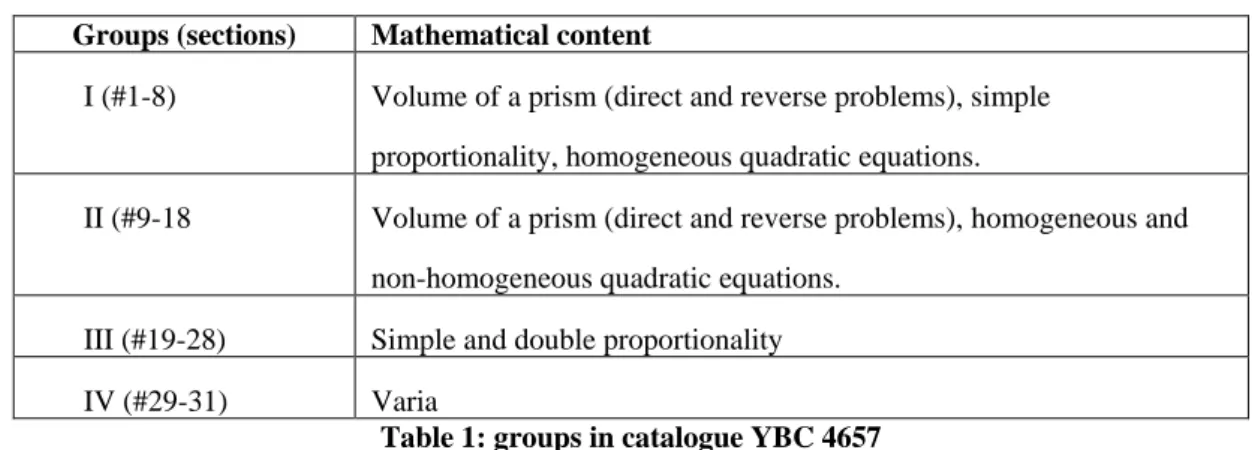
The 31 statements deal with the same topic, but, from a mathematical point of view, they are not homogeneous. They can be grouped into four sets of problems, as shown in Table 1.
Groups (sections) Mathematical content
I (#1-8) Volume of a prism (direct and reverse problems), simple proportionality, homogeneous quadratic equations.
II (#9-18 Volume of a prism (direct and reverse problems), homogeneous and non-homogeneous quadratic equations.
III (#19-28) Simple and double proportionality IV (#29-31) Varia
Table 1: groups in catalogue YBC 4657
The very interesting point is that some of these groups do in fact correspond to known procedure texts (MCT: 73). Indeed, the first group in catalogue YBC 4657 (#1-8) is parallel to the procedure text YBC 4663, which contains exactly the same statements, each statement being followed by the detailed procedure for its resolution. There is the same correspondence between the third group in the catalogue (#19-28) and another procedure text held at Yale. One can easily imagine that groups II and IV in the catalogue would correspond to lost procedure texts.
Associated procedure texts
Let us look at these procedure texts more closely. For example, the first section of procedure text YBC 4663, which corresponds to Group I of the catalogue, contains the following text3
YBC 4663 #1
:
1. ki-la2 5 ninda uš 1 1/2 ninda <sag> 1/2 ninda bur3-bi 10 <gin2> sahar eš2-kar3 6 ⌈še⌉ [a2-bi] 2. gagar sahar-hi-a erim-hi-a u3 ku3-babbar en-nam za-e in-da-zu-de3
2009 and 2010 thanks to the courtesy of Pr Benjamin Foster and Ulla Kasten. These readings are my own, but very closely follow MCT.
3
3. uš sag UR-UR-ta 7.30 i-na-ad-di-ik-ku 4. 7.30 a-na bur3-bi i-ši 45 i-na-ad-di-ku
5. igi eš2-gar3 du8 6 i-na-ad-di-ku a-na 45 ⌈i⌉-ši 4.30 i-na-di-ku 6. 4.30 a-na i-di i-ši 9 i-na-di-ku ki-a-am ⌈ne2-pe-šu⌉
Translation
1. A trench. 5 ninda is the length, 1 ½ ninda the width, 1/2 ninda its depth, 10 gin2 the volume of assignment (for each worker), 6 še (silver) [the wages of a hired man].
2. The area, the volume, the number of workers, and the (total expenses in) silver what? You, in your procedure, 3. The length and the width multiply each other. This will give you 7.30.
4. 7.30 to its depth raise. This will give you 45.
5. The reciprocal of the assignment detach. This will give you 6. To 45 raise. This will give you 4.30 6. 4.30 to the waves raise. This will give you 9. Such is the procedure.
As we see, the statement is exactly the same as in the catalogue. While the statement is written in Sumerian, the procedure is written in Akkadian. The problem is quite simple, and the procedure consists in a short sequence of multiplications and divisions.
The second problem on the tablet derives from the first by circular permutations of the parameters, that is, some given data become unknowns and vice-versa. The six other problems in group I result from the same process. Thus the set of 8 problems forms a systematic exploration of all the facets of a linear situation. This kind of procedure text seems to reflect teaching practices in scribal schools. The use of a type S tablet, which are thought to have been used in the advanced stage of education, at least in Nippur, supports this interpretation (Tinney 1999; Delnero 2010).
To sum up, the characteristic features of the eight catalogues kept at Yale are the following: - They are written in Sumerian.
- They bear a colophon providing the number of statements.
- They are composed of several groups of statements, corresponding to procedure texts.
- The associated procedure texts seem to be collections of exercises used in mathematics education. Catalogues are composite, and appear to be compilations of statements collected from several procedure texts. The fact that the number of problems is carefully noted in a colophon evokes archival practice, perhaps linked to library management, or to the organization of the mathematical curriculum, or both.
Series texts
Series texts are often confused with catalogues; nevertheless, as we will see, they bear witness to a very different approach to mathematical problems by the ancient scribes. The series are lists of problem statements, as are the catalogues, but they are much longer and they run on several numbered tablets. Twenty series tablets are known to date. Of these, 14 are kept at Yale, two are in Chicago, two in Berlin and two in Paris. Series tablets
have a different physical appearance to the catalogues: they are written on multi-column tablets or “type M” (Tinney 1999: 160). The writing is smaller and more cursive than is used in the catalogues.
AO 9071
Let us consider the tablet from the Louvre AO 9071 (published in Proust 2009). The colophon informs us that the tablet contains 95 sections and that the tablet is the seventh in a series.
The first section of the text reads as follows:
The length and the width I added: 50 ninda The length exceeds the width by 10 ninda.
The statements provide the relationship between a length and a width. No information is given about the
concrete situation that these statements refer to. There is no question, no procedure, and no answer. But it is easy to guess that the length and the width are the dimensions of a rectangle, and that the implicit question is: what are the length and the width? Anyway, the wording is quite synthetic and abstract. Section 1 provides two relations that can be translated into modern mathematical language by a system of two equations with two unknowns (where x is the length and y is the width).
= − = + 10 50 y x y x
This is an easy problem, well known to the scribes of that time. The solution is: The length is 30 ninda, the width is 20 ninda.
Section 2 reads as follows:
2/3 of the length: the width.
This section contains only one relation. The other relation is missing. In fact, the other relation has already been given in the first section. So, the complete statement which section 2 refers to is:
<The length and the width I added: 50 ninda> (given in section 1) 2/3 of the length: the width.
This statement could be translated into the modern formula below:
= = + y x y x 3 2 50
As we advance through the text the wording becomes increasingly elliptic and the equations increasingly complex. So much so that, when we reach section 59, we read:
I subtracted: 45 (ba-zi-ma: 45)
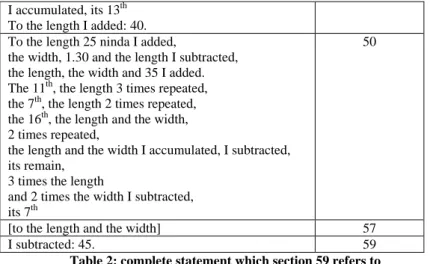
After all the information in the relevant sections has been collected, section 59 refers to the complete statement reconstructed in Table 2.
Block Given in section
The length 3 times repeated, The width 2 times repeated
I accumulated, its 13th To the length I added: 40. To the length 25 ninda I added,
the width, 1.30 and the length I subtracted, the length, the width and 35 I added. The 11th, the length 3 times repeated, the 7th, the length 2 times repeated, the 16th, the length and the width, 2 times repeated,
the length and the width I accumulated, I subtracted, its remain,
3 times the length
and 2 times the width I subtracted, its 7th
50
[to the length and the width] 57
I subtracted: 45. 59
Table 2: complete statement which section 59 refers to
As we see, extremely brief formulations may represent highly developed statements. How is this feat possible? The process is as follows. The statements are broken down into four blocks: the first block corresponds to the first equation of a linear system of two equations with two unknowns. The other blocks correspond to segments of the second equation. The second block is a linear combination of the two unknowns, the length and the width. The third block corresponds to another linear combination of the unknowns. The last block is a relationship between the second block and the third block. The list of statements is produced by successive variations of the four blocks.
These variations produce a list with a tree-like structure with four levelstree structured list with four levels. An elliptic distribution of the information is grafted onto this tree-like structure. The information is given in each level of the tree, and omitted in subsequent dependant levels. As we see, this text cannot be captured by a linear reading. The reader has to move back and forth in order to reconstruct the complete statements. How did the scribes identify the sections where they would find the relevant information? The cuneiform text does not provide any visual assistance. In fact, in this text, the most useful markers are the syntactic ones. As shown before, the statements are made up of four elements. These elements occupy different functions and can, therefore, be distinguished by means of lexical and grammatical indicators. Evidently, the ancient readers of the mathematical series needed some particular skills in order to understand them.
The process used to produce the list is based on the building of the statements, without taking the resolution procedures into account. In other words, the list is not organized according to the methods of resolution, as is the case for procedure texts and catalogues, but according to the formal characteristics of the statements. This simple observation is enough to cast doubt on whether this text was intended to provide data for mathematical education (see also below the remarks about the “impossible problems”).
The description just given for the Louvre tablet could be applied to all the series texts. The main features of these lists are:
- The list has a tree-like structure.
- The language is very artificial. It imitates the style of the catalogues, but the Sumerian grammatical elements are almost absent, and unusual forms, that is, kinds of "neologisms", are introduced.
Other very strange phenomena occur in the mathematical series texts. I will limit myself to mention only some of them.
The super series
Fundamentally, the process of producing the statements is based on the systematic variation of the
coefficients in the equations. This process allows a virtually unlimited development of the lists of statements. It seems that the authors of the series were particularly interested in this potential. Indeed, we know a higher order series which brings together several series. Neugebauer (MKT I: 385) called this an "Oberserie". In these “super series”, such as YBC 4668 (MKT I: 420) the tablets contain hundreds of individual statements, and a complete series would probably bring together thousands of statements. The existence of super series reflects a kind of headlong rush in the hopeless quest for an exhaustive list of all possible equations having the same solution.
Impossible problems
Problem 59 on the Louvre tablet has no equivalent elsewhere in the known corpus of cuneiform
mathematical texts. There is no evidence of how such a baroque "equation" was reduced in order to be resolved. Worse, in some series, there are problems leading to 3rd, 4th or 5th degree equations, which cannot be reduced into lower degree. These problems were clearly not resolved by their author (s). Can we believe that in these cases, they were created for teaching?
A classificatory process
As we have seen, the process for generating a list consists in varying coefficients in the equations, while still maintaining the same solutions. Thus, the process produces two effects: first, groups of equivalent equations; second, a kind of systematic classification of equations. These two results are interesting in themselves, because they imply a reflection on the equations as such.
The grammar of the structures
We have seen an example of a tree-like structure with the Louvre tablet. These structures present various features. Some structures have many levels, others only two. Some are very repetitive, with the same patterns reproduced many times, and therefore any damaged parts of the text can easily be reconstructed. Some others are bushy and the text cannot be guessed. What do these different patterns mean? The syntax of these structures remains to be described and interpreted, and the result of such a study may be useful for other kinds of texts.
To conclude this brief evocation of mathematical series texts, it seems clear that they are not collections of problems for mathematical education. The series were written by erudite scribes of a very high level, having a
perfect command of the Old-Babylonian mathematics tradition. The series texts were probably not aimed at students, but at their fellow scribes.
A new mathematical culture between antiquarism and innovation
When looking at the mathematical texts as lists, we find that they do not all fulfil the same intellectual project. They do not target the same groups of readers, nor do they pursue the same objectives. Catalogues seem to reflect archival practices, while series texts bear witness to speculative inquiry, which produces new material. These issues could be important for the intellectual history of Mesopotamia at the end of the Old Babylonian period. Do the series reflect a different mathematical culture to that developed in the Old Babylonian scribal schools? Evidence such as paleography, serialization and the use of an artificial language imitating Sumerian argue for a quite late dating of the mathematical series texts, that is, the end of the Old Babylonian period (Høyrup 2002: 351). The authors of the series texts were familiar with the mathematical tradition of Southern Mesopotamia, the language and topics of which they seemingly imitate. At the same time, series texts are completely innovative in their language as well as in their mathematical content.
From these remarks, some hypotheses about the context of the series texts could be suggested. It is possible that these texts come from communities of scribes who had fled southern Mesopotamian cities , such as Ur, Uruk and Larsa, after they were destroyed at the end of the 18th century. It is well known that some people from the south had resettled in northern Babylonia, for example in Sippar, Kish and Babylon, transferring some cultural elements (Finkelstein 1972: 11-13; Charpin 1986: 403-415). The authors of the series texts may have been members of these new scribal communities of Kish or Sippar, imbibed with southern culture.
Anyway, the series texts are the result of an original intellectual project, quite different from those of the ancient tradition of the south. By writing the mathematical series, the scribes produced new material, which represents a considerable extension of the known mathematical corpus produced in previous periods. The interest of the scribes moved from solving the equations to the statements themselves, in an attempt to embrace every possibility.
Bibliography
Delnero, Paul. "Sumerian Extract Tablets and Scribal Education." Journal of Cuneiform Studies 62 (2010) 53-69.
Charpin, Dominique. Le clergé d'Ur au siècle d'Hammurabi. Genève: Droz, 1986.
Finkelstein, Jacob J. 1972. Late Old Babylonian documents and letters. Yale oriental series Vol. 13, New Haven: Yale University Press.
Høyrup, Jens. Lengths, Widths, Surfaces. A Portrait of Old Babylonian Algebra and its Kin. Berlin & Londres: Springer, 2002.
MKT I = Neugebauer 1935
Neugebauer, Otto. Mathematische Keilschrifttexte I. Berlin: Springer, 1935.
Neugebauer, Otto, and Abraham J. Sachs. Mathematical Cuneiform Texts. American Oriental Studies Vol. 29, New Haven: AOS & ASOR, 1945.
Proust, Christine. "Deux nouvelles tablettes mathématiques du Louvre : AO 9071 et AO 9072." Zeitschrift für
Assyriologie und Vorderasiatische Archäologie 99 (2009) 167–232.
—."Reading colophons from Mesopotamian clay-tablets dealing with mathematics." NTM Zeitschrift für Geschichte der Wissenschaften, Technik und Medizin 20 (2012) 123-56.
—."Does a master always write for his students? Some evidence from Old Babylonian scribal schools." in
Studying ancient scientific sources produced in an educational context: problems and perspectives, edited
by A. Bernard and C. Proust, in progress.
—."Des listes pour apprendre, résoudre, classer, archiver, explorer ou inventer." in Festschrift Heinrich von
Staden edited by A. F. Rodríguez, K.-D. Fischer, and B. Holmes, to appear.