
Aprotinin does not impair renal haemodynamics and function after cardiac surgery
7
0
0
Texte intégral
(2) Aprotinin and perioperative renal function. fluid and drug administration in addition to haemodynamic measurements. Before operation, crystalloid 10 ml kg–1 was infused over 20 min. General anaesthesia was standardized using fentanyl 40–60 µg kg–1 and midazolam 0.03– 0.06 mg kg–1 followed by pancuronium 0.10 mg kg–1 h–1 for neuromuscular block (0.15 mg kg–1 at induction and 0.05 mg kg–1 during bypass). Mechanical ventilation was adjusted to obtain normocapnia and normoxia. Before cannulation of the aorta and right atrium, heparin sodium 300 u kg–1 was administered; additional heparin was given if the kaolin-activated clotting time (Hemochron 401, International Technidyne Corporation, Edison, NJ, USA) was less than 550 s. Non-pulsatile cardiopulmonary bypass (CPB) was started with a membrane oxygenator (Cobe Laboratories Inc., Lakewood, CO, USA) primed with crystalloid 2 litre; body temperature was decreased to achieve moderate hypothermia (26–30°C) with α-stat regulation for pH management. After aortic clamping, myocardial protection was provided with St Thomas’s solution 600–900 ml infused through the aortic root and repeated at 25–30-min intervals. During CPB, mean arterial pressure was maintained at 55– 70 mm Hg using sodium nitroprusside, phenylephrine, or both. Pump flow was maintained at greater than 2 and 2.4 litre min–1 m–2 during hypothermia and rewarming, respectively. After completion of the distal vascular anastomosis or valve surgery, patients were weaned from CPB when rectal temperature was at least 35.5°C. Fluids and vasoactive and inotropic agents were given to optimize haemodynamic conditions; packed red blood cells were given if blood haemoglobin concentration was less than 9 g dl–1.. glandular kallikrein which cleaves 0.05 mmol of substrate per minute. Intra- and inter-assay coefficients of variation were 4.2% and 7.1%, respectively.. Measurements and calculations Mean arterial pressure, heart rate and right atrial pressure were recorded. Glomerular filtration rate was assumed to equal creatinine or inulin clearances (CIN, Ccreat) and effective renal plasma flow was estimated as PAH clearance (CPAH). Other tests of renal function included osmolar clearance (COsm), water clearance (CH2O) and fractional sodium and potassium excretion. Blood and urinary samples were obtained at the following times: (1) baseline measurement, 30 min before induction of anaesthesia (preop.), (2) before the start of bypass (pre-bypass), (3) before the second cardioplegia (bypass), (4) after administration of protamine (postbypass) and (5) on day 5 after operation. During operation, urine was collected over 30 min and arterial blood was obtained in the middle of each sampling period. Before and after operation, urine was collected over 12 h and mean blood concentrations (for creatinine and electrolytes) at the beginning and end of the clearance period were calculated. Arterial blood was collected into cold tubes containing indomethacin and heparin (for prostaglandin assay) or dipotassium ethylenediamino-tetraacetic acid and aprotinin (for ANP and cGMP assay) and was centrifuged immediately at 4°C. CIN and CPAH were measured only during operation. Urinary and plasma inulin and PAH concentrations were assayed spectrophotometrically. Serum and urinary sodium and creatinine were measured with a standard flame emission photometer. All clearance values were corrected for a standard body surface area of 1.73 m2. Plasma concentrations of ANP and its second messenger cGMP, in addition to plasma and urinary concentrations of the stable metabolites of TxA2 (thromboxane B2 (TxB2)) and prostacyclin (6-keto-PGF1α) were determined before anaesthesia and during operation (pre-op., pre-bypass, bypass and post-bypass). Plasma ANP was extracted from a 2-ml plasma aliquot on a C-18 octadecylsilane cartridge (Sep-Pak, Waters Associates, Milfford, MA, USA) and measured by a specific radioimmunoassay; intra- and inter-assay variations were 3.9% and 13.7%, respectively. cGMP was measured after extraction by ethanol using a commercial kit (Amersham, UK); intra- and inter-assay variations were 4.5% and 10%, respectively. TxB2 and 6-keto-PGF1α concentrations were measured in 100-µl aliquots of plasma or urine by radioimmunoassay without extraction (Amersham, UK). The lower limit of sensitivity was 30 pg ml–1 for both measurements. Excretion of urinary prostanoid metabolites was expressed as pg g creatinine–1. Plasma concentrations of ANP, cGMP and prostanoids were corrected for the haemodiluting effects of CPB according to the change in packed cell volume. Intra- and postoperative i.v. fluid requirements (packed red blood cells, fresh frozen plasma, crystalloid and colloid. Study procedure Patients were allocated randomly to one of two treatment groups in a double-blind manner. Each patient received a similar volume of saline or aprotinin. In the aprotinin group, each patient received 2 million kallikrein inhibitory units (mkiu) over 30 min, 1 mkiu in the CPB priming volume and 0.5 mkiu h–1 i.v. from the start of surgery until skin closure. The mean dose was 4.1 mkiu/patient or approximately 50 000 kiu kg–1. Before anaesthesia, priming doses of inulin 30 mg kg–1 (10% Inulin; Laevosan Gesellschaft mbH, Linz, Austria) and p-paraimmunohippurate 8 mg kg–1 (PAH, Merck, Sharp and Dohme, NJ, USA) were given i.v. followed by a continuous infusion of both drugs at 0.2 and 0.15 mg kg–1 min–1, respectively, up to the end of surgery. An equilibration period of 60 min was allowed before baseline measurements. Diuretics, mannitol or dopamine were not given during the study. Kallikrein concentrations were measured in urinary samples before and after bypass using the method of Amundsen and colleagues.11 This assay measured urinary activity against the chromogenic substrate S-2266 (H-D-Val-Leu-Arg-pNA, AB Kabi Diagnostica, Stockholm, Sweden) for which urine kallikrein is highly specific. Results are expressed as nkat litre–1, where 1 nkat is the amount of. 17.
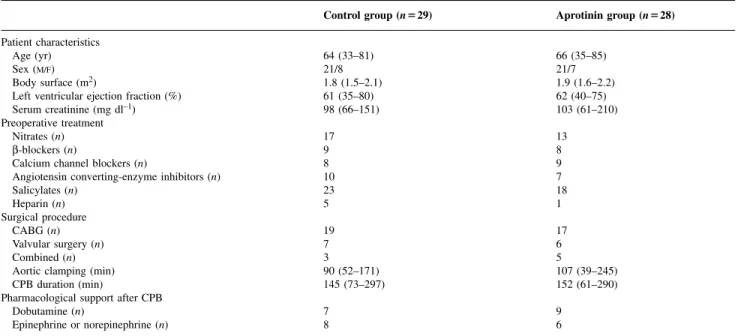
(3) Schweizer et al.. Table 1 Clinical and surgical data (mean (range) or number of patients). No significant differences between groups. Patient characteristics Age (yr) Sex (M/F) Body surface (m2) Left ventricular ejection fraction (%) Serum creatinine (mg dl–1) Preoperative treatment Nitrates (n) β-blockers (n) Calcium channel blockers (n) Angiotensin converting-enzyme inhibitors (n) Salicylates (n) Heparin (n) Surgical procedure CABG (n) Valvular surgery (n) Combined (n) Aortic clamping (min) CPB duration (min) Pharmacological support after CPB Dobutamine (n) Epinephrine or norepinephrine (n). Control group (n⍧29). Aprotinin group (n⍧28). 64 (33–81) 21/8 1.8 (1.5–2.1) 61 (35–80) 98 (66–151). 66 (35–85) 21/7 1.9 (1.6–2.2) 62 (40–75) 103 (61–210). 17 9 8 10 23 5. 13 8 9 7 18 1. 19 7 3 90 (52–171) 145 (73–297). 17 6 5 107 (39–245) 152 (61–290). 7 8. 9 6. solutions) were recorded for each patient. Postoperative blood loss was measured and recorded by observing the volume of drainage into volumetric chest tube drains until their removal (approximately 24–36 h).. atrial pressure in the two groups (data not shown). Temporary inotropic and/or vasopressor support was needed for weaning from CPB in 14 patients in the saline group and in 15 in the aprotinin group; intra-aortic counterpulsation was required in one patient in each group. Postoperative myocardial infarct was diagnosed in two patients in the saline and in one patient in the aprotinin group. Duration of mechanical ventilation, stay in the ICU and time to discharge did not differ between groups. In the aprotinin group, postoperative blood loss (775 (314) ml) and blood transfusion requirements (1.4 (0.7) u) were significantly less than in the control group (1185 (403) ml and 2.6 (1.4) u, respectively).. Statistical analysis Sample size calculation was based on estimates of urinary excretion of cGMP and prostanoids, determined in a preliminary experiment. The calculations indicated that 28 patients were needed in each group to show a difference of 艌1.2 SD (power⫽90%, significance⫽5%). All data are expressed as mean (SD or range); differences were considered significant if P⬍0.05. Two-way analysis of variance with Dunnett’s test was used for within-group comparisons with respect to baseline. Chi-square analysis with Yates’ correction was used to compare percentages of patients. Simple linear correlation (Pearson) or regression analysis was used to evaluate the relationship between variables. For ANP, cGMP and prostanoid analysis, data were log transformed and the concentration equal to the sensitivity of the assay was assigned the value of the statistical limit of significance.. Perioperative renal function In the control group, urinary kallikrein excretion did not change from before to after bypass (2.52 (1.94) and 3.14 (2.18) kat litre–1, respectively) whereas aprotinin treatment was associated with significant lower urinary kallikrein excretion (0.24 (0.22) and 0.31 (0.30) kat litre–1, respectively). Renal function did not differ between groups at any time (Table 2). CPB was associated with significant increases in urinary flow, COsm and fractional excretion of sodium and potassium; all of these variables were still significantly increased shortly after weaning from CPB and had recovered to preoperative values by day 5 after operation. During CPB, CPAH increased in the control and aprotinin groups (⫹54% and ⫹48%, respectively). Ccreat and CIN did not change significantly throughout the study and were correlated with each other (r⫽0.72, P⬍0.05).. Results Patient characteristics and outcome We studied 57 patients (29 in the control group and 28 in the aprotinin group); one patient in each group was subsequently excluded because of bleeding which required re-operation. Another patient in the aprotinin group had a massive myocardial infarct and died shortly after surgery. Patient characteristics, preoperative treatment and surgical data did not differ between groups (Table 1). There were similar changes in mean arterial pressure, heart rate and right. Plasma ANP, plasma and urinary cGMP There were no differences between groups in plasma concentrations of ANP or plasma and urinary values of cGMP. In all. 18.
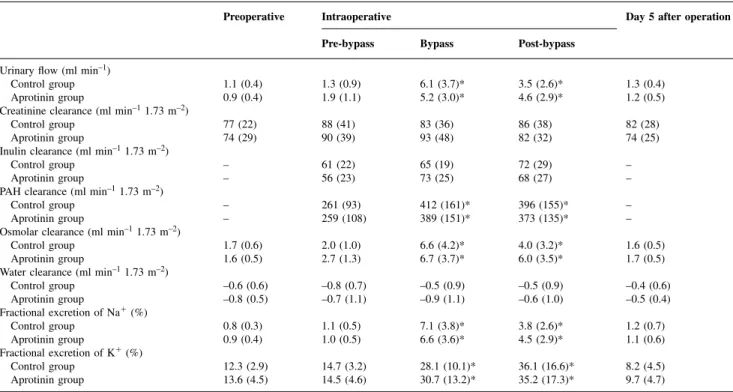
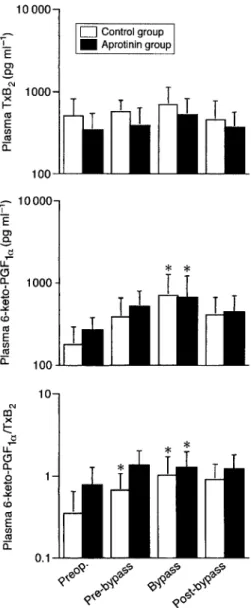
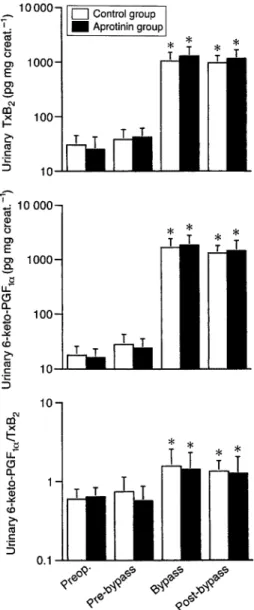
(4) Aprotinin and perioperative renal function. Table 2 Renal function data for patients undergoing cardiac surgery (mean (SD)).*P⬍0.05 compared with preoperative values; no significant difference between groups Preoperative. Intraoperative. Day 5 after operation. Pre-bypass. Bypass. Post-bypass. 1.1 (0.4) 0.9 (0.4). 1.3 (0.9) 1.9 (1.1). 6.1 (3.7)* 5.2 (3.0)*. 3.5 (2.6)* 4.6 (2.9)*. 1.3 (0.4) 1.2 (0.5). 77 (22) 74 (29). 88 (41) 90 (39). 83 (36) 93 (48). 86 (38) 82 (32). 82 (28) 74 (25). – –. 61 (22) 56 (23). 65 (19) 73 (25). 72 (29) 68 (27). – –. – –. 261 (93) 259 (108). 412 (161)* 389 (151)*. 396 (155)* 373 (135)*. – –. 1.7 (0.6) 1.6 (0.5). 2.0 (1.0) 2.7 (1.3). 6.6 (4.2)* 6.7 (3.7)*. 4.0 (3.2)* 6.0 (3.5)*. 1.6 (0.5) 1.7 (0.5). –0.6 (0.6) –0.8 (0.5). –0.8 (0.7) –0.7 (1.1). –0.5 (0.9) –0.9 (1.1). –0.5 (0.9) –0.6 (1.0). –0.4 (0.6) –0.5 (0.4). 0.8 (0.3) 0.9 (0.4). 1.1 (0.5) 1.0 (0.5). 7.1 (3.8)* 6.6 (3.6)*. 3.8 (2.6)* 4.5 (2.9)*. 1.2 (0.7) 1.1 (0.6). 12.3 (2.9) 13.6 (4.5). 14.7 (3.2) 14.5 (4.6). 28.1 (10.1)* 30.7 (13.2)*. 36.1 (16.6)* 35.2 (17.3)*. 8.2 (4.5) 9.7 (4.7). min–1). Urinary flow (ml Control group Aprotinin group Creatinine clearance (ml min–1 1.73 m–2) Control group Aprotinin group Inulin clearance (ml min–1 1.73 m–2) Control group Aprotinin group PAH clearance (ml min–1 1.73 m–2) Control group Aprotinin group Osmolar clearance (ml min–1 1.73 m–2) Control group Aprotinin group Water clearance (ml min–1 1.73 m–2) Control group Aprotinin group Fractional excretion of Na⫹ (%) Control group Aprotinin group Fractional excretion of K⫹ (%) Control group Aprotinin group. patients, plasma ANP decreased during bypass and increased after weaning from bypass (⫹71% in the control group and ⫹93% in the aprotinin group), compared with preoperative baseline values (Fig. 1). There was a significant correlation between plasma ANP and plasma cGMP (r⫽0.52 in controls and r⫽0.62 in the aprotinin group) and between plasma ANP and right atrial pressure (r⫽0.41 in controls and r⫽0.52 in the aprotinin group). Changes in plasma cGMP mimicked those of plasma ANP, although they did not reach statistical significance. Urinary excretion of cGMP increased significantly during and after bypass and was positively correlated with COsm (r⫽0.79 and 0.86 in the control and aprotinin groups, respectively).. Discussion As acute renal failure is related to mortality in cardiac surgery, clinicians should be aware of the potential renal damage from drugs. In this regard, we found that in patients with good renal function, aprotinin treatment (with a mean dose of 4.1 mkiu) did not affect renal function during cardiac surgery with moderate hypothermic CPB. CPB impaired renal solute reabsorption, regardless of aprotinin pretreatment, and was associated with renal release of vasodilatory mediators (nitric oxide and prostacyclin), indicated by urinary excretion of their respective metabolites (cGMP and 6-keto-PGF1α).. Aprotinin dose regimen. Plasma and urinary TxB2 and 6-keto-PGF1α. Different doses of aprotinin have different effects on coagulation, fibrinolysis and the inflammatory cascade.12 Compared with the standard high-dose aprotinin treatment (2 mkiu before bypass, 2 mkiu in the pump prime and an infusion of 0.5 mkiu h–1), a smaller dose (using only 2 mkiu in the pump prime) can also reduce postoperative blood loss.13 14 At plasma concentrations greater than 50 kiu ml–1, plasmin is inhibited, whereas 200 kiu ml–1 is needed to suppress plasma kallikrein. According to a pharmacokinetic model proposed by Levy, Bailey and Salmenpera,15 target plasma concentrations of 200 kiu ml–1 can be achieved with a bolus of aprotinin 2 mkiu in the pre-bypass period, 1 mkiu added to the CPB circuit and an infusion of 0.5 mkiu h–1. We used a slightly higher dose regimen (1 mkiu instead of 0.5 mkiu in the pump prime) that gave a 34% reduction in postoperative blood loss and. Patients in the aprotinin group did not differ from those in the control group in plasma concentrations and urinary excretion of 6-keto-PGF1α and TxB2 and their respective ratios. After the start of bypass, the ratio of plasma concentrations of 6-keto-PGF1α to TxB2 increased significantly because of an increase in 6-keto-PGF1α, while TxB2 remained unchanged (Fig. 2). Urinary excretion of TxB2 and 6-keto-PGF1α increased significantly during and after CPB. The ratio of 6-keto-PGF1α to TxB2 was increased because of greater urinary excretion of 6-keto-PGF1α than TxB2 (Fig. 3). In the two groups, COsm was directly related to urinary excretion of 6-keto-PGF1α (r⫽ 0.63 and 0.69 in the control and aprotinin groups) and to the ratio of 6-keto-PGF1α to TxB2 (r⫽0.52 and 0.54 in the control and aprotinin groups, respectively).. 19.
(5) Schweizer et al.. Fig 2 Changes in plasma thromboxane B2 (TxB2) and 6-keto-PGF1α, and the ratio 6-keto-PGF1α to TxB2 in the two groups of patients undergoing cardiac surgery. Data are mean (SD).*Significant difference from baseline (preoperative) (P⬍0.05).. Fig 1 Changes in plasma atrial natriuretic peptide (ANP) and plasma and urinary cyclic guanidine monophosphate (cGMP) in the two groups of patients undergoing cardiac surgery. Data are mean (SD).*Significant difference from baseline (preoperative) (P⬍0.05). No differences between groups.. messenger cGMP.18 Although we observed no change in plasma concentrations of ANP after infusion of aprotinin, we cannot exclude the possibility that inhibition of ANP metabolism10 was compensated for by a reduction in ANP synthesis in atrial tissues. Increased plasma and urinary ratios of 6-keto-PGF1α to TxB2 during CPB indicate that the balance of prostanoid synthesis was shifted towards prostacyclin-induced vasodilatation which could prevent the vasoconstrictive and thrombogenic effect of TxA2. In clinically relevant concentrations (50–500 mkiu), aprotinin had no effect on endothelial and tubular release of prostacyclin19 and therefore it did not influence perioperative plasma and urinary 6-keto-PGF1α concentrations. In contrast with previous reports showing reduced platelet release of TxA2 in aprotinin-treated patients, we found similar plasma TxB2 concentrations in the two groups.20 21. reduced allogenic blood transfusion. As the affinity of aprotinin for renal tissue is greater than for plasma kallikrein, it was not surprising to observe 90% suppression of urinary excretion of kallikrein.. Aprotinin and ANP–cGMP and prostanoids pathways Plasma concentrations of ANP and systemic and renal formation of TxA2, prostacyclin and nitric oxide were similar in the two groups. The relationships we found between plasma concentrations of ANP, plasma cGMP and right atrial pressure confirmed that, even during operation, atrial release of ANP is triggered by changes in cardiac filling pressure16 17 and that plasma ANP concentrations largely determine circulating concentrations of its second. 20.
(6) Aprotinin and perioperative renal function. characterized by impaired solute reabsorption, a brisk osmolar diuresis and increases in fractional excretion of sodium and potassium. Importantly, we observed a close relationship between osmolar diuresis and renal production of vasodilatory mediators during cardiac surgery. Urinary excretion of 6-keto-PGF1α, TxB2 and cGMP reflect renal synthesis of prostacyclin, TxA2 and nitric oxide.24 During hypothermic CPB, enhanced salt and water excretion may result from several mechanisms: first, prostanoids antagonize the in vivo effect of antidiuretic hormone and inhibit Na⫹/Cl– reabsorption in the proximal and distal nephron and in the loop of Henle25; second, in the papilla, PGI2- and NO-mediated medullary vasodilatation prevents the papillary Na⫹/Cl– countercurrent exchange by disrupting the hyperosmolar gradient26; third, tubular solute reabsorption is impaired by reduced activity of Na⫹/Cl– membrane pumps during hypothermia.. Aprotinin, cardiac surgery and renal dysfunction The use of aprotinin in clinical practice has not been associated with an increased incidence of postoperative renal failure.27–29 In patients undergoing deep hypothermic arrest, the benefits and safety of aprotinin need further study.30 31 In a large multicentre study,32 the need for haemodialysis or filtration was strongly related to poor preoperative renal function, vascular disease and heart failure, type of surgery and use of intra-aortic balloon pump. Despite inhibition of the kallikrein–kinin pathways, aprotinin pretreatment did not influence prostaglandin synthesis, glomerular filtration, renal plasma flow or tubular transport mechanisms. This suggests that the kallikrein–kinin pathways play a minor role in renal homeostasis and that other factors (e.g. renin–angiotensin system) may stimulate the synthesis of prostanoids during cardiac surgery. Interestingly, in animal models of sepsis33 and in humans with cirrhosis,34 aprotinin can reverse systemic vasodilatatory hypotension and improve renal function. In contrast with our data and other studies,27 28 35 some investigators reported mild and transient postoperative increases in serum creatinine concentrations, COsm and FENa⫹ in patients given aprotinin.6 20 However, these studies were not designed to assess renal outcome; changes in renal function were not great and no details were available on perioperative haemodynamic control and the use of fluids, diuretics and mannitol. For instance, in the study of Blauhut and colleagues,20 increased COsm was more likely related to significant higher arterial pressure values which resulted in pressure-induced natriuresis in aprotinin-treated patients. In summary, we found no evidence that in patients undergoing cardiac surgery with hypothermic bypass, a high dose of aprotinin had an adverse effect on renal function or influenced its autoregulatory control mechanisms involving prostanoids and ANP. Nevertheless, until more data are available, a lower dose is still recommended in patients who have diabetes mellitus or renal insufficiency, and in those receiving chronic treatment with angiotensin-. Fig 3 Changes in urinary excretion of thromboxane B2 (TxB2) and 6keto-PGF1α, and the urinary ratio 6-keto-PGF1α to TxB2 in the two groups of patients undergoing cardiac surgery. Data are mean (SD).*Significant difference from baseline (preoperative) (P⬍0.05).. In fact, maximal release of PGI2 occurs shortly after the start of CPB whereas peak plasma TxB2 concentrations occur during rewarming at the end of CPB.22 As we measured prostaglandins approximately 20 min after the start of CPB and before chest closure, we were unable to document the suppressive effect of aprotinin on plasma TxB2.. Renal dysfunction and CPB As reported elsewhere,23 we found no reduction in glomerular filtration rate and renal plasma flow during hypothermic extracorporeal bypass as long as mean arterial pressure and pump flow were maintained within the physiological range of autoregulation. In the two groups, increased CPAH overestimated renal plasma flow because tubular extraction of PAH was reduced. Transient tubular dysfunction was. 21.
(7) Schweizer et al.. 19 Royston BD, Royston D, Coade SB, Morgan DM, Pearson JD. Aprotinin does not inhibit the release of prostacyclin or von Willebrandt factor from cultured human endothelial cells. Thromb Haemost 1992; 67: 172–5 20 Blauhut B, Gross C, Necek S, Doran JE, Spath P, LundsgaardHansen P. Effects of high-dose aprotinin on blood loss, platelet function, fibrinolysis, complement, and renal function after cardiopulmonary bypass. J Thorac Cardiovasc Surg 1991; 101: 958–67 21 Nagaoka H, Innami R, Murayama F, et al. Effects of aprotinin on prostaglandin metabolism and platelet function in open heart surgery. J Cardiovasc Surg 1991; 32: 31–7 22 Faymonville M-E, Deby-Dupont G, Larbuisson R, et al. Prostaglandin E2, prostacyclin, and thromboxane changes during nonpulsatile cardiopulmonary bypass in humans. J Thorac Cardiovasc Surg 1986; 91: 858–66 23 Andersson LG, Jepson A, Bratteby LE, et al. Renal function during cardiopulmonary bypass: influence of the calcium entry blocker felopidine. Anesth Analg 1996; 83: 34–40 24 Frolich JC, Wilson TW, Sweetman BJ, et al. Urinary prostaglandins: identification and origin. J Clin Invest 1975; 55: 763–70 25 Agnoli GC, Borgatti R, Cacciari M, Ikonomu E, Lenzi P, Marinelli M. Effective role of the renin–angiotensin system in the control of prostanoid synthesis and renal function in healthy women with moderate salt depletion. Clin Physiol 1996; 16: 41–59 26 Parekh N, Zou A-P. Role of prostaglandins in renal medullary circulation: response to different vasoconstrictors. Am J Physiol 1996; 40: F653–8 27 Lemmer JH jr, Stanford W, Bonney SL, et al. Aprotinin for coronary artery bypass grafting: effect on postoperative renal function. Ann Thorac Surg 1995; 59: 132–6 28 Dietrich W, Barankay A, Hahnel C, Richter JA. High-dose aprotinin in cardiac surgery: three years’ experience in 1,784 patients. J Cardiothorac Vascular Anesth 1992; 6: 324–7 29 Bidstrup BP, Harrison J, Royston D, Taylor KM, Treasure T. Aprotinin therapy in cardiac operations: a report on use in 41 cardiac centers in the United Kingdom. Ann Thorac Surg 1993; 55: 971–6 30 Okita Y, Takamoto S, Ando M, Morota T, Yamaki F, Kawashima Y. Is use of aprotinin safe with deep hypothermic circulatory arrest in aortic surgery? Investigations on blood coagulation. Circulation 1996; 94: 177–81 31 Parolari A, Antona C, Alamanni F, et al. Aprotinin and deep hypothermic circulatory arrest: there are no benefits even when appropriate amounts of heparin are given. Eur J Cardiothorac Surg 1997; 11: 149–56 32 Chertow GM, Lazarus JM, Christiansen CL, et al. Preoperative renal risk stratification. Circulation 1997; 95: 878–84 33 Cumming AD, Nimmo GR. Hemodynamic, renal, and hormonal actions of aprotinin in an ovine model of septic shock. Crit Care Med 1992; 20: 1134–9 34 MacGilchrist A, Craig KJ, Hayes PC, Cumming AD. Effect of the serine protease inhibitor, aprotinin, on systemic haemodynamics and renal function in patients with hepatic cirrhosis and ascites. Clin Sci 1994; 87: 329–35 35 Levy JH, Pifarre R, Schaff HV, et al. A multicenter, double-blind, placebo-controlled trial of aprotinin for reducing blood loss and the requirement for donor-blood transfusion in patients undergoing repeat coronary artery bypass grafting. Circulation 1995; 92: 2236–44 36 Dobkowski WB, Murkin JM. A risk–benefit assessment of aprotinin in cardiac surgical procedures. Drug Safety 1998; 18: 21–41. converting inhibitors or undergoing deep hypothermic CPB.36. References 1 Bidstrup BP, Royston D, Sapsford RN, Taylor KM. Reduction in blood loss and blood use after cardiopulmonary bypass with high dose aprotinin (Trasylol). J Thorac Cardiovasc Surg 1989; 97: 364–72 2 Scudamore CH, Randall TE, Jewesson PJ, et al. Aprotinin reduces the need for blood products during liver transplantation. Am J Surg 1995; 169: 546–9 3 Janssens M, Joris J, David JL, Lemaire R, Lamy M. High-dose aprotinin reduces blood loss in patients undergoing total hip replacement surgery. Anesthesiology 1994; 80: 23–9 4 Fremes SE, Wong BI, Lee E, et al. Metaanalysis of prophylactic drug treatment in the prevention of postoperative bleeding. Ann Thorac Surg1994; 58: 1580–8 5 Maier M, Starlinger M, Zhegu Z, Rana H, Binder BR. Effect of the protease inhibitor aprotinin on renal hemodynamics in the pig. Hypertension 1985; 7: 32–8 6 D’Ambra MN, Akins CW, Blackstone EH, et al. Aprotinin in primary valve replacement and reconstruction: a multicenter, double-blind, placebo-controlled trial. J Thorac Cardiovasc Surg 1996; 112: 1081–9 7 Werle E, Trautschold I, Haendle H, Fritz H. Physiologic, pharmacologic, and clinical aspects of proteinase inhibitors. Ann NY Acad Sci 1968; 146: 464–78 8 Regoli D, Barabe J. Pharmacology of bradykinin and related kinins. Pharmacol Rev 1980; 32: 1–46 9 Proud D, Kaplan AP. Kinin formation: mechanisms and role in inflammatory disorders. Annu Rev Immunol 1988; 6: 49–83 10 Vanneste Y, Pauwels S, Lambotte L, Michel A, Dimaline R, Deschodt-Lanckman M. Respective roles of kallikrein and endopeptidase 24.11 in the metabolic pathway of atrial natriuretic peptide in the rat. Biochem J 1990; 269: 801–6 11 Amundsen E, Putter J, Friberger P, Knos M, Larstraten M, Claeson G. Methods for the determination of glandular kallikrein by means of chromogenic tri-peptide substrate. Adv Exp Med Biol 1979; 120A: 83–95 12 Fritz H, Fink E, Truscheit E. Kallikrein inhibitors. Fed Proc 1979; 38: 2753–9 13 Laupacis A, Fergusson D. Drugs to minimize perioperative blood loss in cardiac surgery: meta-analyses using perioperative blood transfusion as the outcome. The International Study of Perioperative Transfusion (ISPOT) Investigators. Anesth Analg 1997; 85: 1258–67 14 Davis R, Whittington R. Aprotinin: a review of its pharmacology and therapeutic efficacy in reducing blood loss associated with cardiac surgery. Drugs 1995; 49: 954–83 15 Levy JH, Bailey JM, Salmenpera M. Pharmacokinetics of aprotinin in preoperative cardiac surgical patients. Anesthesiology 1994; 80: 1013–18 16 Raine AE, Erne P, Bu¨ rgisser E, et al. Atrial natriuretic peptide and atrial pressure in patients with congestive heart failure. N Engl J Med 1986; 315: 533–7 17 Schaff HV, Mashburn JP, McCarthy PM, Torres EJ, Burnett JC. Natriuresis during and early after cardiopulmonary bypass: relationship to atrial natriuretic factor, aldosterone and antidiuretic hormone. J Thorac Cardiovasc Surg 1989; 98: 979–86 18 Dussaule J-C, Vahanian A, Michel P-L, et al. Plasma atrial natriuretic factor and cyclic GMP in mitral stenosis treated with balloon valvulotomy. Circulation 1988; 78: 276–85. 22.
(8)
Figure
Documents relatifs