AJH 1:42-46, 1988
Platelet Membrane and Calcium Control
Abnormalities in Essential Hypertension
F. R. Bühler and T. J. Resink
The mechanisms whereby intracellular calcium concen tration is controlled are briefly reviewed. With the current knowledge of both calcium homeostasis and the function and properties of cellular Ca1^-target proteins/
signal transduction systems, a dysfunction of cellular calcium metabolism is considered in relation to the pathogenesis of hypertension. Although the enhanced peripheral vascular resistance characteristic of hyperten sion is ultimately a function of Ca2+ availability for
smooth muscle cell contraction, the platelet possesses many parallel biochemical and physiologic properties.
Therefore, we have utilized the platelet as the cell model for investigating the role of Ca2+ in hypertension dis
orders. An overview of Ca2+-linked platelet processes al
tered in essential hypertension is presented, and an attempt is made to integrate these multiple aberrations in a fundamental membrane lesion. Am J Hypertens 1 : 4 2 - 4 6 , 1988
KEYWORDS: essential hypertension, calcium control, platelets, phosphoinositides, cyclic nucleotides.
C
alcium is a fundamental regulator of cellular function. An understanding of the general principles of cellular C a2 + regulation is crucial to the pathophysiology of hypertension and its effective treatment, because the heart, adrenal glo-merulosa, neural synapses, juxtaglomerular apparatus, platelets, and smooth muscle cells use C a2 + as a positive intracellular messenger.Intracellular calcium concentrations ([Ca2 +]i) are reg ulated by a complex array of transport mechanisms at various membrane and intracellular locations. The entry of C a2 + from the extracellular space is mediated by volt age-sensitive C a2 + channels and other putative mecha nisms including release of C a2 + bound to membrane surfaces, entry through receptor-mediated channels, or nondefined passive leak across the membrane. C a2 + is also released from internal endoplasmic reticulum and
From the Departments of Research and Medicine, University Hos pital, Basel, Switzerland
This work was supported by grants from the Swiss National Fund (No. 3.824.083).
Address correspondence and reprint requests to Prof FR Bühler, Division of Cardiology, University Hospital, C H - 4 0 3 1 Basel, Switzer land.
from mitochondria. In resting cells, [ C a2 4^ is maintained at 1 0 ~7 M, that is, considerably lower than millimolar extracellular free C a2 +. In stimulated cells, [Ca2 +]i does not generally exceed 1 0 ~5 M. Therefore, under both conditions, internal calcium levels are necessarily main tained by the action of active transport mechanisms that remove C a2 + from the cytosol, including the plasma membrane ATP-dependent C a2 + pump, the plasma membrane N a+- C a2 + exchanger, the endoplasmic re ticulum ATP-dependent Ca2"1" pump, and the mitochon dria C a2 + pump. The net result of the operation of all these Ca2 +-translocating mechanisms is the imbalance of C a2 + concentrations within the cells, which are there fore primed for Ca2 +-signaling events to permit a rapid and large increase incytosolic Ca2"1".1"3
ESSENTIAL HYPERTENSION, PLATELETS, AND CALCIUM
In the pathophysiology of essential hypertension (EHT), several factors have been proposed, including enhanced sympathetic nervous system activity, reduced renin-an giotensin-aldosterone axis endocrine control, dietary salt, and genetic factor(s). Direct clinical corollaries for an integrative contributory role for C a2 + in the patho physiology of EHT are that patients with EHT exhibit
excess calcium-influx-dependent vasoconstriction and that blood pressure in these patients is normalized fol
lowing therapy with calcium antagonists.4"6 A key
characteristic of EHT is elevated peripheral vascular re sistance, which is ultimately mediated by enhanced vas cular contractility. An altered state of vascular reactivity can result from alterations in either cellular calcium me tabolism or the sensitivity of response elements to the
actions of C a2 +.7"1 0 Investigations in search of support
for the hypothesis that perturbation of calcium metabo lism is a fundamental lesion in EHT have been carried out on a wide variety of tissue and cell types including myocardium, smooth muscle, erythrocytes, adipocytes, hepatocytes, synaptosomes, and platelets in both
human and animal models of hypertension.7"1 0
A specific role for platelets in the pathophysiology of hypertension should be considered, because these cells are mediators of thrombotic complications, vectors for vascular tone, and promoters of atherosclerosis. There are many similarities between platelets and smooth muscle cells. Both platelets and smooth muscle cells have an adenylate cyclase system that can be activated by adrenaline via a-2 adrenoceptors and inhibited by
prostaglandins with attendant changes in calcium.1 1
Calcium can be selectively stimulated via angiotensin II
receptors,1 2 and calcium entry can be blocked by slow
calcium channel inhibitors.1 3 There are similar
calcium-dependent contractile systems and similar pools for reg ulation of intracellular calcium (the dense tubular sys tem in platelets and the sarcoplasmic reticulum in
smooth muscle c e l l s ) .1 2 There are comparable
calcium-dependent physiologic functions: shape change, aggre gation and secretion in platelets, and contraction in smooth muscle cells. Hormone-receptor activation leads to parallel alterations in the clinical setting of EHT: in creased sensitivity, shape change and aggregation of platelets, and increased vascular resistance of resistance vessels. These corollaries, together with easy clinical ac cessibility and preparative cellular homogeneity of platelets, focused our investigations on the human platelet as a model reflecting events occurring in smooth muscle cells.
It is the purpose of this paper to present a summary of
present findings with respect to cellular C a2 + handling
in platelets from patients with EHT in search of support
for the hypothesis7"1 0 that a generalized membrane de
fect is the common denominator underlying multiple
Ca2 +-associated abnormalities in hypertension. Our
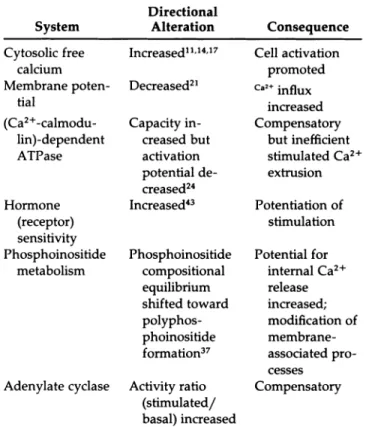
own specific observations are summarized in Table 1. CYTOSOLIC FREE CALCIUM
CONCENTRATIONS
Intracellular calcium content has been demonstrated to be elevated in platelets, erythrocytes, and lymphocytes
from patients with E H T .7"1 0'1 4"1 6 A correlation between
platelet [ C a2 +] i and blood pressure has also been
estab-TABLE 1. PLATELET Ca2 +-LINKED ABNORMALITIES
IN ESSENTIAL HYPERTENSION System Directional Alteration Consequence Cytosolic free calcium Membrane poten tial (Ca2+ -calmodu-lin)-dependent ATPase Hormone (receptor) sensitivity Phosphoinositide metabolism Adenylate cyclase Increased1 1 1 4 1 7 Decreased21 Capacity in creased but activation potential de creased24 Increased43 Phosphoinositide compositional equilibrium shifted toward polyphos phoinositide formation37 Activity ratio (stimulated/ basal) increased Cell activation promoted C a 2 + influx increased Compensatory but inefficient stimulated C a2 + extrusion Potentiation of stimulation Potential for internal C a2 + release increased; modification of membrane-associated pro cesses Compensatory
A brief summary of our findings with respect to EHT and disorders of platelet systems that involve Ca2+. The directional nature of alterations is
indicated, and other than proposed compensatory mechanisms, all modifi cations are considered to facilitate platelet shape change, aggregation, and secretion. Similar abnormalities may contribute to enhanced smooth mus cle contraction in EHT.
lished.1 4 Normalization of platelet [ C a2 +] i occurs follow
ing antihypertensive therapy.1 7 Whatever the underly
ing mechanism, it is not entirely corrected by antihyper tensive therapy, because platelets from treated EHT pa
tients still exhibit an amplified, stimulated [ C a2 +] i re
sponse relative to control subjects.1 7 These data imply
an intrinsic cellular defect and possibly disturbed mech
anisms, including membrane C a2 + binding, C a2 + influx,
hormone-receptor transduction coupling, univalent cat
ion transport, and C a2 + efflux/sequestration.7"1 0
MEMBRANE C a2 + BINDING AND C a2 + INFLUX
Calcium binds to various components of the cell mem brane, including anionic phospholipids and proteins. Altered calcium handling is suggested by decreased
C a2 + binding to the inner and outer surface of plasma
membranes of erythrocytes, adipocytes, and
hepatocytes,7"1 0 perhaps due to a reduction in the num
ber of Ca2 +-binding sites (as opposed to an affinity alter
ation).1 8 Defective calcium binding has been proposed
to favor depolarization with consequent activation of
44 BÜHLER A N D RESINK AJH-JANUARY 1988-VOL 2, NO. 1
the function of potential dependent C a2 + channels in
hypertension are scarce, available data for
synapto-somes and platelets of S H R1 9 , 2 0 and platelets of E H T2 1
indicate partial depolarization of plasma membranes. Such an abnormality could give rise to an increased
basal C a2 + influx and hence increased [ C a2^ .
PROTEIN C a2+ BINDING AND C a2 + EFFLUX
Cytoplasmic divalent cation-binding substances have also been considered in the pathogenesis of
hypertension,7"1 0 but most of them (ie, glycerophos
phates, nucleotides, and inorganic phosphates) are
characterized by KD values that are two to three orders
of magnitude larger than the range of possible changes in [ C a2 +] i. Rather, focus has been on the highly selective
Ca2 +-binding proteins ( KD 1 0 ~6 to 1 0 ~8 M) such as cal
modulin, which plays a central role in the C a2 + d e p e n
-dent regulation of eukaryotic cells.2 2 In EHT, a modifica
tion of interaction between calmodulin and its target
proteins has been p r o p o s e d .7 1 0 Of the many target pro
teins, the plasma membrane C a2 +- A T P a s e is of major
interest because of its critical role in maintaining C a2 +
homeostasis via the promotion of C a2 + efflux.2 3 The
findings with respect to this efflux system in hyperten sion are somewhat varied, with reports of increased,
decreased, or unaltered a c t i v i t i e s .7 , 2 4 - 2 8 The regulation
of C a2 +- A T P a s e , however, is complex, and in addition
to C a2 + and calmodulin other factors such as membrane
hydrophobicity, acidic phospholipids, polyphosphoin
ositides, and proteolysis can modulate C a2 + efflux
activity.7"2 3
PHOSPHOINOSITIDE METABOLISM Phosphoinositides may influence not only the plasma membrane but also internal membranes. Stimulated
C a2 + release from large stores in the endoplasmic reticu
lum is believed to be mediated by inositol 1,4,5 tris-phosphate, a product of hormone-activated
phosphoin-ositide hydrolysis.3 0"3 4 Phosphoinositide metabolism is
also implicated in the regulation of C a2 + influx/efflux
via the plasma membrane, membrane fluidity, mem
brane C a2 + binding, and membrane C a2 +- A T P a s e and
adenylate cyclase activities.2 9"3 3 θίλ-adrenoceptors are
directly coupled to phosphoinositide turnover (as are
vasopressin and angiotensin II receptors), while a2
-adrenoceptors are coupled to adenylate cyclase inhibi
tion.3 4 Postreceptor stimulus-coupling cascades are not
mutually exclusive, and pivotal integrated cellular con trol is mediated via a triangle of second messengers,
namely C a2 +, cyclic AMP, and inositol 1,4,5
trisphos-phate. Available evidence from studies on erythrocytes and platelets in animal and human models of hyperten sion point to the involvement of the phosphoinosi
t i d e s .3 5"3 9 Similar investigations of smooth muscle cells,
which exhibit many more blood pressure regulating hormone receptors than the platelets or erythrocytes,
are necessary. The relationship between alterations in phosphoinositide metabolism and membrane-asso ciated biochemical processes requires definition in order to assign causative or consequential roles in the patho genesis of hypertension.
C a2 + AND CYCLIC NUCLEOTIDES
Cyclic nucleotides are involved in the regulation of heart contractility, vascular smooth muscle tone, release and action of catecholamines, and control of renin se
cretion.4 0 Most functions are regulated (either
synergis-tically or antagonissynergis-tically) by C a2 + and cyclic A M P .4 0
Accordingly, the finding of several anomalies in cyclic nucleotide metabolism in SHR and EHT is not
surprising,4 1"4 3 although many of the findings are quali
tatively discrepant.
Of particular interest is adenylate cyclase, a mem brane-bound enzyme that regulates the synthesis of cy
clic AMP via stimulatory (N8) or inhibitory ( N J guanine
nucleotide-binding proteins.4 4 Nâ is regulated by pro
tein kinase C, a Ca2 +-activated,
diacylglycerol-modu-lated e n z y m e .2 9'4 5 Adenylate cyclase can also be acti
vated by calmodulin and low concentrations of C a2 +
( > 0.8 μΜ) in many cells, including platelets and smooth
muscle; higher C a2 + concentrations are inhibitory.4 6-4 7
Cyclic AMP in turn may influence [ C a2 +] i by promoting
C a2 + efflux/sequestration.4 0 4 8 Thus, derangements in
either phosphoinositide, C a2 +, and/or cyclic AMP me
tabolism may be expected to have profound and mani fold effects on cell function.
CONCLUDING REMARKS
In the past few years our studies on alterations in cal cium and cyclic nucleotide metabolism in EHT have been confined to platelets. The complexities of both cel
lular C a2 + control and coordinated second-messenger
regulation of cellular function make it difficult to assign causative or consequential roles to deranged platelet
C a2 +- l i n k e d processes in the pathophysiology of essen
tial hypertension. Nevertheless, our studies support an underlying membrane pathology as being causative be cause all the derangements described above—
potential, C a2 +- A T P a s e , hormone responsiveness,
adenylate cyclase, and event cytosolic [Ca2 +]i
concentrations — are membrane-associated systems. Modifications of phosphoinositide metabolism may be a key factor accounting for the multifaceted membrane abnormalities associated with EHT. The studies need to be extended to the smooth muscle cell itself to determine whether similar abnormalities are present in the vascu lature and relevant to elevated peripheral vascular re sistance in hypertension.
ACKNOWLEDGMENT
REFERENCES
1. Gill DL: Horizons Biochem Biophys 1982;6:199-236. 2. Rasmussen H, Goodmann DBP: Physiol Rev 1979;
57:421-509.
3. Exton JH: Adv Cycl Nucl Prot Phosph Res 1986;20:214-262.
4. Bühler FR, Hulthén UL: Calcium channel blockers: A pathophysiologically based antihypertensive treatment concept for the future? Eur J Clin Invest 1982;12:1-3. 5. Bühler FR, Hulthén UL, Kiowski W, et al: The place of the
calcium antagonist verapamil in antihypertensive ther apy. J Cardiovasc Pharmacol 1982; 4:S350-S357. 6. Müller FB, Bolli P, Linder L, et al: Calcium antagonists
and the second drug for antihypertensive therapy. Am J Med 1986;81:25-34.
7. Postnov YV, Orlov SN: Ion transport across plasma membrane in primary hypertension. Physiol Rev 1985;65:904.
8. Robinson BF: Altered calcium handling as a cause of primary hypertension. J Hypertension 1984,2:453. 9. Friedman SM: Cellular ionic perturbations in hyperten
sion. J Hypertension 1983;1:109.
10. Postnov YV, Orlov SN: Cell membrane alteration as a source of primary hypertension. J Hypertension 1984;2:1.
11. Erne P, Bühler FR, Affolter H, et al: Excitatory and inhibi tory modulation of intracellular free calcium in human platelets by hormones and drugs. Eur J Pharmacol 1983;91:331.
12. Moore T, Williams GH: Angiotensin II receptors on human platelets. Circ Res 1982;51:314.
13. Resink Τ], Erne Ρ, Bühler FR: The influence of CGP 28392, a 1,4-dihydropyridine on human platelet calcium and cyclic AMP metabolism. Eur J Pharmacol 1985;113:383.
14. Erne P, Bolli P, Bürgisser E, et al: Correlation of platelet calcium with blood pressure: Effect of antihypertensive therapy. Ν Engl J Med 1984;310:1084.
15. Bruschi G, Bruschi ME, Caroppo M, et al: Cytoplasmic
free C a2 + is increased in the platelets of spontaneously
hypertensive rats and essential hypertensive patients. Clin Sei 1985,68:179.
16. Zidek W, Vetter H, Dorst K-G, et al: Intracellular Na+ and
Ca2 + activities in essential hypertension. Clin Sei
1982;63:41s.
17. Erne P, Resink TJ, Bolli P, et al: Free calcium response to adrenaline in platelets of normal and hypertensive (un treated and treated) subjects. J Hypertension 1985;2(suppl 3):159.
18. Devynck MA, Pernollet MG, Nunez AN, et al: Calcium binding alteration in plasma membrane from various tis sues of spontaneously hypertensive rats. Clin Exp Hy-pertens 1982;4:797.
19. Kravtsov GM, Orlov SN, Pokudin NI, et al: Calcium transport in synaptosomes and subcellular membrane fractions of brain tissue in spontaneously hypertensive rats. Clin Sei 1983;65:127.
20. Kuchel O: The autonomic nervous system and blood pressure regulation in human hypertension, in Genest J,
Kuchel O, Hamet P, et al (eds): Hypertension Patho physiology and Treatment. New York, McGraw-Hill, 1983, pp 140.
21. Resink TJ, Dimitrov D, Zschauer A, et al: Platelet cal cium-linked abnormalities in essential hypertension. Ann NY Acad Sei 1986 (in press).
22. Watterson DM, Vincenzi FF (eds): Calmodulin and cell functions. Ann NY Acad Sei 1980;356:1.
23. Carafoli E, Zurini M: The Ca2+-pumping ATPase of
plasma membranes: Purification, reconstitution and properties. Biochim Biophys Acta 1982;683:279. 24. Resink TJ, Tkachuk VA, Erne P, et al: Platelet membrane
calmodulin-stimulated calcium-adenosine triphospha tase: Altered activity in essential hypertension. Hyper tension 1985;8:159.
25. Kwan CY, Grover AK, Sakai Y: Abnormal biochemistry of subcellular membranes isolated from nonvascular smooth muscles of spontaneously hypertensive rats. Blood Vessels 1982;19:273.
26. Wei J-W, Janis RA, Daniel EE: Calcium accumulation and enzymatic activities of subcellular fractions from aortas and ventricles of genetically hypertensive rats. Circ Res 1976;39:133.
27. Pernollet MG, Devynck MA, Meyer P: Abnormal cal cium handling by isolated cardiac plasma membrane from spontaneously hypertensive rats. Clin Sei 1981;61:45s.
28. Aoki K, Yamashita K, Tomita N, et al: ATPase activity
and Ca2+-binding activity of subcellular membranes of
arterial smooth muscle in spontaneously hypertensive rats. Jpn Heart J 1974;15:180.
29. Katada T, Gilman AG, Watanabe Y, et al: Protein kinase C phosphorylates the inhibitory guanine-nucleotide-binding regulatory component and apparently sup presses its function in hormonal inhibition of adenylate cyclase. Eur J Biochem 1985;151:431.
30. Marche Ρ: Polyphosphoinositides and cell activation. Nouv Rev Fr Hematol 1985,27:223.
31. Michell RH: Inositol phospholipids and cell surface re ceptor function. Biochim Biophys Acta 1975;415:81. 32. Vergara J, Tsien RY, Delay M: Inositol
1,4,5-trisphos-phate: A possible chemical link in excitation-contraction coupling in muscle. Proc Natl Acad Sei USA 1985;82:6352.
33. Allan D: Inositol lipids and membrane function in eryth rocytes. Cell Calcium 1982,3:451.
34. Michell RH, Kirk CJ: Why is phosphatidylinositol de graded in response to stimulation of certain receptors? Trends Pharmacol Sei 1981,60:86.
35. Koutouzov S, Marche P, Girard A, et al: Altered turnover of polyphosphoinositides in the erythrocyte membrane of the SH rats. Hypertension 1983;5:409.
36. Marche Ρ, Koutouzov S, Girard A, et al: Phosphoinosi tide turnover in erythrocyte membranes in human and experimental hypertension. J Hypertension 1985;3:25. 37. Dimitrov D, Resink TJ, Müller FB, et al: Altered platelet
phosphatidylinositol metabolism in essential hyperten sion. J Hypertension 1986 (in press).
Phosphoinosi-46 BÜHLER A N D RESINK
tide content in the erythrocyte membranes of rats with spontaneous and renal hypertension. Experientia 1978,34:744.
39. Kiselev G, Minenko A, Moritz V, et al: Polyphosphoino sitide metabolism in erythrocytes of spontaneously hy pertensive rats. Biochem Pharmacol 1981;30:833. 40. Namm DH: The role of cyclic nucleotides in the vascula
ture. Handbook Exp Pharmacol 1982;58:723.
41. Amer MS: Cyclic adenosine monophosphate and hyper tension in rats. Science 1973,179:807.
42. Hamet P, Franks AJ, Adnot S, et al: Cyclic nucleotides in hypertension. Adv Cycl Nucl Res 1980;12:11.
43. Resink TJ, Bürgisser E, Bühler FR: Enhanced platelet cy clic AMP response to prostaglandin E! in essential hy pertension. Hypertension 1986;8:662.
AJH-JANUARY 1988-VOL 1, NO. 1
44. Gilman AG: Guanine nucleotide-binding regulatory proteins and dual control of adenylate cyclase. J Clin Invest 1984;73:1.
45. Takai Y, Kikkawa U, Kaibuchi K, et al: Membrane phos pholipid metabolism and signal transduction for protein phosphorylation. Adv Cycl Nucl Res 1984,18:119. 46. McNeil S, Lakey T, Tomlinson S: Calmodulin regulation
of adenylate cyclase activity. Cell Calcium 1985;6:213. 47. Grigorian GY, Resink TJ, Stucki S, et al: Calmodulin reg ulation of adenylate cyclase activity in human platelet membranes. Cell Calcium 1986;7:261-273.
48. Rasmussen H, Goodman DBP: Relationships between calcium and cyclic nucleotides in cell activation. Physiol Rev 1977,57:421.