Publisher’s version / Version de l'éditeur:
ECS transactions, 12, 1, pp. 691-700, 2008
READ THESE TERMS AND CONDITIONS CAREFULLY BEFORE USING THIS WEBSITE.
https://nrc-publications.canada.ca/eng/copyright
Vous avez des questions? Nous pouvons vous aider. Pour communiquer directement avec un auteur, consultez la première page de la revue dans laquelle son article a été publié afin de trouver ses coordonnées. Si vous n’arrivez pas à les repérer, communiquez avec nous à [email protected].
Questions? Contact the NRC Publications Archive team at
[email protected]. If you wish to email the authors directly, please see the first page of the publication for their contact information.
Archives des publications du CNRC
This publication could be one of several versions: author’s original, accepted manuscript or the publisher’s version. / La version de cette publication peut être l’une des suivantes : la version prépublication de l’auteur, la version acceptée du manuscrit ou la version de l’éditeur.
For the publisher’s version, please access the DOI link below./ Pour consulter la version de l’éditeur, utilisez le lien DOI ci-dessous.
https://doi.org/10.1149/1.2921594
Access and use of this website and the material on it are subject to the Terms and Conditions set forth at
High performance direct ammonia fueled solid oxide fuel cells based on proton conducting solid electrolytes
Yoo, Y.; Lim, N.; Phongaksorn, M.; McFarlan, A.; Maffei, N.
https://publications-cnrc.canada.ca/fra/droits
L’accès à ce site Web et l’utilisation de son contenu sont assujettis aux conditions présentées dans le site LISEZ CES CONDITIONS ATTENTIVEMENT AVANT D’UTILISER CE SITE WEB.
NRC Publications Record / Notice d'Archives des publications de CNRC:
https://nrc-publications.canada.ca/eng/view/object/?id=a288ce05-7e87-4c30-93f4-a7c5aa487f39 https://publications-cnrc.canada.ca/fra/voir/objet/?id=a288ce05-7e87-4c30-93f4-a7c5aa487f39
High Performance Direct Ammonia Fueled Solid Oxide Fuel Cells Based on Proton Conducting Solid Electrolytes
Y. Yooa, N. Lima, M. Phongaksornb, A. McFarlanc, and N. Maffeic a
Institute for Chemical Process and Environmental Technology (ICPET), National Research Council Canada (NRCC), Ottawa, Ontario, Canada K1A 0R6 b
Department of Chemical Engineering, University of Waterloo, Waterloo, Ontario, Canada N2L 3G1
c
CANMET Energy Technology Centre (CETC), Natural Resources Canada, Ottawa, Ontario, Canada K1A 1M1
The high performance anode supported single cells for ammonia fueled SOFCs, comprising of BSCF (Ba0.5Sr0.5Co0.8Fe0.2O 3-δ)//BCY//NiO-BCY have been fabricated by wet colloidal spray for depositing 10-15 µm thin film electrolytes. The detailed characterization of BSCF, including electrical conductivities of sintered specimen as a function of temperature has been conducted to investigate the possibility to utilize BSCF as cathode for proton conducting electrolyte based cells. The electrochemical performance of single cells was characterized at the temperature 600-700 °C under humid 75% H2 in N2 (3% H2O) as well as cracked ammonia as the fuel gas and air as the oxidant gas at a gas flow rate of 10-100 mL min-1. The open circuit voltages were around 1.05-1.08 V at 600 °C indicating little gas leakage through the electrolyte. Maximum power density of 400 mW/cm2 was obtained at 600 °C and 0.7 V under air as the oxidant gas and humid 75% H2 in N2 (3% H2O) as the fuel gas at gas flow rates of 100 and 100 mL min-1, respectively.
Introduction
The commercialization of fuel cells has been limited due to several hurdles such as lack of infrastructure for the storage and transportation of hydrogen. Ammonia can be considered as one of good hydrogen carriers to be suitable for fuel cells. In recent years, it has been shown that solid oxide fuel cells (SOFCs) can be directly operated with ammonia (1-5). In comparison to hydrogen or hydrocarbon gases as typical fuels for fuel cells, ammonia has several attractive advantages such as no CO2 release, mild enthalpy of reforming, ambient temperature liquefaction under 10 atm, non-flammability, narrow explosive range of 16 to 25 per cent by volume in air, high volumetric energy, and established transport and storage infra-structure. In addition, direct-ammonia utilization as fuel eliminates any concern about carbon coking to cause the significant degradation of cell performance during operating hydrocarbon-fueled SOFCs. Typically, the catalytic cracking of ammonia to produce hydrogen in situ under the fuel cell conditions can be carried out on Ni-based and Fe-based catalysts.
The direct-ammonia fuel cell using proton conductive electrolytes can avoid the formation of NOx because the mixed conductive electrolyte exhibits mainly proton
ECS Transactions, 12 (1) 691-700 (2008) 10.1149/1.2921594 © The Electrochemical Society
conductivity in a hydrogen-rich atmosphere and at intermediate temperatures (6,7). However, the electrolyte-supported cells provided very poor power densities of 30-40 mW cm-2 at 700 °C due to the high ohmic resistance of thick electrolytes (1,3). Yoo et al. presented anode-supported type proton conductive electrolyte single cells of Ba0.5Sr0.5Co0.8Fe0.2O3-δ (BSCF)//Ba1.0Ce0.8Y0.2O3-δ (BCY, 50 µm thickness)//NiO-BCY for direct ammonia fuel cells, fabricated by dry-pressing, co-firing, and wet colloidal spray (8). Maximum power densities of 220, 190 and 160 mW cm-2 from single cells were obtained at 700, 650 and 600 °C, respectively under humid 75% H2 in N2 (3% H2O) and air.
In this paper, high performance anode supported single cells for ammonia fueled SOFCs, comprising of BSCF (Ba0.5Sr0.5Co0.8Fe0.2O3-δ)//BCY//NiO-BCY have been fabricated by wet colloidal spray for depositing 10-15 µm thin film electrolytes. The detailed characterization of BSCF, including electrical conductivities of sintered specimen as a function of temperature has been conducted to investigate the possibility to utilize BSCF as cathode for proton conducting electrolyte based cells. Ni diffusion from NiO-BCY anode into BCY electrolyte during sintering process should be reduced or eliminated to enhance proton conductivity of the BCY electrolyte, resulting in increasing open circuit voltage and power density of single cells. It was attempted to increase green packing densities of sprayed electrolytes using a cold isostatic pressing (CIP) techniques for lowering co-firing temperature of the anode and electrolyte, resulting in decreasing the Ni diffusion. Scalable processing technologies such as tape casting and colloidal spray to prepare anode and electrolyte, respectively, have been attempted to fabricate larger dimensional planar single cells than button type cells. In addition, the electrochemical performance of single cells was characterized at the temperature 600-700 °C under humid 75% H2 in N2 (3% H2O) or ammonia as the fuel gas and air as the oxidant gas.
Experimental
Preparation of anode supported electrolyte by pressing, presintering, and wet colloidal spray
The porous NiO-BCY substrates were fabricated by conventional powder pressing and sintering methods. The mixture of NiO (J. T. Baker) and BaCe0.8Y0.2O3-δ (Praxair) proton conducting oxide powders with wt. % of 60 and 40 was ball-milled for 2 h in ethanol and dried at 85 °C. The dried mixture was sieved and mixed with 3~10 wt. % graphite for adjusting sintering shrinkage and then pressed under 40 MPa with 20 mm in diameter and 0.8 mm in thickness. The pressed pellets of NiO-BCY were pre-sintered in air at 700 °C for 2 h. The proton conducting oxide electrolyte layer of BCY of 10-15 µm was deposited on the pre-sintered anode by a proprietary pulsed injection type wet colloidal spray developed at NRC-ICPET (9). Ethanol was used for the suspension medium, and its powder loading was set at about 1.0 g per 10 ml of suspension. The resulting sprayed bi-layers were sintered at 1200-1350 °C in air for 2 h with or without a cold isostatic press (CIP) at a pressure of over 200 MPa to increase the green packing density of sprayed BCY layer before sintering.
Synthesis of BSCF powder by solid state processing and deposition of BSCF cathode by wet colloidal spray
As starting materials, BaCO3, SrCO3, Co3O4 and Fe2O3 powders were used to synthesize a composition with the formula Ba0.5Sr0.5Co0.8Fe0.2O3-δ (BSCF) via conventional solid state reaction. Mixtures of the starting materials were ground and calcined in air at 1000 °C for 3 h. They were then reground, pressed into pellets and sintered in air at 1050 °C for 2 h. BSCF powders synthesized by solid state processing were used for preparing cathodes on anode-supported BCY electrolytes. BSCF powders milled by high energy mill for 5 min were sprayed on the sintered bi-layer of BCY electrolyte and NiO-BCY anode by using the wet colloidal spray process. The cathode layer sprayed on the sintered bi-layer was fired at 850-950 °C for 1 h in air to minimize the interfacial reaction between BCY and BSCF.
Fabrication of NiO-BCY anodes by tape casting process
NiO-BCY anodes for large dimensional single cells with 25 mm diameter were fabricated by conventional solvent based tape casting process based on ethanol and toluene. Processing additives included the mixed solvent, dispersant, binder, plasticizer, and 5-10 wt. % graphite as a pore former to enhance the gas permeability of the anode of NiO-BCY with wt. % of 60 and 40.
Characterization: X-ray diffraction (XRD) and microstructure
The phase formation of compounds and the chemical compatibility of synthesized BSCF with BCY (Praxair) were examined by X-ray diffraction on a Bruker D8 Advanced X-ray diffractometer (Bruker AXS Gmbh, Karlsruhe, Germany) using Cu-Kα radiation by collecting the diffractogram from 2θ = 20°-80° with 0.04 step size. The surface and cross-sectioned area of samples prepared by the combination of colloidal spray/pressing or colloidal spray/tape casting were examined by scanning electron microscopy (SEM). Thermal expansion behavior
The thermal expansion coefficients (TECs) and thermal expansion behavior over the temperature range of 25-900 °C were measured by using TA instruments TMA 2940 in air with the heating and cooling rates of 3°C/min.
Conductivities of BSCF cathode
The electrical conductivities of BSCF rectangular bars were measured by a standard four-point dc method using a Keithley 2400 source meter. The sintered samples were cut to 15.0 mm X 3.0 mm X 4.0 mm by a diamond saw. Pt electrodes were formed on both end surfaces by brush painting of platinum paste (Ferro 4082). Two Pt leads used to measure the voltage drop formed at positions 3 mm apart from both ends were attached to the specimens by winding. A constant current of 80 mA was applied to both end current electrodes and the voltage drop between the Pt leads was measured using a Keithley 2400 source meter.
Electrochemical performance of single cells
The CV characteristics and degradation of single cells composed of BSCF (Ba0.5Sr0.5Co0.8Fe0.2O3-δ)//BCY//NiO-BCY were evaluated at the temperature range 600 to 700 °C under humid 75% H2 in N2 (3% H2O) or cracked ammonia as the fuel gas and air as the oxidant gas at a gas flow rate of 10-100 mL min-1.
Results and discussion Fabrication of anode-supported BCY electrolyte
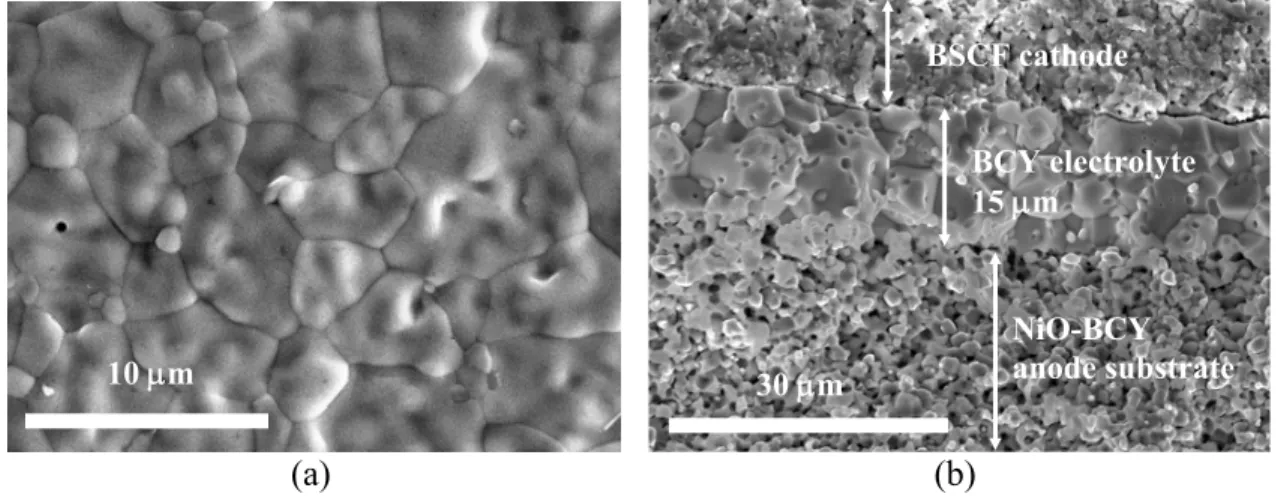
The proton conducting oxide electrolyte layer of BCY of 10-15 µm was deposited on the pre-sintered anode by wet colloidal spray. The porous pre-sintered anode supports were fabricated by two different methods including uni-axial pressing for 20 mm diameter discs and tape casting process for preparing 25 mm diameter discs and larger dimensional cells. The resulting sprayed electrolyte layer was compacted on a cold isostatic press at a pressure of over 200 MPa to increase the packing density. Pressed bi-layers were sintered at 1200-1350 °C for 2 h in air. Figure 1 shows scanning electron micrographs of the surface morphology and the fracture cross-section of the BCY electrolyte deposited on porous NiO-BCY anode. Continuous and crack-free 15 µm-thick BCY thin films having small closed pores and 5-7 um grain size were successfully formed at the sintering temperature of 1275 °C for 2 h in air on the porous NiO-BCY anode support.
(a) (b)
Figure 1. Scanning electron micrographs of (a) the surface morphology and (b) the fracture cross-section of BCY thin film electrolyte on a porous NiO-BCY support.
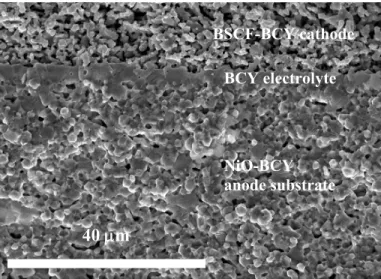
Figure 2 shows the microstructure of anode supported single cell fabricated by tape casting for anode and wet colloidal spray process for electrolyte and cathode. It was confirmed that tape casting process is applicable to fabricate large dimensional NiO-BCY anodes with desirable porosity for scale up.
10 µm BSCF cathode BCY electrolyte 15 µm NiO-BCY anode substrate 30 µm
Figure 2. Scanning electron micrograph of the fracture cross-section of BSCF-BCY//BCY//NiO-BCY single cell fabricated by tape casting process and wet colloidal spray.
Chemical Compatibility of BSCF and BCY
20
30
40
50
60
70
80
2 theta
In
te
n
s
it
y
(
a
.u
.)
Figure 3. XRD patterns of (a) BSCF, (b) BCY and the mixtures of BSCF and BCY heat-treated at (c) 700 C, (d) 800 C, (e) 900 C, and (f) 1000 C. (▼) unknown secondary phases (Ba-Fe-O) (8). 40 µm BSCF-BCY cathode BCY electrolyte NiO-BCY anode substrate (f) 1000 °C (e) 900 °C (d) 800 °C (c) 700 °C (b) BCY (a) BSCF ▼ ▼ ▼ ECS Transactions, 12 (1) 691-700 (2008)
BSCF (Ba0.5Sr0.5Co0.8Fe0.2O3-δ) single phase perovskite with cubic structure was successfully synthesized at 1050 °C for 2 h via conventional solid state processing. The chemical compatibility of BSCF and BCY at different temperatures was recently investigated in detail by Yoo et al. (8) as shown in Figure 3. The mixture of BSCF and BCY heated up to 800 °C shows no significant reacted phases. However, above 900 C, some unknown reacted phases appear in the diffraction patterns, which can be attributed to Ba-Fe-O phases. The adhesion between BSCF cathode and BCY electrolyte is also important parameter to reduce interfacial polarization resistance at operating conditions. It was difficult to get adhesive cathode layer on BCY below 900 °C. Therefore the BSCF cathode sprayed on BCY electrolyte was sintered at 900 °C for 2 h to minimize unnecessary reaction and to keep acceptable contact between layers for the characterization of single cells.
Thermal expansion behavior of cell components
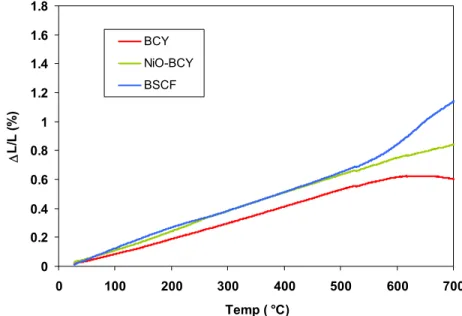
The thermal expansion behavior of cell components including BSCF, BCY, and NiO-BCY under air atmosphere is shown in Figure 4. The thermal expansion coefficients (TECs) of three components calculated in the temperature range 25-600 °C were 13.3, 10.9, and 12.9 x 10⁻⁶ K-1 for BSCF, BCY, and NiO-BCY, respectively, but significantly different over 600 °C, indicating that the further adjustment of thermal expansion behavior of three components is necessary for practical applications. It was reported that the non-linear expansion curve of BSCF can be mainly caused from the loss of lattice oxygen and the formation of oxygen vacancies (10), not by phase transition (11) during heating or cooling. 0 0.2 0.4 0.6 0.8 1 1.2 1.4 1.6 1.8 0 100 200 300 400 500 600 700 Temp ( °C) ∆ L/ L ( % ) BCY NiO-BCY BSCF
Figure 4. Thermal expansion curves of single cell components. Electrical conductivities of Ba0.5Sr0.5Co0.8Fe0.2O3-δ (BSCF) cathode
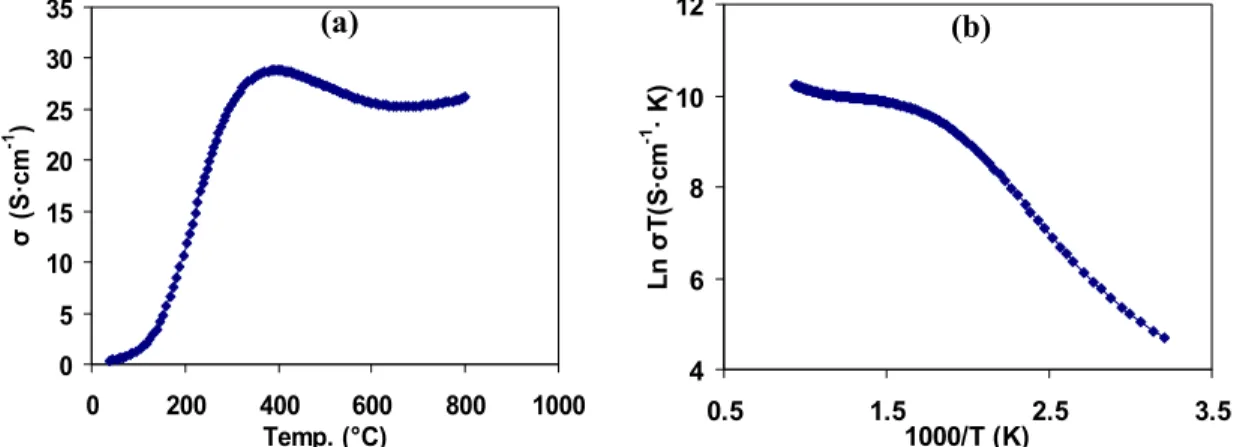
Figure 5 shows the total electrical conductivity of BSCF as a function of temperature in air. BSCF exhibits M-I (Metal-Insulator) transition at around 400 °C and relatively low electrical conductivity of 25-30 S/cm at the intermediate temperatures in comparison to
other known cathodes. It was known that BSCF has high ionic conductivity and remarkable electrochemical performance at intermediate temperatures. The activation energy (Ea) of BSCF, calculated from the Arrhenius plot as shown in Figure 5 (b) is 35.6 kJ mol-1 that is quite close to the value in the literature (10).
0 5 10 15 20 25 30 35 0 200 400 600 800 1000 Temp. (°C) σ (S ·c m -1 ) 4 6 8 10 12 0.5 1.5 2.5 3.5 1000/T (K) Ln σ T( S· c m -1 · K )
Figure 5. Total electrical conductivity of BSCF as a function of temperature in air. Cell performance of single cells
Figure 6 shows the electrochemical performance of single cells composed of Ba0.5Sr0.5Co0.8Fe0.2O3-δ (BSCF) // BCY // NiO-BCY at the temperature 600 °C under humid 75% H2 in Ar (3% H2O) as well as NH3 as the fuel gas and air as the oxidant gas at a flow rate of 100 mL/min, respectively. The open circuit voltages were around 0.93~0.97 V at 600 °C indicating gas leakage and potentially electronic leakage through the electrolyte due to some open pores in the electrolyte and significant Ni diffusion from NiO-BCY anode to the electrolyte layer during sintering process. Ammonia fuel usage caused a little decrease of cell voltage and power density.
0 0.1 0.2 0.3 0.4 0.5 0.6 0.7 0.8 0.9 1 0 100 200 300 400
Current Density (mA/cm2)
C e ll V o lta g e ( V ) 0 20 40 60 80 100 P o w er D en s it y ( m W /cm 2 ) 75% H2 in Ar NH3
Figure 6. Effect of fuel gases on I-V Characteristics of BSCF//BCY//NiO-BCY at 600 °C.
(a) (b)
0 0.2 0.4 0.6 0.8 1 0 100 200 300 400 500 600 700 800
Current Density (mA/cm2)
C e ll V o lta g e (V ) 0 100 200 300 400 500 Pow e r Densi ty ( m W /cm 2 )
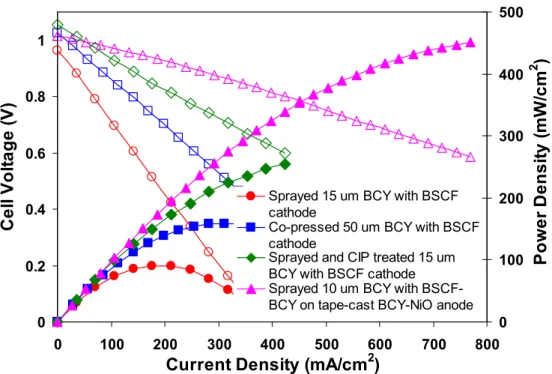
Sprayed 15 um BCY with BSCF cathode
Co-pressed 50 um BCY with BSCF cathode
Sprayed and CIP treated 15 um BCY with BSCF cathode Sprayed 10 um BCY with BSCF-BCY on tape-cast BSCF-BCY-NiO anode
Figure 7. I-V Characteristics of single cells at 600 °C, prepared by different fabricating processes. . 0 0.2 0.4 0.6 0.8 1 1.2 0 20 40 60 80 100 120
Fuel Gas (75% H2 in N2) Flow Rate (cc/min)
Cel l Vol tage (V )
Figure 8. Cell voltage of BSCF//BCY//NiO-BCY single cell fabricated by spray and CIP as a function of fuel gas flow rate at 600 °C.
Figure 7 shows the enhanced cell performance of single cells fabricated by different fabricating processes. It was shown that the use of cold isostatic press (CIP) to increase green packing density, resulting in increasing the sintered density was effective to improve cell performance as expected. The 15 µm thin film electrolyte cell prepared by
spray and CIP shows much higher open circuit voltage and power density than those from a 50 µm thin film electrolyte cell fabricated by co-pressing. The 25 mm diameter single cell fabricated by tape casting, spray, and co-firing exhibited impressive performance. The maximum power density of 400 mW/cm2 was obtained at 600 °C and 0.7 V under air as the oxidant gas and humid 75% H2 in N2 (3% H2O) as the fuel gas at gas flow rates of 100 and 100 mL min-1, respectively. The improved spray and co-firing process for forming less defective BCY thin film electrolyte and the composite cathode of BSCF and BCY significantly enhanced the cell performance to demonstrate the fabrication processing technologies for scale up. The long term cell performance should be investigated further.
Figure 8 shows the open circuit voltages of a single cell as a function of fuel gas flow rate. It was shown that the BSCF//BCY//NiO-BCY cells may exhibit high gas utilization in large dimensional cells and stacks.
Conclusions
The high performance anode supported single cells for ammonia fueled SOFCs comprising of BSCF (Ba0.5Sr0.5Co0.8Fe0.2O3-δ)//BCY//NiO-BCY have been fabricated by wet colloidal spray for depositing 10-15 µm thin film electrolytes. The electrochemical performance of single cells was characterized at the temperature 600-700 °C under humid 75% H2 in N2 (3% H2O) as well as cracked ammonia as the fuel gas and air as the oxidant gas at a gas flow rate of 10-100 mL min-1. The open circuit voltages were around 1.05-1.08 V at 600 °C indicating little gas leakage through the electrolyte. Maximum power density of 400 mW/cm2 was obtained at 600 °C and 0.7 V under air as the oxidant gas and humid 75% H2 in N2 (3% H2O) as the fuel gas at gas flow rates of 100 and 100 mL min-1, respectively.
Acknowledgments
This work was financially supported by Program of Energy Research and Development (PERD) Technology and Innovation (T&I) in Canada. Thanks are also addressed to Mr. Mark Tuck, Ms. Xiaomei Du, and Mr. Luc Pelletier for sample preparation and to Mr. Steve Argue for AA analysis. The authors would like to gratefully acknowledge the assistance of Dr. I. Davidson at NRC-ICPET and Prof. Eric Croiset at University of Waterloo.
References
1. N. Maffei, L. Pelletier, J.P. Charland, and A. McFarlan, J. Power Sources, 140, 264 (2005).
2. A. Wojcik, H. Middleton, I. Damopoulos, and J. Van herle, J. Power Sources, 118, 342 (2003)
3. A. McFarlan, L. Pelletier, and N. Maffei, J. Electrochem. Soc., 151, A930 (2004). 4. N. Maffei, L. Pelletier, and A. McFarlan, J. Power Sources, 136, 24 (2004). 5. Q. Ma, R. Peng, Y. Lin, J. Gao, and G. Meng, J. Power Sources, 161, 95 (2006).
6. K. Katahira, Y. Kohchi, T. Shimura, and H. Iwahara, Solid State Ionics, 53-56, 998 (1992).
7. N. Bonanos, Solid State Ionics, 145, 265 (2001).
8. Y. Yoo, M. Tuck, N. Lim, A. McFarlan, and N. Maffei, in SOFC-X, K. Eguchi, S.C. Singhal, H. Yokokawa, and J. Mizusaki, Editors, p.2305, vol. 7 (1), The Electrochemical Society ECS Transactions, Pennington, NJ (2007).
9. N. Oishi, Y. Yoo, and I. Davidson, J. Am. Ceram. Soc., 90(5), 1365 (2007).
10. B. Wei, Z. Lu, X. Huang, J. Miao, X. Sha, X. Xin, and W. Su, J. Eur. Ceram. Soc., 26, 2827 (2006).