Publisher’s version / Version de l'éditeur:
Proceedings of the Joint 5th Workshop on Statistical Machine Translation and
MetricsMATR, pp. 127-132, 2010
READ THESE TERMS AND CONDITIONS CAREFULLY BEFORE USING THIS WEBSITE.
https://nrc-publications.canada.ca/eng/copyright
Vous avez des questions? Nous pouvons vous aider. Pour communiquer directement avec un auteur, consultez la
première page de la revue dans laquelle son article a été publié afin de trouver ses coordonnées. Si vous n’arrivez pas à les repérer, communiquez avec nous à [email protected].
Questions? Contact the NRC Publications Archive team at
[email protected]. If you wish to email the authors directly, please see the first page of the publication for their contact information.
NRC Publications Archive
Archives des publications du CNRC
This publication could be one of several versions: author’s original, accepted manuscript or the publisher’s version. / La version de cette publication peut être l’une des suivantes : la version prépublication de l’auteur, la version acceptée du manuscrit ou la version de l’éditeur.
Access and use of this website and the material on it are subject to the Terms and Conditions set forth at
Lessons from NRC’s Portage System at WMT 2010
Larkin, Samuel; Chen, Boxing; Foster, George; Germann, Ulrich; Joanis,
Eric; Johnson, Howard; Kuhn, Roland
https://publications-cnrc.canada.ca/fra/droits
L’accès à ce site Web et l’utilisation de son contenu sont assujettis aux conditions présentées dans le site LISEZ CES CONDITIONS ATTENTIVEMENT AVANT D’UTILISER CE SITE WEB.
NRC Publications Record / Notice d'Archives des publications de CNRC:
https://nrc-publications.canada.ca/eng/view/object/?id=a898c7c2-7d00-4cbc-8635-3e5be6cb7817 https://publications-cnrc.canada.ca/fra/voir/objet/?id=a898c7c2-7d00-4cbc-8635-3e5be6cb7817
Lessons from NRC’s Portage System at WMT 2010
Samuel Larkin, Boxing Chen, George Foster, Ulrich Germann, Eric Joanis, Howard Johnson, and Roland Kuhn
National Research Council of Canada (NRC) Gatineau, Québec, Canada.
Abstract
NRC’s Portage system participated in the Eng-lish-French (E-F) and French-English (F-E) translation tasks of the ACL WMT 2010 eval-uation. The most notable improvement over earlier versions of Portage is an efficient im-plementation of lattice MERT. While Portage has typically performed well in Chinese to English MT evaluations, most recently in the NIST09 evaluation, our participation in WMT 2010 revealed some interesting differences be-tween Chinese-English and E-F/F-E transla-tion, and alerted us to certain weak spots in our system. Most of this paper discusses the problems we found in our system and ways of fixing them. We learned several lessons that we think will be of general interest.
1 Introduction
Portage, the statistical machine translation sys-tem of the National Research Council of Canada (NRC), is a two-pass phrase-based system. The translation tasks to which it is most often applied are Chinese to English, English to French (hen-ceforth “E-F”), and French to English (hence-forth “F-E”): in recent years we worked on Chi-nese-English translation for the GALE project and for NIST evaluations, and English and French are Canada’s two official languages. In WMT 2010, Portage scored 28.5 BLEU (un-cased) for F-E, but only 27.0 BLEU (un(un-cased) for E-F. For both language pairs, Portage tru-ecasing caused a loss of 1.4 BLEU; other WMT systems typically lost around 1.0 BLEU after truecasing. (Human evaluation scores are not yet available at the time of writing). In Canada, about 80% of translations between English and French are from English to French, so we would
have preferred better results for that direction. This paper first describes the version of Portage that participated in WMT 2010. It then analyzes problems with the system and describes the solu-tions we found for some of them.
2 Portage system description
2.1 Core engine and training data
The NRC system uses a standard two-pass phrase-based approach. Major features in the first-pass loglinear model include phrase tables derived from symmetrized IBM2 alignments and symmetrized HMM alignments, a distance-based distortion model, a lexicalized distortion model, and language models (LMs) that can be either static or else dynamic mixtures. Each phrase ta-ble used was a merged one, created by separately training an IBM2-based and an HMM-based joint count table on the same data and then add-ing the counts. Each includes relative frequency estimates and lexical estimates (based on Zens and Ney, 2004) of forward and backward condi-tional probabilities. The lexicalized distortion probabilities are also obtained by adding IBM2 and HMM counts. They involve 6 features (mo-notone, swap and discontinuous features for fol-lowing and preceding phrase) and are condi-tioned on phrase pairs in a model similar to that used by Moses; a MAP-based backoff smoothing scheme is used to combat data sparseness when estimating these probabilities. Dynamic mixture LMs are linear mixtures of ngram models trained on parallel sub-corpora with weights set to mi-nimize perplexity of the current source text as described in (Foster and Kuhn, 2007); hence-forth, we’ll call them “dynamic LMs”.
Decoding uses the cube-pruning algorithm of (Huang and Chiang, 2007) with a 7-word distor-tion limit. Contrary to the usual implementadistor-tion of distortion limits, we allow a new phrase to end
more than 7 words past the first non-covered word, as long as the new phrase starts within 7 words from the first non-covered word. Notwith-standing the distortion limit, contiguous phrases can always be swapped. Out-of-vocabulary (OOV) source words are passed through un-changed to the target. Loglinear weights are tuned with Och's max-BLEU algorithm over lat-tices (Macherey et al., 2008); more details about lattice MERT are given in the next section. The second pass rescores 1000-best lists produced by the first pass, with additional features including various LM and IBM-model probabilities; ngram, length, and reordering posterior probabilities and frequencies; and quote and parenthesis mismatch indicators. To improve the quality of the maxima found by MERT when using large sets of partial-ly-overlapping rescoring features, we use greedy feature selection, first expanding from a baseline set, then pruning.
We restricted our training data to data that was directly available through the workshop's web-site; we didn’t use the LDC resources mentioned on the website (e.g., French Gigaword, English Gigaword). Below, “mono” refers to all mono-lingual data (Europarl, news-commentary, and shuffle); “mono” English is roughly three times bigger than “mono” French (50.6 M lines in “mono” English, 17.7 M lines in “mono” French). “Domain” refers to all WMT parallel training data except GigaFrEn (i.e., for Europarl, news-commentary, and UN).
2.2 Preprocessing and postprocessing
We used our own English and French pre- and post-processing tools, rather than those available from the WMT web site. For training, all English and French text is tokenized with a language-specific tokenizer and then mapped to lowercase. Truecasing uses an HMM approach, with lexical probabilities derived from “mono” and transition probabilities from a 3-gram LM trained on tru-ecase “mono”. A subsequent rule-based pass ca-pitalizes sentence-initial words. A final detokeni-zation step undoes the tokenidetokeni-zation.
2.3 System configurations for WMT 2010
In the weeks preceding the evaluation, we tried several ways of arranging the resources available to us. We picked the configurations that gave the highest BLEU scores on WMT2009 Newstest. We found that tuning with lattice MERT rather than N-best MERT allowed us to employ more parameters and obtain better results.
E-F system components:
1. Phrase table trained on “domain”; 2. Phrase table trained on GigaFrEn; 3. Lexicalized distortion model trained on
“domain”;
4. Distance-based distortion model; 5. 5-gram French LM trained on “mono”; 6. 4-gram LM trained on French half of
GigaFrEn;
7. Dynamic LM composed of 4 LMs, each trained on the French half of a parallel corpus (5-gram LM trained on “domain”, 4-gram LM on GigaFrEn, 5-gram LM on news-commentary and 5-gram LM on UN).
F-E system components:
1. Phrase table trained on “domain” 2. Phrase table trained on GigaFrEn 3. Lexicalized distortion model trained on
“domain”
4. Distance-based distortion model 5. 5-gram English LM trained on “mono” 6. 4-gram LM trained on English half of
GigaFrEn
7. Dynamic LM composed of 4 LMs, each trained on the English half of a parallel corpus (5-gram LM trained on “domain”, 4-gram LM on GigaFrEn, 5-gram LM on news-commentary and 5-gram LM on UN).
3 Details of lattice MERT
Our system’s implementation of lattice MERT (LMERT; Macherey et al., 2008) is the most not-able recent change in our system. As more and more features are included in the loglinear mod-el, many of them strongly correlated, N-best MERT (Och, 2003) shows more and more varia-bility in its results, because of convergence to local optima (Foster and Kuhn, 2009). We had been looking for methods that promise more sta-bility and better convergence. LMERT seemed to fit the bill. It optimizes over the complete lattice of candidate translations after a decoding run. This avoids some of the problems of N-best lists, which lack variety, leading to poor local optima and the need for many decoder runs.
Though the algorithm is straightforward and is highly parallelizable, attention must be paid to space and time resource issues during implemen-tation. Lattices output by our decoder were large and needed to be shrunk dramatically for the al-gorithm to function well. Fortunately, this could be achieved via the finite state equivalence algo-rithm for minimizing deterministic finite state
machines. The second helpful idea was to sepa-rate out the features that were a function of the phrase associated with an arc (e.g., translation length and translation model probability fea-tures). These features could then be stored in a smaller phrase-feature table. Features associated with language or distortion models need to be handled in a larger transition-feature table.
The above ideas, plus careful coding of data structures, brought the memory footprint down sufficiently to allow us to use complete lattices from the decoder and optimize over the complete development set for NIST09 Chinese-English. However, combining lattices between decoder runs again resulted in memory requirements. We achieved acceptable performance by searching only the lattice from the latest decoder run; per-haps information from earlier runs, though criti-cal for convergence in N-best MERT, isn’t as important for LMERT.
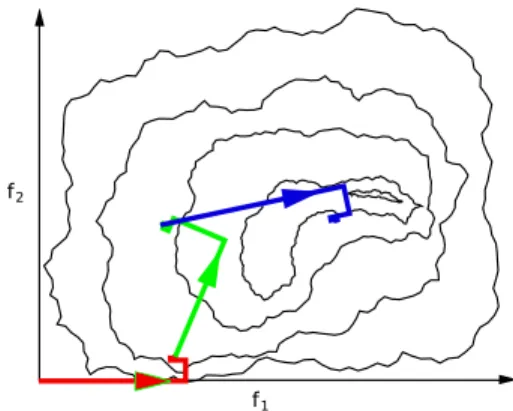
Powell's algorithm (PA), which is at the core of MERT, has good convergence when features are mostly independent and do not depart much from a simple coordinate search; it can run into problems when there are many, correlated fea-tures (as with multiple translation and language models). Figure 1 shows the kind of case where PA works well. The contours of the function be-ing optimized are relatively smooth, facilitatbe-ing learning of new search directions from gradients.
Figure 2 shows a more difficult case: there is
a single optimum, but noise dominates and PA has difficulty finding new directions. Search of-ten iterates over the original co-ordinates, miss-ing optima that are nearby but in directions not discoverable from local gradients. Probes in ran-dom directions can do better than iteration over the same directions (this is similar to the method proposed for N-best MERT by Cer et al., 2008). Each 1-dimensional MERT optimization is exact, so if our probe stabs a region with better scores, it will be discovered. Figures 1 and 2 only hint at the problem: in reality, 2-dimensional search isn’t a problem. The difficulties occur as the di-mension grows: in high didi-mensions, it is more important to get good directions and they are harder to find.
For WMT 2010, we crafted a compromise with the best properties of PA, yet allowing for a more aggressive search in more directions. We start with PA. As long as PA is adding new di-rection vectors, it is continued. When PA stops adding new directions, random rotation (ortho-gonal transformation) of the coordinates is per-formed and PA is restarted in the new space. PA
almost always fails to introduce new directions within the new coordinates, then fails again, so another set of random coordinates is chosen. This process repeats until convergence.
Our LMERT implementation has room for improvement: it may still run into over-fitting problems with many correlated features. Howev-er, during preparation for the evaluation, we no-ticed that LMERT converged better than N-best MERT, allowing models with more features and higher BLEU to be chosen. After the WMT submission, we discovered that our LMERT im-plementation had a bug; our submission was tuned with this buggy LMERT. Comparison be-tween our E-F submission tuned with N-best MERT and the same system tuned with bug-fixed LMERT shows BLEU gains of +1.5-3.5 for LMERT (on dev, WMT2009, and WMT2010, with no rescoring). However, N-best MERT per-formed very poorly in this case; we usually ob-tain a gain due to LMERT of +0.5-1.0 (e.g., for the submitted F-E system).
Figure 1: Convergence for PA (Smooth Feature
Space)
Figure 2: Convergence for PA with Random Rotation
4 Problems and Solutions
4.1 Fixing LMERT
Just after the evaluation, we noticed a discrepan-cy for E-F between BLEU scores computed dur-ing LMERT optimization and scores from the 1-best list immediately after decoding. Our LMERT code had a bug that garbled any ac-cented word in the French reference; previous LMERT experiments had English as target lan-guage, so the bug hadn’t showed up. The bug involved a Perl script that implicitly converted text from ISO Latin 1 encoding to Unicode UTF-8 (this doesn’t affect characters in the 7-bit AS-CII set, such as English ones, but affects French accents). Words in candidate translations were not garbled, so correct translations with accents received a lower BLEU score than they should have. As Table 1 shows, this bug cost us about 0.5 BLEU for WMT 2010 E-F after rescoring (according to the version of BLEU used internal-ly at NRC, which differs from the WMT defini-tion of BLEU in the way the brevity penalty, to-kenization, and smoothing are handled). It is re-markable that despite this bug, the system tuned with buggy LMERT (and submitted) was still better than the best system we obtained with N-best MERT. The bug had no impact on F-E scores. Dev WMT2009 WMT2010 LMERT (bug) 25.26 26.85 27.55 LMERT (no bug) 25.43 26.89 28.07
Table 1: LMERT bug fix (E-F BLEU after rescoring)
4.2 Fixing odd translations
After the evaluation, we carefully studied the system outputs on the WMT 2010 test data, par-ticularly for E-F. Apart from truecasing errors, we noticed two kinds of bad behaviour: transla-tions of proper names and apparent passthrough of English words to the French side.
Examples of E-F translations of proper names from our WMT 2010 submission (each from a different sentence):
Mr. Onderka → M. Roman, Lukáš Marvan → G. Lukáš, Janey → The, Janette Tozer → Janette, Aysel Tugluk → joints tugluk, Tawa Hallae → Ottawa, Oleson → production, Alcobendas → ;
When the LMERT bug described above was fixed, some but not all of these inappropriate translations were corrected (e.g., 3 of the 8 ex-amples above were corrected).
Our system passes OOV words through un-changed. Thus, the names above aren’t OOVs, but words that occur rarely in the training data, and for which bad alignments have a dispropor-tionate effect. We realized that when a source word begins with a capital, that may be a signal that it should be passed through. We thus de-signed a passthrough feature function that applies to all capitalized forms not at the start of a sen-tence (and also to forms at the sensen-tence start if they’re capitalized elsewhere). Consecutive se-quences of capitalized forms are grouped into a phrase suggestion (e.g., Barack Obama → bar-rack obama) which competes with phrase table entries and is assigned a weight by MERT.
The passthrough feature function yields a tiny improvement over the E-F system with the bug-fixed LMERT on the dev corpus (WMT 2008): +0.06 BLEU. It yields a larger improvement on our test corpus: +0.27 BLEU. Furthermore, it corrects all the examples from the WMT 2010 test shown above (after the LMERT bug fix 5 of the 8 examples shown above still had problems, but when the passthrough function is incorpo-rated all of them go away). Although the BLEU gain is small, we are very glad to have found a way of handling this type of error: human beings find it extremely annoying.
The opposite type of error is apparent pass-through. For instance, “we’re” appeared 12 times in the WMT 2010 test data, and was translated 6 times into French as “we’re” - even though better translations had higher forward probabilities. The source of the problem is the backward probabili-ty P(E=“we’re”|F=“we’re”), which is 1.0; the backward probabilities for better French transla-tions of “we’re” are lower. Because of the high probability P(E=“we’re”|F=“we’re”) within the loglinear combination, the decoder often chooses “we’re” as the French translation of “we’re”.
The (E=“we’re”, F=“we’re”) phrase pair in our WMT 2010 phrase tables arose from two sentence pairs where the supposed French trans-lation of an English sentence is in fact a copy of that English sentence. In both cases, the original English sentence contains “we’re”. Naturally, the English words on the “French” side are consis-tently word-aligned with their identical twins on the English side. In general, if the training data has sentence pairs where the “French” sentence contains words from the English sentence, those
words or phrases will end up with very high backward probabilities of being translated as themselves. This problem won’t necessarily ma-nifest itself as an apparent passthrough. Instead, it might cause MERT to lower the weight of the backward probability component and thus hurt performance.
We looked for English contamination of the French side of the parallel training data. The de-gree of contamination is roughly 0.05% for Eu-roparl, 0.5% for news-commentary, 0.5% of UN, and 1% of GigaFrEn (in these corpora the French is also contaminated by other languages, particu-larly German). We didn’t quantify foreign con-tamination of English for these corpora, though it appears to be much less frequent. Contamination can take strange forms. We expected to see Eng-lish sentences copied over intact to the French side, and we did, but we did not expect to see so many “French” sentences that interleaved short English word sequences with short French word sequences, apparently because text with an Eng-lish and a French column had been copied by taking lines from alternate columns. We found a large number of these interleaved “French” sen-tences, and found some of them in exactly this form on the Web (i.e., the corruption didn’t oc-cur during WMT data collection). The details of contamination may not matter: whenever the “French” training sentence contains words from its English partner, there is potential for serious damage via the backward probabilities.
To test this hypothesis, we filtered all parallel and monolingual training data for the E-F system with a language guessing tool called text_cat (Cavnar and Trenkle, 1994). From parallel data, we filtered out sentence pairs whose French side had a high probability of not being French; from LM training data, sentences with a high non-French probability. We set the filtering level by inspecting the guesser’s assessment of news-commentary sentences, choosing a rather aggres-sive level that eliminated 0.7% of news-commentary sentence pairs. We used the same level to filter Europarl (0.8% of sentence pairs removed), UN (3.4%), GigaFrEn (4.7%), and “mono” (4.3% of sentences).
Dev WMT2009 WMT2010 Baseline 25.23 26.47 27.72
Filtered 25.45 26.66 27.98 Table 2: Data filtering (E-F BLEU, no rescoring)
Table 2 shows the results: a small but
consis-tent gain (about +0.2 BLEU). We have not yet confirmed or refuted the hypothesis that words in the target sentences of parallel data that are cop-ies of words in the corresponding source sen-tences lead to damage to backward probability estimates that has a significant impact on system performance.
4.3 Fixing problems with LM training
After the evaluation, we realized that our ar-rangement of the training data for the LMs for both language directions was flawed. The group-ing together of disparate corpora in “mono” and “domain” didn’t allow higher-quality, in-domain corpora to be weighted more heavily (e.g., the news-related corpora should probably have high-er weights than Europarl, but they are lumped together in “mono”). There are also potentially harmful overlaps between LMs (e.g., GigaFrEn is used both inside and outside the dynamic LM). To see if these flaws had an impact on perfor-mance, we trained a new set of French LMs for the E-F system, which replaced all the French LMs described in section 2.3 in the E-F system:
1. 5-gram LM trained on news-commentary and shuffle;
2. Dynamic LM composed of 4 5-gram LMs trained on French side of parallel data (LM trained on GigaFrEn, LM on UN, LM on Europarl, and LM on news-commentary).
We did not apply the passthrough function or language filtering (section 4.2) to any of the training data for any component (LMs, TMs, dis-tortion models) of this system; we did use the bug-fixed version of LMERT (section 4.1).
The experiments with these new French LMs for the E-F system yielded a small decrease of NRC BLEU on dev (-0.15) and small increases on WMT Newstest 2009 and Newstest 2010 (+0.2 and +0.4 respectively; results without res-coring). We didn’t do F-E experiments of this type.
4.4 Fixing truecasing
Our truecaser doesn’t work as well as the tru-ecasers of other groups: we lost 1.4 BLEU by truecasing in both language directions, while others lost about 1.0 (and some lost less). To im-prove our truecaser’s performance, we tried: 1. Training it on all data available for the relevant language 2. Collecting case-pattern statistics over 3-grams instead of unigrams. Neither of these helped scores significantly. We now believe that
we could improve truecaser performance by let-ting case information from source words influ-ence the case of the target words they generate. Unfortunately, we didn’t have time to carry out the necessary software changes before submis-sion of this paper.
5 Lessons
LMERT is a clear improvement over N-best MERT. The submitted system was one for which N-best MERT happened to work particularly badly, so we got ridiculously large gains (after the evaluation, with non-buggy LMERT) of +1.5-3.5 BLEU for LMERT over N-best MERT. These results are outliers: in experiments with similar configurations, we typically get +0.5-1.0 for LMERT over N-best MERT. The changes we tried after submission that yielded improvement were (E-F BLEU gain in brackets): LMERT bug fix (about +0.5); passthrough function (+0.1-0.3); and filtering out of foreign-language infor-mation (+0.2 BLEU). We don’t know yet how additive these gains will be. We also obtained a small apparent gain on test data by rearranging E-F LM training data (section 4.3), though the loss on “dev” suggests this may be a statistical fluctuation. Nothing we tried helped truecaser performance significantly, though we have some ideas how to proceed.
More importantly, we learned some general lessons from the WMT 2010 evaluation.
Always test your system on the relevant lan-guage pair. Our original version of LMERT was developed on Chinese-English and worked well for that pair, but had a bug that surfaced only when the target language had accents.
European language pairs are more porous to information than Chinese-English. Our WMT system reflected design decisions for Chinese-English, and thus didn’t exploit case information in the source (which gives clues both to the case of corresponding target words, and to their trans-lations). It passed through OOVs to the target, but didn’t pass through other words that are like-ly to be proper nouns.
It is beneficial to remove foreign-language contamination from the training data.
Finally, when entering an evaluation one hasn’t participated in for several years, always read system papers from the previous year. Some of the WMT 2008 system papers mention pass-through of some non-OOVs, filtering out of noi-sy training data, and using the case of a source
word to predict the case of the corresponding target word.
References
William Cavnar and John Trenkle. 1994. N-Gram-Based Text Categorization. Proc. Symposium on Document Analysis and Information Retrieval, UNLV Publications/Reprographics, pp. 161-175. Daniel Cer, Daniel Jurafsky, and Christopher D.
Manning. 2008. Regularization and search for min-imum error rate training. Proc. ACL Workshop on Statistical Machine Translation, pp. 26-34. George Foster and Roland Kuhn. 2009. Stabilizing
Minimum Error Rate Training. Proc. Workshop on Statistical Machine Translation, pp. 242-249.
George Foster and Roland Kuhn. 2007. Mixture-Model Adaptation for SMT. Proc. Workshop on Statistical Machine Translation, pp. 128-135. Liang Huang and David Chiang. 2007. Forest
Rescor-ing: Faster Decoding with Integrated Language Models. Proc. Association for Computational Linguistics, pp. 144-151.
Wolfgang Macherey, Franz Josef Och, Ignacio Thay-er, and Jakob Uszkoreit. 2008. Lattice-based Min-imum Error Rate Training for Statistical Machine-Translation. Conf. Empirical Methods in Natu-ral Language Processing, pp. 725-734.
Franz Josef Och. 2003. Minimum Error Rate Training in Statistical Machine Translation. Proc. Associa-tion for ComputaAssocia-tional Linguistics, pp. 160-167.
Richard Zens and Hermann Ney. 2004. Improvements in Phrase-Based Statistical Machine Translation.
Human Language Technology Conf./North American chapter of Association for Computa-tional Linguistics, pp. 257-264.