https://doi.org/10.4224/20386506
READ THESE TERMS AND CONDITIONS CAREFULLY BEFORE USING THIS WEBSITE.
https://nrc-publications.canada.ca/eng/copyright
Vous avez des questions? Nous pouvons vous aider. Pour communiquer directement avec un auteur, consultez la
première page de la revue dans laquelle son article a été publié afin de trouver ses coordonnées. Si vous n’arrivez pas à les repérer, communiquez avec nous à [email protected].
Questions? Contact the NRC Publications Archive team at
[email protected]. If you wish to email the authors directly, please see the first page of the publication for their contact information.
Archives des publications du CNRC
For the publisher’s version, please access the DOI link below./ Pour consulter la version de l’éditeur, utilisez le lien DOI ci-dessous.
Access and use of this website and the material on it are subject to the Terms and Conditions set forth at Sound insulating homes against aircraft noise
Bradley, J. S.
https://publications-cnrc.canada.ca/fra/droits
L’accès à ce site Web et l’utilisation de son contenu sont assujettis aux conditions présentées dans le site LISEZ CES CONDITIONS ATTENTIVEMENT AVANT D’UTILISER CE SITE WEB.
NRC Publications Record / Notice d'Archives des publications de CNRC: https://nrc-publications.canada.ca/eng/view/object/?id=005ee3e2-8073-4473-ba5f-13afc877f67d https://publications-cnrc.canada.ca/fra/voir/objet/?id=005ee3e2-8073-4473-ba5f-13afc877f67d
Sound Insulating Homes Against Aircraft Noise
Bradley, J.S.
NRCC-46396
Homes Against
Aircraft Noise
Sound Insulating
Against Aircraft Noise
J.S. Bradley August 1998
This document was prepared by the National Research Council for the Department of National Defence
Table of Contents
page 1. Introduction 2
2. Basic principles 3
3. Orientation of the home and site planning 8 4. Planning and the layout of rooms in the home 9
5. The walls 10
6. Windows 11
7. Doors 13
8. The roof 14
9. Chimneys, vents and other openings 15 10. The overall picture and priorities 17 11. Improving Existing Homes 18 12. Finding more detailed advice 19
1. Introduction
This document explains the important factors for insulating homes against aircraft noise. It is intended for residents living near airports, local authorities and others not expert in noise control procedures. The information relates to both improving the sound insulation of existing buildings as well as the basic issues for providing satisfactory sound insulation in new buildings.
The basic principles of sound insulation are explained as simply as possible and general guidelines are given concerning the relative importance of various elements of the building facade. This is not a complete design guide. The issues are too complex to provide complete and quantitative design information in such a small report. Section 12 includes suggestions for obtaining more complete technical information on the sound insulation of homes against aircraft noise.
Section 2 below explains the basic principles of sound insulation. This is followed by a discussion of the importance of site and building layout in Sections 3 and 4. Section 5 explains the sound insulating properties of walls, but the more important topics of windows and doors are considered separately in Sections 6 and 7. Sound insulation issues related to roofs are discussed in Section 8. The importance of chimneys, vents and other openings are presented in Section 9 and Section 10 reviews the relative importance of the various issues. Section 11 gives simple procedures for identifying the cause of sound insulation problems in existing buildings. Finally, Section 12 indicates where more detailed technical advice can be obtained.
Aircraft noise can enter a building by both airborne and structure borne paths. Some airborne paths can be blocked or sealed. Ventilation openings can be treated. Structure borne paths, such as walls, windows, doors and roofs can be improved by making the construction a better barrier to sound.
2. Basic principles
(a) How outdoor sound propagates into a home
Sound consists of vibrations of air that we can hear. This can include a wide range of frequencies from low-pitched bass sounds to high-pitched squeals. Many sounds such as aircraft noise are a combination of many different frequencies. Many aircraft sounds whether they are modern commercial jet aircraft or helicopters, tend to
include stronger low frequency sounds. Therefore, it is particularly important that building facades are effective at blocking this low frequency sound energy.
Outdoor sounds can enter a building by two types of paths. Sound can enter (1) via various holes and openings and (2) through the building structure. Since sound is vibrations of air, it easily propagates through holes and openings. These sound paths can be blocked by covering the openings with an airtight seal. In some cases, such as kitchen and bathroom vents, the opening cannot be blocked and sound-attenuating treatments of the opening and associated air ducts must be considered. This is discussed in Section 9.
Sound enters a home via the building structure by
making it vibrate. For example, outdoor sound incident on a window causes it to vibrate and then the vibrations of the
window create vibrations of the indoor air which is the sound heard inside the house. The amount of sound passing through a double window in this way depends on how much vibration is created in the inner surface of the window. Better barriers to sound are those that vibrate less when exposed to sound. In general, heavier
constructions are better barriers to sound because they vibrate less when exposed to sound.
However, other details such as the vibrational separation of different layers are also important and are discussed in the following sections.
(b) Making better barriers to sound
There are 5 key factors to creating better barriers to sound. These apply to various building facade elements such as walls and roofs. They also apply to various sub-components such as windows and doors. The 5 key factors are explained in terms of typical exterior walls but are equally important to other building facade components intended to be effective barriers to intruding noise.
(i) Mass of outer layers
The mass of the surface layers is the most important parameter and heavier walls are better barriers to sound. Heavy brick and masonry constructions are therefore
naturally better barriers to sound. The mass of light weight double leaf constructions can be increased by adding multiple layers of gypsum board on the inside or
additional layers of external sheeting on the outside. (ii) Vibration break between outer layers
Typical Canadian homes are wood stud construction with gypsum board on the inside and various other layers on the outside. A wall will be a much better barrier to sound if there is a structural break to separate the interior and exterior layers. Usually this is achieved by mounting the gypsum board on special resilient channels (sometimes referred to as resilient furring strips). These are made of lightweight sheet metal and are illustrated in the figure on the following page. They act like a spring and create a resilient connection or vibration break between the gypsum board and the rest of the wall. Structural breaks can also be achieved by mounting the inside and outside surfaces on separate sets of studs.
(iii) Absorption in cavity
If the two outer layers of a wall have adequate weight and there is a vibration break between the inside and outer surfaces, the next most important factor is to have porous sound absorbing material in the stud cavity. In most cases exterior walls will be filled with thermal insulation which usually provides the required sound
absorption. However, it is essential that the material in the cavity is porous; that is, material that one can blow air through. Various glass fibre and mineral fibre insulations are examples of porous materials. Styrofoam and similar materials may be effective thermal insulators but are not porous and are not useful sound absorbing materials.
(iv) Seal all cracks
For a wall to be a high performance sound barrier, it is important to seal all cracks. For example, cracks around windows or doors could allow as much sound energy to enter the home as the entire wall surface of the house. It is therefore particularly important that windows and doors have very effective seals that make the closed window or door as airtight as possible.
There are 5 key factors to creating a construction that is an effective barrier to sound. (1) the outer layers must be heavy, (2) there should be a vibration break between the two external surfaces, (3) porous absorbing material is needed in the cavity, (4) all cracks and holes must be sealed, and (5) there should be a large air space between the interior and exterior layers.
(v) Large space between layers
Small air spaces between layers of a sound barrier can seriously reduce the low frequency sound insulation. The combination of the weight of the two outer layers and the depth of the intervening air space creates a low frequency resonance. This low frequency resonance decreases the sound insulation of the construction at lower frequencies. This is a particular problem for typical thermal double glazing with two layers of glass separated by an air space of about 13 mm. Such windows are not very effective at reducing intruding aircraft noise. Similarly, multiple layers of gypsum board should not be installed with small air spaces between them. The required air space also depends on the weights of the layers but usually spaces of 100 mm (4 in) or more are required. However, it is usually better to avoid small air spaces between layers such as glass, gypsum board and other types of sheeting.
(c) Sound insulation rating
The sound insulating properties of a building facade element can be measured in the laboratory as the amount by which the sound level is reduced on travelling through the material. This is usually referred to as Sound Transmission Loss and is measured over a range of frequencies in units of decibels. For interior walls and floors these measurements are reduced to a single number rating called the Sound Transmission
Class (STC). Although this is widely used for interior partitions, it is not appropriate
for most outdoor sounds and exterior partitions because it does not correctly reflect the importance of the strong low frequency content in sounds such as aircraft noise. This report will give examples of the reduction of aircraft noise in terms of A-weighted sound levels. A-weighting is a procedure that combines the different frequencies in a manner similar to the human hearing system. This procedure makes it possible to give a single number that relates to the apparent loudness of sounds. The reductions are the difference between an A-weighted outdoor aircraft noise level and the expected A-weighted indoor sound level in a typical Canadian living room. Table 1 lists aircraft noise reductions of various building facade elements that will be referred to later in this report. These values are for the same surface area of each facade element. The influence of a particular component on the indoor noise levels also depends on the area of that component.
One should be aware that decibels are a logarithmic scale and so decibel values cannot be added and subtracted using simple arithmetic. A reduction of a noise level by less than about 3 decibels will usually not be noticeable. However, a reduction (or increase) of 10 decibels or more will be quite significant and corresponds to halving (or doubling) the loudness of sounds.
(d) Aircraft noise measures
Aircraft noise is quite complex to describe in detail. As an aircraft flys by a location, the level of the sound varies considerably, gradually increasing as it approaches and then decreasing as the aircraft moves farther away. One can most simply measure only the maximum level that occurs during the fly-over of a single aircraft.
Alternatively one can measure either the total or average sound energy recorded during the complete fly-over from a sequence of sound level measurements. Residents near airports experience the combined effect of repeated fly-overs of several different aircraft types under different operating conditions. Thus, aircraft noise is usually described in terms of the combined effect of all aircraft operations at that location for some typical operating day.
In Canada, aircraft noise is described in terms of the Noise Exposure Forecast (NEF). In the United States the Day-Night Sound Level (Ldn) is used. Although they are in
detail different, they give essentially the same average information about overall aircraft noise exposures. Areas where the NEF is greater than 35 are usually not recommended for residential buildings. (Transport Canada recommends not building new homes in areas of NEF greater than 30). In areas with NEF values between 25 and 35, improved sound insulation is normally recommended with better insulation required in the higher end of this range.
It is not possible to uniquely relate average measures such as NEF to the maximum levels of a particular aircraft over-flight. For example, different combinations of numbers of aircraft and maximum levels could lead to the same average measures.
Description of Construction Aircraft
Noise Reduction, dB
Solid core exterior door with good seals. 28 Single-glazed window (4 mm glass). 27 Thermal double glazing (4 mm glass, 13 mm air space, 4mm glass). 27 Superior window (4mm glass, 100 mm air space, 4 mm glass). 32 Recording studio window (6mm glass, 100 mm air space, 6 mm glass). 36 Wood stud wall with wood siding on the exterior and gypsum board on
the interior.
30
Wood stud wall with wood siding on the exterior and gypsum board on resilient channels on the interior.
37
Wood stud wall with 22 mm (7/8 inch) stucco on the exterior and gypsum
board on the interior.
39
Wood stud wall with 22 mm (7/8 inch) stucco on the exterior and gypsum
board on resilient channels on the interior.
46
Wood stud wall with brick exterior and gypsum board on the interior. 46 Flat roof or cathedral ceiling with single layer of gypsum board on the
interior (without resilient channels).
25
Flat roof or cathedral ceiling with single layer of gypsum board on the interior on resilient channels.
36
Flat roof or cathedral ceiling with double layer of gypsum board on the interior on resilient channels.
39
Sloped roof with attic space that includes thermal insulation with a single layer of gypsum board on the ceiling mounted on resilient channels.
43
Table 1. Estimated reduction of A-weighted aircraft noise levels by equal areas of various building facade elements. These estimates were calculated as the reduction from outdoor commercial jet aircraft noise to indoor levels in a typical Canadian living room.
3. Orientation of the home and site planning
Aircraft noise is most intense immediately under aircraft flight paths. Aircraft noise levels (in terms of NEF values) will decrease considerably as you move
perpendicularly away from the flight tracks. It is possible to avoid the more intense aircraft noise exposures by locating new homes a little farther away from the aircraft flight tracks.
It will usually be possible to adjust the orientation of homes at a site so that noise sensitive areas are shielded from the aircraft noise. This is especially true when aircraft flight tracks are not directly overhead but are to one side of the home. The appropriate orientation could create a patio or other outdoor use area in the acoustical shadow of the home. As discussed in Section 4, noise sensitive rooms can be located on the shielded side of the home.
In some situations, there may be considerable noise from aircraft on the ground. This ground run-up noise may, for example, be associated with aircraft maintenance operations. Noise from aircraft on the ground can be reduced by the construction of noise barriers or berms to block the direct path of this sound. It is important that these noise barriers be as close as possible to either the noise source or to the home where the noise reduction is required. They must be high enough to block the direct line of site to the noise source and to create an acoustical shadow in the area where noise reduction is required.
When disturbing noise comes from aircraft on the ground, berms and noise barriers can be constructed to block the direct path of the sound. They are most effective if they are located either close to the noise source or close to the home.
4. Planning and the layout of rooms in the home
When building new homes, noise sensitive rooms should be located on the quiet side of the building. For example, locating bedrooms on the side of the building away from the aircraft noise sources will considerably reduce the level of intruding aircraft noise. In an existing home one could change the use of rooms so that noise sensitive activities such as sleeping are on the quiet side of the building.
When there is clearly a noisy and a quiet side to a building, improvements in the indoor noise levels can be obtained by having only smaller windows on the noisy side of the building. Similarly, it is better to locate doors on the quiet side of the building because windows and doors are usually the weak links in the building facade. Finally any ventilation openings such as those for kitchen and bathroom exhausts should be located on the quiet side of the home.
When the main aircraft flight track is on one side of the home, the building layout should be optimised to minimize noise disturbance. On the noisy side windows should be smaller. Noise sensitive rooms such as bedrooms and outdoor use areas should be located on the quiet side.
5. The walls
The sound insulating properties of walls are usually limited by the effects of windows, doors and other openings in them. These important components of walls are discussed in separate sections that follow.
The expected reductions of aircraft noise are given for 5 different wall examples in Table 1. These examples demonstrate the importance of the 5 basic factors described in Section 2(b). The stucco wall is better than the wood siding because the 22 mm (7/8 inch) thick stucco is heavier. The brick wall is even better because it is heavier
than either of the other two materials and would reduce aircraft noise by 46 dB. With this wall, outdoor aircraft noise of 95 dBA could be reduced to 49 dBA indoors. However, the wood siding wall would only reduce this same aircraft noise to 65 dBA indoors. These examples illustrate that the weight of the surface layers can have a very large effect on the level of the aircraft noise heard indoors. Other types of exterior cladding such as vinyl and aluminum siding may be lighter in weight than the wood siding and may produce smaller reductions of the intruding noises.
Table 1 also gives examples of adding resilient channels to the wood siding and the stucco walls. In both cases the reduction of aircraft noise increased a further 7 dB when resilient channels are added. The combination of the heavy stucco exterior and the interior gypsum board mounted on resilient channels is expected to provide the same sound insulation as the brick and wood stud wall.
Section 2(b) also suggested that large air spaces are important to achieving good low frequency sound insulation. In most parts of Canada, it is now normal practice to use larger studs (150 mm) to include better (i.e. thicker) thermal insulation. This usually also improves the low frequency sound insulation. However, it is important that the cavity absorption be porous absorbing material so that it is acoustically effective as well as thermally insulating.
To improve the sound insulation of an existing wall it may be necessary to remove one of the existing surface layers. For example, one could remove the existing interior gypsum board layer and replace it with a double layer of gypsum board mounted on resilient channels. One must never add the resilient channels on top of an
existing gypsum board layer. This would result in two layers of gypsum board
separated by a small air space and would degrade rather than improve the sound insulation of the wall.
6. Windows
Adequate sound insulation against aircraft noise can only be obtained if the acoustical properties of windows are considered. They are normally the weakest link in the building facade and will usually contribute most to the unwanted indoor noise levels. The same 5 factors mentioned in Section 2(b) determine the sound insulation of windows. However, it is difficult to increase the mass of the surface layers (the glass) and the depth of the air space enough to significantly improve the sound insulation of windows.
Table 1 shows that common types of double glazing with a 13 mm (1/2 inch) air space
are no better than a single layer of the same glass. For this small air space, the double glazing increases the high frequency sound insulation but decreases the low
frequency sound insulation with no net improvement. Larger air spaces can lead to improved sound insulation. However, even for two layers of 6 mm (1/4 inch) glass
separated by a 100 mm (4 inch) air space, aircraft noise would only be reduced by 36 dB. It is not usually acceptable to require such heavy windows in homes and so other methods of improving sound insulation must be considered.
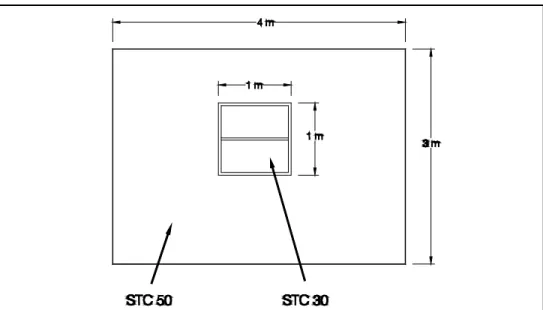
The negative effects of windows on sound insulation can be reduced by decreasing the area of the windows. This would be especially important on the noisy side of the home. Because it is the combined effect of the window and the wall that determines the net sound insulation, one can only partially compensate for a less satisfactory window by improving the sound insulation of the rest of the wall. The figure below illustrates a simple example of the combined effects of a wall and a window. The window is 1 m2 in area and the remainder of the wall is 11 m2. The window by itself would reduce aircraft noise by 30 dB and the wall by 50 dB. The combined effect of the wall and the window, taking into account their different areas and different noise reductions would be to reduce aircraft noise by 40 dB. If the window were reduced to
Example of combined noise reduction of a wall containing a window. The area of the wall is 11 m2 with a noise reduction of 50 dB. The area of the window is 1 m2 with a noise reduction of 30 dB. The noise reduction of the complete assembly is 40 dB.
Typical vertical sliding window with double thermal glazing. Aircraft noise enters via various air leaks and the closely spaced thermal glazing is a poor barrier to low frequency helicopter and aircraft noise.
High performance completely non-opening studio type window with heavy glass and large air space.
0.5 m2 the combined noise reduction would increase to 43 dB. However, if the window were increased in area to 2 m2, the combined sound insulation would be only 37 dB. The total sound insulation is largely determined by the weakest link.
The sound insulation of openable windows will often be limited by leakage through the window seals. If air can leak through the seals, then sound will also be able to pass through. Even though new windows may have very good seals, they may deteriorate with use. The combination of high sound insulation and openable windows is very difficult to achieve in a reliable manner over years of use. Several other approaches have been introduced to attempt to increase the sound insulation of windows. Triple glazing is sometimes proposed as a more complicated approach intended to provide increased sound insulation. Laboratory tests show that triple glazed windows are no better than double glazed windows if they include the same total weight of glass and the same maximum space between the outer panes of glass. Thus, heavier double glazing is usually a less expensive means of obtaining the same sound insulation. Other specially designed acoustical windows include
laminated glass or windows with special gases in the air space between the two glass panes. The small improvements that result from these more complex constructions may be no better than would result from small increases in the weight of the glass or the air space between the glass.
It is often difficult to obtain windows with larger air spaces because most windows are designed for optimum thermal performance. Thermal insulation requirements typically lead to double glazing with an air space of about 13 mm (1/2 inch). One less expensive means of improving the sound insulation of such windows may be to add separate external storm windows with as large an air space as possible.
7. Doors
Doors are similar to windows in that their sound insulating properties are usually inferior to those of the wall. Fortunately, there are usually a smaller number of exterior doors than there are windows and so their net effect is less. Also similar to windows, their sound insulating properties are limited by both the inadequacies of the door panels as well as those of the door seals. For both doors and windows, it is difficult to have heavy exterior surfaces separated by a large air space. Even very good seals will probably degrade with continued use.
Table 1, gives an example of a 28 dB reduction of aircraft noise for a well sealed solid core door. However, for doors with poor seals, the measured sound insulation will be at least 5 dB lower than this.
Because of the practical limitations of doors, it is usually not possible to get very much larger reductions in aircraft noise from a single door. Two practical ways to achieve improved sound insulation for doors are to use either double doors or an entrance vestibule. Two well sealed solid core doors with a 200 mm (8 inch) air space between them are expected to be more than 10 dB better than a single door. Including a small entrance vestibule is effectively a double door with a very large air space between the two doors and should also be very effective.
Example of using an entrance vestibule to improve the sound insulation of an exterior door.
Example of treatment of an attic ventilation grill to improve sound insulation.
8. The roof
Roofs are an important component of sound insulation against aircraft noise because they are usually the largest surface exposed to aircraft noise. Many homes have roofs with large insulated attic spaces that may be quite effective barriers to aircraft noise. Other buildings may have flat roofs that are usually much less effective barriers to aircraft noise.
In the case of a flat roof or a ‘cathedral ceiling’ type construction there is typically a relatively small space between the interior and exterior surfaces and usually no vibration break between the two surfaces. As indicated in Table 1, this type of construction would be expected to reduce aircraft noise by only 25 dB. However, with the addition of resilient channels to provide a vibration break and adequate porous insulation, the expected aircraft noise reduction would be 36 dB. Adding a second layer of gypsum board to the ceiling in combination with the resilient
channels and sound absorbing material would lead to a 39 dB noise reduction. (The resilient channels must never be between two layers of gypsum board because this will decrease the low frequency sound insulation). These examples clearly
demonstrate the basic principles explained in Section 2(b). Adding gypsum board layers increases the mass of the surface layers. Resilient channels create a vibration break between the inner and outer surfaces. Porous absorbing material in the cavity absorbs sound in the air space.
Roofs with an insulated attic space will usually be a quite effective barrier to aircraft noise because of the large air space and the thick layer of porous absorber. Table 1 includes an estimate for such a
roof construction where the gypsum board ceiling is
supported on resilient channels. This performance could be improved by the addition of a second layer of gypsum board on the ceiling. Modern
Canadian roofs of this type are usually well ventilated to minimize moisture problems. These vents will tend to decrease the sound insulation of the roof because sound can travel around the outer layer by passing through the vents. Increasing the weight of the ceiling by additional layers of gypsum board could
compensate for any unwanted effects of the vents. Vents are discussed in Section 9.
9. Chimneys, vents and other openings
Since sound is motion of air, any unblocked openings into a building will allow aircraft noise to enter into a building. Some larger openings such as ventilation exhausts and chimneys may be more obvious causes of sound leaks but quite small cracks can also be important. If for example a 12 m2 wall, that reduces aircraft noise by 50 dB, included only 120 cm2 (18.6 in2) of openings due to cracks around a window or door, the actual aircraft noise reduction would be no more than 30 dB. Thus a very effective wall would have become a quite mediocre barrier to aircraft noise. It is therefore extremely important that all cracks and small openings be completely sealed to obtain good sound insulation to aircraft noise.
Ventilation openings cannot be sealed but can be located so that they are less exposed to the incident aircraft noise. For example bathroom and kitchen exhausts can be located on the quiet side of the building. They could also be located in the sofit surfaces under eaves where they would be shielded from the direct path of the aircraft noise. Sound propagation through ventilation ducts can also be reduced by using sound absorbing linings in the ducts. Such acoustically lined ducts are sometimes referred to as dissipative mufflers.
Ventilation openings into attic spaces are usually of substantial size and will
minimize the effective sound insulation of attic roof systems. Sound can bypass the roof layer by entering the attic space via the ventilation openings. This sound path can be controlled using an acoustical labyrinth, which is similar to acoustically lined ducts. In an acoustical labyrinth the air passing through the ventilator must pass through a more complex path involving several bends. The interior surfaces of this
Improving the sound insulation associated with a bathroom exhaust fan by locating the vent under the eaves where it is shielded from aircraft noise and by using ducts that are lined with sound absorbing material to reduce noise transmission.
path are lined with sound absorbing material. Sound passing through the ventilator is forced to interact with the absorptive linings and hence gets absorbed.
Studies have shown that a conventional open fireplace chimney can be the weak link in the sound insulation of a well insulated home. Chimneys offer a direct path from above the roof where they are perfectly exposed to aircraft noise to inside the home. In Canadian homes fireplaces are typically located in living rooms and family rooms where intruding aircraft noise could be particularly disturbing. Closing the chimney damper would reduce intruding aircraft noise when the fireplace is not in use. Similarly, various enclosed fireplaces and wood stoves would form an additional barrier to reduce the intruding aircraft noise. Other chimneys such as those connected to furnaces and hot water heaters would be less problematic. Intruding aircraft noise would have to propagate through the furnace and then would usually be in a less noise sensitive area of the home.
10. The overall picture and priorities
Windows, doors and other openings are usually most critical to obtaining adequate sound insulation against aircraft noise. Typically the construction of roofs and walls will be more substantial and will contribute less to sound insulation problems. This section summarises the information presented in this report and lists items in order of expected decreasing importance. For example, windows are listed as usually more important than roofs. There is usually no point in improving the sound insulation of the roof if the sound insulation of the windows has not been improved. In most cases there is so much more sound energy passing through the weaker components, such as windows, that improving the already better components, such as the roof, would have no audible effect. Of course, the details of the relative importance of each component of the building facade may vary from one building to another.
Typical order of sound insulation priorities:
•
Windows - ensure adequate seals.- reduce size.
-heavier glass and larger air space.
-add extra layer of heavy glass with large air space to existing window.
•
Doors -ensure adequate seals.-double doors. -entrance vestibule.
•
Vents and -locate ventilation openings on quiet side of building.Holes -acoustically treat ventilation ducts.
-caulk or otherwise seal all holes and cracks.
•
Walls -increase mass of light weight constructions by additional layer(s)of gypsum board or heavier external material.
-use gypsum board on resilient channels to create vibration break.
•
Roof -use double layer of gypsum board mounted on resilient channels for the ceiling.-acoustically treat attic ventilation openings.
11. Improving Existing Homes
Where there are sound insulation problems in existing homes, it is usually necessary to determine the weak link or links that are the main cause of the intruding noise. Large amounts of money could be spent improving other parts of the building facade with little audible effect if the key weak link is not treated.
Thus, the first step is to try to determine the most important path of the aircraft noise into the home. As indicated in this report, the most common weak links are windows, doors, ventilation openings and other cracks and openings. One may be able to identify a dominant sound path by carefully listening close to various potential weak links. For example, by listening close to a kitchen exhaust fan during an aircraft fly over (with the fan not operating) it may be obvious that this is an important path for aircraft noise to enter the home. If the aircraft noise is clearly audible and louder than at other points in the room, the fan exhaust path is probably an important contributor to the total indoor noise.
The second step is to try to verify that the identified path or paths are the most important ones that will influence the total intruding aircraft noise. A simple technique for
verifying the importance of each identified sound path is to temporarily block each path. For example, a ventilation opening could be blocked with a piece of plywood taped over the opening to form a heavy and air tight cover. Similarly, one could temporarily cover a window or door with a sheet of plywood to test if it is the dominant sound path. The plywood should be 13 mm (1/2 in) or more thick and the edges should be taped so that it is an air tight cover. If there is no audible benefit when the identified paths are covered, it is probably not worth trying to upgrade these building elements without first improving some other more important path. It may seem quite difficult to cover a window or door in this way, but it could save the potentially very large cost of ineffective building renovations.
After one or more dominant sound paths have been identified and verified, the third step is to find permanent solutions for improving the sound insulation of these paths. In some cases holes and openings can be permanently blocked. Windows and doors can often be improved by installing new seals. The earlier parts of this report should give further guidance as to the important factors to consider when trying to improve the sound insulation of a particular sound path. In many cases the problem of improving the sound insulation may be too complex for a simple diagnosis and the help of an expert is
12. Finding more detailed advice
Although this document attempts to provide an understanding of the basic issues concerning insulating homes against aircraft noise, it is not a complete design guide. The design of a well insulated home to adequately protect the residents in a noisy area is a very complex subject. Solutions are usually much cheaper at the design stage. Improving sound insulation in existing buildings is usually much more expensive. Those contemplating building a home in an area exposed to significant aircraft noise or where aircraft noise may be expected to increase in the future should contact an acoustical consultant with experience in this area. This is probably the most cost effective means of providing an acceptable indoor environment.
The Canada Mortgage and Housing report. “New Housing and Airport Noise” is a widely used design guide that resulted from work completed by the National Research Council in the early 1970s. This design guide is unfortunately now out of date in many ways. It is based on older aircraft types that created quite different aircraft noise than today’s quieter aircraft. It also does not include many types of modern constructions that are widely used today. However, it may be useful to those wishing more detailed information.
This publication was a joint effort of the National Research Council (NRC) and the Department of National Defence, Director General Environment (DND/DGE). If you have technical questions please contact NRC at (613) 993-2305 or your local DND Base or Wing.
The National Research Council in collaboration with the Department of National Defence and Transport Canada has recently started work on a new design guide that will be based on modern aircraft noise characteristics, modern building construction techniques and is intended to provide more accurate results in a more convenient manner.