Building an Active Node on the Internet
by
David M. Murphy
Submitted to the Department of Electrical Engineering and Computer Science
in partial fulfillment of the requirements for the degree of
Master of Engineering in Electrical Engineering and Computer Science
at the
MASSACHUSETTS INSTITUTE OF TECHNOLOGY
May 1997
@
Massachusetts Institute of Technology 1997. All rights reserved.
0
y
P.1
AA1?
Department of IlectricallEngineering and Computer Science
May 27, 1997
Certified by
...
John V. Guttag
Professor
"fhesis Supervisor
. N•- • Certified by .,David L. Tennenhouse
Senior Research Scientist
Thesis Supervisor
Accepted by ...
...
...
, ...
Arthur C. Smith
Chairman, Departmental Committee on Graduate Theses
Building an Active Node on the Internet
by
David M. Murphy
Submitted to the Department of Electrical Engineering and Computer Science on May 27, 1997, in partial fulfillment of the
requirements for the degree of
Master of Engineering in Electrical Engineering and Computer Science
Abstract
An Active IP Network integrates two very different network programming models, an IP packet based model, and an Active Network capsule based model. This report shows how to integrate these two models into a single node, called an Active IP node, and how to integrate an Active IP node into an IP network. I also present some preliminary ideas on the constraints network architects will face when building Active protocols for a heterogeneous network of Active and non-Active IP nodes.
By using a model of constant and variable processing, integrating the Active and IP ar-chitectures has lead to a clean and simple node design and implementation. Furthermore, mechanisms presented in this report, such as protected buffers, provide various safety con-straints which aid in the integration.
Finally, this report presents some preliminary performance results which, when combined with the above characteristics, suggest that the Active IP platform will be appealing to researchers who wish to study application specific protocols for the Internet.
Thesis Supervisor: John V. Guttag Title: Professor
Thesis Supervisor: David L. Tennenhouse Title: Senior Research Scientist
Acknowledgments
I thank David Tennenhouse for being an excellent adviser on both my thesis and career. He has built a great research group, TNS, and a great research area, Active Networks. I am grateful that he has let me be part of both of them.
I thank John Guttag who has taught me a great deal about doing and presenting excellent
research.
I thank David Wetherall, who has been a wonderful semi-adviser and colleague. I owe him a debt of gratitude for the help he has given me during the year.
I also thank everyone in the SDS group who has made working here such a wonderful experience. I also thank everyone for giving great comments on my practice thesis talks. In particular I thank Ulana Legedza who has supplied insightful comments on various chapters of this thesis.
Finally, I thank my family whose continual love and support throughout my whole life have kept me going.
Contents
1 Introduction
1.1 Active Networks . . . . 1.2 Why integrate Active Networks into IP?
1.3 Novel Aspects ... ... 1.4 This Report ... ... 2 Background and Related Work
2.1 IPv6 ... ... .... 2.2 Java . . . . 2.3 Active Networks ...
2.4 Operating Systems ... 3 Node: Forwarding Engine
3.1 Overview of AIPv6 Node 3.2 Constant Processing ....
3.3 Variable Processing ... 3.4 Protected Packet Buffers .. 3.5 Flow of Control ...
3.6 Default IPv6 Processing . . 3.7 Active Processing .
3.8 API Available to Variable P1rocessing . 4 Code Transport in AIPv6
4.1 Goals for integrating demand-load capabilities into IPv6 4.2 The Demand-load Protocol in ANTS ...
21 22 23 24 24 24 26 28 29 33 33 34
.
. .. . i.
i..
.. .. ..
.... . . .
...· · ··
. . . . . . . . . . . ...4.3 Choices for Code Transport ...
4.4 The Solution: Combine Option and Payload ... 5 Application Protocols
5.1 Constraints . . . . 5.2 Future Active Protocol: Load Balancing . . . . 6 Performance Analysis and Conclusions
6.1 Description of Experiment ... 6.2 Results . . ... .. .. . .... .. .. 6.3 Discussion of Performance ... 6.4 Summary and Conclusions ... A Node: Link Interfaces
A.1 Network Devices ... A.2 Device Drivers ... A.3 Buffer Management ... B Format of Option and Payload
B.1 IPv6 Option ...
B.2 The Marshaled Option ... B.3 The System Payload . ...
47 . . . . . 47 . . . . 49 . . . . . 50 . . . . . 50 . . . . 53 . . . . 54 55
List of Figures
Structure of an AIPv6 node... Packet paths through the Forwarding Receive method processing steps. . . Receive thread processing steps.. . . Routing a packet in an AIPv6 node. process routine for Active processor. 4-1 Demand loading in ANTS...Active compression protocol in an ANTS network .. Active compression protocol in hybrid AIPv6 and IP' Coarse-grained Load Balancing. . ...
Fine-grained DNS load-balancing. . ... v6 netwe . . . . . 42 ork. . ... 42 . . . . . 44 . . . . . 46 . ... . 48 . . . . . 49
6-1 Experimental set up. ... 6-2 Null Capsule's evaluate method . . . . . A-1 The byte array hidden by the NetBuff class. ... The marshaled option. ... The demand-load request payload. ... The demand-load response payload. .... . . . . 58 . . . . . 60 . . . . . 61 3-1 3-2 3-3 3-4 3-5 3-6 Engine . . . . 22 . . . . . 25 . . . . . 26 . . . . . 27 . . . . . 28 . . . . . 28 5-1 5-2 5-3 5-4 B-1 B-2 B-3
List of Tables
3.1 Communication interfaces implemented by each module. . ... 23
3.2 Core forwarding engine classes. . ... ... 25
3.3 Node API ... . ... ... ... .. ... .... .. 29
Chapter 1
Introduction
This report describes the design and implementation of a novel network node that integrates two very different network programming models, an IP packet based model, and an Active Network capsule based model. Both programming models have been integrated into the same implementation, and take advantage of the same type of packets and node resources. Importantly, users of the IP programming model do not need to be aware of the Active Network model. This allows the dual purpose node to be deployed seamlessly into an IP network. For users of the Active Network model, new types of constraints arise when designing Active protocols for a heterogeneous network of Active and non-Active nodes. This report presents some preliminary ideas on how these constraints might affect protocol development.
The node supports the next generation of Internet protocols, IPv6. The novel aspect of this node implementation, is that the node applies two types of processing to packets, constant
and variable. The node applies constant processing, which represents a small subset of the IPv6 protocol, to all incoming packets. The variable processing, depends on the application protocol requested by a packet. If a packet does not request protocol then it undergoes
default IP processing.
In order to support variable processing, the node uses a capsule-based Active Network architecture implemented by David Wetherall. However, the constraint of co-existing with
IP led to a number of significant changes. Most notably, I have defined a new IPv6 option and payload to transport programming code and its associated state, enhanced the class structure of the capsules, and implemented a protected buffer scheme to insure that integral fields within the IP header cannot be changed mid way through the network.
1.1
Active Networks
IP has become the de facto standard for network communication today. It achieves inter-operation among a variety of physical networks by serving as a virtual network layer on top of them. All the nodes on the Internet send packets amongst each other using IP. Further, a wide range of applications can be run over IP. However, despite the diversity above and below the network layer, the Internet Protocol itself is rigid, slow to evolve and difficult to adopt to physical and application layer needs.
In 1990, Clark and Tennenhouse [10] described the need for an adaptable network. They claimed that future networks "must exhibit a significant degree of flexibility and be based on an architecture that admits a wide range of application demands and implementation strategies."
Today's network has a number of examples of the wide demand for customized network protocols. Unfortunately, the IP protocol provides little support for incorporating these needs into its architecture. For example, numerous network administrators have inserted firewalls, which filter packets, into IP routers that sit at the borders of their networks. These solutions tend to be implemented as ad hoc additions to networking code. Simi-larly the Multicast protocol has sat in beta-test limbo for years on the MBONE, thereby preventing commercial network administrators from reducing the bandwidth consumed by group broadcasts. Implementing multicast in the same ad hoc manner which developers have implemented firewalls would be problematic because multicast will only work if it is supported on a global scale.
In response to IP's inability to adapt to changing application needs, a new type of net-work architecture, an Active Netnet-work[30], has been proposed. This architecture allows applications to dynamically extend the functionality of the network by injecting customized
protocols, also known as application specific protocols, into it. In this type of network, packets select the protocol by which they wish to be processed. Nodes within this network become execution environments that supply an Application Programming Interface (API) to the protocols delivered to them.
There are two major approaches towards transporting code in an Active Network, the out-of-band approach and the in-band approach. In the out-out-of-band approach, Active Network nodes are switches that contain a number of pre-defined protocols. The nodes load the protocols through an auxiliary, i.e., out-of-band, mechanism. Packets passing through these nodes request processing by one of the previously installed protocols. In contrast, packets within an in-band architecture do not request processing by a protocol at a node, but rather carry the protocol, in the form of code, with them as they travel throughout the network. Network nodes process the packet by executing the accompanying code. Since an in-band code loading scheme maps very well to a datagram network such as IP, it is the one that this implementation supports.
1.1.1
ANTS
ANTS (Active Node Transport System) [35] is a reference Active Network implementation, and the one which I have incorporated into my architecture. The ANTS implementation uses a variant of the in-band approach towards building an Active Network architecture. Instead of always transporting code with every packet, ANTS nodes cache the most recently used code in order to avoid reloading the code for a related group of packets. Packets, called capsules in the ANTS implementation, carry parameter values for a related piece of code. If the node that a packet passes through contains the related code, the node initializes the code with a packet's parameter values and then executes the code. If the code is not present on the node, the node requests the code from its nearest upstream neighbor. Using this type of code transport mechanism, Active nodes become primed "on the fly" by the packets that pass through them. This connectionless aspect of ANTS maps well into an IP environment.
1.2
Why integrate Active Networks into IP?
Because IP connects millions of nodes, it will be a good deployment mechanism for Active Networks in the future. Merging ANTS into IP gives researchers and developers the oppor-tunity to study how Active Network nodes function both on local area networks (LANs) and wide area networks (WANs). From a practical point of view it also seems unreasonable to expect that the whole Internet will simultaneously convert to an Active Network model of network communication. Merging an Active Network into IPv6 allows the networking community to study how a real deployment of an Active Network would work, and which aspects of backwards compatibility with IPv6 nodes should be supported.
The integration of an Active Network into IP also gives researchers and developers the ability to quickly and easily experiment with making additions to the IP architecture. In today's environment, running experiments on changes to the IP layer involves changing the source code of an IP implementation and coordinating efforts with other researchers to upgrade their IP nodes to the experimental protocol. If this upgrade only needs to be done locally, the process will be time-consuming but at least manageable. Trying to do this on the scale of a WAN becomes a coordination nightmare and only occurs in the rarest of occasions, such as the upgrade from IPv4 to IPv6, or testing Multicast. In contrast, creating a WAN of Active IPv6 nodes would have a fairly large initial fixed cost, but the marginal cost of testing new changes would be small, i.e., it would only involve writing the code for the protocol, and injecting it into the Active IPv6 network.
Finally fully integrating an Active Network into IP will allow people to experiment with developing Active protocols in a heterogeneous network environment of Active and non-Active nodes. The application-specific protocols created for the ANTS implementation work under the assumption that all nodes and packets in the network will be Active. This architecture will allow network architects to determine the what useful protocols that can be built when the above assumption does not hold.
1.3
Novel Aspects
The goal behind the design of an Active IPv6 (AIPv6) node was not to design a replacement for an IP node, but rather to design a node that enhanced IP's capabilities. Thus, an AIPv6 node had to be backwards compatible. This created two constraints,
* An AIPv6 node must be able to route both IPv6 and AIPv6 packets.
* AIPv6 packets must never cause a processing error in non-Active IPv6 nodes.
The majority of this report will describe the design and implementation of a node that satisfies these two constraints.
In satisfying the first constraint, I have built an IPv6 node that resembles most other network implementations. It supports network devices and Ethernet drivers, and supplies an interface (albeit a simple one) to applications. The node runs in the user-space of the Linux OS while processing raw Ethernet frames. It achieves comparable performance to user-space network implementations despite being written in Java.
What differentiates this node from other implementations is how it processes packets. The node applies a fixed set of processing to all entering packets, and then, if appropriate, pro-cesses packets with an application supplied protocol. Packets that do not have a customized protocol undergo default IP processing.
To support customized processing, the node integrates a capsule based Active Network architecture into its packet based IP architecture. Two major questions arise when com-bining these very different models. How can commonalities between packets and capsules be exploited in the implementation? How can the node achieve security for its resources? To exploit the similarities between packets and capsules I have made IPv6 the default func-tionality for all capsule implementations. Building on the work presented in [36] capsules utilize an option plus an IP payload to transport parameter values and programming code respectively throughout an IPv6 network. This insures that non-Active IPv6 nodes will not generate errors when processing Active IPv6 packets. This approach is also novel in that it uses options, which were supposed to support pre-defined optional processing, to support
dynamically defined optional processing.
In order to support security, the node should prevent capsules both from corrupting and from abusing node resources. Though my implementation does not prevent resource abuse it does prevent resource corruption. I have utilized access control mechanisms provided by Java's package and type system to prevent capsules from accessing potentially destructive methods. The node also restricts the areas of the packet to which the capsule can write. It uses a "protected buffer" scheme that prevents capsules from modifying source address and hop limit fields of the packet, thereby insuring a level of accountability, and limiting the amount of time a capsule can exist in the network. The protected buffer scheme follows ideas such as sand-boxing used in the design of operating systems-except that the address space has now become a packet's payload.
To support a programming environment for capsules, I have developed a clean and explicit API that a node can export to AIPv6 packets. All customized protocols, including the default IP protocol, utilize this API for packet processing.
1.4
This Report
The following chapter discusses previous work of relevance to AIPv6 nodes. Chapter three describes the design and implementation of the core module in AIPv6 node, and chapter four describes how seamless code transport was achieved. Chapter five discusses the different classes of applications that can be used in a heterogeneous network environment. Chapter six discusses some performance measurements, and concludes.
Chapter 2
Background and Related Work
This chapter gives background information on the protocol and tools used to build an AIPv6 node; and relates this work to research done in the network and operating systems communities.
2.1
IPv6
The Active IPv6 node supports the IPv6 protocol [12], which is the successor to IPv4. The major benefit IPv6 has over IPv4 is a larger address space; an IPv6 address has a length of 128 bits whereas an IPv4 address has a length of 32 bits. Additionally IPv6 supports a flow identifier field that enables source nodes to label a stream of packets, and its packet format has been streamlined to enable efficient processing by IPv6 nodes.
One of the goals of developing an AIPv6 node, and its related code transport protocol, is to provide an architecture for adding functionality to the IPv6 protocol. IPv6 tries to address the demand for optional processing by defining a set of extension headers that carry parameter values for pre-determined processing in IPv6 nodes. In IPv4 most of these extension headers were treated as options. As evidenced by the Request For Comments (RFC) archives though, IPv6 still does not support all the features requested by applica-tion developers. The most glaring omissions include multicast [11] and support for mobile
hosts[25]. Using an AIPv6 architecture in a significant portion of the IPv6 network would help to deploy these additional features.
2.2
Java
Java is a relatively new language that has a number of features which make it amenable to an Active Network. It provides an Active node some security when downloading foreign code into the Java execution environment. Also using an object-oriented language such as Java allows for compartmentalization and future upgrading of the node.
The key to security in Java is that the type safe checks performed at compile time can be verified during runtime.[34] Thus, the node can be assured that the Java bytecodes which it downloads will obey the interface boundaries to node resources.
2.3
Active Networks
2.3.1
ANTS
The work presented in this thesis has a direct relation to Active Networks projects at MIT. The AIPv6 node incorporates the Active Network functionality of ANTS [35]. The code transport protocol and resource interfaces in an ANTS node have direct counterparts in the AIPv6 node. ANTS does not support the IPv6 protocol though, and thus cannot interoperate with Active and non-Active IPv6 nodes. Thus, users cannot use ANTS to either experiment with changes to the IP protocol or study the effects of using Active protocols within a hybrid network of Active and non-Active nodes.
2.3.2 Active Options
The prime motivator for building an IP node that incorporates Active Network functionality has been the Active Options [36] work done here at MIT. This proof of concept work
demonstrated the feasibility of building an Active Network within the IP protocol. IPv4 nodes within this architecture interpret Tcl scripts sent by applications. The node supported
a handful of procedures that the Tcl scripts could call.
There are a number of differences between the Active Options work and mine. The primary one is the level of functionality supported between the two implementations. The Active Option implementation made a few changes to the Linux networking code to study the feasibility of building an Active IP node. In contrast, my IP implementation has been built from the ground up with the goal of incorporating a more flexible Active Network architecture such as ANTS. Presently my node supports the essential portions of the IPv6 protocol which has made it easy to integrate Active Network functionality, and will make it easy to study and add security measures to the system. Once the core subsystem of the Active IPv6 has been finalized, then adding any remaining IPv6 features should be straight forward.
2.3.3
An ActiveBONE
There presently is a proposal to build a test Active Network within the Internet. This network would have similar characteristics to the 6Bone and MBONE, two virtual networks set up to test the IPv6 and Multicast protocols respectively. Both of those test networks connect two disjoint networks by tunneling through IPv4.The primary difference between an ActiveBONE1 and other test networks is that intermediate Active nodes not specified as tunnel endpoints, will be able to apply Active processing to'packets that flow through them. Unlike the AIPv6 described within this paper, the "ActiveBONE" proposal does not support direct interoperation with non-Active IPv6 nodes.
2.3.4
Applications
A number of other researchers have focused on the use of Active Networks to address specific networking problems.
1
Note, this name has not yet been proposed. I am using it to create an analogy between a test Active Network and the test IPv6 and multicast networks of today.
Researchers at Georgia Tech. [5] have focused on incorporating a small set of Active func-tionality into an existing IP implementation. Their goal has been to study the benefits an Active Network could have towards solving congestion. For experimental purposes they use an out-of-band code approach in which Active packets can only call predefined methods within the network node.
The Protocol Booster [15] project at the University of Pennsylvania has focused on inserting customized processing into protocol stacks. For example, the processing could be a com-pression or decomcom-pression procedure. Also at the University of Pennsylvania is the Active Bridging [2] project that has focused on making an Ethernet bridge that can change its tree discovery protocol "on-the-fly".
2.4
Operating Systems
There has been a great deal work done within the operating systems community to build extensible operating systems that allow applications to customize system services. At the University of Washington work has been done that allows applications to dynamically load extensions into the kernel [4]. Like my system they have relied on a type-safe language to provide a level of protection between the resource interfaces and imported code. They have also defined a network architecture in which applications can insert protocol extensions [16]. Unlike the node presented in this thesis, their work applies only to network host nodes. Work has also been done at MIT that has focused on safely exposing low level system resources to library operating systems [14]. A related activity also allows applications to insert customized protocol handlers into their kernels [33].
Finally, Sun Microsystems has also implemented a Java TCP/IP stack for their Java OS platform [22]. Though not much has been written about the details of their implementation it appears they have achieved reasonable performance which is a good omen for the AIPv6 effort.
Chapter 3
Node: Forwarding Engine
This chapter describes the design and implementation of the core module, the Forwarding Engine, of an AIPv6 node. What is novel about this implementation is that it divides the IPv6 protocol into constant and variable parts. The constant part of the IPv6 protocol must be applied to all IPv6 packets that traverse this node. The variable part of the IPv6 protocol, such as IP forwarding, can be replaced by application specific protocols. Both the IP forwarding routines, and the application specific protocols use the same node API. Using this approach, Active Network functionality can be cleanly integrated into the AIPv6 node. Packets either request processing by their customized protocol or undergo default IP forwarding.
The first section of this chapter motivates the purpose of the Forwarding Engine by giving an overview of the structure of an AIPv6 node. The following sections then describe which routines the Forwarding Engine treats as constant and variable. The chapter the moves into a discussion of the flows of control within the Forwarding Engine, and concludes with a presentation of the node API used by variable processing access.
3.1
Overview of AIPv6 Node
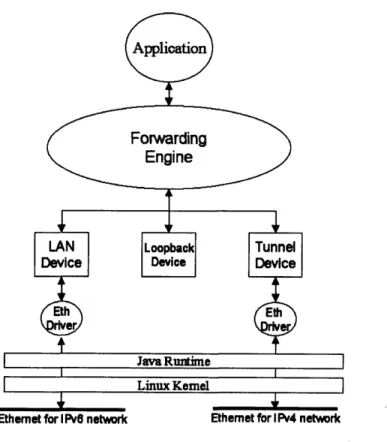
An AIPv6 node has three sets of modules, driver modules, device modules, and the For-warding Engine module. The driver and device modules serve as the link interface to the Forwarding Engine and are described in Appendix A. The Forwarding Engine handles all the network layer processing of packets. As shown in Figure 3-1, packets can enter the node either from the network or from an application. 1
Ethernet for IPv6 network Ethernet for IPv4 network
Figure 3-1: Structure of an AIPv6 node.
Inter-module Communication
Since the Java Runtime does not easily support event and interrupt driven processing at the programming level (with the exception of graphical interface events), AIPv6 modules 1If the AIPv6 node is used as an end node, then the application would be part of the primary path into
the node. An application could also be attached to an intermediate node if it was used as a network manager for example.
at different layers communicate through up-calls.[9]. Each module implements a send and receive method which forms the module's communication interface. This simple interface makes the interaction between modules explicit to the implementer, and also makes imple-menting additional modules, such as other types of network devices, a simple process. Send methods correspond to transmitting a packet out to the network, while receive methods cor-respond to receiving a packet from the network. Table 3.1 shows that not all the modules accept the same arguments to their send and receive methods. As the node gathers more knowledge about the packet buffer moving up its module stack, it converts the packet to a more specialized representation suitable for the module that the packet enters.
Module
Method Argument
Called By
Application receive IPv6Packet Forwarding Engine or Capsule
Forwarding Engine send IPv6Packet Application or Capsule
receive NetBuff Devices
Device send IPv6Packet Forwarding Engine receive NetBuff Driver
Driver send NetBuff Devices
receive NetBuff Linux OS
(through Ethernet socket call) Table 3.1: Communication interfaces implemented by each module.
3.2
Constant Processing
Constant processing is the common processing that all packets entering the Forwarding Engine must undergo. It represents the subset of the IPv6 protocol that must be processed for every packet.
The Forwarding Engine treats decrementing the hop count of a packet as constant process-ing. The hop count in an IPv6 packet is used to avoid Internet routing loops, and so, every node that a packet passes through must decrement the packet's hop count until it equals zero, after which the packet can no longer be forwarded. By making this process constant the network can be assured that Capsules will not remain in an IPv6 network indefinitely.
3.3
Variable Processing
Variable processing in an Active node is processing that is application dependent. This type of processing occurs after constant processing, and can either be an application-specific net-work protocol, or if no protocol has been supplied with the packet, the default IP forwarding routine. All variable processing methods, including the default IP forwarding routines, must interact with node resources, and packets, via the node API.
3.4
Protected Packet Buffers
Capsules need access to the packet buffer in order to create new fields or change the format of existing ones. However, giving a capsule access to all of the IPv6 packet would allow the capsule to change the source address or hop limit fields in the header and could create a serious security problem for other nodes in the network.
Protected buffers prevent variable processing methods from modifying some fields of the packet, such as the source address and hop limit fields, by checking each byte access made into the buffer. Every attempt to modify the byte is checked at runtime. The NetBuff class, described in Appendix A, supports the protected buffer scheme by providing two versions of a set element method. One version, used by classes considered unfriendly by the NetBuff2 performs this runtime check. Friendly classes have access to an equivalent set
element method that does not perform the runtime check.
3.5
Flow of Control
Figure 3-2 shows the packet flow paths within the Forwarding Engine. Packets can enter the Forwarding Engine from two entry points, either from the network via the receive method, or from an application via the send method. The Active Processor and Forwarder classes, represented as squares in the figure, are the primary classes in the Forwarding Engine.
2In Java, a friendly class to the NetBuff class would be one which resides in the same "package", or directory as NetBuff.
They support all the Forwarding Engine's packet processing methods. Additional classes are listed in Table 3.2. The Forwarder class provides the send and receive methods, plus all the methods used in the IP forwarding routine. The Active Processor handles the creation and execution of capsules. The Forwarding Engine does use any packet buffer queues. It relies on the Linux kernel to handle the queueing of packets.
Figure 3-2: Packet paths through the Forwarding Engine
Table 3.2: Core forwarding engine classes.
Classes
Description
Forwarder Heart of the Forwarding engine. Instantiates receive queue and thread.
Its public methods become node API exported to mobile code Supports table lookup, send and receive routines.
DeviceManager Constructs and manages devices for the Forwarder.
ActiveProcessor Handles all the processing of any packet data tagged as Active.
LANDevice Node's interface to an IPv6 network. TunnelDevice Node's interface to an IPv4 network
through which IPv6 packets will be tunneled. LoopbackDevice Node's interface to itself.
3.5.1
Send Processing
Packets entering the node via the send method do not undergo constant processing. In-stead they will be processed directly by either their customized protocol or the default IP forwarding routine. Since packets have been instantiated locally, and correctly initialized, it is assumed that they are valid IP packets.
3.5.2 Receive Processing
Every buffer entering from the network via the receive method undergoes both constant and variable processing. Figure 3-3 displays the code used by the receive method to process a network buffer. The first step involves checking the hop limit field of the buffer. If the value equals zero then the buffer has exceeded its alloted time limit in the network, and the buffer will be dropped. Otherwise the method will try to determine whether this buffer should be instantiated as a subclass of Capsule or as an IPv6Packet. If the buffer represents a capsule then processing will be switched to the Active processor. Otherwise the packet will fall through to standard IPv6 processing.
public void receive(NetBuff buf) IPv6Packet. decrementHopLimit (buf);
if (IPv6Packet. isActive (buf))
activeProcessor.process(buf); else
defaultProcess (buf);
Figure 3-3: Receive method processing steps.
3.6
Default IPv6 Processing
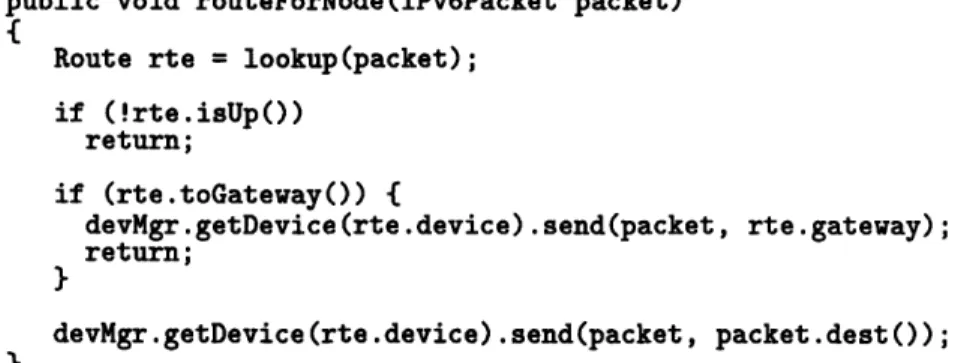
Figure 3-4 shows how the Forwarding Engine applies default processing to an IPv6 packet. After processing a packet's hop-by-hop extension header, the method applies some address specific processing to the packet, if necessary. If the packet is not addressed to the node, then the engine will call the routeForNode method, shown in Figure 3-5, which handles the
forwarding of a packet. This method applies a pruning algorithm to the routes in an AIPv6 node's routing table in order to determine the next route for a packet. The route returned by the lookup method contains both the next hop IP address to which the node should send the packet, and the name of the device that connects to the same network as the next hop IP address.
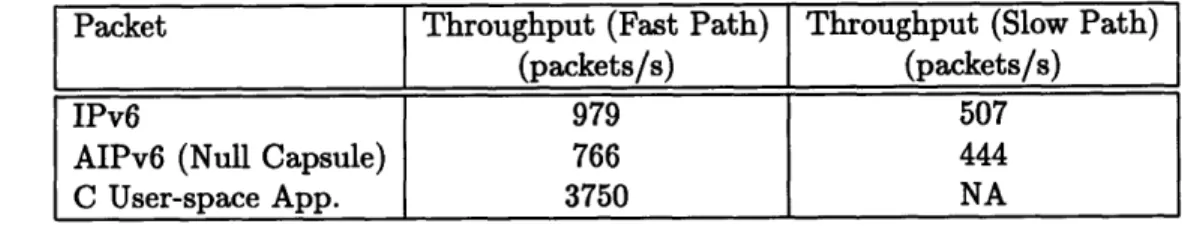
The lookup method supports two processing paths, the fast path and the slow path. Packets enter the fast path when their destination address equals one of the destination address keys in a routing table cache. A route containing the next hop address is returned from this cache hit. Packets whose destination address yields a cache miss in the routing table cache, must pay the penalty of having their route calculated by the pruning algorithm. The route calculated by this algorithm will be stored in the routing table cache for subsequent packets.
The IPv6Packet class shown in the Figures 3-4 and 3-5 has two purposes: it supplies easy access to the IPv6 header fields and to all extension headers plus payload in an IPv6 packet,
and it enforces the IPv6 packet format rules set by the IPv6 specification.
public void defaultProcess(NetBuff buf)
{
IPv6Packet packet = new IPv6Packet(buf); processHopByHop (packet); if (isNodeAddress(packet.dest ())) { processRemainingExtensionHeaders (packet); if (nodeIsAHost()) deliverToApp(packet); return;
}
routeForNode (packet);}
public void routeForNode(IPv6Packet packet) Route rte = lookup(packet);
if (!rte.isUp()) return; if (rte.toGatewayO) { devMgr.getDevice(rte.device).send(packet, rte.gateway); return; I devMgr.getDevice(rte.device).send(packet, packet.dest());
Figure 3-5: Routing a packet in an AIPv6 node.
3.7
Active Processing
Active processing begins for a capsule as soon as it enters the process method of the Active Processor. The processing algorithm used in this implementation is a close analog to the algorithm used in ANTS. When the process method (shown in Figure 3-6) is called with a packet buffer, the method will attempt to deserialize the packet, and if successful will then call the capsule's evaluate method. The evaluate method expects a reference to the forwarder object as its argument. All of the Forwarder's public fields and methods, which form the node's API, are accessible to the evaluate method.
Applications inject new protocols into the network by subclassing the Capsule class and overwriting the evaluate, serialize, and deserialize methods. Since the Capsule class is a subclass of IPv6Packet all capsules have access to a packet's IPv6 extension headers and payload. Access to the first 40 bytes is restricted through the use of the protected buffering scheme described in 3.4.
public void process(NetBuff buf) throws ICMPErrorException Capsule c = deserialize(buf);
if (c != null)
c. evaluate (forwarder);
3.8
API Available to Variable Processing
The essential part of an Active node is the API that it exports to mobile code embedded in packets. When mobile code enters an AIPv6 node it is supplied a reference to the forwarder object. The code has access to all the forwarder's public variables and methods. Table 3.3 lists the API supported by an AIPv6 node. The following sub-sections describe in detail the interesting characteristics of the API.
Table 3.3: Node API.
3.8.1 Resources
Soft-state Cache
An AIPv6 node incorporates a number of ideas from the ANTS [35] implementation, the most important of which is the soft-state cache. The soft-state cache is an Active packet's
scratch space that can be shared by a series of packets associated with the same application group or protocol family. Packets from the same group or family, can create, read, or write entries in the cache, though the node makes no guarantees about the persistence of such data.
Class
Methods
Routing Table
List All Elements Forwarder
TableLookup ForwardPacket Create packet Create IP address Generate ICMP message Soft-state cache
Add Delete Get
Routing Table
The routing table is the most important resource for an IP node. It contains all the routing information needed to send a packet onto its next hop or destination. Since an AIPv6 node can be rendered useless without a routing table, capsules only have read-access to the routing information in the table. Capsules which require different routes than those supported in the routing table, can add their routes to the soft-state cache.
3.8.2 ICMP Exceptions
One of the novel aspects of this node API is how it handles ICMP error processing. Nor-mally, ICMP error processing is hidden within the thousands of lines of code in a node implementation, but within an AIPv6 node that processing has now become explicit. This section explains this idea in more detail.
ICMP
IP uses the Internet Control Message Protocol (ICMP) to communicate error and infor-mational data between IP nodes. A node uses an ICMP error message to alert a source node that it has been sending packets with invalid fields or lengths. A node will use an ICMP informational message for resource discovery such as determining the members in a Multicast group, or whether a node is operational.
How Linux Handles ICMP
In Linux, a routine can generate, and send, an ICMP message without ever alerting its calling routine that it has done so. This type of implementation makes the code hard to extend and manage for a number of reasons. First, it disperses the control of sending messages throughout the whole node. Furthermore it moves knowledge about sending ICMP messages, into code that probably does not need this information. For instance classes that deal with processing the bits of a packet probably should not need to import packet transmission code.
Exceptions
Exceptions separate abnormal processing from the common case, thereby simplifying pro-gramming code. Since most languages that support exceptions require method declarations to list any exceptions that might be thrown, the specification for that code becomes more explicit. This is especially important when defining an interface to programming methods and objects (such as in an AIPv6 node). Furthermore, exceptions also provide the bene-fit of allowing calling methods to decide how to handle exceptional conditions instead of hard-coding responses in lower level procedures.
ICMP Exceptions
Methods that catch ICMP exceptions can elect to either handle them locally or pass them up the call stack to another method which might be in a better position to determine whether an ICMP message needs to be sent.
Chapter 4
Code Transport in AIPv6
This chapter describes the design and implementation of the code transport mechanism used by AIPv6 nodes. It begins with a discussion of the requirements for a successful integration of a code transport protocol into IPv6, and then moves into a detailed explanation of the demand-load protocol used in ANTS. It then discusses the various choices IPv6 presents for transporting data and concludes with the solution that I have chosen.
4.1
Goals for integrating demand-load capabilities into
IPv6
The key to achieving interoperation between an AIPv6 node and an IPv6 node is the code transport mechanism. Since all AIPv6 nodes can process of IPv6 packets, an AIPv6 node can be deployed in an IPv6 network. The potential stumbling block that could prevent interoperation between an AIPv6 node and a IPv6 node is the code transport mechanism. If this mechanism placed programming code, or state values, in a location in an IPv6 packet that caused IPv6 nodes to generate an error while processing the code, then the AIPv6 packet would never arrive at its destination. Any solution must avoid this problem in order to achieve complete interoperation with IPv6 nodes.
The proposed solution must also work within the existing IPv6 specification, and not, for the moment at least, require the IANA to define a new Active protocol. If the solution cannot be used in today's IPv6 network then it is not valid.
4.2
The Demand-load Protocol in ANTS
As mentioned in Chapter 1, ANTS uses an in-band code loading mechanism in which a node loads a packet's code into their memory while processing the packet. The extreme version of an in-band code loading mechanism requires each packet to carry both code and corresponding state values in order for the packet to be processed by each node it traverses. Thus, even though consecutive packets may be processed by the same code, each packet still carries its own code.
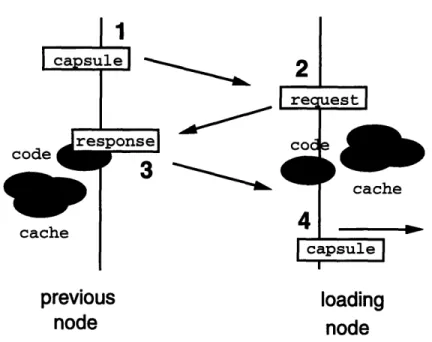
ANTS eliminates this redundant code transport by using a demand-load protocol. Instead of transporting code with every packet, ANTS relies on the nodes within its architecture to send out requests for code when they do not have the code available to process a packet. In the present implementation of ANTS, a node sends a code request only to the adjacent upstream node. Upon receiving a code response from the upstream node, the requesting node stores the code within its cache for some finite amount of time. It will then use this code to process all the successive packets that have the same identifier as the code. Figure 4-1 shows the complete demand-load process in ANTS. Since this process handles all the code transfer, applications need only to embed state values for a corresponding piece of code within the packets that they send out onto the network. As long as the applications supply programming code to the node on which they run, then the applications can be assured that their packets will be executed correctly throughout the network.
The ANTS demand load protocol has a number of nice properties. First, programming code is sent only to the nodes that request it. Applications need neither pre-determine a packet's route, and then upload code to every node the packet will traverse, nor broadcast the programming code to the whole network. Furthermore, since most network protocols usually use a stream of packets, the overhead of doing the initial demand-load is amortized over the number of packets sent during the protocol transmission. Of course, for protocols
cod
cac
previous
node
loading
node
Figure 4-1: Demand loading in ANTS.
which use a small number of packets the demand-load overhead might be quite high.
4.3
Choices for Code Transport
This section describes and analyzes the choices available for integrating an Active Network into an IPv6 network. Section 4.4 presents the solution which I have chosen for the AIPv6 protocol.
4.3.1
Tunneling
Tunneling involves the encapulsation of one protocol within another. It is used when two nodes cannot be linked using their own protocol.
The benefit of tunneling is that if one only wishes to connect two Active nodes that are separated by an IPv6 network then tunneling will work perfectly and not upset the IPv6 network. Tunneling has worked well for a number of networks such as the MBone and the 6bone. Both of these networks though require knowledge of the tunnel end points.
Tunneling would not integrate Active Networks into IPv6. Essentially what tunneling would do is treat IPv6 as a link layer. In this scenario an ANTS capsule would have to be encapsulated in IPv6 before it is sent to the next Active node. An application running on a pure IPv6 node would never be able to interact with Active protocols because its IPv6 node would never process Active packets destined for it.
4.3.2 Using Gateways
Another possibility is to tunnel between Active nodes and then to strip the Active payload before an Active packet is sent to an IPv6 node. This would insure interoperability between Active and non-Active nodes. Within the networking field, a node which converts one protocol to another is called a gateway. This type of scheme would require an Active node to function as both a router and a gateway.
The difficulty in making an Active node a gateway is, that in order for the gateway portion of the node to function properly, the node will need to know the relative positions of all IPv6 nodes and Active nodes in the Internet. Because Active packets can be mapped onto IPv6 packets (just remove the programming code), but IPv6 packets cannot be mapped back onto Active packets, it is imperative that an Active node not remove programming code from a packet that might still pass through an Active node. The cost of insuring a correct removal (an IPv6 node discovery protocol, and an enormous table containing the locations of all IPv6 nodes) seem to outweigh any of the interoperability benefits that could be gained from this choice.
4.3.3
IPv6 Mechanisms
The alternative to using tunnels or gateways is to transport code and state values in either an payload or option. This sub-section describes the benefits and drawbacks of each of these choices.
IPv6 Extension Header
Defining a new IPv6 extension header that supported Active Networks would be a Herculean task from a politically viewpoint. Since all IPv6 nodes must be able process IPv6 extension headers, all IPv6 nodes would need to be Active nodes. This does not appear to be a politically viable option.
Upper Layer Payload
An upper layer payload, is the section of an IPv6 packet that follows the IPv6 header and extension headers. It is not included as part of the IPv6 specification. Unlike an IPv6 extension header, the standardization of an upper layer protocol only applies to the end node implementations that support it. Therefore, a payload, whose size restriction is the maximum size of an IPv6 packet, would be a good vehicle in which to transport large fragments of code and/or state values. An option could also be inserted into the hop-by-hop options header that would alert AIPv6 routers to the presence of this payload within the packet. This type of option has been proposed in [20]. The benefit of this option is that an AIPv6 router would not have to parse every packet's extension headers in search of an Active header.
Unfortunately, defining a new payload which all IPv6 nodes do not support means that IPv6 end nodes would drop packets containing this payload and send an ICMP error message back to the packets' source nodes. This would violate my goal of seamless interoperation and therefore cannot be used to transport any data that might arrive at IPv6 nodes.
An Option in the Hop-by-Hop Options Header
An IPv6 option provides properties for pre-determined non-standard processing that an IPv6 node may apply to an associated packet. An IPv6 option would be a good choice for code transport because it can instruct IPv6 nodes (source, destination and intermediate) to ignore the option if the nodes do not understand it. Using an option to transport code continues on the work done in [36]. Furthermore since there will be network socket support
for applications at the end nodes to insert options in and receive options from the hop-by-hop options header, using an option would allow an application to use Active Network technology while running over an IPv6 end node. The one unfortunate draw back about using an option is that its size is restricted to 256 bytes. This makes it a good vehicle to transport state values, which typically have a size of 50 bytes, but probably not code fragments, which typical have a size of 750-1000 bytes.
Since the hop-by-hop options header has a maximum size of 2056 bytes, and therefore can hold a number of options, one could break up a code fragment into a number of pieces, and place each piece into an option. The main drawback of this would be that each Active node would need to parse about five options for every packet contain about 1K code fragments. This seems like an unnecessary performance hit.
4.4
The Solution: Combine Option and Payload
The solution that I have implemented views the transport process as having two separate parts, code transport and state value transport.
In an Active network, code transport is an end-to-end process between two Active nodes. Active node A sends a code request to Active node B, and Active node B sends a code response to Active node A. Therefore in a hybrid network of Active and non-Active nodes, an IPv6 payload can be used to transport code, since the only two nodes that will attempt to process the payload will be Active.
State value transport, on the other hand, is an in-network process that involves all nodes in an Active network. In a hybrid Active network, this means that state values could potentially be processed by an IPv6 intermediate node or end node. This leaves the network architect with two choices:
* Place the state values in an option, whose maximum size is 256 bytes, and enable interoperation with IPv6 intermediate and end nodes.
enable interoperation with IPv6 intermediate nodes, but require that the source node only send packets to Active destination nodes.
I have decided to choose robustness of operation over robustness of size, and use an option to transport state values. Since one of the goals behind building an AIPv6 node is to provide researchers and developers a platform in which to experiment with a heterogeneous network of Active and non-Active nodes, I feel this choice this choice is warranted.
The AIPv6 transport protocol uses one option, the marshaled option, and one payload, the system payload, to transport code and state values in an IPv6 network. The marshaled option carries state values, and the system payload will carry data for demand requests, and responses.1 The marshaled option maps directly to a marshaled capsule in ANTS, and the system payload maps directly to a marshaled system capsule in ANTS. Details on the format of the option and payload can be found in Appendix B.
Chapter 5
Application Protocols
This chapter describes the types of application specific protocols that can be built for a network consisting of AIPv6 and IPv6 nodes. The first section begins with a discussion of the constraints placed on Active protocols in a heterogeneous network, and the last section discusses a potential application that would combine the ideas presented in this report.
5.1
Constraints
A hybrid network of AIPv6 and IPv6 nodes solves the problem of integrating an Active Network layer into the IP layer. Using this architecture, applications are guaranteed that the Active protocol that they transmit into an IPv6 network, will be executed by Active IPv6 nodes, and will be ignored and processed like an IP packet by non-Active IPv6 nodes. This architecture, however, places a set of constraints on Active protocols that do not exist in a pure Active architecture, e.g., the ANTS architecture. In the ANTS environment, applications assume that Active protocols will, at the very least, be executed by at least two Active nodes, the source and destination node. If the Active protocol passed through intermediary nodes on its way to the destination node, then it would also be executed at those nodes. In an AIPv6 architecture the same assumptions cannot be made. Since applications using AIPv6 protocols can connect to IPv6 destination nodes, they can assume
only that the protocols will execute at one node, the source node.1 If the source node knows
beforehand that the destination node is an AIPv6 node then the guarantee moves closer to the guarantee provided by ANTS.
5.1.1
A Compression Example
Figures 5-1 and 5-2 illustrate how an Active protocol can have different effects when running in an ANTS network versus running in a hybrid network of AIPv6 and IPv6 nodes. The source applications in both figures insert compression protocols into the network to be used on some packets. Neither of the destination applications can parse compressed data. The compression protocol compresses a packet's payload at a node with a low-bandwidth link, and must uncompress the payload before it reaches the destination application.
Figure 5-1: Active compression protocol in an ANTS network
Figure 5-2: Active compression protocol in hybrid AIPv6 and IPv6 network.
Within an ANTS network, the compression protocol will always work correctly. It can compress the payload at an intermediate node, and decompress it at the destination node.
'In present AIPv6 implementation, an application must run over an Active node if it wishes to insert an Active protocol into the network. If, in the future, some Active protocols are added to the core set of protocols supported by all Active nodes, then the source application will only need to transmit an Active option, and not need to run over an Active node.
It will never deliver compressed data to the destination application. Within an AIPv6 network though, the same guarantee of correctness no longer holds because an end node could be a non-Active node. In this case correctness can be assured only when either the source application transmits to Active destination nodes, or over routes with a known number of intermediate nodes, or the destination application understands compressed data.
5.1.2
Not all Active Protocols Transfer Directly
The previous example shows that there exist a class of Active protocols that cannot directly transfer to an AIPv6 network. To work correctly in an AIPv6 network these protocols require the source application to have knowledge about the types of nodes in the network, or require the destination application to have knowledge about the Active protocol.
5.2
Future Active Protocol: Load Balancing
This section describes a hypothetical Active protocol that would use a hybrid network of AIPv6 and IPv6 nodes. The purpose of this exercise is to demonstrate that the design goal of requiring interoperation between an AIPv6 source node and an IPv6 destination node can produce useful protocols.
5.2.1
Why Load Balance?
No server has yet been built that can process all the http requests coming into most popular sites on the World Wide Web (WWW). Therefore some sites utilize a number of web servers to handle this enormous demand. In order to distribute the requests equally among all the web servers, sites use a load balancing algorithm.
5.2.2
Coarse-Grained Load Balancing
Coarse-grained load balancing uses the Domain Name Service (DNS) to return the IP address of the least loaded web server.2
C IP edi*a8s or we ere
L
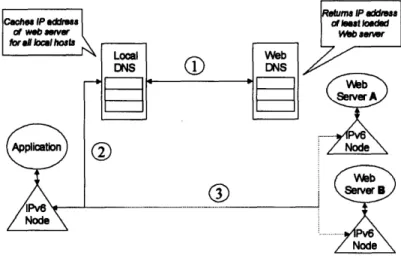
Web Server B 6vP NodeFigure 5-3: Coarse-grained Load Balancing.
Step 1 in Figure 5-3 shows an application sending a DNS resolution request for www.mit.edu to it's local DNS server. Since the local DNS does not yet have a binding for www.mit.edu it contacts MIT's DNS server. During Step 2, MIT's DNS server determines which web server is the least loaded, at the time of request, and resolves the DNS request to that server's IP address. For this example assume the DNS request resolves to web server A. Once receiving a reply from MIT's DNS server, the local DNS server will cache web server A's IP address, and then return the IP address to the requesting host. In step 3 the host will then initiate an http with web server A.
There are two problems with this scheme that could disrupt the load balanced properties of MIT's web servers. One, since the application stores the hostname-IP address binding for the duration of its session, it will only connect to the least-loaded server during its first connection. After that point, what originally was the least-loaded server could quickly become the most-loaded server. Two, since the local DNS server caches the hostname-IP address binding for some period of time, other nodes at the local site will use the same
2
The purpose of DNS is to resolve a host name such as, www.mit.edu, to an IP address. Each network site that advertises a hostname, must setup a DNS server to handle the resolution.
binding, and increase web server A's load. This affects both the client, who faces longer delays in receiving data from MIT's web servers, and MIT web's site, which cannot process
as many requests as it should be able to.
5.2.3
Fine-Grained Active Load Balancing
Fine-grained Active load balancing would build load balancing characteristics into the tcp protocol that underlies the http protocol. It would allow a web client to connect to the least loaded server during every web connection. Web clients that do not have access to Active Network technologies will always connect using the coarse-grained load balancing scheme.
Step 1 of the scheme involves an Active application querying its local DNS server for the IP address of www.mit.edu. Since the local DNS server doesn't have the binding the server contacts MIT's DNS server. This DNS server, using the coarse-grained load balancing algorithm, then returns the IP address of the least loaded server. Upon receiving a response from MIT's DNS server, the local DNS server cache's a binding between www.mit.edu and the returned IP address, and then returns this IP address to the requesting application. In step 3, the first tcp connection packet that the application sends will search the AIPv6 node for a list of available web servers. It will then choose which web server is the least loaded and connect to it. The IP address of the server that it connects to will then be used for the rest of the connection. Since a new request requires a new tcp connection, the Active web
client will always connection to the least loaded web server.
The beauty of this scheme is that if the application does not support this new Active protocol, and has no concept of it, then it will connect directly to MIT's web site and use the coarse-grained load balancing algorithm.
The changes required to implement this Active protocol would be a change in the initial hand shake code of a tcp connection (it will need to recognize that the returned destination address has changed and it should connect to it). Changing an IP address during mid-connection could be a major security problem but it is quite similar to changing port numbers for an FTP connection (though with FTP if the client assumes the machine your
Caches IP address _f wAf- .,-k
L
Retums IP address of a default web server VWeb Server A Pv6 Node VWeb Server B Pv6 NodeFigure 5-4: Fine-grained DNS load-balancing. connecting to is safe, then it most likely won't have an evil port number).
This protocol also requires a process running at the web site that queries the web servers for their load, and then inserts a load table into the AIPv6 border router.
Chapter 6
Performance Analysis and
Conclusions
Despite being written in Java, an AIPv6 node achieves respectable performance. When routing only IPv6 packets, an AIPv6 node achieves an average fast-path throughput of 979 packets/sec. It achieves an average fast path throughput of 766 capsules/sec when routing simple AIPv6 capsules. These results are a significant fraction of the maximum throughput, 3750 pkts/sec, that can be achieved by user space network implementations on the Linux
OS.
1.
6.1
Description of Experiment
Figure 6-1 shows the experimental setup used to test the throughput and latency of an AIPv6 node. Results were recorded for the AIPv6 router, shown as the intermediate node in the figure, as packets flowed from the source node to the destination. The intermediate node's routing table contained three routes, a loopback route, a route to the source node,
and a route to the destination node.
1This upper bound was determined by implementing a user-space application in C that received Ethernet packets from an Ethernet socket and automatically forwarded them to a hardcoded destination. The machine used for this experiment was a 200 MHz Pentium Pro
All three machines used in the experiment ran the Debian 1.2.x distribution of the Linux 2.0.30 kernel. The intermediate and destination machines had Pentium Pro 200 MHz pro-cessors, while the source machine had a Pentium 120 MHz processor.
Figure 6-1: Experimental set up.
6.1.1 Packet Types
During each test, the source node sent one of two types of packets, a vanilla IPv6 packet that contained only an IPv6 header, or a simple Null capsule that routed itself through the nodes. Both packets were forwarded identically, but traveled through different processing paths within the node, the default and Active paths.
Vanilla IPv6 Packet
The vanilla IPv6 packet contained only the IPv6 header. Since it does not have a marshaled option, the node processes it using the default IPv6 routine shown earlier in Figure 3-4.
Null Capsule
The purpose of the Null Capsule is the test the performance associated with the node's Active processing path. Figure 6-2 shows the Null Capsule's evaluate method, which is a simplified version of the default IPv6 routine.