HAL Id: hal-02618964
https://hal.inrae.fr/hal-02618964
Submitted on 25 May 2020HAL is a multi-disciplinary open access
archive for the deposit and dissemination of sci-entific research documents, whether they are pub-lished or not. The documents may come from teaching and research institutions in France or abroad, or from public or private research centers.
L’archive ouverte pluridisciplinaire HAL, est destinée au dépôt et à la diffusion de documents scientifiques de niveau recherche, publiés ou non, émanant des établissements d’enseignement et de recherche français ou étrangers, des laboratoires publics ou privés.
Corner’s rules as a framework for plant morphology,
architecture and functioning - issues and steps forward
Pierre-Eric Lauri
To cite this version:
PierreEric Lauri. Corner’s rules as a framework for plant morphology, architecture and functioning -issues and steps forward. New Phytologist, Wiley, 2019, 221 (4), pp.1679-1684. �10.1111/nph.15503�. �hal-02618964�
Version postprint
Accepted
Article
This article has been accepted for publication and undergone full peer review but has not been through the copyediting, typesetting, pagination and proofreading process, which may lead to differences between this version and the Version of Record. Please cite this article as doi: 10.1111/nph.15503
DR PIERRE-ERIC LAURI (Orcid ID : 0000-0002-7549-0484) Article type : Letter
Corner’s rules as a framework for plant morphology, architecture and functioning – issues and steps forward
Pierre-Éric LAURI
SYSTEM, Univ Montpellier, INRA, Cirad, Montpellier SupAgro, CIHEAM-IAMM, 2 Place Pierre Viala, 34060 Montpellier, France
Author for correspondence:
Pierre-Éric LAURI
Tel.: +33 (0)4 99 61 30 54
Email: [email protected]
ORCID
Pierre-Éric Lauri 0000-0002-7549-0484
The Durian theory and Corner’s rules governing plant architecture
In the middle of the 20th century EJH Corner developed “The Durian theory” (Corner, 1949) and “The Durian theory extended” (Corner, 1953, 1954a, 1954b) named after the large spiny fruit of Durio zibethinus (Bombacaceae) containing light-brown seeds covered by a fleshy and edible white or yellow aril. Following a first intuition that “such fruits must have been
Version postprint
Accepted
Article
borne on massive twigs” Corner (1949) established two “complementary principles”, later referred to as Corner’s rules, that were “susceptible to mathematical treatments”. The “axial conformity” rule states that “the stouter, or more massive, the axis in a given species, the larger and more complicated are its appendages”. The “diminution on ramification” rule states that “the greater the ramification the smaller become the branches and their
appendages”. These two rules delineated the poorly branched pachycaul trees with “thick” stems and “big” leaves and axillary organs (inflorescence, fruit)(Fig. 1a), and the highly branched leptocaul trees with “slender primary axis and branches” and “small” leaves and axillary organs )(Fig. 1b,c).
The Durian theory was merely based on a general view on trees and encompassed an evolutionary aspect theorizing about the primitive character of pachycaul forms. Corner’s hypothesis that leptocaul trees constitute an evolutionary outcome of pachycaul trees has been criticized considering that pachycaul forms may also derive from selective pressures in extreme environments (Mabberley, 1974) or questioning the plesiomorphic characteristic of the large fruits (Nyffeler & Baum, 2000).
Here, it is outlined that although this evolutionary view is discussed, Corner’s rules inspired interspecific and ontogenetic studies from a morphological (organ size and shape), architectural (relations with branching) and functioning (relations with hydraulics and biomechanics) perspectives.
Corner’s rules canonical relationships
Corner’s rules provided a structural vision of woody plants building upon previous works on relationships among morphological traits such as the positive relationships between the diameter of the apical meristem and leaf size (Sinnott, 1921). Noticeably, Corner’s rules were at the origin of the conceptual modeling of whole-plant architecture developed by Hallé and colleagues on existing species (Hallé & Oldeman, 1970; Hallé et al., 1978), recently extended by Chomicki et al. (2017) on Paleozoic taxa. These rules are still providing a heuristic
framework for the quantification of plant form and function at various plant scales (e.g., in relation to plant hydraulics; Lehnebach et al., 2018).
Version postprint
Accepted
Article
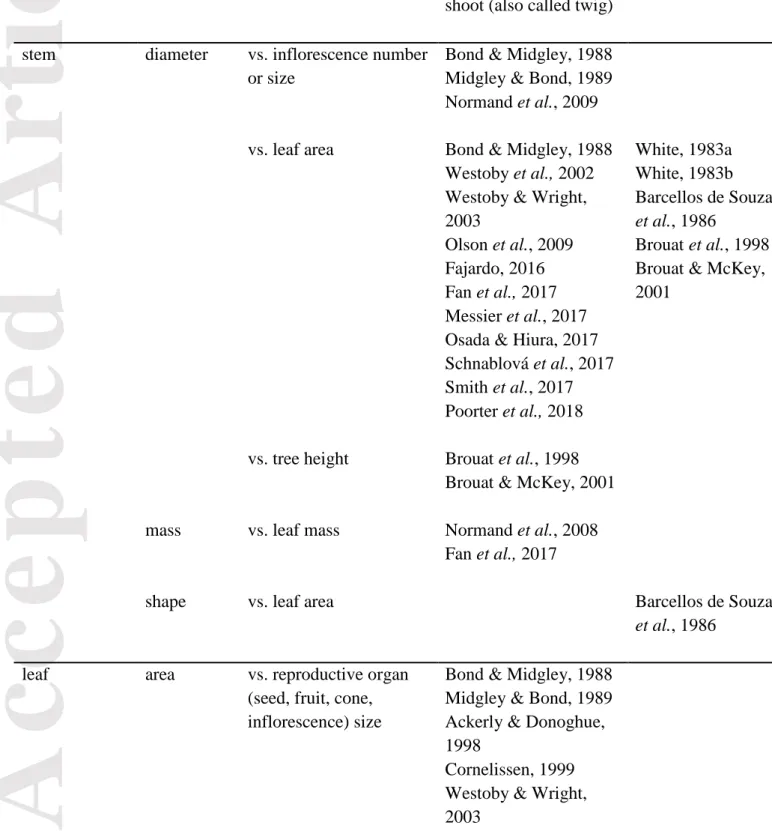
Most research works referring to Corner’s rules are focused on two canonical relationships (Table 1). The first ones are between stem traits (namely diameter used in a majority of studies or directly derived from it such as cross-sectional area and radius; mass; shape) and the number and/or size of appendages (leaf, inflorescence, fruit). The second ones are between leaf area and the number and/or size of appendages whether vegetative (branch) or reproductive (inflorescence, fruit, cone). A few studies document across-scales relationships such as stem diameter or leaf area vs. tree height (Table 1). Although most works are
developed on woody plants a few aim at assessing these relationships on herbaceous plants (e.g., Barcellos de Souza et al., 1986). Studies are developed at two main scales. The first one considers the whole-plant including the branch or the leafy shoot at the end of primary
growth and is used for phylogenetic studies based on interspecific comparisons (e.g., across
Acer accessions; Ackerly & Donoghue, 1998). The second one considers the metamer , i.e.,
the complex formed by the internode, the attached leaf or leaves and the axillary production(s), and is used to study ontogenetic changes during the development of an
individual, whether a tree (Brouat et al., 1998; Brouat & McKey, 2001) or a herbaceous plant (Barcellos de Souza et al., 1986).
The link with hydraulics
For a great majority of authors, the quantitative relationships between stem diameter, loosely termed stem “size” in several articles (e.g., Brouat et al., 1998; Westoby et al., 2002;
Westoby & Wright, 2003), and the appendages the stem supports are primarily interpreted in terms of the vascular supply joining the roots to the appendages through the stem. These relationships have been extensively discussed in past decades using the conceptual framework of the pipe model theory (Shinozaki et al., 1964), including very recently by Lehnebach et al. (2018). This theory predicts that “the amount of leaves existing above a certain horizontal level in a plant community (is) always proportional to the sum of the cross-sectional area of the stems and branches found at that level” (Shinozaki et al., 1964). The pipe model theory does not strictly consider the process of heartwood (non-conducting wood) formation which is independent of pipe production and deactivation and more studies are needed to differentiate between conducting and storage sapwood (Lehnebach et al., 2018). However, as a whole, this theory showed its high heuristic value in stimulating research on relations between structure and functions among plant compartments. For example, the
Version postprint
Accepted
Article
statement of isometry between leaf area and stem cross-sectional area is well supported by findings of Brouat et al. (1998) over the ontogenetic gradient on two caesalpinioid legume trees, and by Petit et al. (2018) on shoots of two deciduous angiosperms and of two evergreen conifers at different distances from the apex.
Further insights from Corner’s rules
Based on a literature review that quantified Corner’s rules among stem, leaf and appendages, it is proposed that three further insights might benefit from Corner’s rules based studies.
Insight 1. Questions raised by biomechanics: the need to consider stem shape and not only stem diameter or cross-sectional area.
Beside hydraulics, the relationships between stem diameter and appendage size or number are also interpreted in terms of biomechanics. Biomechanical properties of a stem are related to two main factors. One factor is wood density “with denser woods being stiffer and stronger than stems with equivalent cross-section composed of less-denser wood” (Niklas & Spatz, 2012). Another factor is shape which determines that for a stem with a same weight of appendages and same construction material properties, the higher the slenderness, i.e., ratio between length and diameter, the lower the mechanical stability. This limitation on length by cross-sectional area is well known by foresters in studies at the whole-tree scale to evaluate the critical buckling height (Niklas, 2013). Therefore, from the morphological point of view, considering only stem diameter (e.g., Brouat et al., 1998; Fan et al., 2017) as a proxy for stem biomechanical strength is misleading. In his initial articles, Corner (1949, 1953, 1954a, 1954b, 1975) most often used the words “massive” or “stout” as opposed to “slender” to qualify stems of pachycaul and leptocaul trees, respectively. These words, although
imprecise, strongly suggested that to maintain same biomechanical characteristics of the stem with regards to appendages a difference in size must be accompanied by a difference in shape. Therefore, not only stem diameter, or even volume or mass, but also shape should be considered in relation to the size of appendages. Working on a rosette-stoloniferous plant,
Callisia fragrans (Commelinaceae), Barcellos et al. (1986) analyzed ontogenetic changes
considering individual metamers. They showed that if as hypothesized leaf area was positively related to stem-cross sectional area supporting the hydraulic relations, it was
Version postprint
Accepted
Article
negatively related to internode slenderness supporting the biomechanical relations. Variations of these three traits thus appeared as good markers of the successive stages this species goes through during its ontogeny, large leaves being associated to short internodes with a low slenderness ratio typical of the erect rosette phase whereas small leaves were associated to long internodes with a high slenderness ratio typical of the stolon phase growing at the soil surface.
At the whole-plant and branch scales, if the relationships between stem diameter and size and number of appendages are well established (Table 1), the relations with stem shape needs to be more documented. For example, Niklas et al. (2006) hypothesized that the high
slenderness ratio of some pachycaul species, comparable to some leptocaul species, were likely related to the absence or paucity of branching. However, this study did not detail relationships between stem traits and appendages.
Insight 2. The definition of a realistic biological-based phenotypic correlation space to better design plant architectural ideotypes.
Above mentioned literature confirms that some main relationships such as stem diameter vs. leaf area and the coordinated changes of these two traits are observed from both the
phylogenetic or interspecific and the ontogenetic points of view. Combined with hydraulics and biomechanics, these results support the idea that Corner’s rules likely cover a universal network of biological relationships shaping plant architecture and functioning.
The definition of ideotype, i.e., the best-adapted biological model in a given agricultural and socio-economic environment (Donald, 1968), is crucial to optimize plant cultivation and yield. Among architectural traits that affect yield, canopy porosity to light is a main variable governing light interception by the plant and therefore partly affects yield (Sinoquet et al., 2007). In the apple, canopy porosity depends on leaf area distribution within the canopy that is directly related to branch orientation and branching density (Willaume et al., 2004). These morphological and architectural traits can be phenotyped in progenies and can also be manipulated in the orchard through tailored precision management procedures (Lauri & Laurens, 2005). Recent attempts that aim at designing plant ideotypes to improve light interception using plant numerical models conclude on the interest of ideotypes with long internodes (e.g., tomato,Sarlikioti et al., 2011; Chen et al., 2014; apple, Picheny et al., 2017)
Version postprint
Accepted
Article
possibly combined with high leaf area (apple, Picheny et al., 2017) and/or with narrow leaves, i.e., high length by width ratio (e.g., tomato, Sarlikioti et al., 2011). Such assertions confirm previous horticultural knowledge on positive relationships between light interception and stem slenderness (e.g., apple, Lespinasse, 1992; Lauri et al., 1997). These works raise the interest to explore further the correlation space among morphological and architectural traits that are biologically meaningful, especially here the extent to which stem length can be positively related to leaf number and area without endangering biomechanical and hydraulic stability. For example, in the apple case, increasing both stem length and leaf area as
proposed by Picheny et al. (2017) is biologically realistic and agronomically relevant only up to a critical value of stem slenderness.
Beyond relationships among vegetative organs, Corner’s rules also encompassed quantitative relationships between vegetative and reproductive organs (e.g., stem diameter positively correlated with the size of reproductive appendages; Midgley & Bond, 1989). It has been shown that flowering rate increases and then decreases when the bearing stem diameter (Normand et al., 2009) or length (Lauri & Trottier, 2004) increases following a quadratic function. These results suggests that Corner’s quantitative relationships established for mature and well differentiated vegetative and reproductive organs are likely to be
prepared during floral induction and through more complex relationships.
Insight 3. The respective contributions of organogenesis and growth mechanisms in determining the phenotypic correlation space.
Schnablová et al. (2017) working on shoot apical meristem (SAM) conclude that stem diameter and leaf size, and in the case of a reproductive meristem seed mass, are “linked to each other by rules such as Corner’s rules”. These relationships are primarily related to cell number in the SAM from which organs are derived with a minor role of cell size (blue arrows in Fig. 1d; e.g., Gonzalez et al., 2012; Schnablová et al., 2017). However, we still have poor knowledge on the stage of organogenesis at which stem and leaf shape are determined and to what extent they result from interactions at the metamer or at the whole-stem scale. On the other hand, axillary meristem initiation from which a branch or an inflorescence develops is tightly related to the boundary regions between the SAM and the leaf primordium (yellow arrows in Fig. 1d; Yang & Jiao, 2016) suggesting that the growth and likely fate of the
Version postprint
Accepted
Article
newly initiated organs at a very early stage. This is supported by findings on branch plagiotropy in Araucaria and Coffea likely resulting from an early SAM signal (see discussion in Chomicki et al., 2017). However, results obtained on individual metamers of peach (Kervella et al., 1995) and apple (Lauri & Térouanne, 1998) show that the growth dynamics of the leaf or of both the internode and the leaf, respectively, affect the axillary bud fate (namely, latent, vegetative, floral; Lauri & Normand, 2017). The challenge is now to better investigate when and how the phenotypic correlation space is built during plant
development and growth and especially to analyze whether organ size and shape, and axillary production size and fate, are fully pre-determined in the SAM or depend on interactions among growing or mature organs at later stages.
Future directions
It is argued that agricultural plants constitute a remarkable biological material to develop Corner’s rules based knowledge-oriented and applied research. A research agenda is proposed with two main goals.
Goal 1. Domestication effects.
Most agricultural plants result from long term domestication by human societies which includes both selection of wild plant material and intentional breeding (Zeder et al., 2006). In a majority of cases, domestication and especially breeding strategies have been oriented towards an increase of the weight of grain (e.g., wheat, Schoppach et al., 2017) or fruit (e.g., apple, Cornille et al., 2014) relative to the whole plant biomass. It is hypothesized that this increase in ‘yield efficiency’ is related to changes in size and shape of vegetative organs that support reproductive organs and likely also in branching. As a premise for such studies it is noteworthy that the decrease in trunk slenderness of domesticated Carica papaya is
interpreted as a mechanical response to the domestication-related increase of large fruit clusters (Niklas & Marler, 2007). Such research can be extended to various agricultural plants benefiting from collaboration between geneticists, breeders and archeobotanists.
Version postprint
Accepted
Article
Goal 2. Environmental effects.
Generally speaking, Corner’s rules based research works (Table 1) consider the plant entity without explicitly integrating the effects of the environment. Changes in environmental conditions arise from climate change and the associated global warming (IPCC, 2014) but also result from growing conditions. This is especially true in agriculture with the
development of more sustainable and diversified agroecosystems that generally increase competitions among plants for above-ground and below-ground resources (Barot et al., 2017). The plasticity in responses to environmental constraints is well studied on annuals (e.g., contrasted patterns of plasticity in allocation, morphology, physiology and architecture in improving light capture or nitrogen acquisition, respectively; Freschet et al., 2018) but far less on woody plants on which the abiotic (e.g., temperature) and biotic (e.g., proximity of neighboring plants) environments have a cumulative effect on tree morphology and
architecture over consecutive growing seasons. It has been shown that besides their effect on budburst phenology (Legave et al., 2015) mild winter temperatures compared to cold winter temperatures significantly decrease branching frequency on stems with similar size and shape (e.g., apple, Dutra-Schmitz et al., 2014). Similarly, shading by neighboring trees in natural or agricultural systems increases stem slenderness and decreases branching (MacFarlane & Kane, 2017). Such studies document the variation spectra of morphological and architectural traits, here stem size or shape and branching frequency, and their relationships. However, how these changes in vegetative growth are related to reproductive growth over the tree lifespan is still little studied. Works on woody plants, typically forest and fruit trees in pure stands or in multispecies systems, typically agroforestry systems, would permit to evaluate the level of plasticity of organs size and shape and of their relationships.
Domestication and adaptation to environmental changes both address morphological and architectural relationships at stem and whole plant scales (insights 1 and 2) with applied issues. For example, based on research works on apple tree architecture showing a relation between low branching frequency and regular flowering over consecutive years, practical guidelines are proposed for system and plant management in the context of sustainable production (Lauri & Simon, 2018; Lauri et al., 2018). At a finer scale (insight 3), it has been shown that meristem plasticity to environmental changes affects differently leaf growth and relative growth rate in Festuca depending on the fast- or slow-growing pattern of the species (Sugiyama & Gotoh, 2010). A further step could benefit from Corner’s rules based studies on the extent to which this environment- or domestication-related meristem plasticity also
Version postprint
Accepted
Article
affects organ fate and growth distribution in time (ontogeny) and in space (plant architecture) with consequences for plant cultivation (e.g., onset of flowering during plant ontogeny).
Acknowledgements
I am deeply indebted to Prof. F. Hallé and to Prof. E. J. H. Corner who during the 1980s oriented me to the study of plant morphology and architecture, and functioning, and to the potential interest for agricultural plants. I am grateful to three anonymous reviewers for their helpful criticisms and advice on a first version of this paper.
References
Ackerly DD, Donoghue MJ. 1998. Leaf Size, Sapling Allometry, and Corner's rules:
phylogeny and correlated evolution in maples (Acer). The American Naturalist 152: 767-791.
Ashton PS. 1976a. Ecology and the Durian theory. Garden’s Bulletin 29: 19-23. Ashton PS. 1976b. The crown characteristics of tropical trees. In: Tomlinson PB,
Zimmermann MH, eds. Tropical trees as living systems. Cambridge, UK: Cambridge University Press, 591-615.
Barcellos de Souza I, Lauri PÉ, Blanc P. 1986. Évolution de paramètres morphologiques
au cours du cycle de croissance de Callisia fragrans (Commelinaceae). Canadian Journal of
Botany 64: 1664-1670.
Barot S, Allard V, Cantarel A, Enjalbert J, Gauffreteau A, Goldringer I, Lata JC, Le Roux X, Niboyet A, Porcher E. 2017. Designing mixtures of varieties for multifunctional
agriculture with the help of ecology. A review. Agronomy for Sustainable Development 37: 13.
Bond W, Midgley J. 1988. Allometry and sexual differences in leaf size. The American
Naturalist 131: 901-910.
Brouat C, Gibernau M, Amsellem L, McKey D. 1998. Corner’s rules revisited: ontogenetic
Version postprint
Accepted
Article
Brouat C, McKey D. 2001. Leaf-stem allometry, hollow stems, and the evolution of
caulinary domatia in myrmecophytes. New Phytologist 151: 391–406.
Chen, TW, Nguyen TMN, Kahlen K, Stützel H. 2014. Quantification of the effects of
architectural traits on dry mass production and light interception of tomato canopy under different temperature regimes using a dynamic functional–structural plant model. Journal of
Experimental Botany 65: 6399–6410.
Chomicki G, Coiro M, Renner SS. 2017. Evolution and ecology of plant architecture:
integrating insights from the fossil record, extant morphology, developmental genetics and phylogenies. Annals of Botany 120: 855–891.
Cornelissen JHC. 1999. A triangular relationship between leaf size and seed size among
wood species: allometry, ontogeny, ecology and taxonomy. Oecologia 118: 248-255.
Corner EJH. 1949. The Durian theory or the origin of the modern tree. Annals of Botany
(NS) 13: 367-414.
Corner EJH. 1953. The Durian theory extended – I. Phytomorphology 3: 465-476.
Corner EJH. 1954a. The Durian theory extended – II. The arillate fruit and the compound
leaf. Phytomorphology 4: 152-165.
Corner EJH. 1954b. The Durian theory extended – III. Pachycauly and megaspermy –
Conclusion. Phytomorphology 4: 263-274.
Corner EJH. 1975. Prototypic organisms XIII - Tropical trees - Thick twig, big leaf. Theoria
to theory 9: 33-43.
Cornille A, Giraud T, Smulders MJM, Roldàn-Ruiz I, Gladieux P. 2014. The
domestication and evolutionary ecology of apples. Trends in Genetics 30: 57–65.
Donald CM. 1968. The breeding of crop ideotypes. Euphytica 17: 385–403.
Duivenvoorden JF, Cuello NL. 2012. Functional trait state diversity of Andean forests in
Venezuela changes with altitude. Journal of Vegetation Science 23: 1105–1113.
Dutra Schmitz J, Guédon Y, Gilberto Herter F, Berenhauser Leite G, Lauri PÉ. 2014.
Version postprint
Accepted
Article
analysis-The case of apple trees in contrasted winter temperature conditions. American
Journal of Botany 101: 398–407.
Fajardo A. 2016. Are trait-scaling relationships invariant across contrasting elevations in the
widely distributed treeline species Nothofagus pumilio ? American Journal of Botany 103: 821-829.
Fan ZX, Sterck F, Zhang SB, Fu PL, Hao GY. 2017. Tradeoff between stem hydraulic
efficiency and mechanical strength affects leaf–stem allometry in 28 Ficus tree species.
Front. Plant Sci. 8:1619.
Freschet GT, Violle C, Bourget MY, Scherer-Lorenzen M, Fort F. 2018. Allocation,
morphology, physiology, architecture: the multiple facets of plant above- and below-ground responses to resource stress. New Phytologist 219: 1338–1352.
Gonzalez N, Vanhaeren H, Inzé D. 2012. Leaf size control: complex coordination of cell
division and expansion. Trends in Plant Science 17: 332-340.
Hallé F, Oldeman RAA. 1970. Essai sur l'architecture et la dynamique de croissance des
arbres tropicaux. Paris, France: Masson.
Hallé F, Oldeman RAA, Tomlinson PB. 1978. Tropical trees and forests. An architectural
analysis. Berlin, Germany: Springer-Verlag.
Hodgson JG, Santini BA, Marti GM, Pla FR, Jones G, Bogaard A, Charles M, Font X, Ater M, Taleb A, et al. 2017. Trade-offs between seed and leaf size (seed–phytomer–leaf
theory): functional glue linking regenerative with life history strategies . . . and taxonomy with ecology? Annals of Botany 120: 633–652.
IPCC. 2014. Pachauri RK, Meyer LA, eds. Climate Change 2014: Synthesis Report.
Contribution of Working Groups I, II and III to the Fifth Assessment Report of the Intergovernmental Panel on Climate Change]. IPCC, Geneva, Switzerland.
http://www.ipcc.ch/pdf/assessment-report/ar5/syr/AR5_SYR_FINAL_All_Topics.pdf
Kervella J, Pagès L, Génard M. 1995. Growth context and fate of axillary meristems of
young peach trees. Influence of parent shoot growth characteristics and of emergence date.
Version postprint
Accepted
Article
Lauri PÉ, Lespinasse JM, Laurens F. 1997. What kind of morphological traits should be
sought in apple seedling progenies in order to select regular bearing cultivars? Acta
Horticulturae 451: 725-729.
Lauri PÉ, Térouanne É. 1998. The influence of shoot growth on the pattern of axillary
development on the long shoots of young apple trees (Malus domestica Borkh.). International
Journal of Plant Sciences 159: 283-296.
Lauri PÉ, Trottier C. 2004. Patterns of size and fate relationships of contiguous organs in
the apple (Malus domestica Borkh.) crown. New Phytologist 163: 533-546.
Lauri PÉ, Laurens F. 2005. Architectural types in apple (Malus Xdomestica Borkh.). In:
Dris R, ed. Crops: growth, quality and biotechnology. Helsinki, Finland: World Food Limited, 1300-1314.
Lauri PÉ, Normand F. 2017. Are leaves only involved in flowering? Bridging the gap
between structural botany and functional morphology. Tree Physiology 37: 1137–1139.
Lauri PÉ, Simon S. 2018. Advances and challenges in sustainable apple cultivation. In:
Lang G, ed. Achieving sustainable cultivation of temperate zone tree fruits and berries. Cambridge, UK. Burleigh dodds Science Publishing Limited,
http://dx.doi.org/10.19103/AS.2018.0040.22 (in press).
Lauri PÉ, Barkaoui K, Ater M, Rosati A. 2018. Agroforestry for fruit trees in the
temperate Europe and dry Mediterranean. In: Mosquera-Losada M and Prabhu R, eds.
Agroforestry for sustainable agriculture, Cambridge, UK. Burleigh dodds Science Publishing
Limited, http://dx.doi.org/10.19103/AS.2018.0041.18 (in press).
Legave JM, Guédon Y, Malagi G, El Yaacoubi A, Bonhomme M. 2015. Differentiated
Responses of Apple Tree Floral Phenology to Global Warming in Contrasting Climatic Regions. Front. Plant Sci. 6:1054. doi: 10.3389/fpls.2015.01054
Lehnebach R, Beyer R, Letort V, Heuret P. 2018. The pipe model theory half a century on:
a review. Annals of Botany 121: 773–795.
Leslie AB, Beaulieu JM, Crane PR, Donoghue MJ. 2014. Cone size is related to branching
Version postprint
Accepted
Article
Lespinasse Y. 1992. Breeding Apple tree: aims and methods. In: Rousselle-Bourgeois F,
Rousselle P, eds. Proceedings of the Joint conference of the EAPR Breeding and varietal
assessement section and the EUCARPIA Potato section. Landerneau, France, January 1992:
INRA, 103-110.
Mabberley DJ. 1974. Branching in pachycaul Senecios: the durian theory and the evolution
of angiospermous trees and herbs. New Phytologist 73: 967-975.
MacFarlane DW, Kane B. 2017. Neighbour effects on tree architecture: functional
trade-offs balancing crown competitiveness with wind resistance. Functional Ecology 31: 1624– 1636.
Messier J, Lechowicz MJ., McGill BJ, Violle C, Enquist BJ. 2017. Interspecific
integration of trait dimensions at local scales: the plant phenotype as an integrated network.
Journal of Ecology 105: 1775–1790.
Midgley J, Bond W. 1989. Leaf size and inflorescence size may be allometrically related
traits. Oecologia 78: 427-429.
Niklas KJ, Cobb ED, Marler TE. 2006. A comparison between the record height-to-stem
diameter allometries of Pachycaulis and Leptocaulis species. Annals of Botany 97: 79–83.
Niklas KJ, Marler TE. 2007. Carica papaya (Caricaceae): a case study of the effects of
domestication on plant vegetative growth and reproduction. American Journal of Botany 94: 999–1002.
Niklas KJ, Spatz HC. 2012. Mechanical properties of wood disproportionately increase with
increasing density. American Journal of Botany 99: 169-170.
Niklas KJ. 2013. Biophysical and size-dependent perspectives on plant evolution. Journal of
Experimental Botany 64: 4817–4827.
Normand F, Bissery C, Damour G, Lauri PÉ. 2008. Hydraulic and mechanical stem
properties affect leaf-stem allometry in Mango cultivars. New Phytologist 178: 590–602.
Normand F, Pambo Bello AK, Trottier C, Lauri PÉ. 2009. Is axis position within tree
architecture a determinant of axis morphology, branching, flowering and fruiting? An essay in mango. Annals of Botany 103: 1325-1336.
Version postprint
Accepted
Article
Nyffeler R, Baum DA. 2000. Phylogenetic relationships of the durians
(Bombacaceae-Durioneae or /Malvaceae/Helicteroideae/(Bombacaceae-Durioneae) based on chloroplast and nuclear ribosomal DNA sequences. Plant Systematic and Evolution 224: 55-82.
Olson ME, Aguirre-Hernàndez R, Rosell JA. 2009. Universal foliage-stem scaling across
environments and species in dicot trees: plasticity, biomechanics and Corner’s Rules.
Ecology Letters 12: 210–219.
Osada N, Hiura T. 2017. How is light interception efficiency related to shoot structure in tall
canopy species? Oecologia 185: 29–41.
Petit G, von Arx G, Kiorapostolou N, Lechthaler S, Prendin AL, Anfodillo T, Caldeira MC, Cochard H, Copini P, Crivellaro A et al. 2018. Tree differences in primary and
secondary growth drive convergent scaling in leaf area to sapwood area across Europe. New
Phytologist 218: 1383–1392.
Picheny V, Casadebaig P, Trépos R, Faivre R, Da Silva D, Vincourt P, Costes E. 2017.
Using numerical plant models and phenotypic correlation space to design achievable ideotypes. Plant, Cell and Environment 40: 1926–1939.
Poorter L, Castilho CV, Schietti J, Oliveira RS, Costa FRC. 2018. Can traits predict
individual growth performance? A test in a hyperdiverse tropical forest hyperdiverse tropical forest. New Phytologist 219: 109–121.
Sarlikioti V, de Visser PHB, Buck-Sorlin GH, Marcelis LFM. 2011. How plant
architecture affects light absorption and photosynthesis in tomato: towards an ideotype for plant architecture using a functional–structural plant model. Annals of Botany 108: 1065– 1073.
Schoppach R, Fleury D, Sinclair TR, Sadok W. 2017. Transpiration sensitivity to
evaporative demand across 120 years of breeding of Australian wheat cultivars. J. Agro.
Crop. Sci. 203: 219-226.
Schnablová R, Herben T, Klimešová J. 2017. Shoot apical meristem and plant body
organization: a cross-species comparative study. Annals of Botany 120: 833–843.
Shinozaki K, Yoda K, Hozumi K, Kira T. 1964. A quantitative analysis of plant form – the
Version postprint
Accepted
Article
Sinnot EW. 1921. The relation between body size and organ size in plants. American
Naturalist 55: 385-403.
Sinoquet H, Stephan J, Sonohat G, Lauri PÉ, Monney P. 2007. Simple equations to
estimate light interception by isolated trees from canopy structure features: assessment with 3D digitised apple trees. New Phytologist 175: 94-106.
Smith DD, Sperry JS, Adler FR. 2017. Convergence in leaf size versus twig leaf area
scaling: do plants optimize leaf area partitioning? Annals of Botany 119: 447–456.
Sugiyama SI, Gotoh M. 2010. How meristem plasticity in response to soil nutrients and
light affects plant growth in four Festuca grass species. New Phytologist 185: 747–758.
Takahashi K, Mikami Y. 2008. A weak relationship between crown architectural and leaf
traits in saplings of eight tropical rain-forest species in Indonesia. Journal of Tropical
Ecology 24:425–432.
Westoby M, Falster DS, Moles AT, Vesk PA, Wright IJ. 2002. Plant ecological strategies:
some leading dimensions of variation between species. Annual Review of Ecology and
Systematics 33: 125–59.
Westoby M, Wright IJ. 2003. The leaf size – twig size spectrum and its relationship to other
important spectra of variation among species. Oecologia 135: 621–628.
White PS. 1983a. Corner's rules in eastern deciduous trees: allometry and its implications for
the adaptive architecture of trees. Bulletin of the Torrey Botanical Club 110: 203-212.
White PS. 1983b. Evidence that temperate East North American evergreen woody plants
follow Corner’s rules. New Phytologist 95: 139-145.
Willaume M, Lauri PÉ, Sinoquet H. 2004. Light interception in apple trees influenced by
canopy architecture manipulation. Trees - Structure and Function 18: 705-713.
Yagi T. 2006. Relationships between shoot size and branching patterns in 10 broad-leaved
tall tree species in a Japanese cool-temperate forest. Canadian Journal of Botany 84: 1894– 1907.
Yang D, Niklas KJ, Xiang S, Sun S. 2010. Size-dependent leaf area ratio in plant twigs:
Version postprint
Accepted
Article
Yang M, Jiao Y. 2016. Regulation of Axillary Meristem Initiation by Transcription Factors
and Plant Hormones. Front. Plant Sci. 7:183. doi: 10.3389/fpls.2016.00183
Zeder MA, Emshwiller E, Smith RD, Bradley DG. 2006. Documenting domestication: the
intersection of genetics and archaeology. Trends in Genetics 22: 139–155.
Key words: Corner's rules, ideotype, shoot apical meristem (SAM), phenotypic correlation
space, domestication, environment, plasticity, agricultural plants.
Version postprint
Accepted
Article
Figure 1. Corner’s rules at various scales. At the whole plant scale, (a) large and thick
internodes with slow slenderness are related to large leaves and no or poor branching (e.g., monocaulous pachycaul tree fern, Cyathea sp.), whereas (b) small and slender internodes are associated to small leaves and high branching (e.g., (c) leptocaul beech tree, Fagus sylvatica); and (d) relationships that determine the correlation space between stem and appendages are initiated in the shoot apical meristem (SAM) where cell number positively affects meristem size which in turn positively affects stem diameter and leaf area (blue arrows; Schnablová et
al., 2017). The axillary meristem, which is initiated in the boundary regions between the
adaxial base of the leaf primordium and the SAM, is closely associated with leaf polarity and also results from signals from the SAM (yellow arrows; Yang & Jiao, 2016; Chomicki et al., 2017). To what extent leaf and stem size and shape, and axillary production size and fate, are pre-determined in the SAM or result from later interactions among growing organs needs to be further investigated. Photo credits: Pierre-Éric Lauri.
Version postprint
Accepted
Article
Table 1 Canonical relationships among morphological and architectural traits illustrating
Corner’s rules at various scales.
Organ Relationships among morphological and architectural traits
Scale
Tree, branch or leafy shoot (also called twig)
Individual metamer
stem diameter vs. inflorescence number or size
Bond & Midgley, 1988 Midgley & Bond, 1989 Normand et al., 2009
vs. leaf area Bond & Midgley, 1988 Westoby et al., 2002 Westoby & Wright, 2003
Olson et al., 2009 Fajardo, 2016 Fan et al., 2017 Messier et al., 2017 Osada & Hiura, 2017 Schnablová et al., 2017 Smith et al., 2017 Poorter et al., 2018 White, 1983a White, 1983b Barcellos de Souza et al., 1986 Brouat et al., 1998 Brouat & McKey, 2001
vs. tree height Brouat et al., 1998 Brouat & McKey, 2001
mass vs. leaf mass Normand et al., 2008 Fan et al., 2017
shape vs. leaf area Barcellos de Souza
et al., 1986
leaf area vs. reproductive organ (seed, fruit, cone, inflorescence) size
Bond & Midgley, 1988 Midgley & Bond, 1989 Ackerly & Donoghue, 1998
Cornelissen, 1999 Westoby & Wright, 2003
Version postprint
Accepted
Article
Only articles referring explicitly to “Corner’s rules” or “The Durian theory” are selected. In the case various expressions cover correlated traits or are imprecise, a single expression is retained after checking of Materials and Methods in each article: “stem diameter” also includes “stem cross-sectional area” and “radius”; “leaf area” also includes “leaf size”; “branching intensity” also includes “degree of branching”.Duivenvoorden & Cuello, 2012 Leslie et al., 2014
vs. branching intensity Ashton, 1976a, 1976b Yagi, 2006
Takahashi & Mikami, 2008
Messier et al., 2017 Osada & Hiura, 2017
vs. leaf number Fajardo, 2016
vs. stem mass Yang et al., 2010
Version postprint
Accepted
Version postprint
Accepted
Version postprint